Rossetti Archive Textual Transcription
Document Title: Poems (1870): Exhumation Proofs, First Issue (partial), Princeton/Troxell
(copy 1)
Author: Dante Gabriel Rossetti
Date of publication: 1869 October 30 (late October)
Printer: Strangeways and Walden
Issue: 1
The full Rossetti Archive record for this transcribed document is available.
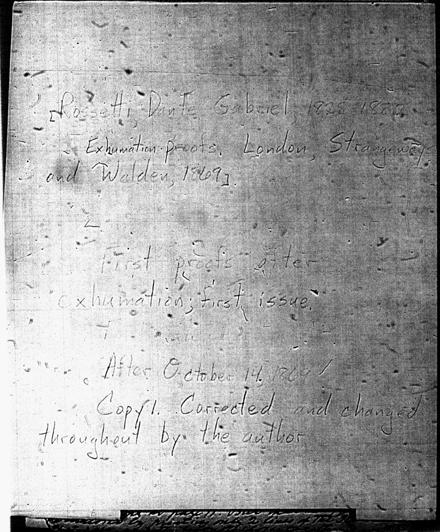
Editorial Description: Notations made on blank page of ms, not in DGR's penmanship.
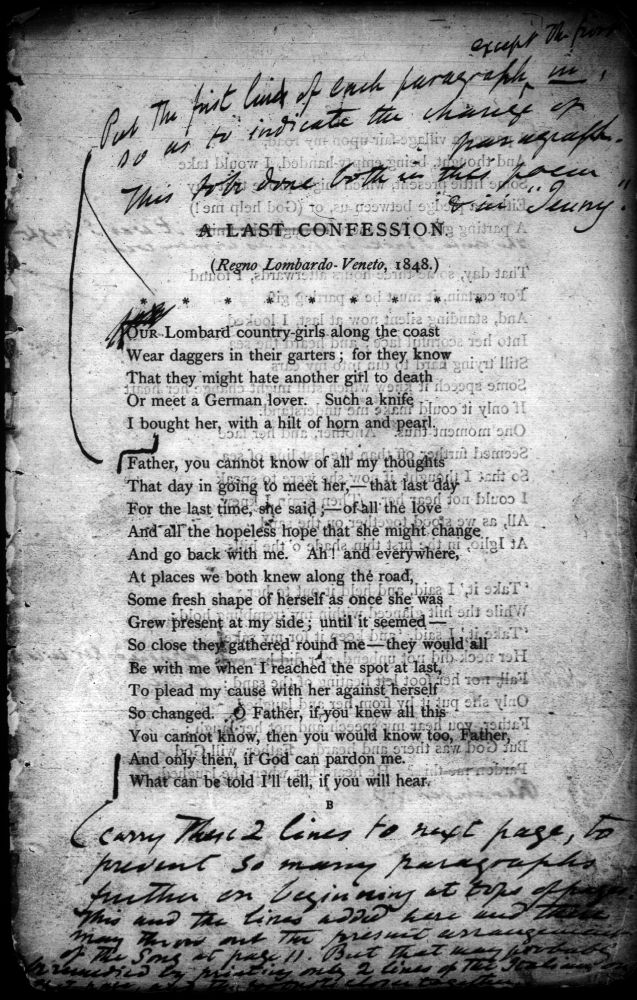
Sig. B

- Our Lombard country-girls along the coast
- Wear daggers in their garters; for they know
- That they might hate another girl to death
- Or meet a German lover. Such a knife
- I bought her, with a hilt of horn and pearl.
Printer's Direction: Put the first line
s of each paragraph
except the first
in,
so as to indicate the change of paragraph. This to be done
both in this piece, & in “Jenny.”
Editorial Description: Notation by DGR linked to line 6.
- Father, you cannot know of all my thoughts
- That day in going to meet her,—that last day
- For the last time, she said;—of all the love
- And all the hopeless hope that she might change
- 10And go back with me. Ah! and everywhere,
- At places we both knew along the road,
- Some fresh shape of herself as once she was
- Grew present at my side; until it seemed—
- So close they gathered round me—they would all
- Be with me when I reached the spot at last,
- To plead my cause with her against herself
- So changed. O Father, if you knew all this
- You cannot know, then you would know too, Father,
- And only then, if God can pardon me.
- 20What can be told I'll tell, if you will hear.
Printer's Direction: Carry these 2 lines to next page, to prevent so many
paragraphs further on beginning at tops of page. This and the lines
added here and there may throw out the
present arrangement of the Song at page 11. But that may probably
be
remedied by printing only 2 lines of the Italian
Transcription Gap: one line (image unclear)
Editorial Description: Notation by DGR attached to lines 19 and 20.
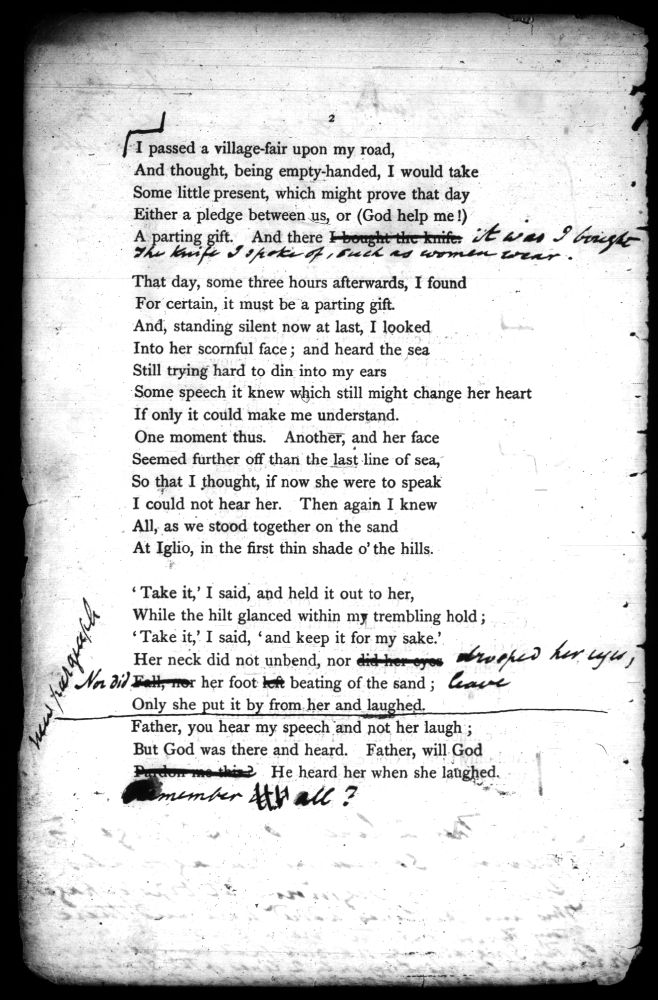
Editorial Description: Paragraph indentation symbol, attached by DGR to line 21.
- I passed a village-fair upon my road,
- And thought, being empty-handed, I would take
- Some little present, which might prove that day
- Either a pledge between us, or (God help me!)
- A parting gift. And there I bought the knife. it was I bought
-
Added TextThe knife I spoke of, such as women wear.
- That day, some three hours afterwards, I found
- For certain, it must be a parting gift.
- And, standing silent now at last, I looked
- 30Into her scornful face; and heard the sea
- Still trying hard to din into my ears
- Some speech it knew which still might change her heart
- If only it could make me understand.
- One moment thus. Another, and her face
- Seemed further off than the last line of sea,
- So that I thought, if now she were to speak
- I could not hear her. Then again I knew
- All, as we stood together on the sand
- At Iglio, in the first thin shade o'the hills.
- 40‘Take it,’ I said, and held it out to her,
- While the hilt glanced within my trembling hold;
- ‘Take it,’I said, ‘and keep it for my sake.’
- Her neck did not unbend, nor did her eyes drooped her eyes
- Fall, nor Nor did her foot left leave beating of the sand;
- Only she put it by from her and laughed.
- Father, you hear my speech and not her laugh;
- But God was there and heard. Father, will God
- Pardon me this? Remember it all? He heard her when she laughed.
Printer's Direction: New paragraph
Editorial Description: Note by DGR with line drawn between lines 45 and 46.
Note: Pages 3-4 missing from extant manuscript.
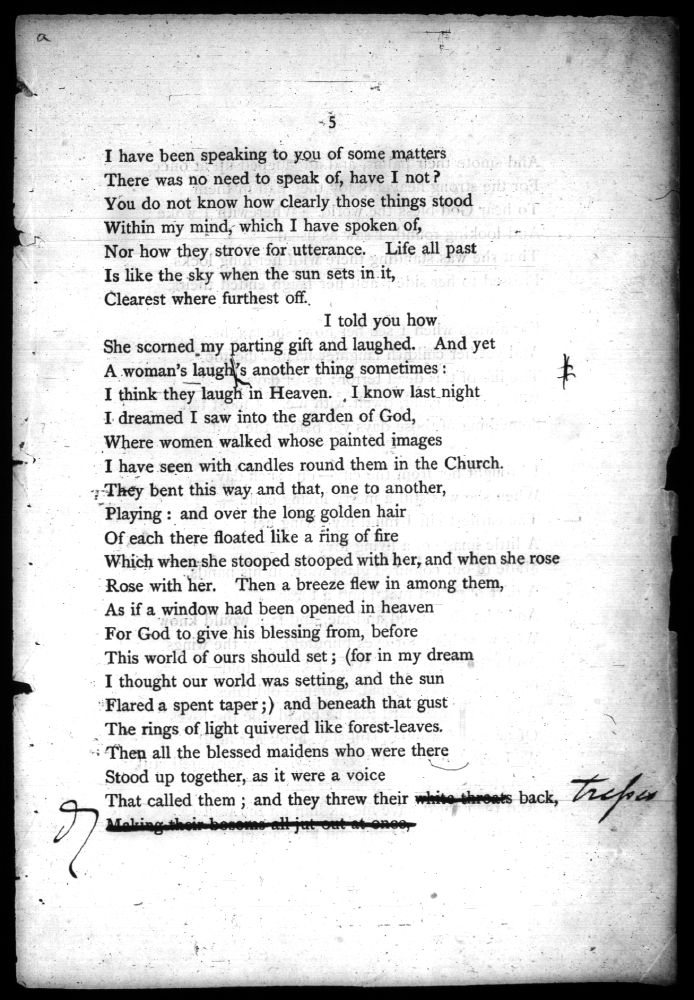
- I have been speaking to you of some matters
- 50There was no need to speak of, have I not?
- You do not know how clearly those things stood
- Within my mind, which I have spoken of,
- Nor how they strove for utterance. Life all past
- Is like the sky when the sun sets in it,
- Clearest where furthest off.
- I told you how
- She scorned my parting gift and laughed. And yet
- A woman's laugh 's another thing sometimes:
- I think they laugh in Heaven. I know last night
- I dreamed I saw into the garden of God,
- 60Where women walked whose painted images
- I have seen with candles round them in the Church.
- They bent this way and that, one to another,
- Playing: and over the long golden hair
- Of each there floated like a ring of fire
- Which when she stooped stooped with her, and when she rose
- Rose with her. Then a breeze flew in among them,
- As if a window had been opened in heaven
- For God to give his blessing from, before
- This world of ours should set; (for in my dream
- 70I thought our world was setting, and the sun
- Flared a spent taper;) and beneath that gust
- The rings of light quivered like forest-leaves.
- Then all the blessed maidens who were there
- Stood up together, as it were a voice
- That called them; and they threw their white throats tresses back,
- Making their bosoms all jut out at once,
- And smote their palms, and all laughed up at once,
- For the strong heavenly joy they had in them
- To hear God bless the world. Wherewith I woke:
- 80And looking round, I saw as usual
- That she was standing there with her long locks
- Pressed to her side; and her laugh ended theirs.
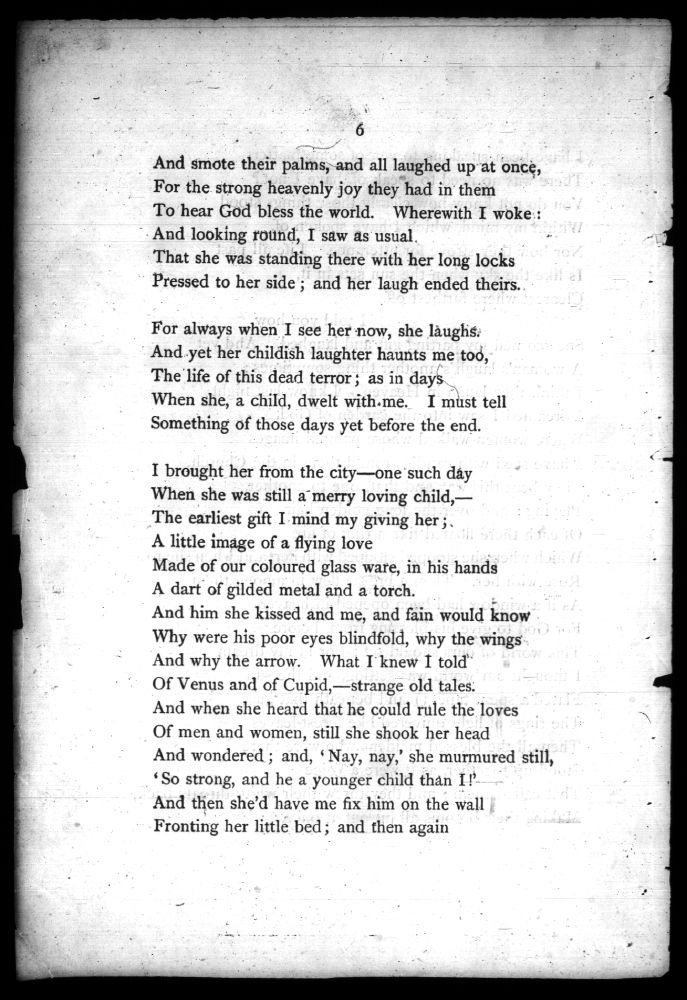
- For always when I see her now, she laughs.
- And yet her childish laughter haunts me too,
- The life of this dead terror; as in days
- When she, a child, dwelt with me. I must tell
- Something of those days yet before the end.
- I brought her from the city—one such day
- When she was still a merry loving child,—
- 90The earliest gift I mind my giving her;
- A little image of a flying love
- Made of our coloured glass ware, in his hands
- A dart of gilded metal and a torch.
- And him she kissed and me, and fain would know
- Why were his poor eyes blindfold, why the wings
- And why the arrow. What I knew I told
- Of Venus and of Cupid,—strange old tales.
- And when she heard that he could rule the loves
- Of men and women, still she shook her head
- 100And wondered; and, ‘Nay, nay,’ she murmured still,
- ‘So strong, and he a younger child than I!’
- And then she'd have me fix him on the wall
- Fronting her little bed; and then again
- She needs must fix him there herself, because
- I gave him to her and she loved him so,
- And he should make her love me better yet,
- If women loved the more, the more they grew.
- But the fit place upon the wall was high
- For her, and so I held her in my arms:
- 110And each time that the heavy pruning -hook
- I gave her for a hammer slipped away
- As it would often, still she laughed and laughed
- And kissed and kissed me. But amid her mirth,
- Just as she hung the image on the nail,
- It slipped and all its fragments strewed the ground:
- And as it fell she screamed, for in her hand
- The dart had entered deeply and drawn blood.
- And so her laughter turned to tears: and ‘Oh!’
- I said, the while I bandaged the small hand,—
- 120‘That I should be the first to make you bleed,
- Who love and love and love you!’—kissing still
- The fingers till I got her safe to bed.
- And still she sobbed,—‘not for the pain at all,’
- She said, ‘but for the Love, the poor good Love
- You gave me.’ So she cried herself to sleep.

Manuscript Addition: ab
Editorial Description: Lower-case letters hand-written in upper-left corner of page. Not in
DGR's penmanship.
- Another later thing comes back to me ,
- 'Twas in those hardest foulest days of all,
- When still from his shut palace, sitting clean
- Above the splash of blood, old M i etternich
- 130(May his soul die, and never-dying worms
- Feast on its pain for ever!) used to thin
- His year's doomed hundreds daintily, each month
- Thirties and fifties. This time, as I think,
- Was when his thrift forbad the poor to take
- That evil brackish salt which the dry rocks
- Keep all through winter when the sea draws in.
- The first I heard of it was a chance shot
- Here and there in the street, and on the stones
- A stumbling clatter as of horse hemmed round.
- 140Then, when she saw me hurry out of doors,
- My gun slung at my shoulder and my knife
- Stuck in my girdle, she smoothed down my hair
- And laughed to see me look so brave, and leaped
- Up to my neck and kissed me. She was still
- A child; and yet that kiss was on my lips
- So hot all day where the smoke shut us in.
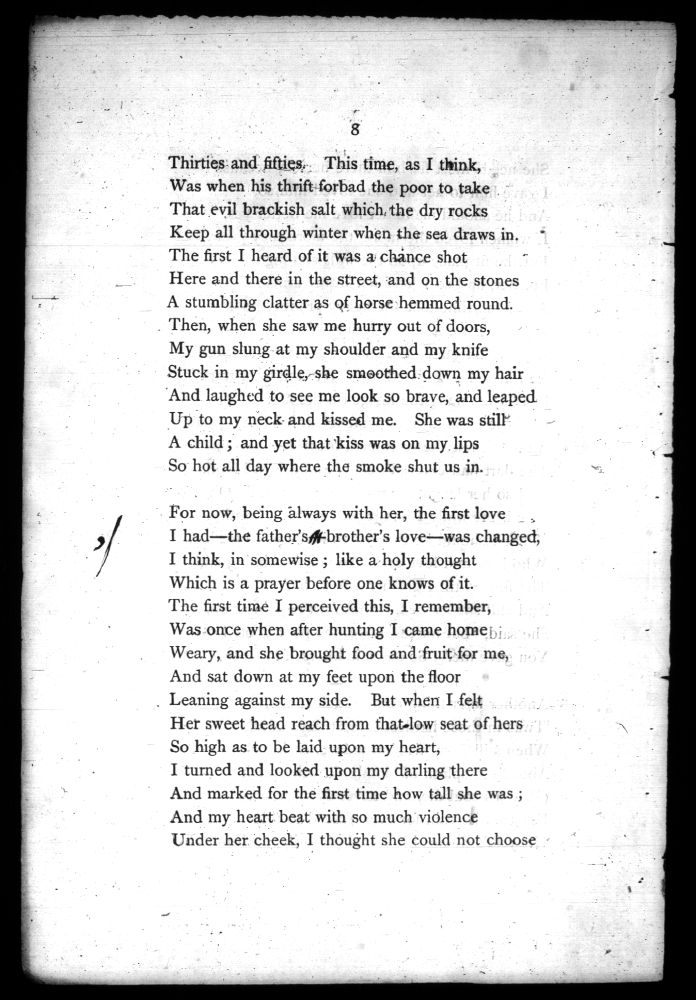
- For now, being always with her, the first love
- I had—the father's brother's — , love—was changed,
- I think, in somewise; like a holy thought
- 150Which is a prayer before one knows of it.
- The first time I perceived this, I remember,
- Was once when after hunting I came home
- Weary, and she brought food and fruit for me,
- And sat down at my feet upon the floor
- Leaning against my side. But when I felt
- Her sweet head reach from that low seat of hers
- So high as to be laid upon my heart,
- I turned and looked upon my darling there
- And marked for the first time how tall she was;
- 160And my heart beat with so much violence
- Under her cheek, I thought she could not choose
- But wonder at it soon and ask me why;
- And so I bade her rise and eat with me.
- And when, remembering all and counting back
- The time s , I made out thirteen years for her
- And told her so, she gazed into my face at me with eyes
-
Added TextAs of the sky and sea on aTranscription Gap: at least one letter (image trunc)grey days
- And bent her body back like a bent bow,
- And drew her long hands through her hair, and asked me
- If she was not a woman; and then laughed:
- 170And as she stooped in laughing, I could see
- Beneath the growing throat the breasts half globed
- Like folded lilies deepest deepset in the stream.
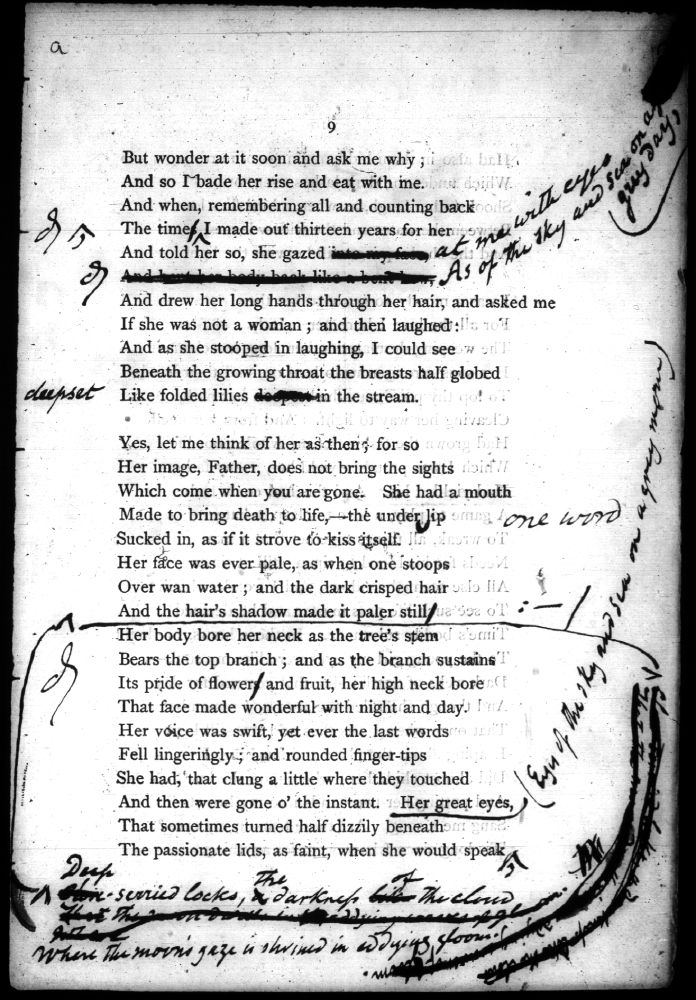
Manuscript Addition: a
Editorial Description: Lower-case letter hand-written in upper left-hand corner of page. Not
in DGR's penmanship.
Printer's Direction: one word
Editorial Description: In right hand margin, next to “under
lip.”
- Yes, let me think of her as then; for so
- Her image, Father, does not bring the sights
- Which come when you are gone. She had a mouth
- Made to bring death to life,—the under lip
- Sucked in, as if it strove to kiss itself.
- Her face was ever pale, as when one stoops
- Over wan water; and the dark crisped hair
- 180And the hair's shadow made it paler still , :—
-
Added Text [?]Deep-serried locks, a the darkness like of the cloud
-
That the moon [?] in eddying waves of gloom.
- Where
-
Added TextWhere the moon's gaze is shrined in eddying gloom.
- Her body bore her neck as the tree's stem
- Bears the top branch; and as the branch sustains
- Its pride of flower s and fruit, her high neck bore
- That face made wonderful with night and day.
- Her voice was swift, yet ever the last words
- Fell lingeringly; and rounded finger-tips
- She had, that clung a little where they touched
- 190And then were gone o' the instant. Her great eyes,
- That sometimes turned half dizzily beneath
- The passionate lids, as faint, when she would speak ,
- Had also in them hidden springs of mirth ,
- Which under the dark lashes evermore
- Shook to her laugh, as when a bird flies low
- Between the water and the willow-leaves,
- And the shade quivers till he wins the light.
Added Text
Transcription Gap: two lines
Editorial Description: Two lines curving around the bottom right corner, which are apparently
intended to follow the existing lines inserted after line 180, have been
stricken through several times.
Manuscript Addition: Eyes of the sky and sea on a grey morn
Editorial Description: Note by DGR in right margin, attached to "Her great
Eyes," line 190.
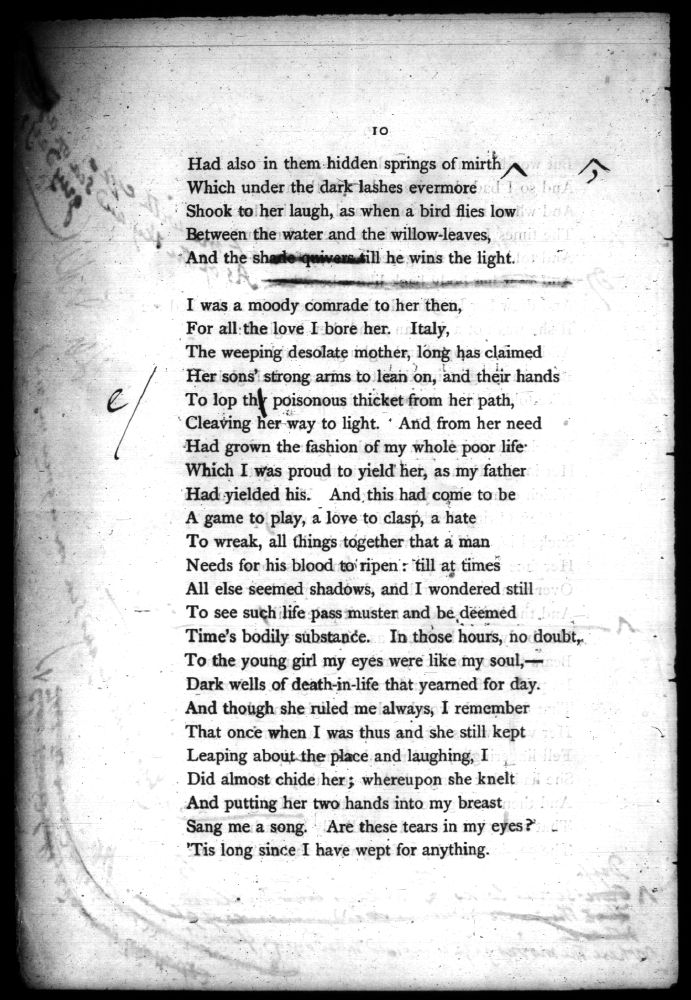
Note: Ink from stricken lines on page 9 has bled through, partially
obscuring line 197.
- I was a moody comrade to her then,
- For all the love I bore her. Italy,
- 200The weeping desolate mother, long has claimed
- Her sons' strong arms to lean on, and their hands
- To lop th y e poisonous thicket from her path,
- Cleaving her way to light. And from her need
- Had grown the fashion of my whole poor life
- Which I was proud to yield her, as my father
- Had yielded his. And this had come to be
- A game to play, a love to clasp, a hate
- To wreak, all things together that a man
- Needs for his blood to ripen: till at times
- 210All else seemed shadows, and I wondered still
- To see such life pass muster and be deemed
- Time's bodily substance. In those hours, no doubt,
- To the young girl my eyes were like my soul,—
- Dark wells of death-in-life that yearned for day.
- And though she ruled me always, I remember
- That once when I was thus and she still kept
- Leaping about the place and laughing, I
- Did almost chide her; whereupon she knelt
- And putting her two hands into my breast
- 220Sang me a song. Are these tears in my eyes?
- 'Tis long since I have wept for anything.
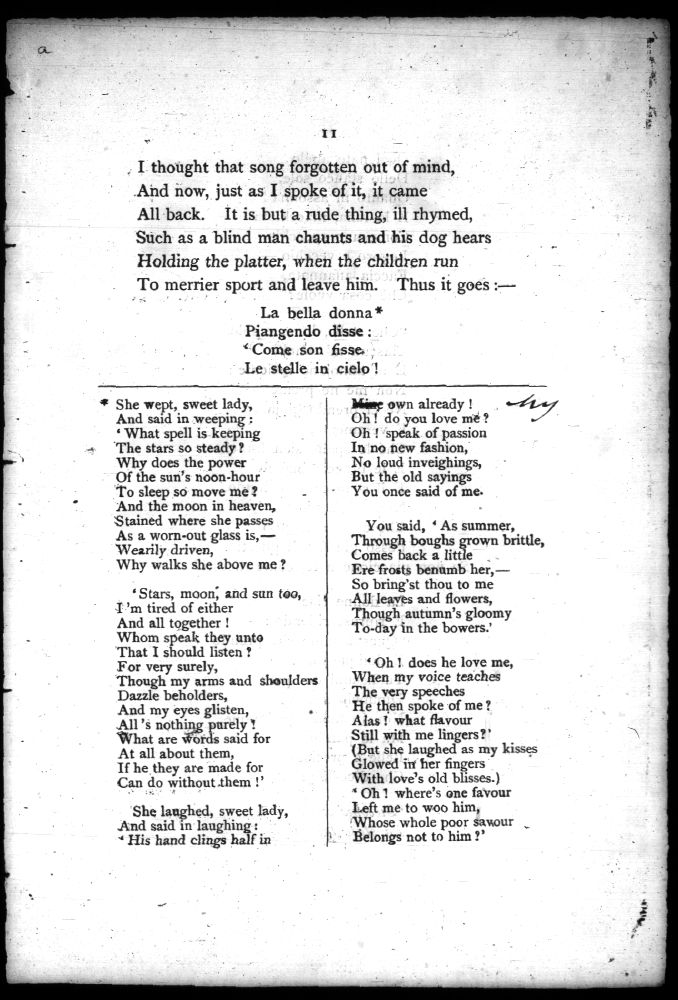
- I thought that song forgotten out of mind,
- And now, just as I spoke of it, it came
- All back. It is but a rude thing, ill rhymed,
- Such as a blind man chaunts and his dog hears
- Holding the platter, when the children run
- To merrier sport and leave him. Thus it goes:—
Manuscript Addition: a
Editorial Description: Lower-case letter hand-written in upper left-hand corner of page. not
in DGR's penmanship
- La bella donna*
- Piangendo disse:
- 230‘Come son fisse
- Le stelle in cielo!
Transcribed Footnote (page 11):
Note: Pagenote formatted in two columns at bottom of page.
- * She wept, sweet lady,
- And said in weeping:
- ‘What spell is keeping
- The stars so steady?
- Why does the power
- Of the sun's noon-hour
- To sleep so move me?
- And the moon in heaven,
- Stained where she passes
- 10 As a worn-out glass is,—
- Wearily driven,
- Why walks she above me?
- ‘Stars, moon, and sun too,
- I'm tired of either
- And all together!
- Whom speak they unto
- That I should listen?
- For very surely,
- Though my arms and shoulders
- 20 Dazzle beholders,
- And my eyes glisten,
- All's nothing purely!
- What are words said for
- At all about them,
- If he they are made for
- Can do without them!’
- She laughed, sweet lady,
- And said in laughing:
- ‘His hand clings half in
- 30 Mine My own already!
- Oh! do you love me?
- Oh! speak of passion
- In no new fashion,
- No loud inveighings,
- But the old sayings
- You once said of me.
- You said, ‘As summer,
- Through boughs grown brittle,
- Comes back a little
- 40 Ere frosts benumb her,—
- So bring'st thou to me
- All leaves and flowers,
- Though autumn's gloomy
- To-day in the bowers.’
- ‘Oh! does he love me,
- When my voice teaches
- The very speeches
- He then spoke of me?
- Alas! what flavour
- 50 Still with me lingers?’
- (But she laughed as my kisses
- Glowed in her fingers
- With love's old blisses.)
- ‘Oh! where's one favour
- Left me to woo him,
- Whose whole poor savour
- Belongs not to him?’
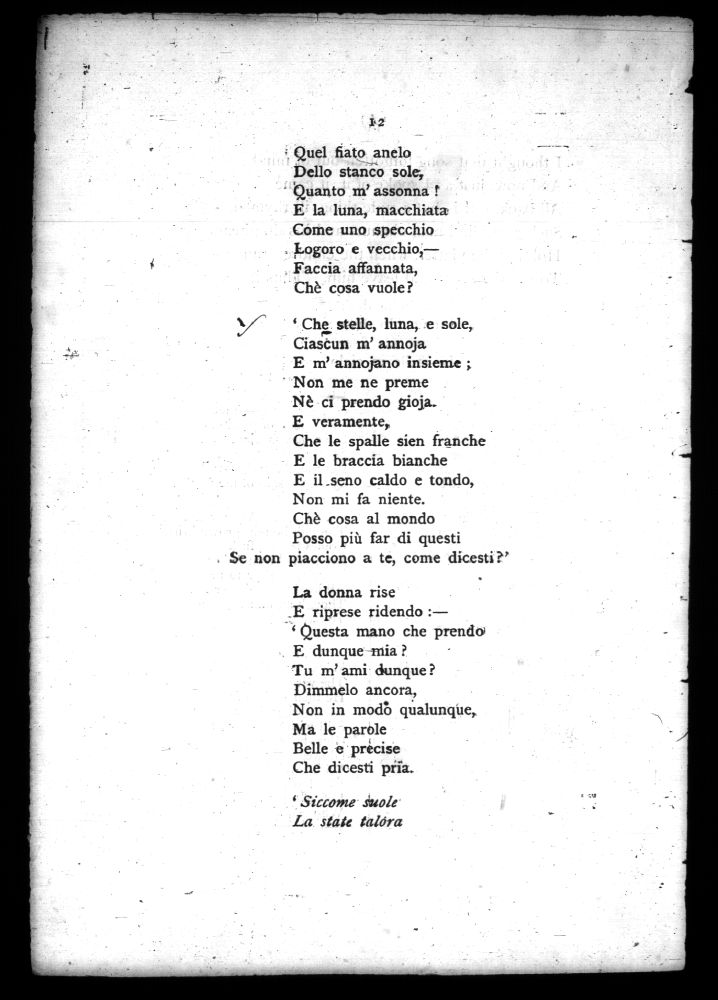
- Quel fiato anelo
- Dello stanco sole,
- Quanto m'assonna!
- E la luna, macchiata
- Come uno specchio
- Logoro e vecchio,—
- Faccia affannata.
- Chè cosa vuole?
- 240‘Ch e è stelle, luna, e sole,
- Ciascun m'annoja
- E m'annojano insieme;
- Non me ne preme
- Nè ci prendo gioja.
- E veramente,
- Che le spalle sien franche
- E le braccia bianche
- E il seno caldo e tondo,
- Non mi fa niente.
- 250Chè cosa al mondo
- Posso più far di questi
- Se non piacciono a te, come dicesti?’
- La donna rise
- E riprese ridendo:—
- ‘Questa mano che prendo
- E dunque mia?
- Tu m'ami dunque?
- Dimmelo ancora,
- Non in modo qualunque,
- 260Ma le parole
- Belle e precise
- Che dicesti pria.
- ‘ Siccome suole
- La state talora
- (Dicesti) un qualche istante
- Tornare innanzi inverno,
- Così ta fai ch'io scerno
- Le foglie tutte quante
- Ben ch'io certo tenessi
- 270 Per passato l'autunno.
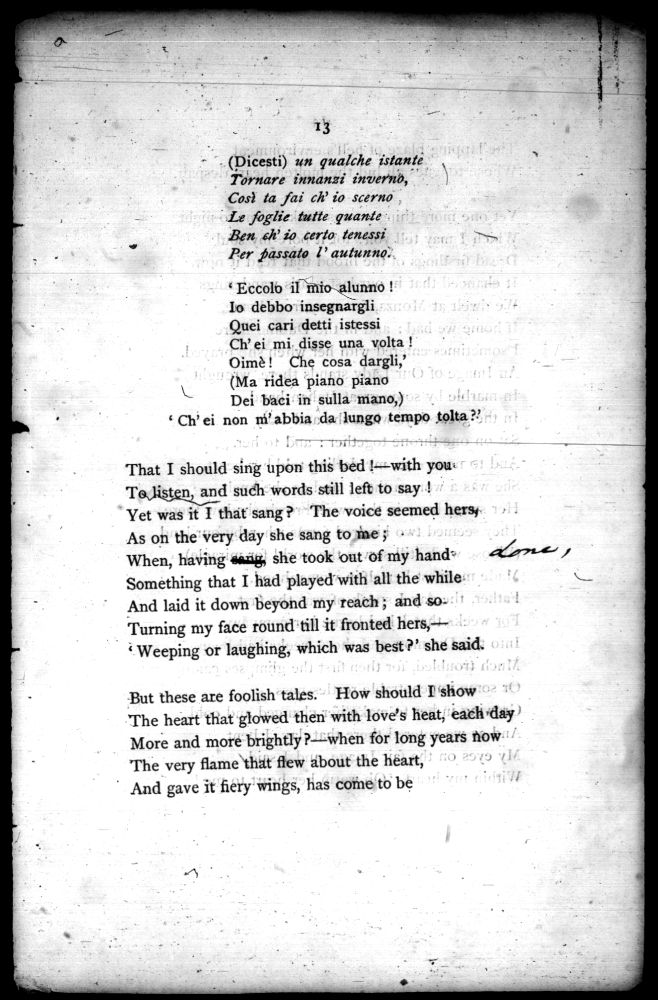
- ‘Eccolo il mio alunno!
- Io debbo insegnargli
- Quei cari detti istessi
- Ch'ei mi disse una volta!
- Oimè! Che cosa dargli,’
- (Ma ridea piano piano
- Dei baci in sulla mano,)
- ‘Ch'ei non m'abbia da lungo tempo tolta?’
- That I should sing upon this bed!—with you
- 280To listen, and such words still left to say!
- Yet was it I that sang? The voice seemed hers,
- As on the very day she sang to me;
- When, having sang, done, she took out of my hand
- Something that I had played with all the while
- And laid it down beyond my reach; and so
- Turning my face round till it fronted hers,—
- ‘Weeping or laughing, which was best?’ she said.
- But these are foolish tales. How should I show
- The heart that glowed then with love's heat, each day
- 290More and more brightly?—when for long years now
- The very flame that flew about the heart,
- And gave it fiery wings, has come to be
- The lapping blaze of hell's environment
- Whose tongues all bid the molten heart despair.
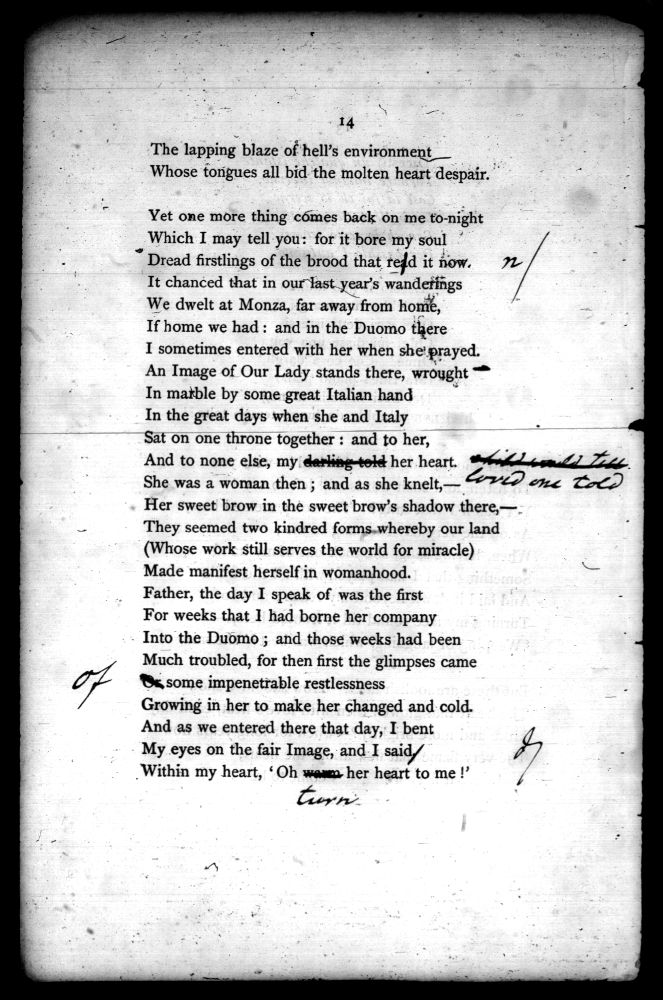
- Yet one more thing comes back on me to-night
- Which I may tell you: for it bore my soul
- Dread firstlings of the brood that re a nd it now.
- It chanced that in our last year's wanderings
- We dwelt at Monza, far away from home,
- 300If home we had: and in the Duomo there
- I sometimes entered with her when she prayed.
- An Image of Our Lady stands there, wrought
- In marble by some great Italian hand
- In the great days when she and Italy
- Sat on one throne together: and to her,
- And to none else, my darling told/child would tell loved one told her heart.
- She was a woman then; and as she knelt,—
- Her sweet brow in the sweet brow's shadow there,—
- They seemed two kindred forms whereby our land
- 310(Whose work still serves the world for miracle)
- Made manifest herself in womanhood.
- Father, the day I speak of was the first
- For weeks that I had borne her company
- Into the Duomo; and those weeks had been
- Much troubled, for then first the glimpses came
- Or Of some impenetrable restlessness
- Growing in her to make her changed and cold.
- And as we entered there that day, I bent
- My eyes on the fair Image, and I said ,
- 320Within my heart, ‘Oh warm turn her heart to me!’
- And so I left her to her prayers, and went
- To gaze upon the pride of Monza's shrine,
- Where in the sacristy the day light still falls
- Upon the Iron Crown of Italy,
- On whose crowned heads the day has closed, nor yet
- Its hale The daybreak gilds another head to crown.
- But coming back, I wondered when I saw
- That the sweet Lady of her prayers now stood
- Alone without her; until further off,
- 330Before some fresh new Madonna newly gaily decked,
- Tinselled and gewgawed, a slight German toy,
- I saw her kneel, still praying. At my step
- She rose, and side by side we left the church.
- I was much moved, and sharply questioned her
- Of her transferred devotion; but she seemed
- Stubborn and heedless; till she lightly laughed
- And said: ‘The old Madonna? Aye indeed,
- ‘She had my old thoughts,—this one has my new.’
- Then silent to the soul I held my way:
- 340And from the fountains of the public place
- Unto the pigeon-haunted pinnacles,
- Bright wings and water winnowed the bright air;
- And stately with her laugh's subsiding smile
- She went, with clear-swayed waist and towering neck
- And hands held light before her; and the face
- Which long had made a day in my life's night
- Was night in day to me; as all men's eyes
- Turned on her beauty, and she seemed to tread
- Beyond my heart to the world made for her.

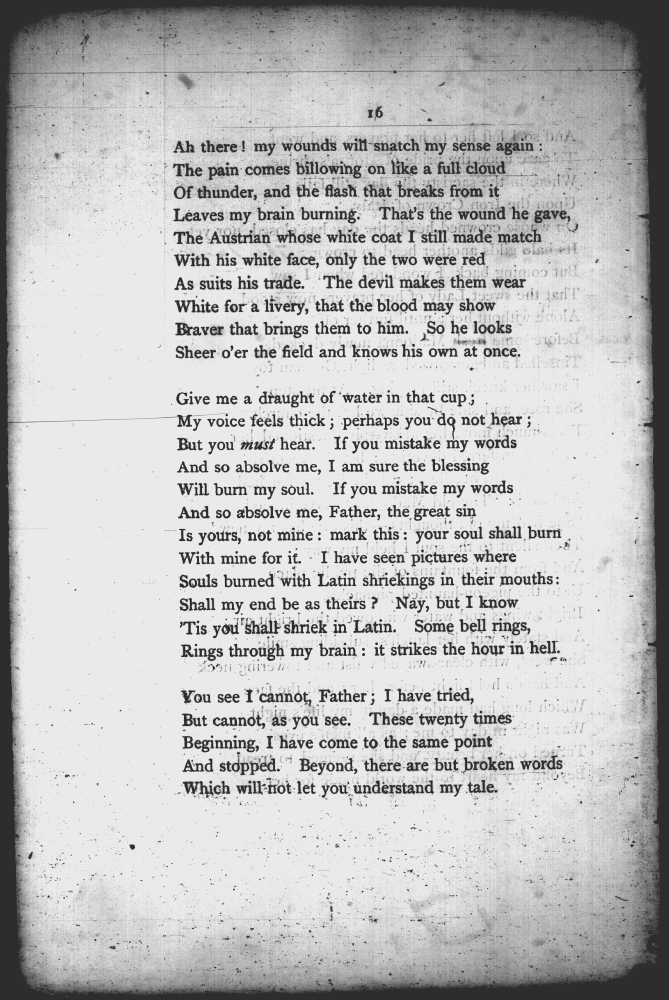
- 350Ah there! my wounds will snatch my sense again:
- The pain comes billowing on like a full cloud
- Of thunder, and the flash that breaks from it
- Leaves my brain burning. That's the wound he gave,
- The Austrian whose white coat I still made match
- With his white face, only the two were red
- As suits his trade. The devil makes them wear
- White for a livery, that the blood may show
- Braver that brings them to him. So he looks
- Sheer o'er the field and knows his own at once.
- 360Give me a draught of water in that cup;
- My voice feels thick; perhaps you do not hear;
- But you must hear. If you mistake my words
- And so absolve me, I am sure the blessing
- Will burn my soul. If you mistake my words
- And so absolve me, Father, the great sin
- Is yours, not mine: mark this: your soul shall burn
- With mine for it. I have seen pictures where
- Souls burned with Latin shriekings in their mouths:
- Shall my end be as theirs? Nay, but I know
- 370'Tis you shall shriek in Latin. Some bell rings,
- Rings through my brain: it strikes the hour in hell.
- You see I cannot, Father; I have tried,
- But cannot, as you see. These twenty times
- Beginning, I have come to the same point
- And stopped. Beyond, there are but broken words
- Which will not let you understand my tale.
- It is that then we have her with us here,
- As when she wrung her hair out in my dream
- To-night, till all the darkness re c eked of it.
- 380Her hair is always wet ; , for she has kept
- Its tresses wrapped about her side for years;
- And when she wrung them round over the floor,
- I heard the blood hiss through her fingers; so
- That I sat straight up in my bed and screamed
- Once and again; and once to once, she laughed.
- Look that you turn not now ; ,—she's at your back:
- Gather your robe up, Father, and keep close,
- Or she'll sit down on it and send you mad.
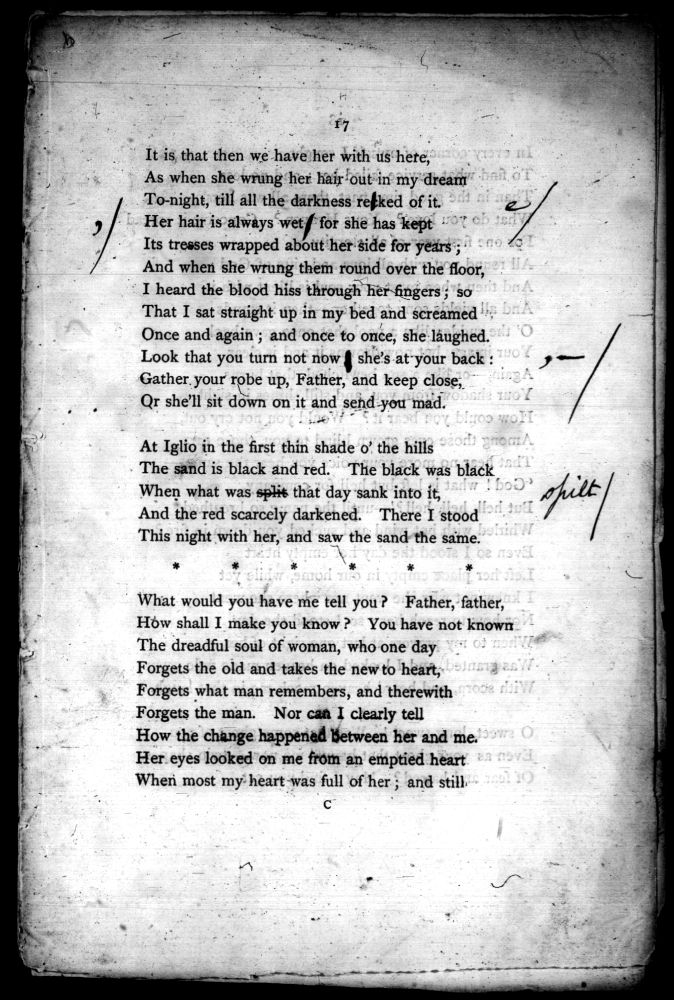
Sig. C
- At Iglio in the first thin shade o' the hills
- 390The sand is black and red. The black was black
- When what was split spilt that day sank into it,
- And the red scarcely darkened. There I stood
- This night with her, and saw the sand the same.
- What would you have me tell you? Father, father,
- How shall I make you know? You have not known
- The dreadful soul of woman, who one day
- Forgets the old and takes the new to heart,
- Forgets what man remembers, and therewith
- Forgets the man. Nor can I clearly tell
- 400How the change happened between her and me.
- Her eyes looked on me from an emptied heart
- When most my heart was full of her; and still
- In every corner of myself I sought
- To find what service failed her; and no less
- Than in the good time past, there all was hers.
- What do you love? Your Heaven? Conceive it spread
- For one first year of all eternity
- All round you with all joys and gifts of God;
- And then when most your soul is blent with it
- 410And all yields song together,—then it stands
- O' the sudden like a pool that once gave back
- Your image, but now drowns it and is clear
- Again,—or like a sun bewitched, that burns
- Your shadow from you, and still shines in sight.
- How could you bear it? Would you not cry out,
- Among those eyes grown blind to you, those ears
- That hear no more your voice you hear the same,—
- ‘God! what is left but hell for company,
- But hell, hell, hell?’—until the name so breathed
- 420Whirled with hot wind and sucked you down in fire?
- Even so I stood the day her empty heart
- Left her place empty in our home, while yet
- I knew not why she went nor where she went
- Nor how to reach her: so I stood the day
- When to my prayers at last one sight of her
- Was granted, and I looked on heaven made pale
- With scorn, and heard heaven mock me in that laugh.
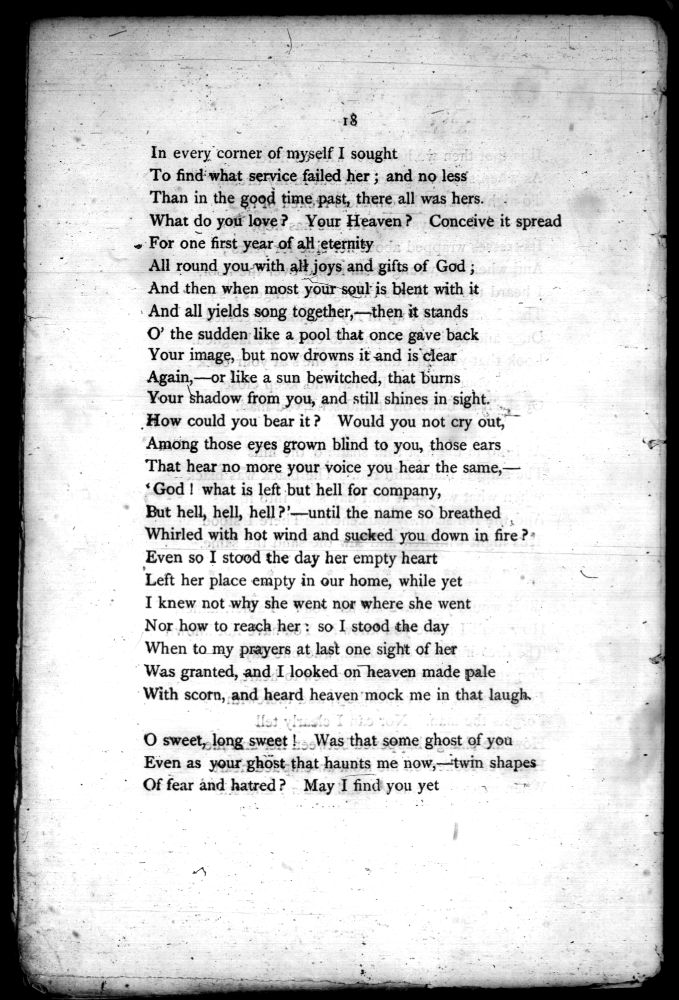
- O sweet, long sweet! Was that some ghost of you
- Even as your ghost that haunts me now,—twin shapes
- 430Of fear and hatred? May I find you yet
- Mine when death wakes? Ah! be it even in flame,
- We may have sweetness yet, if you but say
- As once in childish sorrow: ‘Not my pain,
- My pain was nothing: oh your poor poor love,
- Your broken love! ’
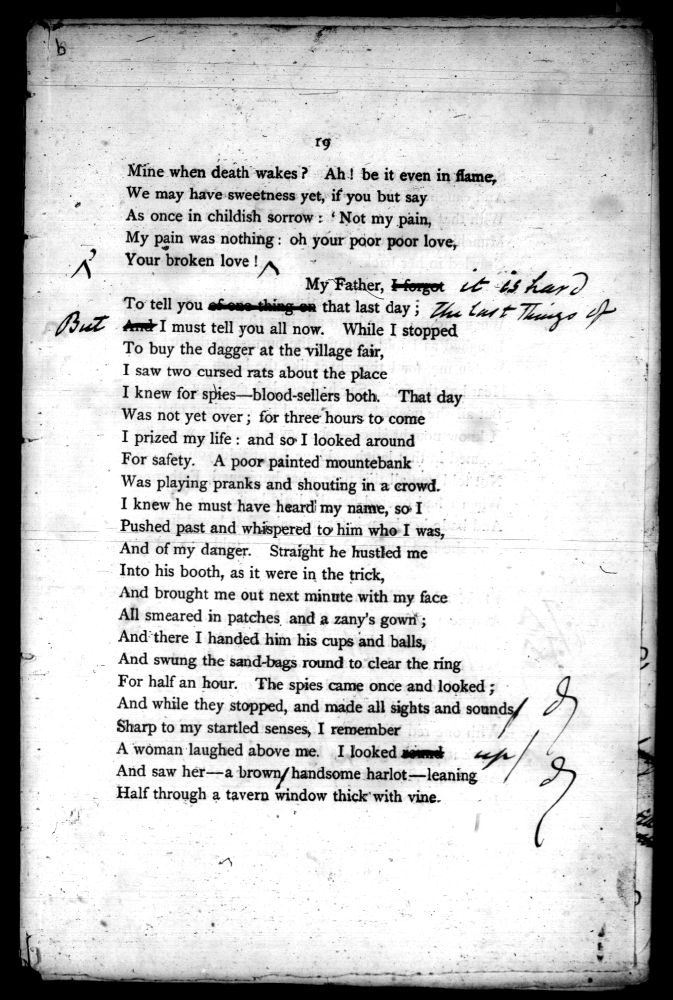
- My Father, I forgot it is hard
- To tell you of one thing on the last things of that last day;
- And But I must tell you all now. While I stopped
- To buy the dagger at the village fair,
- I saw two cursed rats about the place
- 440I knew for spies—blood-sellers both. That day
- Was not yet over; for three hours to come
- I prized my life: and so I looked around
- For safety. A poor painted mountebank
- Was playing pranks and shouting in a crowd.
- I knew he must have heard my name, so I
- Pushed past and whispered to him who I was,
- And of my danger. Straight he hustled me
- Into his booth, as it were in the trick,
- And brought me out next minute with my face
- 450All smeared in patches and a zany's gown;
- And there I handed him his cups and balls,
- And swung the sand-bags round to clear the ring
- For half an hour. The spies came once and looked;
- And while they stopped, and made all sights and sounds ,
- Sharp to my startled senses, I remember
- A woman laughed above me. I looked around up
- And saw her—a brown , handsome harlot—leaning
- Half through a tavern window thick with vine.
- Some man had come behind her in the room ,
- 460And caught her by her arms, and she had turned
- With that coarse empty laugh. I saw him there
- Munching her neck with kisses, while the vine
- Crawled in her back.

- And three hours afterwards,
- When she that I had run all risks to meet
- Laughed as I told you, my life burned to death
- Within me, for I thought it like the laugh
- Heard at the fair. She had not left me long;
- But all she might have changed to, or might change to,
- 470(I know nought since—she never speaks a word—)
- Seemed in that laugh. Have I not told you yet,
- Not told you all this time what happened, Father,
- When I had offered her the little knife,
- And bade her keep it for my sake that loved her,
- And she had laughed? Have I not told you yet?
Deleted Text
- ‘Take it,’ I said to her the second time,
- And keep it for my sake ; .’ a And in her heart
- I plunged the blade , . a And with her blood my hand
- Was burnt; and like some wine of hell, her blood
- 480Rushed to my brain , ; and as in fire my soul
- Swam in it , ; and it filled the sun and sea
- With one red blindness. So she took the knife, —
- Took it, not laughing , as I bade her then,—
- And fell, and her stiff boddice scooped the sand
- Into her bosom.
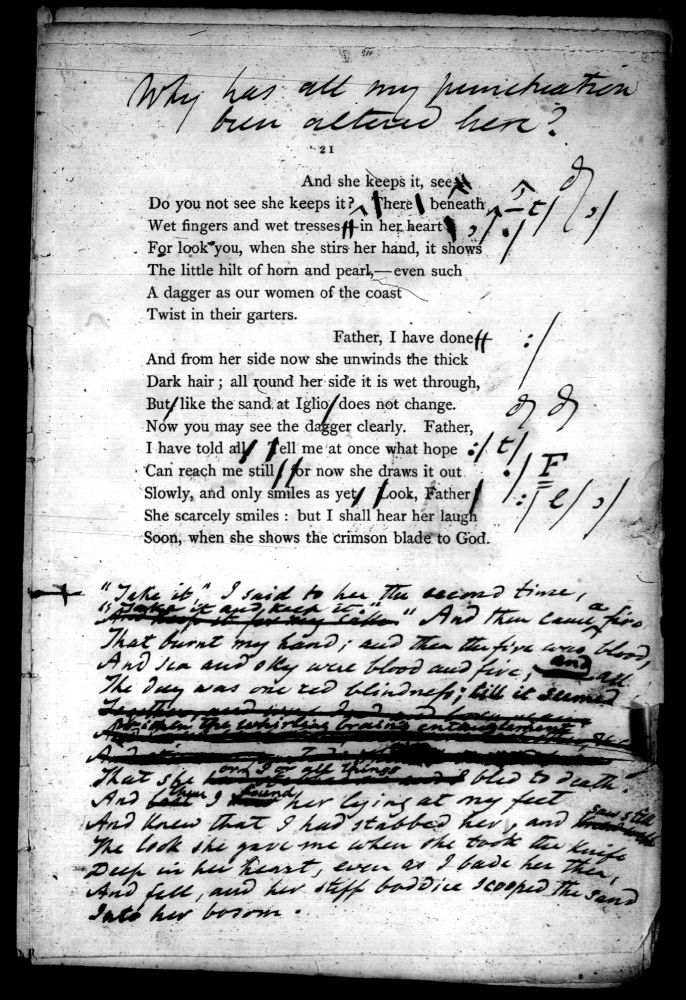
Note: Last stanza on page 20 entirely stricken by DGR. Replaced with first
stanza on page 21.
Printer's Direction: Why has all my punctuation been altered here?
Editorial Description: Note by DGR at top of page.
Added Text
- “Take it,” I said to her the second time,
- “And keep it for my sake.” “Take it and keep it.” And then came a fire
- That burnt my hand; and then the fire was blood,
- And sea and sky were blood and fire,
Transcription Gap: one word (image unclear)and all
- 490The day was one red blindness; till it seemed
-
Transcription Gap: one line (image unclear)
AndTranscription Gap: remainder of line (image unclear)
Added TextWithin the whirling brain's entanglementAndTranscription Gap: remainder of line (image unclear)
- That she
h
Transcription Gap: two letters (image unclear)d into the dTranscription Gap: two words (image unclear)and I or I or all things bled to death.
- And
last
then I
Transcription Gap: one word (image unclear)found her lying at my feet
- And knew that I had stabbed her, and knew well saw still
- The look she gave me when she took the knife
- Deep in her heart, even as I bade her then,
- And fell, and her stiff boddice scooped the sand
- Into her bosom.
- And she keeps it, see — ,
- Do you not see she keeps it? T —there beneath , ,
- 500Wet fingers and wet tresses — , in her heart ! .
- For look you, when she stirs her hand, it shows
- The little hilt of horn and pearl,—even such
- A dagger as our women of the coast
- Twist in their garters.
- Father, I have done — :
- And from her side now she unwinds the thick
- Dark hair; all round her side it is wet through,
- But , like the sand at Iglio , does not change.
- Now you may see the dagger clearly. Father,
- I have told all . T : tell me at once what hope
- 510Can reach me still ; f . For now she draws it out
- Slowly, and only smiles as yet . L : look, Father : ,
- She scarcely smiles: but I shall hear her laugh
- Soon, when she shows the crimson blade to God.
![Image of page [22]](http://www.rossettiarchive.org/img/1-1870.exhum1a.20.jpg)
Note: blank page
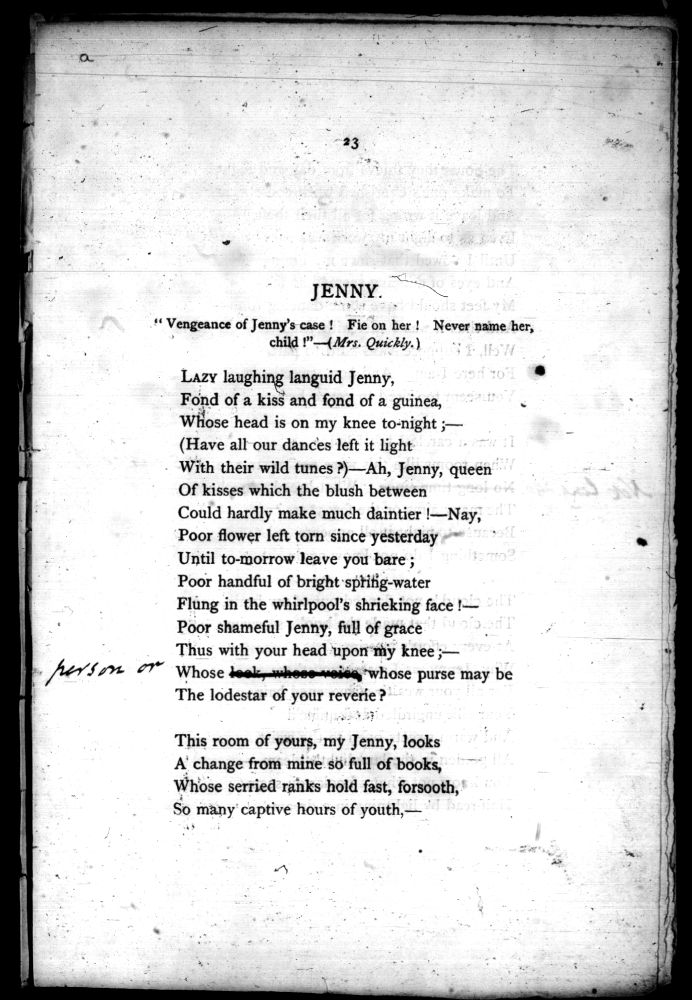
Manuscript Addition: a
Editorial Description: Lower-case letter hand-written in upper left-hand corner of page. Not in DGR's
penmanship
“Vengeance of Jenny's case! Fie on her! Never name
her,
child!”—(
Mrs.
Quickly
.)
- Lazy laughing languid Jenny,
- Fond of a kiss and fond of a guinea,
- Whose head is on my knee to-night;—
- (Have all our dances left it light
- With their wild tunes?)—Ah, Jenny, queen
- Of kisses which the blush between
- Could hardly make much daintier!— Nay,
- Poor flower left torn since yesterday
- Until to-morrow leave you bare;
- 10Poor handful of bright spring-water
- Flung in the whirlpool's shrieking face!—
- Poor shameful Jenny, full of grace
- Thus with your head upon my knee;—
- Whose look, whose voice, person or whose purse may be
- The lodestar of your reverie?
- This room of yours, my Jenny, looks
- A change from mine so full of books,
- Whose serried ranks hold fast, forsooth,
- So many captive hours of youth,—
- 20The hours they thieve from day and night
- To make one's cherished work come right,
- And leave it wrong for all their theft,
- Even as to-night my work was left:
- Until I vowed that since my brain
- And eyes of dancing seemed so fain,
- My feet should have some dancing too:—
- And thus it was I met with you.
- Well, I suppose 'twas hard to part,
- For here I am. And now, sweetheart,
- 30You seem too tired to get to bed.
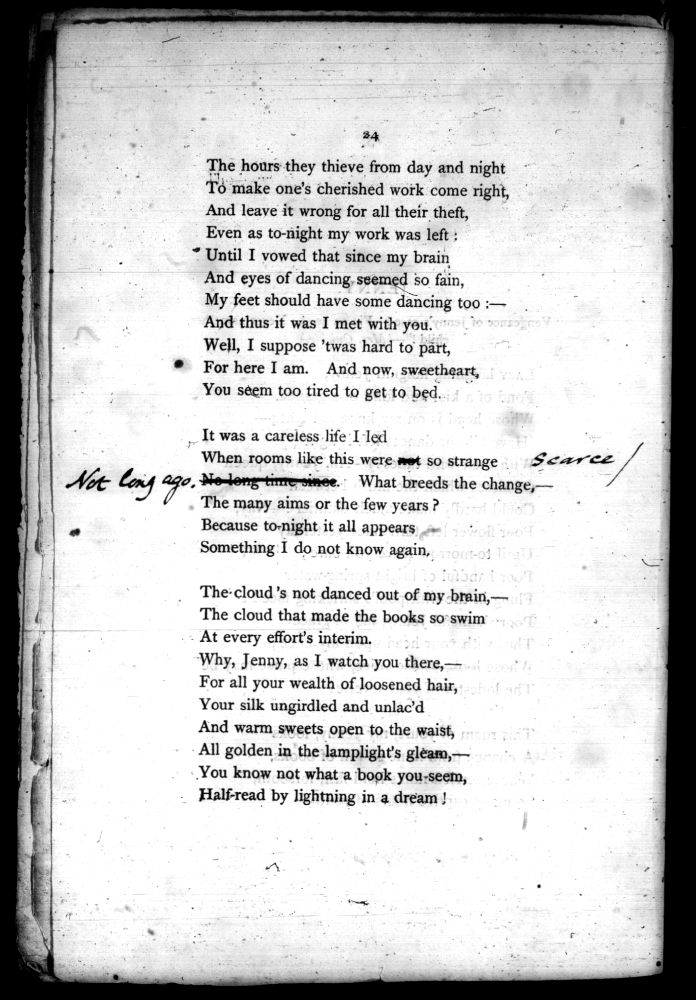
- It was a careless life I led
- When rooms like this were not scarce so strange
- No long time since. Not long ago. What breeds the change,—
- The many aims or the few years?
- Because to-night it all appears
- Something I do not know again.
- The cloud's not danced out of my brain,—
- The cloud that made the books so swim
- At every effort's interim
- 40Why, Jenny, as I watch you there,—
- For all your wealth of loosened hair,
- Your silk ungirdled and unlac'd
- And warm sweets open to the waist,
- All golden in the lamplight's gleam,—
- You know not what a book you seem,
- Half-read by lightning in a dream!
- How should you know, my Jenny? Nay,
- And I should be ashamed to say:—
- Poor beauty, so well worth a kiss!
- 50But while my thought runs on like this
- With wasteful whims more than enough,
- I wonder what you're thinking of.
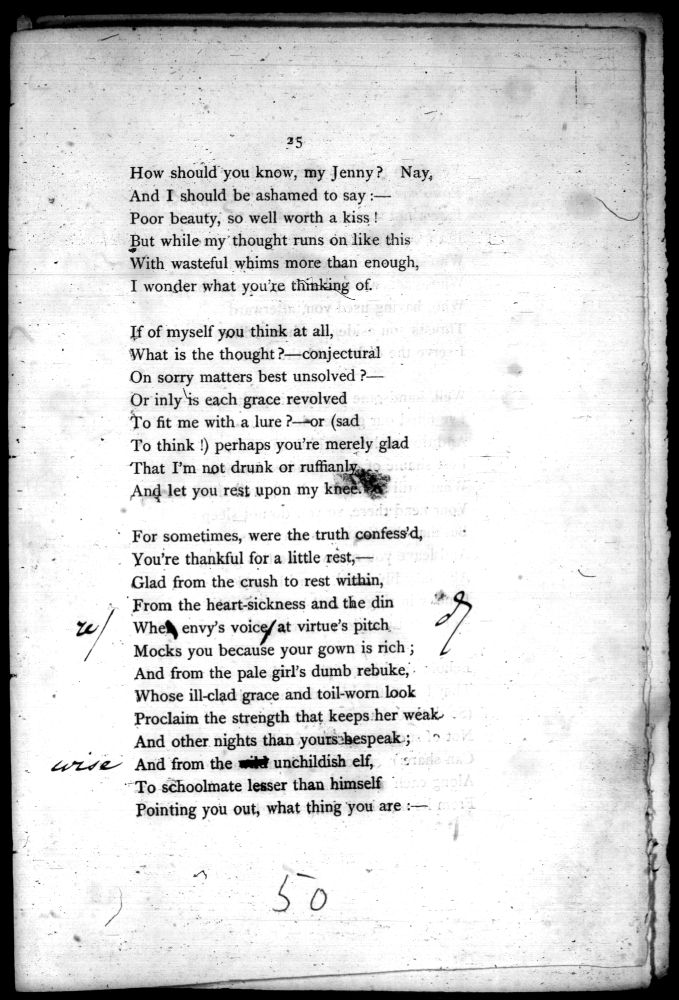
Manuscript Addition: 50
Editorial Description: Number hand-written in bottom center of page. Not in DGR's
penmanship
- If of myself you think at all,
- What is the thought?—conjectural
- On sorry matters best unsolved?—
- Or inly is each grace revolved
- To fit me with a lure?—or (sad
- To think!) perhaps you're merely glad
- That I'm not drunk or ruffianly
- 60And let you rest upon my knee.
- For sometimes, were the truth confess'd,
- You're thankful for a little rest,—
- Glad from the crush to rest within,
- From the heart-sickness and the din
- Whe n re envy's voice , at virtue's pitch
- Mocks you because your gown is rich;
- And from the pale girl's dumb rebuke,
- Whose ill-clad grace and toil-worn look
- Proclaim the strength that keeps her weak
- 70And other nights than yours bespeak;
- And from the wild wise unchildish elf,
- To schoolmate lesser than himself
- Pointing you out, what thing you are:—
- Yes, from the daily jeer and jar,
- From shame and shame's outbraving too,
- Is rest not sometimes sweet to you?—
- But most from the hatefulness of man
- Who spares not to end what he began,
- Whose acts are foul and his speech hard,
- 80Who, having used you, afterward
- Thrusts you aside, as when I dine
- I serve the dishes and the wine.
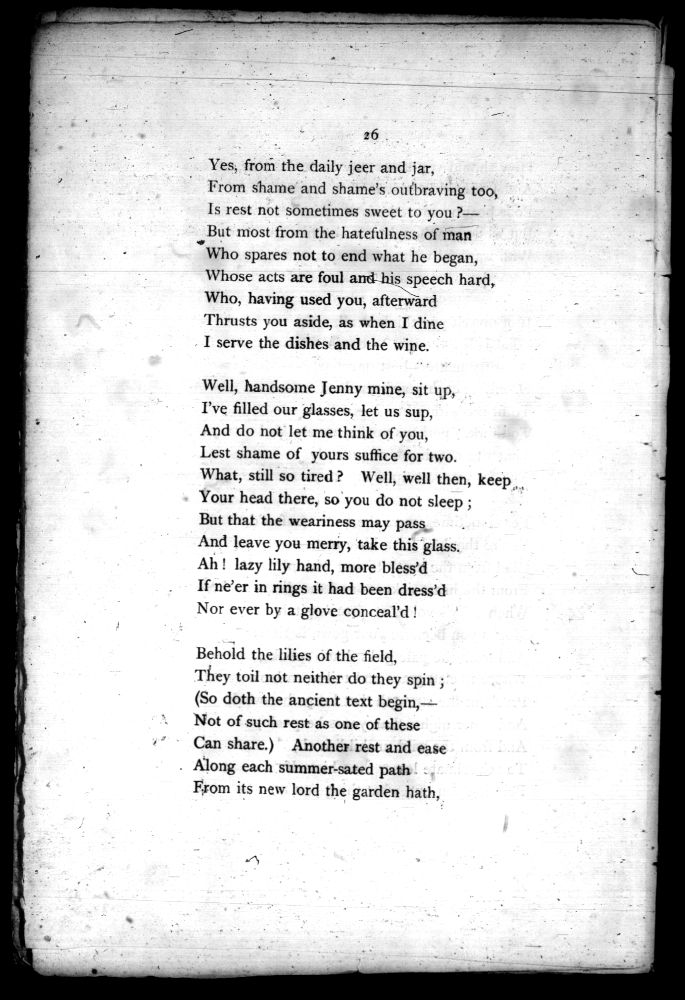
- Well, handsome Jenny mine, sit up,
- I've filled our glasses, let us sup,
- And do not let me think of you,
- Lest shame of yours suffice for two.
- What, still so tired? Well, well then, keep
- Your head there, so you do not sleep;
- But that the weariness may pass
- 90And leave you merry, take this glass.
- Ah! lazy lily hand, more bless'd
- If ne'er in rings it had been dress'd
- Nor ever by a glove conceal'd!
- Behold the lilies of the field,
- They toil not neither do they spin;
- (So doth the ancient text begin,—
- Not of such rest as one of these
- Can share.) Another rest and ease
- Along each summer-sated path
- 100From its new lord the garden hath,
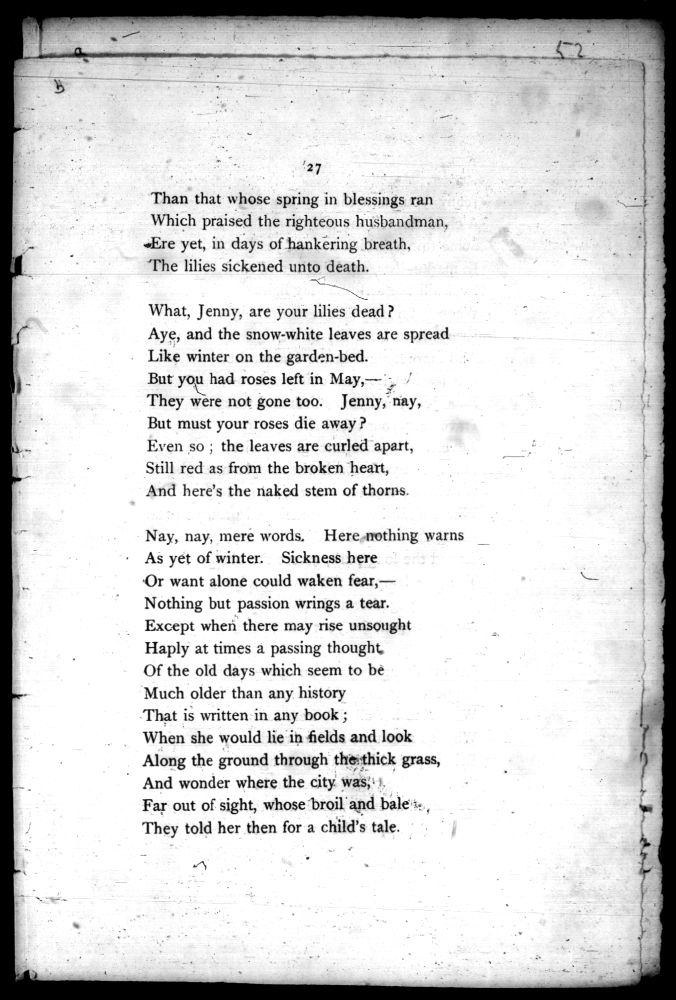
- Than that whose spring in blessings ran
- Which praised the righteous husbandman,
- Ere yet, in days of hankering breath,
- The lilies sickened unto death.
Manuscript Addition: b
Editorial Description: Lower-case letter hand-written in upper left-hand corner of page. Not
in DGR's penmanship
- What, Jenny, are your lilies dead?
- Aye, and the snow-white leaves are spread
- Like winter on the garden-bed.
- But you had roses left in May,—
- They were not gone too. Jenny, nay,
- 110But must your roses die away?
- Even so; the leaves are curled apart,
- Still red as from the broken heart,
- And here's the naked stem of thorns.
- Nay, nay, mere words. Here nothing warns
- As yet of winter. Sickness here
- Or want alone could waken fear,—
- Nothing but passion wrings a tear.
- Except when there may rise unsought
- Haply at times a passing thought
- 120Of the old days which seem to be
- Much older than any history
- That is written in any book;
- When she would lie in fields and look
- Along the ground through the thick grass,
- And wonder where the city was,
- Far out of sight, whose broil and bale
- They told her then for a child's tale.
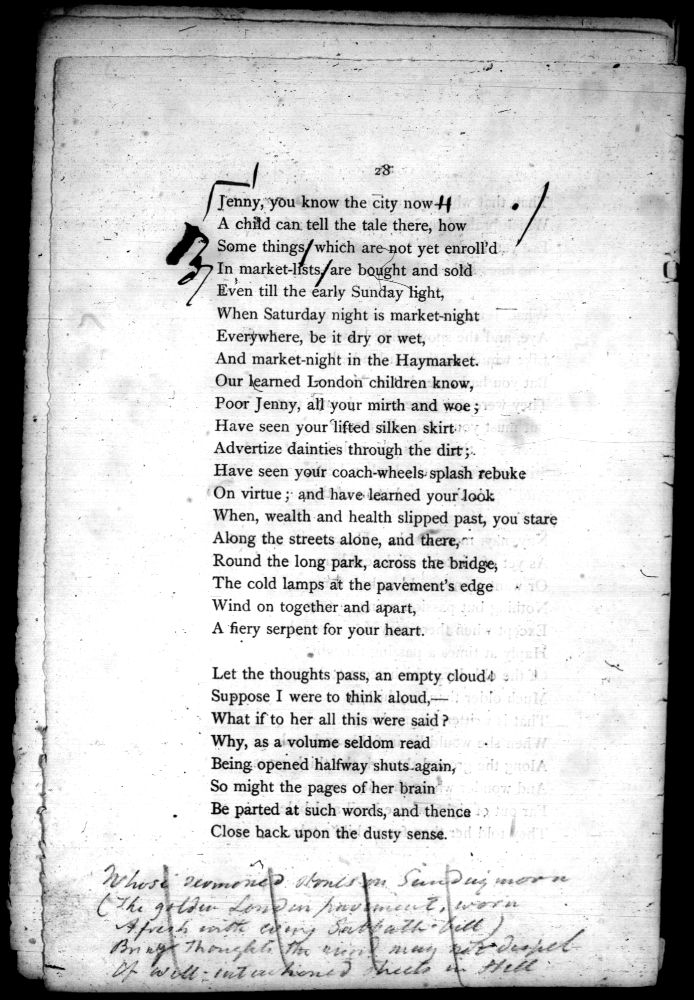
Editorial Description: Paragraph indentation symbol, attached by DGR to line 128.
- Jenny, you know the city now — .
- A child can tell the tale there, how
- 130Some things , which are not yet enroll'd
- In market-lists , are bought and sold
- Even till the early Sunday light,
- When Saturday night is market-night
- Everywhere, be it dry or wet,
- And market-night in the Haymarket.
- Our learned London children know,
- Poor Jenny, all your mirth and woe;
- Have seen your lifted silken skirt
- Advertize dainties through the dirt;
- 140Have seen your coach-wheels splash rebuke
- On virtue; and have learned your look
- When, wealth and health slipped past, you stare
- Along the streets alone, and there,
- Round the long park, across the bridge,
- The cold lamps at the pavement's edge
- Wind on together and apart,
- A fiery serpent for your heart.
Added Text
- Whose sermoned stones on Sunday morn
- (The golden London pavement, worn
- Afresh with every Sabbath-bell
- Bring thoughts the wind may not dispel
- Of well-intentioned streets in Hell
Note: New five line stanza composed and deleted by DGR at bottom of page.
- Let the thoughts pass, an empty cloud!
- Suppose I were to think aloud,—
- 150What if to her all this were said?
- Why, as a volume seldom read
- Being opened halfway shuts again,
- So might the pages of her brain
- Be parted at such words, and thence
- Close back upon the dusty sense.
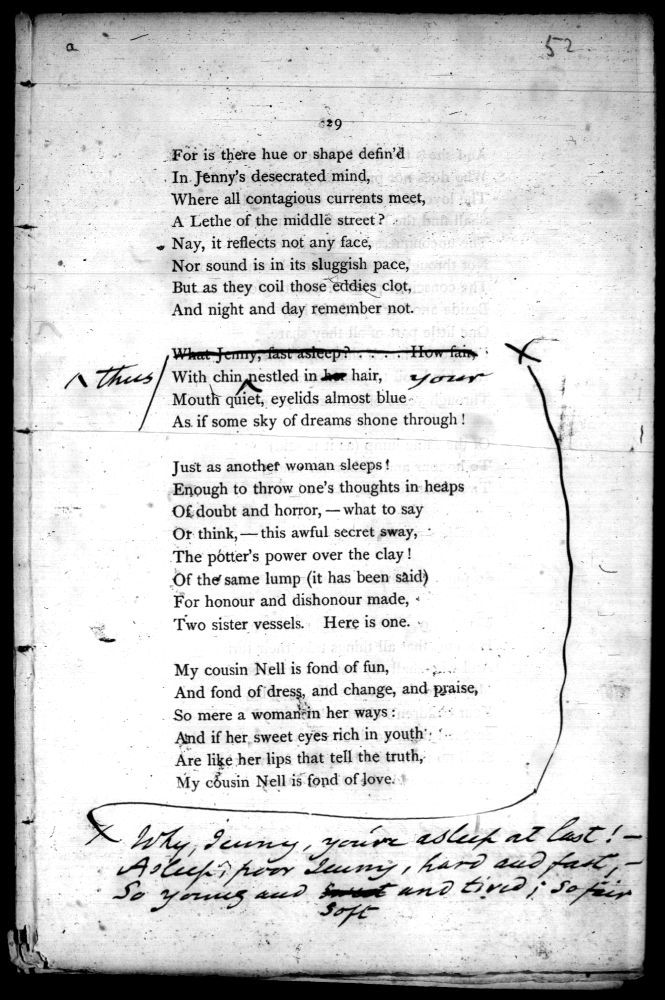
- For is there hue or shape defin'd
- In Jenny's desecrated mind,
- Where all contagious currents meet,
- A Lethe of the middle street?
- 160Nay, it reflects not any face,
- Nor sound is in its sluggish pace,
- But as they coil those eddies clot,
- And night and day remember not.
Manuscript Addition: 52
Editorial Description: Number hand-written in upper right-hand corner of page. Not in DGR's
penmanship
Manuscript Addition: a
Editorial Description: Lower-case letter hand-written in upper left-hand corner of page. Not
in DGR's penmanship
-
What Jenny, fast asleep? . . . . How fair,
Added TextWhy, Jenny, you're asleep at last!
-
Added TextAsleep, poor Jenny, hard and fast,
-
Added TextSo young and sweet soft and tired; so fair
- With chin thus nestled in her your hair,
- Mouth quiet, eyelids almost blue
- As if some sky of dreams shone through!
- 170Just as another woman sleeps!
- Enough to throw one's thoughts in heaps
- Of doubt and horror,—what to say
- Or think,—this awful secret sway,
- The potter's power over the clay!
- Of the same lump (it has been said)
- For honour and dishonour made,
- Two sister vessels. Here is one.
- My cousin Nell is fond of fun,
- And fond of dress, and change, and praise,
- 180So mere a woman in her ways:
- And if her sweet eyes rich in youth
- Are like her lips that tell the truth,
- My cousin Nell is fond of love.
- And she's the girl I'm proudest of.
- Who does not prize her, guard her well?
- The love of change, in cousin Nell,
- Shall find the best and hold it dear:
- The unconquered mirth turn quieter
- Not through her own, through others' woe:
- 190The conscious pride of beauty glow
- Beside another's pride in her,
- One little part of all they share.
- For Love himself shall ripen these
- In a kind soil to just increase
- Through years of fertilizing peace.
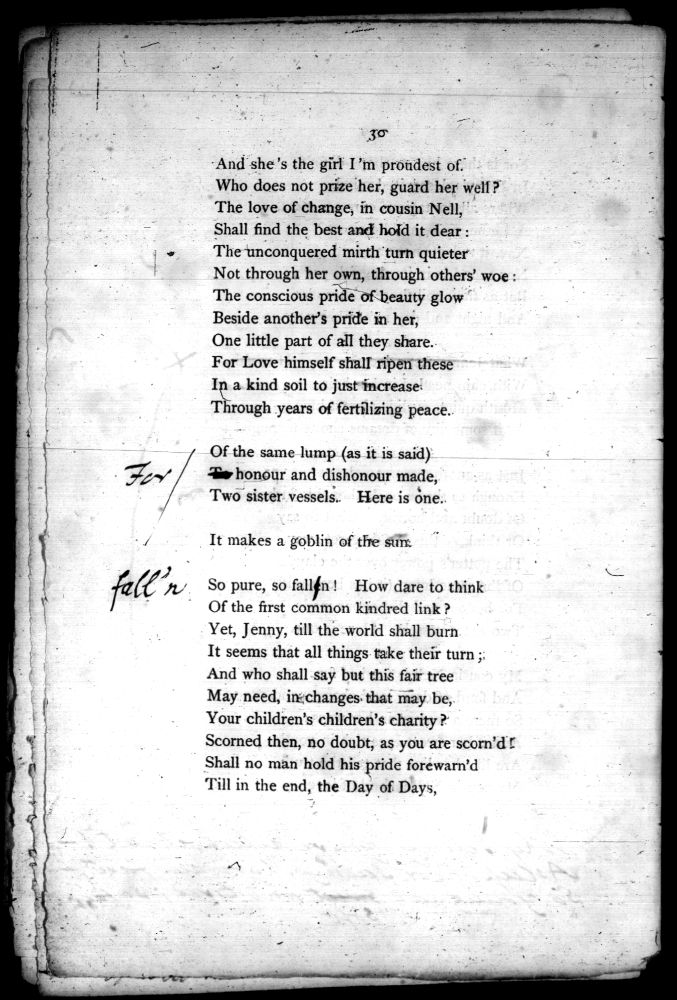
- Of the same lump (as it is said)
- To For honour and dishonour made,
- Two sister vessels. Here is one.
- It makes a goblin of the sun.
- 200So pure, so fallen fall'n! How dare to think
- Of the first common kindred link?
- Yet, Jenny, till the world shall burn
- It seems that all things take their turn;
- And who shall say but this fair tree
- May need, in changes that may be,
- Your children's children's charity?
- Scorned then, no doubt, as you are scorn'd!
- Shall no man hold his pride forewarn'd
- Till in the end, the Day of Days,
- 210At Judgment, one of his own race,
- As frail and lost as you, shall rise,
- His daughter, with his mother's eyes?
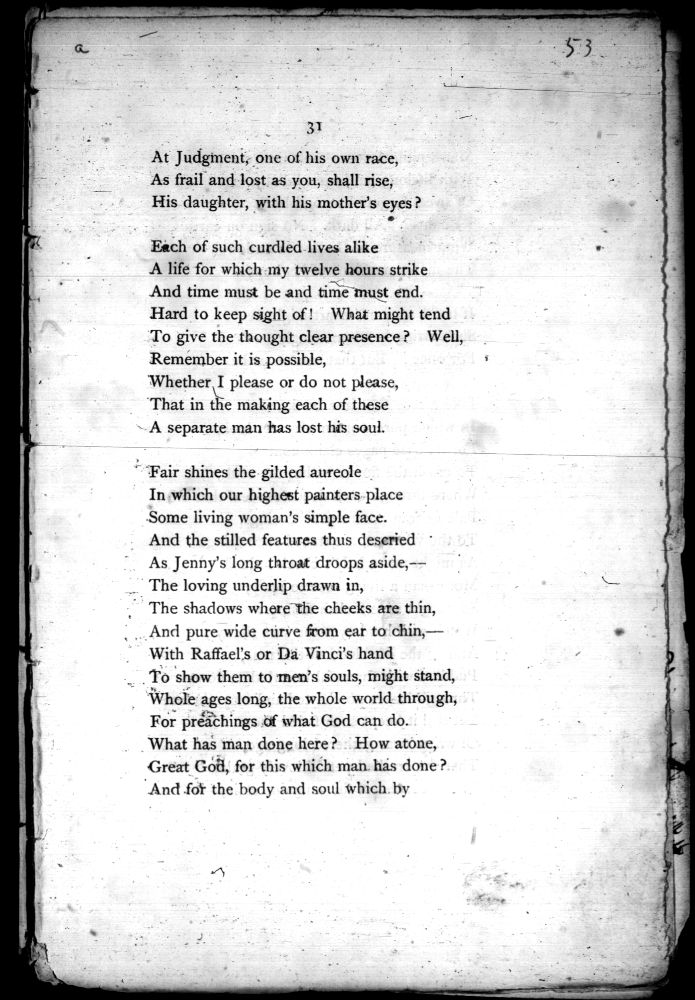
- Each of such curdled lives alike
- A life for which my twelve hours strike
- And time must be and time must end.
- Hard to keep sight of! What might tend
- To give the thought clear presence? Well,
- Remember it is possible,
- Whether I please or do not please,
- 220That in the making each of these
- A separate man has lost his soul.
- Fair shines the gilded aureole
- In which our highest painters place
- Some living woman's simple face.
- And the stilled features thus descried
- As Jenny's long throat droops aside,—
- The loving underlip drawn in,
- The shadows where the cheeks are thin,
- And pure wide curve from ear to chin,—
- 230With Raffael's or Da Vinci's hand
- To show them to men's souls, might stand,
- Whole ages long, the whole world through,
- For preachings of what God can do.
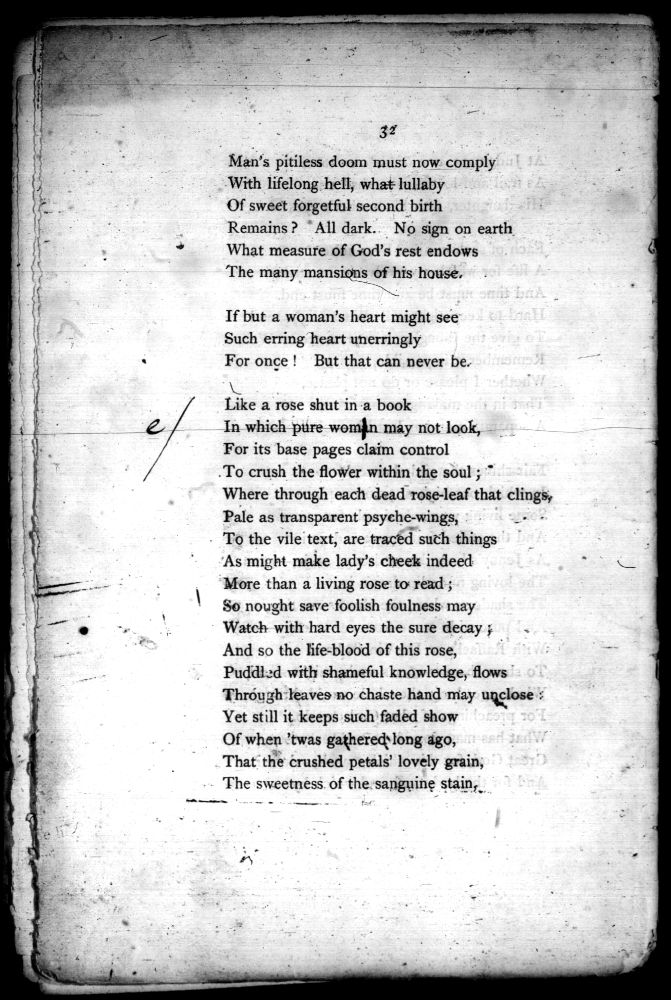
- What has man done here? How atone,
- Great God, for this which man has done?
- And for the body and soul which by
- Man's pitiless doom must now comply
- With lifelong hell, what lullaby
- Of sweet forgetful second birth
- 240Remains? All dark. No sign on earth
- What measure of God's rest endows
- The many mansions of his house.
- If but a woman's heart might see
- Such erring heart unerringly
- For once! But that can never be.
- Like a rose shut in a book
- In which pure wom a en may not look,
- For its base pages claim control
- To crush the flower within the soul;
- 250Where through each dead rose-leaf that clings,
- Pale as transparent psyche-wings,
- To the vile text, are traced such things
- As might make lady's cheek indeed
- More than a living rose to read;
- So nought save foolish foulness may
- Watch with hard eyes the sure decay;
- And so the life-blood of this rose,
- Puddled with shameful knowledge, flows
- Through leaves no chaste hand may unclose:
- 260Yet still it keeps such faded show
- Of when 'twas gathered long ago,
- That the crushed petals' lovely grain,
- The sweetness of the sanguine stain,
Transcription Gap: pages 33-34 (missing from extant manuscript)
- Among stirred clouds and veils withdrawn
- Strikes greyly on her. Let her sleep.
- But will it wake her if I heap
- These cushions thus beneath her head
- Where my knee was? No,—there's your bed,
- My Jenny, while you dream. And there
- 270I lay among your golden hair
- Perhaps the subject of your dreams,
- These golden coins.
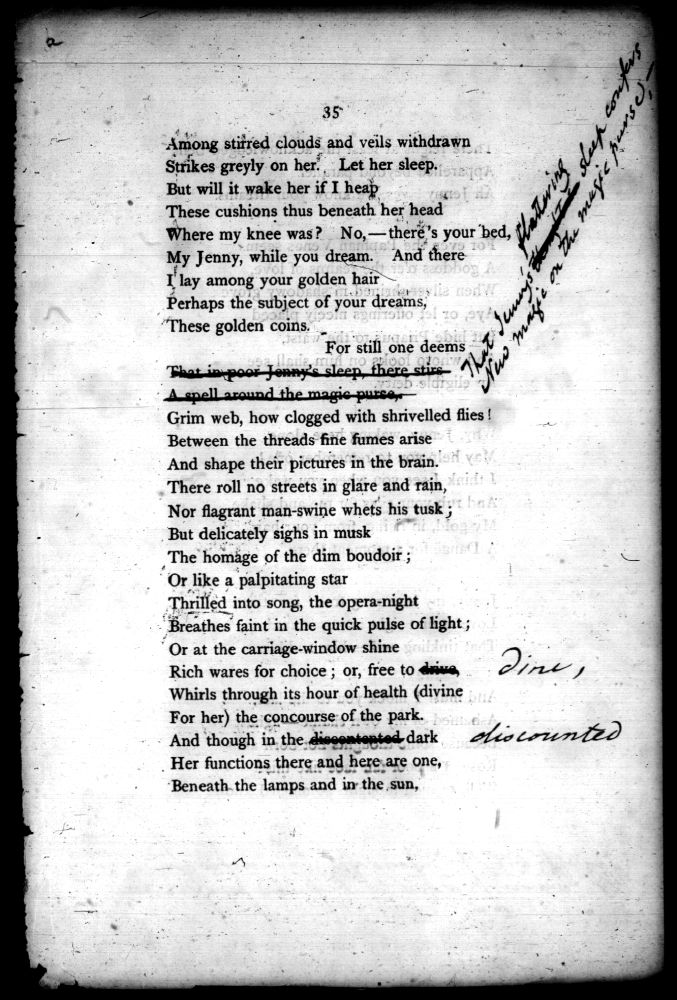
- For still one deems
-
That in poor Jenny's sleep, there stirs
Added TextThat Jenny's thoughtlessflattering sleep confers
-
A spell around the magic purse,—
Added TextNew magic on the magic purse,—
- Grim web, how clogged with shrivelled flies!
- Between the threads fine fumes arise
- And shape their pictures in the brain.
- There roll no streets in glare and rain,
- Nor flagrant man-swine whets his tusk;
- 280But delicately sighs in musk
- The homage of the dim boudoir;
- Or like a palpitating star
- Thrilled into song, the opera-night
- Breathes faint in the quick pulse of light;
- Or at the carriage-window shine
- Rich wares for choice; or, free to drive, dine,
- Whirls through its hour of health (divine
- For her) the concourse of the park.
- And though in the discontented discounted dark
- 290Her functions there and here are one,
- Beneath the lamps and in the sun
- There reigns at least the acknowledged belle
- Apparelled beyond parallel.
- Ah Jenny! yes, we know your dreams.
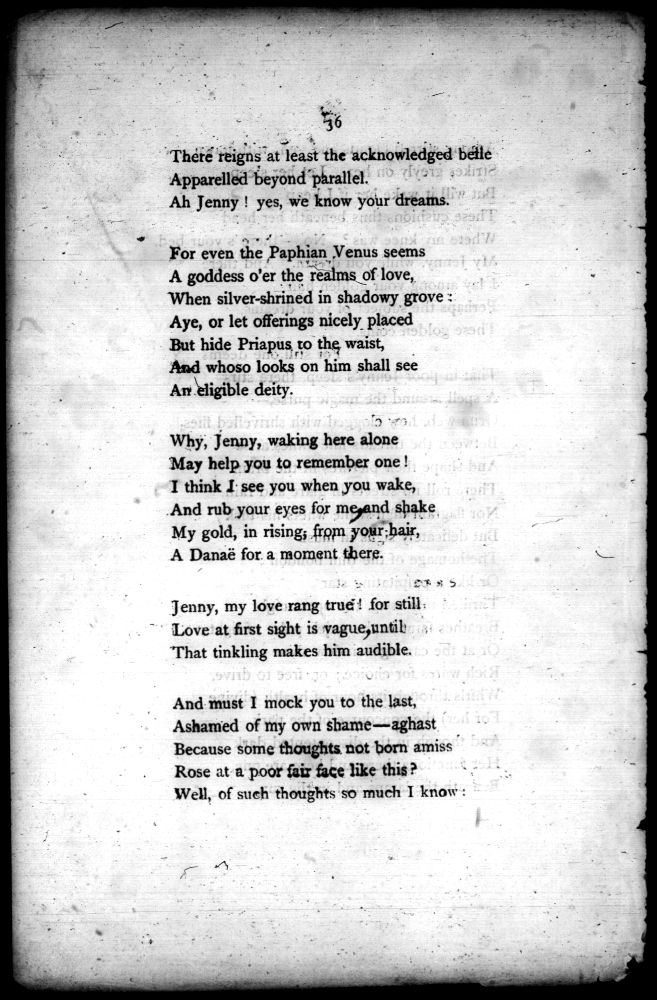
- For even the Paphian Venus seems
- A goddess o'er the realms of love,
- When silver-shrined in shadowy grove:
- Aye, or let offerings nicely placed
- But hide Priapus to the waist,
- 300And whoso looks on him shall see
- An eligible deity.
- Why, Jenny, waking here alone
- May help you to remember one!
- I think I see you when you wake,
- And rub your eyes for me , and shake
- My gold, in rising, from your hair,
- A Danaë for a moment there.
- Jenny, my love rang true! for still
- Love at first sight is vague , until
- 310That tinkling makes him audible.
- And must I mock you to the last,
- Ashamed of my own shame—aghast
- Because some thoughts not born amiss
- Rose at a poor fair face like this?
- Well, of such thoughts so much I know:
Transcription Gap: pages 37-38 (missing from extant manuscript)
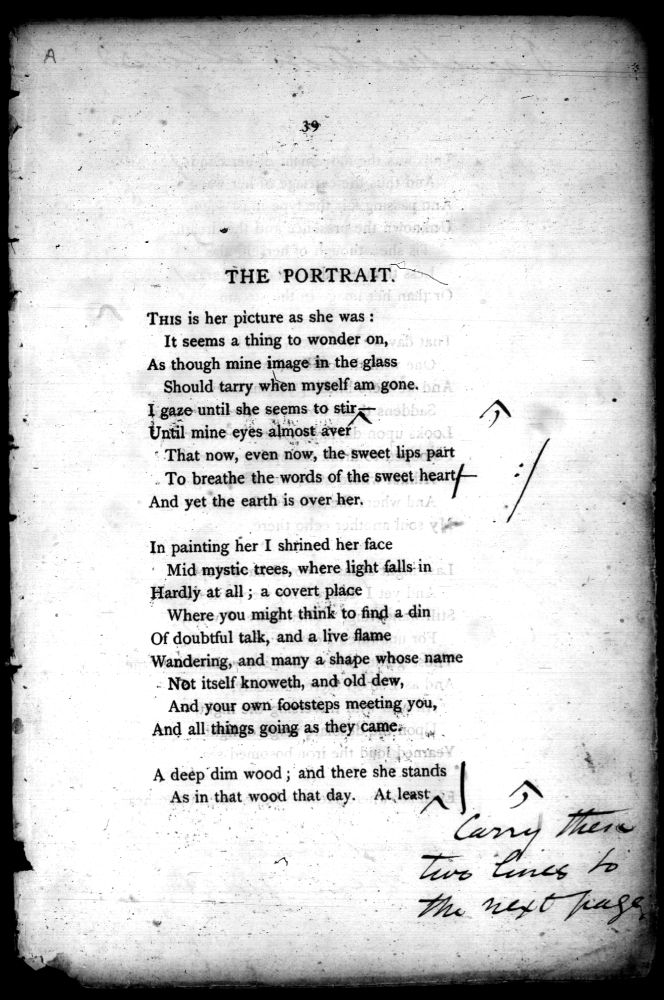
- This is her picture as she was:
- It seems a thing to wonder on,
- As though mine image in the glass
- Should tarry when myself am gone.
- I gaze until she seems to stir ,—
- Until mine eyes almost aver
- That now, even now, the sweet lips part
- To breathe the words of the sweet heart :—
- And yet the earth is over her.
- 10In painting her I shrined her face
- Mid mystic trees, where light falls in
- Hardly at all; a covert place
- Where you might think to find a din
- Of doubtful talk, and a live flame
- Wandering, and many a shape whose name
- Not itself knoweth, and old dew,
- And your own footsteps meeting you,
- And all things going as they came.
- A deep dim wood; and there she stands
- 20 As in that wood that day. At least ,
- Thus was the movement of her hands ,
- And thus the carriage of her waist.
- And passing fair the type must seem,
- Unknown the presence and the dream.
- 'Tis she: though of herself, alas!
- Less than her shadow on the grass ,
- Or than her image in the stream.
Printer's Direction: Carry these two lines to the next page.
Editorial Description: Notation by DGR, attached to lines 19 and 20.
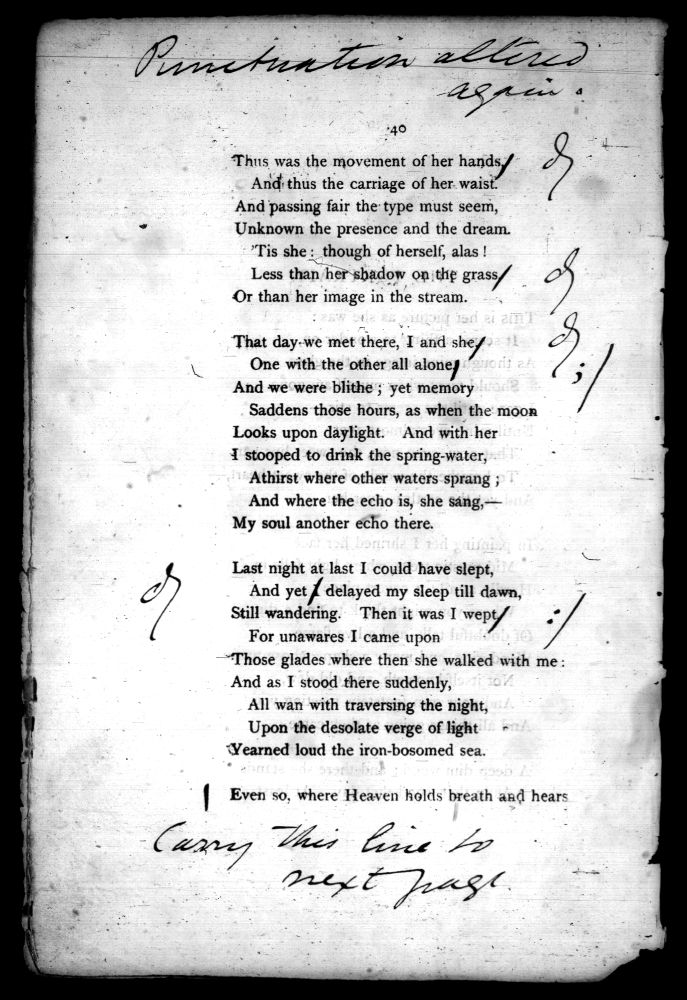
Printer's Direction: Punctuation altered again.
Editorial Description: Notation by DGR at top of page.
- That day we met there, I and she ,
- One with the other all alone : ;
- 30And we were blithe; yet memory
- Saddens those hours, as when the moon
- Looks upon daylight. And with her
- I stooped to drink the spring-water,
- Athirst where other waters sprang;
- And where the echo is, she sang,—
- My soul another echo there.
- Last night at last I could have slept,
- And yet I delayed my sleep till dawn,
- Still wandering. Then it was I wept , :
- 40 For unawares I came upon
- Those glades where then she walked with me:
- And as I stood there suddenly,
- All wan with traversing the night,
- Upon the desolate verge of light
- Yearned loud the iron-bosomed sea.
- Even so, where Heaven holds breath and hears
- The beating heart of l Love's own breast,
- Where round the secret of all spheres
- All angels lay their wings to rest,
- 50How shall my soul stand rapt and awed,
- When, by the new birth borne abroad ,
- Throughout the music of the suns,
- It enters in her soul at once ,
- And knows the silence there for God!
Printer's Direction: Carry this line to next page.
Editorial Description: Noted by DGR at line 46.
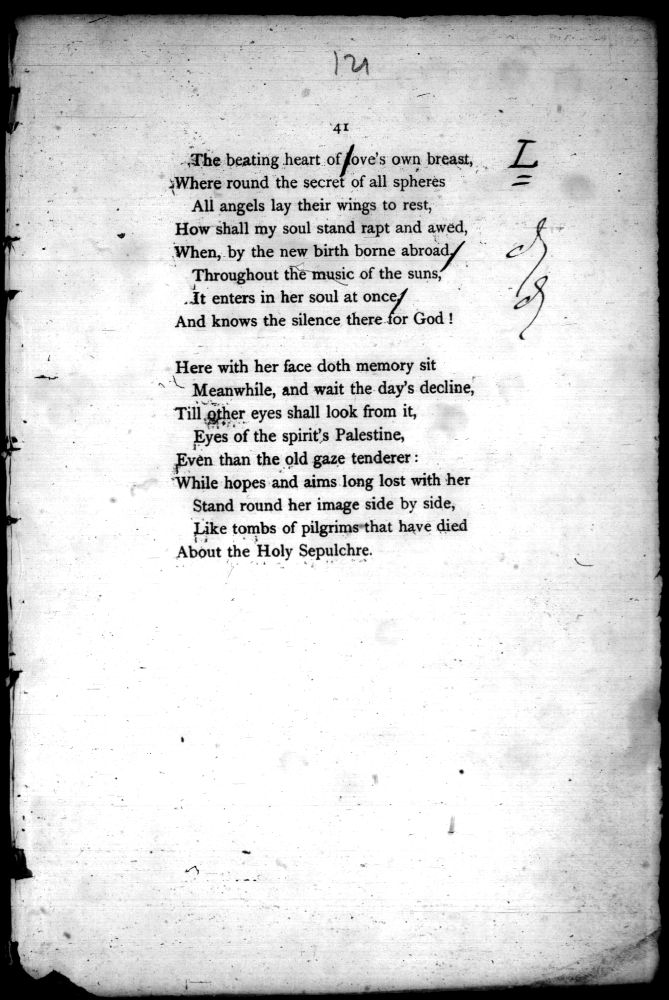
Manuscript Addition: 12
Editorial Description: Number hand-written in top center of page. Not in DGR's
penmanship
- Here with her face doth memory sit
- Meanwhile, and wait the day's decline,
- Till other eyes shall look from it,
- Eyes of the spirit's Palestine,
- Even than the old gaze tenderer:
- 60While hopes and aims long lost with her
- Stand round her image side by side,
- Like tombs of pilgrims that have died
- About the Holy Sepulchre.
![Image of page [42]](http://www.rossettiarchive.org/img/1-1870.exhum1a.36.jpg)
Note: blank page
Transcription Gap: pages 43-48 (missing from extant manuscript)
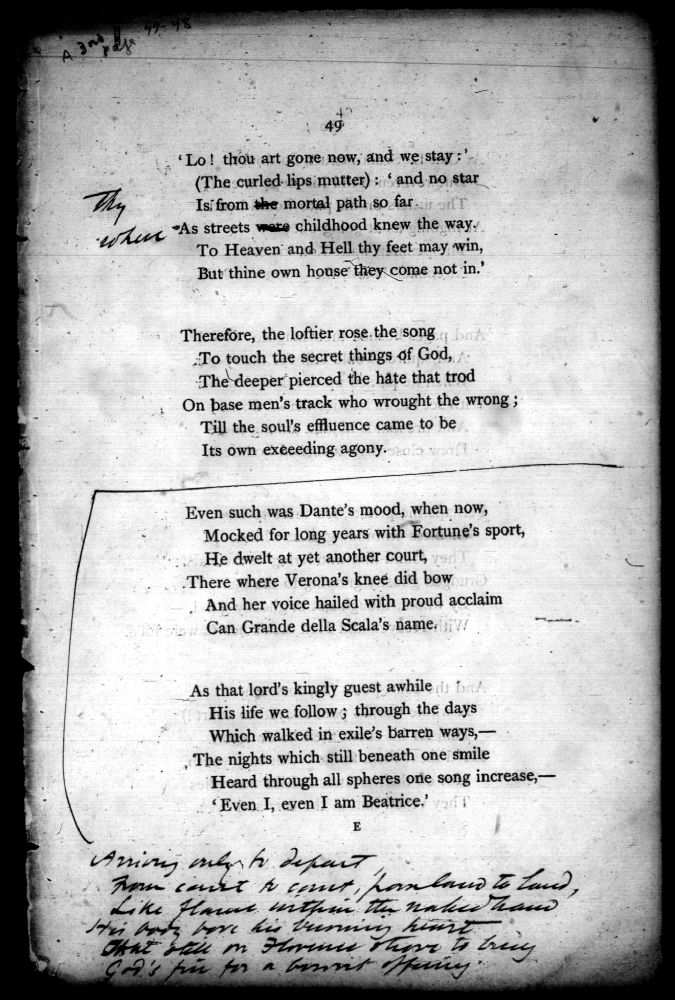
Note: The first two pages of the poem are missing from the ms.
Sig. E
Manuscript Addition: A 3rd page 47-48
Editorial Description: In upper left corner of page. Not in DGR's penmanship; probably
Troxell.
- ‘Lo! thou art gone now, and we stay:’
- (The curled lips mutter): ‘and no star
- Is from the thy mortal path so far
- As streets were where childhood knew the way.
- To Heaven and Hell thy feet may win,
- But thine own house they come not in.’
- Therefore, the loftier rose the song
- To touch the secret things of God,
- The deeper pierced the hate that trod
- 10On base men's track who wrought the wrong;
- Till the soul's effluence came to be
- Its own exceeding agony.
Added Text
- Arriving only to depart,
- From court to court, from land to land,
- Like flame within the naked hand
- His body bore his burning heart
- That still on Florence strove to bring
- God's fire for a burnt offering.
- Even such was Dante's mood, when now,
- 20 Mocked for long years with Fortune's sport,
- He dwelt at yet another court,
- There where Verona's knee did bow
- And her voice hailed with proud acclaim
- Can Grande della Scala's name.
- As that lord's kingly guest awhile
- His life we follow; through the days
- Which walked in exile's barren ways,—
- The nights which still beneath one smile
- Heard through all spheres one song increase,—
- 30 ‘Even I, even I am Beatrice.’
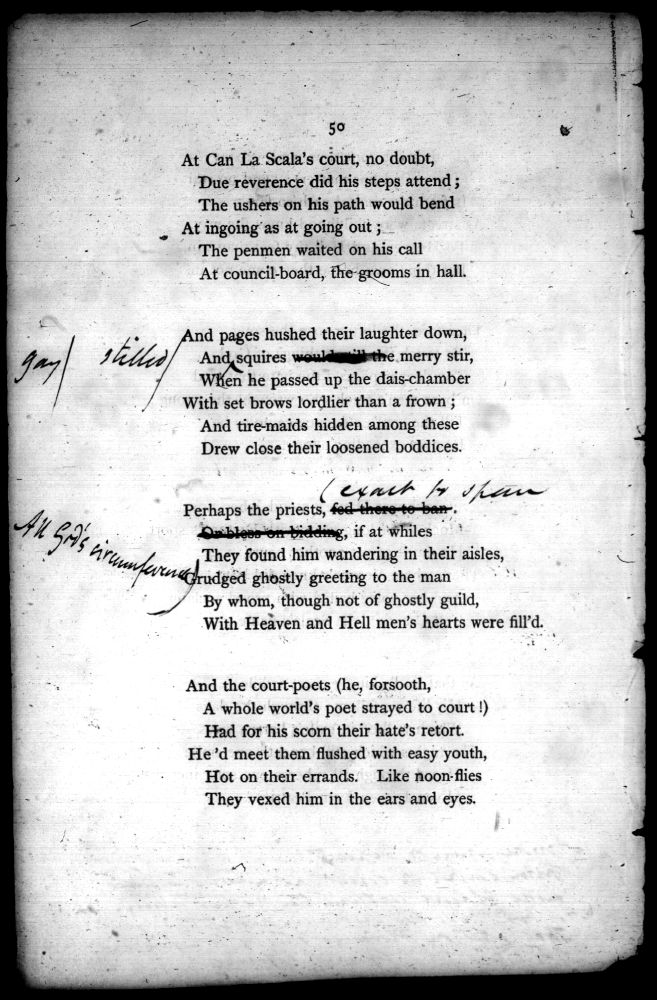
- At Can La Scala's court, no doubt,
- Due reverence did his steps attend;
- The ushers on his path would bend
- At ingoing as at going out;
- The penmen waited on his call
- At council-board, the grooms in hall.
- And pages hushed their laughter down,
- And gay squires would still stilled the merry stir,
- When he passed up the dais-chamber
- 40With set brows lordlier than a frown;
- And tire-maids hidden among these
- Drew close their loosened boddices.
- Perhaps the priests, fed there to ban (exact to span
- Or bless on bidding, All God's circumference) if at whiles
- They found him wandering in their aisles,
- Grudged ghostly greeting to the man
- By whom, though not of ghostly guild,
- With Heaven and Hell men's hearts were fill'd.
- And the court-poets (he, forsooth,
- 50 A whole world's poet strayed to court!)
- Had for his scorn their hate's retort.
- He'd meet them flushed with easy youth,
- Hot on their errands. Like noon-flies
- They vexed him in the ears and eyes.
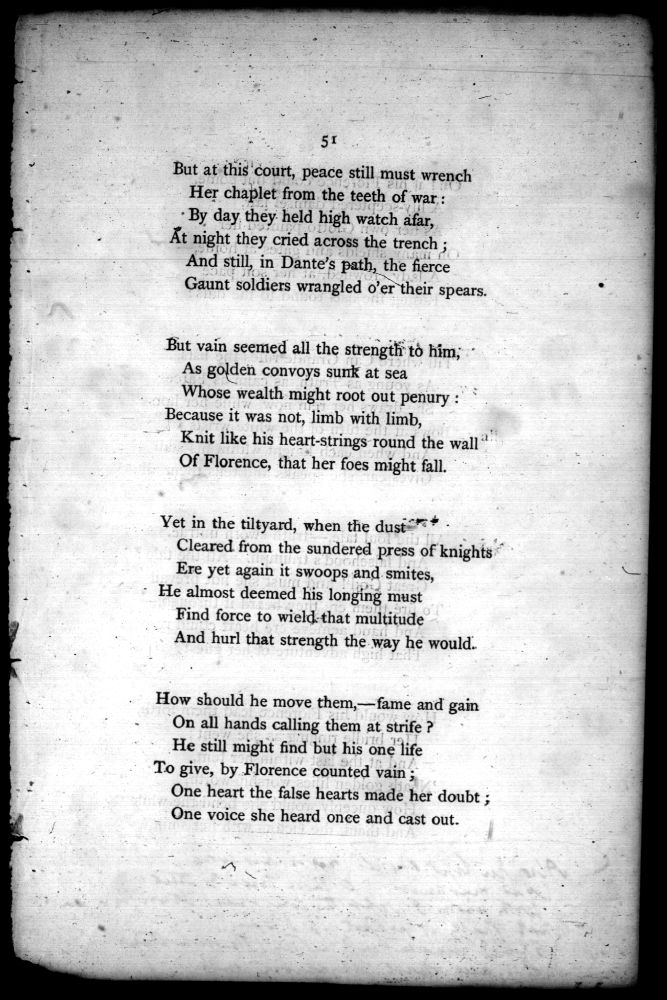
- But at this court, peace still must wrench
- Her chaplet from the teeth of war:
- By day they held high watch afar,
- At night they cried across the trench;
- And still, in Dante's path, the fierce
- 60 Gaunt soldiers wrangled o'er their spears.
- But vain seemed all the strength to him,
- As golden convoys sunk at sea
- Whose wealth might root out penury:
- Because it was not, limb with limb,
- Knit like his heart-strings round the wall
- Of Florence, that her foes might fall.
- Yet in the tiltyard, when the dust
- Cleared from the sundered press of knights
- Ere yet again it swoops and smites,
- 70He almost deemed his longing must
- Find force to wield that multitude
- And hurl that strength the way he would.
- How should he move them,—fame and gain
- On all hands calling them at strife?
- He still might find but his one life
- To give, by Florence counted vain;
- One heart the false hearts made her doubt;
- One voice she heard once and cast out.
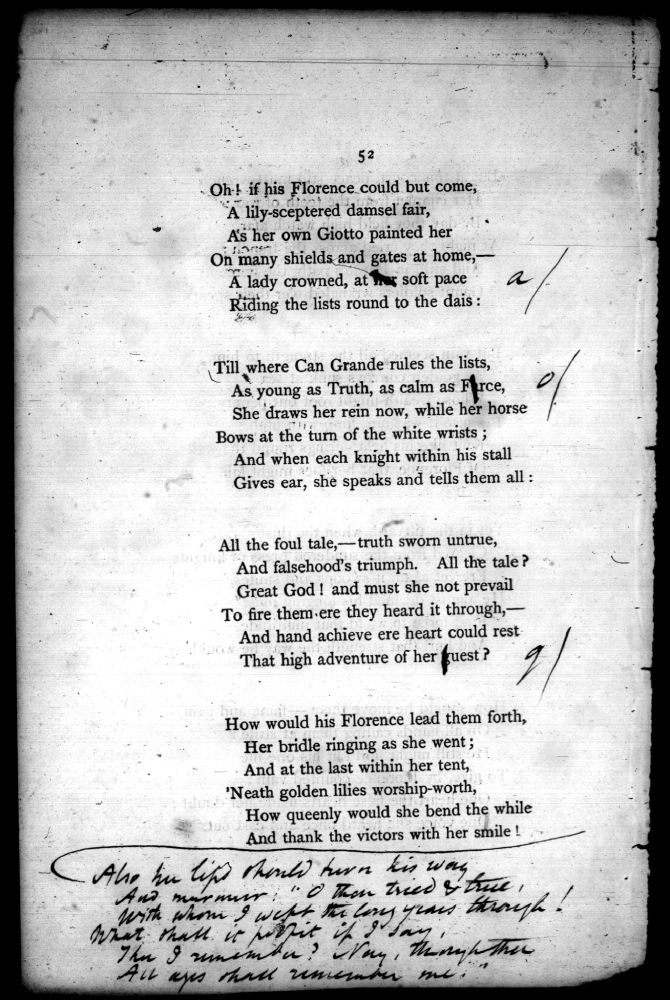
- Oh! if his Florence could but come,
- 80 A lily-sceptered damsel fair,
- As her own Giotto painted her
- On many shields and gates at home,—
- A lady crowned, at her a soft pace
- Riding the lists round to the dais:
- Till where Can Grande rules the lists,
- As young as Truth, as calm as F a orce,
- She draws her rein now, while her horse
- Bows at the turn of the white wrists;
- And when each knight within his stall
- 90 Gives ear, she speaks and tells them all:
- All the foul tale,—truth sworn untrue
- And falsehood's triumph. All the tale?
- Great God! and must she not prevail
- To fire them ere they heard it through,—
- And hand achieve ere heart could rest
- That high adventure of her g quest?
- How would His Florence lead them forth,
- Her bridle ringing as she went;
- And at the last within her tent,
- 100'Neath golden lilies worship-worth,
- How queenly would she bend the while
- And thank the victors with her smile!
Added Text
- Also her lips should turn his way
- And murmur: “O thou tried and true,
- With whom I wept the long years through!
- What shall it profit if I say,
- Thee I remember? Nay, through thee
- All ages shall remember me.”
Transcription Gap: pages 53-54 (missing from extant manuscript)
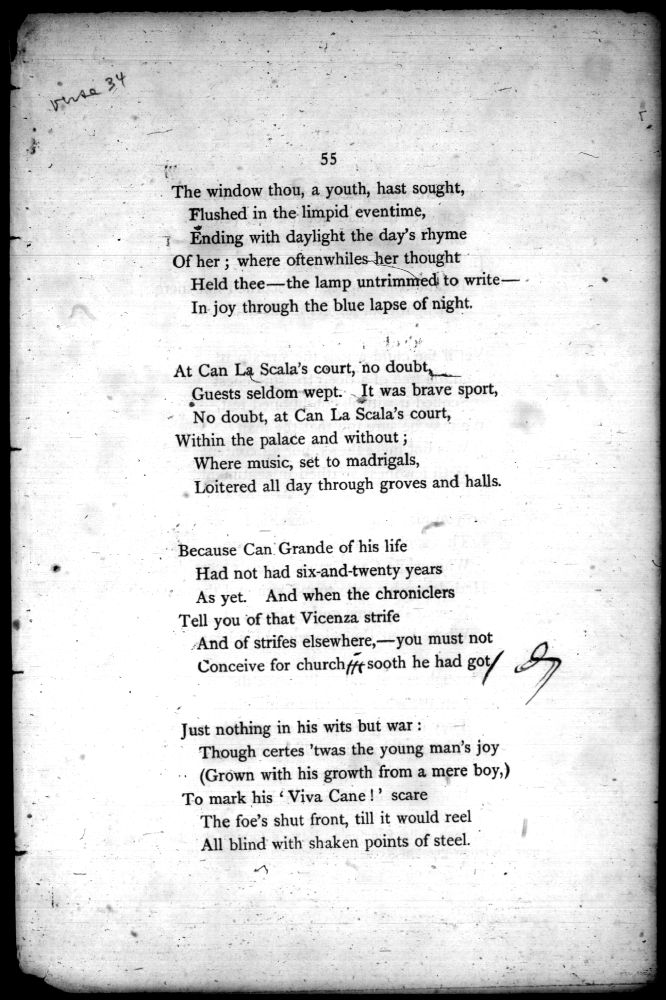
Manuscript Addition: verse 34
Editorial Description: Notation in upper left corner of page. Not in DGR's penmanship.
- The window thou, a youth, hast sought,
- 110 Flushed in the limpid eventime,
- Ending with daylight the day's rhyme
- Of her; where oftenwhiles her thought
- Held thee—the lamp untrimmed to write—
- In joy through the blue lapse of night.
- At Can La Scala's court, no doubt,
- Guests seldom wept. It was brave sport,
- No doubt, at Can La Scala's court,
- Within the palace and without;
- Where music, set to madrigals,
- 120 Loitered all day through groves and halls.
- Because Can Grande of his life
- Had not had six-and-twenty years
- As yet. And when the chroniclers
- Tell you of that Vicenza strife
- And of strifes elsewhere,—you must not
- Conceive for church —sooth he had got .
- Just nothing in his wits but war:
- Though certes 'twas the young man's joy
- (Grown with his growth from a mere boy,)
- 130To mark his ‘Viva Cane!’ scare
- The foe's shut front, till it would reel
- All blind with shaken points of steel.
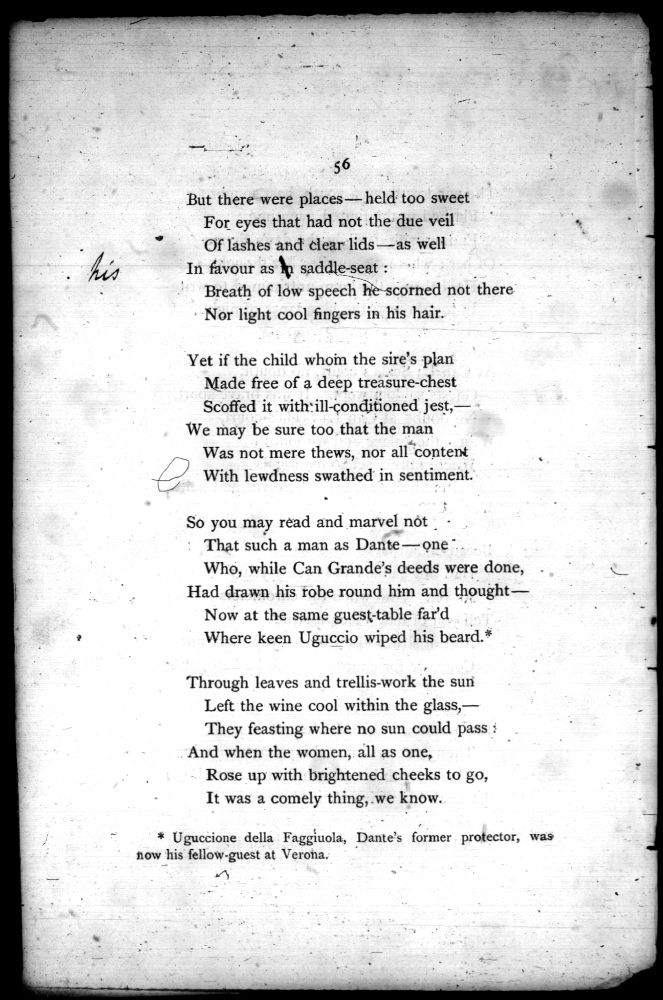
- But there were places—held too sweet
- For eyes that had not the due veil
- Of lashes and clear lids—as well
- In favour as in his saddle-seat:
- Breath of low speech he scorned not there
- Nor light cool fingers in his hair.
- Yet if the child whom the sire's plan
- 140 Made free of a deep treasure-chest
- Scoffed it with ill-conditioned jest,—
- We may be sure too that the man
- Was not mere thews, nor all content
- With lewdness swathed in sentiment.
- So you may read and marvel not
- That such a man as Dante—one
- Who, while Can Grande's deeds were done,
- Had drawn his robe round him and thought—
- Now at the same guest-table far'd
- 150 Where keen Uguccio wiped his beard.*
- Through leaves and trellis-work the sun
- Left the wine cool within the glass,—
- They feasting where no sun could pass:
- And when the women, all as one,
- Rose up with brightened cheeks to go,
- It was a comely thing, we know.
Transcribed Footnote (page 56):
* Uguccione della Faggiuola, Dante's former protector, was
now his
fellow-guest at Verona.
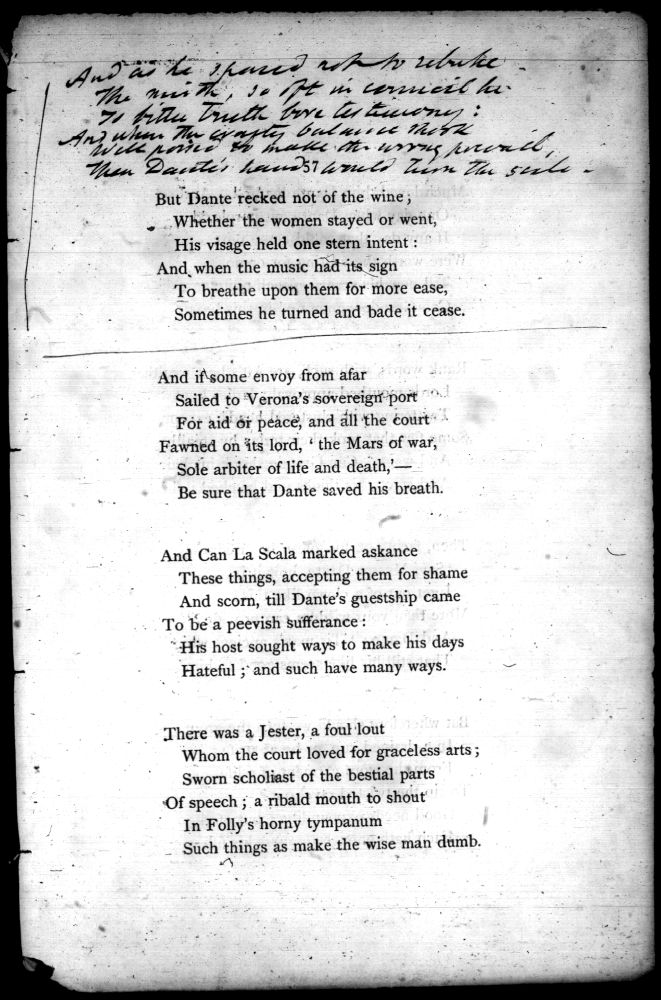
- But Dante recked not of the wine,
- Whether the women stayed or went,
- His visage held one stern intent:
- 160And when the music had its sign
- To breathe upon them for more ease,
- Sometimes he turned and bade it cease.
Added Text
- And as he spared not to rebuke
- The mirth, so oft in council he
- To bitter truth bore testimony:
- And when the crafty balance shook
- Well poised to make the wrong prevail,
- Then Dante's hand would turn the scale.
- And if some envoy from afar
- 170 Sailed to Verona's sovereign port
- For aid or peace, and all the court
- Fawned on its lord, ‘the Mars of war,
- Sole arbiter of life and death,’—
- Be sure that Dante saved his breath.
- And Can La Scala marked askance
- These things, accepting them for shame
- And scorn, till Dante's guestship came
- To be a peevish sufferance:
- His host sought ways to make his days
- 180 Hateful; and such have many ways.
- There was a Jester, a foul lout
- Whom the court loved for graceless arts;
- Sworn scholiast of the bestial parts
- Of speech; a ribald mouth to shout
- In Folly's horny tympanum
- Such things as make the wise man dumb.
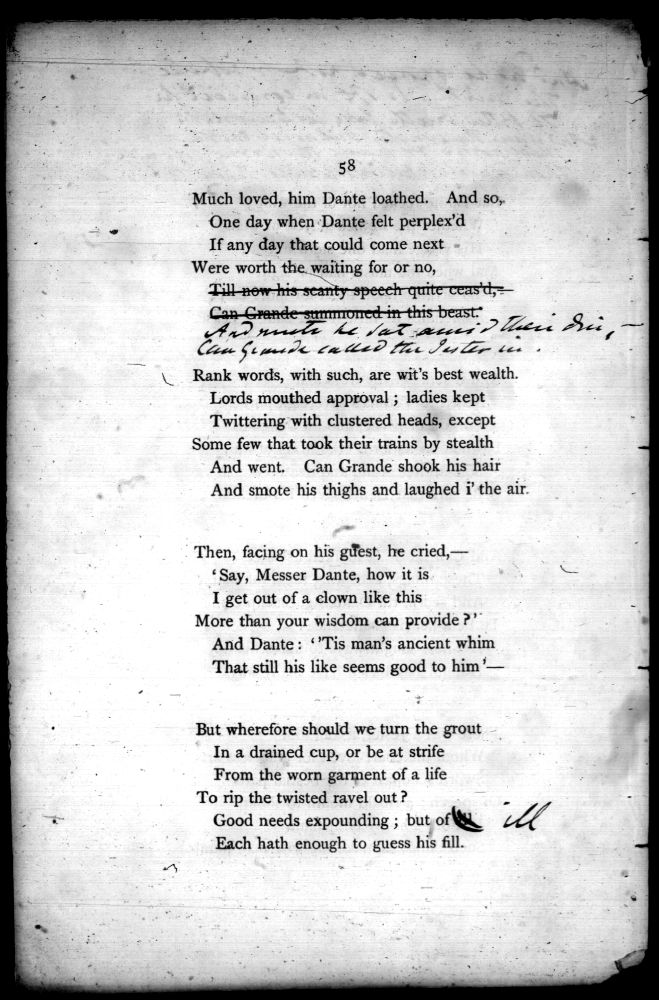
- Much loved, him Dante loathed. And so,
- One day when Dante felt perplex'd
- If any day that could come next
- 190Were worth the waiting for or no,
-
Till now his scanty speech quite ceas'd,—
Added TextAnd mute he sat amid their din,—
-
Can Grande summoned in this beast.
Added TextCan Grande called the Jester in.
- Rank words, with such, are wit's best wealth.
- Lords mouthed approval; ladies kept
- Twittering with clustered heads, except
- Some few that took their trains by stealth
- And went. Can Grande shook his hair
- And smote his thighs and laughed i' the air.
- Then, facing on his guest, he cried,—
- 200 ‘Say, Messer Dante, how it is
- I get out of a clown like this
- More than your wisdom can provide?’
- And Dante: ‘'Tis man's ancient whim
- That still his like seems good to him’—
- But wherefore should we turn the grout
- In a drained cup, or be at strife
- From the worn garment of a life
- To rip the twisted ravel out?
- Good needs expounding; but of all ill
- 210 Each hath enough to guess his fill.

Manuscript Addition: 160
Editorial Description: Number hand-written in bottom center of page. Not in DGR's
penmanship
- They named him Justicer-at-Law:
- Each month to bear the tale in mind
- Of hues a wench might wear unfin'd
- And of the load an ox might draw;
- To cavil in the weight of bread
- And to see purse-thieves gibbeted.
- And when his spirit wove the spell
- (From under even to over noon
- In converse with itself alone,)
- 220As high as Heaven, as low as Hell,—
- He would be summoned and must go:
- For had not Gian stabbed Giacomo?
- Therefore the bread he had to eat
- Seemed brackish, less like corn than tares;
- And the rush-strown accustomed stairs
- Each day were steeper to his feet;
- And when the night-vigil was done,
- His brows would ache to feel the sun.
- Nevertheless, when through from his kin
- 230 There came the tidings how at last
- In Florence a decree was pass'd
- Whereby all banished folk might win
- Free pardon so a fine were paid
- And act of public penance made,—
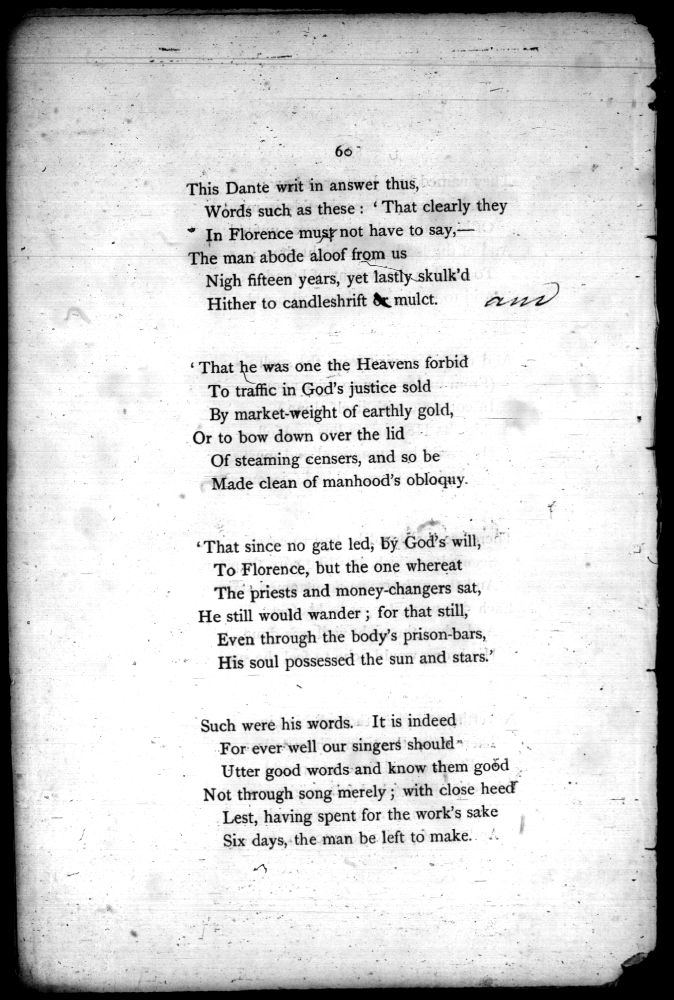
- This Dante writ in answer thus,
- Words such as these: ‘That clearly they
- In Florence must not have to say,—
- The man abode aloof from us
- Nigh fifteen years, yet lastly skulk'd
- 240 Hither to candleshrift or and mulct.
- ‘That he was one the Heavens forbid
- To traffic in God's justice sold
- By market-weight of earthly gold,
- Or to bow down over the lid
- Of steaming censers, and so be
- Made clean of manhood's obloquy.
- ‘That since no gate led, by God's will,
- To Florence, but the one whereat
- The priests and money-changers sat,
- 250He still would wander; for that still,
- Even through the body's prison-bars,
- His soul possessed the sun and stars.’
- Such were his words. It is indeed
- For ever well our singers should
- Utter good words and know them good
- Not through song merely; with close heed
- Lest, having spent for the work's sake
- Six days, the man be left to make.
Transcription Gap: pages 61-62 (missing from extant manuscript)
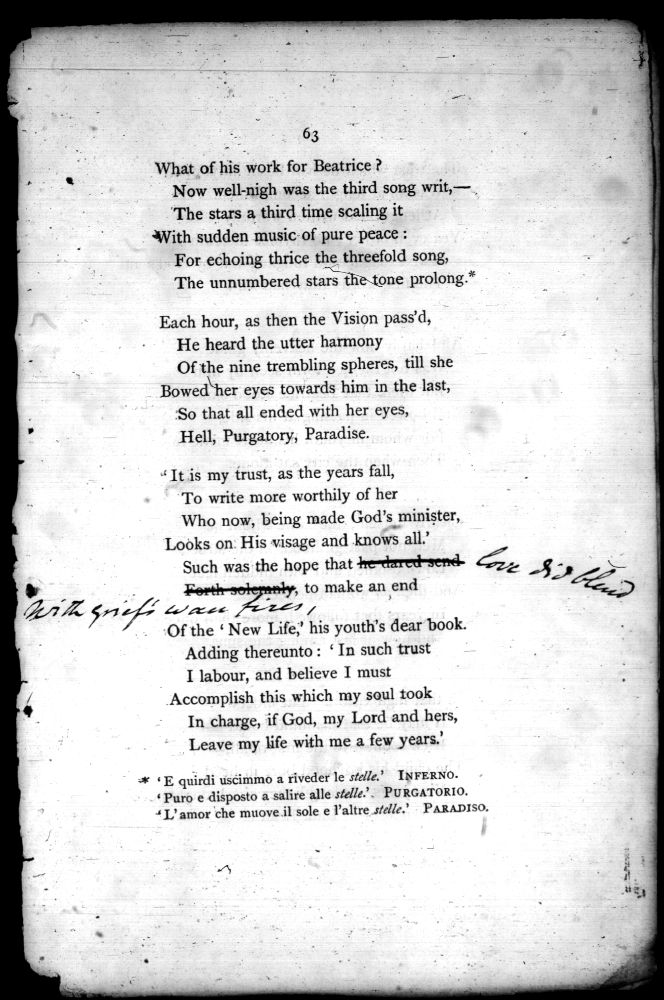
- What of his work for Beatrice?
- 260 Now well-nigh was the third song writ,—
- The stars a third time scaling it
- With sudden music of pure peace:
- For echoing thrice the threefold song,
- The unnumbered stars the tone prolong.*
Transcribed Footnote (page 63):
‘E quirdi uscimmo a riveder le
stelle.’ Inferno.
‘Puro e disposto a salire alle
stelle.’ Purgatorio.
‘L'amor che muove il sole e l'altre
stelle.’ Paradiso.
- Each hour, as then the Vision pass'd,
- He heard the utter harmony
- Of the nine trembling spheres, till she
- Bowed her eyes towards him in the last,
- So that all ended with her eyes,
- 270 Hell, Purgatory, Paradise.
- ‘It is my trust, as the years fall,
- To write more worthily of her
- Who now, being made God's minister,
- Looks on His visage and knows all.’
- Such was the hope that he dared send love did blend
- Forth solemnly, With grief's wan fires, to make an end
- Of the ‘New Life,’ his youth's dear book.
- Adding thereunto: ‘In such trust
- I labour, and believe I must
- 280Accomplish this which my soul took
- In charge, if God, my Lord and hers,
- Leave my life with me a few years.’
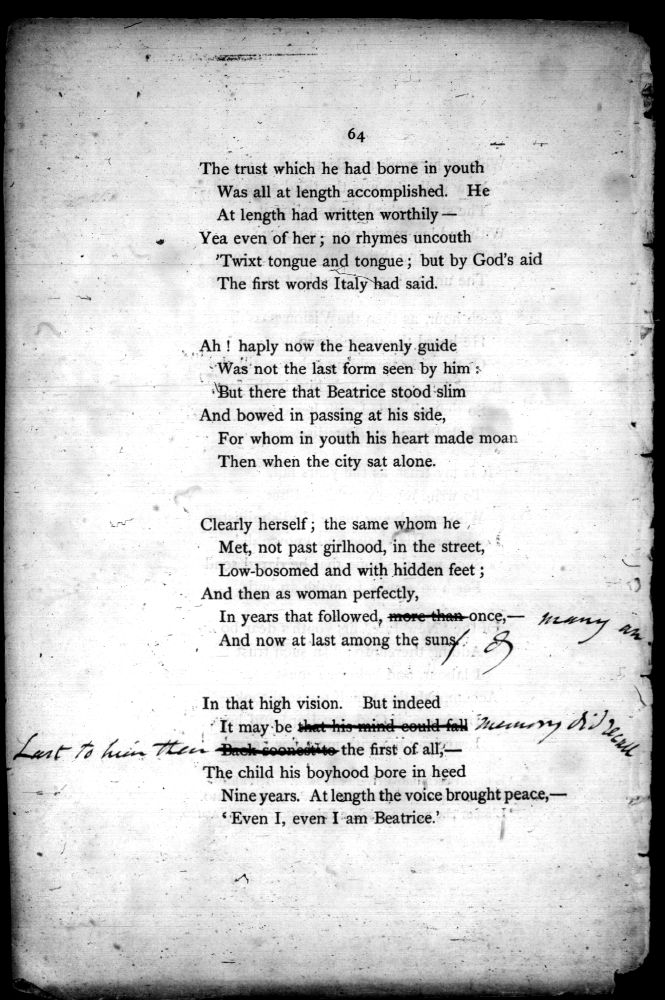
- The trust which he had borne in youth
- Was all at length accomplished. He
- At length had written worthily—
- Yea even of her; no rhymes uncouth
- 'Twixt tongue and tongue; but by God's aid
- The first words Italy had said.
- Ah! haply now the heavenly guide
- 290 Was not the last form seen by him:
- But there that Beatrice stood slim
- And bowed in passing at his side,
- For whom in youth his heart made moan
- Then when the city sat alone.
- Clearly herself; the same whom he
- Met, not past girlhood, in the street,
- Low-bosomed and with hidden feet;
- And then as woman perfectly,
- In years that followed, more than many an once,—
- 300 And now at last among the suns ,
- In that high vision. But indeed
- It may be that his mind could fall memory did recall
- Back soonest to Last to him then the first of all,—
- The child his boyhood bore in heed
- Nine years. At length the voice brought peace,—
- ‘Even I, even I am Beatrice.’
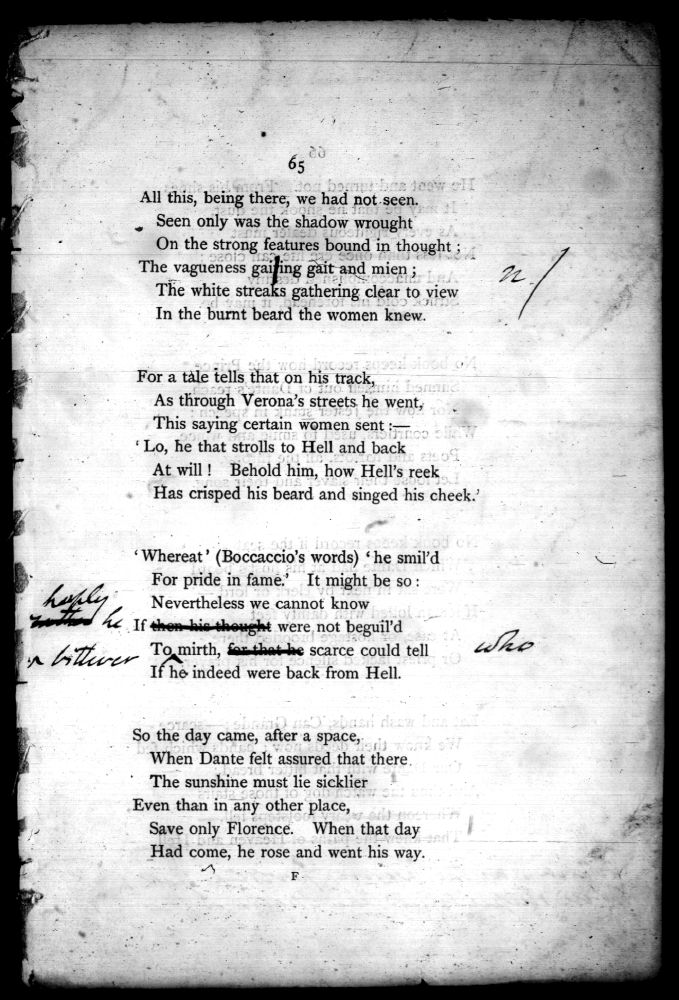
Sig. F
- All this, being there, we had not seen.
- Seen only was the shadow wrought
- On the strong features bound in thought;
- 310The vagueness gai r ning gait and mien;
- The white streaks gathering clear to view
- In the burnt beard the women knew.
- For a tale tells that on his track,
- As through Verona's streets he went,
- This saying certain women sent:—
- ‘Lo, he that strolls to Hell and back
- At will! Behold him, how Hell's reek
- Has crisped his beard and singed his cheek.’
- ‘Whereat’ (Boccaccio's words) ‘he smil'd
- 320 For pride in fame.’ It might be so:
- Nevertheless we cannot know
- If then his thought haply he were not beguil'd
- To bitterer mirth, for that he who scarce could tell
- If he indeed were back from Hell.
- So the day came, after a space,
- When Dante felt assured that there
- The sunshine must lie sicklier
- Even than in any other place,
- Save only Florence. When that day
- 330 Had come, he rose and went his way.

- He went and turned not. From his shoes
- It may be that he shook the dust,
- As every righteous dealer must
- Not less than once Once and again ere life can close;
- And unaccomplished destiny
- Struck cold his forehead, it may be.
- No book keeps record how the Prince
- Sunned himself out of Dante's reach,
- Nor how the Jester stank in speech;
- 340While courtiers, used to smile and wince,
- Poets and harlots, all the throng,
- Let loose their slaver and their song.
- No book keeps record if the seat
- Which Dante held at his host's board
- Were sat in next by clerk or lord,—
- If leman lolled with dainty feet
- At ease, or hostage brooded there,
- Or priest lacked silence for his prayer.
- Eat and wash hands, Can Grande;—scarce
- 350 We know their deeds now: hands which fed
- Our Dante with that bitter bread;
- And thou the watch-dog of those stairs
-
Whereon the weary footsteps fell,
Added TextWhich, as the weary footsteps fell,
-
That knew the paths of Heaven and Hell.
Added TextWere steeper found than Heaven or Hell.
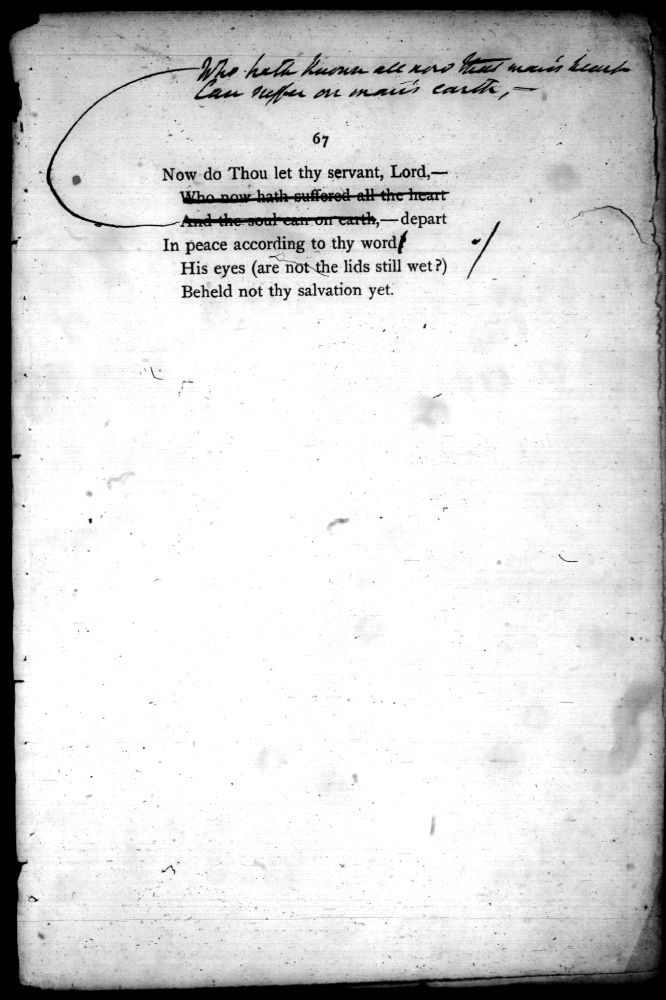
- Now do Thou let thy servant, Lord—
-
Who now hath suffered all the heart
Added TextWho hath known all now that man's heart
- And the soul can on earth, Can suffer on man's earth,—depart
- In peace according to thy word : .
- His eyes (are not the lids still wet?)
- 360Beheld not thy salvation yet.
![Image of page [68]](http://www.rossettiarchive.org/img/1-1870.exhum1a.52.jpg)
Note: blank page
Electronic Archive Edition: 1
Source File:
1-1870.exhum1a.trox.rad.xml
Copyright: Used with permission of Princeton University. From the Princeton
University Library, Department of Rare Books and Special Collections. All rights
reserved. Redistribution or republication in any medium requires express written
consent from Princeton University Library. Permissions inquiries should be
addressed to Associate University Librarian, Rare Books and Special Collections,
Princeton University Library.