![Image of page [cover]](http://www.rossettiarchive.org/img/thumbs_small/gilchrist1863.v2.cover.jpg) page:
page: [cover]
![Image of page [spine]](http://www.rossettiarchive.org/img/thumbs_small/gilchrist1863.v2.spine.jpg) page:
page: [spine]
![Image of page [foreedge]](http://www.rossettiarchive.org/img/thumbs_small/gilchrist1863.v2.fedge.jpg) page:
page: [foreedge]
![Image of page [head]](http://www.rossettiarchive.org/img/thumbs_small/gilchrist1863.v2.head.jpg) page:
page: [head]
![Image of page [tail]](http://www.rossettiarchive.org/img/thumbs_small/gilchrist1863.v2.tail.jpg) page:
page: [tail]
![Image of page [front paste]](http://www.rossettiarchive.org/img/thumbs_small/gilchrist1863.v2.paste.jpg) page:
page: [front paste]
![Image of page [001]](http://www.rossettiarchive.org/img/thumbs_small/gilchrist1863.v2.endp1.jpg) page:
page: [001]
![Image of page [002]](http://www.rossettiarchive.org/img/thumbs_small/gilchrist1863.v2.endp2.jpg) page:
page: [002]
![Image of page [003]](http://www.rossettiarchive.org/img/thumbs_small/gilchrist1863.v2.htitle.jpg) page:
page: [003]
LIFE
OF
WILLIAM BLAKE.
![Image of page [004]](http://www.rossettiarchive.org/img/thumbs_small/gilchrist1863.v2.htitlev.jpg) page:
page: [004]
Editorial Note (page ornament): A cross inscribed in a circle, with an ornamental M in the center and designs in each quadrant.
![Image of page [i]](http://www.rossettiarchive.org/img/thumbs_small/gilchrist1863.v2.htitleva.jpg) page:
page: [i]
Note: Blank page. The design on page [ii] is faintly visible on this page.
![Image of page [ii]](http://www.rossettiarchive.org/img/thumbs_small/gilchrist1863.v2.frontis.jpg) page:
page: [ii]
CHAUCERS CANTERBURY PILGRIMS
Painted in Fresco by William
Blake & by him Engraved & published October 8 1810 at No
28 Corner 1 Broad Street Golden Square
![Image of page [iii]](http://www.rossettiarchive.org/img/thumbs_small/gilchrist1863.v2.title.jpg) page:
page: [iii]
LIFE
OF
WILLIAM BLAKE,
“PICTOR IGNOTUS”
WITH SELECTIONS FROM HIS POEMS AND OTHER WRITINGS
BY THE LATE
ALEXANDER GILCHRISTA
OF THE MIDDLE TEMPLE, BARRISTER-AT LAW;
AUTHOR OF “THE LIFE OF WILLIAM ETTY,
R.A.”
ILLUSTRATED FROM BLAKE’S OWN WORKS,
IN FASCIMILÉ BY W. J. LINTON,
AND IN PHOTOLITHOGRAPHY;
WITH A FEW OF BLAKE’S ORIGINAL PLATES.
IN TWO VOLUMES.
VOL. II.
London and Cambridge:
MACMILLAN AND CO.
1863.
[
The Right of Translation is reserved.]
![Image of page [iv]](http://www.rossettiarchive.org/img/thumbs_small/gilchrist1863.v2.titlev.jpg) page:
page: [iv]
LONDON:
R CLAY, SON, AND TAYLOR, PRINTERS,
BREAD STREET HILL.
![Image of page [v]](http://www.rossettiarchive.org/img/thumbs_small/gilchrist1863.v2.toc.jpg) page:
page: [v]
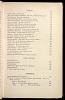
POEMS HITHERTO UNPUBLISHED.
-
Introductory Note.. .. .. 76
-
The Birds.
Where thou dwellest, in what
grove
. .. .. 78
-
Broken Love.
My spectre around me night
and day
. .. .. 79
-
The Two Songs.
I heard an angel
singing
. .. .. 81
-
The Defiled Santuary.
I saw a chapel, all
of gold
. .. .. 82
 page:
page: vii
-
Cupid.
Why was Cupid a boy?. .. .
. 83
-
The Woman taken in Adultery.
The vision
of Christ that thou dost see
. . 84
-
Love’s Secret.
Never seek to tell thy
love
. .. .. 86
-
The Wild Flower’s Song.
As I wandered in
the forest
. .. .. 87
-
The Crystal Cabinet.
The maiden caught
me in the wild
. .. .. 88
-
Smile and Frown.
There is a smile of
love
. .. .. 89
-
The Golden Net.
Beneath a white thorn’s
lovely May
. .. .. 90
-
The Land of Dreams.
Awake, awake, my
little boy!
. .. .. 91
-
Mary.
Sweet Mary, the first time she was
ever was there
. .. .. 92
-
Auguries of Innocence.
To see a world in
a grain of sand
. .. .. 94
-
The Mental Traveller.
I travelled
through a land of men
. .. .. 98
-
William Bond.
I wonder whether the girls
are mad
. .. .. 103
-
Scoffers.
Mock on, mock on, Voltaire,
Rousseau
. .. .. 105
-
The Agony of Faith.
I see, I see, the
mother said
. .. .. 106
-
Daybreak.
To find the western path
. .. .. 107
-
Thames and Ohio.
Why should I care for
the men of Thames
. .. .. 107
-
Young Love.
Are not the joys of morning
sweeter
. .. .. 108
-
Riches.
Since all the riches of the
world
. .. .. 108
-
Opportunity.
He who bends to himself a
joy
. .. .. 108
-
Seed Sowing.
Thou hast a lapful of
seed
. .. .. 109
-
Barren Blosom.
I feared the fury of my
wind
. .. .. 109
-
Night and Day.
Silent, silent night
. .. .. 110
-
In a Myrtle Shade.
To a lovely myrtle
bound
. .. .. 111
-
Couplets and Fragments. .. .. 112
-
Epigrams and Satirical Pieces on Art and Artists. .
. .. 114
APPENDIX.
Note: Appendix materials unrelated to DGR are omitted from the transcription.
- Letters from Blake to Mr. Butts. .. .. 178
- Annotated Catalogue of Blake’s Pictures and Drawings. List I.
of Works in Colours.
-
Section a. Dated Works. .. .. 201
-
Section b. Undated Works,
Biblical and Sacred. . 223
-
Ditto Ditto
Poetical and Miscellaneous. .
. .. 232
![Image of page [viii]](http://www.rossettiarchive.org/img/thumbs_small/gilchrist1863.v2.viii.jpg) page:
page: [viii]
- List II. Uncoloured Works.
-
Section a. Dated Works.
. .. .. 240
-
Section b. Undated Works,
Biblical and Sacred. . 223
-
Ditto ditto
Poetical and Miscellaneous. .
. .. .. . 248
- List III. Works of Unascrertained Method.
-
Biblical and Sacred .. .. .. 255
-
Poetic and Miscellaneous .. .. .. 255
- Accounts between Blake and Mr. Butts.. .. .. .. .. .
256
- List of Engravings.
-
Works designed as well as engraved by
Blake
.. .. .. 257
-
Works engraved, but not designed by Blake.. .. .. 259
-
Works designed, but not engraved by Blake.. .. .. 261
- List of Writings.. .. .. .. .. 261
- Prospecture by Blake issued in 1793.. .. .. 263
-
Engraved Designs by Blake.. .. .
. .. .. 265
-
The Book of Job.
-
Songs of Innocence and Experience.
![Image of page [1]](http://www.rossettiarchive.org/img/thumbs_small/gilchrist1863.v2.B1r.jpg) page:
page: [1]
Note: There is an illustration on this page.
![Image of page [2]](http://www.rossettiarchive.org/img/thumbs_small/gilchrist1863.v2.B1v.jpg) page:
page: [2]
- I give you the end of a golden string:
- Only wind it into a ball,
- It will lead you in at Heaven’s gate,
- Built in Jerusalem wall.
Note: There is an illustration on this page.
 page:
page: 3
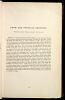
There is no need for many futher critical remarks on
these selections from the Poetical Sketches, which have already been spoken
on in Chap. VI. of the Life. Among the lyrical pieces here chosen, it would
be difficult to award a distinct preference. These Songs are certainly among
the small class of modern times which recall the best period of English song
writing, whose rarest treasures lie scattered among the plays of our
Elizabethan dramatists. They deserve no less than very high admiration in a
quite positive sense, which cannot be even qualified by the slight hasty or
juvenile imperfections of execution to be met with in some of
them, though by no means in all. On the other hand, if we view them
comparatively; in relation to Blake’s youth when he wrote them, or the
poetic epoch in which they were produced; it would be hardly possible to
overrate their astonishing merit. The same return to the diction and high
feeling of greater age is to be found in the unfinished play of
‘Edward the Third,’from which some fragments are
included here. In the original edition, however, these are marred by
frequent imperfections in the metre (partly real and partly dependent on
careless printing), which I have thought it best to remove, as I found it
possible to do so without once in the slightest degree affecting the
originality of the text. The same has been done in a few similar instances
elsewhere. The poem of ‘Blind Man’s Buff’ stands in
curious contrast with the rest, as an effort in another manner, and, though
less excellent, is not without interest. Besides what is here given, there
are attempts in the very modern-antique style of ballad prevalent at the
time, and in Ossianic prose, but all naturally very inferior, and probably
earlier. It is singular that, for formed style and purely literary
qualities, Blake perhaps never afterwards equalled the best things in this
youthful volume, though he often did so in melody and feeling, amd more than
did so in depth of thought.
 page:
page: 4
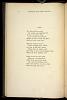
- My silks and fine array,
- My smiles and languished air,
- By love are driven away.
- And mournful lean Despair
- Brings me yew to deck my grave:
- Such end true lovers have.
- His face is fair as heaven
- When springing buds unfold;
- Oh, why to
him was’t given,
-
10Whose heart is wintry cold?
- His breast is Love’s all-worshipped tomb
- Where all love’s pilgrims come.
- Bring me an axe and spade
- bring me a winding-sheet;
- When I my grave have made,
- Let winds and tempests beat:
- Then down I’ll lie, as cold as clay.
- True love doth pass away!
 page:
page: 5
- Love and harmony combine
- And around our souls entwine,
- While thy branches mix with mine
- And our roots together join.
- Joys upon our branches sit,
- Chirping loud and singing sweet;
- Like gentle streams beneath our feet,
- Innocence and virtue meet.
- Thou the golden fruit dost bear,
-
10I am clad in flowers fair;
- Thy sweet boughs perfume the air,
- And the turtle buildeth there.
- There she sits and feeds her young;
- Sweet I hear her mournful song:
- And thy lovely leaves among,
- There is Love: I hear his tongue.
- There his charm’d nest he doth lay,
- There he sleeps the night away,
- There he sports along the day,
-
20And doth among our branches play.
 page:
page: 6
- I Love the jocund dance,
- The softly-breathing song,
- Where innocent eyes do glance,
- Where lisps the maiden’s tongue.
- I love the laughing vale,
- I love the echoing hill,
- Where mirth does never fail,
- And the jolly swain laughs his fill.
- I love the pleasant cot,
-
10I love the innocent bower,
- Where white and brown is our lot,
- Or fruit in the mid-day hour.
- I love the oaken seat
- Beneath the oaken tree,
- Where all the old villagers meet,
- And laugh our sports to see.
- I love our neighbours all,
- But, Kitty, I better love thee:
- And love them I ever shall,
-
20But thou art all to me.
 page:
page: 7
- The wild winds weep,
- And the night is a-cold;
- Come hither, Sleep,
- And my griefs unfold!
- But lo! The Morning peeps
- Over the eastern steeps,
- And rustling birds of dawn
- The earth do scorn.
- Lo! to the vault
-
10Of paved heaven,
- With sorrow fraught,
- My notes are driven:
- They strike the ear of night,
- Make weep the eyes of day;
- They make mad the roaring winds,
- And with tempests play.
- Like a fiend in a cloud
- With howling woe
- After night I do crowd,
-
20And with night will go;
- I turn my back to the East
- Whence comforts have increas’d;
- For light doth seize my brain
- With frantic pain.
 page:
page: 8
- How sweet I roamed from field to field,
- And tasted all the summer’s pride,
- ’Till I the Prince of Love beheld,
- Who in the sunny beams did glide!
- He show’d me lilies for my hair,
- And blushing roses for my brow;
- He led me through his gardens fair,
- Where all his golden pleasures grow.
- With sweet May dews my wings were wet,
-
10And Phœbus fired my vocal rage;
- He caught me in his silken net,
- And shut me in his golden cage.
- He loves to sit and hear me sing,
- Then, laughing, sports and plays with me;
- Then stretches out my golden wing,
- And mocks my loss of liberty.
 page:
page: 9
- Memory, hither come,
- And tune your merry notes;
- And, while upon the wind
- Your music floats,
- I’ll pore upon the stream
- Where sighing lovers dream,
- And fish for fancies as they pass
- Within the watery glass.
- I’ll drink of the clear stream,
-
10And hear the linnet’s song;
- And there I’ll lie and dream
- The day along:
- And, when night comes, I’ll go
- To places fit for woe;
- Walking along the darkened valley
- With silent Melancholy.
 page:
page: 10
- Whether on Ida’s shady brow,
- Or in the chambers of the East,
- The chambers of the sun that now
- From ancient melody have ceased;
- Whether in Heaven ye wander fair,
- Or the green corners of the earth,
- Or the blue regions of the air,
- Where the melodious winds have birth;
- Whether on crystal rocks ye rove
-
10Beneath the bosom of the sea,
- Wandering in many a coral grove;
- Fair Nine, forsaking Poetry;
- How have you left the ancient love
- That bards of old enjoy’d in you!
- The languid strings do scarcely move,
- The sound is forced, the notes are few.
 page:
page: 11
- Thou fair-hair’d angel of the Evening,
- Now, whilst the sun rests on the mountains, light
- Thy brilliant torch of love; thy radiant crown
- Put on, and smile upon our evening bed!
- Smile on our loves; and whilst thou drawest round
- The curtains of the sky, scatter thy dew
- On every flower that closes its sweet eyes
- In timely sleep. Let thy west wind sleep on
- The lake; speak silence with thy glimmering eyes,
-
10 And wash the dusk with silver. Soon, full soon
- Dost thou withdraw; then the wolf rages wide,
- And then the lion glares through the dun forest.
- The fleeces of our flocks are covered with
- Thy sacred dew: protect them with thine influence.
 page:
page: 12
- O Thou, with dewy locks, who lookest down
- Thro’ the clear windows of the morning, turn
- Thine angel eyes upon our western isle,
- Which in full choir hails thy approach, O Spring!
- The hills do tell each other, and the listening
- Valleys hear; all our longing eyes are turned
- Up to thy bright pavilion: issue forth,
- And let thy holy feet visit our clime!
- Come o’er the eastern hills, and let our winds
-
10 Kiss thy perfumed garments; let us taste
- Thy morn and evening breath; scatter thy pearls
- Upon our love-sick land that mourns for thee.
- O deck her forth with thy fair fingers; pour
- Thy softest kisses on her bosom, and put
- Thy golden crown upon her languish’d head
- Whose modest tresses were bound up for thee.
 page:
page: 13
- O Thou who passest thro’ our
valleys in
- Thy strength, curb thy fierce steeds, allay the heat
- That flames from their large nostrils! Thou, O summer!
- Oft pitched’st here thy golden
tent, and oft
- Beneath our oaks hast slept, while we beheld
- With joy thy ruddy limbs and flourishing hair.
- Beneath our thickest shades we oft have heard
- Thy voice, when noon upon his fervid car
- Rode o’er the deep of heaven. Beside our springs
-
10 Sit down, and in our mossy valleys; on
- Some bank beside a river clear, throw all
- Thy draperies off, and rush into the stream!
- Our valleys love the Summer in his pride.
- Our bards are famed who strike the silver wire;
- Our youths are bolder than the southern swains;
- Our maidens fairer in the sprightly dance;
- We lack not songs, nor instruments of joy,
- Nor echoes sweet nor waters clear as heaven,
- Nor laurel wreaths against the sultry heat.
 page:
page: 14
- When silver snow decks Susan’s clothes,
- And jewel hangs at th’ shepherd’s nose,
- The chimney-nook is all my care,
- With hearth so red and walls so fair;
- ‘ Heap the sea-coal, come, heap it higher,
- ‘ The oaken log lay on the fire.’
- The well-washed stools, a circling row,
- With lad and lass, how fair the show!
- The merry can of nut-brown ale,
-
10The laughing jest, the love-sick tale:
- ’Till, tired of chat, the game begins,
- The lasses prick the lads with pins;
- Roger from Dolly twitched the stool,
- She falling, kissed the ground, poor fool!
- She blushed so red, with side-long glance
- At hob-nail Dick who grieved the chance.
- But now for Blind-man’s Buff they call;
- Of each incumbrance clear the hall!
- Jenny her silken ’kerchief folds,
-
20And blear-eyed Will the black lot holds;
- Now, laughing, stops, with ‘Silence! Hush!’
- And Peggy Pout gives Sam a push.
- The Blind-man’s arms, extended wide,
- Sam slips between;—O woe betide
- Thee, clumsy Will!—but tittering Kate
- Is penned up in the corner strait!
- And now Will’s eyes beheld the play,
- He thought his face was t’other way.
- Now, Kitty, now! what chance hast thou!
-
30 Roger so near thee trips!—I vow
- She catches him!—then Roger ties
- His own head up, but not his eyes;
- For thro’ the slender cloth he sees,
 page:
page: 15
- And runs at Sam, who slips with ease
- His clumsy hold; and, dodging round,
- Sukey is tumbled on the ground!
- See what it is to play unfair!
- Where cheating is, there’s mischief there.
- But Roger still pursues the chace,—
-
40‘He sees! he sees!’ cries softly
Grace.
- O Roger, thou, unskill’d in art.
- Must, surer bound, go through thy part!
- Now Kitty, pert, repeats the rhymes,
- And Roger turns him round three times;
- Then pauses ere he starts—But Dick
- Was mischief-bent upon a trick:
- Down on his hands and knees he lay,
- Directly in the Blind-man’s way—
- Then cries out, ‘Hem!’ Hodge heard, and
ran
-
50 With hood-winked chance—sure of his man;
- But down he came.—Alas, how frail
- Our best of hopes, how soon they fail!
- With crimsom drops he stains the ground,
- Confusion startles all around
- Poor piteous Dick supports his head,
- And fain would cure the hurt he made;
- But Kitty hastens with a key,
- And down his back they straight convey
- The cold relief; the blood is stay’d,
-
60And Hodge again holds up his head.
- Such are the fortunes of the game;
- And those who play should stop the same
- By wholesome laws: such as,—all those
- Who on the blinded man impose
- Stand in his stead. So, long a-gone,
- When men were first a nation grown,
- Lawless they lived, till wantonness
- And liberty began to increase,
-
70And one man lay in another’s way:
- Then laws were made to keep fair play.
 page:
page: 16
-
King.. .. . Our names are
written equal
- In Fame’s wide-trophied halls; ’tis
ours to gild
- The letters, and to make them shine with gold
- That never tarnishes: whether Third Edward,
- Or Prince of Wales or Montacute or Mortimer,
- Or e’en the least by birth, gain brightest
fame,
- Is in His hand to whom all men are equal.
- The world of men is like the numerous stars
- That beam and twinkle in the depth of night,
-
10 Each clad in glory according to his sphere:—
- But we that wander from our native seats,
- And beam forth lustre on a darkling world,
- Grow larger as we advance; and some, perhaps
- The most obscure at home, that scarce were seen
- To twinkle in their sphere, may so advance
- That the astonish’d world, with
upturn’d eyes,
- Regardless of the moon and those once bright,
- Stand only but to gaze upon their splendour.
[
He here knights the Prince and other young
Nobles.
- Now let us take a just revenge for those
-
20 Brave lords who fell beneath the bloody axe
- At Paris. Noble Harcourt, thanks, for ’twas
- By your advice we landed here in Brittany,
- A country not as yet sown with destruction,
- And where the fiery whirlwind of swift war
- Hath not yet swept its desolating wing.
- Into three parties we divide by day,
- And separate march, but join again at night:
- Each knows his rank, and Heaven marshal all.
[
Exeunt.
 page:
page: 17
-
King. What can Sir Thomas
Dagworth
- Request that Edward can refuse?
-
Dagw. I hope
- Your majesty cannot refuse so mere
- A trifle: I’ve gilt your cause with my best
blood,
- And would again, were I not now forbid
- By him whom I am bound to obey. My hands
- Are tied up, all my courage shrunk and
wither’d,
- My sinews slacken’d, and my voice scarce heard:
-
10 Therefore I beg I may return to England.
-
King. I know not what you
could have ask’d, Sir Thomas,
- That I would not have sooner parted with
- Than such a soldier as you, and such a friend;
- Nay, I will know the most remote particulars
- Of this your strange petition, that if I can
- I still may keep you here.
-
Dagw. Here on the fields of
Cressy we are settled,
- ‘Till Philip spring the timorous covey again.
- The wolf is hunted down by causeless fear;
-
20 The lion flees, and fear usurps his heart,
- Startled, astonish’d at the clamorous cock.
- The eagle that doth gaze upon the sun
- Fears the small fire that plays about the fen;
- If at this moment of their idle fear
- The dog seize the wolf, the forester the lion,
- The negro, in the crevice of the rock,
- Seize on the soaring eagle, undone by flight
- They tame submit—such the effect flight has
- On noble souls. Now hear its opposite:
-
30The timorous stag starts from the thicket wild,
- The fearful crane springs from the plashy fen,
- The shining snake glides o’er the bending
grass:
- The stag turns head, and bays the crying hounds,
- The crane o’ertaken fighteth with the hawk,
- The snake cloth turn and bite the padding foot.
 page:
page: 18
- And if your majesty’s afraid of Philip,
- You are more like a lion than a crane:
- Therefore I beg I may return to England.
-
King. Sir Thomas, now I
understand your mirth,
-
40 Which often plays with wisdom for its pastime,
- And brings good counsel from the breast of laughter.
- I hope you’ll stay, and see us fight this
battle,
- And reap rich harvest in the field of Cressy,
- Then go to England, tell them how we fight,
- And set all hearts on fire to be with us.
- Philip is plum’d, and thinks we flee from him,
- Else he would never dare to attack us. Now,
- Now is the quarry set! and Death doth sport
- In the bright sunshine of this fatal day.
-
50
Dagw. Now my heart dances,
and I am as light
- As the young bridegroom going to be married.
- Now must I to my soldiers, get them ready,
- Furbish our armours bright, new plume our helms,
- And we will sing like the young housewives busied
- In the dairy. Now my feet are wing’d, but not
- For flight, an ‘t please your grace.
-
King. If all my soldiers are
as pleased as you,
- ‘Twill be a gallant thing to fight or die.
- Then I can never he afraid of Philip.
-
60
Dagw. A rawbon’d
fellow t’other day pass’d by me;
- I told him to put off his hungry looks;
- He said: ‘I hunger for another
battle.’
- I saw a Welchman with a fiery face:
- I told him that he look’d like a candle half
- Burn’d out. He answer’d he was
‘pig enough
- To light another pattle.’ Last night beneath
- The moon I walk’d abroad when all had
pitch’d
- Their tents, and all were still:
- I heard a blooming youth singing a song
-
70He had compos’d, and at each pause he
wip’d
- His dropping eyes. The ditty
was,—‘If he
- Return’d victorious he should wed a maiden
- Fairer than snow and rich as midsummer.’
- Another wept, and wish’d health to his father.
- I chid them both, but gave them noble hopes.
 page:
page: 19
- These are the minds that glory in the battle,
- And leap and dance to hear the trumpet sound.
-
King. Sir Thomas Dagworth, be
thou near our person:
- Thy heart is richer than the vales of France;
-
80 I will not part with such a man as thou.
- If Philip came arm’d in the ribs of death,
- And shook his mortal dart against my head,
- Thou’dst laugh his fury into nerveless shame!
- Go now, for thou art suited to the work,
- Throughout the camp; inflame the timorous,
- Blow up the sluggish into ardour, and
- Confirm the strong with strength, the weak inspire,
- And wing their brows with hope and expectation:
- Then to our tent return, and meet the Council.
[
Exit Dagworth.
-
90
Prince. Now we are alone, Sir
John, I will unburthen
- And breathe my hopes into the burning air,
- Where thousand deaths are posting up and down;
- Commission’d to this fatal field of Cressy.
- Methinks I see them arm my gallant soldiers,
- And gird the sword upon each thigh, and fit
- Each shining helm, and string each stubborn bow,
- And dance unto the neighing of our steeds:
- Methinks the shout begins, the battle burns;
- Methinks I see them perch on English crests,
-
100 And roar the wild flame of fierce war upon
- The thronged enemy. In truth, I am too full;
- It is my sin to love the noise of war.
- Chandos, thou seest my weakness; for strong Nature
- Will bend or break us. My blood like a spring-tide
- Does rise so high to overflow all bounds
- Of moderation; while Reason in her
- Frail bark can see no shore or bound for vast
- Ambition. Come then, take the helm, my Chandos
- That my full blown sails overset me not
-
110In the wild tempest; condemn my venturous youth
- That plays with danger as the innocent child,
 page:
page: 20
- Unthinking, plays upon the viper’s den:
- I am a coward in my reason, Chandos.
-
Chandos. You are a man, my
Prince, and a brave man,
- If I can judge of actions; but your heat
- Is the effect of youth and want of use;
- Use makes the armed field and noisy war
- Pass over as a cloud does, unregarded,
- Or but expected as a thing of course.
-
120Age is contemplative; each rolling year
- Doth bring forth fruit to the mind’s treasure
house;
- While vacant Youth doth crave and seek about
- Within itself, and findeth discontent;
- Then, tir’d of thought, impatient takes the
wing,
- Seizes the fruits of Time, attacks Experience,
- Roams round vast Nature’s forest, where no
bounds
- Are set; the swiftest may have room, the strongest
- Find prey; till, tir’d at length, sated and
tir’d
- With the still changing sameness, old variety,
-
130 We sit us down, and view our former joys
- As worthless.
-
Prince. Then, if we must
tug for experience,
- Let us not fear to beat round Nature’s wilds
- And rouse the strongest prey; then if we fall,
- We fall with glory: for I know the wolf
- Is dangerous to fight, not good for food,
- Nor is the hide a comely vestment; so
- We have our battle for our pains. I know
- That youth has need of age to point fit prey,
-
140 And oft the stander-by shall steal the fruit
- Of the other’s labour. This is philosophy;
- These are the tricks of the world; but the pure soul
- Shall mount on wings, disdaining little sport,
- And cut a path into the heaven of glory,
- Leaving a track of light for men to wonder at.
- I’m glad my father does not hear me talk:
- You can find friendly excuses for me, Chandos;
- But, do you not think, Sir John, that if it please
- The Almighty to stretch out my span of life
-
150 I shall with pleasure view a glorious action
- Which my youth master’d
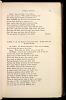 page:
page: 21
-
Chand. Age, my lord, views
motives,
- And views not acts. When neither warbling voice
- Nor trilling pipe is heard, nor pleasure sits
- With trembling age, the voice of Conscience, then
- Sweeter than music in a summer’s eve,
- Shall warble round the snowy head, and keep
- Sweet symphony to feather’d angels sitting
- As guardians round your chair; then shall the pulse
-
160Beat slow; and taste and touch, sight, sound, and smell,
- That sing and dance round Reason’s
fine-wrought throne,
- Shall flee away, and lease him all forlorn—
- Yet not forlorn if Conscience is his friend.
[
Exeunt.
-
Sir Walter. Sir Thomas
Dagworth, I have been a-weeping
- Over the men that are to die to-day.
-
Dagw. Why, brave Sir Walter,
you or I may fall.
-
Sir Walter. I know this
breathing flesh must lie and rot
- Cowed with silence and forgetfulness.—
- Death wons in cities’ smoke, and in still night,
- When men sleep in their beds, walketh about!
- How many in walled cities lie and groan,
- Turning themselves about upon their beds,
-
10 Talking with Death, answering his hard demands!
- How many walk in darkness, terrors around
- The curtains of their beds, destruction still
- Ready without the door! how many sleep
- In earth, cover’d with stones and deathy dust,
- Resting in quietness, whose spirits walk
- Upon the clouds of heaven, to die no more!
- Yet death is terrible, though on angels’ wings
:
- How terrible, then, is the field of death!
- Where he doth rend the vault of heav’n, and
shake
-
20 The gates of hell! Oh Dagworth! France is sick:
- The very sky, tho’ sunshine light it, seems
- To me as pale as the pale fainting man
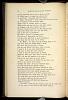 page:
page: 22
- On his death-bed, whose face is shown by light
- Of sickly taper! It makes me sad and sick
- At very heart. Thousands must fall to-day.
-
Dagw. Thousands of souls
must leave this prison house
- To be exalted to those heavenly fields,
- Where songs of triumph, palms of victory,
- Where peace, and joy, and love, and calm content
-
30 Sit singing in the azure clouds, and strew
- Flowers of heaven’s growth over the banquet
table.
- Bind ardent Hope upon your feet like shoes,
- Put on the robe of preparation,
- The table is prepar’d in shining
heav’n,
- The flowers of immortality are blown;
- Let those that fight fight in good steadfastness,
- And those that fall shall rise in victory.
-
Sir Walter. I’ve
often seen the burning field of war
- And often heard the dismal clang of arms;
-
40 But never, till this fatal day of Cressy,
- Has my soul fainted with these views of death.
- I seem to be in one great charnel-house,
- And seem to scent the rotten carcases!
- I seem to hear the dismal yells of Death,
- While the black gore drops from his horrid jaws;
- Yet I not fear the monster in his pride.—
- But oh, the souls that are to die to-day!
-
Dagw. Stop, brave Sir Walter,
let me drop a tear,
- Then let the clarion of war begin;
-
50I’ll fight and weep! ‘tis in my
country’s cause;
- I’ll weep and shout for glorious liberty.
- Grim War shall laugh and shout, bedeck’d in
tears,
- And blood shall flow like streams across the meadows,
- That murmur down their pebbly channels, and
- Spend their sweet lives to do their country service.
- Then England’s leaves shall shoot, her fields
shall smile,
- Her ships shall sing across the foaming sea,
- Her mariners shall use the flute and viol,
- And rattling guns and black and dreary war
-
60 Shall be no more.
-
Sir Walter. Well, let the
trumpet sound and the drum beat;
- Let war stain the blue heavens with bloody banners.
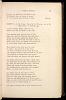 page:
page: 23
- I’ll draw my sword, nor ever sheath it up,
- Till England blow the trump of victory,
- Or I lie stretch’d upon the field of death.
[
Exeunt.
- O Sons of Trojan Brutus, cloth’d in war,
- Whose voices are the thunder of the field,
- Your ancestors came from the fires of Troy,
- (Like lions rous’d by light’ning from
their dens,
- Whose eyes do glare against the stormy fires,)
- Heated with war, fill’d with the blood of
Greeks,
- With helmets hewn, and shields covered with gore,
- In navies black, broken with wind and tide.
- They landed in firm array upon the rocks
-
10Of Albion; they kiss’d the rocky shore:
- ‘Be thou our mother and our nurse,’
they said,
- ‘Our children’s mother; and thou
shalt be our grave,
- ‘The sepulchre of ancient Troy, from whence
- ‘Shall rise cities, and thrones, and awful
powers.’
- Our fathers swarm from the ships. Giant voices
- Are heard from out the hills; the enormous sons
- Of Ocean run from rocks and caves: wild men,
- Naked, and roaring like lions, hurling rocks,
- And wielding knotty clubs, like oaks entangled,
-
20 Thick as a forest ready for the axe.
- Our fathers move in firm array to battle;
- The savage monsters rush like roaring fire,
- Like as a forest roars with crackling flames,
- When the red lightning borne by furious storms
- Lights on some woody shore, and the parch’d
heavens
- Rain fire into the molten raging sea.
- Our fathers, sweating, lean on their spears and view
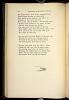 page:
page: 24
- The mighty dead: giant bodies streaming blood,
- Dread visages frowning in silent death.
-
30Then Brutus speaks, inspired; our fathers sit
- Attentive on the melancholy shore.
- Hear ye the voice of Brutus:—‘The
flowing waves
- ‘Of Time come rolling o’er my
breast,’ he said,
- ‘And my heart labours with futurity.
- ‘Our sons shall rule the empire of the sea,
- ‘Their mighty wings shall stretch from east to
west;
- ‘Their nest is in the sea, but they shall roam
- ‘Like eagles for their prey. ..
- ‘Our sons shall rise from thrones in joy, each
one
-
40‘Buckling his armour on; Morning shall be
- ‘Prevented by the gleaming of their swords,
- ‘And Evening hear their song of victory.
- ‘Freedom shall stand upon the cliffs of Albion,
- ‘Casting her blue eyes over the green ocean;
- ‘Or, towering, stand upon the roaring waves,
- ‘Stretching her mighty spear o’er distant lands,
- ‘While with her eagle wings she covereth
- ‘Fair Albion’s shore and all her families.’
Note: There is an illustration at the bottom of the page.
![Image of page [25]](http://www.rossettiarchive.org/img/thumbs_small/gilchrist1863.v2.25.jpg) page:
page: [25]
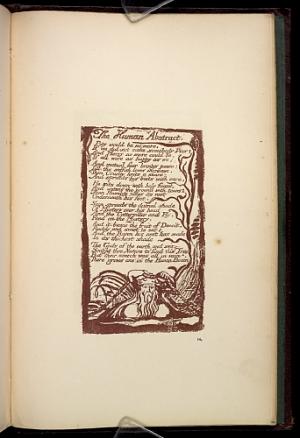
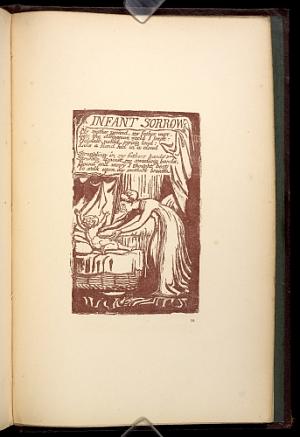
[Here again but little need be added to what has been already said in
the
Life respecting the
Songs of Innocence and Experience. The first series is incomparably the more beautiful of the two,
being indeed almost flawless in essential respects; while in the second
series, the five years intervening between the two had proved sufficient for
obscurity and the darker mental phases of Blake’s writings to set in and
greatly mar its poetic value. This contrast is more especially evident in
those pieces whose subjects tally in one and the other series. For instance,
there can be no comparison between the first
Chimney Sweeper, which touches with such perfect simplicity the true pathetic chord
of its subject, and the second, tinged merely with the common-places of
social discontent. However, very perfect and noble examples of Blake’s
metaphysical poetry occur among the
Songs of Experience, such as
Christian Forbearance, and
The Human Abstract. One piece, the second
Cradle Song, I have myself introduced from the MS. note-book often referred to,
since there can be no doubt that it was written to match with the first, and
it has quite sufficient beauty to give it a right to its natural place. A
few alterations and additions in other poems have been made from the same
source. As the purpose of these republications from Blake is hardly
furthered by including anything of inferior value, I confess that it
occurred to me at first to omit any pieces which seemed really chargeable
with triviality and incompleteness, and therefore likely to obstruct
appreciation with many readers; but I was unwilling, on mature reflection,
to dismember the work as Blake wrote it, particularly as the second section
would have thus come to bear no proportion in bulk to the first. Here, then,
is the whole; and assuredly its beauties, surpassing in degree, and perhaps
unparalleled in kind, not only greatly outweigh its defects, but are also
clearly separable from them.]
 page:
page: 26
- Piping down the valleys wild,
- Piping songs of pleasant glee,
- On a cloud I saw a child,
- And he, laughing, said to me:
- ‘Pipe a song about a Lamb!’
- So I piped with merry cheer.
- ‘Piper, pipe that song again;’
- So I piped: he wept to hear.
- ‘Drop thy pipe, thy happy pipe;
-
10 Sing thy songs of happy cheer!’
- So I sang the same again,
- While he wept with joy to hear.
- ‘Piper, sit thee down and write
- In a book, that all may read.’
- So he vanish’d from my sight,
- And I pluck’d a hollow reed,
- And I made a rural pen,
- And I stain‘d the water clear,
- And I wrote my happy songs
-
20 Every child may joy to hear.
 page:
page: 27
- How sweet is the shepherd’s sweet lot!
- From the morn to the evening he strays;
- He shall follow his sheep all the day,
- And his tongue shall be filled with praise.
- For he hears the lambs’ innocent call,
- And he hears the ewes’ tender reply;
- He is watchful while they are in peace,
- For they know that their shepherd is nigh.
 page:
page: 28
- The sun does arise
- And make happy the skies;
- The merry bells ring,
- To welcome the spring;
- The skylark and thrush,
- The birds of the bush,
- Sing louder around
- To the bells’ cheerful sound;
- While our sports shall be seen
-
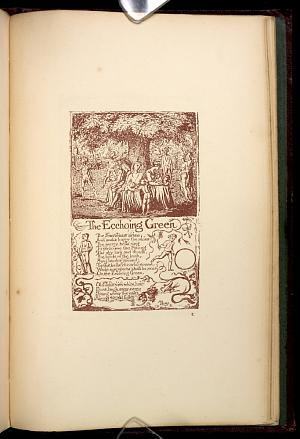
10On the echoing green.
- Old John, with white hair,
- Does laugh away care,
- Sitting under the oak,
- Among the old folk.
- They laugh at our play,
- And soon they all say,
- ‘Such, such were the joys
- When we all—girls and boys—
- ln our youth-time were seen
-
20On the echoing green.’
- Till the little ones, weary,
- No more can be merry,
- The sun does descend,
- And our sports have an end.
- Round the laps of their mothers
- Many sisters and brothers,
- Like birds in their nest,
- Are ready for rest,
- And sport no more seen
-
30 On the darkening green.
 page:
page: 29
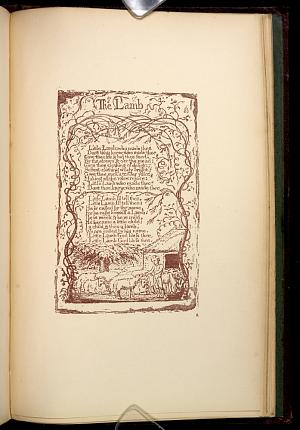
- Little lamb, who made thee?
- Dost thou know who made thee,
- Gave thee life, and bade thee feed
- By the stream and o’er the mead;
- Gave thee clothing of delight,
- Softest clothing, woolly, bright;
- Gave thee such a tender voice,
- Making all the vales rejoice?
- Little lamb, who made thee?
-
10Dost thou know who made thee?
- Little lamb, I’ll tell thee;
- Little lamb, I’ll tell thee:
- He is called by thy name,
- For He calls Himself a Lamb.
- He is meek, and He is mild,
- He became a little child.
- I a child, and thou a lamb,
- We are called by His name.
- Little lamb, God bless thee!
-
20Little lamb, God bless thee
 page:
page: 30
- My mother bore me in the southern wild,
- And I am black, but O my soul is white.
- White as an angel is the English child,
- But I am black, as if bereaved of light.
- My mother taught me underneath a tree,
- And, sitting down before the heat of day,
- She took me on her lap and kissèd me,
- And, pointing to the East, began to say:
- ‘Look on the rising sun: there God does live,
-
10And gives His light, and gives His heat away,
- And flowers and trees and beasts and men receive
- Comfort in morning, joy in the noonday.
- ‘And we are put on earth a little space,
- That we may learn to bear the beams of love;
- And these black bodies and this sunburnt face
- Are but a cloud, and like a shady grove.
- ‘For when our souls have learn’d the
heat to bear,
- The cloud will vanish, we shall hear His voice,
- Saying, “Come out from the grove, my love and care,
-
20And round my golden tent like lambs
rejoice.” ’
- Thus did my mother say, and kissèd me,
- And thus I say to little English boy:
- When I from black, and he from white cloud free,
- And round the tent of God like lambs we joy;
- I’ll shade him from the heat till he can bear
- To lean in joy upon our Father’s knee;
- And then I’ll stand and stroke his silver hair,
- And be like him, and he will then love me.
 page:
page: 31
- Merry, merry sparrow!
- Under leaves so green
- A happy blossom
- Sees you, swift as arrow,
- Seek your cradle narrow,
- Near my bosom.
- Pretty, pretty robin!
- Under leaves so green
- A happy blossom
-
10Hears you sobbing, sobbing,
- Pretty, pretty robin,
- Near my bosom.
 page:
page: 32
- When my mother died I was very young,
- And my father sold me while yet my tongue
- Could scarcely cry, ‘Weep! weep! weep!
weep!’
- So your chimneys I sweep, and in soot I sleep.
- There’s little Tom Dacre, who cried when his head,
- That curled like a lamb’s back, was shaved; so I
said,
- ‘Hush, Tom! never mind it, for when your
head’s bare,
- You know that the soot cannot spoil your white
hair.’
- And so he was quiet, and that very night,
-
10As Tom was a-sleeping, he had such a sight;
- That thousands of sweepers, Dick, Joe, Ned, and Jack,
- Were all of them lock’d up in coffins of
black.
- And by came an angel, who had a bright key,
- And he opened the coffins, and set them all free;
- Then down a green plain, leaping, laughing they run,
- And wash in a river, and shine in the sun.
- Then naked and white, all their bags left behind,
- They rise upon clouds, and sport in the wind;
- And the angel told Tom, if he’d be a good boy,
-
20He’d have God for his father, and never want
joy.
- And so Tom awoke, and we rose in the dark,
- And got with our bags and our brushes to work;
- Though the morning was cold, Tom was happy and warm:
- So, if all do their duty, they need not fear harm.
 page:
page: 33
- Father, father, where are you going?
- O do not walk so fast;
- Speak, father, speak to your little boy,
- Or else I shall be lost.
- The night was dark, no father was there.
- The child was wet with dew;
- The mire was deep, and the child did weep,
- And away the vapour flew.
- The little boy lost in the lonely fen,
- Led by the wandering light,
- Began to cry, but God, ever nigh,
- Appeared like his father, in white.
- He kissed the child, and by the hand led,
- And to his mother brought,
- Who in sorrow pale, through the lonely dale,
- The little boy weeping sought.
 page:
page: 34
- When the green woods laugh with the voice of joy,
- And the dimpling stream runs laughing by;
- When the air does laugh with our merry wit
- And the green hill laughs with the noise of it;
- When the meadows laugh with lively green,
- And the grasshopper laughs in the merry scene;
- When Mary, and Susan, and Emily,
- With their sweet round mouths sing, “Ha, ha,
he!”
- When the painted birds laugh in the shade,
-
10 Where our table with cherries and nuts is spread:
- Come live, and be merry, and join with me,
- To sing the sweet chorus of “Ha, ha, he
!”
 page:
page: 35
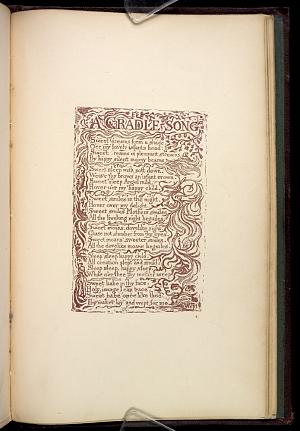
- Sweet dreams, form a shade
- O’er my lovely infant’s head!
- Sweet dreams of pleasant streams
- By happy, silent, moony beams!
- Sweet sleep, with soft down
- Weave thy brows an infant crown!
- Sweet sleep, angel mild,
- Hover o’er my happy child!
- Sweet smiles, in the night
-
10 Hover over my delight!
- Sweet smiles, mother’s smile,
- All the livelong night beguile!
- Sweet moans, dovelike sighs,
- Chase not slumber from thine eyes!
- Sweet moan, sweeter smile
- All the dovelike moans beguile!
- Sleep, sleep, happy child!
- All creation slept and smiled.
- Sleep, sleep, happy sleep!
-
20While o’er thee doth mother weep.
- Sweet babe, in thy face
- Holy image I can trace;
- Sweet babe, once like thee
- Thy Maker lay, and wept for me!
- Wept for me, for thee, for all,
- When He was an infant small.
- Thou His image ever see,
- Heavenly face that smiles on thee!
- Smiles on thee, on me, on all,
-
30Who became an infant small;
- Infant smiles like His own smile
- Heaven and earth to peace beguile.
 page:
page: 36
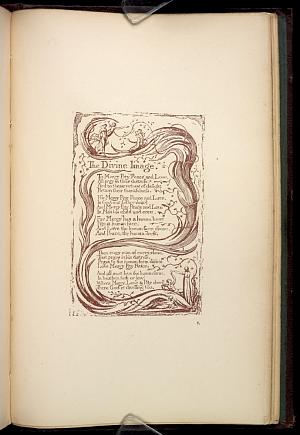
- To mercy, pity, peace, and love,
- All pray in their distress,
- And to these virtues of delight
- Return their thankfulness.
- For mercy, pity, peace, and love,
- Is God our Father dear;
- And mercy, pity, peace, and love,
- Is man, His child and care.
- For Mercy has a human heart,
-
10 Pity a human face;
- And Love, the human form divine;
- And Peace, the human dress.
- Then every man, of every clime,
- That prays in his distress,
- Prays to the human form divine:
- Love, Mercy, Pity, Peace.
- And all must love the human form,
- In heathen, Turk, or Jew;
- Where mercy, love, and pity dwell,
-
20There God is dwelling too.
 page:
page: 37
- ’Twas on a Holy Thursday, their
innocent faces clean,
- Came children walking two and two, in red, and blue, and green
:
- Grey-headed beadles walk’d before, with wands as
white as snow,
- Till into the high dome of Paul’s, they like
Thames’ waters flow.
- O what a multitude they seem‘d, these flowers of
London town,
- Seated in companies they were, with radiance all their own:
- The hum of multitudes was there, but multitudes of lambs,
- Thousands of little boys and girls raising their innocent
hands.
- Now like a mighty wind they raise to heaven the voice of song,
-
10Or like harmonious thunderings the seats of heaven among:
- Beneath them sit the aged men, wise guardians of the poor.
- Then cherish pity, lest you drive an angel from your
door.
 page:
page: 38
- The sun descending in the west,
- The evening star does shine,
- The birds are silent in their nest,
- And I must seek for mine.
- The moon, like a flower
- In heaven’s high bower,
- With silent delight,
- Sits and smiles on the night.
- Farewell, green fields and happy grove,
-
10 Where flocks have ta’en delight;
- Where lambs have nibbled, silent move
- The feet of angels bright;
- Unseen, they pour blessing,
- And joy without ceasing,
- On each bud and blossom,
- And each sleeping bosom.
- They look in every thoughtless nest,
- Where birds are covered warm;
- They visit caves of every beast,
-
20 To keep them all from harm:
- If they see any weeping
- That should have been sleeping,
- They pour sleep on their head,
- And sit down by their bed.
- When wolves and tigers howl for prey,
- They pitying stand and weep;
- Seeking to drive their thirst away,
- And keep them from the sheep.
- But if they rush dreadful,
-
30The angels, most heedful,
- Receive each mild spirit,
- New worlds to inherit
 page:
page: 39
- And there the lion’s ruddy eyes
- Shall flow with tears of gold:
- And pitying the tender cries,
- And walking round the fold:
- Saying: ‘Wrath by His meekness,
- And by His health, sickness,
- Are driven away
-
40From our immortal day.
- ‘And now beside thee, bleating lamb,
- I can lie down and sleep,
- Or think on Him who bore thy name,
- Graze after thee, and weep.
- For wash’d in life’s river,
- My bright mane for ever
- Shall shine like the gold,
- As I guard o’er the fold.’
 page:
page: 40
- Sound the flute!
- Now ’tis mute;
- Birds delight,
- Day and night,
- Nightingale
- In the dale,
- Lark in sky,—
- Merrily,
- Merrily, merrily to welcome in the year.
-
10Little boy,
- Full of joy;
- Little girl,
- Sweet and small;
- Cock does crow,
- So do you;
- Merry voice,
- Infant noise;
- Merrily, merrily to welcome in the year.
- Little lamb,
-
20 Here I am;
- Come and lick
- My white neck;
- Let me pull
- Your soft wool;
- Let me kiss
- Your soft face;
- Merrily, merrily we welcome in the year.
 page:
page: 41
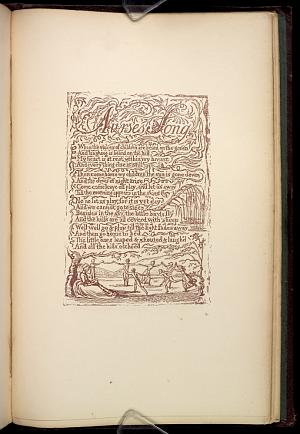
- When the voices of children are heard on the
green,
- And laughing is heard on the hill,
- My heart is at rest within my breast,
- And everything else is still.
- Then come home, my children, the sun is gone down,
- And the dews of night arise;
- Come, come, leave off play, and let us away
- Till the morning appears in the skies.
- No, no, let us play, for it is yet day,
-
10And we cannot go to sleep;
- Besides, in the sky the little birds fly,
- And the hills are all covered with sheep.
- Well, well, go and play till the light fades away,
- And then go home to bed.
- The little ones leaped, and shouted, and laugh’d,
- And all the hills echoèd.
 page:
page: 42
- ‘I have no name;
- I am but two days old.’
- What shall I call thee?
- ‘I happy am,
- Joy is my name.‘
- Sweet joy befall thee!
- Pretty joy!
- Sweet joy, but two days old.
- Sweet joy I call thee:
- Thou dost smile.
- I sing the while,
- Sweet joy befall thee!
 page:
page: 43
- Once a dream did weave a shade
- O’er my angel-guarded bed,
- That an emmet lost its way
- Where on grass methought I lay.
- Troubled, ’wilder’d, and forlorn,
- Dark, benighted, travel-worn,
- Over many a tangled spray,
- All heart-broke, I heard her say:
- ‘O, my children do they cry,
-
10 Do they hear their father sigh?
- Now they look abroad to see,
- Now return and weep for me.’
- Pitying, I dropp’d a tear:
- But I saw a glow-worm near,
- Who replied, ‘What wailing wight
- Calls the watchman of the night?
- ‘I am set to light the ground,
- While the beetle goes his round
- Follow now the beetle’s hum,
-
20 Little wanderer, hie thee home!’
 page:
page: 44
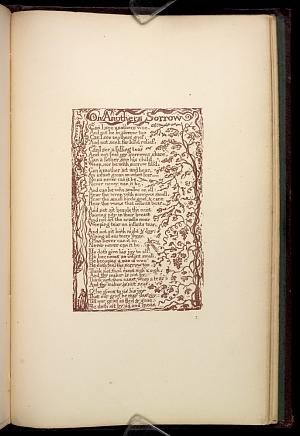
- Can I see another’s woe,
- And not be in sorrow too?
- Can I see another’s grief,
- And not seek for kind relief?
- Can I see a falling tear,
- And not feel my sorrow’s share?
- Can a father see his child
- Weep, nor be with sorrow fill’d?
- Can a mother sit and hear,
-
10An infant groan, an infant fear?
- No, no! never can it be!
- Never, never can it be!
- And can He, who smiles on all,
- Hear the wren, with sorrows small,
- Hear the small bird’s grief and care,
- Hear the woes that infants bear?
- And not sit beside the nest,
- Pouring Pity in their breast?
- And not sit the cradle near,
-
20Weeping tear on infant’s tear?
 page:
page: 45
- And not sit both night and day,
- Wiping all our tears away?
- Oh, no! never can it be!
- Never, never can it be!
- He doth give His joy to all:
- He becomes an infant small,
- He becomes a man of woe,
- He doth feel the sorrow too.
- Think not thou canst sigh a sigh,
-
30 And thy Maker is not by:
- Think not thou canst weep a tear,
- And thy Maker is not near.
- Oh! He gives to us His joy,
- That our griefs He may destroy:
- Till our grief is fled and gone
- He doth sit by us and moan.
 page:
page: 46
- Youth of delight I come hither
- And see the opening morn,
- Image of Truth new-born.
- Doubt is fled, and clouds of reason,
- Dark disputes and artful teazing.
- Folly is an endless maze;
- Tangled roots perplex her ways;
- How many have fallen there!
- They stumble all night over bones of the dead;
-
10 And feel—they know not what save care;
- And wish to lead others, when they should be led.
 page:
page: 47
- Hear the voice of the bard,
- Who Present, Past, and Future see;
- Whose ears have heard
- The Holy Word
- That walked among the ancient trees,
- Calling the lapsed soul,
- And weeping in the evening dew;
- That might control
- The starry pole,
-
10And fallen, fallen light renew!
- O Earth, O Earth, return!
- Arise from out the dewy grass!
- Night is worn,
- And the morn
- Rises from the slumberous mass.
- Turn away no more;
- Why wilt thou turn away?
- The starry floor,
- The watery shore,
- Is given thee till the break of day.
 page:
page: 48
- Earth raised up her head
- From the darkness dread and drear,
- Her light fled,
- (Stony dread!)
- And her locks covered with grey despair.
- ‘Prisoned on watery shore,
- Starry jealousy does keep my den
- Cold and hoar;
- Weeping o’er,
-
10I hear the father of the ancient men.
- Selfish father of men!
- Cruel, jealous, selfish fear!
- Can delight,
- Chain’d in night,
- The virgins of youth and morning bear?
- Does spring hide its joy,
- When buds and blossoms grow?
- Does the sower
- Sow by night?
-
20Or the ploughman in darkness plough?
- Break this heavy chain,
- That does freeze my bones around!
- Selfish, vain,
- Eternal bane,
- That free love with bondage bound.’
 page:
page: 49
- Love seeketh not itself to please,
- Nor for itself hath any care,
- But for another gives its ease,
- And builds a heaven in hell’s
despair.
- So sang a little clod of clay,
- Trodden with the cattle’s feet;
- But a pebble of the brook
- Warbled out these metres meet:
- ‘Love seeketh only
Self to please,
-
10To bind another to its delight,
- Joys in another’s loss of ease,
- And builds a hell in heaven’s
despite.’
 page:
page: 50
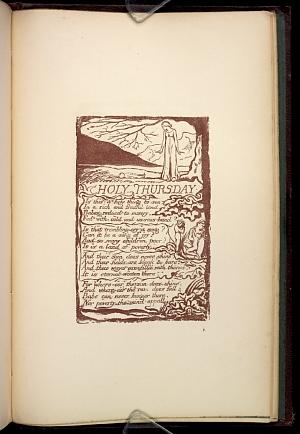
- Is this a holy thing to see,
- In a rich and fruitful land,
- Babes reduced to misery,
- Fed with a cold usurious hand?
- Is that trembling cry a song?
- Can it be a song of joy;
- And so many children poor?
- It is a land of poverty!
- And their sun does never shine,
-
10And their fields are bleak and bare,
- And their ways are fill’d with thorns:
- It is eternal winter there.
- For where’er the sun does shine,
- And where’er the rain does fall,
- Babes should never hunger there,
- Nor poverty the mind appal.
 page:
page: 51
- In futurity,
- I prophetic see,
- That the earth from sleep
- (Grave the sentence deep)
- Shall arise, and seek
- For her Maker meek;
- And the desert wild
- Become a garden mild.
- In the southern clime,
-
10Where the summer’s prime
- Never fades away,
- Lovely Lyca lay.
- Seven summers old
- Lovely Lyca told.
- She had wandered long,
- Hearing wild birds’ song.
- ‘Sweet sleep, come to me
- Underneath this tree;
- Do father, mother weep?
-
20Where can Lyca sleep?
- ‘Lost in desert wild
- Is your little child.
- How can Lyca sleep
- If her mother weep?
- If her heart does ache,
- Then let Lyca wake;
- If my mother sleep,
- Lyca shall not weep.
 page:
page: 52
- ‘Frowning, frowning night,
-
30 O’er this desert bright
- Let thy moon arise,
- While I close my eyes.’
- Sleeping Lyca lay
- While the beasts of prey,
- Come from caverns deep,
- View’d the maid asleep.
- The kingly lion stood
- And the virgin view’d,
- Then he gambol’d round
-
40O’er the hallow’d ground;
- Leopards, tigers, play
- Round her as she lay,
- While the lion old
- Bow’d his mane of gold,
- And her breast did lick,
- And upon her neck,
- From his eyes of flame,
- Ruby tears there came;
- While the lioness
-
50Loos’d her slender dress,
- And naked they conveyed
- To caves the sleeping maid.
 page:
page: 53
- All the night in woe
- Lyca’s parents go
- Over valleys deep,
- While the desarts weep.
- Tired and woe-begone,
- Hoarse with making moan,
- Arm in arm, seven days
- They tread the desart ways.
- Seven nights they sleep
-
10 Among shadows deep,
- And dream they see their child
- Starved in desart wild.
- Pale thro’ pathless ways
- The fancied image strays
- Famished, weeping, weak,
- With hollow piteous shriek.
- Rising from unrest,
- The trembling woman prest
- With feet of weary woe;
-
20 She could no further go.
- In his arms he bore
- Her, armed with sorrows sore;
- Till before their way
- A couching lion lay.
- Turning back was vain,
- Soon his heavy mane
- Bore them to the ground;
- Then he stalk’d around,
 page:
page: 54
- Smelling to his prey,
-
30But their feats allay
- When he licks their hands
- And silent by them stands.
- They look upon his eyes
- Filled with deep surprise;
- And wondering behold
- A spirit arm’d in gold.
- On his head a crown,
- On his shoulders down
- Flow’d his golden hair.
-
40 Gone was all their care.
- ‘Follow me,’ he said,
- ‘Weep not for the maid;
- ‘In my palace deep,
- ‘Lyca lies asleep.’
- Then they followèd
- Where the vision led,
- And saw their sleeping child
- Among tigers wild.
- To this day they dwell
-
50In a lonely dell,
- Nor fear the wolvish howl
- Nor the lion’s growl.
 page:
page: 55
- A Little black thing among the snow,
- Crying ‘weep! weep!’ in notes of woe
- Where are thy father and mother? Say:—
- ‘They are both gone up to the church to pray.
- ‘Because I was happy upon the heath,
- ‘And smil’d among the winter’s
snow,
- ‘ They clothed me in the clothes of death,
- ‘And taught me to sing the notes of woe.
- ‘And because I am happy and dance and sing,
-
10‘They think they have done me no injury,
- ‘And are gone to praise God and His Priest and
King,
- ‘Who make up a heaven of our
misery.’
 page:
page: 56
- When the voices of children are heard on the
green,
- And whisperings are in the dale,
- The days of my youth rise fresh in my mind,
- My face turns green and pale.
- Then come home, my children, the sun is gone down,
- And the dews of night arise;
- Your spring and your day are wasted in play,
- And your winter and night in disguise.
- O Rose, thou art sick!
- The invisible worm
- That flies in the night,
- In the howling storm,
- Has found out thy bed
- Of crimson joy,
- And his dark secret love
- Does thy life destroy.
 page:
page: 57
- Little Fly,
- Thy summer’s play
- My thoughtless hand
- Has brushed away.
- Am not I
- A fly like thee?
- Or art not thou
- A man like me?
- For I dance,
-
10And drink, and sing,
- Till some blind hand
- Shall brush my wing.
- If thought is life,
- And strength, and breath;
- And the want
- Of thought is death;
- Then am I
- A happy fly,
- If I live,
-
20Or if I die.
 page:
page: 58
- I Dreamt a dream! What can it mean?
- And that I was a maiden Queen
- Guarded by an Angel mild:
- Witless woe was ne’er beguil’d!
- And I wept both night and day,
- And he wip’d my tear away;
- And I wept both day and night,
- And hid from him my heart’s delight
- So he took his wings, and fled;
-
10 Then the morn blush’d rosy red.
- I dried my tears, and arm’d my fears
- With ten thousand shields and spears.
- Soon my Angel came again,
- I was arm’d, he came in vain;
- For the time of youth was fled,
- And grey hairs were on my head.
 page:
page: 59
- Tiger, Tiger, burning bright
- In the forests of the night,
- What immortal hand or eye
- Framed thy fearful symmetry?
- In what distant deeps or skies
- Burned that fire within thine eyes?
- On what wings dared he aspire?
- What the hand dared seize the fire?
- And what shoulder, and what art,
-
10Could twist the sinews of thy heart?
- When thy heart began to beat,
- What dread hand formed thy dread feet?
- What the hammer, what the chain,
- Knit thy strength and forged thy brain?
- What the anvil? What dread grasp
- Dared thy deadly terrors clasp?
- When the stars threw down their spears,
- And water’d heaven with their tears,
- Did he smile his work to see?
-
20Did He who made the lamb make thee?
 page:
page: 60
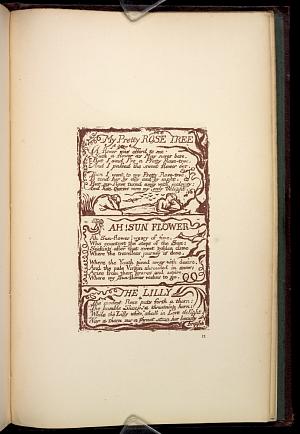
- A Flower was offer’d to me,
- Such a flower as May never bore,
- But I said, I’ve a pretty rose tree,
- And I passed the sweet flower o’er.
- Then I went to my pretty rose tree,
- To tend her by day and by night,
- But my Rose turned away with jealousy
- And her thorns were my only delight.
- Ah! Sunflower! weary of time,
- Who countest the steps of the sun;
- Seeking after that sweet golden prime
- Where the traveller’s journey is done;
- Where the Youth pined away with desire,
- And the pale virgin shrouded in snow,
- Arise from their graves and aspire
- Where my sunflower wishes to go.
 page:
page: 61
- The modest Rose puts forth a thorn,
- The humble sheep a threat’ning horn:
- While the Lily white shall in Love delight,
- Nor a thorn, nor a threat, stain her beauty bright.
- I Laid me down upon a bank,
- Where Love lay sleeping;
- I heard among the rushes dank
- Weeping, weeping.
- Then I went to the heath and the wild,
- To the thistles and thorns of the waste;
- And they told me how they were beguil’d
- Driven out, and compelled to be chaste.
- I went to the Garden of Love,
-
10And saw what I never had seen;
- A Chapel was built in the midst,
- Where I used to play on the green.
- And the gates of this Chapel were shut,
- And ‘thou shalt not,’ writ
over the door;
- So I turned to the Garden of Love
- That so many sweet flowers bore.
- And I saw it was filled with graves,
- And tombstones where flowers should be,
- And priests in black gowns were walking their rounds,
-
20 And binding with briars my joys and desires.
 page:
page: 62
- Dear mother, dear mother, the Church is
cold,
- But the Alehouse is healthy, and pleasant, and warm,
- Besides, I can tell where I am used well;
- The poor parsons with wind like a blown bladder swell.
- But if at the Church they would give us some Ale,
- And a pleasant fire our souls to regale,
- We’d sing and we’d pray all the livelong
day,
- Nor ever once wish from the Church to stray.
- Then the Parson might preach, and drink, and sing,
-
10And we’d be as happy as birds in the spring,
- And modest Dame Lurch, who is always at Church,
- Would not have bandy children, nor fasting, nor birch.
- And God, like a father, rejoicing to see
- His children as pleasant and happy as He,
- Would have no more quarrel with the Devil or the Barrel,
- But kiss him, and give him both drink and apparel.
 page:
page: 63
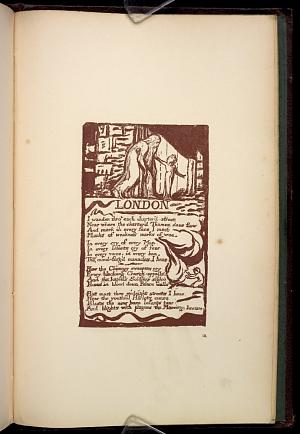
- I Wander through each charter’d
street,
- Near where the charter’d Thames does
flow,
- And mark in every face I meet
- Marks of weakness, marks of woe.
- In every cry of every man,
- In every infant’s cry of fear,
- In every voice, in every ban,
- The mind-forg’d manacles I hear.
- How the chimney-sweeper’s cry
-
10Every blackening church appals,
- And the hapless soldier’s sigh
- Runs in blood down palace walls.
- But most, through midnight streets I hear
- How the youthful harlot’s curse
- Blasts the new-born infant’s tear,
- And blights with plagues the Marriage hearse.
 page:
page: 64
- Pity would be no more
- If we did not make somebody poor,
- And Mercy no more could be
- If all were as happy as we.
- And mutual fear brings Peace,
- Till the selfish loves increase;
- Then Cruelty knits a snare,
- And spreads his baits with care.
- He sits down with holy fears,
-
10And waters the ground with tears;
- Then Humility takes its root
- Underneath his foot.
- Soon spreads the dismal shade
- Of Mystery over his head,
- And the caterpillar and fly
- Feed on the Mystery.
- And it bears the fruit of Deceit,
- Ruddy and sweet to eat,
- And the raven his nest has made
-
20In its thickest shade.
- The gods of the earth and sea
- Sought through nature to find this tree,
- But their search was all in vain:
- There grows one in the human Brain.
 page:
page: 65
- My mother groaned, my father wept,
- Into the dangerous world I leapt,
- Helpless, naked, piping loud,
- Like a fiend hid in a cloud.
- Struggling in my father’s hands,
- Striving against my swaddling bands,
- Bound, and weary, I thought best
- To sulk upon my mother’s breast.
- I was angry with my friend:
- I told my wrath, my wrath did end.
- I was angry with my foe:
- I told it not, my wrath did grow.
- And I watered it in fears
- Night and morning with my tears,
- And I sunnèd it with smiles
- And with soft deceitful wiles.
- And it grew both day and night
-
10 Till it bore an apple bright,
- And my foe beheld it shine,
- And he knew that it was mine,
- And into my garden stole
- When the night had veil’d the pole;
- In the morning, glad, I see
- My foe outstretched beneath the tree.
 page:
page: 66
- ‘Nought loves another as itself,
- ‘ Nor venerates another so,
- ‘Nor is it possible to thought
- ‘A greater than itself to know.
- ‘And, Father, how can I love you
- ‘Or any of my brothers more?
- ‘I love you like the little bird
- ‘That picks up crumbs around the
door.’
- The Priest sat by and heard the child;
-
10 In trembling zeal he seiz’d his hair,
- He led him by his little coat,
- And all admired the priestly care.
- And standing on the altar high,
- ‘Lo! what a fiend is here,’
said he,
- ‘One who sets reason up for judge
- ‘Of our most holy
Mystery.’
- The weeping child could not be heard,
- The weeping parents wept in vain,
- They stripp’d him to his little shirt,
-
20 And bound him in an iron chain,
- And burned him in a holy place
- Where many had been burned before;
- The weeping parents wept in vain.
- Are such things done on Albion’s
shore?
 page:
page: 67
- Children of the future Age,
- Reading this indignant page,
- Know that, in a former time,
- Love, sweet love, was thought a crime.
- In the age of gold,
- Free from winter’s cold,
- Youth and maiden bright,
- To the holy light,
- Naked in the sunny beams delight.
-
10Once a youthful pair,
- Fill’d with softest care,
- Met in garden bright,
- Where the holy light
- Had just removed the curtains of the night.
- Then, in rising day,
- On the grass they play;
- Parents were afar,
- Strangers came not near,
- And the maiden soon forgot her fear.
-
20Tired with kisses sweet,
- They agree to meet
- When the silent sleep,
- Waves o’er heaven’s deep
- And the weary tired wanderers weep.
- To her father white
- Came the maiden bright,
- But his loving look,
- Like the holy book,
- All her tender limbs with terror shook.
-
30Ona! pale and weak,
- To thy father speak;
- Oh the trembling fear,
- Oh! the dismal care
- That shakes the blossoms of my hoary hair!
 page:
page: 68
- Sleep, sleep, beauty bright,
- Dreaming in the joys of night;
- Sleep, sleep; in thy sleep
- Little sorrows sit and weep.
- Sweet babe, in thy face
- Soft desires I can trace,
- Secret joys and secret smiles,
- Little pretty infant wiles.
- As thy softest limbs I feel,
-
10Smiles as of the morning steal
- O’er thy cheek, and o’er thy breast
- Where thy little heart doth rest.
- Oh the cunning wiles that creep
- In thy little heart asleep!
- When thy little heart doth wake,
- Then the dreadful light shall break.
 page:
page: 69
- I Love to rise on a summer morn,
- When birds are singing on every tree;
- The distant huntsman winds his horn,
- And the skylark sings with me:
- O what sweet company!
- But to go to school in a summer morn,—
- Oh! it drives all joy away;
- Under a cruel eye outworn,
- The little ones spend the day
-
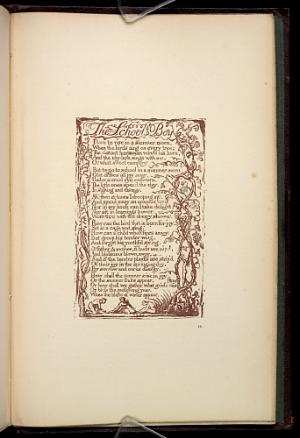
10In sighing and dismay.
- Ah! then at times I drooping sit
- And spend many an anxious hour;
- Nor in my book can I take delight,
- Nor sit in learning’s bower,
- Worn through with the dreary shower.
- How can the bird that is born for joy
- Sit in a cage and sing?
- How can a child, when fears annoy,
- But droop his tender wing,
-
20And forget his youthful spring?
- O father and mother, if buds are nipp’d,
- And blossoms blown away;
- And if the tender plants are stripp’d
- Of their joy in the springing day,
- By sorrow and care’s dismay,—
- How shall the summer arise in joy,
- Or the summer fruits appear?
- Or how shall we gather what griefs destroy,
- Or bless the mellowing year,
-
30When the blasts of winter appear?
 page:
page: 70
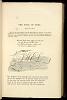
- Whate’er is born of Mortal Birth
- Must be consumed with the earth,
- To rise from generation free:
- Then what have I to do with thee?
- The sexes sprang from shame and pride,
- Blown in the morn, in evening died;
- But mercy changed death into sleep;
- The sexes rose to work and weep.
- Thou, mother of my mortal part,
-
10 With cruelty didst mould my heart,
- And with false self-deceiving tears
- Didst bind my nostrils, eyes, and ears,
- Didst close my tongue in senseless clay,
- And me to mortal life betray.
- The death of Jesus set me free:
- Then what have I to do with thee?
 page:
page: 71
[The
Thel has been spoken of in the
Life
(Chapter X. page 76). It is equal in
delightfulness to Blake’s
lyrical poetry; and being the most tender and simple of the
class of
his works to which it belongs, may prove the most generally acceptable as
a specimen of these.]
-
Does the Eagle know what is in the pit?
-
Or wilt thou go ask the mole?
-
Can Wisdom be put in a silver rod?
-
Or Love in a golden bowl?
Note: The title “THEL I” is illustrated.
- The daughters of the Seraphim led round their sunny flocks,
- All but the youngest: she in paleness sought the secret air
- To fade away like morning beauty from her mortal day.
- Down by the river of Adona her soft voice is heard,
- And thus her gentle lamentation falls like morning dew.
 page:
page: 72
- “O life of this our Spring! why fades the lotus of
the water?
- Why fade these children of the Spring, born but to smile
and fall?
- Ah! Thel is like a watery bow, and like a parting cloud,
- Like a reflection in a glass, like shadows in the water,
-
10 Like dreams of infants, like a smile upon an infant’s face,
- Like the dove’s voice, like transient day, like
music in the air.
- Ah! gentle may I lay me down, and gentle rest my head,
- And gentle sleep the sleep of death, and gentle hear the voice
- Of him that walketh in the garden in the evening
time.”
- The Lily of the valley breathing in the humble grass
- Answer’d the lovely maid and said: ”I
am a watery weed,
- And I am very small, and love to dwell in lowly vales;
- So weak, the gilded butterfly scarce perches on my head.
- Yet I am visited from heaven; and He that smiles on all
-
20Walks in the valley, and each morn over me spreads His hand,
- Saying, ‘Rejoice, thou humble grass, thou new-born
lily-flower,
- Thou gentle maid of silent valleys and of modest brooks;
- For thou shalt be clothed in light and fed with morning manna,
- Till summer’s heat melts thee beside the fountains
and the springs
- To flourish in eternal vales.’ Then why should
Thel complain?
- Why should the mistress of the vales of Har utter a
sigh?”
- She ceased and smiled in tears, then sat down in her silver
shrine.
- Thel answer’d: “O thou little virgin of
the peaceful valley,
- Giving to those that cannot crave, the voiceless, the
o’ertired;
-
30 Thy breath doth nourish the innocent lamb, he smells thy
milky garments,
- He crops thy flowers, while thou sittest smiling in his face,
- Wiping his mild and meekin mouth from all contagious taints.
- Thy wine doth purify the golden honey, thy perfume,
- Which thou dost scatter on every little blade of grass that
springs,
- Revives the milked cow, and tames the fire-breathing steed.
- But Thel is like a faint cloud kindled at the rising sun:
- I vanish from my pearly throne, and who shall find my
place?”
- “Queen of the vales,” the Lily answered,
“ask the tender cloud,
 page:
page: 73
- And it shall tell thee why it glitters in the morning sky,
-
40 And why it scatters its bright beauty through the humid air.
- Descend, O little cloud, and hover before the eyes of
Mel.”
- The cloud descended, and the Lily bowed her modest head
- And went to mind her numerous charge among the verdant
grass.
- “O little cloud,” the virgin said,
“I charge thee tell to me
- Why thou complainest not, when in one hour thou
fad’st away:
- Then we shall seek thee, but not find. Ah! Thel is like to
thee;
- I pass away, yet I complain and no one hears my
voice.”
- The cloud then showed his golden head, and his bright form
emerged
- Hovering and glittering on the air before the face of Thel.
- “O virgin, know’st thou not our steeds
drink of the golden springs
- Where Luvah doth renew his horses? Look’st thou on
my youth,
- And fearest thou because I vanish and am seen no more?
-
10Nothing remains. O maid, I tell thee, when I pass away
- It is to tenfold life, to love, to peace, and raptures holy.
- Unseen descending weigh my light wings upon balmy flowers,
- And court the fair-eyed dew to take me to her shining tent:
- The weeping virgin trembling kneels before the risen sun,
- Till we arise, link’d in a golden band, and never
part,
- But walk united, bearing food to all our tender
flowers.”
- “Dost thou, O little cloud? I fear that I am not
like thee;
- For I walk through the vales of Har, and smell the
sweetest flowers;
- But I feed not the little flowers: I hear the warbling birds,
-
20 But I feed not the warbling birds, they fly and seek their
food:
- But Thel delights in these no more because I fade away,
- And all shall say, without a use this shining woman
liv’d,
- Or did she only live to be at death the food of
worms?”
- The Cloud reclined upon his airy throne and
answer’d thus:
- “Then if thou art the food of worms, O virgin of
the skies,
 page:
page: 74
- How great thy use, how great thy blessing. Every thing that
lives,
- Lives not alone nor for itself. Fear not, and I will call
- The weak worm from its lowly bed, and thou shalt hear its
voice.
- Come forth, worm of the silent valley, to thy pensive
queen.”
-
30The helpless worm arose, and sat upon the Lily’s
leaf,
- And the bright cloud sailed on to find his partner in the
vale.
- Then Thel, astonished, viewed the worm upon its dewy bed.
- “Art thou a worm? image of weakness, art thou but a
worm?
- I see thee, like an infant, wrapped in the Lily’s leaf:
- Ah! weep not, little voice, thou must not speak, but thou
canst weep.
- Is this a worm? I see thee lie helpless and naked, weeping,
- And none to answer, none to cherish thee with mothers
smiles.”
- The clod of clay heard the worm’s voice, and rais’d
her pitying head:
- She bow’d over the weeping infant, and her life
exhal’d
- In milky fondness: then on Thel she fix’d her
humble eyes.
-
10“O beauty of the vales of Har! we live not for
ourselves.
- Thou seest me, the meanest thing, and so I am indeed;
- My bosom of itself is cold and of itself is dark,
- But He that loves the lowly pours His oil upon my head,
- And kisses me, and binds His nuptial bands around my breast,
- And says:—‘ Thou mother of my children,
I have loved thee,
- And I have given thee a crown that none can take
away.’
- But how this is, sweet maid, I know not, and I cannot know;
- I ponder, and I cannot ponder: yet I live and
love!”
- The daughter of beauty wip’d her pitying tears with
her white veil,
-
20 And said:—“Alas I knew not this, and
therefore did I weep.
- That God would love a worm, I knew, and punish the evil foot
- That wilful bruised its helpless form; but that he
cherish’d it
- With milk and oil, I never knew, and therefore did I weep.
- And I complained in the mild air, because I fade away,
- And lay me down in thy cold bed, and leave my shining
lot.”
 page:
page: 75
- “Queen of the vales,” the matron clay
answered; “I heard thy sighs,
- And all thy moans flew o’er my roof, but I have
call’d them down.
- Wilt thou, O queen, enter my house? ‘tis given thee
to enter,
- And to return: fear nothing, enter with thy virgin
feet.”
- The eternal gates’ terrrific porter lifted the
northern bar;
- Thel enter’d in and saw the secrets of the land
unknown.
- She saw the couches of the dead, and where the fibrous root
- Of every heart on earth infixes deep its restless twists:
- A land of sorrows and of tears, where never smile was seen.
- She wander’d in the land of clouds, through valleys
dark, listening
- Dolours and lamentations; wailing oft beside a dewy grave
- She stood in silence, listening to the voices of the ground,
- Till to her own grave-plot she came, and there she sat down,
-
10And heard this voice of sorrow breathed from the hollow
pit.
- “Why cannot the ear be closed to its own
destruction?
- Or the glistening eye to the poison of a smile?
- Why are eyelids stor’d with arrows ready drawn,
- Where a thousand fighting-men in ambush lie,
- Or an eye of gifts and graces showering fruits and coined gold?
- “Why a tongue impress’d with honey from
every wind?
- Why an ear, a whirlpool fierce to draw creations in?
- Why a nostril wide inhaling terror, trembling and affright?
- Why a tender curb upon the youthful burning boy?
-
20Why a little curtain of flesh on the bed of our
desire?”
- The virgin started from her seat, and with a shriek
- Fled back unhinder’d till she came into the vales
of Har.
![Image of page [76]](http://www.rossettiarchive.org/img/thumbs_small/gilchrist1863.v2.76.jpg) page:
page: [76]
[The contents of the precious section which now follows have been
derived partly from the MS. Note-book to which frequent reference has been
made in the
Life, and partly from another small autograph collection of different
matter, somewhat more fairly copied. The poems have been reclaimed, as
regards the first-mentioned source, from as chaotic a mass as could well be
imagined; amid which it has sometimes been necessary either to omit,
transpose, or combine, so as to render available what was very seldom found
in a final state. And even in the pieces drawn from the second source
specified above, means of the same kind have occasionally been resorted to,
where they seemed to lessen obscurity or avoid redundance. But with all
this, there is nothing throughout that is not faithfully Blake’s own.
One piece in this series (
The Two Songs) may be regarded as a different version of
The Human Abstract, occurring in the
Songs of Experience. This new form is certainly the finer one, I think, by reason of its
personified character, which adds greatly to the force of the impression
produced. It is, indeed, one of the finest things Blake ever did, really
belonging, by its vivid completeness, to the order of perfect short
poems,—never a very large band, even when the best poets are
ransacked to recruit it. Others among the longer poems of this section,
which are, each in its own way, truly admirable, are
Broken Love,
Mary, and
Auguries of Innocence.
Never perhaps have the agony and perversity of sundered affection been
more powerfully (however singularly) expressed than in the piece called
Broken Love. The speaker is one whose soul has been intensified by pain to be
his only world, among the scenes, figures, and events of which he moves as
in a new state of being. The emotions have been quickened and isolated by
conflicting torment, till each is a separate companion. There is his
‘spectre,’ the jealous pride which scents in the snow
the footsteps of the beloved rejected woman, but is a wild beast to guard
his way from reaching her; his ‘emanation’ which
silently weeps within him, for has not he also sinned? So they wander
together in ‘a fathomless and boundless deep,’ the
morn full of tempests and the night of tears. Let her weep, he says, not for
his sins only, but for her own; nay, he will cast his sins upon her
shoulders too; they shall be more and more till she come to him again. Also
this woe of his can array itself in stately imagery. He can count separately
how many of his soul’s affections the knife she stabbed it with
has slain, how many yet mourn over the tombs which he has built for these:
he can tell, too, of some that still watch around his bed, bright sometimes
with ecstatic passion of melancholy, and crowning his mournful head with
vine. All these living forgive her transgressions: when will she look upon
them, that the dead may live again? Has she not pity to give for pardon?
nay, does he not need her pardon too? He cannot seek her, but oh! if she
would return! Surely her place is ready for her, and bread and wine of
forgiveness of sins.
I have dwelt on the meaning of this poem, because it is one which,
from the figurative form given to it, might be accounted specially obscure.
But in reality, it perhaps the only instance in which Blake has dealt with
any of the deeper phases of human passion; and though the way of dealing with it is
all his own, the result is as startlingly true as
 page:
page: 77
it is grand and impressive,
and gives rise to regret that this poet did not oftener elect to walk
in the ways, not of spirits or children, but of living men.
The
Crystal Cabinet and the
Mental Traveller belong to a more truly mystical order of poetry. The former is a
lovely piece of lyrical writing, but certainly has not the clearness of
crystal. Yet the meaning of such among Blake’s compositions as
this is, may sometimes be missed chiefly through seeking for a sense more
recondite than was really meant. This enigmatic-looking poem probably does
no more than symbolize in a new way the world-old phenomena of a lover’s
transfiguration of his mistress and of all things through her, and the
reaction when the dream is broken by a too ardent effort to embody it. The
most absolutely puzzling stanza is the last, where the disenchanted couple
become a weeping woman and
babe; perhaps meant to express the greater
natural maturity of the love-element in women.
The
Mental Traveller seemed at first a hopeless riddle; and the editor of these
selections must confess to having been on the point of omitting it, in spite
of its high poetic beauty, as incomprehensible. He is indebted to his
brother for the clear-sighted, and no doubt correct, exposition which is now
printed with it, and brings its full value to light.
The poem of
Mary appears to be, on one side, an allegory of the poetic or spiritual
mind moving unrecognised and reviled among its fellows; and this view of it
is corroborated when we find Blake applying to himself two lines almost
identically taken from it, in the last of the Letters printed towards the
close of this volume. But the literal meaning may be accepted, too, as a
hardly extreme expression of the rancour and envy so constantly attending
pre-eminent beauty in women.
A most noble, though surpassingly quaint example of Blake’s
loving sympathy with all forms of created life, as well as of the kind of
oracular power which he possessed of giving vigorous expression to abstract
or social truths, will be found in the
Auguries of Innocence. It is a somewhat tangled skein of thought, but stored throughout
with the riches of simple wisdom.
Quaintness reaches its climax in
William Bond, which may be regarded as
a kind of glorified street-ballad. One point that requires to be noted, if
the reader would arrive at such moderate comprehension as seems possible
here, is that the term ‘fairies’ is evidently used to
indicate passionate emotion, while ‘angels’ are
spirits of coldness and repulsion. The close of the ballad is very beautiful
in its two last stanzas, but the upshot of the story is wonderfully hazy. It
would appear most probably to imply a reconciliation, resulting from the
hero's pity for the heroine, whom he has been trying to get rid of. If so, it
must be admitted that Mr. Bond is no great prize, nor Miss Green a very
enviable dramatic personage. I have inserted this ballad because it
certainly has beauties as well as peculiarities, and also because it is one
of only two such examples among Blake’s poetry. The other is
coined
Long John Brown and Little Mary Bell, and perhaps the reader may be sufficiently surprised without it.
The shorter poems, and even the fragments, afford many instances of
that exquisite metrical gift and rightness in point of form which constitute
Blake’s special glory among his contemporaries, even more
eminently perhaps than the grander command of mental resources which is also
his. Such qualities of pure perfection in
writing verse,
as he perpetually without effort displayed, are to be met with among those
elder poets whom he loved, and such again are now looked upon as the
peculiar trophies of a school which has arisen since his time; but he alone
(let it be repeated and remembered) possessed them
then,
and possessed them in clear completeness. Colour and metre, these are the
true patents of nobility in painting and poetry, taking precedence of all
intellectual claims; and it is by virtue of these, first of all, that Blake
holds in both arts a rank which cannot be taken from him.
Of the
Epigrams on Art, which conclude this section, a few are really pointed, others
 page:
page: 78
amusingly
irascible,—all more or less a sort of nonsense verses, and not
even pretending to be much else. To enter into their reckless spirit of
doggrel, it is almost necessary to see the original note-book in which they
occur, which continually testifies, by sudden exclamatory entries, to the
curious degree of boyish impulse which was one of Blake’s
characteristics. It is not improbable that such names as Rembrandt, Rubens, Correggio, Reynolds, may have met the reader’s eye before in a very different
sort of context from that which surrounds them in the surprising poetry of
this their brother artist; and certainly they are made to do service here
as scarecrows to the crops of a rather jealous husbandman. And for all that,
I have my strong suspicions that the same amount of disparagement of them
uttered
to instead of
by our good Blake,
would have elicited on his side a somewhat different estimate. These phials
of his wrath, however, have no poison but merely some laughing gas in them;
So now that we are setting the laboratory a little in order, let these too
come down from their dusty upper shelf.]
-
He. Where thou dwellest,
in what grove,
- Tell me, fair one, tell me, love,
- Where thou thy charming nest dost build,
- O thou pride of every field!
-
She. Yonder stands a lonely tree,
- There I live and mourn for thee;
- Morning drinks my silent tear,
- And evening winds my sorrow bear.
-
He. O thou summer’s harmony,
-
10I have lived and mourned for thee;
- Each day I mourn along the wood,
- And night hath heard my sorrows loud.
-
She. Dost thou truly long for me?
- And am I thus sweet to thee?
- Sorrow now is at an end,
- O my lover and my friend!
-
He. Come! on wings of joy we’ll
fly
- To where my bower is hung on high;
- Come, and make thy calm retreat
-
20 Among green leaves and blossoms sweet.
 page:
page: 79
- My Spectre around me night and day
- Like a wild beast guards my way;
- My Emanation far within
- Weeps incessantly for my sin.
- A fathomless and boundless deep,
- There we wander, there we weep;
- On the hungry craving wind
- My Spectre follows thee behind.
- He scents thy footsteps in the snow,
-
10 Wheresoever thou dost go;
- Through the wintry hail and rain
- When wilt thou return again?
- Poor pale pitiable form
- That I follow in a storm,
- From sin I never shall be free
- Till thou forgive and come to me.
- A deep winter dark and cold
- Within my heart thou dost unfold;
- Iron tears and groans of lead
-
20Thou bind’st around my aching head.
- Dost thou not in pride and scorn
- Fill with tempests all my morn,
- And with jealousies and fears?—
- And fill my pleasant nights with tears?
- O’er my sins thou dost sit and moan:
- Hast thou no sins of thine own?
- O’er my sins thou dost sit and weep
- And lull thine own sins fast asleep.
 page:
page: 80
- Thy weeping thou shalt ne’er give o’er;
-
30 I sin against thee more and more,
- And never will from sin be free
- Till thou forgive and come to me,
- What transgressions I commit
- Are for thy transgressions fit,—
- They thy harlots, thou their slave;
- And my bed becomes their grave.
- Seven of my sweet loves thy knife
- Hath bereaved of their life:
- Their marble tombs I built, with tears
-
40And with cold and shadowy fears.
- Seven more loves weep night and day
- Round the tombs where my loves lay,
- And seven more loves attend at night
- Around my couch with torches bright.
- And seven more loves in my bed
- Crown with vine my mournful head;
- Pitying and forgiving all
- Thy transgressions, great and small.
- When wilt thou return, and view
-
50My loves, and them in life renew?
- When wilt thou return and live?
- When wilt thou pity as I forgive?
- Throughout all Eternity
- I forgive you, you forgive me.
- As our dear Redeemer said:
- ‘This the wine, and this the bread.’
 page:
page: 81
- I Heard an Angel singing
- When the day was springing:
- ‘Mercy, Pity, and Peace
- Are the world’s release.’
- So he sang all day
- Over the new-mown hay,
- Till the sun went down,
- And haycocks looked brown.
- I heard a Devil curse
-
10Over the heath and the furze:
- ‘Mercy could be no more
- If there were nobody poor,
- And Pity no more could be
- If all were happy as ye:
- And mutual fear brings Peace.
- Misery’s increase
- Are Mercy, Pity, Peace.’
- At his cures the sun went down,
- And the heavens gave a frown.
 page:
page: 82
- I saw a chapel all of gold
- That none did dare to enter in,
- And many weeping stood without,
- Weeping, mourning, worshipping.
- I saw a serpent rise between
- The white pillars of the door,
- And he forced and forced and forced
- Till he the golden hinges tore:
- And along the pavement sweet,
-
10Set with pearls and rubies bright,
- All his shining length he drew,
- Till upon the altar white
- He vomited his poison out
- On the bread and on the wine.
- So I turned into a sty,
- And laid me down among the swine.
 page:
page: 83
- Why was Cupid a boy,
- And why a boy was he?
- He should have been a girl,
- For aught that I can see.
- For he shoots with his bow,
- And the girl shoots with her eye,
- And they both are merry and glad
- And laugh when we do cry.
- Then to make Cupid a boy
-
10 Was surely a woman’s plan,
- For a boy never learns so much
- Till he has become a man:
- And then he’s so pierced with cares
- And wounded with arrowy smarts,
- That the whole business of his life
- Is to pick out the heads of the darts.
 page:
page: 84
- The vision of Christ that thou dost see
- Is my vision’s greatest enemy.
- Thine is the fare of all mankind,—
- Mine speaks in parables to the blind;
- Thine loves the same world that mine hates;
- Thy Heaven-doors are my Hell-gates.
- Socrates taught what Meletus
- Loathed as a nation’s bitterest curse,
- And Caiaphas was in his own mind
-
10A benefactor to mankind.
- Both read the Bible day and night;
- But thou read’st black where I read white.
- Jesus sat in Moses’ chair;
- They brought the trembling woman there;
- Moses commands she be stoned to death;
- What was the sound of Jesus’ breath?
- He laid his hand on Moses’ law:
- The ancient heavens in silent awe,
- Writ with curses from pole to pole,
-
20 All away began to roll.
- The earth trembling and naked lay,
- In secret bed of mortal clay,
- And she heard the breath of God
- As she heard it by Eden’s flood:—
- ‘To be good only, is to be
- ‘A God, or else a Pharisee.
- ‘Thou Angel of the Presence Divine,
- ‘That didst create this body of mine,
 page:
page: 85
- ‘Wherefore hast thou writ these laws
-
30 ‘And created Hell’s dark jaws?
- ‘Though thou didst all to chaos roll
- ‘With the serpent for its soul,
- ‘Still the breath Divine doth move,
- ‘And the breath Divine is Love.
- ‘Woman, fear not; let me see
- ‘The seven devils that trouble thee;
- ‘Hide not from my sight thy sin,
- ‘That full forgiveness thou may’st win.
- ‘ Hath no man condemned thee?’
- ‘Then what is he
- ‘Who shall accuse thee? Come ye forth,
- ‘Ye fallen fiends of heavenly birth!
- ‘Ye shall bow before her feet,
- ‘Ye shall lick the dust for meat;
- ‘And though ye cannot love, but hate,
- ‘Ye shall be beggars at love’s gate.
- ‘What was thy love? Let me see’t!
- ‘Was it love, or dark deceit?’
-
50‘Love too long from me hath fled;
- ‘ ’Twas dark deceit, to earn my bread;
- ‘ ’Twas covet, or ’twas
custom, or
- ‘Some trifle not worth caring for.
- ‘But these would call a shame and sin
- ‘Love’s temple that God dwelleth
in.’
 page:
page: 86
- Never seek to tell thy love,
- Love that never told can be;
- For the gentle wind doth move
- Silently, invisibly.
- I told my love, I told my love,
- I told her all my heart,
- Trembling, cold, in ghastly fears.
- Ah! she did depart.
- Soon after she was gone from me,
-
10 A traveller came by,
- Silently, invisibly:
- He took her with a sigh.
 page:
page: 87
- As I wandered in the forest
- The green leaves among,
- I heard a wild-flower
- Singing a song.
- ‘I slept in the earth
- ‘In the silent night,
- ‘I murmured my fears
- ‘And I felt delight.
- ‘In the morning I went,
-
10‘As rosy as morn,
- ‘To seek for new joy,
- ‘ But I met with scorn.’
 page:
page: 88
- The maiden caught me in the wild,
- Where I was dancing merrily;
- She put me into her cabinet,
- And locked me up with a golden key.
- This cabinet is formed of gold,
- And pearl and crystal shining bright,
- And within it opens into a world
- And a little lovely moony night.
- Another England there I saw,
-
10Another London with its tower,
- Another Thames and other hills,
- And another pleasant Surrey bower.
- Another maiden like herself,
- Translucent, lovely, shining clear,
- Threefold, each in the other closed,
- O what a pleasant trembling fear!
- O what a smile! a threefold smile
- Filled me that like a flame I burned;
- I bent to kiss the lovely maid,
-
20And found a threefold kiss returned.
- I strove to seize the inmost form
- With ardour fierce and hands of flame,
- But burst the crystal cabinet,
- And like a weeping babe became.
- A weeping babe upon the wild,
- And weeping woman pale reclined,
- And in the outward air again
- I filled with woes the passing wind.
 page:
page: 89
- There is a smile of Love,
- And there is a smile of Deceit,
- And there is a smile of smiles
- In which the two smiles meet.
- And there is a frown of Hate,
- And there is a frown of Disdain,
- And there is a frown of frowns
- Which you strive to forget in vain,
- For it sticks in the heart’s deep core
-
10 And it sticks in the deep backbone.
- And no smile ever was smiled
- But only one smile alone
- (And betwixt the cradle and grave
- It only once smiled can be),
- That when it once is smiled
- There’s an end to all misery.
 page:
page: 90
- Beneath a white thorn’s lovely
May,
- Three virgins at the break of day:—
- ‘Whither, young man, whither away?
- Alas for woe! alas for woe!’
- They cry, and tears for ever flow.
- The first was clothed in flames of fire,
- The second clothed in iron wire;
- The third was clothed in tears and sighs,
- Dazzling bright before my eyes.
-
10They bore a net of golden twine
- To hang upon the branches fine.
- Pitying I wept to see the woe
- That love and beauty undergo—
- To be clothed in burning fires
- And in ungratified desires,
- And in tears clothed night and day;
- It melted all my soul away.
- When they saw my tears, a smile
- That might heaven itself beguile
-
20 Bore the golden net aloft,
- As on downy pinions soft,
- Over the morning of my day.
- Underneath the net I stray,
- Now intreating Flaming-fire,
- Now intreating Iron-wire,
- Now intreating Tears-and-sighs.—
- O when will the morning rise!
 page:
page: 91
- ‘Awake, awake, my little boy!
- Thou wast thy mother’s only joy;
- Why dost thou weep in thy gentle sleep?
- O wake! thy father doth thee keep.
- ‘O what land is the land of dreams?
- What are its mountains and what are its streams?’
- ‘O father! I saw my mother there,
- Among the lilies by waters fair.
- ‘Among the lambs clothèd in white,
-
10She walked with her Thomas in sweet delight.
- I wept for joy, like a dove I mourn—
- O when shall I again return!’
- ‘Dear child! I also by pleasant streams
- Have wandered all night in the land of dreams,
- But, though calm and warm the waters wide,
- I could not get to the other side.’
- ‘Father, O father! what do we here,
- In this land of unbelief and fear?
- The land of dreams is better far,
-
20 Above the light of the morning star.’
 page:
page: 92
- Sweet Mary, the first time she ever was
there,
- Came into the ball-room among the fair;
- The young men and maidens around her throng,
- And these are the words upon every tongue:
- ‘An angel is here from the heavenly climes,
- Or again return the golden times;
- Her eyes outshine every brilliant ray,
- She opens her lips—’tis the month of
May.’
- Mary moves in soft beauty and conscious delight,
-
10To augment with sweet smiles all the joys of the night,
- Nor once blushes to own to the rest of the fair
- That sweet love and beauty are worthy our care.
- In the morning the villagers rose with delight,
- And repeated with pleasure the joys of the night,
- And Mary arose among friends to be free,
- But no friend from henceforward thou, Mary, shalt see.
- Some said she was proud, some reviled her still more,
- And some when she passed by shut-to the door;
- A damp cold came o’er her, her blushes all fled,
-
20Her lilies and roses are blighted and shed.
- ‘O why was I born with a different face,
- Why was I not born like this envious race?
- Why did heaven adorn me with bountiful hand,
- And then set me down in an envious land?’
 page:
page: 93
- ‘To be weak as a lamb and smooth as a dove,
- And not to raise envy, is called Christian love;
- But if you raise envy your merit’s to blame
- For planting such spite in the weak and the tame.
- ‘I will humble my beauty, I will not dress fine,
-
30I will keep from the ball, and my eyes shall not shine;
- And if any girl’s lover forsakes her for me,
- I’ll refuse him my hand and from envy be
free.’
- She went out in the morning attired plain and neat;
- ‘Proud Mary’s gone mad,’ said
the child in the street;
- She went out in the morning in plain neat attire,
- And came home in the evening bespattered with mire.
- She trembled and wept, sitting on the bed-side,
- She forgot it was night, and she trembled and cried;
- She forgot it was night, she forgot it was morn,
-
40Her soft memory imprinted with faces of scorn.
- With faces of scorn and with eyes of disdain,
- Like foul fiends inhabiting Mary’s mild brain;
- She remembers no face like the human divine;
- All faces have envy, sweet Mary, but thine.
- And thine is a face of sweet love in despair,
- And thine is a face of mild sorrow and care,
- And thine is a face of wild terror and fear
- That shall never be quiet till laid on its bier.
 page:
page: 94
To see a world in a grain of sand
And a Heaven in a wild flower,
Hold infinity in the palm of your hand
And Eternity in an hour.
- A Robin redbreast in a cage
- Puts all Heaven in a rage;
- A dove-house filled with doves and pigeons
- Shudders hell through all its regions;
- A dog starved at his master’s gate
- Predicts the ruin of the State;
- A game-cock clipped and armed for fight
- Doth the rising sun affright;
- A horse misused upon the road
-
10Calls to Heaven for human blood;
- Every wolf’s and lion’s howl
- Raises from Hell a human soul;
- Each outcry of the hunted hare
- A fibre from the brain doth tear;
- A skylark wounded on the wing
- Doth make a cherub cease to sing.
- He who shall hurt the little wren
- Shall never be beloved by men;
- He who the ox to wrath has moved
-
20 Shall never be by woman loved;
- He who shall train the horse to war
- Shall never pass the Polar Bar;
- The wanton boy that kills the fly
- Shall feel the spider’s enmity;
- He who torments the chafer’s sprite
- Weaves a bower in endless night.
- The caterpillar on the leaf
- Repeats to thee thy mother’s grief:
 page:
page: 95
- The wild deer wandering here and there
-
30Keep the human soul from care:
- The lamb misused breeds public strife,
- And yet forgives the butcher’s knife.
- Kill not the moth nor butterfly,
- For the last judgment draweth nigh;
- The beggar’s dog, and widow’s cat,
- Feed them, and thou shalt grow fat.
- Every tear from every eye
- Becomes a babe in Eternity;
- The bleat, the bark, bellow, and roar,
-
40Are waves, that beat on Heaven’s shore.
- The bat that flits at close of eye
- Has left the brain that won’t believe;
- The owl that calls upon the night
- Speaks the unbeliever’s fright;
- The gnat that sings his summer’s song
- Poison gets from slander’s tongue;
- The poison of the snake and newt
- Is the sweat of envy’s foot;
- The poison of the honey bee
-
50Is the artist’s
jealousy;
- The strongest poison ever known
- Came from Cæsar’s laurel-crown.
- Naught can deform the human race
- Like to the armourer’s iron brace;
- The soldier armed with sword and gun
- Palsied strikes the summer’s sun;
- When gold and gems adorn the plough,
- To peaceful arts shall envy bow;
- The beggar’s rags fluttering in air
-
60 Do to rags the heavens tear;
- The prince’s robes and beggar’s rags
- Are toadstools on the miser’s bags;
- One mite wrung from the labourer’s hands
- Shall buy and sell the miser’s lands,
- Or, if protected from on high,
- Shall that whole nation sell and buy;
 page:
page: 96
- The poor man’s farthing is worth more
- Than all the gold on Afric’s shore.
- The whore and gambler, by the state
-
70 Licensed, build that nation’s fate;
- The harlot’s cry from street to street
- Shall weave old England’s winding-sheet;
- The winner’s shout, the loser’s curse,
- Shall dance before dead England’s hearse.
- He who mocks the infant’s faith
- Shall be mocked in age and death;
- He who shall teach the child to doubt
- The rotting grave shall ne’er get out;
- He who respects the infant’s faith
-
80 Triumphs over hell and death;
- The babe is more than swaddling bands
- Throughout all these human lands;
- Tools were made and born were hands,
- Every farmer understands.
- The questioner who sits so sly
- Shall never know how to reply;
- He who replies to words of doubt
- Doth put the light of knowledge out;
- A puddle, or the cricket’s cry,
-
90 Is to doubt a fit reply;
- The child’s toys and the old man’s
reasons
- Are the fruits of the two seasons;
- The emmet’s inch and eagle’s mile
- Make lame philosophy to smile;
- A truth that’s told with bad intent
- Beats all the lies you can invent.
- He who doubts from what he sees
- Will ne’er believe, do what you please;
- If the sun and moon should doubt,
-
100 They’d immediately go out.
- Even, night and every morn
- Some to misery are born;
- Every morn and every night
- Some are born to sweet delight;
 page:
page: 97
- Some are born to sweet delight,
- Some am born to endless night.
- Joy and woe are woven fine,
- A clothing for the soul divine;
- Under every grief and pine
-
110Runs a joy with silken twine.
- It is right it should be so;
- Man was made for joy and woe;
- And when this we rightly know,
- Safely through the world we go.
- We are led to believe a lie
- When we see
with not
through the eye
- Which was born in a night to perish in a night
- When the soul slept in beams of light.
- God appears and God is light
-
120To those poor souls who dwell in night;
- But doth a human form display
- To those who dwell in realms of day.
Note: There is an illustration at the bottom of the page.
 page:
page: 98
The ‘Mental Traveller’ indicates an explorer of mental
phænomena. The mental phænomenon here symbolized
seems to be the career of any great Idea or intellectual
movement—as, for instance, Christianity, chivalry, art,
&c.—represented as going through the stages of
—1. birth, 2. adversity and persecution, 3. triumph and
maturity, 4. decadence through over-ripeness, 5. gradual transformation,
under new conditions, into another renovated Idea, which again has to
pass through all the same stages. In other words, the poem represents
the action and re-action of Ideas upon society, and of society upon
Ideas.
Argument of the stanzas: 2. The Idea, conceived with
pain, is born amid enthusiasm. 3 If of masculine, enduring nature, it
falls under the control and ban of the already existing state of society
(the woman old). 5. As the Idea developes, the old society becomes
moulded into a new society (the old woman grows young). 6. The Idea, now
free and dominant, is united to society, as it were in wedlock. 8. It
gradually grows old and effete, living now only upon the spiritual
treasures laid up in the days of its early energy. 10. These still
subserve many purposes of practical good, and outwardly the Idea is in
its most flourishing estate, even when sapped at its roots. 11. The halo
of authority and tradition, or prestige, gathering round the Idea, is
symbolized in the resplendent babe born on his hearth. 13. This prestige
deserts the Idea itself, and attaches to some individual, who usurps the
honour due only to the Idea (as we may see in the case of papacy,
royalty, &c.); and the Idea is eclipsed by its own very
prestige, and assumed living representative. 14. The Idea wanders
homeless till it can find a new community to mould (‘until he
can a maiden win’). 15 to 17. Finding whom, the Idea finds
itself also living under strangely different conditions. 18. The Idea is
now “beguiled to infancy”—becomes a
new Idea, in working upon a fresh community, and under
altered conditions. 20. Nor are they yet thoroughly at one; she flees
away while he pursues. 22. Here we return to the first state of the
case. The Idea starts upon a new course—is a babe; the
society it works upon has become an old society—no longer a
fair virgin, but an aged woman. 24. The Idea seems so new and unwonted
that, the nearer it is seen, the more consternation it excites. 26. None
can deal with the Idea so as to develope it to the full, except the old
society with which it comes into contact; and this can deal with it only
by misusing it at first, whereby (as in the previous stage, at the
opening of the poem) it is to be again disciplined into ultimate
triumph.
- 1
- I travelled through a land of men,
- A land of men and women too;
- And heard and saw such dreadul things
- As cold earth-wanderers never knew.
 page:
page: 99
- 2.
- For there the babe is born in joy
- That was begotten in dire woe;
- Just as we reap in joy the fruit
- Which we in bitter tears did sow.
- 3.
- And if the babe is born a boy,
-
10He’s given to a woman old,
- Who nails him down upon a rock,
- Catches his shrieks in cups of gold.
- 4.
- She binds strong thorns around his head,
- She pierces both his hands and feet,
- She cuts his heart out at his side,
- To make it feel both cold and heat.
Note: Typo: the first words of this stanza should be “Her fingers.”
- 5.
- He rfingers number every nerve
- Just as a miser counts his gold;
- She lives upon his shrieks and cries,
-
20And she grows young as he grows old.
- 6.
- Till he becomes a bleeding youth,
- And she becomes a virgin bright;
- Then he rends up his manacles
- And binds her down for his delight.
- 7.
- He plants himself in all her nerves
- Just as a husbandman his mould,
- And she becomes his dwelling-place
- And garden fruitful seventyfold.
- 8.
- An aged shadow soon he fades,
-
30Wandering round an earthly cot,
- Full fillèd all with gems and gold
- Which he by industry had got.
 page:
page: 100
- 9.
- And these are the gems of the human soul,
- The rubies and pearls of a lovesick eye,
- The countless gold of the aching heart,
- The martyr’s groan and the
lover’s sigh.
- 10.
- They are his meat, they are his drink;
- He feeds the beggar and the poor;
- To the wayfaring traveller
-
40For ever open is his door.
- 11.
- His grief is their eternal joy,
- They make the roofs and walls to ring;
- Till from the fire upon the hearth
- A little female babe doth spring.
- 12.
- And she is all of solid fire
- And gems and gold, that none his hand
- Dares stretch to touch her baby form
- Or wrap her in his swaddling band.
- 13.
- But she comes to the man she loves,
-
50If young or old or rich or poor;
- They soon drive out the aged host,
- A beggar at another’s door.
- 14.
- He wanders weeping far away,
- Until some other take him in;
- Oft blind and age-bent, sore distres’d,
- Until he can a maiden win.
- 15.
- And to allay his freezing age,
- The poor man takes her in his arms;
- The cottage fades before his sight,
-
60The garden and its lovely charms.
 page:
page: 101
- 16.
- The guests are scattered through the land;
- For the eye altering alters all;
- The senses roll themselves in fear,
- And the flat earth becomes a ball.
- 17.
- The stars, sun, moon, all shrink away,
- A desert vast without a bound,
- And nothing left to eat or drink,
- And a dark desert all around:
- 18.
- The honey of her infant lips,
-
70The bread and wine of her sweet smile,
- The wild game of her roving eye,
- Do him to infancy beguile.
- 19.
- For as he eats and drinks be grows
- Younger and younger every day,
- And on the desert wild they both
- Wander in terror and dismay.
- 20
- Like the wild stag she flees away;
- Her fear plants many a thicket wild,
- While he pursues her night and day,
-
80 By various arts of love beguiled.
- 21.
- By various arts of love and hate,
- Till the wild desert’s planted
o’er
- With labyrinths of wayward love,
- Where roam the lion, wolf, and boar.
- 22.
- Till he becomes a wayward babe,
- And she a weeping woman old;
- Then many a lover wanders here,
- The sun and stars are nearer rolled;
 page:
page: 102
- 23.
- The trees bring forth sweet ecstacy
-
90To all who in the desert roam;
- Till many a city there is built,
- And many a pleasant shepherd’s home.
- 24.
- But when they find the frowning babe,
- Terror strikes through the region wide:
- They cry—‘the babe—the babe
is born!’
- And flee away on every side.
- 25.
- For who dare touch the frowning form,
- His arm is withered to its root:
- Bears, lions, wolves, all howling flee,
-
100 And every tree doth shed its fruit.
- 26.
- And none can touch that frowning form
- Except it be a woman old;
- She nails it down upon the rock,
- And all is done as I have told.
 page:
page: 103
- I wonder whether the girls are mad,
- And I wonder whether they mean to kill,
- And I wonder if William Bond will die,
- For assuredly he is very ill.
- He went to church on a May morning,
- Attended by fairies, one, two, and three,
- But the angels of Providence drove them away,
- And he returned home in misery.
- He went not out to the field nor fold,
-
10He went not out to the village nor town,
- But he came home in a black black cloud,
- And took to his bed, and there lay down.
- And an angel of Providence at his feet,
- And an angel of Providence at his head,
- And in the midst a black black cloud,
- And in the midst the sick man on his bed.
- And on his right hand was Mary Green,
- And on his left hand was his sister Jane,
- And their tears fell through the black black cloud
-
20To drive away the sick man’s pain.
- ‘O William, if thou dost another love,
- Dost another love better than poor Mary,
- Go and take that other to be thy wife,
- And Mary Green shall her servant
be.’
- ‘Yes, Mary, I do another love,
- Another I love far better than thee,
- And another I will have for my wife:
- Then what have I to do with thee?
 page:
page: 104
- ‘For thou art melancholy pale,
-
30And on thy head is the cold moon’s
shine,
- But she is ruddy and bright as day,
- And the sunbeams dazzle from her
eyne.’
- Mary trembled, and Mary chilled,
- And Mary fell down on the right-hand floor,
- That William Bond and his sister Jane
- Scarce could recover Mary more.
- When Mary woke and found her laid
- On the right-hand of her William dear,
- On the right-hand of his loved bed,
-
40And saw her William Bond so near;
- The fairies that fled from William Bond
- Danced around her shining head;
- They danced over the pillow white,
- And the angels of Providence left the bed.
- ‘I thought Love lived in the hot sunshine,
- But oh, he lives in the moony light;
- I thought to find Love in the heat of day,
- But sweet Love is the comforter of night.
- ‘Seek Love in the pity of others’ woe,
-
50In the gentle relief of another’s care,
- In the darkness of night and the winter’s snow,
- With the naked and outcast,—seek Love
there.’
 page:
page: 105
- Mock on, mock on, Voltaire, Rousseau,
- Mock on, mock on; ’tis all in vain;
- You throw the sand against the wind,
- And the wind blows it back again.
- And every sand becomes a gem
- Reflected in the beams divine;
- Blown back, they blind the mocking eye
- But still in Israel’s paths they
shine.
- The atoms of Democritus
-
10And Newton’s particles of light
- Are sands upon the Red Sea shore
- Where Israel’s tents do shine so
bright.
 page:
page: 106
- ‘I see, I see,’ the
mother said,
- ‘My children will die for lack of bread!
- What more has the merciless tyrant said?’
- The monk sat him down on her stony bed.
- His eye was dry, no tear could flow,
- A hollow groan bespoke his woe;
- He trembled and shuddered upon the bed;
- At length with a feeble cry he said:—
- ‘When God commanded this hand to write
-
10In the shadowy hours of deep midnight,
- He told me that all I wrote should prove
- The bane of all that on earth I love.
- ‘My brother starved between two walls,
- Thy children’s crying my soul appals;
- I mocked at the rack and the griding chain,—
- My bent body mocks at their torturing pain.
- ‘Thy father drew his sword in the north,
- With his thousands strong he is marched forth;
- Thy brother hath armed himself in steel,
-
20 To revenge the wrongs thy children feel.
- But vain the sword, and vain the bow,—
- They never can work war’s overthrow;
- The hermit’s player and the widow’s tear
- Alone can free the world from fear.
- ‘For a tear is an intellectual thing,
- And a sigh is the sword of an angel king;
- And the bitter groan of a martyr’s woe
- Is an arrow from the Almighty’s bow.
- ‘The hand of vengeance found the bed
-
30To which the purple tyrant fled;
- The iron hand crushed the tyrant’s head,
- And became a tyrant in his stead.’
 page:
page: 107
- To find the western path,
- Right through the gates of wrath
- I urge my way;
- Sweet morning leads me on;
- With soft repentant moan
- I see the break of day.
- The war of swords and spears,
- Melted by dewy tears,
- Exhales on high;
-
10The sun is freed from fears,
- And with soft grateful tears
- Ascends the sky.
- Why should I care for the men of Thames
- And the cheating waters of chartered streams;
- Or shrink at the little blasts of fear
- That the hireling blows into mine ear?
- Though born on the cheating banks of Thames—
- Though his waters bathed my infant limbs—
- The Ohio shall wash his stains from me;
- I was born a slave, but I go to be free.
 page:
page: 108
- Are not the joys of morning sweeter
- Than the joys of night?
- And are the vigorous joys of youth
- Ashamed of the light?
- Let age and sickness silent rob
- The vineyard in the night;
- But those who burn with vigorous youth
- Pluck fruits before the light.
- Since all the riches of this world
- May be gifts from the devil and earthly kings,
- I should suspect that I worshipped the devil
- If I thanked my God for worldly things.
- The countless gold of a merry heart,
- The rubies and pearls of a loving eye,
- The idle man never can bring to the mart
- Nor the cunning hoard up in his treasury.
 page:
page: 109
- He who bends to himself a joy
- Does the winged life destroy;
- But he who kisses the joy as it flies
- Lives in eternity’s sunrise.
- If you trap the moment before it’s ripe,
- The tears of repentance you’ll certainly wipe;
- But if once you let the ripe moment go
- You can never wipe off the tears of woe.
- ‘Thou hast a lapful of seed
- And this is a fair country:
- Why dost thou not cast thy seed
- And live in it merrily?’
- ‘Shall I cast it on the sand
- And turn it into fruitful land?
- For on no other ground can I sow my seed
- Without tearing up some stinking weed.’
 page:
page: 110
- I feared the fury of my wind
- Would blight all blossoms fair and true;
- And my sun it shined and shined,
- And my wind it never blew.
- But a blossom fair or true
- Was not found on any tree;
- For all blossoms grew and grew
- Fruitless, false, though fair to see.
- Silent, silent Night,
- Quench the holy light
- Of thy torches bright;
- For, possessed of Day,
- Thousand spirits stray
- That sweet joys betray.
- Why should joys be sweet
- Usèd with deceit,
- Nor with sorrows meet?
-
10But an honest joy
- Doth itself destroy
- For a harlot coy.
 page:
page: 111
- To a lovely myrtle bound,
- Blossoms showering all around,
- O how weak and weary I
- Underneath my myrtle lie!
- Why should I be bound to thee,
- O my lovely myrtle tree?
- Love, free love, cannot be bound
- To any tree that grows on ground.
Note: There is an illustration at the bottom of the page.
 page:
page: 112
- I walked abroad on a snowy day,
- I asked the soft snow with me to play;
- She played and she melted in all her prime;
- And the winter called it a dreadful crime.
- Abstinence sows sand all over
- The ruddy limbs and flaming hair;
- But desire gratified
- Plants fruits of life and beauty there.
- The look of love alarms,
- Because ’tis filled with fire,
- But the look of soft deceit
- Shall win the lover’s hire:
- Soft deceit and idleness,
- These are beauty’s sweetest dress.
- To Chloe’s breast young Cupid slily stole,
- But he crept in at Myra’s pocket-hole.
- Great things are done when men and mountains meet;
- These are not done by jostling in the street.
- The errors of a wise man make your rule,
- Rather than the perfections of a fool.
 page:
page: 113
- Some people admire the work of a fool,
- For it’s sure to keep your judgment cool:
- It does not reproach you with want of wit;
- It is not like a lawyer serving a writ.
- He’s a blockhead who wants a proof of what he
can’t perceive,
- And he’s a fool who tries to make such a blockhead
believe.
- If e’er I grow to man’s estate,
- O give to me a woman’s fate.
- May I govern all both great and small,
- Have the last word, and take the wall!
- Her whole life is an epigram—smack, smooth, and
nobly penn’d,
- Plaited quite neat to catch applause, with a strong noose at
the end.
- To forgive enemies Hayley does pretend,
- Who never in his life forgave a friend.
- You say reserve and modesty
he has,
- Whose heart is iron, his head wood, and his face brass.
- The fox, the owl, the spider, and the bat
- By sweet reserve and modesty grow fat.
- Why of the sheep do you not learn peace?
- Because I don’t want you to shear my fleece.
- Here lies John Trot, the friend of all mankind;
- He has not left one enemy behind.
- Friends were quite hard to find, old authors say;
- But now they stand in everybody’s way.
 page:
page: 114
- I asked of my dear friend orator Prig:
- ‘What’s the first part of oratory?’ He
said: ‘a great wig.’
- ‘And what is the second?’ Then, dancing
a jig
- And bowing profoundly, he said:‘great
wig.’
- ‘And what is the third?’ Then he snored
like a pig,
- And, puffing his cheeks out, replied: ‘A great
wig.’
- So if to a painter the question you push,
- ‘What’s the first part of
painting?’ he’ll say: ‘A
paint-brush.’
- ‘And what is the second?’ with most
modest blush,
-
10 He’ll smile like a cherub, and say:
“A paint-brush.”
- ‘And what is the third?’
he’ll bow like a rush,
- With a leer in his eye, and reply: “A
paint-brush”
- Perhaps this is all a painter can want:
- But look yonder,—that house is the house of
Rembrandt.
- ‘O dear mother Outline, of wisdom most sage,
- What’s the first part of painting?’ She
said: ‘Patronage.
- ‘And what is the second to please and engage?’
- She frowned like a fury, and said:
‘Patronage.’
- ‘And what is the third?’ She put off
old age,
- And smiled like a syren, and said:
‘Patronage.’
- Give pensions to the learned pig,
- Or the hare playing on a tabor;
- Anglus can never see perfection
- But in the journeyman’s labour.
 page:
page: 115
- As the ignorant savage will sell his own wife
- For a button, a bauble, a bead, or a knife,—
- So the taught savage Englishman spends his whole fortune
- On a smear or a squall to destroy picture or tune:
- And I call upon Colonel Wardle
-
10To give these rascals a dose of caudle.
- All pictures that’s painted with sense or with
thought
- Are painted by madmen, as sure as a groat;
- For the greater the fool, in the Art the more blest,
- And when they are drunk they always paint best.
- They never can Raphael it, Fuseli it, nor Blake it:
- If they can’t see an outline, pray how can they make it?
- All men have drawn outlines whenever they saw them;
- Madmen see outlines, and therefore they draw them.
- Seeing a Rembrandt or Correggio,
- Of crippled Harry I think and slobbering Joe;
- And then I question thus: Are artists’ rules
- To be drawn from the works of two manifest fools?
- Then God defend us from the Arts, I say;
- For battle, murder, sudden death, let’s pray.
- Rather than be such a blind human fool,
- I’d be an ass, a hog, a worm, a chair, a stool.
- You must agree that Rubens was a fool,
- And yet you make him master of your school,
- And give more money for his slobberings
- Than you will give for Raphael’s finest things.
- I understood Christ was a carpenter,
- And not a brewer’s servant, my good Sir.
- Sir Joshua praises Michael Angelo;
- ’Tis Christian meekness thus to praise a
foe:—
- But ’twould be madness, all the world would say,
- Should Michael Angelo praise Sir Joshua.
- Christ used the Pharisees in a rougher way.
 page:
page: 116
- You call me mad; folly to do so,—
- To seek to turn a madman to a foe.
- If you think as you speak, you are an ass;
- If you do not, you are but what you was.
- I mock thee not, though I by thee am mockèd;
- Thou call’st me madman, but I call thee
blockhead.
- Thank God, I never was sent to school
- To be flogged into following the style of a fool!
Note: There is an illustration at the bottom of the page.
![Image of page [117]](http://www.rossettiarchive.org/img/thumbs_small/gilchrist1863.v2.117.jpg) page:
page: [117]
DESCRIPTIVE CATALOGUE.
PUBLIC ADDRESS.
SYBILLINE LEAVES.
VISION OF THE LAST JUDGEMENT.
![Image of page [118]](http://www.rossettiarchive.org/img/thumbs_small/gilchrist1863.v2.118.jpg) page:
page: [118]
[Of the prose writings which now follow, the only ones already in print
are the
Descriptive Catalogue and the
Sybilline Leaves. To the former of these, the
Public Address
which here succeeds it forms a fitting and most interesting pendant. It
has been compiled from a very confused mass of MS. notes; but its
purpose is unmistakeable as having been intended for an accompaniment to
the engraving of
Chaucer’s Pilgrims. Both
the
Catalogue and
Address abound in
critical passages on painting and poetry, which must be ranked without
reserve among the very best things ever said on either subject. Such
inestimable qualities afford quite sufficient ground whereon to claim
indulgence for eccentricities which are here and there laughably
excessive, but which never fail to have a personal, even where they have
no critical, value. As evidence of the writer’s many moods,
these pieces of prose are much best left unmutilated. Let us, therefore,
risk misconstruction in some quarters; there are others where even the
whimsical onslaughts on names no less great than those which the writer
most highly honoured, and assertions as to this or that component
quality of art being everything or nothing as it served the fiery plea
in hand, will be discerned as the impatient extremes of a man who had
his own work to do, which was of one kind as he thought against another,
and who mainly did it too, in spite of that injustice without which no
extremes might ever have been chargeable against him. And let us
remember that, after all, having greatness in him, his
practice
of art included
all great aims,
whether they were such as his antagonistic moods railed against or no.
The
Vision is almost as much a manifesto of opinion as either the
Catalogue or
Address. But its work
is in a wider field, and one which, where it stretches beyond our own
clear view, may not necessarily therefore have been a lost road to Blake
himself. Certainly its grandeur and the sudden great things greatly said
in it, as in all Blake’s prose, constitute it an addition to
our opportunities of communing with him, and one which we may prize
highly.
The constant decisive words in which Blake alludes, throughout these
writing, to the plagiarisms of his contemporaries, are painful to read,
and will be wished away; but still it will be worth thinking whether
their being said, or the need of their being said, is the greater cause
for complaint. Justice, looking through surface accomplishments, greater
nicety and even greater occasional judiciousness of execution, in the
men whom Blake compares with himself, still perceives those words of his
to be true. In each style of the art of a period, and more especially in
the poetic style, there is often some one central derivative man, to
whom personally, if not to the care of the world, it is important that
his creative power should be held to be his own, and that his ideas and
slowly perfected materials should not be caught up before he has them
ready for his own use. Yet, consciously or unconsciously, such an
one’s treasures and possessions are time after time, while he
still lives and needs them, sent forth to the world by others in forms
from which he cannot perhaps again clearly claim what is his own, but
which render the material useless to him henceforward. Hardly wonderful,
after all, if for once an impetuous man of this kind is found raising
the hue and cry, careless whether people heed him or no. It is no small
provocation, be sure, when the gazers hoot you as outstripped in your
race, and you know all the time that the man ahead, whom they shout for,
is only a flying thief.]
![Image of page [119]](http://www.rossettiarchive.org/img/thumbs_small/gilchrist1863.v2.119.jpg) page:
page: [119]
CONDITIONS OF SALE.
I. One-third of the Price to be paid at the time of
Purchase, and the remainder
on Delivery.
II. The Pictures and Drawings to remain in the
Exhibition till its close, which will
be the 29th of
September, 1809; and the Picture of The Canterbury Pilgrims,
which is to be engraved, will be sold only on condition
of its remaining in the
Artist’s hands twelve
months, when it will be delivered to the Buyer.
The Spiritual Form of Nelson guiding Leviathan, in
whose wreathings are
infolded the Nations of the
Earth.
Clearness and precision have been the chief
objects in painting these Pictures.
Clear colours unmudded by
oil, and firm and determinate
lineaments unbroken by shadows,
which ought to display and not to
hide form, as is the practice
of the latter Schools of Italy and Flanders.
 page:
page: 120
The Spiritual Form of Pitt guiding Behemoth; he is
that Angel who, pleased
to perform the
Almighty’s orders, rides on the whirlwind,
directing the
the storms of war: He is ordering the
Reaper to reap the Vine of the Earth,
and the Ploughman
to plough up the Cities and Towers.
This Picture also is a proof of the power of
colours unsullied with oil or with any cloggy vehicle. Oil has
falsely been supposed to give strength to colours: but a little
consideration must show the fallacy of this opinion. Oil will not
drink or absorb colour enough to stand the test of very little time
and of the air. It deadens every colour it is mixed with, at its
first mixture, and in a little time becomes a yellow mask over all
that it touches. Let the works of modern Artists since Rubens’ time
witness the villany of some one at that time, who first brought Oil
Painting into general opinion and practice: since which we have
never had a Picture painted, that could show itself by the side of
an earlier production. Whether Rubens or Vandyke, or both, were
guilty of this villany, is to be inquired in another work on
Painting, and who first forged the silly story and known falsehood
about John of Bruges inventing oil-colours: in the meantime let it
be observed, that before Vandyke’s time and in his time
all the genuine Pictures are on Plaster or Whiting grounds, and none
since.
The two Pictures of Nelson and Pitt are compositions of a
mythological cast, similar to those Apotheoses of Persian, Hindoo,
and Egyptian Antiquity, which are still preserved on rude monuments,
being copies from some stupendous originals now lost, or perhaps
buried till some happier age. The Artist having been taken in vision
into the ancient republics, monarchies, and patriarchates of Asia,
has seen those wonderful originals, called in the Sacred Scriptures
the Cherubim, which were sculptured and painted on walls of Temples,
Towers, Cities, Palaces, and erected in the highly cultivated States
of Egypt, Moab, Edom, Aram, among the Rivers of
Paradise—being originals from which the Greeks and
Hetrurians copied Hercules Farnese, Venus of Medicis, Apollo
Belvedere, and all the grand works of ancient art. They were
executed in a very superior style to those justly admired copies,
being with their accompaniments terrific and grand in the highest
degree. The Artist has endeavoured to emulate the
 page:
page: 121
grandeur of those seen in
his vision, and to apply it to modern Heroes, on a smaller scale.
No man can believe that either Homer’s Mythology, or
Ovid’s, was the production of Greece, or of Latium;
neither will any one believe that the Greek statues, as they are
called, were the invention of Greek Artists; perhaps the Torso is
the only original work remaining; all the rest are evidently
copies, though fine ones, from greater works of the Asiatic
Patriarchs. The Greek Muses are daughters of Mnemosyne or Memory,
and not of Inspiration or Imagination, therefore not authors of such
sublime conceptions. Those wonderful originals seen in my visions
were some of them one hundred feet in height; some were painted as
picture; and some carved as basso-rilievos, and some as groups of
statues, as precious stones though the figures were one hundred feet
in height.
All Frescoes are as high-finished as miniatures or enamels, and
they are known to be unchangeable; but oil, being a body itself,
will drink or absorb very little colour, and, changing yellow, and
at length brown, destroys every colour it is mixed with, especially
every delicate colour. It turns every permanent white to a yellow
and brown putty, and has compelled the use of that destroyer of
colour, white-lead, which, when its protecting oil is evaporated,
will become lead again. This is an awful thing to say to Oil
Painters; they may call it madness, but it is true. All the genuine
old little Pictures, called Cabinet Pictures, are in fresco and not
in oil. Oil was not used, except by blundering ignorance, till after
Vandyke’s time; but the art of fresco-painting being
lost, oil became a fetter to genius and a dungeon to art. But one
convincing proof among many others that these assertions are true
is, that real gold and silver cannot be used with oil, as they are
in all the old pictures and in Mr. B.’s frescoes.
 page:
page: 122
Sir Jeffery Chaucer and the Nine-and-twenty Pilgrims
on their journey
to Canterbury.
The time chosen is early morning, before
sunrise, when the jolly company are just quitting the Tabarde Inn. The
Knight and Squire with the Squire’s Yeoman lead the
Procession; next follow the youthful Abbess, her nun, and three
priests; her greyhounds attend her:
- ‘ Of small hounds had she that she fed
- With roast flesh, milk, and wastel
bread.’
Next follow the Friar and Monk; then the Tapiser, the
Pardoner, and the Sompnour and Manciple. After these
‘Our Host,’ who occupies the centre of the
cavalcade, directs them to the Knight as the person who would be
likely to commence their task of each telling a tale in their order.
After the Host follow the Shipman, the Haberdasher, the Dyer, the
Franklin, the Physician, the Ploughman, the Lawyer, the Poor Parson,
the Merchant, the Wife of Bath, the Miller, the Cook, the Oxford
Scholar, Chaucer himself; and the Reeve comes as Chaucer has
described,—
- ‘And ever he rode hinderest of the
rout.’
These last are issuing from the gateway of the Inn; the
Cook and the Wife of Bath are both taking their morning’s
draught of comfort. Spectators stand at the gateway of the Inn, and
are composed of an old Man, a Woman, and Children.
The landscape is an eastward view of the country, from the
Tabarde Inn in Southwark, as it may be supposed to have appeared in
Chaucer’s time; interspersed with cottages and villages.
The first beams of the Sun are seen above the horizon; some
buildings and spires indicate the situation of the Great City. The
Inn is a gothic building, which Thynne in his Glossary says was the
lodging of the Abbot of Hyde, by Winchester. On the Inn is inscribed
its title, and a proper advantage is taken of this circumstance to
describe the subject of the Picture. The words written over the
gateway of the Inn are as follow: ‘The Tabarde Inn, by
Henry Baillie, the lodgynge-house for Pilgrims who journey to Saint
Thomas’s Shrine at Canterbury.’
 page:
page: 123
The characters of Chaucer’s Pilgrims are the
characters which compose all ages and nations. As one age falls,
another rises, different to mortal sight, but to immortals only the
same; for we see the same characters repeated again and again, in
animals, vegetables, minerals, and in men. Nothing new occurs in
identical existence; Accident ever varies, Substance can never
suffer change nor decay.
Of Chaucer’s characters, as described in his
Canterbury Tales, some of the names or titles are altered by time,
but the characters themselves for ever remain unaltered; and
consequently they are the physiognomies or lineaments of universal
human life, beyond which Nature never steps. Names alter, things
never alter. I have known multitudes of those who would have been
monks in the age of monkery, who in this deistical age are deists.
As Newton numbered the stars, and as Linnæus numbered the
plants, so Chaucer numbered the classes of men.
The Painter has consequntly varied the heads and forms of his
personages into all Nature’s varieties; the Horses he
has also varied to accord to their Riders: the Costume is correct
according to authentic monuments.
The Knight and Squire with the Squire’s Yeoman lead
the procession, as Chaucer has also placed them first in his
prologue. The Knight is a true Hero, a good, great, and wise man;
his whole-length portrait on horseback, as written by Chaucer,
cannot be surpassed. He has spent his life in the field, has ever
been a conqueror, and is that species of character which in every
age stands as the guardian of man against the oppressor. His son is
like him, with the germ of perhaps greater perfection still, as he
blends literature and the arts with his warlike studies. Their dress
and their horses are of the first rate, without ostentation, and
with all the true grandeur that unaffected simplicity when in high
rank always displays. The Squire’s Yeoman is also a great
character, a man perfectly knowing in his profession:
- ‘ And in his hand he bare a mighty
bow.’
Chaucer describes here a mighty man, one who in war is the
worthy attendant on noble heroes.
The Prioress follws there with her female chaplain:
- ‘Another Nonne also with her had she,
- That was her Chaplain, and Priestes
three.’
This Lady is described also as of the first rank, rich and
honoured. She has certain peculiarities and little delicate
affectations, not unbecoming
 page:
page: 124
in her, being
accompanied with what is truly grand and really polite; her person
and face Chaucer has described with minuteness; it is very elegant,
and was the beauty of our ancestors till after
Elizabeth’s time, when voluptuousness and folly began to
be accounted beautiful.
Her companion and her three priests were no doubt all perfectly
delineated in those parts of Chaucer’s work which are now
lost; we ought to suppose them suitable attendants on rank and
fashion.
The Monk follows these with the Friar. The Painter has also
grouped with these the Pardoner and the Sompnour and the Manciple,
and has here also introduced one of the rich citizens of London;—characters likely to ride in company, all being above
the common rank in life, or attendants on those who were so.
For the Monk is described by Chaucer, as a man of the first
rank in society, noble, rich, and expensively attended: he is a
leader of the age, with certain humorous accompaniments in his
character, that do not degrade, but render him an object of
dignified mirth, but also with other accompaniments not so
respectable.
The Friar is a character also of a mixed kind:
- ‘A friar there was a wanton and a
merry;’
but in his office he is said to be a ‘solemn
man:’ eloquent, amorous, witty, and satirical; young,
handsome, and rich; he is a complete rogue; with constitutional
gaiety enough to make him a master of all the pleasures of the world:
- ‘His neck was whitè as the
flour de lis,
- Thereto strong he was as a
champioun.’
It is necessary here to speak of Chaucer’s own
character, that I may set certain mistaken critics right in their
conception of the humour and fun that occur on the journey. Chaucer
is himself the great poetical observer of men, who in every age is
born to record and eternize its acts. This he does as a master, as a
father and superior, who looks down on their little follies from the
Emperor to the Miller: sometimes with severity, oftener with joke
and sport.
Accordingly Chaucer has made his Monk a great tragedian, one
who studied poetical art. So much so that the generous Knight is, in
the compassionate dictates of his soul, compelled to cry out:
- ‘Ho,’ quoth the Knyght,
‘ good Sir, no more of this;
- That ye have said is right ynough, I wis,
 page:
page: 125
- And mokell more; for little heaviness
- Is right enough for much folk, as I guess.
- I say, for me, it is a great disease,
- Whereas men havè been in wealth and
ease,
- To heare of their sudden fall, alas!
- And the contrary is joy and solas.’
The Monk’s definition of tragedy in the proem to
his tale is worth repeating:
- ‘Tragedy is to tell a certain story,
- As olde books us maken memory,
- Of hem that stood in great prosperity,
- And be fallen out of high degree,
- Into misery, and ended wretchedly.’
Though a man of luxury, pride, and pleasure, he is a master
of art and learning, though affecting to despise it. Those who can
think that the proud Huntsman and noble Housekeeper,
Chaucer’s Monk, is intended for a buffoon or burlesque
character, know little of Chaucer.
For the Host who follows this group, and holds the centre of
the cavalcade, is a first-rate character, and his jokes are no
trifles; they are always, though uttered with audacity, equally
free with the Lord and the Peasant; they are always substantially
and weightily expressive of knowledge and experience; Henry
Baillie, the keeper of the greatest Inn of the greatest City; for
such was the Tabarde Inn in Southwark, near London: our Host was
also a leader of the age.
By way of illustration, I instance Shakspeare’s
Witches in Macbeth. Those who dress them for the stage, consider
them as wretched old women, and not, as Shakspeare intended, the
Goddesses of Destiny; this shows how Chaucer has been misunderstood
in
his sublime work. Shakspeare’s
Fairies also are the rulers of the vegetable world, and so are
Chaucer’s; let them be so considered, and then the poet
will be understood, and not else.
But I have omitted to speak of a very prominent, character,
the Pardoner, the Age’s Knave, who always commands and
domineers over the high and low vulgar. This man is sent in every
age for a rod and scourge and for a blight, for a trial of men, to
divide the classes of men; he is in the most holy sanctuary, and he
is suffered by Providence for wise ends, and has also his great use,
and his grand leading destiny.
His companion the Sompnour is also a Devil of the first
magnitude, grand, terrific, rich, and honoured in the rank of which
he holds the
 page:
page: 126
destiny. The uses
to society are perhaps equal of the Devil and of the Angel; their
sublimity who can dispute?
- ‘In daunger had he at his owne gise.
- The younge girles of his diocese,
- And he knew well their counsel,
&c.’
The principal figure in the next group is the Good Parson:
all Apostle, a real Messenger of Heaven, sent in every age for its
light and its warmth. This man is beloved and venerated by all, and
neglected by all: he serves all, and is served by none. He is,
according to Christ’s definition, the greatest of his age: yet he is a Poor Parson of a town. Read Chaucer’s
description of the Good Parson, and bow the head and the knee to
Him, Who, in every age, sends us such a burning and a shining
light. Search, O ye rich and powerful, for these men and obey their
counsel; then shall the golden age return. But alas! you will not
easily distinguish him from the Friar or the Pardoner; they also
are ‘full solemn men,’ and
their counsel you will continue to follow.
I have placed by his side the Sergeant-at-Lawe, who appears
delighted to ride in his company, and between him and his brother
the Ploughman; as I wish men of Law would always ride with them,
and take their counsel, especially in all difficult points.
Chancel’s Lawyer is a character of great venerableness, a
Judge, and a real master of the jurisprudence of his age.
The Doctor of Physic is in this group, and the Franklin, the
voluptuous country gentleman; contrasted with the Physician, and,
on his other hand, with two Citizens of London. Chaucer’s
characters live age after age. Every age is a Canterbury Pilgrimage; we all pass on, each sustaining one or other of these
characters; nor can a child be born who is not one of these
characters of Chaucer. The Doctor of Physic is described as the
first of his profession: perfect, learned, completely Master and
Doctor in his art. Thus the reader will observe that Chaucer makes
every one of his characters perfect in his kind; every one is an
Antique Statue, the image of a class, and not of an imperfect
individual.
This group also would furnish substantial matter, on which
volumes might be written. The Franklin is one who keeps open table,
who is the genius of eating and drinking, the Bacchus; as the
Doctor of Physic is the Æsculapius, the host is the Silenus, the
Squire is the Apollo, the Miller is the Hercules, &c.
Chaucer’s characters are a description of the eternal
Principles that exist in all ages. The Franklin is voluptuousness
itself most nobly portrayed
- ‘It snewèd in his house of
meat and drink.’
 page:
page: 127
The Ploughman is simplicity itself, with wisdom and strength
for its stamina. Chaucer has divided the ancient character of
Hercules between his Miller and his Ploughman. Benevolence is the
Ploughman’s great characteristic; he is thin with
excessive labour, and not with old age, as some have supposed:
- ‘He woulde thresh, and thereto dike and
delve,
- For Christe’s sake, for every poore
wight,
- Withouten hire, if it lay in his
might.’
Visions of these eternal principles or characters of human
life appear to poets in all ages; the Grecian gods were the ancient
Cherubim of Phœnicia; but the Greeks, and since them the Moderns,
have neglected to subdue the gods of Priam. These Gods are visions
of the eternal attributes, or divine names, which, when erected into
gods, become destructive to humanity. They ought to be the servants,
and not the masters, of man or of society. They ought to be made to
sacrifice to Man, and not man compelled to sacrifice to them; for,
when separated from man or humanity, who is Jesus the Saviour, the
vine of eternity? They are thieves and rebels, they are destroyers.
The Ploughman of Chaucer is Hercules in his supreme eternal
state, divested of his spectrous shadow; which is the Miller, a
terrible fellow, such as exists in all times and places, for the
trial of men, to astonish every neighbourhood with brutal strength
and courage, to get rich and powerful, to curb the pride of Man.
The Reeve and the Manciple are two characters of the most
consummate worldly wisdom. The Shipman, or Sailor, is a similar
genius of Ulyssean art, but with the highest courage superadded.
The Citizens and their Cook are each leaders of a class.
Chaucer has been somehow made to number four citizens, which would
make his whole company, himself included, thirty-one. But he says
there were but nine-and-twenty in his company:
- ‘ Full nine-and-twenty in a
company.’
The Webbe, or Weaver, and the Tapiser, or Tapestry Weaver,
appear to me to be the same person; but this is only an opinion,
for full nine-and-twenty may signify one more or less. But I daresay
that Chaucer wrote ‘A Webbe Dyer,’ that is a
Cloth Dyer:
- ‘A Webbe Dyer and a
Tapiser.’
 page:
page: 128
The Merchant cannot be one of the Three Citizen; as his dress
is different, and his character is more marked, whereas Chaucer says
of his rich citizens:
- ‘All were yclothèd in o
liverie.’
The characters of Women Chaucer has divided into two classes,
the Lady Prioress and the Wife of Bath. Are not these leaders of the
ages of men? The Lady Prioress in some ages predominates, and in
some the Wife of Bath, in whose character Chaucer has been equally
minute and exact; because she is also a scourge and a blight. I
shall say no more of her, nor expose what Chaucer has left hidden;
let the young reader study what he has said of her: it is useful as
a scarecrow. There are of such characters born too many for the
peace of the world.
I come at length to the Clerk of Oxenford. This character
varies from that of Chaucer, as the contemplative philosopher varies
from the poetical genius. There are always these two classes of
learned sages, the poetical and the philosophical. The Painter has
put them side by side, as if the youthful clerk had put himself
under the tuition of the mature poet. Let the Philosopher always be
the servant and scholar of Inspiration, and all will be happy.
Such are the characters that compose this Picture, which was
painted in self-defence against the insolent and envious imputation
of unfitness for finished and scientific art, and this imputation
most artfully and industriously endeavoured to be propagated among
the public by ignorant hirelings. The Painter courts comparison with
his competitors, who, having received fourteen hundred guineas and
more from the profits of his designs in that well-known work,
Designs for Blair’s Grave, have left him to shift for
himself; while others, more obedient to an employer’s
opinions and directions, are employed, at a great expense, to
produce works in succession to his by which they acquired public
patronage. This has hitherto been his lot—to get
patronage for others and then to be left and neglected, and his
work, which gained that patronage, eccentricity and
madness—as unfinished and neglected by the
artist’s violent temper: he is sure the works now
exhibited will give the lie to such aspersions.
Those who say that men are led by interest are knaves. A
knavish character will often say, Of what interest is it to me to do
so and so? I answer, of none at all, but the contrary, as you well
know. It is of malice and envy that you have done this; hence I am
aware of you, because I know that you act not from interest but from
malice, even to your
 page:
page: 129
own destruction. It is therefore become a duty which
Mr. B. owes to the Public, who have always recognised him and
patronized him, however hidden by artifices, that he should not
suffer such things to be done, or be hindered from the public
Exhibition of his finished productions by any calumnies in future.
The character and expression in this Picture could never have
been produced with Rubens’ light and shadow, or with
Rembrandt’s, or anything Venetian or Flemish. The
Venetian and Flemish practice is broken lines, broken masses, and
broken colours: Mr. B.’s practice is unbroken lines,
unbroken masses, and unbroken colours. Their art is to lose form;
his art is to find form, and to keep it. His arts are opposite to
theirs in all things.
As there is a class of men whose whole delight is in the
destruction of men, so there is a class of artists whose whole art
and sciencce is fabricated for the purpose of destroying Art. Who
these are is soon known: ‘by their works ye shall know
them.’ All who endeavour to raise up a style against
Raphael, Michael Angelo, and the Antique; those who separate
Painting from Drawing; who look if a picture is well Drawn, and if
it is, immediately cry out that it cannot be well
Coloured—those are the men.
But to show the stupidity of this class of men, nothing need
be done but to examine my rival’s prospectus.
The two first characters in Chaucer, the Knight and the
Squire, he has put among has rabble; and indeed his prospectus calls
the Squire ‘the fop of Chaucer’s
age.’ Now hear Chaucer:
- ‘Of his Statùre, he was of even
length,
- And wonderly deliver, and of great strength;
- And he had be sometime in Chivauchy,
- In Flanders, in Artois, and in Picardy,
- And borne him well as of so litele
space.’
Was this a fop?
- ‘Well could he sit a horse, and faire
ride,
- He could songs make, and ekè well
indite,
- Joust, and eke dancè, portray, and well
write.’
Was this a fop?
- ‘Curteis he was, and meek, and
serviceable;
- And kerft before his fader at the
table.’
Was
this a fop?
 page:
page: 130
It is the same with all his characters; he has done all by
chance, or perhaps his fortune, money, money. According to his
prospectus he has Three Monks; these he cannot find in Chaucer, who
has only One Monk, and that no vulgar character, as he has
endeavoured to make him. When men cannot read, they should not
pretend to paint. To be sure Chaucer is a little difficult to him
who has only blundered over novels and catchpenny trifles of
booksellers; yet a little pains ought to be taken, even by the
ignorant and weak. He has put the Reeve, a vulgar fellow, between
his Knight and Squire, as if he was resolved to go contrary in
everything to Chaucer, who says of the Reeve—
- ‘ And ever he rode hinderest of the
rout’
In this manner he has jumbled his dumb dollies together, and
is praised by his equals for it; for both himself and his friend are
equally masters of Chaucer’s language. They both think
that the Wife of Bath is a young beautiful blooming damsel; and
H— says, that she is the ‘Fair Wife of
Bath,’ and that ‘the Spring appears in her
cheeks.’ Now hear what Chaucer has made her say of
herself, who is no modest one:
- ‘But Lord! when it remembereth me
- Upon my youth and on my jollity,
- It tickleth me about the hearte root.
- Unto this day it doth my hearte boot
- That I have had my world as in my time;
- But age, alas, that all will envenime,
- Hath me bireft, my beauty and my pith
- Let go; farewell! the devil go therewith!
- The flour is gone, there is no more to tell:
-
10The bran, as best I can, I now mote sell;
- And yet, to be right merry, will I fond
- Now forth to telle of my fourth
husbond.’
She has had four husbands, a fit subject for this painter; yet
the painter ought to be very much offended with his friend
H—, who has called his ‘a common scene,’ ‘and very
ordinary forms;’ which is the tritest part of all, for it is so,
and very wretchedly so indeed. What merit can there be in a picture
of which such words are spoken with truth?
But the prospectus says that the Painter has represented
Chaucer himself as a knave who thrusts himself among honest people
to make game of and laugh at them; though I must do justice to the
Painter,
 page:
page: 131
and say that he has made him look more like a fool
than a knave. But it appears in all the writings of Chaucer, and
particularly in his Canterbury Tales, that he was very devout, and
paid respect to true enthusiastic superstition. He has laughed at
his knaves and fools as I do now. But he has respected his True
Pilgrims, who are a majority of his company, and are not thrown
together in the random manner that Mr. S— has done.
Chaucer has nowhere called the Ploughman old, worn out with ‘age and
labour,’ as the prospectus has represented him, and says that the
picture has done so too. He is worn down with labour, but not with
age. How spots of brown and yellow, smeared about at random, can be
either young or old, I cannot see. It may be an old man; it may be
a young one; it may be anything that a prospectus pleases. But I
know that where there are no lineaments there can be no character.
And what connoisseurs call touch, I know by experience, must be the
destruction of all character and expression, as it is of every
lineament.
The scene of Mr. S—’s Picture is by
Dulwich Hills, which was not the way to Canterbury; but perhaps the
Painter thought he would give them a ride round about, because they
were a burlesque set of scarecrows, not worth any man’s
respect or care.
But the Painter’s thoughts being always upon gold,
he has introduced a character that Chaucer has
not—namely, a Goldsmith, for so the prospectus tells us.
Why he has introduced a Goldsmith, and what is the wit of it, the
prospectus does not explain. But it takes care to mention the
reserve and modesty of the Painter; this makes a good epigram
enough:
- ‘The fox, the mole, the beetle, and the
bat,
- By sweet reserve and modesty get
fat’
But the prospectus tells us that the Painter has introduced a
‘Sea Captain;’ Chaucer has a Shipman, a
Sailor, a Trading Master of a Vessel, called by courtesy Captain, as
every master of a boat is; but this does not make him a Sea
Captain. Chaucer has purposely omitted such a personage, as it only
exists in certain periods: it is the soldier by sea. He who would
be a soldier in inland nations is a sea-captain in commercial
nations.
All is misconceived, and its mis-execution is equal to its
misconception. I have no objection to Rubens and Rembrandt being
employed, or even to their living in a palace; but it shall not be
at the expense of Raphael and Michael Angelo living in a cottage,
and in contempt and derision,
 page:
page: 132
I have been
scorned long enough by these fellows, who owe to me all that they
have; it shall be so no longer:
- ‘I found them blind, I taught them how
to see;
- And now they know neither themselves nor
me.’
The Bard, from Gray.
- On a rock, whose haughty brow
- Frown’d o’er old Conway’s foaming
flood,
- Robed in the sable garb of woe,
- With haggard eyes the Poet stood:
- Loose his beard and hoary hair
- Stream’d like a meteor to the troubled
air.
- Weave the warp, and weave the woof,
- The winding-sheet of Edward’s race.
Weaving the winding-sheet of
Edward’s race by means of sounds of spiritual music, and
its accompanying expressions of articulate speech, is a bold, and
daring, and most masterly conception, that the public have embraced
and approved with avidity. Poetry consists in these conceptions; and
shall Painting be confined to the sordid drudgery of facsimile
representations of merely mortal and perishing substances, and not
be, as poetry and music are, elevated into its own proper sphere of
invention and visionary conception? No, it shall not be so!
Painting, as well as poetry and music, exists and exults in immortal
thoughts. If Mr. B’s Canterbury Pilgrims had been done
by any other power than that of the poetic visionary, it would have
been as dull as his adversary’s.
The Spirits of the murdered bards assist in weaving the deadly
woof:
- With me in dreadful harmony they join,
- And weave, with bloody hands, the tissue of thy
line.
The connoisseurs and artists who have made objections to Mr.
B’s mode of representing spirits with real bodies would
do well to consider that the Venus, the Minerva, the Jupiter, the
Apollo, which they admire in Greek statues, are all of them
representations of spiritual existences, of Gods immortal, to the
mortal perishing organ of sight; and yet they
 page:
page: 133
are embodied and
organized in solid marble. Mr. B. requires the same latitude, and
all is well. The Prophets describe what they saw in Vision as real and
existing men whom they saw with their imaginative and immortal
organs; the Apostles the same; the clearer the organ the more
distinct the object. A Spirit and a Vision are not, as the modern
philosophy supposes, a cloudy vapour or a nothing: they are
organized and minutely articulated beyond all that the mortal and
perishing nature can produce. He who does not imagine in stronger
and better lineaments, and in stronger and better light, than his
perishing mortal eye can see, does not imagine at all. The painter
of this work asserts that all his imaginations appear to him
infinitely more perfect and more minutely organized than anything
seen by his mortal eye. Spirits are organized men: Moderns wish to
draw figures without lines, and with great and heavy shadows; are
not shadows more unmeaning than lines, and more heavy? Oh, who can
doubt this!
King Edward and his Queen Eleanor are prostrated, with their
hoses, at the foot of a rock on which the Bard stands; prostrated
by the terrors of his harp, on the margin of the River Conway, whose
waves bear up a corse of a slaughtered bard at the foot of the rock.
The armies of Edward are seen winding among the mountains:
- ‘He wound with toilsome march his long
array.’
Mortimer and Gloucester lie spell-bound behind their king.
The execution of this Picture is also in Water-colours, or
Fresco.
The Ancient Britons.
In the last Battle of King Arthur only Three
Britons escaped; these were the Strongest Man, the
Beautifullest Man, and the Ugliest Man; these three marched
through the field unsubdued, as Gods, and the Sun of Britain
set, but shall arise again with tenfold splendour when Arthur
shall awake from sleep, and resume his dominion over earth
and ocean.
The three general classes of men who are
represented by the most Beautiful, the most Strong, and the most
Ugly, could not be represented by any historical facts but those of
our own country, the Ancient Britons, without violating costume. The
Britons (say historians) were naked
 page:
page: 134
civilized men,
learned, studious, abstruse in thought and contemplation; naked,
simple, plain, in their acts and manners; wiser than after-ages.
They were overwhelmed by brutal arms, all but a small remnant;
Strength, Beauty, and Ugliness escaped the wreck, and remain for
ever unsubdued, age after age.
The British Antiquities are now in the Artist’s
hands; all his visionary contemplations relating to his own country
and its ancient glory, when it was, as it again shall be, the source
of learning and inspiration—(Arthur was a name for the
Constellation Arcturus, or Boötes, the Keeper of the
North Pole); and all the fables of Arthur and his Round Table; of
the warlike naked Britons; of Merlin; of Arthur’s conquest of the
whole world; of his death, or sleep, and promise to return again;
of the Druid monuments, or temples; of the pavement of
Watling-street; of London stone; of the caverns in Cornwall, Wales,
Derbyshire, and Scotland; of the Giants of Ireland and Britain; of
the elemental beings, called by us by the general name of Fairies;
and of these three who escaped, namely, Beauty, Strength, and
Ugliness. Mr. B. has in his hands poems of the highest antiquity.
Adam was a Druid, and Noah; also Abraham was called to succeed the
Druidical age, which began to turn allegoric and mental
signification into corporeal command, whereby human sacrifice would
have depopulated the earth. All these things are written in Eden.
The Artist is an inhabitant of that happy country; and if
everything goes on as it has begun, the world of vegetation and
generation may expect to be opened again to Heaven, through Eden, as
it was in the beginning.
The Strong Man represents the human sublime; the Beautiful Man
represents the human pathetic, which was in the wars of Eden divided
into male and female; the Ugly Man represents the human reason. They
were originally one man, who was fourfold; he was self-divided, and
his real humanity slain on the stems of generation, and the form of
the fourth was like the Son of God. How he became divided is a
subject of great sublimity and pathos. The Artist has written it
under inspiration, and will, if God please, publish it; it is
voluminous, and contains the ancient history of Britain, and the
world of Satan and of Adam.
In the meantime he has painted this Picture, which supposes
that in the reign of that British Prince, who lived in the fifth
century, there were remains of those naked Heroes in the Welch
Mountains; they are there now—Gray saw them in the person
of his Bard on Snowdon; there they
 page:
page: 135
dwell in naked
simplicity; happy is he who can see and converse with them above
the shadows of generation and death. The Giant Albion was Patriarch
of the Atlantic; he is the Atlas of the Greeks, one of those the
Greeks called Titans. The stories of Arthur are the acts of Albion,
applied to a Prince of the fifth century, who conquered Europe, and
held the Empire of the world in the dark age, which the Romans never
again recovered. In this Picture, believing with Milton the ancient
British History, Mr. B. has done as all the ancients did, and as all
the moderns who are worthy of fame—given the historical
fact in its poetical vigour, so as it always happens, and not in
that dull way that some Historians pretend, who, being weakly
organized themselves, cannot see either miracle or prodigy: all is
to them a dull round of probabilities and possibilities; but the
history of all times and places is nothing else but improbabilities
and impossibilities—what we should say was impossible if
we did not see it always before our eyes.
The antiquities of every Nation under Heaven are no less
sacred than those of the Jews. They are the same thing; as Jacob
Bryant and all antiquaries have proved. How other antiquities came
to be neglected and disbelieved, while those of the Jews are
collected and arranged, is an inquiry worthy of both the Antiquarian
and the Divine. All had originally one language, and one religion;
this was the religion of Jesus, the everlasting Gospel. Antiquity
preaches the Gospel of Jesus. The reasoning historian, turner and
twister of causes and consequences—such as Hume, Gibbon,
and Voltaire—cannot, with all his artifice, turn or twist
one fact or disarrange self-evident action and reality. Reasons and
opinions concerning acts are not history; acts themselves alone are
history, and these are not the exclusive property of either Hume,
Gibbon, or Voltaire, Echard, Rapin, Plutarch, or Herodotus. Tell me
the Acts, O historian, and leave me to reason upon them as I please; away with your reasoning and your rubbish! All that is
not action
is not worth reading. Tell me the What; I do not want you to tell me
the Why, and the How; I can find that out myself, as well as you
can, and I will not be fooled by you into opinions, that you please
to impose, to disbelieve what you think improbable or impossible.
His opinion who does not see spiritual agency is not worth any man’s
reading; he who rejects a fact because it is improbable must reject
all History, and retain doubts only.
It has been said to the Artist, Take the Apollo for the model
of your Beautiful Man, and the Hercules for your Strong Man, and the
Dancing Faun for your Ugly Man. Now he comes to his trial. He knows
that
 page:
page: 136
what he does is
not inferior to the grandest Antiques. Superior it cannot be, for
human power cannot go beyond either what he does, or what they have
done; it is the gift of God, it is inspiration and vision. He had
resolved to emulate those precious remains of antiquity; he has
done so, and the result you behold; his ideas of strength and
beauty have not been greatly different. Poetry as it exists now on
earth, in the various remains of ancient author; Music as it exists
in old tunes or melodies, Painting and Sculpture as they exist in
the remains of Antiquity and in the works of more modern
genius—each is Inspiration, and cannot be surpassed; it
is perfect and eternal. Milton, Shakspeare, Michael Angelo, Raphael,
the finest specimens of Ancient Sculpture and Painting and
Architecture, Gothic, Grecian,Hindoo, and Egyptian, are the extent
of the human mind. The human mind cannot go beyond the gift of God,
the Holy Ghost. To suppose that Art can go beyond the finest
specimens of Art that are now in the world is not knowing what Art
is; it is being blind to the gifts of the Spirit.
It will be necessary for the Painter to say something
concerning his ideas of Beauty, Strength, and Ugliness.
The Beauty that is annexed and appended to folly, is a
lamentable accident and error of the mortal and perishing life; it
does but seldom happen; but with this unnatural mixture the sublime
Artist can have nothing to do; it is fit for the burlesque. The
Beauty proper for sublime art is lineaments, or forms and features,
that are capable of being the receptacles of intellect; accordingly
the Painter has given, in his Beautiful Man, his own idea of
intellectual Beauty. The face and limbs that deviate or alter least,
from infancy to old age, are the face and limbs of greatest Beauty
and perfection.
The Ugly likewise, when accompanied and annexed to imbecility
and disease, is a subject for burlesque and not for historical
grandeur; the Artist has imagined his Ugly Man;—one
approaching to the beast in features and form, his forehead small
without frontals, his jaws large, his nose high on the ridge, and
narrow, his chest and the stamina of his make comparatively little,
and his joints and his extremities large; his eyes with scarce any
whites, narrow and cunning, and everything tending toward what is
truly Ugly—the incapability of intellect.
The Artist has considered his Strong Man as a receptacle of
Wisdom, a sublime energizer; his features and limbs do not spindle
out into length without strength, nor are they too large and
unwieldy for his brain and
 page:
page: 137
bosom. Strength
consists in accumulation of power to the principal seat, and from
thence a regular gradation and subordination; strength is
compactness, not extent nor bulk.
The Strong Man acts from conscious superiority, and marches
on in fearless dependence on the divine decrees, raging with the
inspirations of a prophetic mind. The Beautiful Man acts from duty,
and anxious solicitude for the fates of those for whom he combats.
The Ugly Man acts from love of carnage, and delight in the savage
barbarities of war, rushing with sportive precipitation into the
very teeth of the affrighted enemy.
The Roman Soldiers, rolled together in a heap before them,
‘like the rolling thing before the whirlwind,’
show each a different character, and a different expression of fear,
or revenge, or envy, or blank horror or amazement, or devout wonder
and unresisting awe.
The dead and the dying, Britons naked, mingled with armed
Romans, strew the field beneath. Among these, the last of the Bards
who was capable of attending warlike deeds is seen falling,
outstretched among the dead and the dying, singing to his harp in
the pains of death.
Distant among the mountains are Druid Temples, similar to
Stonehenge. The Sun sets behind the mountains, bloody with the day
of battle.
The flush of health in flesh, exposed to the open air,
nourished by the spirits of forests and floods, in that ancient
happy period which history has recorded, cannot be like the sickly
daubs of Titian or Rubens. Where will the copier of nature, as it
now is, find a civilized man who has been accustomed to go naked?
Imagination only can furnish us with colouring appropriate, such as
is found in the Frescoes of Raphael and Michael Angelo: the
disposition of forms always directs colouring in works of true art.
As to a modern Man stripped from his load of clothing, he is like a
dead corpse. Hence Rubens, Titian, Correggio, and all of that
class, are like leather and chalk; their men are like leather and
their women like chalk, for the disposition of their forms will not
admit of grand colouring; in Mr. B.’s Britons, the blood
is seen to circulate in their limbs; he defies competition in
colouring.
 page:
page: 138
‘A Spirit vaulting from a Cloud to turn and
wind a fiery Pegasus’—Shakspeare. The
Horse of Intellect is leaping from the Cliffs of Memory and
Reasoning; it is a barren Rock: it is also called the Barren
Waste of Locke and Newton.
This Picture was done many years ago,
and was one of the first Mr. B. ever did in Fresco; fortunately, or
rather providentially, he left it unblotted and unblurred, although
molested continually by blotting and blurring demons; but he was
also compelled to leave it unfinished for reasons that will be shown
in the following.
The Goats, an experiment Picture.
The subject is taken from the Missionary
Voyage, and varied from the literal fact for the sake of
picturesque scenery. The savage girls had dressed themselves with
vine-leaves, and some goats on board the missionary ship stripped
them off presently. This Picture was painted at intervals, for
experiment with the colours, and is laboured to a superabundant
blackness; it has however that about it which may be worthy the
attention of the Artist and Connoisseur for reasons that follow.
The Spiritual Preceptor, an experiment
Picture.
This subject is taken from the Visions of
Emanuel Swedenborg (Universal Theology, No. 623). The Learned, who
strive to ascend into Heaven by means of learning, appear to
Children like dead horses, when repelled by the celestial spheres.
The works of this visionary are well worthy the attention of
Painters and Poets; they are foundations for grand things; the
reason they have not been more attended to is, because corporeal
demons have gained a predominance; who the leaders of these are,
will be shown below. Unworthy Men, who gain fame among Men, continue
to govern mankind after death, and, in their spiritual bodies,
oppose the
 page:
page: 139
spirits of those
who worthily are famous; and, as Swedenborg observes, by entering
into disease and excrement, drunkenness and concupiscence, they
possess themselves of the bodies of mortal men, and shut the doors
of mind and of thought, by placing Learning above Inspiration. O
Artist! you may disbelieve all this, but it shall be at your own
peril.
Satan calling up his Legions, from Milton’s
Paradise Lost; a composition for a more perfect Picture,
afterward executed for a Lady of high rank. An experiment
Picture.
This Picture was likewise painted at
intervals, for experiment on colours, without any oily vehicle; it
may be worthy of attention, not only on account of its composition,
but of the great Labour which has been bestowed on it, that is,
three or four times as much as would have finished a more perfect
Picture. The labour has destroyed the lineaments: it was with
difficulty brought back again to a certain effect, which it had at
first, when all the lineaments were perfect.
These Pictures, among numerous others painted for experiment,
were the result of temptations and perturbations, labouring to
destroy Imaginative power, by means of that infernal machine, called
Chiaro Oscuro, in the hands of Venetian and Flemish Demons; whose
enmity to the Painter himself, and to all Artists who study in the
Florentine and Roman Schools, may be removed by an exhibition and
exposure of their vile tricks. They cause that everything in art
shall become a Machine. They cause that the execution shall be all
blocked up with brown shadows. They put the original Artist in fear
and doubt of his own original conception. The spirit of Titian was
particularly active in raising doubts concerning the possibility of
executing without a model; and, when once he had raised the doubt,
it became easy for him to snatch away the vision time after time;
for when the Artist took his pencil, to execute his ideas, his power
of imagination weakened so much, and darkened, that memory of nature
and of Pictures of the various Schools possessed his mind, instead
of appropriate execution, resulting from the inventions; like
walking in another man’s style, or speaking or looking in
another man’s style and manner, unappropriate and
repugnant to your own individual character; tormenting the true
Artist, till he leaves the Florentine, and adopts the
 page:
page: 140
Venetian
practice, or does as Mr. B. has done—has the courage to
suffer poverty and disgrace, till he ultimately conquers.
Rubens is a most outrageous demon, and by infusing the
remembrances of his Pictures, and style of execution, hinders all
power of individual thought: so that the man who is possessed by
this demon loses all admiration of any other Artist but Rub52ens, and
those who were his imitators and journeymen. He causes to the
Florentine and Roman Artist fear to execute; and, though the
original conception was all fire and animation, he loads it with
hellish brownness, and blocks up all its gates of light, except one,
and that one he closes with iron bars, till the victim is obliged to
give up the Florentine and Roman practice, and adopt the Venetian
and Flemish.
Correggio is a soft and effeminate and consequently a most
cruel demon, whose whole delight is to cause endless labour to
whoever suffers him to enter his mind. The story that is told in all
Lives of the Painters, about Correggio being poor and but badly paid
for his Pictures, is altogether false; he was a petty Prince, in
Italy, and employed numerous Journeymen in manufacturing (as Rubens
and Titian did) the Pictures that go under his name. The manual
labour in these Pictures of Correggio is immense, and was paid for
originally at the immense prices that those who keep manufactories
of art always charge to their employers, while they themselves pay
their journeymen little enough. But, though Correggio was not poor,
he will make any true artist so, who permits him to enter his mind,
and take possession of his affections; he infuses a love of soft
and even tints without boundaries, and of endless reflected lights,
that confuse one another, and hinder all correct drawing from
appearing to be correct; for if one of Raphael’s or
Michael Angelo’s figures was to be traced, and
Correggio’s reflections and refractions to be added to
it, there would soon be an end of proportion and strength, and it
would be weak, and peppy, and lumbering, and thick-headed, like his
own works; but then it would have softness and evenness, by a
twelvemonth’s labour, where a month would with judgment
have finished it better and higher; and the poor wretch who executed
it would be the Correggio that the life-writers have written
of—a drudge and a miserable man, compelled to softness by
poverty. I say again, O Artist! you may disbelieve all this, but it
shall be at your own peril.
Note. — These experiment Picture
have been bruised and knocked about, without mercy, to try all
experimentents.
 page:
page: 141
The Bramins.—A Drawing.
The subject is, Mr. Wilkin translating the
Geeta; an ideal design, suggested by the first publication of that
part of the Hindoo Scriptures, translated by Mr. Wilkin. I
understand that my Costume is incorrect; but in this I plead the
authority of the ancients, who often deviated from the Habits, to
preserve the Manners, as in the instance of Laocoön, who, though a
priest, is represented naked.
The Body of Abel found by Adam and Eve; Cain, who
was about to bury it, fleeing from the face of his
Parents.—A Drawing.
The Soldiers casting Lots for Christ’s
Garments.—A Drawing.
Jacob’s Ladder.—A Drawing.
The Angels hovering over the Body of Jesus in the
Sepulchre.—A Drawing.
The above four drawings the Artist wishes
were in Fresco, on an enlarged scale, to ornament the altars of
churches, and to make England, like Italy, respected by respectable
men of other countries on account of Art. It is not the want of
genius that can hereafter be laid to our charge; the Artist who has
done these Pictures and Drawings will take care of that; let those
who govern the Nation take care of the other. The times require that
every one should speak out boldly; England expects that every man
should do his duty, in Arts, as well as in Arms or in the Senate.
 page:
page: 142
Ruth.—A Drawing.
This Design is taken from that most
pathetic passage in the Book of Ruth, where, Naomi having taken
leave of her daughters-in-law, with intent to return to her own
country, Ruth cannot leave her, but says, ‘Whither thou
goest, I will go; and where thou lodgest, I will lodge: thy people
shall be my people, and thy God my God: where thou diest, will I
die, and there will I be buried: God do so to me, and more also, if
aught but death part thee and me.’
The distinction that is made in modern times between a
Painting and a Drawing proceeds from ignorance of art. The merit of
a Picture is the same as the merit of a Drawing. The dauber daubs
his Drawings; he who draws his Drawings draws his Pictures. There is
no difference between Raphael’s Cartoons and his
Frescoes, or Pictures, except that the Frescoes, or Pictures, are
more finished. When Mr. B. formerly painted in oil colours, his
Pictures were shown to certain painters and connoisseurs, who said
that they were very admirable Drawings on canvas, but not Pictures;
but they said the same of Raphael’s Pictures. Mr. B.
thought this the greatest of compliments, though it was meant
otherwise. If losing and obliterating the outline constitutes a
Picture, Mr. B. will never be so foolish as to do one. Such art of
losing the outlines is the art of Venice and Flanders; it loses all
character, and leaves what some people call expression: but this is
a false notion of expression; expression cannot exist without
character as its stamina; and neither character nor expression can
exist without firm and determinate outline. Fresco Painting is
susceptible of higher finishing than Drawing on Paper, or than any
other method of Painting. But he must have a strange organization of
sight who does not prefer a Drawing on Paper to a Daubing in Oil by
the same master, supposing both to be done with equal care.
The great and golden rule of art, as well as of life, is this:
That the more distinct, sharp, and wiry the bounding line, the more
perfect the work of art; and the less keen and sharp, the greater
is the evidence of weak imitation, plagiarism, and bungling. Great
inventors, in all ages, knew this: Protogenes and Apelles knew each
other by this line. Raphael and Michael Angelo, and Albert Dürer,
are known by this and this alone. The want of this determinate and
bounding form evidences the idea of want in the artist’s
mind, and the pretence of the plagiary in all its branches.
 page:
page: 143
How do we
distinguish the oak from the beech, the horse from the ox, but by
the bounding outline? How do we distinguish one face or countenance
from another, but by the bounding line and its infinite inflexions
and movements? What is it that builds a house and plants a garden,
but the definite and determinate? What is it that distinguishes
honesty from knavery, but the hard and wiry line of rectitude and
certainty in the actions and intentions? Leave out this line and you
leave out life itself; all is chaos again, and the line of the
Almighty must be drawn out upon it before man or beast can exist.
Talk no more then of Correggio or Rembrandt, or any other of those
plagiaries of Venice or Flanders. They were but the lame imitators
of lines drawn by their predecessors, and their works prove
themselves contemptible disarranged imitations, and blundering
misapplied copies.
The Penance of Jane Shore in Saint Paul’s
Church.—A Drawing.
This Drawing was done above Thirty Years
ago, and proves to the Author, and he thinks will prove to any
discerning eye, that the productions of our youth and of our maturer
age are equal in all essential points. If a man is master of his
profession, he cannot be ignorant that he is so; and, if he is not
employed by those who pretend to encourage art, he will employ
himself, and laugh in secret at the pretences of the ignorant,
while he has every night dropped into his shoe—as soon as
he puts it off, and puts out the candle, and gets into
bed—a reward for the labours of the day, such as the
world cannot give; and patience and time await to give him all
that the world can give.
 page:
page: 144
Intended to accompany Blake’s
Engraving of the Canterbury
Pilgrimage.
The originality of this production make it
necessary to say a few words.
In this plate Mr. Blake has resumed the style with which he
set out in life, of which Heath and Stothard were the awkward
imitators at that time. It is the style of Albert Dürer and the old
engravers, which cannot be imitated by any one who does not
understand drawing, and which, according to Heath, and Stothard,
Flaxman, and even Romney, spoils an engraver; for each of these men
has repeatedly asserted this absurdity to me, in condemnation of my
work, and approbation of Heath’s lame imitation;
Stothard being such a fool as to suppose that his blundering blurs
can be made out and delineated by any engraver who knows how to cut
dots and lozenges, equally well with those little prints which I
engraved after him four-and-twenty years ago, and by which he got
his reputation as a draughtsman.
If men of weak capacities have alone the power of execution in
art, Mr. Blake has now put to the test. If to invent and to draw
well hinders the executive power in art, and his strokes are still
to be condemned because they are unlike those of artists who are
unacquainted with drawing, is now to he decided by the public. Mr.
Blake’s inventive powers, and his scientific knowledge of
drawing, are on all hands acknowledged; it only remains to be
certified whether physiognomic strength and power are to give place
to imbecility. In a work of art it is not fine tints that are
required,
 page:
page: 145
but fine forms; fine tints without fine forms are
always the subterfuge of the blockhead.
I account it a public duty respectfully to address myself to
the Chalcographic Society, and to express to them my opinion, (the
result of the expert practice and experience of many years) that
engraving as an art is lost to England, owing to an artfully
propagated opinion that drawing spoils an engraver. I request the
Society to inspect my print, of which drawing is the foundation, and
indeed the superstructure: it is drawing on copper, as painting
ought to be drawing on canvas or any other surface, and nothing
else. I request likewise that the Society will compare the prints of
Bartolozzi, Woolett, Strange, &c, with the old English portraits, that
is, compare the modern art with the art as it existed previous to
the entrance of Vandyck and Rubens into the country, since which
event engraving is lost; and I am sure the result of the comparison
will be that the Society must be of my opinion, that engraving, by
losing drawing, has lost all character and all expression, without
which the art is lost.
There is not, because there cannot be, any difference of effect
in the pictures of Rubens and Rembrandt: when you have seen one of
their pictures, you have seen all. It is not so with Raphael, Giulio
Romano, Albert Dürer, Michael Angelo; every picture of theirs has
a different and appropriate effect. What man of sense will lay out
his money upon the life’s labours of imbecility and
imbecility’s journeymen, or think to educate a fool how to
build a universe with farthing balls? The contemptible idiots who
have been called great men of late years ought to rouse the public
indignation of men of sense in all professions. Yet I do not shrink
from the comparison in either relief or strength of colour with
either Rembrandt or Rubens; on the contrary, I court the comparison,
and fear not the result,—but not in a dark corner. Their
effects are in every picture the same; mine are in every picture
different.
 page:
page: 146
That vulgar
epigram in art, Rembrandt’s ‘Hundred
Guelders,’ has entirely put an end to all genuine and
appropriate effect: all, both morning and night, is now a dark
cavern; it is the fashion.
I hope my countrymen will excuse me if I tell them a wholesome
truth. Most Englishmen, when they look at pictures, immediately
set about searching for points of light, and clap the picture into a
dark corner. This, when done by grand works, is like looking for
epigrams in Homer. A point of light is a witticism: many are
destructive of all art; one is an epigram only, and no good work
can have them. Raphael, Michael Angelo, Albert Dürer, Giulio
Romano, are accounted ignorant of that epigrammatic wit in art,
because they avoid it as a destructive machine, as it is.
Mr. Blake repeats that there is not one character or
expression in this print which could be produced with the execution
of Titian, Rubens, Correggio, Rembrandt, or any of that class.
Character and expression can only be expressed by those who feel
them. Even Hogarth’s execution cannot be copied or
improved. Gentlemen of fortune, who give great prices for pictures,
should consider the following: When you view a collection of
pictures, painted since Venetian art was the fashion, or go into a
modern exhibition, with a very few exceptions every picture has the
same effect—a piece of machinery of points of light to be
put into a dark hole.
Ruben’s ‘Luxembourg Gallery’
is confessed on all hands to be the work of a blockhead; it bears
this evidence in its face. How can its execution be any other than
the work of a blockhead? Bloated gods, Mercury, Juno, Venus, and
the rattletraps of mythology, and the lumber of an awkward French
palace, are thrown together around clumsy and rickety princes and
princesses, higgledy-piggledy. On the contrary, Giulio
Romano’s ‘Palace of T. at Mantua’
is allowed on all hands to be the production of a man of the most
profound sense and genius; and yet his execution is pro-
 page:
page: 147
nounced by English connoisseurs (and Reynolds their
doll) to be unfit for the study of the painter. Can I speak with too
great contempt of such contemptible fellows? If all the princes in
Europe, like Louis XIV. and Charles I., were to patronize such
blockheads, I, William Blake, a mental prince, would decollate and
hang their souls as guilty of mental high-treason. He who could
represent Christ uniformly like a drayman must have queer
conceptions— consequently his execution must have been as queer: and
those must be queer fellows who give great sums for such nonsense,
and think it fine art. Who that has eyes cannot see that Rubens and
Correggio must have been very weak and vulgar fellows? And we are to
imitate their execution! This is like what Sir Francis Bacon says:
that a healthy child should he taught and compelled to walk like a
cripple, while the cripple must be taught to walk like healthy
people. Oh rare wisdom!
The wretched state of the arts in this country and in Europe,
originating in the wretched state of political science (which is the
science of sciences), demands a firm and determinate conduct on the
part of artists, to resist the contemptible counter-arts,
established by such contemptible politicians as Louis XIV., and
originally set on foot by Venetian picture-traders, music-traders,
and rhyme-traders, to the destruction of all true art, as it is this
day. To recover art has been the business of my life to the
Florentine original, and if possible, to go beyond that original:
this I thought the only pursuit worthy of a man. To imitate I abhor: I obstinately adhere to the true style of art, such as
Michael
Angelo, Raphael, Giulio Romano, Albert Dürer, left it. I
demand therefore of the amateurs of art the encouragement which is my
due; if they continue to refuse, theirs is the loss, not mine, and
theirs is the contempt of posterity. I have enough in the
approbation of fellow-labourers: this is my glory and exceeding
great reward. I go on and nothing can hinder my course.
 page:
page: 148
While the works of Pope and Dryden are looked upon as the
same art with those of Shakespeare and Milton, while the works of
Strange and Woolett are looked upon as the same art with those of
Raphael and Albert Dürer, there can be no art in a nation but such
as is subservient to the interest of the monopolising trader.
Englishmen! rouse yourselves from the fatal slumber into which
booksellers and trading dealers have thrown you, under the artfully
propagated pretence that a translation or a copy of any kind can be
as honourable to a nation as an original, belieing the English
character in that well-known saying, Englishmen improve what others
invent. This even Hogarth’s works prove a detestable
falsehood. No man can improve an original invention, nor can an
original invention exist without execution organised, delineated,
and articulated either by God or man: I do not mean smoothed up and
niggled and poco-pen’d, and all the beauties paled out, blurred, and
blotted; but drawn with a firm and decided hand at once, like
Michael Angelo, Shakespeare and Milton. I have heard many people
say: ‘Give me the ideas—it is no matter what
words you put them into;’ and others say:
‘Give me the design, it is no matter for the
execution.’ These people knew enough of artifice, but
nothing of art. Ideas cannot be given but in their minutely
appropriate words, nor can a design be made without its minutely
appropriate execution. The unorganized blots and blurs of Rubens and
Titian are not art, nor can their method ever express ideas or
imaginations, any more than Pope’s metaphysical jargon of
rhyming. Unappropriate execution is the most nauseous of all
affectation and foppery. He who copies does not
execute—he only imitates what is already executed.
Execution is only the result of invention.
I do not condemn Rubens, Rembrandt, or Titian, because they
did not understand drawing, but because they did not understand
colouring; how long shall I be forced to beat this into
men’s ears? I do not condemn Strange or Woolett because
they did not understand
 page:
page: 149
drawing, but
because they did not understand engraving. I do not condemn Pope or
Dryden because they did not understand imagination, but because they
did not understand verse. Their colouring, graving, and verse, can
never be applied to art: that is not either colouring, graving, or
verse, which is unappropriate to the subject. He who makes a design
must know the effect and colouring proper to be put to that design,
and will never take that of Rubens, Rembrandt, or Titian, to turn
that which is soul and life into a mill or machine.
They say, there is no straight line in nature. This is a lie,
like all that they say, for there is every line in nature. But I
will tell them what there is not in nature. An even tint is not in
nature—it produces heaviness. Nature’s shadows
are ever varying, and a ruled sky that is quite even never can
produce a natural sky. The same with every object in a
picture—its spots are its beauties. Now, gentlemen
critics, how do you like this? You may rage; but what I say I will
prove by such practice (and have already done so) that you will rage
to your own destruction. Woolett I knew very intimately by his
intimacy with Basire, and I knew him to be one of the most ignorant
fellows that I ever knew. A machine is not a man nor a work of art;
it is destructive of humanity and of art. Woolett, I know, did not
know how to grind his graver; I know this. He has often proved his
ignorance before me at Basire’s, by laughing at
Basire’s knife-tools, and ridiculing the forms of Basire’s
other gravers, till Basire was quite dashed and out of conceit with
what he himself knew. But his impudence had a contrary effect on me.
A certain portrait-painter said to me in a boasting way:
‘Since I have practised painting, I have lost all idea of drawing.’
Such a man must know that I looked upon him with contempt. He did
not care for this any more than West did, who hesitated and
equivocated with me upon the same subject, at which time he
 page:
page: 150
asserted that
Woolett’s prints were superior to Basire’s, because they
had more labour and care. Now this is contrary to the truth. Woolett
did not know how to put so much labour into a head or a foot as
Basire did; he did not know how to draw the leaf of a tree. All his
study was clean strokes and mossy tints; how then should he be able
to make use of either labour or care, unless the labour and care of
imbecility? The life’s labour of mental weakness
scarcely equals one hour of the labour of ordinary capacity, like
the full gallop of the gouty man to the ordinary walk of youth and
health. I allow that there is such a thing as high-finished
ignorance, as there may be a fool or a knave in an embroidered coat;
but I say that the embroidery of the ignorant finisher is not
like a coat made by another, but is an emanation from ignorance
itself, and its finishing is like its master—the
life’s labour of five hundred idiots, for he never does
the work himself.
What is called the English style of engraving, such as it
proceeded from the toilets of Woolett and Strange (for
their’s were Fribble’s toilets) can never
produce character and expression. I knew the men intimately from
their intimacy with Basire, my master, and knew them both to be
heavy lumps of cunning and ignorance, as their works show to all the
Continent, who laugh at the contemptible pretences of Englishmen to
improve art before they even know the first beginnings of art. I
hope this print will redeem my country from this coxcomb situation,
and show that it is only
some Englishmen, and not
all, who are thus ridiculous in their pretences. Advertisements in
newspapers are no proofs of popular approbation, but often the
contrary. A man who pretends to improve fine art does not know what
fine art is. Ye English engravers must come down from your high
flights; ye must condescend to study Marc Antonio and Albert
Dürer; ye must begin before you attempt to finish or
improve: and when you have begun, you will know better than to
think of improving what cannot be improved. It is very
 page:
page: 151
true what you
have said for these thirty-two years: I am mad, or else you are so.
Both of us cannot be in our right senses. Posterity will judge by
our works. Woolett’s and Strange’s works are
like those of Titian and Correggio, the life’s labour of
ignorant journeymen, suited to the purposes of commerce, no doubt,
for commerce cannot endure individual merit; its insatiable maw
must be fed by what all can do equally well; at least it is so in
England, as I have found to my cost these forty years. Commerce is
so far from being beneficial to arts or to empires that it is
destructive of both, as all their history shows, for the above
reason of individual merit being its great hatred. Empires flourish
till they become commercial, and then they are scattered abroad to
the four winds.
Woolett’s best works were etched by Jack Browne;
Woolett etched very ill himself. ‘The
Cottagers,’ and ‘Jocund Peasants,’
the ‘Views in Kew Garden,’
‘Foot’s-Cray,’ and ‘Diana and
Actæon,’ and, in short, all that are called Woolett’s,
were etched by Jack Browne; and in Woolett’s works the
etching is all, though even in these a single leaf of a tree is
never correct. Strange’s prints were, when I knew him,
all done by Aliamet and his French journeymen, whose names I forget.
I also knew something of John Cooke, who engraved after Hogarth.
Cooke wished to give Hogarth what he could take from Raphael, that
is, outline, and mass, and colour; but he could not. Such prints as
Woolett and Strange produce will do for those who choose to purchase
the life’s labour of ignorance and imbecility in
preference to the inspired monuments of genius and inspiration.
In this manner the English public have been imposed upon for
many years, under the impression that engraving and painting are
somewhat else besides drawing. Painting is drawing on canvas, and
engraving is drawing on copper, and nothing else; and he who
pretends to be either painter or engraver without being a master of
 page:
page: 152
drawing is an
impostor. We may be clever as pugilists, but as artists, we are, and
have long been, the contempt of the continent. Gravelot once said to
my master Basire: ‘De English may be very clever in deir
own opinions, but dey do not draw de draw.’
Whoever looks at any of the great and expensive works of
engraving that have been published by English traders must feel a
loathing and disgust; and accordingly most Englishmen have a
contempt for art, which is the greatest curse that can fall upon a
nation.
The modern chalcographic connoisseurs and amateurs admire only
the work of the journeyman picking out of whites and blacks in what
are called tints. They despise drawing, which despises them in
return. They see only whether everything is toned down but one spot
of light. Mr. Blake submits to a more severe tribunal: he invites
the admirers of old English portraits to look at his print.
An example of these contrary arts is given us in the
characters of Milton and Dryden, as they are written in a poem
signed with the name of Nat Lee, which perhaps he never wrote and
perhaps he wrote in a paroxysm of insanity; in which it is said
that Milton’s poem is a rough unfinished piece, and that
Dryden has finished it. Now let Dryden’s Fall and
Milton’s Paradise be read, and I will assert that
everybody of understanding must cry out shame on such niggling and
poco-pen as Dryden has degraded Milton with. But at the same time I
will allow that stupidity will prefer Dryden, because it is in rhyme
and monotonous sing-song sing-song from beginning to end. Such are
Bartolozzi, Woolett, and Strange.
Men think that they can copy nature as correctly as I copy
imagination. This they will find impossible: and all the copies, or
pretended copies, of nature, from Rembrandt to Reynolds, prove that
nature becomes to its victim nothing but blots and blurs. Why are
copies of nature incorrect, while copies of imagination
 page:
page: 153
are correct?
This is manifest to all. The English artist may be assured that he
is doing an injury and injustice to his country while he studies and
imitates the effects of nature. England will never rival Italy while
we servilely copy what the wise Italians, Raphael and Michael
Angelo, scorned, nay abhorred, as Vasari tells us. What kind of
intellects must he have who sees only the colours of things, and
not the forms of things? No man of sense can think that an imitation
of the objects of nature is the art of painting, or that such
imitation (which any one may easily perform) is worthy of
notice—much less that such an art should be the glory and
pride of a nation. The Italians laugh at the English connoisseurs,
who are (most of them) such silly fellows as to believe this.
A man sets himself down with colours, and with all the
articles of painting; he puts a model before him, and he copies
that so neat as to make it a deception. Now, let any man of sense
ask himself one question: Is this art? Can it be worthy of
admiration to anybody of understanding? Who could not do this? What
man, who has eyes and an ordinary share of patience, cannot do this
neatly? Is this art, or is it glorious to a nation to produce such
contemptible copies? Countrymen, countrymen, do not suffer
yourselves to be disgraced!
No man of sense ever supposes that copying from nature is the
art of painting; if the art is no more than this, it is no better
than any other manual labour: anybody may do it, and the fool often
will do it best, as it is a work of no mind. A jockey, that is
anything of a jockey, will never buy a horse by the colour; and a
man who has got any brains will never buy a picture by the colour.
When I tell any truth, it is not for the sake of convincing
those who do not know it, but for the sake of defending those who
do.
It is nonsense for noblemen and gentlemen to offer premiums for
 page:
page: 154
the encouragement
of art, when such pictures as these can be done without premiums.
Let them encourage what exists already, and not endeavour to
counteract by tricks. Let it no more be said that empires encourage
arts, for it is arts that encourage empires. Arts and artists are
spiritual, and laugh at mortal contingencies. Let us teach
Buonaparte, and whomsoever else it may concern, that it is not arts
that follow and attend upon empire, but empire that attends upon and
follows the arts. It is in their power to hinder instruction, but
not to instruct; just as it is in their power to murder a man, but
not to make a man.
I do not pretend to paint better than Raphael or Michael
Angelo, or Giulio Romano, or Albert Dürer; but I do pretend to
paint finer than Rubens, or Rembrandt, or Correggio, or Titian. I do
not pretend to engrave finer than Albert Dürer; but I do
pretend to engrave finer than Strange, Woolett, Hall, or Bartolozzi; and all because I understand drawing, which they understood
not.
Englishmen have been so used to journeymen’s undecided
bungling, that they cannot bear the firmness of a
master’s touch. Every line is the line of beauty; it is
only fumble and bungle which cannot draw a line. This only is
ugliness. That is not a line which doubts and hesitates in the midst
of its course.
I know my execution is not like anybody else’s. I do not
intend it should be so. None but blockheads copy one another. My
conception and invention are on all hands allowed to be superior;
my execution will be found so too. To what is it that gentlemen of
the first rank both in genius and fortune have subscribed their
names? To my inventions. The executive part they never disputed.
The painters of England are unemployed in public works, while
the sculptors have continual and superabundant employment. Our
churches and our abbeys are treasures of their producing for ages
back, while painting is excluded. Painting, the principal art, has
no place among our almost only public works. Yet it is more
 page:
page: 155
adapted to solemn
ornament than marble can be, as it is capable of being placed in any
height, and, indeed, would make a noble finish, placed above the
great public monuments in Westminster, St. Paul’s and other
cathedrals. To the Society for the Encouragement of Art I address
myself with respectful duty, requesting their consideration of my
plan as a great public means of advancing fine art in Protestant
communities. Monuments to the dead painters by historical and
poetical artists, like Barry and Mortimer (I forbear to name living
artists, though equally worthy)—I say, monuments to
painters—must make England what Italy is, an envied
storehouse of intellectual riches.
It has been said of late years, the English public have no
taste for painting. This is a falsehood. The English are as good
judges of painting as of poetry, and they prove it in their contempt
for great collections of all the rubbish of the Continent, brought
here by ignorant picture-dealers. An Englishman may well say ‘I am
no judge of painting,’ when he is shown these smears and daubs, at
an immense price, and told that such is the art of painting. I say
the English public are true encouragers of real art, while they
discourage and look with contempt on false art.
Resentment for personal injuries has had some share in this
public address, but love for my art, and zeal for my country, a
much greater.
I do not know whether Homer is a liar and that there is no
such thing as generous contention. I know that all those with whom I
have contended in art have striven, not to excel, but to starve me
out by calumny and the arts of trading competition. The manner in
which my character has been blasted these thirty years both as an
artist and a man may be seen particularly in a Sunday paper called
The Examiner, published in Beaufort’s Buildings (we all
know that editors of newspapers trouble their heads very little
about art and science, and that they are always paid for what they
put in
 page:
page: 156
upon these
ungracious subjects): and the manner in which I have rooted out the
nest of villains will be seen in a poem concerning my three years
herculean labours at Felpham, which I shall soon publish. Secret
calumny and open professions of friendship are common enough all the
world over, but have never been so good an occasion of poetic
imagery. When a base man means to be your enemy, he always begins
with being your friend. Flaxman cannot deny that one of the very
first monuments he did I gratuitously designed for him; at the
same time he was blasting my character as an artist to Macklin, my
employer, as Macklin told me at the time, and posterity will know.
Many people are so foolish as to think they can wound Mr. Fuseli
over my shoulder; they will find themselves mistaken; they could
not wound even Mr. Barry so.
In a commercial nation, impostors are abroad in all
professions; these are the greatest enemies of genius. In the art
of painting these impostors sedulously propagate an opinion that
great inventors cannot execute. This opinion is as destructive of
the true artist as it is false by all experience. Even Hogarth
cannot be either copied or improved. Can Angelus never discern
perfection but in a journeyman labourer?
P.S.—I do not believe that this absurd opinion
ever was set on foot till, in my outset into life, it was artfully
published, both in whispers and in print, by certain persons whose
robberies from me made it necessary to them that I should be hid in
a corner. It never was supposed that a copy could be better than an
original, or near so good, till, a few years ago, it became the
interest of certain knaves. The lavish praise I have received from
all quarters for invention and drawing has generally been
accompanied by this: ‘He can conceive, but he cannot execute.’ This
absurd assertion has done me, and may still do me, the greatest
mischief. I call for public protection against these villains. I am,
like others, just equal in invention and in execution, as my works
show. I, in my
 page:
page: 157
own defence,
challenge a competition with the finest engravings, and defy the
most critical judge to make the comparison honestly: asserting, in
my own defence, that this print is the finest that has been done, or
is likely to be done, in England, where drawing, the foundation, is
condemned, and absurd nonsense about dots and lozenges and clean
strokes made to occupy the attention to the neglect of all real art.
I defy any man to cut cleaner strokes than I do, or rougher, when I
please; and assert, that he who thinks he can engrave or paint
either, without being a master of drawing, is a fool. Painting is
drawing on canvas, and engraving is drawing on copper, and nothing
else. Drawing is execution and nothing else; and he who draws best
must be the best artist. And to this I subscribe my name as a public
duty.
William Blake.
 page:
page: 158
[In an early part of the same book from which has been gathered
the foregoring
Public Address, occur three
memoranda having reference to the methods by which Blake engraved
some of his designs.
These receipts are written immediately under the two very curious
entries—‘Tuesday, Jan. 20, 1807, Between two and seven in the evening.
Despair’ And—I say I shan’t live five years; and if I live one, it
will be a wonder. June 1793.’ The last-quoted entry is in pencil, and pretty
evidently made
before the subjoined.]
To engrave on pewter: Let there be first a drawing made
correctly with black-lead pencil; let nothing be to seek. Then rub
it off on the plate, covered with white wax; or perhaps pass it
through press. This will produce certain and determined forms on the
plate, and time will not be wasted in seeking them afterwards.
To wood-cut on pewter: Lay a ground on the plate, and
smoke it as for etching. Then trace your outlines, and, beginning
with the spots of light on each object, with an oval-pointed needle
scrape off the ground, as a direction for your graver. Then proceed
to graving, with the ground on the plate; being as careful as
possible not to hurt the ground, because it, being black, will show
perfectly what is wanted.
To wood-cut on copper: Lay a ground as for etching;
trace, &c., and, instead of etching the blacks, etch the
whites, and bit it in.’
 page:
page: 159
Every poem must necessarily be a perfect
Unity, but why Homer’s is peculiarly so I cannot tell: he
has told the story of Bellerophon, and omitted the Judgment of
Paris, which is not only a part, but a principal part, of
Homer’s subject. But when a work has unity, it is as much
so in a part as in the whole. The torso is as much a unity as the
Laocöon. As unity is the cloak of folly, so goodness is
the cloak of knavery. Those who will have unity exclusively in Homer
come out with a moral like a sting in the tail. Aristotle says
characters are either good or bad: now, goodness or badness has
nothing to do with character. An apple-tree, a pear-tree, a horse, a
lion, are characters; but a good apple-tree or a bad is an
apple-tree still. A horse is not more a lion for being a bad
horse—that is its character: its goodness or badness is
another consideration.
It is the same with the moral of a whole poem as with the moral
goodness of its parts. Unity and morality are secondary
considerations, and belong to Philosophy, and not to
Poetry—to exception, and not to rule—to
accident, and not to substance. The ancients called it eating of the
Tree of Good and Evil.
The Classics it is, the Classics, and not Goths or monks, that
desolate Europe with wars.
 page:
page: 160
Sacred truth has pronounced that Greece and
Rome, as Babylon and Egypt, so far from being parents of Arts and
Sciences, as they pretend, were destroyers of all Art. Homer,
Virgil, and Ovid, confirm this, and make us reverence the Word of
God, the only light of Antiquity that remains unperverted by war. Virgil, in the
Eneid, Book VI. line 848, says: ‘Let others study Art. Rome has
somewhat better to do—namely, War and
Dominion.’
Rome and Greece swept art into their maw, and destroyed it. A
warlike State never can produce art. It will rob and plunder, and
accumulate into one place, and translate, and copy, and buy and
sell, and criticise, but not make. Grecian is mathematic form.
Mathematic form is eternal in the reasoning memory. Living form is
eternal existence. Gothic is living form.
 page:
page: 161
The Last Judgment is not fable, or allegory, but
vision. Fable, or allegory, is a totally distinct and inferior kind of
poetry. Vision, or imagination, is a representation of what actually
exists, really and unchangeably. Fable, or allegory, is formed by the
daughters of Memory. Imagination is surrounded by the daughters of
inspiration, who, in the aggregate, are called Jerusalem. Fable is
allegory, but what critics call
the fable is vision
itself. The Hebrew Bible and the Gospel of Jesus are not allegory, but
eternal vision, or imagination, of all that exists. Note here that
fable, or allegory, is seldom without some vision. “Pilgrim’s Progress” is full of it; the Greek poets the same. But allegory and
vision ought to be known as two distinct things, and so called for the
sake of eternal life. The [ancients produce fable] when they assert that
Jupiter usurped the throne of his father, Saturn, and brought on an iron
age, and begot on Mnemosyne, or memory, the great Muses, which are not
inspiration, as the Bible is. Reality was forgot, and the varieties of
time and space only remembered, and called reality. The Greeks represent
Chronos, or Time, as a very aged man. This is fable, but the real vision
of Time is an eternal youth. I have, however, somewhat accommodated my
figure of Time to the common opinion; as I myself am also infected with
it, and my vision is also infected, and I see Time aged—alas! too much so. Allegories are things that relate to moral virtues.
Moral
virtues do not exist: they are allegories and dissimulations. But Time
and Space are real beings, a male and a female; Time is a man, Space is
a woman, and her masculine portion is Death. Such is
 page:
page: 162
the mighty difference
between allegoric fable and spiritual mystery. Let it here be noted that
the Greek fables originated in spiritual mystery and real vision, which
are lost and clouded in fable and allegory; while the Hebrew Bible and
the Greek Gospel are genuine, preserved by the Saviour’s
mercy. The nature of my work is visionary, or imaginative; it is an
endeavour to restore what the ancients called the Golden Age.
Plato has made Socrates say that poets and prophets do not know or
understand what they write or utter. This is a most pernicious
falsehood. If they do not, pray, is an inferior kind to be called
‘knowing?’ Plato confutes himself.
The Last Judgment is one of these stupendous visions. I have
represented it as I saw it. To different people it appears differently,
as everything else does.
In eternity one thing never changes into another thing: each
identity is eternal. Consequently, Apuleius’s Golden Ass,
and Ovid’s Metamorphoses, and others of the like kind, are
fable; yet they contain vision in a sublime degree, being derived from
real vision in more ancient writings. Lot’s wife being
changed into a pillar of salt alludes to the mortal body being rendered
a permanent statue, but not changed or transformed into another
identity, while it retains its own individuality. A man can never become
ass nor horse; some are born with shapes of men who are both; but
eternal identity is one thing, and corporeal vegetation is another
thing. Changing water into wine by Jesus, and into blood by Moses,
relates to vegetable nature also.
The nature of visionary fancy, or imagination, is very little
known, and the eternal nature and permanence of its ever-existent images
are considered as less permanent than the things of vegetable and
generative nature. Yet the oak dies as well as the lettuce; but its
eternal image or individuality never dies, but renews by its seed. Just
so the imaginative image returns by the seed of
 page:
page: 163
contemplative thought. The writings of the prophets
illustrate these conceptions of the visionary fancy by their various
sublime and divine images as seen in the worlds of vision.
The world of imagination is the world of eternity. It is the divine
bosom into which we shall all go after the death of the vegetated body.
This world of imagination is infinite and eternal, whereas the world of
generation, or vegetation, is finite and temporal. There exist in that
eternal world the permanent realities of every thing which we see
reflected in this vegetable glass of nature.
All things are comprehended
in these eternal forms in the divine body of the Saviour, the true vine
of eternity . . . who appeared to me as coming to judgment among His
saints, and throwing off the temporal, that the eternal might be
established. Around Him were seen the images of existences according to
a certain order, suited to my imaginative eye, as follows:—
Jesus seated between the two pillars, Jachin and Boaz, with the word
divine of revelation on His knee, and on each side the four-and-twenty
elders sitting in judgment; the heavens opening around Him by unfolding
the clouds around His throne. The old heavens and the old earth are
passing away, and the new heavens and the new earth descending: a sea
of fire issues from before the throne. Adam and Eve appear first before
the judgment-seat, in humiliation; Abel surrounded by innocents; and
Cain, with the flint in his hand with which he slew his brother, falling
with the head downwards. From the cloud on which Eve stands Satan is
seen falling headlong, wound round by the tail of the serpent, whose
bulk, nailed to the cross round which he wreathes, is falling into the
abyss. Sin is also represented as a female bound in one of the
serpent’s folds, surrounded by her fiends. Death is chained
to the cross, and Time falls together with Death, dragged down by a
demon crowned with laurel. Another demon, with a key, has the charge of
Sin, and is dragging her down by the hair
 page:
page: 164
Beside them a figure
is seen, scaled with iron scales from head to feet, precipitating
himself into the abyss with the sword and balances: he is Og, king of
Bashan.
On the right, beneath the cloud on which Abel kneels, is Abraham,
with Sarah and Isaac, also with Hagar and Ishmael on the left. Abel
kneels on a bloody cloud, descriptive of those Churches before the
Flood, that they were filled with blood and fire and vapour of smoke.
Even till Abraham’s time the vapour and heat were not
extinguished. These states exist now. Man passes on, but states remain
for ever: he passes through them like a traveller, who may as well
suppose that the places he has passed through exist no more, as a man
may suppose that the states he has passed through exist no more:
everything is eternal.
Beneath Ishmael is Mahomed: and beneath the falling figure of Cain
is Moses, casting his tables of stone into the deeps. It ought to be
understood that the persons, Moses and Abraham, are not here meant, but
the states signified by those names; the individuals being
representatives, or visions, of those states, as they were revealed to
mortal man in the series of divine revelations, as they are written in
the Bible. These various states I have seen in my imagination. When
distant, they appear as one man; but, as you approach, they appear
multitudes of nations. Abraham hovers above his posterity, which appear
as multitudes of children ascending from the earth, surrounded by
stars, as it was said: ‘As the stars of heaven for multitude.’ Jacob
and his twelve sons hover beneath the feet of Abraham, and receive their
children from the earth. I have seen, when at a distance, multitudes of
men in harmony appear like a single infant, sometimes in the arms of a
female. This represented the Church.
But to proceed with the description of those on the left hand.
Beneath the cloud on which Moses kneels are two figures, a male and a
female, chained together by the feet. They represent those
 page:
page: 165
who perished by the
Flood. Beneath them a multitude of their associates are seen falling
headlong. By the side of the them is a mighty fiend with a book in his
hand, which is shut: he represents the person named in Isaiah xxii. c. and
20 v., Eliakim, the son of Hilkiah. He drags Satan down headlong. He is
crowned with oak. By the side of the scaled figure, representing Og, king
of Bashan, is a figure with a basket, emptying out the varieties of
riches and wordly honours. He is Araunah, the Jebusite, master of the
threshing-floor. Above him are two figures elevated on a cloud,
representing the pharisees, who plead their own righteosness before the
throne: they are weighed down by two fiends. Beneath the man with the
basket are three fiery fiends, with grey beard, and scourges of fire:
they represent cruel laws. They scourge a group of figures down into
the deeps. Beneath them are various figures in attitudes of contention,
representing various states of misery, which, alas! every one on earth is
liable to enter into, and against which we should all watch. The ladies
will be pleased to see that I have represented the Furies by three men,
and not by three women. It is not because I think the ancients wrong; but
they will be pleased to remember that mine is vision, and not fable. The
spectator may suppose them clergymen in the pulpit, scourging sin,
instead of forgiving it.
The earth beneath these falling groups of figures is rocky and
burning, and seems as if convusled by earthquakes. A great city, on fire,
is seen in the distance. The armies (?) are fleeing upon the mountains.
On the foreground Hell is opened, and many figures are descending into
it down stone steps, and beside a gate beneath a rock, where Sin and
Death are to be closed eternally by that fiend who carries the key in one
hand, and drags them down with the other. On the rock, and above the gate,
a fiend with wings urges the wicked onward with fiery darts. He is
Hazael, the Syrian, who drives abroad all those who rebel against the
Saviour. Beneath the steps is Babylon, represented by a king crowned,
grasping his
 page:
page: 166
sword and his
sceptre. He is just awakened out of his grave. Around him are other
kingdoms arising to judgment, represented in this picture by single
personages, according to the descriptions in the Prophets. The figure
dragging up a woman by her hair represents the Inquisition, as do those
contending on the sides of the pit; and, in particular, the man
strangling a woman represents a cruel Church.
Two persons, one in purple, the other in scarlet, are descending
down the steps into the pit. These are Caiaphas and Pilate; two states
where all those reside who calumniate and murder under pretence of
holiness and justice. Caiaphas has a blue flame, like a mitre, on his
head: Pilate has bloody hands, that can never be cleansed. The females
behind them represent the females belonging to such states, who are
under perpetual terrors and vain dreams plots, and secret deceit. Those
figures that descend into the flames before Caiaphas and Pilate are
Judas and those of his class. Achitophel is also here, with the cord in
his hand.
Between the figures of Adam and Eve appeals a fiery gulph
descending from the sea of fire before the throne. In this cataract four
angels descend headlong with four trumpets to awake the dead. Beneath
these is the seat of the harlot, named Mystery in the Revelations. She
is seized by two beings, each with three heads: they represent
vegetative existence. As it is written in Revelations, they strip her
naked, and burn her with fire. It represents the eternal consumption of
vegetable life and death, with its lusts. The wreathed torches in their
hands represent eternal fire, which is the fire of generation or
vegetation: it is an eternal consummation. Those who are blessed with
imaginative vision see this eternal female, and tremble at what others
fear not; while they despise and laugh at what others fear. Beneath her
feet is a flaming cavern, in which are seen her kings, and councillors,
and warriors, descending in flames, lamenting, and looking upon her in
astonishment
 page:
page: 167
and terror, and
Hell is opened beneath her seat; on the left hand, the great Red Dragon
with seven heads and ten horns. He has a book of accusations, lying on
the rock, open before him. He is bound in chains by two strong demons:
they are Gog and Magog, who have been compelled to subdue their master
(Ezekiel xxxviii. c. 8 v.) with their hammer and tongs, about to new-create
the seven-headed kingdoms. The graves beneath are opened, and the
dead awake and obey the call of the trumpet: those on the right hand
awake in joy, those on the left in horror. Beneath the
Dragon’s cavern a skeleton begins to animate, starting into
life at the trumpet’s sound, while the wicked contend with
each other on the brink of perdition. On the right, a youthful couple
are awaked by their children; an aged patriarch is awaked by his aged
wife: he is Albion, our ancestor, patriarch of the Atlantic Continent,
whose history preceded that of the Hebrews, and in whose sleep, or
chaos, creation began. The good woman is Britannica, the wife of Albion.
Jerusalem is their daughter. Little infants creep out of the
flowery mould into the green fields of the blessed, who, in various
joyful companies, embrace and ascend to meet eternity.
The persons who ascend to meet the Lord, coming in the clouds with
power and great glory, are representations of those states described in
the Bible under the names of the Fathers before and after the Flood.
Noah is seen in the midst of these, canopied by a rainbow. On his right
hand Shem, and on his left Japhet. These three persons represent Poetry,
Painting, and Music, the three powers in man of conversing with
Paradise, which the Flood did not sweep away. Above Noah is the Church
Universal, represented by a woman surrounded by infants. There is such a
state in eternity: it is composed of the innocent civilized heathen and
the uncivilized savage, who, having not the law, do by nature the
things contained in the law. This state appears like a female crowned
with stars, driven into the wilderness: she has the moon under her
feet. The aged
 page:
page: 168
figure with wings,
having a writing tablet, and taking account of the numbers who arise, is
that Angel of the Divine Presence mentioned in Exodus xiv. C. 19 v.
Around Noah, and beneath him, are various figures risen into the
air. Among these are three females, representing those who are not of
the dead, but of those found alive at the Last Judgment. They appear to
be innocently gay and thoughtless, not being among the condemned,
because ignorant of crime in the midst of a corrupted age. The Virgin
Mary was of this class. A mother meets her numerous family in the arms
of their father: these are representations of the Greek learned and
wise, as also of those of other nations, such as Egypt and Babylon,
in which were multitudes who shall meet the Lord coming in the clouds.
The children of Abraham, or Hebrew Church, are represented as a
stream of figures, on which are seen stars, somewhat like the Milky Way.
They ascend from the earth, where figures kneel, embracing above the
graves, and represent religion, or civilized life, such as it is in the
Christian Church, which is the offspring of the Hebrew. Just above the
graves, and above the spot where the infants creep out of the ground
(?) stand two—a man and woman: these are the primitive
Christians. The two figures in purifying flames, by the side of the
Dragon’s cavern, represent the latter state of the Church,
when on the verge of perdition, yet protected by a flaming sword.
Multitudes are seen ascending from the green fields of the blessed, in
which a Gothic church is representative of true art (called Gothic in
all ages, by those who follow the fashion, as that is called which is
without shape or fashion). By the right hand of Noah, a woman with
children represents the state called Laban the Syrian: it is the
remains of civilization in the state from whence Adam was taken. Also,
on the right hand of Noah, a female descends to meet her lover or
husband, representative of that love called friendship, which looks for
no
 page:
page: 169
other heaven than the
beloved, and in him sees all reflected as in a Glass of eternal diamond.
On the right hand of these rise the diffident and humble, and on
their left a solitary woman with her infant. These are caught up by
three aged men, who appear as suddenly emerging from the blue sky for
their help. These three aged men represent divine providence, as opposed
to and distinct from divine vengeance, represented by three aged men, on
the side of the picture among the wicked, with scourges of fire.
If the spectator could enter into these images in his imagination,
approaching them on the fiery chariot of his contemplative thought; if
he could enter into Noah’s rainbow, could make a friend and
companion of one of these images of wonder, which always entreat him to
leave mortal things (as he must know), then would he arise from the
grave, then would he meet the Lord in the air, and then he would be
happy. General knowledge is remote knowledge: it is in particulars that
wisdom consists, and happiness too. Both in art and in life general
masses are as much art as a pasteboard man is human. Every man has
eyes, nose, and mouth; this every idiot knows; but he who enters into
and discriminates most minutely the manners and intentions, the
characters in all their branches, is the alone wise or sensible man;
and on this discrimination all art is founded. I entreat, then, that the
spectator will attend to the hands and feet; to the lineaments of the
countenance: they are all descriptive of character, and not a line is
drawn without intention, and that most discriminate and particular. As
poetry admits not a letter that is insignificant, so painting admits not
a grain of sand, or a blade of grass insignificant—Much less
an insignificant blur or mark.
Above the head of Noah is Seth. This state, called Seth, is male
and female, in a higher state of happiness than Noah, being nearer the
state of innocence. Beneath the feet of Seth two figures represent
 page:
page: 170
the two seasons of
Spring and Autumn, while, beneath the feet of Noah, four seasons
represent the changed state made by the Flood.
By the side of Seth is Elijah: he comprehends all the prophetic
characters. He is seen on his fiery chariot, bowing before the throne of
the Saviour. In like manner the figures of Seth and his wife comprehend
the Fathers before the Flood, and their generations: when seen remote,
they appear as one man. A little below Seth, on his right, are two
figures, a male and a female, with numerous children.These represent
those who were not in the line of the Church, and yet were saved from
among the antediluvians who perished. Between Seth and these, a female
figure represents the solitary state of those who, previous to the Flood,
walked with God.
All these rise towards the opening cloud before the throne, led
onward by triumphant groups of infants. Between Seth and Elijah three
female figures, crowned with garlands, represent Learning and Science,
which accompanied Adam out of Eden.
The cloud that opens, rolling apart from before the throne, and
before the new heaven and the new earth, is composed of various groups
of figures, particularly the four living creatures mentioned in
Revelations as surrounding the throne. These I suppose to have the chief
agency in removing the old heavens and the old earth, to make way for
the new heaven and the new earth, to descend from the throne of God and
of the Lamb. That living creature on the left of the throne gives to the
seven Angels the seven vials of the wrath of God, with which they,
hovering over the deeps beneath, pour out upon the wicked their plagues.
The other living creatures are descending with a shout, and with the
sound of the trumpet, and directing the combats in the upper elements.
In the two corners of the picture: on the left hand, Apollyon is foiled
before the sword of Michael; and, on the right, the two witnesses are
subduing their enemies.
On the cloud are opened the books of remembrance of life and death: before that of life, on the right, some figures bow in
 page:
page: 171
lamentation; before
that of death, on the left, the Pharisees are pleading their own
righteousness. The one shines with beams of light, the other utters
lightening and tempests.
A Last Judgement is necessary because fools flourish. Nations
flourish under wise rulers, and are depressed under foolish rulers; it is
the same with individuals as with nations. Works of art can only be
produced in perfection where the man is either in affluence or is above
the care of it. Poverty is the fools’ rod, which at last is turned on
his own back. That is a Last Judgement, when men of real art govern, and
pretenders fall. Some people, and not a few artists, have asserted that
the painter of this picture would not have done so well if he had been
properly encouraged. Let those who think so reflect on the state of
nations under povery, and their incapability of art. Though art is above
either, the argument is better for affluence than poverty; and, though
he would not have been a greater artist, yet he would have produced
greater works of art, in proportion to his means. A Last Judgement is
not for the purpose of making bad men better, but for the purpose of
hindering them from oppressing the good.
Around the throne heaven is opened, and the nature of eternal
things displayed, all springing from the Divine Humanity. All beams from
Him: He is the bread and the wine; he is the water of life. Accordingly,
on each side of the opening heaven appears an Apostle: that on the right
represent Baptism; that on the left represents the Lord’s
Supper.
All the life consists of these two: throwing off error and knaves
from our company continually, and receiving truth or wise men into our
company continually. He who is out of the Church and opposes it is no
less an agent of religion than he who is in it: to be an error, and to
be cast out, is a part of God’s design. No man can embrace
true art till he has explored and cast out false art (such is the nature
of mortal things); or he will be himself cast out by those who have
 page:
page: 172
already embraced true
art. Thus, my picture is a history of art and science, the foundation of
society, which is humanity itself. What are all the gifts of the Spirit
but mental gifts? Whenever any individual rejects error, and embraces
truth, a Last Judgment passes upon that individual.
Over the head of the Saviour and Redeemer, the Holy Spirit, like a
dove, is surrounded by a blue heaven, in which are the two cherubim that
bowed over the ark; for here the temple is open in heaven, and the ark
of the covenant is a dove of peace. The curtains are drawn apart, Christ
having rent the veil: the candlestick and the table of show-bread
appear on each side: a glorification of angels with harps surrounds the
dove.
The Temple stands on the mount of God. From it flows on each side
a river of life, on whose banks grows the Tree of Life, among whose
branches temples and pinnacles, tents and pavilions, gardens and groves,
display Paradise, with its inhabitants, walking up and down, in
conversations concerning mental delights. Here they are no longer
talking of what is good and evil, or of what is right or wrong, and
puzzling themselves in Satan’s labyrinth; but are conversing
with eternal realities, as they exist in the human imagination.
We are in a world of generation and death, and this world we must
cast off if we would be artists (?) such as Raphael, Michael Angelo, and
the ancient sculptors. If we do not cast off this world, we shall be
only Venetian painters, who will be cast off and lost from art.
Jesus is surrounded by beams of glory, in which are seen all
around him infants emanating from Him: these represent the eternal
births of intellect from the divine humanity. A rainbow surrounds the
throne and the glory, in which youthful nuptials receive the infants in
their hands. In eternity woman is the emanation of man; she has no will
of her own; there is no such thing in eternity as a female will.
 page:
page: 173
On the side next Baptism are seen those called in the Bible
Nursing Fathers and Nursing Mothers: they represent Education. On the
side next the Lord’s Supper, the Holy Family, consisting of
Mary, Joseph, John the Baptist, Zacharias, and Elizabeth, receiving the
bread and wine, among other spirits of the Just made perfect. Beneath
these, a cloud of women and children are taken up, fleeing from the
rolling cloud which separates the wicked from the seats of bliss. These
represent those who, though willing, were too weak to reject error
without the assistance and countenance of those already in the truth:
for a man can only reject error by the advice of a friend, or by the
immediate inspiration of God. It is for this reason, among many others,
that I have put the Lord’s Supper on the left hand of the
throne, for it appears so at the Last Judgment for a protection.
The painter hopes that his friends, Anytus, Melitus, and Lycon,
will perceive that they are not now in ancient Greece; and, though they
can use the poison of calumny, the English public will be convinced that
such a picture as this could never be painted by a madman, or by one in
a state of outrageous manners; as these bad men both print and publish
by all the means in their power. The painter begs public protection, and
all will be well.
Men are admitted into heaven, not because they have curbed and
governed their passions, or have no passions, but because they have
cultivated their understandings. The treasures of heaven are not
negations of passion, but realities of intellect, from which all the
passions emanate, uncurbed in their eternal glory. The fool shall not
enter into heaven, let him be ever so holy: holiness is not the price
of entrance into heaven. Those who are cast out are all those who,
having no passions of their own, because no intellect, have spent their
lives in curbing and governing other people’s by the various
arts of poverty, and cruelty of all kinds. The modern Church crucifies
Christ with the head downwards. Woe, woe, woe to
 page:
page: 174
you, hypocrites! Even
murder, which the Courts of Justice (more merciful than the Church) are
whispered to allow, is not done in passion, but in cool-blooded design
and intention.
Many suppose that before the Creation all was solitude and chaos.
This is the most pernicious idea that can enter the mind, as it takes
away all sublimity from the Bible, and limits all existence to creation
and chaos—to the time and space fixed by the corporeal
vegetative eye, and leaves the man who entertains such an idea the
habitation of unbelieving demons. Eternity exists, and all things in
eternity, independent of creation, which was an act of mercy. I have
represented those who are in eternity by some in a cloud, within the
rainbow that surrounds the throne. They merely appear as in a cloud when
anything of creation, redemption, or judgment, is the subject of
contemplation, though their whole contemplation is concerning these
things. The reason they so appear is the humiliation of the reason and
doubting selfhood, and the giving all up to inspiration. By this it will
be seen that I do not consider either the just, or the wicked, to be in
a supreme state, but to be, every one of them, states of the sleep which
the soul may fall into in its deadly dreams of good and evil, when it
leaves Paradise following the Serpent.
Many persons, such as Paine and Voltaire, with some of the
ancient Greeks, say: ‘We will not converse concerning good and evil; we
will live in Paradise and Liberty.’ You may do so in spirit, but not in
the mortal body, as you pretend, till after a Last Judgment. For in
Paradise they have no corporeal and mortal body:
that originated with
the Fall and was called Death, and cannot be removed but by a Last
Judgment. While we are in the world of mortality, we must
suffer—the whole Creation groans to be delivered.
There will
always be as many hypocrites born as honest men, and they will always
have superior power in mortal things. You cannot have liberty in this
world without what you call moral virtue,
 page:
page: 175
and you cannot have
moral virtue without the subjection of that half of the human race who
hate what you call moral virtue.
The nature of hatred and envy, and of all the mischiefs in the
world, is here depicted. No one envies or hates one of his own party;
even the devils love one another in their own way. They torment one
another for other reasons than hate or envy: these are only employed
against the just. Neither can Seth envy Noah, or Elijah envy Abraham;
but they may both of them envy the success of Satan, or of Og, or
Moloch. The horse never envies the peacock, nor the sheep the goat; but
they envy a rival in life and existence, whose ways and means exceed
their own. Let him be of what class of animals he will, a dog will envy
a cat who is pampered at the expense of his own comfort, as I have
often seen. The Bible never tells us that devils torment one another
through envy; it is through this that they torment the just. But for
what do they torment one another? I answer: For the coercive laws of
hell, moral hypocrisy. They torment a hypocrite when he is
discovered—they punish a failure in the tormentor who has
suffered the subject of his torture to escape. In Hell, all is
self-righteousness; there is no such thing there as forgiveness of sin.
He who does forgive sin is crucified as an abetter of criminals, and he
who performs works of mercy, in any shape whatever, is punished and, if
possible, destroyed—not through envy, or hatred, or malice,
but through self-righteousness, that thinks it does God service, which
god is Satan. They do not envy one another: they contemn or despise one
another. Forgiveness of sin is only at the judgment-seat of Jesus the
Saviour, where the accuser is cast out, not because he sins, but because
he torments the just, and makes them do what he condemns as sin, and
what he knows is opposite to their own identity.
It is not because angels are holier than men or devils that makes
them angels, but because they do not expect holiness from one another,
but from God only.
 page:
page: 176
The player is a liar when he says: ‘Angels are happier than men,
because they are better.’ Angels are happier than men and devils,
because they are not always prying after good and evil in one another,
and eating the tree of knowledge for Satan’s gratification.
The Last Judgment is an overwhelming of bad art and science.
Mental things are alone real: what is called corporeal nobody knows of; its dwelling-place is a fallacy, and its existence
an imposture. Where
is the existence out of mind, or thought?—where is it but in
the mind of a fool. Some people flatter themselves that there will be no
Last Judgment, and that bad art will be adopted and mixed with good
art—that error or experiment will make a part of truth; and
they boast that it is its foundation. These people flatter themselves; I
will not flatter them. Error is created, truth is eternal. Error or
creation will be burned up, and then, and not till then, truth or
eternity will appear. It is burned up the moment men cease to behold
it. I assert, for myself, that I do not behold the outward creation, and
that to me it is hindrance and not action. ‘What!’ it will be questioned;
‘when the sun rises, do you not see a round disc of fire, somewhat like
a guinea?’ Oh! no, no! I see an innumerable company of the heavenly
host, crying: ‘Holy, holy, holy is the Lord God Almighty!’ I question
not my corporeal eye, any more than I would question a window concerning
a sight. I look through it, and not with it.
The Last Judgment [will be] when all those are cast away who
trouble religion with questioning concerning good and evil, or eating of
the tree of those knowledges or reasonings which hinder the vision of
God, turning all into a consuming fire. When imagination, art, and
science, and all intellectual gifts, all the gifts of the Holy Ghost,
are looked upon as of no use, and only contention remains to man; then
the Last Judgment begins, and its vision is seen by the eye of every one
according to the situation he holds.
Transcription Gap: [177 - 264] (Appendix materials unrelated to DGR)
![Image of page [265]](http://www.rossettiarchive.org/img/thumbs_small/gilchrist1863.v2.265.jpg) page:
page: [265]
THE BOOK OF JOB.
TWENTY-ONE PHOTO-LITHOGRAPHS FROM THE ORIGINALS.
SONGS OF INNOCENCE AND EXPERIENCE.
SIXTEEN OF THE ORIGINAL PLATES.
![Image of page [266]](http://www.rossettiarchive.org/img/thumbs_small/gilchrist1863.v2.266.jpg) page:
page: [266]
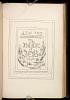 page:
page: [unpaginated]
Note: The engravings are unpaginated; pagination continues with DGR's note on page 267.
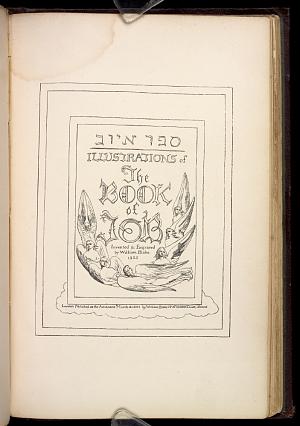
Figure: Frontispiece to
The Book of Job .
 page:
page: [unpaginated]
 page:
page: [unpaginated]
 page:
page: [unpaginated]
 page:
page: [unpaginated]
 page:
page: [unpaginated]
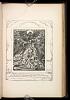 page:
page: [unpaginated]
 page:
page: [unpaginated]
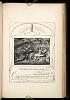 page:
page: [unpaginated]
 page:
page: [unpaginated]
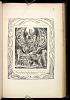 page:
page: [unpaginated]
 page:
page: [unpaginated]
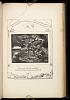 page:
page: [unpaginated]
 page:
page: [unpaginated]
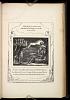 page:
page: [unpaginated]
 page:
page: [unpaginated]
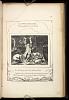 page:
page: [unpaginated]
 page:
page: [unpaginated]
 page:
page: [unpaginated]
 page:
page: [unpaginated]
 page:
page: [unpaginated]
 page:
page: [unpaginated]
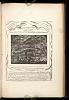 page:
page: [unpaginated]
 page:
page: [unpaginated]
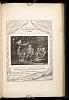 page:
page: [unpaginated]
 page:
page: [unpaginated]
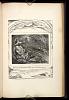 page:
page: [unpaginated]
 page:
page: [unpaginated]
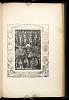 page:
page: [unpaginated]
 page:
page: [unpaginated]
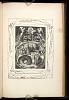 page:
page: [unpaginated]
 page:
page: [unpaginated]
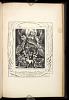 page:
page: [unpaginated]
 page:
page: [unpaginated]
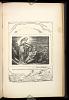 page:
page: [unpaginated]
 page:
page: [unpaginated]
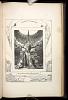 page:
page: [unpaginated]
 page:
page: [unpaginated]
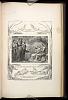 page:
page: [unpaginated]
 page:
page: [unpaginated]
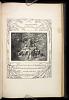 page:
page: [unpaginated]
 page:
page: [unpaginated]
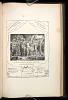 page:
page: [unpaginated]
 page:
page: [unpaginated]
 page:
page: [unpaginated]
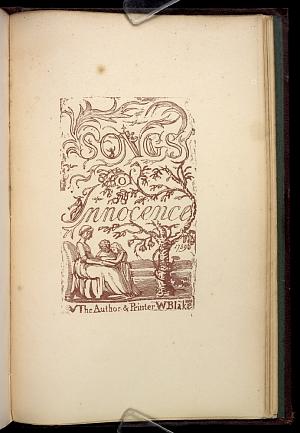
Figure: Frontispience to
Songs of
Innocence
.
 page:
page: [unpaginated]
 page:
page: [unpaginated]
 page:
page: [unpaginated]
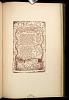 page:
page: [unpaginated]
 page:
page: [unpaginated]
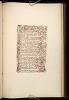 page:
page: [unpaginated]
 page:
page: [unpaginated]
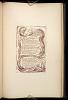 page:
page: [unpaginated]
 page:
page: [unpaginated]
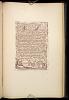 page:
page: [unpaginated]
 page:
page: [unpaginated]
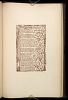 page:
page: [unpaginated]
 page:
page: [unpaginated]
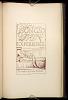 page:
page: [unpaginated]
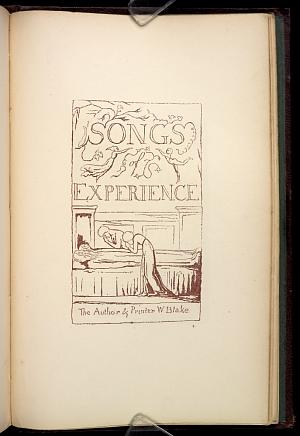
Figure: Frontispience to
Songs of
Experience
.
 page:
page: [unpaginated]
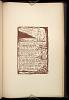 page:
page: [unpaginated]
 page:
page: [unpaginated]
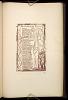 page:
page: [unpaginated]
 page:
page: [unpaginated]
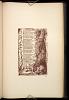 page:
page: [unpaginated]
 page:
page: [unpaginated]
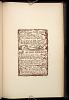 page:
page: [unpaginated]
 page:
page: [unpaginated]
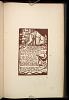 page:
page: [unpaginated]
 page:
page: [unpaginated]
 page:
page: [unpaginated]
 page:
page: [unpaginated]
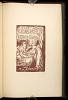 page:
page: [unpaginated]
 page:
page: [unpaginated]
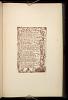 page:
page: [unpaginated]
 page:
page: [unpaginated]
 page:
page: 267
ENGRAVED DESIGNS BY BLAKE.
[The Plates here appended were not contemplated in the
original scheme of this work, or certain of the
Job designs would not have been
reproduced in fac-simile in the first volume. By an afterthought, however, the
aid of photo-lithography was called in to give the whole
Job series as a
thorough and important example of Blake’s style. These photo-lithographs are,
of course, line for line, and minutest touch for touch, the
counterparts of their originals. They are smaller, however; and the effect of
light and shade has a certain want of the decision and clearness which is one of
the characteristics of the copper plates. But on the whole they may be safely
put forward as giving a very sufficient idea of these, quite complete, indeed,
in many of the most essential respects; and considering that the original
publication is a rare and high-priced book, its reproduction here is a very
valuable addition to our table of contents.
Quite as valuable, though still in another way not quite perfect, are the
original plates of the
Songs also given. These were recovered by Mr. Gilchrist,
being the only remnant of the series still in existence on copper; the rest
having, it is believed, been stolen after Blake’s death, and sold for
old metal. They are, therefore, as absolutely the
originals as those appearing
in the copies printed by Blake; and the reason why they must still be
pronounced imperfect is that they were intended as a mere preparation for
colouring by handout has been explained in the
Life; while, being here
necessarily given without the colour, they cannot be said to embody
Blake’s intention in producing them. Much which may here seem
unaccountably rugged and incomplete is softened by the sweet liquid rainbow
tints of the coloured copies into a mysterious brilliancy which could never have
been obtained over a first printing of a neater or more exact kind; body colour
as well as transparent colour being used in the finishing. However, there will
be no doubt among those who love Blake’s works as to the advisability
of including them here even in the rough; and indeed, to any observer of poetic
feeling, it is but the first glance at them which can prove really
disappointing. Abundant beauty remains, even without the colour, in the wealth
of lovely ever-varying lines, and plentiful overgrowth from the very heart of
the painter, springing and clinging all round the beautiful verses. No
littleness here because the scale of work is a small one. Almost any one of
these pages might be painted, writing and all, on a space twenty feet high, and
leave nothing to be desired as grand decorative work.
On comparing these Plates with the fac-similes of designs belonging to the
same class of Blake’s works which are contained in the first volume,
it will be at once apparent that the latter are generally extremely successful
as reproductions of his style. His work of other kinds, more dependent on
engraving in lines, was far more difficult to deal with by the process adopted;
but everywhere the aim has been towards the utmost fidelity whether the
fac-simile was on the exact scale of the original or not.
 page:
page: 268
In concluding the last of the brief prefatory notes to the various sections
of this second volume, the writer of them believes he may trust not only to have
expressed his own views on the matters to which they relate, but that these are
also in harmony with the intentsions and fully-matured plans of his friend the
author of the
Life. He had had many conversation with Mr. Gilchrist regarding the completion
of this cherished work; and must have understaken this slight supplementary task
with a still heavier heart, had he not been sure that he agreed with the author
of the work in all points concerning its subject, and that there was no danger
of any opinion being expressed in the few closing passages, which
he would unwillingly have endorsed. it may be said on this last page of
the book, that at least neither love of Blake in its author, nor love of its
author in those on whom the issuing of his work devolved, has been wanting to
make it a true memorial of both.
D. G. R.]
Note: There is an illustration at the bottom of the page.
 page:
page: [unpaginated]
 page:
page: [unpaginated]
![Image of page [spine]](http://www.rossettiarchive.org/img/gilchrist1863.v2.spine.jpg)
![Image of page [foreedge]](http://www.rossettiarchive.org/img/gilchrist1863.v2.fedge.jpg)
![Image of page [tail]](http://www.rossettiarchive.org/img/gilchrist1863.v2.tail.jpg)
![Image of page [003]](http://www.rossettiarchive.org/img/gilchrist1863.v2.htitle.jpg)
![Image of page [004]](http://www.rossettiarchive.org/img/gilchrist1863.v2.htitlev.jpg)
![Image of page [i]](http://www.rossettiarchive.org/img/gilchrist1863.v2.htitleva.jpg)
![Image of page [iii]](http://www.rossettiarchive.org/img/gilchrist1863.v2.title.jpg)
![Image of page [iv]](http://www.rossettiarchive.org/img/gilchrist1863.v2.titlev.jpg)
![Image of page [v]](http://www.rossettiarchive.org/img/gilchrist1863.v2.toc.jpg)
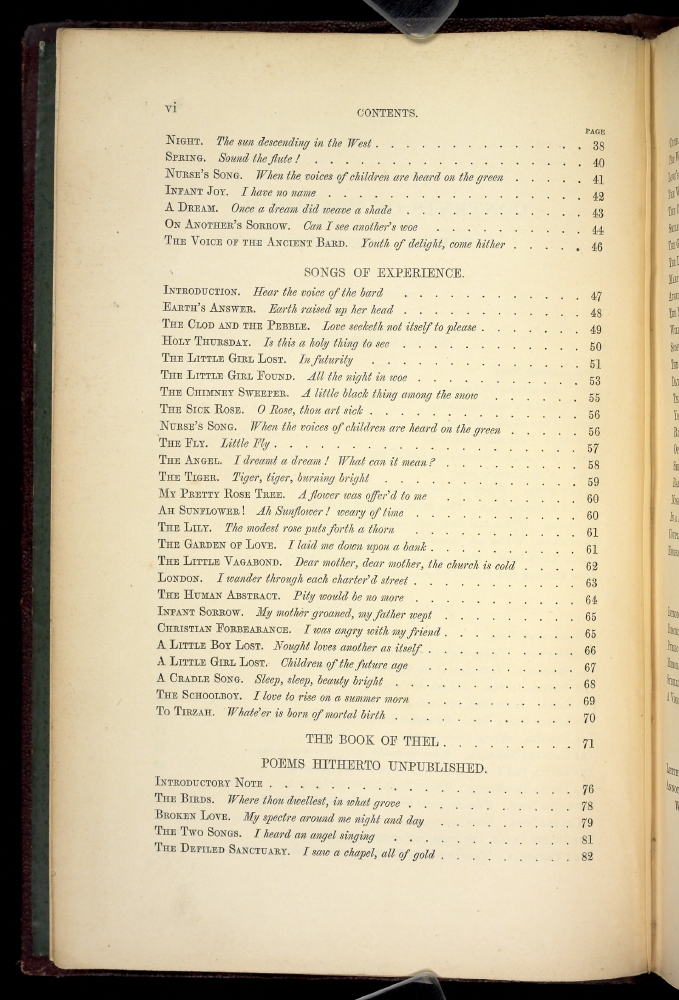
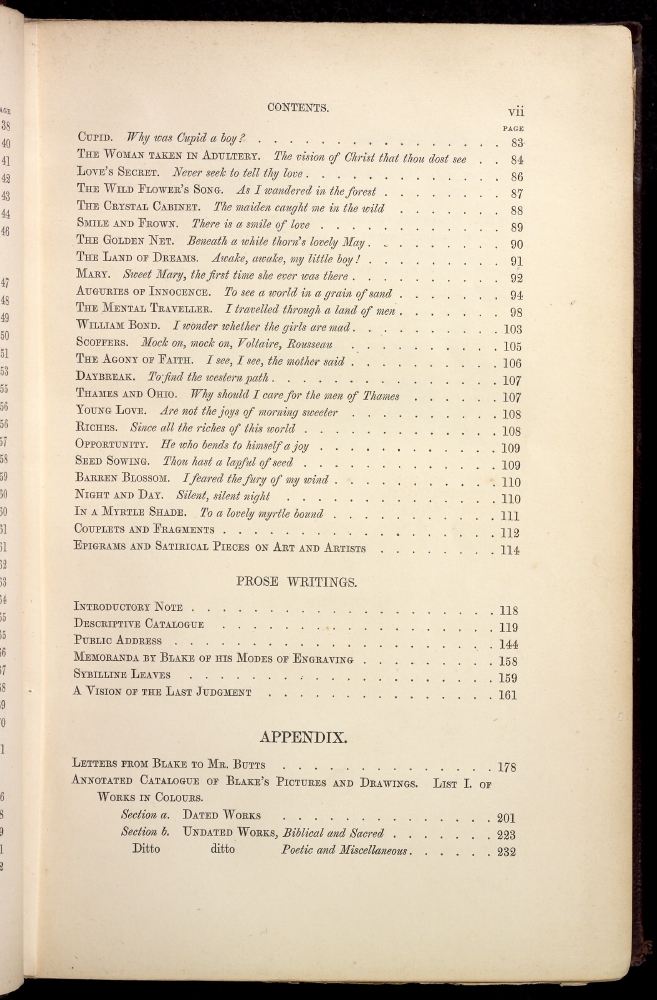
![Image of page [viii]](http://www.rossettiarchive.org/img/gilchrist1863.v2.viii.jpg)