 page:
page: cover
Editorial Note (page ornament): An ornamental border frames all but the printer's name and address, at the bottom of the page.
No. VIII.
AUGUST, 1856. Price 1
s
THE
Oxford + Cambridge
Magazine,
Editorial Note (page ornament): Initial O, C, and M are ornamental
CONDUCTED BY MEMBERS OF THE
TWO UNIVERSITIES.
Editorial Note (page ornament): Publisher's mark.
CONTENTS.
- On Popular Lectures, considered as an irregular
Channel of National Education . . . .
453
- Woman, her Duties, Education and Position . . . . .
462
- “Death the Avenger” and “Death the Friend” . . .
Morris
477
- Two Pictuers . . . . . .
479
- Svend and his Brethren . . . .
Morris
488
- Gertha’s Lovers . . . .
Morris
499
- The Burden of Nineveh . . . . .
Rossetti
512
LONDON:
BELL AND DALDY, FLEET STREET.
PRINTED BY C. WHITTINGHAM, TOOKS COURT, CHANCERY LANE.
 page:
page: [unpaginated]
Transcription Gap: (Advertisements)
![Image of page [453]](http://www.rossettiarchive.org/img/thumbs_small/ap4.o93.1.453.jpg) page:
page: [453]
Editorial Note (page ornament): An ornamental design appears at the top of the page.
Editorial Note (page ornament): Initial T is ornamental
The last article was devoted to advocating the support and extension of popular lectures as one of the most fruitful among the
irregular channels of
public instruction. I endeavoured to answer some of the objections current against them, which, if they have not prevented
their establishment, may sensibly contribute to
retard their progress and efficiency. To those who allow early acquisitions to lie idle in later life, I ventured to appeal,
urging them to lend their talents to the task, and
opposing to any diffidence they might feel in coming forward, the elementary character essential to the success of their lessons.
But theoretical objections are, perhaps, easily refuted. One of more practical weight would seem to be the difficulties to
be overcome before educated men can realize
how elementary and how simple such lessons to be truly useful require to be made.
Every man above petty feelings, if he only knew the height from which
Column Break
to be intelligible he must often descend, would no doubt have the courage to come down. But
some effort is required, and a certain simplicity and “disinvoltura” of mind, to be able to stoop from a higher standard
of taste and acquirements to one which may jar against every habit of thought, and to dismiss, even for a time, an ideal,
the fruit, perhaps, of much labour and patience. Yet
is this absolutely necessary, if village and popular lectures in general are to have any serious result. The gardener who
prunes the random shoot, needs but a pocket-knife for
his purpose, but if he would manure the ancestral tree he must grasp the pickaxe and the spade. He who has put the coping-stone
to an edifice, devotes his final efforts to the
finish of the whole, polishes here and glazes there; but whoever would lend a hand at the foundations of a nation, must deal
in Cyclopean blocks.
To consider the subject with any degree of breadth, it is necessary to examine a little into the principles of education in
general, thence to derive
 page:
page: 454
the distinctive features of a sound system of lectures adapted to the use of the people.
The progress of any one science from its lowest truth to its highest link, is but a miniature of the progress of real education.
For all sciences which deserve the name start from principles or facts, the truth of which is or may be made evident to every
ordinary capacity—hence called
axioms. Moreover, in so far as they are sciences and not speculations, their progress from the most elementary to the highest
truths is by means of links, each of which, from
what has preceded, becomes as evident, or, by further subdivision may be made as evident, as the original axiom, which claimed
the assent of mankind.
Science, then, is not anything else than universal fact, methodised by and for universal mind. And education, so far as it
is true and complete, is but the progress of the
incarnation, so to speak, of science, consisting as it does in the constant and connected passage of the mind under education
from that which is, to that which is not, known;
from that which is, to that which is not, understood; from the random to the connected idea; from the simple proposition to
the complex syllogism; from the brick to the
building. For the knowledge of every man, under which I desire to include
omne cogitabile, embracing the most trivial details of daily life, may be divided into two parts, the living and the dead, fruitful and barren,
rational and unrationalized, philosophical
and unphilosophical, organic and inorganic, according as we may choose different modes of expression. The latter part embraces
all the facts floating disjointed in his memory,
true it may be in themselves, but unconnected with that other part of his knowledge, which, in regard to his intellect, might
almost be called
himself. This
other part is called philosophical, because, so far as it goes, it satisfies
Column Break
his highest curiosity; rational, because subject to method; organic, because grafted into the
spontaneous growth of his mind; fruitful, because it alone can fertilize, by assimilating, the new materials presented to
his notice. It is, in a word, the fructifying and
vital part and capital of his knowledge. The former, consisting of facts isolated or unexplained, constitutes, in too many,
if not all men, by far the largest part of what they
know, and is barren beyond the immediate application of each fact.
To illustrate the distinction between the two kinds of knowledge, we might, perhaps, compare facts and ideas to instruments.
Thus he who knows by rote only the use of an
engine, may doubtless by means of it accomplish the object for which it is designed; while he who, besides the use, should
also understand its theory, construction, and the
nature of its materials, would not only,
ceteris paribus, ply it as well, but alone, of the two, be able to mend and improve it, or by his actual knowledge be led to the discovery
of other appliances. The mariner may apply by
rote the trigonometrical rules which will guide his vessel to the desired haven, but it belonged to Napier to deal with the
formulæ themselves.
Let then true education, in its broadest acceptation, be defined to be the progress of the incarnation of science, or of the
whole body of sciences.
Then, as any one science proceeds in the abstract, so must education proceed in the concrete. And this conclusion would seem
to point out the path to be pursued in the
instruction of the people. We must first learn how to descend to what they know, and, starting from this, strive to give life
to that knowledge in them which is dead, by
everything that will connect what they do not with what they do understand. Thus will every link added to the chain be an
addition
 page:
page: 455
to the vital training of the country. To such a training we may look for a nursery of great men; and, while with regard to
one
another we maintain our respective positions, with regard to other nations we shall rise as one vast and living aggregate.
And here one can scarcely help asking the question,
if we do not make sober haste to give to our lower orders, and, indeed, to our farmers themselves, the instruction in keeping
with the progress of the age, whether even the
spontaneous vigour of our freedom will be adequate to keep pace with the methodical foresight of bureaucracy abroad?
But this by the way.
To return; “the lower classes,” it is sometimes said, “take kindly to lectures at first; but their interest soon begins to
flag, and
their attendance to diminish.”
I cannot say I have found this to be the case, where I have known village lectures given. But I can readily believe, as indeed
I am fully convinced, that unless on the
one hand proper respect is shown for the audience, the lecturer not treating it like a child; and unless, on the other hand,
system is introduced into the
subjects,—above all, unless the precise focus is found which will enable ordinary men to understand, and to feel they understand,
what they never understood
before—enable them to experience the gratification of that nobler and sounder appetite, which soon palls over the merely marvellous
and unintelligible, and to leave
the lecture room abler and better men—
as every advance in genuine truth must make men both abler and better,—unless we can do all this,
we may be certain that the bulk of the Anglo-Saxon race, inured to patient toil, will soon grow chary of their sixpences;
and, whether they can give expression to their hidden
sentiment or not, think shame in their secret hearts to barter substantial comforts against the sights of the eye and the
tickling of the ear, or risk the mainstay
Column Break
of old
age for fine sentences which they cannot follow and fine diagrams which they cannot comprehend.
Having described in general terms that which appears essential to the highest efficiency of popular lectures, it may be well
to give some particular illustrations of the
principles laid down.
With the use of the lever for instance, every labourer is familiar. Mention need only be made of the crowbar, and passing
from this the hearer may be reminded how the
principle applies to the spade, the pickaxe, the tongs, the oar of a boat, a pair of scissors, nay his own arm. And in all
these we have a foundation on which to raise a living
superstructure. What an admirable lecture might be written in the simplest language did it consist even only of a catalogue
of all contrivances and machines in which in
whatever way the lever occurs. How easily might a man who had spent some time and thought in collecting such examples arrange
them in logical sequence adding a brief account of
each, from the crowbar up to the watch and the different machinery employed in manufactures. And in this there are two points
especially deserving of attention: firstly, the
unity and simplicity of the fundamental idea running through the whole, “the lever and only the lever;” and secondly, the
richness and variety of the
applications of which that idea is susceptible.
By the former we avoid the fatigue and despair of being jostled out of one principle into another, scarcely comprehending
any; and the main principle pervading the whole
serves as a golden clue to thread with ease and security the labyrinth of adaptations. While on the other hand each appliance
rising above the preceding and helping as a
stepping-stone to its successor prevents the interest from flagging. And this is real instruction, giving breadth and versatility
of thought, depth of understanding, and a
noble emulation to turn other ideas
 page:
page: 456
equally simple to equal account. Then having shown the
natural sequence, and thus prepared the mind of the
audience, if we turn back and so far as it can be obtained trace the
historical progress of the various adaptations described, even the iron hand of Machinery
is humanised: we learn to connect our present comforts, the assuaging of pain, the diminution of calamity, the increased length
of life, with the thoughts and industries of men
perhaps as lowly as ourselves, the influence of whose simple thoughts centuries ago is felt in every crevice of our life.
Who knows but a simple thought on our part may tend to
gladden thousands of hearts centuries hence? And thus even the labourer may rise to the conception of the poet, and for a
time become a being of large discourse looking before
and after.
And in mentioning the lever, I have been guided by no latent idea, simply taking the first instance that occurred. But in
Mr. Babbage’s Economy of Manufactures there is hardly a section, which in itself might not furnish the text to the most valuable amplification in the shape of
a popular lecture, always remembering that
unity in variety is the soul of instruction. If the principle illustrated cannot be too simple in itself, the number of its
applications cannot be too minutely specified. If
possible every lecture should be founded on one idea, and one only, and this should radiate through things apparently the
most diverse.
The word “Geometry” is in itself the subject for an admirable lecture, starting from the literal meaning of Land-surveying,
and giving a broad
description of its more striking applications. But this leads me naturally to make a distinction of great importance between
the instruction imparted by lectures and the
education of children at school; for such a distinction is an answer to those who contend that lectures are of no use because
they do not teach us “to do”
things. Now
Column Break
every science is divided into two parts; the theory, and the practice of the theory—or the concrete art of the abstract science.
At school the
practice chiefly is taught; and no doubt a lecture will never teach Geometry nor the practice of any science.
But there is much to be known
about Geometry which may be of the highest possible use in many points of view. Pascal, when denied as a boy the pleasure
of learning mathematics, could not be prevented from thinking about them, and by means of certain expressions caught up from
his father he is said in his play hours to have
discovered the first twenty-four propositions of Euclid, calling the circle, “a round,” and the straight line, “a bar.” A
knowledge
about things paves the way to learning the things themselves, and it is in this point of view that lectures are chiefly excellent.
It is thought by some, especially Cambridge men, that lectures can never be of much use unless connected with schools or evening
classes, where a practical acquaintance
with the details of the subjects lectured upon may be taught to those, who like to attend. Such classes may indeed be most
valuable auxiliaries. But between the opinion that
lectures are comparatively of little use without them and the conclusion that, if we have not the latter, we may dispense
with the former, there is but a step,—in my
opinion, a very deplorable step. By all means let us improve, extend and raise the system of our country schools until lectures
may serve only to amplify and recal or correct
the learning of younger days, but in the mean time let not the true use of a proper system of popular lectures be ignored.
Were it desired, indeed, to impart to a mixed audience in one or two hours the perfect knowledge and practical possession
of any subject, the student well knows how
impossible the task would be. But if that were the only definition of
useful knowledge, what
 page:
page: 457
would become of the general superiority of the attainments of the higher classes, should they be made to rest on the perfect
knowledge and mastery of things, with most of which, if the truth be told, they have in general only a most loose and casual
acquaintance? Knowledge may be useful and fruitful
even when it fails altogether of the examination standard. And the one great and paramount object of the lectures, which I
venture to advocate, is not to answer examination
questions, but to stimulate the general thought and give versatility to the mind of the people by teaching it to look “before
and after.”
It is also argued that a decline in the industrious habits of our labourer will follow the development of his mind, and that
by distracting his thoughts you will make him
a dreamer. When asked lately to contribute to the support of a school, a farmer moodily answered, that he would not give anything
for keeping it up, but he would give
£2 to have it pulled down, for since “them new-fangled ways,” he couldn’t do as he liked with his own, and men wouldn’t
work as their fathers. But in a moral point of view, to keep the ploughboy at a minimum of intelligence, lest he should prove
an idler at his plough, is only more dishonest and
criminal than direct slavery. And in a purely utilitarian aspect, were it even probable in theory, that intelligence and industry
must vary inversely, the contrary of which in
fact seems much rather the rule, would it not be far more probable, now when our wants are established and confirmed by long
habit, that the growth of intelligence by
increasing invention and skill must tend to obviate the necessity, were there any, for keeping a part of our population as
low, instead of raising it as high, as possible in
the human scale?
I may instance the Lothians in Scotland, which are said to present one of the most perfect and prosperous agricultural systems,
and where in
Column Break
general intelligence the labourers are probably second to none. And the history of civilization is a running commentary on the fact
that, while on the one
hand habits of industry, far from declining, have actually grown with the growth of knowledge, the necessity for mere drudgery
has been diminished, by multiplying the resources
of ingenuity.
Again it is feared (though not perhaps so openly avowed) by ultra Conservatives, that, when gentlemen have grown tired of
lecturing, shallow orators from among the people
themselves will take the matter up and turn lecture rooms into hot-beds of faction. And they contend that, as a little knowledge
is a dangerous thing, so it is a wiser course
to keep to the maxim,
But far from being led away by the adage that “a little knowledge is a dangerous thing,” let us rather remember that little
is the only portal to
much.
The general intelligence and life of the many is, indeed, the only constant foundation for the special preeminence of the
few, and if any truth is more than another
broadly displayed by the history of achievement in arms, art, science, literature and politics, it is that “the few” great
men in every department are but
the final birth and offspring of gradual, long hidden, and shapeless brooding in the mind and womb, so to speak, of a multitude.
Let us therefore tend the many, secure, that if
the soil be enriched, the trees will not be wanting.
It is certainly true that, if educated men do not come forward to give lectures, their place is commonly taken by itinerant
lecturers, some of whom indeed give very
excellent lectures, but the majority of whom are shallow and illiterate. A case in point happened under my own observation,
where an Irishman, who represented himself as an old
military schoolmaster
 page:
page: 458
was permitted to hold forth at a village institute. He chose for his subject the races of mankind, which he treated, ranting
fashion, at the top of his voice by a farrago of texts of Scripture loosely and fantastically strung together and embellished
by such scientific similes as the following,
namely, that the colour of the negro is the blind which Nature has drawn over his face. “Consider,” says he, “what you do
yourselves of a hot
day. You pulls down your blinds,” (he had begun his discourse by a protest against pedantic slavery to the tyranny of grammar)
“you pulls down your
blinds,” he said, “and that is just what Providence does to the nigger.” He forgot to mention that black is the hottest of
all colours.
It may be thought perhaps that the village audience, before whom the lecture was delivered, preferred it to a more correct
performance. It was not so however. For at the
close, when no one volunteered a remark, and the man of the providential blind proceeded to thank his hearers for their “kyind
attention,” and actually
volunteered another lecture for the ensuing week on any subject any gentleman might please to suggest, “including metaphysics”(!)
an intelligent and
matter-of-fact farmer got up, and with a slight hesitation in his speech and gentle wave of the hand, rendered doubly eloquent
after the sonorous outpouring of our
metaphysician, said, that “in the name of the audience he begged to thank the gentleman, but . . . but . . . it was not exactly
perhaps what they
wanted;”—on the delivery of which effective oration he sat down amid marked approval.
If quacks are found in this as in most other walks of life, it only points more emphatically to the duty of educated men neither
to flag, nor to flinch. It has been the
glory of England that the bulk of her sons have never been wanting to a duty once recognised and acknowledged, and let us
hope that
Column Break
none who can serve the cause will be
backward in attempting so honourable and fruitful a task. Doubtless they will reap a rich reward, not only in the improvement
of those whom they instruct, but by their
blessings, sympathy and affection, not faction and discontent, and by tightening those bonds of solid esteem between the rich
and poor, on which the future welfare of the
nation must more than ever depend.
Hitherto I have spoken of the exact sciences only; but almost every subject perhaps is susceptible of the treatment suggested,
nor can the topic chosen be too simple in
itself. Hardly a condiment appears on the labourer’s table but might be made the theme for most valuable lectures.
Let tea be taken:—the nature and properties of the plant; the countries where it grows; the Zone or Belt of vegetation; the
history of the introduction of
the beverage into this country; the gradual fall in the price of the article in connection, on the one hand with the extension
of sale, and on the other with the gradual change
in the manners and customs of our ancestors: all these are themes sure to be interesting to a practical people, and capable
of being made the vehicles of the soundest
instruction.
But in lectures of this kind it is not enough to state parenthetically that tea, for instance, was once sold at twenty-five
shillings a pound. It is the fulness of the
account and the unfurling of a true picture which is important, so long as the main idea throughout is one and familiar to
all.
Nor let it be said that such knowledge is purely utilitarian. The progress of mankind is utilitarian to those only, who either
do not understand it, or themselves see
everything through utilitarian eyes. Not the tea, not the coffee, but the wonders of creation and human enterprise, and
 page:
page: 459
the life of fellow-men on a large scale, are the real themes, the literal text itself being but the familiar peg in each
man’s mind, attached to which, fresh knowledge acquires a local habitation and a name. And true knowledge, so far indeed as
it is purely intellectual, is but the
“conception” of the particular under the general. Every step upwards from the former to the latter is a step in intellectual
elevation; while the tendency
acquired by a man to view the details of his daily life, not as isolated and concerning himself alone, but as items of the
great Common Weal, is also an advance in moral
elevation.
A little knowledge may be a bad thing; but it is unfortunately the only adit to the “much,” which is as useful to morality,
as light is to the
traveller.
Why, for instance, do we not put our hands into the fire to gratify curiosity? Because, I presume, our knowledge of the injury
that would follow is so
absolute that any temptation to gratify the curiosity at such a price is infinitely small in comparison; so small that, were it in
any case to overpower that
knowledge, the disproportion of the curiosity to the knowledge would be called madness. But madness is not the general state
of things, and the excesses which arise are mainly
due, not to the disproportion of the particular faculty craving to be gratified, but to the low and fluctuating state of men’s
intuition or living knowledge on each
particular point. In the first instance there is very little difference between the temptation which a child feels to touch
the fire, as a most beautiful and fascinating
object, and that of putting fire into the inside in the shape of alcohol. For in the latter case, to make a correct estimate,
we must separate the general craving for food or
drink of any kind from the particular temptation which, in the origin infinitesimal, grows by slow degrees into confirmed
drunkenness.
Nemo repente turpissimus.
Column Break
No man becomes a drunkard in a day. No doubt in a confirmed drunkard the force of habit is very often out of the reach of
all intellectual safeguards. But such is
not the case with the large class of men in the intermediate state in which one glass more or less a day will ultimately turn
the scale in favour of excess or sobriety.
Now drunkenness is but one vice. But taking the sum total of the vices and errors of mankind, it will, I think, be allowed
that with respect to each there is a very broad
margin occupied by all those to whom the more or less “knowledge” is of paramount importance in the long run, to enable them
to escape from habitual wrong
into habitual right. And should it be objected that we have all the desirable knowledge, for instance, of the effects of intoxication,
and that it does not avail to prevent
drunkenness, I would answer, that such an objection rests on the confusion between casual and habitual drunkenness, against
the latter of which knowledge often does cease to be
of avail, which in the former case would be effectual. But, in truth, we really have
not all the desirable knowledge; that which we possess is not absolute.
For in the first place different men may drink different quantities, not only with impunity, but with benefit. And in the
second place, the exact quantity suited to each man is
not known, nor is it known, however it may be surmised, whether many a man would not have lived a longer and more useful life
had he been a “two-bottle”
man instead of an ascetic, and
vice versâ. Now it is precisely the doubt which exists in so many men’s minds whether the “too
much” or the “too little” is harming them at any time that often proves a pitfall in the long run. Nor should the weakness
of human nature be
accused, because men hesitate to forego an indulgence, the denial of which may do them positive harm and nobody else any good.
 page:
page: 460
Now the point on which I so desire to insist, is that,
before excess has become a habit and in some sense a necessity, if a man could know
precisely the safe limits short of excess or defect, in each particular, he would, in the great majority of cases, keep within those
limits. Thus, when men know as
absolutely the consequences of drinking one additional glass of wine as they do of putting a hand into the fire, they will
forego the glass, or be classed as madmen.
Such knowledge is the fulcrum of Archimedes, and the faith that moves mountains is but a temporary substitute.
But, until we have such exact and absolute knowledge, there will be an aggregate of drunkenness proportioned to the fluctuations
of doubt inseparable from imperfect
knowledge on any and every subject.
And, as has already been said, what is true of one vice or error, moral or physical, is true of the great body, and this,
if the principle laid down be true, every
addition to the total of the living knowledge of men has a general tendency, directly or indirectly, to correct, refine, and
ultimately to eliminate. For light and darkness
cannot coexist, and truth is infinitely stronger than evil. And if the mind of man be one, if he have only one kind of thought,
as no educated man can doubt, then to think
right and to know the truth on any subject is a step towards thinking right and knowing the truth on every subject. And the
obedience to “truth
understood” is surely as much superior in principle to obedience to mere command as rational persuasion is to brute compulsion,
the consent of the man to the assent
of the child.
Again, the necessity of the “knowledge of common things” for the children of the poor has been constantly advocated with far-seeing
sagacity by a
philanthropic nobleman whose name is too well known to require mention. And why may not
Column Break
the scheme be extended to the parents themselves, through whom we may also hope
all the more securely to reach their children.
Lectures upon “bread,” “malt,” “hops,” “the dairy,” “bees;”
upon “tea,” “coffee,” and every condiment on the labourer’s table; upon trades, occupations and callings; on the state
and progress of the taxes and laws which affect him; on British as compared with foreign liberty, and freedom real and spurious;
on punishments, prisons, workhouses and poor
laws; on real and spurious benevolence; on the gradual growth of civilization, its advantages and disadvantages illustrated
by most homely examples; these are the subjects for
a village audience.
And if any should smile at the simplicity of some of the topics, though loath to recur to a hackneyed quotation, I would remind
him of the “sermons in stones
and good in everything,” here most truly in its place.
Are not the slow and irregular movements of a child’s fingers practising a scale the necessary introduction to their pliability
in the finished performer and
inspired artist, and will not every student bear witness to the analogy between this and the workings of the mind on new subjects
of thought? Those who know this, and who also
know the wonderful stiffness of the joints in the villager’s mind in the commonest things, his hostility to change for the
better, his stolid and ignorant faith in
the superiority of everything that he and his fathers have done, will not deny, that the details of his daily life are the
very key to the fortress of his obstinacy.
If bread be the text, let the enquiry be in clear, homely language, what are the different kinds of bread?—how made in different
places and countries? with the
advantages and disadvantages of the different methods. The effect of this will be not only to teach the villager that there
are other ways of doing a thing than his own, but also
 page:
page: 461
that
his own way is not always the best. Further let the calculation be made circumstantially of the absolute and
relative costs of the different methods of baking bread enumerated by the lecturer—absolute, in regard of price; relative
by comparison with some of the principal
necessaries of life.
This will inculcate thrift.
But here also, among other important corollaries, occasion may be taken to show by the most practical teaching how price and
value are not the same thing, whence the
lecturer may easily pass to a still higher consideration, namely, that even “material” comfort and prosperity are not always
to be measured by the amount
of wages.
At first sight one might think the labourers know this better than any one. But on the contrary it will be found that they
are constantly open to delusion on this point.
A large landed proprietor was but the other day complaining of their ignorance in this respect, instancing an intelligent
farm servant of his own, who, seduced by the offer of
a guinea a week, left his situation to work for the Crystal Palace Company. But when he arrived, he found lodging and food
so ruinously high that the increase in his wages was
no adequate compensation, and he was worse off with a guinea a week than he had been in the country with his cottage rent
free on twelve shillings. Accordingly he returned to
his former master, lamenting his mistake, but had the mortification to find his place filled up.
Then, let the different kinds of corn grown in different parts of the world be described, and, if possible, exhibited.
Opportunity will here arise to explain the broadest principles of importation and exportation.
The history of the cultivation of corn and the quantities grown in different places and with what success, are further topics
of interest. The adulteration of bread, and
again its
Column Break
nutritive qualities in comparison with other articles of food, are other important subjects. Many curious facts will arise
in connection with each item full of
interest to the rustic mind. I myself, if I may be permitted to mention it, was surprised on visiting one of our model prisons
to find a very striking example of the different
effects of different kinds of food on the prisoners. For it appears that in some of these gaols every prisoner is weighed
on coming in, and again on leaving the prison, and in
every case he is found to have lost weight, even to the amount sometimes of eleven or twelve pounds in two months, while the
substitution of bacon for butcher’s meat
is found to have the effect of preventing the loss of weight in a remarkable degree, and is ordered by the visiting physician
whenever the waste assumes any appearance of
danger to the constitution. From this circumstance it may also be shown parenthetically that imprisonment, with every attention
to the diet, the cleanliness and comfort of the
prisoner, is yet a real and material punishment, even to the most degraded, since at the expiration of the term the prisoners
are invariably found to have lost weight.
And these are some of the aspects in which the simple subject “Bread” may be treated in such a manner as to inform, enlighten,
and therefore
as a general rule to elevate, a village audience.
Probably no two lecturers would view the same subject in exactly the same light, and if I have ventured to make any suggestions,
it is chiefly with a view to
illustration.
Perhaps it may be urged that comparatively few country gentlemen might find the materials at hand for compiling such lectures
on many of the subjects which they might
wish to undertake. But may it not be suggested that a society might be formed, the object of which would be to work out such
a system of lectures, combining
 page:
page: 462
excellent and multifarious knowledge with a certain broad simplicity, something in the style of Professor Johnstone’s
lectures on the Chemistry of Common Life, with diagrams on a very large and simple scale, like those published by Messrs.
Day and Son for Marlborough House? Were such lectures
in existence, they might be hired out to those whose pursuits would not permit them, perhaps, to compose, though they might
allow of their altering, adapting, or amplifying
lectures already prepared. And the want of large diagrams, I know by experience, is much felt by those who know how important
they are, when they can be introduced to the
success of lectures, and who would hire, but cannot afford either to buy or to make them themselves. I cannot but think this
a subject that may well be recommended to the
thoughts of the wealthy and philanthropic. For it is not perhaps too much to say that, for the uprooting of popular prejudices
and superstitions, for enlargement of mind and
capacity and willingness for improvement, for the increase of ingenuity and invention,
Column Break
the growth of discovery, and thirst after knowledge, for the heartier cooperation
of parents in the education of their children, nay, for their intelligent co-operation in every sound reform and resistance
to all unsound and spurious agitation, for
expediting the business of the land by the removal of the
vis inertiæ, the obstinacy, and the self-complacency of ignorance: for all this, and more, we may look to a proper scheme properly carried
out of village lectures.
And now I would bid my reader farewell.
Most sensible I am how weakly I have advocated a cause so great. But as a child may point to the mountain path, which he himself
is unable to climb, so, if in any degree
the few random thoughts dropped in their way should have attracted the energies of those great hearts ever ready for a great
work, my most sanguine hopes will have been amply
realized,—any pains I may have taken more than amply rewarded.
-
Satis superque dulce decus.
Editorial Note (page ornament): Initial T is ornamental.
The subject which I have ventured upon in this paper being so wide that to exhaust it would be to define the destiny of the human
race, I cannot hope to
do more than to offer a few hints concerning it, sometimes merely enforcing what is already acknowledged, though not acted
upon, sometimes advancing what may be almost or
altogether new to many of my readers. My remarks will be found to apply principally to ladies of the middle classes, though
I hope they will extend beyond them, directly or
indirectly to the whole sex.
Column Break
Within the last few years especial attention has been drawn to what are called social questions: great has been the interest
excited concerning them, and no slight efforts
have been made to solve them. Of all these problems it seems to me that not one is more comprehensive, more important or more
difficult, than that which I now bring forward. It
affects immediately half the human race; and without fit training for women it is idle to look for any real progress of mankind;
while opposed to this training is an army of
obstacles, difficulties both inherent in the work itself, and aggravated
Transcribed Footnote (page 462):
*“Lectures to Ladies on Practical Subjects.” “Sisters of Charity abroad and at home.” By
Mrs. Jameson. Second Edition.
 page:
page: 463
by prejudice, fashion, jealousy, moral cowardice. Let me beg the reader’s earnest consideration of this subject, and
recommend to his attentive study (if he is not already familiar with them) the two books, the titles of which are given at
the bottom of my first page. The one is printed from
lectures delivered to ladies, as a preliminary to the establishment of a female college, similar to, if not joined with, the
Working Men’s College, with which some
of the lecturers are connected; the other is written by a lady well known in the literary world, and thus, coming from a woman,
is perhaps more valuable for our purpose even
than the Lectures. In the preparation of this paper I have carefully read both, and indeed, to a considerable extent, have
based it upon them.
As a third text-book I shall add Tennyson’s
Princess, containing, as it does, the truest conception of woman’s duty and position, and some of the most practical advice concerning
her education, that I have ever
met with, in verse or in prose. I will make a few observations upon it, before I go further; not by way of reviewing it as
a poem, (a design which I wish distinctly to
disavow,) but solely inasmuch as it bears upon our subject.
Ida’s attempt
- “To lift the woman’s fallen divinity
- Upon an even pedestal with man,”
soon proved an entire failure, owing not more to external difficulties than to inherent faults. First, it was made independently
of the aid of men,
(“Far off from men I built a fold for them,” her own words, “Let no man enter in on pain of
death,”—the inscription on the gate of her college,) in direct opposition to the principle upon which Mrs. Jameson insists so much,
the
cooperation of the sexes. Secondly, her instrument of regeneration was knowledge, mere knowledge; (“knowledge, so my daughter held, Was all in
all,”) she built her college “far off from men,” far away from any poor and wretched,
Column Break
the relief of whom might
have called out those affections through which woman must be educated as much as through her mental faculties. Again, this
very system of knowledge was far too wide, and, in
consequence, too shallow, as is intimated by the poet in a passage which I shall quote farther on. Lastly (not to examine
the method at greater length) the mode of life was
recluse, to the neglect of those social duties which are necessary for woman, if possible, even more than for man,—the statutes
being
- “Such as these:
- Not for three years to correspond with home;
- Not for three years to cross the liberties;
- Not for three years to speak with any men.”
Many of the pupils were already weary of the seclusion when the Prince and his two friends broke in upon it; and every reader
will acknowledge that the poet has
accurately followed nature in representing the system as speedily and entirely overthrown.—With the light afforded by the
ill success of this attempt, let us now
proceed with our own enquiries.
And first we will examine what are some of the peculiar
duties required of our countrywomen in this our generation: I say
some, because
to enquire into all, or even any large number of them, here is a simple impossibility; and accordingly I shall confine myself
to those, the performance of which is most
pressingly required by the wants of the time, and some at least of which have been greatly neglected hitherto. It will be
convenient to make that common division into physical,
intellectual and moral, a distinction which I need not say refers only to the different
objects upon which the same moral principle of duty is exercised.
I.
Physical duties.—I shall touch upon these very slightly, observing only this, that it is the duty of women (an obligation which of course
lies chiefly upon mothers) to train up children
 page:
page: 464
healthy, strong and brave: and this they owe not only to their country, which may need those children, when grown to manhood,
as
soldiers, but no less to the laws of God; for every man
ought, under all circumstances, to be brave; while, if he is not healthy and strong, he must look to
it that the cause is not his own indolence, carelessness or self-indulgence. And that women may bring up children thus, they
should be healthy, strong and brave themselves; and
surely the health of the upper and middle classes must lie, to a very great extent, in their own hands; while courage, though,
it may be, of a different kind, is as much needed
in a woman as in a man, and as possible to be acquired by her as by him. That these duties are not fulfilled will, I am sure,
be generally allowed. Our girls grow up to an
alarming extent the reverse of healthy and strong; while, if we can still produce hardy and valiant men to conquer at Almas
and Inkermanns, it is not in consequence, but in
spite, of the female influence exercised upon them in their childhood and boyhood. Yet, if I denied that women in our own
time and our own country have displayed energy, and
the noblest, namely, moral courage, to face and overcome difficulties to which men had proved unequal, the remembrance of
every reader would confute me, and the names of Mrs.
Chisholm, Miss Carpenter and Miss Nightingale would at once rise in every heart.
II.
Intellectual duties.—I shall consider this division under two heads:
1. The necessity under which women lie of understanding, appreciating and assisting their male friends (especially wives their
husbands) in their intellectual pursuits.
2. The duty of teaching,—the opportunities for discharging which are afforded chiefly to ladies of the upper and middle classes,
especially those who are
unmarried and unoccupied.
I might add that it is the duty, not
Column Break
less than the privilege, of every human being to cultivate to the utmost under the circumstances the mind whose value cannot
be
estimated, and whose capacity cannot be measured, and which, if uncultivated, will continually lose in power. But the consideration
of this will fall naturally under the second
of our three primary divisions.
1. It may seem a startling assertion to make, but I believe that every one, after a little observation or reflection, will
admit it to be true, that there is no little
danger of an intellectual barrier being raised between the male and female members of a family. There are now so many facilities
for mental improvement, there are so many
inducements for men to avail themselves of these increased opportunities, there is so much, too, in the mere mingling with
the world to sharpen and invigorate the mind, that
women, unless they are content to misunderstand and fail to appreciate and sympathize with their husbands and brothers, must
be educated far otherwise than at present, must be
well acquainted with a far wider and more important range of subjects than the majority (at least of the ladies of our middle
classes) have hitherto studied. It is surely
unnecessary to enforce the increase of mutual respect, (respect, on the woman’s side, I mean grounded on knowledge, for of
blind, undiscriminating admiration there
is more than enough already,) of mutual helpfulness and domestic happiness which would follow from a more equal education.—It
is a matter of common remark that
clever men frequently marry unintellectual wives; sometimes it is even asserted that they prefer such. That such marriages
are not infrequent is an undoubted fact; but the
preference of such wives I entirely disbelieve. I believe, moreover, that the most talented men, even the great geniuses,
could find women as great in appreciation as
themselves in creation; nay, from the essential difference between the male and the female intellect, wo-
 page:
page: 465
Note: On this page, the last line of the second column has been printed as the first line of the first column, and the first line
of the first column has been printed as the
first line of the second column. A
cancel leaf was printed to correct this error.
this sin and misery is
preventible,— ledge their superiors on many points of creative power. Let this intellect, then, be developed, if there were
no other reason than that wife should
sympathize more with husband, sister with brother.
2. It is truly said by Maurice (in the Introductory lecture,
Lectures to Ladies) that we are all, men and women alike, born under the law of instructing
others, under penalty of ourselves forgetting what we know. He adds that women possess the capability of instructing more
than men, bringing forward instances which will
satisfy many. Whether this latter be true or not, these two things we may certainly lay down, that women are under the obligation
of imparting their knowledge, and that, in
this, as in all cases, where a duty is imposed, the faculty for discharging it is also given; they have by nature a capacity
for teaching. To nearly all the task of professedly
teaching must fall: to a few,
professionally, as governesses, to the majority as mothers and elder sisters. Let all do this first, obvious duty well, with all
their strength and all their skill; in every case let the nearest duties, especially those of home, be first fulfilled; let
us establish this unmistakeably; now we may add that
those who, after the performance of their professional and domestic duties, still have leisure and opportunity, may extend
their sphere beyond their pupils, their children and
younger brothers and sisters. To dwell upon the importance of this duty is surely unnecessary. I hope, too, that the cowardly
and selfish prejudice against educating the poor
is by now fast dying out. What urgent necessity there is, may be shown by a single fact mentioned by Mrs. Jameson, that one
half of the women who are married annually in
England cannot sign their names in the parish register. This indicates an amount of ignorance for which few of us, I think,
were prepared.—But the benefit is not
Column Break
men whom they would feel and acknow- expected to be limited to the mere acquisition of information: much good is looked for
from the intercourse of ladies with women of
lower rank; while, if ladies engage personally in boys’ schools, they cannot fail to exercise a beneficial influence all their
own, such as gentlemen, on the one
hand, however refined, and, on the other, the boys’ own mothers and sisters, perhaps almost as ignorant as the boys themselves,
do not, and cannot,
possess.—Let me recommend this Introductory Lecture to the thoughtful examination of such of my female readers as have health
and unoccupied time.
III.
Moral duties.—A vast subject, in which I cannot pretend to do more than point out a few duties which I think are most pressingly urged
upon women by the wants of the time, some of which are already receiving attention, but all of which will bear further consideration
and recommendation. I shall entirely omit
those which they owe to their families, that I may have the more space for some of their obligations to society at large,
of which the family is a miniature.
No one, of either sex, and of whatever age, can be unaware that an enormous mass of ignorance, crime and misery, in their
most revolting shapes, exists in this civilized
country,—not here and there, in London and Liverpool, or in unheard-of villages, but everywhere, throughout the length and
breadth of the land; in our metropolis and
huge manufacturing and sea-port towns, in our small country towns, in the mining Counties, in our Arcadia, the agricultural
districts,—these last, it would seem,
according to Kingsley, the worst of all. No one who looks into a Newspaper or a Magazine, or dips ever so lightly into any
of the many books which treat of social questions,
can be ignorant of this. It is almost as easily learnt, too, that a large proportion of this sin and misery is preventible,—
 page:
page: 466
preventible in this very present time, and that, not only by State measures, or even by the combined labours of
“Societies,” but also by private efforts, if only made energetically, and directed by knowledge and discretion. But nothing
affects the mind less than
mere general statements, nothing blunts it more than repetition of those generalities. The slightest knowledge of particulars,
howsoever gained, would do more towards inducing
a practical attempt at a remedy than a lifetime’s reading or hearing of such, however interesting and startling. This knowledge
is very easily gained, nothing more
easily; the experience of a morning’s visits would give it (the best way, as bringing the evil under personal observation);
it may be obtained from a daily
newspaper, from dozens of books. The books under review, especially the Lectures, will furnish quite a sufficient amount,
and will open the eyes of ladies both to the
particular forms of evil existing round them, and to the means for alleviating it. I will enumerate some of the departments,
in which the authors of these lectures call upon
women to combine with men for the extinction or mitigation of the vices and miseries which degrade and oppress their fellow men and fellow women. Nothing
more is needed than to transcribe the titles of the majority of the lectures.
- 1. The College and the Hospital.
- 2. The Country Parish.
- 3. On Over-work, Distress and Anxiety, as causes of mental and bodily disease amongst the poor, &c.
- 4. On Dispensaries and allied institutions.
- 5. District Visiting.
- 6. The Influence of Occupation on Health.
- 7. On Law as it affects the poor.
- 10. On Sanitary Law.
- 11. Workhouse Visiting.
What a field is here opened for ladies whose family duties do not engross them; and how many there are
Column Break
who not only have leisure from household occupations, but who
positively have nothing, or scarcely anything to do, except to amuse themselves,—hardest task of all, possible to no human
being. Everybody knows that among you,
ladies of the higher and middle classes, there are hundreds “sickening of a vague disease,” pining for interesting and useful
employment, for something
far different from pianoforte playing and novel-reading and visiting; for something which may unfold the mind and satisfy
those affections which cannot be (for they were never
meant to be) bestowed all upon your families and personal friends. Here is work for you to do, ready to your hand, noble work
in its end, if difficult and distasteful in its
process. I appeal to you now on the selfish grounds of the development of your own mind, and the satisfying of the cravings
of your own heart; but I can take a far higher stand
than that; thousands are dying round you, dying in and of hunger, nakedness, ignorance, vice, misery; you can do something,
it may be much, to save them; to do it is your duty,
which remains the same, whether you heed it or not. And there are darker scenes even than those I have pointed to; there are
Reformatories, there are Penitentiaries; there is
evil which I will not name here. Surely here is work for you, brought home to your very door; only begin, and from the smallest
beginnings you know not what may arise.
But let me guard against misconception. Do I call upon
all ladies to undertake these offices? First let me say that I think there are very few who could
not do something, even though it were very little; and, having premised this, I freely answer that but a very small proportion
can
devote themselves to these
charitable works even for a short period; few, especially married ladies, can even give much of their time to them. Again,
those who
 page:
page: 467
have leisure, are
they all required to engage in them? And again, No, certainly not. Many of them are too weak in
health, some are without the requisite mental organization, to prosecute effectually, at all events the more arduous and distasteful
of them. I have already spoken of the
preservation of health as a duty, and I would be very careful how I attempted to impose upon a too susceptible mind the sight
of wretchedness which could not be relieved and
sin which could not be amended. Yet again I say that of those who have health and leisure there are few who could not do something;
those who could not visit the houses of the
poor or hospitals might visit workhouses, (for which it is said there are peculiar facilities,—Lecture XL
Lectures to Ladies) those who could not
do this might promote, if not aid in superintending, schools for the children, or might assist in Dispensaries: I think the
willing hand would in all cases find something to
do. But whatever is done must be done on principle; far be it from me to encourage romantic or sentimental mock-charity, which
would benefit, I think, neither agent nor
recipient, and certainly not the former, and would stand but for a short time the shocks of experiment.
Methinks I hear objections against the performance of these charities, raised both by ladies and gentlemen, of more sentimentality,
I will be bold to say, than real
delicacy of feeling, that they are unfeminine, unladylike. “What,” they may say, “would you have educated ladies go into the
houses of the poor
as district-visitors; still worse, attend hospitals, workhouses, reformatories?” And many, who would shrink from expressing
these objections, yet feel them, and
would act upon them. To these I would reply, if it is to the work in itself they object, that “there is a perennial nobleness
in work;” that work, of
itself, so far from being a degradation
Column Break
to a woman, even to the finest and most delicate lady, is an honour and a privilege to her; and, for the kind of labours
prescribed, they are of the same nature as those which were performed by Him, who went about doing good, healing all manner
of diseases and ministering to the poor, and who
will pronounce upon the righteous in the great day of recompense this commendation, “Come, ye blessed of my Father, inherit
the kingdom prepared for you from the
foundation of the world. For I was an hungred, and ye gave me meat: I was thirsty, and ye gave me drink: I was a stranger,
and ye took me in: naked, and ye clothed me: I was
sick, and ye visited me: I was in prison, and ye came unto me.”
Let me conclude this first division with a short extract from
The Princess, which will be acknowledged to be as
true as a definition of one of the highest and most distinctive duties of woman as it is beautiful as a poetical
description.
- “So was their sanctuary violated,
- So their fair college turn’d to hospital;
- At first with all confusion; by and bye
- Sweet order lived again with other laws:
- A kindlier influence reign’d; and everywhere
- Low voices with the ministering hand
- Hung round the sick; the maidens came, they talk’d,
- They sang, they read: till she, not fair, began
- To gather light, and she that was became
-
10Her former beauty treble; and to and fro
- With books, with flowers, with Angel offices,
- Like creatures native unto gracious act
- And in their own clear element, they moved.”
II. Having thus cursorily treated of the
duties of women, let us briefly enquire what is the
education which may fit them for those
duties; in which enquiry it will be convenient to keep our former division into physical, intellectual and moral.
1.
Physical Education.—That the physical training of our women is deficient nobody will deny. No one can
 page:
page: 468
fail to be struck by the large proportion of the young ladies of his acquaintance whose health is delicate; nor will any
one be
astonished, if he considers what are the means they take for its preservation. While the boys of a family play at cricket,
row, jump, wrestle, &c, the girls are limited
in their exercise to walking, and that at a pace seldom exceeding two miles and a half an hour, unless to this be added back-boards,
and, possibly, dumb-bells. Now if these
active exercises are necessary for the health of the boy, is his sister so differently constituted that she can afford to
dispense with them, and all substitutes for them? The
result gives an answer in the negative. I therefore advocate that all girls’ schools be provided with gymnasia, in which they
may gain at once health, strength and
grace. But equally with gymnastic practices I would recommend more abundant exercise in the open air, by riding on horseback,
when that is practicable, and by walking, somewhat
more briskly than is at present the fashion; and this not more for physical than for mental health. All men, particularly
men of sedentary occupations, whose case answers most
nearly to that of women, must feel the beneficial effect of out-door exercise, which, besides the physical influences of the
motion and the fresh air, offers a succession of
sights which call off the mind from its own contemplation, and prevent it from preying on itself. The same cannot but apply
to women. And if it be objected that this increased
bodily exertion would diminish their softness and delicacy, I reply that I have no fear of this; though I trust that by it
they
would gain the loss of
sentimentality and nervous fancies. In support of these observations let me quote from a pamphlet on the Education of Girls,
written by a lady, a passage which states this
question of their physical training with admirable brevity and comprehensiveness.
“To sum up the whole, women
Column Break
should try to become as tall, as strong, as capable of enduring mental and bodily exertion as it is possible for them to
be; and till they have attained this maximum point, they have not fulfilled the intention of God.
“To it the public taste must conform, and no means be left untried for its attainment, still less must any such be regarded
as indecorous. The usual and
purely arbitrary notion of only certain games and certain bodily motions being decorous for the female sex is a miserable
restriction on the ‘individuality of
the individual.’
“It is a cruel thing to maim the fair forms and cripple the light limbs of one generation of women after another, in deference
to a false ideal and a
corrupted eye.”
2.
Intellectual Education.—A wide subject truly, on which it is impossible for me here to do more than offer a few remarks, without much
connection, and, probably enough, not original.
One of the chief faults that I have noticed in the female intellect is incapacity for strict and severe thinking, shutting
the large majority of women out from the
genuine examination of all such subjects as require patient and close attention, and even in subjects which they are competent
to handle perpetually producing vagueness and
inaccuracy. Their school course embraces too wide a range,—a conspicuous fault, as I have already observed, in Ida’s system.
Fancy the following being the list of a morning’s lectures at Oxford or Cambridge.
- “And then we stroll’d
- For half the day through stately theatres
- Bench’d crescent-wise. In each we sat, we heard
- The grave Professor. On the lecture state
- The circle rounded under female hands
- With flawless demonstration: follow’d then
- A classic lecture, rich in sentiment,
- With scraps of thundrous Epic lilted out
- By violet-hooded Doctors, elegies
 page:
page: 469
-
10And quoted odes, and jewels five-words-long,
- That on the stretch’d forefinger of all Time
- Sparkle for ever: then we dipt in all
- That treats of whatsoever is, the state,
- The total chronicles of man, the mind,
- The morals, something of the frame, the rock,
- The star, the bird, the fish, the shell, the flower,
- Electric, chemic laws, and all the rest,
- And whatsoever can be taught and known;
- Till, like three horses that have broken fence,
-
20And glutted all night long breast-deep in corn
- We issued, gorged with knowledge—”
The consequence of this extension is and must be superficiality. For indeed how much
can a girl learn at school worthy the name of sound knowledge, when
she is taken from it at the age of sixteen or eighteen, at the very age when her brother, destined for Oxford or Cambridge,
first really begins to “read?”
With so short a time allowed for her education, the chief thing that should be taught her is the art of learning, which is
the thing she learns least of all. Now let it be
remembered that an acquisition of mere accomplishments does not amount to an education, and is a very poor substitute for
it. A knowledge of French (acquired more with a view
to conversation than a study of French literature), proficiency in music, tolerable skill in drawing, fancy needlework, elegant
manners, however good in themselves, may leave
the mind really uncultivated, and, if they stand alone, may make their possessor admired as a “fine lady,” but never honoured
as an educated woman.
And intimately connected with this incapacity for close thinking is the want of reasoning power, to which we are so accustomed
in women as to regard it rather as a
privilege or a positive excellence than as a fault or a deficiency. And not only do men allow them this privilege, they claim
for themselves the right to render
- “No other but a woman’s reason;
- I think
it so because I think
it so.”
Now this in a drawing-room sounds
Column Break
very pretty, and is there counted sound logic; but thus in one half of the human race one of the most important faculties
of
the human mind, and the most distinctive of all, is systematically and deliberately neglected. One might have thought that
this alone would have been sufficient refutation. But
the consequences of this neglect are not obscure; they can be traced unmistakeably in wrong judgments, unworthy attachments,
unjust dislikes. Mere feeling is not enough: it
may, and I know continually does, go right: but in this life of probation, in which the good is so hard to be distinguished
from the bad, so hard to be followed when it
is distinguished, men and women alike need every faculty of their nature to keep them in the right way.—Now I shall be asked,
would I recommend
logic to be taught girls? I am not prepared with a
direct answer, but I will give the best I can. We have in Oxford an example of the working of logic,
notwithstanding which it is constantly asked, does the science of logic conduce to the improvement of the reasoning faculties?
will a man argue the better for knowing what
processes the mind goes through in arguing? There are not few who answer in the negative. For myself, I reply, though not
confidently, in the affirmative. It seems to me that
the mere circumstance of having the attention pointedly directed to the connection between the premises and the conclusion
cannot but make a man a better reasoner. On this
question depends the other, whether logic should be taught in girls’ schools. If logic is good for men, why not for women,
whose reason is less acute by nature? But
clearly the reason can be cultivated (whether equally well or not is left out of the question now) without the science of
logic, namely, by aiming at accuracy in all thinking,
reading, writing and speaking whatsoever. That this ought to be done both in male and in female education all must
 page:
page: 470
admit, while no one can assert that it is attended to sufficiently.
The next fault I shall notice is narrow-mindedness, by no means confined to women, but at all events conspicuous in them,
resulting partly from the intensity of their
feelings, partly from limited observation and a contracted range of knowledge. As an educational corrective I would recommend
history, studied on a far larger scale and in a
more philosophical spirit than at present. It is wonderful how little women know of past times, even of the history of their
own country. Thus it becomes difficult for them to
conceive other modes of life, other habits of thought than those which now prevail around them; and so, despite of the kindness
and the mercifulness of their disposition, they
are in danger of becoming bigoted and uncharitable, from the mere lack of such an amount of knowledge as a single good history
would supply.
I would say a few words concerning domestic work, needlework, &c. Much of this is often necessary, and let that by all means
be done: for in all cases I would
most distinctly lay down that home duties must be performed first. But at the same time let it not be forgotten that sewing
and knitting, however useful they may be, however,
too, they may allow opportunity for reflection and conversation, of themselves supply no food whatsoever for the intellect,
thus leaving the mind free to thoughts, which are
very apt to become morbid. With this caution I pass from such domestic employment as is necessary to the needlework, &c. done
for the mere sake of occupation, which
opens a different question. Some of this is of a more ornamental character than that which is necessary, and so exercises
the invention and the taste a little more; but I think
ladies might in nearly all instances be better employed, while such worse than caricatures of nature as wax flowers and wax
fruits, are abominations which I
Column Break
should have
thought no lady of taste could perpetrate.
I do not aim here at drawing up a curriculum of study for ladies, even if I were competent to do so; I wish rather to indicate
the
nature of the
education which they must receive, and to point out some of their principal mental defects, with suggestions for their remedies:
above all, I desire to plead earnestly for a
far freer development of their intellect than has hitherto been conceded, no new plea, I grant, but yet one which still urgently
needs to be continually and vigorously put
forward.
Whether the intellect of woman is capable of being made equal to that of man, is a somewhat invidious and, perhaps, not very
profitable enquiry. Little light is thrown
upon the question by experience; for the minds of women hitherto have been so much less cultivated than the minds of men,
that the past affords no fair comparison. For myself,
I incline to the belief that man (having been made the head of the woman) was created to be her superior in mental as in bodily
strength. Had it been otherwise, would the mere
superiority of physical force (in some degree compensated, apparently, by greater power of enduring pain in the weaker sex)
have so long secured to men the lead they have taken
in every branch of intellectual excellence? Again, we have another test, to me an important one. It is one of the chief characteristics
of genius to overcome external
obstacles, sometimes even making them subservient to its greatness. There are numberless instances of men who have unfolded
their powers in spite of obscurity, poverty,
friendlessness, opposition; whereas the number of women who can compare even with the second-rate or third-rate great men
is very small.
- “In arts of government;
- Elizabeth and others; arts of war
- The peasant Joan and others; arts of grace
- Sappho and others
vied with any man.”
 page:
page: 471
Even if the words in italics were true, what a poor set-off would these “scattered stars,” Elizabeth, Joan of Arc and Sappho,
though eked out by
those “others” unnamed, be against the long lists of men who have been famed as statesmen, warriors and poets. For observe,
it is not only in the severe
kinds of greatness that men have excelled, as statesmen, warriors, philosophers, lawyers: this we should have looked for:
but in those kinds which have to do with beauty,
“the arts of grace,” in which we might have expected women to surpass men, the preeminence of the latter is equally signal:
the great poets, painters,
musicians have been men. Yet, if we needed encouragement for the intellectual culture of women, we should have but to mention
the names of some now living, Mrs. Browning, Mrs.
Gaskell, Miss Young,—or, to take instances of excellence rather moral than intellectual, the three I have already spoken of,
Mrs. Chisholm, Miss Carpenter, Miss
Nightingale.
- “Let them not fear: some said their heads were less:
- Some men’s were small; not they the least of men;
- For often fineness compensated size;
- Besides the brain was like the hand, and grew
- With using; thence the man’s, if more was more;
- He took advantage of his strength to be
- First in the field: some ages had been lost;
- But woman ripen’d earlier, and her life
- Was longer; and albeit their glorious names
-
10Were fewer, scatter’d stars, yet since in truth
- The highest is the measure of the man,
- And not the Kaffir, Hottentot, Malay,
- Nor those horn-handed breakers of the glebe,
- But Homer, Plato, Verulam, even so
- With woman.”
But whether the female intellect is as a whole equal to the male or not, that it has its points of superiority cannot be
doubted: quickness and minuteness of
observation, tact, love of order, power of appreciation all will allow to
Column Break
be prominent in it: and this may guide us to the true mental relation of the sexes, the one must
be the complement of the other; though, if we allow man to be the intellectual head, we may look for the influence of woman
to be exercised chiefly upon the heart; she
imparting to us her instinctive love and faith, we strengthening and widening that love and faith by increase of knowledge.
- “For woman is not undevelopt man,
- But diverse: could we make her as the man,
- Sweet love were slain: his dearest bond is this,
- Not like to like, but like in difference.
- Yet in the long years liker must they grow;
- The man be more of woman, she of man;
- He gain in sweetness and in moral height,
- Nor lose the wrestling thews that throw the world;
- She mental breadth, nor fail in childward care,
-
10Nor lose the childlike in the larger mind;
- Till at the last she set herself to man,
- Like perfect music unto noble words;
- And so these twain, upon the skirts of Time,
- Sit side by side, full-summ’d in all their powers,
- Dispensing harvest, sowing the To-be,
- Self-reverent each, and reverencing each,
- Distinct in individualities,
- But like each other even as those who love.
- Then comes the statelier Eden back to men:
-
20Then reign the world’s great bridals, chaste and calm:
- Then springs the crowning race of humankind.”
I have only to add that it is the duty and privilege of every woman, as of every man, to cultivate to the utmost that glorious
intellect with which God has endowed them,
that He might make then in His own image; that intellect which, if cultivated rightly, will open to them continually more
and more the inexhaustible wonders of truth, will
unveil to them prospect after prospect of beauty, and best of all, (such is the intimate connection, if not the identity,
of those faculties which we distinguish as moral and
intellectual,) will make them more kind, more just, more truthful, more humble. For there is a sense, which Socrates, I think,
understood better than most of those who now talk
 page:
page: 472
so loudly about intellectual advancement, in which virtue is knowledge: for surely the wicked man cannot know, I mean know
so as to
feel and realize, the moral relation of good and evil,—the infinite preciousness of the one, the infinite vileness of the
other; or he would not leave unimproved one
opportunity of doing good, or yield to one temptation to do evil, for all the honour and the pleasure which the world could
give. Despite of the boasts of the march of
intellect, of the complaints of intellect worship, in this age, we are yet a great way off from recognising the unspeakable
grandeur and glory of the human mind: we hear rather
of its productions, especially its material productions, or at best of its power of inventing those material appliances, than
of its spiritual works and its more spiritual
faculties. But let us gain a truer estimate of this soul, which is the very likeness of God, an estimate which will not fill
us with pride, but on the contrary with humility,
making us know certainly and feel vividly that we live continually in the presence of the unseen, eternal Realities.
3.
Moral Education.—By this I mean a preparation for those duties which I have called moral, and accordingly I will speak of a training for
those only which I noticed under that head. What this preparation should be, my readers will find enquired into with great
fulness in the books under
review,—a course, however, which very few may be able to follow. For much stress is laid upon the importance of working in
union, for instance, in a Female College,
such as that proposed in the Lectures to Ladies, or in an establishment like that at Kaiserwerth on the Rhine, in which Miss
Nightingale was employed as nurse seven years. That
this is highly desirable must be allowed; but I would advise ladies not to put off such charitable offices as they may have
opportunities of performing till they can join some
society: let them work alone rather than not at all: the
Column Break
working itself will be the best part of the proposed education, however much may be contributed by the combined
knowledge and experience of a society, and by the facilities which it may afford its individual members. Those who labour
without these advantages may make many mistakes at the
first, may omit to do much good, may even do much harm; but let them not be discouraged; only let them use all their energy
and judgment, and time and experience will provide
remedies.
III. I have now come to the vexed question of the Rights of Woman. I have preferred to enquire first what are the duties which
are most urgently required of her in this
age, and what is the education which will best fit her to discharge them. We shall now be better able to determine what position
she may claim on the performance of those
duties and the acquisition of that education. When men see her taking an increasing share in the work of human progress, labouring
in the various departments of social
improvement, teaching the ignorant, consoling the wretched, reforming the depraved, they will be much more ready to yield
her the Rights which they will then feel to be her
due, than when they are demanded simply as Rights, however justly. In no mean sense is it true that her weakness is her strength,
her silence is her best
eloquence,—if only it be the silence that speaks through deeds. If she grounds her Rights upon the performance of her duties,
she will not lack for champions out of
her own sex: men will rise up who will count it an honour to join in exalting those who are raising and ennobling their common
humanity.
Yet that there are the most rooted prejudices among men against the social advance of women is too evident. Mrs. Jameson mentions
several instances of the indifference or
positive scorn and hostility displayed by gentlemen of talent and education towards the intellectual improvement of women,
 page:
page: 473
the necessary preparation for their real, permanent social advance. On the other hand, to their honour let it be said,
“that the working men who attend the Working Men’s College have expressed a strong desire that their wives should have similar
opportunities of acquiring
knowledge as those offered to themselves.”—And whatever prejudices exist, whether among the higher or the lower classes, they
may and must be overcome:
those “rotten pales” must no longer be allowed to be a barrier between the two sexes, who were created for mutual help: much
has been done already; for in
the heart of man himself is a most powerful ally, that which has been called the woman-worshipping instinct, implanted at
least in the Teutonic races. Woman-worshipping. It is
a strong word; yet I think a weaker would not suffice. For does not a man feel for a woman (and the more manly he is, the
more he feels this) a reverence, an awe, such as he
feels not for men? Let the history of Florence Nightingale and her fellow-nurses among the soldiers in the east bear witness
to this.
That the position of woman is and has been unfair, may surely be taken for granted. Her social history is briefly summed up
in Psyche’s Lecture (
The Princess).
- “Thereupon she took
- A bird’s-eye-view of all the ungracious past;
- Glanced at the legendary Amazon,
- As emblematic of a nobler age;
- Appraised the Lycian custom, spoke of those
- That lay at wine with Lar and Lucumo;
- Ran down the Persian, Grecian, Roman lines
- Of empire, and the woman’s state in each,
- How far from just; till, warming with her theme,
-
10 She fulmined out her scorn of laws Salique,
- And little-footed China, touch’d on Mahomet
- With much contempt; and came to chivalry,
- When some respect, however slight, was paid
- To woman, superstition all awry:
Column Break
- However then commenced the dawn: a beam
- Had slanted forward, falling in a land
- Of promise: fruit would follow.”
Ida’s letter to her brothers enumerates both past and present grievances.
- “O brother, you have known the pangs we felt,
- What heats of indignation when we heard
- Of those that iron-cramp’d their women’s feet;
- Of lands in which at the altar the poor bride
- Gives her harsh groom for bridal-gift a scourge;
- Of living hearts that crack within the fire
- Where smoulder their dead despots; and of those,—
- Mothers,—that, all prophetic pity, fling
- Their pretty maids in the running flood, and swoops
-
10The vulture, beak and talon, at the heart
- Made for all noble motion; and I saw
- That equal baseness lived in sleeker times
- With smoother men: the old leaven leaven’d all:
- Millions of throats would bawl for civil rights,
- No woman named.”
I will now quote from a pamphlet drawn up by a lady a few of the laws concerning women, of which the authoress complains.
The reader must decide for himself how far he
sympathizes with her.
“A woman of the age of twenty-one, having the requisite property qualifications, cannot vote in elections for members of Parliament.”
“Nearly all offices under Government are closed to women. . . . . . There is no important office which they can hold, with
the single exception of that
of Sovereign.”
“The professions of law and medicine, whether or not closed by law, are closed in fact.”
“A man and wife are one person in law; the wife loses all her rights as a single woman, and her existence is entirely absorbed
in that of her
husband.”
“Money earned by a married woman belongs absolutely to her husband.” (This presses peculiarly hard upon women of the lower classes.)
 page:
page: 474
“The legal custody of children belongs to the father. During the lifetime of a sane father, the mother has no rights over her
children, except a limited
power over infants, and the father may take them from her and dispose of them as he thinks fit.”
“The expenses of only a common divorce bill are between six hundred and seven hundred pounds, which makes the possibility of
release from the
matrimonial bond a privilege of the rich.”
“A wife cannot be plaintiff, defendant or witness in an important part of the proceeding for a divorce, which evidently must
lead to much
injustice.”
The Authoress appends a few Observations to the Summary of the laws, in which she complains chiefly of the condition of married
women, especially with regard to the
distribution of property, an inequality which we may hope to see, at least partially, remedied in the next session of Parliament.
What are the precise means for adjusting the relation of the sexes I cannot pretend to specify: they must be left to persons
of far more experience than myself: but I am
confident that they will not be found to be clamorous demands for Rights, a posture of opposition to men, and a rejection
of their aid. With the Prince I hold
- “The woman’s cause is man’s: they rise or sink
- Together, dwarfed or godlike, bond or free:
- For she that out of Lethe scales with man
- The shining steps of Nature, shares with man
- His nights, his days, moves with him to one goal,
- Stays all the fair young planet in her hands,—
- If she be small, slight-natured, miserable,
- How shall men grow?”
Therefore with him I would add, for the sake both of men and of women,
Column Break
- We two will serve them both in aiding her—
- Will clear away the parasitic forms
- That seem to keep her up but drag her down—
- Will leave her space to burgeon out of all
- Within her—let her make herself her own
- To give or keep, to live and learn, and be
- All that not harms distinctive womanhood.
- This proud watchword rest
-
10 Of equal; seeing either sex alone
- Is half itself, and in true marriage lies
- Nor equal nor unequal; each fulfils
- Defect in each, and always thought in thought,
- Purpose in purpose, will in will, they grow,
- The single pure and perfect animal,
- The two-cell’d heart beating, with one full stroke,
- Life”
Was a truer conception of woman, her position, education and “mission” ever formed? And is it not as beautiful as it is true,
the poetical and
the practical here meeting in perfect union? And when this education has been given her, this position conceded her, may we
not look also for the accomplishment at length of
her “mission,” so enthusiastically described by Psyche?
- “Everywhere
- Two heads in council, two beside the hearth,
- Two in the tangled business of the world,
- Two in the liberal offices of life,
- Two plummets dropt for one to sound the abyss
- Of science, and the secrets of the mind:
- Musician, painter, sculptor, critic more:
- And everywhere the broad and bounteous Earth
- Should bear a double growth of those rare souls,
-
10Poets, whose thoughts enrich the blood of the world.”
May these things be, and
- “All things serve their time
- Toward that great year of equal mights and rights.”
There is, however, one branch of the relation of the sexes which I wish to discuss here, because it is at once one of the
most difficult and most important, yet
hitherto one of the most neglected, points of the whole question, I mean the relation between the younger
 page:
page: 475
members of the sexes. As far as I am aware, no systematic attempt has been made to regulate this; and the remarks which I
am about
to offer are entirely the result of my own observation and reflection. These I fear will be unwelcome to many, if not most,
of my readers, especially to my female readers; but
I shall not shrink from avowing them, convinced that, however rude and imperfect they may be in theory, and hazardous in practice,
they yet point in the right direction, in
which it is incumbent upon us to walk at all risks. The relation which exists at present is to my mind altogether unsatisfactory.
It may be stated in few words: all familiar
association that aims at nothing farther than friendship is discountenanced, if not positively prevented: young ladies are
taught to look upon every unmarried gentleman (I
quote words I believe in actual use among older ladies) as a “possible lover;” the effect of which is to throw them into a
false position with nearly all
their male acquaintances, as in fact is virtually admitted by that very word “possible.” Now, if the friendship thus jealously
guarded against bore no
better fruit than mere pleasure to the young friends,—if I could not praise, I would not blame, the caution which dictates
this decorous policy. But consider what is
the influence that a single female friend may exert upon a boy at school, or a young man at “College,” or “in the world:”
consider
the temptations into which in either position he is daily and hourly thrown; temptations to grossness of act and word and
thought, to hardness, to rudeness, to coarse
selfishness. If he is naturally of a refined temper, and so escape the grosser vices, are there not still temptations which
female friendship might strengthen him to meet? Has
not the man of cultivated intellect his peculiar dangers, perhaps not less great, because more subtle, than those which assail
an opposite
Column Break
character?—temptations to intellectual pride, to coldness, to self-concentration, which is often mere selfishness? I think
every man of intellect must have tried at
some period of his life, most probably in his youth, on his first entrance into manhood, to build for himself a “Palace of
Art.” Now against this what
remedy is there but love, strong and active within the heart, and openly displayed in word and deed? It may be said this remedy
will easily and soon be found,—he
will meet one whom he will love above all others. But I answer this remedy may
not be found either soon or easily; and meanwhile the danger is present and
urgent. Neither are relations and male friends sufficient. The love between relations often lies passive, even when it is
real and deep, from custom caring little to display
itself in kind actions. Besides, many a man has no near relations or is separated from them. And between male friends there
is seldom the interchange of those little kindnesses
and affectionate words which give so much point and warmth to women’s love. And I maintain that it is the legitimate tendency
of demonstration of affection to
increase and produce affection, whereas coldness of demeanour is the high road to coldness of feeling. And on the other hand
what may not the stronger and more cultivated mind
of a young man effect in the education of a girl? Here let me observe that the earlier mental development of women is much
more apparent than real. A girl of sixteen has the
look of a woman, while a boy of that age is a rude, shy schoolboy; yet probably he possesses far more sound knowledge than
she: add three or four years to each, and in solid
acquirements and real intellectual development he is in all probability still more her superior; while between the genuine
mental power of a young man of twenty and a girl of
sixteen, though in the eyes of society she may rank at the least as old as he,
 page:
page: 476
there is no comparison,—a thing which need surprise us little.
For the sake then of their mutual influence for good I plead for a less restricted association between young men and young
women; the advantages are too great to be
foregone because they are accompanied with danger; the danger, too, I think, would continually decrease: before long it would
be found that girls would choose their lovers with
less haste and more discrimination when they had more room for choice. I know well what opposition would be made to this;
that all, especially young ladies, who ventured upon
such a course, must be prepared for misconception, misrepresentation, and even open condemnation; but, if the cause be good,
and want martyrs, martyrs must come forward,
sustained by the consciousness of doing right. If Fashion is to be assailed by none, because the first assailants must suffer,
her lies and inanities will oppress us till the
end of time. It is for ladies themselves to make the first attack here: we pray them to make it with vigour and courage.
- “Cursed be the social wants that sin against the strength of youth!
- Cursed be the social lies that warp us from the living truth!
- Cursed be the sickly forms that err from honest Nature’s rule!”
I need scarcely add that I would have this extended and freer intercourse serious and earnest: far be it from me to plead
for an increase of the idle chatter, the dreary
frivolity, with which it is now the custom for young ladies and young gentlemen to kill the time in drawing-rooms. Especially
must truth be scrupulously preserved, and all mere
“compliments” looked upon as what they are, lies and insults. Rather than these let nothing be said: though if false and superficial
talk were abstained
from for a while, true conversation would soon succeed, than which I know nothing more delightful
Column Break
and more profitable. For consider what real conversation is: it is the
communion of two souls, heart talking with heart and mind with mind, through the ear that hears the living voice, and the
eye that sees and watches the soul’s
mirror, the face: books can never supply this; the soul of the man is there, but you have to make it your own; it will not
speak spontaneously to you; it must be sought after,
with labour, sometimes with weariness and pain; and, at the best, you have not the whole man with you; you cannot have that
mysterious and altogether inexplicable influence
which we call his Presence, an influence so subtle and powerful that it needs not speech to enforce it, however much words
may enhance it. Of a truth, I say again, I know
nothing so full at once of delight and profit as true conversation, as scarcely anything is more tedious and unprofitable
than mere chatter: what efforts then ought we not to
make to break those artificial restraints which pervert this fellowship of soul into the superficiality and inanity which
do but repress the intellect and cover up the heart?
I have no more to say, though I am conscious with what meagreness I have treated this great subject; nothing more, except
to express my confidence in the great destiny
which lies before woman, already begun to be accomplished, if only she can complete it. That destiny is no obscure one, the
character which will be at once the result and the
great cause of its fulfilment is not unknown, not unexampled: for, when I read in history of the great and glorious women
who, scattered stars though they be, have yet shone
with no self-derived glory, when I remember that there are women now living equal to those in past times, whether in intellectual
power or in moral heroism, and reflect that
“the highest is the measure of the man,” I cannot but foresee in these greatest and noblest few an earnest
 page:
page: 477
of what all may yet become. When I think, too, of all the beautiful things that have been written of woman, from Solomon
and Homer,
through Sophocles, Shakespeare and Dante, down to Tennyson and Kingsley, when I think how poets and philosophers, painters
and sculptors, have poured out their minds and hearts
in a vain attempt to express their love and reverence for what some women have been and are, for what all were created to
be, I cannot but ask, shall not we, the multitude,
though neither poets nor philosophers, yet men, with the hearts of husbands, brothers and sons, acknowledge the divinity which
lies in her, more easily to be recognized by us
than that which lies no less in ourselves,—consciously acknowledge it, and earnestly and unceasingly endeavour to clear away
all that hinders its free development?
And will not women themselves ever strive to attain the ideal which they may learn lives in the hearts of men, which surely
must live in their own hearts,—well
knowing that an ideal is no vain phantom of imaginary perfection, but that which the creature was formed to be, which to a
great extent it is still granted it to be, which it
must never cease to strive after, on pain of
Column Break
perpetual retrogression? Let me set before them, not an ideal, not indeed the highest form of character which women have
actually attained, but an example, perhaps, not less valuable than these, as being more in the reach of the generality,—whose
influence was through the heart, and
whose desert and reward was love. The Prince is speaking to Ida.
- “ ‘Alone,’ ” I said, “ ‘from earlier than I know,
- Immersed in rich foreshadowings of the world,
- I loved the woman: he, that doth not, lives
- A drowning life, besotted in sweet self,
- Or pines in sad experience worse than death,
- Or keeps his wing’d affections clipt with crime.
- Yet was there one through whom I loved her, one
- Not learned, save in gracious household ways,
- Not perfect, nay, but full of tender wants,
-
10No Angel, but a dearer being, all dipt
- In Angel instincts, breathing Paradise,
- Interpreter between the Gods and men,
- Who look’d all native to her place, and yet
- On tiptoe seem’d to touch upon a sphere
- Too gross to tread, and all male minds perforce
- Sway’d to her from their orbits as they moved,
- And girdled her with music. Happy he
- With such a mother! faith in womankind
- Beats with his blood, and trust in all things high
-
20Comes easy to him, and though he trip and fall,
- He shall not blind his soul with clay.’ ”
Editorial Note (page ornament): Initial T is ornamental.
The names of two wonderful wood Engravings by Alfred Rethel, a German, and one to be remembered in the aftertime.
Now Death the Avenger commemorates the first appearance of the Cholera, in 1831, which happened in Paris at a masked ball.
It is there, in that room, the Cholera, and Death; a strangely chosen room, one thinks, in its architecture, for a ball-room;
liker to a tomb than that; it might have
served well in those old
Column Break
times for the followers of John and Paul to meet in—to feel new life come upon them; new thoughts, new love, new longings,
new hope.
Thick walls and heavy roof, and deep splayed windows it has, but withal gorgeous patterned hangings from gallery and pillar
and dais; gorgeous, but ugly; the patterns
crawl like evil poisonous spiders, like the blotches of damp on foul walls.
And in this ball-room only one dances now—Death—arrayed in hood and the long robes of a pilgrim, girt about the middle with
a rope; one
 page:
page: 478
leg showing from the long drapery is thrown forward in mockery of dancing; and the dancers? there are two of them lying there,
a man
and a woman, both dead and stiff—the man’s mask has fallen down, covers all his face except the eyes and forehead—and very
strangely contrasted
are the calm, self-satisfied, inane features of the mask with the wrinkled forehead and brows contracted in pain of the face
that was alive once; the woman’s mask,
fastened to her hat, has fallen back, and her open mouth shows free from it; her arms are hidden by her dress, a long flower-garland
trails round about her. And the rest of the
maskers are rushing in mad race out of the room, the last wearing a fantastic dress with a fool’s hump on the back of it,
his arms muffled in his mumming-dress.
Others are there who rush out also, the musicians; huddled all together, their instruments blocking up the way, no man looking
at his neighbour to see how he fares, or
caring for him: for the grinning skeleton, Death, standing there with his head thrown on one side, has two bones in his hands,
which he uses as fiddle and fiddle-bow, playing
so wonderfully that, as you look at the drawing, you almost seem to hear the wild terrible skirling of some mad reel.
Most terrible figure of all, in the background sits The Cholera, waiting; in her right hand a triple scourge armed at the
end with goads; such firm grip of that scourge;
and her left hand clasps her right arm just below the wrist, fearful strong arms and hands—she is wrapped in long raiment
that trails on the ground, and has flames
all about it—her face is black, her mouth stern, indignant, with lips drawn up tight together; fixed eyes, glaring straight
forward, and lidless, no drooping eyelids
to her, beneath any rebuke, any defiance; is it not strange, that with all this the face is not a cruel one? Such a sense
the thing seems to have that it too is
God’s creature,
Column Break
called up in his quarrel; strange that there should be even pity in it.
This is “Death the
Avenger.”—Then “Death the Friend.”
In an old tower just below the belfry, in the place where they ring the bells: there is Death again in his pilgrim’s dress,
tolling for one who is just dead,
the Sacristan of that Church; this Death is draped tenderly down to the feet; there is no maddening horror about him, awe
only; he is not grinning as in the other picture, but
gazes downward, thoughtfully, almost sadly, thinking of the old man’s life that has been. And he, with his hands laid together
and his eyes closed, is leaning back
in his chair: many a time these latter years has he leant back so; then needs must that he rise stiffly and wearily to go
about his duties; but now he need never rise again;
his lips, parted a little now, need never again be drawn together close, at sight of weary injustice and wrong; he will soon
understand why all these things were. The dragons
on the spire eaves lean forward open mouthed, disappointed because he has got quit of all that now; near the head of him against
the wall is a figure of Christ on the Cross, a
Bible is open by the side of him; near the stairs is a horn hanging, a huntsman’s horn, and through the window, on the sill
of which a bird is singing, you can see
the fair sunset-country stretching away for leagues and leagues (for we are high up here, just under the spire).
They say he was a hunter in the old time, this man; that he heard the north wind sing about his ears, as he dashed over the
open spaces; that the young beech-leaves in the
early summer quivered at the blasts of his horn; that many a time he rode into that village you can see down there, wherein
he was born, where his father and his
father’s father lived, weary with riding; that some one used to look out for him when he rode in, in the evenings. But that
too is all gone by—only
 page:
page: 479
in memories perhaps—yet he had other hopes then perhaps than this, a mere old sacristan dying lonely in the old belfry.
What matter? for the setting sun is
Column Break
bright over all that country, and the bird sings still in the window sill—not afraid of death.
This is “Death the Friend.”
Editorial Note (page ornament): Initial R is ornamental
Ruskin has told us in his ‘Notes’ this year, that the present Exhibition is richer than usual in good pictures; we are right glad to learn it; may every year
see a growth in right knowledge and power
until R. A. shall mean in very truth Royal Artist! But it is also a pleasant thought that the Academy does not contain
all the good pictures that have been
painted this year or last: others there are, which have not met the public eye and shall not yet awhile; very beautiful and
precious; not only as studies of lovely form and
colour; but as memorials of human life, its passions and holy affections; stories whether of the past or present, with that
deep meaning in them, which can quicken our faith in
God and man. Such are poems addressed to the eye and heart, sacred Poems; which some who walk in the dusty highway of the
world may feel it a blessing to see, perhaps still
more to have seen. Two such I intend now to describe, well knowing how imperfect must be the result of the undertaking—one
earnest look at the originals were worth a
volume of any translation!—but wishing at any rate to give the world, or rather our Magazine-world the good news that two
excellent pictures have been summoned into
existence.
Of
the first, the subject is taken from the Vita Nuova of Dante; the Vita Nuova in which Dante in a series of poems and sonnets connected by prose gives the history of his early life, and especially of
his affection for Beatrice.
Column Break
In one of
these poems he describes a dream in which he saw by foreboding Beatrice lying dead:
- “Allor diceva Amor: ‘Più non ti celo;
- Vieni a veder nostra donna che giace.’
- L’immaginar fallace
- Mi condussi a veder mia donna morta;
- Equando l’avea scorta,
- Vedea che donne la covrian d’un velo.
- Ed avea seco umiltà si verace
- Che parea che dicesse, ‘Io sono in pace.’ ”
- “Then Love said: ‘Now all things shall be made clear;
- Come and behold our lady where she lies.’
- These idle fantasies
- Then carried me to see my lady dead.
- And when I enterèd,
- Ladies I saw with a veil covering her:
- And with her was such very humbleness,
- That she appeared to say, ‘I am at peace.’ ”
It is this passage which the painter has chosen to illustrate. And is it not a great and worthy one? Let the reader consider
for a moment what this vision was, and who
once saw it, and when, and where; then let him read on.
It is a chamber in the city of Florence. Invisibly, as it were some sympathizing Spirit, we take up our station in the middle
of the room, and look on in silence. In the
farther wall, which is decorated with a simple diaper pattern of gold on a purple ground, is hollowed out an oblong recess
containing a narrow bed, such as was common in those
simple times, and the like of which may yet be often seen in old rustic dwellings; fit offering-place for an evening prayer!
Stretched upon this bed lies Beatrice, in the fixed
peace of after-death; her stately form folded in a pure white robe,—shroud I will not call it, for the arms are free, in
 page:
page: 480
delicately-fitting sleeves, and the fair taper hands meet palm to palm, in that sweet attitude of faithful resignation in
which the
Christians of the thirteenth century loved to portray the dying believer. And as we look, we see there is no marriage ring:
Beatrice has died unwedded. Her head inclines
towards us, propped upon the pillow:—it is one worthy of Dante’s love; its sculptured lines are full of intellectual beauty,
and fairest grace of mind and
manners;—the rose of life has left her cheeks, and her eyes are closed for ever; but her rich amber hair evenly parted over
the brow is streaming silently down,
wandering unrestrained in long waves down either side of her face over neck and shoulders and bosom, and divides over this
left arm which is nearest us, like a river towards
the close of its course. Two maidens, in the flower of womanhood, ‘ladies’ as the poem honourably calls them, are about to
cover the dead with a sheet, whereon lie sprinkled a
few flowers of the blushing May, gathered like her in their lovely prime; one stands at her head, the other at her feet, and
with according motion they reverently raise the
sheet, and sustain it there; for, behold, One shall see Beatrice yet again before her face be hid, her own Dante. He has entered
the chamber, Love leading him:—Love,
a youth clad in intensest azure flushed with emerald green, and with long angel-wings of mantling crimson and scarlet that
overarch bare arms; in his right hand he holds
Dante’s left, in his own a bow and arrow to mark who he is, and he stoops over the bed lovingly and kisses in last farewell
those pallid lips. But
Dante—He stands there, meekly submitting, with bowed head and body leaning slightly forward, gazing intently as in a trance,
fixed by the spell of unutterable
thoughts; he speaks no word, nor makes any sign of surprise—his lips are closed, his right arm hangs at rest by his side,
he is all eye and soul, and keeps gazing,
gazing, on
Column Break
his lost loved one with a look of deep still grief.
I cannot in anywise tell the perfect unity of repose which dwells in all these figures; it is felt in every line and through
all the countless soft gradations of colour,
as well as in every expression of the countenances, and breathes its influence in every passive detail, in the fixed lines
of bed and diapered wall and even floor, the solemn
fall of the drapery, the supreme stillness of the subdued light; nor on the other hand the dramatic concentraton towards the
one fact, that Beatrice is lying there dead; the
entireness of sympathy each soul has with each, yet each manifesting the same emotion its own way. Of the maidens, one with
earnest eyes, suffused with tearful tenderness but
not with tears, looks down, I think, at Dante; the other, not so deeply moved, cannot look at all, or else only at her simple
charge, but her head is raised a little, and her
eyelids are cast down in reverence: both stand silent, motionless. They are lovely figures both, but the one which stands
by Beatrice’s head is rightly the more
beautiful and interesting. Her features are graceful and yet full of character in which gentle affection seems predominant;
her complexion is of the fairest bloom, and her
auburn hair, which becomes golden where it meets the light, is drawn quietly in a single curve from the forehead, and gathers
in a full mass over the neck, not unlike the
manner of these later times; and oh, her robe! it is of the sweetest green, with shadows all of soft blue in the folds of
rest, which descend to her feet, and encompass the
ground on which she stands; underneath is another mantle, more closely fitting to the form, of glowing amethyst, seen only
in the loose drooping sleeve, and that opening
beneath the arm, which tapers lingering down, in shape like a blade of spear-grass, and at length loses itself in a single
point. The sleeve is banded with gold, and there is
gleam
 page:
page: 481
of a golden girdle, which encircles the waist within. The like of all this for colour I have never seen. The hair of her companion,
sister I may well call her, is brown tending to purple, and is arranged in the like form; her dress too is green, but approaching
not to blue, but through many gradations to
yellow; and just at the feet is a glimpse of the russet-orange mantle beneath, in colour like the wing which skirts and underlies
the peacock’s glory. As I have
said, this figure has not the same intensity of expression as the other, nor has the colouring the same tender charm, nor
are the folds of the drapery so severely simple, nor
do they trail so solemnly about her feet; but why regret this? was it not well to make a difference;—to speak the truth that
all who have the same part to act are
not equally gifted, equally honoured?
The Dante is very noble in form, and stands nearest to us in worthy prominence. He is yet young, but a few years entered into
manhood; his stature lofty, his head rather
small and exquisitely set on a long neck, such as one always associates with nobility of birth and culture; his features those
which the discovered fresco of Giotto has made
known to us, so eloquent of keen perception and the faculty of intense reflection, the nose slightly curved, as if telling
of a power of militant scorn, the mouth delicately
fashioned in lingering curves of quick emotion, which yet may meet in sternest self-restraint. He is the man of mind living
in an age of prowess. His costume is the same as in
the fresco, but the colours are the artist’s choice, and are chosen as if to show that the cloud broods darkest over him,
Dante. Over a crimson dress is a long robe
of purple subdued almost to blackness, and so severe in arrangement as well as firm in texture, that scarce any fold is seen
to gather in it; on his head he wears a peaked
crimson cap, under which a fringe of dark hair
Column Break
traces itself along; the cap is bound round the brow with a broad band of the same deep purple, and falls backward over the
shoulders. His shoes are a sort of slippers, to mark, so it seems, his indoor pursuits, and on his breast, where the robe
meets, is fastened a stylus and inkhorn, looking like
a golden brooch, and bidding us remember the feeling which once held the art of writing
sacred, and prompted men to decorate its implements, just as the
knight lavished gold and jewels on his sword-hilt. In the youth who represents Love, besides the points already noted, the
eye dwells on the ruddy hair and the opalescent hues
of the face and bared arms and feet, traced here and there with wandering veins of misty green; for these are elaborated with
surpassing richness and delicacy. And yet
notwithstanding its miraculous glory of colour, this figure is the least interesting to me, and even jars somewhat on my mind;
and for this reason, that I cannot quite
believe in him. True, he is not altogether a heathen, for his wings are those of an angel such as a Christian only could conceive,
still he is partially so;
and even angels when they appear in material forms are to us, who live in these times, (I am sorry for this, and yet not sorry)
hardly credible; they are to us not angels, but
only human creatures with an impossible extra-machinery.—The bow and arrow, whence come they, what mean they? The shaft is
a good cloth yard long, and looks an ugly
weapon for hurting rather than a messenger of joy, which Love always is; and moreover it seems to me that the bow and arrow
are a little in the way, the holding of them
constraining rather an ungraceful posture in leaning over the bed. So that I must a little quarrel with this equipment. Was
it needful that Love should be so caparisoned? Would
not the desired meaning have been intelligible without the introduction into the scene, otherwise so true, of these things
 page:
page: 482
which provoke questioning, and so disturb the serenity of our belief that what we see was once a reality?
Leaving now these glorious figures, with this last remark only that they are all studied from nature, even the Dante being
eked out by a living subject, and that, though
almost sculpturesque in fixedness, there is no stiffness in them, but a true freedom, only very tranquil, as if by earnest
choice; let us observe some of the accessories of the
picture: they are well worth observing, for they are wrought out with the faithfulness and thoughtfulness of the noble school
to which the artist belongs. On the wall hangs a
quaint sort of harp: Beatrice was fond of music! A step in the floor separates Dante from the rest of the group, symbolizing
that he is in another and a lower world than they,
and he treads upon poppyflowers, to show that it is also a world of dreams; these poppies being strown upon the floor in sweet
variety of position, but yet in severely limited
number, and at intervals of space almost regular, as it were in a mysterious order, so that nought may disturb the eye, or
break that feeling of repose, which belongs to Sleep,
to Death, and the deep passions of the soul. Then in the recess above the bed, each partially veiled by the suspended sheet,
are three small windows, the central one circular,
the other two triangles of curved lines, all overgrown from without by an orange tree, whose green leaves with their ripening
golden fruit nestle into the crannies, as,
sculptured, they would into the angles of some spandril, for they are in friendship as all nature is, with human work; very
peacefully too, for they know not what is passing
within, their own quiet life of beauty and bounty is enough for them; and through their crevices come chinks of the daylight
beyond. Perhaps it may seem strange, especially to
us inhabitants of the North, that windows should be over a bed; but the artist felt the need of a few
Column Break
points of coloured light to relieve the gloom, so he put them there;
and they are welcome. Again, the roof of the chamber is open to the sky, and the sunlight is shining gloriously, here on sloping
eaves embossed with orange moss, there on the
twin buttresses of a lofty house, each with a side in shadow; and a pair of bells are hanging, each in its proper corner—bells,
that blest discovery of mediæval
Italy, so loved then, so precious even now—bells, whose voice is music, whose call is Duty, now ordering the happy gathering
of families to daily bread, now
summoning a united people to the house of God for praise and prayer. And above all the blue heaven is seen, growing intenser
in colour towards the zenith; and far away is a
troop of angels in misty rainbow hues, escorting homewards the soul of Beatrice, which speeds its upward way before them,
a white cloud, just as Dante describes. Even this
cloud is not altogether white, its underside is attempered with a shadow of faint purple, the side which is next the earth.
These are lovely thoughts, and Dante’s
own as well as the painter’s: and of course intensely mediæval; nevertheless I almost wish this shaping of them away, for
the same stern reason that I like not the
bow and arrow and wings of Love. Surely there is enough elsewhere in the picture to whisper to us, that Beatrice is gone to
a world where sorrow is unknown, attended by the
blessed spirits of angels and the just made perfect. Surely!
Back therefore to Earth, where we may believe, and believing, may rejoice; and this surer joy the painter has not denied us.
Towards either side, the chamber opens to the
city. In the left corner is an ascending spiral stair, supported by open pillars, its upward spring curving like the lovely
energetic lines of young leaves upspringing and
unfolding; in the right is a groined archway with a column and wreathed capital, a canopy of gloom over steps descending to
the
 page:
page: 483
ground. And there lies Florence reposing in the noonday sun! In the outlook on the right we see the broad blue Arno winding,
(for two
turreted bridges span its waters at different angles,) and a boat is sailing there, its white sail filling and its blue pendant
streaming gaily to the breeze; and in the
foreground on the hither bank is a windmill with its own bell, and mossy wall, and overhanging tree; whilst on the other side,
though the pillars of the staircase, we see an
ample square, a public well in the centre of it, a house with porch and turrets, and just a single figure. Beyond are streets
with other towers and houses, gathered in
fellowship, fading away in the distance, the light still on them: and below the stair is a peep of wall and garden and summer-house.
This landscape, which in such little compass (for it is quite subordinate to the rest of the picture) speaks to us of light
and space and distance, and above all of human
fellowship, is introduced, I think, with exquisite judgment. It is welcome to us as the sweet natural close of one of Tennyson’s
impassioned stories, “Love and Duty”, for instance, or “Edwin Morris”. Not only does it here serve to mark the when and where of the story, giving the entire character of the scene on which Dante
and Beatrice looked on every day of the
happy past, not only does the broad gladsome light of day make contrast with the gloom of the presence-chamber of Death, and
so endue it with deeper solmenity and
impressiveness, just as the light of life in the ministrant women makes only more touching the pale motionless face of her
who is dead; not only this, but a truth is here, very
precious to the mourner. For does not this landscape unite that narrow sorrow-haunted cell to the great city of Florence,
to that greater city, which is called the
World?—seeming to say to Dante’s
Column Break
poor chastened heart, “In thy sorrow think not thou art alone, think not so; but lift up thine
eyes and behold, There is a whole world beside thee; and the sun is shining there, and men dwell there, and are happy there,
and busy there, even as our Universal Father
has in His mercy provided. The mill-sail goes round, the serving maidens trip to the well morning and evening, and the boatman
plies his sail; and there are garden and
bower, lovely sights and sounds, and all is well. Let not thy heart, O Son of Man, cling to selfish repining, awake to holy
love and gratitude and joy!”
And Dante shall see this, shall hear and feel this—not now, but presently.
Perhaps these words recall to the reader another poem which is so familiar to us all.
- “Break, break, break,
- On thy cold gray stones, O Sea!
- And I would that my tongue could utter
- The thoughts that arise in me.
- Oh well for the fisherman’s boy,
- That he shouts with his sister at play!
- Oh well for the sailor lad,
- That he sings in his boat on the bay!
- And the stately ships go on
-
10To their haven under the hill;
- But oh for the touch of a vanish’d hand,
- And the sound of a voice that is still!
- Break, break, break,
- At the foot of thy crags, O Sea!
- But the tender grace of a day that is dead
- Will never come back to me.”
I quote it to show how kindred are the hearts of poets* and of all men, and to observe how the painter’s brush and the
poet’s pen have worked in the self-same spirit; the scene is in both cases just indicated by a few touching features.
I now bid farewell to the meaning of this picture, much of it yet unfathomed, its fulness altogether impossible to words,
and turn to the workmanship. It is as a work of
colour that this picture, or rather drawing, for it is executed in water colours only, is
Transcribed Footnote (page 483):
*There is a beautiful poem of R.C. Trench’s to the like effect, called “A Walk in a churchyard.”
 page:
page: 484
Note: The first two lines of the first paragraph in the second column are reversed. A
cancel leaf was printed to correct
this error.
most remarkable. To perception of colour the modern eye, even of the painter’s, is comparatively dead (though it will not
be much longer!) so
that chromatic splendour is either altogether denied, or else the painter rests content with just defining a thing as red
or blue or what not. But in this drawing, as in other
works by the same artist, is manifested a fervent love for rich and brilliant colour, and a rare mastery in handling it. The
plumage of tropical birds is the only thing I can
compare to it for general effect. Green and purple, scarlet, crimson, blue, and many another glory of the paintbox, in themselves
as soon as they touch the pallet the delight
of the eye, are here freely bestowed upon us, and at once surprise us with joy, like a rainbow in the sky; no words can express
the tenderness, the subtlety of their beauty
truly bent; not in the drapery only and in the countenances, where the colour is principal and brilliant, but even in things
of the most subordinate interest, the gloom of the
archway, the stone stair, the timbers of the floor: think not, simple reader, that these are mere brown things!—the shadows
in the white sheet which is raised over
Beatrice are wrought, magically, it seems no less, in faint green and blue-gray inter-blending; I name these, yet despair
of naming them rightly; they are almost as nameless as
the colours which live in the petals of the pale garden anemones, of which they remind me. All too, when looked closely into,
is so mysterious, attained one cannot tell how,
but by the magic instinct of genius guiding the hand through strangest confusions to the beautiful purpose of the mind; but
one secret of the work seems to lie in a wondrous
feeling for the play of shadow, its spirit-like wanderings and ethereal colours, for a few paces back these many hues melt
into the proper unity which belongs to each object,
and articulate the lights and shadows with impressive emphasis. Is not this the truth of Nature—mystery within
Column Break
mystery, life within life, and a clear voice
through it all? Another attribute of this colour, if indeed it be not vitally included in the first, is the bloom of its surface;
not radiant however and dazzling, as in
sunshine, but softly glowing with the secret of life in every particle, as the sustained undertone of a sweet and quiet melody.
Perhaps the reader, who two months ago saw a
cluster of wild hyacinths in a shady nook of wood, may know how true, how lovely this is!
colour in the whole, as in every great
There must also be a harmony of work; but this is here so complex that I do not pretend to comprehend it; this only I know,
that I
would change nothing.
One word may well be given to the frame, as it is of the Artist’s own designing. Beside a double beaded moulding of gilt,
is a broad band of silver, on which,
above the picture, are inscribed the words “Vita Nuova”, followed by the stanza of the poem, which, distributed prose-wise, is completed below; on the right border are the words
“Quomodo sedet sola civitas”, the exclamation which broke from Dante when he heard of Beatrice’s death, on the left “Veni sponsa de Libano,” the angel-song of their meeting in Paradise; and beneath all is the date of her true death, “12 Giogno 1290.”
And now it may well be asked, “Who has done this? Who is it who has thus made new again and beautiful this old touching story,
which so endears to us the
memory of the great Voice of Italy?”—One Dante Gabriel Rossetti.
Let the reader now turn his thoughts to a far different scene. Away from the thirteenth century to the nineteenth; from ancient
dream to modern fact; from sunny Florence
to the wintry English Channel; from that quiet chamber to the noisy deck of an Emigrant-ship. And another Poet shall now reveal
his thoughts to us; not Rossetti any longer, but
Madox
 page:
page: 485
Brown.* He too shall show us a tragedy of domestic life, but withal one of peculiarly national
interest; we shall again see the young, the beautiful in sorrow; and many truths shall be brought to our remembrance; perhaps
this as the concluding one; that at the root of
all human achievement lies Suffering, that evermore must the cross precede the crown.
An easterly gale is blowing down Channel, keen and chill. The sky is one dull gray; the sea a sullen green ridged with white
waves; the horizon seawards a line of leaden
purple. On the weather quarter stands unmoved a wall of chalky cliffs; the cliffs we know and love so well. The Outward-bound
is scudding with the wind on her starboard
quarter, heeling over to it, the weather shrouds showing taut against the sky; the surges follow her, spirting now and then
freely over the taffrail. It is afternoon, I think;
and just an hour ago the capstern was running merrily round with the clinking cable; the topsails were filling; and on the
deck might be seen farewell embraces, farewell kisses
and tears. But now these are over, and the waving pockethandkerchiefs have ceased to flutter, and friends are lost to view;
still the deck is crowded, and eyes are all
astrain—to see
THE LAST OF ENGLAND
.
Seated on the poop are a young husband and wife, side by side. It is November channel weather, as I said, and very cold. His
brown pea-coat is close buttoned to the chin,
the collar up like a wall on either side the face; his brown wide-awake is firmly set on his head, and tethered down to the
large horn-button. His left hand is in his breast,
the naked flesh just glimpses through the buttonhole; in it he holds the umbrella over his wife to shelter her from the wind
and spray. Their
Column Break
right hands are clasped
together, her’s gloved, but his gloveless; the east wind spares it not, so that the warm life-blood mutinies within and gathers
in discoloured patches round the
rigid knuckles; but there is blanching where the touch of loving fingers presses. Her shawl is wrapt closely over neck and
bosom, but the wind has slightly raised it below, and
shows the glossy purple of the dress within; discloses too her bare left hand (witness of altar vows) clasping yet another
hand—a tiny one, the hand of their
first-born! A fold of warm green coverlet is just seen opposing the purple; and two little socks of knitted wool, scarlet
and white, peer out elsewhere. Happy little one!
others have their home to seek; but thy home is safe and here, in a mother’s bosom; all proof as yet to sorrow; kindly guarded
from east wind and salt spray, that
hurtle past in vain. The Father’s countenance is somewhat shadowed under the broad brim, and is white with cold. It is the
face of a man of some five-and-twenty
years, evidently a “gentleman;” bred in all the comforts and refined ways of “good society;” we see that he knows how to dress,
for
this occasion or for gayer ones. He has a mind too; we read quick sympathies of thought in that thin face, those keen restless
features, and think that he, like many a young
Englishman, has had his speculations about Religion and Politics. In practice he has not been a successful man; his presence
here says as much, and the mouse-coloured moustache
he has suffered to grow, as if in defiance of an unkind world; and in that earnest sorrowful gaze there is a touch of bitterness,
as if angry thoughts of the past, too-anxious
thoughts for the future were not wanting. But now nobler emotions prevail; for he has a heart, and has loved and loves: beside
him are wife and child, and there—
Transcribed Footnote (page 485):
* The Picture is now in Mr. Windus’s collection at Tottenham.
 page:
page: 486
fading away is Fatherland,—fading away.
But it is on
her that our eye chiefly dwells. A pure English face; and very beautiful; just ripened into fulness by duly numbered years and
maternal
offices; ruddy with the cold, red also with crying, yet clear and rosy with youthful health. A coronet of brown hair is plaited
over her forehead; but the gale has caught a
stray band, and it is streaming across her brow, unheeded; the red ribbons of her bonnet and the blue veil are likewise flying
upward, dancing and fluttering, and the tarpaulin
covering has fallen from her knees—all unheeded. Her thoughts are elsewhere, far away; not with the rough present, not with
the dim future, but in the sacred
Past—with childhood, home, parents; a thousand happy memories as maiden wooed and bride won; the dear land which saw and held
them all; which she shall see no
more.—Yes, we may look lovingly into that face: sweet records are there and promises as sweet; for love and faith have long
chosen it for their dwelling-place. To
the world she has been a friend, and the world has been a friend to her: a heart trustful from the cradle, constant in native
piety and duty has blest the joy, and blesses now
the sorrow. Poor grief-laden ones! God be with you, God is with you. We pity you, we bless you, we wish you kind fate in the
land, whither ye are going. Kind fate; not without
toil and care, but prosperous, fruitful: a fair home, brave sons and daughters, friends, possessions. Perhaps, (who knows?)
after generations, citizens of a mighty kingdom, may
remember this day, and tell the tale with pride and gratitude how ye came over the sea! “Instead of thy fathers, thou shalt
have children, whom thou mayest make
princes in all lands.”
The remaining figures are subordinate to these: but each brings with it the fresh interest of an individual life, both history
and prophecy; each bears its part in the
whole, an echo or a contrast.
Column Break
Behind the husband and wife are two children, of humbler rank but, as their dress denotes, of wise and careful parents: you
cannot help
noticing her brown straw bonnet so neatly trimmed with blue ribbon, nor his stout suit of corderoy, stout boots, laced and
with ironed heels, blue worsted socks, and the white
knitted comforter knotted round his throat. They are brother and sister; and the arm of each is round the other’s neck; she
is the elder of the two, and has seen
perhaps thirteen years; her comely face is just seen over the man’s shoulder, gazing wistfully, not without tears: the boy
kneels upon the bench by her side, his cap
in hand, his chestnut hair tossing in the wind, his face not visible, but we know which way he is looking; his comforter has
blown over his right shoulder, and a little child
some four years old, who has strayed I think from her friends, is grasping it; in her other hand, dyed like an autumn leaf
with the wintry air, she holds a burnished apple,
which she is munching quietly, all unconscious why others are so sad. Behind these again, is a group of a very different character.
There is an Irishman of the lowest grade, a
cigar between his teeth, some of which have disappeared, perhaps at Donnybrook; he is half drunk with the contents of that
bottle, whose black neck is protruding out of his
breast pocket; we see the bottle will be the ruin of him yet! half drunk he is even at this solemn time, and of course quarrelsome;
in another moment his naked fist will be in
the face of some one before him, (who is thrusting back to escape the blow,) and will to say the least knock the pipe out
of his mouth,—unless that good old mother
stay the fist in time; we just see her old marred and withered hands uplifted. Behind the Irishman is a low Englishman, pressing
to see the row; his face is inflamed with
liquor, one guesses from the same bottle. A sensual depraved wretch he is, without even the Irishman’s devil-me-
 page:
page: 487
care humour; the greedy lusts of the body are all he cares for, one cannot prophesy a good end for him, most likely a
drunkard’s fate; as for his Irish friend, I suspect he will get his quietus in a row at the Diggings.
Lastly in the weather quarter-boat is one of the crew, a sailor-lad in blue and white striped jersey, very busy stooping down
to arrange the fresh vegetables brought off
in the boat’s last trip: he is on duty, and his duty is enough for him; he looks not at the receding shore, perhaps, such
is habit, does not care to look. On the
boat’s stern we read the Ship’s name—El Dorado!
I think any one who has followed this description will now have some notion of the merits of this picture; its daring and
complete conception, its studied composition and
profound feeling. The labour bestowed upon it must have been immense, for it is a picture of considerable size, executed in
oils; it must have been the work of months. I have
heard, and the result testifies, that it was painted from first to last from nature and in the open air. Daylight is really
there, not brilliant indeed, but clear and amply
diffused, so that every detail of form and colour is shown. The accessories are aptly, truly chosen, then painted with the
utmost care. Nothing is idle, nothing insignificant,
nothing slovenly. In the lady’s shawl, every fold, every flowing line of the close check pattern is followed, and the texture
of the woollen material is so rendered,
that you seem to recognize it by the feel. Purple and green cabbages are slung on the leeside between the stanchions, and
are swaying with the ship’s motion; look
narrowly and you see the fraying of the stranded rope subtly coloured, and a yarn flying westwards obeying the wind. Or observe
the flattened bonnet of the old Irishwoman, and
the shawl that has fallen from her shoulder in the struggle, or the olive frieze coat and battered hat of the Irishman, or
Column Break
the gentleman’s tartan trowsers, the
ribbed cuffs of his coat, and the plaid lining within, a corner of which is raised by the wind; all so true, so faithful to
the very fact, as almost to tell the very year when
the picture was painted! Or for a touch of poetry, not inconsistent with fact, observe the ship in the offing, leaning over
to the breeze, outward bound, as if to show, this is
the English Channel, and these are not the only wayfarers; and the homeward bound steamer to windward, the foam of its paddle-wheels
and wake just visible, its smoke a long
westward horizontal line, rigid almost as the radius of the compass card,—prophecy, if not of return, (but we will not wish
our friends that, but rather a brave life
and happy home afar,) at least of the blessing of swift and frequent communion with those they love—the Australian Mail! For
dexterous composition, let it be noticed
how the interest of colour cunningly centres in the very heart of the subject; the blue veil, the rosy ribbon, the countenances
of hero and heroine, and between them a space of
green sea.
On the whole I call this a most noble historical picture; a most worthy record of a fact in English history, which is already
memorable, and will one day be far more so.
Once again in our own time, there has been an Exodus; a planting of new and distant lands by men from the kingdoms of an old
world. Alas! that no Moses has led our people, nor
even an Alaric or a Horsa; that no Puritan piety or self-sacrificing public spirit, as in Elizabethan time, has inspired this
mighty enterprise; whence much sin and sorrow,
even as this picture may tell us. Still an Exodus there has been; and men are not utterly forsaken of God: one bond of union
yet remains, by His good grace renewed every day
amongst us, and here in its loneliness shines forth with more sacred power, beautiful and strong and full of blessing in the
hour of trial—the bond of Family
 page:
page: 488
Love. Has not the Painter shown us this too?—If Truth of fact, sought by zealous labour, and Truth of spirit discerned by
a devout heart may hope to win long life for work of man’s hand, then for this picture there is in store a long, long term
of honour. May it live a thousand years!
Men will then prize it, as it deserves. For, oh, if we could see, (but for a single moment,) faithfully depicted as here,
a likeness of our old Norman forefathers, when, with a
Conqueror for their King, they left the shores of the Seine river nearly eight hundred years ago!
Thinking of this picture, I cannot but remember that we have now a band of brave Artists, who ascending above mere portrait-painting
(too often a mere vanity) and
ascending above modern landscape-art, beautiful and worthy as that is, have chosen Man for their subject; and with serious
love have set themselves to represent the most moving
and characteristic incidents
Column Break
of Modern Life,—of the time which is our own; we saw it two years ago in the “
Awakened Conscience;” we saw it last year in “The Rescue;” we see it in this, in “The Peace:”* we see it out of the Academy likewise. As we wish that the hearts of many may be kindled to know how much of divine
beauty and awe yet dwells and manifests itself in human form even now; as we long for union in Art as in all other work; we
entreat such of these men, as yet linger in the
background, mindful of former insults, to come forward at whatever sacrifice, and try the Hanging Committee once more;—once
more, and again, and again. The time is
ripe. Authority even if blind is not yet deaf: and the voice of few, fast promising to become the voice of many must be heard,
and must be obeyed; for they are in earnest; what
they say, they
believe. Nay, I think, Authority means well, and will try to do well. Let us see.
Transcribed Footnote (page 488):
* This picture of “The Peace” well represents the general purpose and character of the school. At first
sight a feeling of disappointment arises, that the subject is not worthily treated. But we look again; and the utter truthfulness
of the conception unfolds itself; and a
feeling almost of awe comes over us, when we begin to
believe. The artist has resolved above all things to speak the truth to us. No flattery: the soldier
shall be brave in fight, but a lover of pleasure, of comfort and ease, of gorgeous and fantastic dress: there shall be no
utterance of religious sentiment, no common
worship—the day of solemn public processions, of Te Deums, of a devout army, of a devout people, is gone by and is not yet
replaced—let there be a happy family gathering, gay holiday, and happy looks of love! Of the well-considered detail so completely
historical, so excellently
painted, there is no need to speak, nor of the brave and beautiful thought of associating the remembrance of stern battle-deeds
with the innocent play of childhood. The
public has seen all this; what does the public think of it?

Editorial Note (page ornament): Initial A is ornamental
A king in the olden time ruled over a mighty nation: a proud man he must have been, any man who was king of that nation: hundreds
of lords, each a
prince over many people, sat about him in the council chamber, under the dim vault, that was blue like the vault of heaven,
Column Break
and shone with innumerable glistenings of
golden stars.
North, south, east, and west, spread that land of his, the sea did not stop it; his empire clomb the high mountains, and spread
abroad its arms over the valleys of them;
all along the sea-line shone cities set with their crowns of towers in the midst of broad bays, each
 page:
page: 489
fit, it seemed, to be a harbour for the navies of all the world.
Inland the pastures and cornlands lay, chequered much with climbing, over-tumbling grape-vines, under the sun that crumbled
their clods, and drew up the young wheat in the
spring time, under the rain that made the long grass soft and fine, under all fair fertilizing influences: the streams leapt
down from the mountain tops, or cleft their way
through the ridged ravines; they grew great rivers, like seas each one.
The mountains were cloven, and gave forth from their scarred sides wealth of ore and splendour of marble; all things this
people that King Valdemar ruled over could do;
they levelled mountains, that over the smooth roads the wains might go, laden with silk and spices from the sea: they drained
lakes, that the land might yield more and more, as
year by year the serfs, driven like cattle, but worse fed, worse housed, died slowly, scarce knowing that they had souls;
they builded them huge ships, and said that they were
masters of the sea too; only, I trow the sea was an unruly subject, and often sent them back their ships cut into more pieces
than the pines of them were, when the adze first
fell upon them; they raised towers, and bridges, and marble palaces with endless corridors rose-scented, and cooled with welling
fountains.
They sent great armies and fleets to all the points of heaven that the wind blows from, who took and burned many happy cities,
wasted many fields and valleys, blotted out
from the memory of men the names of nations, made their men’s lives a hopeless shame and misery to them, their women’s lives
disgrace, and
then—came home to have flowers thrown on them in showers, to be feasted and called heroes.
Should not then their king be proud of them? Moreover they could fashion stone and brass into the shapes of men; they could
write books; they
Column Break
knew the names of the
stars, and their number; they knew what moved the passions of men in the hearts of them, and could draw you up cunningly,
catalogues of virtues and vices; their wise men could
prove to you that any lie was true, that any truth was false, till your head grew dizzy, and your heart sick, and you almost
doubted if there were a God.
Should not then their king be proud of them? Their men were strong in body, and moved about gracefully—like dancers; and the
purple-black, scented hair of their
gold-clothed knights seemed to shoot out rays under the blaze of light that shone like many suns in the king’s halls. Their
women’s faces were very fair
in red and white, their skins fair and half-transparent like the marble of their mountains, and their voices sounded like
the rising of soft music from step to step of their
own white palaces.
Should not then their king be proud of such a people, who seemed to help so in carrying on the world to its consummate perfection,
which they even hoped their
grandchildren would see?
Alas! alas! they were slaves—king and priest, noble and burgher, just as much as the meanest tasked serf, perhaps more even
than he, for they were so willingly,
but he unwillingly enough.
They could do everything but justice, and truth, and mercy; therefore God’s judgments hung over their heads, not fallen yet,
but surely to fall one time or
other.
For ages past they had warred against one people only, whom they could not utterly subdue; a feeble people in numbers, dwelling
in the very midst of them, among the
mountains; yet now they were pressing them close; acre after acre, with seas of blood to purchase each acre, had been wrested
from the free people, and their end seemed drawing
near; and this time the king, Valdemar, had marched to their land with a great army, to make war
 page:
page: 490
on them, he boasted to himself, almost for the last time.
A walled town in the free land; in that town, a house built of rough, splintery stones; and in a great low-browed room of
that house, a grey-haired man pacing to and fro
impatiently: “Will she never come?” he says, “it is two hours since the sun set; news, too, of the enemy’s being in the land;
how
dreadful if she is taken!” His great broad face is marked with many furrows made by the fierce restless energy of the man;
but there is a wearied look on it, the
look of a man who, having done his best, is yet beaten; he seemed to long to be gone and be at peace: he, the fighter in many
battles, who often had seemed with his single arm
to roll back the whole tide of fight, felt despairing enough now; this last invasion, he thought, must surely quite settle
the matter; wave after wave, wave after wave, had
broken on that dear land and been rolled back from it, and still the hungry sea pressed on; they must be finally drowned in
that sea; how fearfully they had been tried for
their sins. Back again to his anxiety concerning Cissela, his daughter, go his thoughts, and he still paces up and down wearily,
stopping now and then to gaze intently on
things which he has seen a hundred times; and the night has altogether come on.
At last the blast of a horn from outside, challenge and counter-challenge, and the wicket to the court-yard is swung open;
for this house, being in a part of the city
where the walls are somewhat weak, is a little fortress in itself, and is very carefully guarded. The old man’s face brightened
at the sound of the new comers, and
he went toward the entrance of the house where he was met by two young knights fully armed, and a maiden. “Thank God you are
come,” he says; but stops
when he sees her face, which is quite pale, almost wild with some sorrow. “The saints! Cissela, what is it?” he says,
Column Break
“Father, Eric will
tell you.” Then suddenly a clang, for Eric has thrown on the ground a richly-jewelled sword, sheathed, and sets his foot on
it, crunching the pearls on the sheath;
then says, flinging up his head,—“There, father, the enemy is in the land; may that happen to every one of them! but for my
part I have accounted for two
already.” “Son Eric, son Eric, you talk for ever about yourself; quick, tell me about Cissela instead: if you go on boasting
and talking always about
yourself, you will come to no good end, son, after all.” But as he says this, he smiles nevertheless, and his eye glistens.
“Well, father, listen—such a strange thing she tells us, not to be believed, if she did not tell us herself; the enemy has
suddenly got generous,
one of them at least, which is something of a disappointment to me—ah! pardon, about myself again; and that is about myself
too. Well, father, what am I to
do?—But Cissela, she wandered some way from her maidens, when—ah! but I never could tell a story properly, let her tell it
herself; here
Cissela!—well, well, I see she is better employed, talking namely, how should I know what! with Siur in the window-seat yonder—but
she told us that, as
she wandered almost by herself, she presently heard shouts and saw many of the enemy’s knights riding quickly towards her;
whereat she knelt only and prayed to God,
who was very gracious to her; for when, as she thought, something dreadful was about to happen, the chief of the knights (a
very noble-looking man, she said) rescued her, and,
after he had gazed earnestly into her face, told her she might go back again to her own home, and her maids with her, if only
she would tell him where she dwelt and her name;
and withal he sent three knights to escort her some way toward the city; then he turned and rode away with all his knights
but those three, who, when they knew that he
 page:
page: 491
had quite gone, she says, began to talk horribly, saying things whereof in her terror she understood the import only: then,
before
worse came to pass came I and slew two, as I said, and the other ran away ‘lustily with a good courage;’ and that is the sword
of one of the slain
knights, or, as one might rather call them, rascally caitiffs.”
The old man’s thoughts seemed to have gone wandering after his son had finished; for he said nothing for some time, but at
last spoke dejectedly.
“Eric, brave son, when I was your age I too hoped, and my hopes are come to this at last; you are blind in your hopeful youth,
Eric, and do not see that this
king (for the king it certainly was) will crush us, and not the less surely because he is plainly not ungenerous, but rather
a good, courteous knight. Alas! poor old Gunnar,
broken down now and ready to die, as your country is! How often, in the olden time, thou used’st to say to thyself, as thou
didst ride at the head of our glorious
house, ‘this charge may finish this matter, this battle must.’ They passed away, those gallant fights, and still the foe pressed
on, and hope, too, slowly
ebbed away, as the boundaries of our land grew less and less: behold this is the last wave but one or two, and then for a
sad farewell to name and freedom. Yet, surely the end
of the world must come when we are swept from off the face of the earth. God waits long, they say, before he avenges his own.”
As he was speaking, Siur and Cissela came nearer to him, and Cissela, all traces of her late terror gone from her face now,
raising her lips to his bended forehead,
kissed him fondly, and said, with glowing face,
“Father, how can I help our people? Do they want deaths? I will die. Do they want happiness? I will live miserably through
years and years, nor ever pray for
death.”
Some hope or other seemed growing up in his heart, and showing through
Column Break
his face; and he spoke again, putting back the hair from off her face, and clasping it about
with both his hands, while he stooped to kiss her.
“God remember your mother, Cissela! Then it was no dream after all, but true perhaps, as indeed it seemed at the time; but
it must come quickly, that
woman’s deliverance, or not at all. When was it that I heard that old tale, that sounded even then true to my ears? for we
have not been punished for nought, my son;
that is not God’s way. It comes across my memory somehow, mingled in a wonderful manner with the purple of the pines on the
hill-side, with the fragrance of them
borne from far towards me; for know, my children, that in times past, long, long past now, we did an evil deed; for our forefathers,
who have been dead now, and forgiven so
long ago, once mad with rage at some defeat from their enemies, fired a church, and burned therein many women who had fled
thither for refuge; and from that time a curse
cleaves to us. Only they say, that at the last we may be saved from utter destruction by a woman; I know not. God grant it
may be so.”
Then she said, “Father, brother, and you, Siur, come with me to the chapel; I wish you to witness me make an oath.”
Her face was pale, her lips were pale, her golden hair was pale; but not pale, it seemed, from any sinking of blood, but from
gathering of intensest light from somewhere,
her eyes perhaps, for they appeared to burn inwardly.
They followed the sweeping of her purple robe in silence through the low heavy-beamed passages: they entered the little chapel,
dimly lighted by the moon that night, as
it shone through one of the three arrow-slits of windows at the east end. There was little wealth of marble there, I trow;
little time had those fighting men for
stone-smoothing. Albeit, one noted many semblances of flowers even
 page:
page: 492
in the dim half-light, and here and there the faces of brave men, roughly cut enough, but grand, because the hand
of the carver had followed his loving heart. Neither was there gold wanting to the altar and its canopy; and above the low
pillars of the nave hung banners, taken from the foe
by the men of that house, gallant with gold and jewels.
She walked up to the altar and took the blessed book of the Gospels from the left side of it; then knelt in prayer for a moment
or two, while the three men stood behind
her reverently. When she rose she made a sign to them, and from their scabbards gleamed three swords in the moonlight; then,
while they held them aloft, and pointed toward the
altar, she opened the book at the page whereon was painted Christ the Lord dying on the cross, pale against the gleaming gold:
she said, in a firm voice, “Christ
God, who diedst for all men, so help me, as I refuse not life, happiness, even honour, for this people whom I love.”
Then she kissed the face so pale against the gold, and knelt again.
But when she had risen, and before she could leave the space by the altar, Siur had stepped up to her, and seized her hurriedly,
folding both his arms about her; she let
herself be held there, her bosom against his; then he held her away from him a little space, holding her by the arms near
the shoulder; then he took her hands and led them
across his shoulders, so that now she held him.
And they said nothing; what could they say? Do you know any word for what they meant?
And the father and brother stood by, looking quite awe-struck, more so they seemed than by her solemn oath. Till Siur, raising
his head from where it lay, cried out
aloud: “May God forgive me as I am true to her! hear you, father and brother?”
Then said Cissela: “May God help me in my need, as I am true to Siur.”
Column Break
And the others went, and they two were left standing there alone, with no little awe over them, strange and shy as they had
never yet been to each other. Cissela
shuddered, and said in a quick whisper; “Siur, on your knees! and pray that these oaths may never clash.”
“Can they, Cissela?” he said.
“O love,” she cried, “you have loosed my hand; take it again, or I shall die, Siur!”
He took both her hands, he held them fast to his lips, to his forehead; he said: “No, God does not allow such things: truth
does not lie; you are truth; this
need not be prayed for.”
She said; “Oh, forgive me! yet—yet this old chapel is damp and cold even in the burning summer weather. O knight Siur, something
strikes through me;
I pray you kneel and pray.”
He looked steadily at her for a long time without answering, as if he were trying once for all to become indeed one with her;
then said: “Yes, it is possible;
in no other way could you give up everything.”
Then he took from off his finger a thin golden ring, and broke it in two, and gave her the one half, saying: “When will they
come together?”
Then within a while they left the chapel, and walked as in a dream between the dazzling lights of the hall, where the knights
sat now, and between those lights sat down
together, dreaming still the same dream each of them; while all the knights shouted for Siur and Cissela. Even if a man had
spent all his life looking for sorrowful things,
even if he sought for them with all his heart and soul, and even though he had grown grey in that quest, yet would he have
found nothing in all the world, or perhaps in all the
stars either, so sorrowful as Cissela.
They had accepted her sacrifice after long deliberation, they had arrayed her in purple and scarlet, they had
 page:
page: 493
crowned her with gold wrought about with jewels, they had spread abroad the veil of her golden hair; yet now, as they led
her forth
in the midst of the band of knights, her brother Eric holding fast her hand, each man felt like a murderer when he beheld
her face, whereon was no tear, wherein was no writhing
of muscle, twitching of nerve, wherein was no sorrow-mark of her own, but only the sorrow-mark which God sent her, and which
she
must perforce wear.
Yet they had not caught eagerly at her offer, they had said at first almost to a man: “Nay, this thing shall not be, let us
die altogether rather than
this.” Yet as they sat, and said this, to each man of the council came floating dim memories of that curse of the burned women,
and its remedy; to many it ran
rhythmically, an old song better known by the music than the words, heard once and again, long ago, when the gusty wind overmastered
the chestnut-boughs, and strewed the smooth
sward with their star-leaves.
Withal came thoughts to each man, partly selfish, partly wise and just, concerning his own wife and children, concerning children
yet unborn; thoughts too of the glory of
the old name; all that had been suffered and done that the glorious free land might yet be a nation.
And the spirit of hope, never dead but sleeping only, woke up within their hearts: “We may yet be a people,” they said to
themselves, “if
we can but get breathing time.”
And as they thought these things, and doubted, Siur rose up in the midst of them and said: “You are right in what you think,
countrymen, and she is right; she
is altogether good and noble; send her forth.”
Then, with one look of utter despair at her as she stood statue-like, he left the council, lest he should fall down and die
in the midst of them, he said; yet he died not
then, but lived for many years afterwards.
Column Break
But they rose from their seats, and when they were armed, and she royally arrayed, they went with her, leading her through
the dear streets, whence you always saw the
great pine-shadowed mountains; she went away from all that was dear to her, to go and sit a crowned queen in the dreary marble
palace, whose outer walls rose right up from the
weary-hearted sea. She could not think, she durst not; she feared, if she did, that she would curse her beauty, almost curse
the name of love, curse Siur, though she knew he
was right, for not slaying her; she feared that she might curse God.
So she thought not at all, steeping her senses utterly in forgetfulness of the happy past, destroying all anticipation of
the future: yet, as they left the city amid the
tears of women, and fixed sorrowful gaze of men, she turned round once, and stretched her arms out involuntarily, like a dumb
senseless thing, towards the place where she was
born, and where her life grew happier day by day, and where his arms first crept round about her.
She turned away and thought, but in a cold speculative manner, how it was possible that she was bearing this sorrow; as she
often before had wondered, when slight things
vexed her overmuch, how people had such sorrows and lived, and almost doubted if the pain was so much greater in great sorrows
than in small troubles, or whether the nobleness
only was greater, the pain not sharper, but more lingering.
Halfway toward the camp the king’s people met her; and over the trampled ground, where they had fought so fiercely but a little
time before, they spread
breadth of golden cloth, that her feet might not touch the arms of her dead countrymen, or their brave bodies.
And so they came at last with many trumpet-blasts to the king’s tent, who stood at the door of it, to welcome his bride that
was to be: a noble man
 page:
page: 494
truly to look on, kindly, and genial-eyed; the red blood sprang up over his face when she came near; and she looked back
no more,
but bowed before him almost to the ground, and would have knelt, but that he caught her in his arms and kissed her; she was
pale no more now; and the king, as he gazed
delightedly at her, did not notice that sorrow-mark, which was plain enough to her own people.
So the trumpets sounded again one long peal that seemed to make all the air reel and quiver, and the soldiers and lords shouted:
“Hurrah for the Peace-Queen,
Cissela!”
“Come, Harald,” said a beautiful golden-haired boy to one who was plainly his younger brother, “Come, and let us leave Robert
here by the
forge, and show our lady-mother this beautiful thing. Sweet master armourer, farewell.”
“Are you going to the queen then?” said the armourer.
“Yea,” said the boy, looking wonderingly at the strong craftsman’s eager face.
“But, nay; let me look at you awhile longer, you remind me so much of one I loved long ago in my own land. Stay awhile till
your other brother goes with
you.”
“Well, I will stay, and think of what you have been telling me; I do not feel as if I should ever think of anything else for
long together, as long as I
live.”
So he sat down again on an old battered anvil, and seemed with his bright eyes to be beholding something in the land of dreams.
A gallant dream it was he dreamed; for he
saw himself with his brothers and friends about him, seated on a throne, the justest king in all the earth, his people the
lovingest of all people: he saw the ambassadors of
the restored nations, that had been unjustly dealt with long ago; everywhere love, and peace if possible, justice and truth
at all events.
Column Break
Alas! he knew not that vengeance so long delayed, must fall at last in his life-time; he knew not that it takes longer to
restore that whose growth has been through age
and age, than the few years of a life-time; yet was the reality good, if not as good as the dream.
Presently his twin-brother Robert woke him from that dream, calling out: “Now, brother Svend, are we really ready; see here!
but stop, kneel first; there, now
am I the Bishop.”
And he pulled his brother down on to his knees, and put on his head, where it fitted loosely enough now, hanging down from
left to right, an iron crown fantastically
wrought, which he himself, having just finished it, had taken out of the water, cool and dripping.
Robert and Harald laughed loud when they saw the crown hanging all askew, and the great drops rolling from it into Svend’s
eyes and down his cheeks, looking
like tears: not so Svend; he rose, holding the crown level on his head, holding it back, so that it pressed against his brow
hard, and, first dashing the drops to right and
left, caught his brother by the hand, and said: “May I keep it, Robert? I shall wear it some day.”
“Yea,” said the other; “but it is a poor thing; better let Siur put it in the furnace again and make it into sword hilts.”
Thereupon they began to go, Svend holding the crown in his hand: but as they were going, Siur called out: “Yet will I sell
my dagger at a price, Prince Svend,
even as you wished at first, rather than give it you for nothing.”
“Well, for what?” said Svend, somewhat shortly, for he thought Siur was going back from his promise, which seemed ugly to
him.
“Nay, be not angry prince,” said the armourer, “only I pray you to satisfy this whim of mine; it is the first favour I have
asked of you:
will you ask the fair, noble lady, your mother, from
 page:
page: 495
Siur the smith, if she is happy now?”
“Willingly, sweet master Siur, if it pleases you; farewell.”
And with happy young faces they went away; and when they were gone, Siur from a secret place drew out various weapons and
armour, and began to work at them, having first
drawn bolt and bar of his workshop carefully.
Svend, with Harald and Robert his two brethren, went their ways to the queen, and found her sitting alone in a fair court
of the palace full of flowers, with a marble
cloister round about it; and when she saw them coming, she rose up to meet them, her three fair sons.
Truly as that right royal woman bent over them lovingly, there seemed little need of Siur’s question.
So Svend showed her his dagger, but not the crown; and she asked many questions concerning Siur the smith, about his way of
talking and his face, the colour of his hair
even, till the boys wondered, she questioned them so closely, with beaming eyes and glowing cheeks, so that Svend thought
he had never before seen his mother look so beautiful.
Then Svend said: “And, mother, don’t be angry with Siur, will you? because he sent a message to you by me.”
“Angry!” and straightway her soul was wandering where her body could not come, and for a moment or two she was living as before,
with him close by
her, in the old mountain land.
“Well, mother, he wanted me to ask you if you were happy now.”
“Did he, Svend, this man with brown hair, grizzled as you say it is now? Is his hair soft then, this Siur, going down on to
his shoulders in waves? and his
eyes, do they glow steadily, as if lighted up from his heart? and how does he speak? Did you not tell me that his words led
you, whether you would or no, into dreamland? Ah
well! tell him I am happy, but not so happy as we shall be, as we were. And so you,
Column Break
son Robert, are getting to be quite a cunning smith; but do you think you will ever
beat Siur?”
“Ah, mother, no,” he said, “there is something with him that makes him seem quite infinitely beyond all other workmen I have
ever heard
of.”
Some memory coming from that dreamland smote upon her heart more than the others; she blushed like a young girl, and said
hesitatingly:
“Does he work with his left hand, son Robert; for I have heard that some men do so?” But in her heart she remembered how once,
long ago in the old
mountain country, in her father’s house, some one had said that only men who were born so, could do cunningly with the left
hand; and how Siur, then quite a boy, had
said, “Well, I will try:” and how, in a month or two, he had come to her with an armlet of silver, very curiously wrought,
which he had done with his own
left hand.
So Robert said: “Yea, mother, he works with his left hand almost as much as with his right, and sometimes I have seen him
change the hammer suddenly from his
right hand to his left, with a kind of half smile, as one who would say, ‘Cannot I then?’ and this more when he does smith’s
work in metal than
when he works in marble; and once I heard him say when he did so, ‘I wonder where my first left hand work is; ah! I bide my
time.’ I wonder also, mother,
what he meant by that.”
She answered no word, but shook her arm free from its broad sleeve, and something glittered on it, near her wrist, something
wrought out of silver set with quaint and
uncouthly-cut stones of little value.
In the council-chamber, among the lords, sat Svend and his six brethren; he chief of all in the wielding of sword or axe,
in the government of people, in drawing the love
of men and women to him; perfect in face and body, in wisdom and strength was Svend: next to
 page:
page: 496
him sat Robert, cunning in working of marble, or wood, or brass; all things could he make to look as if they lived, from
the sweep
of an angel’s wings down to the slipping of a little field-mouse from under the sheaves in the harvest-time. Then there was
Harald, who knew concerning all the stars
of heaven and flowers of earth: Richard, who drew men’s hearts from their bodies, with the words that swung to and fro in
his glorious rhymes: William, to whom the
air of heaven seemed a servant when the harp-strings quivered underneath his fingers: there were the two sailor-brothers,
who the year before, young though they were, had come
back from a long, perilous voyage, with news of an island they had found long and long away to the west, larger than any that
this people knew of, but very fair and good,
though uninhabited.
But now over all this noble brotherhood, with its various gifts hung one cloud of sorrow; their mother, the Peace-Queen Cissela
was dead, she who had taught them truth
and nobleness so well; she was never to see the beginning of the end that they would work; truly it seemed sad.
There sat the seven brothers in the council chamber, waiting for the king, speaking no word, only thinking drearily; and under
the pavement of the great church Cissela
lay, and by the side of her tomb stood two men, old men both, Valdemar the king, and Siur.
So the king, after that he had gazed awhile on the carven face of her he had loved well, said at last:
“And now, Sir Carver, must you carve me also to lie there.” And he pointed to the vacant space by the side of the fair alabaster
figure.
“O king,” said Siur, “except for a very few strokes on steel, I have done work now, having carved the queen there; I cannot
do this thing
for you.”
What was it sent a sharp pang of bitterest suspicion through the very heart of the poor old man? he looked
Column Break
steadfastly at him for a moment or two as if he would
know all secrets; he could not, he had not strength of life enough to get to the bottom of things; doubt vanished soon from
his heart and his face under Siur’s
pitying gaze; he said, “Then perhaps I shall be my own statue,” and therewithal he sat down on the edge of the low marble
tomb, and laid his right arm
across her breast; he fixed his eyes on the eastern belt of windows, and sat quite motionless and silent; and he never knew
that she loved him not.
But Siur, when he had gazed at him for awhile, stole away quietly, as we do when we fear to awaken a sleeper; and the king
never turned his head, but still sat there,
never moving, scarce breathing, it seemed.
Siur stood in his own great hall (for his house was large), he stood before the dais, and saw a fair sight, the work of his
own hands.
For, fronting him, against the wall were seven thrones, and behind them a cloth of samite of purple wrought with golden stars,
and barred across from right to left with
long bars of silver and crimson, and edged below with melancholy, fading green, like a September sunset; and opposite each
throne was a glittering suit of armour wrought
wonderfully in bright steel, except that on the breast of each suit was a face worked marvellously in enamel, the face of
Cissela in a glory of golden hair; and the glory of
that gold spread away from the breast on all sides, and ran cunningly along with the steel rings, in such a way as it is hard
even to imagine: moreover, on the crest of each
helm was wrought the phoenix, the never-dying bird, the only creature that knows the sun; and by each suit lay a gleaming
sword terrible to look at, steel from pommel to point,
but wrought along the blade in burnished gold that outflashed the gleam of the steel, was written in fantastic letters the
word “Westward.”
 page:
page: 497
So Siur gazed till he heard footsteps coming; then he turned to meet them. And Svend and his brethren sat silent in the council
chamber, till they heard a great noise and
clamour of the people arise through all the streets; then they rose to see what it might be. Meanwhile on the low marble tomb,
under the dim sweeping vault sat, or rather lay,
the king; for, though his right arm still lay over her breast, his head had fallen forward, and rested now on the shoulder
of the marble queen. There he lay, with strange
confusion of his scarlet, gold-wrought robes; silent, motionless, and dead. The seven brethren stood together on a marble
terrace of the royal palace, that was dotted about on
the balusters of it with white statues: they were helmetted, and armed to the teeth, only over their armour great black cloaks
were thrown.
Now the whole great terrace was a-sway with the crowd of nobles and princes, and others that were neither nobles or princes,
but true men only; and these were helmetted
and wrapped in black cloaks even as the princes were, only the crests of the princes’ helms were wrought wonderfully with
that bird, the phoenix, all flaming with
new power, dying because its old body is not strong enough for its new-found power: and those on that terrace who were unarmed
had anxious faces, some fearful, some stormy with
Devil’s rage at disappointment; but among the faces of those helmed ones, though here and there you might see a pale face,
there was no fear or rage, scarcely even
any anxiety, but calm, brave joy seemed to be on all.
Above the heads of all men on that terrace shone out Svend’s brave face, the golden hair flowing from out of his helmet: a
smile of quiet confidence
overflowing from his mighty heart, in the depths of which it was dwelling, just showed a very little on his eyes and lips.
While all the vast square, and all the windows and roofs even of the
Column Break
houses over against the palace, were alive with an innumerable sea of troubled raging faces,
showing white, upturned from the undersea of their many-coloured raiment; the murmur from them was like the sough of the first
tempest-wind among the pines; and the gleam of
spears here and there like the last few gleams of the sun through the woods when the black thunder-clouds come up over all,
soon to be shone through, those woods, by the gleam
of the deep lightning.
Also sometimes the murmur would swell, and from the heart of it would come a fierce, hoarse, tearing, shattering roar, strangely
discordant, of “War! War! give
us war, O king!”
Then Svend stepping forward, his arms hidden under his long cloak as they hung down quietly, the smile on his face broadening
somewhat, sent from his chest a mighty,
effortless voice over all the raging:
“Hear, O ye people! War with all that is ugly and base; peace with all that is fair and good.—
NO WAR with my brother’s
people.”
Just then one of those unhelmetted, creeping round about stealthily to the place where Svend stood, lifted his arm and smote
at him with a dagger; whereupon Svend
clearing his right arm from his cloak with his left, lifted up his glittering right hand, and the traitor fell to the earth
groaning with a broken jaw, for Svend had smitten
him on the mouth a backward blow with his open hand.
One shouted from the crowd, “Ay, murderer Svend, slay our good nobles, as you poisoned the king your father, that you and
your false brethren might oppress us
with the memory of that Devil’s witch, your mother!”
The smile left Svend’s face and heart now, he looked very stern as he said:
“Hear, O ye people! In years past when I was a boy my dream of dreams was ever this, how I should make you good, and because
good, happy, when I should become
king over you; but
 page:
page: 498
as year by year passed I saw my dream flitting; the deep colours of it changed, faded, grew grey in the light of coming manhood;
nevertheless, God be my witness, that I have ever striven to make you just and true, hoping against hope continually; and
I had even determined to bear everything and stay with
you, even though you should remain unjust and liars, for the sake of the few who really love me: but now, seeing that God
has made you mad, and that his vengeance will speedily
fall, take heed how you cast out from you all that is good and true-hearted! Once more—which choose you, Peace or War?”
Between the good and the base, in the midst of the passionate faces and changing colours stood the great terrace, cold, and
calm, and white, with its changeless statues;
and for a while there was silence.
Broken through at last by a yell, and the sharp whirr of arrows, and the cling, clang, from the armour of the terrace as Prince
Harald staggered through unhurt, struck
by the broad point on the helmet.
“What! War?” shouted Svend wrathfully, and his voice sounded like a clap of thunder following the lightning flash when a tower
is struck.
“What! war? swords for Svend! round about the king, good men and true! Sons of the golden-haired, show these men
WAR.”
As he spoke he let his black cloak fall, and up from their sheaths sprang seven swords, steel from pommel to point only; on
the blades of them in fantastic letters of
gold, shone the word
WESTWARD.
Then all the terrace gleamed with steel, and amid the hurtling of stones and whizz of arrows they began to go westward.
The streets ran with blood, the air was filled with groans and curses, the low waves nearest the granite pier were edged with
blood, because they
Column Break
first caught the
drippings of the blood.
Then those of the people who durst stay on the pier saw the ships of Svend’s little fleet leaving one by one; for he had taken
aboard those ten ships
whosoever had prayed to go, even at the last moment, wounded, or dying even; better so, for in their last moments came thoughts
of good things to many of them, and it was good
to be among the true.
But those haughty ones left behind, sullen and untamed, but with a horrible indefinable dread on them that was worse than
death, or mere pain, howsoever
fierce—these saw all the ships go out of the harbour merrily with swelling sail and dashing oar, and with joyous singing of
those aboard; and Svend’s was
the last of all.
Whom they saw kneel down on the deck unhelmed, then all sheathed their swords that were about him; and the Prince Robert took
from Svend’s hand an iron crown
fantastically wrought, and placed it on his head as he knelt; then he continued kneeling still, till, as the ship drew further
and further away from the harbour, all things
aboard of her became indistinct.
And they never saw Svend and his brethren again.
Here ends what William the Englishman wrote; but afterwards (in the night-time) he found the book of a certain chronicler
which saith:
“In the spring-time, in May, the 550th year from the death of Svend the wonderful king, the good knights, sailing due eastward,
came to a harbour of a land
they knew not: wherein they saw many goodly ships, but of a strange fashion like the ships of the ancients, and destitute
of any mariners: besides they saw no beacons for the
guidance of seamen, nor was there any sound of bells or singing, though the city was vast, with many goodly towers and palaces.
So when they landed they found that which is
hardly to be believed, but
 page:
page: 499
which is nevertheless true: for about the quays and about the streets lay many people dead, or stood, but quite without motion,
and
they were all white or about the colour of new-hewn freestone, yet were they not statues but real men, for they had, some
of them, ghastly wounds which showed their entrails,
and the structure of their flesh, and veins, and bones.
“Moreover the streets were red and wet with blood, and the harbour
Column Break
waves were red with it, because it dripped in great drops slowly from the quays.
“Then when the good knights saw this, they doubted not but that it was a fearful punishment on this people for sins of theirs;
thereupon they entered into a
church of that city and prayed God to pardon them; afterwards, going back to their ships, sailed away marvelling.
“And I John who wrote this history saw all this with mine own eyes.”
Editorial Note (page ornament): Initial A is ornamental
And meantime how did it fare with Gertha?
The time passed slowly between hope and fear, and all the time was weary with a sick longing that would have been no less
had he but gone out on a hunting expedition.
She had pity too for those who were sick with love and dread, and all those who looked on her loved her.
Then one evening about sunset-time, as the nuns were singing in their chapel and she with them, as the low sun struck through
the western window, and smote upon the
gold about the altar till it changed it to a wonderful crimson, upon which the pale painted angels that flecked the gold showed
purer and paler than ever—there
came, on that sunset evening, far off and faint at first, across, over the roofs of the houses up to the hill whereon the
Abbey stood, a sound of shouting mingled with the
wailing of women, and the still sadder and more awful wailing of the great trumpets, which seemed to be the gathered sorrow
from the hearts of the men, who themselves could
not wail because of their manhood.
Column Break
Tremblingly the nuns heard it, and their hymns fainted and died, as that awful sound of the indignant sorrow of a whole people
going up to heaven rose and deepened,
and swept onward: and Gertha turned pale even to the lips, and trembled too, at first, like an aspen-leaf, her heart beating
so the while that she could hear the throbbings
of it; but with a mighty effort she put back the trembling fever; she said low to herself: “He is dead, and I must not die
yet.” Then she left her
seat and walked, pale in her face like a marble statue, up to the altar; she turned round and faced the door and the sun,
none hindering her, for they said, “she
waits for news about the battle.”
The sun was on her forehead at first as she stood still, but it sunk lower till it touched her lips, and they seemed to quiver
(though she held them still) in that
flood of light.
So she stood, when lo! the clash of arms in the vestibule, and there entered armed knights without bowing to the altar or
crossing themselves, Leuchnar first, then
Barulf and some twenty lords following him; the others gazed about confusedly at first, but
 page:
page: 500
Leuchnar going before them all, walked swiftly up to the place where Gertha stood, and fell before her feet, spreading his
arms
out towards her as he did so, and his iron armour rattled with strange echo about the vaulted roof; she did not look at him,
her eyes beheld rather the far off
battle-field, and Olaf lying there somewhere under the earth.
“Queen Gertha,” he began; but his voice failed him for thronging memories; Sir Barulf and the others drew reverently towards
the two, and waited
a little way off standing in a half circle: he heaved a great sigh, then bent lower yet, till his mail clinked against the
step whereon she stood, then suddenly raised his
passionate eyes to hers, and gazed till she was forced to look on him both with heart and eyes.
She beheld him pityingly: he said again: “Queen Gertha!” (thereat she started) “Queen Gertha, he is dead.”
“O Leuchnar, I heard the trumpets sing it so, therefore I stayed here for his message; what is it?”
“That you must be Queen over us yet awhile, Lady Gertha.”
“Ah! and must I be; may I not go to him at once? for do you know, Leuchnar,” (and she stooped down low towards him, and laid
her hand on his
head as he knelt) “do you know, I saw him just now lying pale and cold, waiting for me, his arms stretched out this way towards
me, his changed eyes looking
longingly.”
“O noblest,” he said, “know you not with how many perils we are beset? Whose spirit but his can help us through, and with
whom does
it dwell but with you?”
She wept: “Leuchnar, though He call for me so, yet perhaps that is because he is sick and weak and scarce knows what he says:
and I know that in his heart
he desires above all things the safety of this people that goes westward; so I will be Queen till the last foe is vanquished—tell
them so.”
Column Break
Then he took her hand; how strangely as he held it did the poor flesh of him quiver, how his heart melted in the midst of
his body! he held her hand—and
said, “I am Queen Gertha’s liegeman.” Then sprung to his feet and called out aloud: “Sir Barulf and Knights all, come and
do
homage to Gertha, our Queen!”
Then each man knelt before her, and took her hand, and said, “I am Queen Gertha’s liegeman.”
Afterwards all standing about her together, but lower than she, clashed their swords and axes across her that rang out joyfully,
wildly, half madly in that quiet
place; while the sun grew lower so that its light fell on her bosom, and her face above looked out sad and pale and calm from
among the flashing steel.
So that day Gertha was made Queen. And then all throughout the city you might have heard the ringing of hammers on iron as
the armourers did their work, and the
clinking of the masons’ trowels as they wrought at the walls, strengthening them; for the walls had grown somewhat weak, as
it was very many years since any
enemy had threatened the city with a land army.
And on the sixth day came King Borrace, having wasted the land far and wide as he marched. Now when he had sent a herald to
demand the surrender of that city, who had
not even been suffered to enter it, but had been answered scornfully from the walls, he gnashed his teeth, and mounting a
great black horse and armed with a mace rode
about, ordering his battle.
Then also Gertha, leaving her hall of Council, went round about the walls with a band of knights: over her robes of purple
and crimson her glorious hair flowed loose,
and a gold crown marked her, circling her head; while in her hand she bore a slim white rod for a leader’s staff.
Very faithful and true were all those
 page:
page: 501
in the town, both soldiers and women, but when she drew near to any, their faith grew so, that they seemed transported out
of
themselves; the women wept for very love, and the men shouted “Gertha! Gertha!” till all the air rang; and King Borrace muttered
stupidly from between
his teeth, “They are praying to their gods, the fools.” Then, turning about, he said to one who was master of his artillery;
“Gasgan, son
of a dog, bring up the catapults and shoot me down that woman there—there she goes, poking her head over the battlements—quick,
O wretch begotten by
the Devil’s ram.”
So Gasgan fixed his catapult and aimed the rugged stone at Gertha as she leaned over the wall, thinking, forgetting the fight
and all, for him, just for a single
instant.
He looked along the engine once, twice, thrice; once, twice, thrice he started back without letting the catch slip. “Dog,”
said Borrace, riding
up, “why shootest not?”
The man looked up with drops of cold sweat hanging to his brow, then stammered out,
“O my Lord, it is nothing,—that is, there is nothing there now, nor was there when I fitted the levers; but when my hand went
to the bolt, each
time I saw standing before me that man, the King who was slain the other day, his sword drawn in his hand, and frowning on
me terribly; I cannot shoot, my Lord—O
Lord, save me!” he shrieked at last, for Borrace, hitching up his great iron mace by its thong into his hand, began to swing
it, putting back his lips from his
teeth and setting his head forward.
“Son of a rotten sheep, can a ghost stop a stone from a petraria? go and join King Olaf.” So he struck him on the uplifted
face, between the
eyes, and Gasgan fell dead without a groan, not to be known any more by his wife or mother even, for the mace had shattered
his skull.
“Now then,” said Borrace, “I will
Column Break
try the ghost of this fellow whom I slew once, and whom I will slay again, God being my
help.”
He leapt down from his horse, and let his hand fall to the bolt, but just as he did so, before him, calm, but frowning, stood
Olaf with bright-gleaming sword and
yellow hair blown by the wind: “Art thou not dead then?” shouted Borrace furiously, and with a great curse he drew the bolt.
The stone flew fiercely enough, but not towards Gertha; it went sideways, and struck down two of Borrace’s own lords, dashing
the life out of the first and
maiming the other for life. Borrace flung on to his horse, howling out like a mad dog, “Witch! Witch!” and like a man possessed
galloped toward the
city as though he would leap wall and ditch, screaming such mad blasphemy as cannot be written.
After him very swiftly galloped some fifty knights and men-at-arms for his protection, and but just in time; for one of the
city gates swung open, the drawbridge fell
with a heavy thump, and out rode a single knight armed with a northern axe instead of a spear, slim in figure, but seeming
to be good at war. He dashed through the first
few of Borrace’s horsemen, who came up in scattered fashion because they had been riding as in a race, unhorsing a man to
right and left of him as he passed
through them, then made right at the King; as they met, Borrace struck out blind with rage at the knight, who putting aside
the heavy mace smote him on the side of the
helm, that he tumbled clean out of the saddle.
“Gertha! Gertha!” shouted the knight, and he caught Borrace’s horse by the bridle, and dashed off towards the gate again,
where in
the flanking towers the archers stood ready to cover his retreat; for some twenty yards as they galloped furiously on, Borrace
dragged in the stirrup, then the
stirrup-leather broke, and his horsemen
 page:
page: 502
seeing him lie still there, gave up the pursuit of the victorious knight, which was the better advised, as the first flight
of
arrows from the bowmen had already slain three outright, and wounded five, and they were again getting their strings to their
ears.
“Gertha! Leuchnar for Gertha!” rang from the knight again, as he turned just before he crossed the drawbridge; but the last
of the enemies stood
up in his stirrups and poised his lance in act to throw; but before it left his hand an arrow had leapt through his throat,
and he fell dead.
“Gertha!” shouted the archer. And then again the drawbridge swayed up, letting little stones fall into the moat from it, down
rattled the portcullis,
and the heavy gate swung to.
Then presently arose mightily the cry of “Gertha! Gertha, the Queen!”
But withal, when the pirates found that King Borrace was not slain, but only very much bruised, they advanced their engines,
and the catapults and balistæ
and rams shook the wall, and made many sore cracks in the older parts, and the arrows flew like hail, and the “cats,” great
wooden towers covered with
skins to protect them from fire, began to rise against the town.
Nevertheless, through all that weary day, though the defenders were so few for the great length of wall, they fought cheerfully
and with good faith, like the men they
were.
So that when they brought news to battered King Borrace, who lay tossing on his bed, concerning how little progress they had
made, he gnashed his teeth, and cursed
and was right mad.
And all the while through the thunder of the balistæ stones against the wall, through the howling of the catapult stones as
they came among them into the
city, through the gaunt uplifting of the misshapen rams, through the noise of the sledge-hammers clamping the iron bands of
the cat-towers,
Column Break
through the whirr of
arrows, through wounds and weariness, and death of friends, still rose the shout of “Gertha! Gertha the Queen! Gertha!”
Guess whether many people lay awake that night, or rather whether any slept at all, save those who were utterly wearied out
by that day’s fighting or by
their own restless excitement. Many did not even try to sleep, but sat round about the cold hearth telling stories; brave
stories, mostly of the good old times that were
fathers to the good times now; or else they would go about the walls in an eager fever to see what was going on; and some
there were who stood all that night by the bed of
some sorely wounded friend; and some, mother, lover, friend, stood also by bedsides holding the cold hands with bitter thoughts
that were hard to bear.
That night was dark, with much gusty wind and a drizzle of rain, therefore, though it was August and the days long, yet it
was quite dark by nine o’clock,
and a little after twilight the enemies’ petrariæ left off playing, so that the besieged had rest: but before daybreak the
drizzle had changed to
steady rain, the wind having fallen.
Even before dawn the camp was a-stir, and two hours afterwards the cat-towers were again building, and the battering had begun
again.
And so that day passed, through the rainy hours of it; and about two hours after noon the enemy tried to scale the lowest
part of the wall near the harbour. Thereupon
Gertha came to that part and looked on the fighters from a tower with a circle of knights round about. Therefore her people
waxed so valiant, that though the pirates,
fighting like madmen, fixed the ladders to the wall even through the storm of arrows and stones, (for the tide was out and
there was no water now round about the wall,)
they were nevertheless driven back with great slaughter.
 page:
page: 503
Also, on the other side of the town, one of the cat-towers was fired, and many perished miserably therein.
That evening Gertha sat and took council with her lords and knights; whereon Leuchnar arose and said, “Noble lady, we must
make a sortie, and collect every
man, and every boy too, to guard the walls meanwhile, for we are very few to guard so great a city, and the enemy is very
many; half our men are utterly worn out with these
two days’ fighting, coming so close upon their long march; the walls, either old and crumbling, or new and still damp, are
cracked in twenty places: they are
making a great raft for the crossing of the moat; go to the open window, lady, and you will hear, though it is night, the
sound of their hammers busy on it. When King
Borrace can put on his armour again, (would that I had slain him outright!) we shall be attacked in twenty places at once,
and then I fear it will go hard with the fair
city; we must make a night attack, and do all the burning and slaying that we may.”
“Dear knight,” said Barulf, “you are young and wise, this thing must be done: let some one get together two thousand of our
best men,
and those that are least wearied; let them be divided into two bands, and march out, the one by Gate St. George, the other
by the East Gate; you, Sir Leuchnar, shall lead
the one out of Gate St. George, and I will lead the other.”
He said this last quite eagerly, and the colour sprang up to his face: Gertha looked at him half shyly, then spoke to him.
“Nay, Sir Barulf, are you not then too old for blushing? Except for the last word your speech was very wise, but that spoilt
it rather, for you must stay
behind with us, some one else must go.”
She smiled serenely as she spoke; indeed she seemed quite happy now, seeing prophetically perhaps that the end drew near.
Column Break
“And I?” said Leuchnar, “may I not go?”
“Go, fair knight, and the Lord keep you from all harm.”
But Barulf said, smiling also; “As for me, Queen Gertha, you know best, so I will stay behind, and hope to get a good drive
at the three Dukes; they will
keep, doubtless; may the Lord make their hands light! but who shall go in my stead?”
She looked round the noble assembly, and her eyes fixed on a young knight who sat over against her; their eyes met, and he
seemed to Gertha to resemble somewhat her
king, who was waiting for her near the poplar-trees. So she said:
“Sir knight, I know not your name; you I mean, with the blue surcoat and the golden Chevron on it; but will you take this
service upon you?”
He had been gazing at her all the time they had sat there, and when he heard her speaking to him it must have seemed to him
as if they two were alone together, for he
looked this way and that, just as though he feared that some one might hear what they said one to the other; he rose and fell
before her feet, not knowing if he were in
Heaven or not, for his yearning was so strong that it almost satisfied itself. He muttered something almost inaudible about
his unworthiness.
She gazed at him as he lay there with that inexpressible pity and tenderness in her face, which made all men love her so,
trust in her.
“Wait, fair knight, and rise I pray you; have you Father or Mother alive yet?”
“No, Lady,” he said, still kneeling, like a suppliant for dear life.
“Any sisters or brothers?”
“None, Lady Gertha, now.”
“Have you a Lover?”
“Yea—one whom I love.”
Oh how the look of pity deepened in her eyes! what wonder that every nerve trembled in his body?
“And would she give it to your charge to lead a desperate sortie,
 page:
page: 504
young as you are, with ‘life all before you,’ as men say?”
“Will she bid me go?” he said.
“Poor boy!—yet go—in the after-time we shall meet again, whatever happens, and you and Olaf will be friends, and you will
see all his
glory. What is your name?”
“Richard.”
“Farewell, Richard,” and she gave him her hand to kiss; then he departed, saying no word, and sat outside for a minute or
two, quite bewildered
with his happiness.
Then came Leuchnar, and they went together to see concerning the men they wanted, and as they went they told each other that
which was nearest their hearts: then said
Richard:
“This is about the happiest time of my life, since I was a child; shall we not fight well, Sir Leuchnar?”
“Yes,” he said, “we ought both to praise God, Sir Richard, that, things being so, he has shown us so clearly what to do; I
remember
now how often in the past days I used after my fashion to torment myself, with thinking how ever I should pass the time if
it chanced that my love (when it came, for love
of all kinds was long in coming to my dull heart) should fail me; and now God calls us merely to spend a few hours in glorious
fight, and then doubtless he will give us
forgetfulness till we see her again: and all this I have not at all deserved, for though men’s lips formed themselves to speak
my name often, praising it for my
many good deeds, yet the heart knoweth its own bitterness, and I know wherefore I did such things, not for God’s glory, but
for my glory.”
“Does not God then accept a man’s deeds, even if he stumble up to do them through mixed motives, part bad and part good? is
it not written,
‘by their fruits ye shall know them?’—and your fruits—how often when I have heard men talking of you have I longed to be like
you, so brave and wise and good!”
“Ah! the fruits, the fruits!” said
Column Break
Leuchnar, “when I think what the lawful fruits of my thoughts were, I shudder to see how
near the Devil’s House I have passed. Pray for me in the battle, Richard.”
“You are very good and humble, Leuchnar,” he said, “and I know not what good the prayers of such an one as I am could do you,
but I
will pray. Yet I myself have been careless about deeds at all; I have loved beauty so much that I fear if any crime had at
any time stood between me and beauty I should
have committed that crime to reach it; yet has God been so kind to me, and kindest of all in this, that I who have done nothing
all my life long yet, should do this and
then die.”
“And it is good to do one thing, and then die,” said Leuchnar; “farewell.”
So they departed each to his own band; and by this time the rain had ceased, the wind had risen, and was now blowing strong
from the sea; the clouds were clearing off
somewhat, but it was not quite bright; moreover the moon, though it had risen, was pretty much behind the clouds.
The two thousand horsemen went, each thousand in its own direction, very quietly along the streets; they opened Gate St. George
quite quietly also, and Leuchnar
passed out at the head of his men. Now on each side of that gate was a cat-tower; so a hundred men were sent to each of these
to burn them first; they were then to follow
the main body, doing such damage as they could to the petrariæ along their way: now this side of the camp happened to be very
carelessly guarded, scarcely
guarded at all in fact; there was no one in the cats, and the guards about fifty in number, who ought to have been watching
them, were asleep some twenty yards off; so both
parties succeeded in firing the cats, taking care to put such store of tow and flax mingled with pitch into them that it should
be impossible to drown the flames; moreover
the guards awakened by the trampling of the horses and roar of the flames were put
 page:
page: 505
to the sword as they rose, sleepy, bewildered, unable to use their arms: then the two hundred men, burning as they went along
the altogether unguarded petrariæ on their path, soon joined the main body, and they all rode on swiftly toward the camp,
just beginning to stir because of the
noise, and the flare of the burning cats. A few minutes’ gallop brought Leuchnar to the foremost tents, which were fired,
and then through the smoke and flame
Leuchnar dashed into King Borrace’s camp at the head of his thousand horsemen.
At first there was scarce any resistance, the men were cut down and speared as they ran half-armed from out of the burning
tents, and the flames spread in the rising
wind; but the alarm too spreading, and many bands coming up in good order, Leuchnar was surrounded almost before he knew it;
so in a pause in the fight he looked about him
to see how he and his could die most to the advantage of the People; he listened and looked toward the East Gate, there were
no flames to be seen in that quarter where
Richard was to have fired the great balistæ and the rams and the raft for the crossing of the moat; for, to leave Leuchnar
about to do something desperate, some
of King Borrace’s men on that side had heard a stir in the town, and the bravest of them had gone to tell him: for at this
time he was well nigh mad with his
foil, and raged like the Devil himself, to whom indeed he must have been nearly related, and the service of telling him anything
like bad news was indeed a desperate one.
However as I said, some brave men plucked up heart of grace to go and tell him that the townsmen seemed to be about to make
a sally on that side of the camp.
He answered them first of all by throwing four javelins at them, one after another; for he had a sheaf of those weapons put
by his bedside for that very purpose; one
of them was wounded by this javelin-flight, the others by careful dodging managed to
Column Break
avoid him: then at last he listened to them, and being rather sobered ordered
5000 horsemen to fetch a compass and charge Richard’s party in the rear when he was well drawn out towards the balistæ, which,
as they were larger on
this side, (for it was on this side that the enemy hoped most to make a breach,) were farther from the walls that they might
be out of the range of the
townsmen’s engines.
So when Richard came out of the East Gate very softly, this band of 5000 men was quite close to him, and the balistæ were
guarded by a great body of
archers and slingers; and neither horsemen nor archers could be seen, because, the night being gusty, the moon was at that
time behind the clouds: so then Rolf coming near
to one of the great balistæ sent aside fifty men to fire it, who were straightway attacked in front and flank by arrow-flights,
so that all those who were not
armed in proof were either slain or too badly wounded to retreat; the rest rode back in haste to the main body, which had
halted as soon as Richard saw how matters went:
then indeed would Sir Richard and all his men have died without helping Gertha, or the People that went westward, much, as
men count help: but the Captain of those 5000
thought he would not attack Richard from behind, lest he should ride down his own people in the darkness, who he saw had already
had some contest with the townsmen; but
thinking that he would turn at once toward the town meant to fall on him as he retreated without order.
But Richard, seeing well how things had really gone, turned round to his men, and called out, “Keep well together, and fight
well for
Gertha”—then, “Sound trumpets, and Richard for Gertha!” So they dashed right at the camp at the gallop, and entered it close
to
Borrace’s tent, where it was not deep but straggling.
Now Borrace, thinking that nothing else could happen but that the townsmen should all be slain close to the walls,
 page:
page: 506
was standing near his tent, talking to some of his Captains, and armed all save his helm; for he was now well, or nearly
well of
his bruises, and intended to lead an attack the next day. So there he stood, and four Captains with him, he twirling his mace
about in his nervous excitement, and sometimes
looking uneasily at those that stood by, as if he thought they were getting something out of him. Judge of his astonishment
when he heard Richard’s shout of
“Gertha,” and then the thunder of the horsehoofs.
“Curse that witch!” he ground out from between his teeth, “shall I never hear the last of her? only I think when I have seen
her well
burnt out of hand, after that”—
“For your life, my lord! for your life! they are coming this way, they will be over us in a minute!” and he turned and ran,
and ran well too;
and Borrace also began to run, and got clear out of the way of the main body, and would have escaped but that a certain knight,
espying him, and knowing well the villainous
wolf’s face of the man, as he looked over his shoulder, under the clearing moon, turned off a little and rode at him while
he ran like ten men, crying out with a
great laugh as he knocked him over, “Twice, O King Borrace!”
And indeed King Borrace was not knocked over thrice, for this time the brains were fairly knocked out of his smashed head
by the great horsehoofs, the knight having
disdained to use his sword on a runaway, and besides, being a genial sort of man, he had a kind of contemptuous pity for so
stupid a brute, and thought to give him a
chance.
However when the horsemen had ridden past, the Captains came back to see first of all what had become of their Lord and Master,
for they had seen him go over, and
with very mixed feelings. They found him as I said with his brains knocked out, and quite dead, whereat the first, Lord Robert,
lifted his eyebrows and gave a long
Column Break
whistle in utter astonishment that so slight a matter as a horse should have slain him, for his head seemed to be solid and
mostly of oak. But Sebald, the second of them,
lifted his foot and dug his heel deep in the already fearfully lacerated face of the dead tyrant saying as he did so,
“Beast and devil, remember my sister! I told you then I would do this one time or other,” (and again he stamped,) “said so
openly,
yet you took me into your service instead of killing me as I hoped you would, madman that you were.”
For in his madness of half-satisfied vengeance it seemed to him that he had slain him with his own hands; but suddenly it
came across him how it was, and he said:
“Yet, O God! to think that I am disappointed in my revenge: yet still it is pleasant to do this, though another man slew him;”
and again his
heel came down on the dead King’s wretched face: then he stooped down and put his hands to the warm blood that flowed from
the wounds, and raised them to his
lips and drank, and the draught seemed to please him.
Meanwhile Gherard, the third Captain, who had at first stood still without saying a word and apparently in deep thought, suddenly
started, and catching hold of Sebald
by the shoulder said savagely: “Fool! can’t you stop that play-acting? Keep it till you are by yourself, for it is thrown
away upon us, I can tell
you; and don’t you see all of you that this must not be known? quick! quick! help me to carry him into the tent; here Sebald,
man, lift and
quick—ah!” he said, turning round and glancing about uneasily, “where is Erwelt? but you carry him while I”—
And he darted off after the fourth Captain (Erwelt), who had somehow disappeared, a man of mincing manners, very elaborately
dressed.
So Sebald and Robert, as they lifted the body, saw Gherard as he ran in great bounds towards Erwelt; they
 page:
page: 507
saw his hand slide down to his dagger, but there was no weapon in the sheath; he ground his teeth with vexation, but still
went
on till he had overtaken his man; then he touched him on the shoulder and said: “Erwelt, I want to speak to you.” “Well,”
said
the other, “what is it?” But his heart sank and he felt as if Death stood before him, dart and all, as indeed he did, for
Gherard was a very strong
man, and, as he saw Erwelt’s hand go down towards the dagger-hilt, he felled him with a quick blow between the eyes, then
before he could recover was kneeling on
him; he dragged the broad double-edged dagger from its jewelled sheath, and buried it thrice in Erwelt’s breast, then drew
it across his throat from ear to ear;
then, thrusting the dagger back again into its sheath, after he had carefully wiped it on the white and blue velvet of the
dead man’s dress, he sprang up and ran
back towards the King’s tent, leaving the body to lie piteously under the moon which was shining out from dark purple hollows
between the clouds.
The light of it flashed on the poor fop’s jewels, shone on his upturned face and gashed throat and feeble nerveless hands.
How much more dreadful was that
one corpse than all the many, lying now nearer to the walls; than those even who lay with ghastly breakings of the whole frame
torn by great stones; or slain by wounds that
struck them haphazard in strange unlikely places: or slain as they lay already wounded; or who lay with their bodies twisted
into unimaginable writhings brought about by
pain and fear. All these and many more, many, very many of each sort, they were altogether less horrible than this one corpse
of a
murdered man.
The murderer found the others already in the tent, for Robert had said: “Sebald, don’t let us see that; you and I know nothing
about it for the
present; for we must hold together; and for my part I vote that we
Column Break
let Gherard work for us, he is such a clever fellow.”
Sebald made no answer; his eyes were dry, his throat was dry, his heart was dry with intense thinking if by any means he could
extend his vengeance beyond the present
world. He thought of all the curses he had ever heard; how meaningless and uninventive they all seemed when set beside his
hatred! he thought so that I know not into what
uttermost hell he had dragged his own heart; he certainly did not feel as if he were on earth; his head grew dizzy, he could
scarcely walk under his burden, but somehow
between them they managed to get the body into the tent unperceived.
Then he thought: “I can bear this no longer, I must think of something else just now; but I will make it the work of my whole
life hereafter.”
So then Gherard burst in, muttering from between his teeth, “so much for one marplot:” and Sebald woke up and was in the world
again.
So they began to talk, Robert sitting down and with his elbow on the table, stroking his cheek with his open hand; Sebald
standing still, with knit brows, and
blood-stained hands crossed over his breast; while Gherard walked up and down, twisting his fingers together behind his back,
his cheek all a-flush and his eyes
glistening—and Erwelt lay stiffening in the moonlight. So those three fell a-plotting.
Meanwhile such a hubbub and confusion had been going on before the walls as if the fiends were loose; for the archers, when
Richard had passed beyond hope of pursuit,
having sent a few arrows into the darkness at nothing, turned and looked about them.
Now they knew nothing at all concerning those horsemen who had been sent to take Richard in the rear, so, seeing some helmets
glittering in the somewhat doubtful
moonlight, they advanced a little towards them, and, thinking as a matter of course that they were from the town, sent two
or
 page:
page: 508
three flights of arrows among them as an experiment, getting ready to run away in case they should be too many for them,
doing
all this before the horsemen could shout out that they were from the camp; and when they did so, the townsmen, seeing clearly
that Richard and his men were away, opened a
heavy fire on everything that they saw, and Borrace’s archers believed that the horsemen lied, and still shot all they might.
Whereon the horsemen changed their minds, and settled that these were another band of men from the town whom they had not
counted on, and so charged with a good will,
especially as the long-bows and cross-bows and petrariæ were playing on them diligently from the city-walls.
Now the archers were more numerous than the horsemen, and, though not so well armed, fought stoutly, throwing away their bows
and using their axes and swords, nor
did they find out their mistake till many were slain both of horsemen and archers, and even then they were quite ready to
go on with that work from sheer rage and vexation
of heart; but restraining themselves, and being restrained by their leaders, they got separated somehow, and marched back
to their own quarters, where one and all swore
that they would stay, nor move again that night for man or Devil, whatever happened.
And so they fell to drinking all they might. But Sir Richard and all his, having won through the camp with but little opposition,
(for the enemy were all drawn off
other-where,) crossed the river that lay beyond, by a broad shallow ford that he knew well, (higher up it passed by that cottage,)
then took mere bridle-ways and
waggon-roads through the woods that lay beyond the river, after he had told his men that he intended making a circuit and
falling from behind on that part of the camp where
Leuchnar was. “For he is probably hard pressed by this time,” said he, “the sortie being from the
Column Break
first somewhat desperate and wild
though necessary.” And he made this circuit lest he should be cut off before he could reach Leuchnar; had he known that there
would be no pursuit, (there would
have been but for Borrace’s death, and the happy clash between the horsemen and archers)—had he known all this he would certainly
not have gone so far
about, or gone through such intricate ways where the men could not help straggling.
So the rain-drops fell in showers on their armour as they past, from the low tree-boughs brushed by their crests and lowered
spears; the moon flashed on the wet
leaves that danced in the rushing sea-wind; with whirr of swift wings the wood-pigeon left the wood.
How often had Richard wandered here in the past days! what thoughts were his in those old times, of the glory of his coming
manhood! what wonder at the stories of
lovers that he read, and their deeds! what brave purposes never to be fulfilled! yet he meant them then honestly enough, yet
he was to do one deed at the last if only one,
that was something; and as he thought this he straightway drove thoughts of all other things from his mind, and thought of
what he should do now.
He called a halt, and listened; then perceiving clearly that there was no pursuit at all, he led his men out of the woods,
by a way he knew well, round toward Gate
St. George, but cautiously and quietly for fear of an attack from the camp.
Then after awhile they halted again, and he heard the noise of the irregular
mêlée I have told you about, and could scarce
account for it; he heard the noise of the fight about where Leuchnar was; and he heard withal another sound that made his
heart beat with hope: it was a far-off sound
swelling and fainting in the rise and fall of the southwest wind that blew from over the sea, the sound of triumphant trumpets:
he leaned forward from his saddle to listen
better, and many a
 page:
page: 509
soldier’s eyes sparkled as he cried out suddenly, “Victory! it is Edwin — quick to Leuchnar!” So
away they went toward Gate St. George at a smart pace.
They drew rein when they came within a few minutes’ gallop from the camp that their horses might not go blown into the battle,
then advanced with as
little noise as possible, till they drew near and saw the enormous masses of the enemy surging round something which they
knew well to be Leuchnar in a desperate case.
Then shouted their leader, “Richard! Richard for Gertha!” and with one mighty charge, which scattered the enemy to right and
left, they were
buried in the enormous multitude that was in vain striving to break Leuchnar’s array.
For he, trying to win his way back to the city that he might sally out at the East Gate to the aid of Sir Richard, beset as
he thought he was, as he was doing this
he was first cut off from the city and driven back towards the camp, and then surrounded.
Whereupon the horsemen having dismounted formed a great square with closely planted shields, and long spears set out like
the teeth of a great beast, and on this
square King Borrace’s horsemen, that were King Borrace’s no more now, had wasted their strength for long: for howsoever many
men of it were slain by
the arrows and slings or by the hurling of the long lances, yet the living filled up the places of the dead, and the square,
though lessening every moment, was not broken
when Richard made that charge, and joined Leuchnar: having hewn his way through with most of his men to that square of serried
spears, “Brother!” he
shouted, “hold out yet awhile, for Edwin is coming in triumph over the sea, and we must live till then.”
So they joined their two bands, and made a thicker and larger square than before, having cleared a space by one or two desperate
charges, and soon the fight was
fiercer than ever.
Column Break
But the men fell fast before the arrow-flights and they grew utterly wearied with standing there on foot; in pauses of the
fight very anxiously did Richard and
Leuchnar listen, and they heard a snatch now and then of the dear trumpet-music, and hoped, or tried to hope: yet it seemed
that they must die before help came, the greater
part at least.
Then an arrow whistled, and Leuchnar staggered and bowed forward; he was wounded, not mortally indeed, but it dizzied and
confused him. Almost at the same time the
crowd opened, and there rose a shout of “Gherard! Gherard!” Forthwith a fresh band of horsemen charged, all armed in proof
and splendidly mounted,
with Gherard himself at the head of them.
How it all happened Richard scarce knew, but so it was that they broke the terrible hedge of spears, and presently each man
found himself fighting separately or with
one or two friends about him; tired men too against fresh ones, men on foot against horsemen, and all things seemed desperate.
Yet even then between all the clash of the battle Richard heard the roar of the bells from all the belfries and the shouting
of the people. Edwin had landed. Then as
he thought of this he grew half mad to think that they should die before the very eyes of their friends, and shouted out “Gertha!
fight on, brave lads, and
gather together all you may!” He with some half dozen of his own men tried to gather others again, but, while he struggled
desperately, his great sword flashing
this way and that, but rising duller from every stroke because of the blood on it, he was suddenly borne away, and Leuchnar
beheld him alone amidst a ring of foes, saw his
sword still flashing for a little, then saw him fall with many wounds and lie dead, at peace at last.
He himself, though surrounded by a band of friends, was sorely wounded; and, sick with pain and loss of blood,
 page:
page: 510
he had nearly fainted; and the few around him were falling, falling fast under axe and sword and spear, when lo! the gates
open,
and the cry of “Edwin for Gertha!” rings all about, thousands pour out of the great gates, over the bridge, there is a sharp
fight, and the bodies at
least of Leuchnar and Richard are rescued.
For the pirates are driven back to their camp, not to stay quiet there for long; for even as they stand at bay about their
tents the word goes that Borrace is slain;
nor only so; the moon sinks, the east begins to redden, and within an hour after her setting many new spears fleck the clear
light; the advanced guard of the Lord
Hugh’s victorious army who have marched night-long to come to the help of the fair city.
Close them all about, brave sons of the men that go westward! Borrace is dead, Gherard is dead, Erwelt is dead, Sebald lies
bleeding to death from four sore wounds,
Robert fled soon, but was drowned in crossing the river.
The cats are on fire, the petrariæ are in ashes, all the camp is one blaze, everywhere the foe are throwing their arms away
and crying for quarter, soon
they are all slain, wounded, or prisoners.
Column Break
Meanwhile a messenger, pale and worn out, is brought to Gertha, and kneels down before her feet; he says, “Lady, I have a
message for you.” (O
Gertha! words spoken before.)
“Quick, good man,” she says, “for these things draw to an end;” and a smile of quiet triumph passes across her pale face.
“Three days ago,” he says, “the Emperor strove to force the passes; he and three of his captains were slain, and my Lord Adolf
will
be here soon.”
“Thank God!” she says, “but you, poor man, what reward for you? ah! sleep has overmastered him:” for he has fallen
forward before her so that his head rests on her feet; she touches him, takes his hand to raise him up; it is stonecold, he
is dead.
But for these men of King Borrace—let the wounded go to our hospitals that they may learn there something of love which they
have not even dreamed about
as yet; let the slain be buried, and lie under the earth, under the grass among the roots of the land they came to conquer:
let the prisoners depart unarmed, but with
provisions for their journey, let them cross the frontier, and never trouble the good land more, lest a worse thing befall
them.
And in the fresh morning sat Gertha the Queen in the body, while her spirit was a long way off, and round about her sat the Lords
and Knights with
flushed joyful faces, she alone pale though calm and serene, for she too was joyful.
Then into the midst of the great hall they bore Leuchnar dying from his many wounds, not in great pain, for his spirit was
leaving his body gently, as if he were worn
out merely.
And Gertha rose from her throne and went to meet them that bore him, and there was a flutter along the tapestry that the hall
was hung with,
Column Break
as the wind rushed
through the opened door, and therewithal Gertha woke, her spirit came again as if Olaf had sent it.
So she gazed at him as he had hoped she might, as a Queen on her faithful subject: before this, often a certain uneasy feeling,
not pity exactly, used to come across
her when she saw him; it used to seem such a hard thing to her that it should be thus; it was just such a feeling as might
have turned to love with one less constant than
Gertha: but now even this was gone, and Leuchnar felt that it was so, even by the look of her eyes upon him.
 page:
page: 511
And he, raising himself, hardly said to her, “Queen Gertha, I am come to say farewell for a little.”
“Poor Leuchnar, who loved me so!”
“Nay,” he said, “happy Leuchnar, who loves you still! in the time to come it may be that lovers, when they have not all they
wish for,
will say, ‘Oh! that we might be as Leuchnar, who died for Queen Gertha in the old time!’ ”
“True,” she said, “farewell, Sir Leuchnar.”
Oh! how eagerly he took her hand! “Happy Leuchnar,” he said faintly, then, “Domine, in manus
tuas,” and he fell asleep, his head falling back.
For a short time she stood, holding his dead hand; then gently disengaged it and laid it with the other one, crossing them
downwards.
Then they carried him out again silently; and again ran that tremour through the gold wrought hangings, and her spirit had
gone away again.
And within a while, as the great sun rose higher, came the sound of trumpets, and the roar of the bells from all the belfries:
Adolf was come. How near the end drew.
That noontide was windless, cloudless, and very bright, except that a soft haze had sprung up everywhere from the moist earth,
into which all things far and fair melted.
She came from the midst of that knot of Lords that had clustered about her, and with her dark hair loose, stood in the balcony
above the people, and through the
hearts of all thrilled her clear speech.
“God has been very good to us, friends, and we have conquered, and now you must let me go as you promised. And you may grieve
that I must go, and wish me
back often, but still I must go: it is not only because I wish to go that I must leave you, but I cannot help it: I think,
nay am sure, that this also is best both for you
and me. If I were Queen much longer you would be disappointed
Column Break
with me, yet would not say so, because you love me.
“Think now! I am but Gertha, the peasant’s daughter, and I know it was only the spirit of your dead Lord working in me that
made you love me so.
But if I were Queen for long I should come to be only Gertha again; so I must go. And if you will, let Barulf, who is old,
but very wise, be King.”
There was sad silence for a little when she had finished, then a confused sound of weeping, and sobs, and earnest wishes went
up towards the balcony, where she stood
with her arms lying down her side: already she looked as if she were a different kind of being from them: she said,
“Will you have Barulf for your King? if you will, say so to pleasure me; then farewell.”
They shouted, “Barulf! God save King Barulf!” and lo! even in that shout she had vanished, like an angel that comes from heaven
when God lends
him, and goes to heaven again when God calls him.
Gertha walked over the field of battle; no meadow of sweet waving grass and lovely flowers, but something very horrible to
gaze at, to pass over.
Yet she did not seem to take note of any of its horrors: her handmaiden was with her; but when they came within fifty yards
of the aspen circle where he lay, she
charged her to stop, and watch all that came to pass there, that she might tell the people hereafter.
So the handmaiden sat down there on the mournful battle-field on some great war-saddle that had been thrown down there.
But Gertha, when she had kissed her, left her and walked toward those aspen-trees; she was clad in her old peasants’ raiment
again, and was quite without
ornament of gold or jewels; only, her black hair hung braided on either side of her face and round about
 page:
page: 512
her head was a garland of yellow flowering stone-crop, such as he wore in his helmet that battle-day: but now when she entered
the circle of aspens there seemed to be silence over all the earth, except that when she first stepped among the shadows of
the trees, a faint breeze rose out of the south,
and the lightly-hung leaves shivered, the golden haze trembled.
Now although all the rest of the battle-field was trodden into bloody mud, dry now again, but loaded with all dreadful things,
this spot yet kept the summer flowers,
neither was there any mark of his grave.
So there lay down Gertha, and the blue speedwell kissed her white cheek; there her breath left her, and she lay very still,
while the wind passed over her now and
then, with hands laid across her breast.
Nevertheless this was what Edith, her handmaiden, said to Barulf the King, and his Lords and Knights:
“And so I sat on the war-saddle and watched, and as my Lady stepped forward to enter that circle of trees, I saw my Lord Olaf,
the King, as clearly as
before he died, step forward to meet her, and he caught her in his arms, and kissed her on the mouth and on both cheeks.
“And they two were together there for hours (talking it seemed), sometimes sitting on the flowers and grass;
Column Break
(for that spot, my lords, is not trodden
as the rest of the field is;) sometimes walking from tree to tree with fingers interlaced.
“But just about sunset time, I felt as if I must needs go and speak to my dear Lady once again, and hold her hand again: so
I went up trembling; and lo! my
Lord Olaf was not there any more, and I saw my Lady Gertha only, lying dead upon the flowers, with her hands crossed over
her breast, and a soft wind that came from the
place where the sun had set shook the aspen leaves. So I came away.”
Thereat the King and his Knights wondered.
And the People raised a mighty Church above the place where they lay, in memory of Olaf’s deeds and Gertha’s love: and soon
about the Church
there gathered a fair City, that was very famous in the after-time.
Yet it was strange that this Church, though the people wrought at it with such zeal and love, was never finished: something
told them to stop by then they had reached
the transepts of it: and to this day the mighty fragment, still unfinished, towering so high above the city roofs toward the
sky, seems like a mountain cliff that went a
wandering once, and by earnest longing of the lowlanders was stayed among the poplar trees for ever.
“
Burden. Heavy calamity; the chorus of a song.”—
Dictionary.
Editorial Note (page ornament): Initial I is ornamental
Note: Though the periodical is printed in two columns, the poem is printed in single column, centered.
- I have no taste for polyglot:
- At the Museum ’twas my lot,
- Just once, to jot and blot and rot
- In Babel for I know not what.
- I went at two, I left at three.
- Round those still floors I tramp’d, to win
- By the great porch the dirt and din;
- And as I made the last door spin
- And issued, they were hoisting in
-
10 A wingèd beast from Nineveh.
 page:
page: 513
- A human face the creature wore,
- And hoofs behind and hoofs before,
- And flanks with dark runes fretted o’er.
- ’Twas bull, ’twas mitred minotaur;
- A dead disbowell’d mystery;
- The mummy of a buried faith,
- Stark from the charnel without scathe,
- Its wings stood for the light to bathe,—
- Such fossil cerements as might swathe
-
20 The very corpse of Nineveh.
- Some colour’d Arab straw-matting,
- Half-ripp’d, was still upon the thing.
- (What song did the brown maidens sing,
- From purple mouths alternating,
- When that was woven languidly?)
- What vows, what rites, what prayers preferr’d,
- What songs has the strange image heard?
- In what blind vigil stood interr’d
- For ages, till an English word
-
30 Broke silence first at Nineveh?
- On London stones our sun anew
- The beast’s recover’d shadow threw.
- No shade that plague of darkness knew,
- No light, no shade, while older grew
- By ages the old earth and sea.
- Oh! seem’d it not—that spell once broke,
- As though the sculptured warriors woke,
- As though the shaft the string forsook,
- The cymbals clash’d, the chariots shook,
-
40And there was life in Nineveh?
- On London stones its shape lay scored.
- That day when, nigh the gates, the Lord
- Shelter’d His Jonah with a gourd,
- This sun (I said) here present, pour’d
- Even thus this shadow that I see.
- This shadow has been shed the same
- From sun and moon,—from lamps which came
- For prayer,—from fifteen days of flame,
- The last, while smoulder’d to a name
-
50Sardanapalus’ Nineveh.
- Within thy shadow, haply, once
- Sennacherib has knelt, whose sons
- Smote him between the altar-stones:
- Or pale Semiramis her zones
- Of gold, her incense brought to thee,
- In love for grace, in war for aid; . . . .
- Ay, and who else? . . . . till ’neath thy shade
- Within his trenches newly made
- Last year the Christian knelt and pray’d—
-
60Not to thy strength—in Nineveh.
 page:
page: 514
- Now, thou poor god, within this hall
- Where the blank windows blind the wall
- From pedestal to pedestal,
- The kind of light shall on thee fall
- Which London takes the day to be.
- Here cold-pinch’d clerks on yellow days
- Shall stop and peer; and in sun-haze
- Small clergy crimp their eyes to gaze;
- And misses titter in their stays,
-
70 Just fresh from “Layard’s Nineveh.”
- Here, while the Antique-students lunch,
- Shall Art be slang’d o’er cheese and hunch,
- Whether the great R. A.’s a bunch
- Of gods or dogs, and whether Punch
- Is right about the P. R. B.
- Here school-foundations in the act
- Of holiday, three files compact,
- Shall learn to view thee as a fact
- Connected with that zealous tract,
-
80“Rome: Babylon and Nineveh.”
- Deem’d they of this, those worshippers,
- When, in some mythic chain of verse,
- Which man shall not again rehearse,
- The faces of thy ministers
- Yearn’d pale with bitter ecstasy?
- Greece, Egypt, Rome,—did any god
- Before whose feet men knelt unshod,
- Deem that in this unblest abode
- An elder, scarce more unknown god
-
90Should house with him from Nineveh?
- Ah! in what quarries lay the stone
- From which this pigmy pile has grown,
- Unto man’s need how long unknown,
- Since thy vast temple, court and cone
- Rose far in desert history?
- Ah! what is here that does not lie
- All strange to thine awaken’d eye?
- Ah! what is here can testify,
- (Save that dumb presence of the sky)
-
100 Unto thy day and Nineveh?
- Why, of those mummies in the room
- Above, there might indeed have come
- One out of Egypt to thy home,
- A pilgrim. Nay, but even to some
- Of these thou wert antiquity!
- And now, they and their gods and thou,
- All relics here together,—now
- Whose profit? Whether bull or cow,
- Isis or Ibis, who or how,
-
110 Whether of Thebes or Nineveh?
 page:
page: 515
- The consecrated metals found,
- And ivory tablets, underground,—
- Wing’d teraphim and creatures crown’d,—
- When air and daylight fill’d the mound,
- Fell into dust immediately.
- And even as these, the images
- Of awe and worship,—even as these,—
- So, smitten with the sun’s increase,
- Her glory moulder’d and did cease
-
120 From immemorial Nineveh.
- The day her builders made their halt,
- Those cities of the lake of salt
- Stood firmly stablish’d without fault,
- Made proud with pillars of basalt,
- With sardonyx and porphyry.
- The day that Jonah bore abroad
- To Nineveh the voice of God,
- Beside a brackish lake he trod
- Where erst Pride fix’d her sure abode,
-
130 As then in royal Nineveh.
- The day when he, Pride’s lord and Man’s,
- Show’d all earth’s kingdoms at a glance
- To Him before whose countenance
- The years recede, the years advance,
- And said, Fall down and worship me;
- ’Mid all the pomp beneath that look,
- Then stirr’d there, haply, some rebuke,
- When to the wind the salt pools shook,
- And in those tracts, of life forsook,
-
140 That knew thee not, O Nineveh!
- Delicate harlot,—eldest grown
- Of earthly queens! thou on thy throne
- In state for ages sat’st alone;
- And need were years and lustres flown
- Ere strength of man could vanquish thee:
- Whom even thy victor foes must bring
- Still royal, among maids that sing
- As with dove’s voices, taboring
- Upon their breasts, unto the King,—
-
150 A kingly conquest, Nineveh!
- . . . . Here woke my thought. The wind’s slow sway
- Had wax’d; and like the human play
- Of scorn that smiling spreads away,
- The sunshine shiver’d off the day:
- The callous wind, it seem’d to me,
- Swept up the shadow from the ground:
- And pale, as whom the Fates astound,
- The god forlorn stood wing’d and crown’d:
- Within I knew the cry lay bound
-
160 Of the dumb soul of Nineveh.
 page:
page: 516
- Then waking up, I turn’d, because
- That day my spirits might not pause
- O’er any dead thing’s doleful laws;
- That day all hope with glad applause
- Through miles of London beckon’d me:
- And all the wealth of life’s free choice,
- Love’s ardour, friendship’s equipoise,
- And Ellen’s gaze and Philip’s voice,
- And all that evening’s curtain joys,
-
170Struck pale my dream of Nineveh.
- Yet while I walk’d, my sense half shut,
- Still saw the crowds of kerb and rut
- Go past as marshall’d to the strut
- Of ranks in gypsum quaintly cut:
- It seem’d in one same pageantry
- They follow’d forms which had been erst;
- To pass, till on my sight should burst
- That future of the best or worst
- When some may question which was first,
-
180 Of London or of Nineveh.
- For as that Bull-god once did stand,
- And watch’d the burial-clouds of sand,
- Till these at last without a hand
- Rose o’er his eyes, another land,
- And blinded him with destiny:
- So may he stand again; till now,
- In ships of unknown sail and prow,
- Some tribe of the Australian plough
- Bear him afar, a relic now
-
190Of London, not of Nineveh.
- Or it may chance indeed that when
- Man’s age is hoary among men,
- His centuries threescore and ten,—
- His furthest childhood shall seem then
- More clear than later times may be:
- Who, finding in this desert place
- This form, shall hold us for some race
- That walk’d not in Christ’s lowly ways,
- But bow’d its pride and vow’d its praise
-
200Unto the god of Nineveh.
- The smile rose first,—anon drew nigh
- The thought:. . . . Those heavy wings spread high
- So sure of flight, which do not fly;
- That set gaze never on the sky;
- Those scriptured flanks it cannot see;
- Its crown, a brow-contracting load;
- Its planted feet which trust the sod: . . . .
- (So grew the image as I trod)
- O Nineveh, was this thy God,
-
210 Thine also, mighty Nineveh?
Transcription Gap: (Advertisements)
 page:
page: [unpaginated]
 page:
page: [unpaginated]
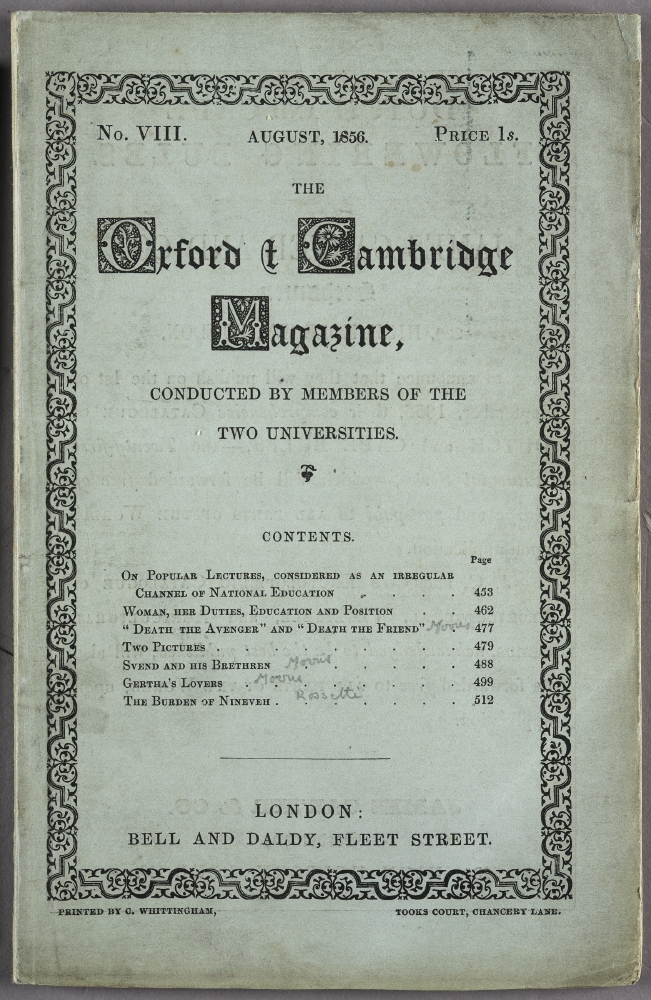
![Image of page [453]](http://www.rossettiarchive.org/img/ap4.o93.1.453.jpg)