 page:
page: cover
Manuscript Addition: J. M. Herbert
Editorial Description: Written in pen above the ornamental border
Manuscript Addition: Morris
Editorial Description: Written in pencil to the right of “The Story of the Unknown Church.”
Manuscript Addition: Morris
Editorial Description: Written in pencil to the right of “Winter Weather. A Poem.”
Editorial Note (page ornament): An ornamental border frames everything but the printer's name and address at the bottom of the page.
No. I.
JANUARY, 1856. Price 1
s.
THE
Oxford + Cambridge
Magazine,
Editorial Note (page ornament): Initial O, C, and M are ornamental
CONDUCTED BY MEMBERS OF THE
TWO UNIVERSITIES.
Editorial Note (page ornament): Publisher's mark.
LONDON:
BELL AND DALDY, FLEET STREET.
PRINTED BY C. WHITTINGHAM, TOOKS COURT, CHANCERY LANE.
 page:
page: [unpaginated]
Transcription Gap: (Advertisements)
![Image of page [1]](http://www.rossettiarchive.org/img/thumbs_small/ap4.o93.1.001.jpg) page:
page: [1]
Editorial Note (page ornament): An ornamental design appears at the top of the page.
Editorial Note (page ornament): Initial W is ornamental.
We often complain, and hear others complain, that the minds of this age are incapable of strong and patient intellectual effort;
that they
fritter themselves away in easy flights; that reader and writer alike disport themselves in the novel, the review, the leading
article, till they lose both taste
and power for soberer and weightier work. Popular history, we say, is but a series of sparkling and stimulating sketches,
popular poetry but
“short swallow-flights of song” skimming the very base of that Aonian mount above which Milton’s muse soared
with no middle flight. Much, or all of this, in more genial moments, we allow to be true, but call it the necessity of the
time, which we must hopefully, not
querulously, adapt ourselves to. How should it be otherwise in this nineteenth century, in the midst of which God has placed
us, with its whirl of conflicting
principles, its tossing sea of
Column Break
theories and anachronisms, beliefs and disbeliefs, truths of Heaven and falsehoods of the Pit, each struggling in its own
direction, the whole mass drifting—whither? A man, be he reader or writer, in the midst of such a time, may not go definitely
forward, with a single
eye, to a single object; but must needs move, if haply he can move at all, in a constant zigzag, ever carried out of his course
by side currents, ever fearing
that the moment is at hand when he must abandon the helm and trust himself solely to the wind and the wave. To speak without
figure, every man in these days is so
beset, at every moment, by questions of great, nay, of the greatest importance, all of which claim his thoughts at once, that
it becomes impossible for him to
devote a lifetime to the study of a particular aspect of a particular question. Moreover, no thought, or mechanical process
having the similitude of thought,
which does not bear upon the great questions of the day (the great questions of all days, did they but know
 page:
page: 2
it!) can, except by factitious means, become interesting to us. The poet must tell us of the men of the day, their
“sorrows and aspirations,” or of the men of the past,—solely as in contrast or other relation to
ourselves;* and that suggestively, not exhaustingly; we have not time for more: the epic fragment will be more welcome than
the epic complete. The historian must consign to the dustheap of oblivion, though with an erudite tear, his heraldries and
genealogies, his
“battles of the crows and kites,” ever remembering that knowledge is not good in itself, but only as it makes us good,
and must be content to learn from the novelist, or let the novelist take his place; for the age has said,—We will have nothing
more to do with
phantoms, incoherent and inconceivable, however logical; we want to see men as they were and are; not with motives, but with
impulses; not equations, with so many
virtues minus so many vices, but men, with infinite possibilities of good and evil; we want to see them, not that we may satisfy
a flippant curiosity, but that we
may gauge ourselves by them, that we may know why we are what we are, why they were other than we. If
you cannot satisfy us, we must seek those
who can; though they should call themselves Magazine writers, nay Novelists; it matters little whether the acts recorded be
truly told, in their minutiae of place
and time and agent, so that the feelings and impulses be truly portrayed. Thus many in these days think and say; not without
just cause given. For example, take
the age of Elizabeth, a time the most interesting to us of all times in English history, perhaps in world-history; its men
and women were so truly English, so
truly noble;
Column Break
it circumstances so like our own, its character so unlike. What have we in the literature of these days, of any days,
since Elizabeth’s time itself, which, thank God, being dead, yet speaketh, putting before us that age as it really was, excepting
a few years back,
a few magazine articles, by Mr. Kingsley and Mr. Froude, and a novel by Mr. Kingsley?†
Not challenging any comparison with these men, but thankfully accepting the hint they have given, I purpose to call the attention
of the readers of our
magazine, for a short time, in this and subsequent numbers, to the life and acts of the man who was looked upon by his contemporaries
as the star of
Elizabeth’s court and time; the most perfect character, perhaps, of whom history has taken note: the courtier, the Christian,
the scholar, the warrior,
the friend of Spenser and Raleigh; the incomparable Sir Philip Sydney. I have no transcendental aim; I shall endeavour, for
my own good and yours, to set Sir
Philip Sydney before you as he looked and spoke, and wrote, and was; to give you glimpses of the times he lived in, and the
men and women he was associated with;
to teach you the lessons his life has taught me, and especially that most important lesson of his life (in these days) that
a man may be a true servant of his
country and his queen, an accomplished gentleman, a thorough scholar, alive to all the interests (called secular) of his fellow-men,
and yet none the less, but by
much the more, a true servant of Christ. I know not whether I shall succeed; I know I shall not fail utterly, for the effort
will be good both for myself and you,
and therefore I have heart and hope to begin.
Transcribed Footnote (page 2):
*See Mr. Brimley’s admirable analysis of the “Morte
d’Arthur,” in the recent volume of “Cambridge Essays,” pp. 241 sqq.
Transcribed Footnote (page 2):
†Mr. Parker’s advertising sheet gives hope of a still more interesting contribution to the history of this time,
shortly forthcoming.
 page:
page: 3
We need not give the genealogists too hard measure. Many a Jabez, “more honourable than his brethren,”
lies hid for us, a jewel in the dustheap, in the pages of those pedantic old pedigree-makers. The very names, the Fulke Fitz
Warrens, and the Warren de
l’Isles, that bristle over the pages of Collins’s account of the genealogy of the Sidney family,* have a
twang of chivalry about them, an associative power that sets at nought the compiler’s evident respect for the duty of dulness.
What charms must they have had for him who fed his mind daily with the mediæval romance and story, with the black letter of
the “Morte d’Arthur” when a boy, with the converse of Edmund Spenser when a man! The perusal of his ancestry must have
helped to make him what he was, the “chevalier sans puer et sans reproche,” and he did not hesitate to own its influence. He glories in being a Dudley,†
and “does acknowledg that his cheefest honour is to be a Dudlei.” The perfunctory, copy-book morality of Horace and such
writers, was not then in vogue; a man might thank God for a noble ancestry, as his heart told him to do, without rebuke of
conscience for unseemly and pharisaical
pride. A man is
not merely what he makes himself; he is what God makes him; and when God would make a man noble and great, He often puts him
where the blood of the noble and great may stir and tingle in his veins, where, with his mother’s milk or at his nurse’s knee,
he may drink
in tales of the valour and virtue, and obedience of those of his name and house; how, through faith, they subdued kingdoms,
waxed valiant in fight, and turned to
flight the armies of the aliens. Therefore these “
imagines” that crowd the hall
Column Break
of Sir Philip Sidney’s
childhood’s home are not all shadows to us, being not all shadows to him; and we may linger a little among them without grudging
the time.
There were those of bad repute as well as of good, even among his mother’s ancestry, the De l’Isles; the first of that name
who has an
habitation in history, was “accounted one of the evil Councillors” of an evil monarch: Brian de l’Isle, who
received nobility and dignity from King John. But we find no stain upon the valour of the race, and but that one upon their
patriotism. Gerard, the evil
Councillor’s great grandson (I think), was conspicuous in all Edward III.’s wars in Scotland and France. He was at Creçy,
at Calais, at
Poictiers, right through the peace of Bretigny: and many another mighty cleaver of helmets (whom it were needless to invoke)
he numbered in his kith and kin.
Beside the De l’Isles, we find among the family heroes the stalwart figure of Richard Beauchamp, “my Lord of Warwick,” known
to
the French at Agincourt and Bordeaux, and to us mostly through Shakespeare: also John Talbot, my Lord of Shrewsbury, who died
a soldier’s death at
Chastillion, rather than survive defeat; and the Beauchamps and Talbots upward to the time when they left their Norway forests
with Rolf the Ganger, and upward
still to the beginning of things. One of the daughters of the Talbots, Viscounts Lisle (in whom the family centers), marries
(temp. Edw. IV.) one Edward Grey,
probably a “King’s poor cousin,” who is thereupon made Baron, and afterwards Viscount Lisle; again the family centers in a
daughter, by name of Elizabeth, and she marries Edmund Dudley, a powerful man of law of that day: known to us not
Transcribed Footnote (page 3):
*
Int. to Sidney Papers.
Transcribed Footnote (page 3):
† “Defence of Earl of Leicester,” ibid.
 page:
page: 4
favourably as an instrument of Henry VII. for the replenishing of his coffers. He with his colleague Empson made extortion
an art;
studied obsolete statutes with praiseworthy ingenuity; invented recherché methods of rifling the strong box of the subject,
which were found to benefit
himself, even more than his sovereign, till his sin found him out; and altogether did his best to merit the exalted position
to which the
vox populi and the young king’s consent adjudged him as soon as his master was dead. He was beheaded amid universal acclamation,
in the second year of Henry VIII. There was a little son of his, six years old, John Dudley; to whom his father perhaps was
indulgent enough when he had leisure,
and who must have been sorely puzzled by his ignominious transit. He grows up; a valiant youth of good parts; goes to France
with Charles Brandon Duke of Suffolk
to fight the Duke of Bourbon; being valiant as I said, he is knighted at 22; Sir John Dudley. The King notices him; “bluff”
King Hal, who
“loved a man;” honour grows upon him; he is master of the armory; he is master of Horse to pale-faced Anne of Cleves, our
new queen; a
Viscount (De l’Isle by title, for he represents his grandmother’s family); Lord High Admirall for life; one dignity following
close upon
another: waging war, meantime, as the Baillies of “Eddenborow” and the Dauphin at Boulogne can testify, successfully by land
and sea. So his
honour grows; and the block whereon he shall lay his head is yet in the heart of the oak, in the depth of the forest. An ambitious
man, who, being high, dreams
of being higher, perhaps highest: (for the times are big with all manner of possibilities:) not very clear in his convictions,
but blustering and impetuous in the
utterance of them, selling himself, body and soul, to the impulse of the moment; a lion in battle, in his heart of hearts
a coward; not scrupulous of means, but
by temperament
Column Break
a fighter, rather than a plotter; the hottest-headed of men; so unlike the oily respectability and shallow consistency of
his rival Somerset.
Through Edward’s reign these two struggle; a life-and-death struggle. As the duke sinks, the earl rises; Earl (newly) of Warwick;
soon a Duke too, of
Northumberland; victor over Scots at Musselburgh, insurgents at Norwhich. Thus Duke meets Duke in the tug of war; Northumberland,
once clearly in the ascendant,
marries his eldest son to Somerset’s daughter; there seem fire-seeds of generosity in this man, which burst into blaze now
and then. The next day, his
third son Robert (to be Earl of Leicester, not invisible in this, or in general history,) is married (publicly enough, as
appears from Edward’s
journal), to Amy, daughter of Sir John Robsart; “after which marriage there were certain gentlemen that did strive who should first take away a
goose’s head which was hanged alive on two cross-posts.” All that follows we know, how the gentle lady Jane Dudley is caught
away from her oriel window and “Plato his Phaedo,” into a vortex of plot and intrigue, a Queen against her will, against her
judgment: how
the plain good sense of Englishmen declares against cajolery, even for a Protestant succession: and our blustering Duke rides
out through Shoreditch, distrusting
his doings and his party; “The people throng to see us, but none biddeth us God speed.” We remember his spasmodic effort to
save himself, by setting up Queen Mary’s standard at the market-cross whither he had gone to set up Queen Jane’s; we remember
his arrest at
King’s College, and that uneasy struggle to win himself a respite by vehemently abjuring all he had vehemently professed;
overdoing it even to the
last, and impetuously declaring that he deserved to die a thousand such deaths, that he died in the true Catholic faith; and
so, “dastard-like,
with Peter, he
 page:
page: 5
forsook his Master.” Not pitied he, more than his father on that spot forty-three years ago; for he drags down
with him to death the innocent, the gifted, the loving and loveable Jane Grey, sweetest saint that ever suffered for sins
not her own.
This Duke’s children, by his wife Jane Guildford, of the old De la Warr stock, were
- 1. John, Earl of Warwick, imprisoned with his father, but liberated shortly after, with the seeds of jail fever in him; he
died at Penshurst, October
1554.
- 2. Ambrose, Earl of Warwick: “he was a most excellent person, and died without issue.”
- 3. Robert, Earl of Leicester.
- 4. Guildford, who died on the scaffold, with his wife Jane Grey.
- 5. Henry, slain four years afterward at the siege of St. Quintin’s.
- And two daughters,—Lady Mary Sidney, and Catherine, Countess of Huntingdon.
Sir Philip’s father’s genealogy has no names in it so eminent for good or ill as some we have touched upon. There was a William
de
Sidne, an Angevin friend and servant of our Angevin King, Henry II.; and there was a William Sidnei, sprung lineally from
him,—a Flodden-hero, who
received knighthood from Henry VIII., and the manor of Penshurst in Kent from Edward VI. He has issue, four daughters,—
- Anne, Lady Hungerford; a daughter of whom (Sir Philip’s first cousin) marries a blue-blooded Castillian, Duke of Feria, of
many and sounding
titles.
- Lucy, Lady Harrington.
- Anne, Lady Fitzwilliam, ancestress of at least one man not immemorable,—George Gordon, Lord Byron.
- Frances, Countess of Suffolk.
And one son—Henry Sidney, the father of Sir Philip, one of the noblest to the many noble gentlemen of that
Column Break
age, the young
prince’s playfellow, the young king’s dearest friend. He is one of the four gentlemen of the bedchamber (another being William
Cecil) ; he
is “the most compleat young gentleman of the court;” being knighted, (no empty title in those days,) he marries the lady
Mary, the great Duke’s daughter; for knighthood raises a man to the level of the highest. But troublous times are at hand;
the boy-king dies in his
friend’s arms. Sir Henry is in no mind for plotting; he retires, full of sad thought, with his young wife, to the beech-woods
of Penshurst. His friend
and king is gone; those nearest to him are engaged in an unlawful struggle, which cannot end but in failure and destruction;
his allegiance, as a true Christian
man, is due to one whom he can scarcely regard but as an enemy to the true Christian faith. They can do nothing but sit still
and wait, though with heavy heart,
they two; and as messenger after messenger comes in, like those who burst upon Job, each with his freight of dolorous tidings,
what wonder if the gentle
Mary’s heart sank utterly within her, if she resigned, as for ever, all thought of this world’s happiness? Her father put
to an ignominious
death; her noble young brother, and that sweet sister-in-law, whom she has but lately taken to her love: these are heavy blows
indeed; but she has a brave heart;
her stay is in God, and her help in tending that sick brother, John, who has come to them from prison, as a brand plucked
from the burning; alas! only to smoulder
slowly away, instead of being caught in sudden blaze. Other hope too she has,—to be better fulfilled; and, in these dull November
days, God cheers her
with a son, a richer and dearer blessing than aught He has taken away. To her children, her husband, and her God, life shall
henceforth be given. The mischance of
sickness has “cast a
 page:
page: 6
veil over her excellent beauty,”* the mischance of history over her gaiety of heart, and the
world, with its critic sneers, is not for her. Yet is she no ascetic, “By nature of a large ingenuous spirit;” a mother indeed
for our
Philip, who learns, or inherits, from her that chivalrous sense of duty, that affectionate cheerfulness, that crystal-clear and radiant
truthfulness of heart.†
Henry Sidney is respected, even trusted, by the Queen; he is sent to Ireland, two years after her accession, as Vice-Treasurer,
and is connected therewith,
as Justice, Deputy, Governor (under Mary and Elizabeth), for eleven years: resident there, or at Ludlow, for he is also Lord
President of the Marches of
Wales—a post more of a sinecure than his Irish one. What he does in Ireland time would fail us to tell. How he routs the insurgent
Scots of
Ulster—killing James Macconnel, their leader, with his own hand, and thus winning those “spolia
opima,” which in all Rome’s history were gained but thrice; how he defeats the O’Molloy and the O’Reilly,
and gains the submission of Shane O’Neill himself; how he fortifies Dublin; builds the bridge of Athlone; gives presidents
to the remoter provinces;
divides Munster into counties; revives obsolete statutes, “to the great good of the realm;” prints the laws and ordinances
of Ireland;
increases the crown revenues; settles the boundary of the “Pale;” projects a University; invites the Irish chieftains (many
of them debased
Normans) to his castle, and “reclaims them to clean-living and sobriety,” by a good example; how,
Column Break
in brief, having found Ireland
“ruined by intestine feuds, the Pale overrun by thieves and robbers, the countrymen poor, the soldiers beggarly, loose, and
idle, the churches
uncovered, and the clergy scattered,” he leaves it (compared with what it was) orderly and peaceful, prospering in Church
and State: all this must be
read in Collins, and in Fuller, who sums up the whole matter (as is his wont), epigrammatically, in nine Herculean labours.
Altogether, this man stands out great
above his fellows; patient and laborious to a degree; a much-suffering Ulysses (suffering too from sharp internal complaint);
a man of parts, of “sweet
delivery,” truthful, dutiful, modest, godly; of even cheerfulness, so that he writes to his son; “Yow degenerate from yowr
father, yf yow
find not your selfe most able in wytte and bodye to doe any thinge when you be most mery.” He lives splendidly, as a viceroy
in Ireland ought to do;
spends his patrimony on his queen’s service: dies poor, and is buried, “like Valerius,” at the public expense. He had been
summoned from Ireland in consequence of intrigues between the Desmonds and the Ormonds, and, as he stepped on board, he exclaimed
with the Psalmist, says Fuller,
“When Israel came out of Egypt and the house of Jacob from among a strange people.”
He had three sons :—
- 1. Sir Philip.
- 2. Sir Robert, afterwards Earl of Leicester, and grandfather of Algernon Sidney.
- 3. Sir Thomas.
And four daughters, but one of
Transcribed Footnote (page 6):
*
Fulke Greville, Lord Brooke: our chief contemporary authority on the facts of Sidney’s life. His book is of a class
which are now styled “Reminiscences” rather than “Memoirs.”
Transcribed Footnote (page 6):
† See Mr. Kingsley’s portraiture of Mrs. Leigh, a wonderfully truthful delineation of a
noble lady of that time. Lady Sidney, particularly, he must have had in view. Mrs. Leigh’s fondness for the “little
mystic”
Alt-Deutsch Theologie, which some have objected to as not very probable, has its counterpart in Lady
Anne Bacon’s translations from Bernardo Ochino, one of the earliest Socinians. Cf. Macaulay’s Essay on Bacon,
Ed. Rev., July 1837.
 page:
page: 7
whom survived him, the noble Countess of Pembroke, “Sidney’s sister,
Column Break
Pembroke’s mother,”* of whom we shall hear again.
[
To be continued.]
Transcribed Footnote (page 7):
- *Marble Pyles let no man rayse
- To her name for after Daies.
- Some kinde woman, borne as she,
- Beading this, like Niobe
- Shall turne marble, and become
- Both her mourner and her tombe.
So sings rare Ben Jonson. It is worth noticing, that Milton has introduced a similar cold conceit into his epitaph on Shakespeare,
which, fortunately, is
perfect enough without it.
Editorial Note (page ornament): Initial A is ornamental.
Altogether disbelieving, and reprehending with the strongest indignation, the doctrine upon which so many of the critics of the present
day
seem to act, however they might shrink from maintaining it in so many words, that the reviewer, by virtue of his office, is
superior to the writer reviewed, and
knowing full well not only at what an infinite height above me is the poet upon whom I have taken on myself to pass a judgment,
but also that a critique upon him,
which by any partiality can be called adequate, is utterly beyond my power, it is with the greatest diffidence that I approach
my subject. But whatever I shall
advance will have been carefully weighed, and will be the result of several years’ almost uninterrupted reading of the Author.
Would that every reviewer of
a great writer could say as much.
The essay will extend through three numbers,—a length which it is hoped will not appear too great to the reader, if he reflects
how great a work it is
to criticise a great poet—to be in some sort an interpreter between him and the public. Indeed, as it is, there will be but
too good cause for complaint of
the criticism attempted here, as sketchy and imperfect. The first part will be devoted to the Miscellaneous
Column Break
Poems, and The Princess; the second to In Memoriam; the third to the volume last published.
In commenting upon the Miscellaneous Poems, I have the choice of two methods; either to make meagre remarks upon many, or
to examine a very few at greater
length. The latter appears to me beyond doubt to be preferred. Accordingly, I shall particularize only three; The Lady of Shalott; The Two Voices ; and The Vision of Sin ; in each of which I shall point out and enforce one or more of the principal excellencies of their author. It is surely unnecessary
to state that I do not
consider these limited severally to the poems in which I shall call attention to them. Let one example suffice. I shall observe
upon his melody in The Lady of Shalott; but scarcely one unmelodious line, if one at all, exists in the whole of his works.
No fitter poem than The Lady of Shalott can be taken for illustrating a faculty very desirable, if not absolutely requisite in poetry—painting in words. There is
a mysterious sympathy
between the different branches of Art, which binds them all into one closely connected whole. There are well-known instances,
such as Michael Angelo and Leonardo da
Vinci, of men who have united in their single selves the painter, the architect, the sculptor,
 page:
page: 8
and the poet. The love of music expressed by poets is far too common to require example. Not that this is what I shall intend
when I shall
say presently that the great poet is a musician. But not only that; he is also a painter. One of the most remarkable instances
of verbal painting is a Tale, which
might almost with exact propriety be called a poem—Sintram and his Companions, by De la Motte
Fouqué. But not inferior even to the German Romancer is the English poet. I have selected The Lady of Shalott because this pictorial power so pervades it throughout, that almost every new passage paints a new picture. But to the common
eye still more striking than any
of these are some of the pictures in The Palace of Art and Morte d’Arthur, which, accordingly, I quote in preference, commending the whole of The Lady of Shalott to the reader’s private examination.
- “One seem’d all dark and red,—a tract of sand,
- And some one pacing there alone,
- Who paced for ever in a glimmering land,
- Lit with a low large moon.”
- “Or in a clear, wall’d city on the sea,
- Near gilded organ-pipes—her hair
- Wound with white roses, slept St. Cecily;
- An angel look’d at her.”
- “Or mythic Uther’s deeply-wounded son,
-
10In some fair space of sloping greens,
- Lay, dozing in the vale of Avalon,
- And watch’d by weeping queens.”
The Palace of Art.
- “A chapel nigh the field,
- A broken chancel with a broken cross,
- That stood on a dark strait of barren land.
- On one side lay the Ocean, and on one
- Lay a great water, and the moon was full.”
- “But the other swiftly strode from ridge to ridge,
- Clothed with his breath, and looking as he walk’d,
- Larger than human on the frozen hills.”
- “Then saw they how there hove a dusky barge,
-
10Dark as a funeral scarf from stem to stern,
- Beneath them; and descending, they were ’ware
- That all the decks were dense with stately forms
- Black-stoled, black-hooded, like a dream—by these
- Three Queens with crowns of gold.”
Morte d’Arthur.
Column Break
I will now explain in what sense I said that the poet is a musician other than as he is a lover of music. There have been
those, surely a few only who have
despised, or affected to despise, the mere language, whether of poetry or prose, maintaining that the matter is all in all,
or at least so entirely principal, as to
make the words, provided they are perspicuous, of little importance. Again there are others, perhaps a few likewise, who feel
and acknowledge an altogether magical
power in language. The generality come between these extremes, affected considerably by verbal force and sweetness, but very
far from comprehending the full
significance of words. In the second class I would place myself. Much verse do I know with good, even original, sentiments
given in lucid and forcible language, to
which I cannot yield the name of poetry, though at first somewhat puzzled to render a reason for my refusal, till supplied
by Carlyle, who tells me that poetry is
song,—that is, that poetry requires as one essential the free, spontaneous flow of music. Here I would I could dive deep into
the mystery of music, and
fully explain why ancient philosophers by musical (
μουδικός) meant good and
orderly, show the intimate union they saw or felt between the measured flow of musical sounds and the good actions and peaceful
thoughts of a well-regulated life. In
default of this, I ask the reader to call back to his memory the sense of moral good which has made him happy while listening
to some quiet melody, and with the
recollection of this within him, let him read In Memoriam, and examine himself whether its calm refined rhythm does not produce the same feeling of moral satisfaction. Let him not
fancy that this rhythm is merely the
result of labour and practice, added to what is called a good ear; as little let him imagine that it is addressed to the ear
alone; for it is meant through the ear to
reach the soul. But surely to prove that music
 page:
page: 9
is allied to poetry is superfluous; how closely allied I have not space, if ability, to determine; it were more to the purpose
to show that
the poems of Tennyson are musical. And here I am perplexed from very abundance of material. His voice is “the richest-toned
that sings,”
“a lyre of widest range,” or rather all instruments in one. It is gilding refined gold to praise his melody; one might as
well gravely enunciate
that Shakespeare was a master of the human heart. You cannot open his poems without finding it, everywhere perfect of its
kind, whether it be the fairy-like flow of The Lady of Shalott, the dreamy smoothness of the Lotos-Eaters, the measured dignity of Morte d’Arthur, the fiery, sometimes furious, energy, with the most rapid and abrupt transitions of Locksley Hall, that rhythmical perfection of In Memoriam, which I am really at a loss to characterize, except by saying that it seems to me the very maturity of a power of versification
unequalled even before,
“moulded in colossal calm,” or lastly, the superlative sweetness and softness of that already oft-quoted serenade, “Come into
the
garden, Maud.” I am averse to the easy practice of making quotations, but, as I have chosen The Lady of Shalott as a sort of text to which to append my observations upon Tennyson’s versification, a few passages from it may not only be
allowed, but looked for.
I give them without any comment.
- “Willows whiten, aspens quiver,
- Little breezes dusk and shiver
- Through the wave that runs for ever
- By the island in the river,
- Flowing down to Camelot.”
- “By the margin, willow-veil’d
- Slide the heavy barges, trail’d
- By slow horses, and unhail’d
- The shallop flitteth, silken-sail’d
-
10Skimming down to Camelot”
- “In the stormy east-wind straining,
- The pale yellow woods were waning,
- The broad stream in his banks complaining
- Heavily the low sky raining,
- Over tower’d Camelot”
Column Break
- “Heard a carol, mournful, holy,
- Chaunted loudly, chaunted lowly,
- Till her blood was frozen slowly
- And her eyes were darken’d wholly,
-
20Turn’d to tower’d Camelot”
In The Two Voices I shall particularize only the union of intellect and feeling which, as it is one of the most essential qualifications of
poetry, so it distinguishes many of
Tennyson’s longer poems in the highest degree. Indeed if I were to select that which I think most excellent in him, I should
have little hesitation in
choosing this. In his smaller poems, from the very nature of the case, there is often little room for it, or rather it would
be entirely out of place; but in The Palace of Art, The Two Voices, The Vision of Sin, In Memoriam, (I name only some of his very greatest; but the list might easily be enlarged,) some of the most important and most difficult
questions of life are discussed
with an intellectual keenness and accuracy only to be expected from a philosopher, yet with all the melody, warmth and deep
feeling of the greatest of poets. Mere
philosophy, whether physics or psychology or metaphysics, is fit only for prose works, professedly and openly philosophical:
there is something essentially prosaic in
it; its chief requisites, precision, logical order, freedom from metaphor, the employment of the intellect alone, these, if
not separately, at least when united, are
altogether alien to poetry; and verse, in which philosophy is philosophically treated, has no more claim to rank as poetry
than the Ethics of Aristotle, or the Second Book of the Novum Organum, if put with as little violence as possible into metre. But philosophy, poetically treated, true philosophical poetry, the
great problems of life handled at
once with intellectual subtlety and warmth of feeling, I regard as the highest kind of poetry of all; nay, it may be I am
blinded by love, but I cannot help looking
upon it as the highest effort of human genius. Uniting the interest of the subject themselves,—acuteness
 page:
page: 10
of reason and strength of feeling,—the wonderful magic of language,—the equally wonderful magic of rhythm, drawing and
painting to the imagination,—so coming home at once to the souls, the minds, the hearts, the ears, eyes and fancies of men,
it seems to me to have a grand
comprehensiveness of beauty, which no other work of man comprises. I say advisedly it seems to me; for I know well that to
one man one thing seems, and is, greatest,
and to another man another thing; that to the man of science there is nothing so great as science, to the painter nothing
so noble as pictures, to the musician
nothing so deep and beautiful as music. So let it be; for truth and beauty, though of absolute certainty, are of infinite
range; so that, though because of our fallen
intellect there is now no one mind that can take in all knowledge and all beauty, yet beauty and truth can embrace all intellects
and all tastes.
The Two Voices would itself afford an ample subject for a review; and indeed not only admits of, but requires, one; but my limits prevent
me from saying at the present more
than this, that I place it the highest of the Miscellaneous poems,—surpassed even by In Memoriam only by the latter being of greater length.
The Vision of Sin, beside being, as its name imports, a vision, is also an Allegory. A few words therefore about poetical Visions and Allegories
in general, and
Tennyson’s handling of them in particular, will be necessary before I enter more in detail upon the poem itself.
A poetical Vision, as it is most difficult for the poet to employ, so is it not easy for the critic to describe what it is.
Whatever it may have in common with
the dreams of sleep, it has so much distinct from them that it is upon no account to be classed simply among them. Two characteristics
alone, its continuity and
sequence, are sufficient to distinguish it from them.
Column Break
But that it has much in common with them is equally plain, as in the following instances, the first from The Vision of Sin:
- “And I thought I would have spoken,
- And warned that madman, ere it grew too late,
- But, as in dreams I could not”—
The second, from A Dream of Fair Women:
- “With that sharp sound, the white dawn’s creeping beams,
- Stolen to my brain, dissolved the mystery
- Of folded sleep.”
though it is worthy of notice that this is the only passage in that poem which contains unmistakeably any feature peculiar
to sleeping dreams.
On the other hand the continuity and sequence point to a day dream, the Vision of Inspiration, which poets really see, even
in these later days. But whatever
is its nature, it has been by universal consent conceded to the poet, though it has proved one of the most unmanageable and
perilous of all his instruments. Young
poets are constantly taking it in feeble and unskilful hands to their own hurt. Alas, their dreams are too often of men neither
waking nor sleeping, nor indeed in any
other state which the rest of the world knows of. But in nothing is Tennyson more felicitous than in his treatment of visions.
Consistent, significant and beautiful,
they yet so remind the reader of his own dreams as to convince him that the poet writes from experience. His narration of
actual dreams is exact. I give a few
examples.
- “Till now at noon she slept again,
- And seem’d knee-deep in mountain grass,
- And heard her native breezes pass,
- And runlets babbling down the glen,
- She breathed in sleep a lower moan,
- And murmuring, as at night and morn,
- She thought, ‘My spirit is here alone,
- Walks forgotten, and is forlorn.’
- Dreaming she knew it was a dream;
-
10She felt he was, and was not there.”
Mariana in the South.
 page:
page: 11
- “And then to bed, where half in doze I seem’d
- To float about a glimmering night and watch
- A full sea, glazed with muffled moonlight, swell
- On some dark shore just seen that it was rich.”
The Princess.
- “When in the down I sink my head,
- Sleep, Death’s twin-brother, times my breath;
- Sleep, Death’s twin-brother, knows not Death
- Nor can I dream of thee as dead:
- I walk as ere I walk’d forlorn,
- When all our path was fresh with dew,
- And all the bugle breezes blew
- Reveilleé to the breaking morn.
- But what is this? I turn about,
-
10I find a trouble in thine eye
- Which makes me sad I know not why,
- Nor can my dream resolve the doubt:
- But ere the lark hath left the lea
- I wake, and I discern the truth,
- It is the trouble of my youth
- That foolish sleep transfers to thee.”
In Memoriam.
But The Vision of Sin is also an Allegory. Allegories are perhaps a still more dangerous instrument of poetry than Vision. For beside the difficulty
of treating them, there is
something particularly unsatisfactory in the knowledge that you must not rest in the story, but must convert your flesh and
blood men and women, into abstractions,
into principles and emotions, into virtues and vices. Human nature loves and delights in the personal, and shrinks from the
abstract; and especially poetry shuns
abstractions, and holds close to persons. It is this very love of the personal that makes poets write allegories; but the
reader is strongly tempted to get rid of the
abstractions altogether, and turn the allegory into a mere tale. And it is as moral stories that The Faerie Queen, The Pilgrim’s Progress, and The Ancient Mariner are read for the most part. Fortunately some of their great lessons are so entirely on the surface, that he who runs cannot
help but read. Certainly few care
to enter minutely into the details, to find the moral bearing of this fact and that fact. For the interpretation
Column Break
of an allegory involves the mysterious
connection between the outward and the inward, which makes our daily life a marvel and a symbol. That it subsists all perhaps
are conscious, though the multitude very
dimly and partially; the spiritual meaning of many visible things many understand, but the entire significance of the whole
no man can comprehend. However, as it is
necessary that the story should be complete in itself, it may happen that parts of it have no immediate secondary meaning.
But in some allegories the connection
between the primary and secondary meanings is very close, of which I know no apter instance than Poe’s Tale of William Wilson, the story of which is so self-complete that it is possible that many have read it without suspecting that the double of
the narrator is his conscience, yet
its moral signification is most closely interwoven with its literal; as for instance, to bring forward one out of many, the
second William Wilson cannot speak above a
low, though distinct whisper, like the still small voice of conscience. And that this union in The Palace of Art and The Vision of Sin is very intimate, is palpable; but how intimate it is this is not so easy to see. I shall give a somewhat lengthy explanation
of The Vision of Sin, in which I shall show that particular facts in the story, as the rising of the fountain, have a direct moral signification;
if a similar analysis were made
of The Palace of Art, I have little doubt that the details of this also would be found to be each immediately symbolical.—As it is against The Vision of Sin, that a charge not unfrequently laid against Tennyson in general, is perhaps most frequently and most plausibly brought,
nay, as I have heard many confess
that it is wholly unintelligible to them, it may be doing a service to his readers if I offer an explanation of it, an explanation
which I cannot positively declare
to be the true one, but which is the result of many very careful readings, and much
 page:
page: 12
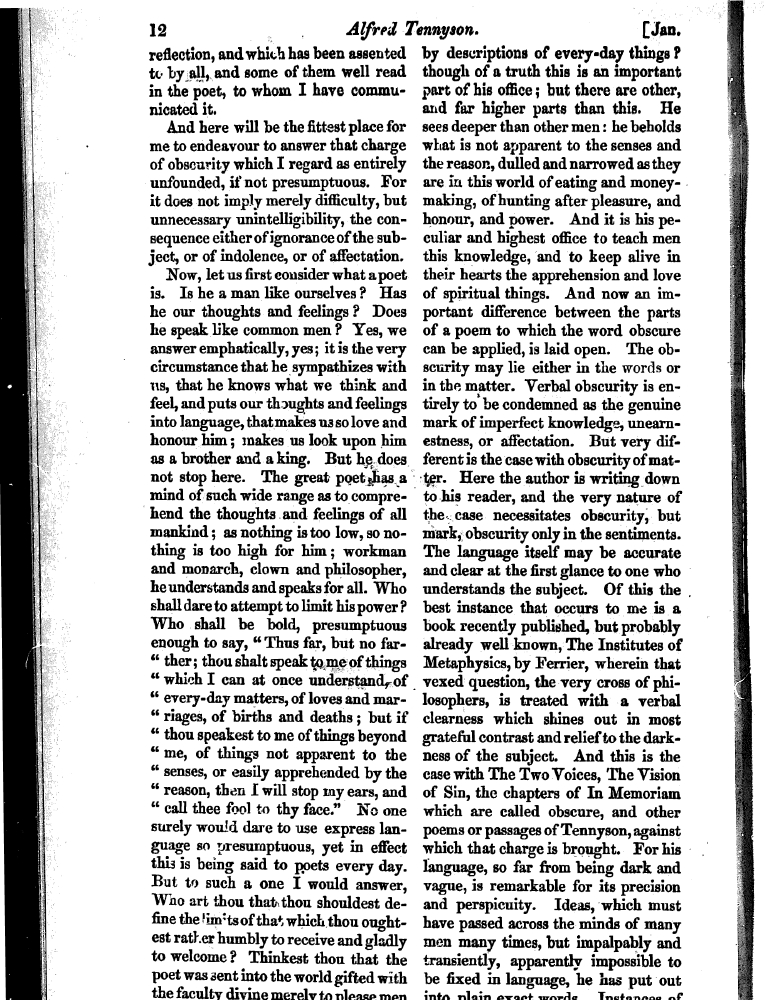
reflection, and which has been assented to by all, and some of them well read in the poet, to whom I have communicated it.
And here will be the fittest place for me to endeavour to answer that charge of obscurity which I regard as entirely unfounded,
if not presumptuous. For it does
not imply merely difficulty, but unnecessary unintelligibility, the consequence either of ignorance of the subject, or of
indolence, or of affectation.
Now, let us first consider what a poet is. Is he a man like ourselves? Has he our thoughts and feelings? Does he speak like
common men? Yes, we answer
emphatically, yes; it is the very circumstance that he sympathizes with us, that he knows what we think and feel, and puts
our thoughts and feelings into language,
that makes us so love and honour him; makes us look upon him as a brother and a king. But he does not stop here. The great
poet has a mind of such wide range as to
comprehend the thoughts and feelings of all mankind; as nothing is too low, so nothing is too high for him; workman and monarch,
clown and philosopher, he understands
and speaks for all. Who shall dare to attempt to limit his power? Who shall be bold, presumptuous enough to say, “Thus far, but no farther; thou
shalt speak to me of things which I can at once understand, of every-day matters, of loves and marriages, of births and deaths;
but if thou speakest to me of
things beyond me, of things not apparent to the senses, or easily apprehended by the reason, then I will stop my ears, and
call thee fool to thy
face.” No one surely would dare to use express language so presumptuous, yet in effect this is being said to poets every day. But
to such a one I
would answer, Who art thou that thou shouldest define the limits of that which thou oughtest rather humbly to receive and
gladly to welcome? Thinkest thou that the
poet was sent into the world gifted with the faculty divine merely to please men
Column Break
by descriptions of every-day things? though of a truth this is an important
part of his office; but there are other, and far higher parts than this. He sees deeper than other men: he beholds what is
not apparent to the senses and the reason,
dulled and narrowed as they are in this world of eating and money-making, of hunting after pleasure, and honour, and power.
And it is his peculiar and highest office
to teach men this knowledge, and to keep alive in their hearts the apprehension and love of spiritual things. And now an important
difference between the parts of a
poem to which the word obscure can be applied, is laid open. The obscurity may lie either in the words or in the matter. Verbal
obscurity is entirely to be condemned
as the genuine mark of imperfect knowledge, unearnestness, or affectation. But very different is the case with obscurity of
matter. Here the author is writing down to
his reader, and the very nature of the case necessitates obscurity, but mark, obscurity only in the sentiments. The language
itself may be accurate and clear at the
first glance to one who understands the subject. Of this the best instance that occurs to me is a book recently published,
but probably already well known, The
Institutes of Metaphysics, by Ferrier, wherein that vexed question, the very cross of philosophers, is treated with a verbal
clearness which shines out in most
grateful contrast and relief to the darkness of the subject. And this is the case with The Two Voices, The Vision of Sin, the chapters of In Memoriam which are called obscure, and other poems or passages of Tennyson, against which that charge is brought. For his language,
so far from being dark and vague,
is remarkable for its precision and perspicuity. Ideas, which must have passed across the minds of many men many times, but
impalpably and transiently, apparently
impossible to be fixed in language, he has put out into plain exact words. Instances of
 page:
page: 13
this occur everywhere in his poems, perhaps most of all in The Two Voices, but I will make a single quotation, and that from A Dream of Fair Women.
- “No memory labours longer from the deep
- Gold-mines of thought to lift the hidden ore
- That glimpses, moving up, than I from sleep
- To gather and tell o’er
- Each little sound and sight. With what dull pain
- Compassed, how eagerly I sought to strike
- Into that wondrous track of dreams again!
- But no two dreams are like.”
If, then, any one is inclined to call Tennyson obscure and affected, let him question himself whether he is acquainted with
the subject of the poem; and, if he
finds that he is not, let him try to master it; and, when he has mastered it, I confidently predict that he will be even amazed
to discover how felicitously it is
treated, just at the proper length, and in the most forcible and precise language.—I will now give the promised explanation
of The Vision of Sin. It is an Allegory, with a high moral purpose, to set forth the punishment of sensuality and pleasure-seeking.
- “A youth came riding toward a palace-gate;
- He rode a horse with wings, that would have flown,
- But that his heavy rider kept him down.”
Such of my readers as are acquainted with the Phædrus of Plato, will at once call to mind
the myth of the two winged steeds and the charioteer, by which Plato represents the human soul, and will easily interpret
the modern poet. For the information of such
as are unacquainted with that dialogue I translate the following passage.
“Let the soul be likened to a nature composed of a pair of winged horses and a charioteer. Now all the horses and the charioteers
of the gods are both
themselves good and of good descent, but the rest are of a mixed quality. And in the first place with respect to us, it is
our guiding principle that drives the pair
of horses; in the second place, of these horses, the one is good and noble,
Column Break
and of like descent, the other is the opposite and of the opposite
descent.”
I need now scarcely say, that these horses represent severally the good and the bad inclinations of our nature, while the
charioteer is the guiding principle,
which Plato would have called reason, but which perhaps we should rather call conscience. In the passage in The Vision of Sin there is but one horse, the spiritual part of man, “with wings, that would have flown, But that his heavy rider,” by which
we are to
understand the carnal desires, the body, “kept him down.” “And from the palace came a child of sin”—a
temptation or a tempter,
- “Who took him by the curls, and led him in,
- Where sat a company with heated eyes,
- Expecting when a fountain should arise.
- A sleepy light upon their brows and lips—
- Suffused them, sitting, lying, languid shapes,
- By heaps of gourds, and skins of wine, and piles of grapes.”
A sated party of pleasure, waiting for the feeling of satiety to pass away; for it is that which is signified by the rising
of the fountain. Then follows a
scene of voluptuousness, which I doubt not every reader will now easily make out for himself, and in which I will draw attention
to one thing only, the exquisite
description of the music, partly under the terms of form and colour, asking him to bear in mind what I said before about the
union of the arts.
But now a change comes over the dream:
- “And then I look’d up toward a mountain tract,
- That girt the region with high cliff and lawn;
- I saw that every morning, far withdrawn
- Beyond the darkness and the cataract,
- God made himself an awful rose of dawn
- Unheeded.”
This last line is perhaps the most strange and difficult in Tennyson; but I propose the following interpretation with little
hesitation. The “awful rose of dawn” signifies
primarily the red morning; in an extended sense
 page:
page: 14
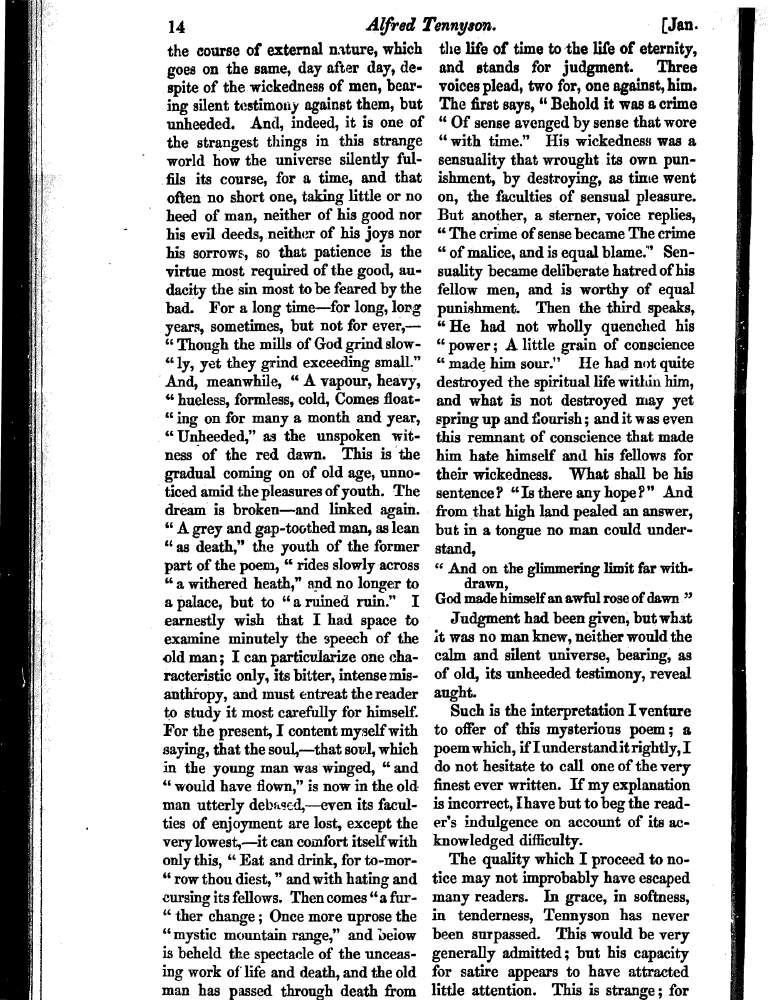
the course of external nature, which goes on the same, day after day, despite of the wickedness of men, bearing silent testimony
against
them, but unheeded. And, indeed, it is one of the strangest things in this strange world how the universe silently fulfils
its course, for a time, and that often no
short one, taking little or no heed of man, neither of his good nor his evil deeds, neither of his joys nor his sorrows, so
that patience is the virtue most required
of the good, audacity the sin most to be feared by the bad. For a long time—for long, long years, sometimes, but not for
ever,—“Though the mills of God grind slowly, yet they grind exceeding small.” And, meanwhile, “A
vapour, heavy, hueless, formless, cold, Comes floating on for many a month and year, Unheeded,” as the unspoken witness of the red dawn. This
is the gradual coming on of old age, unnoticed amid the pleasures of youth. The dream is broken—and linked again. “A grey and gap-toothed
man, as lean as death,” the youth of the former part of the poem, “rides slowly across a withered heath,”
and no longer to a palace, but to “a ruined ruin.” I earnestly wish that I had space to examine minutely the speech of the old
man; I can particularize one characteristic only, its bitter, intense misanthropy, and must entreat the reader to study it
most carefully for himself. For the
present, I content myself with saying, that the soul,—that soul, which in the young man was winged, “and would have
flown,” is now in the old man utterly debased, —even its faculties of enjoyment are lost, except the very lowest,—it can
comfort itself with only this, “Eat and drink, for to-morrow thou diest,” and with hating and cursing its fellows. Then comes
“a further change; Once more uprose the mystic mountain range,” and below is beheld the spectacle of the unceasing work of
life and death, and the old man has passed through death from
Column Break
the life of time to the life of eternity, and stands for judgment. Three voices plead, two for,
one against, him. The first says, “Behold it was a crime Of sense avenged by sense that wore with time.” His wickedness was a
sensuality that wrought its own punishment, by destroying, as time went on, the faculties of sensual pleasure. But another,
a sterner, voice replies,
“The crime of sense became The crime of malice, and is equal blame.” Sensuality became deliberate hatred of his fellow men,
and is worthy of equal punishment. Then the third speaks, “He had not wholly quenched his power; A little grain of conscience made him sour.”
He had not quite destroyed the spiritual life within him, and what is not destroyed may yet spring up and flourish; and it
was even this remnant of conscience that
made him hate himself and his fellows for their wickedness. What shall be his sentence? “Is there any hope?” And from that high
land pealed an answer, but in a tongue no man could understand,
- “And on the glimmering limit far withdrawn,
- God made himself an awful rose of dawn.”
Judgment had been given, but what it was no man knew, neither would the calm and silent universe, bearing, as of old, its
unheeded testimony, reveal aught.
Such is the interpretation I venture to offer of this mysterious poem; a poem which, if I understand it rightly, I do not
hesitate to call one of the very
finest ever written. If my explanation is incorrect, I have but to beg the reader’s indulgence on account of its acknowledged
difficulty.
The quality which I proceed to notice may not improbably have escaped many readers. In grace, in softness, in tenderness,
Tennyson has never been surpassed.
This would be very generally admitted; but his capacity for satire appears to have attracted little attention. This is strange;
for
 page:
page: 15
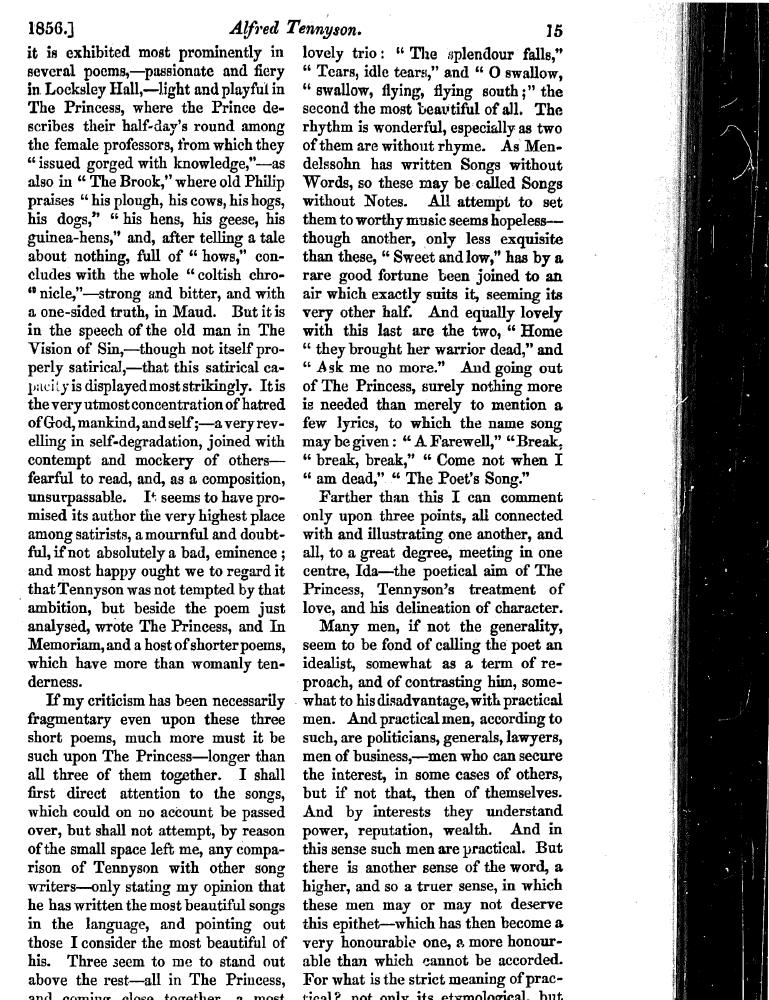
it is exhibited most prominently in several poems,—passionate and fiery in Locksley Hall,—light and playful in The Princess, where the Prince describes their half-day’s round among the female professors, from which they “issued gorged with
knowledge,”—as also in “The Brook,” where old Philip praises “his plough, his cows, his hogs,
his dogs,” “his hens, his geese, his guinea-hens,” and, after telling a tale about nothing, full of “hows,” concludes with
the whole “coltish chronicle,”—strong and bitter, and with a one-sided truth, in Maud. But it is in the speech of the old man in The Vision of Sin,—though not itself properly satirical,—that this satirical capacity is displayed most strikingly. It is the very utmost concentration
of
hatred of God, mankind, and self;—a very revelling in self-degradation, joined with contempt and mockery of others— fearful
to read, and, as a
composition, unsurpassable. It seems to have promised its author the very highest place among satirists, a mournful and doubtful,
if not absolutely a bad, eminence;
and most happy ought we to regard it that Tennyson was not tempted by that ambition, but beside the poem just analysed, wrote
The Princess, and In Memoriam, and a host of shorter poems, which have more than womanly tenderness.
If my criticism has been necessarily fragmentary even upon these three short poems, much more must it be such upon The Princess—longer than all three of them together. I shall first direct attention to the songs, which could on no account be passed
over, but shall not
attempt, by reason of the small space left me, any comparison of Tennyson, with other song writers—only stating my opinion
that he has written the most
beautiful songs in the language, and pointing out those I consider the most beautiful of his. Three seem to me to stand out
above the rest—all in The Princess, and coming close together, a most
Column Break
lovely trio: “The splendour falls,” “Tears, idle tears,” and
“O swallow, swallow, flying, flying south;” the second the most beautiful of all. The rhythm is wonderful, especially as two
of them are without
rhyme. As Mendelssohn has written Songs without Words, so these may be called Songs without Notes. All attempt to set them
to worthy music seems
hopeless—though another, only less exquisite than these, “Sweet and low,” has by a rare good fortune been joined to an air
which
exactly suits it, seeming its very other half. And equally lovely with this last are the two, “Home they brought her warrior
dead,” and
“Ask me no more.” And going out of The Princess, surely nothing more is needed than merely to mention a few lyrics, to which the name song may be given: “A Farewell,”
“Break, break, break,” “Come not when I am dead,” “The Poet’s Song.”
Farther than this I can comment only upon three points, all connected with and illustrating one another, and all, to a great
degree, meeting in one centre,
Ida—the poetical aim of The Princess, Tennyson’s treatment of love, and his delineation of character.
Many men, if not the generality, seem to be fond of calling the poet an idealist, somewhat as a term of reproach, and of
contrasting him, somewhat to his
disadvantage, with practical men. And practical men, according to such, are politicians, generals, lawyers, men of business,—men
who can secure the
interest, in some cases of others, but if not that, then of themselves. And by interests they understand power, reputation,
wealth. And in this sense such men are
practical. But there is another sense of the word, a higher, and so a truer sense, in which these men may or may not deserve
this epithet—which has then
become a very honourable one, a more honourable than which cannot be accorded. For what is the strict meaning of practical?
not only its etymological, but
 page:
page: 16
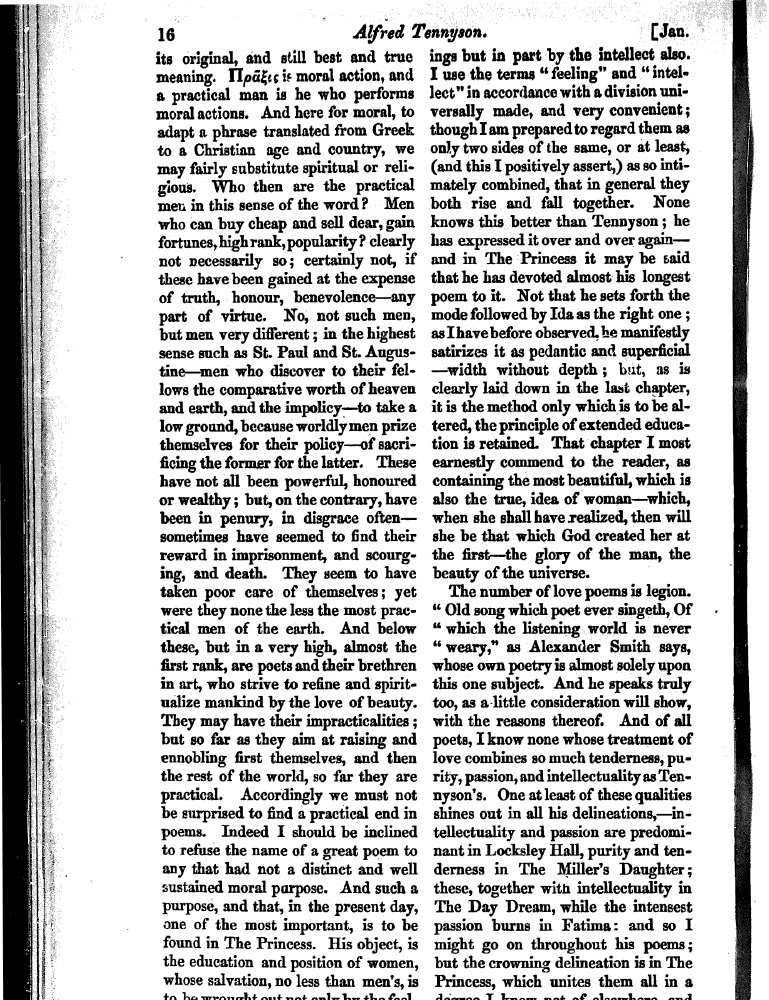
its original, and still best and true meaning. Π
ραξις is moral action, and
a practical man is he who performs moral actions. And here for moral, to adapt a phrase translated from Greek to a Christian
age and country, we may fairly substitute
spiritual or religious. Who then are the practical men in this sense of the word? Men who can buy cheap and sell dear, gain
fortunes, high rank, popularity? clearly
not necessarily so; certainly not, if these have been gained at the expense of truth, honour, benevolence—any part of virtue.
No, not such men, but men
very different; in the highest sense such as St. Paul and St. Augustine—men who discover to their fellows the comparative
worth of heaven and earth, and
the impolicy—to take a low ground, because worldly men prize themselves for their policy—of sacrificing the former for the
latter. These have
not all been powerful, honoured or wealthy; but, on the contrary, have been in penury, in disgrace often—sometimes have seemed
to find their reward in
imprisonment, and scourging, and death. They seem to have taken poor care of themselves; yet were they none the less the most
practical men of the earth. And below
these, but in a very high, almost the first rank, are poets and their brethren in art, who strive to refine and spiritualize
mankind by the love of beauty. They may
have their impracticalities; but so far as they aim at raising and ennobling first themselves, and then the rest of the world,
so far they are practical. Accordingly
we must not be surprised to find a practical end in poems. Indeed I should be inclined to refuse the name of a great poem
to any that had not a distinct and well
sustained moral purpose. And such a purpose, and that, in the present day, one of the most important, is to be found in The Princess. His object, is the education and position of women, whose salvation, no less than men’s, is to be wrought out not only by
the feelings
Column Break
but
in part by the intellect also. I use the terms “feeling” and “intellect” in accordance with a division universally made,
and very convenient; though I am prepared to regard them as only two sides of the same, or at least, (and this I positively
assert,) as so intimately combined, that
in general they both rise and fall together. None knows this better than Tennyson; he has expressed it over and over again—and
in The Princess it may be said that he has devoted almost his longest poem to it. Not that he sets forth the mode followed by Ida as the
right one; as I have before observed,
he manifestly satirizes it as pedantic and superficial—width without depth; but, as is clearly laid down in the last chapter,
it is the method only which
is to be altered, the principle of extended education is retained. That chapter I most earnestly commend to the reader, as
containing the most beautiful, which is
also the true, idea of woman—which, when she shall have realized, then will she be that which God created her at the first—the
glory of the man,
the beauty of the universe.
The number of love poems is legion. “Old song which poet ever singeth, Of which the listening world is never weary,” as Alexander
Smith
says, whose own poetry is almost solely upon this one subject. And he speaks truly too, as a little consideration will show,
with the reasons thereof. And of all
poets, I know none whose treatment of love combines so much tenderness, purity, passion, and intellectuality as Tennyson’s.
One at least of these qualities
shines out in all his delineations,—intellectuality and passion are predominant in Locksley Hall, purity and tenderness in The Miller’s Daughter; these, together with intellectuality in The Day Dream, while the intensest passion burns in Fatima: and so I might go on throughout his poems; but the crowning delineation is
in The Princess, which unites them all in a degree I know not of elsewhere, and
 page:
page: 17
makes its author, before all others, the Poet of Love.
This, together with the third point, will be made plain, if we examine at some length the character of Ida, who is at once
the chief figure and the centre of
the love poetry in The Princess. All Tennyson’s persons are brought before us with the true dramatic art which makes us feel and think of them as actual
men and women. To select a
few out of a vast number in his Miscellaneous Poems, I would instance the hero in Locksley Hall, the speaker and the first voice in The Two Voices, and the old man in The Vision of Sin. Whatever portrayal of character the plan of In Memoriam allows is exact. In the third part of this essay I shall analyze the hero in Maud, and I may now suggest in passing, the persons in The Brook, especially old Philip. But, as might have been expected, it is in The Princess that his dramatic power is best displayed. I proceed to comment upon Ida, merely observing of the others, that they are all
drawn, or rather sketched, with
the hand of a master. I have before said that Tennyson’s characters are felt as actual men and women; yet I now allow that
Ida is an ideal. She is an ideal
of woman, as woman was created, as she may yet be in the time of “the world’s great bridal”—the half “of that
great race which is to be.” But, though an ideal, she is no abstraction, and is felt to be real and personal as much as any
of the many male ideals which
have been drawn from time immemorial: the Trojan, or rather Greek, and I might almost say English, Hector, the Scandinavian
Odin, the Mediæval Sir
Galahad—these are not the less human because no man has hitherto reached their standard; in the long, let us hope great, future,
who knows but that equal
heroes may arise? And so Ida is a woman, yes, as woman may yet become, with all the purity, softness, and loving tenderness
which men assign to woman as her crowning
and distinctive, though
Column Break
not her exclusive, attribute. Woman she is from the very first; not less when lecturing to her female scholars and disdainfully
thrusting the male intruders from her college, than when nursing the wounded Prince, and yielding to his love. Her courage
and her devotion to her great cause make
her at first reject his love and brave the anger of his father and her own, and the war that ensued; but her gratitude and
her gentleness, or perhaps something
greater even than these, something that already “killed her with herself”—for he had mixed with her girlhood’s dreams made
her write,“Still take not his life; he risked it for my own: His mother lives.” With womanly indignation she takes her babe
from the friend who
seemed so deeply to have wronged her and her cause, “false, false, false;” but with womanly tenderness she cherishes it, and
with womanly
longing feels it a “pledge of a love not to be hers,” very soon restoring it to the mother. What sisterly affection mingles
with her anger and
resolution in her letter to her brother! With what feminine pride she promises him immortal renown as the champion of woman!
How readily and gladly she opens her
college to her wounded brothers and to her wounded lover, who alas! had been the foe that had “bred all this change!” Small
praise, it may be
said; but soon, almost as readily, though with deep sorrow and the darkest forebodings, with all her “world in secret blackened,
seeming blank and waste,
and vain,” she flings her doors wide, that all the wounded enemies not less than friends may enter, though all her maidens
must be sent home, except those
who may nurse the sick! And now, while she herself nurses the Prince and returns his love, surely all can see her woman,—devoted,
dependent,
loving,—looking to him who is to be her husband for aid and guidance in her great work of reforming half the world. She is
the noblest, the sweetest, the
most
 page:
page: 18
beautiful female character I know in fiction; the very flower of that pure, delicate mind which had already created
Column Break
the Marianas,
Eleanore, Lady Flora, and Lady Clare.

Editorial Note (page ornament): Initial T is ornamental.
The dancers swept merrily by me on that night of Lady Lacy’s ball eleven years ago, and fanned me pleasantly as they bounded
past
to the tune of instruments, and there was nothing in all this to make me peevish, and fretful, and morose; yet I stood aside
moodily, taking no part in the dancing,
nor the talk—and though I asked myself often how it was that I felt so evil-minded on that night, yet I needed no answer,
knowing well the reason, that it
was because of my cousin Gertrude, and her troop of flatterers, and because she slighted me openly, putting me to shame before
all who knew our betrothal; and because
I could not help thinking that somehow her love had grown cold of late. And some there were who rated me for my gloomy looks,
and pestered me with silly questionings,
to which I lent little heed or answer. And all the while Gertrude was hidden from me by a ring of satellites, but her silver
laugh and jesting troubled me heavily.
“To-morrow,” said I, “I will speak to her kindly and firmly, and if it must be so, release her whatever comes to me.” I
had fancied moreover that her father’s manner was shy and altered to me when I crossed him in the Hall; for he passed by me
with unwonted coldness, and
left the house immediately. Two gentlemen were talking in a low tone to one another, close at hand, but, though I moved to
be out of overhearing, I had unconsciously
caught the substance of their conversation, earnest and grave—some great failures in the north had followed the strikes, and
certain great city houses were
said to be deeply involved in the
Column Break
loss. Why should I, with unreasoning, overleaping thought, so swiftly couple this with that strange meeting in the hall?
I
cannot tell, only a fear not wholly indefinite fell upon me.
I would leave now; where was the hostess, my firm, most constant protector in all boyish scrapes? in the glance I gave round
the room I saw that Gertrude was
not there: I was at her ladyship’s side presently, and held out my hand. “So soon, Charlie, you must be ill; upon my word
you look so, let
me”—“No, dear Lady Lacy, there is positively nothing the matter with me, a slight headache perhaps;” and as I urged this
it came upon me indeed quick and throbbing—“my father said he should want me at a very early hour in the morning, and I cannot
fail
him.” “It is not much past twelve,” she said; “you are not generally so particular about sleep. Poor boy!” I
saw she was aware of more than she expressed. A kind look and kinder pressure. “I am sorry I prepared such an entertainment
for you, Charlie; good
bye.”
Yet I could not go without saying “good-night” to my beautiful cousin, who caused me such secret sorrow, but knew it not.
Passing the
refreshment room I saw her, as I thought, sitting in the cool, for her face was scarlet with the flush of dancing, and slightly
bent, but another step discovered that
she was not alone, and what I saw besides I say not: then I passed out straightway into the night, where the snow lay deep
upon the ground on that February morning,
feeling not heart-broken and crushed as I used to think I should feel, if any great distress fell upon me, but full of
 page:
page: 19
animal spirit and strange excitement. There was not a star in all the sky: I was glad there were none to look down with their
far-off, cold
and restless eyes upon me; but a thick covering of snow-cloud was wrapped about the earth and shrouded it all night long.
As I stepped upon the pavement the
half-clothed, shivering form of a woman came and cried to me. “Pity, oh! pity, it is so cold, and my child is starving, Sir—no
home, nor food
for it all this day long;” and all her voice was broken by the chattering of her set teeth in the frozen jaws. Surely, surely
it was the good Lord sent
this encounter, at the moment when my selfish heart was thinking only of its grief; for when the woman was gone, a deep shame
and inward silence came upon me, such,
only stronger according to the growth of years, as in younger days had smitten me with cruel contrast when a lean starved
face pressed itself into silly flatness
against a pastrycook’s window, when I was within. Contrast, why contrast then? did I not indeed know that every day misery
walked the gay streets with
opulence, and squalor shared the houses with fashion? Ah! but man is very brave in the sunlight—did one ever behold a wraith
in the noonday, or see
meridian glamour? but the hour and waste of darkness, how are they not phantomed with infinite spirits!
“No home, no food all the day long,’” and yet our dogs are housed and fed! Oh! there should be echo of these words,
reverberation deep and hollow, through every happy home at midnight, when the lights are out, and all men are at once alone,—“No
home;” “no food.” Is it true? Question the winds that blow over cities at night-time, what voices they bear along with them.
Is it
enough, oh! good people, to thank God night and morning for home and life?—will it be asked ever at any time, chiefly at one
great time, “Where
is thy brother?”—will it be answered, “Am I my brother’s keeper?”
Column Break
Alas! poor heart of mine, how should I ever comfort it again! already I was changed, even in this brief time. I said within
myself, “Since no good
sleep can come to me this night, I will walk among the streets till morning, and see the woe of the great city”—and while
the words were yet
within my mind, I struck upon it unawares.
“Oh! Richard—Dickey, doan’t—mercy! you’ll hurt the child—oh!”— God! the
cry that went up shrieking to thy heaven—oh! didst Thou hear it? yet there came down no thunder nor fire, nor did the ground
beneath open and consume. She
had gone down before that fearful blow, her poor head striking, as it fell, against the projecting window-frame—surely she
is dead: three or four men came
out of the tap-room at the cry, for it was keen and piercing. I saw that they were drunk, all of them, like the monster who
had done this evil deed; he stood leaning
against the wall, all unconscious, muttering curses. I was kneeling upon the snow beside her now; it was a cruel sight beneath
the wretched glimmer of the
lamp-light—her cheek and mouth were full of blood; as I raised her head it flowed over me; presently I think she would have
choked in the swoon: her bonnet
fell from her to the ground as I lifted her, and her hair, wet with the trampled snow, was long and raven black. I took no
heed to the inarticulate gabble round me; I
knew the wretch had staggered towards me, making the dark air black with oaths, that his silly, half-witted comrades were
doing their feeble best to lead him back,
and once my arm received a kick meant for the helpless form it shielded:—but my eyes were upon her countenance trying to trace
below the signs of want and
famine, the lines of what must once have been tender, well-nigh beautiful.
The noise of the sliding and staggering of their feet was stopped by the swinging to of the door. I followed the direction
of her arm to reach the
 page:
page: 20
pulse; the hand was very firmly clasping something—both hands; surely not a child, not a child?
“Wot’s up ’ere, Sir?—a woman drunk I ’spose.”
“Oh! policeman, look down here—look at this child.” He stooped and disengaged it tenderly enough for the man. “Why
it’s dead, sir, stone dead—but not cold yet; may be she killed it herself a-fallin.” “No, no, no; the man’s in
there, in there, her husband, who struck her down.” There was horror upon my face I know, and pride of experience in his voice
as he answered,
“Why, bless yer, sir, these things ’appens plenty enough; every night pretty nigh.” “See her looked to and sheltered for
the night, and from the brute in there.” Then I left money with him, and hurried away.
It began again to snow thickly, coming slantwise against the cheek, so that I was fain lower my head awhile, and let the
storm pass by. A dull and heavy sound
of the quarters came from time to time from the churches, and at long intervals a traveller would pass rapidly, and, saving
this, I seemed already alone in the great
streets, yet I knew this could not be; somewhere in desolate bye-lanes I knew there was homeless woe, but a terror of the
unknown evil chained me to the great
thoroughfares, and I never left them.
An hour more and I was leaning against the parapet of Waterloo Bridge, where I have often stood since then, in dreams; as
I have stood once in reality, by
another river in another city, watching not the river nor the rush of the rough water, which lay indeed viewless far below,
known only by reflection from dim lamps on
bridges beyond, but watching the flow of silence and the darkness, as I could not from the narrow streets—darkness and silence
infinite, most unlike that
we meet on trackless moors, and on high mountain tops, but laden with the pestilence of huddled crowds, and
Column Break
all the untold horrors of cities. I know not what
unnameable horror is borne upon this nightly silence upon bridges—some dreadful dolour, ineffable, mysterious there is in
it, which makes the great bridges
at that hour, to my thinking, more awful than any place on earth. Where lies the horror? have I read somewhere, years ago,
when my little store of reading made fancy
doubly dear, and a legend was a thing remembered, did I read a story of self-inflicted death and murder underneath the arches?
Only this I know, that all weird
perplexity, and strange uncertain horror, and ghastly trooping of multitudinous forms, that crowd and sway and palpitate in
shifting gloom, are all, all gathered
together here, so that in evil dreams, which kept me nightly company many a long year afterwards, there was, chief of all,
an oppressive haunting of my confused sense
by a dark swift river, cold and rough and treacherous, far below me, banked on both sides of its limitless shores by a multitude
of human beings, who cast forth arms
of supplication across the water, while they wept and watched and waited, looking for some deliverance that never came nor
would come till the end.
So standing trancedly, gathering in great store of fearful imagination for dreams to come, there fell upon my ear a sound
of confused voices from the south
side as of people quarrelling, which at times grew shrill and then ceased again, and recommenced. I hurried across the bridge
as fast as my feet would bear me, in the
snow, towards the direction of the noise, for the intervening space could not be great: turning the corner of the second street,
the cries were again distinct, as if
a door had suddenly opened, close at hand now; the cries of a young girl uppermost in wild supplication. “Oh! mother, mother,
loose me, let me
go—I can’t go home, loose me, let me go;” and they were answered by curses and reproaches, and names,
 page:
page: 21
hard and bitter. I heard them—the most stained and spotted names that women bear did her mother call her; and the soiled
and
sullied gaiety of her dress, and the rent and shattered comeliness of her face told a tale, not unheard before: for a moment
the girl freed herself from the clenched
and tightened hold of the other, and fled down the street. I saw the mother’s face then under the glimmer of the misty lamp,—saw
the fruitless
outstretching of her bare thin arms, and the totter forward, and the fall. I stayed not a moment, but was in pursuit, quickly
overtaking and bringing back my poor
prisoner, crying and sobbing, “Let me go, sir, for God’s sake; don’t take me back again to mother.” Her sobbing was so
violent that she was powerless now, and I led her gently to the place where her mother sat, for she had risen and was sitting
on a step, moaning in a low voice, and
rocking with the anguish of her soul. And in that hour, standing with those lonely ones on the winter morning, I was suddenly
aware of a change come over me; knew
that all the joy and pleasure of life had passed in a moment, and a new order had begun; felt a shiver pass through every
limb that the night wind had not caused;
knew afterwards it was the unsheathing of the sword for battle by the angel of my life; and while the chill was yet upon me,
the bells rang out the hour of four, and
I said within myself, “I shall never laugh again until I die.” The moment of the crisis had passed, and I was awake again.
I touched the woman
on the shoulder, holding her daughter by the hand. “She is come back to you,” I said, “she will never leave you any more;
come, look
up, she is waiting to be forgiven;” but the mother never ceased to rock and sway to and fro, muttering indistinctly,“I guessed
it above a month
ago, when it kep’ me awake night after night—her’d better ha’ died, like Jenny, though her was clemmed,
Column Break
nor come to
this—hers the last of ’em a’—her’d better ha’ died, like Jenny, though I seed her
starving.” There upon the snow, at the feet of her wasted mother, did she throw herself, crying, “Mother, forgive me, I’m
going home,
mother; I am, indeed; I shall never leave you any more—look up, look up—there, there, now take me, hold me, mother, so, so—hush,
we’ll beg our way from this London to-morrow; we’ll stop no more—hush—oh! my God!” A storm of sobs and broken
cries, as from hearts nigh rending—then a lull of quiet weeping, face to face. I left all the contents of my purse in the
daughter’s hand, and
drew away, lest I should break the holy peace that had not been with them since innocency fled.
Two acts of the great city tragedy that is played every night; but “enough,” I said, “enough, I can bear no more horrors,
for
surely the worst misery is not simple homelessness, nor cold nor hunger, but something worse than all these together; oh!
far worse.” And remorse came upon
me for all the years of my life, spent in thoughtless indifference to misery so near me, and a cowardly dread lest I should
not go unpunished. I was very cold, and
eyesore with the bitter wind, as I retraced my steps towards the abbey. As I passed the house which I had left five hours
before, the upper windows were still
a-light, and upon the drawn blinds great shadows fell at intervals. The dancing went on still: how well I knew the life that
was passing there! at another time I
could have laughed, fancying the little tumult of pride and passion there enacting, how little! Yet there was present to my
mind then only a sense of injustice and
wrong, of happiness unmerited and misery undeserved, a feeling of monstrous hard inequality that, coming with the vividness
of a new emotion on my overstrained
sympathy, sent me for the moment reeling down precipitate gulfs of thought, leading I knew
 page:
page: 22
not whither. God forgive me; yet between those walls of feasting and the outer misery was not the distance very short? even
as brief, I
think, as between the turf we walk upon to-day, and the coffin that shall lie below presently.
In the deep darkness of the fog I saw a carriage drive up, and by and by the form of one I knew stept out of the wide doorway,
shawled close against the night
air, but not to be mistaken by me; an officer, whom I also knew, discharged my duty, more gallantly, I confessed, and gracefully,
than I had ever done it, bowed low,
and so returned.
The morning came at length, gloomy and bringing a fall of frozen sleet, but I was glad of its coming in any form, however
wretched. One by one the gas-lights
were put out, and at street corners were little gatherings of men and boys, making their spare, comfortless breakfast, before
the day’s labour: the growth
of the new morning was marked more by the increase of passing feet than of light. Rapidly I made my way homewards now; my
father wanted me early, and I had never
failed him; it was yet good time when I reached home, for the window-blinds were down, and the shutters still unclosed. I
knocked, and as if some one were that moment
at the door, it opened immediately, even before I had ceased to rap. “Why John,” I said, “you have’nt been sitting up and
watching for me, have you?” for the old man looked ill, and shivered violently, I thought, with cold, but it was not so. “Is
my father
up?” Before he answered, the door of the first room in the hall opened, and our physician came forward and took me by the
hand. I was speechless, because
of the old man’s trembling and the presence of our physician; the latter led me into the room, closed the door, and caught
me by both hands. “I
have melancholy news for you, Mister Charles; can you bear it? rest upon this chair
Column Break
a moment—your poor father is no more; he was called suddenly,
very suddenly away at four this morning.” I heard every word distinctly, never were my ears more wakeful; at four o’clock
too. I struggled for a
moment to free myself, and go to him lying dead, but my knees smote together and failed me, and I fell against the table;
there followed a dizziness and confused
reeling of all objects in the room, which by and by passed away, and left me weak, but not speechless. “I will go and see
him now, Sir; I am strong
again.” A look of unutterable pity fell upon me for a moment, and from its strangeness a fearful and horrible suspicion linked
itself with that
foreshadowed fear of seven hours back, so that I shouted and passed out, and along the ball to the staircase foot, and fell
there swooning.
When I was again conscious I found myself in my own room upon my bed, where I remained two days and nights in deep oblivion
of all things. Neither in all that
time did I undress or partake of any food, but lay quiet and still as they laid me, sleeping deeply nearly all the time; but
in the morning of the third day, so soon
as the gloming had melted into fuller daylight through the windows, I rose and passed into my father’s presence—he bade me
be there early, and I
came. Now ever since the Lord Christ rose from the grave upon the third day, it has not ceased to happen with the dead that
all the beauty of their former days should
be renewed for a little space in their countenance, more purified and cleansed than it had ever been in youth and life, and
all the sin and evil passed away utterly,
and after that the change, and the corruptible given to corruption. And it was so with him; for as I stood bending above his
face, white as the whitest marble, I saw
the features crowned with a greater beauty than they had ever had in life. There a full hour afterwards they found me, and
led me away unresistingly; but in
 page:
page: 23
the longing and the yearning of my heart to be with him during that mysterious hour, I think I reached the limits of life
and death, and was
not far from overpassing. I saw him no more again. They took him from his own room, the chamber of his little hopes and schemes
for me—oh! not for himself,
but me—his child, who lay deeply sleeping in the chamber above his head, while he kept vigil. They took him beyond his old
familiar doors once more, and
down the street once more, and a silly pageant with him of black draped mockeries, and plumes that shook mournfully to one
refrain of
“nevermore,” making my heart stone, and my head sick with close air and desolation. And I returned to the great house where
we had all lived
once, my mother, and my little sister, and my father. Many came and went, and held committees, and examined ledgers and safes,
and papers and desks, and drew up
forms, and signed signatures, and wound up affairs, never heeding or asking for me till all was over; and I was invited to
meet them, and hear that my father was
ruined, and everything must be sold to meet the creditors. Very kindly, on the whole, did these men of business deal with
me, in spite of their hard looks. I had been
quite prepared for all that had come to pass; somehow I had been put unconsciously in knowledge of all these things. One old
man, whom I had remembered at my
father’s table, came forward, and speaking even tenderly and delicately, offered his home to me while the sale went on at
least, and for so long a time as
I should afterwards need, but I declined. So this last week ended, and brought at its close the last Sunday I should ever
spend in the old house. I wondered that
Gertrude had not been to see me, had not even written to me; a short note of condolence came from her father, he was away
from town, and could not attend the funeral.
“I wish she had written me a line,” I kept
Column Break
saying; but I resolved that no evil dreams should break this last Sabbath at home.
“Let no unfaithfulness be in me to-day,” I said,—“the last, the last.”
Yet beneath the surface of my tranquillity there ran an undercurrent of turbulent doubtings, so that oftentimes I caught
myself longing for the morrow, that I
might see Gertrude, and tell her all that I had resolved upon, and release her from our childish engagement. How I loved her,
yet the close presence of that other
grief nerved me to support this also. At night I was sore troubled with dreams, more than I had ever been before; kept awaking
from them, and then sleeping on again,
and continuing the vision that had startled me; they changed and glided from one to another form with that mocking semblance
of reason that makes them so real;
towards morning came one that I remembered afterwards, because of what followed. I had gone down the street in which we lived,
and passed immediately into a strange
country I had never seen before; for miles away it was overgrown with a forest of funeral plumes instead of trees; suddenly
some one was laughing above me, and the
laugh, I thought, was Gertrude’s, and looking up, I saw her standing on a platform that was near me; and while I yet looked
there was another had come
beside her, and they were both laughing together, I thought, at me. Whereat I grew angry, and an inexpressibly painful sensation
came over me, while quickly, quite
imperceptibly, I was struggling in water, and they still above me, leaning over the parapet of a bridge and laughing. I caught
a rope that hung from the summit to
within a foot above my head, and while my hand closed upon it, it became suddenly, I thought, a pistol, and with a quick,
sharp clapping at my ear, shot me through;
and the laughter died away upon the parapet far above me. I woke with the pain in my head as if I had been really shot, while
my heart
 page:
page: 24
beat audibly, and heard a sharp rapping at my door. “It’s eight o’clock, sir; you told me to call you at
seven, but I could’nt this last morning, sir.”
Poor old John, the oldest servant of our house, who had known my father from a child. I bade him enter; I scarcely think
he could have slept all night. Then I
dressed carefully, breakfasted, and bade all the servants God speed. I would have given them some memorials of my father and
of me, but could not honestly, for
everything was to be sold, everything, so completely ruined were we. So I spoke to them and talked about their future prospects,
and wept as they sobbed again to part
with me; for my father was gentle to his servants, and spoke ever kindly to them, and they had remained, all of them, many
years in our house.
The last two or three hours were busily spent in gathering together and destroying whatever papers or letters I had, whose
use or pleasure had gone, and this
had left me little time for thinking; but once in the street, no longer face to face with bitter memories, the perplexities
of my future came upon me with the fury of
a whirlwind. I had determined to see Gertrude that morning, to release her from her early promise, made when the world was
all beyond her and unknown, and in days
when I was her hero all unrivalled. I could not blame her, not much at least, that she found many more brilliant than I had
ever been; no, I would act as bravely and
manfully that morning as became my father’s son: yet my resolution nearly choked my life. I tried to think of her father’s
moneyed pride, and my
own ruin, but could not; now that I was going to give up my treasure I felt only how I loved it, yet I had not come without
counting the cost. Through the long week
that followed my father’s burial I had come through bitter tribulation and searing of the heart to what I had determined.
Yet as I neared the street in
which
Column Break
she lived, the quick pulsation of my heart would catch my breath, and send me staggering along. So clear it seemed to me
before, all the words that I
should say; but now they all melted away from my hold, and I walked on as one blinded by some fearful sight. Oh! it was much
to lose; how much, who shall ever say?
who shall make a reckoning of woe like this? but so short time past how smoothly went my life. Six months back I had gone
to meet her at the port where she landed,
and my future years were then coloured with the colour of the golden sunset that we walked in together on the close of that
summer day. And now how was it with me,
and with him who had given me life, and her who had made it dear?
I walked through many needless streets, because of the violent beating at my heart; and when it had somewhat ceased, I began
to near the house of my doom. I
had reached it soon, and was at the door; it opened to let some one pass out. “Is Miss Aymas at home?” “Yes, sir.”
“I wish to see her alone, you need not give my name, say a gentleman wishes to see her for a few moments.” The servant led
me into the
drawing-room. I entered, and was quite alone. As I crossed the room the reflection of my mourning dress, in a full length
mirror, quite startled me; a foolish fright,
but my heart stood ready to leap at everything. There was the water-colour I had commissioned a young artist friend of mine
to paint for her, hanging in the room. I
had never seen it, and now approached it, if by any means it could divert my overstrained expectation. There was drawn the
figure of a lonely man standing before a
city, iron-walled and turretted, and garrisoned with a multitude that stood above the gates; but the background of the city
was fire, and those thousand or more who
kept the gates stood black against the yellow light, and the fire,
 page:
page: 25
which was the atmosphere of the city, glowed through the iron grating that barred the going in, and fell upon the dead water
of the moat
round about, heavily and dull, and upon the pale face of the man who stood there, “at war ’twixt will and will not in his
mind;” and
I knew it for Dante, and his vision of the city of hell. The picture was wrought wonderfully, as I knew it would be, knowing
the artist, and his soul, from boyhood.
There was neither play nor forked struggling in that fire, but only glow—the quietness of omnipotent strength. Strange that
it held me so—came
upon me like a thought, long lost and forgotten, newly found; the visage of the man too, it seemed scarcely definite, else
the great heart of the painter beat too
stormily when he came to that, and his hand refused obedience; for, assuredly, the face was not at all unlike my own, but
older, many years older. I clung fixedly
upon the pictured prophecy with the eyes of a drowning man when they fasten piteously upon the white clouds that drift across
his face, so near they seem to him
looking upwards. My heart had so died within me, that, for a while, I saw as one who sees not, to whom all things are alike
unreal; for the room, and all within it,
shrunk into unreality, seemed as unreal as the picture, and in the lapsing of my soul into the dream of the picture, the action
seemed reversed, and I appeared
awakening from a sleep of troubles and dilemmas. A footstep descending to the level of the room convulsed me for a moment—the
dream of unreality was gone;
the door opened and I was face to face, with Gertrude: she was pale, in her black dress, I thought she trembled slightly as
I took her hand. “You have
received Papa’s note,” she asked, “this morning?” I shook my head in answer. She seemed strangely confused, and a painful
suspense of silence followed. “Do you stay long in town?” she asked presently. I answered that my plans
Column Break
were unsettled, wondering at the
strangeness of the question, and the nervous manner of her speech. Finding I did not even speak now, she went on: “We go to-day
to Scotland.” I
looked up as soon as this was said, and fixed my eyes upon her. “And you were going away without seeing me, cousin, or even
writing to me?”
How hotly the fire was burning there behind the walls, in the city of Dis, upon the brows of that solitary man it struck
hotly, but upon my brows how cold
drops of moisture hung! But I gathered breath and spoke passionately. “Oh, Gertrude, you have been very cruel to me in my
bitterness.” For a
moment a cataract of tears stood ready to fall, and I could not see for them. She laid her hand convulsively upon my arm,
and said,“I must stop no more; I
cannot bear to see you after all that I have done; we ought not to have met in this way, you will see why, when you read my
father’s letter; try to forgive
me sometime.” And when I looked again she was gone.
The seasons came and went continually, as in the former days. I saw the changing of the moon, and the rising and falling
of old constellations, as in the
beginning of years; and round about the land the ancient winds were blowing and the old sea waves beating, when I left my
country, for my great woe had not fallen
upon them, nor caused that that dark river should cease to flow for other men as it had ceased for me. There was not anything
in all the earth to comprehend my woe.
Away, and across the sea to France, flying from that city of homeless streets weak and sick, and going mad, for I did not
mistake the signs that visited me too
surely, a startling crushing sense of memory leaving me altogether—and one fixed thought that never left me, but came soothing
me at all hours of the day
and night—a prophetical
 page:
page: 26
foresight of speedy death—onwards, ever onwards, travelling southward, losing memory, growing strange and unknown to my ownself.
And, as I journeyed on, from day to day, for long weeks, it seemed in some weird trance, all the land before me ripened slowly
into corn-fields, flowered into
infinite sweet gardens, stretching seaward, stretching sunward, miles away. But, somehow, human faces grew ever vague and
indistinct and shadowy, passed close beside
me, but yet seemed far off and out of hearing. But I took comfort from the corn-flowers and the deep scarlet poppies; for
I lay among them in the quiet morning, all
my length among them, waiting, waiting for some fulfilment, I could not remember what, but thought it would surely come at
last when they cut away the corn, and the
blue and purple flowers, and darkened the sweet skies with rain and wind and cloud, and drove me from them. But, though I
travelled ever ceaselessly, I came upon no
more flower-lands; but, one night, instead, I came within sight—oh! my poor head—of home again;—saw surely the red fires of
London
divide the earth and sky, with a long chain of broken lights; knew that the time was come at length—that when I reached the
river-side, all would be
forgotten, no more cold and hunger, and homelessness for me, no more rain and wind—but a land of corn and cornflowers, and
the blue sky above.
By the river bank at length, changed from when I stood there last, but that was long, long ago: there was a moving in the
chimes, and they rang out the hour of
four, and a quick, immemorial pang shot through me, and I was falling—falling—falling.
The fragrance of freshly-gathered flowers was about me as I lay softly somewhere when life returned to me; my eyes rested
on unfamiliar objects. I was lying on
a bed in some strange room; it seemed my waking had been
Column Break
looked for, watched for: I was not alone. Slowly, very slowly, my vision took in the figures of the two
who stood beside my bed; a lady, oh! so wonderfully beautiful to look upon, and a man, who might be her father, tall and bronzed
and gray with years. My eyes rested
upon them both tranquilly, with no painful feeling of strangeness nor sense of curiosity; so filled I was with their beauty,
that when the father spoke to me, his
words came strange; I could not understand them; and all the while, with wide, deep eyes, the lady looked at me, and there
was pity in her stedfast look; then the man
spoke again, in a gentle and low voice, and again I felt the pain of uncomprehended speech; he must have seen my perplexity:
gradually, very gradually, all that I had
suffered came upon me; one by one all the broken links were gathered up, and I remembered my journey, and knew that I was
in France, away from my country. Perhaps he
saw the gleam of re-born intelligence lighten up my forehead, for he spoke to the lady, and she passed away from the room.
He spoke again,—I could hear him
now,—kindly and soothingly, felt my hand and my forehead, bathed it till it gathered coolness, and gave me to drink, for my
lips were parched; then I slept
again, dreamfully, and woke about the time of sunset; the man was no longer in the room, but beside my bed she sat working,
and I lay looking at her beauty, regarding
her long before she raised her eyes and met my upward gaze. For a moment she was startled, then came near and bent over me:
“Hush! you must be quite still;
you must not speak yet.” She spoke English to me, yet, in spite of her anxious looks and uplifted finger, I asked where I
was. “In Paris; you
have been very ill—near to death; but hush! presently you shall know all: sleep again!” so I looked at her till my eyelids
closed, and slept and
woke again, ever to find her working steadily close beside me, ever to be
 page:
page: 27
gently chidden when I spoke; and the sweet incense of flowers ceased not to hang about the room. Day increased and sunk again,
and found her
always keeping vigil; and at midnight also she was not wanting, for after quiet days came nights of feverous dreaming, tumultuous,
tempestuous, out of which I started
with a loud cry at some unutterable horror and perplexity, saw the dim light burning in a corner of the room, and the large
shadow of the watcher on the wall, with
her head bowed above me, and, raising lifeless eyes, met ever that one sweet face, that mingled not with my dreams nor ever
sanctified them. Ah! those dreams of
mine—of unutterable woe, of frightful forms and horrible,—faces all inhuman, but with human meaning,—leering, writhing, swelling,
expanding, ever pursuing; of rooted footsteps in high desolate landings, when a tread is close behind, and a loud ringing
noise, like the sound that lives in shells,
comes booming up, increasing and growing louder from that chamber there, which no man ever enters, because of the fearful
thing that is and is not therein.
But, as days and weeks went on, these also passed away, and I lay weak indeed, and not far from the limits of life and death,
but my understanding darkened no
more. So about the end of summer, I sat upright near the window of the room, and Onore was with me, for she seldom left her
place beside me, and quietly I drew from
her all that had happened, and how it had come to pass that I was there: then she told me how in the last winter, on a February
morning early, at the end of the
month, the 28th—she should never forget the day—her father was called up (he was a physician) to see the body of a young man,
an Englishman they
said, who had been rescued from the river an hour before, and lay at the station close at hand, and, as they thought, dead.
And because he pitied me so deeply for my
woe-worn face, and desolation, and because the
Column Break
face was like some one he remembered, and because I was a stranger, and from the land where he had lived and
loved and wedded, he took me to his home, and nursed and tended me; but I saw, or thought I saw, a paleness in the beautiful
face of my nurse; and I thought,
“If I have caused this, it will be worse than all the evil that has befallen me.”
Every day we sat together, and spoke of many things, not any longer of past sorrow; and she told me of her hitherto life,
which I most longed to hear, and of
her father’s goodness and his noble acts; and here she blushed and her sweet voice trembled; never voice of singing bird,
or wind among the trees was more
musical than hers. I thought of her as of the King’s daughter in the Song of songs, “Her lips are like a thread of scarlet,
and her speech is
comely.” She looked most queenly from her dark and regal eyes.
One day towards the end of the year, she took out of her writing-desk some letters of her mother’s, and read them to me,
for she loved to talk of
her mother, and to dwell upon the fact that she was an Englishwoman; from her she had learnt to speak so easily, and as she
read on, with her voice ringing clear,
events, and names, and dates caused me to bend all my listening to their purport, and forget the voice for a little while;
they were all familiar to me, nay, my own
name came over and over again, I wondered if I were really sane, and whether my madness had indeed quite passed away. How
I was listening now, trembling lest it
should not be true, and I be cheated and fooled with accidents; but as she read on I was more confirmed, and laughed with
a laugh of triumph, and held her fast,
crying, “Onore, it was your cousin that you saved.” No more, for a faint feeling passed through me and rapidly left me. Then
I told her all my
life past for the first time, omitting nothing; and there, in the morning of the New Year, I spoke also of my love for her,
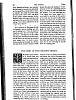 page:
page: 28
deep, intense,
enduring; and whether she sorrowed for my sorrows, and pitied me for my griefs, so many and so cruel; or whether she really
loved the thing she had saved I know well;
but there in the golden winter morning, by the fireside, bright and warm, did she hold my hand in hers, and kiss my forehead,
saying, “Dost thou indeed
love me as I have loved thee?”
It is a morning in May upon the hill of Canteleu; we are walking, my wife and I, talking lowly from the depth of happiness,
upon the brow of the winding road.
And below us is the valley and the river, and the city of the towers, and all above the heavens are overlaid with happy blue.
A wind is somewhere passing in the upper
air, driving the thin white clouds in furious whirls
Column Break
across the sky, and causing it to descend as it were in a quivering rain of blue, but where we stand no
wind stirs the grasses. It is our marriage day. I am happy now, quite happy, for a sweet plant is growing in the garden of
my soul, and my spirit walks there,
desolate no more, nor wounded with its ancient grief. Only sometimes, very rarely for a flash of time, there is a sudden unlocking
and unsealing of folded memories,
and for a moment I walk again by dark waters, in some lone forest upon windy hills, and hear voices inarticulate like something
heard before; smell a savour of
flowers as if I had lived the life of flowers in incorporeal existence, and at such times I gather hints and traces of an
unrecorded time, for in the reckoning of my
life there is a missing year.
Editorial Note (page ornament): Initial I is ornamental.
I was the master-mason of a church that was built more than six hundred years ago; it is now two hundred years since that church
vanished from the
face of the earth; it was destroyed utterly,—no fragment of it was left; not even the great pillars that bore up the tower
at the cross, where the choir
used to join the nave. No one knows now even where it stood, only in this very autumn-tide, if you knew the place, you would
see the heaps made by the earth-covered
ruins heaving the yellow corn into glorious waves, so that the place where my church used to be is as beautiful now as when
it stood in all its splendour. I do not
remember very much about the land where my church was; I have quite forgotten the name of it, but I know it was very beautiful,
and even now, while I am thinking of
it, comes a flood of old memories, and I almost seem to see it again,—that old beautiful land! only
Column Break
dimly do I see it in spring and summer and
winter, but I see it in autumn-tide clearly now; yes, clearer, clearer, oh! so bright and glorious! yet it was beautiful too
in spring, when the brown earth began to
grow green: beautiful in summer, when the blue sky looked so much bluer, if you could hem a piece of it in between the new
white carving; beautiful in the solemn
starry nights, so solemn that it almost reached agony—the awe and joy one had in their great beauty. But of all these beautiful
times, I remember the whole
only of autumn-tide; the others come in bits to me; I can think only of parts of them, but all of autumn; and of all days
and nights in autumn, I remember one more
particularly. That autumn day the church was nearly finished, and the monks, for whom we were building the church, and the
people, who lived in the town hard by,
crowded round us oftentimes to watch us carving.
Now the great Church, and the
 page:
page: 29
buildings of the Abbey where the monks lived, were about three miles from the town, and the town stood on a hill overlooking
the rich autumn
country: it was girt about with great walls that had overhanging battlements, and towers at certain places all along the walls,
and often we could see from the
churchyard or the Abbey garden, the flash of helmets and spears, and the dim shadowy waving of banners, as the knights and
lords and men-at-arms passed to and fro
along the battlements; and we could see too in the town the three spires of the three churches; and the spire of the Cathedral,
which was the tallest of the three,
was gilt all over with gold, and always at night-time a great lamp shone from it that hung in the spire midway between the
roof of the church and the cross at the top
of the spire. The Abbey where we built the Church was not girt by stone walls, but by a circle of poplar trees, and whenever
a wind passed over them, were it ever so
little a breath, it set them all a-ripple; and when the wind was high, they bowed and swayed very low, and the wind, as it
lifted the leaves, and showed their silvery
white sides, or as again in the lulls of it, it let them drop, kept on changing the trees from green to white, and white to
green; moreover, through the boughs and
trunks of the poplars, we caught glimpses of the great golden corn sea, waving, waving, waving for leagues and leagues; and
among the corn grew burning scarlet
poppies, and blue corn-flowers; and the corn-flowers were so blue, that they gleamed, and seemed to burn with a steady light,
as they grew beside the poppies among
the gold of the wheat. Through the corn sea ran a blue river, and always green meadows and lines of tall poplars followed
its windings. The old Church had been
burned, and that was the reason why the monks caused me to build the new one; the buildings of the Abbey were built at the
same time as the burned-
Column Break
down Church,
more than a hundred years before I was born, and they were on the north side of the Church, and joined to it by a cloister
of round arches, and in the midst of the
cloister was a lawn, and in the midst of that lawn, a fountain of marble, carved round about with flowers and strange beasts;
and at the edge of the lawn, near the
round arches, were a great many sun-flowers that were all in blossom on that autumn day; and up many of the pillars of the
cloister crept passion-flowers and roses.
Then farther from the Church, and past the cloister and its buildings, were many detached buildings, and a great garden round
them, all within the circle of the
poplar trees; in the garden were trellises covered over with roses, and convolvolus, and the great-leaved fiery nasturtium;
and specially all along by the poplar
trees were there trellises, but on these grew nothing but deep crimson roses; the hollyhocks too were all out in blossom at
that time, great spires of pink, and
orange, and red, and white, with their soft, downy leaves. I said that nothing grew on the trellises by the poplars but crimson
roses, but I was not quite right, for
in many places the wild flowers had crept into the garden from without; lush green briony, with green-white blossoms, that
grows so fast, one could almost think that
we see it grow, and deadly nightshade, La bella donna, O! so beautiful; red berry, and purple, yellow-spiked flower, and deadly,
cruel-looking, dark green leaf, all
growing together in the glorious days of early autumn. And in the midst of the great garden was a conduit, with its sides
carved with histories from the Bible, and
there was on it too, as on the fountain in the cloister, much carving of flowers and strange beasts. Now the Church itself
was surrounded on every side but the north
by the cemetery, and there were many graves there, both of monks and of laymen, and often the friends of those, whose
 page:
page: 30
bodies lay there, had planted flowers about the graves of those they loved. I remember one such particularly, for at the
head of it was a
cross of carved wood, and at the foot of it, facing the cross, three tall sun-flowers; then in the midst of the cemetery was
a cross of stone, carved on one side with
the Crucifixion of our Lord Jesus Christ, and on the other with Our Lady holding the Divine Child. So that day, that I specially
remember, in Autumn-tide, when the
church was nearly finished, I was carving in the central porch of the west front; (for I carved all those bas-reliefs in the
west front with my own hand;) beneath me
my sister Margaret was carving at the flower-work, and the little quatrefoils that carry the signs of the zodiac and emblems
of the months: now my sister Margaret was
rather more than twenty years old at that time, and she was very beautiful, with dark brown hair and deep calm violet eyes.
I had lived with her all my life, lived
with her almost alone latterly, for our father and mother died when she was quite young, and I loved her very much, though
I was not thinking of her just then, as she
stood beneath me carving. Now the central porch was carved with a bas-relief of the Last Judgment, and it was divided into
three parts by horizontal bands of deep
flower-work. In the lowest division, just over the doors, was carved The Rising of the Dead; above were angels blowing long
trumpets, and Michael the Archangel
weighing the souls, and the blessed led into heaven by angels, and the lost into hell by the devil; and in the topmost division
was the Judge of the world.
All the figures in the porch were finished except one, and I remember when I woke that morning my exultation at the thought
of my Church being so nearly
finished; I remember, too, how a kind of misgiving mingled with the exultation, which, try all I could, I was unable to shake
off; I
Column Break
thought then it was a
rebuke for my pride, well, perhaps it was. The figure I had to carve was Abraham, sitting with a blossoming tree on each side
of him, holding in his two hands the
corners of his great robe, so that it made a mighty fold, wherein, with their hands crossed over their breasts, were the souls
of the faithful, of whom he was called
Father: I stood on the scaffolding for some time, while Margaret’s chisel worked on bravely down below. I took mine in my
hand, and stood so, listening to
the noise of the masons inside, and two monks of the Abbey came and stood below me, and a knight, holding his little daughter
by the hand, who every now and then
looked up at him, and asked him strange questions. I did not think of these long, but began to think of Abraham, yet I could
not think of him sitting there, quiet and
solemn, while the Judgment-Trumpet was being blown; I rather thought of him as he looked when he chased those kings so far;
riding far ahead of any of his company,
with his mail-hood off his head, and lying in grim folds down his back, with the strong west wind blowing his wild black hair
far out behind him, with the wind
rippling the long scarlet pennon of his lance; riding there amid the rocks and the sands alone; with the last gleam of the
armour of the beaten kings disappearing
behind the winding of the pass; with his company a long, long way behind, quite out of sight, though their trumpets sounded
faintly among the clefts of the rocks; and
so I thought I saw him, till in his fierce chase he leapt, horse and man, into a deep river, quiet, swift, and smooth; and
there was something in the moving of the
water-lilies as the breast of the horse swept them aside, that suddenly took away the thought of Abraham and brought a strange
dream of lands I had never seen; and
the first was of a place where I was quite alone, standing by the side of a river, and there was the sound of singing a very
long way off, but no living thing
 page:
page: 31
of any kind could be seen, and the land was quite flat, quite without hills, and quite without trees too, and the river wound
very much,
making all kinds of quaint curves, and on the side where I stood there grew nothing but long grass, but on the other side
grew, quite on to the horizon, a great sea
of red corn-poppies, only paths of white lilies wound all among them, with here and there a great golden sun-flower. So I
looked down at the river by my feet, and saw
how blue it was, and how, as the stream went swiftly by, it swayed to and fro the long green weeds, and I stood and looked
at the river for long, till at last I felt
some one touch me on the shoulder, and, looking round, I saw standing by me my friend Amyot, whom I love better than any one
else in the world, but I thought in my
dream that I was frightened when I saw him, for his face had changed so, it was so bright and almost transparent, and his
eyes gleamed and shone as I had never seen
them do before. Oh! he was so wondrously beautiful, so fearfully beautiful! and as I looked at him the distant music swelled,
and seemed to come close up to me, and
then swept by us, and fainted away, at last died off entirely; and then I felt sick at heart, and faint, and parched, and
I stooped to drink of the water of the
river, and as soon as the water touched my lips, lo! the river vanished, and the flat country with its poppies and lilies,
and I dreamed that I was in a boat by
myself again, floating in an almost land-locked bay of the northern sea, under a cliff of dark basalt. I was lying on my back
in the boat, looking up at the intensely
blue sky, and a long low swell from the outer sea lifted the boat up and let it fall again and carried it gradually nearer
and nearer towards the dark cliff; and as I
moved on, I saw at last, on the top of the cliff, a castle, with many towers, and on the highest tower of the castle there
was a great white banner floating, with a
red chevron on it, and three golden stars on the
Column Break
chevron; presently I saw too on one of the towers, growing in a cranny of the worn stones, a great bunch of
golden and blood-red wall-flowers, and I watched the wall-flowers and banner for long; when suddenly I heard a trumpet blow
from the castle, and saw a rush of armed
men on to the battlements, and there was a fierce fight, till at last it was ended, and one went to the banner and pulled
it down, and cast it over the cliff into the
sea, and it came down in long sweeps, with the wind making little ripples in it;—slowly, slowly it came, till at last it fell
over me and covered me from
my feet till over my breast, and I let it stay there and looked again at the castle, and then I saw that there was an amber-coloured
banner floating over the castle
in place of the red chevron, and it was much larger than the other: also now, a man stood on the battlements, looking towards
me; he had a tilting helmet on, with the
visor down, and an amber-coloured surcoat over his armour: his right hand was ungauntletted, and he held it high above his
head, and in his hand was the bunch of
wall-flowers that I had seen growing on the wall; and his hand was white and small, like a woman’s, for in my dream I could
see even very far off things
much clearer than we see real material things on the earth: presently he threw the wall-flowers over the cliff, and they fell
in the boat just behind my head, and
then I saw, looking down from the battlements of the castle, Amyot. He looked down towards me very sorrowfully, I thought,
but, even as in the other dream, said
nothing; so I thought in my dream that I wept for very pity, and for love of him, for he looked as a man just risen from a
long illness, and who will carry till he
dies a dull pain about with him. He was very thin, and his long black hair drooped all about his face, as he leaned over the
battlements looking at me: he was quite
pale, and his cheeks were hollow, but
 page:
page: 32
his eyes large, and soft, and sad. So I reached out my arms to him, and suddenly I was walking with him in a lovely garden,
and we said
nothing, for the music which I had heard at first was sounding close to us now, and there were many birds in the boughs of
the trees: oh, such birds! gold and ruby,
and emerald, but they sung not at all, but were quite silent, as though they too were listening to the music. Now all this
time Amyot and I had been looking at each
other, but just then I turned my head away from him, and as soon as I did so, the music ended with a long wail, and when I
turned again Amyot was gone; then I felt
even more sad and sick at heart than I had before when I was by the river, and I leaned against a tree, and put my hands before
my eyes. When I looked again the
garden was gone, and I knew not where I was, and presently all my dreams were gone. The chips were flying bravely from the
stone under my chisel at last, and all my
thoughts now were in my carving, when I heard my name, “Walter,” called, and when I looked down I saw one standing below me,
whom I had seen in
my dreams just before—Amyot. I had no hopes of seeing him for a long time, perhaps I might never see him again, I thought,
for he was away (as I thought)
fighting in the holy wars, and it made me almost beside myself to see him standing close by me in the flesh. I got down from
my scaffolding as soon as I could, and
all thoughts else were soon drowned in the joy of having him by me; Margaret, too, how glad she must have been, for she had
been betrothed to him for some time before
he went to the wars, and he had been five years away; five years! and how we had thought of him through those many weary days!
how often his face had come before me!
his brave, honest face, the most beautiful among all the faces of men and women I have ever seen. Yes, I remember how five
years ago I held his hand as
Column Break
we came
together out of the cathedral of that great, far-off city, whose name I forget now; and then I remember the stamping of the
horses’ feet; I remember how
his hand left mine at last, and then, some one looking back at me earnestly as they all rode on together—looking back, with
his hand on the saddle behind
him, while the trumpets sang in long solemn peals as they all rode on together, with the glimmer of arms and the fluttering
of banners, and the clinking of the rings
of the mail, that sounded like the falling of many drops of water into the deep, still waters of some pool that the rocks
nearly meet over; and the gleam and flash of
the swords, and the glimmer of the lance-heads and the flutter of the rippled banners, that streamed out from them, swept
pass me, and were gone, and they seemed like
a pageant in a dream, whose meaning we know not; and those sounds too, the trumpets, and the clink of the mail, and the thunder
of the horse-hoofs, they seemed
dream-like too—and it was all like a dream that he should leave me, for we had said that we should always be together; but
he went away, and now he is come
back again.
We were by his bed-side, Margaret and I; I stood and leaned over him, and my hair fell sideways over my face and touched
his face; Margaret kneeled beside me,
quivering in every limb, not with pain, I think, but rather shaken by a passion of earnest prayer. After some time (I know
not how long), I looked up from his face to
the window underneath which he lay; I do not know what time of the day it was, but I know that it was a glorious autumn day,
a day soft with melting, golden haze: a
vine and a rose grew together, and trailed half across the window, so that I could not see much of the beautiful blue sky,
and nothing of town or country beyond; the
vine leaves were touched with red here and there, and three over-blown roses,
 page:
page: 33
light pink roses, hung amongst them. I remember dwelling on the strange lines the autumn had made in red on one of the gold-green
vine
leaves, and watching one leaf of one of the overblown roses, expecting it to fall every minute; but as I gazed, and felt disappointed
that the rose leaf had not
fallen yet, I felt my pain suddenly shoot through me, and I remembered what I had lost; and then came bitter, bitter dreams,—dreams
which had once made me
happy,—dreams of the things I had hoped would be, of the things that would never be now; they came between the fair vine leaves
and rose blossoms, and
that which lay before the window; they came as before, perfect in colour and form, sweet sounds and shapes. But now in every
one was something unutterably miserable;
they would not go away, they put out the steady glow of the golden haze, the sweet light of the sun through the vine leaves,
the soft leaning of the full blown roses.
I wandered in them for a long time; at last I felt a hand put me aside gently, for I was standing at the head of—of the bed;
then some one kissed my
forehead, and words were spoken—I know not what words. The bitter dreams left me for the bitterer reality at last; for I had
found him that morning lying
dead, only the morning after I had seen him when he had come back from his long absence—I had found him lying dead, with his
hands crossed downwards, with
his eyes closed, as though the angels had done that for him; and now when I looked at him he still lay there, and Margaret
knelt by him with her face touching his:
she was not quivering now, her lips moved not at all as they had done just before; and so, suddenly those words came to my
mind which she had spoken when she kissed
me, and which at the time I had only heard
Column Break
with my outward hearing, for she had said, “Walter, farewell, and Christ keep you; but for me, I must be
with him, for so I promised him last night that I would never leave him any more, and God will let me go.” And verily Margaret
and Amyot did go, and left
me very lonely and sad.
It was just beneath the westernmost arch of the nave, there I carved their tomb: I was a long time carving it; I did not
think I should be so long at first, and
I said, “I shall die when I have finished carving it,” thinking that would be a very short time. But so it happened after
I had carved those two
whom I loved, lying with clasped hands like husband and wife above their tomb, that I could not yet leave carving it; and
so that I might be near them I became a
monk, and used to sit in the choir and sing, thinking of the time when we should all be together again. And as I had time
I used to go to the westernmost arch of the
nave and work at the tomb that was there under the great, sweeping arch; and in process of time I raised a marble canopy that
reached quite up to the top of the arch,
and I painted it too as fair as I could, and carved it all about with many flowers and histories, and in them I carved the
faces of those I had known on earth (for I
was not as one on earth now, but seemed quite away out of the world). And as I carved, sometimes the monks and other people
too would come and gaze, and watch how the
flowers grew; and sometimes too as they gazed, they would weep for pity, knowing how all had been. So my life passed, and
I lived in that abbey for twenty years after
he died, till one morning, quite early, when they came into the church for matins, they found me lying dead, with my chisel
in my hand, underneath the last lily of
the tomb.
 page:
page: 34
Editorial Note (page ornament): Initial I is ornamental.
I have a wish to record the master-facts of my life—facts not the less real and important, to myself at least, because the joys
and sorrows of which they are composed are difficult to be set forth in words, to be separated from the unformed quarry of
feelings and half-thoughts. They are what
has given me, who am poor and unknown, memories for the sake of which I would not change my identity with that of the brightest
genius, and hopes which are full of
the life which is “the life indeed”—the life of revived death. Oh the malignity of that first devil’s
lie—“Ye shall not surely die!” Surely, surely everything here points to death as the path of life. They who have slain their
ambition, their selfish hopes, their passions, these are the conquerors who are “dead,” and whose life is “hid with Christ
in
God.” But let me go on to say how a nature strong and passionate, while scorning what is false and base, was yet long in attaining
aught that is true and
pure.
I am not particularly remarkable for anything. The prevailing quality which I have observed in myself being a very great degree
(so I consider it) of
impressibleness, which has had the effect of making me very shy and reserved. My observation during the first part of my life fell upon men
rather
than upon nature, owing to a peculiar education. For I am constitutionally very delicate; was sent to school late, and passed
all my schooldays in my native place,
one of the largest manufacturing towns in England. True it is that I have watched many times the smoke-drifts rushing swiftly
across the streets, pursuing and
pursued, with shapes more quickly changing, fiercer and more fantastic than those of the slow white clouds above them; true
that I have seen the
Column Break
half-filled
pools of the brick-field, which, poor and contemptible though they are, bear often upon them the floating moon, their one
white flower, swell and brim into vast and
boundless lakes, point after point receding into lofty mountains, clothed with woods and based with half-seen towers: true
that I have seen the great sun sink over
the town into a bank of vapours, above which curled and writhed and flew the everlasting smoke, so that I have thought of
many things to which that sunset might be
likened: true that I have fancied the long rows of poplars and aspens which I sometimes visited outside the town, beyond the
brick-field, and which seemed stiff with
for ever twisting themselves from the killing smoke, and which rattled when the wind was upon them; true, I say, that I have
fancied these beloved suffering trees to
be swaying white and green, with a million bright glancings, in some golden country where the sun should shine always, and
the wind blow always warm and soft. All
this, and more of the same sort, is true; but I got no further. I had but little opportunity for any accurate knowledge of
nature, and but few of the now familiar
changes and sounds, in which I have since found my purest delight, fell upon my senses in boyhood. The dragons in the smoke,
the mountains, woods and castles of the
brick-pools, the images of sun and sunset, the waving trees, and happy country, were stored safely up in my imagination among
its chief treasures, to be recurred to
again and again. There they were, and to me were an unfailing possession, along with a golden harp which I had seen when very
young, and the head of an angel, beheld
once in a picture and never forgotten. But men became my chief study, and it was my great delight to watch the faces that
passed me
 page:
page: 35
in the street, framing for each a history and character suited to what I fancied was their expression: Among my school-fellows
I was liked,
being considered, though very shy, yet anxious to please. This was indeed true, and the worse for me. Speculation upon others
implied, of course, a continual
comparison of others with myself; and, being joined with a natural timidity, or, as I have called it, impressibility, whilst
it gave me considerable insight into
character, rendered me, above all things, desirous to adapt myself to the different people into whose society I was thrown.
Thus was formed in me, almost from the
beginning, a dangerous habit of self-introspection, and a nervous wish to give pleasure at any cost; wherein was involved
a want of moral courage, and a positive
selfishness, which might easily turn the first calamity into morose despairing, or sully the first love with turbid passion.
Being then such an one, reserved, timid, and, though I knew it not, selfish, I removed, at the usual age, to the University.
It should be added, that at this
time I was fond of poetry, a poet, and cherishing an almost insane pride in my art and confidence in my power. This contributed
to my shyness and taciturnity, and I
fear to my selfishness. At the University I renewed my acquaintance with Arnetage, a young man whom I had known at school,
and who had quitted school a year before
myself. Arnetage is dead now, and so is
she; and it is well, for death alone could measure the love wherewith I loved them both.
In no long time my acquaintance with Arnetage deepened into true and lasting love. I loved him for his beauty, his intellect,
his splendid temper, his
everlasting cheerfulness. He loved me too, I know not why; but so it was, that surrounded by the brilliant and the gay, himself
the most brilliant and the gayest, he
turned to quiet timid me, and sought to make me
Column Break
his friend. We read together Keats and Tennyson, to the latter of whom he introduced me. I remember thinking
that his admiration for Tennyson savoured rather of dilettanteism, that he was rather taken by the melody of the verse, than
possessed by the power and glory of the
divine poet. He used to express his rapture in words; I sat in silence and enjoyed; and I thought that, because he could only
express a little of what I felt within
myself, that his appreciation was less deep and fine than my own. It did not occur to me, so enthusiastic did he seem in what
he was saying, that perhaps he also felt
something which he did not express, because it was beyond the power of expression. I was slow in finding out that his soul
was infinitely deeper, truer, and tenderer
than my own. He could have done unfalteringly what I should have failed to do in repeated and bitter struggles.
But there was friendship, and more than friendship between us. He told me the history of his whole life, a tale of heroic
habitudes, gentle and self-forgetful;
told in such an unconscious way, that I also forgot while listening to mark its nobleness, feeling as if he were myself. Amongst
other things, he related how he had
been from a boy betrothed to his cousin Margaret, who lived in our town with her widowed father and a maiden aunt: how he
had rebelled against this betrothal with his
whole soul, had seen Margaret for a long time only to dislike her, but at length had been so won upon by her beauty and her
perfect mind, that his dislike had changed
to love: how, a few months before I knew him at college, he had declared to Margaret his scruples and his love: how Margaret
had owned at once the same scruples,
ending in the same love. All this did he pour into my wondering ear, so that I listened as to a revelation, eagerly longing
to experience the same blessedness. For
then I knew not love—that mightiest magician, who can lift
 page:
page: 36
man to heaven or sink him into hell. At the end of three years Arnetage left the University, and I saw no more of him for
a long time. The
only fault, if fault it can be called, which I had seen in him was an extreme delicacy, a haughty and absolute withdrawal
into himself at the slightest symptom of
neglect or misapprehension.
At the end of my own career at the University I returned to my native town, which was, as I have said, one of the largest
in England. And now comes the grand
incident of my life. I was walking one day in one of the suburbs, where I had not often been, for it was divided by the greatest
extent of the town from the part
where I lived myself. It was an uncertain day, towards the close of autumn; there seemed a mist of light about the clouds;
it was raining in the distance, but
sometimes the sun broke forth irregularly, drawing northward across the fields long shadows of chestnut and poplar, and striking
the red bricks of the nearer houses
into vivid light. A large house, with its garden in front, at the end of a short street into which I turned, was thus struck
by the sunlight as I began to approach
it. In the midst of the sudden brightness, the flower shrubs and glittering trees of the garden, my eyes fell upon a form
which instantly fascinated their gaze: it
was the form of a lady—a face perfectly beautiful, the eyes uplifted in joyful surprise towards the sudden light, the rich
dark hair glowing a purple
beneath the sun, the white dress radiant. The look was of surprise and pleasure, but did not dissipate the tokens of tranquil
power and dignity which I immediately
understood would be the usual expression. I approached in breathless eagerness. No one else was in the street, and I longed,
I knew not why, to be nearer. I wished my
footsteps were noiseless as I went crashing along the wet gravel; but, as I reached nearly opposite, without apparently perceiving
me, the beautiful
Column Break
vision
slowly withdrew, and at the same instant the sunlight suddenly was swept away.
It did not strike me then, nor for many months after, that the quarter of the town where this circumstance occurred was the
same in which Arnetage had told me
that his cousin lived. But I found that the angel’s face, which was even yet among the most cherished possessions of my imagination,
had faded, or changed,
and become identified with beautiful presence in the garden. I found myself indescribably affected by that face. I thought
of nothing else. I talked to that image in
murmurous words. I fancied the beautiful unknown in various situations of peril and difficulty, in which I was to appear the
rescuer. I was, and am, poor; and at the
time in question, was very proud, indeed morbidly sensitive on the subject of money. She, I concluded, from what I had seen,
must be comparatively wealthy. I am
ashamed to have to say that it cost me a struggle to imagine myself even in that poor way dependent upon her, whom I now felt
that I loved with all the passion of my
nature, and to whom I hoped one day to owe all the happiness of my life. Never did lover feel more hopelessly the curse of
poverty than I did. I summoned round her in
imagination, trembling the while with apprehension, whole troops of wealthy and fortunate suitors, legions of tempters, matchmakers
and formalists,—round
her, who, as I found it hard to realize, was ignorant of my very existence; while the only consolation for my mingled pride
and terror was to see her imaginarily cast
down from wealth, deserted by the world, and discovering me the only faithful. I mention this that you may perceive to what
I was reduced by passion, which could find
no issue, self-corroding and hopeless.
I can well recall the second visit I paid to that neighbourhood. The interval between that and the first
 page:
page: 37
was brief, if measured by time—but how long measured by what I had felt. The day was just such another as before; bursts
of
sunshine, alternated with slender rain, each seemingly wafted from the silken sulky clouds in joyous contradiction by the
same wind. How I approached the house,
expecting to see the same transfiguring light, the same sweet happy face, and head “sunning over with curls.” How I was disappointed,
as matter
of course, seeing nothing but the house-roof shining with rain, the wet trees and garden railing, and the blank windows! How
I slunk away, wondering whether any one
had been watching me from those same windows, and whether this any one (who took form in my mind as a violently timid aunt)
would not take me for an inspectant
housebreaker. Throughout that winter I found myself doing the same thing. It was the only course my passion could shape for
itself. Night and day, in sunshine and
rain, but oftenest when evening had set in, and the gas-lights of the suburb glimmered few and far between, each in its halo
of fog, and the lights of the houses
shone behind the blinds, and so, until these lights disappeared and re-appearing above, were finally extinguished, was I to
be seen, pacing about and about, with a
fire at my heart, an anguish, and a longing irrepressible, that sometimes amounted to positive physical pain. This was my
great time, for, during the day, I felt
conscious, and guilty, and ashamed; and, after walking the whole town’s length, through mire and thawing snow, for the sole
purpose of getting a glimpse of
the place where she might be, I would pass meekly by, scarcely raising my eyes, and feeling more than ever like a housebreaker—a
fancy which I could not
get out of my head. I had no means of getting an introduction to the family, though I attempted it repeatedly. My sole reward
for my walks and vigils was a very
occasional
Column Break
glance of her face at window or door, and once I was nearly in time to see her enter the gate; and once I met her in the
town, and once saw her in a
carriage driving along a road leading into the country, which road was forthwith added to my dreary beat. These were rare
intervals of brightness, and served to urge
into fiercer heat the fire which was consuming my life. When I reflected on what I was enduring, I sometimes thought myself
actually mad, and, in fact, my strange
self-tortures may have had insanity in them.
Thus the winter wore lingeringly away. In the spring, Arnetage returned from a tour on the Continent, in which he had been
engaged ever since I left college. A
little time before his return, I had grown desperate, and had concocted a notable scheme for gaining access to the abode of
the unknown. From the door-plate, I had
long ago ascertained that the family name was Stuart, and heard one day accidentally, from a picture-dealer, that Mr. Stuart
possessed a picture that was the pride of
the town. Now, I had some skill in judging of pictures, and my opinion was held of value. Could I not call with my friend
the picture-dealer, for the purpose of
inspecting the picture? Perhaps he did not know Mr. Stuart; perhaps his Mr. Stuart and mine were different individuals; perhaps,
as had already been the case with
many such a scheme of mine, I should not venture to propose it at all. But just then I was full of it, meditating and resolving,
when Arnetage stood before me.
He expressed himself shocked at my pale and altered looks, but soon seemed to forget them in an account of his travels and
adventures, which he gave with
delightful animation and humour. It was late when he rose to depart.
“Well,” said he, giving me his hand, “I have cheered you up a
little tonight; and to-morrow, to complete the healing process, I mean to introduce
 page:
page: 38
you to my beautiful betrothed, Margaret Stuart.” He had never mentioned her name before.
“Margaret Stuart,” said I, “why I thought her name was Arnetage.” It was all over. A dulness, a torpor, almost a swoon, had
fallen upon me, after
Arnetage’s departure, during the time when my mind refused to contemplate the greatness of my misfortune. I had found that
my best beloved friend was my
rival, that was all that I could realize; but this dull torpor was penetrated, shot through by sharpest pangs, and these gradually
increased in intensity and
frequency until I awoke to my situation, as I have often been awaked from an actual sleep by bodily pain. And now began a
long and terrible struggle of love, pride,
jealousy, and friendship, which lasted throughout the hours of darkness. As the sun’s rim appeared, I at length slept, thinking
that I had conquered myself
by coming to the following resolution; that no one should ever know of my love; that I would not even attempt to forget Margaret,
but would love her still, and love
her fervently and purely, even as I loved Arnetage; and that I would strive to find my happiness in witnessing the happiness
of the two whom best I loved on earth,
accustoming myself to love them for their love of one another. I awoke next morning from a heavy and troubled sleep, full
of brave resolutions, and prayed fervently,
as I had need. In those fiery hours of the preceding night, my old agonized love, in which I had writhed as in fire, seemed
finally to have burned itself out. I
shuddered at myself, when I thought of the past—of my mad self-torments. It seemed, indeed, like an evil, yet irresistibly
fascinating dream. So, when
Arnetage came to conduct me to the presence of his Margaret, I found myself full of virtue and self-pity; and, as it were,
above him, on a little moral hill,
wherefrom calmly to survey him,
Column Break
my unconscious rival, as he stood before me in his brightness, beauty, and strength. It was not very well, but it was all
I
could do, for my nature is feeble and passionate.
I went then, and stood face to face with the magnificent beauty, which I thought I knew so well. I saw the noble opulence
of face and form, the commanding
tranquillity, which I had pictured but too well; I heard the full measured tones of that sweet rich voice, and met the gaze
of those large meditating eyes. I marked
too the quiet love that was between them; how noble they both were, how calmly regardful of one another. Love, that had burst
like an angry wave into my poor breast,
had flowed without agitation into those vast and gulf-like hearts. I felt myself inconceivably insignificant. I looked at
Arnetage serenely smiling, and found it hard
to love him. In spite of everything, the old sore was reopening, the old wasting miserable agony was coming back. I took dim
note of other things. There was furniture
lavish and gorgeous; there was the picture—a portrait whose eyes followed me everywhere. There were also some other people
in the room. A good-natured
nervous old gentleman tried to talk to me. He was Margaret’s father. An oldish, vixenish, foolishly acute-looking lady thought
she was scrutinizing me
closely. She was Margaret’s aunt, and of her more hereafter.
On our way back, Arnetage asked me with anxious confidence what I thought of his cousin.
“Perfectly beautiful, and you ought to be very happy.” I spoke bitterly and foolishly, for did not his broad-beaming smile
speak of love,
trust, and full happiness?
However, after a while I succeeded in recovering something of the resolutions of the morning. It was impossible to look upon
the glorious being before me, so
thoroughly possessed by his own love, and yet so delicately kind and affectionate to me, and regard him
 page:
page: 39
with an eye of spleen or envy. And I thought, improbable as it seemed, that something might occur to cloud that sunny heaven
of love. The
thought was born of baseness; let me confess it, for I somehow drew from it consolation for my own despair; but oh! love so
faultily passionate as mine is very
dangerous when brought suddenly to hopelessness. The thought did good by arousing at once all my friendship for Arnetage.
I recollected the one weakness of his
character, which seemed strangely inconsistent with the rest of it; the shrinking haughtiness which scorned vindication by
words, and caused him to retire for ever on
the slightest appearance of misapprehension or unworthy suspicion. And I disliked that old vixenish aunt, who, I felt, was
totally incapable of comprehending the
character either of Arnetage or of her niece, and who seemed to have great influence over her more quiet but equally shortsighted
brother.
After this, I saw Arnetage daily. We renewed as much as possible our old college life. We read together, we walked together,
we talked together. Arnetage, as I
had discovered at college, was a poet, and had now produced a great number of pieces more or less finished, and we spent many
happy hours in criticising and
correcting these, deciding between various readings, amending rhymes, and reconstructing stanzas; occasionally engaged in
eager debate. I had long since given up the
dream of being a poet myself, but it gave me no pang of envy to see my friend nearing the goal which I could only behold afar
off. Arnetage introduced me to his
father—his mother was dead years ago—a fine specimen of the English merchant, frank and honourable, like his son; a keen judge
of character,
inured to the most vigorous and responsible exertions, full of benevolence and hospitality. He had raised himself to great
opulence, and was enabled to achieve
Column Break
successfully, by dint of his own intuitive sagacity, the most hazardous speculations. His danger lay, in my opinion, in over
confidence in his own resources: he was
in the habit of risking everything on a die hitherto thrown with unerring skill. He was still actively engaged in commerce,
and no one stood higher in the estimation
of all men. I also now frequently saw Margaret, alone and with Arnetage, and at each interview felt a relapse, though fainter
and fainter, into my old mad whirl of
passion. Ah! it cost many bitter struggles with myself, with what I had exalted as the better, the saving part of my nature,
many despairing cries to God, before I
could completely master the old besetment, and love her not for myself but for him. But by degrees I conquered, and learned
to love them both at once for their love
to one another, even as I marked the still growth of that love of theirs, so frank, so utterly above caprice or concealment,
or common passion. These things continued
for a year, until Arnetage’s book came out, bearing his name boldly on the title-page. And indeed I thought there was nothing
in it to be ashamed of.
Now it came to pass that a certain great reviewer happened to be in want of a victim whose dissection should add a zest to
his forthcoming number. What could be
fairer game than the first book of a young poet, particularly of one who presumptuously dared to put his name upon his work,
thereby doing despiteful defiance to the
critical might, and offering the better mark for the critical arrows. Besides, the upstart pretended to high aspirations and
imaginings, and, as the great reviewer
had it, “manifested the usual spirit of restless discontent with the things that be,” meaning to signify a certain unreasonable
dislike to cant
and tyranny and hypocrisy. So the great reviewer first attempted to classify, to catalogue, the book, and failing in that,
perhaps even to his own dissatisfaction,
 page:
page: 40
satisfaction, fell upon it and rated it in good set terms, misunderstanding, misrepresenting—all but misquoting; and in this
process gratuitously and scandalously insulting the author. The affair made me very indignant, and at first aroused the wrath
of Arnetage, but after a time he forgave
it, because, as he said, “pity was akin to forgiveness,” and he even laughingly showed the article to Margaret, who had the
poems by heart, and
reverenced their author. About the time that this article appeared, a much more serious embarrassment befel Arnetage. The
failure of a bank and the ill success of a
great speculation, greatly involved the affairs, and even compromised considerably the commercial character of his father.
Arnetage was obliged to apply himself
vigorously to relieve the pressure of labour and anxiety which fell upon the old man.
The news that the great merchant’s credit was tottering spread all over the town, and at length reached the ears of Mr. Stuart,
to whom it occasioned
no small disquiet. For the father of my friend had always been to Mr. Stuart an oracle and lode-star, and he had been wont
to look with pride upon his future alliance
with the Arnetages. To hear that he was falling shocked Mr. Stuart very greatly. He was however reassured after a personal
interview with Mr. Arnetage. But the aunt,
who had him very much under control, being perfectly incompetent to form a notion of the real state of things, and being a
person of some imagination of a kind,
immediately upon hearing the rumours in circulation, had a vision of Mr. Arnetage in the Court of Insolvency. How was this
mental fact to bear upon the destinies of
Margaret and my friend? The good lady might have become reconciled even to the dismal result she had conjured up, for she
had discernment enough to see that Arnetage
was vigorous and alert, and might raise a goodly structure of wealth even from the ruins of his
Column Break
father. And she had moreover a great veneration for literature,
and had not Arnetage written a book? So she was not at all sure whether, considering the attachment which existed between
her niece and Arnetage, it were not as well
to let things take their present course, even in such dismal contingency as bankruptcy. But at this critical point of her
speculations, the review left at the house
by my unlucky friend fell into her hands, and worked an instantaneous revolution. Behold what was thought of the provincial
pretender in the orthodox capital of
letters! Was not Arnetage a fool, an ignoramus, even as the great reviewer described him? She felt half shocked at having,
as she thought, admired his poems, and
remembered with comfort that it had cost her an effort to do so. And she rapidly proceeded to discover that she never had
liked that young man, she always felt
strange with him; there was something about him she never could get accustomed to. Finally she went forthwith to announce
her impressions to Mr. Stuart, carrying the
review with her.
Mr. Stuart was a good deal staggered, especially at the considerate estimate of his intended son-in-law in the Review, for
he, too, entertained the most
unbounded reverence for printed words. He could not, however, all at once divest himself of the long habit of looking forward
to the future alliance as a desirable
thing; but his sister’s incessant remonstrances so far succeeded in counterbalancing his usual good nature, that he managed
the next time Arnetage came to
give him a tolerably cool reception. This was enough for Arnetage, whose pride was then in an unusually active condition;
he kept himself away from visiting the
Stuarts for more than a fortnight, and then suddenly returned, and abruptly demanded that a day should be fixed for his union
with Margaret. The reply from her father
was courteous, to the effect that the marriage could not take place until
 page:
page: 41
present affairs were cleared up, and Arnetage was in some settled occupation. Margaret’s heart flowed out towards her lover;
she
had been daily pestered about the review and the sinister reports afloat, and she fully understood and forgave his absence.
He should marry her, she said, whenever he
pleased, and even if the rumoured ruin of his father were true, still she had enough for both, and had confidence in his honour
and industry. But when Arnetage
decided otherwise, she obeyed. “It is better,” he said, “for both of us that our marriage should be delayed; we can trust
one
another, for if not, let us never be married at all; it does not become us that anything should be done hastily. Your father’s
hint about my desultory mode
of life may be true, and I will reform. My father’s affairs require that a trusty agent should be sent into the Mediterranean,
to examine the proceedings
of certain rascally Italian and Levantine traders. I will go, and doubt not that in good time I shall return to claim you
as mine by right of conquest.”
So he went, I accompanying him to the water-side. We paced together the small and unfrequented pier, pending the arrival of
the steamer, the sea-weed bulbs cracking
beneath our feet; for it was his whim to embark not at Liverpool, but at one of the numerous villages further out towards
the sea. Here I told him of my resolution to
abide in Liverpool until he returned, adding, that I had already secured lodgings. He seemed surprised, and said, that he
hoped nevertheless I should see Margaret
often, and write to him all particulars about her. I promised this with eagerness; though alas, my real object in removing
to Liverpool was to get away from the place
where she was, for I mistrusted myself in his absence. I longed, for a moment, to tell him all that lay concealed within me,
but now the mighty steamer was rapidly
sweeping down along with the tide, which was fast
Column Break
running out. Arnetage and I sprang into our boat, and were soon alongside: another moment, and he was waving
his hand to me from the steamer’s deck, and I was sadly pulling back.
I found that not without reason had I mistrusted myself; even when Arnetage was with me, keeping alive by word and look my
love for him, even then the
selfishness in my breast had arisen again and again in opposition to the honourable course I strove to keep before me. And
now he was gone, and I could see my
soul’s idol alone; alone I could behold those large and humid eyes, that to him used to kindle or to dissolve, raining, as
it were, tears of light and
love; and those lips that grew richer in pathos, with the answer that hung upon them when he spoke: I could listen alone to
that voice which to him would vibrate with
pride and tenderness. What if they should beam and melt, and vibrate to me at the mention of him? How could I dare, then,
to see her? I saw her once, once only, and
the consequences to me were awful. To avoid committing folly, I was compelled to leave her suddenly, and fling myself into
the first railway train for Liverpool. And
there I sat sad, depressed and trembling with the violent effort it had cost me to leave her presence. Every soaring bird,
every tree and field, every house and
church, which I thanked heaven that we rushed so quickly by, seemed to bear a message and remembrance from Margaret. In Liverpool
my only comfort was to pace the
little pier where Arnetage and I had stood, hearing the sea-weed burst beneath my feet, looking toward the sea and cloud,
calling upon his name. Arnetage, Arnetage!
Oh wild, wide, lone, and barren sea, and shadows untasted by the sun! were not ye even as the darkness over me, in which I
struggled with cries and tears, stretching
abroad blind hands of supplication.
I wrote to Arnetage twice, and heard from him once; he wrote from Greece, and said that he was about to sail for
 page:
page: 42
Italy. Margaret was well the second time I wrote.
A hasty message came to me that Margaret was suddenly and seriously ill. None knew what ailed her; some said she pined for
Arnetage. I knew that she did not.
Hers was not the love that had to do with pining and common regrets for absence. Did not her eye that one day kindle with
joy and love to me at the mention of his
name, as if he had been with her? But she grew thin, and weakened day by day. Perhaps the vessel was too full of love and
happiness, and holy faith. But she weakened
very swiftly, and the best thing people said of it was, that she was too good for this world. Indeed, she vanished more than
died. As for me, it was enough, and too
much, to pace the street in front of the house, as I used to do of old, looking constantly at the candle that burned all night
behind the blind of her room; now
bright, now dimmer, and again brighter. I paced about sternly and mechanically, thinking only of her, and of the loss to me;
thinking of Arnetage only, with a dull
sort of speculation as to the manner in which he would receive the news. The people of the house knew that I was there, and
humoured me; sometimes coming out to tell
me that she was better. At length some one came, and said that she wished to speak to me. In an instant the thought of Arnetage
came upon my mind with full force, and
I shuddered, actually dreading, lest I should profane that angel’s death-bed with an outbreak of passion. I went, as if walking
in a dream, into the
parlour, where was the aunt weeping, and the father.
“Do you think,” I began vacantly, “that she wishes to see me?”
“To be sure, that is what you have just been told,” began the old man testily, hurriedly adding, “why good heavens, how ill
you
look!”
The next moment I had fallen heavily upon the floor. I came to my senses
Column Break
in a week, and found myself on my own bed, attended by my own old servant. I felt
thankful for this, for if I had raved, perhaps no one had heard me. I have never asked. But the end had been reached; I found
Margaret had expired the day before.
I visited her grave once, once only for many years. I dared not go again until long years had passed away. And this was the
reason. I said to myself one
morning, the first on which I found myself able to walk—this day I will go to the grave, but not yet. So I waited all that
day, feeling horrible, and full
of earthy power. I was obliged to see several people, and had often to put the strongest restraint upon myself lest I should
scream and sob aloud. In the evening I
went to the grave. It was in the suburb, not very far from my house, on the other side of the hill, whereon stood the long
row of poplars turned in sickness from the
reeking smoke that was withering them. The sun was setting on the other side of the town, as I had often watched him in my
early days: the sun, I say, was setting,
slipping down sadly into the dense smoke of the horizon, and casting sheets of pale yellow over the higher parts of the western
sky. There was scarce another colour,
until this sank into a bloody, ghastly, smoke-traversed region, wherein was the dying king of heaven himself. The cold gravestone
was bathed in this pale yellow
light, the freshly turned soil about was yellow and clayey, and mixed with trodden grass: it was autumn again, and the trees
and paths were filled with yellow leaves.
I moved about mournfully, mournfully; read the epitaph, looked long and sadly at the grave, thinking how much love she that
lay below had awakened in me, and how she
had died without knowing it. I came away resolved never to return, “for the sky will never be blue, nor the earth be happy,
while I am by, and she will be
troubled among the dead. She cannot be mine even
 page:
page: 43
in the grave. I will return no more.”
I have said that Arnetage was to go to Italy, from his last letter. I had written to him since, both when Margaret’s illness
came on, and when she
grew worse and after her death. But no answer came. About three weeks after the funeral, I was sitting alone in my room, in
Liverpool, reading the exquisite narrative
of the death of Guy, in the Heir of Redcliffe. My tears were dropping fast; and I was half praying at times for peace and
patience like Amy’s. Suddenly I
heard a step ascending to my room—a step which caused me, I knew not why, with trepidation to hide the volume I was reading.
A knock, and the door was
opened ere I could reply. Arnetage entered, as I half expected, yet most feared, thinking it impossible. He sat himself heavily
down, and I observed that his face was
stern and rigid, the noble features having an exaggerated appearance, as if carved in marble; he was worn to a shadow and
looked shockingly ill. His first word
was—“Margaret?”
“She is well,” said I, with such nervous eagerness that I seemed to make of the words but one syllable. I had with unconsciousness,
and by
some instinct, spoken as if he had not read, and I had not written, the letters of her illness and death. The next moment
I recollected them, and this added excessive
confusion to my manner. He looked at me as if I were very far off, his brow deepened in sternness, and he broke a long silence
in a deep measured tone:—
“I half guess how it is; so will ask no more now, but tell you at once why you see me, and why you see me thus. My last letter
told you that I was
about to sail for Italy. Since then, if you have written, I have received no letters, and no wonder, for I never reached the
destination I pointed out to you. To
Italy I went, but it seems that I carried with me the seeds of the plague from the Greek islands; and instead of
Column Break
proceeding inland at once, I was forced to wait
for some weeks ill of a terrible fever. I found myself dreadfully weakened when the fever left me; and the physicians said
that the most speedy way to recover a
degree of strength would be to remain quiet by the seaside. So in a small and most glossy vale, on the Adriatic coast, I took
a cottage wherein to live in quiet. I
must be particular in describing this place. It had one chief room, which I converted into a bedroom, with two windows, almost
opposite each other, and opening east
and west, as the cottage itself fronted seaward and shoreward. In this room weakness compelled me to lie during great part
of the day, gazing sadly and impotently
from these two windows. From the west window I could behold one of the most beautiful of Italian landscapes—a long level tract
rising inland, cornfield and
pasture and vineyard, islanded by huge rocks and dark-stemmed, dark-tufted trees, rising slowly beyond and beyond one another
until they ceased in scarcely seen
mountains. Before this window and close at hand were two large twin beech trees, whose shadows at sunset and moonset fell
forwards across my room and across my bed.
From the east window I could see the clear Adriatic rising and sinking in its tides without a ripple: yet this sea too, could
look wan and ghostly beneath the moon.
“Here then I remained until I had mustered strength to walk along the beach, upon the sand beneath the high pile of rounded
stones stretching far
away leagues long, curving with the curved shore, which even this calm sea had been heaping up during the ages of its being.
I had also penetrated inland for some
distance among the vines and olives, and might have prolonged my stay until recovered health made me really fit for departure,
but it was not to be so.
“One evening I had been watching with pleasure the long strokes of the
 page:
page: 44
sunset upon the rows of vines that ran down towards the shore, how the light caught the heads of the branches and flung them
in shadow upon
one another, and how the strong shore-grass danced and glanced almost like steel for brightness. These and other things now
forgotten had I been watching, and thought
sweetly the while of Margaret, of you, and of home. It was an evening of unusual peace and blessedness, and I thought of it
again when I went to bed, and again was
happy.
“But that night I dreamt that the moon was rising over the waters in great lustre, so that the whole sea was living, and defined
with rolling golden
light, all except one tract far, far to the east, behind the moon, where there seemed to be a residue of mist and infinite
space. Out of this there emerged, suddenly,
and with great swiftness, coming towards me,—I was standing on the shore, above that ridge of smooth round boulders, a large
dark object, which I could not
at first make out. It neared and neared, however, with inconceivable rapidity, until I was able to discover what it was. It
was a large two-masted vessel, but with
only the stumps of its masts remaining, and without a scrap of canvass, or rigging, or gear of any sort to be seen about it.
Without any visible propulsion it was
moving straight and swift for the shore just where I stood. Close above it, and exactly accompanying it, flew a black cloud,
sending forth rain in long undiminishing
streams, until the deck-planking was soaked, and torrents were pouring from the ports. The sky above was cloudless and serene.
Upon the deck of this strange ship
appeared two figures—a man at the helm deeply muffled, and in the bows a lady kneeling, whose features I somehow could not
discern, although her face was
uncovered, and her hair thrown back lank and dripping. I made out, however, that she wore an aspect of deadly palor, and I
remember that I thought
Column Break
she was
sea-sick. All this I had time to make out; for, though the whole thing came on without abating an instant of its fearful speed,
yet there was an enormous interval of
time between my first recognizing what it was and its approaching very nearly. But, suddenly it seemed only a few yards distant,
steadily holding on its course. I
shouted to the helmsman to beware, but my voice only muttered in my own ears. I saw the water between it and the shore slightly
agitated; the next moment the huge
black bows had lifted against the ridge of boulders, and were grinding and groaning upon it. I rushed down to aid the lady;
but at my first step she vanished
flutteringly towards the sea, like the spray of a fountain caught and drifted by the wind. The steersman lingered a little,
standing on one leg; then, with
contortions altogether unusual, he jerked himself over the side of the vessel. I awoke struggling to scale the ship, which
yielded to my weight.
“I awoke startled, and saw the moon sinking, and the two beech trees, with the moon behind them, tossing and nodding towards
me with huge plumes, and
many a ghastly chasm among their leaves, through which lolled long inane faces, open-mouthed, mocking me. Then I saw that
the fantastic shadow dance of their leaves
was flickering on the floor, and up to my bed. And it came upon me that she whom I had seen was, could be, no other than Margaret,
and that I had indeed seen a
vision, a portent summoning me away. The impression remained strong in the morning, though I had slept again; and I did not
try to reason it away, but set forth
straightway homewards, obeying destiny; and am here, expecting anything, fully able to bear anything, should it be that Margaret
is dead.”
Thus a dream had power to work upon the habitually, though calmly, enthusiastic temperament of my friend.
“My brother, my brother,” I cried,
 page:
page: 45
as Arnetage paused, “it is so: let it be for both of us.”
He took the announcement calmly, as if he had been long nerved to it, and patiently inquired into the circumstances of her
illness and death. We sat very late
that night, and next morning he was to go on to our native town. And that night, partly to divert his sorrow, partly to relieve
myself of an intolerable burden, I
told him the story of my own love for Margaret, concealing nothing. I knew that it was selfish to obtrude my own miseries
upon him then; but he was so calm, so
majestic in his self-control, and the weight hung so heavy upon me that I could not refrain; and I was afterwards glad that
I obeyed the impulse. He wept at my
tale,—he who had shed no tear for himself; and I felt, as I concluded, that the old hysterical agony had ceased within me,
never to revive, and that I
could henceforth
Column Break
hold converse with the memory of Margaret in unsullied and abiding love. We ascertained that the day and hour of the vision
corresponded
closely with the time of Margaret’s decease.
Arnetage went into the world, sternly and uncompromisingly fulfilling every duty. We were inseparable; we often talked unreservedly
of Margaret, and
imperceptibly my soul grew more and more attuned to his heroic pitch. But ever he grew paler and thinner; and one word of
solemn prophecy was ever on his unmoved
lips. “He who hath seen a spirit, a spirit shall soon become.” True, for within the year he was lying by the side of Margaret.
I am now alone upon earth—alone in the midst of men, alone in converse with those two blessed ones, whom I see in heaven;
but whether my time here be
long or short, matters nothing.
Editorial Note (page ornament): Initial L is ornamental.
Let a man’s heart be never so steeled against didactic, philosophical, or descriptive poetry; nay, let him even profess to consider
all love-poetry as a thing which it is contemptible to read, and shameful to write: it will still go hard, but you shall find
such a man accessible to the simple
narrative of the heroic ballad. With what delight will even your real lover of poetry, your critical appreciates of its various
provinces, your faithful student of
it, turn in days like these to the national songs of his fatherland, and the early unskilled numbers of those true poets of
the people, whose names are countless and
unknown; to those legends, so old and yet so young, which tell of the cradling of the nations, and how
Column Break
their infant feet began to go, when as yet there was but
little strength and little foresight in the people. We love to be told again how the lusty child strangled great serpents,
and how with its growth, grew also its
wants and powers, till it learned to choose Virtue for a companion, and to perform those mighty labours “for advantage of
the nations.”
So we think that Professor Longfellow’s new poem has come out at a fortunate conjuncture, and the Song of Hiawatha is to us welcome as flowers in spring. The volume consists of a number of Ojibway legends concerning the divine man who moulded
the ideas of their race, and
was a messenger chosen by the Master of Life to impart to them such benefits as His wisdom decreed. The stories are told
 page:
page: 46
with variations among all the Indian tribes of North America; the name of the hero also varying, but his character being
unaltered. Mr.
Longfellow says they stand here as they came “from the lips of Nawadaha, the musician, the sweet singer,” who in his turn
was taught them in the
pleasant vale of Tawasentha, by the birds of the air and by the beasts of the field. The poet addresses all those who love
the haunts and glories of nature; those who
love the childlike tones of a nation’s legends; those “who have faith in God and nature,” and believe that savages have like
struggles and passions with ourselves, and that groping for the unseen good they are raised and strengthened by the right
hand of God; and those, too, who can feel
the homely pathos of a half-effaced inscription in a neglected churchyard, and perceive that the unskilful verse does yet
speak to the heart; all such the poet bids,
and with good reason, to
- “Stay and read this rude inscription,
- Read this Song of Hiawatha!”
We will try to give a brief outline of the poem, interspersed with a few quotations, hoping by this means to induce our readers
to take up the book itself. As
Master of the Ceremonies, we introduce you to the latest production of an eminently healthy poet, and advise you to cultivate
its acquaintance. Read the book once,
and you will like it; read it again, and it will grow upon you.
The Song of Hiawatha begins by telling of the occasion on which the Master of Life, the Great Spirit, came down from heaven, and smoked the Peace-pipe
as a signal to the nations
to assemble. All the Indian tribes came at the call, full of hatred and envy of each other. The Great Spirit compassionately
laid the shadow of his hand upon them to
calm their souls, and, speaking with a voice like the sound of far off waters, bade them be content with the good provision
he had made for their wants, and leave
their
Column Break
wars and bloodshed, as their strength lay in their living peacefully together as brothers. He promised them a Deliverer and
Prophet, to whose voice, if
they hearkened, they would prosper; but if they slighted his words they must fade away and perish. Finally, he bade them wash
off their war-paint and bloodstains, and
smoke the Calumet together, and live as brothers. The warriors obeyed; they washed and buried their weapons, sought their
pipes, and departed. “The Creator
smiled upon his helpless children, and vanished in the smoke of his own Peace-pipe through the doorways of heaven.”
This promised Deliverer was no other than Hiawatha, the son of Mudjekeewis the West Wind, and Wenonah, the first-born child
of Nokomis, who bore her among the
Prairie lilies, after falling from the full moon upon the meadow. The West Wind proved faithless, as Nokomis had warned her
daughter, so that Wenonah brought forth
her son in sorrow, and died in anguish. Hiawatha was thus left to the care of his grandmother, who instructed him in the history
of his parentage, and all else
connected with the false West Wind. So when Hiawatha grew to manhood his heart was hot, like a living coal, against his cruel
father; and having equipped himself in
his magic mittens and moccasons, he strode fiercely westward. Earth and sky seemed full of burnings and lurid vapour as he
went on his way, outstripping the deer and
the bison, till he found his father. Many days he talked with him, and listened to his boastings, and at last he demanded
vengeance for the wrong done to his mother;
and after a hard contest of three days, Mudjekeewis ceased retreating, and made peace with his son. Cheerfully did the young
warrior return, his spirit now at rest,
and all nature seeming pleasant round him. On his way home he bought arrows of the old man in the land of the Dacotahs,
 page:
page: 47
possibly, that he might see the old man’s daughter, Minnehaha, Laughing Water. At any rate, he said nothing of arrows or
of
maiden on his return, but spoke only of his interview and contest with the mighty West Wind. Then for seven days the youth
fasted, and prayed for the good of the
nations, and not for his own greater skill and glory. Therefore the friend of man, Mondamin, was sent to tell him that his
prayers were heard, and to wrestle with him
till it should please the Master of Life that Mondamin should be killed. On the last day of his fasting, and in the fourth
contest, Hiawatha slew the stranger, and
buried him as he had been bidden, and tended his grave, scaring away the ravens. Slowly from the grave came up the maize,
clad in green and yellow, as the young
stranger had been; and Hiawatha recognized it as the friend of man,“and made known unto the people this new gift of the Great
Spirit.’”
Now Hiawatha’s chief friends were the sweet singer Chibiabos, a man both brave and tender, pliant and stately, and the very
strong man Kwasind, who
in his youth was a lonely child, and spent much time in prayer and fasting. The musician sang so sweetly that all sounds of
nature borrowed sweetness from his
singing, and all men were melted with his pathos;
- “For he sang of peace and freedom,
- Sang of beauty, love, and longing;
- Sang of death, and life undying
- In the Islands of the blessed,
- In the Kingdom of Ponemah,
- In the land of the Hereafter.”
And the strong man Hiawatha loved, for “his strength allied to goodness,” so that these three consulted much together “how
the
tribes of men might prosper,” and the first exploit of the Deliverer and the very strong man was to clear the river of all
obstacles, so that they made the
passage of it safe for the people. Then we have Hiawatha’s fishing, and how he overcame the King of the Fishes, the great
Sturgeon. And next comes his
great
Column Break
fight with the mightiest magician, the Pearl Feather, who slew Nokomis’ Father, and sent fog, disease, and death among the
people. Him he slew,
having learnt that his only vulnerable point was in the roots of his long black hair: there he shot him. The woodpecker who
gave him the information did not go
unrewarded, and the people were made happy with the victory and spoil. Then Hiawatha woos and wins in simple guise the daughter
of the arrow maker,
“loveliest of Dacotah women.” Hand in hand go the pair, leaving the old man lonely, and moralising on the way in which daughters
leave their
parents, though he is very proud of Hiawatha. In their pleasant journey they are met with congratulations by the blue bird
and the robin, while the sun recommends the
rule of love to Hiawatha, and the moon whispers of the sway of patience to the lovely Laughing Water. So they have a magnificent
wedding feast, enlivened by the
dancing of the idle and graceful Paupuk Keewis, sweetened by the singing of Chibiabos, and by the stories of the “measureless
liar” Iagoo. This
Iagoo was old and ugly, a capital story teller, and proverbial for his boasting. He entertained the guests with the story
of the Son of the Evening Star; a beautiful
story of which nothing but the whole can give anything like an idea, and unfortunately we cannot find room for it entire.
Then comes the blessing of the cornfields, performed by Minnehaha in the darkness of night, alone, without garments, going
round the enclosure. The husking of
the maize too is described, “the gamesome labour of the young men and the women,” at which they work with much merriment,
watched by the old men
and warriors who sit smoking under the pine trees. In those days Hiawatha drew the attention of the people to notice how the
old traditions and the very names of the
dead fade away, together with much wisdom and craft, for want of
 page:
page: 48
written record. So he communicated to them a system of picture-writing, rude and elementary, but efficient for historical
purposes, and for
expressing the words of an absent friend. Thus they wrote on the smooth birch-bark and white reindeer skin, and also on the
graveposts of the village. Meanwhile
sorrow comes on Hiawatha, who loses his brother Chibiabos, drowned in the Big Sea Water of Lake Superior. For seven weeks
he mourns him thus:
- “ ‘He is dead, the sweet musician!
- He, the sweetest of all singers!
- He has gone from us for ever:
- He has moved a little nearer
- To the Master of all music,
- To the Master of all singing!
- O, my brother, Chibiabos!”’
With strong magic the medicinemen raise Chibiabos from the bottom of the lake, and set him on the four days’ journey of the
dead men, at the end of
which he reached the land of ghosts and shadows. And at this time Hiawatha taught men the medicinal powers of herbs, and the
cure of all diseases. He has fresh
trouble now with the idle Paupuk Keewis, who introduces hazard, and causes such mischief with gambling, and insults Hiawatha
so grievously, that he resolves to put
him to death. After a long chase, and after the gambler has many times changed his form, Hiawatha kills him, and restores
order to the village. Next the strong man
meets his death, being killed by the pigmies, who hated him for his strength, and managed to hit him on the crown of the head,
his only vulnerable point, as he floats
sleeping down the river.
And now comes the beginning of the end. How the ghosts come, uninvited, to the wigwam of Hiawatha, crouch in the shadows,
and snatch the choicest portions of
the evening meal, returning to the shadows in unbroken silence. Long they stay there, silent always, never moving by day,
but fetching fuel every night; till at last,
on hearing them sob grievously, Hiawatha inquires if any want of hospitality
Column Break
has made them weep; and they reply that they are ghosts, and see what a useless
burden they should be if they returned to their friends, for “the departed have no place among the living.” They depart; a
famine comes upon the
land, and two guests come to the wigwam, and looked, with haggard eyes and hollow,—
- At the face of Laughing Water,
- And the foremost said, ‘Behold me!
- I am Famine, Bukadawin!’
- And the other said, ‘Behold me!
- I am Fever, Ahkosewin!’ ”
Hiawatha rushes into the empty forest for wood:
- “In his heart was deadly sorrow,
- In his face a stormy firmness;
- On his brow the sweat of anguish
- Started, but it froze and fell not.
- ‘Gitche Manito, the Mighty!’
- Cried he with his face uplifted
- In that bitter hour of anguish,
- ‘Give your children food, O Father!
- Give us food, or we must perish!
-
10Give me food for Minnehaha,
- For my dying Minnehaha!‘”
But there was no other answer
- “Than the echo of his crying,
- Than the echo of the woodland,
- ‘Minnehaha! Minnehaha!’ ”
Her dying thoughts revert to her father’s home; she hears the falling water of Minnehaha, from which she was named, and sees
her father standing
lonely at his doorway; Nokomis nursing her hears but the night wind, sees but the smoke. Then said Minnehaha,
- “ ‘The eyes of death
- Glare upon me in the darkness!
- I can feel his icy fingers
- Clasping mine amid the darkness!
- Hiawatha! Hiawatha!’ ”
Far off he hears this agonizing death-cry, and returns to mourn her loss. “Farewell,” said he, “Minnehaha!
- ‘All my heart is buried with you,
- All my thoughts go onward with you!
- Come not back again to labour,
- Come not back again to suffer,
- Where the Famine and the Fever
- Wear the heart and waste the body.
- Soon my task will be completed,
- Soon your footsteps I shall follow
- To the Islands of the Blessed,
-
10To the Kingdom of Ponemah,
- To the land of the Hereafter!’ ”
 page:
page: 49
With such noble devotion does Hiawatha mourn his wife.
Meantime the white men approach, heralded by reports of Iagoo, who gets no credit for them, owing to his well-known character.
Nevertheless, he speaks truly,
and Hiawatha confirms his statements, who says that he has seen in a vision the westward marches
- “Of the unknown, crowded nations.
- * * * * * *
- In the woodlands rang their axes,
- Smoked their towns in all the valleys,
- Over all the lakes and rivers
- Rush’d their great canoes of thunder.”
But his own people he saw forgetful of his counsels,—
- “Saw the remnants of his people
- Sweeping westward, wild and woeful,
- Like the cloud-rack of a tempest,
- Like the wither’d leaves of autumn.”
The white men came amicably, and were well received and hospitably entertained.
- “ ‘It is well,’ they said, ‘O brothers,
- That you come so far to see us.”’
Hiawatha confirms the message of the white prophet, the Black-robed Chief, and bids farewell to his people. He launches his
canoe, and, bidding it speed
westward, leaves the land of his lifetime, the place of his labours and teaching. And all the people said “Farewell for ever!”
- “Said, ‘Farewell, O Hiawatha’ ”
And the forests sighed, and the waves sobbed, and the heron screamed,
and their voice was—
- “ ‘Farewell, O Hiawatha!’ ”
- “Thus departed Hiawatha,
- Hiawatha the Beloved,
- In the glory of the sunset,
- In the purple mists of evening,
- To the regions of the home-wind,
- Of the north-west wind, Keewaydin,
- To the Islands of the Blessed,
- To the Kingdom of Ponemah,
- To the land of the Hereafter!”
So ends one of the noblest pieces of legend it has ever been our lot to read or hear. We take it for granted that Mr. Longfellow
has Indian authority for all
the incidents, but the narration
Column Break
must be his own. And how beautiful the narration is! The metre also, now for the first time, if we mistake not, used for
narrative, being indeed scarcely naturalized in the language, suits the story admirably. Simple and yet rare, like the legends
of which it is made the vehicle, it has
a force and dignity scarcely to have been expected from its rocking rhythm. Rhymed in pairs of lines, and so put into quatrains,
it occurs in German, (in
Uhland’s poem of The Ferry, for example,) and is beautifully tender there; here there is still the same character attached
to it, and the absence of rhyme
is a great help to its powers. The jingling of a double rhyme, page after page, would have been intolerable. Capable of great
plaintiveness, as in the songs of
Chibiabos, and in some of our extracts, it is also equal to vigorous description, and many a time in the volume does such
description occur. Witness the fasting of
Hiawatha, his encounters, and above all that scene of the famine, and the vain search for food in the empty forest.
There seems to us an increase of power in this poem over any hitherto displayed by Mr. Longfellow. We had seen his great success
in short lyrics, his moderate
power in the drama, and his exquisite versification in Evangeline, which presents perhaps the only specimen of English hexameter
not looking as awkward as French
blank verse, but comporting itself almost like a native. We had seen too his narrative power in the same poem, that touching
tale of Acadie; but we were not prepared
for so much of it as is shown in the Song of Hiawatha. Thoroughly has he caught the spirit of the legend, and well performed
his labour of love. Henceforth the
Ojibway and the Dacotah are to us realities, men of like passions with ourselves. In our own dear mother-tongue their sweet
singer Nawadaha has spoken to us, and the
voice has gone direct from his heart to ours.
 page:
page: 50
Editorial Note (page ornament): Initial T is ornamental.
This last and greatest work of Mr. Thackeray has been completed now some six months, and, in the meantime, has been subjected
to both public and
private criticism with, I believe, one unvarying judgment of commendation, that he has indeed performed his labour excellently,
and done a good work for society in
giving us this story of our manner of life so faithfully and tenderly. One looks now, at last, for an escape from that old
imputed charge of bitterness and wayward
choosing of the evil only in his delineation of life; it was fast becoming meaningless from its very frequency, and I fear
also an occasion sometimes for the most
pitiful twaddle and conversational hypocrisy. Alas, those brilliant formulas in which we sometimes fold our criticisms and
condemnations, and suffer them to pass from
mouth to mouth, without question or gainsay, how are they not the cause of infinite injustice to others, and to ourselves
of loss irreparable? It is but a little time
ago that the name of Thackeray seemed an accepted text
in perpetuum for gravest homilies upon evil speaking, satire, and slander; and, as if to counteract any latent consciousness of truth,
that would be present sometimes,
there would follow much self-complacency and congratulation upon our many social virtues and national character; for it is
observable that men who will volunteer the
most abject confessions of their own shortcomings,—and if self-depreciation were only humility, would afford an example of
grace, edifying to all
Christendom,—yet do nevertheless betray a strange impatience if their confessions are believed by others and accepted against
them; do become, after a
marvellous fashion, indignant when their Church confessions of unworthiness
Column Break
are granted by their neighbours as not improbable. Yet, verily, if this our daily
humiliation, is not the veriest hypocrisy and climax of our iniquity; if we are not altogether committed to a sham worship,
how comes this inconsistency of ours, that
we reject our own testimony against ourselves in the mouth of a brother; that we do perseveringly seek to turn into a charge
of spleen and sneering against a writer
his faithful picturing of an evil we cannot deny, and a life of broken promises we are ever confessing. It is time now to
have done with this silly, because untrue
assertion that Thackeray gives only the evil that he sees, and gives that bitterly, for now at least he has vindicated for
himself a name of truthfulness and widest
sympathy unsurpassable; and it is time also for the critic altogether to take up a new position, descend from his seat of
judgment to one of testimony; for, although
it be well for him at the first appearance of a teacher among men, to prove and examine the spirit from whence it is, administering
counsel, and at times correction,
blaming gently and not unwisely, remembering that so God has tempered our hearts and intellects together, that wheresoever
we render praise it will never be wholly
undeserved, but in our condemnation it may be we were ourselves wanting in knowledge and comprehending sympathy. I say, though
it is good for the critic to take his
allotted place then, to try every beginning and prove it; yet, when once this is done, and a great creative spirit has become
manifest from the trial, then our place
also is with the many that look on and listen, our duty to proclaim its honour, rejoice in its light unselfishly; so only
may we hope to understand its teaching, and
the symbol of understanding in neither the
 page:
page: 51
unbridled tongue nor the supercilious lip, nor the mocking jest, but the hand closed upon the mouth.
Finding, therefore, in this story a wonderfully faithful picture of the great world as it passes daily before us, many-sided,
deeply intricate; finding so much
mystery of our manifold human life unfolded, and the veil of its complexity drawn aside, not without deepest awe and veneration;
how should we do other than listen
reverently, and be thankful for the gift, and speak unlimited praise of it, heeding neither charge of extravagance, nor custom
of detraction.
Regarding then, this masterpiece of all novel writing, in which is fulfilled, not indeed for the first time, but to an hitherto
unreached limit, all that one
looked to see this literature set before it for an aim, one is impelled, by associations connected with its very completeness
to a retrospect of the first beginnings
of fiction, and the need that gave occasion to its birth full half a century ago. For it was then, while as our fathers were
sorely troubled and perplexed with the
problem of this strange universe, that by a mighty reaction this new literature came into being. Sorely tired were they, even
as we are sometimes to this very day,
only more sadly, hopelessly, for they were now jaded and weary, and sick to death of unbelief, and doubtings of their unbelief,
and questionings, if at length, at any
time, “the riddle of the painful earth” would solve itself, suffering greatly in a fire of tribulation more than we, their
children, have ever
seen, revolutions and rebellions, and the overthrow of ancient ways and uprooting of many dead forms, out of which life and
vitality had departed long ago; till, from
universal gloom and darkness of the understanding there grew up hardness of heart and isolation, selfish and untender. Therefore,
they began to look for comfort and
tranquillity otherwhere than in the outward relations of the world, to find
Column Break
in fiction and recital of imagined griefs a sympathy they vainly sought for, and
alas! had altogether ceased to find in reality; and it was a good and happy change,—spite of its sickly and distempered form,
a happy change,—
when men believing nothing else, yet believed they felt, knew they were unhappy, began to speak about their feelings, and
speaking, to believe and trust them: yes,
with all its melancholy sentiment and outward misanthropy, it was a very happy thing for men when they thus began to confide
their sorrows to each other. Be sure the
evil is already past, and the grief nigh being overcome, when we speak of our sorrows and aspirations one to another.
The world of half a century back was filled with Werthers, speechless, voiceless, suffering in mute agony until Goëthe came,
a heaven-sent
interpreter, who set their discordant voices to a tune, and fashioned their murmurings into articulate speech; the fame of
that first utterance of his shall testify
how truly he had comprehended, and spoken for them; and from that time to this, through truthful yearnings and desire for
sympathy, through fashion, which is the
curse of all things good; through dilettantism, the latest born of an evil brood in an evil time; through puerilities, senilities,
imbecilities, there has not ceased
one perpetual flow of novels and romances to that degree that one would think all conceivable combinations of plot and counterplot
had been exhausted at length; and
yet they go on multiplying, representing nearly half the literature of the people, and all the literature of many, till in
this year of grace where can we limit their
remote influences, where define their subtle working upon our personal, that is, our real education; for good or evil, directly
or indirectly, they share in the
education of all, they form all the experience of many: however fashioned at the first, through whatever silly transformations
they have
 page:
page: 52
gone, at one time food only for listless dreamers and idlers in the great vineyard, at another sent into the desert like
scapegoats, laden
with the follies and pitiful absurdities of divided Christendom, they have attained such imperial dominion as well behoves
us neither to overlook nor hastily condemn,
present definite claims to be listened to now, that are somewhat grown of late, forcing us to the conclusion that leisure
hours, as they are charitably named, are no
unaccountable atoms of a life, that the mind at least will abide no vacuity, will and must be filled with something, be it
of good or evil, must be planted and
watered, or suffered to lie waste and breed impurity. Therefore it is above all things needful that those who have the charge
of watching the process of the times
should keep especial guard upon this, that literature of fiction, since it is imperatively demanded, should at least fulfil
as noble a destiny as it is capable of:
that, as it needed a great man to bring it forth, it should never be without great men to cherish and support it; that especially
the young, whose happy fancy and
imagination cannot always be crushed into silence, will sometimes rebel for lack of food, and go seeking it themselves, should
run no danger of gathering poison with
their fruit.
Now I well know that novels, and what is ignorantly called “light reading,” find little favour with many as an acknowledged
element in
education, that parents and tutors are especially jealous of its influence, cannot be brought to look upon it as not altogether
evil, cannot believe that a genius, a
great man, a hero in the highest sense, is to be found in its whole history; and perhaps this is not altogether to be blamed
or wondered at: seeing what this fiction
has hitherto been, in so many instances, it would indeed be strange if any good could come of it. Looking back upon a whole
dreary waste of barren, false idealism,
Column Break
I cannot help thinking it called loudly for the doom pronounced upon it by Carlyle, in memorable words: “Day after day, looking at the high
destinies which yet await literature, which literature will ere long address herself with more decisiveness than ever to fulfil,
it grows clearer to us that the
proper task of literature lies in the domain of belief, within which poetic fiction, as it is charitably named, will have
to take a quite new figure if allowed a
settlement there. Whereby were it not reasonable to prophesy that this exceeding great multitude of novel writers, and such
like, must in a new generation
gradually do one of two things, either retire into nurseries, and work for children, minors, and semifatuous persons of both
sexes, or else, what were far better,
sweep their novel fabric into the dust-eart, and betake them, with such faculty as they have, to understand and record what
is true, of which surely there is, and
for ever will be, a whole infinitude unknown to us, of infinite importance to us. Poetry will more and more come to be understood
as nothing but higher knowledge,
and the only genuine romance for grown persons Reality.” Yes verily,—
- “God Himself is the best Poet,
- And the Real is his Song.”
And indeed it was high time to waken to a comprehension of this truth, to leave off for ever dreaming, as if life were a
lengthened summer afternoon, and we
were meant to cease altogether at its expiring. Oh! life and reality, shall we ever know them as they are? Here at least not
wholly, their dark wisdom is far
withdrawn from us at the feet of God; but something surely, either by symbol or the darkness of similitude, is yet possible,
something whereby we may discern the
dream within the dream, and choose the true: thus much may we surely take for granted, that this life
 page:
page: 53
of ours is not altogether
yesterday nor yet
to-morrow, but is chiefly and above all a continual
to-day, whose true expression is present action, present virtue; and this primary fact, this, the essence of what is signified by
life, we have
strangely forgotten at times, been strangely unfaithful to our post in these “foremost files of time,” looking backwards,
looking onwards for
some golden year, with a world neglected at our feet, forgetting—
- “That unto him who works and feels he works,
- This same grand year is ever at the doors.
Too much life has perished surely on this road to Eldorado; too much precious breath in sighing after days that never come
again, in aspirations after others
that may never come; it was time to ask—
- “When will the hundred summers die,
- And thought and time be born again,
- And newer knowledge, drawing nigh,
- Bring truth that sways the soul of men?”
But now, at last, to all who understand the signals of the future, there is audible upon the winds a gathering cry for life,
“more life and
fuller;” a great awakening from evil dreams and long deathful slumbers in sepulchres, of things past; a reprieve at length
from vigils for a dawn that will
not come, a general ascending from the valley of dry bones into the upper air, in a new world, which is the old still, among
other faces happy with real laughter,
sanctified with real sorrow, beautiful with the crimson flow of life—contemplating which, and all the widening, deepening
sympathy and brotherhood
involved in it, like a new land to some Columbus, I cannot but feel hopefully, speak hopefully for the present and the coming
years and their hidden destiny; cannot,
above all, but speak thankfully and with deepest reverence for such great names as Tennyson and Holman Hunt, Ruskin and Carlyle,
and Kingsley, and many others who
have led on this most
Column Break
godly crusade against falsehood, doubt, and wretched fashion, against hypocrisy and mammon, and lack of earnestness, and
among
them—according to his rare and excellent gift—Thackeray, whom I shall not hesitate to call great and among the greatest. Those
who will refuse
the title from mere questioning, whether novel writing really affords scope for greatness, can know little of the requisites
for its construction, little of the keen,
piercing analysis, the long observance, and the sympathy which are needed for its perfection; and upon this subject of greatness
a thought occurs to me which may be
best developed here.
When we think upon heroic men, conquerors, prophets, poets, painters, musicians, it is for the most part in the
light of difference, as being
specially conquerors, prophets, or any other, that we dwell upon them, seldom if ever in the
light of unity, as being all of them comprehended under
the one idea of
greatness; and herein I believe we are unconscious of a certain oversight and imperfectness of conception; for it seems that the
foundation and root of difference lies not so much in the kind or quality of their genius as in the form of it—the mode or
manner in which it shall be
manifested; that like as one same Spirit informs the diverse personalities of men, so also does one same stream of inspiration,
visible in no two souls alike, inhabit
the great amongst us; which mode and manner of their appearance are governed and fashioned by the wants of the age in which
they live, the spaciousness or narrowness
of the circle in which they revolve, and the great idea in their time growing into fact among men: from which it would follow,
that in so far as any genius nears to
perfection in its finite and particular developement, so far might we justly reason that it nears to universality, so that
if such and such things were not to happen
and such again to intervene, it would not be lost nor darkened but
 page:
page: 54
assume a new form; that the accident of prophet, poet, warrior, would change and interchange, but the substratum of greatness,
the idea, the
essence and efficient cause of all, would not change but be abiding. I would not be understood to speak without limitation,
as not regarding the evident appointments
of nature; it is the misfortune of advocating a neglected or forgotten side of any question, that one is chargeable with an
implied denial of any other point of
view—the gifts and appointments of nature shall go very far, but accident of time and place even farther to the making of
a man. We have seen at once in
the world’s history the most surpassing faculties of many centred in one. Have there not gone before us Æschylus and Leonardo,
Dante and Michael
Angelo and Raffaelle: there have not been wanting poets whose songs were battles and heroic actions, and their life a mighty
epic like St. Louis, and warriors whose
battles were sharpsworded words, who sang the pæan of their own victory over the Dragon, and their own death-song that followed
close after like that lean
Dante—and Shakespeare also with his great human heart and worldwide sympathy, he the most human among men, the very crown
of humanity, can we think at all
what he had been in other far different times to those wherein he lived: a conqueror and leader of armies, discoverer of new
worlds, I think, in the old heroic days
when the land lay all unknown before him and unpeopled; or a prophet in the childhood of a growing nation, when somehow the
heaven seemed nearer, and voices from its
deep infinity were not heard so faintly nor far between: or a Socrates when men were first mazed at the juggles of the brain
and lost in more than Cretan labyrinth;
or a builder of churches in the after-time, a carver of the human countenance in its hitherto untold mystery, out of the hewn
rock and the quarry, even as in his own
generation he sang
Column Break
the round of human love and action and passion. Holding it then inseparable to the idea of genius that it be thus plastic,
shapeable into any
form, fit for all uses, embracing all height and depth; and of great men in like manner as having their work ever within the
innermost circle of their age;
comprehending, interpreting, supporting, advancing it,—central men among their contemporaries; and seeing, moreover, that
the channels through which any
such might hope to reach the heart and pulsation of living men and work most effectually upon them, lie especially through
the domain of this new literature, one
would, I think, naturally look in this direction for the manifestation of genius, and so looking would, I doubt not, find
it, in more representatives than one, and in
Thackeray, very near a consummation.
What a change it is to be brought face to face with human character, to bid farewell, as we surely shall now do, to idealities,
to be cheated no longer with
far-off abstractions. I protest that in the Waverley Novels and whole historical romance school that followed them, one looks
in vain for anything to sympathize with;
one cannot love these attributes, “icily, regular, splendidly null,” that are invested with a temporary personality; this
is not
character—to sum up human life by epithet on epithet, after the fashion of our history-writers, is but to dwell upon the very
surface of things, and remain
there, catalogue-making, after all. We, my brothers, are not sheaves of well-assorted attributes, but inconsistent half-formed
wills not to be so measured nor
described: sometimes brave, I think, we all are, sometimes cowardly too, generous and illiberal, merciful and tyrannous, by
turn and turn about in the self-same day,
and we have no brotherhood with these embodied attributes, we desire a biographer for our own poor mazed life, one who shall
hold up a mirror to ourselves, mingling
the sweet and bitter, the light
 page:
page: 55
and darkness, as they are most truly mingled in life.
Strange that the world has grown so old maturing systems of religion and philosophy that have not taught us wisdom: it seems
we are yet at the beginning of
years; what know we of our nearest neighbour? appearance only and outward seeming, nothing more; we have known him, it may
be twoscore years, have seen him always
calm, grave, and business-like, the last man in all the world to be accused of sentiment, and romance; and his likeness hanging
there, the very image of his hard
unmoved face, we call successful, a happy effort of the painter: yet, it may be, the curtain and the pillar and the cushioned
chair are as much belonging to him as
that cold face. The painter saw him not, nor we either, as he looked once, for a single moment it may be, when his divinity
was revealed through clouds and darkness,
in passionate working of his features at an outrage offered, or a love flung back unrequited, or a friend turned false to
him. Behold we know nothing of him for ever;
that hour revealed him in silence, henceforward he is locked up and sealed against a time to come.
I shall abstain altogether from quotation or digest of the history in
the Newcomes, both from want of space, and chiefly because of the unsatisfactory nature of such custom: for the many who have read the
book, what has been or shall be said
of it, will find at least ready understanding, if not assent; for those who have not such quotations, however selected and
voluminous, would convey little idea of my
meaning; for those again who read reviews only for the sake of their quotations, (and there are confessedly many such,) I
shall warn at once; and for those still more
unfortunate knowledge hunters who are satisfied to claim acquaintance with an author through his reviewers and such selections
as they may of their bounty give, I
extend
Column Break
the same warning—that they must seek elsewhere: even as it is I shall be unable to do more than merely point out the chief
moral design of the
book, as it seems to me, and even this cursorily; leaving all collateral and minor aims which are manifest throughout, to
the reader’s own suggestions.
And first of the central purpose of the book for which I imagine it was mainly written, reaching to the very heart and core
of social disease, unhappy wedded
life—the marriages that are not made in heaven, but if anywhere out of this strange world, why least of all in Heaven. Of
all marvels in this same universe
that pass our poor philosophy I doubt not this of marriage is the very strangest, seeing to what end it has arrived at last,
and from what beginning! Were one to ask
the sober question now at this late hour, why was it first ordained, how would he be answered? would it solve the problem
we see before us daily? Suppose he should
answer to this result—“It was ordained to bear the burden of a great mystery, the secret of the marriage of the Lamb, that
we might not be
without a continual symbol whereby to comprehend that holy union, that when the Bridegroom came we might know him and receive
him worthily.” Mysticism! say
you: not so, but forgotten truth. What if it should indeed be found at last that not mere palpable finite evil is the harvest
of godless marriages, not broken hearts
nor spotted life nor dishonoured children only, but that we have done infinite dishonour and despite to the holy thing it
signified? How will it be then? Who shall
lay damages and plead and give sentence then? Does that story of Christ’s marriage with his people come home to us pure and
holy? is there no darkness in
our comprehension of the type? If men would learn to believe of all things here that they are but dim revelations of a hidden
glory, that every finite thing in this
vast universe is linked by ultimate
 page:
page: 56
relation to some eternity, is bound indissolubly to the feet of God; that not an act nor law nor visible thing whatever but
has its greater
counterpart out of space and Time—there would be less mockery and jesting in the world and more earnestness, less doing for
fashion’s sake and
more for Christ’s.
The plot of the story teems with marriages that should never have been made, differing in extent of subsequent misery, according
to the degree of good or evil
natures brought together. There is Madame de Florae, holy, prayerful, self-sacrificing—her life has been a painful vigil;
she has been dying daily; hardly
after forty years can she say tranquilly, “when the end comes with its great absolution I shall not be sorry.” How then shall
it be with Clive,
paired, but not matched with his foolish little wife? she cannot understand him, has no companionship for him; after all our
indignation she is perhaps thoughtless
more than selfish, or if selfish, capable of transformation; she deserved at least a better fate; yet they might have lived
not unhappily, spite of all this. But
Clive was not in love with her—loved some one else too surely, and, knowing this, it was an evil step to take—thoughtlessly,
carelessly cruel;
in the sight of their elders it seemed an excellent match— money and youth, and beauty and amiable indifference—and behold
the end! But what
shall be said of the marriage in high life? what of the domestic hearth and family bosom of Sir Barnes Newcome, Bart. of Newcome?
if the last was sufficiently
heart-rending, what shall be said of this? Too truly it is an old story; we have seen it elsewhere also: above all others,
one is before me in all the memory of its
painted horrors—Hogarth’s Marriage à la Mode, which seems its painted counterpart.
It is a subject of regret that the narrow limits of a single essay do not admit of a fuller investigation into these social
questions; so shallow and
Column Break
void
it seems to name them only and pass on, but it must be so. There is one more great social problem, however, set forth and
answered in the lives of the actors of the
book, which must share in this hasty sketch—a wofully neglected subject of thought, to the evil results of which oblivion
one can place no definite bounds;
but in this case I the less regret the brevity of what must be said, because the question, and much more that appertains to
it, is embodied in a
pamphlet on pre-Raphaelitism, by Ruskin, and continually in other portions of
his works, to be hereafter commented on in these pages.
I refer principally to that episode in Clive’s life where he makes known to his father the desire of his heart to become a
painter, and dedicate his
life to that end; and the good Colonel loving his son so that he would gladly die for him, cannot be brought to see it with
the eyes of his son. Can understand him
adopting it for amusement’s sake, refined
dilettantism; but to be a painter by profession—to live by the labour of his hands
so, this he cannot comprehend, this society and immaculate respectability cannot endure. So poor Clive has a hard battle to
fight; even Ethel can give him no
sympathy, views his dreamland through a London fog. After all our rhapsodies about soul, what do we really sacrifice for it?
We, men who have written so many volumes
upon it and its immortal nature, who have called it by such high-sounding names for the sake of naming it, though none should
ever express it worthily save with lips
covered and deep silence, calling it Shekinah, and the articulate voice of God, heard louder than thunder and the voice of
waters; sweeter than any wind. And yet for
that evil genius Fashion, we could darken this Shekinah, close our ears against that clear-sounding voice for ever. Respectability?
When shall we waken from this
nightmare and dream of phantoms
 page:
page: 57
to a knowledge of the true dignity of work in any kind; to a confession of the majesty of soul in any form? I wish that the
primal question
at the setting out of life were not
what is the best thing to do, and the most thought of, but rather
how and in what manner and degree of excellence it is to be
done. I claim at once an express assent to the position, that the work we do we do not for ourselves, nor our own pleasure
nor advancement, but in the name of Christ,
according to his commandment; and then for our children’s sake, that we may make them better, happier; and then for the sake
of all who have gone before
us, that the travail and sorrow of their hard battle may not be unfruitful, may not become the desolation of wasted energy.
It is the only premise upon which I can
worthily found the conclusion that our work, whatsoever it be, must be the best of its kind, the noblest we can offer. So
the former question frames itself anew:
“What is the best that any man can give?” And God has given us an answer, “that in which he finds most happiness,“ for
this testimony he has sealed with truth.
And is this the question, O fathers, that you ask your children, and teach them to ask themselves, “what they have most happiness
in?“—not transitory, idle pleasure, but enduring happiness; hence what they are most fitted for, what they can do best, what
they can honour God
most by doing. If this were the first inquiry, and were made the law and final cause in all our choice of action, I think
we should meet less and less with those
palpable signs of hurry and indifference, and listlessness and utter weariness, which face us at every turn, and paralyse
alike art and government, and social
relations,—a wide and fruitful subject for after development. Here, unhappily, is room only for hasty notice, and a promise
that the question shall be
taken up at some future time.
Column Break
Of Thackeray’s manner and style of writing a few words, the characteristics, I conceive, to be principally two, Humour and
Pathos, most noble in
combination: and first, of his humour, we meet it continually in gentle irony and glancing satire, as well as more directly
in his open, laughing cheerfulness: it is
for this, chiefly, that he is no favourite with religious parties; being such as they are, we will not regret it too severely:
thus at least one agrees with them that
it is a hard thing to be laughed at, and thus far with him also, that it is a hard thing not to laugh. Perhaps people differ
more about jesting, and its proper
conditions of object, manner and place, than about really serious things: this Babel of laughter sadly wants a music-master—one
to strike the key-note and
lead off the noisy chorus; for people will laugh, and who shall refuse them? “Laughter is like sunshine,” says Carlyle; only let
us keep in memory that story of the Apes by the Dead Sea. Like all else in Babel it lacks a reasonable soul at times, and
in want of this will have to be taught
roughly its proper whereabouts, lest it trespass upon holy ground; for laughter is not first nor best: love and faith, and
hope and long-suffering, and self-sacrifice
are raised high above its inarticulate din. For the sake of Him who gave them we will never laugh at these, and because we
read not ever that He laughed while
dwelling among men; but at whatsoever is mean and proud, and selfish and over-reaching, and hypocritical, laughter long and
loud that shall strike the stars.
Sin truly is very foul and fearful; in its effects terrible, crushing the heart of man with overwhelming hopelessness, and
oftentimes the terror of wickedness
cannot but be uppermost in thought; yet it were a good thing also, and a sign of greater constancy and stronger faith, to
feel how utterly contemptible it is, how
laughable and ridiculous its miserable existence, and
 page:
page: 58
it is here that I imagine Thackeray has done good service to truth of morality and fact:—of morality, because he sets up
crime in
a kind of pillory for universal laughter and derision: no catastrophe and fearful overtaking of punishment to make his villains
martyrs after all; loud laughter only
and utter scorn, such as becomes men to feel, for who can calculate the folly of sin? and truth of fact in his account of
retributive justice and fidelity to its
general fate. His is not that fair land of romance and faerie, where the good are rewarded after sorrows, and the evil punished
after short success, but rather the
life we live, a fretful, sore, and envious life for many who behold the wicked in high places, and the throne of iniquity
set up, and themselves cast out.
Of his pathos what shall I say? so true, so musical, one would not think that human speech were so very musical; it exalts
him everywhere into highest poetry;
as colour glorifies everything it overlays, so does the great sympathising heart everything it comes near and dwells with.
In those scenes between the Colonel and his
son, chiefly in that one after Clive knows of Ethel’s betrothal, and his father’s noble offer of sacrifice, and again in the
reconciliation at
the close of the book; they speak like man to man, in the very simplest words, because of the agony of the hour, but there
is sweetest music in every word. And those
letters of Madame de Florae, so full of the memory of an ancient sorrow, and a life that has been dying daily, “One supports
the combats of life, but they
are long, and one comes from them very wounded: ah! when shall they be over?” Alas! for ill-fated, un-forgotten love, colouring
all the background of their
lives with a melancholy twilight gloom, beautiful, profound: in all story I remember not anywhere the like, from that first
parting for life to that last shriek,
Léonore, how full is it of the anguish of enduring memory!
Column Break
“Did it not seem once as if two hands never could unlock, so closely were they
enlaced together? ah! mine are old and feeble now; forty years have passed since the time when you used to say that they were
young and fair. How well I remember me
of every one of those days, though there is a death between me and them, and it is across a grave I review them.” This is
like the melody of an old song we
have not heard for years, like that burden of the song of tears, “O death in life! the days that are no more!” Some time we
shall meet Clive and
Ethel again, and J. J. also, when all the letters and life-passages about him have been collected, and then we shall be admitted
to his dream-land; weak, deformed,
and silent, he is the genius of them all, the most inspired amongst them;
au revoir, J. J., it is not for long.
So let us end, not as having completed the half of our task, nor spoken that half well, as became the subject, but withal
faithfully. This book has gone forth
now upon a great embassy, gone forth from us into the future, bearing with it the seal and signature of truth; for even while
the memory of its sweet pages is yet
abiding, and we think upon all these things, the gain, the suffering, and the loss, and all the tumult of our life, even now
the days are gathering in and closing
upon us, and presently, very shortly, we shall be called the past, and our deeds good or evil will be judged of men in other
years. This book also will be a record of
us; flesh of our flesh will read it, and see what manner of men their fathers were. Will they speak lovingly, kindly of us,
remembering the good to our account, the
evil to their own? Will they stretch forth hands of blessing, not remembering the sorrow nor the curse we have handed down
to them, so much heavier than we received
ourselves, by the weight of all our evil days? Will they forgive us all these things? Is it also our wont so to deal with
our
 page:
page: 59
fathers’ memory, to speak mercifully, gratefully of them? too truly this lack of reverence must go down also in the catalogue
of
our great sins.
Thackeray will, I doubt not, one day be numbered with the great naturalists in all time, a lesser Shakespeare in golden and
coloured chronicles, in a goodly
company of painters, poets, and musicians, all who have ever burned with consuming love for men, or struck the key-note of
human triumph and lamentation into loud
pæans and enduring song.
A few words concerning Mr. Doyle’s illustrations. I have something also to say previously upon the entire subject of illustrations,
which may be
fairly spoken here. Engravings have of late become a very essential feature in book-making, so that their very frequency alone,
as testifying the direction of public
taste, requires that this long silence and oblivion of their merits should be broken, and they should be forthwith acknowledged
as a subject of criticism. I fear
almost we have too many of them, being such as they for the most part are; that generally there is too much work for the engraver,
too little thought from the artist:
any drawings are good for children, only certain ones for men; dogs and cows and houses and trees, the more generalized the
better for spelling-books; but not such as
these, something widely different from these, for men. In looking over a vast majority of book engravings, one is struck with
the same want of purpose and absence of
interest and particular truth, which attaches to that dreary mountain of fiction and false romance we were just now condemning;
about as separably interesting they
seem as the stones in a pyramid; alas! one grieves to say, but for such as these the desert and illimitable sand-sea is the
place of their ultimate abiding, the
inevitable destiny of labour without thought. More than enough truly have we of these useless illustrations that can tell
us no new thing,
Column Break
nor give palpable
embodiment to our confused thoughts, and so perpetuate them. When shall we learn to read a picture as we would a poem, to
find some story from it, some little atom of
human interest that may feed our hearts withal, lest the outer influences of the day crush them from good thoughts? when will
men look for these things, and the
artist satisfy them? We desire to hear these artists, so many and so good, speak to us as they can do in their own sweet language,
not a strange one altogether,
easily to be learned even by listening only, and once learnt, universal, wide as the great world; a wonderful language, such
as no other is, save music and sculpture;
but let us not be for ever put off with husks till we cease to look for any good. We are not forced to have illustrations
to our books, not forced to have books
themselves; nay, if we will think of it, not forced to have many things we count essential. Men lived and suffered, thought,
and died, long before they painted or
wrote; but we are forced to have them good if at all: this we do need. It is an everlasting truth that if a thing is worth
doing at all, it is worth doing well; I say
not
perfectly, that is quite a different matter, unattainable, a proud word, ever doomed for mockery and defeat, but that it should be the
best we can give, the fruit
of the travail of our soul; and this we look for vainly. I think if we all understood the kind of labour it necessitates to
produce a slight engraving, we should be
less tolerant of this thoughtless multiplication of purposeless designs. No happy or wholesome work, nay, in steel engraving
positively injurious, is the condition of
our having them; and then moreover, to let pass the matter of bodily injury, which no man may do with impunity, and consider
it upon higher ground, it becomes at once
a simple and palpable choice of good or evil: no spiritual or imaginative work this copying of other men’s thoughts, nothing
here satisfying
 page:
page: 60
and developing, altogether a sacrifice and slavish self-abnegation. It should at least be something good or needful that
we make the subject
of such sacrifice, not indifferent or unnecessary, such as we can easily do without, no mere question of book-making on the
handsome page principle: for every line so
perpetuated in engraving, let us remember some human soul has foregone its freedom and invention and creative energy, which
is the soul of art, for our good. One day
too surely shall we need a reason for every time we trifled with the labour of the meanest man, and it will be no answer that
we did not know these things.
Some few years ago
a monthly periodical was published upon the subject of art and poetry; it appears to have ceased after a
few numbers, not without having spoken something that will live in echoes yet. As the
frontispiece
of one number was an etching by Holman Hunt, an illustration indeed to a poem, but the latter
having so little reference to it, that it may well stand for an independent picture; truly a song without words, and yet not
wholly speechless, for out of its golden
silence came voices for all who would hearken, telling a tale of love. Two lovers are together in a meadow, by a pool of standing
water, and behind them a circle of
trees is throwing morning shadows on the grass; she is kneeling, stooping forwards to gather wild flowers growing on the bank,
clasped and circled by the arm of him
who loves her and shall be her future lord, he is bending lovingly over her, shielding her from harm; yet there is no peril
in the water, and the space between her
and the edge is great, still he clasps her lightly, guarding her from a danger that is not: judge of it, O lovers! how true
it is. But below, in another scene, lies a
figure flung upon the foreground, lying all his length, and his face pressed deeply into the fresh mould of a grave, for behind
him, in the distance, the nuns are
passing,
Column Break
singing Dies iræ and Beati mortui, and the bell is sounding close behind him as he lies
quiet. Surely he will never rise and come away! wherefore did she die, and how? and was it long after the flower-gathering
by the water side on the summer day. I know
how it all came to pass, and you would also if you saw the picture: silently, quite silently, has the story taken form. I
would not tell the legend as it comes to me,
for your version would be altogether otherwise, and yet both most true: something like this we cry for, is it not like a cry
for food?
Out of oblivion, for the sake of justice, I have made this memorial of a forgotton picure; not for invidious distinction,
or because it is the ony articulate
voice among so many: it serves to exemplify my meaning about story in pictures. There is one more I cannot help noticing,
for its marvellous beauty, a
drawing of
higher finish and pretension than the last, from the pencil of Rossetti, in
“Allingham’s Day and Night Songs”,
just published; it is I think the most beautiful drawing for an illustration I have ever seen, the weird faces of the maids
of Elfinmere, the musical timed
movement of their arms together as they sing, the face of the man, above all, are such as only a great artist could conceive.
Why is the author of the
Blessed Damozel, and the
story of Chiaro, so seldom on the lips of men? if only we could hear him oftener, live in the light of his
power a little longer.
Now the want I have complained of, a want of purpose, and the power of making the drawing tell its story well, is the very
last to be charged against Mr. Doyle;
from such a happy combination of author and artist as so rarely occurs much was to be expected, and has accordingly been fulfilled.
Yet what does apply in what I have
said is this, that a certain kind of mechanical demand (how far necessary to a book published by numbers I
Column Break
 page:
page: 61
cannot say), for having a determinate quantity of illustration, irrespective of the capabilities of the matter for artistic
treatment, cannot
but fetter the artist very considerably, and lessen his facility of movement. Many of the scenes chosen perhaps do not really
afford a subject for illustration, and
we have no right to be disappointed, or our disappointment may be accidental, arising from our preconceived mental pictures
of not being coincident with the
artist’s arrangement; and here satisfaction, or the contrary, will be proportionate to the reader’s power of realizing the
scenes pictorially as
he reads on, or supposing him to possess this faculty according to his freedom from or enthralment to them. The main illustrations,
however, seem to me far less
successful than the rest, not
Column Break
striking or great in conception, nor, if faithfully interpreted in the engraving, always well executed: but in the symbolical
drawings, which form round the initial letters of chapters, it is very different; here he is wonderfully successful, and,
as an artist should ever be, no faint echo
of other men’s thoughts, but a voice concurrent or prophetical, full of meaning; they are little sketches apt to be passed
over in carelessness, but on
examination found to be full of real art and poetical comprehension.
More particularly I would specify the initials to chapters— Vol. I. c.xxvi. xxx. xxxvi. Illustrations to pp. 45, 75, 165,
317. Vol. II. c.iii. iv.
vi. xx. xxviii. xxxi. Illustrations pp. 59, 71, 178, 249.
Editorial Note (page ornament): Initial T is ornamental.
This book exhibits Mr. Kingsley in no new light. We are accustomed to find him, at every successive appearance, adopting a new
mode of
expression for the thoughts that are in him, and bringing the same great general truths to bear on a new subject. But from
this book we learn nothing more of the
author, except that he is still what he was; as full of life, as large-hearted and earnest, as “careful of the right,” as
we have known him all
along; older, of course, and less impetuous, and more disposed to see the providence of God in the things that are. As a preacher
Mr. Kingsley’s merit is
quite distinct from that of those who are ordinarily regarded as princes in that art. Here is no touch of fine writing, no
word of ornament; vigorous, scholarly
English, of course,
Column Break
comes native to him, but he speaks in every sentence, as a
living man to living men; simple village souls, perhaps, but every one of them
standing in the confluence of eternities, every one of them redeemed by Christ’s death, sought after by the Spirit of God,
sought after by the tempting
Devil.
Perhaps in this book there is a more sustained opposition to the popular religious sentiment of the day than in Mr. Kingsley’s
former volumes of
sermons. In the first ten sermons that popular sentiment is shown to be contrary to the old formularies of the English Church,
particularly to the Church Catechism,
the wisest summary of things necessary and useful to be taught which any church can show; wisest in the principles it starts
from, in the order of its lessons; wise
in what it leaves out, as well as in what it
Transcribed Footnote (page 61):
*“Sermons for the Times,” by Charles Kingsley, Rector of Eversley. London: John W. Parker and Son, West Strand. 1855.
 page:
page: 62
Note: Pages 62-64 exist in at least two states. The replacement leaves are transcribed here; the
cancelled sheets are also available in the archive.
puts in. For it starts from no other principle than this, that the heart of man, corrupt though it be by nature, is redeemed
by the sacrifice of Christ, so that the child is born, not into the Devil's kingdom, but God's kingdom, is from earliest infancy
a member of none other than Christ,
and in a state of salvation for which he ought to thank God heartily. This is not what children are taught now-a-days. Then
what is a child to do? Is he to go through
certain experiences, till he becomes
conscious of God's reconcilement to him? Far from it; God loves him already, and he is to believe
that, whether conscious of it or no, and to live a godly, righteous and sober life, loving God and his neighbour, as the Catechism
tells him how,
doing his clear duty with a single heart, and trusting in God that he shall never be confounded. We may see the wisdom of
the Catechism, too, in the order of its teaching; in that it “tells him of the love, before it tells
him of the wrath; of the order, before it tells him of the disorder; of the right, before the wrong; of the health, before
the disease; of the freedom, before the
bondage; of the truth, before the lies; of the light, before the darkness; in one word, it tells him first of the eternal
and good God, who was, and is, and shall be
to all eternity, before and above the evil devil.”—P. 44.
This is the chief lesson to be learnt from these ten sermons; but both in these, and in the other twelve, many equally important
principles are dwelt upon, which
every reader of Mr. Kingsley, and of his guide and friend, Mr. Maurice, is familiar with. That the relations between man and
man, between
Column Break
father and child, between
husband and wife, between Englishman and England, are sacred, not merely as typical of the highest truths, but as the actual
embodiment and copy of those
truths; that selfishness and self-wrought isolation are the very root and ground of sin, and of all violation of God’s
order;* that heaven consists in doing God’s will, and hell in doing one’s own selfish will; that there is a
Light which lighteth every man that is born into the world, and inspires every man with whatever thought of good he has thought,
whatever deed of good he has done;
that God is as surely present in the history of nations now, as he ever was in the history of the Jews; that the repeated
defeats of Russia, and the sad story of our
own Crimean mismanagement, are surely punishments for sins,—for those sins of which they are the natural and necessary results,
according to the laws by
which God governs His universe;—all these truths we may learn from this book, and may be very thankful that there are men
who are never weary of teaching
them. These are dark days for the Church of England, when its priests and laymen are litigating about altar-cloths and credence
tables; when, among high and low,
mint and anise and cummin seem to have taken the place of the weightier matters of the law, truth and righteousness; but we
need not despair of her, while her Prayer
Book lasts, and while there remains, to expound it in its depth and breadth of significance, one such earnest and noble-hearted
and manly clergyman as Frederick Maurice,
or as Charles Kingsley.
W.L.H.
Transcribed Footnote (page 62):
*The great lesson of that much misunderstood Poem,“Maud.”
 page:
page: 63
Editorial Note (page ornament): Initial W is ornamental.
Note: Though the rest of the periodical is printed in two columns, poems are printed in a single column, centered.
- We rode together
- In the winter weather
- To the broad mead under the hill;
- Though the skies did shiver
- With the cold, the river
- Ran, and was never still.
- No cloud did darken
- The night; we did hearken
- The hound’s bark far away.
-
10 It was solemn midnight
- In that dread, dread night,
- In the years that have pass’d for aye.
- Two rode beside me,
- My banner did hide me,
- As it droop’d adown from my lance;
- With its deep blue trapping,
- The mail over-lapping,
- My gallant horse did prance.
- So ever together
-
20In the sparkling weather
- Moved my banner and lance;
- And its laurel trapping,
- The steel over-lapping,
- The stars saw quiver and dance.
- We met together
- In the winter weather
- By the town-walls under the hill;
- His mail-rings came clinking,
- They broke on my thinking,
-
30For the night was hush’d and still.
- Two rode beside him,
- His banner did hide him,
- As it droop’d down strait from his lance;
- With its blood-red trapping,
- The mail over-lapping,
- His mighty horse did prance.
- And ever together
- In the solemn weather
- Moved his banner and lance;
-
40And the holly trapping,
- The steel overlapping,
- Did shimmer and shiver, and dance.
 page:
page: 64
- Back reined the squires
- Till they saw the spires
- Over the city wall;
- Ten fathoms between us,
- No dames could have seen us,
- Tilt from the city wall.
- There we sat upright
-
50Till the full midnight
- Should be told from the city chimes:
- Sharp from the towers
- Leapt forth the showers
- Of the many clanging rhymes.
- ’Twas the midnight hour,
- Deep from the tower
- Boom’d the following bell;
- Down go our lances,
- Shout for the lances!
-
60The last toll was his knell.
- There he lay, dying;
- He had, for his lying,
- A spear in his traitorous mouth;
- A false tale made he
- Of my true, true lady;
- But the spear went through his mouth.
- In the winter weather
- We rode back together
- From the broad mead under the hill;
-
70And the cock sung his warning
- As it grew toward morning,
- But the far-off hound was still.
- Black grew his tower
- As we rode down lower,
- Black from the barren hill;
- And our horses strode
- Up the winding road
- To the gateway dim and still.
- At the gate of his tower,
-
80 In the quiet hour,
- We laid his body there;
- But his helmet broken,
- We took as a token;
- Shout for my lady fair!
- We rode back together
- In the winter weather
- From the broad mead under the hill;
- No cloud did darken
- The night; we did hearken
-
90How the hound bay’d from the hill.
Transcription Gap: (Advertisements)
 page:
page: [unpaginated]
 page:
page: [unpaginated]
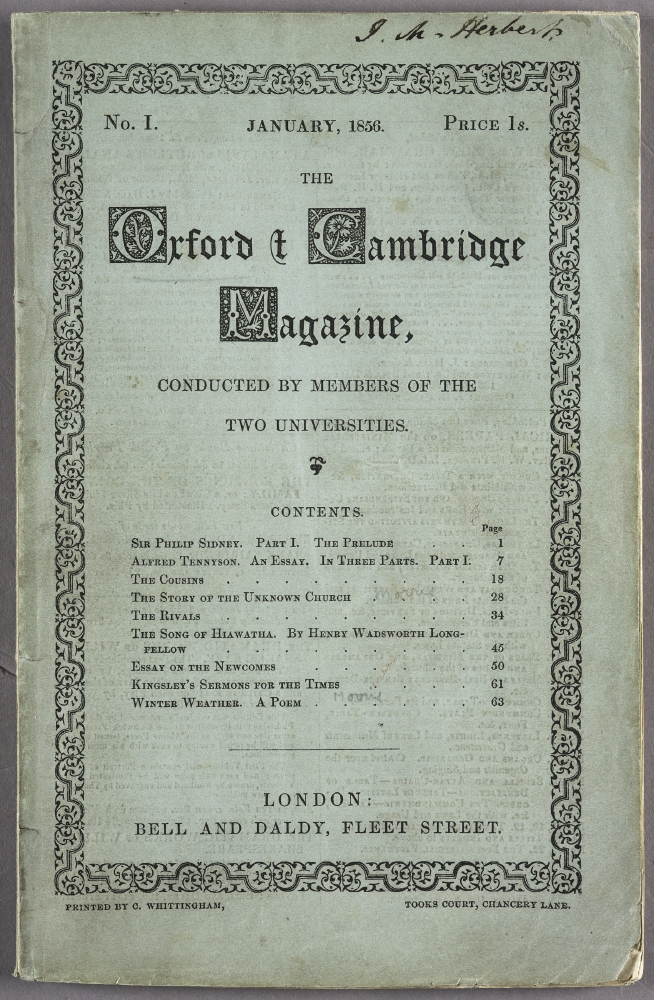
![Image of page [1]](http://www.rossettiarchive.org/img/ap4.o93.1.001.jpg)