 page:
page: cover
Editorial Note (page ornament): An ornamental border frames all but the printer's name and address, at the bottom of the page.
No. VII.
JULY, 1856. Price 1
s
THE
Oxford + Cambridge
Magazine,
Editorial Note (page ornament): Initial O, C, and M are ornamental
CONDUCTED BY MEMBERS OF THE
TWO UNIVERSITIES.
Editorial Note (page ornament): Publisher's mark.
CONTENTS.
- On the Life and Character of Marshal St. Arnaud .
389
- Gertha's Lovers
Morris . . . . . . . .
403
- A Study in Shakespeare . . . . .
417
- Lancashire and “Mary Barton” . . . .
441
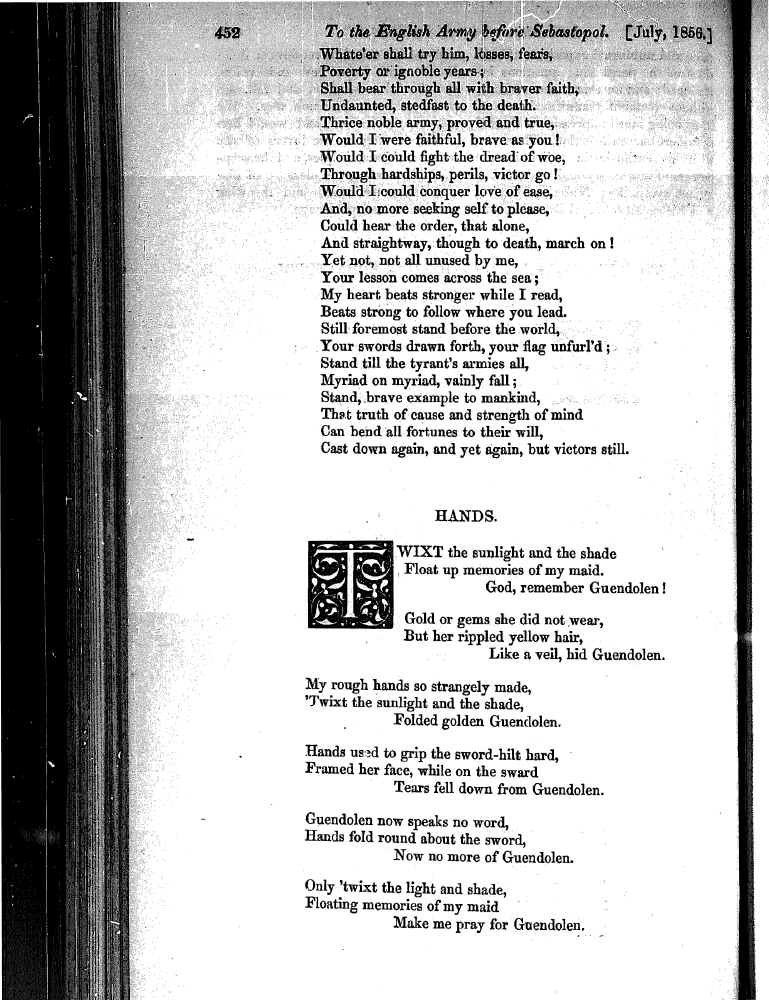
- To the English Army before Sebastopol . . .
451
- Hands
Morris . . . . . . . . .
452
LONDON:
BELL AND DALDY, FLEET STREET.
PRINTED BY C. WHITTINGHAM, TOOKS COURT, CHANCERY LANE.
 page:
page: [unpaginated]
Transcription Gap: (Advertisements)
![Image of page [389]](http://www.rossettiarchive.org/img/thumbs_small/ap4.o93.1.389.jpg) page:
page: [389]
Editorial Note (page ornament): An ornamental design appears at the top of the page.
Editorial Note (page ornament): Intitial W is ornamental.
We have been three months at peace. Even we who live at home at ease and feel that it is a reality and not a name. We have no
more
lists of killed and wounded, which we look over with fear lest we should catch the name of an old friend, and which we know
that others who have all they
hold dearest at stake are looking over with a death-like anxiety. We have no more harrowing accounts of the sufferings of
our soldiers, which make us accuse
ourselves of a life of selfish ease, while others are fighting the battle of truth and right. We hope it is a lasting peace.
The conditions were agreed to
by men who have in the very highest degree the great English virtues of common sense and honesty. The people at first feared
they were overreached, but are
gradually gaining a conviction, that the blood of our warriors has not been shed in vain. Now that we breathe freely after
the contest, it will not be
uninteresting to study the life of one of its heroes; the man who first led to the Crimea that
Column Break
daring expedition, which, after unlooked-for toils and
endurance, was finally crowned with the success which has so largely contributed to the result of the war. But a study of
the character of Marshal St.
Arnaud has a great interest for its intrinsic value, especially as it is opened up to us in his private letters, which lay
before us a picture of his life,
filling in by the most intimate details of thought and feeling the outline which his public services and graphic despatches
had already presented to the
world.
A youth, in whom the most conspicuous qualities are good humour, ardour, and ambition, the outward traits of deeper qualities,
which become developed
in later life, in a character where we see the man of refined and elegant mind and feeling winning the hearts of all around
him; the able general, devoted
to his duty and sympathizing keenly and actively in all the sufferings of his soldiers; the patriot, anxious above all things
for the glory of France; such
is the character which these private letters, added to what we know of his public life, disclose to us.
 page:
page: 390
We shall not attempt in this essay to give a detailed account of his life, but as true a sketch as we can of the man, by a
series of pictures drawn at
different periods; dwelling chiefly upon those later scenes of his career which have the most lively historical interest for
us at present, and in which the
real excellence of his character is most fully brought out.
His father, an
avocat at Paris, died when his son was five years old. He received his education at the
Lycée Napoléon, and obtained his commission in the
Gardes des Corps at the age of seventeen, at the end of the eventful year 1815. The life in such a corps, however, affording too many temptations
to a young,
ardent nature, his stepfather soon afterwards procured him an exchange into a regiment of infantry. Soon tired of garrison
life, and impatient for active
service, in the year 1822 he volunteered his services in the war for the independence of Greece.
His description of the state of things on his arrival there is very amusing. All wanted the command. Every one was captain,
no one soldier. In spite of
all this, he proffered his services to the Ephors at Navarino, who gave him a cup of coffee and a pipe, read his letters of
introduction, and dismissed him
without a reply, or even thanks for his offer. He met with a similar reception from the senate at Corinth; so after mixing
in a few fights before Modon,
which was occupied by the Turks and besieged by the Greeks, he left the country. Before returning to France he visited Constantinople,
Smyrna, and
Gallipoli. In the following years he visited Italy, Belgium, and England, studied their languages, and became a proficient
in English and Italian.
The revolution of July, 1830, appearing likely to kindle an European war, recalled him to France, where he obtained employment
in the rank of
sub-lieutenant in the 64th Regiment, then in garrison at Brest. There he married, and was soon afterwards engaged
Column Break
in active service in the war in La
Vendée, the district which a few traces of the golden age of St. Louis, lingering through all the corrupt governments that
followed, had made the constant
rallying point of the royalists. The end of the year 1832 brought him, much to his chagrin, to Blaye, with a battalion which
was to perform the not very
dignified service of a guard to the Duchesse de Berry. “From chaser of the chouan,” he writes, “behold me turned
gaoler. I shall die with rage if they fight on the Rhine, while I remain shut up in the citadel of Blaye.”
It was here, however, that he met with General Bugeaud, with whom his subsequent life in Algeria is much bound up. He first
attracted the notice
of that general by translating a small book of his into three languages, and soon afterwards he became his
officier-d’ordonnance
.
From this time to 1835 he is employed in different garrisons. In October of that year he returns to Paris, and is attached
to the
Gymnase Militaire. Early in 1836 he loses his wife, and applies soon after for service in the Foreign Legion for Africa, where he endeavours
to forget his domestic
grief in the energetic performance of his public duties. To his brother he writes from Africa: “Patience, resignation, you see my lot. I
have sufficient courage and philosophy to bear it without murmuring. There are better; but this life, so active, mingled with
so many dangers, such
privations, has restored my heart, increased my energy tenfold; and if at times the remembrance of the past did not come to
make me sad, I could be
almost happy—quite happy, if I could have news of you, of my mother, and of my children. But you do write as often as you
can, I am sure.
Ma gentille petite fille! kiss her a thousand times for me, and tell her that I too think of her, and of her brother, and that I love them both dearly,
and am working
for them.”
 page:
page: 391
It was not long after his arrival in Africa that peace was made with Abd-el-kader, and the French army turned its attention
against the Bey of
Constantine. It was at the siege of Constantine, which was one of the hottest actions on record, that St. Arnaud well earned
his first Cross of the Legion
of Honour. Shortly after this we find him nearly falling a victim to cholera, but much cheered by the affection and attention
of his comrades.
“I was dying, my brother,” he writes, “but I saw myself loved, regretted.”
In July, 1839, his company occupy Jijelli, and during a pestilence he converts his house into an hospital. “In the shelter of my
fig-tree and vine arbour,” he writes, “I have received five Voltigeurs whom the hospital cannot admit, and who are struck
down
with the terrible burning of the hot fever. They are on the straw, enveloped in coverings; I give them as many citrons, oranges,
&c. as I can,
and supply baths for their feet.”
During the spring and summer of the year 1840, he distinguished himself in several actions; and in August he is raised to
the rank of Commandant of
the 18th Regiment of Infantry, and stationed at Metz.
Towards the end of that year it begins to appear that Abd-el-kader is becoming a formidable enemy; and it becomes evident
that Marshal
Valée is not the man to oppose him successfully. To preserve the French possessions, vigorous measures must be taken. Accordingly
General Bugeaud
is made governor of Algeria, and the army there is increased to 100,000 men. St. Arnaud, in writing to congratulate him on
his appointment, places at his
disposal his own services and African experience, on which Bugeaud immediately asks his services from the ministry. He obtains
them, and St. Arnaud finds
himself in command in the Zouaves, “the first soldiers in the world,” under Colonel Cavaignac.
Bugeaud’s plan for subduing Abd-
Column Break
el-kader is by terrifying the Arab tribes into obedience to the French. He adopted the Arab system of warfare,
making his troops almost as moveable as the Arabs themselves, and carrying destruction and devastation among every tribe who
would not submit. It was an
aggressive and severe system, but necessary for the security of the French possessions. The outposts of the French territory
were garrisoned, protecting the
tribes which had submitted, and ready for predatory excursions in the country of those who had not.
That Bugeaud was a great general there is no question. He was not, however, popular with the army; and St. Arnaud, who fully
appreciated his great
qualities, had often to defend him from abuse. A sketch of this man’s character, in a letter of St. Arnaud to his brother,
may interest the reader:
“General Bugeaud pursues his end with a perseverance as praiseworthy as it is able. Passionately fond of war and combat, he
prefers to
great accounts which he might produce, the pursuit of an end useful to the country. This man is admirable, brother; people
do not know him; they do not
render him justice. He has true genius; I follow him, I examine him dispassionately, and every day I discover in him new qualities.
But he has many
defects. Frank and loyal to excess, he approaches at times to bluntness. Of an inconceivable activity, he becomes trifling.
Engaged for fifteen years in
agriculture; living in continual contact with the less elevated class of society, he has not all the dignity, all the
tenue desirable. But what conscientiousness! What probity! What refinement of sentiment! What self-denial! And he is surrounded
with
difficulties.”
There is a great contrast between these great men; and yet the tie between them was strong. Very likely it was the refinement
of St. Arnaud,
contrasted with his own rougher nature,
 page:
page: 392
that drew Bugeaud so much to him. Their intimacy became great. On one occasion St. Arnaud, in a letter from Algiers, says:
“The general, on his return home, found me there as he had left me, and his reception was paternal. As I would have retired
to leave
him with his wife and children, he said to me: ‘Stay, you are one of the family.’”
In April, 1842, St. Arnaud is promoted to the rank of Lieut.-Colonel, and soon afterwards placed by Bugeaud in the Government
of Milianah, one of the
outpost garrisons of the French, with three battalions of infantry, sixty cavalry, besides artillery, engineers, &c., under
his orders. His work
here is a mixture of administrative and military duties. He has to find quarters for his garrison of more than 2000, where
there was at first scarcely room
for 800. He has to organize the civil government of the city, &c, and occasionally to make a sortie to punish the revolting
tribes and lay waste
their country. The best idea of his position there may be given in his own words. Six weeks after his arrival he writes to
his brother: “I
regard my position exactly as you do. It is truly too fine. You are right in saying it. I reign, and reign almost without
control. I have neither
Chambers to control me, nor Ministers to counsel or to contradict me; and hitherto all the measures which I have taken had
been already accomplished
when I gave in the proposal for them, and nearly always have been approved. It is the finest epoch of my life, my brother;
and for our old age an
inexhaustible subject of recollections and anecdotes. I have acquired self-command visible to my own eyes, and that will not
astonish you if you think
of the important orders which I give; of their immediate execution, of the responsibility which accompanies them. With the
Arabs hesitation is
feebleness, incapacity. One must then think quickly, but well; strike hard, but
Column Break
justly. This is my endeavour, and I flatter myself the Arabs at
Milianah love me as much as the French. How many miseries to relieve, my brother! How many three-franc pieces, in the form
of a measure of wheat, have
entered the houses of poor families, to arrest the famine at their door! . . . . In short, where were ruins a city rises;
where misery reigned,
reappears commerce, industry, well-being. I had 100 poor families, I have now scarcely ten; and the number diminishes every
instant, for I make them
useful and make them earn their bread.” That he had effectually gained the hearts of the people appears from the following extract:
“General Fabvier, Inspector General of Africa, has just passed three days at Milianah. I shewed him everything in
detail;—the theatre, public works, building, administration, magazines, municipal commission;—I left the general in admiration,
stupified. Then while he was inspecting the three battalions, I took the command, made them manœuvre and defile before him;
in short, the
brave man is gone away enchanted with me. I will not repeat the compliments with which he overwhelmed me. But the best part
of the affair was this: all
the influential Arabs, the chiefs of the tribes, came to pay their respects to the general. At the moment of his departure
they presented themselves in
a body, and begged him to tell the governor and king to leave me always at Milianah; and that, if they wished to take me from
them, they would not let
me go.”
At the same time his military talents were not without exercise. At the head of his little column from Milianah he had several
times to make
expeditions against the neighbouring tribes, which he always conducted with success. It was a command for a general, though
he was only a
lieutenant-colonel.
In July, 1843, he was to give up the
 page:
page: 393
command of Milianah; Bugeaud receiving orders to give employment to his general officers in those governments. He is informed
of
this in a very complimentary letter from Bugeaud, thus:—“There can be nothing but what is honourable for you to be replaced by
a major-general, and it can by no means injure you. You have gained your spurs at Milianah; and without doubt a third or fourth
recommendation will give
you a regiment.” In July St. Arnaud leaves for Paris and is succeeded by General Gentil.
In February, 1844, he returns to Africa as colonel of the 32nd regiment. After taking part in a few expeditions in the earlier
part of the year, he
is, in November, appointed commandant supérieur of Orléansville, where his duties are very similar to
those at Milianah, and where he continues till November, 1847, when he receives the rank of Major-general, having previously
attained the rank of Commander
in the Legion of Honour.
This epoch is also marked by the submission of Abd-el-Kader. The second of the hostile chiefs, Bou-Heaza, had already submitted
to St. Arnaud himself
at Orléansville, and requested, on his surrender, to be conducted to him. In January, 1848, St. Arnaud starts for Paris. “I
shall see Abd-el-Kader again in Paris,” he writes. “O destiny!”
He returns to Paris just in time for the Revolution, Bosquet having taken his duties in the meanwhile at Orléansville.
To describe the part he took in the Revolution, we quote a note of the editor of the Letters:
“In the night between the 23rd and 24th of February, at two o’clock in the morning, Marshal Bugeaud called up General de St.
Arnaud (who was at
Paris on leave), and gave him the command of a brigade. On the morning of the 24th, the general carried in his course the
barricades of the
Column Break
Rue
Richelieu, which were scarcely defended, but which were reconstructed after the passage of the troops. On his turning back
from the Place de Carrousel,
the general received orders to go and occupy the Prefecture of Police with three battalions of the army and one battalion
of the National Guard. This
last disbanded itself at the Pont Neuf. The general had been forbidden to make use of arms. In spite of this order, and without
infringing it, the
general occupied the prefecture, and there maintained himself till he learnt the abdication and departure of the king, and
the seizure of the Tuileries
and Chamber of Deputies. He attempted to retire upon Vincennes with his troops, in the middle of which he had stationed the
Municipal Guard. Arrested on
the Quai de Gevres and the Place de l’Hotel de Ville by the barricades, the general could not prevent the soldiers from dispersing
at the cry of
abdication. He was pressed upon, surrounded, thrown from his horse, bruised, threatened with death. Disengaged by an officer
of the National Guard, and
conducted to the Hotel de Ville, where the Provisional Government was forming itself, brought in and placed in custody in
one of the halls, he recovered
his liberty with the aid of a working jeweller named Caylon. From the Hotel de Ville he came to the house of M. Leroy St.
Arnaud, while the latter,
forewarned of the danger his brother was running, had just come to the Hotel de Ville to look for him.”
“In all these events,” he says, writing to a friend, “I have done my duty to the last. I have been
wounded—fortunately not seriously; my horses have been wounded; that of my officier d’ordonnance killed; my
aide-de-camp pulled from his horse, bruised, &c. I owe my life only to a miracle, and I had not the strength to thank God
for having done so.
 page:
page: 394
Some day I shall relate to you these unpleasant details. It would be too long to write them.
“After this great public event, I will tell you a private one, which has its importance, I am going to marry.—To marry in
the midst of revolutionary storms,—to bind to one’s destiny the destiny of a woman. That is bold, is it not? What think you?
I have faith in
myself and my wife. I espouse the sister of my brother’s wife, daughter of the Marquis of Trazegnies. I say marquis, because
the levelling revolution
has not yet affected Belgium, and the family of my wife is Belgian, and lives in Belgium.
“Mademoiselle Louise de Trazegnies is graceful,
spirituelle, perfect in education, in demeanour, in principles.”
At the end of April he returned, with his wife, to Africa, and is transferred from the government of Orléansville to that
of Mostaganem,
one of more importance, and afterwards from thence to the command of the subdivision at Algiers. We pass slightly over the
remaining events of his history
in Africa. On the 27th of January, 1850, he is nominated commandant of the division of Constantine, his last appointment in
Africa. About the beginning of
May, 1851, an expedition into Lesser Kabylie, which he has some time been meditating, is undertaken by him. This was the most
important expedition of which
he had the command in Africa. It was completed with entire success. It occupied eighty days, in which time the division passed
over 430 miles, and measured
their strength twenty-six times against the enemy, always with victory. More than forty tribes were subdued, and in the whole
expedition their loss was
about one-eighth of the entire number.
In July, at the end of this expedition, St. Arnaud is appointed general of division, and soon after is recalled to Paris,
to take the command of an
Column Break
active division. On the 26th of October he receives the portfolio of minister of war under the President, Prince Louis Napoleon.
We must pause here for a moment to look at his political sentiments. They were simple and consistent, and centred in an abhorrence
of a republic and
of selfish demagogues. He would have supported the monarchy under Louis Philippe. When that had fallen, he looked with despair
on the prospects of France,
and would have welcomed anything that had given the chance of a firm and stable government. “One thing,” he writes in a letter
in 1842, “I shall always oppose, in word and deed, that is a Republic, because it is hateful to me.”
“Poor France!” he writes in December, 1848, “so strong, so glorious, once! will she awake?”
Again, in February, 1850, “Army of the President, army of the Republic, I would none of them. I would rally round that which would have
nothing of a Republic, which I love neither for itself, nor for its forms, nor above all for its men. France wishes it not,
France repels
it.”
He was personally unknown to Louis Napoleon until he came to Paris in 1851, to take the command before mentioned. He had given
his vote for him in
December, 1848, as the man who was unknown, when all the rest were odious to him. St. Arnaud was pointed out to the President
by his rare combination of
administrative and military talent, as shown in his government of Constantine and his expedition to Little Kabylie. He took
office as minister of war on the
26th of October, 1851, an office which could have been no light task during the stormy debates and narrowly contested divisions
in the National Assembly
during those few months. The most important debate in which he took part was that upon the proposition of the quæstors for
conferring upon the
President of the Assembly an unlimited right of calling
 page:
page: 395
out the military force. The proposition was a most direct vote of want of confidence in the executive government. It was
rejected
by a majority of 408 to 300; but in the applause which followed the vote, several of the majority exclaimed, “It is only a
victory for
them.” The assembly finally rejected the government measure for the abolition of the limitations of land suffrage by the law
of the 21st of May,
1850, and the
coup d’etat was resolved on.
Let us now look for a moment at the position of Louis Napoleon in the autumn of 1851. He was at the head of the executive
government of France, with a
legislative assembly in which the party in opposition to his government was tremendously strong, sometimes victorious. Shall
he resign his power, or
continue in office and be obliged to sanction acts of which he disapproves? Such would be the constitutional alternative.
But on the other hand, look at the
vision which opens itself. He saw France torn with contending factions, to which for sixty years it had been alternately the
victim. The elements of a reign
of terror were still there. So late as June, 1848, Paris had witnessed a death-struggle, which only just saved her from its
triumph. He felt a power within
him, and a noble destiny before him; a destiny nobler far than the mere name and state of Emperor of the French. He felt called
as the
“instrument of the decrees of Providence” to give order and stability to the government of France, and to make his country
honoured
and powerful; not by extending the bounds of her territory, but “by putting herself at the head of the movement of generous
impulses to extend
everywhere the empire of right and justice.” Such words were scarcely believed when they were uttered; but in all minds unprejudiced
by party
feelings the acts of every year are increasing the conviction of their sincerity.
His determination was then taken to
Column Break
make use of the real power which he possessed of forcibly dissolving the National Assembly, and appealing
for the ratification of the act to the only
sovereign of a republic, the people. Such we believe to be a true view of the Revolution of
1851, looking at it from the side of Louis Napoleon himself. Into the question between him and the National Assembly we do
not enter. That he was most
sacredly pledged to the existing constitution is true; but, on the other hand, the permanence of that constitution was impossible;
and it was no longer
upheld by the will of the French people, which was its only origin and resting-ground. The pleading of advocates on the point
would be interminable; and the
judgment is above any earthly court.
We have spoken at such length of Louis Napoleon in order the better to enter into the feelings and motives of St. Arnaud’s
line of action on the
present stirring occasion. He entered heart and soul into the plans of Louis Napoleon; and of course did his share of the
work in bringing them about.
“Good morning, dear mother,” he writes early on the 2nd of December, 1851, “I write at a solemn moment. Two
hours hence we are to be present at a revolution, which I hope will save the country.
“This assembly, foolish, blind, factious, will be dissolved, and an appeal to the people will decide the lot of a nation wearied
with being tossed about by disquiet and cares. We shall have a stable government, and I have confidence that all will go well.
The Republic remains with
the President named for ten years.”
Before morning the leaders of the opposition in the assembly are arrested; the doors of the house shut and guarded, and Paris
placarded with the
President’s decree of the National Assembly dissolved; universal suffrage re-established, the state of siege declared in Paris,
and the people convoked in
their
comitia to vote upon the ratification of
 page:
page: 396
the President’s act. To these decrees follows his appeal to the people.
Such was the revolution of the 2nd of December. On the morning of the 4th, the resistance organized by the minority of the
Assembly and their
supporters came to a crisis, but the military standing by the President, it was immediately suppressed. As every one remembers,
the President’s appeal to
the people was entirely successful, and was responded to by a majority of 7,000,000 votes.
In February, 1852, St. Arnaud lost his only son, a fine fellow of about twenty, of whom he had been very fond and proud. He
had been prevented by his
public duty from going to see him in his last moments; and we can see from a few short private letters about this time the
heart which bears affliction like
a man in the uninterrupted discharge of his public duties; but which also feels it like a man in the deeper thoughts which
form the constant refrain to the
work of life.
He accompanied the Prince Napoleon in his celebrated tour before the declaration of the empire; and gives some very interesting
descriptions of the
enthusiasm of the people. From Bordeaux he writes:—“Bordeaux has shown itself the first city in France by its reception. At
Grenoble enthusiasm of the heart; at Toulouse enthusiasm of the head; here enthusiasm of conviction, and from good society.
You don’t like speeches, but
what do you think of that at Bordeaux? It is a fine and noble manifesto, which will satisfy Europe where it is hardest to
satisfy. The discourse is
summed up in this French thought, ‘When France is satisfied, Europe is tranquil!’ ”
A few months after this, we find among the letters one or two so remarkable, and throwing such a light upon the innermost
recesses of the character,
that we cannot pass them without a full quotation. In March, 1853, while at Hyères, St. Arnaud has
Column Break
had a sharp attack of illness. His
brother Leroy had joined him, though St. Arnaud himself had written to spare him the trouble, as he was convalescent. His
next letter is to his
half-brother, M. de Forcade. “Dear brother, the Conseiller d’état has just set out for Toulon
as tranquil and happy as he had come uneasy and disquieted. He has seen the progress of a wretched disease arrested, and health
return as by
enchantment, with strength increasing every day. Then passed in me something extraordinary. The body, spirit, all was sick;
and this state had caused a
great disorder, which had attacked the principle of life. I took refuge in meditation; then in prayer I lifted my soul to
God, and the calm returned to
my heart.
“I have found in the curé of Hyères a priest such as I understand and love.
We have had long conversations, and on Sunday I take the sacrament like a true Christian. This conversion will perhaps astonish
you, and you will see in
me a great change. Prayer is an excellent medicine, remember this on occasion. You may let my amiable sister read this letter;
her elevated soul will
comprehend me.”
The ground is too sacred for comments of ours. We shall pass on, merely remarking, that if any one, in looking at the devotion
and self-sacrifice of
this man’s life during his last expedition to the Crimea, should trace the influence of the prayers and meditations at Hyères,
we do not think he
will be wrong. We must admire too the man who can leave on record his inmost feelings with such an absence of reserve on the
one hand and of self-deception
on the other. Soon after he writes again to the same:—“To the fierceness, to the irritation which governed me have succeeded a
calm and a gravity perhaps too serious, but which still cling to my malady. I have suffered so much!
 page:
page: 397
I hope soon to recover a gentle gaiety, but I do not dissemble that all my ideas are grave and serious. I read much the
‘Imitation of Jesus Christ,’ and this wonderful book, which penetrates me with admiration, inspires me also with a painful
distrust of my strength. Will God give me enough strength of will, enough perseverance to remain in this noble path which
he shows me? This is what I
ask of him every day with fervour.”
From this time his health is never very good.
In April, 1854, however, he is called to the command of the army of the East, which he accepts without hesitation.
The army is first organized at Gallipoli, in order to be ready to protect Constantinople in case of the Russians making good
their progress so far. In
the middle of June a second camp begins to be formed at Varna, and it is among the trials and disasters of the army here that
the character of our hero is
brought out in its greatest brightness. In the meantime Silistria is holding out beyond hope, and though considerable time
must elapse before the whole army
and material can be got up and made ready for the march, it appears still possible that the allied armies may be able to save
Silistria, and drive the
Russians into the Danube. St. Arnaud’s plans are well matured, and it will give a good idea of the difficulties with which
he had to contend, as well as of
the foresight with which it was his habit to act, if we make an extract from a letter to his brother written from Yenikali,
June
20th:—“I see that you always lend yourself with ardour to the plans of a campaign. I have already carefully drawn out more
than twenty, and may, perhaps, not carry out one of them. They say, one ought always to have one’s plans determined beforehand;
I say one should be
ready for all contingencies, and make decisions prompt and sound. Plans must be daily regulated by circumstances.
Column Break
“I shall probably quit Varna from the 10th to the 11th of July, to march upon Silistria: and my plan is to save the town and
drive
the Russians into the Danube. But who can say that I may not be obliged to face about to the right against the 30,000 Russians
who are in the
Dobrutscha. It is for this that I have strongly occupied Kustenje with marines from the fleet; and if the Russians, after
sure and positive information,
besiege Silistria regularly and not out of all order, proceeding by trenches, &c., make in front of the Danube a very strongly
intrenched camp
defended by fourteen works armed with heavy guns, a camp in which there are about 90,000 men; if the Russians, I say, having
done this, let the allied
army defile from the forest below Silistria, place 20,000 men to defend their camp, which will be enough; and with 60,000
men, and the 30,000 descending
from the Dobrutscha, march to place themselves on my right and in my rear, occupy the grand route between Varna and Pravadi,
and intercept my
communication with the sea, I may find myself in a very awkward position. Don’t be alarmed, I have taken my precautions against
the manœuvre,
and shall baffle it; but you see with what prudence one must act. If had 100,000 men, I should put 30,000 men in force on
my right, and proceed straight
on my way.”
His hopes, however, were to be disappointed in another way. As soon as it appeared that the allied army was nearly ready to
be put in motion, the
Russians, having made one final grand assault on Silistria in which they were repulsed, commenced a retreat, re-crossed the
Danube, destroying their
redoubts, batteries and intrenchments, and thus, as St. Arnaud expresses it, in saving themselves, robbed him of a great opportunity
of victory.
Everything now must be decided on afresh. He will not, as he writes, follow
 page:
page: 398
the Russians, unless to aid the Austrians, if they should decide on war, as he would otherwise throw the Russians back upon
their
reserves and magazines, and withdraw himself from the sea, his true base of operations; in which case a defeat of the Russians
would do them little damage,
but one of the allies would be most disastrous.
In the meantime negotiations are going on at Vienna; but, while the reply of Russia is uncertain, it is evident the armies
must not remain inactive.
On the 11th of July a grand council of war is held at St. Arnaud’s quarters to decide upon what is to be done; and the result
is, that the expedition to the
Crimea is resolved upon. This was in accordance with St. Arnaud’s own views, and there is little doubt that he was the chief
advocate of the proposal, which
he carried “in spite of timid counsels.” These are the words of the Emperor in his letter of condolence to his widow, and
refer
without doubt to this council of war. The others present in the conference were the Admirals Dundas and Hamelin, Bruat and
Lyons, and Lord Raglan. Now that
the expedition, though after long toil and disappointment, has been crowned with such substantial results, no one will gainsay
the wisdom of the step; and
even when the prospects appeared the darkest, it was never blamed by the main body of the English people. It is true that
St. Arnaud was sanguine as to the
quickness of the result; but he never shut his eyes to the immense difficulties to be overcome. “We must,” he writes to his
brother, “expect a strong resistance, an artillery formidable and well served, difficulties of ground as well as of position
for attack. The
Fort Constantine, at the north of the city, is considerable. It is the key to Sebastopol; it is there that we shall have to
commence a regular siege;
but we shall have at the same time to carry on a siege and hazard a battle. What a glorious page of military history!
Column Break
At the same moment to
immortalize the Crimea by a siege, one, and perhaps several, battles, and a naval combat, for the Russian fleet will not let
itself be burnt without
going out; fourteen vessels of the line defend it in all, and the Russian fleet has its valour, if we may judge from the exploit
of the
Wladimir.”
In the meantime negotiations had been going on between Austria and Turkey respecting the occupation of the Principalities
by Austria. The Austrian
Envoy had spent two days with St. Arnaud; and we have no doubt that as Austria was not prepared to take more active measures,
he had acquiesced in the
proposal. His approval of this treaty has been blamed by his detractors; but that, as one sometimes heard wildly stated, this
treaty could have had any
immediate prejudicial influence on our operations, is simply absurd. The only possible objection could be the question whether
a refusal of this to Austria,
except on the condition of actual co-operation in the war, would have induced her to go further; and beyond this the remote
possibility of its leading to
future complications. On the other hand, it was necessary in order to set our army free for the Crimea; for it must never
be forgotten that our first duty
in the war was to defend the territory of Turkey from aggression, and that it was only the presence of our troops at Varna
which caused the retreat of the
Russians from Silistria.
In the midst of the preparations for the expedition to the Crimea, appears an enemy against which artillery is of no avail.
The cholera breaking out
at first among the Spahis d’Orient in the first division, thence spreading to the second and third, seems to paralyze the
work, and to threaten to put a
stop to the expedition. It is during this visitation, however, that the Christian heroism of the General’s character is brought
out in its full brightness.
Feeling the disasters of the army more
 page:
page: 399
than any one, and himself all the time suffering under a trying illness, he is throughout, the cheering and encouraging spirit
of
all. In a description of the pestilence in the
Moniteur we read:—“In the midst of the painful trials to which the army has been exposed, the common danger has given rise to
various acts of devotedness, and nothing can equal the moral vigour which has been displayed during the continuance of the
epidemic, as well by those
who obey as by those who command. Marshal St. Arnaud every day passed several hours among the sick, consoling and encouraging
them, and
‘everywhere,’ he says in his report, ‘I recognise the great nation, a moral demeanour of iron, a devotion beyond all
admiration. Everybody assumes a multiple character, the soldiers are become sisters of mercy.’ ”
And he had set them the example. No one sustained the double character better than himself. As he was their general in the
field, so he led the
mission of mercy in the hospital. But we can form the best conception of what he did and felt during that trying time from
his own letters, where he
describes all with that true modesty, which makes no pretence of concealing his own merits. To his brother, on the 4th of
August, he
writes:—“I bear up stoutly against such a disaster. I sustain every one; but I am bruised at heart.”
Again, to the same, August 9th. “Can history produce many situations parallel to mine? My spirit and energy at least are at their highest
pitch. God, who strikes me on one side, supports me on the other. My health has not for a long time been better; in the midst
of the grief and cares
which feed upon me, and which I smother in secret—death in my heart, calm on my brow. Such is my existence. When you receive
this letter I
shall be embarked for the Crimea, or very nearly so. In the
Column Break
meantime I pass five hours daily amidst the dead and dying.”
Again, to his wife, August 9th and 10th, after visiting the hospitals on the heights of Franha, “I have seen there 1000 sick and
2000 invalids, who never leave my thoughts. I believe to be a general-in-chief one ought to be utterly selfish; I cannot be
so. I love my soldiers, and
suffer with their ills.” To the same, August 23rd. “I went yesterday to see all my cholera patients, and was not
dissatisfied. A poor officer of artillery died in my arms. I hope I have saved another by speaking a little to his heart and
his
imagination.”
To add to the misfortunes of the army, on the 10th of August a conflagration broke out, which must have been terrible indeed
to those who knew the
full extent of the danger. “During five hours,” St. Arnaud says, in describing it to his brother, “we were
between life and death. The flames played on the walls of our three powder magazines, French, English and Turkish. The ammunition
for the
whole war was there, eight million cartridges. Four times I was in despair. I was in doubt whether to take the last resource,
and sound the retreat, the
signal of
Sauve qui peut. God inspired me. I resisted. I battled with it; sent my adieux to you, to all, and awaited the
explosion. The wind
changed. A gap was made with the hatchet, the magazines were cleared. At five in the morning we had got the fire under, though
it is still burning; a
seventh of the town exists no longer.”
Towards the end of the month the cholera begins to disappear in the army, though it still lingers in the fleet. It is now
well known in the army that
the Crimea is to be their destination, and the spirit of all rises in the expectation of getting to work; but as the health
and spirits of the army rally,
those of the General, who has been throughout their miseries the
 page:
page: 400
encouraging and consoling spirit, becomes exhausted. His letters are generally uncomplaining; but he occasionally expresses
a
strong longing for a complete repose, and looks forward to rest in the bosom of his family when the main object of the expedition
is achieved. For the
moment of action he believes he shall find strength enough. “God,” he says, “will not withdraw from me his grace at the
moment when it is most necessary.” His health becomes worse as the time of embarkation approaches, and between the anxiety
weighing upon his mind
and his bodily suffering, his spirits are prostrated. On the morning of embarkation he writes to his wife in very anguish
of mind: “I
abstain from all reflections; those which I should make would be so bitter that they would not be Christian. Shall I ever
have drunk deep enough in the
cup of bitterness? There are moments when my whole soul revolts and rebels. Prayer acts on me only like a tempest. Its powerlessness
throws me back
sometimes into doubt, and I suffer so much that my faith gives way. I ask why a poor being should be overwhelmed with so many
tortures and sufferings,
inflicted at once on the body and the soul. If the physical pain had left me all my strength, I should struggle against it;
but my strength fails me in
the contest; it is too long. Everything has an end. One hope yet remains, the repose which I must have on board ship.” What must have
been the mental suffering here described! It is the complaint of a true Christian at a moment when he cannot realize the consolation
of his religion.
On the 2nd of September St. Arnaud starts in the
Ville de Paris for the rendezvous in the bay of Baltschick, where they have to wait
a day or two for the English, who are not yet ready. The whole, however, weigh anchor merrily on the 7th, but the Commander-in-chief
is prostrated under
Column Break
an aguish fever, superadded to his old complaints, and has to keep his bed the greater part of the voyage. His health, however,
rallies as they
approach the land. Respecting the disembarkation his own view was in favour of saving time and marches by landing in the face
of the enemy at the Katcha,
which they were occupying. He was, however, overruled by the English, who thought it impossible, and it was agreed to land
at Old Fort. He had been right as
it appeared afterwards. He had sent the fourth division to the Katcha to make a demonstration of landing there. At the first
few shells thrown from the
ships the Russians filed off, and it appeared that this division could have landed alone if it had received the order. So
he writes in a subsequent letter
to his brother, and adds, “I do not make the English feel too much that I was right.”
From the landing at Old Fort, every step of the expedition is a household word with us. We must, however, spare a few words
to describe the great
closing scene of our hero’s life, the battle of Alma, especially dwelling upon the part he personally took in it and the dispositions
for it, which have
often been misunderstood. We shall take the account, in a great measure, from his own words in his public despatches and private
letters.
On the evening of the 19th September the allies bivouacked in sight of the Alma. The Russian army, which occupied the opposite
heights, consisted of
all their disposable forces in the Crimea; they had 40,000 bayonets, 6,000 cavalry, and an artillery force consisting of 120
pieces well served. The centre
and right of their position, where the slopes were less steep than on the left, were fortified with redoubts, and there also
were concentrated the greater
masses of their troops. The valley in front of the slopes, which is covered with trees, gardens and houses, was occupied by
riflemen. The river itself has a
 page:
page: 401
winding course with only occasional fords.
At six o’clock in the morning of the 20th, St. Arnaud sent the division under General Bosquet to turn the right flank of the
enemy. This movement,
executed under protection of the guns of the fleet, was attended with complete success, and in a measure, he says in his report,
decided the success of the
day. A similar movement on the English left had formed part of his original plan; but, as they were menaced by the cavalry
on the left of the Russians, it
had to be abandoned. We shall proceed chiefly in St. Arnaud’s own words. “At half-past twelve the line of the allied armies, occupying an
extent of more than a full league, arrived at the Alma, and was received with a terrible fire from the riflemen. At this moment
the head of Bosquet’s
column appeared over the heights. The signal was given for the general attack.” The French line is advanced through the gardens, each
passing where he could. The Russian riflemen in retiring are followed by the French skirmishers, who press them with great
daring to the foot of the
heights. In the meantime the French artillery is brought to bear on the Russian battalions who are descending the heights
to support their riflemen in
retreat. The French first line arrives at the foot of the heights, under the fire of the enemy’s batteries, while the second
line is advanced through the
gardens to its support. Then commenced a real battle, with episodes of brilliant deeds and noble valour. The French were victorious
everywhere, and carried
the heights with enthusiastic cheers, the wounded even raising themselves from the ground to cry
Vive l’Empereur. The Russians are compelled to withdraw from the crest of the hill, and the French reserve artillery is brought up with incredible
celerity over
such obstacles as are presented by the river and the steepness of the heights. After some continuance
Column Break
of an exchange of cannonade and musketry, the
Russians retire in bad order, which, with the help of cavalry, might have been converted into a rout.
The English had encountered greater obstacles, for the positions they had to take were more strongly fortified, and there
also were concentrated the
greater masses of the enemy; for the Russians had not supposed that the steep declivities on their left could be surmounted
by a large force of the enemy.
How the English surmounted these obstacles must be well remembered; through what a storm of shot and shell they crossed the
river, and how in regular line
they walked up to the face of the batteries; such things once heard can never be forgotten, and we should go too much from
our present subject if we were to
describe them at length. We shall only quote one more picture of the whole from St. Arnaud’s account of it to his brother.
“I never saw a
finer panorama than this battle of Alma. Arrived on the heights, the better to judge of the movements of the enemy, I could
see the positions carried by
my Zouaves, and the English arranging their line under the fire of the Russian artillery. It was sublime!”
St. Arnaud’s first plan of attack on Sebastopol seems to have been to attempt a
coup de main by a combined attack by land and sea on the northern forts. For in his first mention of Sebastopol in his private letters,
he calls Fort
Constantine the key to the place; but now on the 24th September, writing from the bivouac of the Katcha, and speaking of the
Russian manoeuvre of sinking
their ships, which was done after the battle of the Alma, he says, “The Russians have committed an act of desperation, which proves to
what extent they are terror-struck. They have closed the entry of the port of Sebastopol by sinking three of their large vessels
and two of the
frigates. It is a commencement of Moscow. It troubles me much, for it will force
 page:
page: 402
me perhaps to change my plan of attack, and to take the army towards the south on the side of Balaklava.”
This march was resolved on. It was impossible to attempt a regular siege on the north side; for besides the ground not being
good for fortifying their
position, they would be badly placed for obtaining supplies.
On the 24th they march from the Katcha and arrive at the Belbeck. From here he writes: “The Russians had erected strong batteries in
front of the passages of the Belbeck. I threw myself to their left, and passed six miles above them. I have turned all their
positions. To-morrow I
advance by the route to Balaklava. I pass the night by the Tchernaia, and on the 26th I shall be at the south of Sebastopol,
master of Balaklava, and
having turned all the strong batteries and redoubts of the enemy to the north. This is a fine manœuvre.”
It was his last; he had finished his work in this world. On the night of the 25th he was prostrated by an attack of cholera.
On the 26th he addressed
his adieus to the army. On the 29th he embarked on board the
Berthollet for Therapia, and that day he died.
He had found the repose he had been longing for through these months of suffering and labour. He fell at his post, as many
another brave man has done
in the Crimea. But that soil holds no heart more brave and gentle than that of their Commander-in-chief.
The grave generally stops the mouth of calumny. It is not always so with those who have taken part in great political events.
And in true, loyal
England, where not a man but joins in honouring the Queen, however we may be often disposed to grumble at those set in authority
under her, and however we
may dispute on questions of class interests, we can scarcely realize the bitterness of feeling which rages between the different
parties in France. St.
Arnaud was a man, who since the autumn of 1851, was politically
Column Break
bound up with Louis Napoleon; and those who hate Napoleon’s government, as they dare
not openly speak defiance against the Emperor, take delight in spreading all kinds of calumnies against his general and minister
of war. Their variety and
absurdity is refutation enough, but the publication of the letters to his family, as his brother says in the preface to that
book, is the best answer to
them. The picture of his character from these letters can be no deception. They are the reflector which presents to us an
image of his character, and even
if there be some kept back from us, the image is distinct, and a few more would only throw additional light upon it.
These letters have a most peculiar charm about them. To say nothing of his constancy in correspondence, for in the midst of
the greatest press of
business in the bureau, or as soon as his tent is pitched in a bivouac on an expedition, we find him writing to his wife or
brothers, they possess a
vividness of description, an unreservedness of feeling, an amiability and refinement, which is delightful. We cannot refrain
from quoting here a little gem
in a letter to his wife from Varna, not long before setting sail for the Crimea. “It is your birthday, my Louise, and I am not by you to
wish you joy. This is a real pain to me. Yesterday I sent you by the
Mouette my little remembrance, which will reach you
to-day.
“You might think, perhaps, I should have forgotten your birth-day; it had been almost pardonable in the midst of so much business;
but no, you will receive a bouquet of flowers of all kinds, sweet, and not mixed with cares; I keep them for myself.”
We hope in what we have written the character of the man has been sufficiently developed, without a formal summary in conclusion.
And if this essay
has made the character more clear to any one, or corrected misconceptions of it, its end has been gained.
 page:
page: 403
- “All thoughts, all passions, all delights,
- Whatever stirs this mortal frame,
- All are but ministers of love,
- And feed his sacred flame.”—
Coleridge
Editorial Note (page ornament): Initial L is ornamental
Long ago there was a land, never mind where or when, a fair country and good to live in, rich with wealth of golden corn,
beautiful with many woods, watered by great rivers, and pleasant trickling streams; moreover, one extremity of it was bounded
by the washing of the
purple waves, and the other by the solemn watchfulness of the purple mountains.
In a fair lowland valley of this good land sat a maiden, one summer morning early, working with her needle, while she thought
of other matters as
women use. She was the daughter of a mere peasant, tiller of the kind soil, fisher in the silver waters of the river that
flowed down past his cottage
to the far-off city; he lived from day to day seeing few people, the one or two neighbours who lived in the cottages hard
by, the priest of the little
hamlet, now and then an artizan travelling in search of work; except, indeed, when he went to the wars; for he was a fighting
man, as were all the
people of that country, when need was. His wife was dead these five years, and his daughter alone lived with him; yet she,
though of such lowly
parentage, was very beautiful; nor merely so, but grand and queen-like also; such a woman as might inspire a whole people
to any deed of wise daring for
her love.
What thoughts were hers, as she sat working on that summer morning, the song of birds all about her, and the
Column Break
lapping of the low, green river
waves on the white sand sounding fresh and pleasantly as the west wind blew them toward her? What thoughts? Good thoughts,
surely. For the land wherein
she dwelt—so fair a land, so small a land, had never ceased to be desired by the tyrant kings who bore rule round about. Always
had they made
war against it; never had they conquered, though sometimes they were seemingly victorious in a scattered fight here and there,
through sheer force of
numbers; for the dwellers in that good land were of a different race to the lazy, slavish people who dwelt about them. Many
a song Gertha could sing you
of how, long, and long ago, they came from a land far over the sea, where the snow-laden pine-forests, weird halls of strange
things, hang over the
frozen waters for leagues, and leagues, and leagues along the coasts that were the cradles of mighty nations. Sailing over
the sea then, long ago, with
their ships all a-blaze with the steel that the heroes carried, they came to this land with their wives and children, and
here made desperate war with
the wild beasts, with savage swamps, dragon-inhabited, daring famine, and death in all ugly shapes.
And they grew and grew, for God favoured them; and those who dwelt nearest to the “Savage Land,” as it used to be called,
grew more and more like the strangers, and their good rule spread; and they had a mighty faith withal that they should one
day ring
 page:
page: 404
the world, going westward ever till they reached their old home in the east, left now so far behind.
Judge, therefore, whether the tyrant kings feared these free, brave men! Judge whether, growing more and more cruel as they
grew more and more
fearful, they strained the chain over the miserable millions of their subjects so that with many it grew intolerable, and
was broken asunder; so that,
both in well-doing and in wrong-doing, God’s kingdom spread.
Think what armies went up against the good land; what plains and valleys were sown with swords and spears and helmets, and
the bones of valiant
men; and from being nameless once, only thought of as the place where such and such a tree grew very plenteous, where such
a river ran, became now to be
remembered to all time, nor to be forgotten in eternity.
Think of the desperate fights, in treacherous slippery fords, where the round stones rolled and shifted beneath the hurried
trampling of men,
fighting for life, and more than life, amid the plash of the reddened waters in the raw, gusty twilight of the February mornings;
or in close woods,
little lighted up by the low sun just going to sink when the clouds looked thunderous in the summer evenings; or with shouts
from crag to crag of the
great slate-cliffs, with wrathful thundering of rocks down into the thronged pass below, with unavailing arrow-flights, because
arrows cannot pierce the
mountains, or leap about among the clefts of the rocks where the mountaineers stand, fiercely joyous.
Think too of the many heads, old and young, beautiful and mean, wept over, not joyously indeed; nay, who knows with what agony,
yet at least with love
unflecked by any wandering mote of the memory of shame or shrinking; think of the many who, though they fought not at all
with spear or sword, yet did, indeed,
bear the brunt of many a battle, in patiently waiting through
Column Break
heart-sickening watchings, yet never losing hope, in patiently bearing unutterable misery of
separation, yet never losing faith.
Had not Gertha then enough to think of, as she sat working hard by where the water lapped the white sand? For this people
were so drawn together
that through the love they bore to one another sprung terrible deeds of heroism, any one of which would be enough for a life-time’s
thought; almost
every man of that nation was a hero and a fit companion for the angels; and the glory of their fathers, and how themselves
might do deeds that would not
shame them, were the things that the men thought of always; and the women, for their part, looked to become wives to brave
men, mothers to brave sons.
So now Gertha was singing rough spirit-stirring songs of the deeds of old, and thinking of them too with all her heart as
she sung. Why she, weak
woman as she was, had not she seen the enemies’ ships hauled up on the island bank yonder, and burned there? Were not the
charred logs, which once,
painted red and black, used to carry terror to the peaceful, slothful people of the islands, mouldering there yet, grown over
by the long clinging
briony? Did not her eyes flash, her brow and cheeks flush with triumph, her heart swell and heave beneath her breast, when
the war-music grew nearer and
louder every moment; and when she saw at last the little band of her dear countrymen hemming in the dejected prisoners, the
white red-crossed banner
floating over all, blessing all alike, knight, and sailor, and husbandman; and when she saw, too, her own dear, dear father,
brave among the bravest,
marching there with bright eyes, and lips curled with joyous triumphant indignation, though the blood that he was marked withal
did not come from his
enemies’ veins only? Did she not then sing, joyously and loud-ringing, remembering these things
 page:
page: 405
and many others, while the west wind was joyous about her too, whispering to her softly many things concerning the land of
promise?
She sung about a king who lived long ago, a man wise and brave beyond all others, slain treacherously in a hunting party by
emissaries of the
enemy, and slain at the height of his wisdom and good rule; and this was one of the songs that his people had embalmed his
memory withal. So, as she
sung, behold, the blowing of horns, and trampling as of horse, just as her voice rang clear with,
- “The King rode out in the morning early,
- Went riding to hunting over the grass;
- Ere the dew fell again that was then bright and pearly,
- O me!—what a sorrow had come to pass!”
And a great company rode past going to hunt indeed, riding slowly, between her and the river, so that she saw them all clearly
enough, the two
noble knights especially, who rode at the head of them; one very grand and noble, young withal, yet looking as if he were
made to burst asunder the
thickest circles of the battle, to gather together from the most hopeless routs men enough to face the foe, and go back fighting,
to roll back the line
of fight when it wavered, to give strength to all warriors’ hearts: fancy such an one, so wise, yet so beautiful, that he
moved like the moving of
music; such tenderness looked from his eyes, so lovingly the morning sun and the sweet morning haze touched the waves of his
golden hair, as they rode
on happily. He that rode beside him was smaller and slenderer, smaller both in body and face, and it seemed in mind and heart
also; there was a troubled
restless look about his eyes; his thin lips were drawn inward tightly, as if he were striving to keep down words which he
ought not to speak, or else
sometimes very strangely, this look would change, the eyes would glance about no more, yet look more eager
Column Break
and strangely anxious than ever; the
thin lips would part somewhat, as if he were striving to say something which would not leave his heart; but the great man’s
eyes were large and serene,
his lips full, his forehead clear, broad, and white; his companion was sallow, his forehead lower and rather narrow, his whole
face drawn into wrinkles
that came not by age, for he was no older than the other.
They past as they had come, and when the last note of their horns had died away, Gertha went about her household duties; yet
all that day,
whatever she might do, however much she tried to beat the phantom down, that stately man with the golden hair floated always
before her eyes.
Evening now, the sun was down, the hunt had swept away past the cottage again, though not within sight of it, and the two
knights having lost
their companions were riding on slowly, their tired horses hanging down their heads.
“Sire, where are we going to?” said the small dark man; “I mean to say where past that beech-tree? the low
swinging boughs of which will hit you about the end of the nose, I should think: Ah! his head goes down, somewhat in good
time; he has escaped the
beech-bough.”
But the other answered no word, for he did not hear his friend speak, he was singing softly to himself:
- “The King rode out in the morning early,
- Went riding to hunting over the grass;
- Ere the dew fell again that was then bright and pearly,
- O me!—what a sorrow had come to pass!”
He sung this twice or thrice with his head sunk down toward the saddlebow, while the other knight gazed at him with a sad
half smile, half sneer
on his lips and eyes; then with a sigh he turned him about and said, “Pardon, Leuchnar, you said something I did not hear;
my mind was not in
this wood, but somewhere else, I know not
 page:
page: 406
where. Leuchnar, we shall not find the hunt to-night; let us, let us seek rest at that cottage that we passed this morning;
it seems to be the only house near.”
“Yea, my Lord Olaf,” said Leuchnar, smiling again in that bitter way, when he saw in spite of the twilight, both of the
sunken sun and of the thick beech-wood, a great blush come over Olaf’s face.
“Yea, for why should we not?” and as he said this, he fairly burst out into strange explosive laughter, that did not sound
merry, yet was not repulsive, but sad only; for Leuchnar was thinking of the ways of man, and found much to amuse him therein;
yet his laughter sounded
sad in spite of himself, for he was not one who was made to laugh, somehow; but what specially made him laugh now was this,
that neither of them had
forgotten that hour in the morning, and the maiden sitting alone near the river: each of them, as they burst through the greenest
glades of the forest,
with cry of hound and sound of horn, had, according to his faith, visions of a dark-haired maiden, sitting and singing, her
eyes raised and fixed on one
of them; also both wished to go there again, and accordingly had been sad laggards in the hunt, and had lost themselves, not
very unwillingly, perhaps;
yet now neither liked to confess his longing to the other; Leuchnar would not even do so to himself, and for these reasons
he laughed, and his laugh
sounded strange and sad.
But Olaf knew that he was in love, and all day long he had been nursing that love delightedly; he blushed yet more at Leuchnar’s
laugh, for these
two seldom needed to tell each other their thoughts in so many words, and certainly not this time. He bowed his head downwards
in his confusion so low,
that his gold curls, falling forward, mingled with the full black of his horse’s mane, and growled out therefrom:
“You are a strange fellow, Leuchnar,
Column Break
though a good one; but we will go.”
“Yea, to the peasant’s cottage, my lord,” said Leuchnar, with his head raised, his eyes set straight forward, and his lips
curled into something much more like a sneer than a smile; thereat Olaf with a spring sat upright in his saddle, and glanced
quickly on either side of
him, as though something had stung him unawares; afterwards they both turned their horses’ heads aside, and rode slowly in
the direction of the cottage,
Leuchnar singing in a harsh voice, “The King rode out in the morning early,”—“though the dew has fallen
again,” he muttered; whereat Olaf gave an uneasy side glance at him.
And soon they heard again the lapping of the river waves on the sand of the silver bay, only lower than before, because the
wind had fallen. Then
presently they drew rein before the cottage door, when the moon was already growing golden. Sigurd, Gertha’s father, came
to the door, and courteously
held the stirrups of the knights while they dismounted, and they entered, and sat down to such fare as the peasant had, and
Gertha served them. But they
prayed her so to sit down, that at last it seemed discourteous to refuse them, and she sat down timidly.
Then said Sigurd, when they had eaten enough, “I pray you tell me, fair knights, what news there is from the city, if you
come from
thence; for there is a rumour of war hereabout, only uncertain as yet.”
“Nay, at the city,” Leuchnar said, “there is certain news concerning one war, and even beside this, rumours of a
great conspiracy between the surrounding rulers of slaves. The Emperor says that this valley always belonged to him; though,
indeed, he was not very
anxious for it when poisonous swamps spread out on both sides of the river here; or rather his ancestors laid no claim to
it; but now, at all events, he
is coming to take his own, if he can
 page:
page: 407
get it; coming by way (it is his only way, poor fellow!) of the mountain passes. Only, my lord Adolf is off to meet him with
ten thousand men, and they are going to try the matter by arbitrement in this fashion; marry, that if the valley belongs to
the Emperor, he must know
the way to it, and accordingly shall have it if he gets through the mountains in any other way than as a prisoner or dead
corpse.”
Sigurd and Olaf laughed grimly at Leuchnar’s conceit, and Gertha’s eyes flashed; while both the knights watched her without
seeing how
matters went with each other. “Then,” said Sigurd again, “Concerning the young king, fair knights, what is he?” Olaf’s eyes
twinkled at the question, and Leuchnar seeing that he wanted to answer, let him do so, watching him the while with a quaint
amused look on his face.
“Why,” said Olaf, “he is counted brave and wise, and being young, will, I hope, live long; but he is very ugly.” Here he
turned, and looked at his friend with a smile. Sigurd started and seemed disappointed, but Gertha turned very pale, and rose
from her seat suddenly, nor
would she sit down again all that evening.
Then Olaf saw that she knew he was the king, and somehow did not feel inclined to laugh any more, but grew stately and solemn,
and rather silent
too; but Leuchnar talked much with Gertha, and he seemed to her to be very wise; yet she remembered not what he said, scarcely
heard it indeed, for was
not the
KING by her; the king of all that dear people; yet, above all, whether the other were so or not,
her king?
Poor maid! she felt it was so hopeless; nay, she said to herself, “Even if he were to say he loved me, I should be obliged
to deny my
love; for what would all the people say, that the king of so great a nation should marry a peasant girl, without learning
or wealth, or wisdom, with
nothing but a pretty face? Ah! we must be apart always in this world.”
Column Break
And Olaf, the king, said, “So Leuchnar loves her—and I love her. Well, it will change his life, I think; let him have her;
poor fellow! he has not got many to love him. Besides, she is a peasant’s daughter; I am a great king. Yet is she nobler than
I am, for all my kingship.
Alas, I fear the people, not for myself, but for her; they will not understand her nobility; they will only see that which
comes uppermost, her seeming
wisdom, her seeming goodness, which, perchance, will not show to be so much greater than other women’s, as the queen’s ought
to do. Then withal to her,
if, perchance, at any time I am not quite sufficient to fill her heart, will come a weariness of our palace life, a longing
for old places, old habits;
then sorrow, then death, through years and years of tired pining, fought against, bravely indeed, but always a terrible weight
to such an one as she is.
Yet, if I knew she loved me, all this ought to be put aside; and yet, why should she love me? And, if she does not love me
now, what hope is there; for
how can we see each other any more, living such different far apart lives? But for Leuchnar this is otherwise; he may come
and go often. Then he is
wiser; ah! how much wiser than I am; can think and talk quite wonderfully, while I am but a mere fighting man; how it would
change his life too, when he
found any one to love him infinitely, to think his thoughts, be one with him, as people say. Yes, let Leuchnar have her.”
Those three so seeming-calm! what stormy passions, wild longings, passed through their hearts that evening! Leuchnar seeming-genial
with his good
friendly talk, his stories of brave deeds, told as if his heart were quite in them; speaking so much more like other men than
his wont was; yet saying
to himself, “She must see that I love her; when since I can remember have I talked so?” Poor fellow; how should she know that?
his
voice was to her as the voices of a dream, or perhaps
 page:
page: 408
rather like grand music when it wakes a man; for, verily the glory of his tales got quite separated from him, and in some
dim
way floated in a glory round about Olaf, as far as Gertha was concerned. She heard his name, the hero of every deed, which
that far-distant knight,
Leuchnar, less present than his own tales, was telling of; whenever danger clung about the brave in those tales, her heart
beat for fear of her
golden-haired, broad-foreheaded hero; she wondered often, as her heart wandered even from those tales, why she did not fall
down before him and win his
love or die. How then could she think of Leuchnar? Yet Olaf did think of him, saw well through all his talking what he was
thinking of; and, for his own
part, though he did not talk aloud, and though even what he said to himself had to do with that subject dearest to him, yet
none the less even to
himself choked down fiery longings, hardly, very hardly to be restrained.
He tried hard to throw himself into Leuchnar’s heart, to think of the loneliness of the man, and his wonderful power of concentrating
every
thought, every least spark of passion, on some one thing; he remembered how in the years past he had clutched so eagerly at
knowledge; how that
knowledge had overmastered him, made him more and more lonely year by year; made him despise others because they did not KNOW;
he remembered, with a
certain pang, how Leuchnar even despised him for one time; yes, he could bear just then to recal all the bitter memories of
that time; how he saw it
creeping over his friend; how he saw it struggled against, yet still gaining, gaining so surely; he called to mind that day,
when Leuchnar spoke his
scorn out openly, bitterly despising his own pride and himself the while; he remembered how Leuchnar came back to him afterwards,
when knowledge failed
him; and yet how it was never the same between them as it had been;
Column Break
he remembered then many a fight wherein they rode side by side together,
Leuchnar as brave as he, yet ever with that weight of self-scorn upon him, that made him despise even his bravery; while Olaf
rejoiced in his own,
reverenced that of others; then he remembered how he was made king, how the love of his countrymen became from that time much
more of a passion, true
love, than it had been; and through all these things he tried to be Leuchnar, as it were; not such a hard thing for him; for,
through his unselfishness,
he had gained that mighty power of sympathy for others, which no fiercest passion can altogether put aside, even for the time.
So he, too, had his
thoughts, not easily to be read by others, not to be expressed by himself.
So the night passed; and they went to rest, or what seemed so, till they were wakened very early in the morning by the sound
of a trumpet ringing
all about the wooded river-shore; the knights and Sigurd rose and went forth from the cottage, knowing the trumpet to be a
friendly one; and presently
there met them a band of knights fully armed, who drew rein when they saw them.
“King Olaf,” said their leader, an old, white-haired knight, “thank God we have found you! When we reached the
palace last night, after having lost you, there were waiting for us ambassadors, bringing with them declarations of war from
the three Dukes and King
Borrace; so now, I pray you, quick back again! I have sent all about for men, but the time presses, and there is a credible
report that King Borrace has
already begun his march toward the plain; as for the three Dukes, (whom may the Lord confound!) Lord Hugh’s army will account
for them, at any rate to
hold them in check till we have beaten King Borrace; but for him we must march presently, if we mean to catch him; only come
King Olaf, and all will be
well.”
 page:
page: 409
Then knelt Sigurd before the King, as he stood with eyes flashing, and cheek flushing, thinking how God’s foes were hastening
on to their destruction; yet for all his joy he longed to see Gertha, perhaps for the last time; for she was not there, neither
did she come at Sigurd’s
call.
So the King smiled sorrowfully when Sigurd made excuse for her, saying that she feared so great a man as the King; he could
not help wishing she
loved him, even though he meant to give her up: so he said; he could not
Column Break
acknowledge to the full what a difference her love would make to him.
Then would he have given Sigurd presents of money and jewels, but Sigurd would not take them; only at the last, being constrained,
he took the
King’s dagger, hilted with curiously wrought steel.
Then they all rode away together; Barulf, the old man, by the King’s side, and talking eagerly with him concerning the coming
wars; but Leuchnar
fell into the rear, and said no word to any.
Then for some days each man wrought his best, that they might meet the invaders as they ought; yet through all the
work Leuchnar seemed very restless and uneasy, falling into staring fits, and starting from them suddenly; but the king was
calm and cheerful outwardly,
whatever passion strove to fever him.
But one day when he was resting, leaning out of a window of the palace that was almost hidden by the heaped jasmine and clematis,
he heard
horse-hoofs, and presently saw Leuchnar, his sallow face drawn into one frown of eagerness, well mounted, lightly armed, just
going to ride away, Olaf
well knew whither.
A fierce pang shot through to Olaf’s heart; he felt dizzied and confused; through the clematis stems and curled tendrils,
through the mist rising
from his own heart, he dimly saw Leuchnar gather himself together, raise his bridle-hand, and bend forward as his horse sprung
up to the gallop; he felt
sick, his strong hands trembled; and through the whirling of his brain, and the buzzing in his ears, he heard himself shout
out: “Good speed,
Sir Leuchnar, with your wooing!”
That was enough; his heart sank, and his passion grew cool for the second, when he saw how fearfully Leuchnar’s face changed
at the well-
Column Break
understood words: troubled before as it had been, what was it now, when suddenly all the conscience of the man showed in that
small spot of clay, his
face?
He turned his horse, and rode back swiftly; Olaf waited for him there, scarce knowing what he did at first; yet within a little,
something,
thoughts of approaching death perhaps, had steadied his brain, and kept his passion back: he heard soon the quick footsteps
of some one striding far,
and walked quietly toward the door, where he met Leuchnar, his teeth set, his lips a little open, that his hard-drawn breathings
might not choke him,
his black eyes fixed forward and shining grimly from under his heavy brows like pent-house roofs.
Olaf took him by the arm and gripped him hard; but he tore it away fiercely; he flung himself down before Olaf’s feet.
“King Olaf,” he said passionately, “I will not go, I will stay here then, if you look at me like
that—with your broad white forehead and golden locks—you!—I will die here if I cannot live till I meet the
enemy.”
Olaf stooped to raise him up, but he drew farther back from him; then said, still kneeling:
“No word—no word yet, king, from you—was it not enough, Olaf, that you
 page:
page: 410
should take care of me, and love me in the days before you were king—me, a lonely discontented man, a black spot
in the clear whiteness of the most loving people of the earth? was it not enough that, on the day when all the people shouted
for Olaf, calling him the
wisest and the best, you, with the crown yet on your head, the holy oil not dry there, should take me by the hand, and say
to all the knights and all
the people, whom you loved so, whom I (God help me!) loved not; ‘behold Leuchnar, my friend, who has given me all the wisdom
I ever
had?’ Ah, king! had you looked on me at that moment and seen even then my curling lips saying to my false heart, ‘I am so
much
wiser than these simple ones!’—but your clear eyes only looked straight forward, glancing over the heads of the people that
was
dear to you, despised by me. Was it not enough, King Olaf, that you, as the days passed, still keeping me the nearest to you,
still asking me concerning
everything, should be beginning to thaw my hard heart and to shake my faith in the faithlessness of Adam’s sons? were not
these things enough, that you
also, first of all finding pretences to mar the nobleness of your sacrifice even to your own heart, should give your love
up to me, not as I do now to
you, noisily, but quietly, without a word spoken; then afterwards, when you saw with what base eagerness I caught at that
love given up by you, and
fearing terrible things for my wretched soul if this went on, stopped me, like my guardian angel, just now when I was sneaking
off like a thief in the
night, and perhaps now—God help me! God help me!—have perhaps even made me do one thing in the whole course of my life which
it is
good to have done in His eyes?”
Then, as he knelt there, like a man before the presence of God, the king spoke slowly, with humble face indeed, and tearfully,
but almost smiling,
because all things seemed so clear to him in a moment of prophetic vision.
Column Break
“Dear Knight, your words seem like a bitter satire to me; for I did not call you back just now for your salvation, but because
my
selfish passion (think of a selfish king, Leuchnar; what a misery!) my passion carried me away: O, forgive me! for indeed
I wish you to have her; think
now, how many cares, and joys too, I have in tending this people that God has given me; I am sure that I shall not be quite
unhappy for long, whatever
happens; sometimes, perhaps, when I am weary, sometimes in the dead night, sometimes in the dying autumn, I shall have thoughts
of her; but they will
never be unbearable, because no power in earth or heaven can keep me from loving her: it will be no shame to you either, Leuchnar;
do you not remember,
in past days, how, when we talked of this matter, you have often said, (wherein even then I scarce agreed with you,) that
the love of man and woman
should go before everything, before all friendship, all duty, all honour even? you thought so then; can you doubt now?” He
ceased, and said
no word for a little; then spoke doubtfully.
“And yet, and yet—are we not as men who reckon, as they say, without their host? What will Gertha say? ought we not to know
before this great battle is fought, from which, perchance, neither of us will come alive? and we march to-morrow, and I may
not leave the council and my
work here: wherefore, dear Leuchnar, I pray you on your allegiance mount again and ride quickly away to that cottage, and
ask her if
she—loves you—and if—if—Leuchnar, we may be near to death; whatever happens we must be
brothers—so God speed you on your wooing.”
Leuchnar had risen while the king was speaking, and stood before him till he ceased with head sunk down on his breast; then
raised his face,
radiant now with a certain joy, to Olaf’s; he spoke no word, as though that joy, or
 page:
page: 411
something else, confused and hurrying, that went with it, was too great for him; but, bending, kissed the king’s hand and
departed.
Then Olaf again leaned from the window and watched him go by again swiftly, till the sound of the horse-hoofs had died away:
then he turned toward
the council chamber, thinking:
“His face was not like the face of a man who is going to do what he thinks wrong: I fear lest he go as my ambassador—nay,
do
I
fear? Yet surely that will be the best way to speed his own wooing—O, Gertha! Gertha!—perhaps the sword will
cut this knot so close wound up together now; yet I will not pray for that, only that Leuchnar may live.”
Then presently he was in the midst of his lords. Oh what a weary ride that was of Leuchnar’s! It was early morning when he
started, high noon by
the time he drew rein at the cottage door; and that joy which at first he had in his noble deed faded from off his face as
the sun rose higher, even as
the dew did from off the face of the meadows, and when he dismounted at that house of Sigurd’s, his face was woful and ghastly
to look on.
He knocked at the door, then entered when no one answered: he said out aloud, though he saw no one there, as if he distrusted
his power to repeat
that lesson got by heart with such pain: “I bear a message to the Lady Gertha.”
Only the cool duskiness of the heavy-shadowed oak beams met his eye, only the echo of his own hollow voice, and the chirp
of the sparrows, the
scream of the swifts,—met his ear.
For Gertha was not within; but from the wood she had seen the glimmer of his arms in the hot noontide, and came down, stately
and slow, unmoved to
look on, but her heart of hearts wavering within her with hope and fear and ecstasy of love: perhaps (O poor heart, what wild
hope!) it might be the
king.
She met him just at the door from
Column Break
whence he had turned to seek her: he durst not meet her eyes, those grand fire-orbs that had pierced him
through and through that other day; if he had looked up at her face he would have seen the disappointment, the sickness of
hope deferred, showing
somewhat there in spite of her efforts to keep the appearance of it back.
He, with his face turned away, said, in a hard voice as before, “I bear a message for the Lady Gertha.” No blush coloured
her pale cheeks, no start or trembling went through her grand form; she still held that flower in her hand, holding it with
queenly sway, for it fitted
in her hand like a sceptre: she said gently, “If you want
Lady Gertha, you must go elsewhere, my lord; I am Sigurd the
husbandman’s daughter.”
“But you are Gertha that we heard sing that day,” he said fiercely, and turning his eager eyes suddenly on her.
“Yea,” she said, trembling a little now, and turning even paler; for she saw how matters went with him, and feared, not any
violence from him, for she soon read him through and through, but rather that he should fall down dead before her, his passion
rent his heart so.
“Gertha, Olaf the king says, Will you be queen?” he said, still looking hungrily at her.
The crimson blood rushed up over her face, then went to her heart again, leaving her very lips grey. She paused a moment,
with her arms stretched
straight down, and her hands clenched: she said, without looking up:
“Tell him, ‘No;’ I am too lowly, not wise enough, I should shame him; I will not be
queen—But”—
What wild passions rushed through poor Leuchnar’s heart! how he fought with that Devil which had looked him steadily in the
face so long, ever
since he was born till now.
She stood there still before him, with arms stretched downward, hands clenched; he seized her by the wrist, and almost shrieked
out;
“But what?
 page:
page: 412
—Gertha! Gertha! before God, do you
love him?”
Her colour came again as she looked him in the face, put very close to her’s now, so close that she felt his breath upon it;
she said calmly,
almost proudly, “Yea, I love him; how could it be otherwise?”
“Some token then, for Christ’s sake; quick, Gertha! and where will you be in the war time?”
“My father goes with me to-morrow to the city. I shall dwell at St. Agnes’ convent of nuns till Borrace is defeated.”
“Then some token!—here!” (and he tore down from the cottage eaves a bunch of golden stone-crop) “if
you love him (think of God, Gertha,) kiss this.”
She bowed her head, and touched the yellow flowers with her lips; as she did so, he bent and kissed her forehead; then, with
the flowers yet in
his hand, he sprung impetuously to his saddle and gallopped as if for his life. The Devil was conquered at last.
“Poor knight!” said Gertha, looking after him pityingly, “then he loves me too; it seems wrong to feel happy when
such a noble knight is so miserable.”
Yet she did feel very happy, and soon forgot poor Leuchnar and his sorrows, who was riding meanwhile wildly through the forest;
yet, as he drew
further from her, the madness of his passion abated a little; he gave his horse rest at last, and, dismounting, lay down on
the ferns by the side of the
forest-path, and there, utterly worn out in mind and body, fell asleep; a dreamless sleep it was at first, as deep as death
almost, yet, as it grew
lighter, he fell to dreaming, and at last woke from a dream wherein Gertha had come to him, shrieked out that Olaf was slain,
then thrown her arms about
his neck; but, as he tried to kiss her, he awoke, and found himself under the beech-boughs, his horse standing over him, and
the bridle, hanging loose
from the
Column Break
bit, dangling about his face; for the horse doubted if he were dead.
He rose from that dream with a great wrench of his heart, and, mounting, rode on soberly. The moon shone down on him now,
for he had slept far
into the night. The stone-crop was fading fast, and as he looked at it, he doubted whether to curse it or bless it, but at
last raised it to his mouth
and kissed it, knowing whose lips had touched it before, looking half-fearfully over his shoulder as he did so; perhaps he
thought a little also how
Olaf’s face would flush into perfect beauty for joy, when he saw it; for joy mixed with a certain regret for himself.
So, when he reached the palace, quite late at night, when the moon was already setting, he found Olaf standing in the great
hall alone, looking
pale and wearied.
Leuchnar came quite close to him, and said, taking his hand and smiling a sick smile, “Olaf, she sent you this, kissing it.”
Olaf caught the faded flowers, kissed them a thousand times, knelt, and held them against his heart, against his forehead.
He
murmured—what words I know not, or, knowing, shall not say; while Leuchnar stood by with that old bitter smile on his lips.
Poor fellow! he
had expected sudden clasping of Olaf’s arms about him, praise for his nobleness, consolation for his failure. Ah! did he not
know himself what a passion
love was? Then why did he expect from so true a man as Olaf protestation that he was the first when truly he was but the second?
O! you all know what it
is to be second in such a race; it is to be nowhere. Why he, too, if he had been successful, would have forgotten Olaf, and
the way his sword flashed in
the battle. It was only now in his disappointment that a certain natural instinct made him catch at all the love that came
across him of whatsoever
kind. That was why he thought so much of Olaf now. Yes, and in a little time he did think of all
 page:
page: 413
this, and smiled no more. “Poor Leuchnar!” he said to himself, “you must be very far in the
background now, know that for certain. Then, did you not know all this when you knelt here some twelve hours back? O! foolish
Leuchnar! yet, poor
Leuchnar, too!”
And he was now so far from smiling that, but for his manhood, he would have wept for self-pity. Moreover, Olaf came to him
and said, laying his
hands on his shoulders, and leaning forward towards his face:
“You are the noblest of all men, and will in nowise lose your reward.”
Column Break
And Leuchnar knew that, or he might have gone mad; yet he prayed that his reward might be death presently, in the joyous battle.
So, on the morrow, they marched to meet King Borrace; and, on the evening of the third day, encamped but a little distance
from his pirates.
And when, on the next morning, they stood in battle array, and the king rode up and down their line, Leuchnar saw in his helm
the bunch of
stone-crop, now quite withered.
Then that day, among the aspens, they joined battle.
Then, in the midst of them, the old man rose up and spoke, while all the rest sat silent, some gazing fixedly on the
ground, some on the fair dead king, that lay there before them.
For he had been slain with one wound that had gone right through his breast to the heart, and his body was not hacked or disfigured.
They had taken
his rent armour from off him, and washed his corpse, and spread out his long yellow hair to right and left of his face, along
the samite cloth, purple,
gold-starred, that he lay upon; and, behind him, at his head, they had laid his sword and armour, the helm yet having that
stone-crop in it, the ends of
the stalks at least; for all the rest had been shredded off in that fierce fight. Great waxen candles burned all about him;
two priests sat at the head
and two at the foot of the bier, clad in gorgeous robes of deep sorrowful purple, gold-embroidered; for these men reverenced
man’s body so, even when
the soul was not so near to it as it had been, that, in those hours of doubt and danger, they thought the time well spent
in making the body of their
king, of him the best and most beautiful of all men, look as beautiful as God would ever have dead bodies look.
Column Break
So, while some gazed on the ground, some on the fair dead king, none weeping, but all stern with thought; for they had to
think of him as being
present with them in their council, not
dead,—while they gazed earnestly, the old man, Barulf, arose and said,
“Sons of the men that go from east to west, and round again to the east! I advise you this day to do such a deed of valour
as you have
never done yet. Death in God’s behalf, on the side of your friends, is not hard to bear, brothers, even when it comes slow
and lingering; but how
glorious to die in a great battle, borne down by over-many foes, to lie, never dead, but a living terror for all time to God’s
enemies and ours, a
living hope to the sons of God. And to die altogether, beholding, between the sword-strokes, the faces of dear friends all
a-light with intensest
longing—is not that glorious!”
Their stern faces lighted up with flushing of cheek and flashing of eye as he spake; for in their hearts was fear of something
far worse than dying
on that field between the aspens with friends’ eyes upon them. But Barulf went on.
“Yet, brothers, not this I bid you do. I give, as my counsel, that we
 page:
page: 414
depart this night, taking with us nothing but our arms, some small provision, and this dear dead thing here: turn our backs
upon the foe, and depart, that we may reach the mother city, where the women and children are; and I think I have good reasons
for this.”
“And how then shall we face the women and children?” said a young man moodily.
“Brother,” said Barulf, “will you be a coward, indeed, from fear of being thought a coward? your heart does not
counsel this, I know; and as for the women and children, are they mere beasts, so as not to understand this? will they not
say rather? ‘These
men are warriors, they cannot fear death; then are they the braver to be so faithful, to be without fear of reproach for fear,
so faithful to us above
all things; we will love them all the more.’ ”
“But why should we not die here, fighting, Sir Barulf?” said another; “are there not men left when we are all
dead?”
“Yea, dear knight, men, but not men
enough. Think awhile—Adolf with his ten thousand men, and God’s snow
and storm that are tens and tens of thousands, guard the passes against the emperor. Good—they are enough as it is; but take
away half for
the defence of the cities, the mother-city above all, which is the weakest, the most beautiful, the fullest of women and children
of all—and
then would five thousand be enough to guard those passes? Even as it is, were not this summer a cold one and the snows deep,
the emperor might drive his
serf-soldiers, with whip and sword-point over our dead soldiers’ bodies: but suppose they were lessened, our heroes would
indeed die in their places,
and would doubtless slay many of the enemy; but suppose they killed and wounded twice their own number, yet two days afterwards
some 200,000 men would
be marching over our land
Column Break
within fifty miles of the beautiful city.
“Again, Edwin and his 300 ships, diligently sailing into every nook and strait of the pirate island, and every day and night
solemnly
passing to and fro, with the white red-crossed banner at their mast-heads, guard the coast well; but let him land half, nay
a third only of his men for
the defence of the city, and in a week the sea-port towns and villages, safe from all scath now, would be blazing very high
toward the heavens, and King
Borrace’s red and black ship-sides would gleam with the reflection of the Greek fire, as the dragons of it leapt toward the
harbour-mouth.
“Moreover, the Lord Hugh, in his fortified camp, holds his own well enough now against the three Dukes; who prowl always like
accursed
cowardly wolves as they are, gnashing their teeth when they think that their provisions cannot last much longer, not more
than another month; and,
stamping on the ground, invoke the devil, their cousin german, when they remember that not a blade of grass or ear of corn
is left in the country behind
them, laid waste as it was with fire, by the cruel fools as they marched: they, howling too for very rage when they see the
wains in long lines entering
Hugh’s camp, and when they hear the merry sound of the trumpets, mingled often with the chaunting of the priests and the singing
of men, singing about
death that is no death. Ah! they howl, the wolves disappointed enough now; but suppose Hugh were to weaken his camp so as
no longer to be able to send
out his swarm of light-armed, who prevent the enemy from spoiling the yet un-wasted country; then, also, no longer fearing
an attack, the Dukes march
nearer to him, get themselves corn and wine, cut off his supplies, march past him at last with their 50,000 men, not easy
to destroy
then. For cowards as the Dukes are, and imbecile drivellers,
 page:
page: 415
knowing nothing of war, yet have they along with them crafty captains, who, when their highnesses’ passions master them not,
give good advice which is listened to, and the commoner sort, though robbers by nature and nurture, have yet a certain kind
of courage, and much
strength in body and skill of arms.”
In all the warrior’s faces you might have seen a gloomy conviction that his counsel was good; but they sat silent, it seemed
such a shame to turn
and flee before this enemy they had just beaten.
Yet never for a moment did they doubt but that their people would in the end prevail over the enemies that hemmed them in,
whatever became of
those 20,000 left alive there on the plain; and Barulf spoke to the better part of all their hearts, when he said:
“Does it then seem so hard a thing to you, sons of the men that go westward, that we, having fought for three days such a
battle as
this, should have at last to turn and flee, carrying our dead king with us? Oh! it is hard, very bitter and cruel, brothers;
yet is it God’s will, and
in his sight, doubtless, is as glorious as if we all died here in our places. And I am well assured that this and all things
else only hasten us
westward; it cannot be in any of your hearts that this people should fail. Nay, rather our sons’ sons in the after-time will
speak of these as glorious
days in which the nations hedged us about, but in which we prevailed mightily against them.—
“But for another matter”—and as he spoke, the memory came across him bitterly that the king they had chosen but
two years since lay dead before them now: then his face changed, and so it was with all of them, now that they were free to
think of that loss; for, but
a little time back, he had been with them; even just now, as they talked in their old way of fresh battles, and thought of
the swinging of
Column Break
the
swords, he had almost seemed to be there alive; but now—
One of the priests who sat by him had fallen asleep, wearied out with tending the wounded and dying, and his head had fallen
on his breast;
another sat quite upright with his hands laid on his knees, thinking dreadful things of what was coming on the land; the third,
a spare young man,
black-haired and sallow-faced, in his nervous anxiety twitched at the border of his cope as he glanced about the tent, looking
uneasily on the face,
first of one, then of another, of those that sat there; the fourth, as he sat, sad-faced and great-eyed, thinking of his mother
and sisters whom he had
left in a castle of the lowland country, had taken one long yellow tress of the dead man’s hair, and was absently twining
it about his fingers.
Then arose Leuchnar with about as miserable a look on his face as a good man can ever have, and said:
“Sir Barulf, I know what you were about to say, concerning the king” (a shudder ran through them all), “I have a
message from the king to all of you. I was by him when the spear pierced his true heart; I drew him a little out of the fight;
he said: ‘I am
wounded to death; but, alive or dead, I must not leave this field, bury me just about where the enemy makes his last stand
before he turns.’
For you see, knights, our dead lord was sure of this, that the fair city would be saved. Then the blood rising from his heart
choked him somewhat, yet
he said gaspingly: ‘Quick, Leuchnar, bend to my mouth.’ So I bent, and he said, faintly and hurriedly: ‘Undo my mail,
and take the paper there, and give it to the lords and knights in council.’ So I took a paper from his breast over his heart;
the spear had
pierced it through, and had carried some of it into the wound, and the trickling blood had stained it; I took it from off
the broken truncheon of the
lance which was yet in the wound. I showed it to him, he bowed his head
 page:
page: 416
in token that all was well, when he had looked at it eagerly; then he said: ‘I wish to go, draw out the truncheon,
faithful and true! poor Leuchnar!’ I drew it out; there was a great rush of blood; he smiled on me, and died.”
Thereon Leuchnar stepped from his place, and, going up to Barulf, gave him the paper, very much stained and torn. Barulf read
it.
“Good saints, how strange! do you know what is written in it, Sir Leuchnar?”
“Nay, I but guess, Sir Barulf; for I did not open it.”
“Listen, knights!” said Barulf, and he read: “Knights and lords, if I die in this battle, as I think I shall,
then (if so be it seem good to you) let Gertha, the daughter of Sigurd the husbandman, be queen in my stead; she lodges in
the mother-city, with the
abbess of St. Agnes’ Abbey of nuns.”
“Yes, I thought so,” said Leuchnar, scarcely however speaking to them, for he was thinking to himself of himself; his sorrow
seemed to have lessened much, even in the reading of that letter, for he thought: “Now she is queen, and has this sorrow on
her, I can serve
her much better, and my love will not trouble her now as it would have done, for it will seem only like the love of a good
subject to his mistress; and
I will lessen every grief of hers as it arises, loving her so, never vexing her in the least; O selfish Leuchnar, to be glad
of her sorrow! yet I am
glad, not of her sorrow, but of my service that will be.”
These thoughts, and how many more, he thought in a single instant of time; how many pictures came up to be gazed on as it
were for a long time, in
that instant! pictures of his life before he saw her, and of the things which in his mind belonged to her; the white sandy
shore that the low waves
broke on; the feathering beech trees, with their tender green leaves in the early summer; king Borrace’s burnt ships, great
logs
Column Break
clomb over by the
briony and clematis; the high-roofed cottage, whereon the loving golden-glowing stone-crop grew;—they came up before his eyes
to be gazed at;
and the heavy waxen candles burnt lower, the sleeping priest breathed heavily, the others sat in painful silence, nursing
their grief; which things
Leuchnar saw not because of those sweet pictures, even as they say that the drowning man, when the first fierce pain and struggle
is over, sees no more
the green, red-stained, swaying water-weeds, that lap his eyes and mouth, sees rather his old home, and all the things that
have been, for memory is
cruel-kind to men.
Still the candles flared and flickered in the gusts that stirred the tent, for the wind was rising with the moon; and at last
the one nearest the
tent door was blown out by a long blast, and the priest who had been sleeping awoke, drew up his body with a start, trying
to fix his blinded blinking
eyes on Sir Barulf’s face, as waked men use to do.
Thereat suddenly Barulf sprung to his feet, as if he too was waking from sleep, and cried out aloud:
“Rouse ye, lords and knights, that we may march to our queen! for, for my part, our queen she shall be; all he said and did
was right
and true when he was alive; and he was, and is, the wisest of all men, and she too is a right noble woman; was it never told
you, knights, how she saved
her father when king Borrace’s men took him prisoner? What say you, shall she be our queen?”
And they all said “Yea.”
Then again said Barulf: “Unless lords Edwin, Hugh, and Adolf gainsay it (as I have no doubt they will not), God save queen
Gertha!”
Then they all stood up and said: “God save queen Gertha!”
And Barulf said: “Send a herald round about the army to proclaim Gertha queen, and to bid all to be ready to march some two
hours
before the setting of the moon. Cause also the knight
 page:
page: 417
who carries the great banner to be present, that we may bury the king.”
So when all was ready, the noblest of the knights, Barulf and Leuchnar among them, lifted up the bier whereon the king lay,
and they marched
together towards the burial-place; and the standard-bearer bore the great banner to flap above him, and the priests went before
and after, chaunting;
and a great body of knights and soldiers went with them as they marched over the plain; and the great moon, risen now, struck
on their arms, threw the
shadows of them weirdly on the dead that lay so thick among the trees, looked down on by the summer moon, rustled over by
the full-leaved aspens.
They went a full mile, till they came to a place ringed about with aspen trees, about which the enemy that past day had been
finally broken.
Here they buried him, standing about in a ring, in as thick ranks as ever in the battle; tearlessly and sternly they watched
the incense smoke
rising white in the moonlight, they listened to the
Column Break
chaunting, they lifted up their voices, and very musically their sorrow of heart was spoken.
“Listen!” said king Borrace’s men, when they heard the singing; “Hark to the psalm-singing dogs! but by about
this time to-morrow they will be beginning to leave off singing for good and all, for clearly the fools will wait to be killed,
and we shall kill them
all, and then hurrah for plunder!”
But the next day about noontide, when they, (not hurrying themselves, for they thought they were quite safe,) when they reached
the camp, behold
it was empty, for they all marched the night before, and were now still marching along the dusty road leagues and leagues
from that battle-field.
Whereon king Borrace, instead of pursuing them, returned to his camp, where he gnashed his teeth for some half-hour or so,
and held a great feast,
he and his, and stayed on that field for three days,—“To give his army rest,” he said.
To be continued.
Editorial Note (page ornament): Initial W is ornamental
Were the general reader to open the play of Timon of Athens, the chances are ten to one that the eye would light on some passage containing images so revolting that the book would be
instantly closed; and
most certainly would this be the case were it a lady whose eye should glance over the page. As on this account the Drama is
not one which it would be
agreeable to persons in general to peruse, the extracts in the following essay are more copious than would be necessary in
treating of any of the more
popularly known of Shakespeare’s works, to which
Column Break
the student could without scruple be referred. However, the moral of this tragedy is so
important, the character of Timon, much misunderstood, is of such great interest, and the play abounds in passages of such
high poetic beauty, that we
venture to hope that, in bringing this drama out of its comparative obscurity, we shall render a pleasure to the public; and
in presenting a more
truthful reading of the character of the principal personage, mingle another ray in the effulgent crown of England’s arch
poet.
The Tragedy of Timon of Athens is that one of Shakespeare’s dramas which regards wealth. For the development
 page:
page: 418
of this subject our great poet has shown us examples of every mode in which riches are used and abused. He portrays in
Apemantus the one extreme—that, viz. of the cynic, who affects coarseness of manners and squalor of habit, and indulges his
natural
churlishness of disposition. Next he depicts the selfish and sensual men of the world—mere revellers in the luxury which money
can procure.
In Flavius he paints a man of sense and worth, knowing and practising the common rules of prudence and of generosity, with
a loftiness of heart,
however, which is not too common. The extreme opposed to the cynic is crowned by Timon, who is at the top of that scale of
which Apemantus is at the
bottom: the two men are the precise contrary of each other; in native disposition no less than in rank and wealth. And out
of this great diversity of
characters and situation is to be culled the true philosophy of life as to the right employment of money: although this is
not the only, or even the
most important, moral to be deduced from this drama, as in the sequel will appear.
Unlike the mode which an inferior dramatist would in all probability have adopted, Shakespeare has chosen to show us in this
play not merely or
mainly the evils which usually spring from the ordinary ill use of money. Instead of this he has selected the deepest tragedy
of all; that, namely,
which befalls a being such as Timon, who is separated from the rest of his fellow men yet more by the exaltation of his nature
than he is by the
loftiness of his social rank.
A few passages from the opening scene of the play make us at once acquainted with his character and position, and even give
us some idea of his
person and deportment. The speakers are a merchant, a poet, and a painter, who are in attendance in Timon’s ante room.
The poet, looking at the portrait of
Column Break
Timon which the painter has brought, exclaims:
- “
Poet. Admirable: how this grace
- Speaks his own standing! what a mental power
- This eye shoots forth! how big imagination
- Moves in this lip! to the dumbness of the gesture
- One might interpret.
-
Mer. A most incomparable man; breath’d, as it were,
- To an untirable and continuate goodness.
-
Enter certain Senators, and pass over.
-
Poet. The senators of Athens:—happy men!
-
10
Pain. Look, more!
-
Poet. You see this confluence, this great flood of visitors.
- I have, in this rough work, shaped out a man
- Whom this beneath world doth embrace and hug
- With amplest entertainment:
-
Pain. How shall I understand you?
-
Poet. You see how all conditions, how all minds,
- (As well of glib and slippery creatures, as
- Of grave and austere quality,) tender down
- Their services to Lord Timon: his large fortune,
-
20Upon his good and gracious nature hanging
- Subdues and properties to his love and tendance
- All sorts of hearts: yea, from the glass-faced flatterer
- To Apemantus, that few things loves better
- Than to abhor himself: even he drops down
- The knee before him, and returns in peace,
- Most rich in Timon’s nod.”
In corroboration of the mental power attributed to Lord Timon, we have some clue as to what was the scope of his mind, and
the range of the
subjects which had passed before it, in a passage in which he sums up the conditions of a well ordered state: he enumerates:
- “Piety and fear,
- Religion to the gods, peace, justice, truth,
- Domestic awe, night-rest, and neighbourhood,
- Instruction, manners, mysteries and trades,
- Degrees, observances, customs and laws.”
This category is indeed somewhat severe in its character; for it is made at a moment when the conviction of
 page:
page: 419
the vice and littleness of mankind has been painfully forced upon Timon, but of itself it is sufficient to show that he had
the mind of a philosopher and of a statesman. And we may rest assured that the mind which could frame such a summary would
not deal with any matter
brought before it but in a spirit consonant with its own greatness.
Nor was Timon a patriot and statesman only in theory. In the fourth act his friend Alcibiades alludes to the obligations which
his country owed to
Timon in these terms:
- “Thy
great deeds, when neighbour states
- But for thy
sword and
fortune trode upon them.”
Timon, therefore, being thus qualified by natural intellectual and moral endowment, by mental cultivation, and by active service
and sacrifice for
the sake of his country, to perform the functions which devolve upon him as the great nobleman, we are made witnesses of the
manner in which he
discharges these. All his acts and deeds are accompanied by some remark, which proves that they are not idle and weak impulses,
but truly result from
principles of action derived from his own observation and reflection. It is evident that in his most munificent actions he
considers no less what it is
his duty to do than what it is agreeable to his heart to grant. Let us take an example or two from the first scene.
The servant of Ventidius has brought from his master, imprisoned for debt, an entreaty, that Timon will free him. To the request,
couched in those
terms of entire trustfulness most calculated to touch Timon’s heart, he replies:
- “Noble Ventidius! Well;
- I am not of that feather to shake off
- My friend when he must need me. I do know him
- A gentleman that well deserves a help,
- Which he shall have. I’ll pay the debt and free him.
-
Ven. Serv. Your lordship ever binds him.
-
Tim. Commend me to him: I will send his ransom;
- And being enfranchised, bid him come to me;
Column Break
- ’Tis not enough to help the feeble up,
-
10But to support him after. Fare you well.”
But Lord Timon’s sympathies were not only for his nobly born friends. We see him ensuring the happiness of one of his attendants,
Lucilius,
contemptuously described as “one that holds a trencher,” by the father of the girl whom he seeks in marriage, a marriage to
which
Lucilius’s want of fortune was the only obstacle. After being told that the maiden had been well brought up, and having taken
care to ascertain that the
affection is mutual, Timon endeavours to overrule the father’s objection to the match by the assurance,
but finding that the mercenary father will disinherit his daughter unless she marries one whose fortune satisfies his notion
of what is
adequate, Timon, addressing him, says:
-
Tim. This gentleman of mine hath served me long;
- To build his fortune, I will strain a little,
-
For ’tis a bond in men. Give him thy daughter:
- What you bestow, in him I’ll counterpoise,
- And make him weigh with her.
-
Old Athenian. Most noble lord,
- Pawn me to this your honour, she is his.
-
Tim. My hand to thee: mine honour on my promise.
What delights us here is the conscientiousness which has led his mind to recognize the fact that masters have duties no less
than those whom they
employ, and the kindness with which he performs his share of the “bond.”
This matter thus satisfactorily adjusted, Timon receives the poet, painter, merchant and jeweller; which enables us to see
him in the character of
the enlightened friend of the arts and learning. He accepts the works brought for his purchase, and accepts with such words
of discriminating
commendation as to the true artist must ever enhance the pleasure of transactions with the rich and great.
That Timon possessed all “the mental power,” and all that “big imagination”
 page:
page: 420
which are ascribed to him in the opening scene, we have abundant evidence from everything that falls from his lips throughout
the drama. Moreover, we are distinctly informed that—prior to the time at which the play opens, he had risked both his fortune
and his life
for the public cause; so that to him might be applied those lines of one of our great poets,
- “I see thou know’st what is of use to know,
- What best to say canst say, to do canst do.”
But we are left to make out these facts for ourselves; they are marked only incidentally by the dramatist. His object was
not to show us Timon
as the man of thought, (as he has shown us Hamlet,) nor as the man of action, (as he has shown us Othello,) but as the man
of feeling. The
personification of humanity, in the widest as well as the highest sense of that word, the man of many social attachments;
ready (the word is his own) to
build up the fortunes of his friends; delighting also with bright and genial heart to share with them the pleasures of the
chase; to entertain them with
sumptuous and brilliant hospitality; and to bestow on them and to exchange with them costly gifts, at once the tokens of his
friendship for them, and of
his confidence in the sincerity of their friendship for himself. In the hour of need and of peril he could indeed dedicate
his time, and life and
property to affairs of state; but these duties satisfied, he returned to his high and important individual sphere as to his
natural and most happy
condition. It is under this aspect of private friendship that we must now observe Timon.
He is still conversing with the various persons who have come to his levée, when a servant announces the arrival of “Alcibiades
and
some twenty horse, all of companionship.” Timon’s salutation shows the genial nature of the noble host.
- “Right welcome, Sir:
Column Break
- Ere we depart we’ll share a bounteous time
- In different pleasures. Pray you let us in.”
They then withdraw, and enter two lords.
- “
1st Lord. Come, shall we in,
- And taste Lord Timon’s bounty? He outgoes
- The very heart of kindness.
-
2nd Lord. He pours it out. Plutus, the god of gold,
- Is but his steward: no meed but he repays
- Sevenfold above itself; no gift to him
- But breeds the giver a return exceeding
- All use of quittance.
-
1st Lord. The noblest mind he carries
-
10That ever governed man.”
At the great banquet which follows, and at which are assembled Alcibiades and his companions in arms, Lords Lucius, Lucullus,
Sempronius, and
other Athenian senators, it is not difficult to realize how natural it was that, the graver offices of his high station just
fulfilled, his imprisoned
friend released, his faithful servant made happy for life, those who looked to him for patronage rewarded with thanks and
money, and at present guests
at his table, the mind of Timon should turn with the zest of an approving conscience to the enjoyment of that splendid hospitality
which suited the
elegance of his taste, the munificence of his disposition, and the sympathetic feelings of his heart. It is at this moment
of internal and external
felicity, when the brilliancy of the outward scene was but a feeble type of the light, and love, and joy, which beamed within,
in the secret soul of
Timon, that a remark which falls from one of the guests elicits a reply from him which is of the deepest importance, since
it reveals to us his theory
of human nature, and of human duty, and shows us what, in him, were the hidden and innermost springs of action. The dialogue
is as follows:
“
1st Lord. Might we but have that happiness, my lord, that you would once use our hearts, whereby we might express
some part of our zeals, we should think ourselves for ever perfect.*
Tim. O no doubt, my good friends, but the gods themselves have provided that I
Transcribed Footnote (page 420):
*Arrived at the perfection of happiness.
 page:
page: 421
shall have much help from you. How had you been my friends else? Why have you that charitable title from thousands,
did you not chiefly belong to my heart? I have told more of you to myself, than you can with modesty speak in your own behalf;
and thus far I
confirm you. O you gods, think I, what need we have any friends, if we should never have need of them? They were the most
needless creatures
living, should we never have use for them, and would most resemble sweet instruments hung up in cases that keep their sounds
to themselves. Why,
I have often wished myself poorer that I might come nearer to you. We are born to do benefits: and what better or properer
can we call our own
than the riches of our friends? O, what a precious comfort ’tis to have so many like brothers, commanding one another’s
fortunes!”
And here, the exultation of feelings induced by this ideal of a world of mutual love and help affecting him to tears, he playfully
turns the
subject:
“O joy, e’en made away ere it can be born! mine eyes cannot hold out water, methinks: to forget their faults I drink to
you.”
We have here the very key note of his being; by this we can account for all its present harmony, and as surely can we predict
all the discord and
the jar which will arise, should any adverse fate ensue. Meanwhile, being now acquainted with Timon’s view of human nature
and of society in general,
and his full trust in his own friends in especial, we are prepared to understand the incidents which occur during this very
banquet.
Ventidius enters and thus addresses him:
- “
Ven. Most honoured Timon, ’t hath pleased the gods remember
- My father’s age, and call him to long peace.
- He has gone happy and has left me rich:
- Then, as in grateful virtue I am bound
- To your free heart, I do return those talents
- Doubled, with thanks and service, from whose help
- I derived liberty.
-
Tim. O by no means,
- Honest Ventidius: you mistake my love:
-
10I gave it freely ever; and there’s none
- Can truly say he gives, if he receives:
- If our betters play at that game, we must not dare
- To imitate them. Faults that are rich are fair.”
Column Break
The concluding remark is evidently intended to arrest some objection which Ventidius is about to raise. What Timon means to
say is this: the fault
(or inexactness) is fair, (is no injustice) which is rich (consists in paying more than is strictly due). It is a playful
way of saying this arrangement
between us is fair, it is all right.
To this the answer of Ventidius is,
- “A noble spirit!”
- [
They all stand ceremoniously looking on Timon.]
- “
Tim. Nay, my lords, ceremony
- Was but devised at first to set a gloss
- On faint deeds, hollow welcomes,
- Recanting goodness, sorry ere ’tis shown;
- But where there is true friendship, there needs none.
- Pray, sit; more welcome are ye to my fortunes
- Than my fortunes to me.”
Let us not omit in passing to note the piety concealed in that passage of the foregoing speech of Timon to Ventidius:
- “If our betters play at that game,
- We must not dare to imitate them.”
He here intimates that, though the Gods may justly claim grateful recognition of the benefits they bestow on man, man himself
can make no such
claim on those whom he benefits. This sentiment, only hinted at in the speech to Ventidius, since it would have been out of
place in that gay
assemblage, is expressed more fully in a grace which he utters at a very different banquet at which he presides in a subsequent
scene, where, first
saying to those assembled,
- “Sit—sit—The Gods require our thanks,”
he prays thus:
“
You great benefactors, sprinkle our society with thankfulness. For your own gifts make yourselves praised,”
&c.
In fact Timon looked upon his vast possessions simply as a gift, which it was his duty and his delight to apply for the benefit
of his fellow
creatures.
Arrived at this point in the drama we are now in possession of the sincere
 page:
page: 422
opinion and feelings which Timon cherishes towards men in general, and especially towards the friends who surround him; but
our acquaintance with his estimate of humanity is incomplete until we know his estimate of women. In this tragedy no woman
appears on the scene except
in a brief and subordinate part; but a masque of ladies, which is introduced in the course of the banquet scene, gives us
the first and best, but not
the only, opportunity of learning Timon’s real opinion of the sex. The masquers are ladies of his acquaintance, who have played
this masque at his
request; they are selected as partners by the lords who rise from table and “dance with them a lofty strain or two to the
hautboy,” and then are by their noble host courteously invited to partake of “an idle banquet” which
“attends” them. We may fairly extend the application of his speech, and believe that the dramatist, in the epithets, which
Timon
uses towards those his private friends, meant to show us what were those which he deemed expressive of the sex in general.
After the dance is ended he
thus addresses them:
- “
Tim. You have done our pleasures much grace, fair ladies,
- Set a fair fashion on our entertainment,
- Which was not half so beautiful and kind;
- You have added worth unto ’t and lively lustre;
- And entertained me with mine own device;
- I am to thank you for it.”
And that he sustained this opinion of women to the last is shown in that speech of his to Flavius in the fourth act which
commences,
- “
Tim. What, dost thou weep?—Come nearer; then I love thee,
- Because thou art a woman and disclaim’st
- Flinty mankind.”
In contrast with the brilliant and stately guests of Timon, and still more strongly in contrast with Timon’s own bounteous
and elegant self, there
sits at his table, like a dark shadow, the cynic, Apemantus, come there, not to share the feast, for he eats only roots,
Column Break
which he carries thither
himself, and nothing does he drink but “honest water,” as he calls it. He has come “to observe,” he tells
Timon: he likewise succeeds in putting every creature whom he approaches into a rage; even Timon, after trying in vain to
engage him in some pleasant
conversation, administers to him a stern and just rebuke:
- “
Tim. Fie, thou art a churl; you have got a humour there
- Does not become a man; ’tis much to blame:
- They say, my lords, that
ira furor brevis est,
- But yond’ man’s ever angry.”
Apemantus with the sanctimonious remark that
- ”Feasts are too proud to give thanks to the Gods,”
offers up a grace. Timon we have seen was too delicate, too sincere, to intrude his pious gratitude on those with whom he
was perhaps conscious
it would meet with little sympathy; but Apemantus does not scruple in the face of men and gods to utter the following:
- “Immortal gods, I crave no pelf;
- I pray for no man but myself:
- Grant I may never prove so fond
- To trust man on his oath or bond:
- Or a harlot for her weeping,
- Or a dog that seems a sleeping:
- Or a keeper with my freedom:
- Or my friends if I should need ’em.
- Amen, so fall to’t:
-
10Rich men sin, and I eat root.”
- [
Eats and drinks.
In these lines is contained a satire on all creation, man, woman, and beast; foes and friends all come under the ban. There
is no question that
Apemantus as much means to characterize the whole sex by the epithet he applies to one class of women, as Timon by his “beautiful
and
kind,” “worth,” and “lively lustre,” figures his conception of women: and here we may observe
that, as philosophers assert that the advance of a nation in civilization may be rated according to the esteem in which women
are held, so we may apply
the same assertion to individuals, and assure ourselves that a very excellent
 page:
page: 423
criterion of the worth and goodness of a man is the degree of his appreciation of women.
Apemantus, born of the very dregs of the people, yet having some amount of intellect, and still more vanity, his path in life
was determined by
his natural coarseness and churlishness. He gained admission to the society of the rich and noble, simply by the expedient
of “putting on the
cunning of a carper,” to use an expression of his own. He might have effected the same object by falsehood and servility;
but it was more to
his taste to sneer and to vex, than to flatter and to please. When towards the end of the drama he intrudes himself and his
advice upon Timon, Timon
well paints him in these words:
- “
Tim. Thou art a slave whom Fortune’s tender arm
- With favour never clasp’d, but bred a dog.
- Hadst thou like us from our first swath proceeded
- The sweet degrees that this brief world affords,
- To such as may the passive drugs of it
- Freely command, thou wouldst have plunged thyself
- In general riot; melted down thy youth
- In different beds of lust; and never learn’d
- The icy precepts of respect, but follow’d
-
10The sugar’d game before thee.
- Poor rogue hereditary,
- If thou hadst not been born the worst of men
- Thou hadst been a knave and flatterer.”
That the asceticism of Apemantus proceeded from no austere love of virtue; that it was merely assumed for motives of vain
glory, we have ample
evidence at the end of the play; and in truth he is a specimen of grossness and hypocrisy from which we willingly turn to
a theme more grateful.
Let us now, therefore, take note of what occurs further at Timon’s banquet. Towards the conclusion of that high festival,
some of the lords rising
from table to take leave, Timon calls to his steward to bring “the little casket.” We then witness that generous love of giving
which was one of his characteristics. Not only does he
Column Break
give jewels to one and another of his parting guests, but by a happy touch we are made to
feel that he habitually noticed the fancies of those about him, and ever sought to give them all the gratification that lay
in his power. Turning to one
of his friends he says:
- “
Tim. And now I remember me, my lord, you gave
- Good words the other day of a bay courser
- I rode on:
it is yours because you liked it.”
But we are not to suppose that this presentation of gifts was all on Timon’s side. Whilst he is occupied in begging their
acceptance of these
costly marks of his love, a servant enters and announces that his guest, Lord Lucius, has presented him with “Four milk-white
horses, trapped
in silver;” and another domestic soon after comes to him to say, that Lord Lucullus (another of his guests) entreats his company
to-morrow to
hunt with him, and has sent him “two brace of greyhounds.” Timon answers gaily,
- “I’ll hunt with him, and let them be received
- Not without fair reward.”
To overcome any reluctance they may feel or feign in accepting his presents, Timon gracefully intimates to his friends that
he shall some day
accept a return from them:
- “I’ll tell you true, I’ll call on you.”
They all answer,
Timon is now quite elated: carried away with pleasure at their marks of friendship in the presents they have sent, and at
their expressions of
devoted affection many times reiterated in the course of the evening, his excitement raised to the highest degree,—in his
boundless sympathy
and joy he exclaims:
- “I take all and your several visitations
- So kind to heart, ’tis not enough to give;
- Methinks I could deal kingdoms to my friends,
- And ne’er be weary.”
The parting wish of one of his friends is:
 page:
page: 424
- “
1st Lord. The best of happiness,
- Honour and fortunes keep with you, Lord Timon.”
And with his answer:
- “
Tim. Ready for his friends.”
- [Alcibiades, Lords, &c.
depart.
It is not wonderful, if after this fullness
Column Break
of delight, he should say to Apemantus who (lingering after the rest of the company)
endeavours to dash his satisfaction:
- “
Tim. Nay,
- An you begin to rail on society once,
- I am sworn not to give regard to you.
- Farewell: and come with better music.”
Fully as the incidents of the banquet scene have been here noticed, there remains yet one more to observe. Whilst Timon is
welcoming newly arrived guests, his steward approaches him, and they exchange the following sentences.
- “
Flav. I beseech your honour
- Vouchsafe me a word, it does concern you near.
-
Tim. Near? why then another time I’ll hear thee.”
From this, if the spectator augurs that “something hath been amiss,” that augury is destined to prove fearfully correct.
The truth which he has refused to hear from Flavius breaks upon him in the most sudden and awkward manner. The appointment
with Lucullus to hunt
with him has been kept, and Timon enters from the chase accompanied by Alcibiades, Lords, &c. Caphis, the servant of a senator,
approaches and
interrupts what Timon is saying to Alcibiades with these words:
- “
Caph. My lord, here is a note of certain dues.
-
Tim. Dues? Whence are you?
-
Caph. Of Athens here, my lord.
-
Tim. Go to my steward.
-
Caph. Please it your lordship, he hath put me off
- To the succession of new days this month:
- My master is awaked by great occasion
- To call upon his own; and humbly prays you,
- That with your other noble parts you’ll suit,
-
10In giving him his right.”
The servants of other usurers then present their masters’ claims.
Timon saying to his friends:
- “I do beseech you, good my lords, keep on;
- I’ll wait upon you instantly.”
Column Break
addresses to his steward this grave and high-toned rebuke,
- “Come hither, pray you.
- How goes the world, that I am thus encounter’d
- With clamorous demands of date-broke bonds,
- And the detention of long-since-due debts,
- Against my honour?
-
Flav. Please you, gentlemen,
- The time is unagreeable to this business;
- Your importunacy cease, till after dinner,
- That I may make his lordship understand
-
10Wherefore you are not paid.
-
Tim. Do so, my friends.
- See them well entertain’d.”
The last a very characteristic injunction, showing that he neither resented the rudeness of the encounter, nor had the least
suspicion of the state
of his affairs.
After dinner Timon and Flavius reenter, Timon saying,
- “You make me marvel. Wherefore, ere this time,
- Had you not fully laid my state before me;
- That I might so have rated my expense,
- As I had leave of means?”
From this we see that Timon possessed that rectitude of mind, that sense of justice, which, as Caphis says, “suited with his
other noble
parts;” and that, whatever might be the cause of his debts, that cause was not want of principle. The dialogue proceeds,
- “
Flav, You would not hear me,
- At many leisures I propos’d.
-
Tim. Go to:
- Perchance, some single vantages you took,
- When my indisposition put you back;
- And that unaptness made your minister,
- Thus to excuse yourself.
-
Flav. O my good lord,
- At many times I brought in my accounts,
-
10Laid them before you; you would throw them off,
 page:
page: 425
- And say, you found them in mine honesty.
- When, for some trifling present, you have bid me
- Return so much, I have shook my head, and wept;
- Yea, ’gainst the authority of manners, prayed you
- To hold your hand more close; I did endure
- Not seldom nor no slight checks; when I have
- Prompted you in the ebb of your estate,
- And your great flow of debts.”
Only pausing to observe, that in Timon’s answer we have the first fruits of misfortune, suspicion,—for until now there have
passed his
lips none but words of confidence and esteem towards any one,—let us endeavour to discover why it happens that with the honourable
feelings
expressed by Timon, and for which everybody in the play gives him credit, he now finds himself in the sad position of a debtor.
Perfect in himself,
almost to ideal perfection, Timon is a striking example of the total wreck that a man may sustain, if, from the circumstances
in which he has been
placed, he has been precluded from arriving at the knowledge of any principle important in the conduct of life; and especially
when these circumstances
meet with an organization calculated to receive all their influence, and to foster the natural bias
up to the point of a fatal
disproportion
.
In Timon we see the union of immense possessions with a disposition to use them for the benefit and the pleasure of others.
From his
“first swath,” as he says, he had been able “freely to command the passive drugs of this brief world.” Unchecked,
until now, his fortune had sufficed for all his demands upon it, whether for the service of the state or of his friends. Judging
from his experience he
might well deem his resources inexhaustible, for he had always found them so. What could a man who had never felt the slightest
obstacle to any wish of
his, know of the common rules of prudence? He did not know these: it is impossible
Column Break
he should have learnt them. How little he was aware of the
exhaustive nature of his proceedings we may see from what he has said only a few hours before to his friends, “I have often
wished myself
poorer that I might come nearer to you.” It may be urged that he should have looked into his resources; but on what motive
should a Timon
have done this? Not for the vain-glorious satisfaction of reckoning up his wealth;—we have seen that anything which concerned
himself was
wholly uninteresting to him. It was enough for him to be told, “It does concern you near,” for him to reply instinctively:
“Near? Why, then, another time I’ll hear thee.” Indeed so wholly uninteresting had the subject been to him that he has even
forgotten the efforts made by his steward to obtain a hearing, or only remembers them once or twice as having been very ill-timed.
Neither would he scrutinize his circumstances from any misgiving as to the misappropriation of his property, but say of his
accounts that he found
them in the honesty of his steward.
Nor, lastly, would he examine them to see what limits to place on his expenditure. As has been said, his experience was, that
he could spend
whatever he pleased, and the security in which he slumbered might have been culpable in another man; in him it was simply
inevitable, according to the
laws of the human mind.
We will now take up the speech of Flavius where we left it; he proceeds:
- “My dear-lov’d lord,
- Though you hear now, (too late!) yet now’s a time,
- The greatest of your having lacks a half
- To pay your present debts.
-
Tim. Let all my land be sold.
-
Flav. ’Tis all engaged, some forfeited and gone;
- And what remains will hardly stop the mouth
- Of present dues: the future comes apace:
- What shall defend the interim? and at length
-
10How goes our reckoning?
 page:
page: 426
-
Tim. To Lacedæmon did my land extend.
-
Flav. O my good lord, the world is but a word;
- Were it all yours to give it in a breath,
- How quickly were it gone.
-
Tim. You tell me true.
-
Flav. If you suspect my husbandry or falsehood,
- Call me before the exactest auditors,
- And set me on the proof.”
The steward then proceeds to draw a picture of the boundless hospitality of Timon’s house, and concludes thus:
- “Who is not Timon’s?
- What heart, head, sword, force, means, but is Lord Timon’s?
- Great Timon, noble, worthy, royal Timon?
- Ah! when the means are gone, that buy this praise,
- The breath is gone whereof this praise is made:
- Feast-won, fast-lost; one cloud of winter showers,
- These flies are couch’d.”
To which Timon answers:
- “
Tim. Come, sermon me no further:
- No villainous bounty yet hath pass’d my heart;
- Unwisely, not ignobly, have I given.
- Why dost thou weep? Canst thou the conscience lack,
- To think I shall lack friends? Secure thy heart;
- If I would broach the vessels of my love,
- And try the argument of hearts by borrowing,
- Men and men’s fortunes could I frankly use,
- As I can bid thee speak.
-
10
Flav. Assurance bless your thoughts!
-
Tim. And in some sort, these wants of mine are crown’d,
- That I account them blessings; for by these
- Shall I try friends: you shall perceive how you
- Mistake my fortunes; I am wealthy in my friends.”
In nothing is the true greatness of a character seen more than in the remedies which are sought for the evils that befall
the man, whether these
evils are due to the blows of ill fortune or to some imperfection in the man himself. Timon’s “Let all my land be sold,” is
the
decision of a brave and just spirit: and it is not until he has learnt that he cannot, by any personal sacrifice, adjust his
circumstances, that
Column Break
he has recourse to the help of his friends.
Here again his calculations are made from experience: and what had that experience been? In the first place his friends were
(as we have seen,) in
the habit of sending him gifts which he accounted marks of generosity and of friendship. Next, as he had never until now had
occasion to appeal to their
generosity, he could only take its measure by his own heart, which gave him for answer, “we are born to do benefits, and what
better or
properer can we call our own than the riches of our friends;” and, lastly, had not one of them, but a few hours since, said
that, would he
but test their zeals, they would think themselves arrived at the perfection of happiness? Are we not told by the poet in the
first scene,
- “ His large fortune
- Upon his good and gracious nature hanging,
- Subdues and properties to his love and tendance
- All sorts of hearts?”
and Timon himself says,
- “Myself
- Who had the world as my confectionary,
- The mouths, the tongues, the eyes and hearts of men
- At duty more than I could frame employment;
- That numberless upon me stuck
- As leaves do on the oak,” &c. &c.
With these experiences then he sends forth his servants with the promptitude of his ardent nature, and there is something
infinitely pathetic in
the mingled tenderness, and delicacy, and confidence with which, as he names each, he recals to himself the reasons which
each should have to fulfil his
wishes with all possible alacrity.
- “
Tim. Within there, ho! Flaminius! Servilius! * * *
- I will despatch you severally.—You to Lord Lucius—
- To Lord Lucullus you: I hunted with
- His Honour to-day:—You, to Sempronius;
- Commend me to their loves; and, I am proud, say,
- That my occasions have found time to use them
 page:
page: 427
- Toward a supply of money: let the request
- Be fifty talents. * * *
- Go you, Sir, [
to another Serv.] to the Senators
-
10(Of whom, even to the State’s best health I have
- Deserv’d this hearing,) bid ’em send o’ the instant
- A thousand talents to me.
-
Flav. I have been bold,
- (For that I know it the most general way,)
- To them to use your signet, and your name;
- But they do shake their heads, and I am here
- No richer in return.
-
Tim. Is’t true? Can it be?
-
Flav. They answer in a joint and corporate voice,
-
20That now they are at fall, want treasure, cannot
- Do what they would: are sorry—you are honourable,—
- But yet they could have wish’d—they know not—but
- Something hath been amiss—a noble nature
- May catch a wrench—would all were well—’tis pity—
- And so, intending other serious matters,
- After distasteful looks and these hard fractions,
- With certain half-caps and cold-moving nods
- They froze me into silence.
-
Tim. You Gods reward them!
-
30I pr’ythee, man, look cheerly; these old fellows
- Have their ingratitude in them hereditary:
- Their blood is caked, ’tis cold, it seldom flows;
- ’Tis lack of kindly warmth, they are not kind;
- And nature, as it grows again toward earth,
- Is fashion’d for the journey, dull, and heavy.—
- Go to Ventidius— [
to a Serv. Pr’ythee [
to Flavius,] be not sad,
- Thou art true and honest; ingeniously I speak,
- No blame belongs to thee:—[
to Serv.] Ventidius lately
- Buried his father; by whose death, he’s stepped
-
40 Into a great estate: when he was poor,
- Imprison’d and in scarcity of friends,
- I clear’d him with five talents, greet him from me;
- Bid him suppose, some good necessity
- Touches his friend, which craves to be remember’d
- With those five talents;—that had,—[
to Flavius] give it these fellows
- To whom ’tis instant due. Ne’er speak or think
Column Break
- That Timon’s fortunes ’mongst his friends can sink.”
In the latter portion of this speech mark the kind care which he takes to repair his momentary injustice to Flavius, to assure
him that he is
satisfied of his honesty and to cheer him with his own hopes; mark also the justice of his nature and its tender trustfulness
in the two concluding
periods. With these words we take leave of Timon, that Timon whom we have seen so full of happiness and of goodness: these
are the last calm words we
shall ever hear from his lips. Let us look back once more to admire, as we must admire, the energy and judgment, the rectitude
and nobly affectionate
heart of the man as displayed in this scene. He first of all aims at the just thing—to sell his land; on finding this idea
unavailing, he
then, with excellent taste and judgment, addresses himself to friends on whom he fairly had claims, viz., to those whom he
has enriched; to the Senate
whom he has saved in their hour of peril, and to the man whom he has freed from imprisonment for debt. And all this he does
in the spirit in which he
had declared to his friends, “I have often wished myself poorer that I might come nearer to you.” He feels not at all that
he has
sunk in worldly position; he forgets this fact in another consideration which absorbs him: he “accounts” these
“wants” to be “blessings,” since they afford the occasion for those proofs of friendship for which his
noble, gentle soul thirsted, without ever once misdoubting.
The interviews of the various friends with the servants sent to them by Timon are worth study, affording as they do specimens
of one class of men
of the world; but space will only permit us here briefly to state the result in each case. Sempronius says:
- “
Sem. Must he needs trouble me in’t? Humph! ’Bove all others?
- He might have tried Lord Lucius or Lucullus;
- And now Ventidius is wealthy too,
 page:
page: 428
- Whom he redeem’d from prison.
All these three
-
Owe their estates unto him.
-
Servant. O, my lord,
- They have all been touch’d, and found base metal; for
- They have all denied him.”
Sempronius then proceeds to make this acknowledgment,
- “In my conscience I was the first man
- That e’er received gift from him:”
and pretending to be very angry that Timon had applied to others before him (forgetting that he had just been grumbling at
being sent to
first), he dismisses the messenger with insult.
Flaminius, who has been sent to Lucullus, is told
“Thou art wise; and thou knowest well enough, although thou comest to me, that this is no time to lend money; especially upon
bare
friendship, without security. Here’s three solidares for thee, good boy: wink at me, and say thou saw’st me not. Fare thee
well.
-
Flam. Is’t possible, the world should so much differ;
- And we alive, that liv’d? Fly, damned baseness,
- To him that worships thee.
[
Throwing the money away.
-
Lucul. Ha! now I see thou art a fool, and fit for thy master.”
Lucius pretends that he has just bought an estate, and was sending to Timon to help him to complete the purchase, and adds:
“but I
would not for the wealth of Athens I had done it now.”
Shakespeare at this point has introduced three strangers, who, like the old Greek chorus, are remote, but not unsympathizing,
spectators of what
is passing. After the exit of Lucius, they speak.
- “
1st Stran. Do you observe this, Hostilius?
-
2nd Stran. Ay, too well.
-
1st Stran. Why this
- Is the world’s soul; and just of the same piece
- Is every flatterer’s spirit. Who can call him
- His friend, that dips in the same dish? for in
- My knowing Timon hath been this lord’s father,
- And kept his credit with his purse;
Column Break
- Supported his estate; nay, Timon’s money
-
10Has paid his men their wages. He ne’er drinks,
- But Timon’s silver treads upon his lip,
- And yet, (O see the monstrousness of man,
- When he looks out in an ungrateful shape!)
- He does deny him, in respect of his,
- What charitable men afford to beggars.
-
3rd Stran. Religion groans at it.”
The nature of Timon’s debts is further shown us by the servants of his lordly creditors, whilst they are waiting in his hall
to present their
bills to him.
- “
Tit. I’ll show you how to observe a strange event.
- Your lord sends now for money.
-
Hor. Most true he does.
-
Tit. And he wears jewels now of Timon’s gift,
- For which I wait for money.
-
Hor. It is against my heart.
-
Luc. Serv. Mark, how strange it shows,
- Timon in this should pay more than he owes;
- And e’en as if your lord should wear rich jewels,
-
10And send for money.
-
Hor. I am weary of this charge, the gods can witness:
- I know my lord hath spent of Timon’s wealth
- And now ingratitude makes it worse than stealth.”
The first effects of grievous disappointment we learn from the feeling speech of his attendant, Servilius, who enters, and
says to these servants
of Timon’s creditors:
- “
Serv. If I might beseech you, gentlemen,
- To repair some other hour, I should much
- Derive from it; for, take it on my soul,
- My lord leans wondrously to discontent.
-
His comfortable temper has forsook him;
-
He is much out of health, and keeps his chamber.”
There are now cries heard behind the stage.
- “
Flam. (within.) Servilius help! my lord! my lord!
[
Enter Timon
in a rage. Flaminius
following.]
-
Tim. What, are my doors oppos’d against my passage?
- Have I been ever free, and must my house
- Be my retentive enemy, my jail?
- The place which I have feasted, does it now,
- Like all mankind, show me an iron heart?”
The dreadful answer to this question
 page:
page: 429
is the rude and determined presentation of their bills by the creditors. It is clear Flaminius has been trying to prevent
Timon from meeting these persons, and the effect on him is most violent. His only answers are like these: “
Cut my heart in
sums:” “Tell out my blood:” “Five thousand drops pays that:”
ending with
“
Tear me, take me, and the gods fall upon you.”
This scene works Timon up to the resolve to meet his friends once more. They come; make such lame apologies as they can; suppose
that his requests
for aid have only been to try them: but, even while again accepting his hospitality, speculate upon how long the means will
last out of maintaining such
liberality. A splendid banquet is brought in, all the dishes covered. Timon’s short, constrained, sarcastic sentences are
a terrible prelude and omen of
the storm that is about to burst. But when the table is furnished, he thus speaks; and even in the first sentence we feel
the bitter change that has
come over his once delicate, gracious, and happy spirit:
“
Tim. Each man to his stool, with that spur as he would to the lip of his mistress: your diet shall be in all places
alike. Make not a city feast of it, to let the meat cool ere we can agree upon the first place: Sit, sit. The gods require
our thanks.
You great benefactors, sprinkle our society with thankfulness. For your own gifts make yourselves praised: but reserve still
to
give, lest your deities be despised. Lend to each man enough, that one need not lend to the other; for, were your godheads
to borrow of men,
men would forsake the gods. Make the meat be beloved more than the man that gives it. Let no assembly of twenty be without
a score of
villains. If there sit twelve women at the table, let a dozen of them be—as they are. The rest of your fees, O
gods,—the Senators of Athens, together with the common lag of people,—what is amiss in them, you gods make suituble
for destruction. For these my present friends,—as they are to me nothing, so in nothing bless them, and to nothing they are
welcome
. Uncover, dogs, and lap.
[
The dishes uncovered are full of warm water.]
- May you a better feast never behold,
- You knot of mouth-friends! Smoke and luke-warm water
Column Break
- Is your perfection. This is Timon’s last:
- Who stuck and spangled you with flatteries,
- Washes it off, and sprinkles in your faces
- Your reeking villany. [
Throwing water in their faces.”]
After more of the same kind, he beats and drives them out, and concludes with:
- “Burn, house; sink, Athens! henceforth hated be
- Of Timon, man, and all humanity.”
But if Timon, at that moment, all his tenderness thrown back upon himself, hated humanity, all humanity did not hate him.
The fidelity of his
servants is exquisitely shown in the parting scene with them and Flavius.
- “
Enter FLAVIUS
with two or three Servants.
-
1st Ser. Hear you, master Steward, where’s our master?
- Are we undone? cast off? nothing remaining?
-
Flav. Alack, my fellows, what should I say to you?
- Let me be recorded by the righteous gods,
- I am as poor as you.
-
1st Serv. Such a house broke!
- So noble a master fallen! All gone! and not
- One friend, to take his fortune by the arm,
-
10And go along with him!
-
2nd Serv. As we do turn our backs
- From our companion thrown into his grave;
- So his familiars to his buried fortunes
- Slink all away; leave their false vows with him
- Like empty purses picked: and his poor self,
- A dedicated beggar to the air,
- With his disease of all-shunned poverty,
- Walks, like contempt, alone.—More of our fellows.
-
Enter other Servants.
-
20
Flav. All broken implements of a ruined house.
-
3rd Serv. Yet do our hearts wear Timon’s livery,
- That see I by our faces; we are fellows still,
- Serving alike in sorrow: Leak’d is our bark;
- And we, poor mates, stand on the dy’ing deck,
- Hearing the surges threat: we must all part
- Into this sea of air.
-
Flav. Good fellows all,
- The latest of my wealth I’ll share amongst you.
- Wherever we shall meet, for Timon’s sake,
 page:
page: 430
-
30Let’s yet be fellows; let’s shake our heads, and say,
- As ’twere a knell unto our master’s fortunes,
-
We have seen better days. Let each take some;
[
Giving them money.
- Nay, put out all your hands. Not one word more:
- Thus part we rich in sorrow, parting poor.
[
Exeunt Servants.
- O the fierce wretchedness that glory brings us!
- Who would not wish to be from wealth exempt,
- Since riches point to misery and contempt?
- Who’d be so mock’d with glory? or to live
- But in a dream of friendship?
-
40To have his pomp, and all what state compounds,
- But only painted like his varnish’d friends?
- Poor honest lord, brought low by his own heart;
- Undone by goodness! Strange, unusual blood,
- When man’s worst sin is he does too much good!
- Who then dares to be half so kind again?
- For bounty, that makes gods, does still mar men.
- My dearest lord,—bless’d to be most accursed,
- Rich, only to be wretched;—thy great fortunes
- Are made thy chief afflictions. Alas, kind lord!
-
50He’s flung in rage from this ungrateful seat
- Of monstrous friends: nor has he with him to
- Supply his life, or that which can command it.
- I’ll follow, and inquire him out:
- I’ll serve his mind with my best will;
- Whilst I have gold I’ll be his steward still.”
Arrived at this point in his story, let us look back to the past, in order to estimate the character of Timon; and let us
not fear to face the
truth; let us especially not fear to face it when we are judging of character, more particularly the character of one whom,
like him, we are prone to
idolize. It is the foundation of all true constancy to be able to see faults, and grave faults too, in those whom we most
highly regard, and yet to feel
that there remains enough of transcendent beauty to hold our hearts in thrall for ever.
We have already traced to its source the boundless and uncalculating expenditure
Column Break
of Timon, and said that it arose from the greatness of his
possessions, which had proved to him hitherto inexhaustible riches. In like manner we have traced to its source his view of
human nature, and said that,
having always had the smiles and professions of love of all the world around him, and feeling in his own heart nothing but
love to them, he believed the
earth to be peopled with brothers, and brothers anxious to share all happiness with each other. It was in vain that Flavius
tried to make him examine
the state of his property; in vain that Apemantus told him that his friends were mere flatterers; he saw no reason why he
should listen to the one; the
truth the other urged he deemed a falsehood, and attributed to his sullen humour. Flavius in despair, exclaims:
- “ What shall be done? He will not hear till feel.”
This line admirably describes the state of Timon’s mind, the state of every mind filled with its own imagination, and placing
more confidence in
it than in the opinions and views of others. This was the extent of Timon’s fault, if fault that can be called which is only
true to nature: for every
man of strong feeling and intellect (and Timon possessed both in an extraordinary degree) believes his own most vital feelings
and thoughts, especially
when grounded on his own experience, more than he does those of another. Therefore for such a man, too often it happens that
nothing will open his eyes
to the truth, but his own painful experience; and then it is that “a noble nature may catch a wrench.”
Granting that Timon, placed in a peculiar set of circumstances, and gifted with a peculiar constitution, lacked the wisdom
that men of a more
ordinary position and character attain, this does not imply in him any moral flaw; it is merely saying that his experience
was incomplete, and his
wisdom therefore imperfect. His error,
 page:
page: 431
such as it was, was not sufficient alone to produce a catastrophe, and we must seek elsewhere (besides in Timon himself)
for
the causes of his misfortune. Flavius mentions one of these causes, when, beholding his master, he exclaims:
- “O monument
- And wonder of good deeds evilly bestowed!
- What viler thing upon the earth than friends,
- Who can bring noblest minds to basest ends?”
Here we have the pith of the matter. Timon’s munificence was “evilly bestowed.” It was lavished upon “the usuring
senate,” and the men of his own rank; that is to say, those who loved gold above all things, and those who loved worldly pleasures
above all
things; in a word, the selfish.
Next, he had no friends, he had no friend. Had he possessed, either in man or woman, a real friend, one on whom his heart
and mind could, in his
adversity, rest, the final scene would have been far different. For him there was no Antonio, no Portia. Why this? With vast
riches, beauty, grace, and
refinement of taste, with intellect and with heart, how is it that we find him absolutely without the ties of love and of
true friendship? Was it his
fate? Or was there a want in his nature? Had he that constitution which, rich in
Column Break
kindness, never warmed into affection, and which led him to
dedicate his heart neither to public affairs, nor to one individual, but to a society or set of individuals between whom and
himself the chief bond was
the pleasure and the service that he had the opportunity of doing them? So studiously has Shakespeare shown us Timon deprived
of reciprocated and
devoted love, that it is evident he intended to personify in him the genius of goodness or universal benevolence. Accordingly
we find that the thought
which he delights to cherish, the idea which brings the tear to his eye, is that of a world of fraternal kindness. “O what a precious
comfort ’tis to have so many like brothers commanding one another’s fortunes.” In Timon, when first we are made acquainted with
him, the manners and habits, the amusements and employments of a man of rank and wealth are combined with far higher thoughts
and feelings. Grace and
joyousness brighten the logic and the poetry which are now teeming from his brain, and these last add dignity and worth to
the glittering splendour of
his life, whilst over all and directing all broods that spirit of munificence, which, finding not its proper home on earth,
leads its possessor, by
torturing but rapid steps, to ruin—to the grave—to peace. But we are anticipating.
We have seen with what energy, judgment, and nobleness of heart, Timon met the sudden information that he was ruined in fortune.
Let us now watch how he bears (or fails to bear) the demolition of his ideal world—the irresistible proofs that he has (to
use the expression
of Flavius) been “mocked with glory,” and “lived but in a dream of
friendship.”
If we analyze the grace which Timon uttered at the banquet of warm water, we shall find two ideas prevailing: one
Column Break
a sense of the wickedness
of men and women, the other the idea that for evil so enormous (as there could be no remedy) the only thing left to wish was
the destruction of the
wicked. “The rest of your fees, O gods,—the senators of Athens, together with the common lag of people,—what is
amiss in them, you gods make suitable for destruction.” These two ideas of universal corruption and the prayer for its
destruction, we shall find are never henceforth to leave him; and if
 page:
page: 432
for a moment reason and respect and hope beam a struggling ray into his soul, the feeble glimmer is soon to be overwhelmed
by
a paroxysm of disgust, of rage, and of despair. “His wits are lost and drowned in his calamities”—not
that Timon is mad in the sense of being under any mental delusion, but his mind is irretrievably morbid and sunk. It broods
on one view of all things,
and is filled with images of disgust and horror and vice, from which it ever and anon rushes for refuge into the idea of the
annihilation of mankind.
This state is at its height on his quitting Athens. When, on looking back at that fatal “seat of monstrous friends,” he
imagines to himself its hidden licentiousness and cruelty, pity is for an instant overwhelmed in rage: and we see then a greatly
exaggerated instance of
that momentary losing of himself which we have before remarked, when, on the sudden discovery of the state of his affairs,
he so hastily accuses Flavius
of fault. The mind is for the time thrown off its balance, and words are uttered which the man when calm would disavow. How
true to nature; how like
what occurs in highly sensitive, ardent, impulsive temperaments! How Shakespeare, in this tragedy, has shown, with all his
own skill, that a man may
suffer a shock that shall cause the continual recurrence of such loss of self-possession; that this shall happen whenever
the fixed idea which
exasperates the mind is recalled; and that to a mind in this state of morbid sensitiveness everything which occurs or which
is seen or heard has a
tendency to recall the irritating thought. With this guiding idea let us now observe the further course of the principal personage
in the drama.
From the suddenly awakened perception of the hollowness and corruption of the society in which he had lived, and on which
he had wasted his
affection, there was nothing left but to flee: to flee the very face of man, and plunge into the wildest solitudes:
Column Break
- “Timon will to the woods, where he shall find
- The unkindest beast more kinder than mankind.”
Still in quest then of kindness! And the very prayer which he offers up to the gods, to grant that his hate may grow “To the
whole race of mankind, high and low,” does it not prove that he felt his rage even then giving way? Indeed, nature can never
change. Timon can never become Apemantus. The loving, generous soul must always remain loving and generous, and the fury and
rage of Timon are only
loving-kindness in another guise. “Many are the forms of the divinity.”
Timon, then, seeks solitude—but here the same torture awaits him. He finds even here food for the anguish which fills his
whole being.
See how the most beautiful objects in nature minister to his passion, instead of soothing it.
- “I’ll example you with thievery.
- The sun’s a thief, and with his great attraction
- Robs the vast sea: the moon’s an arrant thief,
- And her pale fire she snatches from the sun.
- The sea’s a thief, whose liquid surge resolves
- The moon into salt tears: the earth’s a thief,
- That feeds and breeds by a composture stolen
- From general excrement: each thing’s a thief.
- The laws, your curb and whip, in their rough power
-
10Have uncheck’d theft.”
Timon’s world is not like Hamlet’s world, one simply void of joy; but wickedness and selfishness pierce even into the workings
of inanimate
nature and of the brute creation. There seems, however, to have been one object on which his eye rested with pleasure; one
voice to which his ear
listened with mournful solace. The sea was that object; and it is evident that in its murmurs, and in its tumultuous, but
not uncontrolled, heaving
billows, his senses and his thoughts found something like peace. Take for instance this passage:
 page:
page: 433
- “Then Timon presently prepare thy grave:
- Lie where the light foam of the sea may beat
- Thy gravestone daily.”
This is perfectly true to fact. In mental and bodily exhaustion the ocean is of all natural objects the most soothing and
the most
exhilarating, not only perhaps on account of its affording an inexhaustible variety of sights and of sounds, but likewise
because it suggests a
tranquillizing idea,—the idea, viz. of mighty power controlled by immutable law.
Yet though nature and solitude have failed to soothe and to cheer the mind of the recluse, we perceive by the first soliloquy
he utters that his
reason has been at work, and that he sees the world in a truer light than before his ruin, and is feeling his way out, towards
other principles of
happiness than those which had so signally failed in his own case. The first words which we hear from him, in the solitude
of the woods, show us that he
no longer idealizes the world. He sees that society is composed of various ranks—each flattering the one above; that money
is that which
obtains honour; and that, instead of being a bond of union, as he had once deemed, it puts variance even between near relations.
- “
Tim. Twinn’d brothers of one womb,
- Whose procreation, residence, and birth
- Scarce is dividant,—touch them with several fortunes,
- The greater scorns the lesser . . .
- Who dares, who dares
- In purity of manhood stand upright,
- And say, ‘This man’s a flatterer?’ if one be
- So are they all: for every grize of fortune
- Is smooth’d by that below: the learned pate
-
10Ducks to the golden fool. All is oblique,
- There’s nothing level in our cursed natures
- But direct villany.”
The corollary is:
- “Therefore be abhorr’d
- All feasts, societies, and throngs of men!
- His semblable, yea himself, Timon disdains!”
And then memory rushing back to his own experience brings on the fit of rage:
- “Destruction fang mankind!”
Column Break
The thought in which Timon always finds refuge as the only cure for all ill.
In the next passage:
- “Earth yield me roots. [
Digging.
- Who seeks for better of thee, sauce his palate
- With thy most operant poison,”
We trace an utter disdain of those luxuries which money can buy. This is a further change in Timon. In his own person he had
been fastidiously
elegant, as we learn from what Apemantus says to him. “When thou wast in thy gilt and thy perfume they mocked thee for too much
curiosity,” (finical delicacy) but now he is
- “Sick of this false world, and will love nought
- But even the mere necessities upon it.”
We see the same idea in his interview with the thieves. They say to him that they are “not thieves, but men that much do
want.” He answers:
- “Your greatest want is you want much of meat.
- Why should you want? Behold the earth hath roots;
- Within this mile break forth a hundred springs,
- The oaks bear mast, the briers scarlet hips;
- The bounteous housewife, Nature, on each bush
- Lays her full mess before you. Want? why want?”
And he clearly has his former too bounteous hospitality in his mind, when, having found a root, he says, addressing the earth:
- “Dry up thy marrows, vines and plough-torn leas,
- Whereof ingrateful man with liquorish draughts
- And morsels unctuous, greases his pure mind,
- That from it all consideration slips.”
This is different from the Timon who on a former occasion presented a bay courser to his guest, saying, “It is yours because
you liked it.” He sees that self-indulgence (which he had pampered in his friends) is the prime motive of that love of gold which
is so fearful in its effects on mankind, and the conclusion he comes to is, that the utmost simplicity is to be preferred
to luxury.
The line
- “His semblable, yea himself, Timon disdains!”
 page:
page: 434
touchingly shows, that in his adversity the native rectitude of his soul did not forsake him; but that he was conscious,
and
confessed that he had been guilty of a want of wisdom which made him despise himself.
At this point of the story there occurs a remarkable incident; Timon, in digging for roots, finds a vast treasure:
- “ (
Digging.) What is here?
- Gold? yellow, glittering, precious gold? No, gods,
- I am no idle votarist. Roots, you clear heavens.”
We behold him then again in possession of immense riches, with the added possession of a knowledge which he never until now
had, the knowledge,
viz. of all the worldly estimation that riches give a man. His first emotion is certainly pleasurable; the second is a rejection
of that transient
emotion; the third is a prayer or mental wish for the purity and simplicity of life he now so much values; the expression
“you
clear heavens,” is admirably suggestive of the feeling that is at this moment in his mind. He proceeds:
- “Thus much of this will make black white; foul fair;
- Wrong right; base noble; old young; coward valiant;
- Ha, you gods! Why this? What this, you gods? Why this
- Will lug your priests and servants from your sides;
- Pluck stout men’s pillows from below their heads:
- This yellow slave
- Will knit and break religions; bless the accursed;
- Make the hoar leprosy adored; place thieves,
- And give them title, knee and approbation
-
10 With senators on the bench: this is it,
- That makes the wappened widow wed again;
- She whom the spital house and ulcerous sores
- Would cast the gorge at, this embalms and spices
- To the April day again.”
There is here no gleam of light as to a proper use of money; it is only a view of its power to procure honour to the vile.
He concludes with,
“I’ll make thee do thy right nature,” and the opportunity of applying it to the purpose of enriching the fallen
is not slow in arriving.
Alcibiades, who has been banished
Column Break
from Athens, is returning to lay siege to that city, when he meets with Timon in the woods. The general is
accompanied by his mistresses, Phrynia and Timandra, and the group undoubtedly forms a trio who cannot fail, by reminding
Timon of the cruelty and vice
of his species, to put him into the most violent state of rage. The shock which he feels in coming again for the first time
in contact with one who must
immediately have reminded him of his lost home and ancient life is forcibly perceived in the expression:
- “The canker gnaw thy heart
- For showing me again the eyes of man!”
These terrible words reveal the sensation of
his own heart at this moment: they are only too descriptive of the pang we
suffer when any mortal sorrow (that lives not less because it sometimes slumbers) is awakened by a sudden touch; it is then
we become conscious what a
canker has been gnawing, and what a dark, hollow, “aching void” it has made in the heart.
Alcibiades, finding his friend in these wild solitudes, scarcely to be recognized as human, so deplorable is his appearance,
inquires,
- “How came the noble Timon to this change?
-
Tim. As the moon does, by wanting light to give.
- But then, renew I could not like the moon;
- There were no suns to borrow of”—
the exquisite pathos of which answer needs no comment.
The sight of Alcibiades in arms draws from Timon one of his great reflections:
- “Religious canons, civil laws are cruel;
- Then what should war be?”
He subsequently answers the question himself by the most piteous recital of its cruelties coupled with an injunction to execute
them on Athens;
but so exquisitely is the pathos made to overwhelm the horror, that it is impossible not to see that he had no other object
than to deter Alcibiades
from perpetrating the crimes he depicts; and indeed he so far succeeds that Alcibiades
 page:
page: 435
says, “I’ll take thy gold, not all thy counsel.” It is to be observed, that Timon goes
into this description of war only as a last resource, and when he perceives that Alcibiades is deaf to the rebuke he conveys
to him, and rejects the
patriotism he would awaken in him, when, Alcibiades having tried to rouse Timon’s revengeful feelings against his ungrateful
country, he replies:
- “The gods confound them all’ i’ thy conquest, and
- Thee after when thou hast conquered!
-
Alcib. Why me, Timon?
-
Tim. That,
- By killing villains, thou wast born to conquer
- My country.”
And having uttered this passionate burst of patriotic remorse, what other interpretation than the above can be put on the
speech that follows?
- “Put up thy gold; Go on,—here’s gold,—go on;
- Be as a planetary plague when Jove
- Will o’er some high-viced city hang his poison
- In the sick air. Let not thy sword skip one,” &c.
The gold given with the injunction “There’s gold to pay thy soldiers,” is evidently for the sake of the suffering army,
Alcibiades having informed him,
- “ I have but little gold of late, brave Timon,
- The want wherof doth daily make revolt
- In my penurious band.”
And further to confirm this view of his aim in the address to Alcibiades, we have his answer to the observation of Apemantus,
“Here is
no use for gold,”
- “
Tim. The best and truest:
- For here it sleeps and does no hired harm.”
Again. The first words which Timon utters when Alcibiades and his companions have withdrawn, and he resumes his digging for
roots,
- “That nature being
sick of man’s unkindness
- Should yet be hungry,”
go further to show how little his instructions to Alcibiades to commit violence, and to his mistresses to commit vice, were
so meant. They were
meant,
Column Break
on the contrary, to shock and startle them out of their purposed and usual evil ways by depicting the enormity of the miseries
they
produced. And when he answers Timandra’s question, if he has any gold for her, by saying that he has enough to make such as
her forswear her course; and
when afterwards he gives her some, can we doubt (after what he has said about the power of gold to make “black white, foul
fair, wrong
right,” and his resolve to make gold “do its right nature”) that he intended she should use it as the means whereby she
might live honourably?
In like manner, in accordance with what he has said of the power of gold to “place thieves and give them title, knee and
approbation,” he gives some thieves money, with the injunction which follows a description of the miseries they cause in the
world,
“Steal not less for this I give you.” But these men are less impassive than the warrior and the courtezans have been. One
of them
says, “he has almost charmed me from my profession by persuading me to it;” and they make up their minds to leave their
“profession” when they “see peace in Athens;” for say they, “No time is so miserable but a man
may be true.”
The parting sentences of Alcibiades and Timon show in the latter his newly acquired pain at the voice of praise. How mournfully
it sighs itself
out!
- “
Alcib. I never did thee harm.
-
Tim. Yes, thou spok’st well of me.
-
Alcib. Call’st thou that harm?
-
Tim. Men daily find it such!”
The object of Apemantus in visiting Timon is to rebuke him for affecting his manners, and to persuade him to attempt to rise
again in the world by
flattery. In this interview he lays bare the hypocrisy and malice of his nature, and the loathing and scorn with which Timon
recoils, as if he were a
leper, from the real misanthrope, show how little there was of similitude in his disgust at the wickedness of mankind and
the unprovoked malignity of Apemantus.
 page:
page: 436
In speaking with Apemantus, Timon maintains a lofty superiority; and, until quite the end, a calmer demeanour than his wont;
ceasing to rail on mankind in general, all his indignation is turned on his cowardly tormentor, and beneath his laconic, but
closely argued replies, the
vulgar malignant hypocrite cowers. As if to show how entirely the two men differ, Shakespeare has made Apemantus wrong in
every remark he makes about
Timon. But not to linger on this conversation, let us pass on to its effect on Timon. That effect was to inspire him with
a yet darker despair. In the
soliloquy which follows, we hear, for the first time, the anticipations which he has formed for himself; he looks upon the
sea-washed grave as the only
necessity for him; recounts the evil purpose to which gold is put in the lives of others; and ends, as usual, in wishing the
destruction of mankind.
- “I am sick of this false world; and will love nought
- But even the mere necessities upon it.
- Then, Timon, presently prepare thy grave;
- Lie where the light foam of the sea may beat
- Thy grave stone daily: make thine epitaph,
- That death in me at others lives may laugh.
- O thou sweet king killer and dear divorce
[
Looking on the gold.
- ’Twixt natural son and sire! thou bright defiler
- Of Hymen’s purest bed! Thou valiant Mars!
-
10Thou ever young, fresh, lov’d, and delicate wooer,
- Whose blush doth thaw the consecrated snow
- That lies on Dian’s lip! thou visible god,
- That solder’st close impossibilities,
- And mak’st them kiss! that speak’st with every tongue,
- To every purpose! O thou touch of hearts!
- Think, thy slave, man, rebels; and by thy virtue
- Set them into confounding odds, that beasts
- May have the world in empire.”
The terrible state into which Timon has by this time sunk is made known to us by Flavius, who has come to seek
Column Break
him out and to comfort him.
He exclaims,
- “O you gods,
- Is yon despised and ruinous man my lord,
- Full of decay and failing? O monument
- And wonder of good deeds evilly bestow’d,
- What an alteration of honour has
- Desperate want made!
- What viler thing upon the earth than friends,
- Who can bring noblest minds to basest ends?”
In the interview with Flavius, Timon is for a moment himself again. The tears of his steward do more to restore him than aught
else has done.
Nature herself has failed to soothe, and has only ministered to his sufferings, and the persons who have as yet fallen in
his way have only reminded him
of the cruelty, vice, and malice of mankind. But here draws near to him one whose “honest grief,” with all the force of sincerity,
reaches his heart. From this beautiful and pathetic scene let us take the following:
- “
Tim. What, dost thou weep? Come nearer; then I love thee,
- Because thou art a woman, and disclaim’st
- Flinty mankind; whose eyes do never give,
- But thorough lust and laughter. Pity’s sleeping:
- Strange times, that weep with laughing, not with weeping!
-
Flav. I beg of you to know me, good my lord,
- To accept my grief, and whilst this poor wealth lasts,
- To entertain me as your steward still.
-
Tim. Had I a steward so true, so just, and now
-
10So comfortable? It almost turns
- My dangerous nature mild. Let me behold
- Thy face.—Surely this man was born of woman.—
- Forgive my general and exceptless rashness,
- Perpetual-sober gods! I do proclaim
- One honest man,—mistake me not—but one;
- No more, I pray,—and he is a steward.
- How fain would I have hated all mankind,
- And thou redeem’st thyself. But all, save thee,
- I fell with curses. . . . . .
-
20But tell me true,
- (For I must ever doubt, though ne’er so sure,)
- Is not thy kindness subtle, covetous,
 page:
page: 437
- If not a usuring kindness; and as rich men deal gifts,
- Expecting in return twenty for one?”
From these concluding lines it is clear that Timon now understands the meaning of the gifts he was in the habit of receiving
from his friends. The
answer of Flavius convinces Timon that he is sincere in saying,
- “That which I show, heaven knows is merely love,
- Duty and zeal to your unmatched mind,
- Care of your food and living: and believe it,
- My most honoured lord,
- For any benefit that points to me,
- Either in hope or present, I’d exchange
- For this one wish, that you had power and wealth
- To requite me, by making rich yourself.
-
Tim. Look thee ’tis so. Thou singly honest man,
-
10Here take: the gods out of my misery
- Have sent thee treasure. Go, live rich and happy:
- But thus condition’d. Thou shalt build from men,
- Hate all, curse all: show charity to none;
- But let the famish’d flesh slide from the bone
- Ere thou relieve the beggar: give to dogs
- What thou deny’st to men; let prisons swallow them,
- Debts wither them.”
And here, memory bringing upon him the vision of his own wrongs, the paroxysm of rage comes upon him yet more fiercely, and
in spite of his
entreaties to be allowed to stay, Flavius is forced to quit him.
In the conditions which Timon makes in conferring this gift he shows, in his distracted way, his sense of the proper use of
riches.
He is evidently recounting those uses which he himself had made of his wealth, which remain in his mind as works to be approved
of, when the
presents which he had made to rich men were seen to have been only so many rewards to covetousness
. The passage must be looked upon as a list
of duties which he enjoins on Flavius—though the passionate grief and rage which seize on him at the recollection of the ill
requital of his
own charities cause
Column Break
him to put the injunction in the form of a command to do just the contrary.
There is a very noble phrase which Timon makes use of in this interview. It is this:
- “Forgive my general and exceptless rashness,
- Perpetual-sober gods.”
What an idea of deity is conveyed in the epithet “perpetual-sober:” we seem to feel the great calm, and to have suggested
to
us the results of calm, power, justice, and wisdom. And how pathetic is the feeble moan of the now conscious, but irrecoverably
unbalanced mind!
- “Forgive my general and exceptless rashness.”
We may pass rapidly over the interview with the poet and painter, who are the only persons, except the thieves, who have known,
before they sought
him, that Timon had found a treasure. Their former patron, now deaf to flattery, rebukes them for their deceit and covetousness,
exhorts them to
amendment, and sends them empty away.
The next persons who resort to Timon are a deputation of senators, who come from the senate to offer to him the absolute government
of the city,
now in danger from Alcibiades. These are their words:
- “
1 Sen. O forget
- What we are sorry for ourselves in thee.
- The senators with one consent of love
- Entreat thee back to Athens, . .
-
2 Sen. They confess
- Toward thee forgetfulness too general gross:
- Which now the public body,—which doth seldom
- Play the recanter,—feeling in itself
- A lack of Timon’s aid,
hath sense withal
-
10
Of its own fall, restraining aid to Timon;
- And send forth us to make their sorrow’d render,*
- Together with a recompense more fruitful
- Than their offence can weigh down by the dram;
- Ay, even such heaps and sums of love and wealth
Transcribed Footnote (page 437):
*Confession
 page:
page: 438
- As shall to thee blot out what wrongs were theirs,
- And write in thee the figures of their love
- Ever to read them thine.”
These words produce on Timon the same effect as the tears of Flavius had done. They restore him for a moment to himself.
- “
Tim. You witch me in it;
- Surprise me to the very brink of tears:
- Lend me a fool’s heart and a woman’s eyes,
- And I’ll beweep these comforts, worthy senators.
-
1 Sen. Therefore, so please thee to return with us,
- And of our Athens (thine and ours,) to take
- The captainship, thou shalt be met with thanks,
- Allow’d with absolute power, and thy good name
- Live with authority.”
So far, good; but no sooner does the speaker mention the necessity for this application, which is the attack of Alcibiades,
- “Who like a boar too savage, doth root up
- His country’s peace,”
than the jarring chord is struck again, and Timon relapses.
Flavius, who, both in prosperity and in adversity, always is right in his observations of his master (proving thereby with
what sedulous love and
devotion he watched him), has warned the senators that “all is in vain,” and they are obliged at last to confess that
- “His discontents are unremoveably
- Coupled to nature.”
The broken-hearted man is utterly without strength. He has not found vital energy enough to avail himself of the riches that
have fallen into his
hands, except to place them in the hands of those who thereby may cease to do evil if they will, and of his steward, whose
good heart he knows will
apply them well. So now he cannot muster his distracted faculties to make use of the absolute power and wealth offered him;
Earth and its sorrows are
fast fading from his view. He replies wildly, and then adds,
- “Why I was writing of my epitaph.
Column Break
- It will be seen to-morrow. My long sickness
- Of health and living now begins to mend
- And nothing brings me all things.”
True to his affirmation, “but yet I love my country,” his dying thoughts and his last messages are sent to Athens. As his
intellect had been shown in the noble summary he made of the virtues of the state, so, notwithstanding the wild close of the
speech (which close we have
now learnt always to expect), the heart of the man is now shown in the review he makes of the sufferings of humanity.
- “Commend me to my loving countrymen, * * *
- And tell them, that to ease them of their griefs,
- Their fears of hostile strokes, their aches, losses,
- Their pangs of love, with other incident throes
- That nature’s fragile vessel doth sustain
- In life’s uncertain voyage,” &c., &c.
Sympathy breathes in every word here. His closing speech is as follows:
- “Come not to me again: but say to Athens,
- Timon hath made his everlasting mansion
- Upon the beached verge of the salt flood;
- Which once a day with his embossed froth
- The turbulent surge shall cover; thither come
- And let my gravestone be your oracle.—
- Lips, let sour words go by and language end:
- What is amiss plague and infection mend!
- Graves only be men’s works and death their gain!
-
10Sun, hide thy beams! Timon hath done his reign.”
When, in the third act of this drama, the senate and Alcibiades are disputing on the matter which ended in his banishment,
one of the senators
says;
- “He’s truly valiant that can wisely suffer
- The worst that man can breathe; and make his wrongs
- His outsides; wear them like his raiment, carelessly;
- And ne’er prefer his injuries to his heart,
- To bring it into danger.”
This is certainly one way of meeting injuries, and the highest and the best
 page:
page: 439
way: Alcibiades took another, and Timon yet another.
As to the latter rushing from Athens, that “ungrateful seat of monstrous friends,” all he has wished is to see them no more;
the anger which he felt irritated with fatal jar his nerves, and tortured his own heart, but went no further to others than
“sour
words,” and an indefinable but ever present sense that for the prevailing wickedness which he had suddenly discovered to exist
in the world
there was no remedy but destruction: as for his own misery also, we see, there was no end but death. The possession of gold
lights up in him no thought
of going back to the world. Courted by both the belligerent parties, he seeks no revenge. At the first tokens of repentance
he melts into tears before
the ungrateful senators: and so far from rejoicing that Alcibiades should avenge him, his only feeling is irritation against
him because he is
“born to destroy his country.”
The fate of the worldly practical man and of the unworldly man of humanity are emphatically pronounced at the close of the
tragedy. Alcibiades,
who has resented the ingratitude of the senate to himself and to Timon, and has wrested justice,
vi et armis, from the oppressors, we behold attaining worldly power and all the desires of his heart. Mark the difference.
At the moment when the senate, whose submission is as abject as their cruelty had been unrelenting, have talked Alcibiades
over to terms of peace,
a soldier whom he has sent to Timon enters, and thus speaks:
- “
Sold. My noble general, Timon is dead,
- Entombed upon the very hem o’ the sea:
- And on his gravestone this insculpture; which
- With wax I brought away, whose soft impression
- Interprets for my poor ignorance.
-
Alcib. [reads]. Here lies a wretched corse, of wretched soul bereft:
-
Seek not my name. A plague consume you wicked caitiffs left!
-
Here lie I, Timon; who alive all living men did hate:
Column Break
-
Pass by and curse thy fill; but pass, and stay not here thy gait.
-
10These well express in thee thy latter spirits:
- Though thou abhorr’dst in us our human griefs,
- Scorn’dst our brain’s flow, and those our droplets, which
- From niggard nature fall, yet rich conceit
- Taught thee to make vast Neptune weep for aye
- On thy low grave, on faults forgiven. Dead
- Is noble Timon; of whose memory
- Hereafter more.”
In the concluding words we already see the white marble column, with its eulogistic “insculpture” rising in that city of
Athens, renowned for ingratitude to its great men, and a too late repentance thereof. Timon had this disposition of his fellow
citizens in his mind,
when speaking of his tomb, he sends them this message by the deputation of senators,
- “Thither come,
- And let my gravestone be your oracle,”
Would they read the words,
- “Here lie I, Timon, who alive all living men did hate,”
without remembering his “most untirable and continuate goodness:” or read those other words, “Pass by and
curse thy fill,” without lingering to utter those blessings on the memory of their benefactor, which could not indeed “pierce
the
dull cold ear of death,” but which in life would have filled his heart with tumultuous joy? Yes; the soul, vanishing from
the earth, yet,
trusting in the tardy justice of mankind and desiring that its earthly remains should rest beside the element which had been
the companion and solace of
its misery, dimly hoped to grant and to receive that forgiveness which all that is human needs and should reciprocate.
The proud impatience of the
- “But pass and stay not here thy gait,”
is an expression of the solitariness which he had learned to love; which he must have felt throughout his life, but which
at one time was
painful to
 page:
page: 440
him. Himself tells us that he had yearned to “come nearer” to his fellow men. Lonely in his exalted
prosperity and goodness, lonelier in his misery, his was
- “The eagle flight, bold and forth on,
- Leaving no tract behind.”
Yet let us not be disheartened. A nature like Timon’s, sincerely generous and good, cannot shine without irradiating, and
in some degree
purifying, the coarser beings around. Speaking of Timon’s ungrateful friends, the poet says: “What to you? Whose starlike
nobleness gave life
and influence to their whole being.” And so it did. Whoever speaks of Timon in the play is for that moment raised above his
ordinary tone of
thought. The poet’s verse always rises when Timon is his theme. The painter’s best picture is inspired by him; the friends
themselves utter their best
sayings in his praise; even the cold-blooded senator stops in the midst of his selfish reckoning up of Timon’s debts to say,
“I love and
honour him.” Flavius and his servants, Alcibiades and the strangers, glowingly pour out their feelings in his honour. And
it is shown that
even Apemantus at one time was touched by his unaffected goodness, and as nearly loved him as he was capable of loving any
one.
One concluding remark we would make, this, viz. It is not often that men are born so royally gifted by nature and fortune
as was Timon; not often
that generosity runs into such excess, nor often that it meets with ingratitude so deep and dire. But in a lesser degree there
are always in the world
persons who, like Timon, mistakingly think others good because themselves are so: there are always persons in the world willing
to
share a portion of those possessions which their piety counts as “gifts” to be used for the benefit of others; there are
always persons who dedicate their intellect and their time to others: there are always persons who forsake the trivial pleasures
of
Column Break
high-born
station, and take upon themselves anxiety for the sake of those who (as this play describes them)
- “Labour on the bosom of this sphere
- To propagate their states.”
Humanity has always its Timons. Men who out of the good treasure of their hearts lovingly, trustingly, freely give good gifts
to men. Ah! let such
be well aware on what a pinnacle they stand. Let them be aware that they must expect from those whom they benefit Nothing. They are
givers, not receivers, and the distinction should be well marked in their own minds. Let them know that they are here to minister,
and not to be
ministered unto: happy if, for their pearls, the swine do not turn again and rend them. It is not from those whom they benefit
that they must expect
love. They will meet with appreciation only from those who like them are also God’s angels, and ministers of grace to humanity.
In the sympathy of
these, and in the peace of a conscience at one with the Eternal, must they look for their reward on earth. For it is worthy
of observation that, if it
argues a noble nature to give unselfishly, it argues a yet higher nature to receive generously. The delight that Timon felt
in giving his friends the
opportunity of serving him was a higher and far more rare sentiment than the delight he felt in conferring favours upon them.
In prosperity his speech to them is:
- “More welcome are ye to my fortunes
- Than my fortunes to me.”
In adversity his message to them is:
- “Commend me to their
loves, and I am proud, say,
- That my occasions have found time to use them
- Toward a supply of money.”
He is proud, because, judging from his own heart, he is giving them the occasion of exercising that power of doing benefits
which he felt to be
the highest duty of life, and which (when the person benefited was a dear friend) constituted its best pleasure. In this
 page:
page: 441
sentiment there was true generosity, but a generosity which belongs only to the highest nature, as a reciprocity like this
belongs only to the nearest friendship.
There are three ways of receiving a benefit, as there are three classes of persons on whom benefits may be bestowed. First,
the utterly selfish:
they, like Timon’s friends, will snatch at everything they can get, and give nothing in return, except blame and the epithet
fool perhaps, which were
Lucullus’s gifts to Timon. Next there are the proud, but just, persons, who have a sense of inferiority in accepting favours,
and will strive to repay
them, partly from a consciousness that it is right to do so, but more from a wish to free themselves from the hateful yoke
of the sense of obligation.
Then there come the few rare instances in which benefits conferred are felt to be proofs of love, are accepted as such with
love; and will be
repaid on any and every occasion that love can find or make of manifesting its ever-living soul.
Now, as the first class are by far the largest portion of mankind, the reason is clear why ingratitude is so frequent; and
it is wisdom to know
the fact, and to calculate upon its results. Of the second class, Ventidius is an instance in this play. He comes to return
the talents to Timon when he
has them; but Timon, once having given them to him “freely ever,” that is to say to keep, he may honestly
Column Break
keep them; they
are his as much as any part of his property. He knows not the pleasure of giving; he therefore does not give them back to
Timon, be the urgency what it
may. Of the third class, Alcibiades, Flavius and the servants of Timon are humble instances. Timon has given them more than
money; he has shown them
sympathy; they repay it with sympathy, and render back all the service they can.
Of the highest sympathy and fellowship of which we have spoken as existing between persons animated with the same spirit,
even though there should
exist no reciprocity of services, we have an instance in this drama in the Stranger; with whose speech we shall close our
remarks, only observing that
here was Timon’s true friend, one whom he was never to see, of whose very existence he was unconscious, and yet who understood
him better and loved him
more than did any one else. Such is life. The speech occurs in the third act, and is called forth by the sight of the ingratitude
of those whom Timon
has benefited.
- “
1st Stran. For mine own part,
- I never tasted Timon in my life,
- Nor came any of his bounties over me
- To mark me for his friend; yet I protest,
- For his right noble mind, illustrious virtue,
- And honourable carriage,
- Had his necessity made use of me,
- I would have put my wealth into donation,
- And the best half should have return’d to him;
-
10So much I love his heart.”
Editorial Note (page ornament): Initial T is ornamental.
The progress of society is always more apparent than real; change is apt to be mistaken for advance; a jerk for a continuous
movement; the same path of exertion would not, without detriment, last the world for ever; an infinite
Column Break
straight line is wearisome, and indeed
impossible on earth. Grecian simplicity and self-dependence must be a bye-gone for ever. After certain periods humanity vents
its increasing powers in a
fresh direction; by the heir-loom of hereditary experience it trusts to make good choice of change,
 page:
page: 442
to leave the world better than it found it. “We acquire new arts and lose old instincts.” Modern
inventions, however necessary as results, scarcely make up for the comparative loss of attaining them. Our workmen consider
decencies what Henry VII. looked
upon as luxuries, but it is questionable whether they are happier or wiser. The spirit of mercantile adventure of Elizabeth’s
captains, and the boundless
extension of manufactures last century, the confirmation of our maritime and our internal material prosperity, were transitions
to the present order of
things. Work is a test of civilization, increasing twofold; in extension, I mean in the small proportion of those who live
without it; and in intension, in
the assistance of wisdom and invention. Into sad states do our armies of industry sometimes allow themselves to fall; much
wrangling and overreaching
between officers and men, between van and rear, and right wing and left wing, entanglement and forgetfulness, general demoralization,
and recovery
sometimes, not always—witness mediæval Venice, and more than one other. The inordinate increase of our town population, one
of the
great social phenomena of the last few centuries, is a sign of our material well-doing; Nineveh, Babylon, Rome, sprang up
thus, and their fall was very
great: the points of difference may be security to us, they may be otherwise.
Five hundred years ago Manchester contained but few inhabitants, probably about 500; by no means, however, an unimportant
number, since at that period
the entire
town population of England was not much more than a fifteenth of the whole country; now it is in a vast majority. When Camden
made his survey two centuries and a half back, he regards his tour over half-civilized Lancashire despondently: “I approach
it,” says he, “with a kind of dread; may it forebode no ill;” but that he might not
Column Break
seem
wanting to this county, like an upright man, instead of trusting to hearsays, he declares his intention “to run the hazard of the
attempt.” By him Bolton, Oldham, and other now populous places have no mention: Manchester “surpassed all the towns
hereabouts in building, populousness, woollen manufacture, marketplace, and church.” And now this corner of England in political
importance is second to none; its “Field of Peterloo,” and its anti-corn law meetings gave main aid to the subversion of
government-platitudes, and to the furtherance of English liberties; thither are the eyes of all social reformers at present
directed; to it, never fuller of
untiring energy and enterprise, with still a heart to acknowledge industry and a will to reward it, and with a prudence that
sees further and deeper than
the mere prices and qualities of cotton-fibre, we look for an outlet from the portentous maze and threatening of the social
elements into which neglect and
procrastination have hurried us. Whence then sprang this unprecedented rapidity of human increase, and what are its possible
or probable limits? In a new
country all attention is at first concentrated upon agriculture, where from little skill great profits result,—the reverse
being the case in old
countries,—and consequently all increase of labour brings increase of prosperity, all assistance more than supports itself;
for this reason is it
that the United States can afford to double its numbers in some twenty years; but, of course, such a ratio could not go on
for ever. In a few centuries
there would not be standing room for them, much less the possibility of labour. An old settled country must look to other
sources than agriculture for means
to support an increasing population; when through the appliances afforded by the mechanical discoveries of Arkwright, Watts,
and others, so vast a field of
labour was opened, a large family was suddenly
 page:
page: 443
discovered by the poor man to be a source of wealth, there was no want foreseen or other misery to cause moral restraint;
capital, and in consequence the number of wives and children, increased in a manner unparalleled, for the amount of population
will always depend upon the
amount of capital in the nation; a class, after once acquiring the power of additional luxuries, are themselves unwilling
to give them up, or to entail such
necessity on their descendants; hence results a check to over-population, and the fact that there is “a natural tendency in
subsistence to
increase in a greater ratio than population.” It is indeed a false and short-sighted supposition that increase of population
should go on without
check; it
must be accommodated to that of wealth. It so happens, however, that a few years’ extraordinary prosperity does not materially
affect the labour market for some fifteen or twenty years; and if at the end of that period capital has not been proportionably
advancing, destitution and a
glut of labour are the consequence; more especially, if bad harvests or political commotions should fall at the same time.
We do not wonder at Wilson
exclaiming, “Twins is a great trial to a poor man, bless ’em.” To take an instance given by Mr.
M’Culloch:—“While the population of Great Britain, which amounted to about 7,000,000 in 1740, had risen to above 18,000,000
in 1840, being an increase in the interval of rather more than 255 per cent.; the population of Ireland, which amounted to
about 2,000,000 in 1740, had
risen to about 8,000,000 in 1840, being an increase of no less than 400 per cent., or of 145 per cent. more than in Great
Britain, notwithstanding the
vastly greater increase of capital in the latter.” Our choked workhouses and immigration swamps, and the reckless belief in potatoes,
show us the result of this,—ample requital of our misgovernment. The belief that potatoes
Column Break
are enough to live upon contentedly, is not that
a good doctrine? Would it not make room for many millions more on God’s earth? Besides countless higher reasons, this would
be only to put off the evil day;
for potato-contentment has been the consequence of over-population, and the cause of that recklessness and not half civilized
state of those who carry the
belief into practice; moreover, in another century, with perhaps six times the number of inhabitants, and thrice only the
capital, we should require roots
as cheap again, and so on, until we should soon be cannibals from compulsion, if not from inclination also. Ireland has yet
much to learn in another way;
happier for our colonies and America had she received her first lesson before 1845. Our own population will now, doubtless,
begin to check its increase, if
it be wise for its happiness. It has been observed, that the decencies of one class are the necessaries of another, and the
luxuries of a third. It is hard
to fix a minimum to the improvement which we trust to see effected ultimately; natural and artificial decencies are in many
cases difficult of distinction;
we hope for equality of health at all events throughout the classes, and a better distribution of wealth; theorising on equality
in the latter is visionary
at present, and most likely ever must be, but we feel an able-bodied pauper is no normal fact of society. We have before us
a Hercules’ task to sweep the
world clear of workhouses, open sewers, strikes, money-grubbings, over-production, and an ugly infinity of political and religious
phantasms; the existence
of such things implies an unsettled transitionary period—to
what remains with ourselves.
The increasing demand and increasing facility of production of these necessaries by machinery have given rise to an unprecedented
and almost
inconceivable extension of division of labour. This principle has been exaggerated,
 page:
page: 444
and equally underrated, in its advantages. It originates in, and can only be upheld by, mutual dependence, which involves
so many
elements of true happiness. Robinson Crusoe, be sure, was not the happiest man in the world; he, however, was only isolated,
and could attribute to that his
impossibility of reliance on others; but there are some societies where mutual independence is carried out to a very great
extent, where there is no system
to incommode the unrestrained growth of a self-dependent race. New Zealanders, for instance; there they reverse the old-world
maxim, and hate their brethren
and love their enemies with a hungry love; no despotism there, no taxes, no ‘work-or-the-grave;’ each man feeds, clothes,
builds for
himself, in the easiest manner he can, and lives—in the lees of wretchedness. Upon this principle of division of labour are
formed governments,
and governing bodies, such as our constabulary and magistracy; it has been remarked, too, that through this, “the labour of a few
individuals, devoted exclusively to the forwarding of letters, produces results which all the exertions of all the inhabitants
of Europe could not
effect, were each person to act independently.” There is another consequence of the division of labour pointed out by A. Torrens, as
“the territorial division of labour;” that is, the power of substituting for our labour other that is cheaper; as,
for instance, in the production of tea, which in our own country would take thirty times as much to obtain as importing. But
the great advantage in division
and subdivision of labour is the increase of dexterity acquired by the workman when occupied with only part of his former
range of work, and the saving of
time spent in passing from one operation to another. The number of hands through which every small and trifling article of
daily use passes before
completion, is marvellous, and increases with each new invention of machinery; hence, it is of the utmost
Column Break
importance to inquire into the tendencies
and consequences of the system. As most advantages in material prosperity have their drawbacks, so this division of labour
of all others; so great, in fact,
and numerous are they in manufactures, that many have indignantly asked why it should be matter of boast or congratulation
at all. We ourselves, however,
regard it as a necessary result, and a means to ultimate good; it has enabled us to endure much that we should otherwise probably
have sunk under, and we
look to the discovery of permanent remedies to counteract any injuries which it tends to cause society. Workmen have, if not
well overlooked, sufficient
temptation to do their work slovenly, and thereby involve those who receive it from them for continuance, and so it leaves
the factory inferior in quality,
without interest to the men, and to the dissatisfaction and detriment of the master. Few take personal pride in that whereon
they themselves have been but
little employed, and that on the part, which is perhaps, after all, the most trifling and unloveable; the workman cannot,
on hearing praise, feel elation to
say, “It is mine;” the master only may say, “This came from my factory,” “I caused this to be
done,” not “I did it.” Emerson has somewhere remarked upon the tendency of man to lose his powers of thought and pass into
a mere machine; the more limited the man’s range of action, the stronger this tendency is manifested; now, the infinitesimal
concentration in making
pinheads or drilling holes into pens, buttons, and needles, cannot well be lessened, and without some agency to counterbalance
the evil we should despair of
this order of things. The two chief remedies are education, including physical amusements, and the prevention of overwork.
To the consideration of the
former Mr. Helps has especially devoted himself, and already his suggestions are many of them being successfully practised
upon; we shall
 page:
page: 445
postpone our inquiries into it to a future number, and content ourselves with transcribing, from “The Claims of
Labour,” the authority of one who has fully expressed in action the benevolent views which he has indicated in the following
words:—“No humble cottage youth or maiden will ever acquire the charm of pleasing manners by rules, or lectures, or
sermons, or legislation, or any other of those abortive means by which we from time to time endeavour to change poor human
nature, if they are not
permitted to
see what they are taught they should practise, and to hold intercourse with those whose manners are superior to their
own. . . Another point which has appeared to me of great importance is to provide as many resources as possible of interest
and amusement for their
leisure hours; something to which they may return with renewed relish when their daily work is done; which may render their
homes happy and cheerful,
and may afford subjects of thought, conversation, and pursuit among them.” Old self-educated Job Legh, in “Mary Barton,” with his company of dried flies and grubs, found many quiet moments of relief and respite from painful anxiety and temptations.
The
evils of overwork are daily increasing; a nation of haggard, half-starved maniacs and idiots, is no pleasant subject of thought;
yet the number spreads at
twice or thrice the rate of population, and does not seem inclined to stop. England alone of nations has this unenviable peculiarity.
I speak of those in
asylums: how many thousands besides have their energies weakened and their understanding dulled by constant nervous tension
of mind and body cannot be
calculated. Which is worse, an hour of concentrated agony on the rack, or years of struggling anxiety ever midway between
suicide and starvation? The
nineteenth century, methinks, is somewhat a braggart.
Column Break
“Machinery is the ruin of poor folk.” So thought the conclave of neighbours the night before John Barton went to London as
one of
the body of delegates, to testify to the destitution of the manufacturing districts; so thought the Luddites, and destroyed
what they could of it in the
machinery panic of 1812, when commercial speculations and discredit, over-production and bad harvests, conspired to distress
the condition of the labouring
classes in a manner scarcely conceivable; so thought the opponents of many great inventions of last century. The “poor folk”
were
oblivious, perhaps had never been conscious, that it was through machine-power giving them an advantage over other nations
that they had been enabled to
exist at all in such increased numbers. It is not wonderful that men judging from appearances should speak thus, when they
find a sudden stagnation and glut
of production at the very time they can least endure it. This belief, too, is a traditional one: often, when machinery has
undergone improvement, there has
been a temporary dismissal for the labourer, until, as the demand increases, there is not only reason for his recal, but also
necessity for additional
labour. At the latter end of last century, the population of Lancashire nearly doubled itself in twenty years; improvement
followed improvement; all
stability, and thoughts of it, vanished; every means of production seemed transitory; no fear of the masters glutting the
cotton-market, nor of men glutting
the labour-market; the more in the family the merrier;—“blessed was the man who had his quiver full of
them;” the land seemed young again, and outgrew its strength: enterprise, hurry, and jumble; extension, competition, and
“Devil-take-the-hindmost;” till now, in our wild flight after no one knows what, we have outstript all decency, and left our
work in
most slovenly fashion, bewildered with our own haste; and all
 page:
page: 446
England is strewn with the effects of a mechanical earthquake—toppling chimneys, half-formed railways, open sewers and
pit-shafts, four-inch house-walls, putrifying rivers, smoke, slag and brick-ends, cellar-life and needle-women, lock-outs
and knob-sticks. It is but
recently, long after necessity and self-interest have importuned it, that employers have begun to consider the relations between
machinery, workmen and
themselves; our fathers never dreamt but that all must come right, if left to adjust itself: “Surely, if I, who began housekeeping with a
firkin and a cottage, rent £15 per annum, leave my son a choice wine-cellar, Blank-hall and its pineries, with mills and 5000
‘hands,’ commercial prosperity must be advancing; there were no Captains of Industry like this before my day; take joy, stomach,
for all is well.” Genus—manufacturer; species—“Bradshaw” and
“Thornton,” the unregenerate, are a great drawback to our real advance: great evil where boundless good might be.
“The great cry that rises from all our manufacturing cities, louder than their furnace blast, is in very deed this: that we
manufacture everything there except men,—we blanch cotton, and strengthen steel, and refine sugar, and shape pottery; but
to brighten, to
strengthen, to refine, or to form a single living spirit, never enters into our estimate of advantages.”
Under the present relations of master and men there is much talk about identity of interests; and, as in other matters, how
widely the course of action
is at variance with the doctrine! While so much distrust, reasonable and unreasonable, exists, it is useless to condemn the
spirit of combination whereby
either party strives to ensure their respective interests in total disregard of the other. In the time of Henry VI. it was
felony for workmen to confederate
together to procure an advance of wages, and even till 1824,
Column Break
all similar combinations, whether to persuade or intimidate, were subject to summary
punishment, without even the right of appeal to a jury. The consequences of this even the prejudice of Mr. Thornton
acknowledges:—“The manufacturers, at the beginning of this century had almost unlimited power; the men were rendered dizzy
by it; because a man was successful in his ventures, there was no reason that in all other things his mind should be well
balanced; on the contrary, his
sense of justice, and his simplicity, were often utterly smothered under the glut of wealth that came down upon him; and they
tell strange tales of the
wild extravagance of living indulged in on gala-days by those early cotton lords. There can be no doubt, too, of the tyranny
they exercised over their
workpeople. You know the proverb, Mr. Hall, ‘set a beggar on Horseback and he’ll ride to the devil;’—well, some of
these early manufacturers did ride to the devil in a magnificent style, crushing human bone and flesh under their horses’
hoofs without remorse. But by
and by came a reaction; there were more factories, more masters; more men were wanted; the power of masters and men became
more evenly balanced, and now
the battle is pretty fairly waged between us.” It is, however, doubtful whether it is the repeal of these arbitrary and unjust laws
that has hitherto wrought what real difference and improvement is discernible; for there naturally arose counter-combinations
on the part of the masters to
resist all encroaching demands of the men, and, as the latter have in case of strikes no lasting means of subsistence to fall
back upon, the struggle has
nearly always ended in their defeat. Not that the employers escape uninjured from these competitions; frequently, through
the impossibility to get their
orders executed, the trade shifts to other parts of the
 page:
page: 447
kingdom, and even out of it altogether, to the great detriment of our national prosperity. The workman, it cannot be doubted,
has
a right to demand what he esteems to be “a fair day’s wages for a fair day’s work,” and this demand can only be upheld by
a
combination with his fellow-workmen. It unfortunately cannot be pleaded that, whereas the masters are aware of all the complications
of trade, they will
adjust their wages equitably. The
non-sequitur is obvious; it would imply more than a knowledge of human nature and certain facts would justify. But if a demand is made,
reasonably or unreasonably,
compliance in the one, or resistance in either case, is in the hands of the stronger party:
he will not have to starve in either case. It
is the interest of the employed to get the utmost remuneration for his labour; of the employer to give the least possible;
is there much thought beyond? Has
the reader ever tried to impress upon workmen, with employers of the “cash-nexus,” the principle of identity of interests?
Hear the
respective feelings on the point. Nicholas Higgins speaks: “It’s our business to take the bated wage, and be thankful, and their business
to bate us down to clemming point, to swell their profits. . . . . I tell you it’s their part,—their cue, as some folks call
it, to beat us
down, to swell their fortunes, and it’s ours to stand up and fight hard, not for ourselves alone, but for them round about
us, for justice and fair
play. We help to make their profits, and we ought to help spend ’em.” John Thornton: “Yes, the fools will have a
strike—let them. It suits us well enough. But we gave them a chance; they think trade is flourishing, as it was last year.
We see the storm
on the horizon, and draw in our sails; but because we don’t explain our reasons, they won’t believe we’re acting reasonably.
We must give line and
letter for the way we
Column Break
choose to spend or save our money.” “But why,” asked Margaret,
“could you not explain what good reasons you have for expecting a bad trade?” “Do you give your servants reasons for
your expenditure, or your economy in the use of your own money? We, the owners of capital, have a right to choose what we
will do with
it.” And so, from distrust and misunderstanding, arise heartburnings and contentions. Alas, for the half million of money wasted
during
the Preston lock-out! what result has it produced?—increased the mutual good feeling of master and men? Nay, it has rather
involved the loss of
millions gone for ever from this district, some of it not even staying in England.
In 1853, the demand for raw cotton, according to the circular of Messrs. Du Fay of Manchester, had increased in Germany, Russia,
and Holland 7½ per
cent., decreased in Great Britain 1½ per cent. “This decreased consumption has been caused by strikes for higher wages, at a
time when trade and other circumstances did not warrant the advance. . . . A trade once transferred is not easily recovered.” It was
confidently prophesied that the Preston strike, from its rashness and disastrous defeat, would be the last; but scarcely a
month passes but we hear of a
similar stagnation in some quarter; the truth is, disputes of this kind are increasing, persistence in “cash-nexus” does not
afford
the slightest chance of alteration. It is but recently we learn the strike and ultimate return of workmen in the coal-districts
of the North, after they had
endured the most inconceivable destitution. Many plans have been adopted in different trades to prevent the recurrence of
these difficulties by giving
workmen the liberty of urging their claims, and by a frank and open system of adjustment; openness is found indispensable.
“Trust men, and
they will be true to you; treat them
 page:
page: 448
greatly, and they will show themselves great, though they make an exception in your favour in all their rules of
trade.” Many reprehend the non-interference of government; but the truth is, government has not always the faculty to prevent these
self-annihilations. Coercion in social regulations is ever regarded with dislike and jealousy. Respective claims may be represented
to government, which can
do much to alleviate virulence of feeling, and prevent over-production and loss by transfer of trade. Mr. M’Culloch, writing
on this point,
says:—“Even if it were conceded that it might be expedient for government to interfere to put down a combination to raise
wages above their proper level, or to frame improper regulations in regard to the employment of workpeople, the concession
would be of no real value to
the apologists of combination laws; for the result of combination is, in fact, the only certain test by which we can pronounce
whether the advance of
wages claimed by the workmen and the regulations proposed by them are fair and reasonable, or the reverse. If government were
to refer to the masters
for information on the subject, they would most likely be told that the best-founded claim for a rise of wages was unjust
and ill-founded; and if, on
the other hand, they were to refer to the workmen, who have as good a right to be consulted as the others, the most exorbitant
and unreasonable demand
would be said to be moderate and proper, and such as could not be equitably refused. It is only by fair and free competition
of the parties in the
market, that we discern which of these opposite and contradictory assertions is most consistent with truth.” Novel method of
attaining truth! Must this always be the last resort? We do not think that such measures can rectify any real disproportion;
the masters are never forced to
yield, the workmen
Column Break
cannot last out beyond a certain time, and then, though the stomach may give way, the conviction will only be more deeply
rooted.
These facts cannot fail to induce a persuasion that the relations of masters and men must be based otherwise; it may be true
in one sense, that the
interests of both parties are identical, but it is no less true that a vast majority do not and never will, under the existing
system, act on that
supposition, and that, by the way in which they do act, the whole kingdom must in another century be brought into a state
of utter anarchy. We see no outlet
except through a more complete and natural organization of labour.
It is not many years since Carlyle brought forward the theory of “Permanent Contract,” and even insinuated the possibility
of
permanent interest being granted to the workers by each captain of industry. It was then objected to as visionary, unpractical,
even trifling,—a
decrial all great designs and men have to undergo. Nevertheless a few years have proved his noble foresight; it is found to
succeed as no plan ever did
succeed, although the practice is yet in its infant, undeveloped state. “Love of man cannot be bought by cash payment, and without love we
cannot endure to be together.” There is scarcely an employer living who does not see this is true, who does not feel that many an act
of kindness and its appreciation have given him more real pleasure and joy of heart than the receipt of a large order. To
feel that upon you devolves the
responsibility of superintending the social life of your workmen, is an ennobling knowledge, never to be complained of or
regretted. There was something
more than mere bond of gold that united the feudal baron, your predecessor, to his dependents.
He would demand, in behalf of English
liberties, of royalty itself, an improvement in the condition of those who could not help themselves. When the people were
driven desperate in
 page:
page: 449
1258, we are told that the barons, headed by the beloved Simon de Montfort, entered the hall of Westminster in full armour.
The
clanging of swords made the king tremble; conscience-stricken, he exclaimed, “Am I a prisoner?” “Not so,”
replied Roger Bigod—“But your foreign favourites and your own extravagance have involved this realm in great wretchedness;
wherefore
we demand, that the powers of government be entrusted and made over to a committee of bishops and barons, that the same may
root up abuses and enact good
laws.”
Distrust and mutiny among his dependents would have been dangerous to the peace of mind and welfare of a leader then. “How
could he subsist
with mere temporary mercenaries round him, at sixpence a day; ready to go over to the other side, if seven pence were offered?”
It is out of all
reason to expect a workman to resist the temptation of even an extra shilling weekly, if punctuality of payment be his only
attachment to his first
employer. And so he shifts and changes about like a Scythian or Red Indian. Once let the master show that there is a firmer
link between them, one that is
unbroken even out of working hours; let him encourage his amusements as well as his toil, his mental as well as manual industry;
let him show a regard for
his home and children, avoid uncalled-for interference, and not cause suspicion by want of frankness, not always looking for
gratitude expressed, and the
result can but be self-satisfaction and expansion of heart and brain. We have before remarked that Carlyle mentioned the possibility
of
“Permanent Interest.” His words are these: “A question arises here: Whether, in some ulterior, perhaps some not
far-distant stage of this ‘Chivalry of Labour,’ your Master-worker may not find it possible, and needful, to grant his Workers
permanent
interest in his enterprise and theirs?
Column Break
So that it become, in practical result, what in essential fact and justice it
ever is, a joint enterprise; all men, from the chief master down to the lowest overseer and operative, economically as well
as loyally concerned for it?
Which question I do not answer. The answer, near or else far, is perhaps, Yes;—and yet one knows the difficulties. Despotism
is essential in
most enterprises; I am told, they do not tolerate ‘freedom of debate’ on board a seventy-four! Republican senate and
plebiscita, would not answer well in cotton-mills; and yet observe there too: Freedom, not Nomad’s or ape’s Freedom, but man’s Freedom;
this is indispensable.
We must have it, and will have it! To reconcile Despotism with Freedom—well, is that such a mystery? Do you not already know
the way? It is
to make your Despotism
just. Rigorous as Destiny; but just, too, as Destiny and its laws. The Laws of God: all men obey these, and
have no ‘Freedom’ at all but in obeying them. The way is already known, part of the way; and courage and some qualities are
needed
for walking on it.” Such a system has already to a great extent been tried and proved successful beyond all dreams of expectation;
more than one great company in England now admit workmen as shareholders; the consequence has been a real identification of
interests, mutual reliance,
respect, and good feeling, and, of course, by the introduction of so many more interested eyes, steadiness of cooperation
and absence of thwarting
deficiencies. Mr. Mill, whose opinions in social matters are always worthy of the deep attention they receive, says emphatically,
“I must
repeat my conviction that the industrial economy which divides society absolutely into two portions—the payers of wages and
the receivers of
them—the first counted by thousands and the last by millions, is neither fit for nor capable
 page:
page: 450
of indefinite duration; and the possibility of changing this system for one of combination without dependence, and unity
of
interests instead of organized hostility, depends altogether on the future development of the partnership principle.”
The objection of single-handed expenditure has been urged; though this cannot hold against the latter definite system, where
the capital of so many
workmen also is involved. But after all, who is considered the most “successful” in life, the man who measures his success
by his
million, or he who, in addition to his half million, can show certain far-reaching results of the other moiety, that proves
both his own right and the
happiness of those who contributed to amass it? A wise man has indignantly asked, “Why needs any man be rich? Why must he have horses,
fine garments, handsome apartments, access to public buildings, and places of amusement? Only for want of thought. Once awaken
a divine thought in him,
and he flies into a solitary garden or garet to enjoy it, and is richer with that dream than the fee of a county could make
him. . . . We dare not trust
our wit for making our house pleasant to our friends, and so we buy ice-creams. . . . As soon as there is faith, as soon as
there is society, cushions
and comfits will be left to slaves: we shall be rich to great purposes, poor only for selfish ones.”
A still greater has said, “The wealth of a man is the number of things which he loves and blesses, which he is loved and blessed
by.”
No one can doubt that, according to the realization or non-realization of identity of interests, the destiny of the workmen,
and therefore of the
masters, is to rise or fall; so much of human connection we
must acknowledge, and act uprightly upon it too, or there can be but one
issue. We
Column Break
have on both sides been blinded by ignorance or neglect; we trust somewhat to the enlightenment of education. Perhaps it
is as well that
attention has but lately been directed to the “Ignorance of the Masses;” we may boast of better principles of teaching than
those just
dying out. It may be that out of this evil more good will come. They yet retain somewhat of the rough-hewn steadfastness of
nature, are given to outspoken
truthfulness, a distaste for shams and subterfuge; they have experienced no pangs of “respectability,” and feel no need of
tricksy
words in their noble “God-is-great” astonishments: that they have the power of utterance was proved at Preston; not comparable,
to be
sure, with parliamentary eloquence,—too much earnestness and abandonment for that; yet do not quarrel with them for their
presumption, nor for
their inability to see two sides of a question; more than one man now-a-days is hissed for the exact reverse of these qualities.
Last of all remember this: “True religion teaches us to reverence what is under us, to recognize humility and poverty, mockery and despite, disgrace and
wretchedness, suffering and death, as things divine.”*
Before closing this subject we wish to say a few words respecting Mrs. Gaskell’s novels. We have seen it stated absurdly enough,
but in a publication
of some authority, that in reading “Mary Barton,” and “North and South,” we must be careful to avoid receiving any bias that her social opinions may insinuate. Now this remark is of a character
which many are
prone to indulge in; it arises rather from want of reflection and an ungrateful desire to say something monitory and disparaging.
Comparing them with
authentic documents and our own experience, we can confidently assert we have never elsewhere read so veritable
Transcribed Footnote (page 450):
*
Goethe.
 page:
page: 451
and unbiassed exposition of both sides of the perplexing questions introduced; and for that reason we have, without
comment, transcribed parts of it, as being more impressive and lucid than mere barren assertion. Thornton, with his enthusiastic
belief in the powers of
machinery and disregard of human sympathy; Nicholas Higgins, with his reckless scepticism of heaven
Column Break
and his distrust of his employer; John Barton,
with his earnest endeavours, and fearful temptation and fall, are portrayed in no common way. We marvel, thank God, and would
fain profit; leaving to the
lovers of the orthographies and styles, and the sceptical of statistics, the pleasure of discovering mares’ nests and throwing
out doubts and patronage.

Editorial Note (page ornament): Initial O is ornamental
Note: Though the rest of the periodical is printed in two columns, poems are printed in a single column, centered.
- O noble army, proved and true,
- Long tried, whom nothing can subdue;
- Not treacherous storms of unknown seas,
- Not the dark working of disease;
- Not fearful odds of myriad foes,
- Not even surprise, when many rose,
- Startled from dreams by gun and shell,
- And almost dreaming when they fell.
- Vain too the frost, the winter rain,
-
10The labour in the trenches vain;
- In vain the nightly cannonade;
- Vain all,—they could not be dismay’d.
- Sick, starved, unfed, all martial show
- Stript off, left bare in naked woe;
- With elements, sea, land and sky,
- And foes in one conspiracy,
- They stood unshaken, till the fire
- Has tried them, and their great desire
- Nears, gradual, yet we doubt not sure,
-
20With honour ever to endure.
- O valiant soldiers, tried and true,
- What foes your valour shall subdue!
- Not foes alone in fort and field,
- But different, mightier powers shall yield.
- Think you we look’d on coldly, we
- Who dwell in safety o’er the sea?
- Think you our pulses were not stirr’d,
- As day by day all England heard
- The history of your state forlorn,—
-
30Your wants, your sufferings, all borne,
- Long borne, with patient fortitude,
- The crown of manhood? All our blood
- Was moved to read that noble story;
- Hearts beat heroic to your glory.
- Your countrymen shall emulate
- Your courage, bearing each his fate,
 page:
page: 452
- Whate’er shall try him, losses, fears,
- Poverty or ignoble years;
- Shall bear through all with braver faith,
-
40Undaunted, stedfast to the death.
- Thrice noble army, proved and true,
- Would I were faithful, brave as you!
- Would I could fight the dread of woe,
- Through hardships, perils, victor go!
- Would I could conquer love of ease,
- And, no more seeking self to please,
- Could hear the order, that alone,
- And straightway, though to death, march on!
- Yet not, not all unused by me,
-
50Your lesson comes across the sea;
- My heart beats stronger while I read,
- Beats strong to follow where you lead.
- Still foremost stand before the world,
- Your swords drawn forth, your flag unfurl’d;
- Stand till the tyrant’s armies all,
- Myriad on myriad, vainly fall;
- Stand, brave example to mankind,
- That truth of cause and strength of mind
- Can bend all fortunes to their will,
-
60Cast down again, and yet again, but victors still.
Editorial Note (page ornament): Initial T is ornamental.
Note: Though the rest of the periodical is printed in two columns, poems are printed in a single column, centered.
- Twixt the sunlight and the shade
- Float up memories of my maid.
- God, remember Guendolen!
- Gold or gems she did not wear,
- But her rippled yellow hair,
- Like a veil, hid Guendolen.
- My rough hands so strangely made,
- ’Twixt the sunlight and the shade,
- Folded golden Guendolen.
-
10Hands used to grip the sword-hilt hard,
- Framed her face, while on the sward
- Tears fell down from Guendolen
- Guendolen now speaks no word,
- Hands fold round about the sword,
- Now no more of Guendolen.
- Only ’twixt the light and shade,
- Floating memories of my maid
- Make me pray for Guendolen.
Transcription Gap: (Advertisements)
 page:
page: [unpaginated]
 page:
page: [unpaginated]
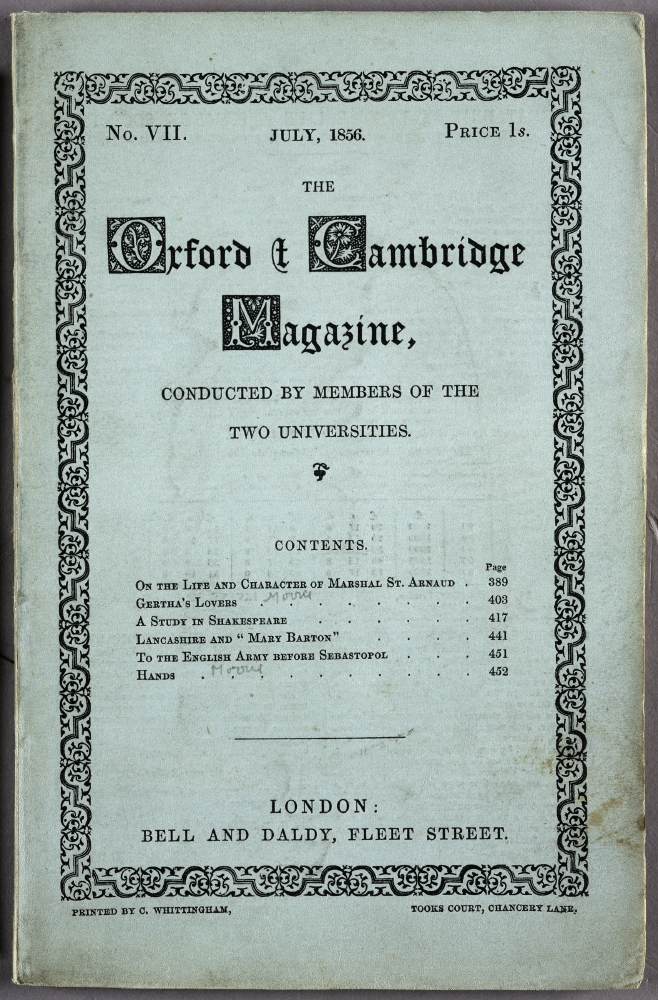

![Image of page [389]](http://www.rossettiarchive.org/img/ap4.o93.1.389.jpg)