Rossetti Archive Textual Transcription
The full Rossetti Archive record for this transcribed document is available.
![Image of page [i]](http://www.rossettiarchive.org/img/ap4.g415.1901.v3i.jpg)
MARCH, 1850.
With an Etching by F. Madox Brown.
Art and Poetry:
Being Thoughts towards Nature
Conducted principally by Artists.

- When whoso merely hath a little thought
- Will plainly think the thought which is in him,—
- Not imaging another's bright or dim,
- Not mangling with new words what others taught;
- When whoso speaks, from having either sought
- Or only found,—will speak, not just to skim
- A shallow surface with words made and trim,
- But in that very speech the matter brought:
- Be not too keen to cry—“So this is all!—
- 10A thing I might myself have thought as well,
- But would not say it, for it was not worth!”
- Ask: “Is this truth?” For is it still to tell
- That, be the theme a point or the whole earth,
- Truth is a circle, perfect, great or small?
London:
DICKINSON & Co., 114, NEW BOND STREET,
AND
AYLOTT & JONES, 8, PATERNOSTER ROW.
G.F Tupper, Printer, Clement's Lane, Lombard Street.
![Image of page [ii]](http://www.rossettiarchive.org/img/ap4.g415.1901.v3iii.jpg)
- Cordelia— W. M. Rossetti . . . . . . . . . . . . . . 97
- Macbeth . . . . . . . . . . . . . . . . . . . . . . . 99
- Repining.— Ellen Alleyn . . . . . . . . . . . . . . 111
- Sweet Death— Ellen Alleyn . . . . . . . . . . . . . 117
- Subject in Art, No. II . . . . . . . . . . . . . . . 118
- Carillon.— Dante G. Rossetti. . . . . . . . . . . . 126
- Emblems.— Thomas Woolner . . . . . . . . . . . . . . 127
- Sonnet.— W. B. Scott . . . . . . . . . . . . . . . . 128
- From the Cliffs.— Dante G. Rossetti . . . . . . . . 129
- Fancies at Leisure.— W. M. Rossetti . . . . . . . . 129
- Papers of “The M. S. Society,” Nos. I. II. & III . . . 131
- Review, Sir Reginald Mohun.— W.M. Rossetti . . . . . 137
that the future Numbers will appear on the last day of the
Month for which they are dated. Also, that a supplementary,
or large-sized Etching will occasionally be given (as with the
present Number.)

GONERIL: REGAN: LEAR: FOOL: CORDELIA: FRANCE:
- “The jewels of our father, with washed eyes
- Cordelia leaves you. I know you what you are
- And, like a sister, am most loth to tell
- Your faults, as they are named. Use well our father:
- To your professed bosoms I commit him.
- But yet, alas!—stood I within his grace,
- I would prefer him to a better place.
- So farewell to you both.”
- Cordelia, unabashed and strong,
- Her voice's quite scarcely less
- Than yester-eve, enduring wrong
- And curses of her father's tongue,
- Departs, a righteous-souled princess;
- Bidding her sisters cherish him.
- They turn on her and fix their eyes,
- But cease not passing inward;—one
- Sneering with lips still curled to lies,
- 10Sinuous of body, serpent-wise;
- Her footfall creeps, and her looks shun
- The very thing on which they dwell.
- The other, proud, with heavy cheeks
- And massive forehead, where remains
- A mark of frowning. If she seeks
- With smiles to tame her eyes, or speaks,
- Her mouth grows wanton: she disdains
- The ground with haughty, measured steps.
- The silent years had grown between
- 20Father and daughter. Always she
- Had waited on his will, and been
- Foremost in doing it,—unseen
- Often: she wished him not to see,
- But served him for his sake alone.
- He saw her constant love; and, tho'
- Occasion surely was not scant,
- Perhaps had never sought to know
- How she could give it wording. So
- His love, not stumbling at a want,
- 30Among the three preferred her first.
- Her's is the soul not stubborn, yet
- Asserting self. The heart was rich;
- But, questioned, she had rather let
- Men judge her conscious of a debt
- Than freely giving: thus, her speech
- Is love according to her bond.
- In France the queen Cordelia had
- Her hours well satisfied with love:
- She loved her king, too, and was glad:
- 40And yet, at times, a something sad,
- May be, was with her, thinking of
- The manner of his life at home.
- But this does not usurp her mind.
- It is but sorrow guessed from far
- Thro' twilight dimly. She must find
- Her duty elsewhere: not resigned—
- Because she knows them what they are,
- Yet scarcely ruffled from her peace.
- Cordelia—a name well revered;
- 50Synonymous with truth and tried
- Affection; which but needs be heard
- To raise one selfsame thought endeared
- To men and women far and wide;
- A name our mothers taught to us.
- Like placid faces which you knew
- Years since, but not again shall meet;
- On a sick bed like wind that blew;
- An excellent thing, best likened to
- Her own voice, gentle, soft, and sweet;
- 60Shakpere's Cordelia;—better thus.
ence of a very important error in the hitherto universally adopted
interpretation of the character of Macbeth. We shall prove that
a design of illegitimately obtaining the crown of Scotland had been
conceived by Macbeth, and that it had been communicated by him to
his wife, prior to his first meeting with the witches, who are commonly
supposed to have suggested that design.
Shaksperian dramas, already entertain concerning them a set of
traditional notions, generally originated by the representations, or
misrepresentations, of the theatre, afterwards to become strength-
ened or confirmed by desultory reading and corroborative criticism.
With this class of persons it was our misfortune to rank,
when we first entered upon the study of “Macbeth,” fully be-
lieving that, in the character of the hero, Shakspere intended to
represent a man whose general rectitude of soul is drawn on to ruin
by the temptations of supernatural agents; temptations which have
the effect of eliciting his latent ambition, and of misdirecting that
ambition when it has been thus elicited.
upon us by “Macbeth” came far short of that sense of complete
satisfaction which we were accustomed to receive from every other
of the higher works of Shakspere. But, upon deeper study, the
view now proposed suggested itself, and seemed to render every
thing as it should be. We say that this view suggested itself,
because it did not arise directly from any one of the numerous
passages which can be quoted in its support; it originated in a
general feeling of what seemed to be wanting to the completion of
the entire effect; a circumstance which has been stated at length
from the persuasion that it is of itself no mean presumption in
favour of the opinion which it is the aim of this paper to establish.
* It is proper to state that this article was written, and seen, exactly as it
at
present stands, by several literary friends of the writer, a considerable time
before
the appearance, in the “Westminster Review,” of a Paper advocating a view of
“Macbeth,” similar to that which is here taken. But although the publication
of the
particular view was thus anticipated, nearly all the most forcible argu-
ments for
maintaining it were omitted; and the subject, mixed up, as it was, with
lengthy
disquisitions upon very minor topics of Shaksperian acting, &c. made
no very
general impression at the time.
more than usually minute. We shall commence by giving an
analysis of the first Act, wherein will be considered, successively,
every passage which may appear to bear either way upon the point
in question.
scene can be profitably employed only in conjunction with those to
be discovered in the third. Our analysis must, therefore, be entered
upon by an attempt to ascertain the true character of the impres-
sions which it was the desire of Shakspere to convey by the second.
the “bleeding Soldier,” and of Rosse. These narrations are con-
structed with the express purpose of vividly setting forth the per-
sonal valour of Duncan's generals, “Macbeth and Banquo.” Let
us consider what is the maximum worth which the words of
Shakspere will, at this period of the play, allow us to attribute to
the moral character of the hero:—a point, let it be observed,
of first-rate importance to the present argument. We find Mac-
beth, in this scene, designated by various epithets, all of which,
either directly or indirectly, arise from feelings of admiration created
by his courageous conduct in the war in which he is supposed
to have been engaged. “Brave” and “Noble Macbeth,” “Bel-
lona's Bridegroom,” “Valiant Cousin,” and “Worthy Gentleman,”
are the general titles by which he is here spoken of; but none of
them afford any positive clue whatever to his moral character.
Nor is any such clue supplied by the scenes in which he is pre-
sently received by the messengers of Duncan, and afterwards
received and lauded by Duncan himself. Macbeth's moral cha-
racter, up to the development of his criminal hopes, remains
strictly negative. Hence it is difficult to fathom the meaning of
those critics, (A. Schlegel at their head), who have over and over
again made the ruin of Macbeth's “so many noble qualities”* the
subject of their comment.
announcement of whose intention to re-assemble upon the heath,
there to meet with Macbeth, forms the certainly most obvious,
though not perhaps, altogether the most important, aim of the short
scene by which the tragedy is opened. An enquiry of much
interest here suggests itself. Did Shakspere intend that in his
tragedy of “Macbeth” the witches should figure as originators of
gratuitous destruction, in direct opposition to the traditional, and
* A. Schlegel's “Lectures on Dramatic Literature.” Vol. II. p. 208.
personages have been denied the possession of any influence what-
ever over the untainted soul. Has Shakspere in this instance re
tained, or has he abolished, the chief of those characteristics which
have been universally attributed to the beings in question?
reasons: Whenever Shakspere has elsewhere embodied supersti-
tions, he has treated them as direct and unalterable facts of human
nature; and this he has done because he was too profound
a philosopher to be capable of regarding genuine superstition as
the product of random spectra of the fancy, having absolute
darkness for the prime condition of their being, instead of
eeing in it rather the zodiacal light of truth, the concomitant
of the uprising, and of the setting of the truth, and a partaker
in its essence. Again, Shakspere has in this very play devoted
a considerable space to the purpose of suggesting the self-same
trait of character now under discussion, and this he appears to
have done with the express intent of guarding against a mistake,
the probability of the occurrence of which he foresaw, but which,
for reasons connected with the construction of the play, he could
not hope otherwise to obviate.
sister, we learn, has just returned from killing swine; another
breathes forth vengeance against a sailor, on account of the un-
charitable act of his wife; but “his bark cannot be lost,” though it
may be “tempest tossed.” The last words are scarcely uttered
before the confabulation is interrupted by the approach of Macbeth,
to whom they have as yet made no direct allusion whatever, through-
out the whole of this opening passage, consisting in all of some five
and twenty lines. Now this were a digression which would be a
complete anomaly, having place, as it is supposed to have, at this
early stage of one of the most consummate of the tragedies of Shak-
spere. We may be sure, therefore, that it is the chief object of
these lines to impress the reader beforehand with an idea that, in
the mind of Macbeth, there already exist sure foundations for that
great superstructure of evil, to the erection of which, the “meta-
physical aid” of the weird sisters is now to be offered. An opinion
which is further supported by the reproaches of Hecate, who,
afterwards, referring to what occurs in this scene, exclaims,
- “All you have done
- Hath been but for a wayward son,
- Spiteful, and wrathful, who, as others do,
- Loves for his own end, not for you.”

witches had spurred him on to their acquirement.
play is taken, the machinations of the witches are not assumed to
be un-gratuitous, cannot be employed as an argument against our
position. In history the sisters figure in the capacity of prophets
merely. There we have no previous announcement of their inten-
tion “to meet with Macbeth.” But in Shakspere they are invested
with all other of their superstitional attributes, in order that they
may become the evil instruments of holy vengeance upon evil; of
that most terrible of vengeance which punishes sin, after it has ex-
ceeded certain bounds, by deepening it.
and Banquo, the witches wind up their hurried charm. They are
first perceived by Banquo. To his questions the sisters refuse to
reply; but, at the command of Macbeth, they immediately speak,
and forthwith utter the prophecy which seals the fate of Duncan.
behaviour of Macbeth upon coming into sudden contact with beings
who appear to hold intelligence of his most secret thoughts; and
upon hearing those thoughts, as it were, spoken aloud in the presence
of a third party? His behaviour would be precisely that which is
implied by the question of Banquo.
- “Good sir, why do you start and seem to fear
- Things which do sound so fair?”
If, on the other hand, our view is not true, why, seeing that their
characters are in the abstract so much alike, why does the present
conduct of Macbeth differ from that of Banquo, when the witches
direct their prophecies to him? Why has Shakspere altered the
narrative of Holinshed, without the prospect of gaining any advan-
tage commensurate to the licence taken in making that alteration?
These are the words of the old chronicle: “This (the recontre
with the witches) was reputed at the first but some vain fantastical
illusion by Macbeth and Banquo, insomuch that Banquo would call
Macbeth in jest king of Scotland; and Macbeth again would call
him in jest likewise the father of many kings.” Now it was the
invariable practice of Shakspere to give facts or traditions just as
he found them, whenever the introduction of those facts or tra-
ditions was not totally irreconcileable with the tone of his concep-
tion. How then (should we still receive the notion which we are
now combating) are we to account for his anomalous practice in
this particular case?
delay their departure, exclaiming,
- “Stay, you imperfect speakers, tell me more:
- By Sinol's death, I know I am thane of Glamis;
- But how of Cawdor? the thane of Cawdor lives,
- A prosperous gentleman; and, to be king
- Stands not within the prospect of belief,
- No more than to be Cawdor. Say, from whence
- You owe this strange intelligence?”
“To be king stands not within the prospect of belief, no more than
to be Cawdor.” No! it naturally stands much less within the
prospect of belief. Here the mind of Macbeth, having long been
accustomed to the nurture of its “royal hope,” conceives that it is
uttering a very suitable hyperbole of comparison. Had that mind
been hitherto an honest mind the word “Cawdor” would have
occupied the place of “king,” “king” that of “Cawdor.” Observe
too the general character of this speech: Although the coincidence
of the principal prophecy with his own thoughts has so strong an
effect upon Macbeth as to induce him to, at once, pronounce the
words of the sisters, “intelligence;” he nevertheless affects to treat
that prophecy as completely secondary to the other in the strength
of its claims upon his consideration. This is a piece of over-cautious
hypocrisy which is fully in keeping with the tenor of his conduct
throughout the rest of the tragedy.
doubt whether there had been “such things there as they did speak
about.” This is the natural incredulity of a free mind so circum-
stanced. On the other hand, Macbeth, whose manner, since the
first announcement of the sisters, has been that of a man in a
reverie, makes no doubt whatever of the reality of their appearance,
nor does he reply to the expressed scepticism of Banquo, but
abruptly exclaims, “your children shall be kings.” To this Banquo
answers, “you shall be king.” “And thane of Cawdor too: went
it not so?” continues Macbeth. Now, what, in either case, is the
condition of mind which can have given rise to this part of the
dialogue? It is, we imagine, sufficiently evident that the playful
words of Banquo were suggested to Shakspere by the narration of
Holinshed; but how are we to account for those of Macbeth, other-
wise than by supposing that the question of the crown is now
settled in his mind by the coincidence of the principal prediction,
with the shapings of his own thoughts, and that he is at this
moment occupied with the wholly unanticipated revelations, touch-
ing the thaneship of Cawdor, and the future possession of the throne
by the offspring of Banquo?
words of these men, upon receiving the announcement of Rosse:
“ Banquo. What! can the devil speak truth?
Macbeth. The thane of Cawdor lives: why do you dress me
In borrowed robes?”
Mark how that reception is in either case precisely the reverse of
that given to the prophecy itself. Here Banquo starts. But what
is here done for Banquo, by the coincidence of the prophecy with
the truth, has been already done for Macbeth, by the coincidence of
his thought with the prophecy. Accordingly, Macbeth is calm
enough to play the hypocrite, when he must otherwise have experi-
enced surprise far greater than that of Banquo, because he is much
more nearly concerned in the source of it. So far indeed from being
overcome with astonishment, Macbeth still continues to dwell upon
the prophecy, by which his peace of mind is afterwards constantly
disturbed,
- “Do you not hope your children shall be kings,
- When those that gave the thane of Cawdor to me
- Promised no less to them?”
of the interpretation, the error of which we are now endeavouring to
expose. He says,
- “That, trusted home,
- Might yet enkindle you unto the crown,
- Besides the thane of Cawdor. But, 'tis strange;
- And often times, to win us to our harm,
- The instruments of darkness tell us truths,
- Win us with honest trifles, to betray us
- In deepest consequence.”
the entire nature and extent of the supernatural influence brought
into play upon the present tragedy; whereas, in truth, all that they
express is a natural suspicion, called up in the mind of Banquo, by
Macbeth's remarkable deportment, that such is the character of the
influence which is at this moment being exerted upon the soul of the
man to whom he therefore thinks proper to hint the warning they
contain.
particularly worthy of comment:
- “This supernatural soliciting
- Cannot be ill; cannot be good:—if ill,
- Why hath it given me earnest of success,
- Commencing in a truth? I am thane of Cawdor:
- If good, why do I yield to that suggestion,
- Whose horrid image doth unfix my hair,
- And make my seated heart knock at my ribs
- Against the use of nature? Present fears
- Are less than horrible imaginings.
- 10My thought, whose murder yet is but fantastical,
- Shakes so my single state of man, that function
- Is smothered in surmise, and nothing is,
- But what is not.”
regards the communications of the witches merely in the light of an
invitation to the carrying out of a design pre-existent in his own
mind. He thinks that the spontaneous fulfilment of the chief
prophecy is in no way probable; the consummation of the lesser
prophecy being held by him, but as an “earnest of success” to his
own efforts in consummating the greater. From the latter portion
of this soliloquy we learn the real extent to which “metaphysical
aid” is implicated in bringing about the crime of Duncan's murder.
It serves to assure Macbeth that that is the “nearest way” to the
attainment of his wishes;—a way to the suggestion of which he now,
for the first time, “ yields,” because the chances of its failure have
been infinitely lessened by the “earnest of success” which he has
just received.
in Banquo's words, “Look how our partner's rapt,” by exclaiming,
- “If chance will have me king, why chance may crown me,
- Without my stir.”
ago have arrived, had “soliciting” meant “suggestion,” as most
people suppose it to have done; or at least, under those circum-
stances, he would have been satisfied with that conclusion, instead
of immediately afterwards changing it, as we see that he has done,
when he adds,
- “Come what come may,
- Time and the hour runs through the roughest day!”
With that the third scene closes; the parties engaged in it proceed-
ing forthwith to the palace of Duncan at Fores.
successor in the realm of Scotland. After this Macbeth hastily
departs, to inform his wife of the king's proposed visit to their
castle, at Inverness. The last words of Macbeth are the following,
- “The prince of Cumberland!—That is a step,
- On which I must fall down, or else o'erleap.
- For in my way it lies. Stars, hide your fires!
- Let not light see my black and deep desires;
- The eye wink at the hand; yet let that be,
- Which the eye fears, when it is done, to see.”
as to the fulfilment of the speaker's royal hope, and for an entire
absence of any expression of reliance upon the power of the witches,
—the hitherto supposed originators of that hope,—in aiding its
consummation. It is particularly noticeable that Macbeth should
make no reference whatever, not even in thought, (that is, in
soliloquy) to any supernatural agency during the long period inter-
vening between the fulfilment of the two prophecies. Is it probable
that this would have been the case had Shakspere intended that
such an agency should be understood to have been the first motive
and mainspring of that deed, which, with all its accompanying
struggles of conscience, he has so minutely pictured to us as having
been, during that period, enacted? But besides this negative argu-
ment, we have a positive one for his non-reliance upon their pro-
mises in the fact that he attempts to outwit them by the murder of
Fleance even after the fulfilment of the second prophecy.
band's narration of his interview with the witches. The order of
our investigation requires the postponement of comment upon the
contents of this letter. We leave it for the present, merely cau-
tioning the reader against taking up any hasty objections to a very
important clause in the enunciation of our view by reminding
him that, contrary to Shakspere's custom in ordinary cases, we are
made acquainted only with a portion of the missive in question.
Let us then proceed to consider the soliloquy which immediately
follows the perusal of this letter:
- “I do fear thy nature.
- It is too full o' the milk of human kindness,
- To catch the nearest way: thou wouldst be great;
- Art not without ambition; but without
- The illness should attend it. That thou wouldst highly,
- That wouldst thou holily; wouldst not play false
- And yet wouldst wrongly win: thou'dst have, great Glamis,
- That which cries this thou must do if thou have it,
- And that which rather thou dost fear to do,
- 10Thou wishest should be undone.”
the character it depicts, which is far too intimate to allow of its
being other than a direct inference from facts connected with pre-
vious communications upon similar topics between the speaker and
the writer: unless, indeed, we assume that in this instance Shak-
spere has notably departed from his usual principles of charac-
terization, in having invested Lady Macbeth with an amount of
philosophical acuteness, and a faculty of deduction, much beyond
those pretended to by any other of the female creations of the same
author.
approach of Duncan. Observe Lady Macbeth's behaviour upon
receiving it. She immediately determines upon what is to be done,
and all without (are we to suppose?) in any way consulting, or
being aware of, the wishes or inclinations of her husband! Observe
too, that neither does she appear to regard the witches' prophecies
as anything more than an invitation, and holding forth of “meta-
physical aid” to the carrying out of an independent project. That
this should be the case in both instances vastly strengthens the
argument legitimately deducible from each.
Macbeth, after a long and eventful period of absence, let it be
recollected, enters to a wife who, we will for a moment suppose,
is completely ignorant of the character of her husband's recent
cogitations. These are the first words which pass between them,
- “ Macbeth. My dearest love,
- Duncan comes here to-night.
- L. Macbeth. And when goes hence?
- Macbeth. To-morrow, as he purposes.
- L. Macbeth. Oh! never
- Shall sun that morrow see!
- Your face, my thane, is as a book where men
- May read strange matters:—to beguile the time,
- Look like the time; bear welcome in your eye,
- 10Your hand, your tongue: look like the innocent flower,
- But be the serpent under it. He that's coming
- Must be provided for; and you shall put
- This night's great business into my dispatch,
- Which shall to all our nights and days to come
- Give solely sovereign sway and masterdom.
- Macbeth. We will speak further.”
situation at present, by common consent, attributed to the speakers of them? That is to say a situation in which each speaker is totally
ignorant of the sentiments pre-existent in the mind of the other. Are
the words, “we will speak further,” those which might in nature
form the whole and sole reply made by a man to his wife's com-
pletely unexpected anticipation of his own fearful purposes? If
not, if few or none of these lines, thus interpreted, will satisfy the
reader's feeling for common truth, does not the view which we have
adopted invest them with new light, and improved, or perfected
meaning?
contains nothing which bears either way upon the point in question.
Proceeding, therefore, to the seventh and last scene of the first act
we come to what we cannot but consider to be proof positive of the
opinion under examination. We shall transcribe at length the
portion of this scene containing that proof; having first reminded
the reader that a few hours at most can have elapsed between the
arrival of Macbeth, and the period at which the words, now to be
quoted, are uttered.
- “ Lady Macbeth. Was the hope drunk,
- Wherein you dressed yourself? Hath it slept since,
- And wakes it now, to look so green and pale
- At what it did so freely? From this time,
- Such I account thy love. Art thou afeard
- To be the same in thine own act and valour,
- As thou art in desire? Would'st thou have that
- Which thou esteem'st the ornament of life,
- And live a coward in thine own esteem,
- 10Letting, I dare not, wait upon, I would,
- Like the poor cat in the adage?
- Macbeth. Prithee, peace:
- I dare do all that may become a man;
- Who dares do more is none.
- Lady Macbeth. What beast was't then
- That made you break this enterprise to me?
- When you durst do it, then you were a man,
- And to be more than what you were you would
- Be so much more the man. Nor time nor place
- 20 Did then adhere, and yet you would make both.
- They have made themselves, and that their fitness now
- Does unmake you. I have given suck, and know
- How tender 'tis to love the babe that milks me:
- I would, while it was smiling in my face,
- Have plucked my nipple from its boneless gums,
- And dashed the brains out, had I so sworn
- As you have done to this.”
“nor time nor place did then adhere,” render it evident that they
hold reference to something which passed before Duncan had sig-
nified his intention of visiting the castle of Macbeth. Consequently
the words of Lady Macbeth can have no reference to the previous
communication of any definite intention, on the part of her husband,
to murder the king; because, not long before, she professes herself
aware that Macbeth's nature is “too full of the milk of human kind-
ness to catch the nearest way;” indeed, she has every reason to
suppose that she herself has been the means of breaking that enter-
prise to him, though, in truth, the crime had already, as we have
seen, suggested itself to his thought, “whose murder was as yet
fantastical.”
bal communication between them. But no such communication can
have taken place since Macbeth's rencontre with the witches; for,
besides that he is, immediately after that recontre, conducted to the
presence of the king, who there signifies an intention of proceeding
directly to Macbeth's castle, such a communication would have ren-
dered the contents of the letter to Lady Macbeth completely super-
fluous. What then are we to conclude concerning these problematical
lines? First begging the reader to bear in mind the tone of sophistry
which has been observed by Schlegel to pervade, and which is
indeed manifest throughout the persuasions of Lady Macbeth, we
answer, that she wilfully confounds her husband's,—probably vague
and unplanned—“enterprise” of obtaining the crown, with that
“nearest way” to which she now urges him; but, at the same time,
she obscurely individualizes the separate purposes in the words,
“and to be more than what you were, you would be so much
more the man.”
strongly impeaches the candour of the majority of Shakspere's
commentators, that the impenetrable obscurity which must have
pervaded the whole of this passage should never have been made
the subject of remark. As far as we can remember, not a word has
been said upon the matter in any one of the many superfluously
explanatory editions of our dramatist's productions. Censures have
been repeatedly lavished upon minor cases of obscurity, none upon
this. In the former case the fault has been felt to be Shakspere's, for it has usually existed in the expression; but in the latter the
language is unexceptional, and the avowal of obscurity might
imply the possibility of misapprehension or stupidity upon the part
of the avower.
general adoption of those views will be the doubt, whether so
important a feature of this consummate tragedy can have been left
by Shakspere so obscurely expressed as to be capable of remaining
totally unperceived during upwards of two centuries, within which
period the genius of a Coleridge and of a Schlegel has been applied
to its interpretation. Should this objection be brought forward, we
reply, in the first place, that the objector is ‘begging’ his question
in assuming that the feature under examination has remained
totally unperceived. Coleridge by way of comment upon these
words of Banquo,
- “Good sir, why do you stand, and seem to fear
- Things that do sound so fair?”
writes thus: “The general idea is all that can be required of a
poet—not a scholastic logical consistency in all the parts, so as to
meet metaphysical objectors. * * * * * * * * How strictly true
to nature it is, that Banquo, and not Macbeth himself, directs our
notice to the effects produced in Macbeth's mind, rendered temptible
by previous dalliance with ambitious thoughts.” Here Coleridge denies
the necessity of “logical consistency, so as to meet metaphysical
objectors,” although he has, throughout his criticisms upon Shaks-
pere, endeavored, and nearly always with success, to prove the
existence of that consistency; and so strongly has he felt the want of
it here, that he has, in order to satisfy himself, assumed that “pre-
vious dalliance with ambitious thoughts,” whose existence it has
been our object to prove.
question, surely nothing can be easier than to believe that for the
belief in which we have so many precedents. How many beauties,
lost upon Dryden, were perceived by Johnson; How many, hidden
to Johnson and his cotemporaries, have been brought to light by
Schlegel and by Coleridge.
- She sat alway thro' the long day
- Spinning the weary thread away;
- And ever said in undertone:
- “Come, that I be no more alone.”
- From early dawn to set of sun
- Working, her task was still undone;
- And the long thread seemed to increase
- Even while she spun and did not cease.
- She heard the gentle turtle-dove
- 10Tell to its mate a tale of love;
- She saw the glancing swallows fly,
- Ever a social company;
- She knew each bird upon its nest
- Had cheering songs to bring it rest;
- None lived alone save only she;—
- The wheel went round more wearily;
- She wept and said in undertone:
- “Come, that I be no more alone.”
- Day followed day, and still she sighed
- 20For love, and was not satisfied;
- Until one night, when the moonlight
- Turned all the trees to silver white,
- She heard, what ne'er she heard before,
- A steady hand undo the door.
- The nightingale since set of sun
- Her throbbing music had not done,
- And she had listened silently;
- But now the wind had changed, and she
- Heard the sweet song no more, but heard
- 30Beside her bed a whispered word:
- “Damsel, rise up; be not afraid;
- For I am come at last,” it said.
- She trembled, tho' the voice was mild;
- She trembled like a frightened child;—
- Till she looked up, and then she saw
- The unknown speaker without awe.
- He seemed a fair young man, his eyes
- Beaming with serious charities;
- His cheek was white, but hardly pale;
- 40And a dim glory like a veil
- Hovered about his head, and shone
- Thro' the whole room till night was gone.
- So her fear fled; and then she said,
- Leaning upon her quiet bed:
- “Now thou art come, I prithee stay,
- That I may see thee in the day,
- And learn to know thy voice, and hear
- It evermore calling me near.”
- He answered: “Rise, and follow me.”
- 50But she looked upwards wonderingly:
- “And whither would'st thou go, friend ? stay
- Until the dawning of the day.”
- But he said: “The wind ceaseth, Maid;
- Of chill nor damp be thou afraid.”
- She bound her hair up from the floor,
- And passed in silence from the door.
- So they went forth together, he
- Helping her forward tenderly.
- The hedges bowed beneath his hand;
- 60Forth from the streams came the dry land
- As they passed over; evermore
- The pallid moonbeams shone before;
- And the wind hushed, and nothing stirred;
- Not even a solitary bird,
- Scared by their footsteps, fluttered by
- Where aspen-trees stood steadily.
- As they went on, at length a sound
- Came trembling on the air around;
- The undistinguishable hum
- 70Of life, voices that go and come
- Of busy men, and the child's sweet
- High laugh, and noise of trampling feet.
- Then he said: “Wilt thou go and see ?”
- And she made answer joyfully;
- “The noise of life, of human life,
- Of dear communion without strife,
- Of converse held 'twixt friend and friend;
- Is it not here our path shall end ?”
- He led her on a little way
- 80Until they reached a hillock: “Stay.”
- It was a village in a plain.
- High mountains screened it from the rain
- And stormy wind; and nigh at hand
- A bubbling streamlet flowed, o'er sand
- Pebbly and fine, and sent life up
- Green succous stalk and flower-cup.
- Gradually, day's harbinger,
- A chilly wind began to stir.
- It seemed a gentle powerless breeze
- 90That scarcely rustled thro' the trees;
- And yet it touched the mountain's head
- And the paths man might never tread.
- But hearken: in the quiet weather
- Do all the streams flow down together?—
- No, 'tis a sound more terrible
- Than tho' a thousand rivers fell.
- The everlasting ice and snow
- Were loosened then, but not to flow;—
- With a loud crash like solid thunder
- 100The avalanche came, burying under
- The village; turning life and breath
- And rest and joy and plans to death.
- “Oh! let us fly, for pity fly;
- Let us go hence, friend, thou and I.
- There must be many regions yet
- Where these things make not desolate.”
- He looked upon her seriously;
- Then said: “Arise and follow me.”
- The path that lay before them was
- 110Nigh covered over with long grass;
- And many slimy things and slow
- Trailed on between the roots below.
- The moon looked dimmer than before;
- And shadowy cloudlets floating o'er
- Its face sometimes quite hid its light,
- And filled the skies with deeper night.
- At last, as they went on, the noise
- Was heard of the sea's mighty voice;
- And soon the ocean could be seen
- 120In its long restlessness serene.
- Upon its breast a vessel rode
- That drowsily appeared to nod
- As the great billows rose and fell,
- And swelled to sink, and sank to swell.
- Meanwhile the strong wind had come forth
- From the chill regions of the North,
- The mighty wind invisible.
- And the low waves began to swell;
- And the sky darkened overhead;
- 130And the moon once looked forth, then fled
- Behind dark clouds; while here and there
- The lightning shone out in the air;
- And the approaching thunder rolled
- With angry pealings manifold.
- How many vows were made, and prayers
- That in safe times were cold and scarce.
- Still all availed not; and at length
- The waves arose in all their strength,
- And fought against the ship, and filled
- 140The ship. Then were the clouds unsealed,
- And the rain hurried forth, and beat
- On every side and over it.
- Some clung together, and some kept
- A long stern silence, and some wept.
- Many half-crazed looked on in wonder
- As the strong timbers rent asunder;
- Friends forgot friends, foes fled to foes;—
- And still the water rose and rose.
- “Ah woe is me! Whom I have seen
- 150Are now as tho' they had not been.
- In the earth there is room for birth,
- And there are graves enough in earth;
- Why should the cold sea, tempest-torn,
- Bury those whom it hath not borne?”
- He answered not, and they went on.
- The glory of the heavens was gone;
- The moon gleamed not nor any star;
- Cold winds were rustling near and far,
- And from the trees the dry leaves fell
- 160With a sad sound unspeakable.
- The air was cold; till from the South
- A gust blew hot, like sudden drouth,
- Into their faces; and a light
- Glowing and red, shone thro' the night.
- A mighty city full of flame
- And death and sounds without a name.
- Amid the black and blinding smoke,
- The people, as one man, awoke.
- Oh! happy they who yesterday
- 170On the long journey went away;
- Whose pallid lips, smiling and chill,
- While the flames scorch them smile on still;
- Who murmur not; who tremble not
- When the bier crackles fiery hot;
- Who, dying, said in love's increase:
- “Lord, let thy servant part in peace.”
- Those in the town could see and hear
- A shaded river flowing near;
- The broad deep bed could hardly hold
- 180Its plenteous waters calm and cold.
- Was flame-wrapped all the city wall,
- The city gates were flame-wrapped all.
- What was man's strength, what puissance then?
- Women were mighty as strong men.
- Some knelt in prayer, believing still,
- Resigned unto a righteous will,
- Bowing beneath the chastening rod,
- Lost to the world, but found of God.
- Some prayed for friend, for child, for wife;
- 190Some prayed for faith; some prayed for life;
- While some, proud even in death, hope gone,
- Steadfast and still, stood looking on.
- “Death—death—oh! let us fly from death;
- Where'er we go it followeth;
- All these are dead; and we alone
- Remain to weep for what is gone.
- What is this thing? thus hurriedly
- To pass into eternity;
- To leave the earth so full of mirth;
- 200To lose the profit of our birth;
- To die and be no more; to cease,
- Having numbness that is not peace.
- Let us go hence; and, even if thus
- Death everywhere must go with us,
- Let us not see the change, but see
- Those who have been or still shall be.”
- He sighed and they went on together;
- Beneath their feet did the grass wither;
- Across the heaven high overhead
- 210Dark misty clouds floated and fled;
- And in their bosom was the thunder,
- And angry lightnings flashed out under,
- Forked and red and menacing;
- Far off the wind was muttering;
- It seemed to tell, not understood,
- Strange secrets to the listening wood.
- Upon its wings it bore the scent
- Of blood of a great armament:
- Then saw they how on either side
- 220Fields were down-trodden far and wide.
- That morning at the break of day
- Two nations had gone forth to slay.
- As a man soweth so he reaps.
- The field was full of bleeding heaps;
- Ghastly corpses of men and horses
- That met death at a thousand sources;
- Cold limbs and putrifying flesh;
- Long love-locks clotted to a mesh
- That stifled; stiffened mouths beneath
- 230Staring eyes that had looked on death.
- But these were dead: these felt no more
- The anguish of the wounds they bore.
- Behold, they shall not sigh again,
- Nor justly fear, nor hope in vain.
- What if none wept above them?—is
- The sleeper less at rest for this?
- Is not the young child's slumber sweet
- When no man watcheth over it?
- These had deep calm; but all around
- 240There was a deadly smothered sound,
- The choking cry of agony
- From wounded men who could not die;
- Who watched the black wing of the raven
- Rise like a cloud 'twixt them and heaven,
- And in the distance flying fast
- Beheld the eagle come at last.
- She knelt down in her agony:
- “O Lord, it is enough,” said she:
- “My heart's prayer putteth me to shame;
- 250“Let me return to whence I came.
- “Thou for who love's sake didst reprove,
- “Forgive me for the sake of love.”
- The sweetest blossoms die.
- And so it was that, going day by day
- Unto the church to praise and pray,
- And crossing the green church-yard thoughtfully,
- I saw how on the graves the flowers
- Shed their fresh leaves in showers;
- And how their perfume rose up to the sky
- Before it passed away.
- The youngest blossoms die.
- 10They die, and fall, and nourish the rich earth
- From which they lately had their birth.
- Sweet life: but sweeter death that passeth by,
- And is as tho' it had not been.
- All colors turn to green:
- The bright hues vanish, and the odours fly;
- The grass hath lasting worth.
- And youth and beauty die.
- So be it, O my God, thou God of truth.
- Better than beauty and than youth
- 20Are saints and angels, a glad company:
- And Thou, O lord, our Rest and Ease,
- Are better far than these.
- Why should we shrink from our full harvest? why
- Prefer to glean with Ruth?
and sculpture, it is necessary to repeat those premises, and to re-es-
tablish those principles which were advanced or elicited in the first
number of this essay.
in the same ratio as the natural prototypes of those works would
affect him; and not in proportion to the difficulties overcome in the
artificial representation of those prototypes. Not contending, mean-
while, that the picture painted by the hand of the artist, and then
by the hand of nature on the eye of the beholder, is, in amount, the
same as the picture painted there by nature alone; but disregarding,
as irrelevant to this investigation, all concomitants of fine art wherein
they involve an ulterior impression as to the relative merits of the
work by the amount of its success, and, for a like reason, disregard-
ing all emotions and impressions which are not the immediate and
proximate result of an excitor influence of, or pertaining to, the
things artificial, as a bona fide equivalent of the things natural .
one looks on a certain painting or sculpture for the first time, the
first notion is that of a painting or sculpture. (2nd.) In the next
place, while the objects depicted are revealing themselves as real
objects, the notion of a painting or sculpture has elapsed, and, in its
place, there are emotions, passions,| actions (moral or intellectual)
according in sort and degree to the heart or mind-moving influence
of the objects represented. (3rd.) Finally, there is a notion of a
painting or sculpture, and a judgment or sentiment commensurate
with the estimated merits of the work.—The second statement gives
the premised conditions under which Fine Art is about to be
treated: the 3rd statement exemplifies a phase in the being of Fine
Art under which it is never to be considered: and furthermore,
whilst the mental reflection last mentioned (the judgment on the
work) is being made, it may occur that certain objects, most diffi-
cult of artistic execution, had been most successfully handled: the
merits of introducing such objects, in such a manner, are the merits
of those concomitants mentioned as equally without the scope of
consideration.
principles.
general happiness of man, by addressing those of his attributes
which are peculiarly human, by exciting the activity of his rational
and benevolent powers; and thereafter:—2nd, that the Subject in
Art should be drawn from objects which so address and excite him;
and 3rd, as objects so exciting the mental activity may (in propor-
tion to the mental capacity) excite it to any amount, and so possibly
in the highest degree (the function of Fine Art being mental excite-
ment, and that of High Art being the highest mental excitement ) that
all objects so exciting mental activity and emotion in the highest
degree, may afford subjects for High Art.
deduced, let us proceed to enquire into the propriety of selecting
the Subject from the past or the present time; which enquiry
resolves itself fundamentally into the analysis of objects and
incidents experienced immediately by the senses, or acquired by
mental education.
incidents and objects of to-day, as exposed to our daily observation,
and the incidents and objects of time past, as bequeathed to us by
history, poetry, or tradition.
between the things of to-day and those of times past: but as all
former times, their incidents and objects differ amongst themselves,
this can hardly be the cause of the specific difference sought for—a
difference between our share of things past and things present.
This real, but not specific difference then, however admitted, shall
not be considered here.
past is stamped with an impress of mental assimilation: an impress
it has received from the mind of the author who has garnered it up,
and disposed it in that form and order which ensure it acceptance
with posterity. For let a writer of history be as matter of fact as
he will, the very order and classification of events will save us the
trouble of confusion, and render them graspable, and more capable
of assimilation, than is the raw material of every-day experience.
In fact the work of mind is begun, the key of intelligence is given,
and we have only to continue the process. Where the vehicle for
the transmission of things past is poetry, then we have them
presented in that succession, and with that modification of force,
a resilient plasticity, now advancing, now recoiling, insinuating and
grappling, that ere this material and mental warfare is over, we
find the facts thus transmitted are incorporated with our psychical existence. And in tradition is it otherwise?—Every man tells the

tale in his own way; and the merits of the story itself, or the
person who tells it, or his way of telling, procures it a lodgment in
the mind of the hearer, whence it is ever ready to start up and claim
kindred with some external excitement.
with some poetry about them; while from those of diurnal ex-
perience we must extract this poetry ourselves: and although all
good men are, more or less, poets, they are passive or recipient
poets; while the active or donative poet caters for them what they
fail to collect. For let a poet walk through London, and he shall
see a succession of incidents, suggesting some moral beauty by a
contrast of times with times, unfolding some principle of nature,
developing some attribute of man, or pointing to some glory in The
Maker: while the man who walked behind him saw nothing but
shops and pavement, and coats and faces; neither did he hear the
aggregated turmoil of a city of nations, nor the noisy exponents of
various desires, appetites and pursuits: each pulsing tremour of
the atmosphere was not struck into it by a subtile ineffable some-
thing willed forcibly out of a cranium: neither did he see the
driver of horses holding a rod of light in his eye and feeling
his way, in a world he was rushing through, by the motion of
the end of that rod:—he only saw the wheels in motion, and
heard the rattle on the stones; and yet this man stopped twice at
a book shop to buy ‘a Tennyson,’ or a ‘Browning's Sordello.’
Now this man might have seen all that the poet saw; he walked
through the same streets: yet the poet goes home and writes a
poem; and he who failed to feel the poetry of the things themselves
detects it readily in the poet's version. Then why, it is asked, does
not this man, schooled by the poet's example, look out for himself
for the future, and so find attractions in things of to-day? He
does so to a trifling extent, but the reason why he does so rarely
will be found in the former demonstration.
invested in peculiar attractions: this the poet knows and feels, and
the probabilities are that he transferred the incidents of to-day, with
all their poetical and moral suggestions, to the romantic long-ago,
partly from a feeling of prudence, and partly that he himself was
under this spell of antiquity, How many a Troubadour, who
recited tales of king Arthur, had his incidents furnished him by
the events of his own time! And thus it is the many are attracted
to the poetry of things past, yet impervious to the poetry of things
present. But this retrograde movement in the poet, painter, or sculptor (except in certain cases as will subsequently appear), if not
the result of necessity, is an error in judgment or a culpable dis-
honesty. For why should he not acknowledge the source of his
inspiration, that others may drink of the same spring with himself;
and perhaps drink deeper and a clearer draught?—For the water is
unebbing and exhaustless, and fills the more it is emptied: why
then should it be filtered through his tank where he can teach men
to drink it at the fountain?
ledge, his best and most original ideas are derived from his own
times: if his great lessonings to piety, truth, charity, love, honor,
honesty, gallantry, generosity, courage, are derived from the same
source; why transfer them to distant periods, and make them not
things of to-day? Why teach us to revere the saints of old, and not
our own family-worshippers? Why to admire the lance-armed
knight, and not the patience-armed hero of misfortune? Why to
draw a sword we do not wear to aid and oppressed damsel, and not a
purse which we do wear to rescue an erring one? Why to worship
a martyred St. Agatha, and not a sick woman attending the sick?
Why teach us to honor an Aristides or a Regulus, and not one who
pays an equitable, though to him ruinous, tax without a railing
accusation? And why not teach us to help what the laws cannot
help?—Why teach us to hate a Nero or an Appius, and not an
underselling oppressor of workmen and betrayer of women and
children? Why to love a Ladie in bower, and not a wife's fire-
side? Why paint or poetically depict the horrible race of Ogres
and Giants, and not show Giant Despair dressed in that modern
habit he walks the streets in? Why teach men what were great
and good deeds in the old time, neglecting to show them any good
for themselves?—Till these questions are answered absolutory to
the artist, it were unwise to propose the other question—Why a
poet, painter or sculptor is not honored and loved as formerly?
“As formerly,” says some avowed sceptic in old world transcendency
and golden age affairs, “I believe formerly the artist was as much
respected and cared for as he is now. 'Tis true the Greeks granted
an immunity from taxation to some of their artists, who were often
great men in the state, and even the companions of princes. And
are not some of our poets peers? Have not some of our artists
received knighthood from the hand of their Sovereign, and have
not some of them received pensions?”
certain characteristic facts which, tho' not here demonstrated, may
be authenticated by reference to history. Of these, the facts of Alfred's disguised visit to the Danish camp, and Aulaff's visit to the
Saxon, are sufficient to show in what respect the poets of that
period were held; when a man without any safe conduct whatever
could enter the enemy's camp on the very eve of battle, as was here
the case; could enter unopposed, unquestioned, and return unmo-
lested!—What could have conferred upon the poet of that day so
singular a privilege? What upon the poet of an earlier time that
sanctity in behoof whereof
- “The great Emathian conqueror bid spare
- The house of Pindarus, when temple and tower
- Went to the ground: and the repeated air
- Of sad Electra's poet had the power
- To save the Athenian walls from ruin bare.”
What but an universal recognition of the poet as an universal bene-
factor of mankind? And did mankind recognize him as such, from
some unaccountable infatuation, or because his labours obtained for
him an indefeasible right to that estimate? How came it, when a
Greek sculptor had completed some operose performance, that his
countrymen bore him in triumph thro' their city, and rejoiced in his
prosperity as identical with their own? How but because his art
had embodied some principle of beauty whose mysterious influence
it was their pride to appreciate—or he had enduringly moulded the
limbs of some well-trained Athlete, such as it was their interest to
develop, or he had recorded the overthrow of some barbaric invader
whom their fathers had fallen to repel.
some song of brave doing, ere evening he himself might be the hero
of such song.—What wonder then that he held sacred the function
of the poet! Now-a-days our heroes (and we have them) are left
unchapleted and neglected—and therefore the poet lives and dies
neglected.
rally evolved in course of enquiring into the propriety of choosing
the subject from past or present time, and in course of the conse-
quent analysis) that Art, to become a more powerful engine of
civilization, assuming a practically humanizing tendency (the admit-
ted function of Art), should be made more directly conversant with
the things, incidents, and influences which surround and constitute
the living world of those whom Art proposes to improve, and,
whether it should appear in event that Art can or can not assume
this attitude without jeopardizing her specific existence, that such a
consummation were desirable must be equally obvious in either
case.
that the poet is affected by every day incidents, which would have
little or no effect on the mind of a general observer: and if you ask
the poet, who from his conduct may be the supposed advocate of
the past as the fittest medium for poetic eduction, why he em-
bodied the suggestions of to-day in the matter and dress of
antiquity; he is likely to answer as follows.—“You have stated
“that men pass by that which furnishes me with my subject: If I
“merely reproduce what they slighted, the reproduction will be
“slighted equally. It appears then that I must devise some means
“of attracting their sympathies—and the medium of antiquity is
“the fittest for three several reasons. 1st.—Nothing comes down
“to us from antiquity unless fraught with sufficient interest of some
“sort, to warrant it being worthy of record. Thus, all incidents
“which we possess of the old time being more or less interesting,
“there arises an illative impression that all things of old really
“were so: and all things in idea associated with that time,
“whether real or fictitious, are afforded a favorable entertainment.
“Now these associations are neither trivial nor fanciful:* for I
“remember to have discovered, after visiting the British Museum
“for the first time, that the odour of camphor, for which I had
“hitherto no predilection, afforded me a peculiar satisfaction,
“seemingly suggestive of things scientific or artistic; it was in fact
“a literary smell! All this was vague and unaccountable until
“some time after when this happened again, and I was at once
“reminded of an enormous walrus at the British Museum, and
“then remembered how the whole collection, from end to end, was
“permeated with the odour of camphor! Still, despite the con-
“ sciousness of this, the camphor retains its influence. Now let a
“poem, a painting, or sculpture, smell ever so little of antiquity, and
“every intelligent reader will be full of delightful imaginations.
“2nd.—All things ancient are mysterious in obscurity:—veneration,
“wonder, and curiosity are the result. 3rd.—All things ancient
“are dead and gone:—we sympathize with them accordingly. All
“these effects of antiquity, as a means of enforcing poetry, declare it
“too powerful an ally to be readily abandoned by the poet.” To
all this the painter will add that the costume of almost any ancient
time is more beautiful than that of the present—added to which it
exposes more of that most beautiful of all objects, the human figure.
* Here the author, in the person of respondent, takes occasion to narrate
a real
fact.
incidents of the present time are well nigh barren in poetic attrac-
tion for the many. Then it was objected, but not granted, that their
poetic or pictorial counterparts will be equally unattractive also: but
this last remains to be proved. It was said, and is believed by the
author, (and such as doubt it he does not address) that all good men
are more or less poetical in some way or other; while their poetry
shows itself at various times. Thus the business-man in the street has
other to think of than poetry; but when he is inclined to look at a
picture, or in his more poetical humour, will he neglect the pictorial
counterpart of what he neglected before? To test this, show him a
camera obscura, where there is a more literal transcript of present-
day nature than any painting can be:— what is the result? He ex-
presses no anxiety to quit it, but a great curiosity to investigate; he
feels it is very beautiful, indeed more beautiful than nature: and
this he will say is because he does not see nature as an artist does.
Now the solution of all this is easy: 1st. He is in a mood of mind
which renders him accessible to the influences of poetry, which was
not before the case. 2nd. He looks at that steadily which he before
regarded cursorily; and, as the picture remains in his eye, it
acquires an amount of harmony, in behoof of an intrinsic harmony
resident in the organ itself, which exerts proportionately modifying
influences on all things that enter within it; and of the nervous
harmony, and the beautifully apportioned stimuli of alternating
ocular spectra. 3rd. There is a resolution of discord effected by the
instrument itself, inasmuch as its effects are homogeneous. All
these harmonizing influences are equally true of the painting; and
though we have no longer the homogeneous effect of the camera, we
have the homogeneous effect of one mind, viz., the mind of the
artist.
rendering of real life or nature in its own real garb and time, as
faithfully as Art can render it, nothing need be said to answer the
advantages of the antique or mediæval rendering; since they were
only called in to neutralize the aforesaid obstacles, which obstacles
have proved to be fictitious. It remains then to consider the artistic
objection of costume, &c., which consideration ranges under the
head of real differences between the things of past and present times,
a consideration formerly postponed. But this requiring a patient
analysis, will necessitate a further postponement, and in conclusion,
there will be briefly stated the elements of the argument, thus.—
It must be obvious to every physicist that physical beauty (which
this subject involves on the one side [the ancient] as opposed to the want of it on the other [the modern]) was in ancient times as
superior to physical beauty in the modern, as psychical beauty in
the modern is superior to psychical beauty in the ancient. Costume
then, as physical, is more beautiful ancient than modern. Now that
a certain amount of physical beauty is requisite to constitute Fine
Art, will be readily admitted; but what that amount is, must be
ever undefined. That the maximum of physical beauty does not
constitute the maximum of Fine Art, is apparent from the facts of
the physical beauty of Early Christian Art being inferior to that of
Grecian art; whilst, in the concrete, Early Christian Art is superior
to Grecian. Indeed some specimens of Early Christian Art are
repulsive rather than beautiful, yet these are in many cases the
highest works of Art.
picturesque costume and the exposed human figure, was so far from
desirable, that it seems purposely deformed by blotches of livid
color; yet the whole is a most noble work of Poussin. Containing
as much physical beauty as this picture, the writer remembers to
have seen an incident in the streets where a black-haired, sordid,
wicked-headed man, was striking the butt of his whip at the neck
of a horse, to urge him round an angle of the pavement; a smocked
countryman offered him the loan of his mules: a blacksmith stand-
ing by, showed him how to free the wheel, by only swerving the animal
to the left: he, taking no notice whatever, went on striking and
striking; whilst a woman waiting to cross, with a child in her one
hand, and with the other pushing its little head close to her side,
looked with wide eyes at this monster.
moral interest than, and as much picturesque matter as, many antique
or mediæval subjects, is only wanting in that romantic attraction
which, by association, attaches to things of the past. Yet, let these
modern subjects once excite interest, as it really appears they can,
and the incidents of to-day will acquire romantic attractions by the
same association of ideas.
considered in detail at a future period.
** In these and others of the Flemish Towns, the
Carillon, or chimes
which have a most fantastic and delicate music, are played
almost continually
The custom is very ancient.
- At Antwerp, there is a low wall
- Binding the city, and a moat
- Beneath, that the wind keeps afloat.
- You pass the gates in a slow drawl
- Of wheels. If it is warm at all
- The Carillon will give you thought.
- I climbed the stair in Antwerp church,
- What time the urgent weight of sound
- At sunset seems to heave it round.
- 10Far up, the Carillon did search
- The wind; and the birds came to perch
- Far under, where the gables wound.
- In Antwerp harbour on the Scheldt
- I stood along, a certain space
- Of night. The mist was near my face:
- Deep on, the flow was heard and felt.
- The Carillon kept pause, and dwelt
- In music through the silent place.
- At Bruges, when you leave the train,
- 20—A singing numbness in your ears,—
- The Carillon's first sound appears
- Only the inner moil. Again
- A little minute though—your brain
- Takes quiet, and the whole sense hears.
- John Memmeling and John Van Eyck
- Hold state at Bruges. In sore shame
- I scanned the works that keep their name.
- The Carillon, which then did strike
- Mine ears, was heard of theirs alike:
- 30It set me closer unto them.
- I climbed at Bruges all the flight
- The Belfry has of ancient stone.
- For leagues I saw the east wind blown:
- The earth was grey, the sky was white.
- I stood so near upon the height
- That my flesh felt the Carillon.
- I lay through one long afternoon,
- Vacantly plucking the grass.
- I lay on my back, with steadfast gaze
- Watching the cloud-shapes pass;
- Until the evening's chilly damps
- Rose from the hollows below,
- Where the cold marsh-reeds grow.
- I saw the sun sink down behind
- The high point of a mountain;
- 10Its last light lingered on the weeds
- That choked a shattered fountain,
- Where lay a rotting bird, whose plumes
- Had beat the air in soaring.
- On these things I was poring:—
- The sun seemed like my sense of life,
- Now weak, that was so strong;
- The fountain—that continual pulse
- Which throbbed with human song:
- The bird lay dead as that wild hope
- 20Which nerved my thoughts when young.
- These symbols had a tongue,
- And told the dreary lengths of years
- I must drag my weight with me;
- Or be like a mastless ship stuck fast
- On a deep, stagnant sea.
- A man on a dangerous height alone,
- If suddenly struck blind,
- Will never his home path find.
- When divers plunge for ocean's pearls,
- 30And chance to strike a rock,
- Who plunged with greatest force below
- Receives the heaviest shock.
- With nostrils wide and breath drawn in,
- I rushed resolved on the race;
- Then, stumbling, fell in the chase.
- Yet with time's cycles forests swell
- Where stretched a desert plain:
- Time's cycles make the mountains rise
- Where heaved the restless main:
- 40On swamps where moped the lonely stork,
- In the silent lapse of time
- Stands a city in its prime.
- I thought: then saw the broadening shade
- Grow slowly over the mound,
- That reached with one long level slope
- Down to a rich vineyard ground:
- The air about lay still and hushed,
- As if in serious thought:
- But I scarcely heeded aught,
- 50Till I heard, hard by, a thrush break forth,
- Shouting with his whole voice,
- So that he made the distant air
- And the things around rejoice.
- My soul gushed, for the sound awoke
- Memories of early joy:
- I sobbed like a chidden boy.
- How many a throb of the young poet-heart,
- Aspiring to the ideal bliss of Fame,
- Deems that Time soon may sanctify his claim
- Among the sons of song to dwell apart.—
- Time passes—passes! The aspiring flame
- Of Hope shrinks down; the white flower Poesy
- Breaks on its stalk, and from its earth-turned eye
- Drop sleepy tears instead of that sweet dew
- Rich with inspiring odours, insect wings
- 10Drew from its leaves with every changing sky,
- While its young innocent petals unsunn'd grew.
- No more in pride to other ears he sings,
- But with a dying charm himself unto:—
- For a sad season: then, to active life he springs.
- The sea is in its listless chime:
- Time's lapse it is, made audible,—
- The murmur of the earth's large shell.
- In a sad blueness beyond rhyme
- It ends: sense, without thought, can pass
- No stadium further. Since time was,
- This sound hath told the lapse of time.
- No stagnance that death wins,—it hath
- The mournfulness of ancient life,
- 10Always enduring at dull strife.
- As the world's heart of rest and wrath,
- Its painful pulse is in the sands.
- Last utterly, the whole sky stands,
- Grey and not known, along its path.
- The sky is blue here, scarcely with a stain
- Of grey for clouds: here the young grasses gain
- A larger growth of green over this splinter
- Fallen from the ruin. Spring seems to have told Winter
- He shall not freeze again here. Tho' their loss
- Of leaves is not yet quite repaired, trees toss
- Sprouts from their boughs. The ash you called so stiff
- Curves, daily, broader shadow down the cliff.
- How the rooks caw, and their beaks seem to clank!
- Let us just move out there,—(it might be cool
- Under those trees,) and watch how the thick tank
- By the old mill is black,—a stagnant pool
- Of rot and insects. There goes by a lank
- Dead hairy dog floating. Will Nature's rule
- Of life return hither no more? The plank
- Rots in the crushed weeds, and the sun is cruel.
- Long time I lay there, while a breeze would blow
- From the south softly, and, hard by, a slender
- Poplar swayed to and fro to it. Surrender
- Was made of all myself to quiet. No
- Least thought was in my mind of the least woe:
- Yet the void silence slowly seemed to render
- My calmness not less calm, but yet more tender,
- And I was nigh to weeping.—‘Ere I go,’
- I thought, ‘I must make all this stillness mine;
- 10The sky's blue almost purple, and these three
- Hills carved against it, and the pine on pine
- The wood in their shade has. All this I see
- So inwardly I fancy it may be
- Seen thus of parted souls by their sunshine.’
- Look at that crab there. See if you can't haul
- His backward progress to this spar of a ship
- Thrown up and sunk into the sand here. Clip
- His clipping feelers hard, and give him all
- Your hand to gripe at: he'll take care not fall:
- So,—but with heed, for you are like to slip
- In stepping on the plank's sea-slime. Your lip—
- No wonder—curves in mirth at the slow drawl
- Of the squat creature's legs. We've quite a shine
- 10Of waves round us, and here there comes a wind
- So fresh it must bode us good luck. How long
- Boatman, for one and sixpence? Line by line
- The sea comes toward us sun-ridged. Oh! we sinned
- Taking the crab out: let's redress his wrong.
- I look into the burning coals, and see
- Faces and forms of things; but they soon pass,
- Melting one into other: the firm mass
- Crumbles, and breaks, and fades gradually,
- Shape into shape as in a dream may be,
- Into an image other than it was:
- And so on till the whole falls in, and has
- Not any likeness,—face, and hand, and tree,
Sig. I 2
- All gone. So with the mind: thought follows thought,
- 10This hastening, and that pressing upon this,
- A mighty crowd within so narrow room:
- And then at length heavy-eyed slumbers come,
- The drowsy fancies grope about, and miss
- Their way, and what was so alive is nought.
* The Editor is requested to state that “M. S.” does not here mean Manuscript.
- Sixteen Specials in Priam's Keep
- Sat down to their mahogany:
- The League, just then, had made busters cheap,
- And Hesiod writ his “Theogony,”
- A work written to prove “that, if men would be men,
- And demand their rights again and again,
- They might live like gods, have infinite smokes,
- Drink infinite rum, drive infinite mokes,
- Which would come from every part of the known
- 10And civilized globe, twice as good as their own,
- And, finally, Ilion, the work-shop should be
- Of the world—one vast manufactory!”
- From arrow-slits, port-holes, windows, what not,
- Their sixteen quarrels the Specials had shot
- From sixteen arblasts, their daily task;
- Why they'd to do it they didn't ask,
- For, after they'd done it, they sat down to dinner;
- The sixteen Specials they didn't get thinner;
- But kept quite loyal, and every day
- 20Asked no questions but fired away.
- Would you like me to tell you the reason why
- These sixteen Specials kept letting fly
- From eleven till one, as the Chronicle speaks?
- They did it, my boys, to annoy the Greeks,
- Who kept up a perpetual cannonade
- On the walls, and threaten'd an escalade.
- The sixteen Specials were so arranged
- That the shots they shot were not shots exchanged,
- But every shot so told on the foe
- 30The Greeks were obliged to draw it mild:
- Diomedes—“A fix,” Ulysses—“No go”
- Declared it, the “king of men” cried like a child;
- Whilst the Specials, no more than a fine black Tom
- I keep to serenade Mary from
- The tiles, where he lounges every night,
- Knew nor cared what they did, and were perfectly right.
- But the fact was thus: one Helenus,
- A man much faster than any of us,
- More fast than a gent at the top of a “bus,”
- 40More fast than the coming of “Per col. sus.”
- Which Shakespeare says comes galloping,
- (I take his word for anything)
- This Helenus had a cure of souls—
- He had cured the souls of several Greeks,
- Achilles sole or heel,—the rolls
- Of fame (not French) say Paris:—speaks
- Anatomist Quain thereof. Who seeks
- May read the story from z to a;
- He has handled and argued it every way;—
- 50A subject on which there's a good deal to say.
- His work was ever the best, and still is,
- Because of this note on the Tendo Achillis.
- This Helenus was a man well bred,
- He was up in Electricity,
- Fortification, Theology,
- Æsthetics and Pugilicity;
- Celsus and Gregory he'd read;
- Knew every “dodge” of glove and fist;
- Was a capital curate, (I think I've said)
- 60And Transcendental Anatomist:
- Well up in Materia Medica,
- Right up in Toxicology,
- And Medical Jurisprudence, that sell!
- And the dead sell Physiology:
- Knew what and how much of any potation
- Would get him through any examination:
- With credit not small, had passed the Hall
- And the College——and they couldn't pluck him at all.
- He'd written on Rail-roads, delivered a lecture
- 70Upon the Electric Telegraph,
- Had played at single-stick with Hector,
- And written a paper on half-and-half.
- With those and other works of note
- He was not at all a “ people's man,”
- Though public, for the works he wrote
- Were not that sort the people can
- Admire or read; they were Mathematic
- The most part, some were Hydrostatic;
- But Algebraic, in the main,
- 80And full of a, b, c, and n—
- And other letters which perplex—
- The last was full of double x!
- In fact, such stuff as one may easily
- Imagine, didn't go down greasily,
- Nor calculated to produce
- Such heat as “cooks the public goose,”
- And does it of so brown a hue
- Men wonder while they relish too.
- It therefore was that much alone
- 90He studied; and a room is shown
- In a coffee-house, an upper room,
- Where none but hungry devils come,
- Wherein 'tis said, with animation
- He read “Vestiges of Creation.”
- Accordingly, a month about
- After he'd chalked up steak and stout
- For the last time, he gave the world
- A pamphlet, wherein he unfurled
- A tissue of facts which, soon as blown,
- 100Ran like wildfire through the town.
- And, first of all, he plainly showed
- A capital error in the mode
- Of national defences, thus—
- “The Greek one thousand miles from us,”
- Said he, (for nine hundred and ninety-nine
- The citadel stood above the brine
- In perpendicular height, allowing
- For slope of glacis, thereby showing
- An increase of a mile,) “'tis plain
- 110The force that shot and shell would gain,
- By gravitation, with their own,
- Would fire the ground by friction alone;
- Which, being once in fusion schooled
- Ere cool, as Fire-mist had cooled”
- Would gain a motion, which must soon,
- Just as the earth detached the moon
- And gave her locomotive birth,
- Detach some twenty miles of earth,
- And send it swinging in the air,
- 120The Devil only could tell where!
- Then came the probability
- With what increased facility
- The Greeks, by this projectile power,
- Might land on Ilion's highest tower,
- All safe and sound, in battle array,
- With howitzers prepared to play,
- And muskets to the muzzles rammed;—
- Why, the town would be utterly smashed and jammed,
- And positively, as the phrase is
- 130Vernacular, be “sent to blazes”!
- In the second place, he then would ask,
- (And here he took several members to task,
- And wondered—“he really must presume
- To wonder” a statesman like—you know whom—
- Who ever evinced the deepest sense
- Of a crying sin in any expense,
- Should so besotted be, and lost
- To the fact that now, at public cost,
- Powder was being day by day
- 140Wantonly wasted, blown away);—
- Yes, he would ask, “with what intent
- But to perch the Greeks on a battlement
- From which they might o'erlook the town,
- The easier to batter it down,
- Which he had proved must be the case
- (If it hadn't already taken place):
- He called on his readers to fear and dread it,
- Whilst he wrote it,—whilst they read it!”
- “How simple! How beautifully simple,” said he,
- 150“And obvious was the remedy!
- Look back a century or so—
- And there was the ancient Norman bow,
- A weapon (he gave them leave to laugh)
- Efficient, better, cheaper by half:
- (He knew quite well the age abused it
- Because, forsooth, the Normans used it)
- These, planted in the citadel,
- Would reach the walls say,—very well;
- There, having spent their utmost force,
- 160They'd drop down right, as a matter of course,
- A thousand miles! Think—a thousand miles!
- What was the weight for driving piles
- To this? He calculated it—
- 'Twould equal, when both Houses sit,
- The weight of the entire building,
- Including Members, paint, and gilding;
- But, if a speech or the address
- From the throne were given, something less,
- Because, as certain snores aver,
- 170The House is then much heavier.
- Now this, though very much a rub like
- For Ministers, convinced the public;
- And Priam, who liked to hear its brays
- To any tune but “the Marseillaise,”
- Summoned a Privy Council, where
- 'Twas shortly settled to confer
- On Helenus a sole command
- Of Specials.—He headed that daring band!
- And sixteen Specials in Priam's keep
- 180Got up from their mahogany;
- They smoked their pipes in silence deep
- Till there was such a fog—any
- Attempt to discover the priest in the smother
- Had bothered old Airy and Adams and t'other
- And—Every son of an English mother.
“When a true genius appears in the world, you may know him by this
sign,
that the Dunces are all in confederacy against
him.”—
Swift.
no doubt our superior in judgment, yet knows himself for a fool—
by the proverb?
readers, have clearer wits than the dunces—then why should I not
know what you are as soon as, or sooner than Bavius, &c.—unless
a dunce has a good nose, or a natural instinct for detecting wit.
men of ill-balanced mental faculties, yet perhaps, in a great degree,
superior to the average of minds. For instance, a poet of much
merit, but more ambition, has written the “Lampiad,” an epic;
when he should not have dared beyond the Doric reed: his ambi-
tious pride has prevented the publication of excellent pastorals,
therefore the world only knows him for his failure. This, I say, is a
likely man to become a detractor; for his good judgment shows
the imperfections of most works, his own included; his ambition
(an ill-combination of self-conscious worth and spleen) leads him
to compare works of the highest repute; the works of contem-
poraries; and his own. In all cases where success is most difficult,
he will be most severe; this naturally leads him to criticise the
very best works.
knows he possesses certain merits, and knows what the perfection
of them should be. This is the ground work of envy, which makes
a man of parts a comparative fool, and a confederate against
“true genius.”
and pain: this has been satisfactorily proved in my next paper,
upon “Cause and Effect,” therefore I shall take it for granted.
What, then, is there but the mind to determine its own state of
happiness, or misery: just as the motion of the scales depends upon
themselves, when two equal weights are put into them. The balance
ought to be truly hung; but if the unpleasant scale is heavier, then
the motion is in favor of the pleasant scale, and vice versa. Whether
the beam stands horizontally, or otherwise, does not matter (that
only determines the key): draw a line at right angles to it, then put
in your equal weights; if the angle becomes larger on the unpleasant
scale's side of the line, happiness is the result, if on the other, misery.
he who would be happy should have the unpleasant side heavier.
I hate corollaries or we might have a group of them equally appli-
cable to Art and Models.
Bart. Done in Verse by George John Cayley. Canto 1 st.
Pickering. 1849.
whether in substance or in detail, is never pleasant. We do not here
impute to this poem any inconsistency between one portion and
another; but certainly its form is at variance with its subject and
treatment. In the wording of the title, and the character of typo-
graphy, there is a studious archaism: more modern the poem itself
could scarcely be.
at depicting the easy intercourse of high life; and the author enters
on his theme with a due amount of sympathy. It is in this respect,
if in any, that the mediæval tone of the work lasts beyond the title
page. In Mr. Cayley's eyes, the proof of the comparative prosperity
of England is that
- “Still Queen Victoria sits upon her throne;
- Our aristocracy still keep alive,
- And, on the whole, may still be said to thrive,—
- Tho' now and then with ducal acres groan
- The honored tables of the auctioneer.
- Nathless, our aristocracy is dear,
- Tho' their estates go cheap; and all must own
- That they still give society its tone.”—p. 16.
He proceeds in these terms:
- “Our baronets of late appear to be
- Unjustly snubbed and talked and written down;
- Partly from follies of Sir Something Brown,
- Stickling for badges due to their degree,
- And partly that their honor's late editions
- Have been much swelled with surgeons and physicians;
- For ‘honor hath small skill in surgery,’
- And skill in surgery small honor.”—p. 17.
What “honor” is here meant? and against whom is the taunt
implied?—against the “surgeons and physicians,” or against the
depreciation of them. Surely the former can hardly have been in-
tended. The sentence will bear to be cleared of some ambiguity, or
else to be cleared off altogether.

and of “an income clear of 20,000 pounds,” and to his friends
Raymond St. Oun, De Lacy, Wilton, Tancarville, and Vivian—
(for the author's names are aristocratic, like his predilections)—is
effected through the medium of a stanza, new, we believe, in ar-
rangement, though differing but slightly from the established octave,
and of verses so easy and flowing as to make us wonder less at the
promise of
- “provision plenty
- For cantos twelve, or may be, four and twenty,”
than at Mr. Cayley's assertion that he
“Can never get along at all in prose.”
many nor important, and will admit of compression into a very small
compass.
on the preceding night, is going over the grounds with them in a
shooting party after a late breakfast. St. Oun expresses a wish to
“prowl about the place” in preference, not feeling in the mood for
the required exertion.
- “‘Of lazy dogs the laziest ever fate
- Set on two useless legs you surely are,
- And born beneath some wayward sauntering star
- To sit for ever swinging on a gate,
- And laugh at wiser people passing through.’
- So spake the bard De Lacy: for they two
- In frequent skirmishes of fierce debate
- Would bicker, tho' their mutual love was great.”—p. 35.
his rambles after the first few shots. He accordingly soon resigns
his gun to the keeper Oswald, whose position as one who
- “came into possession
- Of the head-keepership by due succession
- Thro' sire and grandsire, who, when one was dead,
- Left his right heir-male keeper in his stead,”
Mr. Cayley evidently regards with some complacence. The friends
enter a boat: here, while sailing along a rivulet that winds through
the estate, St. Oun falls to talking of wealth, its value and insuf-
ficiency, of death, and life, and fame; and coming at length to ask
after the history of Sir Reginald's past life, he suggests “this true
epic opening for relation:”
- “‘The sun, from his meridian heights declining
- Mirrored his richest tints upon the shining
- Bosom of a lake. In a light shallop, two
- Young men, whose dress, etcaetera, proclaims,
- Etcætera,—so would write G.P.R. James—
- Glided in silence o'er the waters blue,
- Skirting the wooded slopes. Upward they gazed
- On Nornyth's ancient pile, whose windows blazed
- “‘In sunset rays, whose crimson fulgence streamed
- 10 Across the flood: wrapped in deep thought they seemed.
- ‘You are pensive, Reginald,’ at length thus spake
- The helmsman: ‘ha! it is the mystic power
- Fraught by the sacred stillness of the hour:
- Forgive me if your reverie I break,
- Craving, with friendship's sympathy, to share
- Your spirit's burden, be it joy or care.’”—pp. 48, 49.
losing his mother at the moment of his birth, and his father and
only sister dying also soon after, he is left alone in the world.
- “‘My father was a melancholy man,
- Having a touch of genius, and a heart,
- But not much of that worldly better part
- Called force of character, which finds some plan
- For getting over anguish that will crush
- Weak hearts of stronger feeling. He began
- To pine; was pale; and had a hectic flush
- At times; and from his eyelids tears would gush.
- “‘Some law of hearts afflicted seems to bind
- 10A spell by which the scenes of grief grew dear;
- He never could leave Italy, tho' here
- And there he wandered with unquiet mind,—
- Rome, Florence, Mantua, Milan; once as far
- As Venice; but still Naples had a blind
- Attraction which still drew him thither. There
- He died. Heaven rest his ashes from their care.
- “‘He wrote, a month or so before he died,
- To Wilton's father; (he is Earl of Eure,
- My mother's brother); saying he was sure
- 20That he should soon be gone, and would confide
- Us to his guardian care. My uncle came
- Before his death. We stood by his bedside.
- He blessed us. We, who scarcely knew the name
- Of death, yet read in the expiring flame
- “‘Of his sunk eyes some awful mystery,
- And wept we knew not why. There was a grace
- Of radiant joyful hope upon his face,
- Most unaccustomed, and which seemed to be
- All foreign to his wasted frame; and yet
- 30So heavenly in its consolation we
- Smiled through the tears with which our lids were wet.
- His lips were cold, as, whispering, ‘Do not fret
- “‘When I am gone,’ he kissed us: and he took
- Our uncle's hands, which on our heads he laid,
- And said: ‘My children, do not be afraid
- Of Death, but be prepared to meet him. Look;
- Here is your mother's brother; he to her
- As Reginald to Eve.’ His thin voice shook.—
- ‘Eve was your Mother's name.’ His words did err,
- 40As dreaming; and his wan lips ceased to stir.’”—pp. 55-57.
common-place in sentiment and diction; but independently of the
good it does really contain, as being the only one of such a character
sustained in quality to a moderate length.)
not bound by common sympathies. The latter has known life early,
and “earned experience piecemeal:” with the former, thought has
already become a custom.
friends come up, and they all return homeward. Here, too, ends
the story of this canto; but not without warranting some surmise
of what will furnish out the next. There is evidence of observation
adroitly applied in the talk of the two under-keepers who take
charge of the boat.
- “They said: ‘Oh! what a gentleman to talk
- Is that there Lacy! What a tongue he've got!
- But Mr. Vivian is a pretty shot.
- And what a pace his lordship wish to walk!
- Which Mr. Tancarville, he seemed quite beat:
- But he's a pleasant gentleman. Good lawk!
- How he do make me laugh! Dang! this 'ere seat
- Have wet my smalls slap thro'. Dang! what a treat!
- “‘There's company coming to the Place to morn:
- 10Bess housemaid told me. Lord and Lady——: dash
- My wigs! I can't think on. But there's a mash
- O' comp'ny and fine ladies; fit to torn
- The heads of these young chaps. Why now I'd lay
- This here gun to an empty powder-horn
- Sir Reginald be in love, or that-a-way.
- He looks a little downcast-loikish,—eh?’”—pp.62, 63.
indeed, the gentlemanly good humour of the poem is uninterrupted.
This, combined with neatness of handling, and the habit of not over-
doing, produces that general facility of appearance which it is no
disparagement, in speaking of a first canto, to term the chief result
of so much of these life and adventures as is here “done into verse.”
It may be fairly anticipated, however, that no want of variety in the c
onception, or of success in the pourtrayal, of character will need to
be complained of: meanwhile, a few passages may be quoted to con-
firm our assertions. The two first extracts are examples of mere
cleverness; and all that is aimed at is attained. The former follows
out a previous comparison of the world with a “huge churn.”
- “Yet some, despising life's legitimate aim,
- Instead of butter, would become “the cheese;”
- A low term for distinction. Whence the name
- I know not: gents invented it; and these
- Gave not an etymology. I see no
- Likelier than this, which with their taste agrees;
- The caseine element I conceive to mean no
- Less than the beau ideal of the Casino.”—p. 12.
- “Wise were the Augurers of old, nor erred
- 10In substance, deeming that the life of man—
- (This is a new reflection, spick and span)—
- May be much influenced by the flight of birds.
- Our senate can no longer hold their house
- When culminates the evil star of grouse;
- And stoutest patriots will their shot-belts gird
- When first o'er stubble-field hath partridge whirred.”—p.25.
conciseness:
- “Comes forth the first great poet. Then a number
- Of followers leave much literary lumber.
- He cuts his phrases in the sapling grain
- Of language; and so weaves them at his will.
- They from his wickerwork extract with pain
- The wands now warped and stiffened, which but ill
- Bend to their second-hand employment.”—pp. 4, 5.
- “What's life? A riddle;
- Or sieve which sifts you thro' it in the middle.”—p.45.
very sufficiently described:
- “The night was cold and cloudy as they topped
- A moorland slope, and met the bitter blast,
- So cutting that their ears it almost cropped;
- And rain began to fall extremely fast.
- A broken sign-post left them in great doubt
- About two roads; and, when an hour was passed,
- They learned their error from a lucid lout;
- Soon after, one by one, their lamps went out.”—p.29.
occurrence of which could be looked for, after so clearly expressed
an intention as this:
- “But, if an Author takes to writing fine,
- (Which means, I think, an artificial tone),
- The public sicken and won't read a line.
- I hope there's nothing of this sort in mine.”—p. 6.
seriously ask Mr. Cayley to reflect whether he has always borne his
principle in mind, and avoided “writing fine;” whether he has not
sometimes fallen into high-flown common-place of the most undis-
guised stamp, rendered, moreover, doubly inexcusable and out of
place by being put into the mouth of one of the personages of the
poem; It is Sir Reginald Mohun that speaks; and truly, though
not thrust forward as a “wondrous paragon of praise,” he must be
confessed to be,
- “Judging by specimens the author quotes,
- An utterer of most ordinary phrases,”
not words only and sentences, but real phrases, in the more distinct
and specific sense of the term.
- “‘There, while yet a new born thing,
- Death o'er my cradle waved his darksome wing;
- My mother died to give me birth: forlorn
- I came into the world, a babe of woe,
- Ill-omened from my childhood's early morn;
- Yet heir to what the idolators of show
- Deem life's good things, which earthly bliss bestow.
- “‘The riches of the heart they call a dream;
- Love, hope, faith, friendship, hollow phantasies:
- 10Living but for their pockets and their eyes,
- They stifle in their breasts the purer beam
- Of sunshine glanced from heaven upon their clay,
- To be its light and warmth. This is a theme
- For homilies: and I will only say,
- The heart feeds not on fortune's baubles gay.’”—p. 51.
- “‘But what is this? A dubious compromise;
- Twilight of cloudy zones, whereon the blaze
- Of sunshine breaks but seldom with its rays
- Of heavenly hope, towards which the spirit sighs
- Its aspirations, and is lost again
- 'Mid doubts: to grasp the wisdom of the skies
- Too feeble, tho' convinced earth's bonds are vain,
- Cowering faint-hearted in the festering chain.’”—p. 60.
sin of inversion, which is no less prevalent, throughout the poem,
in the conversational than in the narrative portions. In some cases
the exigencies of rhyme may be pleaded in palliation, as for “Cam's
marge along” and “breezy willows cool,” which occur in two con-
secutive lines of a speech; but there are many for which no such
excuse can be urged. Does any one talk of “sloth obscure,” or
of “hearts afflicted?” Or what reason is there for preferring
“verses easy” to easy verses? Ought not the principle laid down
in the following passage of the introduction to be followed out, not
only into the intention, but into the manner and quality also, of the
whole work?
- “‘I mean to be sincere in this my lay:
- That which I think I shall write down without
- A drop of pain or varnish. Therefore, pray,
- Whatever I may chance to rhyme about,
- Read it without the shadow of a doubt.’”—p. 12.
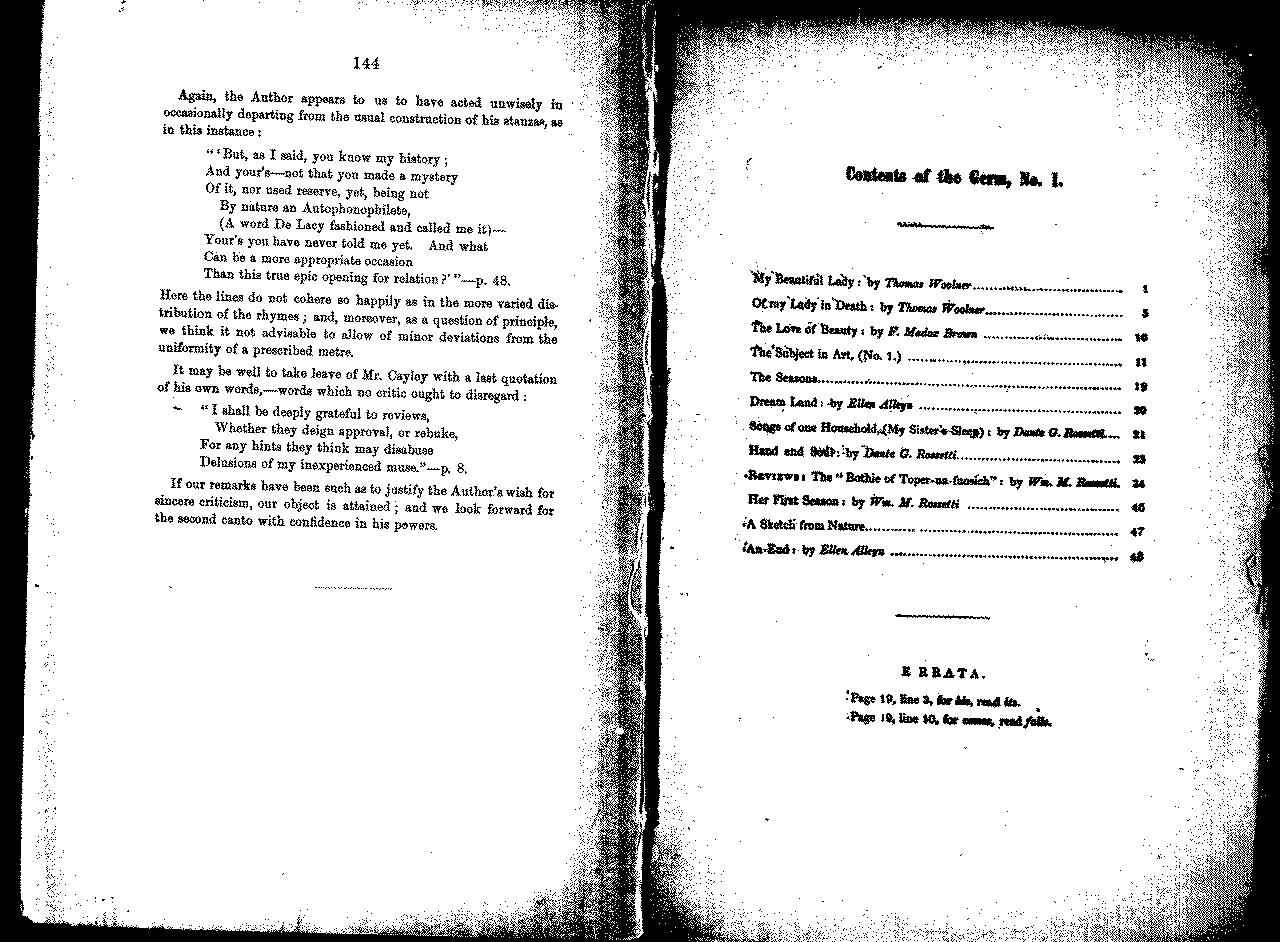
occasionally departing from the usual construction of his stanzas, as
in this instance:
- “‘But, as I said, you know my history;
- And your's—not that you made a mystery
- Of it, nor used reserve, yet, being not
- By nature an Autophonophilete,
- (A word De Lacy fashioned and called me it)—
- Your's you have never told me yet. And what
- Can be a more appropriate occasion
- Than this true epic opening for relation?’”—p. 48.
Here the lines do not cohere so happily as in the more varied dis-
tribution of the rhymes; and, moreover, as a question of principle,
we think it not advisable to allow of minor deviations from the
uniformity of a prescribed metre.
of his own words,—words which no critic ought to disregard:
- “I shall be deeply grateful to reviews,
- Whether they deign approval, or rebuke,
- For any hints they think may disabuse
- Delusions of my inexperienced muse.”— p.8.
sincere criticism, our object is attained; and we look forward for
the second canto with confidence in his powers.
- My Beautiful Lady: by Thomas Woolner................................1
- Of my Lady in Death: by Thomas Woolner..............................5
- The Love of Beauty: by F. Madox Brown..............................10
- The Subject in Art, (No. 1.)....................................... 11
- The Seasons........................................................ 19
- Dream Land: by Ellen Allyn.........................................20
- Songs of one Household, (My Sister's Sleep): by Dante G. Rossetti. 21
- Hand and Soul: by Dante G. Rossetti................................23
- Reviews: The “Bothie of Toper-na-fuosich”: by Wm. M. Rossetti...... 34
- Her First Season: by Wm. M. Rossetti...............................46
- A Sketch From Nature............................................... 47
- An End: by Ellen Allyn.............................................48
Page 19, line 10, for comes, read falls.
![Image of page [x2]](http://www.rossettiarchive.org/img/ap4.g415.1901.v4i.jpg)
develope thought and principle, Essays concerning Art and
other subjects, and analytic Reviews of current Literature—
particularly of Poetry. Each number will also contain an
Etching; the subject to be taken from the opening article
of the month.
to claim for Poetry that place to which its present develop-
ment in the literature of this country so emphatically
entitles it.
Art will be to encourage and enforce an entire adherance to
the simplicity of nature; and also to direct attention, as an
auxiliary medium, to the comparatively few works which Art
has yet produced in this spirit. It need scarcely be added
that the chief object of the etched designs will be to illustrate
this aim practically, as far as the method of execution will
permit; in which purpose they will be produced with the
utmost care and completeness.