Rossetti Archive Textual Transcription
The full Rossetti Archive record for this transcribed document is available.
![Image of page [i]](http://www.rossettiarchive.org/img/ap4.g415.1901.v1i.jpg)
JANUARY, 1850.
With an Etching by W. HOLMAN HUNT.
The Germ:
Thoughts towards Nature
In Poetry, Literature, and Art.

- When whoso merely hath a little thought
- Will plainly think the thought which is in him,—
- Not imaging another's bright or dim,
- Not mangling with new words what others taught;
- When whoso speaks, from having either sought
- Or only found,—will speak, not just to skim
- A shallow surface with words made and trim,
- But in that very speech the matter brought:
- Be not too keen to cry—“So this is all!—
- 10A thing I might myself have thought as well,
- But would not say it, for it was not worth!”
- Ask: “Is this truth?” For is it still to tell
- That, be the theme a point or the whole earth,
- Truth is a circle, perfect, great or small?
London:
AYLOTT & JONES, 8, PATERNOSTER ROW.
G.F Tupper, Printer, Clement's Lane. Lombard Street.
![Image of page [ii]](http://www.rossettiarchive.org/img/ap4.g415.1901.v1iii.jpg)
- My Beautiful Lady . . . . . . . . . . . . . . . . . . . . 1
- Of my Lady in Death . . . . . . . . . . . . . . . . . . . 5
- The Love of Beauty . . . . . . . . . . . . . . . . . . . 10
- The Subject in Art, (No. 1.) . . .. . . . . . . . . . . . 11
- The Seasons . . . . . . . . . . . . . . . . . . . . . . . 19
- Dream Land . . . . . . . . . . . . . . . . . . . . . . . 20
- Songs of One Household, (My Sister's Sleep.) . . . . . . 21
- Hand and Soul . . . . . . . . . . . . . . . . . . . . . . 23
- The Bothie of Toper-na-fuosich . . . . . . . . . . . . . 34
- Her First Season . . . . . . . . . . . . . . . . . . . . 46
- A Sketch from Nature . . . . . . . . . . . . . . . . . . 47
- An End . . . . . . . . . . . . . . . . . . . . . . . . . 48
un-published Poems, Essays, or other articles appearing to
coincide with the views in which this Periodical is established,
and who may feel desirous of contributing such papers—will
forward them, for the approval of the Editor, to the Office of
publication. It may be relied upon that the most sincere
attention will be paid to the examination of all manuscripts,
whether they be eventually accepted or declined.
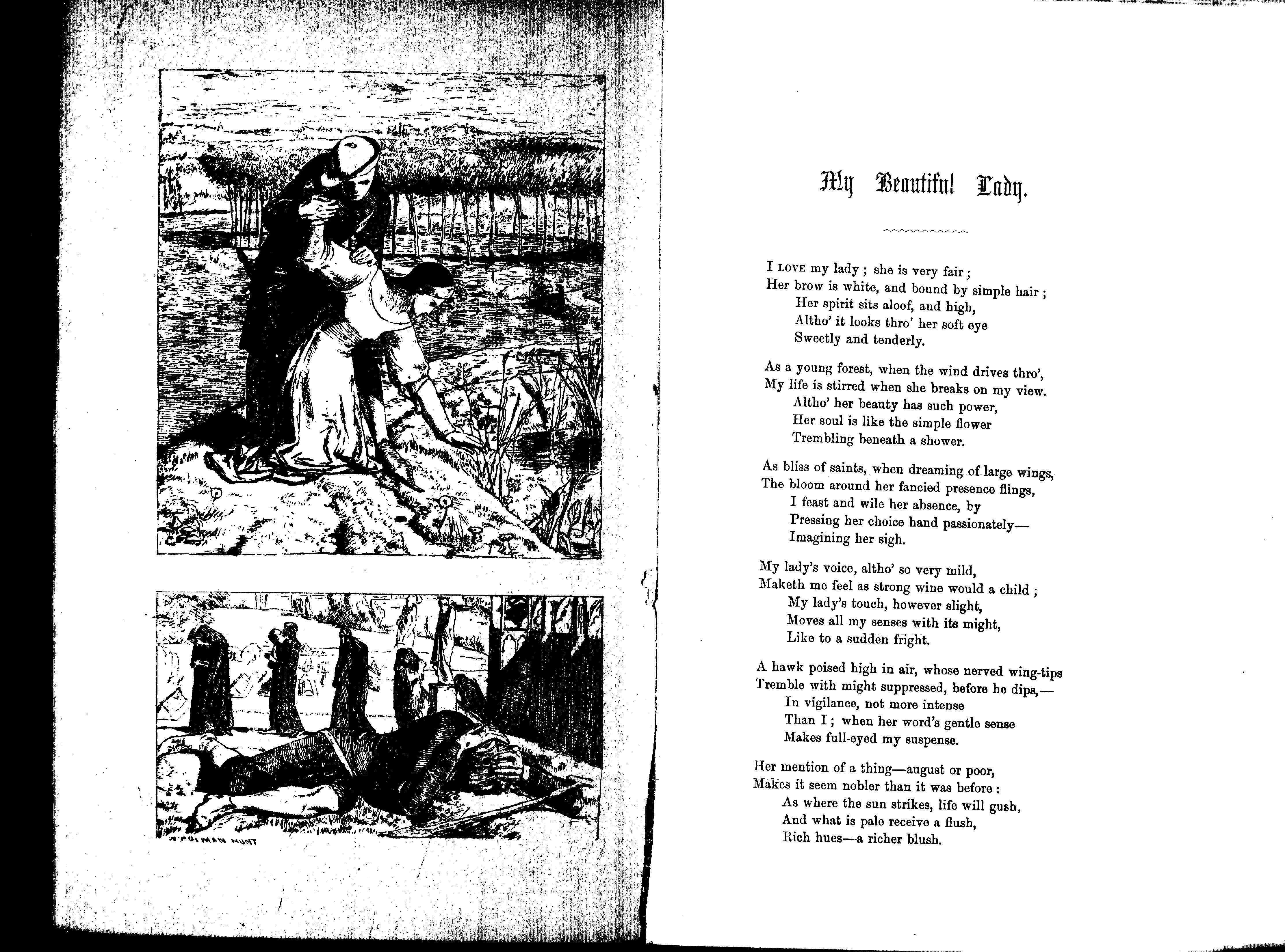
- I love my lady; she is very fair;
- Her brow is white, and bound by simple hair;
- Her spirit sits aloof, and high,
- Altho' it looks thro' her soft eye
- Sweetly and tenderly.
- As a young forest, when the wind drives thro',
- My life is stirred when she breaks on my view.
- Altho' her beauty has such power,
- Her soul is like the simple flower
- 10Trembling beneath a shower.
- As bliss of saints, when dreaming of large wings,
- The bloom around her fancied presence flings,
- I feast and wile her absence, by
- Pressing her choice hand passionately—
- Imagining her sigh.
- My lady's voice, altho' so very mild,
- Maketh me feel as strong wine would a child;
- My lady's touch, however slight,
- Moves all my senses with its might,
- 20Like to a sudden fright.
- A hawk poised high in air, whose nerved wing-tips
- Tremble with might suppressed, before he dips,—
- In vigilance, not more intense
- Than I; when her word's gentle sense
- Makes full-eyed my suspense.
- Her mention of a thing—august or poor,
- Makes it seem nobler than it was before:
- As where the sun strikes, life will gush,
- And what is pale receive a flush,
- 30Rich hues—a richer blush.
- My lady's name, if I hear strangers use,—
- Not meaning her—seems like a lax misuse.
- I love none but my lady's name;
- Rose, Maud, or Grace, are all the same,
- So blank, so very tame.
- My lady walks as I have seen a swan
- Swim thro' the water just where the sun shone.
- There ends of willow branches ride,
- Quivering with the current's glide,
- 40By the deep river-side.
- Whene'er she moves there are fresh beauties stirred;
- As the sunned bosom of a humming-bird
- At each pant shows some fiery hue,
- Burns gold, intensest green or blue:
- The same, yet ever new.
- What time she walketh under flowering May,
- I am quite sure the scented blossoms say,
- “O lady with the sunlit hair!
- “Stay, and drink our odorous air—
- 50“The incense that we bear:
- “Your beauty, lady, we would ever shade;
- “Being near you, our sweetness might not fade.”
- If trees could be broken-hearted,
- I am sure that the green sap smarted,
- When my lady parted.
- This is why I thought weeds were beautiful;—
- Because one day I saw my lady pull
- Some weeds up near a little brook,
- Which home most carefully she took,
- 60Then shut them in a book.
- A deer when startled by the stealthy ounce,—
- A bird escaping from the falcon's trounce,
- Feels his heart swell as mine, when she
- Stands statelier, expecting me,
- Than tall white lilies be.
- The first white flutter of her robe to trace,
- Where binds and perfumed jasmine interlace,
- Expands my gaze triumphantly:
- Even such his gaze, who sees on high
- 70His flag, for victory.
- We wander forth unconsciously, because
- The azure beauty of the evening draws:
- When sober hues pervade the ground,
- And life in one vast hush seems drowned,
- Air stirs so little sound.
- We thread a copse where frequent bramble spray
- With loose obtrusion from the side roots stray,
- (Forcing sweet pauses on our walk):
- I'll lift one with my foot, and talk
- 80About its leaves and stalk.
- Or may be that the prickles of some stem
- Will hold a prisoner her long garment's hem;
- To disentangle it I kneel,
- Oft wounding more than I can heal;
- It makes her laugh, my zeal.
- Then on before a thin-legged robin hops,
- Or leaping on a twig, he pertly stops,
- Speaking a few clear notes, till nigh
- We draw, when quickly he will fly
- 90Into a bush close by.
- A flock of goldfinches may stop their flight,
- And wheeling round a birchen tree alight
- Deep in its glittering leaves, until
- They see us, when their swift rise will
- Startle a sudden thrill.
- I recollect my lady in a wood,
- Keeping her breath and peering—(firm she stood
- Her slim shape balanced on tiptoe—)
- Into a nest which lay below,
- 100Leaves shadowing her brow.
- I recollect my lady asking me,
- What that sharp tapping in the wood might be?
- I told her blackbirds made it, which,
- For slimy morsels they count rich,
- Cracked the snail's curling niche:
- She made no answer. When we reached the stone
- Where the shell fragments on the grass were strewn,
- Close to the margin of a rill;
- “The air,” she said, “seems damp and chill,
- 110“We'll go home if you will.”
- “Make not my pathway dull so soon,” I cried,
- “See how those vast cloudpiles in sun-glow dyed,
- “Roll out their splendour: while the breeze
- “Lifts gold from leaf to leaf, as these
- “Ash saplings move at ease.”
- Piercing the silence in our ears, a bird
- Threw some notes up just then, and quickly stirred
- The covert birds that startled, sent
- Their music thro' the air; leaves lent
- 120Their rustling and blent,
- Until the whole of the blue warmth was filled
- So much with sun and sound, that the air thrilled.
- She gleamed, wrapt in the dying day's
- Glory: altho' she spoke no praise,
- I saw much in her gaze.
- Then, flushed with resolution, I told all;—
- The mighty love I bore her,—how would pall
- My very breath of life, if she
- For ever breathed not hers with me;—
- 130Could I a cherub be,
- How, idly hoping to enrich her grace,
- I would snatch jewels from the orbs of space;—
- Then back thro' the vague distance beat,
- Glowing with joy her smile to meet,
- And heap them round her feet.
- Her waist shook to my arm. She bowed her head,
- Silent, with hands clasped and arms straightened:
- (Just then we both heard a church bell)
- O God! It is not right to tell:
- 140But I remember well
- Each breast swelled with its pleasure, and her whole
- Bosom grew heavy with love; the swift roll
- Of new sensations dimmed her eyes,
- Half closing them in ecstasies,
- Turned full against the skies.
- The rest is gone; it seemed a whirling round—
- No pressure of my feet upon the ground:
- But even when parted from her, bright
- Showed all; yea, to my throbbing sight
- 150The dark was starred with light.
- All seems a painted show. I look
- Up thro' the bloom that's shed
- By leaves above my head,
- And feel the earnest life forsook
- All being, when she died:—
- My heart halts, hot and dried
- As the parched course where once a brook
- Thro' fresh growth used to flow,—
- Because her past is now
- 10No more than stories in a printed book.
- The grass has grown above that breast,
- Now cold and sadly still,
- My happy face felt thrill:—
- Her mouth's mere tones so much expressed!
- Those lips are now close set,—
- Lips which my own have met;
- Her eyelids by the earth are pressed;
- Damp earth weighs on her eyes;
- Damp earth shuts out the skies.
- 20My lady rests her heavy, heavy rest.
- To see her slim perfection sweep,
- Trembling impatiently,
- With eager gaze at me!
- Her feet spared little things that creep:—
- “We've no more right,” she'd say,
- “In this the earth than they.”
- Some remember it but to weep.
- Her hand's slight weight was such,
- Care lightened with its touch;
- 30My lady sleeps her heavy, heavy sleep.
- My day-dreams hovered round her brow;
- Now o'er its perfect forms
- Go softly real worms.
- Stern death, it was a cruel blow,
- To cut that sweet girl's life
- Sharply, as with a knife.
- Cursed life that lets me live and grow,
- Just as a poisonous root,
- From which rank blossoms shoot;
- 40My lady's laid so very, very low.
- Dread power, grief cries aloud, “unjust,”—
- To let her young life play
- Its easy, natural way;
- Then, with an unexpected thrust,
- Strike out the life you lent,
- Just when her feelings blent
- With those around whom she saw trust
- Her willing power to bless,
- For their whole happiness;
- 50My lady moulders into common dust.
- Small birds twitter and peck the weeds
- That wave above her head,
- Shading her lowly bed:
- Their brisk wings burst light globes of seeds,
- Scattering the downy pride
- Of dandelions, wide:
- Speargrass stoops with watery beads:
- The weight from its fine tips
- Occasionally drips:
- 60The bee drops in the mallow-bloom, and feeds.
- About her window, at the dawn,
- From the vine's crooked boughs
- Birds chirupped an arouse:
- Flies, buzzing, strengthened with the morn;—
- She'll not hear them again
- At random strike the pane:
- No more upon the close-cut lawn,
- Her garment's sun-white hem
- Bend the prim daisy's stem,
- 70In walking forth to view what flowers are born.
- No more she'll watch the dark-green rings
- Stained quaintly on the lea,
- To image fairy glee;
- While thro' dry grass a faint breeze sings,
- And swarms of insects revel
- Along the sultry level:—
- No more will watch their brilliant wings,
- Now lightly dip, now soar,
- Then sink, and rise once more.
- 80My lady's death makes dear these trivial things.
- Within a huge tree's steady shade,
- When resting from our walk,
- How pleasant was her talk!
- Elegant deer leaped o'er the glade,
- Or stood with wide bright eyes,
- Staring a short surprise:
- Outside the shadow cows were laid,
- Chewing with drowsy eye
- Their cuds complacently:
- 90Dim for sunshine drew near a milking-maid.
- Rooks cawed and labored thro' the heat;
- Each wing-flap seemed to make
- Their weary bodies ache:
- The swallows, tho' so very fleet,
- Made breathless pauses there
- At something in the air:—
- All disappeared: our pulses beat
- Distincter throbs: then each
- Turned and kissed, without speech,—
- 100She trembling, from her mouth down to her feet.
- My head sank on her bosom's heave,
- So close to the soft skin
- I heard the life within.
- My forehead felt her coolly breathe,
- As with her breath it rose:
- To perfect my repose
- Her two arms clasped my neck. The eve
- Spread silently around,
- A hush along the ground,
- 110And all sound with the sunlight seemed to leave.
- By my still gaze she must have known
- The mighty bliss that filled
- My whole soul, for she thrilled,
- Drooping her face, flushed, on my own;
- I felt that it was such
- By its light warmth of touch.
- My lady was with me alone:
- That vague sensation brought
- More real joy than thought.
- 120I am without her now, truly alone.
- We had no heed of time: the cause
- Was that our minds were quite
- Absorbed in our delight,
- Silently blessed. Such stillness awes,
- And stops with doubt, the breath,
- Like the mute doom of death.
- I felt Time's instantaneous pause;
- An instant, on my eye
- Flashed all Eternity:—
- 130I started, as if clutched by wild beasts' claws,
- Awakened from some dizzy swoon:
- I felt strange vacant fears,
- With singings in my ears,
- And wondered that the pallid moon
- Swung round the dome of night
- With such tremendous might.
- A sweetness, like the air of June,
- Next paled me with suspense,
- A weight of clinging sense—
- 140Some hidden evil would burst on me soon.
- My lady's love has passed away,
- To know that it is so
- To me is living woe.
- That body lies in cold decay,
- Which held the vital soul
- When she was my life's soul.
- Bitter mockery it was to say—
- “Our souls are as the same:”
- My words now sting like shame;
- 150Her spirit went, and mine did not obey.
- It was as if a fiery dart
- Passed seething thro' my brain
- When I beheld her lain
- There whence in life she did not part.
- Her beauty by degrees,
- Sank, sharpened with disease:
- The heavy sinking at her heart
- Sucked hollows in her cheek,
- And made her eyelids weak,
- 160Tho' oft they'd open wide with sudden start.
- The deathly power in silence drew
- My lady's life away.
- I watched, dumb with dismay,
- The shock of thrills that quivered thro'
- And tightened every limb:
- For grief my eyes grew dim;
- More near, more near, the moment grew.
- O horrible suspense!
- O giddy impotence!
- 170I saw her fingers lax, and change their hue.
- Her gaze, grown large with fate, was cast
- Where my mute agonies
- Made more sad her sad eyes:
- Her breath caught with short plucks and fast:—
- Then one hot choking strain.
- She never breathed again:
- I had the look which was her last:
- Even after breath was gone,
- Her love one moment shone,—
- 180Then slowly closed, and hope for ever passed.
- Silence seemed to start in space
- When first the bell's harsh toll
- Rang for my lady's soul.
- Vitality was hell; her grace
- The shadow of a dream:
- Things then did scarcely seem:
- Oblivion's stroke fell like a mace:
- As a tree that's just hewn
- I dropped, in a dead swoon,
- 190And lay a long time cold upon my face.
- Earth had one quarter turned before
- My miserable fate
- Pressed on with its whole weight.
- My sense came back; and, shivering o'er,
- I felt a pain to bear
- The sun's keen cruel glare;
- It seemed not warm as heretofore.
- Oh, never more its rays
- Will satisfy my gaze.
- 200No more; no more; oh, never any more.
- John Boccaccio, love's own squire, deep sworn
- In service to all beauty, joy, and rest,—
- When first the love-earned royal Mary press'd,
- To her smooth cheek, his pale brows, passion-worn,—
- 'Tis said, he, by her grace nigh frenzied, torn
- By longings unattainable, address'd
- To his chief friend most strange misgivings, lest
- Some madness in his brain had thence been born.
- The artist-mind alone can feel his meaning:—
- 10Such as have watched the battle-rank'd array
- Of sunset, or the face of girlhood seen in
- Line-blending twilight, with sick hope. Oh! they
- May feed desire on some fond bosom leaning:
- But where shall such their thirst of Nature stay?
ingenuity, merely from the difficulties they surmount; like an
‘egg in a bottle,’ a tree made out of stone, or a face made of
pigment; and the pleasure we receive, is our wonder at the
achievement; then, to such as so believe, this treatise is not written.
But if, as the writer conceives, works of Fine Art delight us by the
interest the objects they depict excite in the beholder, just as those
objects in nature would excite his interest; if by any association of
ideas in the one case, by the same in the other, without reference to
the representations being other than the objects they represent:—
then, to such as so believe, the following upon ‘SUBJECT’ is
addressed. Whilst, at the same time, it is not disallowed that a
subsequent pleasure may and does result, upon reflecting that the
objects contemplated were the work of human ingenuity.
Sculptor; what ought to be the nature of that ‘subject,’ how far
that subject may be drawn from past or present time with advantage,
how far the subject may tend to confer upon its embodiment the
title, ‘High Art,’ how far the subject may tend to confer upon its
embodiment the title ‘Low Art;’ what is ‘High Art,’ what is
‘Low Art’?
may differ as to facts, the principle will be readily granted, that
‘High Art,’ i. e. Art, par excellence, Art, in its most exalted
character, addresses pre-eminently the highest attributes of man,
viz.: his mental and his moral faculties.
addresses the less exalted attributes of man, viz.: his mere sensory
faculties, without affecting the mind or heart, excepting through the
volitional agency of the observer.
before we endeavour to define more particularly, let us analyze the
subject, and see what it will yield.
appears somewhat remarkable, are, with the exception of those by
incompetent artists, universally admitted to be ‘High Art.’ Now
do we afford them this high title, because all remnants of the
antique world, by tempting a comparison between what was, and
is, will set the mental faculties at work, and thus address the highest attributes of man? Or, as this is owing to the agency of
the observer, and not to the subject represented, are we to seek for
the cause in the subjects themselves!
this cannot be the cause, unless all modern sculpture be considered
‘High Art.’ This is leaving out of the question in both ages, all
works badly executed, and obviously incorrect, of which there are
numerous examples both ancient and modern.
men or women in thoughtful or impassioned action: sometimes they
are indeed acting physically; but then, as in the Jason adjusting
his Sandal, acting by mechanical impulse, and thinking or looking
in another direction. In relievo we have an historical combat,
such as that between the Centaurs and Lapithæ; sometimes a group
in conversation, sometimes a recitation of verses to the Lyre; a
dance, or religious procession.
the intellectual, and often to the moral faculties, they are naturally,
and according to the broad definition, works of ‘High Art.’ Of
the relievo, the historical combat appeals to the passions; and,
being historical, probably to the intellect. The like may be said of
the conversational groups, and lyrical recitation which follow. The
dance appeals to the passions and the intellect ; since the intellect
recognises therein an order and design, her own planning; while
the solemn, modest demeanour in the religious procession speaks to
the heart and the mind. The same remarks will apply to the few
ancient paintings we possess, always excluding such merely deco-
rative works as are not fine art at all.
have been denominated works of ‘High Art;’ and here we remark
the difference between the hypothetical or rational, and the historical
account of facts; for though here is reason enough why ancient art
might have been denominated ‘High Art,’ that it was so denomi-
nated on this account, is a position not capable of proof: whereas,
in all probability, the true account of the matter runs thus—The
works of antiquity awe us by their time-hallowed presence; the
mind is sent into a serious contemplation of things; and, the subject
itself in nowise contravening, we attribute all this potent effect to
the agency of the subject before us, and ‘High Art,’ it becomes
then and for ever, with all such as “follow its cut.” But then as
this was so named, not from the abstract cause, but from a result and
effect ; when a new work is produced in a similar spirit, but clothed
in a dissimilar matter, and the critics have to settle to what class
the old one, like the poor beggar Irus in front of Ulysses; then are
they turned over and applied, each to each, like the two triangles in
Euclid; and then, if they square, fit and tally in every quarter—
with the nude to the draped in the one, as the nude to the draped
in the other—with the standing to the sitting in the one, as the
standing to the sitting in the other—with the fat to the lean in the
one, as the fat to the lean in the other—with the young to the old
in the one, as the young to the old in the other—with head to body,
as head to body; and nose to knee, as nose to knee, &c. &c., (and
the critics have done a great deal)—then is the work oracularly
pronounced one of ‘High Art;’ and the obsequious artist is
pleased to consider it is.
literally reconciled, though wrought in the self-same spirit; then
this unfortunate creature of genius is degraded into a lower rank of
art; and the artist, if he have faith in the learned, despairs; or, if
he have none, he swears. But listen, an artist speaks: “If I have
genius to produce a work in the true spirit of high art, and yet am
so ignorant of its principles, that I scarce know whereon the success
of the work depends, and scarcely whether I have succeeded or no;
with this ignorance and this power, what needs your knowledge or
your reasoning, seeing that nature is all-sufficient, and produces a
painter as she produces a plant?” To the artist (the last of his
race), who spoke thus, it is answered, that science is not meant for
him, if he like it not, seeing he can do without it, and seeing, more-
over, that with it alone he can never do. Science here does not
make; it unmakes, wonderingly to find the making of what God has
made—of what God has made through the poet, leading him blindly
by a path which he has not known; this path science follows slowly
and in wonder. But though science is not to make the artist, there
is no reason in nature that the artist reject it. Still, science is pro-
perly the birthright of the critic; 'tis his all in all. It shows him
poets, painters, sculptors, his fellow men, often his inferiors in their
want of it, his superiors in the ability to do what he cannot do;
it teaches him to love them as angels bringing him food which he
cannot attain, and to venerate their works as a gift from the
Creator.
While the constituents of high art were unknown, whilst its
abstract principles were unsought, and whilst it was only recognized
in the concrete, the critics, certainly guilty of the most unpardon-
able blindness, blundered up to the masses of ‘High Art,’ left by antiquity, saying, “there let us fix our observatory,” and here came

out perspective glass, and callipers and compasses; and here they
made squares and triangles, and circles, and ellipses, for, said they,
“this is ‘High Art,’ and this hath certain proportions;” then in
the logic of their hearts, they continued, “all these proportions we
know by admeasurement, whatsoever hath these is ‘High Art,’
whatsoever hath not, is ‘Low Art.’ This was as certain as the
fact that the sun is a globe of glowing charcoal, because forsooth
they both yield light and heat. Now if the phantom of a then
embryon-electrician had arisen and told them that their “high art
marbles possessed an electric influence, which, acting in the brain
of the observer, would awake in him emotions of so exalted a
character, that he forthwith, inevitably nodding at them, must utter
the tremendous syllables ‘High Art;’” he, the then embryon-
electrician, from that age withheld to bless and irradiate the
physiology of ours, would have done something more to the purpose
than all the critics and the compasses.
wrought, is not our model; for, according to that faith demanded
at setting out, fine art delights us from its being the semblance of
what in nature delights. Now, as the artist does not work by the
instrumentality of rule and science, but mainly by an instinctive
impulse; if he copy the antique, unable as he is to segregate the
merely delectable matter, he must needs copy the whole, and
thereby multiply models, which the casting-man can do equally
well; whereas if he copy nature, with a like inability to distinguish
that delectable attribute which allures him to copy her, and under the
same necessity of copying the whole, to make sure of this “tenant
of nowhere;” we then have the artist, the instructed of nature,
fulfilling his natural capacity, while his works we have as manifold
yet various as nature's own thoughts for her children.
‘Fine Art’ delights, by presenting us with objects, which in nature
delight us; and ‘High Art’ was defined, that which addresses the
intellect; and hence it might appear, as delight is an emotion of
the mind, that ‘Low Art,’ which addresses the senses, is not Fine
Art at all. But then it must be remembered, that it was neither
stated of ‘Fine Art,’ nor of ‘High Art,’ that it always
delights; and again, that delight is not entirely mental. To point
out the confines of high and low art, where the one terminates and
the other commences, would be difficult, if not impracticable without
sub-defining or circumscribing the import of the terms, pain,
pleasure, delight, sensory, mental, psychical, intellectual, objective,
mainly pertinent to the subject, it must be content to receive no
better definitions than those broad ones already laid down, with
their latitude somewhat corrected by practical examples. Yet
before proceeding to give these examples, it might be remarked of
‘High Art,’ that it always might, if it do not always excite some
portion of delight, irrespective of that subsequent delight consequent
upon the examination of a curiosity; that its function is sometimes,
with this portion of delight, to commingle grief or distress, and that
it may, (though this is not its function,) excite mental anguish, and
by a reflex action, actual body pain. Now then to particularize,
by example; let us suppose a perfect and correct painting of a stone,
a common stone such as we walk over. Now although this subject
might to a religious man, suggest a text of scripture; and to the
geologist a theory of scientific interest; yet its general effect upon
the average number of observers will be readily allowed to be more
that of wonder or admiration at a triumph over the apparently
impossible (to make a round stone upon a flat piece of canvass) than
at aught else the subject possesses. Now a subject such as this
belongs to such very low art, that it narrowly illudes precipitation
over the confines of Fine Art ; yet, that it is Fine Art is indis-
putable, since no mere mechanic artisan, or other than one specially
gifted by nature, could produce it. This then shall introduce us to
“Subject.” This subject then, standing where fine art gradually
confines with mechanic art, and almost midway between them; of
no use nor beauty; but to be wondered at as a curiosity; is a subject
of scandalous import to the artist, to the artist thus gifted by nature
with a talent to reproduce her fleeting and wondrous forms. But
if, as the writer doubts, nature could afford a monster so qualified
for a poet, yet destitute of poetical genius; then the scandal attaches
if he attempt a step in advance, or neglect to join himself to those,
a most useful class of mechanic artists, who illustrate the sciences
by drawing and diagram.
only instanced, in fact, to exemplify an extreme; let us consider the
merits of a subject really practical, such as ‘dead game,’ or ‘a
basket of fruit;’ and the first general idea such a subject will
excite is simply that of food, ‘something to eat.’ For though
fruit on the tree, or a pheasant in the air, is a portion of nature and
properly belongs to the section, ‘Landscape,’ a division of art
intellectual enough; yet gather the fruit or bring down the pheasant,
and you presently bring down the poetry with it ; and although
Sterne could sentimentalize upon a dead ass; and though a dead pheasant in the larder, or a dead sheep at a butcher's, may excite
feelings akin to anything but good living; and though they may
there be the excitive causes of poetical, nay, or moral reflexion; yet,
see them on the canvass, and the first and uppermost idea will be
that of ‘ Food,’ and how, in the name of decency, they ever came
there. It will be vain to argue that gathered fruit is only nature
under a certain phase, and that a dead sheep or a dead pheasant is
only a dead animal like a dead ass—it will be pitiably vain and
miserable sophistry, since we know that the dead pheasant in a
picture will always be as food, while the same at he poulterer's will
be but a dead pheasant.
to every object in nature. Thus one of the series may be that that
object is matter, one that it is individual matter, one that it is
animal matter, one that it is a bird, one that it is a pheasant, one
that it is a dead pheasant, and one that it is food. Now, our
general ideas or notions are not evoked in this order as each new
object addresses the mind; but that general idea is first elicited
which accords with the first or principle destination of the object:
thus the first general idea of a cowry, to the Indian, is that of
money, not of a shell; and our first general idea of a dead pheasant
is that of food, whereas to a zoologist it might have a different effect:
but this is the exception. But it was said, that a dead pheasant in
a picture would always be as food, while the same at the poulterer's
would be but a dead pheasant: what then becomes of the first
general idea? It seems to be disposed of thus: at the first sight of
the shop, the idea is that of food, and next (if you are not hungry,
and poets never are), the mind will be attracted to the species of
animal, and (unless hunger presses) you may be led on to moralize
like Sterne: but, amongst pictures, where there is nothing else to
excite the general ideas of food, this, whenever adverted to, must
over re-excite that idea; and hence it appears that these esculent
subjects might be poetical enough if exhibited all together, i.e., they
must be surrounded with eatables, like a possibly-poetical-pheasant
in a poulterer's shop.
would seem justified by its insignificance, but as this is a branch of
art which has never aspired to be ‘High Art,’ it contains something
definite in its character which makes it better worth the analysis
than might appear at first sight; but still, as a latitude has been
taken in the investigation which is ever unavoidable in the handling
of such mercurial matter as poetry (where one must spread out a
broad definition to catch it wherever it runs), and as this is ever incomprehensible to such as are unaccustomed to abstract thinking,
from the difficulty of educing a rule amidst an infinite array of
exceptions, and of recognising a principle shrouded in the obscurity
of conflicting details; it appears expedient, before pursuing the
question, to reinforce the first broad elementary principles with
what definite modification they may have acquired in their progress
to this point in the argument, together with the additional data
which may have resulted from analytic reference to other correlative
matter.
interest of the objects it depicts, and, as subsequently stated, grieves
or distresses in proportion as the objects are grievous or distressing,
we have this resultant: “Fine Art excites in proportion to the
excitor influence of the object;” and then, that “ fine art excites
either the sensory or the mental faculties, in a like proportion to
the excitor properties of the objects respectively.” Thus then we
have, definitely stated, the powers or capabilities of Fine Art, as
regulated and governed by the objects it selects, and the objects it
selects making its subject. Now the question in hand is, “what
the nature of that subject should be,” but the subject must be ac-
cording to what Fine Art proposes to effect; all then must depend
upon this proposition. For if you propose that Fine Art shall
excite sensual pleasure, then such objects as excite sensual pleasure
should form the subject of Fine Art; and those which excite sensual
pleasure in the highest degree, will form the highest subject —‘High
Art.’ Or if you propose that Fine Art shall excite a physical ener-
getic activity, by addressing the sensory organism, which is a phase
of the former proposition, (for what are popularly called sensual
pleasures, are only particular sensory excitements sought by a phy-
sical appetite, while this sensory-organic activity is physically appe-
tent also,) then the subjects of art ought to be draw form such ob-
jects as excite a general activity, such as field-sports, bull-fights,
battles, executions, court pageants, conflagrations, murders; and
those which most intensely excite this sensory-organic activity, by
expressing most of physical human power or suffering, such as battles,
executions, regality, murder, would afford the highest subject of Fine
Art, and consequently these would be “ High Art.” But if you propose
(with the writer) that Fine Art shall regard the general happiness
of man, but addressing those attributes which are peculiarly human,
by exciting the activity of his rational and benevolent powers (and
the writer would add, man's religious aspirations, but omits it as
sufficiently evolvable from the proposition, and since some well-
willing men cannot at present recognize man as a religious animal), then the subject of Fine Art should be drawn from objects which
address and excite the activity of man's rational and benevolent
powers, such as:—acts of justice—of mercy—good government—
order—acts of intellect—men obviously speaking or thinking ab-
stract thoughts, as evinced by one speaking to another, and looking
at, or indicating, a flower, or a picture, or a star, or by looking on
the wall while speaking—or, if the scene be from a good play, or
story, or another beneficent work, then not only of men in abstract
thought or meditation, but, it may be, in simple conversation, or in
passion—or a simple representation of a person in a play or story,
as of Jacques, Ferdinand, or Cordelia; or, in real life, portraits of
those who are honestly beautiful; or expressive of innocence, happi-
ness, benevolence, or intellectuality, but not of gluttony, wantonness,
anger, hatred, or malevolence, unless in some cases of justifiable
satire—of histrionic or historic portraiture—landscape—natural
phenomena—animals, not indiscriminately—in some cases, grand or
beautiful buildings, even without figures—any scene on sea or land
which induces reflection—all subjects from such parts of history as
are morally or intellectually instructive or attractive—and therefore
pageants—battles—and even executions—all forms of thought and
poetry, however wild, if consistent with rational benevolence—all
scenes serious or comic, domestic or historical—all religious subjects
proposing good that will not shock any reasonable number of reason-
able men—all subjects that leave the artist wiser and happier—and
none which intrinsically act otherwise—to sum all, every thing or
incident in nature which excites, or may be made to excite, the
mind and the heart of man as a mentally intelligent, not as a brute
animal, is a subject for Fine Art, at all times, in all places, and in
all ages. But as all these subjects in nature affect our hearts or our
understanding in proportion to the heart and understanding we
have to apprehend and to love them, those will excite us most
intensely which we know most of and love most. But as we may
learn to know them all and to love them all, and what is dark to-
day may be luminous to-morrow, and things, dumb to-day, to-morrow
grow voiceful, and the strange voice of to-day be plain and reproach
us to-morrow; who shall adventure to say that this or that is the highest?
And if it appear that all these subjects in nature may affect us with
equal intensity, and that the artist's representations affect as the
subjects affect, then it follows, with all these subjects, Fine Art may
affect us equally; but the subjects may all be high; therefore, all
Fine Art may be High Art.
- The crocus, in the shrewd March morn,
- Thrusts up his saffron spear;
- And April dots the sombre thorn
- With gems, and loveliest cheer.
- Then sleep the seasons, full of might;
- While slowly swells the pod,
- And rounds the peach, and in the night
- The mushroom bursts the sod.
- The winter comes: the frozen rut
- 10Is bound with silver bars;
- The white drift heaps against the hut;
- And night is pierced with stars.
- Where sunless rivers weep
- Their waves into the deep,
- She sleeps a charmed sleep;
- Awake her not.
- Led by a single star,
- She came from very far,
- To seek where shadows are
- Her pleasant lot.
- She left the rosy morn,
- 10She left the fields of corn,
- For twilight cold and lorn,
- And water-springs.
- Thro' sleep, as thro' a veil,
- She sees the sky look pale,
- And hears the nightingale,
- That sadly sings.
- Rest, rest, a perfect rest,
- Shed over brow and breast;
- Her face is toward the west,
- 20The purple land.
- She cannot see the grain
- Ripening on hill and plain;
- She cannot feel the rain
- Upon her hand.
- Rest, rest, for evermore
- Upon a mossy shore,
- Rest, rest, that shall endure,
- Till time shall cease;—
- Sleep that no pain shall wake,
- 30Night that no morn shall break,
- Till joy shall overtake
- Her perfect peace.
- She fell asleep on Christmas Eve.
- Upon her eyes' most patient calms
- The lids were shut; her uplaid arms
- Covered her bosom, I believe.
- Our mother, who had leaned all day
- Over the bed from chime to chime,
- Then raised herself for the first time,
- And as she sat her down, did pray.
- Her little work-table was spread
- 10With work to finish. For the glare
- Made by her candle, she had care
- To work some distance from the bed.
- Without, there was a good moon up,
- Which left its shadows far within;
- The depth of light that it was in
- Seemed hollow like an altar-cup.
- Through the small room, with subtle sound
- Of flame, by vents the fireshine drove
- And reddened. In its dim alcove
- 20The mirror shed a clearness round.
- I had been sitting up some nights,
- And my tir'd mind felt weak and blank;
- Like a sharp strengthening wine, it drank
- The stillness and the broken lights.
- Silence was speaking at my side
- With an exceedingly clear voice:
- I knew the calm as of a choice
- Made in God for me, to abide.
- I said, “Full knowledge does not grieve:
- 30This which upon my spirit dwells
- Perhaps would have been sorrow else:
- But I am glad 'tis Christmas Eve.”
- Twelve struck. That sound, which all the years
- Hear in each hour, crept off; and then
- The ruffled silence spread again,
- Like water that a pebble stirs.

- Our mother rose from where she sat.
- Her needles, as she laid them down,
- Met lightly, and her silken gown
- 40Settled: no other noise than that.
- “Glory unto the Newly Born!”
- So, as said angels, she did say;
- Because we were in Christmas-day,
- Though it would still be long till dawn.
- She stood a moment with her hands
- Kept in each other, praying much;
- A moment that the soul may touch
- But the heart only understands.
- Almost unwittingly, my mind
- 50Repeated her words after her;
- Perhaps tho' my lips did not stir;
- It was scarce thought, or cause assign'd.
- Just then in the room over us
- There was a pushing back of chairs,
- As some who had sat unawares
- So late, now heard the hour, and rose.
- Anxious, with softly stepping haste,
- Our mother went where Margaret lay,
- Fearing the sounds o'erhead—should they
- 60Have broken her long-watched for rest!
- She stooped an instant, calm, and turned;
- But suddenly turned back again;
- And all her features seemed in pain
- With woe, and her eyes gazed and yearned.
- For my part, I but hid my face,
- And held my breath, and spake no word:
- There was none spoken; but I heard
- The silence for a little space.
- My mother bowed herself and wept.
- 70And both my arms fell, and I said:
- “God knows I knew that she was dead.”
- And there, all white, my sister slept.
- Then kneeling, upon Christmas morn
- A little after twelve o'clock
- We said, ere the first quarter struck,
- “Christ's blessing on the newly born!”
- “Rivolsimi in quel lato
- Là 'nde venia la voce,
- E parvemi una luce
- Che lucea quanto stella:
- La mia mente era quella.”
were already painters in Lucca, and Pisa, and Arezzo, who feared
God and loved the art. The keen, grave workmen from Greece,
whose trade it was to sell their own works in Italy and teach
Italians to imitate them, had already found rivals of the soil with
skill that could forestall their lessons and cheapen their crucifixes
and addolorate, more years than is supposed before the art came at
all into Florence. The pre-eminence to which Cimabue was raised
at once by his contemporaries, and which he still retains to a wide
extent even in the modern mind, is to be accounted for, partly by
the circumstances under which he arose, and partly by that extra-
ordinary purpose of fortune born with the lives of some few, and
through which it is not a little thing for any who went before, if
they are even remembered as the shadows of the coming of such an
one, and the voices which prepared his way in the wilderness. It is
thus, almost exclusively, that the painters of whom I speak are
now known. They have left little, and but little heed is taken of
that which men hold to have been surpassed; it is gone like time gone
—a track of dust and dead leaves that merely led to the fountain.
signs of a better understanding have become manifest. A case in
point is that of the tryptic and two cruciform pictures at Dresden,
by Chiaro di Messer Bello dell' Erma, to which the eloquent pam-
phlet of Dr. Aemmster has at length succeeded in attracting the stu-
dents. There is another, still more solemn and beautiful work, now
proved to be by the same hand, in the gallery at Florence. It is
the one to which my narrative will relate.
family in Arezzo; where, conceiving art almost, as it were, for him-
self, and loving it deeply, he endeavored from early boyhood towards
the imitation of any objects offered in nature. The extreme longing
after a visible embodiment of his thoughts strengthened as his years
increased, more even than his sinews or the blood of his life; until
he would feel faint in sunsets and at the sight of stately persons.
When he had lived nineteen years, he heard of the famous Giunta
Pisano; and, feeling much of admiration, with, perhaps, a little of
that envy which youth always feels until it has learned to measure
success by time and opportunity, he determined that he would seek
out Giunta, and, if possible, become his pupil.
being unwilling that any other thing than the desire he had for
knowledge should be his plea with the great painter; and then,
leaving his baggage at a house of entertainment, he took his way
along the street, asking whom he met for the lodging of Giunta. It
soon chanced that one of that city, conceiving him to be a stranger
and poor, took him into his house, and refreshed him; afterwards
directing him on his way.
he was a student, and that nothing in the world was so much at
his heart as to become that which he had heard told of him with
whom he was speaking. He was received with courtesy and con-
sideration, and shewn into the study of the famous artist. But the
forms he saw there were lifeless and incomplete; and a sudden
exultation possessed him as he said within himself, “I am the master
of this man.” The blood came at first into his face, but the next
moment he was quite pale and fell to trembling. He was able,
however, to conceal his emotion; speaking very little to Giunta,
but, when he took his leave, thanking him respectfully.
thoroughly some one of his thoughts, and let the world know him.
But the lesson which he had now learned, of how small a greatness
might win fame, and how little there was to strive against, served
to make him torpid, and rendered his exertions less continual.
Also Pisa was a larger and more luxurious city than Arezzo; and,
when in his walks, he saw the great gardens laid out for pleasure,
and the beautiful women who passed to and fro, and heard the
music that was in the groves of the city at evening, he was taken
with wonder that he had never claimed his share of the inheritance
of those years in which his youth was cast. And women loved
Chiaro; for, in despite of the burthen of study, he was well-favoured
and very manly in his walking; and, seeing his face in front, there
was a glory upon it, as upon the face of one who feels a light round
his hair.
night, being in a certain company of ladies, a gentleman that was
there with him began to speak of the paintings of a youth named
Bonaventura, which he had seen in Lucca; adding that Giunta Pisano
might now look for a rival. When Chiaro heard this, the lamps shook
before him, and the music beat in his ears and made him giddy. He
rose up, alleging a sudden sickness, and went out of that house with
his teeth set.
remaining in Pisa, that no day more might be lost; only living en-
tirely to himself. Sometimes, after nightfall, he would walk abroad
in the most solitary places he could find; hardly feeling the ground
under him, because of the thoughts of the day which held him
in fever.
gardens fast by the Church of San Rocco. During the offices, as he
sat at work, he could hear the music of the organ and the long
murmur that the chanting left; and if his window were open,
sometimes, at those parts of the mass where there is silence through-
out the church, his ear caught faintly the single voice of the
priest. Beside the matters of his art and a very few books, almost
the only object to be noticed in Chiaro's room was a small conse-
crated image of St. Mary Virgin wrought out of silver, before which
stood always, in summer-time, a glass containing a lily and a rose.
pictures; as also, in all likelihood, the one—inferior in merit, but
certainly his—which is now at Munich. For the most part, he was
calm and regular in his manner of study; though often he would
remain at work through the whole of the day, not resting once so
long as the light lasted; flushed, and with the hair from his face.
Or, at times, when he could not paint, he would sit for hours in
thought of all the greatness the world had known from of old;
until he was weak with yearning, like one who gazes upon a path
of stars.
the end of which his name was spoken throughout all Tuscany. As his
fame waxed, he began to be employed, besides easel-pictures,
upon paintings in fresco: but I believe that no traces remain to us
of any of these latter. He is said to have painted in the Duomo:
and D'Agincourt mentions having seen some portions of a fresco by
him which originally had its place above the high altar in the
Church of the Certosa; but which, at the time he saw it, being very
dilapidated, had been hewn out of the wall, and was preserved in
the stores of the convent. Before the period of Dr. Aemmster's
researches, however, it had been entirely destroyed.

girded up his loins; and he had not paused until fame was reached:
yet now, in taking breath, he found that the weight was still at his
heart. The years of his labor had fallen from him, and his life
was still in its first painful desire.
before, with the studies of his early youth, there had always been a
feeling of worship and service. It was the peace-offering that he
made to God and to his own soul for the eager selfishness of his
aim. There was earth, indeed, upon the hem of his raiment; but
this was of the heaven, heavenly. He had seasons when he could
endure to think of no other feature of his hope than this: and some-
times, in the ecstacy of prayer, it had even seemed to him to behold
that day when his mistress—his mystical lady (now hardly in her
ninth year, but whose solemn smile at meeting had already lighted
on his soul like the dove of the Trinity)—even she, his own
gracious and holy Italian art—with her virginal bosom, and her un-
fathomable eyes, and the thread of sunlight round her brows—should
pass, through the sun that never sets, into the circle of the shadow
of the tree of life, and be seen of God, and found good: and then it
had seemed to him, that he, with many who, since his coming, had
joined the band of whom he was one (for, in his dream, the body he
had worn on earth had been dead an hundred years), were permitted
to gather round the blessed maiden, and to worship with her through
all ages and ages of ages, saying, Holy, holy, holy. This thing he
had seen with the eyes of his spirit; and in this thing had trusted,
believing that it would surely come to pass.
as, in the pursuit of fame, the unrest abiding after attainment had
proved to him that he had misinterpreted the craving of his own
spirit—so also, now that he would willingly have fallen back on
devotion, he became aware that much of that reverence which he
had mistaken for faith had been no more than the worship of beauty.
Therefore, after certain days passed in perplexity, Chiaro said within
himself, “My life and my will are yet before me: I will take
another aim to my life.”
hand to no other works but only to such as had for their end the
presentment of some moral greatness that should impress the be-
holder: and, in doing this, he did not choose for his medium the
action and passion of human life, but cold symbolism and abstract
impersonation. So the people ceased to throng about his pictures
as heretofore; and, when they were carried through town and town
to their destination, they were no longer delayed by the crowds
eager to gaze and admire: and no prayers or offerings were brought
to them on their path, as to his Madonnas, and his Saints, and his
Holy Children. Only the critical audience remained to him; and
these, in default of more worthy matter, would have turned their
scrutiny on a puppet or a mantle. Meanwhile, he had no more of
fever upon him; but was calm and pale each day in all that he did
and in his goings in and out. The works he produced at this time
have perished—in all likelihood, not unjustly. It is said (and we
may easily believe it), that, though more labored than his former
pictures, they were cold and unemphatic; bearing marked out upon
them, as they must certainly have done, the measure of that boun-
dary to which they were made to conform.
his breath, never resting (for he was afraid), and would not know it.
in Pisa, for holy matters: and each man left his occupation; and
all the guilds and companies of the city were got together for games
and rejoicings. And there were scarcely any that stayed in the
houses, except ladies who lay or sat along their balconies between
open windows which let the breeze beat through the rooms and
over the spread tables from end to end. And the golden cloths that
their arms lay upon drew all eyes upward to see their beauty; and
the day was long; and every hour of the day was bright with the
sun.
ment of the Piazza Nunziata, and saw the hurry of people that
passed him, got up and went along with them ; and Chiaro waited
for him in vain.
from the Church close at hand: and he could hear the sounds that
the crowd made in the streets; hushed only at long intervals while
the processions for the feast-day chanted in going under his windows.
Also, more than once, there was a high clamour from the meeting
of factious persons: for the ladies of both leagues were looking
down; and he who encountered his enemy could not choose but
draw upon him. Chiaro waited a long time idle; and then knew
that his model was gone elsewhere. When at his work, he was
blind and deaf to all else; but he feared sloth: for then his stealthy
thoughts would begin, as it were, to beat round and round him,
seeking a point for attack. He now rose, therefore, and went to
the window. It was within a short space of noon; and underneath
him a throng of people was coming out through the porch of San
Rocco.
for that mass. The first to leave had been the Gherghiotti; who,
stopping on the threshold, had fallen back in ranks along each side
of the archway: so that now, in passing outward, the Marotoli had
to walk between two files of men whom they hated, and whose
fathers had hated theirs. All the chiefs were there and their
whole adherence; and each knew the name of each. Every man
of the Marotoli, as he came forth and saw his foes, laid back his
hood and gazed about him, to show the badge upon the close cap
that held his hair. And of the Gherghiotti there were some who
tightened their girdles; and some shrilled and threw up their
wrists scornfully, as who flies a falcon; for that was the crest of
their house.
coes, presenting a moral allegory of Peace, which Chiaro had painted
that year for the Church. The Gherghiotti stood with their backs
to these frescoes: and among them Golzo Ninuccio, the youngest
noble of the faction, called by the people of Golaghiotta, for his de-
based life. This youth had remained for some while talking list-
lessly to his fellows, though with his sleepy sunken eyes fixed on
them who passed: but now, seeing that no man jostled another, he
drew the long silver shoe off his foot, and struck the dust out of it
on the cloak of him who was going by, asking him how far the
tides rose at Viderza. And he said so because it was three months
since, at that place, the Gherghiotti had beaten the Marotoli to the
sands, and held them there while the sea came in; whereby many
had been drowned. And, when he had spoken, at once the whole
archway was dazzling with the light of confused swords; and they
who had left turned back; and they who were still behind made
haste to come forth: and there was so much blood cast up the
walls on a sudden, that it ran in long streams down Chiaro's
paintings.
between his lids, and he could not look. He sat down, and heard
the noise of contention driven out of the church-porch and a great
way through the streets; and soon there was a deep murmur that
heaved and waxed from the other side of the city, where those of
both parties were gathering to join in the tumult.
wished to set his foot on a place that looked green and fertile; and
once again it seemed to him that the thin rank mask was about to
spread away, and that this time the chill of the water must leave
leprosy in his flesh. The light still swam in his head, and bewil-
dered him at first ; but when he knew his thoughts, they were
these:—
that I nourished in this my generation of men,—shall pass from me,
and leave my feet and my hands groping. Yet, because of this, are
my feet become slow and my hands thin. I am as one who, through
the whole night, holding his way diligently, hath smitten the steel
unto the flint, to lead some whom he knew darkling; who hath
kept his eyes always on the sparks that himself made, lest they
should fail; and who, towards dawn, turning to bid them that he
had guided God speed, sees the wet grass untrodden except of his
own feet. I am as the last hour of the day, whose chimes are a
perfect number; whom the next followeth not, nor light ensueth
from him; but in the same darkness is the old order begun afresh.
Men say, ‘This is not God nor man; he is not as we are, neither
above us: let him sit beneath us, for we are many.’ Where I
write Peace, in that spot is the drawing of swords, and there men's
footprints are red. When I would sow, another harvest is ripe.
Nay, it is much worse with me than thus much. Am I not as a
cloth drawn before the light, that the looker may not be blinded;
but which sheweth thereby the grain of its own coarseness; so that
the light seems defiled, and men say, ‘We will not walk by it.’
Wherefore through me they shall be doubly accursed, seeing that
through me they reject the light. May one be a devil and not
know it?”
his veins, till he could sit no longer, and would have risen; but
suddenly he found awe within him, and held his head bowed,
without stirring. The warmth of the air was not shaken; but
there seemed a pulse in the light, and a living freshness, like rain.
The silence was a painful music, that made the blood ache in his
temples; and he lifted his face and his deep eyes.
with a green and grey raiment, fashioned to that time. It seemed
that the first thoughts he had ever known were given him as at
first from her eyes, and he knew her hair to be the golden veil through
which he beheld his dreams. Though her hands were joined, her
face was not lifted, but set forward; and though the gaze was
austere, yet her mouth was supreme in gentleness. And as he
looked, Chiaro's spirit appeared abashed of its own intimate
presence, and his lips shook with the thrill of tears; it seemed such
a bitter while till the spirit might be indeed alone.
much with him as his breath. He was like one who, scaling a
great steepness, hears his own voice echoed in some place much
higher than he can see, and the name of which is not known to him.
As the woman stood, her speech was with Chiaro: not, as it were,
from her mouth or in his ears; but distinctly between them.
know me as I am. Thou sayest that fame has failed thee, and faith
failed thee; but because at least thou hast not laid thy life unto riches,
therefore, though thus late, I am suffered to come into thy know-
ledge. Fame sufficed not, for that thou didst seek fame: seek thine
own conscience (not thy mind's conscience, but thine heart's), and
all shall approve and suffice. For Fame, in noble soils, is a fruit of
the Spring: but not therefore should it be said: ‘Lo! my garden
that I planted is barren: the crocus is here, but the lily is dead in
the dry ground, and shall not lift the earth that covers it: therefore
I will fling my garden together, and give it unto the builders.’
Take heed rather that thou trouble not the wise secret earth; for in
the mould that thou throwest up shall the first tender growth lie to
waste; which else had been made strong in its season. Yea, and
even if the year fall past in all its months, and the soil be indeed, to
thee, peevish and incapable, and though thou indeed gather all thy
harvest, and it suffice for others, and thou remain vext with empti-
ness; and others drink of thy streams, and the drouth rasp thy
throat;—let it be enough that these have found the feast good, and
thanked the giver: remembering that, when the winter is striven
through, there is another year, whose wind is meek, and whose sun
fulfilleth all.”
her that spoke, for the speech seemed within him and his own. The
air brooded in sunshine, and though the turmoil was great outside,
the air within was at peace. But when he looked in her eyes, he
wept. And she came to him, and cast her hair over him, and,
took her hands about his forehead, and spoke again:
This cannot be so. Either thou hadst it not, or thou hast it. But
who bade thee strike the point betwixt love and faith? Wouldst
thou sift the warm breeze from the sun that quickens it? Who
bade thee turn upon God and say: “Behold, my offering is of earth,
and not worthy: thy fire comes not upon it: therefore, though I
slay not my brother whom thou acceptest, I will depart before thou
smite me.” Why shouldst thou rise up and tell God He is not
content? Had He, of His warrant, certified so to thee? Be not
nice to seek out division; but possess thy love in sufficiency: as-
suredly this is faith, for the heart must believe first. What He hath
set in thine heart to do, that do thou; and even though thou do it
without thought of Him, it shall be well done: it is this sacrifice
that He asketh of thee, and His flame is upon it for a sign. Think
not of Him; but of His love and thy love. For God is no morbid
exactor: he hath no hand to bow beneath, nor a foot, that thou
shouldst kiss it.”
his face; and the salt tears that he shed ran through her hair upon
his lips; and he tasted the bitterness of shame.
of thy teaching,—thine heart hath already put them away, and it
needs not that I lay my bidding upon thee. How is it that thou, a
man, wouldst say coldly to the mind what God hath said to
the heart warmly? Thy will was honest and wholesome; but
look well lest this also be folly,—to say, ‘I, in doing this, do
strengthen God among men.’ When at any time hath he cried unto
thee, saying, ‘My son, lend me thy shoulder, for I fall?’ Deemest
thou that the men who enter God's temple in malice, to the
provoking of blood, and neither for his love nor for his wrath will
abate their purpose,—shall afterwards stand with thee in the
porch, midway between Him and themselves, to give ear unto thy
thin voice, which merely the fall of their visors can drown, and to
see thy hands, stretched feebly, tremble among their swords? Give
thou to God no more than he asketh of thee; but to man also, that
which is man's. In all that thou doest, work from thine own heart,
simply; for his heart is as thine, when thine is wise and humble;
and he shall have understanding of thee. One drop of rain is as
another, and the sun's prism in all: and shalt not thou be as he,
whose lives are the breath of One? Only by making thyself his equal
can he learn to hold communion with thee, and at last own thee
above him. Not till thou lean over the water shalt thou see thine
image therein: stand erect, and it shall slope from thy feet and be
lost. Know that there is but this means whereby thou may'st
serve God with man:—Set thine hand and thy soul to serve man
with God.”
spirit, she left his side quietly, and stood up as he had first seen
her; with her fingers laid together, and her eyes steadfast, and with
the breadth of her long dress covering her feet on the floor. And,
speaking again, she said:
me thus, as I am, to know me: weak, as I am, and in the weeds of
this time; only with eyes which seek out labour, and with a faith,
not learned, yet jealous of prayer. Do this; so shall thy soul
stand before thee always, and perplex thee no more.”
grew solemn with knowledge: and before the shadows had turned,
his work was done. Having finished, he lay back where he sat,
and was asleep immediately: for the growth of that strong sunset
was heavy about him, and he felt weak and haggard; like one just
come out of a dusk, hollow country, bewildered with echoes, where
he had lost himself, and who has not slept for many days and
nights. And when she saw him lie back, the beautiful woman came
to him, and sat at his head, gazing, and quieted his sleep with her voice.
Pisa, though Chiaro had not heard it: and the last service of that
Feast was a mass sung at midnight from the windows of all the
churches for the many dead who lay about the city, and who had to
be buried before morning, because of the extreme heats.
the same time with myself—those, at least, to whom Art is some-
thing,—will certainly recollect how many rooms of the Pitti Gallery
were closed through that season, in order that some of the pictures
they contained might be examined, and repaired without the neces-
sity of removal. The hall, the staircases, and the vast central suite
of apartments, were the only accessible portions; and in these such
paintings as they could admit from the sealed penetralia were pro-
fanely huddled together, without respect of dates, schools, or persons.
of the best pictures. I do not mean only the most talked of: for
these, as they were restored, generally found their way somehow
into the open rooms, owing to the clamours raised by the students;
and I remember how old Ercoli's, the curator's, spectacles used to
be mirrored in the reclaimed surface, as he leaned mysteriously over
these works with some of the visitors, to scrutinize and elucidate.
was among those, I believe, brought from the other rooms, and had
been hung, obviously out of all chronology, immediately beneath
that head by Raphael so long known as the “Berrettino,” and now
said to be the portrait of Cecco Ciulli.
figure of a woman, clad to the hands and feet with a green and grey
raiment, chaste and early in its fashion, but exceedingly simple.
She is standing: her hands are held together lightly, and her
eyes set earnestly open.
delicacy, have the appearance of being painted at once, in a single
sitting: the drapery is unfinished. As soon as I saw the figure, it
drew an awe upon me, like water in shadow. I shall not attempt to
describe it more than I have already done; for the most absorbing
wonder of it was its literality. You knew that figure, when painted,
had been seen; yet it was not a thing to be seen of men. This
language will appear ridiculous to such as have never looked on the
work; and it may be even to some among those who have. On
examining it closely,I perceived in one corner of the canvass the
words Manus Animam pinxit, and the date 1239.
were all displaced. I then stepped up to the Cavaliere Ercoli, who
was in the room at the moment, and asked him regarding the
subject of authorship of the painting. He treated the matter, I
thought, somewhat slightingly, and said that he could show me the
reference in the Catalogue, which he had compiled. This, when
found, was not of much value, as it merely said, “Schizzo d'autore
incerto,” adding the inscription.* I could willingly have prolonged
my inquiry, in the hope that it might somehow lead to some result;
but I had disturbed the curator from certain yards of Guido, and he
was not communicative. I went back therefore, and stood before
the picture till it grew dusk.
was round the spot, all copying the “Berrettino.” I contrived,
however, to find a place whence I could see my picture, and where
I seemed to be in nobody's way. For some minutes I remained
undisturbed; and then I heard, in an English voice: “Might I beg of
you, sir, to stand a little more to this side, as you interrupt my view.”
picture from the windows, and I could not see it. However, the
request was reasonably made, and from a countryman; so I com-
plied, and turning away, stood by his easel. I knew it was not worth
while; yet I referred in some way to the work underneath the
one he was copying. He did not laugh, but he smiled as we do in
England: “ Very odd, is it not?” said he.
Englishman select an Englishman to speak with, conceived, I sup-
pose, that he could understand no language but his own. They had
evidently been noticing the interest which the little picture appeared
to excite in me.
next to him. He spoke with a Genoese accent, and I lost the sense
in the villainous dialect. “Che so?” replied the other, lifting his
eyebrows towards the figure; “roba mistica: 'st' Inglesi son
matti sul misticismo: somiglia alle nebbie di là. Li fa pensare
alla patria, “E intenerisce il core
Lo dì ch' han detto ai dolci amici adio.”
novice in the language, and did not take in what was said. I
remained silent, being amused.
student, whose birthplace was unmistakable even had he been
addressed in any other language: “que dis-tu de ce genre-là?”
and looking at me and at the figure, quite politely, though with an
evident reservation: “Je dis, mon cher, que c'est une spécialité dont
je me fiche pas mal. Je tiens que quand on ne comprend pas une
chose, c'est qu' elle ne signifie rein.”
*I should here say, that in the catalogue for the year just over, (owing, as in
cases
before mentioned, to the zeal and enthusiasm of Dr. Aemmester) this, and
several other
pictures, have been more competently entered. The work in
question is now placed in the
Sala Sessagona, a room I did not see—under the
number 161. It is described as
“Figura mistica di Chiaro dell' Erma,” and
there is a brief notice of
the author appended.
Arthur Hugh Clough. Oxford: Macpherson. London: Chapman
and Hall .—1848.
issues from the press of these present days, what is so called by courtesy
as well as that which may claim the title as of right, would impose on
himself a task demanding no little labor, and entailing no little disgust
and weariness. Nor is the trouble well repaid. More profit will not
accrue to him who studies, if the word can be used, fifty of a certain
class of versifiers, than to him who glances over one: and, while a
successful effort to warn such that poetry is not their proper sphere,
and that they must seek elsewhere for a vocation to work out, might
embolden a philanthropist to assume the position of scare-crow, and
drive away the unclean birds from the flowers and the green leaves; on
the other hand, the small results which appear to have hitherto attended
such endeavors are calculated rather to induce those who have yet made,
to relinquish them than to lead others to follow in the same track. It
is truly a disheartening task. To the critic himself no good, though
some amusement occasionally, can be expected: to the criticised, good
but rarely, for he is seldom convinced, and annoyance and rancour al-
most of course; and, even in those few cases where the voice crying
“in the wilderness” produces its effect, the one thistle that abandons
the attempt at bearing figs sees its neighbors still believing in their
success, and soon has its own place filled up. The sentence of those
who do not read is the best criticism on those who will not think.
count of any works that do not either show a purpose achieved or give
promise of a worthy event; while of such we hope to overlook none.
the public been more buzzed round by triviality and common-place;
but we hold firm, at the same time, that at none other has there been a
greater or a grander body of genius, or so honorable a display of well
cultivated taste and talent. Certainly the public do not seem to know
this: certainly the critics deny it, or rather speak as though they never
contemplated that such a position would be advanced: but, if the fact
be so, it will make itself known, and the poets of this day will assert
themselves, and take their places.
compromise, but always as bearing in mind that the inventor is more
than the commentator, and the book more than the notes; and that, if
it is we who speak, we do so not for ourselves, nor as of ourselves.
in the dropping of the Mr. even at his first work,) unites the most enduring
forms of nature, and the most unsophisticated conditions of life and
character, with the technicalities of speech, of manners, and of persons
of an Oxford reading party in the long vacation. His hero is
- “Philip Hewson, the poet,
- Hewson, the radical hot, hating lords and scorning ladies;”
and his heroine is no heroine, but a woman, “Elspie, the quiet, the
brave.”
of primitive simplicity in which the poem is conceived; is itself a
background, as much as are “Knoydart, Croydart, Moydart, Morrer,
and Ardnamurchan;” and gives a new individuality to the passages of
familiar narrative and every day conversation. It has an intrinsic
appropriateness; although, at first thought of the subject, this will,
perhaps, be scarcely admitted of so old and so stately a rhythmical
form.
of much pliancy and vigour, a certain air of experiment in occasional
passages, and a license in versification, which more than warrants a
warning “to expect every kind of irregularity in these modern
hexameters.” The following lines defy all efforts at reading in dactyls
or spondees, and require an almost complete transposition of accent.
“There was a point which I forgot, which our gallant Highland homes [have;”—
“While the little drunken Piper came across to shake hands with [Lindsay:”—
“Something of the world, of men and women: you will not refuse me.”
would remove all objection; and there are others where a final syllable
appears clearly deficient; as thus:—
“Only the road and larches and ruinous millstead between” [ them]:—
“Always welcome the stranger: I may say, delighted to see [ such]
Fine young men:”—
“Nay, never talk: listen now. What I say you can't apprehend ”[ yet]:”—
“Laid her hand on her lap. Philip took it. She did not resist” [ him]:—
“Roaring after their prey, do seek their meat from God;”
“Close as the bodies and intertwining limbs of athletic wrestlers.”
—(in English, “the hut of the bearded well,” a somewhat singular
title, to say the least,) is so strong and complete as to render necessary
the few words of dedication, where, in inscribing the poem, (or, as the
author terms it, “trifle,”) to his “long-vacation pupils,” he expresses a
hope, that they “will not be displeased if, in a fiction, purely fiction,
they are here and there reminded of times enjoyed together.”
at “the place of the Clansmen's meeting.” Their characters, discrimi-
nated with the nicest taste, and perfectly worked out, are thus in-
troduced:
- “Be it recorded in song who was first, who last, in dressing.
- Hope was the first, black-tied, white-waistcoated, simple, his Honor;
- For the postman made out he was a son to the Earl of Ilay,
- (As, indeed, he was to the younger brother, the Colonel);
- Treated him therefore with special respect, doffed bonnet, and ever
- Called him his Honor: his Honor he therefore was at the cottage;
- Always his Honor at least, sometimes the Viscount of Ilay.
- “Hope was the first, his Honor; and, next to his Honor, the Tutor.
- Still more plain the tutor, the grave man nicknamed Adam,
- 10White-tied, clerical, silent, with antique square-cut waistcoat,
- Formal, unchanged, of black cloth, but with sense and feeling beneath [it;
- Skilful in ethics and logic, in Pindar and poets unrivalled;
- Shady in Latin, said Lindsay, but topping in plays and Aldrich.
- “Somewhat more splendid in dress, in a waistcoat of a lady,
- Lindsay succeeded, the lively, the cheery, cigar-loving Lindsay,
- Lindsay the ready of speech, the Piper, the Dialectician:
- This was his title from Adam, because of the words he invented,
- Who in three weeks had created a dialect new for the party.
- “Hewson and Hobbes were down at the matutine bathing; of course
- 20Arthur Audley, the bather par excellence glory of headers:
- Arthur they called him for love and for euphony: so were they bathing
- There where in mornings was custom, where, over a ledge of granite,
- Into a granite bason descended the amber torrent.
- There were they bathing and dressing: it was but a step from the cot-[tage,
- Only the road and larches and ruinous millstead between.
- Hewson and Hobbes followed quick upon Adam; on them followed [Arthur.
- “Airlie descended the last, splendescent as god of Olympus.
- When for ten minutes already the fourwheel had stood at the gateway;
- He, like a god, came leaving his ample Olympian chamber.”—pp. 5, 6.
classic character to some of its more familiar aspects, is the frequent
recurrence of the same line, and the repeated definition of a personage
Arthur Audley “the glory of headers,” and the tutor “the grave man
nicknamed Adam,” from beginning to end; and so also of the others.
“Long constructions strange and plusquam-Thucydidean,”
that only of “Sir Hector, the Chief and the Chairman;” in honor of the
Oxonians, than which nothing could be more unpoetically truthful, is
preserved, with the acknowledgment, ending in a sarcasm at the game
laws, by Hewson, who, as he is leaving the room, is accosted by “a
thin man, clad as the Saxon:”
- “‘Young man, if ye pass thro' the Braes o'Lochaber,
- See by the Loch-side ye come to the Bothie of Toper-na-fuosich.’”—p. 9.
overlooked for giving individuality to the persons introduced: Sir
Hector, of whom we lose sight henceforward, the attaché, the Guards-
man, are not mere names, but characters: it is not enough to say that
two tables were set apart “for keeper and gillie and peasant:” there is
something to be added yet; and with others assembled around them were
“Pipers five or six ; among them the young one, the drunkard .”
ladies and rustic girls, their partners.” And here speaks out Hewson
the chartist:
- “‘Never (of course you will laugh, but of course all the same I shall say [it,)
- Never, believe me, revealed itself to me the sexual glory,
- Till, in some village fields, in holidays now getting stupid,
- One day sauntering long and listless, as Tennyson has it,
- Long and listless strolling, ungainly in hobbydihoyhood,
- Chanced it my eye fell aside on a capless bonnetless maiden,
- Bending with three-pronged fork in a garden uprooting potatoes.
- Was it the air? who can say? or herself? or the charm of the labor?
- But a new thing was in me, and longing delicious possessed me,
- 10Longing to take her and lift her, and put her away from her slaving.
- Was it to clasp her in lifting, or was it to lift her by clasping,
- Was it embracing or aiding was most in my mind? Hard question.
- But a new thing was in me: I too was a youth among maidens.
- Was it the air? who can say? But, in part, 'twas the charm of the [labor.’”
service.
“‘Is not all this just the same that one hears at common room
[breakfasts,
Or perhaps Trinity-wines, about Gothic buildings and beauty?’”
— p. 13.
perfectly developed in the lines succeeding:
- “And with a start from the sofa came Hobbes; with a cry from the sofa,
- There where he lay, the great Hobbes, contemplative, corpulent, witty;
- Author forgotten and silent of currentest phrase and fancy;
- Mute and exuberant by turns, a fountain at intervals playing,
- Mute and abstracted, or strong and abundant as rain in the tropics;
- Studious; careless of dress; inobservant; by smooth persuasions
- Lately decoyed into kilt on example of Hope and the Piper,
- Hope an Antinous mere, Hyperion of calves the Piper. . . . .
- “‘Ah! could they only be taught,’ he resumed, ‘by a Pugin of women
- 10How even churning and washing, the dairy, the scullery duties,
- Wait but a touch to redeem and convert them to charms and attractions;
- Scrubbing requires for true grace but frank and artistical handling,
- And the removal of slops to be ornamentally treated!”—pp. 13, 14.
the poem, a moral to be pursued through commonplace lowliness of
station and through high rank, into the habit of life which would be,
in the one, not petty,—in the other, not overweening,—in any, calm
and dignified.
- “‘You are a boy; when you grow to a man, you'll find things alter.
- You will learn to seek the good, to scorn the attractive,
- Scorn all mere cosmetics, as now of rank and fashion,
- Delicate hands, and wealth, so then of poverty also,
- Poverty truly attractive, more truly, I bear you witness.
- Good, wherever found, you will choose, be it humble or stately,
- Happy if only you find, and, finding, do not lose it.’”—p. 14.
proceeding on their tour ; and Philip Hewson will be of these.
- “‘Finally, too,’ from the kilt and the sofa said Hobbes in conclusion,
- ‘Finally Philip must hunt for that home of the probable poacher,
- Hid in the Braes of Lochaber, the Bothie of what-did-he-call-it.
- Hopeless of you and of us, of gillies and marquises hopeless,
- Weary of ethic and logic, of rhetoric yet more weary,
- There shall he, smit by the charm of a lovely potatoe-uprooter,
- Study the question of sex in the Bothie of what-did-he-call-it.”’—p. 18.
must confine ourselves to tracing the development of the idea in which
the subject of the poem consists.
where they stay for three days: and this experience of himself begins.
He comes prepared; and, if he seems to love the “golden-haired
Katie,” it is less that she is “the youngest and comeliest daughter”
than because of her position, and that in that she realises his precon-
ceived wishes. For three days he is with her and about her; and he
than the consequence of his principles; it is his own will uncon-
sidered and but half understood. And a letter to Adam tells how it
had an end:
- “‘I was walking along some two miles from the cottage,
- Full of my dreamings. A girl went by in a party with others:
- She had a cloak on,—was stepping on quickly, for rain was beginning;
- But, as she passed, from the hood I saw her eyes glance at me:—
- So quick a glance, so regardless I, that, altho' I felt it,
- You couldn't properly say our eyes met; she cast it, and left it.
- It was three minutes, perhaps, ere I knew what it was. I had seen her
- Somewhere before, I am sure; but that wasn't it,—not its import.
- No; it had seemed to regard me with simple superior insight,
- 10Quietly saying to herself: ‘Yes, there he is still in his fancy. . . . . .
- Doesn't yet see we have here just the things he is used to elsewhere,
- And that the things he likes here, elsewhere he wouldn't have looked at;
- People here, too, are people, and not as fairy-land creatures.
- He is in a trance, and possessed,—I wonder how long to continue.
- It is a shame and pity,—and no good likely to follow.’—
- Something like this; but, indeed, I cannot the least define it.
- Only, three hours thence, I was off and away in the moor-land,
- Hiding myself from myself, if I could, the arrow within me.’”—p. 29.
- “Even as cloud passing subtly unseen from mountain to mountain,
- Leaving the crest of Benmore to be palpable next on Benvohrlich,
- Or like to hawk of the hill, which ranges and soars in its hunting,
- Seen and unseen by turns.” . . . . . .
- “‘Surely the force that here sweeps me along in its violent impulse,
- Surely my strength shall be in her, my help and protection about her,
- Surely in inner-sweet gladness and vigor of joy shall sustain her;
- Till, the brief winter o'erpast, her own true sap in the springtide
- Rise, and the tree I have bared be verdurous e'en as aforetime:
- Surely it may be, it should be, it must be. Yet, ever and ever,
- ‘Would I were dead,’ I keep saying, ‘that so I could go and uphold [her.’”—pp. 26, 27.
still on some one who is to her all that Philip had ever been.
stage. He is at Balloch, with the aunt and the cousin of his friend
Hope: and the lady Maria has made his beliefs begin to fail and totter,
and he feels for something to hold firmly. He seems to think, at one
moment, that the mere knowledge of the existence of such an one
ought to compensate for lives of drudgery hemmed in with want; then
he turns round on himself with, “How shall that be?” And, at length,
he appeases his questions, saying that it must and should be so, if it is.

cast a shoe, and the were directed to David Mackaye. Hewson is
still in the clachan hard by when he urges his friend to come to him:
and he comes.
- “There on the blank hill-side, looking down through the loch to the [ocean;
- There, with a runnel beside, and pine-trees twain before it,
- There, with the road underneath, and in sight of coaches and steamers,
- Dwelling of David Mackaye and his daughters, Elspie and Bella,
- Sends up a column of smoke the Bothie of Toper-na-fuosich. . . . .
- “So on the road they walk, by the shore of the salt sea-water,
- Silent a youth and maid, the elders twain conversing.”—pp. 36, 37.
- “Ten more days, with Adam, did Philip abide at the changehouse;
- Ten more nights they met, they walked with father and daughter.
- 10Ten more nights; and, night by night, more distant away were
- Philip and she; every night less heedful, by habit, the father.—pp. 38, [39.
narrow space remaining to us is our only apology to the reader for
making any omission whatever in these extracts.
- “For she confessed, as they sat in the dusk, and he saw not her blushes,
- Elspie confessed, at the sports, long ago, with her father, she saw him,
- When at the door the old man had told him the name of the Bothie;
- There, after that, at the dance; yet again at the dance in Rannoch;
- And she was silent, confused. Confused much rather Philip
- Buried his face in his hands, his face that with blood was bursting.
- Silent, confused; yet by pity she conquered here fear, and continued:
- ‘Katie is good and not silly: be comforted, Sir, about her;
- Katie is good and not silly; tender, but not, like many,
- 10Carrying off, and at once, for fear of being seen, in the bosom
- Locking up as in a cupboard, the pleasure that any man gives them,
- Keeping it out of sight as a prize they need be ashamed of:
- That is the way, I think, Sir, in England more than in Scotland.
- No; she lives and takes pleasure in all, as in beautiful weather;
- Sorry to lose it; but just as we would be to lose fine weather. . . . .
- There were at least five or six,—not there; no, that I don't say,
- But in the country about,—you might just as well have been courting.
- That was what gave me much pain; and (you won't remember that tho'),
- Three days after, I met you, beside my Uncle's walking;
- 20And I was wondering much, and hoped you wouldn't notice;
- So, as I passed, I couldn't help looking. You didn't know me;
- But I was glad when I heard, next day, you were gone to the teacher.’
- “And, uplifting his face at last, with eyes dilated,
- Large as great stars in mist, and dim with dabbled lashes.
- Philip, with new tears starting,
- ‘You think I do not remember,’
- Said, ‘suppose that I did not observe. Ah me! shall I tell you?
- Elspie, it was your look that sent me away from Rannoch.’ . . . .
- And he continued more firmly, altho' with stronger emotion.
- ‘Elspie, why should I speak it? You cannot believe it, and should not.
- 30Why should I say that I love, which I all but said to another?
- Yet, should I dare, should I say, Oh Elspie you only I love, you,
- First and sole in my life that has been, and surely that shall be;
- Could, oh could, you believe it, oh Elspie, believe it, and spurn not?
- Is it possible,—possible, Elspie?’
- ‘Well,’ she answered,
- Quietly, after her fashion, still knitting; ‘Well, I think of it.
- Yes, I don't know, Mr. Philip; but only it feels to me strangely,—
- Like to the high new bridge they used to build at, below there,
- Over the burn and glen, on the road. You won't understand me. . . . .
- Sometimes I find myself dreaming at nights about arches and bridges;
- 40Sometimes I dream of a great invisible hand coming down, and
- Dropping a great key-stone in the middle.’ . . . .
- “But while she was speaking,—
- So it happened,—a moment she paused from her work, and, pondering,
- Laid her hand on her lap. Philip took it, she did not resist.
- So he retained her fingers, the knitting being stopped. But emotion
- Came all over her more and more, from his hand, from her heart, and
- Most from the sweet idea and image her brain was renewing.
- So he retained her hand, and, his tears down-dropping on it,
- Trembling a long time, kissed it at last: and she ended.
- And, as she ended, up rose he, saying: ‘What have I heard? Oh!
- 50What have I done, that such words should be said to me? Oh! I see it,
- See the great key-stone coming down from the heaven of heavens.’
- And he fell at her feet, and buried his face in her apron.
- “But, as, under the moon and stars, they went to the cottage,
- Elspie sighed and said: ‘Be patient, dear Mr. Philip;
- Do not do anything hasty. It is all so soon, so sudden.
- Do not say anything yet to any one.’
- ‘Elspie,’ he answered,
- “Does not my friend go on Friday? I then shall see nothing of you:
- Do not I myself go on Monday? ‘But oh!’ he said, ‘Elspie,
- Do as I bid you, my child; do not go on calling me Mr.
- 60Might I not just as well be calling you Miss Elspie?
- Call me, this heavenly night, for once, for the first time, Philip.’
- “‘Philip,’ she said, and laughed, and said she could not say it.
- ‘Philip,’ she said. He turned, and kissed the sweet lips as they said it.
- “But, on the morrow, Elspie kept out of the way of Philip;
- And, at the evening seat, when he took her hand by the alders,
- Drew it back, saying, almost peevishly:
- “‘No, Mr. Philip;
- I was quite right last night: it is too soon, too sudden,
- What I told you before was foolish, perhaps,—was hasty.
- When I think it over, I am shocked and terrified at it.’”. . . .
- 70“Ere she had spoken two words, had Philip released her fingers;
- As she went on, he recoiled, fell back, and shook, and shivered.
- There he stood, looking pale and ghastly; when she had ended,
- Answering in a hollow voice:
- “‘It is true; oh! quite true, Elspie.
- Oh! you are always right; oh! what, what, have I been doing?
- I will depart to-morrow. But oh! forget me not wholly,
- Wholly, Elspie, nor hate me; no, do not hate me, my Elspie.’”
- “But a revulsion passed thro' the brain and bosom of Elspie;
- And she got up from her seat on the rock, putting by her knitting,
- Went to him where he stood, and answered:
- “‘No, Mr. Philip:
- 80No; you are good, Mr. Philip, and gentle; and I am the foolish:
- No, Mr. Philip; forgive me.’
- “She stepped right to him, and boldly
- Took up his hand, and placed it in her's, he daring no movement;
- Took up the cold hanging hand, up-forcing the heavy elbow.
- ‘I am afraid,’ she said; ‘but I will;’ and kissed the fingers.
- And he fell on his knees, and kissed her own past counting. . . . . .
- “As he was kissing her fingers, and knelt on the ground before her,
- Yielding, backward she sank to her seat, and, of what she was doing
- Ignorant, bewildered, in sweet multitudinous vague emotion,
- Stooping, knowing not what, put her lips to the curl on his forehead.
- 90And Philip, raising himself, gently, for the first time, round her
- Passing his arms, close, close, enfolded her close to his bosom.
- “As they went home by the moon, ‘Forgive me, Philip,’ she whispered:
- ‘I have so many things to talk of all of a sudden,
- I who have never once thought a thing in my ignorant Highlands.’”—[pp. 39-44.
poetry? There is something in this of the very tenderness of tender-
ness; this is true delicacy, fearless and unembarrassed. Here it seems
almost captious to object: perhaps, indeed, it is rather personal whim
than legitimate criticism which makes us take some exception at “the
curl on his forehead;” yet somehow there seems a hint in it of the
pet curate.
not till after many conversations with the “teacher” that she allows
her resolve to be fixed. So, at last,
- “There, upon Saturday eve, in the gorgeous bright October,
- Under that alders knitting, gave Elspie her troth to Philip.”
And, after their talk, she feels strong again, and fit to be his.—Then
they rise.
- “‘But we must go, Mr. Philip.’
- “‘I shall not go at all,’ said
- He, ‘If you call me Mr. T hank Heaven! that's well over!’
- “‘No, but it's not,’ she said; ‘it is not over, nor will be.
- Was it not, then,’ she asked, ‘the name I called you first by?
- No, Mr. Philip, no. You have kissed me enough for two nights.
- No.—Come, Philip, come, or I'll go myself without you.’
- “‘You never call me Philip,’ he answered, ‘until I kiss you.’”—pp. [47, 48.
College, and study for a year.
he would now hold to his creed, yet not as rejecting his experience.
Some, he says, were made for use; others for ornament; but let these
be so made, of a truth, and not such as find themselves merely thrust
into exemption from labor. Let each know his place, and take it,
“For it is beautiful only to do the thing we are meant for.”
And of his friend urging Providence he can only, while answering that
doubtless he must be in the right, ask where the limit comes between
circumstance and Providence, and can but wish for a great cause, and
the trumpet that should call him to God's battle, whereas he sees
- “Only infinite jumble and mess and dislocation,
- Backed by a solemn appeal, ‘For God's sake, do not stir there.’”
And the year is now out.
- “Philip returned to his books, but returned to his Highlands after. . . .
- There in the bright October, the gorgeous bright October,
- When the brackens are changed, and heather blooms are faded,
- And, amid russet of heather and fern, green trees are bonnie,
- There, when shearing had ended, and barley-stooks were garnered,
- David gave Philip to wife his daughter, his darling Elspie;
- Elspie, the quiet, the brave, was wedded to Philip, the poet. . . . .
- So won Philip his bride. They are married, and gone to New Zealand.
- Five hundred pounds in pocket, with books and two or three pictures,
- 10Tool-box, plough, and the rest, they rounded the sphere to New Zealand.
- There he hewed and dug; subdued the earth and his spirit.”— pp. 52-55.
The elaboration, not only of character and of mental discipline, but of
incident also, is unbroken. The absences of all mention of Elspie in the
opening scene and again at the dance at Rannoch may at first seem to
be a failure in this respect; but second thoughts will show it to be far
otherwise: for, in the former case, her presence would not have had
any significance for Hewson, and, in the latter, would have been over-
looked by him save so far as might warrant a future vague recollection,
pre-occupied as his eyes and thoughts were by another. There is one
condition still under which we have as yet had little opportunity of dis-
playing this quality; but it will be found to be as fully carried out in
the descriptions of nature. In the first of our extracts the worlds are
few, but stand for many.
- “Meäly glen, the heart of Lochiel's fair forest,
- Where Scotch firs are darkest and amplest, and intermingle
- Grandly with rowan and ash;—in Mar you have no ashes;
- There the pine is alone or relieved by birch and alder.”—p. 22.
effect; but not so far as to induce any negligence in essential details:
- “As, at return of tide, the total weight of ocean,
- Drawn by moon and sun from Labrador and Greenland,
Note: The notation ‘p. 12.’ at the end of line 5 of the lower poem quoted here is printed on a separate line below, as a turnover.
- Sets in amain in the open space betwixt Mull and Scarfa,
- Heaving, swelling, spreading, the might of the mighty Atlantic;
- There into cranny and slit of the rocky cavernous bottom
- Settles down; and with dimples huge the smooth sea-surface
- Eddies, coils, and whirls, and dangerous Corryvreckan.”—p. 52.
isolation is perfect; but it is the isolation, not of the place and the actors
only; it is, as it were, almost our own in an equal degree;
- “Ourselves too seeming
- Not as spectators, accepted into it, immingled, as truly
- Part of it as are the kine of the field lying there by the birches.”
- “There, across the great rocky wharves a wooden bridge goes,
- Carrying a path to the forest; below,—three hundred yards, say,—
- Lower in level some twenty-five feet, thro' flats of shingle,
- Stepping-stones and a cart-track cross in the open valley.
- But, in the interval here, the boiling pent-up water
- Frees itself by a final descent, attaining a bason
- 10Ten feet wide and eighteen long, with whiteness and fury
- Occupied partly, but mostly pellucid, pure, a mirror;
- Beautiful there for the color derived from green rocks under;
- Beautiful most of all where beads of foam uprising
- Mingle their clouds of white with the delicate hue of the stillness.
- Cliff over cliff for its sides, with rowan and pendent birch-boughs,
- Here it lies, unthought of above at the bridge and pathway,
- Still more concealed from below by wood and rocky projection.
- You are shut in, left alone with yourself and perfection of water,
- Hid on all sides, left alone with yourself and the goddess of bathing.”—
- 20“So they bathed, they read, they roamed in glen and forest;
- Far amid blackest pines to the waterfall they shadow,
- Far up the long long glen to the loch, and the loch beyond it
- Deep under huge red cliffs, a secret.”
valia,” the joint production of Clough and Thomas Burbidge, there is
a peculiar moderness, a reference distinctly to the means and habits
of society in these days, a recognition of every-day fact, and a willing-
ness to believe it as capable of poetry as that which, but for having
once been fact, would not now be tradition. There is a certain special
character in passages like the following, the familiarity of the matter
blending with the remoteness of the form of metre, such as should not
be overlooked in attempting to estimate the author's mind and views
of art:
- “Still, as before (and as now), balls, dances, and evening parties, . . . .
- Seemed like a sort of unnatural up-in-the-air balloon work, . . . .
- As mere gratuitous trifling in presence of business and duty
- As does the turning aside of the tourist to look at a landscape
- Seem in the steamer or coach to the merchant in haste for the city.”—[p. 12.
- “I was as one that sleeps on the railway; one who, dreaming,
- Hears thro' his dream the name of his home shouted out,—hears and [hears not,
- Faint, and louder again, and less loud, dying in distance,—
- Dimly conscious, with something of inward debate and choice, and
- 10Sense of [present] claim and reality present; relapses,
- Nevertheless, and continues the dream and fancy, while forward,
- Swiftly, remorseless, the car presses on, he knows not whither.”—p.38.
the alternation of the poetic and the familiar, with a certain mixture
even of classical phrase and allusion, is highly appropriate, and may
almost be termed constant, except in occasional instances where more
poetry, and especially more conception and working out of images, is
introduced than squares with a strict observance of nature. Thus the
lines quoted where Elspie applies to herself the incident of “the high
new bridge” and “the great key-stone in the middle” are succeeded
by others (omitted in our extract) where the idea is followed into its
details; and there is another passage in which, through no less than seven-
teen lines, she compares herself to an inland stream disturbed and
hurried on by the mingling with it of the sea's tide. Thus also one of
the most elaborate descriptions in the poem,—an episode in itself of
the extremest beauty and finish, but, as we think, clearly misplaced,—
is a picture of the dawn over a great city, introduced into a letter of
Philip's, and that, too, simply as an image of his own mental condition.
There are but few poets for whom it would be superfluous to reflect
whether pieces of such-like mere poetry might not more properly form
part of the descriptive groundwork, and be altogether banished from
discourse and conversation, where the greater amount of their intrinsic
care and excellence becomes, by its position, a proportionally increasing
load of disregard for truthfulness.
work, we would refer the reader to the character of Arthur Audley,
unnecessary to the story, but most important to the sentiment; for a
comprehensive instance of minute feeling for individuality, to the nar-
rative of Lindsay and the corrections of Arthur on returning from their
tour.
- “He to the great might have been upsoaring, sublime and ideal;
- He to the merest it was restricting, diminishing, dwarfing;”
For pleasant ingenuity, involving, too, a point of character, to the final
letter of Hobbes to Philip, wherein, in a manner made up of playful
subtlety and real poetical feeling, he proves how “this Rachel and
Leah is marriage.”
extensively read; its length combined with the metre in which it is
written, or indeed a first hasty glance at the contents, does not allure the majority even of poetical readers; but it will not be left or forgotten

by such as fairly enter upon it. This is a poem essentially thought and
studied, if not while in the act of writing, at least as the result of a
condition of mind; and the author owes it to the appreciations of all
into whose hands it shall come, and who are willing to judge for them-
selves, to call it, should a second edition appear, by its true name;—
not a trifle, but a work.
poem is a fact in one respect somewhat remarkable, as contrasting
with the notice which the “Ambarvalia” has received. Nevertheless,
independently of the greater importance of “the Bothie” in length
and development, it must, we think, be admitted to be written on
sounder and more matured principles of taste,—the style being sufficiently
characterized and distinctive without special prominence, whereas not
a few of the poems in the other volume are examples rather of style
than of thought, and might be held in recollection on account of the
former quality alone.
- He gazed her over, from her eyebrows down
- Even to her feet: he gazed so with the good
- Undoubting faith of fools, much as who should
- Accost God for a comrade. In the brown
- Of all her curls he seemed to think the town
- Would make an acquisition; but her hood
- Was not the newest fashion, and his brood
- Of lady-friends might scarce approve her gown.
- If I did smile, 'twas faintly; for my cheeks
- 10Burned, thinking she'd be shown up to be sold,
- And cried about, in the thick jostling run
- Of the loud world, till all the weary weeks
- Should bring her back to herself and to the old
- Familiar face of nature and the sun.
- The air blows pure, for twenty miles,
- Over this vast countrié:
- Over hill and wood and vale, it goeth,
- Over steeple, and stack, and tree:
- And there's not a bird on the wind but knoweth
- How sweet these meadows be.
- The swallows are flying beside the wood,
- And the corbies are hoarsely crying;
- And the sun at the end of the earth hath stood,
- 10And, thorough the hedge and over the road,
- On the grassy slope is lying:
- And the sheep are taking their supper-food
- While yet the rays are dying.
- Sleepy shadows are filling the furrows,
- And giant-long shadows the trees are making;
- And velvet soft are the woodland tufts,
- And misty-gray the low-down crofts;
- But the aspens there have gold-green tops,
- And the gold-green tops are shaking:
- 20The spires are white in the sun's last light;—
- And yet a moment ere he drops,
- Gazes the sun on the golden slopes.
- Two sheep, afar from fold,
- Are on the hill-side straying,
- With backs all silver, breasts all gold:
- The merle is something saying,
- Something very very sweet:—
- ‘The day—the day—the day is done:’
- There answereth a single bleat—
- 30The air is cold, the sky is dimming,
- And clouds are long like fishes swimming.

- Love, strong as death, is dead.
- Come, let us make his bed
- Among the dying flowers:
- A green turf at his head;
- And a stone at his feet,
- Whereon we may sit
- In the quiet evening hours.
- He was born in the spring,
- And died before the harvesting.
- 10On the last warm summer day
- He left us;—he would not stay
- For autumn twilight cold and grey
- Sit we by his grave and sing
- He is gone away.
- To few chords, and sad, and low,
- Sing we so.
- Be our eyes fixed on the grass,
- Shadow-veiled, as the years pass,
- While we think of all that was
- 20In the long ago.
PROVIDENT LIFE OFFICE
50, REGENT STREET.
CITY BRANCH: 2, ROYAL EXCHANGE BUILDINGS.
![Image of page [x2]](http://www.rossettiarchive.org/img/ap4.g415.1901.v2i.jpg)
develope thought and principle, Essays concerning Art and
other subjects, and analytic Reviews of current Literature—
particularly of Poetry. Each number will also contain an
Etching; the subject to be taken from the opening article
of the month.
to claim for Poetry that place to which its present develop-
ment in the literature of this country so emphatically
entitles it.
Art will be to encourage and enforce an entire adherence to
the simplicity of nature; and also to direct attention, as an
auxiliary medium, to the comparatively few works which Art
has yet produced in this spirit. It need scarcely be added
that the chief object of the etched designs will be to illustrate
this aim practically, as far as the method of execution will
permit; in which purpose they will be produced with the
utmost care and completeness.