Rossetti Archive Textual Transcription
The full Rossetti Archive record for this transcribed document is available.
![Image of page [i]](http://www.rossettiarchive.org/img/ap4.g415.1901.v2i.jpg)
FEBRUARY, 1850.
With an Etching by W. HOLMAN HUNT.
The Germ:
Thoughts towards Nature
In Poetry, Literature, and Art.

- When whoso merely hath a little thought
- Will plainly think the thought which is in him,—
- Not imaging another's bright or dim,
- Not mangling with new words what others taught;
- When whoso speaks, from having either sought
- Or only found,—will speak, not just to skim
- A shallow surface with words made and trim,
- But in that very speech the matter brought:
- Be not too keen to cry—“So this is all!—
- 10A thing I might myself have thought as well,
- But would not say it, for it was not worth!”
- Ask: “Is this truth?” For is it still to tell
- That, be the theme a point or the whole earth,
- Truth is a circle, perfect, great or small?
London:
AYLOTT & JONES, 8, PATERNOSTER ROW.
G.F Tupper, Printer, Clement's Lane. Lombard Street.
![Image of page [ii]](http://www.rossettiarchive.org/img/ap4.g415.1901.v2iii.jpg)
- The Child Jesus: by James Collinson ...................................49
- A Pause of Thought: by Ellen Alleyn..............................57
- The Purpose and Tendency of Early Italian Art: by John Seward....58
- Song: by Ellen Alleyn............................................64
- Morning Sleep: by Wm. B. Scott...................................65
- Sonnet: by Calder Campbell.......................................68
- Stars and Moon.....................................................................69
- On the Mechanism of a Historical Picture: by F. Madox Brown......70
- A Testimony: by Ellen Alleyn.....................................73
- O When and Where: by Thomas Woolner..............................75
- Fancies at Leisure: by Wm. M. Rossetti...........................76
- The Sight Beyond: by Walter H. Deverell..........................79
- The Blessed Damozel: by Dante G. Rossetti........................80
- REVIEWS: “The Strayed Reveller, and other Poems:” by
Wm. M.
Rossetti .........................................................84
received, and who have not been otherwise replied to,
are requested to accept the Editor's acknowledgments.
![Image of page [iv]](http://www.rossettiarchive.org/img/ap4.g415.1901.49.jpg)

Ex ore infantiam et Lactentium pertecizli laudem.
“O all ye that pass by the way, attend and see if there be any sorrow like to my sorrow.”—
- Joseph, a carpenter of Nazareth,
- And his wife Mary had an only child,
- Jesus: One holy from his mother's womb.
- Both parents loved him: Mary's heart alone
- Beat with his blood, and, by her love and his,
- She knew that God was with her, and she strove
- Meekly to do the work appointed her;
- To cherish him with undivided care
- Who deigned to call her mother, and who loved
- 10From her the name of son. And Mary gave
- Her heart to him, and feared not; yet she seemed
- To hold as sacred that he said or did;
- And, unlike other women, never spake
- His words of innocence again; but all
- Were humbly treasured in her memory
- With the first secret of his birth. So strong
- Grew her affection, as the child increased
- In wisdom and in stature with his years,
- That many mothers wondered, saying: “These
- 20Our little ones claim in our hearts a place
- The next to God; but Mary's tenderness
- Grows almost into reverence for her child.
- Is he not of herself? I' the temple when
- Kneeling to pray, on him she bends her eyes,
- As though God only heard her prayer through him.
- Is he to be a prophet? Nay, we know
- That out of Galilee no prophet comes.”
- But all their children made the boy their friend.
- Three cottages that overlooked the sea
- 30Stood side by side eastward of Nazareth.
- Behind them rose a sheltering range of cliffs,
- Purple and yellow, verdure-spotted, red,
- Layer upon layer built up against the sky.
- In front a row of sloping meadows lay,
- Parted by narrow streams, that rose above,
- Leaped from the rocks, and cut the sands below
- Into deep channels widening to the sea.
- Within the humblest of these three abodes
- Dwelt Joseph, his wife Mary, and their child.
- 40A honeysuckle and a moss-rose grew,
- With many blossoms, on their cottage front;
- And o'er the gable warmed by the South
- A sunny grape vine broadened shady leaves
- Which gave its tendrils shelter, as they hung
- Trembling upon the bloom of purple fruit.
- And, like the wreathed shadows and deep glows
- Which the sun spreads from some old oriel
- Upon the marble Altar and the gold
- Of God's own Tabernacle, where he dwells
- 50For ever, so the blossoms and the vine,
- On Jesus' home climbing above the roof,
- Traced intricate their windings all about
- The yellow thatch, and part concealed the nests
- Whence noisy close-housed sparrows peeped unseen.
- And Joseph had a little dove-cote placed
- Between the gable-window and the eaves,
- Where two white turtle doves (a gift of love
- From Mary's kinsman Zachary to her child)
- Cooed pleasantly; and broke upon the ear
- 60The ever dying sound of falling waves.
- And so it came to pass, one Summer morn,
- The mother dove first brought her fledgeling out
- To see the sun. It was her only one,
- And she had breasted it through three long weeks
- With patient instinct till it broke the shell;
- And she had nursed it with all tender care,
- Another three, and watched the white down grow
- Into full feather, till it left her nest.
- And now it stood outside its narrow home,
- 70With tremulous wings let loose and blinking eyes;
- While, hovering near, the old dove often tried
- By many lures to tempt it to the ground,
- That they might feed from Jesus' hand, who stood
- Watching them from below. The timid bird
- At last took heart, and, stretching out its wings,
Sig. D 2
- Brushed the light vine-leaves as it fluttered down.
- Just then a hawk rose from a tree, and thrice
- Wheeled in the air, and poised his aim to drop
- On the young dove, whose quivering plumage swelled
- 80About the sunken talons as it died.
- Then the hawk fixed his round eye on the child,
- Shook from his beak the stained down, screamed, and flapped
- His broad arched wings, and, darting to a cleft
- I' the rocks, there sullenly devoured his prey.
- And Jesus heard the mother's anguished cry,
- Weak like the distant sob of some lost child,
- Who in his terror runs from path to path,
- Doubtful alike of all; so did the dove,
- As though death-stricken, beat about the air;
- 90Till, settling on the vine, she drooped her head
- Deep in her ruffled feathers. She sat there,
- Brooding upon her loss, and did not move
- All through that day.
- And the child Jesus wept,
- And, sitting by her, covered up his face:
- Until a cloud, alone between the earth
- And sun, passed with its shadow over him.
- Then Jesus for a moment looked above;
- And a few drops of rain fell on his brow,
- Sad, as with broken hints of a lost dream,
- 100Or dim foreboding of some future ill.
- Now, from a garden near, a fair-haired girl
- Came, carrying a handful of choice flowers,
- Which in her lap she sorted orderly,
- As little children do at Easter-time
- To have all seemly when their Lord shall rise.
- Then Jesus' covered face she gently raised,
- Placed in his hand the flowers, and kissed his cheek
- And tried with soothing words to comfort him;
- 110He from his eyes spoke thanks.
- But still the tears,
- Fast trickling down his face, drop upon drop,
- Fell to the ground. That sad look left him not
- Till night brought sleep, and sleep closed o'er his woe.
- Again there came a day when Mary sat
- Within the latticed doorway's fretted shade,
- Working in bright and many colored threads
- A girdle for her child, who at her feet
- Lay with his gentle face upon her lap.
- Both little hands were crossed and tightly clasped
- Around her knee. On them the gleams of light
- Which broke through overhanging blossoms warm,
- And cool transparent leaves, seemed like the gems
- 10Which deck Our Lady's shrine when incense-smoke
- Ascends before her, like them, dimly seen
- Behind the stream of white and slanting rays
- Which came from heaven, as a veil of light,
- Across the darkened porch, and glanced upon
- The threshold-stone; and here a moth, just born
- To new existence, stopped upon her flight,
- To bask her blue-eyed scarlet wings spread out
- Broad to the sun on Jesus' naked foot,
- Advancing its warm glow to where the grass,
- 20Trimmed neatly, grew around the cottage door.
- And the child, looking in his mother's face,
- Would join in converse upon holy things
- With her, or, lost in thought, would seem to watch
- The orange-belted wild bees when they stilled
- Their hum, to press with honey-searching trunk
- The juicy grape; or drag their waxed legs
- Half buried in some leafy cool recess
- Found in a rose; or else swing heavily
- Upon the bending woodbine's fragrant mouth,
- 30And rob the flower of sweets to feed the rock,
- Where, in a hazel-covered crag aloft
- Parting two streams that fell in mist below,
- The wild bees ranged their waxen vaulted cells.
- As the time passed, an ass's yearling colt,
- Bearing a heavy load, came down the lane
- That wound from Nazareth by Joseph's house,
- Sloping down to the sands. And two young men,
- The owners of the colt, with many blows
- From lash and goad wearied its patient sides;
- 40Urging it past its strength, so they might win
- Unto the beach before a ship should sail.
- Passing the door, the ass turned round its head,
- And looked on Jesus: and he knew the look;
- And, knowing it, knew too the strange dark cross
- Laying upon its shoulders and its back.
- It was a foal of that same ass which bare
- The infant and the mother, when they fled
- To Egypt from the edge of Herod's sword.
- And Jesus watched them, till they reached the sands.
- 50Then, by his mother sitting down once more,
- Once more there came that shadow of deep grief
- Upon his brow when Mary looked at him:
- And she remembered it in days that came.
- And the time passed.
- And, one bright summer eve,
- The child sat by himself upon the beach,
- While Joseph's barge freighted with heavy wood,
- Bound homewards, slowly labored thro' the calm.
- And, as he watched the long waves swell and break,
- Run glistening to his feet, and sink again,
- Three children, and then two, with each an arm
- Around the other, throwing up their songs,
- Such happy songs as only children know,
- 10Came by the place where Jesus sat alone.
- But, when they saw his thoughtful face, they ceased,
- And, looking at each other, drew near him;
- While one who had upon his head a wreath
- Of hawthorn flowers, and in his hand a reed,
- Put these both from him, saying, “Here is one
- Whom you shall all prefer instead of me
- To be our king;” and then he placed the wreath
- On Jesus' brow, who meekly bowed his head.
- And, when he took the reed, the children knelt,
- 20And cast their simple offerings at his feet:
- And, almost wondering why they loved him so,
- Kissed him with reverence, promising to yield
- Grave fealty. And Jesus did return
- Their childish salutations; and they passed
- Singing another song, whose music chimed
- With the sea's murmur, like a low sweet chant
- Chanted in some wide church to Jesus Christ.
- And Jesus listened till their voices sank
- Behind the jutting rocks, and died away:
- 30Then the wave broke, and Jesus felt alone.
- Who being alone, on his fair countenance
- And saddened beauty all unlike a child's
- The sun of innocence did light no smile,
- As on the group of happy faces gone.
- And, when the barge arrived, and Joseph bare
- The wood upon his shoulders, piece by piece,
- Up to his shed, Jesus ran by his side,
- Yearning for strength to help the aged man
- Who tired himself with work all day for him.
- But Joseph said: “My child, it is God's will
- That I should work for thee until thou art
- Of age to help thyself.—Bide thou his time
- Which cometh—when thou wilt be strong enough,
- 10And on thy shoulders bear a tree like this.”
- So, while he spake, he took the last one up,
- Settling it with heaved back, fetching his breath.
- Then Jesus lifted deep prophetic eyes
- Full in the old man's face, but nothing said,
- Running still on to open first the door.
- Joseph had one ewe-sheep; and she brought forth,
- Early one season, and before her time,
- A weakly lamb. It chanced to be upon
- Jesus' birthday, when he was eight years old.
- So Mary said—“We'll name it after him,”—
- (Because she ever thought to please her child)—
- “And we will sign it with a small red cross
- Upon the back, a mark to know it by.”
- And Jesus loved the lamb; and, as it grew
- 10Spotless and pure and loving like himself,
- White as the mother's milk it fed upon,
- He gave not up his care, till it became
- Of strength enough to browse and then, because
- Joseph had no land of his own, being poor,
- He sent away the lamb to feed amongst
- A neighbour's flock some distance from his home;
- Where Jesus went to see it every day.
- One late Spring eve, their daily work being done,
- Mother and child, according to their wont,
- 20Went, hand in hand, their chosen evening walk.
- A pleasant wind rose from the sea, and blew
- Light flakes of waving silver o'er the fields
- Ready for mowing, and the golden West
- Warmed half the sky: the low sun flickered through
- The hedge-rows, as they passed; while hawthorn trees
- Scattered their snowy leaves and scent around.
- The sloping woods were rich in varied leaf,
- And musical in murmur and in song.
- Long ere they reached the field, the wistful lamb
- 30Saw them approach, and ran from side to side
- The gate, pushing its eager face between
- The lowest bars, and bleating for pure joy.
- And Jesus, kneeling by it, fondled with
- The little creature, that could scarce find how
- To show its love enough; licking his hands,
- Then, starting from him, gambolled back again,
- And, with its white feet upon Jesus' knees,
- Nestled its head by his: and, as the sun
- Sank down behind them, broadening as it neared
- 40The low horizon, Mary thought it seemed
- To clothe them like a glory.—But her look
- Grew thoughtful, and she said: “I had, last night,
- A wandering dream. This brings it to my mind;
- And I will tell it thee as we walk home.
- “I dreamed a weary way I had to go
- Alone, across an unknown land: such wastes
- We sometimes see in visions of the night,
- Barren and dimly lighted. There was not
- A tree in sight, save one seared leafless trunk,
- 50Like a rude cross; and, scattered here and there,
- A shrivelled thistle grew: the grass was dead,
- And the starved soil glared through its scanty tufts
- In bare and chalky patches, cracked and hot,
- Chafing my tired feet, that caught upon
- Its parched surface; for a thirsty sun
- Had sucked all moisture from the ground it burned,
- And, red and glowing, stared upon me like
- A furnace eye when all the flame is spent.
- I felt it was a dream; and so I tried
- 60To close my eyes, and shut it out from sight.
- Then, sitting down, I hid my face; but this
- Only increased the dread; and so I gazed
- With open eyes into my dream again.
- The mists had thickened, and had grown quite black
- Over the sun; and darkness closed round me.
- (Thy father said it thundered towards the morn.)
- But soon, far off, I saw a dull green light
- Break though the clouds, which fell across the earth,
- Like death upon a bad man's upturned face.
- 70Sudden it burst with fifty forked darts
- In one white flash, so dazzling bright it seemed
- To hide the landscape in one blaze of light.
- When the loud crash that came down with it had
- Rolled its long echo into stillness, through
- The calm dark silence came a plaintive sound;
- And, looking towards the tree, I saw that it
- Was scorched with the lightning; and there stood
- Close to its foot a solitary sheep
- Bleating upon the edge of a deep pit,
- 80Unseen till now, choked up with briars and thorns;
- And into this a little snow white lamb,
- Like to thine own, had fallen. It was dead
- And cold, and must have lain there very long;
- While, all the time, the mother had stood by,
- Helpless, and moaning with a piteous bleat.
- The lamb had struggled much to free itself,
- For many cruel thorns had torn its head
- And bleeding feet ; and one had pierced its side,
- From which flowed blood and water. Strange the things
- 90We see in dreams, and hard to understand;—
- For, stooping down to raise its lifeless head,
- I thought it changed into the quiet face
- Of my own child. Then I awoke, and saw
- The dim moon shining through the watery clouds
- On thee awake within thy little bed.”
- Then Jesus, looking up, said quietly:
- “We read that God will speak to those he loves
- Sometimes in visions. He might speak to thee
- Of things to come his mercy partly veils
- 100From thee, my mother; or perhaps, the thought
- Floated across thy mind of what we read
- Aloud before we went to rest last night;—
- I mean that passage in Isaias' book,
- Which tells about the patient suffering lamb,
- And which it seems that no one understands.”
- Then Mary bent her face to the child's brow,
- And kissed him twice, and, parting back his hair,
- Kissed him again. And Jesus felt her tears
- Drop warm upon his cheek, and he looked sad
- 110When silently he put his hand again
- Within his mother's. As they came, they went,
- Hand in hand homeward.
- And the child abode
- With Mary and with Joseph, till the time
- When all the things should be fulfilled in him
- Which God had spoken by his prophets' mouth
- Long since; and God was with him, and God's grace.
- I looked for that which is not, nor can be,
- And hope deferred made my heart sick, in truth;
- But years must pass before a hope of youth
- Is resigned utterly.
- I watched and waited with a steadfast will:
- And, tho' the object seemed to flee away
- That I so longed for, ever, day by day,
- I watched and waited still.
- Sometimes I said,—“This thing shall be no more;
- 10My expectation wearies, and shall cease;
- I will resign it now, and be at peace:”—
- Yet never gave it o'er.
- Sometimes I said,—“It is an empty name
- I long for; to a name why should I give
- The peace of all the days I have to live?”—
- Yet gave it all the same.
- Alas! thou foolish one,—alike unfit
- For healthy joy and salutary pain,
- Thou knowest the chase useless, and again
- 20Turnest to follow it.
been “an endeavour to encourage and enforce an entire adherence
to the simplicity of nature; and also to direct attention, as an
auxiliary medium, to the comparatively few works which Art has
yet produced in this spirit.” It is in accordance with the former
and more prominent of these objects that the writer proposes at
present to treat.
tion of Art in England will have observed, as a great change in the
character of the productions of the modern school, a marked attempt
to lead the taste of the public into a new channel by producing pure
transcripts and faithful studies from nature, instead of convention-
alities and feeble reminiscences from the Old Masters; an entire
seeking after originality in a more humble manner than has been
practised since the decline of Italian Art in the Middle Ages. This
has been most strongly shown by the landscape painters, among
whom there are many who have raised an entirely new school of
natural painting, and whose productions undoubtedly surpass all
others in the simple attention to nature in detail as well as in
generalities. By this they have succeeded in earning for themselves
the reputation of being the finest landscape painters in Europe.
But, although this success has been great and merited, it is not of
them that we have at present to treat, but rather to recommend
their example to their fellow-labourers, the historical painters.
requires a somewhat longer and more devoted course of observation
than any other is undoubted; but that it has a reward in a greater
effect produced, and more delight in the searching, is, the writer
thinks, equally certain. We shall find a greater pleasure in pro-
portion to our closer communion with nature, and by a more exact
adherence to all her details, (for nature has no peculiarities or
excentricities) in whatsoever direction her study may conduct.
at least more purely followed by, the early Italian Painters; a
feeling which, exaggerated, and its object mistaken by them, though
still held holy and pure, was the cause of the retirement of many of
the greatest men from the world to the monastery; there, in
undisturbed silence and humility,
- “Monotonous to paint
- Those endless cloisters and eternal aisles
- With the same series, Virgin, Babe, and Saint,
- With the same cold, calm, beautiful regard.”
Even with this there is not associated a melancholy feeling alone;
for, although the object was mistaken, yet there is evinced a con-
sciousness of purpose definite and most elevated; and again, we
must remember, as a great cause of this effect, that the Arts
were, for the most part, cleric, and not laic, or at least were under
the predominant influence of the clergy, who were the most
important patrons by far, and their houses the safest receptacles for
the works of the great painter.
cipline; but he may show his participation in the same high feeling
by a firm attachment to truth in every point of representation,
which is the most just method. For how can good be sought by
evil means, or by falsehood, or by slight in any degree? By a
determination to represent the thing and the whole of the thing, by
training himself to the deepest observation of its fact and detail,
enabling himself to reproduce, as far as possible, nature herself,
the painter will best evince his share of faith.
followers of the Arts have to show that they share in the peculiar
character of the present age,—a humility of knowledge, a diffidence
of attainment; for, as Emerson has well observed,
- “The time is infected with Hamlet's unhappiness,—
- ‘Sicklied o'er with the the pale cast of thought.’
Is this so bad then? Sight is the last thing to be pitied. Would
we be blind? Do we fear lest we should outsee nature and God, and
drink truth dry?”
the modern school, a want of deference to established authorities, a
removing of ancient landmarks. This is best answered by the
profession that nothing can be more humble than the pretension to
the observation of facts alone, and the truthful rendering of them.
If we are not to depart from established principles, how are we to
advance at all? Are we to remain still? Remember, no thing re-
mains still; that which does not advance falls backward. That this
movement is an advance, and that it is of nature herself, is shown by
its going nearer to truth in every object produced, and by its being
guided by the very principles the ancient painters followed, as soon
as they attained the mere power of representing an object faithfully. These principles are now revived, not from them, though through
their example, but from nature herself.
of the art, artificial, cannot be better shown than by the statement
of a few examples from their works. There is a magnificent Niello work
by an unknown Florentine artist, on which is a group of
the Saviour in the lap of the Virgin. She is old, (a most touching
point); lamenting aloud, clutches passionately the heavy-weighted
body on her knee; her mouth is open. Altogether it is one of the
most powerful appeals possible to be conceived; for there are few
but will consider this identification with humanity to be of more
effect than any refined or emasculate treatment of the same subject
by later artists, in which we have the fact forgotten for the sake of
the type of religion, which the Virgin was always taken to represent,
whence she is shown as still young; as if, nature being taken
typically, it were not better to adhere to the emblem throughout,
confident by this means to maintain its appropriateness, and, there-
fore, its value and force.
Fall, in which the serpent has given to it a human head with a most
sweet, crafty expression. Now in these two instances the style is
somewhat rude; but there are passion and feeling in it. This is
not a question of mere execution, but of mind, however developed.
Let us not mistake, however, from this that execution should be
neglected, but only maintained as a most important aid, and in that
quality alone, so that we do not forget the soul for the hand. The
power of representing an object, that its entire intention may be
visible, its lesson felt, is all that is absolutely necessary: mere
technicalities of performance are but additions; and not the real
intent and end of painting, as many have considered them to be.
For as the knowledge is stronger and more pure in Masaccio than in
the Caracci, and the faith higher and greater,—so the first repre-
sents nature with more true feeling and love, with a deeper insight
into her tenderness; he follows her more humbly, and has produced
to us more of her simplicity; we feel his appeal to be more earnest:
it is the crying out of the man, with none of the strut of the actor.
earnest thought which has been frittered away by a long dreary
course of preparatory study, by which all life has been evaporated.
Never forget that there is in the wide river of nature something
which every body who has a rod and line may catch, precious things
which every one may dive for.
which is manifestly unfair; for this error, as well as several others
of a similar kind, was not the result of blindness or stupidity, but of
the simple ignorance of what had not been applied to the service of
painting at their time. It cannot be shown that they were incorrect
in expression, false in drawing, or unnatural in what is called com-
position. On the contrary, it is demonstrable that they exceeded all
others in these particulars, that they partook less of coarseness and
of conventional sentiment than any school which succeeded them,
and that they looked more to nature; in fact, were more true, and
less artificial. That their subjects were generally of a melan-
choly cast is acknowledged, which was an accident resulting
from the positions their pictures were destined to occupy. No man
ever complained that the Scriptures were morbid in their tendency
because they treat of serious and earnest subjects: then why of the
pictures which represent such? A certain gaunt length and slen-
derness have also been commented upon most severely; as if the
Italians of the fourteenth century were as so many dray horses, and
the artist were blamed for not following his model. The consequence
of this direction of taste is that we have life-guardsmen and pugilists
taken as models for kings, gentlemen, and philosophers. The writer
was once in a studio where a man, six feet two inches in height, with
atlantean shoulders, was sitting for King Alfred. That there is no
greater absurdity than this will be perceived by any one that has
ever read the description of the person of the king given by his
historian and friend Asser.
tury. Geology and chemistry are almost re-instituted. The first
has been nearly created; the second expanded so widely that it now
searches and measures the creation. And how has this been done
but by bringing greater knowledge to bear upon a wider range of
experiment; by being precise in the search after truth? If this
adherence to fact, to experiment and not theory,—to begin at the
beginning and not fly to the end,—has added so much to the know-
ledge of man in science; why may it not greatly assist the moral
purposes of the Arts? It cannot be well to degrade a lesson by
falsehood. Truth in every particular ought to be the aim of the
artist. Admit no untruth: let the priest's garment be clean.
refutation of any charge that the character of their school was
neccessarily gloomy will be found in the works of Benozzo Gozzoli,
as in his ‘Vineyard’ where there are some grape-gatherers the most
elegant and graceful imaginable; this painter's children are the most natural ever painted. In Ghiberti,—in Fra Angilico, (well
named),—in Masaccio,—in Ghirlandajo, and in Baccio della
Porta, in fact in nearly all the works of the painters of this school,
will be found a character of gentleness, grace, and freedom, which
cannot be surpassed by any other school, be that which it may; and
it is evident that this result must have been obtained by their
peculiar attachment to simple nature alone, their casting aside all
ornament, or rather their perfect ignorance of such,—a happy
fortune none have shared with them. To show that with all these
qualifications they have been pre-eminent in energy and dignity,
let us instance the ‘Air Demons’ of Orcagna, where there is a
woman borne through the air by an Evil Spirit. Her expression is
the most terrible imaginable; she grasps her bearer with desperation,
looking out around her into space, agonized with terror. There are
other figures in the same picture of men who have been cast down,
and are falling through the air: one descends with his hands tied,
his chin up, and long hair hanging from his head in a mass. One
of the Evil Spirits hovering over them has flat wings, as though
they were made of plank: this gives a most powerful character to
the figure. Altogether, this picture contains perhaps a greater
amount of bold imagination and originality of conception than any
of the kind ever painted. For sublimity there are few works which
equal the ‘Archangels’ of Giotto, who stand singly, holding their
sceptres, and with relapsed wings. The ‘Paul’ of Masaccio is a
well-known example of the dignified simplicity of which these
artists possessed so large a share. These instances might be multi-
plied without end; but surely enough have been cited in the
way of example to show the surpassing talent and knowledge of
these painters, and their consequent success, by following natural
principles, until the introduction of false and meretricious ornament
led the Arts from the simple chastity of nature, which it is as use-
less to attempt to elevate as to endeavour to match the works of
God by those of man. Let the artist be content to study nature
alone, and not dream of elevating any of her works, which are alone
worthy of representation.*
* The sources from which these examples are drawn, and where many more
might be
found, are principally:—
D'Agincourt: “Histoire d
e l'Art par
les
Monumens;”—Rossini: “Storia della Pittura;”—Ottley: “Italian School of
Design,”
and his
120 Fac-similes of scarce prints;—and the “Gates of
San
Giovanni,” by Ghiberti; of which last a cast of one entire is set up in
the
Central School of Design, Somerset House; portions of the same are also in
the
Royal Academy.
period of a nation's: never with the full and gaudy bloom which
but hides corruption, but the severe health of its most active and
vigorous life; its mature youth, and not the floridity of age,
which, like the wide full open petals of a flower, indicates that its
glory is about to pass away. There has certainly always been a
period like the short warm season the Canadians call the “Indian
Summer,” which is said to be produced by the burning of the
western forests, causing a factitious revival of the dying year: so
there always seems to have been a flush of life before the final
death of the Arts in each period:—in Greece, in the sculptors and
architects of the time after Pericles; in the Germans, with the
successors of Albert Durer. In fact, in every school there has been
a spring, a summer, an autumn, an “Indian Summer,” and then
winter; for as surely as the “Indian Summer,” (which is, after all,
but an unhealthy flush produced by destruction,) so surely does
winter come. In the Arts, the winter has been exaggerated action,
conventionalism, gaudy colour, false sentiment, voluptuousness, and
poverty of invention: and, of all these characters, that which has
been the most infallible herald of decease, voluptuousness, has been
the most rapid and sure. Corruption lieth under it; and every
school, and indeed every individual, that has pandered to this, and
departed from the true spirit in which all study should be conducted,
sought to degrade and sensualize, instead of chasten and render
pure, the humanity it was instructed to elevate. So has that school,
and so have those individuals, lost their own power and descended
from their high seat, fallen from the priest to the mere parasite,
from the law-giver to the mere courtier.
there are many signs, let us have it unstained by this vice of sen-
suality of mind. The English school has lately lost a great deal of
this character; why should we not be altogether free from it?
Nothing can degrade a man or a nation more than this meanness;
why should we not avoid it? Sensuality is a meanness repugnant
to youth, and disgusting in age: a degradation at all times. Let
us say
- “ My strength is as the strength of ten,
- Because my heart is pure.”
Bearing this in mind,—the conviction that, without the pure heart,
nothing can be done worthy of us; by this, that the most successful
school of painters has produced upon us the intention of their
earnestness at this distance of time,—let us follow in their path, guided by their light: not so subservient as to lose our own freedom,

but in the confidence of equal power and equal destiny; and then
rely that we shall obtain the same success and equal or greater power,
such as is given to the age in which we live. This is the only
course that is worthy of the influence which might be exerted by
means of the Arts upon the character of the people: therefore let it
be the only one for us to follow if we hope to share in the work.
the actions of any age is, or might be, predominant above all others
will be readily allowed by all that have given any thought to the
subject: and that there is no assignable limit to the good that may
be wrought by their influence is another point on which there can
be small doubt. Let us then endeavour to call up and exert this
power in the worthiest manner, not forgetting that we chose a
difficult path in which there are many snares, and holding in mind
the motto, “ No Cross, no Crown.”
character of a single leaf earnestly studied, which may do its share in
the great labor of the world: remember that it is by truth alone
that the Arts can ever hold the position for which they were
intended, as the most powerful instruments, the most gentle guides;
that, of all classes, there is none to whom the celebrated words of
Lessing, “That the destinies of a nation depend upon its young
men between nineteen and twenty-five years of age,” can apply so
well as to yourselves. Recollect, that your portion in this is most
important: that your share is with the poet's share; that, in every
careless thought or neglected doubt, you shelve your duty, and for-
sake your trust; fulfil and maintain these, whether in the hope of
personal fame and fortune, or from a sense of power used to its
intentions; and you may hold out both hands to the world. Trust
it, and it will have faith in you; will hearken to the precepts you
may have permission to impart.
- Oh! roses for the flush of youth,
- And laurel for the perfect prime;
- But pluck an ivy-branch for me,
- Grown old before my time.
- Oh! violets for the grave of youth,
- And bay for those dead in their prime;
- Give me the withered leaves I chose
- Before in the olden time.
- Another day hath dawned
- Since, hastily and tired, I threw myself
- Into the dark lap of advancing sleep.
- Meanwhile through the oblivion of the night
- The ponderous world its old course hath fulfilled;
- And now the gradual sun begins to throw
- Its slanting glory on the heads of trees,
- And every bird stirs in its nest revealed,
- And shakes its dewy wings.
- A blessed gift
- 10Unto the weary hath been mine to-night,
- Slumber unbroken: now it floats away:—
- But whether 'twere not best to woo it still,
- The head thus properly disposed, the eyes
- In a continual dawning, mingling earth
- And heaven with vagrant fantasies,—one hour,—
- Yet for another hour? I will not break
- The shining woof; I will not rudely leap
- Out of this golden atmosphere, through which
- I see the forms of immortalities.
- 20Verily, soon enough the laboring day
- With its necessitous unmusical calls
- Will force the indolent conscience into life.
- The uncouth moth upon the window-panes
- Hath ceased to flap, or traverse with blind whirr
- The room's dusk corners; and the leaves without
- Vibrate upon their thin stems with the breeze
- Flying towards the light. To an Eastern vale
- That light may now be waning, and across
- The tall reeds by the Ganges, lotus-paved,
- 30Lengthening the shadows of the banyan-tree.
- The rice-fields are all silent in the glow,
- All silent the deep heaven without a cloud,
- Burning like molten gold. A red canoe
- Crosses with fan-like paddles and the sound
- Of feminine song, freighted with great-eyed maids
- Whose unzoned bosoms swell on the rich air;
- A lamp is in each hand; some mystic rite
- Go they to try. Such rites the birds may see,
- Ibis or emu, from their cocoa nooks,—
- 40What time the granite sentinels that watch
- The mouths of cavern-temples hail the first
- Faint star, and feel the gradual darkness blend
- Their august lineaments;—what time Haroun
- Perambulated Bagdat, and none knew
- He was the Caliph who knocked soberly
- By Giafar's hand at their gates shut betimes;—
- What time prince Assad sat on the high hill
- 'Neath the pomegranate-tree, long wearying
- For his lost brother's step;—what time, as now,
- 50Along our English sky, flame-furrows cleave
- And break the quiet of the cold blue clouds,
- And the first rays look in upon our roofs.
- Let the day come or go; there is no let
- Or hindrance to the indolent wilfulness
- Of fantasy and dream-land. Place and time
- And bodily weight are for the wakeful only.
- Now they exist not: life is like that cloud,
- Floating, poised happily in mid-air, bathed
- In a sustaining halo, soft yet clear,
- 60Voyaging on, though to no bourne; all heaven
- Its own wide home alike, earth far below
- Fading still further, further. Yet we see,
- In fancy, its green fields, its towers, and towns
- Smoking with life, its roads with traffic thronged
- And tedious travellers within iron cars,
- Its rivers with their ships, and laborers,
- To whose raised eye, as, stretched upon the sward,
- They may enjoy some interval of rest,
- That little cloud appears no living thing,
- 70Although it moves, and changes as it moves.
- There is an old and memorable tale
- Of some sound sleeper being borne away
- By banded fairies in the mottled hour
- Before the cockcrow, through unknown weird woods
- And mighty forests, where the boughs and roots
- Opened before him, closed behind;—thenceforth
- A wise man lived he, all unchanged by years.
- Perchance again these fairies may return,
Sig. E 2
- And evermore shall I remain as now,
- 80A dreamer half awake, a wandering cloud!
- The spell
- Of Merlin old that ministered to fate,
- The tales of visiting ghosts, or fairy elves,
- Or witchcraft, are no fables. But his task
- Is ended with the night;—the thin white moon
- Evades the eye, the sun breaks through the trees,
- And the charmed wizard comes forth a mere man
- From out his circle. Thus it is, whate'er
- We know and understand hath lost the power
- 90Over us;—we are then the master. Still
- All Fancy's world is real; no diverse mark
- Is on the stores of memory, whether gleaned
- From childhood's early wonder at the charm
- That bound the lady in the echoless cave
- Where lay the sheath'd sword and the bugle horn,—
- Or from the fullgrown intellect, that works
- From age to age, exploring darkest truths,
- With sympathy and knowledge in one yoke
- Ploughing the harvest land.
- The lark is up,
- 100Piercing the dazzling sky beyond the search
- Of the acutest love: enough for me
- To hear its song: but now it dies away,
- Leaving the chirping sparrow to attract
- The listless ear,—a minstrel, sooth to say,
- Nearly as good. And now a hum like that
- Of swarming bees on meadow-flowers comes up.
- Each hath its just and yet luxurious joy,
- As if to live were to be blessed. The mild
- Maternal influence of nature thus
- 110Ennobles both the sentient and the dead;—
- The human heart is as an altar wreathed,
- On which old wine pours, streaming o'er the leaves,
- And down the symbol-carved sides. Behold!
- Unbidden, yet most welcome, who be these?
- The high-priests of this altar, poet-kings;—
- Chaucer, still young with silvery beard that seems
- Worthy the adoration of a child;
- And Spenser, perfect master, to whom all
- Sweet graces ministered. The shut eye weaves
Note: The exclamation point at the end of line 126 is type-damaged; the lower half is not visible.
- 120A picture;—the immortals pass along
- Into the heaven, and others follow still,
- Each on his own ray-path, till all the field
- Is threaded with the foot-prints of the great.
- And now the passengers are lost; long lines
- Only are left, all intertwisted, dark
- Upon a flood of light......... I am awake!
- I hear domestic voices on the stair.
- Already hath the mower finished half
- His summer day's ripe task; already hath
- 130His scythe been whetted often; and the heaps
- Behind him lie like ridges from the tide.
- In sooth, it is high time to wave away
- The cup of Comus, though with nectar filled,
- And sweet as odours to the mariner
- From lands unseen, across the wide blank sea.
- When midst the summer-roses the warm bees
- Are swarming in the sun, and thou—so full
- Of innocent glee—dost with thy white hands pull
- Pink scented apples from the garden trees
- To fling at me, I catch them, on my knees,
- Like those who gather'd manna; and I cull
- Some hasty buds to pelt thee—white as wool
- Lilies, or yellow jonquils, or heartsease;—
- Then I can speak my love, ev'n tho' thy smiles
- 10Gush out among thy blushes, like a flock
- Of bright birds from rose-bowers; but when thou'rt gone
- I have no speech,—no magic that beguiles,
- The stream of utterance from the harden'd rock:—
- The dial cannot speak without the sun!
- Beneath the stars and summer moon
- A pair of wedded lovers walk,
- Upon the stars and summer moon
- They turn their happy eyes, and talk.
Edith.
- “Those stars, that moon, for me they shine
- With lovely, but no startling light;
- My joy is much, but not as thine,
- A joy that fills the pulse, like fright.”
Alfred.
- “My love, a darken'd conscience clothes
- 10The world in sackcloth; and, I fear,
- The stain of life this new heart loathes,
- Still clouds my sight; but thine is clear.
- “True vision is no startling boon
- To one in whom it always lies;
- But if true sight of stars and moon
- Were strange to thee, it would surprise.
- “Disease it is and dearth in me
- Which thou believest genius, wealth;
- And that imagined want in thee
- 20Is riches and abundant health.
- “O, little merit I my bride!
- And therefore will I love her more;
- Renewing, by her gentle side,
- Lost worth: let this thy smile restore!”
Edith.
- “Ah, love! we both, with longing deep,
- Love words and actions kind, which are
- More good for life than bread or sleep,
- More beautiful than Moon or Star.”
ducing a work of the class commonly denominated “Historic Art,”
we have no wish to set ourselves in opposition to the practice of
other artists. We are quite willing to believe that there may be
various methods of working out the same idea, each productive of a
satisfactory result. Should any one therefore regard it as a subject
for controversy, we would only reply that, if different, or to them
better, methods be adopted by other painters, no less certain is it
that there are numbers who at the onset of their career have not the
least knowledge of any one of these methods; and that it is chiefly
for such that these notes have been penned. In short, that to all
about to paint their first picture we address ourselves.
picture, ought undoubtedly to be on the choosing of a fit subject;
but, the object of the present paper being purely practical, it would
ill commence with a question which would entail a dissertation
bearing upon the most abstract properties of Art. Should it after-
wards appear necessary, we may append such a paper to the last
number of these articles; but, for the present, we will content
ourselves with beginning where the student may first encounter a
difficulty in giving body to his idea.
should be to make himself thoroughly acquainted with the character
of the times, and habits of the people, which he is about to represent;
and next, to consult the proper authorities for his costume, and
such objects as may fill his canvass; as the architecture, furniture,
vegetation or landscape, or accessories, necessary to the elucidation
of the subject. By not pursuing this course, the artist is in danger
of imagining an effect, or disposition of lines, incompatible with the
costume of his figures, or objects surrounding them; and it will be
found always a most difficult thing to efface an idea that has once
taken possession of the mind. Besides which, it is impossible to
conceive a design with any truth, not being acquainted with the
character, habits, and appearance, of the people represented.
must be composed, the artist must endeavour, as far as lies in his
power, to embody the picture in his thoughts, before having recourse
to paper. He must patiently consider his subject, revolving in his mind every means that may assist the clear development of the
story: giving the most prominent places to the most important
actors, and carefully rejecting incidents that cannot be expressed by
pantomimic art without the aid of text. He must also, in this
mental forerunner of his picture, arrange the “grouping” of his
figures,—that is, the disposing of them in such agreeable clusters or
situations on his canvass as may be compatible with the dramatic
truth of the whole, (technically called the lines of a composition.)
He must also consider the color, and disposition of light and dark
masses in his design, so as to call attention to the principal objects,
(technically called the “effect.”) Thus, to recapitulate, the painter,
in his first conception of his picture, will have to combine three
qualities, each subordinate to the other;—the intellectual, or clear
development, dramatic truth, and sentiment, of his incident;—the
construction, or disposition of his groups and lines, as most con-
ducive to clearness, effect, and harmony;—and the chromatic, or
arrangement of colors, light and shade, most suitable to impress
and attract the beholder.*
ties will allow of, the student will take pencil and paper, and sketch
roughly each separate figure in his composition, studying his own
acting, (in a looking-glass) or else that of any friend he may have
of an artistic or poetic temperament, but not employing for the
purpose the ordinary paid models.—It will be always found that
they are stiff and feelingless, and, as such, tend to curb the
vivacity of a first conception, so much so that the artist may
believe an action impossible, through the want of comprehension of
the model, which to himself or a friend might prove easy.
beyond his natural energies, seeking to enter into the character of
each actor, studying them one after the other, limb for limb, hand
for hand, finger for finger, noting each inflection of joint, or tension
of sinew, searching for dramatic truth internally in himself, and in
all external nature, shunning affectation and exaggeration, and striving
after pathos, and purity of feeling, with patient endeavor
and utter simplicity of heart. For on this labor must depend the
success of his work with the public. Artists may praise his color,
* Many artists, chiefly of the schools not colorists, are in the habit of
making
their designs in outline, leaving the colors and light and shade to be thought
of
afterwards. This plan may offer facilities; but we doubt if it be possible
to
arrange satisfactorily the colors of a work which has been designed in
outline
without consideration of these qualities.
ness, truth, and sentiment, of his work will alone affect the many.
will be to make a sketch in oil of the whole design; after which,
living models, as like the artist's conception as can be found, must
be procured, to make outlines of the nude of each figure, and again
sketches of the same, draped in the proper costume.*
outline, of the whole, being, in fact, a small and hasty cartoon.† ;
student will be the grouping, and the correct size and place of
each figure; also the perspective of the architecture and ground
plan will now have to be settled; a task requiring much patient
calculation, and usually proving a source of disgust to the novice
not endowed with much perseverance. But, above all, the quality
to be most studied in this outline design will be the proportion of the
whole work.
be termed “constructive beauty in art,” we will close this paper on
“the Design,” as belonging more properly to the mechanical than
the intellectual side of art; as being rather the slow growth of
experience than the spontaneous impulse of the artistic temperament.
It is a feature in art rather apt to savor of conventionality to such as
would look on nature as the only school of art, who would consider
it but as the exponent of thought and feeling; while, on the other
hand, we fear it likely to be studied to little effect by such as
receive with indiscriminate and phlegmatic avidity all that is
handed down to them in the shape of experience or time-sanc-
tioned rule. But plastic art claims not merely our sympathy, in
its highest capacity to emit thought and sentiment; but as form,
colour, light, life, and beauty; and who shall settle the claims be-
* There is always difficulty attending this very necessary portion of the study
of
the picture; because, if the dresses be borrowed or hired, at this period they
may be
only wanted for a few hours, and perhaps not required again for some
months to paint
into the picture.—Again, if the costume have to be made, and
of expensive material,
the portion of it seen may be sufficient to pin on to a
lay figure, without having
the whole made, which could not be worn by the
living model. However, with all the
larger or loose draperies, it is very
necessary to sketch them first from the living
model.
† Should the picture be of small dimensions, it will be found more expeditious
to
make an outline of it on paper the full size, which can be traced on to the
canvass,
keeping the latter clean. On the contrary, should the painting be large,
the outline
had better be made small, and squared to transfer to the canvass.
neither impair nor contradict the beauties of nature; but which are
not of nature, and yet are, inasmuch as art itself is but part of
nature: and of such, the beauties of the nature of art, is the feeling
for constructive beauty. It interferes not with truth or sentiment;
it is not the cause of unlikely order and improbable symmetry; it is
not bounded by line or rule, nor taught by theory. It is a feeling
for proportion, ever varying from an infinity of conflicting causes,
that balances the picture as it balances the Gothic edifice; it is a
germ planted in the breast of the artist, that gradually expands by
cultivation.
offer would be never to leave a design, while they imagine they
could alter for the better (subordinate to the truth of nature) the
place of a single figure or group, or the direction of a line.
they neglect a refinement, of which every great master takes ad-
vantage to increase the fascination which beauty, feeling, or passion,
exercises over the multitude.
- I said of laughter: It is vain;—
- Of mirth I said: What profits it?—
- Therefore I found a book, and writ
- Therein, how ease and also pain,
- How health and sickness, every one
- Is vanity beneath the sun.
- Man walks in a vain shadow; he
- Disquieteth himself in vain.
- The things that were shall be again.
- 10The rivers do not fill the sea,
- But turn back to their secret source:
- The winds, too, turn upon their course.
- Our treasures, moth and rust corrupt;
- Or thieves break through and steal; or they
- Make themselves wings and fly away.
- One man made merry as he supp'd,
- Nor guessed how when that night grew dim,
- His soul would be required of him.
- We build our houses on the sand
- 20Comely withoutside, and within;
- But when the winds and rains begin
- To beat on them, they cannot stand;
- They perish, quickly overthrown,
- Loose at the hidden basement stone.
- All things are vanity, I said:
- Yea vanity of vanities.
- The rich man dies; and the poor dies:
- The worm feeds sweetly on the dead.
- Whatso thou lackest, keep this trust:—
- 30All in the end shall have but dust.
- The one inheritance, which best
- And worst alike shall find and share.
- The wicked cease from troubling there,
- And there the weary are at rest;
- There all the wisdom of the wise
- Is vanity of vanities.
- Man flourishes as a green leaf,
- And as a leaf doth pass away;
- Or, as a shade that cannot stay,
- 40And leaves no track, his course is brief:
- Yet doth man hope and fear and plan
- Till he is dead:—oh foolish man!
- Our eyes cannot be satisfied
- With seeing; nor our ears be fill'd
- With hearing: yet we plant and build,
- And buy, and make our borders wide:
- We gather wealth, we gather care,
- But know not who shall be our heir.
- Why should we hasten to arise
- 50So early, and so late take rest?
- Our labor is not good; our best
- Hopes fade; our heart is stayed on lies:
- Verily, we sow wind; and we
- Shall reap the whirlwind, verily.
- He who hath little shall not lack;
- He who hath plenty shall decay:
- Our fathers went; we pass away;
- Our children follow on our track:
- So generations fail, and so
- 60They are renewed, and come and go.
- The earth is fattened with our dead;
- She swallows more and doth not cease;
- Therefore her wine and oil increase
- And her sheaves are not numbered;
- Therefore her plants are green, and all
- Her pleasant trees lusty and tall.
- Therefore the maidens cease to sing,
- And the young men are very sad;
- Therefore the sowing is not glad,
- 70And weary is the harvesting.
- Of high and low, of great and small,
- Vanity is the lot of all.
- A king dwelt in Jerusalem:
- He was the wisest man on earth;
- He had all riches from his birth,
- And pleasures till he tired of them:
- Then, having tested all things, he
- Witnessed that all are vanity.
- All knowledge hath taught me,
- All sorrow hath brought me,
- Are smothered sighs
- That pleasure lies,
- Like the last gleam of evening's ray,
- So far and far away,—far away.
- Under the cold moist herbs
- No wind the calm disturbs.
- O when and where?
- 10Nor here nor there.
- Grass cools my face, grief heats my heart.
- Will this life I swoon with never part?
- Following the river's course,
- We come to where the sedges plant
- Their thickest twinings at its source;—
- A spot that makes the heart to pant,
- Feeling its rest and beauty. Pull
- The reeds' tops thro' your fingers; dull
- Your sense of the world's life; and toss
- The thought away of hap or cross:
- Then shall the river seem to call
- 10Your name, and the slow quiet crawl
- Between your eyelids like a swoon;
- And all the sounds at heat of noon
- And all the silence shall so sing
- Your eyes asleep as that no wing
- Of bird in rustling by, no prone
- Willow-branch on your hair, no drone
- Droning about and past you,—nought
- May soon avail to rouse you, caught
- With sleep thro' heat in the sun's light,—
- 20So good, tho' losing sound and sight,
- You scarce would waken, if you might.
- My friend, are not the grasses here as tall
- As you would wish to see? The runnell's fall
- Over the rise of pebbles, and its blink
- Of shining points which, upon this side, sink
- In dark, yet still are there; this ragged crane
- Spreading his wings at seeing us with vain
- Terror, forsooth; the trees, a pulpy stock
- Of toadstools huddled round them; and the flock—
- Black wings after black wings—of ancient rook
- 10By rook; has not the whole scene got a look
- As though we were the first whose breath should fan
- In two this spider's web, to give a span
- Of life more to three flies? See, there's a stone
- Seems made for us to sit on. Have men gone
- By here, and passed? or rested on that bank
- Or on this stone, yet seen no cause to thank
- For the grass growing here so green and rank?
- It was at day-break my thought said:
- “The moon makes chequered chestnut-shade
- There by the south-side where the vine
- Grapples the wall; and if it shine
- This evening thro' the boughs and leaves,
- And if the wind with silence weaves
- More silence than itself, each stalk
- Of flower just swayed by it, we'll walk,
- Mary and I, when every fowl
- 10Hides beak and eyes in breast, the owl
- Only awake to hoot.”—But clover
- Is beaten down now, and birds hover,
- Peering for shelter round; no blade
- Of grass stands sharp and tall; men wade
- Thro' mire with frequent plashing sting
- Of rain upon their faces. Sing,
- Then, Mary, to me thro' the dark:
- But kiss me first: my hand shall mark
- Time, pressing yours the while I hark.
- Is it a little thing to lie down here
- Beside the water, looking into it,
- And see there grass and fallen leaves interknit,
- And small fish sometimes passing thro' some bit
- Of tangled grass where there's an outlet clear?
- And then a drift of wind perhaps will come,
- And blow the insects hovering all about
- Into the water. Some of them get out;
- Others swim with sharp twitches; and you doubt
- 10Whether of life or death for other some.
- Meanwhile the blueflies sway themselves along
- Over the water's surface, or close by;
- Not one in ten beyond the grass will fly
- That closely skirts the stream; nor will your eye
- Meet any where the sunshine is not strong.
- After a time you find, you know not how,
- That it is quite a stretch of energy
- To do what you have done unconsciously,—
- That is, pull up the grass; and then you see
- 20You may as well rise and be going now.
- So, having walked for a few steps, you fall
- Bodily on the grass under the sun,
- And listen to the rustle, one by one,
- Of the trees' leaves; and soon the wind has done
- For a short space, and it is quiet all;
- Except because the rooks will make a caw
- Just now and then together: and the breeze
- Soon rises up again among the trees,
- Making the grass, moreover, bend and tease
- 30Your face, but pleasantly. Mayhap the paw
- Of a dog touches you and makes you rise
- Upon one arm to pat him; and he licks
- Your hand for that. A child is throwing sticks,
- Hard by, at some half-dozen cows, which fix
- Upon him their unmoved contented eyes.
- The sun's heat now is painful. Scarce can you
- Move, and even less lie still. You shuffle then,
- Poised on your arms, again to shade. Again
- There comes a pleasant laxness on you. When
- 40You have done enough of nothing, you will go.
- Some hours perhaps have passed. Say not you fling
- These hours or such-like recklessly away.
- Seeing the grass and sun and children, say,
- Is not this something more than idle play,
- Than careless waste? Is it a little thing?
- Though we may brood with keenest subtlety,
- Sending our reason forth, like Noah's dove,
- To know why we are here to die, hate, love,
- With Hope to lead and help our eyes to see
- Through labour daily in dim mystery,
- Like those who in dense theatre and hall,
- When fire breaks out or weight-strained rafters fall,
- Towards some egress struggle doubtfully;
- Though we through silent midnight may address
- 10The mind to many a speculative page,
- Yearning to solve our wrongs and wretchedness,
- Yet duty and wise passiveness are won,—
- (So it hath been and is from age to age)—
- Though we be blind, by doubting not the sun.
- Bear on to death serenely, day by day,
- Midst losses, gains, toil, and monotony,
- The ignorance of social apathy,
- And artifice which men to men display:
- Like one who tramps a long and lonely way
- Under the constant rain's inclemency,
- With vast clouds drifting in obscurity,
- And sudden lightnings in the welkin grey.
- To-morrow may be bright with healthy pleasure,
- 10Banishing discontents and vain defiance:
- The pearly clouds will pass to a slow measure,
- Wayfarers walk the dusty road in joyance,
- The wide heaths spread far in the sun's alliance,
- Among the furze inviting us to leisure.
- Vanity, say they, quoting him of old.
- Yet, if full knowledge lifted us serene
- To look beyond mortality's stern screen,
- A reconciling vision could be told,
- Brighter than western clouds or shapes of gold
- That change in amber fires,—or the demesne
- Of ever mystic sleep. Mists intervene,
- Which then would melt, to show our eyesight bold
- From God a perfect chain throughout the skies,
- 10Like Jacob's ladder light with winged men.
- And as this world, all notched to terrene eyes
- With Alpine ranges, smoothes to higher ken,
- So death and sin and social miseries;
- By God fixed as His bow o'er moor and fen.
- The blessed Damozel leaned out
- From the gold bar of Heaven:
- Her blue grave eyes were deeper much
- Than a deep water, even.
- She had three lilies in her hand,
- And the stars in her hair were seven.
- Her robe, ungirt from clasp to hem,
- No wrought flowers did adorn,
- But a white rose of Mary's gift
- 10On the neck meetly worn;
- And her hair, lying down her back,
- Was yellow like ripe corn.
- Herseemed she scarce had been a day
- One of God's choristers;
- The wonder was not yet quite gone
- From that still look of hers;
- Albeit to them she left, her day
- Had counted as ten years.
- (To one it is ten years of years:
- 20........ Yet now, here in this place
- Surely she leaned o'er me,—her hair
- Fell all about my face.........
- Nothing: the Autumn-fall of leaves.
- The whole year sets apace.)
- It was the terrace of God's house
- That she was standing on,—
- By God built over the sheer depth
- In which Space is begun;
- So high, that looking downward thence,
- 30She could scarce see the sun.
- It lies from Heaven across the flood
- Of ether, as a bridge.
- Beneath, the tides of day and night
- With flame and blackness ridge
- The void, as low as where this earth
- Spins like a fretful midge.
- But in those tracts, with her, it was
- The peace of utter light
- And silence. For no breeze may stir
- 40Along the steady flight
- O seraphim; no echo there,
- Beyond all depth or height.
- Heard hardly, some of her new friends,
- Playing at holy games,
- Spake, gentle-mouthed, among themselves,
- Their virginal chaste names;
- And the souls, mounting up to God,
- Went by her like thin flames.
- And still she bowed herself, and stooped
- 50Into the vast waste calm;
- Till her bosom's pressure must have made
- The bar she leaned on warm,
- And the lilies lay as if asleep
- Along her bended arm.
- From the fixt lull of heaven, she saw
- Time, like a pulse, shake fierce
- Through all the worlds. Her gaze still strove,
- In that steep gulph, to pierce
- The swarm: and then she spake, as when
- 60The stars sang in their spheres.
- “I wish that he were come to me,
- For he will come,” she said.
- “Have I not prayed in solemn heaven?
- On earth, has he not prayed?
- Are not two prayers a perfect strength?
- And shall I feel afraid?
- “When round his head the aureole clings,
- And he is clothed in white,
- I'll take his hand, and go with him
- 70To the deep wells of light,
- And we will step down as to a stream
- And bathe there in God's sight.
- “We two will stand beside that shrine,
- Occult, withheld, untrod,
- Whose lamps tremble continually
- With prayer sent up to God;
- And where each need, revealed, expects
- Its patient period.

- “We two will lie i' the shadow of
- 80That living mystic tree
- Within whose secret growth the Dove
- Sometimes is felt to be,
- While every leaf that His plumes touch
- Saith His name audibly.
- “And I myself will teach to him—
- I myself, lying so,—
- The songs I sing here; which his mouth
- Shall pause in, hushed and slow,
- Finding some knowledge at each pause
- 90And some new thing to know.”
- (Alas! to her wise simple mind
- These things were all but known
- Before: they trembled on her sense,—
- Her voice had caught their tone.
- Alas for lonely Heaven! Alas
- For life wrung out alone!
- Alas, and though the end were reached?........
- Was thy part understood
- Or borne in trust? And for her sake
- 100Shall this too be found good?—
- May the close lips that knew not prayer
- Praise ever, though they would?)
- “We two,” she said, “will seek the groves
- Where the lady Mary is,
- With her five handmaidens, whose names
- Are five sweet symphonies:—
- Cecily, Gertrude, Magdalen,
- Margaret, and Rosalys.
- “Circle-wise sit they, with bound locks
- 110And bosoms covered;
- Into the fine cloth, white like flame,
- Weaving the golden thread,
- To fashion the birth-robes for them
- Who are just born, being dead.
- “He shall fear haply, and be dumb.
- Then I will lay my cheek
- To his, and tell about our love,
- Not once abashed or weak:
- And the dear Mother will approve
- 120My pride, and let me speak.
- “Herself shall bring us, hand in hand,
- To Him round whom all souls
- Kneel—the unnumber'd solemn heads
- Bowed with their aureoles:
- And Angels, meeting us, shall sing
- To their citherns and citoles.
- “There will I ask of Christ the Lord
- Thus much for him and me:—
- To have more blessing than on earth
- 130In nowise; but to be
- As then we were,—being as then
- At peace. Yea, verily.
- “Yea, verily; when he is come
- We will do thus and thus:
- Till this my vigil seem quite strange
- And almost fabulous;
- We two will live at once, one life;
- And peace shall be with us.”
- She gazed, and listened, and then said,
- 140Less sad of speech than mild:
- “All this is when he comes.” She ceased;
- The light thrilled past her, filled
- With Angels, in strong level lapse.
- Her eyes prayed, and she smiled.
- (I saw her smile.) But soon their flight
- Was vague 'mid the poised spheres.
- And then she cast her arms along
- The golden barriers,
- And laid her face between her hands,
- 150And wept. (I heard her tears.)
it is that which we have heard aptly described as self-consciousness.
In this many appear to see the only permanent trace of the now
old usurping deluge of Byronism; but it is truly a fact of the time,
—less a characteristic than a portion of it. Every species of com-
position—the dramatic, the narrative, the lyric, the didactic, the
descriptive—is imbued with this spirit; and the reader may cal-
culate with almost equal certainty on becoming acquainted with the
belief of a poet as of a theologian or a moralist. Of the evils
resulting from the practice, the most annoying and the worst is that
some of the lesser poets, and all mere pretenders, in their desire to
emulate the really great, feel themselves under a kind of obligation
to assume opinions, vague, incongruous, or exaggerated, often not
only not their own, but the direct reverse of their own,—a kind of
meanness that has replaced, and goes far to compensate for, the
flatteries of our literary ancestors. On the other hand, this quality
has created a new tie of interest between the author and his public,
enhances the significance of great works, and confers value on even
the slightest productions of a true poet.
compositions is incompatible with strict notions of art will scarcely
be disputed: but such a general objection does not apply in the case
of lyric poetry, where even the character of the subject is optional.
It is an instance of this kind that we are now about to consider.
the first published poetical work of its author, although the following
would rather lead to the inference that he is no longer young.
- “But my youth reminds me: ‘Thou
- Hast lived light as these live now;
- As these are, thou too wert such.’”—p. 59.
And, in another poem:
- “In vain, all, all, in vain,
- They beat upon mine ear again,
- Those melancholy tones so sweet and still:
- Those lute-like tones which, in long-distant years,
- Did steal into mine ears.”—p. 86.
Accordingly, we find but little passion in the volume, only four pieces (for “The Strayed Reveller” can scarcely be so considered)
being essentially connected with it. Of these the “Modern Sappho”
appears to us not only inferior, but as evidencing less maturity both
of thought and style; the second, “Stagyrus,” is an urgent appeal
to God; the third, “The New Sirens,” though passionate in
utterance, is, in purpose, a rejection of passion, as having been
weighed in the balance and found wanting; and, in the last, where
he tells of the voice which once
- “Blew such a thrilling summons to his will,
- Yet could not shake it;
- Drained all the life his full heart had to spill;
- Yet could not break it:”—
he records the “intolerable change of thought” with which it now
comes to his “long-sobered heart.” Perhaps “The Forsaken
Merman” should be added to these; but the grief here is more
nearly approaching to gloomy submission and the sickness of hope
deferred.
in the sonnet that opens the volume,
- “Of toil unsevered from tranquillity;
- Of labor that in one short hour outgrows
- Man's noisy schemes,—accomplished in repose,
- Too great for haste, too high for rivalry.”—p. 1.
His conception of the poet is of one who
- “Sees before him life unroll,
- A placid and continuous whole;
- That general life which does not cease;
- Whose secret is, not joy, but peace;
- That life, whose dumb wish is not missed
- If birth proceeds, if things subsist;
- The life of plants and stones and rain;
- The life he craves:—if not in vain
- Fate gave, what chance shall not control,
- 10His sad lucidity of soul.”—pp. 123-4. ( Resignation.)
Such is the author's purpose in these poems. He recognises in
each thing a part of the whole: and the poet must know even as he
sees, or breathes, as by a spontaneous, half-passive exercise of a
faculty: he must receive rather than seek.
- “Action and suffering tho' he know,
- He hath not lived, if he lives so.”
whole,” is the principle which will be found here manifested in
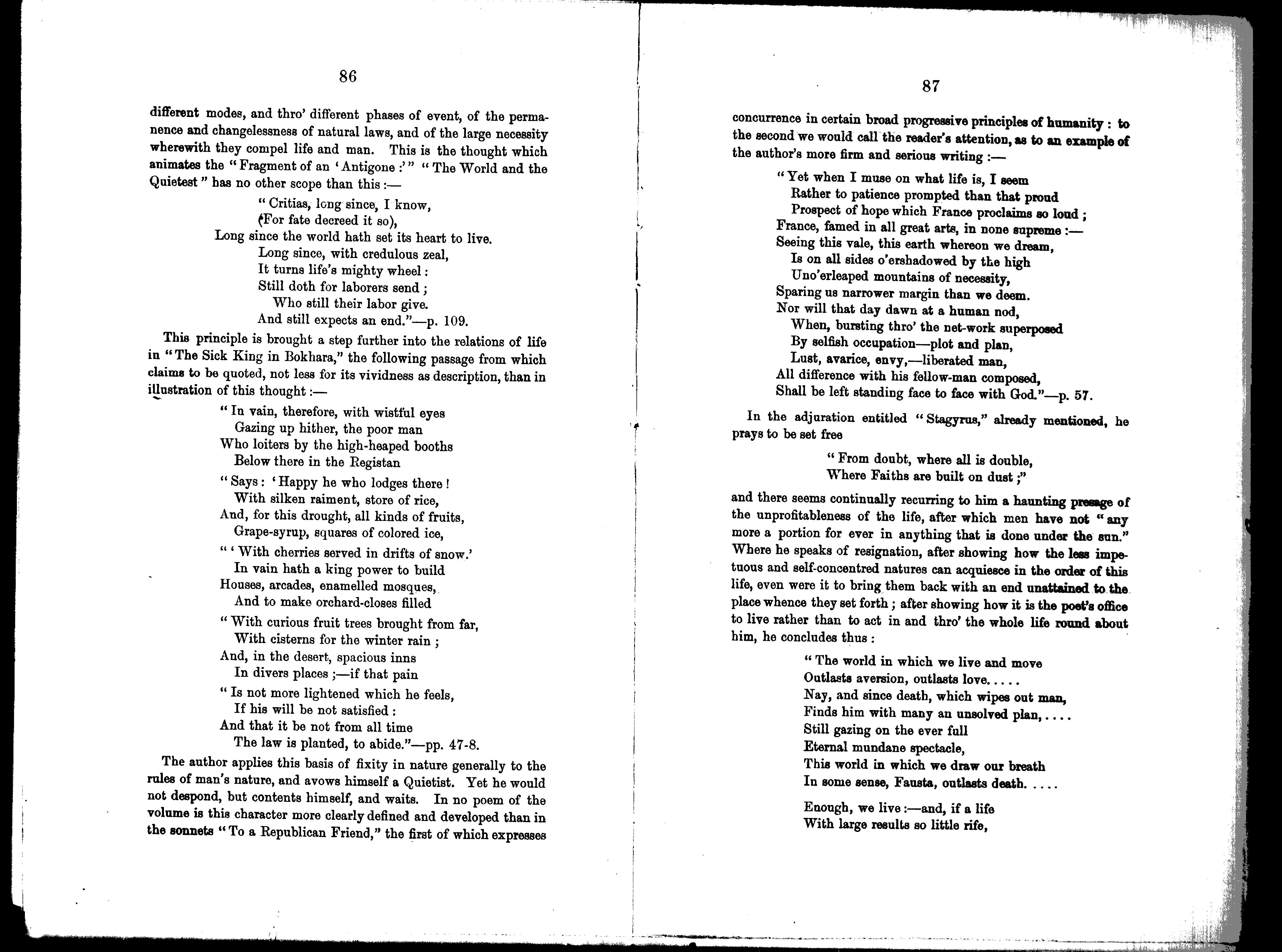
different modes, and thro' different phases of event, of the perma-
nence and changelessness of natural laws, and of the large necessity
wherewith they compel life and man. This is the thought which
animates the “Fragment of an ‘Antigone:’”“The World and the
Quietest” has no other scope than this:—
- “Critias, long since, I know,
- (For fate decreed it so),
- Long since the world hath set its heart to live.
- Long since, with credulous zeal,
- It turns life's mighty wheel:
- Still doth for laborers send;
- Who still their labor give.
- And still expects an end.”—p. 109.
in “The Sick King in Bokhara,” the following passage from which
claims to be quoted, not less for its vividness as description, than in
illustration of this thought:—
- “In vain, therefore, with wistful eyes
- Gazing up hither, the poor man
- Who loiters by the high-heaped booths
- Below there in the Registan
- “Says: ‘Happy he who lodges there!
- With silken raiment, store of rice,
- And, for this drought, all kinds of fruits,
- Grape-syrup, squares of colored ice,
- “‘With cherries served in drifts of snow.’
- 10In vain hath a king power to build
- Houses, arcades, enamelled mosques,
- And to make orchard-closes filled
- “With curious fruit trees brought from far,
- With cisterns for the winter rain;
- And, in the desert, spacious inns
- In divers places;—if that pain
- “Is not more lightened which he feels,
- If his will be not satisfied:
- And that it be not from all time
- 20The law is planted, to abide.”—pp. 47-8.
rules of man's nature, and avow himself a Quietist. Yet he would
not despond, but contents himself, and waits. In no poem of the
volume is this character more clearly defined and developed than in
the sonnets “To a Republican Friend,” the first of which expresses concurrence in certain broad progressive principles of humanity: to
the second we would call the reader's attention, as to an example of
the author's more firm and serious writing:—
- “Yet when I muse on what life is, I seem
- Rather to patience prompted than that proud
- Prospect of hope which France proclaims so loud;
- France, famed in all great arts, in none supreme:—
- Seeing this vale, this earth whereon we dream,
- Is on all sides o'ershadowed by the high
- Uno'erleaped mountains of necessity,
- Sparing us narrower margin than we deem.
- Nor will that day dawn at a human nod,
- 10When, bursting thro' the net-work superposed
- By selfish occupation—plot and plan,
- Lust, avarice, envy,—liberated man,
- All difference with his fellow-man composed,
- Shall be left standing face to face with God.”—p. 57.
prays to be set free
- “From doubt, where all is double,
- Where Faiths are built on dust;”
and there seems continually recurring to him a haunting presage of
the unprofitableness of the life, after which men have not “any
more a portion for ever in anything that is done under the sun.”
Where he speaks of resignation, after showing how the less impe-
tuous and self-concentred natures can acquiesce in the order of this
life, even were it to bring them back with an end unattained to the
place whence they set forth; after showing how it is the poet's office
to live rather than to act in and thro' the whole life round about
him, he concludes thus:
- “The world in which we live and move
- Outlasts aversion, outlasts love.....
- Nay, and since death, which wipes out man,
- Finds him with many an unsolved plan,....
- Still gazing on the ever full
- Eternal mundane spectacle,
- This world in which we draw our breath
- In some sense, Fausta, outlasts death.....
- Enough, we live:—and, if a life
- 10With large results so little rife,
- Tho' bearable, seem scarcely worth
- This pomp of worlds, this pain of birth,
- Yet, Fausta, the mute turf we tread,
- The solemn hills around us spread,
- This stream that falls incessantly,
- The strange-scrawled rocks, the lonely sky,
- If I might lend their life a voice,
- Seem to bear rather than rejoice.
- And, even could the intemperate prayer
- 20Man iterates, while these forbear,
- For movement, for an ampler sphere,
- Pierce fate's impenetrable ear,
- Not milder is the general lot
- Because our spirits have forgot,
- In actions's dizzying eddy whirled,
- The something that infects the world.”—pp. 125-8.—
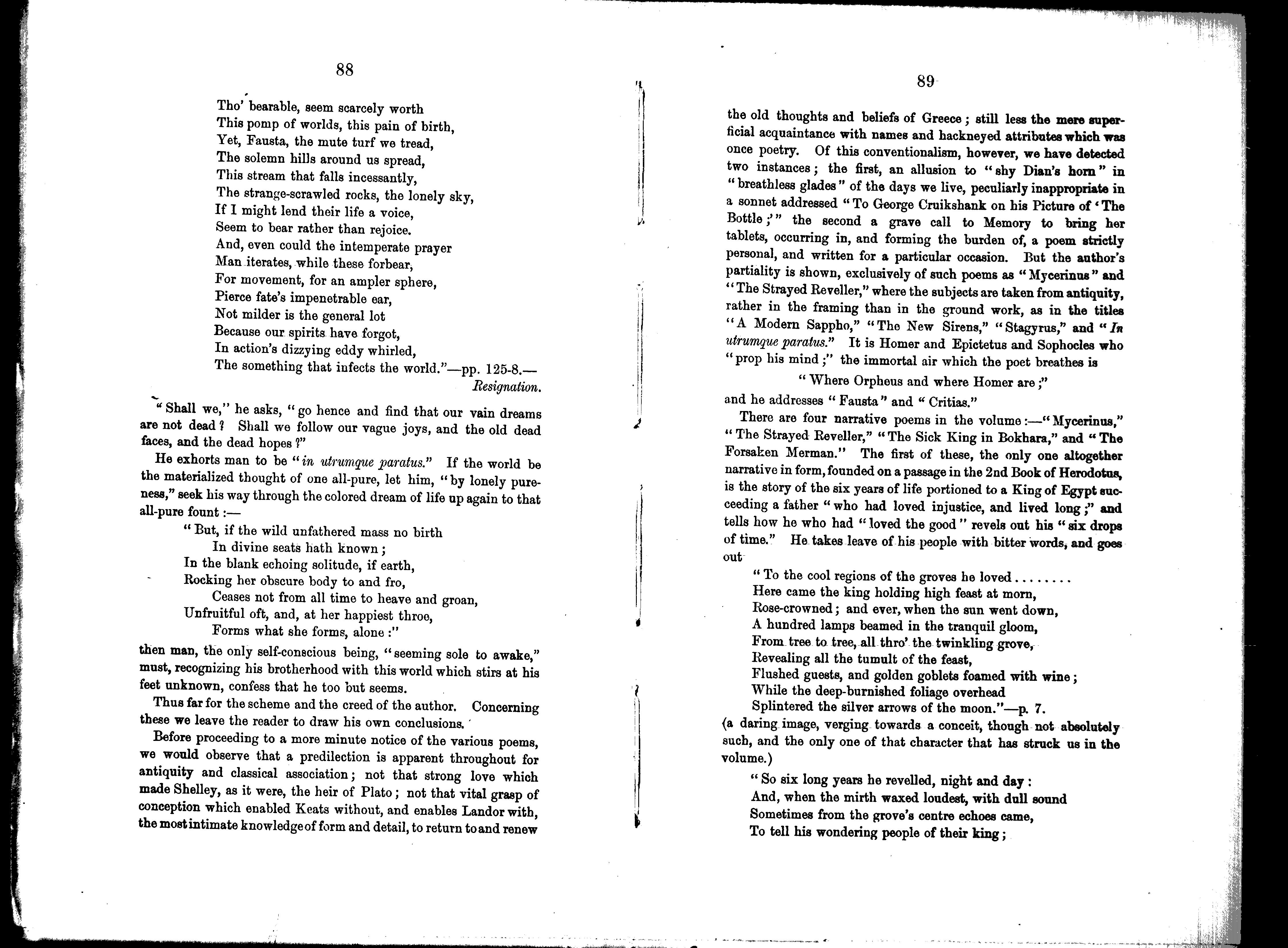
are not dead? Shall we follow our vague joys, and the old dead
faces, and the dead hopes?”
the materialized thought of one all-pure, let him, “by lonely pure-
ness,” seek his way through the colored dream of life up again to that
all-pure fount:—
- “But, if the wild unfathered mass no birth
- In divine seats hath known;
- In the blank echoing solitude, if earth,
- Rocking her obscure body to and fro,
- Ceases not from all time to heave and groan,
- Unfruitful oft, and, at her happiest throe,
- Forms what she forms, alone:”
then man, the only self-conscious being, “seeming sole to awake,”
must, recognizing his brotherhood with this world which stirs at his
feet unknown, confess that he too but seems.
these we leave the reader to draw his own conclusions.
we would observe that a predilection is apparent throughout for
antiquity and classical association; not that strong love which
made Shelley, as it were, the heir of Plato; not that vital grasp of
conception which enabled Keats without, and enables Landor with,
the most intimate knowledge of form and detail, to return to and renew the old thoughts and beliefs of Greece; still less the mere super-
ficial acquaintance with names and hackneyed attributes which was
once poetry. Of this conventionalism, however, we have detected
two instances; the first, an allusion to “shy Dian's horn” in
“breathless glades” of the days we live, peculiarly inappropriate in
a sonnet addressed “To George Cruikshank on his Picture of ‘The
Bottle;’” the second a grave call to Memory to bring her
tablets, occurring in, and forming the burden of, a poem strictly
personal, and written for a particular occasion. But the author's
partiality is shown, exclusively of such poems as “Mycerinus” and
“The Strayed Reveller,” where the subjects are taken from antiquity,
rather in the framing than in the ground work, as in the titles
“A Modern Sappho,” “The New Sirens,” “Stagyrus,” and “ In
utrumque paratus .” It is Homer and Epictetus and Sophocles who
“prop his mind;” the immortal air which the poet breathes is
“Where Orpheus and where Homer are;”
and he addresses “Fausta” and “Critias.”
“The Strayed Reveller,” “The Sick King in Bokhara,” and “The
Forsaken Merman.” The first of these, the only one altogether
narrative in form, founded on a passage in the 2nd Book of Herodotus,
is the story of the six years of life portioned to a King of Egypt suc-
ceeding a father “who had loved injustice, and lived long;” and
tells how he who had “loved the good” revels out his “six drops
of time.” He takes leave of his people with bitter words, and goes
out
- “To the cool regions of the groves he loved........
- Here came the king holding high feast at morn,
- Rose-crowned; and ever, when the sun went down,
- A hundred lamps beamed in the tranquil gloom,
- From tree to tree, all thro' the twinkling grove,
- Revealing all the tumult of the feast,
- Flushed guests, and golden goblets foamed with wine;
- While the deep-burnished foliage overhead
- Splintered the silver arrows of the moon.”—p. 7.
such, and the only one of that character that has struck us in the
volume.)
- “So six long years he revelled, night and day:
- And, when the mirth waxed loudest, with dull sound
- Sometimes from the grove's centre echoes came,
- To tell his wondering people of their king;
- In the still night, across the steaming flats,
- Mixed with the murmur of the moving Nile.”—pp. 8, 9.
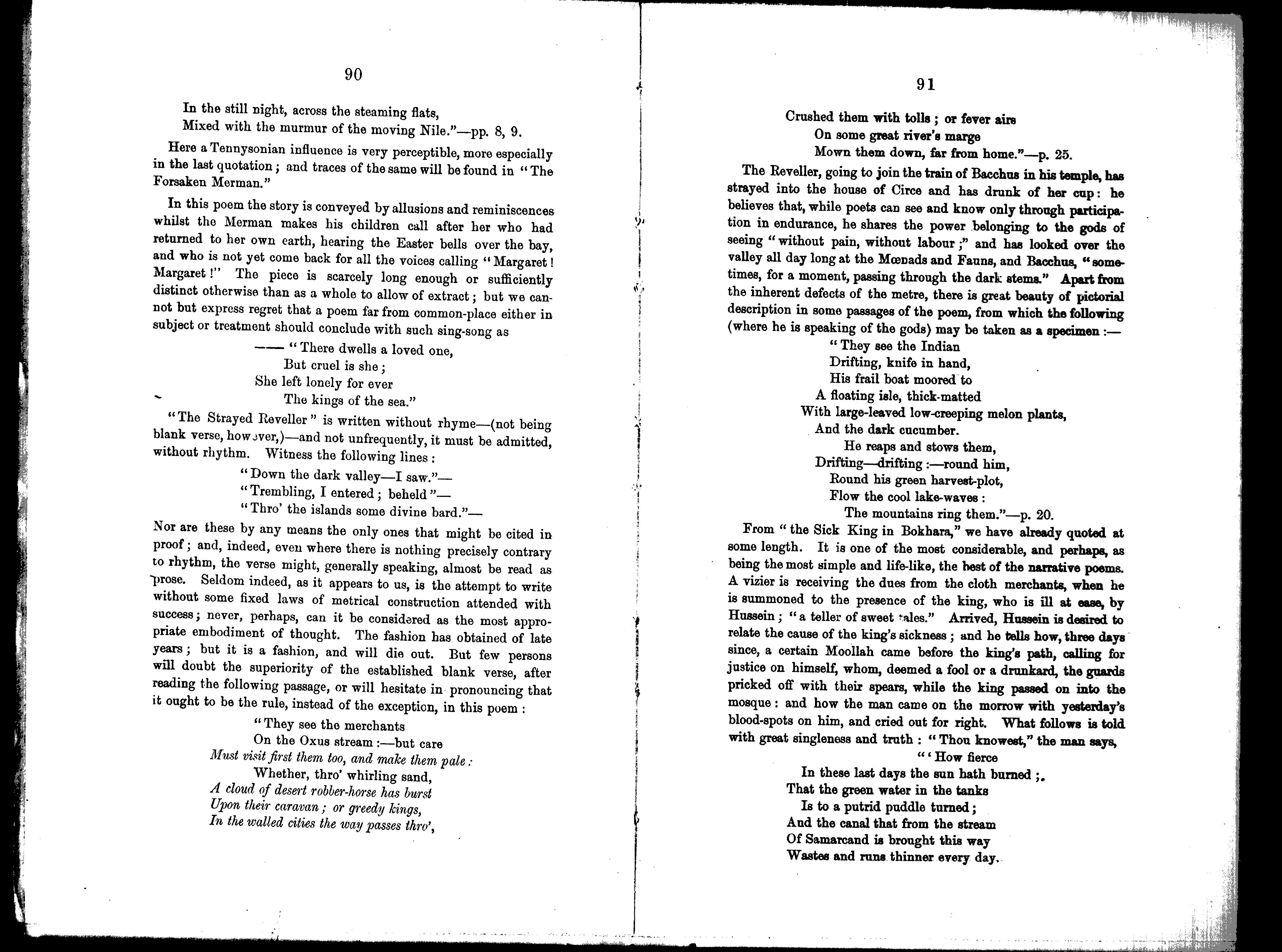
in the last quotation; and traces of the same will be found in “The
Forsaken Merman.”
whilst the Merman makes his children call after her who had
returned to her own earth, hearing the Easter bells over the bay,
and who is not yet come back for all the voices calling “Margaret!
Margaret!” The piece is scarcely long enough or sufficiently
distinct otherwise than as a whole to allow of extract; but we can-
not but express regret that a poem far from common-place either in
ubject or treatment should conclude with such sing-song as
- — ——“There dwells a loved one,
- But cruel is she;
- She left lonely for ever
- The kings of the sea.”
blank verse, however,)—and not unfrequently, it must be admitted,
without rhythm. Witness the following lines:
- “Down the dark valley—I saw.”—
- “Trembling, I entered; beheld”—
- “Thro' the islands some divine bard.”—
Nor are these by any means the only ones that might be cited in
proof; and, indeed, even where there is nothing precisely contrary
to rhythm, the verse might, generally speaking, almost be read as
prose. Seldom indeed, as it appears to us, is the attempt to write
without some fixed laws of metrical construction attended with
success; never, perhaps, can it be considered as the most appro-
priate embodiment of thought. The fashion has obtained of late
years; but it is a fashion, and will die out. But few persons
will doubt the superiority of the established blank verse, after
reading the following passage, or will hesitate in pronouncing that
it ought to be the rule, instead of the exception, in this poem:
- “They see the merchants
- On the Oxus stream:—but care
- Must visit first them too, and make them pale:
- Whether, thro' whirling sand,
- A cloud of desert robber-horse has burst
- Upon their caravan; or greedy kings,
- In the walled cities the way passes thro',
- Crushed them with tolls; or fever airs
- On some great river's marge
- 10Mown them down, far from home.”—p. 25.
strayed into the house of Circe and has drunk of her cup: he
believes that, while poets can see and know only through participa-
tion in endurance, he shares the power belonging to the gods of
seeing “without pain, without labour;” and has looked over the
valley all day long at the Mœnads and Fauns, and Bacchus, “some-
times, for a moment, passing through the dark stems.” Apart from
the inherent defects of the metre, there is great beauty of pictorial
description in some passages of the poem, from which the following
(where he is speaking of the gods) may be taken as a specimen:—
- “They see the Indian
- Drifting, knife in hand,
- His frail boat moored to
- A floating isle, thick-matted
- With large-leaved low-creeping melon plants,
- And the dark cucumber.
- He reaps and stows them,
- Drifting—drifting:—round him,
- Round his green harvest-plot,
- 10Flow the cool lake-waves:
- The mountains ring them.”—p. 20.
some length. It is one of the most considerable, and perhaps, as
being the most simple and life-like, the best of the narrative poems.
A vizier is receiving the dues from the cloth merchants, when he
is summoned to the presence of the king, who is ill at ease, by
Hussein: “a teller of sweet tales.” Arrived, Hussein is desired to
relate the cause of the king's sickness; and he tells how, three days
since, a certain Moollah came before the king's path, calling for
justice on himself, whom, deemed a fool or a drunkard, the guards
pricked off with their spears, while the king passed on into the
mosque: and how the man came on the morrow with yesterday's
blood-spots on him, and cried out for right. What follows is told
with great singleness and truth: “Thou knowest,” the man says,
- “‘How fierce
- In these last day the sun hath burned;
- That the green water in the tanks
- Is to a putrid puddle turned;
- And the canal that from the stream
- Of Samarcand is brought this way
- Wastes and runs thinner every day.
- “‘Now I at nightfall had gone forth
- Alone; and, in a darksome place
- 10Under some mulberry-trees, I found
- A little pool; and, in brief space,
- With all the water that was there
- I filled my pitcher, and stole home
- Unseen; and, having drink to spare,
- I hid the can behind the door,
- And went up on the roof to sleep.
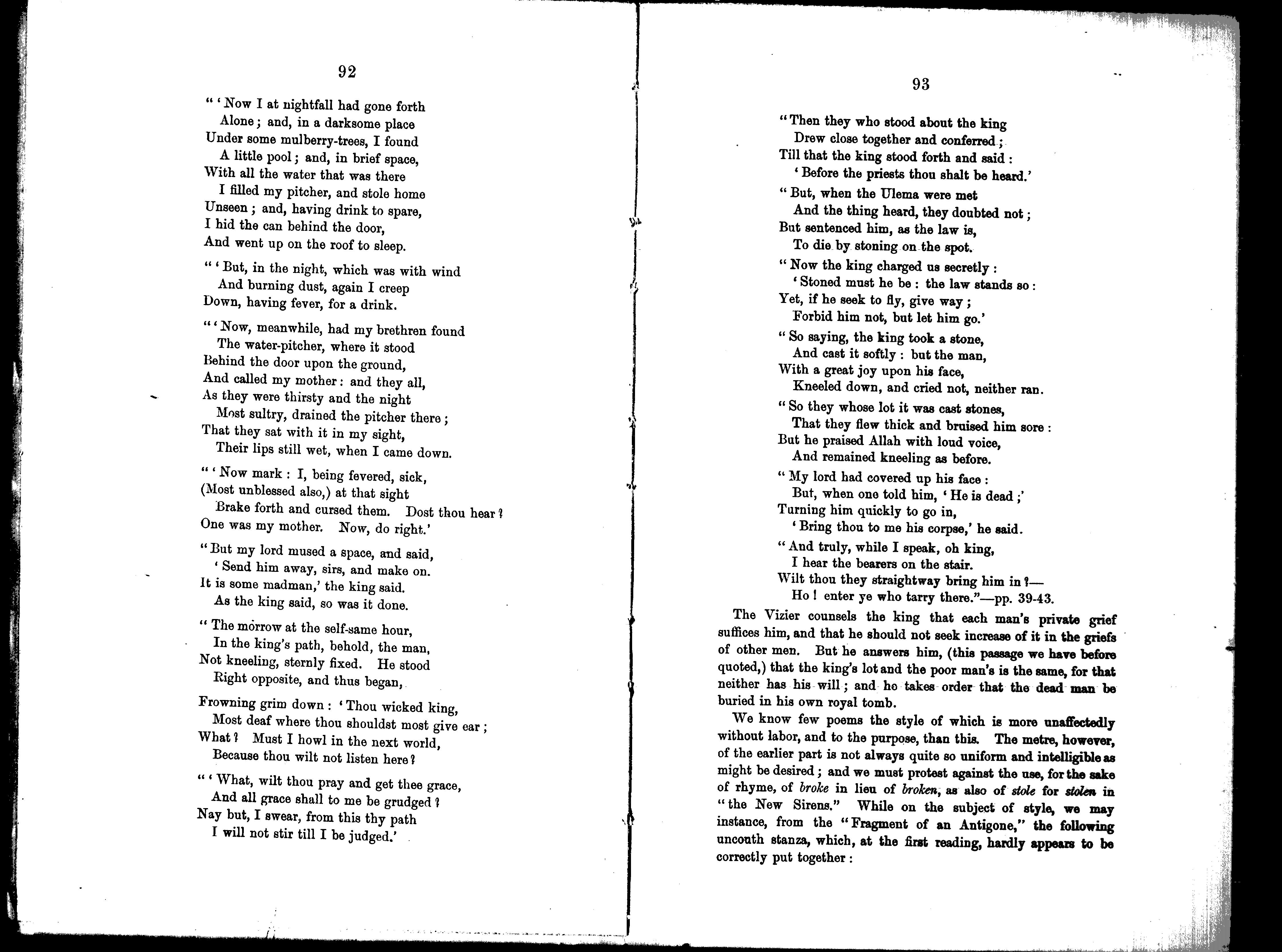
- “‘But, in the night, which was with wind
- And burning dust, again I creep
- Down, having fever, for a drink.
- 20“‘Now, meanwhile, had my brethren found
- The water-pitcher, where it stood
- Behind the door upon the ground,
- And called my mother: and they all,
- As they were thirsty and the night
- Most sultry, drained the pitcher there;
- That they sat with it in my sight,
- Their lips still wet, when I came down.
- “‘Now mark: I, being fevered, sick,
- (Most unblessed also,) at that sight
- 30Brake forth and cursed them. Dost thou hear?
- One was my mother. Now, do right.’
- “But my lord mused a space, and said,
- ‘Send him away, sirs, and make on.
- It is some madman,’ the king said.
- As the king said, so was it done.
- “The morrow at the self-same hour,
- In the king's path, behold, the man,
- Not kneeling, sternly fixed. He stood
- Right opposite, and thus began,
- 40Frowning grim down: ‘Thou wicked king,
- Most deaf where thou shouldst most give ear;
- What? Must I howl in the next world,
- Because thou wilt not listen here?
- “‘What, wilt thou pray and get thee grace,
- And all grace shall to me be grudged?
- Nay but, I swear, from this thy path
- I will not stir till I be judged.’
- “Then they who stood about the king
- Drew close together and conferred;
- 50Till that the king stood forth and said:
- ‘Before the priests thou shalt be heard.’
- “But, when the Ulema were met
- And the thing heard, they doubted not;
- But sentenced him, as the law is,
- To die by stoning on the spot.
- “Now the king charged us secretly:
- ‘Stoned must he be: the law stands so:
- Yet, if he seek to fly, give way;
- Forbid him not, but let him go.’
- 60“So saying, the king took a stone,
- And cast it softly: but the man,
- With a great joy upon his face,
- Kneeled down, and cried not, neither ran.
- “So they whose lot it was cast stones,
- That they flew thick and bruised him sore:
- But he praised Allah with loud voice,
- And remained kneeling as before.
- “My lord had covered up his face:
- But, when one told him, ‘He is dead;’
- 70Turning him quickly to go in,
- ‘Bring thou to me his corpse,’ he said.
- “And truly, while I speak, oh king,
- I hear the bearers on the stair.
- Wilt thou they straightway bring him in?—
- Ho! enter ye who tarry there.”—pp. 39-43.
suffices him, and that he should not seek increase of it in the griefs
of other men. But he answers him, (this passage we have before
quoted,) that the king's lot and the poor man's is the same, for that
neither has his will; and he takes order that the dead man be
buried in his own royal tomb.
without labor, and to the purpose, than this. The metre, however,
of the earlier part is not always quite so uniform and intelligible as
might be desired; and we must protest against the use, for the sake
of rhyme, of broke in lieu of broken, as also of stole for stolen in
“the New Sirens.” While on the subject of style, we may
instance, from the “Fragment of an Antigone,” the following
uncouth stanza, which, at the first reading, hardly appears to be
correctly put together:
- “But hush! Hœmon, whom Antigone,
- Robbing herself of life in burying,
- Against Creon's laws, Polynices,
- Robs of a loved bride, pale, imploring,
- Waiting her passage,
- Forth from the palace hitherward comes.”—p. 30.
is “The New Sirens.” The author addresses, in imagination, a
company of fair women, one of whose train he had been at morning;
but in the evening he has dreamed under the cedar shade, and seen
the same forms “on shores and sea-washed places,”
“With blown tresses, and with beckoning hands.”
between the vines; but now their warm locks have fallen down
over their arms. He prays them to speak and shame away his
sadness; but there comes only a broken gleaming from their
windows, which
“Reels and shivers on the ruffled gloom.”
He asks them whether they have seen the end of all this, the load
of passion and the emptiness of reaction, whether they dare look at
life's latter days,
- “When a dreary light is wading
- Thro' this waste of sunless greens,
- When the flashing lights are fading
- On the peerless cheek of queens,
- When the mean shall no more sorrow,
- And the proudest no more smile;
- While the dawning of the morrow
- Widens slowly westward all that while?”
And he implores them to “let fall one tear, and set him free.” The
past was no mere pretence; it was true while it lasted; but it is
gone now, and the East is white with day. Shall they meet again,
only that he may ask whose blank face that is?
- “Pluck, pluck cypress, oh pale maidens;
- Dusk the hall with yew.”
difficult to select particular passages for extraction, but such
extracts, if made, would fail in producing any adequate impression.
“Resignation,” that it may here be necessary to say only that it is
in the form of speech held with “Fausta” in retracing, after a lapse
of ten years, the same way they had once trod with a joyful company. The tone is calm and sustained, not without touches of
familiar truth.
“To the Duke of Wellington, on hearing him mispraised,” and on
“Religious Isolation,” deserve mention; and it is with pleasure we
find one, in the tenor of strong appreciation, written on reading the
Essays of the great American, Emerson. The sonnet for “Butler's
Sermons” is more indistinct, and, as such, less to be approved, in
imagery than is usual with this poet. That “To an Independent
Preacher who preached that we should be in harmony with
nature,” seems to call for some remark. The sonnet ends with
these words:
- “Man must begin, know this, where nature ends;
- Nature and man can never be fast friends;
- Fool, if thou canst not pass her, rest her slave.”
sioned it, we cannot see anything so absurd in that discourse; and
where the author confutes the Independent preacher by arguing that
- “Nature is cruel ; man is sick of blood:
- Nature is stubborn ; man would fain adore:
- Nature is fickle ; man hath need of rest:”
we cannot but think that, by attributing to nature a certain human
degree of qualities, which will not suffice for man, he loses sight of
the point really raised: for is not man's nature only a part of
nature? and, if a part, necessary to the completeness of the whole?
and should not the individual, avoiding a factitious life, order him-
self in conformity with his own rule of being? And, indeed, the
author himself would converse with the self-sufficing progress of
nature, with its rest in action, as distinguished from the troublous
vexation of man's toiling:—
- “Two lessons, Nature, let me learn of thee,
- Two lessons that in every wind are blown;
- Two blending duties harmonised in one,
- Tho' the loud world proclaim their enmity.”—p. 1.
in it. & “The Hayswater Boat” seems a little got up, and is scarcely
positive enough. This remark applies also, and in a stonger degree,
to the “Stanzas on a Gipsy Child,” which, and the “Modern Sappho,”
previously mentioned, are the pieces least to our taste in the volume.
There is a something about them of drawing-room sentimentality;
and they might almost, without losing much save in size, be com-
pressed into poems of the class commonly set to music. It is
rather the basis of thought than the writing of the “Gipsy Child,” which affords cause for objection; nevertheless, there is a passage
in which a comparison is started between this child and a “Seraph
in an alien planet born,”—an idea not new, and never, as we think,
worth much; for it might require some subtlety to show how a
planet capable of producing a Seraph should be alien from that
Seraph.
of expression, to be met with in these pages; a point of style to be
particularly looked to when the occurrence or the absence of such
forms one very sensible difference between the first-rate and the
second-rate poets of the present times.
- “All pains the immortal spirit must endure,
- All weakness that impairs, all griefs that bow,
- Find their sole voice in that victorious brow;”
whereas a brow's voice remains to be uttered: nor, till the
nature of the victory gained by the brow shall have been pointed
out, are we able to hazard an opinion of the precise value of the
epithet.
hand with horror winged;” where a similar question arises; and,
returning to the “Gipsy Child,” we are struck with the unmeaning-
ness of the line:
“Who massed round that slight brow these clouds of doom?”
Republican Friend,” appear reconcileable with any ideas of ap-
propriateness:
- ——“While before me flow
- The armies of the homeless and unfed.”
remember throughout the volume have now been mentioned.
this Poet's style: it is clear and comprehensive, and eschews flowery
adornment. No particular model has been followed, though that
general influence which Tennyson exercises over so many writers of
this generation may be traced here as elsewhere. It may be said
that the author has little, if anything, to unlearn. Care and con-
sistent arrangement, and the necessary subordination of the parts to
the whole, are evident throughout; the reflective, which appears the
more essential form of his thought, does not absorb the due obser-
vation or presentment of the outward facts of nature; and a well-
poised and serious mind shows itself in every page.
50, REGENT STREET.
CITY BRANCH: 2, ROYAL EXCHANGE BUILDINGS.
![Image of page [x2]](http://www.rossettiarchive.org/img/ap4.g415.1901.v3i.jpg)
written upon the principles of Art, (of course excepting that
on the mere mechanism), a very small portion is by Artists
themselves; and that is so scattered, that one scarcely knows
where to find the ideas of an Artist except in his pictures.
as evolved in Art, in another language besides their own
proper one, this Periodical has been established. Thus, then,
it is not open to the conflicting opinions of all who handle the
brush and palette, nor is it restricted to actual practitioners;
but is intended to enunciate the principles of those who, in
the true spirit of Art, enforce a rigid adherence to the sim-
plicity of Nature either in Art or Poetry, and consequently
regardless whether emanating from practical Artists, or from
those who have studied nature in the Artist's School.
or verse), Poems, Essays, and the like, as may seem conceived
in the spirit, or with the intent, of exhibiting a pure and
unaffected style, to which purpose analytical Reviews of
current Literature—especially Poetry—will be introduced;
as also illustrative Etchings, one of which latter, executed
with the utmost care and completeness, will appear in each
number.