Rossetti Archive Textual Transcription
The full Rossetti Archive record for this transcribed document is available.
![Image of page [i]](http://www.rossettiarchive.org/img/ap4.g415.1.v4.titlepages.jpg)
MAY, 1850
With an Etching by W. H. Deverell
Art and Poetry:
Being Thoughts towards Nature
Conducted principally by Artists.

- When whoso merely hath a little thought
- Will plainly think the thought which is in him,—
- Not imaging another's bright or dim,
- Not mangling with new words what others taught;
- When whoso speaks, from having either sought
- Or only found,—will speak, not just to skim
- A shallow surface with words made and trim,
- But in that very speech the matter brought:
- Be not too keen to cry—“So this is all!—
- 10A thing I might myself have thought as well,
- But would not say it, for it was not worth!”
- Ask: “Is this truth?” For is it still to tell
- That, be the theme a point or the whole earth,
- Truth is a circle, perfect, great or small?
London:
DICKINSON & Co., 114, NEW BOND STREET,
and
AYLOTT & JONES, 8, PATERNOSTER ROW.
G. F. Tupper, Printer, Clement's Lane. Lombard Street.
![Image of page [ii]](http://www.rossettiarchive.org/img/thumbs_small/ap4.g415.1.v4.tableofcontents.jpg)
- Etching.—Viola and Olivia.
- Viola and Olivia ... J.L. Tupper ......................................... 145
- A Dialogue.— John Orchard ................................. 146
- On a Whit-sunday Morn in the Month of May.— John Orchard .. 167
- Modern Giants.— Laura Savage F.G. Stephens.............................. 169
- To the Castle Ramparts— W.M. Rossetti ..................... 173
- Pax Vobis.— Dante G. Rossetti ............................. 176
- A Modern Idyl.— Walter H. Deverell ........................ 177
- “Jesus Wept.”— W.M. Rossetti .............................. 179
- Sonnets for Pictures.— Dante G. Rossetti .................. 180
- Papers of “The M. S. Society,” J.L. Tupper No IV. Smoke ................. 183
- No. V. Rain .................. 186
- Review: Christmas Eve and Easter Day.— W.M.Rossetti ....... 187
- The Evil under the Sun .......... D o ............................ 192
that the future Numbers will appear on the last day of the
Month for which they are dated. Also, that a supplementary,
or large-sized Etching will occasionally be given.
![Image of page [iv]](http://www.rossettiarchive.org/img/thumbs_small/ap4.g415.1.etching-145.jpg)
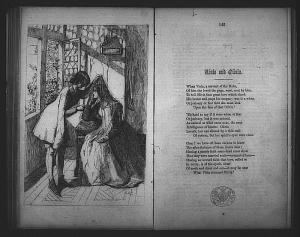
- When Viola, a servant of the Duke,
- Of him she loved the page, went, sent by him,
- To tell Olivia that great love which shook
- His breast and stopt his tongue; was it a whim,
- Or jealousy or fear that she must look
- Upon the face of that Olivia?
- 'Tis hard to say if it were whim or fear
- Or jealousy, but it was natural,
- As natural as what came next, the near
- 10Intelligence of hearts: Olivia
- Loveth, her eye abused by a thin wall
- Of custom, but her spirit's eyes were clear.
- Clear? we have oft been curious to know
- The after-fortunes of those lovers dear;
- Having a steady faith some deed must show
- That they were married souls—unmarried here—
- Having an inward faith that love, called so
- In verity, is of the spirit, clear
- Of earth and dress and sex—it may be near
- 20What Viola returned Olivia?
scarcely more than a week before its author, Mr. John Orchard, died. It was
written to commence a series of “Dialogues on Art,” which death has rendered
for ever incomplete: nevertheless, the merits of this commencement are such that
they seemed to warrant its publication as a fragment; and in order that the
chain of argument might be preserved, so far as it goes, uninterrupted, the
dialogue is printed entire in the present number, despite its length. Of the
writer, but little can be said. He was an artist; but ill health, almost amounting
to infirmity—his portion from childhood—rendered him unequal to the bodily
labour inseparable from his profession: and in the course of his short life, whose
youth was scarcely consummated, he exhibited, from time to time, only a very few
small pictures, and these, as regards public recognition, in no way successfully.
In art, however, he gave to the “seeing eye,” token of that ability and earnest-
ness which the “hearing ear” will not fail to recognize in the dialogue now
published; where the vehicle of expression, being more purely intellectual, was
more within his grasp than was the physical and toilsome embodiment of art.
few other fugitive pieces, which will, in such event, as the Poem succeeding this
Dialogue, be published in these pages.
understood and appreciated, we subjoin, in his own words, some explanation of
his further intent, and of the views and feelings which guided him in the
composition of the dialogue:
1st, because it gives the writer the power of exhibiting the question, Art, on all
its sides; 2nd, because the great phases of Art could be represented idio-
syncratically; and, to make this clear, I have named the several speakers ac-
cordingly; 3rd, because dialogue secures the attention; and, that secured, deeper
things strike, and go deeper than otherwise they could be made to; and, 4th and
last, because all my earliest and most delightful pleasures associate themselves
with dialogue,—(the old dramatists, Lucian, Walter Savage Landor, &c.)
another to condemn it; but that I make each one utter his wisest in the very
wisest manner he can, or rather, that I can for him.
and its processes, invention and imitation, imitation chiefly. Kosmon begins
by showing, in illustration of the truth of Christian's concluding sentences, how
imperfectly all the Ancients, excepting the Hebrews, loved, understood, or felt
Nature, &c. This is not an unimportant portion of Art knowledge.
Christian when they discourse of imitation. It properly belongs to imitation;
and, under that head, it can be most effectively and perfectly confuted. Somewhat
after this idea, the “verticalism” and “involution” will be shown to be direct
from Nature; the gilding, &c., disposed of on the ground of the old piety using
the most precious materials as the most religious and worthy of them; and hence,
by a very easy and probable transition, they concluded that that which was most
soul-worthy, was also most natural.”]
is the first day of spring. May it be the herald of a bountiful year,
—not alone in harvests of seeds. Great impulses are moving through
man; swift as the steam-shot shuttle, weaving some mighty pattern,
goes the new birth of mind. As yet, hidden from eyes is the design:
whether it be poetry, or painting, or music, or architecture, or
whether it be a divine harmony of all, no manner of mind can tell;
but that it is mighty, all manners of minds, moved to involuntary
utterance, affirm. The intellect has at last again got to work upon
thought: too long fascinated by matter and prisoned to motive
geometry, genius—wisdom seem once more to have become human,
to have put on man, and to speak with divine simplicity. Kosmon,
Sophon, again welcome! your journey is well-timed; Christian, my
young friend, of whom I have often written to you, this morning
tells me by letter that to-day he will pay me his long-promised visit.
You, I know, must rejoice to meet him: this interchange of knowledge
cannot fail to improve us, both by knocking down and building up:
what is true we shall hold in common; what is false not less in
common detest. The debateable ground, if at last equally debateable
as it was at first, is yet ploughed; and some after-comer may sow it
with seed, and reap therefrom a plentiful harvest.
diamond with innumerable facets, each one alike brilliant and
piercing. Your information respecting your friend Christian has not
a little interested me, and made me desirous of knowing him.
we shall both see and taste your friend.
think a dearth of original thought in the world, at any time, was an
evil: perhaps it is not so; nay, perhaps, it is a good! Is not an
interregnum of genius necessary somewhere ? A great genius, sun-
like, compels lesser suns to gravitate with and to him; and this is
subversive of originality. Age is as visible in thought as it is in
man. Death is indispensably requisite for a new life. Genius is like
a tree, sheltering and affording support to numberless creepers and
climbers, which latter die and live many times before their protecting
tree does; flourishing even whilst that decays, and thus, lending to
it a greenness not its own; but no new life can come out of that expiring tree; it must die: and it is not until it is dead, and fallen,
and rotted into compost, that another tree can grow there; and many
years will elapse before the new birth can increase and occupy the
room the previous one occupied, and flourish anew with a greenness
all its own. This on one side. On another; genius is essentially
imitative, or rather, as I just now said, gravitative; it gravitates
towards that point peculiarly important at the moment of its exist–
ence; as air, more rarified in some places than in others, causes the
winds to rush towards them as toward a centre: so that if poetry,
painting, or music slumbers, oratory may ravish the world, or
chemistry, or steam-power may seduce and rule, or the sciences sit
enthroned. Thus, nature ever compensates one art with another;
her balance alone is the always just one; for, like her course of the
seasons, she grows, ripens, and lies fallow, only that stronger, larger
and better food may be reared.
and sciences, as periodically ruling the world along with poetry,
painting, and music,—am I to understand that you deem them powers
intellectually equal, and to require of their respective professors as
mighty, original, and human a genius for their successful practice?
human?—nay, are they not—especially steam-power, chemistry and
the electric telegraph—more—eminently more—useful to man, more
radically civilizers, than music, poetry, painting, sculpture, or
architecture?
mistry and the mechanical arts and sciences, and between poetry,
painting, and music, there exists the whole totality of genius—of
genius as distinguished from talent and industry. To be useful alone
is not to be great: plus only is plus, and the sum is minus something
and plus in nothing if the most unimaginable particle only be absent.
The fine arts, poetry, painting, sculpture, music, and architecture, as
thought, or idea, Athene-like, are complete, finished, revelations of
wisdom at once. Not so the mechanical arts and sciences: they are
arts of growth; they are shaped and formed gradually, (and that,
more by a blind sort of guessing than by intuition,) and take many
men's lives to win even to one true principle. On all sides they are
the exact opposites of each other; for, in the former, the principles
from the first are mature, and only the manipulation immature; in the
latter, it is the principles that are almost always immature, and the
manipulation as constantly mature. The fine arts are always grounded
upon truth; the mechanical arts and sciences almost always upon
hypothesis; the first are unconfined, infinite, immaterial, impossible of reduction into formulas, or of conversion into machines; the last
are limited, finite, material, can be uttered through formulas, worked
by arithmetic, tabulated and seen in machines.
the beautiful and good, to the good without the beautiful; and you,
who love nature, and regard all that she, and what man from her, can
produce, with equal delight,—true to your's,—cannot perceive
wherefore he limits genius to the fine arts. Let me show you why
Kalon's ideas are truer than yours. You say that chemistry, steam-
power, and the electric telegraph, are more radically civilizers than
poetry, painting, or music: but bethink you: what emotions beyond
the common and selfish ones of wonder and fear do the mechanical
arts or sciences excite, or communicate? what pity, or love, or other
holy and unselfish desires and aspirations, do they elicit? Inert of
themselves in all teachable things, they are the agents only whereby
teachable things,—the charities, sympathies and love,—may be more
swiftly and more certainly conveyed and diffused: and beyond
diffusing media the mechanical arts or sciences cannot get; for they
are merely simple facts; nothing more: they cannot induct; for they,
in or of themselves, have no inductive powers, and their office is
confined to that of carrying and spreading abroad the powers which
do induct; which powers make a full, complete, and visible existence
only in the fine arts. In fact and thought we have the whole
question of superiority decided. Fact is merely physical record:
Thought is the application of that record to something human.
Without application, the fact is only fact, and nothing more; the
application, thought, then, certainly must be superior to the record,
fact. Also in thought man gets the clearest glimpse he will ever
have of soul, and sees the incorporeal make the nearest approach to
the corporeal that it is possible for it to do here upon earth. And
hence, these noble acts of wisdom are—far—far above the mechanical
arts and sciences, and are properly called fine arts, because their high
and peculiar office is to refine.
ing from physical facts the sciences and mechanical arts as ever it is
in poetry, painting, or music. The act of inventing print, or of
applying steam, is quite as soul-like as the inventing of a picture,
poem, or statue.
think. But the things upon which they exercise their several faculties
are very widely unlike each other; the chemist or engineer cogitates
only the physical; the poet or painter joins to the physical the human,
and investigates soul—scans the world in man added to the world without him—takes in universal creation, its sights, sounds, aspects,
and ideas. Sophon says that the fine arts are thoughts; but I think
I know a more comprehensive word; for they are something more
than thoughts; they are things also; that word is nature—Nature
fully— thorough nature—the world of creation. All that is in man,
his mysteries of soul, his thoughts and emotions—deep, wise, holy,
loving, touching, and fearful,—or in the world, beautiful, vast,
ponderous, gloomy, and awful, moved with rhythmic harmonious
utterance— that is Poetry. All that is of man—his triumphs, glory,
power, and passions; or of the world—its sunshine and clouds, its
plains, hills or valleys, its wind-swept mountains and snowy Alps,
river and ocean—silent, lonely, severe, and sublime—mocked with
living colours, hue and tone, — that is Painting. Man—heroic man,
his acts, emotions, loves,—aspirative, tender, deep, and calm,—inten–
sified, purified, colourless,—exhibited peculiarly and directly through
his own form; that is sculpture. All the voices of nature—of man—
his bursts of rage, pity, and fear—his cries of joy—his sighs of love;
of the winds and the waters—tumultuous, hurrying, surging, tremu–
lous, or gently falling—married to melodious numbers; that is music.
And, the music of proportions—of nature and man, and the harmony
and opposition of light and shadow, set forth in the ponderous; that
is Architecture.
your dear fiends, Kosmon and Sophon. The moment of discoursing
with them has at last arrived: May I profit by it! Kalon, fearful
of checking your current of thought, I stood without, and heard that
which you said: and, though I agree with you in all your definitions
of poetry, painting, sculpture, music, and architecture; yet certainly
all things in or of man, or the world, are not, however equally
beautiful, equally worthy of being used by the artist. Fine art
absolutely rejects all impurities of form; not less absolutely does
it reject all impurities of passion and expression. Everything
throughout a poem, picture, or statue, or in music, may be sensuously
beautiful; but nothing must be sensually so. Sins are only paid for
in virtues; thus, every sin found is a virtue lost—lost—not only to
the artist, but a cause of loss to others—to all who look upon what
he does. He should deem his art a sacred treasure, intrusted to
him for the common good; and over it he should build, of the most
precious materials, in the simplest, chastest, and truest proportions,
a temple fit for universal worship: instead of which, it is too often
the case that he raises above it an edifice of clay; which, as mortal
as his life, falls, burying both it and himself under a heap of dirt.
To preserve him from this corruption of his art, let him erect for his guidance a standard awfully high above himself. Let him think
of Christ; and what he would not show to as pure a nature as His,
let him never be seduced to work on, or expose to the world.
and Satire hath got its death-stroke. The beautiful is not the beau–
tiful unless it is fettered to the moral; and Virtue rejects the physical
perfections, lest she should fall in love with herself, and sin and
cause sin.
innocent, chaste, unsensual,—whether Greek or satirical, is con–
demned: but everything—every picture, poem, statue, or piece of
music— which elicits the sensual, viceful, and unholy desires of
our nature—is, and that utterly. The beautiful was created the
true, morally as well as physically; vice is a deformment of virtue,—
not of form, to which it is a parasitical addition—an accretion which
can and must be excised before the beautiful can show itself as it was
originally made, morally as well as formally perfect. How we all
wish the sensual, indecent, and brutal, away from Hogarth, so that
we might show him to the purest virgin without fear or blushing.
though small in themselves, are yet large enough to taint the
whole body. And those impurities, like rank growths of vine, may
be lopped away without injuring any vital principle. In perfect
art the utmost purity of intention, design, and execution, alone is
wisdom. Every tree—every flower, in defiance of adverse contin–
gencies, grows with perfect will to be perfect: and, shall man, who
hath what they have not, a soul wherewith he may defy all ill, do
less?
where close round the pricks; not a single step may be taken in
advance without wounding something vital. Corruption strews thick
both earth and ocean; it is only the heavens that are pure, and man
cannot live upon manna alone.
and I mean. Neither he nor I wish nature to be used less, or
otherwise than as it appears; on the contrary, we wish it used
more—more directly. Nature itself is comparatively pure; all that
we desire is the removal of the factitious matter that the vice of
fashion, evil hearts, and infamous desires, graft upon it. It is not
simple innocent nature that we would exile, but the devilish and
libidinous corruptions that sully nature.
be but little of worth left in the world for the artist to use; for, if I understand you rightly, you object to his making use of any
passion, whether heroic, patriotic, or loving, that is not rigidly
virtuous.
Hogarth had. A picture, poem, or statue, unless it speaks some
purpose, is mere paint, paper, or stone. A work of art must have
a purpose, or it is not a work of fine art: thus, then, if it be a work
of fine art, it has a purpose; and, having purpose, it has either a
good or an evil one: there is no alternative. An artist's works are his
children, his immortal heirs, to his evil as well as to his good; as he
hath trained them, so will they teach. Let him ask himself why does
a parent so tenderly rear his children. Is it not because he knows
that evil is evil, whether it take the shape of angels or devils? And
is not the parent's example worthy of the artist's imitation? What
advantage has a man over a child? Is there any preservative pecu–
liar to manhood that it alone may see and touch sin, and yet be not
defiled? Verily, there is none! All mere battles, assassinations, im–
molations, horrible deaths, and terrible situations used by the artist
solely to excite,—every passion degrading to man's perfect nature,
—should certainly be rejected, and that unhesitatingly.
Art—true art—fine art — cannot be either coarse or low. Innocent-
like, no taint will cling to it, and a smock frock is as pure as “vir–
ginal-chaste robes.” And,—sensualism, indecency, and brutality,
excepted—sin is not sin, if not in the act; and, in satire, with the
same exceptions, even sin in the act is tolerated when used to point
forcibly a moral crime, or to warn society of a crying shame which
it can remedy.
not condemn the oak because of its apples; and, like them, the sin
in the poem, picture, or statue, may be a wormy accretion grafted
from without. The spectator often makes sin where the artist in–
tended none. For instance, in the nude,—where perhaps, the poet,
painter, or sculptor, imagines he has embodied only the purest and
chastest ideas and forms, the sensualist sees—what he wills to see;
and, serpent-like, previous to devouring his prey, he covers it with
his saliva.
clearest crystal or the coarsest clay, alike intoxicates and makes
beasts of men. Be assured that every nude figure or nudity intro–
duced in a poem, picture, or piece of sculpture, merely on physical
grounds, and only for effect, is vicious. And, where it is boldly
introduced and forms the central idea, it ought never to have a sense of its condition: it is not nudity that is sinful, but the figure's
knowledge of its nudity,(too surely communicated by it to the
spectator,) that makes it so. Eve and Adam before their fall were
not more utterly shameless than the artist ought to make his inven–
tions. The Turk believes that, at the judgment-day, every artist
will be compelled to furnish, from his own soul, soul for every one
of his creations. This thought is a noble one, and should thoroughly
awake poet, painter, and sculptor, to the awful responsibilities they
labour under. With regard to the sensualist,— who is omnivorous,
and swine-like, assimilates indifferently pure and impure, degrading
everything he hears or sees,—little can be said beyond this; that
for him, if the artist be without sin, he is not answerable. But in
this responsibility he has two rigid yet just judges, God and him–
self;—let him answer there before that tribunal. God will acquit
or condemn him only as he can acquit or condemn himself.
beautifully painted must kindle sensuality; and, described as beauti–
fully in poetry, it will do the like, almost, if not quite, as readily.
Sculpture is the only form of art in which it can be used thoroughly
pure, chaste, unsullied, and unsullying. I feel, Christian, that you
mean this. And see what you do!—What a vast domain of art you
set a Solomon's seal upon! how numberless are the poems, pictures,
and statues—the most beautiful productions of their authors—you
put in limbo! To me, I confess, it appears the very top of prudery
to condemn these lovely creations, merely because they quicken
some men's pulses.
tures, poems, and statues, calling them not works of art—or fine art
—because they have no higher purpose than eye or ear-delight. If
this law be held to be good, very few pictures called of the English
school—of the English school, did I say ?—very few pictures at all,
of any school, are safe from condemnation: almost all the Dutch
must suffer judgment, and a very large proportion of modern
sculpture, poetry, and music, will not pass. Even “Christabel”
and the “Eve of St. Agnes” could not stand the ordeal.
shall the artist spend weeks and months, nay, sometimes years, in
thought and study, contriving and perfecting some beautiful inven–
tion,— in order only that men's pulses may be quickened? What!
—can he, jesuit-like, dwell in the house of soul, only to discover
where to sap her foundations?—Satan-like, does he turn his angel of
light into a fiend of darkness, and use his God-delegated might
against its giver, making Astartes and Molochs to draw other thou- sands of innocent lives into the embrace of sin? And as for you,
Kosmon, I regard purpose as I regard soul; one is not more the
light of the thought than the other is the light of the body; and
both, soul and purpose, are necessary for a complete
intellect; and intellect, of the intellectual—of which the fine arts are the capital
members—is not more to be expected than demanded. I be–
lieve that most of the pictures you mean are mere natural history
paintings from the animal side of man. The Dutchmen may, cer–
tainly, go Letheward; but for their colour, and subtleties of
execution, they would not be tolerated by any man of taste.
be necessary round our flower gardens to keep out swine and other
vile cattle—yet I can see no reason why, with excluding beasts, we
should also exclude light and air. Purpose is purpose or not, accord–
ing to the individual capacity to assimilate it. Different plants
require different soils, and they will rather die than grow on
unfriendly ones; it is the same with animals; they endure existence
only through their natural food; and this variety of soils, plants, and
vegetables, is the world less man. But man, as well as the other
created forms, is subject to the same law: he takes only that aliment
he can digest. It is sufficient with some men that their sensoria be
delighted with pleasurable and animated grouping, colour, light, and
shade: this feeling or desire of their's is, in itself, thoroughly inno–
cent: it is true, it is not a great burden for them to carry; no, but
it is the lightness of the burden that is the merit; for thereby, their
step is quickened and not clogged, their intellect is exhilarated and
not oppressed. Thus, then, a purpose is secured, from a picture or
poem or statue, which may not have in it the smallest particle of
what Christian and I think necessary for it to possess; he reckons a
poem, picture, or statue, to be a work of fine art by the quality and
quantity of thought it contains, by the mental leverage it possesses
wherewith to move his mind, by the honey which he may hive, and
by the heavenly manna he may gather therefrom.
the windows are so contrived that all of earth is excluded, and only
heaven is seen. Wisdom is not only shown in the soul, but also in
the body: the bones, nerves, and muscles, are quite as wonderful in
idea as is the incorporeal essence which rules them. And the animal
part of man wants as much caring for as the spiritual: God made
both, and is equally praised through each. And men's souls are as
much touchable and teachable through their animal feelings as ever
they are through their mental aspirations; this both Orpheus and
Amphion knew when they, with their music, made towns to rise in savage woods by savage hands. And hence, in that light, nothing
is without a purpose; and I maintain,—if they give but the least
glimpse of happiness to a single human being,—that even the Dutch
masters are useful, I believe that the thought-wrapped philosopher,
who, in his close-pent study, designs some valuable blessing for his
lower and more animal brethren, only pursues the craving of his
nature; and that his happiness is no higher than their's in their
several occupations and delights. Sight and sense are fully as power–
ful for happiness as thought and ratiocination. Nature grows flowers
wherever she can; she causes sweet waters to ripple over stony beds,
and living wells to spring up in deserts, so that grass and herbs may
grow and afford nourishment to some of God's creatures. Even the
granite and the lava must put forth blossoms.
Neither can a blind man be made to see by placing him opposite the
sun. The sound of the violin is as innocent as that of the organ.
And, though there be a wide difference in the sacredness of the
occupations, yet dance, song, and the other amusements common to
society, are quite as necessary to a healthy condition of the mind and
body, as is to the soul the pursuit and daily practice of religion.
The healthy condition of the mind and body is, after all, the happy
life; and whether that life be most mental or most animal it matters
little, even before God, so long as its delights, amusements, and
occupations, be thoroughly innocent and chaste.
mankind be innocent and chaste,—with you all, heartily, I believe
it matters little how or in what form they be enjoyed. Pure water
is certainly equally pure, whether it trickle from the hill-side or flow
through crystal conduits; and equally refreshing whether drunk
from the iron bowl or the golden goblet;—only the crystal and gold
will better please some natures than the hill-side and the iron. I
know also that a star may give more light than the moon,—but that
is up in its own heavens and not here on earth. I know that it is
not light and shade which make a complete globe, but, as well, the
local and neutral tints. Thus, my friends, you perceive that I am
neither for building a wall, nor for contriving windows so as to ex–
clude light, air, and earth. As much as any of you, I am for every
man's sitting under his own vine, and for his training, pruning, and
eating its fruit how he pleases. Let the artist paint, write, or carve,
what and how he wills, teach the world through sense or through
thought,—I will not dissent; I have no patent to entitle me to do
so; nay, I will be thoroughly satisfied with whatsoever he does, so
long as it is pure, unsensual, and earnestly true. But, as the mental is the peculiar feature that places man apart from and above animals,
—so ought all that he does to be apart from and above their nature;
especially in the fine arts, which are the intellectual perfection of the
intellectual. And nothing short of this intellectual perfection,—
however much they may be pictures, poems, statues, or music,—can
rank such works to be works of Fine Art. They may have merit,—
nay, be useful, and hence, in some sort, have a purpose: but they
are as much works of Fine Art as Babel was the Temple of Solomon.
be drawn to crave for and love the fine arts: it is only to take him
in hand as we would take some animal—tenderly using it— entreat–
ing it, as it were, to do its best—to put forth all its powers with all
its capable force and beauty. Nor is it so very difficult a task to
raise, in the low, conceptions of things high: the mass of men have
a fine appreciation of God and his goodness: and as active, chari–
table, and sympathetic a nurture in the beautiful and true as they
have given to them in religion, would as surely and swiftly raise in
them an equally high appreciation of the fine arts. But, if the
artist would essay such a labour, he must show them what fine art
is: and, in order to do this effectually, as an architect clears away
from some sacred edifice which he restores the shambles and shops,
which, like filthy toads cowering on a precious monument, have
squatted themselves round its noble proportions; so must he remove
from his art-edifice the deformities which hide —the corruptions
which shame it.
show. The disfigurements which both he and I deplore are strictly
what he compared them to; they are shambles and shops grafted on
a sacred edifice. Still, indigenous art is sacred and devoted to reli–
gious purposes: this keeps it pure for a time; but, like a stream
travelling and gathering other streams as it goes through wide
stretches of country to the sea, it receives greater and more nume–
rous impurities the farther it gets from its source, until, at last, what
was, in its rise, a gentle rilling through snows and over whitest
stones, roars into the ocean a muddy and contentious river. Men
soon long to touch and taste all that they see; savage-like, him
whom to-day they deem a god and worship, they on the morrow get
an appetite for and kill, to eat and barter. And thus art is degraded,
made a thing of carnal desire—a commodity of the exchange. Yes,
Sophon, to be instructive, to become a teaching instrument, the art-
edifice must be cleansed from its abominations; and, with them,
must the artist sweep out the improvements and ruthless restora–
tions that hang on it like formless botches on peopled tapestry. The multitude must be brought to stand face to face with the pious and
earnest builders, to enjoy the severely simple, beautiful, aspiring,
and solemn temple, in all its first purity, the same as they bequeathed
it to them as their posterity.
bread to the black and sour mass that formerly served him: and
when true jewels are placed before him, counterfeit ones in his eyes
soon lose their lustre, and become things which he scorns. The
multitude are teachable— teachable as a child; but, like a child, they
are self-willed and obstinate, and will learn in their own way, or
not at all. And, if the artist wishes to raise them unto a fit audience,
he must consult their very waywardness, or his work will be a
Penelope's web of done and undone: he must be to them not only
cords of support staying their every weakness against sin and
temptation, but also, tendrils of delight winding around them. But
I cannot understand why regeneration can flow to them through
sacred art alone. All pure art is sacred art. And the artist having
soul as well as nature—the lodestar as well as the lodestone—to
steer his path by—and seeing that he must circle earth—it matters
little from what quarter he first points his course; all that is neces–
sary is that he go as direct as possible, his knowledge keeping him
from quicksands and sunken rocks.
though conceived in the same spirit of love — with things mighty,
the artist, if he desires to inform the people thoroughly, must imi–
tate Christ, and, like him, stoop down to earth and become flesh of
their flesh; and his work should be wrought out with all his soul and
strength in the same world-broad charity, and truth, and virtue, and
be, for himself as well as for them, a justification for his teaching.
But all art, simply because it is pure and perfect, cannot, for those
grounds alone, be called sacred: Christian, it may, and that justly;
for only since Christ taught have morals been considered a religion.
Christian and sacred art bear that relation to each other that the
circle bears to its generating point; the first is only volume, the last
is power: and though the first—as the world includes God—includes
with it the last, still, the last is the greatest, for it makes that which
includes it: thus all pure art is Christian, but not all is sacred.
Christian art comprises the earth and its humanities, and, by impli–
cation, God and Christ also; and sacred art is the emanating idea—
the central causating power—the jasper throne, whereon sits Christ,
surrounded by the prophets, apostles, and saints, administering
judgement, wisdom, and holiness. In this sense, then, the art you
would call sacred is not sacred, but Christian: and, as all perfect art is Christian, regeneration necessarily can only flow thence; and thus
it is, as you say, that, from whatever quarter the artist steers his
course, he steers aright.
Christian art by you deemed possible? I question it. How can you get the
art of one age to reflect that of another, when the image to be re–
flected is without the angle of reflection? The sun cannot be seen
of us when it is night! and that class of art has got its golden age
too remote—its night too long set—for it to hope ever to grasp rule
again, or again to see its day break upon it. You have likened art
to a river rising pure, and rolling a turbid volume into the ocean. I
have a comparison equally just. The career of one artist contains
in itself the whole of art-history; its every phase is presented by
him in the course of his life. Savage art is beheld in his childish
scratchings and barbarous glimmerings; Indian, Egyptian, and
Assyrian art in his boyish rigidity and crude fixedness of idea and
purpose; Mediæval, or pre-Raffaelle art is seen in his youthful timid
darings, his unripe fancies oscillating between earth and heaven;
there where we expect truth, we see conceit; there where we want
little, much is given—now a blank eyed riddle,—dark with excess
of self,—now a giant thought—vast but repulsive,—and now angel
visitors startling us with wisdom and touches of heavenly beauty.
Every where is seen exactness; but it is the exactness of hesitation,
and not of knowledge—the line of doubt, and not of power: all the
promises for ripeness are there; but, as yet, all are immature. And
mature art is presented when all these rude scaffoldings are thrown
down—when the man steps out of the chrysalis a complete idea—
both Psyche and Eros— free-thoughted, free-tongued, and free-
handed;—a being whose soul moves through the heavens and the
earth—now choiring it with angels—and now enthroning it, bay-
crowned, among the men-kings;—whose hand passes over all earth,
spreading forth its beauties unerring as the seasons—stretches through
cloudland, revealing its delectable glories, or, eagle-like, soars right
up against the sun;—or seaward goes seizing the cresting foam as it
leaps—the ships and their crews as they wallow in the watery valleys,
or climb their steeps, or hang over their flying ridges:—daring and
doing all whatsoever it shall dare to do, with boundless fruitfulness of
idea, and power, and line; that is mature art—art of the time of
Phidias, of Raffaelle, and of Shakspere. And, Christian, in prefer–
ring the art of the period previous to Raffaelle to the art of his time,
you set up the worse for the better, elevate youth above manhood, and
tell us that the half-formed and unripe berry is wholesomer than the
perfect and ripened fruit.
your nature prefers the full and rich to the exact and simple: you
do not go deep enough—do not penetrate beneath the image's gilt
overlay, and see that it covers only worm-devoured wood. Your
very comparison tells against you. What you call ripeness, others,
with as much truth, may call over-ripeness, nay, even rottenness;
when all the juices are drunk with their lusciousness, sick with over-
sweetness. And the art which you call youthful and immature—
may be, most likely is, mature and wholesome in the same degree
that it is tasteful, a perfect round of beautiful, pure, and good.
You call youth immature; but in what does it come short of man-
hood? Has it not all that man can have,—free, happy, noble, and
spiritual thoughts? And are not those thoughts newer, purer, and
more unselfish in the youth than in the man? What eye has the
man, that the youth's is not as comprehensive, keen, rapid, and
penetrating? or what hand, that the youth's is not as swift, force–
ful, cunning, and true? And what does the youth gain in becoming
man ? Is it freshness, or deepness, or power, or wisdom? nay
rather—is it not languor—the languor of satiety—of indifferentism?
And thus soul-rusted and earth-charmed, what mate is he for his
former youth? Drunken with the world-lees, what can he do but
pourtray nature drunken as well, and consumed with the same
ferver or stupor that consumes himself, making up with gilding and
filigree what he lacks in truth and sincerity? and what comparison
shall exist here and between what his youth might or could have
done, with a soul innocent and untroubled as heaven's deep calm of
blue, gazing on earth with seraph eyes—looking, but not longing—
or, in the spirit rapt away before the emerald-like rainbow-crowned
throne, witnessing “things that shall be hereafter,” and drawing
them down almost as stainless as he beheld them? What an array
of deep, earnest, and noble thinkers, like angels armed with a
brightness that withers, stand between Giotto and Raffaelle; to
mention only Orcagna, Ghiberti, Masaccio, Lippi, Fra Beato Ange–
lico, and Francia. Parallel them with post-Raffaelle artists? If
you think you can, you have dared a labour of which the fruit shall
be to you as Dead Sea apples, golden and sweet to the eye, but, in
the mouth, ashes and bitterness. And the Phidian era was a youthful
one—the highest and purest period of Hellenic art: after that time
they added no more gods or heroes, but took for models instead
the Alcibiadeses and Phyrnes, and made Bacchuses and Aphrodites;
not as Phidias would have—clothed with the greatness of thought,
or girded with valour, or veiled with modesty; but dissolved with
the voluptuousness of the bath, naked, wanton, and shameless.
to ripe manhood: and he is right. Early summer is nobler than
early autumn; the head is wiser than the hand. You take the
hand to mean too much: you should not judge by quantity, or
luxuriance, or dexterity, but by quality, chastity, and fidelity. And
colour and tone are only a fair setting to thought and virtue. Per–
haps it is the fate, or rather the duty, of mortals to make a sacrifice
for all things, withheld as well as given. Hand sometimes suc–
cumbs to head, and head in its turn succumbs to hand; the first is
the lot of youth, the last of manhood. The question is—which of
the two we can best afford to do without. Narrowed down to
this, I think but very few men would be found who would not
sacrifice in the loss of hand in preference to its gain at the loss of
head.
Raffaelle art, are you not—you yourself — urging the committal of
“ruthless restorations” and “improvements,” new and vile as any
that you have denounced? You tell the artist, that he should
restore the sacred edifice to its first purity—the same as it was be–
queathed by its pious and earnest builders. But can he do this and
be himself original? For myself, I would above all things urge
him to study how to reproduce, and not how to represent—to imi–
tate no past perfection, but to create for himself another, as beau–
tiful, wise, and true. I would say to him, “build not on old
ground, profaned, polluted, trod into slough by filthy animals; but
break new ground—virgin ground—ground that thought has never
imagined or eye seen, and dig into our hearts a foundation, deep and
broad as our humanity. Let it not be a temple formed of hands
only, but built up of us—us of the present— body of our body, soul of
our soul.”
move it along, they seek for a fulcrum to use their lever from;
and, this obtained, they can place the stone wheresoever they please.
And world-perfections come into existence too slowly for men to
reject all the teaching and experience of their predecessors: the
labour of learning is trifling compared to the labour of finding out;
the first implies only days, the last, hundreds of years. The dis–
covery of the new world without the compass would have been
sheer chance; but with it, it became an absolute certainty. So,
and in such manner, the modern artist seeks to use early mediæval
art, as a fulcrum to raise through, but only as a fulcrum; for he
himself holds the lever, whereby he shall both guide and fix the
stones of his art temple; as experience, which shall be to him a
ontrol; and as a compass, which shall regulate his journey, but
which, so far from taking away his liberty, shall even add to it, be–
cause through it his course is set so fast in the ways of truth as
to allow him, undividedly, to give up his whole soul to the purpose
of his voyage, and to steer a wider and freer path over the track–
less, but to him, with his rudder and compass, no longer the trackless
or waste ocean; for, God and his endeavours prospering him, that
shall yield up unto his hands discoveries as man-worthy as any
hitherto beheld by men, or conceived by poets.
use Hellenic art as a means toward making happy discoveries;
formatively, there is nothing in it that is not both beautiful and
perfect; and beautiful things, rainbow-like, are once and for ever
beautiful; and the contemplation and study of its dignified, graceful,
and truthful embodiments—which, by common consent, it only is
allowed to possess in an eminent and universal degree—is full as
likely to awaken in the mind of its student as high revelations of
wisdom, and cause him to bear to earth as many perfections for
man, as ever the study of pre-Raffaelle art can reveal or give,
through its votary.
degree, like the rainbow, must have a spiritual as well as a physical
voice. Lovely as it is, it is not the arch of colours that glows in
the heavens of our hearts; what does, is the inner and invisible
sense for which it was set up of old by God, and of which its
many-hued form is only the outward and visible sign. Thus,
beautiful things alone, of themselves, are not sufficient for this
task; to be sufficient they must be as vital with soul as they are
with shape. To be formatively perfect is not enough; they must
also be spiritually perfect, and this not locally but universally. The
art of the Greeks was a local art; and hence, now, it has no spiri–
tual. Their gods speak to us no longer as gods, or teach us
divinely: they have become mere images of stone—profane em–
bodiments. False to our spiritual, Hellenic art wants every thing
that Christian art is full of. Sacred and universal, this clasps us,
as Abraham's bosom did Lazarus, within its infinite embraces,
causing every fibre of our being to quicken under its heavenly
truths. Ithuriel's golden spear was not more antagonistic to Satan's
loathly transformation—than is Christian opposed to pagan art.
The wide, the awful gulf, separating one from the other, will be felt
instantly in its true force by first thinking Zeus, and then thinking
Christ. How pale, shadowy, and shapeless the vision of lust, revenge, and impotence, that rises at the thought of Zeus; but at
the thought of Christ, how overwhelming the inrush of sublime
and touching realities; what height and depth of love and power;
what humility, and beauty, and immaculate purity are made ours
at the mention of his name; the Saviour, the Intercessor, the
Judge, the Resurrection and the Life. These—these are the divinely
awful truths taught by our faith; and which should also be taught
by our art. Hellenic art, like the fig tree that only bore leaves,
withered at Christ's coming; and thus no “happy discoveries” can
flow thence, or “revelations of wisdom,” or other perfections be
borne to earth for man.
in a thing, it cannot be put upon it; and hence, if a work of art be
not a god, it must be a man, or a mere image of one; and that the
faith of the Pagan is the foolishness of the Christian. Nor does
he utter unreason; for, notwithstanding their perfect forms, their
gods are not gods to us, but only perfect forms: Apollo, Theseus,
the Ilissus, Aphrodite, Artemis, Psyche, and Eros, are only shape–
ful manhood, womanhood, virginhood, and youth, and move us
only by the exact amount of humanity they possess in common with
ourselves. Homer and Æschylus, and Sophocles, and Phidias, live not
by the sacred in them, but by the human: and, but for this common
bond, Hellenic art would have been submerged in the same Lethe
that has drowned the Indian, Egyptian, and Assyrian Theogonies
and arts. And, if we except form, what other thing does Hellenic
art offer to the modern artist, that is not thoroughly opposed to his
faith, wants, and practice? And thought—thought in accordance
with all the lines of his knowledge, temperament, and habits—
thought through which he makes and shapes for men, and is un–
derstood by them—it is as destitute of, as inorganic matter of soul
and reason. But Christian art, because of the faith upon which
it is built, suffers under no such drawbacks, for that faith is as per–
sonal and vigorous now as ever it was at its origin—every motion
and principle of our being moves to it like a singing harmony;—
it is the breath which brings out of us, Æolian-harp-like, our most
penetrating and heavenly music—the river of the water of life,
which searches all our dry parts and nourishes them, causing them
to spring up and bear abundantly the happy seed which shall en–
rich and make fat the earth to the uttermost parts thereof.
man, and that without faith sight even is feeble: but I also believe
that a man is as much a part of the religious, moral, and social
system in which he lives, as is a plant of the soil, situation, and
as much power to change the belief of the man, as they have to
alter the structure of the plant. A faith once in a man, it is there
always; and, though unfelt even by himself, works actively: and
Hellenic art, so far from being an impediment to the Christian
belief, is the exact reverse; for, it is the privilege of that belief,
through its sublime alchymy, to be able to transmute all it touches
into itself: and the perfect forms of Hellenic art, so touched, move
our souls only the more energetically upwards, because of their
transcendent beauty; for through them alone can we see how won–
derfully and divinely God wrought—how majestic, powerful, and
vigorous he made man—how lovely, soft, and winning, he made
woman: and in beholding these things, we are thankful to him that
we are permitted to see them—not as Pagans, but altogether as
Christians. Whether Christian or Pagan, the highest beauty is
still the highest beauty; and the highest beauty alone, to the total
exclusion of gods and their myths, compels our admiration.
Hellenic Art, is, but for its existence, all other kinds—pre-Raffaelle
as well—could not have had being. The Greeks were, by far, more
inclined to worship nature as contained in themselves, than the
gods,—if the gods are not reflexes of themselves, which is most
likely. And, thus impelled, they broke through the monstrous
symbolism of Egypt, and made them gods after their own hearts;
that is, fashioned them out of themselves. And herein, I think we
may discern something of providence; for, suppose their natures
had not been so powerfully antagonistic to the traditions and con–
ventions of their religion, what other people in the world could or
would have done their work? Cast about a brief while in your
memories, and endeavor to find whether there has ever existed a
people who in their nature, nationality, and religion, have been so
eminently fitted to perform such a task as the Hellenic? You will
then feel that we have reason to be thankful that they were allowed
to do what else had never been done; and, which not done, all
posterity would have suffered to the last throe of time. And, if
they have not made a thorough perfection—a spiritual as well as a
physical one—forget not that, at least, they have made this physical
representation a finished one. They took it from the Egyptians,
rude, clumsy, and seated; its head stony—pinned to its chest; its
hands tied to its side, and its legs joined; they shaped it, beautiful,
majestic, and erect; elevated its head; breathed into it animal fire;
gave movement and action to its arms and hands; opened its legs
and made it walk—made it human at all points—the radical impersonation of physical and sensuous beauty. And, if the god has
receded into the past and become a “pale, shadowy, and shapeless
vision of lust, revenge, and impotence,” the human lives on graceful,
vigorous, and deathless, as at first, and excites in us admiration as
unbounded as ever followed it of old in Greece or Italy.
rhetoric of the body; but nowhere is to be seen in them that
diviner poetry, the oratory of the soul! Truly they are a splendid
casket enclosing nothing—at least nothing now of importance to
us; for what they once contained, the world, when stirred with
nobler matter, disregarded, and left to perish. But, Kosmon, we
cannot discuss probabilities. Our question is—not whether the
Greeks only could have made such masterpieces of nature and art;
but whether their works are of that kind the most fitted to carry
forward to a more ultimate perfection that idea which is peculiarly
our's. All art, more or less, is a species of symbolism; and the
Hellenic, notwithstanding its more universal method of typification,
was fully as symbolic as the Egyptian; and hence its language is not
only dead, but forgotten, and is now past recovery: and, if it were
not, what purpose would be served by its republication? For, for
whom does the artist work? The inevitable answer is, “For his
nation!” His statue, or picture, poem, or music, must be made up
and out of them; they are at once his exemplars, his audience, and
his worshippers; and he is their mirror in which they behold them–
selves as they are: he breathes them vitally as an atmosphere, and
they breathe him. Zeus, Athene, Heracles, Prometheus, Agamemnon,
Orestes, the House of Œdipus, Clytemnestra, Iphigenia, and
Antigone, spoke something to the Hellenic nations; woke their
piety, pity, or horror,—thrilled, soothed, or delighted them; but
they have no charm for our ears; for us, they are literally disem–
bodied ghosts, and voiceless as shapeless. But not so are Christ,
and the holy Apostles and saints, and the Blessed Virgin; and not
so is Hamlet, or Richard the Third, or Macbeth, or Shylock, or the
House of Lear, Ophelia, Desdemona, Grisildis, or Una, or Genevieve.
No: they all speak and move real and palpable before our eyes, and
are felt deep down in the heart's core of every thinking soul among
us:—they all grapple to us with holds that only life will loose. Of
all this I feel assured, because, a brief while since, we agreed together
that man could only be raised through an incarnation of himself.
Tacitly, we would also seem to have limited the uses of Hellenic art
to the serving as models of proportion, or as a gradus for form: and,
though I cannot deny them any merit they may have in this respect,
still, I would wish to deal cautiously with them: the artist,—most especially the young one, and who is and would be most subject to
them and open to their influence,—should never have his soul asleep
when his hand is awake; but, like voice and instrument, one should
always accompany the other harmoniously.
mediæval art. Archaisms are not more tolerable in pictures than
they are in statues, poems, or music; and the archaisms of this kind
of art are so numerous as to be at first sight the most striking feature
belonging to it. Most remarkable among these unnatural peculiari–
ties are gilded backgrounds, gilded hair, gilded ornaments and
borders to draperies and dresses, the latter's excessive verticalism of
lines and tedious involution of folds, and the childlike passivity of
countenance and expression: all of which are very prominent, and
operate as serious drawbacks to their merits; which—as I have
freely admitted—are in truth not a few, nor mean.
in a state of being called society; and, — though perhaps in a lesser
degree—he is as subject to its influences—its fashions and customs
— as they are. But in this respect his failings may be likened to
the dross which the purest metal in its molten state continually
throws up to its surface, but which is mere excrement, and so little
essential that it can be skimmed away: and, as the dross to the metal,
just so little essential are the archaisms you speak of to the early art,
and just so easily can they be cast aside. But bethink you, Kosmon.
Is Hellenic art without archaisms? And that feature of it held to
be its crowning perfection—its head—is not that a very marked
one? And, is it not so completely opposed to the artist's experience
in the forms of nature that—except in subjects from Greek history
and mythology—he dares not use it—at least without modifying it
so as to destroy its Hellenism?
in it; before it can be serviceable it must be broken up and recast.
If its sum of beauty—its line of lines, the facial angle, must be
destroyed—as it undoubtedly must,—before it can be used for the
general purposes of art, then its claims over early mediæval art, in
respect of form, are small indeed. But is it not altogether a great
archaism?
Hellenic art by Christian and yourself, they are not weighty enough
to outbalance its beauty, at least to me: at present they may have
set its sun in gloom; yet I know that that obscuration, like a dark
foreground to a bright distance, will make its rising again only the
more surpassingly glorious. I admire its exquisite creations, because they are beautiful, and noble, and perfect, and they elevate me
because I think them so; and their silent capabilities, like the star-
dust of heaven before the intellectual insight, resolve themselves
into new worlds of thoughts and things so ever as I contemplate
their perfections: like a prolonged music, full of sweet yet melan–
choly cadences, they have sunk into my heart — my brain—my soul—
never, never to cease while life shall hold with me. But, for all that,
my hands are not full; and, whithersoever the happy seed shall
require me, I am not for withholding plough or spade, planting or
watering; and that which I am called in the spirit to do—will I do
manfully and with my whole strength.
the commencement. It is better to sacrifice myrrh and frankin–
cense than virtue and wisdom, thoughts than deeds. Would that
all men were as ready as yourself to dispark their little selfish
enclosures, and burn out all their hedges of prickly briers and
brambles—turning the evil into the good—the seed-catching into
the seed-nourishing. Of the too consumptions let us prefer the
active, benevolent, and purifying one of fire, to the passive, self-
eating, and corrupting one of rust: one half minute's clear shining
may touch some watching and waiting soul, and through him kindle
whole ages of light.
the day fades so imperceptibly into night that were it not for ex–
perience, darkness would surprise us long before we believed the
day done: and, in relation to art, its revolutions are still more im–
perceptible in their gradations; and, in fulfilling themselves, they
spread over such an extent of time, that in their knowledge the
experience of one artist is next to nothing; and its twilight is so
lengthy, that those who never saw other, believe its gloom to be day;
nor are their successors more aware that the deepening darkness is
the contrary, until night drops big like a great clap of thunder, and
awakes them staringly to a pitiable sense of their condition. But,
if we cannot have this experience through ourselves, we can through
others; and that will show us that Pagan art has once—nay twice
— already brought over Christian art a “darkness which might be
felt;” from a little handful cloud out of the studio of Squarcione, it
gathered density and volume through his scholar Mantegna —made
itself a nucleus in the Academy of the Medici, and thence it issued
in such a flood of “heathenesse” that Italy finally became covered
with one vast deep and thick night of Pagandom. But in every
deep there is a lower deep; and, through the same gods-worship,
a night intenser still fell upon art when the pantomime of David made its appearance. With these two fearful lessons before his
eyes, the modern artist can have no other than a settled conviction
that Pagan art, Devil-like, glozes but to seduce—tempts but to
betray; and hence, he chooses to avoid that which he believes to
be bad, and to follow that which he holds to be good, and blots out
from his eye and memory all art between the present and its first
taint of heathenism, and ascends to the art previous to Raffaelle;
and he ascends thither, not so much for its forms as he does for its
Thought and Nature—the root and trunk of the art-tree, of
whose numerous branches form is only one—though the most im–
portant one: and he goes to pre-Raffaelle art for those two things,
because the stream at that point is clearer and deeper, and less
polluted with animal impurities, than at any other in its course.
And, Kalon and Kosmon, had you remembered this, and at the same
time recollected that the words, “Nature” and “Thought” express
very peculiar ideas to modern eyes and ears— ideas which are totally
unknown to Hellenic Art—you would have instantly felt, that the
artist cannot study from it things chiefest in importance to him—of
which it is destitute, even as is a shore-driven boulder of life and
verdure.
- The sun looked over the highest hills,
- And down in the vales looked he;
- And sprang up blithe all things of life,
- And put forth their energy;
- The flowers creeped out their tender cups,
- And offered their dewy fee;
- And rivers and rills they shimmered along
- Their winding ways to the sea;
- And the little birds their morning song
- 10Trilled forth from every tree,
- On a Whit-sunday morn in the month of May.
- Lord Thomas he rose and donned his clothes;
- For he was a sleepless man:
- And ever he tried to change his thoughts,
- Yet ever they one way ran.
- He to catch the breeze through the apple trees,
- By the orchard path did stray,
- Till he was aware of a lady there
- Came walking adown that way:
- 20Out gushed the song the trees among
- Then soared and sank away,
- On a Whit-sunday morn in the month of May.
- With eyes down-cast care-slow she came,
- Heedless of shine or shade,
- Or the dewy grass that wetted her feet,
- And heavy her dress all made:
- Oh trembled the song the trees among,
- And all at once was stayed,
- On a Whit-sunday morn in the month of May.
- 30Lord Thomas he was a truth-fast knight,
- And a calm-eyed man was he.
- He pledged his troth to his mother's maid
- A damsel of low degree:
- He spoke her fair, he spoke her true
- And well to him listened she.
- He gave her a kiss, she gave him twain
- All beneath an apple tree:
- The little birds trilled, the little birds filled
- The air with their melody,
- 40On a Whit-sunday morn in the month of May.
- A goodly sight it was, I ween,
- This loving couple to see,
- For he was a tall and a stately man,
- And a queenly shape had she.
- With arms each laced round other's waist,
- Through the orchard paths they tread
- With gliding pace, face mixed with face,
- Yet never a word they said:
- Oh! soared the song the birds among,
- 50And seemed with a rapture sped,
- On a Whit-sunday morn in the month of May.
- The dew-wet grass all through they pass,
- The orchard they compass round;
- Save words like sighs and swimming eyes
- No utterance they found.
- Upon his chest she leaned her breast,
- And nestled her small, small head,
- And cast a look so sad, that shook
- Him all with the meaning said:
- 60Oh hushed was the song the trees among,
- As over there sailed a gled,
- On a Whit-sunday morn in the month of May.
- Then forth with a faltering voice there came,
- “Ah would Lord Thomas for thee
- That I were come of a lineage high,
- And not of a low degree.”
- Lord Thomas her lips with his fingers touched,
- And stilled her all with his ee':
- “Dear Ella! Dear Ella!” he said,
- 70“Beyond all my ancestry
- Is this dower of thine—that precious thing,
- Dear Ella, thy purity.
- Thee will I wed—lift up thy head—
- All I have I give to thee—
- Yes—all that is mine is also thine—
- My lands and my ancestry.”
- The little birds sang and the orchard rang
- With a heavenly melody,
- On a Whit-sunday morn in the month of May.
great bulk, and the nearness of our view, which prevents us from
perceiving their grandeur. This is how it is that the glory of the
present is lost upon the contemporaries of the greatest men; and,
perhaps this was Swift's meaning, when he said that Gulliver could
not discover exactly what it was that strode among the corn-ridges
in the Brobdignagian field: thus, we lose the brightness of things
of our own time in consequence of their proximity.
application thereof to a good use, that the writer humbly endeavours
to treat. We will for this purpose take as an example, that which
may be held to indicate the civilization of a period more than any
thing else; namely, the popular perception of the essentials of Poetry; and endeavour to show that while the beauties of old
writers are acknowledged, (tho' not in proportion to the attention
of each individual in his works to nature alone) the modern school
is contemned and unconsidered; and also that much of the active
poetry of modern life is neglected by the majority of the writers
themselves.
the shaking of conventional heads, that the Poets of the present day
are equal to all others, excepting one: however this may be, it is
certain we are not fair judges, because of the natural reason stated
before; and there is decidedly one great fault in the moderns, that
not only do they study models with which they can never become
intimately acquainted, but that they neglect, or rather reject as
worthless, that which they alone can carry on with perfect success:
I mean the knowledge of themselves, and the characteristics of their
own actual living. Thus, if a modern Poet or Artist (the latter
much more culpably errs) seeks a subject exemplifying charity, he
rambles into ancient Greece or Rome, awakening not one half the
sympathy in the spectator, as do such incidents as may be seen in
the streets every day. For instance; walking with a friend the
other day, we met an old woman, exceedingly dirty, restlessly
pattering along the kerb of a crowded thoroughfare, trying to cross:
her eyes were always wandering here and there, and her mouth
was never still; her object was evident, but for my own part, I
must needs be fastidious and prefer to allow her to take the risk of
being run over, to overcoming my own disgust. Not so my friend;
he marched up manfully, and putting his arm over the old woman's
shoulder, led her across as carefully as though she were a princess.
Of course, I was ashamed: ashamed! I was frightened; I expected
to see the old woman change into a tall angel and take him off to
heaven, leaving me her original shape to repent in. On recovering
my thoughts, I was inclined to take up my friend and carry him
home in triumph, I felt so strong. Why should not this thing be
as poetical as any in the life of Saint Elizabeth of Hungary or any
one else? for, so we look at it with a pure thought, we shall see
about it the same light the Areopagite saw at Jerusalem surround
the Holy Virgin, and the same angels attending and guarding it.
things about us; our railways, factories, mines, roaring cities, steam
vessels, and the endless novelties and wonders produced every day;
which if they were found only in the Thousand and One Nights, or
in any poem classical or romantic, would be gloried over without
end; for as the majority of us know not a bit more about them, but merely their names, we keep up the same mystery, the main
thing required for the surprise of the imagination.
mind; and how do you apply this influence? In what direction is it
forced? Why, for the last, you sit in your drawing-rooms, and listen to
a quantity of tinkling of brazen marches of going to war; but you
never see before your very eyes, the palpable victory of leading nature
by her own power, to a conquest of blessings; and when the music is
over, you turn to each other, and enthusiastically whisper, “How
fine!”—You point out to others, (as if they had no eyes) the senti–
ment of a flowing river with the moon on it, as an emblem of the
after-peace, but you see not this in the long white cloud of steam,
the locomotive pours forth under the same moon, rushing on; the
perfect type of the same, with the presentment of the struggle
beforehand. The strong engine is never before you, sighing all night,
with the white cloud above the chimney-shaft, escaping like the
spirits Solomon put his seal upon, in the Arabian Tales; these
mightier spirits are bound in a faster vessel; and then let forth, as
of little worth, when their work is done.
has made, and you groan about the noise. Vast roads draw together
the Earth, and you say how they spoil the prospect, which you
never cared a farthing about before.
possessing thousands of powers as great as any used yet, you see no
glory:—the only thought is so many Acids and Alkalies. You
require a metaphor for treachery, and of course you think of our
puny old friend the Viper; but the Alkaline, more searching and
more unknown, that may destroy you and your race, you have never
heard of,—and yet this possesses more of the very quality required,
namely, mystery, than any other that is in your hands.
is Love; but you seem never to see any light about the results of
long labour of mind, the most intense Love. Devotedness, mag–
nanimity, generosity, you seem to think have left the Earth since
the Crusades. In fact, you never go out into Life: living only in
the past world, you go on repeating in new combinations the same
elements for the same effect. You have taught an enlightened
Public, that the province of Poetry is to reproduce the Ancients;
not as Keats did, with the living heart of our own Life; but so as
to cause the impression that you are not aware that they had wives
and families like yourselves, and laboured and rested like us all.
pulsations, fears, self-doubts, hates, goodness, devotedness, and
noble world-love; this is not done under pretty flowers of metaphor
in the lispings of a pet parson, or in the strong but uncertain
fashion of the American school; still less in the dry operose
quackery of professed doctors of psychology, mere chaff not studied
from nature, and therefore worthless, never felt, and therefore
useless; but with the firm knowing hand of the anatomist, demon–
strating and making clear to others, that the knowledge may be
applied to purpose. All this difficult task is achieved so that you
may read till your own soul is before you, and you know it; but
the enervated public complains that the work is obscure forsooth:
so we are always looking for green grass—verdant meads, tall pines,
vineyards, etc., as the essentials of poetry; these are all very pretty
and very delicate, the dust blows not in your eyes, but Chaucer has
told us all this, and while it was new, far better than any one else;
why are we not to have something besides? Let us see a little of
the poetry of man's own works,—
- “Visibly in his garden walketh God.”
works as Frankenstein, that “Poor, impossible monster abhorred,”
who would be disgusting if he were not so extremely ludicrous:
and all this search after impossible mystery, such trumpery!
growing into the popular taste, is fed with garbage; doing more
harm than all the preachings and poundings of optimistic Reviews
will be able to remedy in an hundred years.
poisoning the mind in one direction; it renders us sceptical of virtue
in others, and we lose the power of pure perception. So —reading
the glorious tale of Griselda and looking about you, you say there
never was such a woman; your wise men say she was a fool; are there
no such fools round about you? pray look close :—so the result of
this is, you see no lesson in such things, or at least cannot apply it,
and therefore the powers of the author are thrown away. Do you
think God made Boccaccio and Chaucer to amuse you in your idle
hours, only that you might sit listening like crowned idiots, and then
debate concerning their faithfulness to truth? You never can imagine
but they knew more of nature than any of us, or that they had less
reverence for her.
upon murky old masters, with dismally demoniac trees, and dull waters of lead, colourless and like ice; upon rocks that make geolo–
gists wonder, their angles are so impossible, their fractures are so new.
Thousands are given for uncomfortable Dutch sun-lights; but if you
are shown a transcript of day itself, with the purple shadow upon
the mountains, and across the still lake, you know nothing of it
because your fathers never bought such: so you look for nothing in it;
nay, let me set you in the actual place, let the water damp
your feet, stand in the chill of the shadow itself, and you will
never tell me the colour on the hill, or where the last of the
crows caught the sinking sunlight. Letting observation sleep,
what can you know of nature? and you are a judge of landscape
indeed. So it is that the world is taught to think of nature, as seen
through other men's eyes, without any reference to its own original
powers of perception, and much natural beauty is lost.
- The Castle is erect on the hill's top,
- To moulder there all day and night: it stands
- With the long shadow lying at its foot.
- That is a weary height which you must climb
- Before you reach it; and a dizziness
- Turns in your eyes when you look down from it,
- So standing clearly up into the sky.
- I rose one day, having a mind to see it.
- 'Twas on a clear Spring morning, and a blackbird
- 10Awoke me with his warbling near my window:
- My dream had fashioned this into a song
- That some one with grey eyes was singing me,
- And which had drawn me so into myself
- That all the other shapes of sleep were gone:
- And then, at last, it woke me, as I said.
- The sun shone fully in on me; and brisk
- Cool airs, that had been cold but for his warmth,
- Blow thro' the open casement, and sweet smells
- Of flowers with the dew yet fresh upon them,—
- 20Rose-buds, and showery lilacs, and what stayed
- Of April wallflowers.
- I set early forth,
- Wishing to reach the Castle when the heat
- Should weigh upon it, vertical at noon.
- My path lay thro' green open fields at first,
- With now and then trees rising statelily
- Out of the grass; and afterwards came lanes
- Closed in by hedges smelling of the may,
- And overshadowed by the meeting trees.
- 30So I walked on with none but pleasant thoughts;
- The Spring was in me, not alone around me,
- And smiles came rippling o'er my lips for nothing.
- I reached at length,—issuing from a lane
- Which wound so that it seemed about to end
- Always, yet ended not for a long while,—
- A space of ground thick grassed and level to
- The overhanging sky and the strong sun:
- Before me the brown sultry hill stood out,
- Peaked by its rooted Castle, like a part
- 40Of its own self. I laid me in the grass,
- Turning from it, and looking on the sky,
- And listening to the humming in the air
- That hums when no sound is; because I chose
- To gaze on that which I had left, not that
- Which I had yet to see. As one who strives
- After some knowledge known not till he sought,
- Whose soul acquaints him that his step by step
- Has led him to a few steps next the end,
- Which he foresees already, waits a little
- 50Before he passes onward, gathering
- Together in his thoughts what he has done.
- Rising after a while, the ascent began.
- Broken and bare the soil was; and thin grass,
- Dry and scarce green, was scattered here and there
- In tufts: and, toiling up, my knees almost
- Reaching my chin, one hand upon my knee,
- Or grasping sometimes at the earth, I went,
- With eyes fixed on the next step to be taken,
- Not glancing right or left; till, at the end,
- 60I stood straight up, and the tower stood straight up
- Before my face. One tower, and nothing more;
- For all the rest has gone this way and that,
- And is not anywhere, saving a few
- Fragments that lie about, some on the top,
- Some fallen half down on either side the hill,
- Uncared for, well nigh grown into the ground.
- The tower is grey, and brown, and black, with green
- Patches of mildew and of ivy woven
- Over the sightless loopholes and the sides:
- 70And from the ivy deaf-coiled spiders dangle,
- Or scurry to catch food; and their fine webs
- Touch at your face wherever you may pass.
- The sun's light scorched upon it; and a fry
- Of insects in one spot quivered for ever,
- Out and in, in and out, with glancing wings
- That caught the light, and buzzings here and there;
- That little life which swarms about large death;
- No one too many or too few, but each
- Ordained, and being each in its own place.
- 80The ancient door, cut deep into the wall,
- And cramped with iron rusty now and rotten,
- Was open half: and, when I strove to move it
- That I might have free passage inwards, stood
- Unmoved and creaking with old uselessness:
- So, pushing it, I entered, while the dust
- Was shaken down upon me from all sides.
- The narrow stairs, lighted by scanty streaks
- That poured in thro' the loopholes pierced high up,
- Wound with the winding tower, until I gained,
- 90Delivered from the closeness and the damp
- And the dim air, the outer battlements.
- There opposite, the tower's black turret-girth
- Suppressed the multiplied steep chasm of fathoms,
- So that immediately the fields far down
- Lay to their heaving distance for the eyes,
- Satisfied with one gaze unconsciously,
- To pass to glory of heaven, and to know light.
- Here was no need of thinking:—merely sense
- Was found sufficient: the wind made me free,
- 100Breathed, and returned by me in a hard breath:
- And what at first seemed silence, being roused
- By callings of the cuckoo from far off,
- Resolved itself into a sound of trees
- That swayed, and into chirps reciprocal
- On each side, and revolving drone of flies.
- Then, stepping to the brink, and looking sheer
- To where the slope ceased in the level stretch
- Of country, I sat down to lay my head
- Backwards into a single ivy-bush
- 110Complex of leaf. I lay there till the wind
- Blew to me, from a church seen miles away,
- Half the hour's chimes.
- Great clouds were arched abroad
- Like angels' wings; returning beneath which,
- I lingered homewards. All their forms had merged
- And loosened when my walk was ended; and,
- While yet I saw the sun a perfect disc,
- There was the moon beginning in the sky.
- 'Tis of the Father Hilary.
- He strove, but could not pray: so took
- The darkened stair, where his feet shook
- A sad blind echo. He kept up
- Slowly. 'Twas a chill sway of air
- That autumn noon within the stair,
- Sick, dizzy, like a turning cup.
- His brain perplexed him, void and thin:
- He shut his eyes and felt it spin;
- 10The obscure deafness hemmed him in.
- He said: “the air is calm outside.”
- He leaned unto the gallery
- Where the chime keeps the night and day:
- It hurt his brain,—he could not pray.
- He had his face upon the stone:
- Deep 'twixt the narrow shafts, his eye
- Passed all the roofs unto the sky
- Whose greyness the wind swept alone.
- Close by his feet he saw it shake
- 20With wind in pools that the rains make:
- The ripple set his eyes to ache.
- He said, “Calm hath its peace outside.”
- He stood within the mystery
- Girding God's blessed Eucharist:
- The organ and the chaunt had ceased:
- A few words paused against his ear,
- Said from the altar: drawn round him,
- The silence was at rest and dim.
- He could not pray. The bell shook clear
- 30And ceased. All was great awe,—the breath
- Of God in man, that warranteth
- Wholly the inner things of Faith.
- He said: “There is the world outside.”
- “Pride clings to age, for few and withered powers,
- Which fall on youth in pleasures manifold,
- Like some bright dancer with a crowd of flowers
- And scented presents more than she can hold:
- “Or as it were a child beneath a tree,
- Who in his healthy joy holds hand and cap
- Beneath the shaken boughs, and eagerly
- Expects the fruit to fall into his lap.”
- So thought I while my cousin sat alone,
- 10Moving with many leaves in under tone,
- And, sheened as snow lit by a pale moonlight,
- Her childish dress struck clearly on the sight:
- That, as the lilies growing by her side
- Casting their silver radiance forth with pride,
- She seemed to dart an arrowy halo round,
- Brightening the spring time tress, brightening the ground;
- And beauty, like keen lustre from a star,
- Glorified all the garden near and far.
- The sunlight smote the grey and mossy wall
- 20Where, 'mid the leaves, the peaches one and all,
- Most like twin cherubim entranced above,
- Leaned their soft cheeks together, pressed in love.
- As the child sat, the tendrils shook round her;
- And, blended tenderly in middle air,
- Gleamed the long orchard through the ivied gate:
- And slanting sunbeams made the heart elate,
- Startling it into gladness like the sound,—
- Which echo childlike mimicks faintly round
- Blending it with the lull of some far flood,—
- 30Of one long shout heard in a quiet wood.
- A gurgling laugh far off the fountain sent,
- As if the mermaid shape that in it bent
- Spoke with subdued and faintest melody:
- And birds sang their whole hearts spontaneously.
- When from your books released, pass here your hours,
- Dear child, the sweet companion of these flowers,
- These poplars, scented shrubs, and blossomed boughs
- Of fruit-trees, where the noisy sparrows house,
- Shaking from off the leaves the beaded dew.
- 40Now while the air is warm, the heavens blue,
- Give full abandonment to all your gay
- Swift childlike impulses in rompish play;—
- The while your sisters in shrill laughter shout,
- Whirling above the leaves and round about,—
- Until at length it drops behind the wall,—
- With awkward jerks, the particoloured ball:
- Winning a smile even from the stooping age
- Of that old matron leaning on her page,
- Who in the orchard takes a stroll or two,
- 50Watching you closely yet unseen by you.
- Then, tired of gambols, turn into the dark
- Fir-skirted margins of your father's park;
- And watch the moving shadows, as you pass,
- Trace their dim network on the tufted grass,
- And how on birch-trunks smooth and branches old,
- The velvet moss bursts out in green and gold,
- Like the rich lustre full and manifold
- On breasts of birds that star the curtained gloom
- From their glass cases in the drawing room.
- 60Mark the spring leafage bend its tender spray
- Gracefully on the sky's aërial grey;
- And listen how the birds so voluble
- Sing joyful pæans winding to a swell,
Sig. M 2
- And how the wind, fitful and mournful, grieves
- In gusty whirls among the dry red leaves;
- And watch the minnows in the water cool,
- And floating insects wrinkling all the pool.
- So in your ramblings bend your earnest eyes.
- High thoughts and feelings will come unto you,—
- 70Gladness will fall upon your heart like dew,—
- Because you love the earth and love the skies.
- Fair pearl, the pride of all our family:
- Girt with the plenitude of joys so strong,
- Fashion and custom dull can do no wrong:
- Nestling your young face thus on Nature's knee.
- Mary rose up, as one in sleep might rise,
- And went to meet her brother's Friend: and they
- Who tarried with her said: “she goes to pray
- And weep where her dead brother's body lies.”
- So, with their wringing of hands and with sighs,
- They stood before Him in the public way.
- “Had'st Thou been with him, Lord, upon that day,
- He had not died,” she said, drooping her eyes.
- Mary and Martha with bowed faces kept
- 10Holding His garments, one on each side.—“Where
- Have ye laid him?” He asked. “Lord, come and see.”
- The sound of grieving voices heavily
- And universally was round Him there,
- A sound that smote His spirit. Jesus wept.
- Mystery: God, Man's Life, born into man
- Of woman. There abideth on her brow
- The ended pang of knowledge, the which now
- Is calm assured. Since first her task began,
- She hath known all. What more of anguish than
- Endurance oft hath lived through, the whole space
- Through night till night, passed weak upon her face
- While like a heavy flood the darkness ran?
- All hath been told her touching her dear Son,
- 10And all shall be accomplished. Where he sits
- Even now, a babe, he holds the symbol fruit
- Perfect and chosen. Until God permits,
- His soul's elect still have the absolute
- Harsh nether darkness, and make painful moan.
- Mystery: Katharine, the bride of Christ.
- She kneels, and on her hand the holy Child
- Setteth the ring. Her life is sad and mild,
- Laid in God's knowledge—ever unenticed
- From Him, and in the end thus fitly priced.
- Awe, and the music that is near her, wrought
- Of Angels, hath possessed her eyes in thought:
- Her utter joy is her's, and hath sufficed.
- There is a pause while Mary Virgin turns
- 10The leaf, and reads. With eyes on the spread book,
- That damsel at her knees reads after her.
- John whom He loved and John His harbinger
- Listen and watch. Whereon soe'er thou look,
- The light is starred in gems, and the gold burns.
(⁂ It is necessary to mention,
that this picture would appear to have been in the
artist's mind an allegory, which the modern spectator may
seek vainly to interpret.)
- Scarcely, I think; yet it indeed may be
- The meaning reached him, when this music rang
- Sharp through his brain, a distinct rapid pang,
- And he beheld these rocks and that ridg'd sea.
- But I believe he just leaned passively,
- And felt their hair carried across his face
- As each nymph passed him; nor gave ear to trace
- How many feet; nor bent assuredly
- His eyes from the blind fixedness of thought
- 10To see the dancers. It is bitter glad
- Even unto tears. Its meaning filleth it,
- A portion of most secret life: to wit:—
- Each human pulse shall keep the sense it had
- With all, though the mind's labour run to nought.
(⁂ In this picture, two cavaliers and
an undraped woman are seated in the grass, with
musical instruments, while another woman dips a vase into a
well hard by, for water.)
- Water, for anguish of the solstice,—yea,
- Over the vessel's mouth still widening
- Listlessly dipt to let the water in
- With slow vague gurgle. Blue, and deep away,
- The heat lies silent at the brink of day.
- Now the hand trails upon the viol-string
- That sobs; and the brown faces cease to sing,
- Mournful with complete pleasure. Her eyes stray
- In distance; through her lips the pipe doth creep
- 10And leaves them pouting; the green shadowed grass
- Is cool against her naked flesh. Let be:
- Do not now speak unto her lest she weep,—
- Nor name this ever. Be it as it was:—
- Silence of heat, and solemn poetry.
- A remote sky, prolonged to the sea's brim:
- One rock-point standing buffetted alone,
- Vexed at its base with a foul beast unknown,
- Hell-spurge of geomaunt and teraphim:
- A knight, and a winged creature bearing him,
- Reared at the rock: a woman fettered there,
- Leaning into the hollow with loose hair
- And throat let back and heartsick trail of limb.
- The sky is harsh, and the sea shrewd and salt.
- 10Under his lord, the griffin-horse ramps blind
- With rigid wings and tail. The spear's lithe stem
- Thrills in the roaring of those jaws: behind,
- The evil length of body chafes at fault.
- She doth not hear nor see—she knows of them.
- Clench thine eyes now,—'tis the last instant, girl:
- Draw in thy senses, set thy knees, and take
- One breath for all: thy life is keen awake,—
- Thou may'st not swoon. Was that the scattered whirl
- Of its foam drenched thee?—or the waves that curl
- And split, bleak spray wherein thy temples ache?—
- Or was it his the champion's blood to flake
- Thy flesh?—Or thine own blood's anointing, girl?....
- ....Now, silence: for the sea's is such a sound
- 10As irks not silence: and except the sea,
- All is now still. Now the dead thing doth cease
- To writhe, and drifts. He turns to her: and she
- Cast from the jaws of Death, remains there, bound,
- Again a woman in her nakedness.
- I'm the king of the Cadaverals,
- I'm Spectral President;
- And, all from east to occident,
- There's not a man whose dermal walls
- Contain so narrow intervals,
- So lank a resident.
- Look at me and you shall see
- The ghastliest of the ghastly;
- The eyes that have watched a thousand years,
- 10The forehead lined with a thousand cares,
- The seaweed-character of hairs !—
- You shall see and you shall see,
- Or you may hear, as I can feel,
- When the winds batter, how these parchments clatter,
- And the beautiful tenor that's ever ringing
- When thro' the Seaweed the breeze is singing:
- And you should know, I know a great deal,
- When the bacchi arcanum I clutch and gripe,
- I know a great deal of wind and weather
- 20By hearing my own cheeks slap together
- A-pulling up a pipe.
- I believe—and I conceive
- I'm an authority
- In all things ghastly,
- First for tenuity
- For stringiness secondly,
- And sallowness lastly—
- I say I believe a cadaverous man
- Who would live as long and as lean as he can
- 30Should live entirely on bacchi—
- On the bacchic ambrosia entirely feed him;
- When living thus, so little lack I,
- So easy am I, I'll never heed him
- Who anything seeketh beyond the Leaf:
- For, what with mumbling pipe-ends freely,
- And snuffing the ashes now and then,
- I give it as my firm belief
- One might go living on genteelly
- To the age of an antediluvian.
- 40This from the king to each spectral Grim—
- Mind, we address no bibbing smoker !
- Tell not us 'tis as broad as it's long,
- We've no breadth more than a leathern thong
- Tanned—or a tarnished poker:
- Ye are also lank and slim?—
- Your king he comes of an ancient line
- Which “length without breadth” the Gods define,
- And look ye follow him!
- Lanky lieges! the Gods one day
- 50Will cut off this line, as geometers say,
- Equal to any given line:—
- PI,—PE—their hands divine
- Do more than we can see:
- They cut off every length of clay
- Really in a most extraordinary way—
- They fill your bowls up—Dutch C'naster,
- Shag, York River—fill 'em faster,
- Fill 'em faster up, I say.
- What Turkey, Oronoko, Cavendish!
- 60There's the fuel to make a chafing dish,
- A chafing dish to peel the petty
- Paint that girls and boys call pretty—
- Peel it off from lip and cheek:
- We've none such here; yet, if ye seek
- An infallible test for a raw beginner,
- Mundungus will always discover a sinner.
- Now ye are charged, we give the word
- Light! and pour it thro' your noses,
- And let it hover and lodge in your hair
- 70Bird-like, bird-like—You're aware
- Anacreon had a bird—
- A bird! and filled his bowl with roses.
- Ha ha! ye laugh in ghastlywise,
- And the smoke comes through your eyes,
- And you're looking very grim,
- And the air is very dim,
- And the casual paper flare
- Taketh still a redder glare.
- Now thou pretty little fellow,
- 80Now thine eyes are turning yellow,
- Thou shalt be our page to-night!
- Come and sit thee next to us,
- And as we may want a light
- See that thou be dexterous.
- Now bring forth your tractates musty,
- Dry, cadaverous, and dusty,
- One, on the sound of mammoths' bones
- In motion; one, on Druid-stones:
- Show designs for pipes most ghastly,
- 90And devils and ogres grinning nastily!
- Show, show the limnings ye brought back,
- Since round and round the zodiac
- Ye galloped goblin horses which
- Were light as smoke and plack as pitch;
- And those ye made in the mouldy moon,
- And Uranus, Saturn, and Neptune,
- And in the planet Mercury,
- Where all things living and dead have an eye
- Which sometimes opening suddenly
- 100Stareth and startleth strangëly
- But now the night is growing better,
- And every jet of smoke grows jetter,
- While yet there blinks sufficient light,
- Bring in those skeletons that fright
- Most men into fits, but that
- We relish for their want of fat.
- Bring them in, the Cimabues
- With all or each that horribly true is,
- Francias, Giottos, Masaccios,
- 110That tread on the tops of their bony toes,
- And every one with a long sharp arrow
- Cleverly shot through this spinal marrow,
- With plenty of gridirons, spikes, and fires
- And fiddling angels in sheets and quires.
- Hold! 'tis dark! 'tis lack of light,
- Or something wrong in this royal sight,
- Or else our musty, dusty, and right
- Well-beloved lieges all
- Are standing in rank against the wall,
- 120And ever thin and thinner, and tall
- And taller grow and cadaveral !
- Subjects, ye are sharp and spare,
- Every nose is blue and frosty,
- And your back-bone's growing bare,
- And your king can count your costæ,
- And your bones are clattering,
- And your teeth are chattering,
- And ye spit out bits of pipe,
- Which, shorter grown, ye faster gripe
- 130In jaws; and weave a cloudy cloak
- That wraps up all except your bones
- Whose every joint is oozing smoke:
- And there's a creaky music drones
- Whenas your lungs distend your ribs,
- A sound, that's like the grating nibs
- Of pens on paper late at night;
- Your shanks are yellow more than white
- And very like what Holbein drew!
- Avaunt! ye are a ghastly crew
- 140Too like the Campo Santo—down!
- We are your monarch, but we own
- That were we not, we very well
- Might take ye to be imps of hell:
- But ye are glorious ghastly sprites,
- What ho! our page! Sir knave—lights, lights,
- The final pipes are to be lit:
- Sit, gentlemen, we charge ye sit
- Until the cock affrays the night
- And heralds in the limping morn,
- 150And makes the owl and raven flit;
- Until the jolly moon is white,
- And till the stars and moon are gone.
- The chamber is lonely and light;
- Outside there is nothing but night—
- And wind and a creeping rain.
- And the rain clings to the pane:
- And heavy and drear's
- The night; and the tears
- Of heaven are dropt in pain.
- And the tears of heaven are dropt in pain;
- And man pains heaven and shuts the rain
- 10Outside, and sleeps: and winds are sighing;
- And turning worlds sing mass for the dying.
simply that of an expositor; when his duty is not to assert, but to
interpret. It is his privilege to have been the first to study a
subject, and become familiar with it; what remains is to state facts,
and to suggest considerations; not to lay down dogmas. That
which he speaks of is to him itself a dogma; he starts from con–
viction: his it is to convince others, and, as far as may be, by the
same means as satisfied himself; to incite to the same study, doing
his poor best, meanwhile, to supply the present want of it.
feels the right, and has it, of speaking with authority. He con–
demns, or gives praise; and his judgment, though merely individual
and subject to revision, is judgment. Before the certainty of
genius and deathless power, in the contemplation of consummate
art, his position changes: and well for him if he knows, and is
contented it should be so. Here he must follow, happy if he only
follows and serves; and while even here he will not shelve his
doubts, or blindly refuse to exercise a candid discrimination, his
demur at unquestioning assent, far from betraying any arrogance,
will be discreetly advanced, and on clearly stated grounds.
approaching whom diffidence is necessary. The mere extent of his
information cannot pass unobserved, either as a fact, or as a title
to respect. No one who has read the body of his works will deny
that they are replete with mental and speculative subtlety, with
vivid and most diversified conception of character, with dramatic
incident and feeling; with that intimate knowledge of outward
nature which makes every sentence of description a living truth;
replete with a most human tenderness and pathos. Common as is
the accusation of “extravagance,” and unhesitatingly as it is
applied, in a general off-hand style, to the entire character of
Browning's poems, it would require some jesuitism of self-persuasion
to induce any one to affirm his belief in the existence of such
extravagance in the conception of the poems, or in the sentiments
expressed; of any want of concentration in thought, of national or
historical keeping. Far from this, indeed, a deliberate unity of
purpose is strikingly apparent. Without referring for the present to what are assumed to be perverse faults of execution—a question
the principles and bearing of which will shortly be considered—
assuredly the mention of the names of a few among Browning's
poems—of “Paracelsus,”“Pippa Passes,”“Luria,” the “Souls's
Tragedy,”“King Victor and King Charles,” even of the less perfect
achievement, “Strafford”; or, passing to the smaller poems, of
“The Soliloquy of the Spanish Cloister,” “The Laboratory,” and
“The Bishop orders his Tomb at St. Praxed's”;—will at once
realize to the memory of all readers an abstruse ideal never lost
sight of, and treated to the extreme of elaboration. As regards this
point, we address all in any manner acquainted with the poet's
works, certain of receiving an affirmative answer even from those
who “ can't read Sordello, or understand the object of writing in
that style.”
be admitted,—and we again refer for confirmation or refutation to
all who have sincerely read him, and who, valuing written criticism
at its worth, value also at its worth the criticism of individual con–
viction,—wherein are we to seek this extravagance ? The ground
work exempted, the imputation attaches, if anywhere, to the
framework; to the body, if not to the soul. And we are thus left
to consider the style, or mode of expression.
style is, firstly, national; next, chronological; and lastly, individual.
To try the oriental system by the European, and pronounce either
wrong by so much as it exceeds or falls short, would imply so
entire a want of comprehensive appreciation as can scarcely fail to
induce the conviction, that the two are distinct and independent,
each to be tested on its own merits. Again, were the Elizabethan
dramatists right, or are those of our own day? Neither absolutely,
as by comparison alone; his period speaks in each; and each must
be judged by this: not whether he is true to any given type, but
whether his own type be a true one for himself. And this, which
holds good between nations and ages, holds good also between
individuals. Very different from Shelley's are Wordsworth's nature
in description, his sentiment, his love; Burn's and Keats's differ–
ent from these and from each other: yet are all these, nature, and
sentiment, and love.
pronounced good, so that it but find a measure of recognition in its
own age and country; nay, even the author's self-approval will be
sufficient. And, as a corollary, each age must and ought to reject
its predecessor; and Voltaire was no less than right in dubbing Shakspere barbarian. That it is not so, however, will appear when
the last element of truth in style, that with which all others com–
bine, which includes and implies consistency with the author's self,
with his age and his country, is taken into account. Appropriate–
ness of treatment to subject it is which lies at the root of all
controversy on style: this is the last and the whole test. And the
fact that none other is requisite, or, more strictly, that all others
are but aspects of this one, will very easily be allowed when it is
reflected that the subject, to be of an earnest and sincere ideal, must
be an emanation of the poet's most secret soul; and that the soul
receives teaching from circumstance, which is the time when and
place where.
conception of his subject is not identical with, and, in the majority
of cases, will be unlike, his reader's. And, the question of style
(manner) being necessarily subordinate to that of subject (matter),
it is not for the reader to dispute with the author on his mode of
rendering, provided that should be accepted as embodying (within
the bounds of grammatical logic) the intention preconceived. The
object of the poet in writing, why he attempts to describe an event
as resulting from this cause or this, or why he assumes such as the
effect; all these considerations the reader is competent to enter–
tain: any two men may deduce from the same premises, and may
probably arrive at different conclusions: but, these conclusions
reached, what remains is a question of resemblance, which each
must determine for himself, as best conscious of his own intention.
To take an instance. Shakspere's conception of Macbeth as a man
capable of uttering a pompous conceit—
- (“Here lay Duncan,
- His silver skin laced with his golden blood—”)
be a correct or an impressive conception, or it may be the reverse.
That the rendering of the momentary intention is adequate here
there is no reason to doubt. If so, in what respect is the reader
called upon to investigate a matter of style? He must simply
return to the question of whether this point of character be con–
sistent with others imagined of the same person; this, answered
affirmatively, is an approval,—negatively, a condemnation, of inten–
tion; the merit of style, in either case, being mere competence, and
that admitted irrespectively of the reader's liking or disliking of the
passage per se , or as part of a context. Why, in this same tragedy
of Macbeth, is a drunken porter introduced between a murder and its
discovery? Did Shakspere really intend him to be a sharp-witted man? These questions are pertinent and necessary. There is no
room for disputing that this scene is purposely a comic scene: and,
if this is certain, the style of the speech is appropriate to the scene,
and of the scene, to the conception of the drama? Is that concep–
tion admirable?
and appropriateness of style, and of the mode by which entire classes
of disputable points, usually judged under that name, may be reduced
to the more essential element of conception; because it will be
almost invariably found, that a mere arbitrary standard of irrespon–
sible private predilection is then resorted to. Nor can this be well
guarded against. The concrete, style, being assumed as always con–
stituting an entity auxiliary to, but not of necessity modified by, and
representing subject,—as something substantially pre-existing in
the author's mind or practice, and belonging to him individually;
the reader will, not without show of reason, betake himself to the
trial of personality by personality, another's by his own; and will
thus pronounce on poems or passages of poems not as elevated, or
vigorous, or well-sustained, or the opposite, in idea, but, according
to certain notions of his own, as attractive, original, or conventional
writing.
human* embodiment—the metaphysical and dramatic or epic facul–
ties. Of style in description the reader is more nearly as compe–
tent a judge as the writer. In the one case, the poet is bound to
realize an idea, which is his own, and the justness of which, and
therefore of the form of its expression, can be decided only by rea–
soning and analogy; in the other, having for his type material
phænomena, he must reproduce the things as cognizable by all,
though not hereby in any way exempt from adhering absolutely to
his proper perception of them. Here, even as to ideal description or
simile, the reader can assert its truth or falsehood of purpose, its suffi–
ciency or insufficiency of means: but here again he must beware of
exceeding his rights, and of substituting himself to his author. He
must not dictate under what aspect nature is to be considered, stigma–
tizing the one chosen, because his own bent is rather towards some
other. In the exercise of censure, he cannot fairly allow any per–
sonal peculiarities of view to influence him; but will have to decide
from common grounds of perception, unless clearly conscious of
In employing the word “human,” we would have our
intention understood
to include organic spiritualism—the
superhuman treated, from a human
pou
sto,
as ideal mind, form, power, action,
&c.
the author's part.
that, details of character and of action being a portion of the latter,
the real point to determine in reference to the former is, whether
such details are completely rendered in relation to the general pur–
pose. And here, to return to Robert Browning, we would enforce
on the attention of those among his readers who assume that he
spoils fine thoughts by a vicious, extravagant, and involved style, a
few analytical questions, to be answered unbiassed by hearsay evi–
dence. Concerning the dramatic works: Is the leading idea con–
spicuously brought forward throughout each work? Is the language
of the several speakers such as does not create any impression other
than that warranted by the subject matter of each? If so, does it
create the impression apparently intended? Is the character of
speech varied according to that of the speaker? Are the passages
of description and abstract reflection so introduced as to add to
poetic, without detracting from dramatic, excellence? About the
narrative poems, and those of a more occasional and personal quality
the same questions may be asked with some obvious adaptation; and
this about all:—Are the versification strong, the sound sharp or
soft, monotonous, hurried, in proportion to the requirement of sense;
the illustrative thoughts apt and new; the humour quaint and
relishing? Finally, is not in many cases that which is spoken of as
something extraneous, dragged in aforethought, for the purpose of
singularity, the result more truly of a most earnest and single-minded
labor after the utmost rendering of idiomatic conversational truth;
the rejection of all stop-gap words; about the most literal transcript of
fact compatible with the ends of poetry and true feeling for Art?
This a point worthy note, and not capable of contradiction.*
to establish the assurance that Browning's style is copious, and
certainly not other than appropriate,—instance contrasted with
instance—as the form of expression bestowed on the several phases
of a certain ever-present form of thought. We have already endea–
vored to show that, where style is not inadequate, its object as a
means being attained, the mind must revert to its decision as to rela–
tive and collective value of intention: and we will again leave
* We may instance several scenes of“Pippa Pauses,”—the concluding one
especially, where Pippa reviews her day; the whole of
the “Soul's Tragedy,”—
the
poetic as well as the prose portion; “The Flight of the Duchess;”“Wa–
ring,” &c.; and
passages continually recurring in “Sordello,” and in “Colombe's
Birthday.”
verdict of his readers.
only answer:—Admitted a leading idea, not only metaphysical but
subtle and complicated to the highest degree; how work out this
idea, unless through the finest intricacy of shades of mental develop–
ment? Admitted a philosophic comprehensiveness of historical
estimate and a minuteness of familiarity with details, with the added
assumption, besides, of speaking with the very voice of the times;
how present this position, unless by standing at an eminent point,
and addressing thence a not unprepared audience? Admitted an
intense aching concentration of thought; how be self-consistent,
unless uttering words condensed to the limits of language?—And let
us at last say: Read Sordello again. Why hold firm that you
ought to be able at once to know Browning's stops, and to pluck out
the heart of his mystery? Surely, if you do not understand him,
the fact tells two ways. But, if you will understand him, you shall.
in which we enter on the consideration of a new poem by Robert
Browning. Those who already feel with us will scarcely be dis–
posed to forgive the prolixity which, for the present, has put it out
of our power to come at the work itself: but, if earnestness of inten–
tion will plead our excuse, we need seek for no other.
- How long, oh Lord?—The voice is sounding still,
- Not only heard beneath the altar stone,
- Not heard of John Evangelist alone
- In Patmos. It doth cry aloud and will
- Between the earth's end and earth's end, until
- The day of the great reckoning, bone for bone,
- And blood for righteous blood, and groan for groan:
- Then shall it cease on the air with a sudden thrill;
- Not slowly growing fainter if the rod
- 10Strikes one or two amid the evil throng,
- Or one oppressor's hand is stayed and numbs,—
- Not till the vengeance that is coming comes:
- For shall all hear the voice excepting God?
- Or God not listen, hearing?—Lord, how long?
Published Monthly.—Price One Shilling.
![Image of page [x1]](http://www.rossettiarchive.org/img/thumbs_small/ap4.g415.1.v4.finalpage.jpg)
written upon the principles of Art, (of course excepting that
on the mere mechanism), a very small portion is by Artists
themselves; and that is so scattered, that one scarcely knows
where to find the ideas of an Artist except in his pictures.
as evolved in Art, in another language besides their own
proper one, this Periodical has been established. Thus, then,
it is not open to the conflicting opinions of all who handle the
brush and palette, nor is it restricted to actual practitioners;
but is intended to enunciate the principles of those who, in
the true spirit of Art, enforce a rigid adherence to the sim-
plicity of Nature either in Art or Poetry, and consequently
regardless whether emanating from practical Artists, or from
those who have studied nature in the Artist's School.
or verse), Poems, Essays, and the like, as may seem conceived
in the spirit, or with the intent, of exhibiting a pure and
unaffected style, to which purpose analytical Reviews of
current Literature—especially Poetry—will be introduced;
as also illustrative Etchings, one of which latter, executed
with the utmost care and completeness, will appear in each
number.