 page:
page: cover
Editorial Note (page ornament): An ornamental border frames all but the printer's name and address, at the bottom of the page.
No. XII.
DECEMBER, 1856. Price 1
s
THE
Oxford + Cambridge
Magazine,
Editorial Note (page ornament): Initial O, C, and M are ornamental
CONDUCTED BY MEMBERS OF THE
TWO UNIVERSITIES.
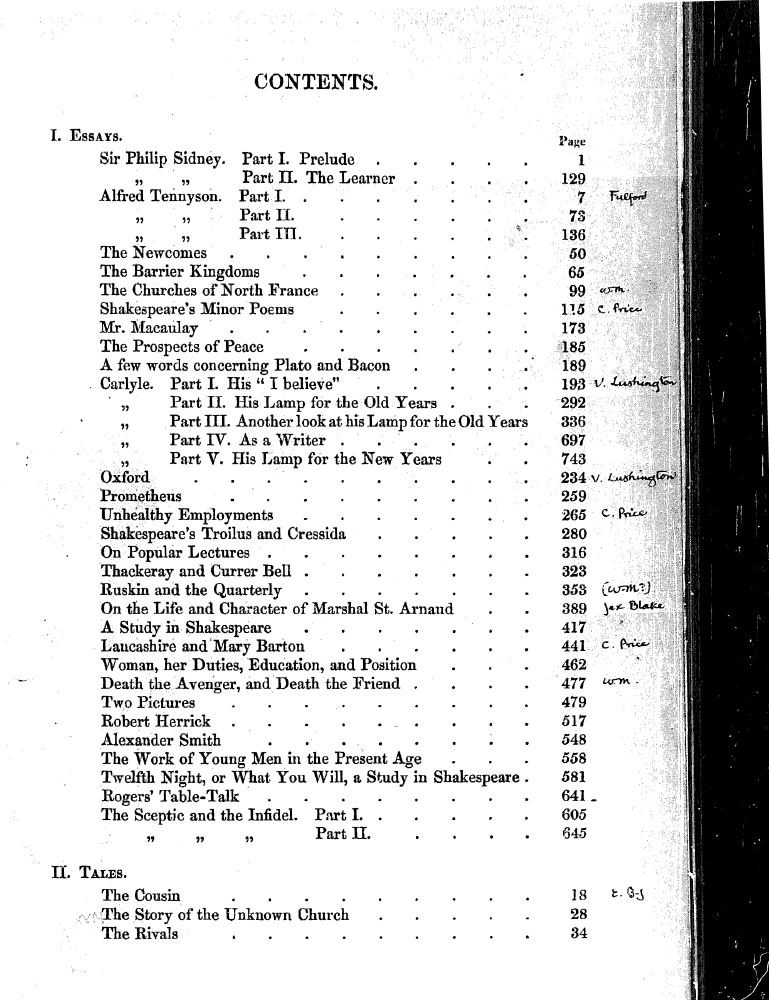
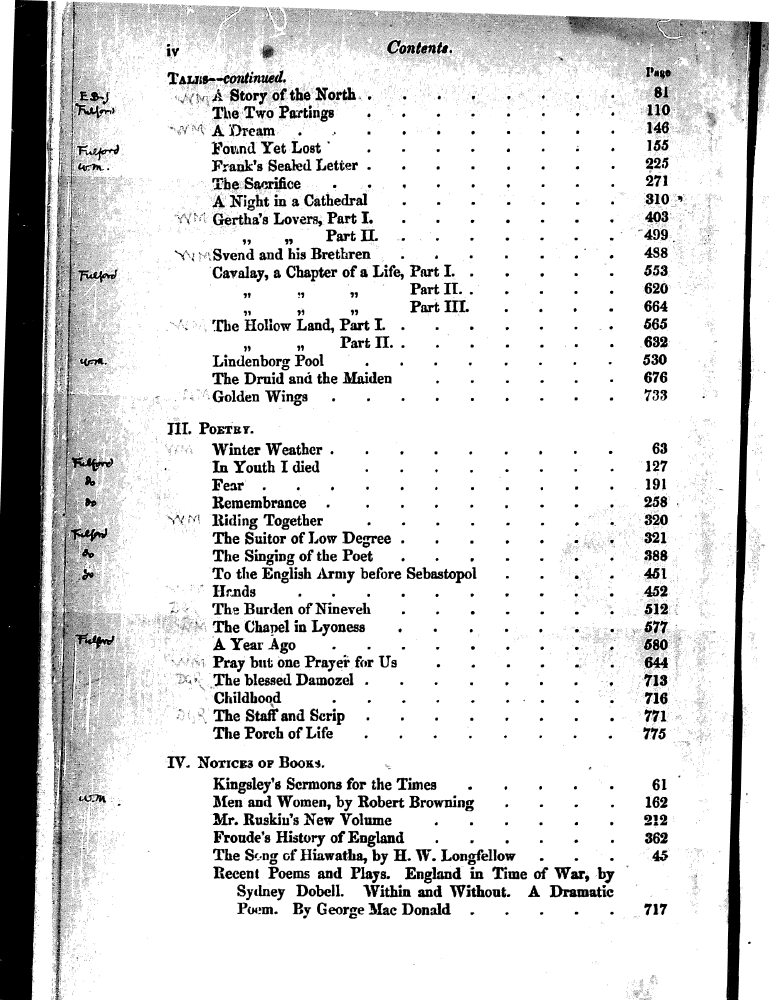
CONTENTS.
- Recent Poems and Plays. . . . .
717
- Golden Wings . . . . .
733
- Carlyle. Chapter V. . . . . .
743
- The Staff and the Scrip . . . . .
771
- The Porch of Life . . . . .
775
LONDON:
BELL AND DALDY, FLEET STREET.
PRINTED BY C. WHITTINGHAM, TOOKS COURT, CHANCERY LANE.
 page:
page: [unpaginated]
Transcription Gap: (Advertisements)
![Image of page [717]](http://www.rossettiarchive.org/img/thumbs_small/ap4.o93.1.717.jpg) page:
page: [717]
Editorial Note (page ornament): An ornamental design appears at the top of the page.
Editorial Note (page ornament): Initial A is ornamental
Akin to the pride men often take in their conceits and foibles, to the disparagement of their real worth, is the strange fatality
by which many of our best writers have
longed after achievements most alien to their genius; so that we may say of none more emphatically than of the race of authors,
happy are they who at once know their vocation and are enabled to
follow it. Sometimes fortunate chance has restricted their performance to that work of which they are truly masters, and we
have been saved from Ovid’s
tragedies, and Pope’s “Epic Poem,” and Coleridge’s “Magnum
Opus:” but we are every now and then obliged to forgive and forget much on which the author set his chiefest store. Had not Goethe
been better without his theory of light,
Dryden and Fielding without their bad plays? Did not Tobias Smollet write a history, and, to name a great man after a small
one, have we not had too many “Ecclesiastical Sonnets”
Column Break
from the revered poet of the Lakes himself? But, to come to our application, there is nothing in which the result of such
a mistaken tendency is more manifest than in the
flood of Dramas we have had poured upon us during the last six years, by writers who, with various shades of wisdom or folly,
have shown themselves to be anything rather than dramatists. The
conception seems to have taken hold of their minds, that no one now-a-days can be a full-fledged poet until he has written
something in the shape of a play; and so, impatient of gradual ascent,
our recent rhymers have commonly given us their first efforts in this form. Several of those may be dismissed to a quiet oblivion;
but there are others whose luxuriant imagination, broad
sympathies, and refined perception have been only cramped by the uncongenial form in which they have endeavoured to unfold
them. Those poets are, for the most part, either didactic or lyrical, and
the freest and best expressions of their
Transcribed Footnote (page [717]):
*“England in time of War.” Sydney Dobell. London: Smith, Elder and Co. 1856.“Within and Without.” A Dramatic Poem. George MacDonald. London: Longman and Co.
1855.
 page:
page: 718
thought are, with few exceptions, as far as possible removed from that which is dramatic. They paint scenery with a pencil
dipped in all the hues of
nature; they describe feeling, often with exquisite truth; but there is little or no action in the writings of what we may
call our last generation of singers. Their works will live rather for the
beautiful they contain than as being beautiful or true themselves. So it is with “Festus,” that wilderness of philosophy and foam, of wisdom and absurdity—“the Life Drama,” with its deep passion, luxuriant colouring, and occasional rant; and so it is pre-eminently with “Balder,” where we do not
know whether more to admire the
exquisite tenderness of some passages, or to recoil from the atrocious bad taste of others. Mr. Bailey combines the descriptive
with the lyrical power; witness his picture of
Autumn, and the quiet thoughts it suggests; also that little love song, “Like an Island in a River,” beautiful and simple enough to redeem even his account of creation. Alexander Smith, with less perhaps of reflective power,
more rarely offends against the rules of taste than
his compeers of the so-called spasmodic school; he has, of them all, the fullest melody, the most concise expression; in the
portraiture of nature and of passion alike he has proved himself, in
many notable instances, a wonderful master. Mr. Dobell, with whom we have more especially to do, we are happy to say at length
under his real name, is eminently a lyrist. Those of our readers who
read “the Roman by Sydney Yendys” when it appeared six years ago, will recollect the happy impression it conveyed, that, after a long period of barrenness,
we had a new poet once more springing up amongst us.
The book was well received and everywhere lauded. The theme chosen was one which was in all hearts, and we were ready to overlook,
in our welcome—in our appreciation of its beauties
Column Break
and harmony, the real defects of the book. These were, however, too considerable long to escape notice; the song was not,
after all, felt to be adequate to the subject. Under the name of a
drama, it was a long monologue, redeemed from tediousness by the enthusiasm of rhetoric rather than the inspiration of more
genuine poetry. The images were strung together too much like beads upon
a thread. There was little practical aim, and less positive achievement, in the issue of the book. We remember it now, in
connexion with one or two striking descriptions—that of the
Coliseum for instance—and a number of melodious chaunts sung by minstrels, dancers, soldiers, and that indefatigable monk,
the rather obtrusive hero of the piece. Among those, that
which opens the volume, a sweet measure “full of love notes”—“There went an incense through the land one
night”—“O Lila, round our early love”—the war chorus of the Milanese, “Who would drone on in a
dull world like this”—and the warbling of the children sporting by the doorway, are fine enough to make the whole book worth reading. But there
is nowhere action,
variety, or character: where alone there is any effort towards dramatic effect, in the scene between Francisca and the Monk,
it is a confessed failure.
Four years passed before the appearance of “Balder,” during which time a tide set in, bringing us a whole shoal of verses, good, bad, and indifferent, all marked by a strong
subjective tendency. Longfellow
had given us his “Golden Legend,” Frederick Tennyson his “Days and
Hours,” and Matthew Arnold his adaptations from the Greek. The whole spasmodic school had sprung into existence; we had had “The Life Drama”—Gerald Massey—“Night and the Soul”—Poems by Quallon—hosts of rhapsodies, as vague as dreams, and not half so natural; plays of the new order, where some one
talked about his feelings and
 page:
page: 719
fate, through scores of dreary pages, with “a pause,” “a long pause,” and “a very long
pause;” or held parley with the most patient of beauties, in most interminable dialogues, broken up by most unmeaning ditties.
And, lowest depth of all, we had another volume of
Mr. Gilfillan’s critiques! No wonder then that we begun to cry enough, and were in no very favourable mood to receive a new edition of Hamlet,
with all the other parts omitted. Strong prepossession in his favour at once gave a certain currency to Mr. Dobell’s new volume, but it soon received a very
general sentence of condemnation. Many, following the guidance of the author’s friends, or led by that malicious chance which
invariably directs a stray reader to the very worst
passages, got hold of the abominable pictures of war and pestilence, and, naturally enough, shut the book; others fell asleep
in the middle of some speech, and forgot where to begin again; many
more valiantly read and read, and “found no end in wondering mazes lost.” Yet, with all its want of taste, nay more, of common sense, “Balder” is a poem of a far higher order than “The Roman;” it contains thoughts and feelings which belong to a mind more matured, and are the result of a clearer insight. If its defects
are glaring, its beauties are often most subtle.
We cannot now enlarge on either; suffice it to say, that in some passages he has touched with a master hand upon some of the
deepest chords of human nature. We can never forget the suggestive
description of the village bride, pp. 13, 14; or of England and her mighty dead, pp. 92, 93. Part of the sketch of Chamouny and the long glorious summer day remain fresh in our memories. That picture of Amy too, in
scene xxviii, is very lovely, and we recur again and again to her
dirges, and feel glad, as we listen to their weary yet winning melody, that we have a poet among us who can express so tenderly
the mourning of a woman’s heart. We
Column Break
read:
“The years they come and the years they go,” “If thou wouldst sleep, my babe,” “That I might die and be at rest, O
God!” “In the spring twilight,” with many others; and cannot deny the imagination of true genius to the author of “Balder.” But, as a drama, it
is nothing, and means nothing other than has been told, far more plainly and therefore far better, long ago. The idea from which
the plot
takes its rise—the desire to witness death in order to paint it,
- “I cannot stamp
- The face of Death till he hath graven the seal,”
is hideously unnatural, and almost justifies “Firmilian.” That dread angel, in one shape or other, is surely revealed to each one of us soon enough! The end indeed rises into action,
and one scene of intense emotion leaves us
bewildered on dangerous ground; still to attain this there is much of wilderness to wade through. We turn page after page
of fine figures and fair sounding lines and, at the end of each, conclude
with the royal Dane, “Words, Words, Words!” so true is it in tragedy,
- “Grown men want thought.
- Thought’s what they mean by verse and seek in verse,
- Boys seek for images and melody.”
Much of the meditation here is fantastic rather than profound: even the most passionate parts are often mere spasms. Balder
rages like the red sparkling iron; he has no idea of the white heat
that glows in silence. We close the book with a feeling of fatigue, and think we would rather have some “lilt” of Robert Burns, or the
“Patriot” or the “Evelyn Hope” of Robert Browning, than the whole mass of it.
We wish so much that is beautiful and true were disentangled from so awkward a setting, and therefore the more gladly welcome
this new volume in which Mr. Dobell’s genius has been
allowed, with fewer fetters, to follow its natural bent.
 page:
page: 720
“England in time of War,” is a series of chaunts, descriptive pieces, sonnets and dramatic lyrics, expressing the various hopes and fears which thrilled
through the heart of England, during the late
terrible struggle of her sons, in that which she fondly believed to be a battle for right and liberty. The theme is well chosen.
Here is a legitimate field for the exercise of those faculties in
which Mr. Dobell most excels. There is room for his tenderness and his energy, for the eye of the artist and the insight of
the man. We find them all well employed in this volume: the vigour of
some passages being only surpassed by the pathos of others, while the beauty of his landscape rivals the truth of those more
subtle pictures of emotion which it is the special prerogative of the
poet to represent. Mr. Dobell is no vague moralist. He has shown himself, in all his works, as one who sympathizes with freedom
everywhere, but keeps his warmest heart for the land in which he
dwells. He is generously proud of England: we can believe would be glad either to live or die for her; and so is fitted to
write patriotic poems. There is little of politics, in a narrow sense, in
this volume, or rather,—except, perhaps, in the “Shower in War Time,”—(an effort to lay the eternal peace question,)—none at all. He dismisses Diplomacy, in a sonnet, rather an ugly one we
think, with an oath, and prefers
to represent the broad feelings and homely thoughts of men and women, poor soldiers and their wives, to discussing the debates
of courts and cabinets. And it may be he is right;—he has
avoided the rock of declamation. Was not Goethe’s warning, “Remember politics is not poetry?” Books like this, and the thoughts they suggest, do us
good, when we think too much of wars as games of chess, and the men who fight in them as pawns. They help us to remember that
in all their checkered fortune they are indeed our fellows, linked to
the
Column Break
earth by the same bonds which connect us, and having an equal stake in their life and death with ourselves. We consider this
Mr. Dobell’s most successful work, both in the
fuller realization of its aim, and the better taste displayed in individual pieces. There is less of that straining after
effect, which sometimes approached near to bombast in “The Roman;” and comparatively little of that wild ejaculation, which as it were made a fool of some of the finest passages in Balder. The feeling throughout is chaste, and the expression generally simple. There is much of graphic portraiture, touching delineation,
and comprehensive thought. Some of these strains are
surpassed in melody by nothing that has issued from our modern Lyre. It must not however be supposed that the volume is uniform
in its excellence; while there are some passages of surpassing
beauty on the one hand, there are defects on the other, which indicate the need of yet further culture and discipline. Let
us get over those and have done with them. And first, though Scotch
ourselves, we decidedly object to the use of the Scottish dialect. None perhaps, wielded by one to whom it is the language
of daily life, has more of concentrated power; none is capable of more
emphatic pathos; none has more expressive words, or is so full of quaint humour. Our rural districts live in the works of
Burns, with vivid reality, as they could in no other language under the
sun; hardly one of his songs will endure translation, without losing half its force. Mr. Dobell has felt this, and thought
to attain the Doric force of those lyrics, by adopting their language in
those of his ballads to which he wished to give a provincial tone. He has been more successful than we should have expected;
more so than many natives of our northern towns, who are unused to the
country dialect. Some of the pieces thrown into this form, as the “Mother’s Lesson,” are characterized
 page:
page: 721
by an energy and suggestiveness which suit well with their dress; but, here and there, he inevitably falls into snares of
false expression and absurd
application, which give the whole poem an affected if not a ludicrous air. Fancy such lines as this in the “Market Wife’s Song,”
- “And sæ I cry to God—
while the hens cackle a!
- And whiddie, whuddie, whaddie gang the auld wheels twa.”
What an ill-advised union of the sacred and the ludicrous have we here! Or this in the Gaberlunzie,
- “His slow steps rouse the
blethrin grouse (!) the peewit fas and squeals.”
Our author is fond of refrains, and sometimes manages them artistically, and sometimes does not. This applies to his former
books, but more especially to the volume before us; where, if there
are some beautiful verses that fall upon the ear ever and anon like the cadence of sweet bells, there are instances, too abundant,
of repetitions without rhyme or reason, which entirely mar the
poems in which they occur. We conceive the true principle of a refrain is, that it be something: in itself both emphatic and
musical, and which has a definite relation throughout, a mellowing or
an arousing influence on the whole poem. Wherever they have been adjudged successful, from the very earliest instances down
to Edgar Allen Poe’s
“Raven,” this rule will be found to be preserved. It is so in the choruses of all our best songs, and the recurring strain which
winds up each verse of many of our ballads. Witness “I love but you alone,” in the “Nut Browne Maid;” Campbell’s chaunt in “The Mariners of England;”—the “Toll
Slowly,” in the “Rhyme of the Duchess May,” or the carol of the “May
Queen” in Tennyson. All these are prominent in meaning, as well as in position; giving, in themselves, a summary of the piece in which they
are set,
or a
Column Break
tone to its whole effect. I do not think that a similar plea can be put forward for such iterations as those in “Farewell,” or the verses well designated “Wind.” They indeed contain little else; the breezes signify nothing.—Besides, there is moderation in all things, and the mere number
of “
wolds” and “
farewells” is appalling. There are others, which it is unnecessary to particularize, open to the same objection.
“How’s my boy?” gives one the painful impression of being meant to be particularly fine;—painful, for we confess never to
have heard it read without
that
αναριθμον
γελασμα
which is the fit corrective of whatever is so unnatural and constrained. It is just such a parody
as Swift might have penned, in his sourest mood, to make mockery of the most holy affliction. We cannot attribute any such
design to Mr. Dobell; but his insight is strangely at fault if he does
not know that affection is the first, and not the last, to catch at the approach of evil tidings;—the foremost to realize
the full import of calamity. In some instances there is a
heaping up of words without adequate purpose, poems in fact which need not have been written. “The Sailor’s Return” is rather pointless, and the “Health to the Queen” a mere boisterous huzzah, unrelieved by any of that raciness which redeems from folly his lines about a fiddlestick. Two
of the longest pieces, “Rain on the Roof” and a “Prayer of the Understanding,” in spite of a great deal that is excellent, remind us too much of the metaphysical reveries of Balder, and the “Gaberlunzie’s walk” contains nothing remarkably good to compensate for its mysticism. These blemishes are few, and such as we hope to see the
author throw from him yet, if he is not one of those
who cherish their defects, to the exclusion of all criticism except their own.—We turn to the agreeable task of indicating
some of the more pleasing features of the volume.
 page:
page: 722
In nothing has our recent poetry and romance made a greater advance, as compared with that of the last generation, than in
the truer and better light in which it represents all the gentler
features of humanity: most especially in the far higher position it assigns to woman and her influence. When we compare Tennyson
with Dryden, in this light, or the “Men and Women” of Browning with those of Pope, we feel that we have abundant recompense for the vagueness and want of definition of
which the followers of the old school so much complain. There is nothing more happily conspicuous in Mr. Dobell’s poetry than
the delicacy with which he treats the female nature, the
faith he seems to have in its omnipotence to purify and sustain. Hence the accurate sympathy with which he has here sung the
joys and sorrows of many a matron and many a maid, as they lament the
departed or welcome home the wanderer. There is a tone of true heroic feeling in the “Mother’s Lesson,” as she tells to her son how “his brave brither fell,”
- “Gran gran are a proud mither’s tears,
- And the gate that she gangs in her wae,”
for she has a comfort, amid them all, in thoughts of his glory and “Auld Lang Syne.”
“Tommy’s Dead” is among the most pathetic pictures of the desolation of bereavement we have seen. Here is a right use of a refrain; the
knell comes in to disturb the simplest duties, and
darken all things with the chill of the grave. The “Little Girl’s Song” is beautiful. How touching the address to her absent father!
- “Papa, papa, if I could but know!
- Do you think her voice was always so low?
- Did I always see what I seem to see,
- When I wake up at night and her pillow is wet?
- You used to say her hair it was gold—
- It looks like silver to me.
- But still she tells the same tale that she told,
- She sings the same song when I sit on her knee,
Column Break
- And the house goes on as it went long ago,
-
10When we lived together, all three.”
Something in the “Orphan’s Song” reminds us of certain verses in “Maud,” but it has a sweetness of its own. The image of the lonely child talking to her little bird as she dies, is brought very
clearly before us in the mournful melody of those
verses. One of the finest poems in the book, that certainly which displays the richest descriptive power, is the sad and oft
told tale “He loves and rides
away.” Listen to this cadence in the address of the deserted one to her infant.
- “Small and fair, choice and rare,
- Snowy pale with moonlight hair,
- My little one blossoms and springs!
- Like joy with woe singing to it,
- Like love with sorrow to woo it,
- So my witty one, so my pretty one sings!
- And I see the white hawthorn tree and the bright summer bird singing through it,
- And my heart is prouder than kings.”
The luxuriant image of a lady swimming, in another stanza, almost makes us think of Spenser’s bathing nymphs. “Lady
Constance” and “Home Wounded” are masterpieces, in their way. Nowhere more has the poet shown his art than in this
exaltation of a poor cripple soldier into an object almost of our envy, as a hero, with the labour of his life well done,
left to wear out its evening in repose, amid the fragrance of the flowers.
Here is a landscape, seen through the mist of love, in calm contentedness:
- “And she will trip like spring by my side,
-
And be all the birds to my ear.
- And here all three we’ll sit in the sun,
- And see the Aprils one by one,
- Primrosed Aprils on and on,
- Till the floating prospect closes
- In golden glimmers that rise and rise,
- And perhaps are gleams of Paradise,
- And perhaps too far for mortal eyes,
-
10New springs of fresh primroses,
- Springs of earth’s primroses,
- Springs to be and springs for me,
- Of distant dim primroses.”
The repetition here never palls, it is the lingering of so beautiful a note. The opening lines of “A Shower in War time” are richly melodious, especially
 page:
page: 723
those about the angel in the cloud; it concludes, with a touch of philosophy not inapplicable at the present day.
- “Lov’st thou not Peace? Aye, moralist,
- Both peace and thee. Yet well I wist
- They who shut Janus did slay Christ.”
The “Young Man’s Song” and “An Evening Dream” contain much that is
admirable; so also “A Hero’s Grave” and “Grass from the Battle field;” but
is it an utter lack of all sense of the ludicrous, or what, that admits of lines like the following?
- “That ancient heaven of brass, so long unfurl’d,
- Falls with a crash of fame that fills the world.”
We are tempted to ejaculate with that classic critic Jeames Yellowplush,
- “Igsplane this, men and angels!”
Again what is meant by “haze in haze pervolving as in glad release,” or the whole passage about “the dry unjewelled
cup” at the commencement of the same poem?—There is nothing that our author needs to bear more in mind than the necessity of
plain speaking. It is hyper-criticism to
insist on every figure and phrase being self-contained; still, all good general effect comes out of lines in which the ordinary
mass of thinking readers can at least see some sort of meaning. But
we had done with cavilling. “The German Legion” is a favourite of ours; it has the simple force of a true tale well told. We could wish to quote some of its latter verses,
but perhaps the gem of the whole volume is the
little ballad with which we must conclude those extracts. Let Mr. Dobell only write such songs as this, and England will not
soon let either himself or his works pass from her affectionate memory.
- “Oh, happy, happy maid,
- In the year of war and death
- She wears no sorrow!
- By her face so young and fair,
- By the happy wreath
- That rules her happy hair,
- She might be a bride to-morrow!
Column Break
- She sits and sings within her moonlit bower,
- Her moonlit bower in rosy June;
-
10Yet ah, her bridal breath,
- Like fragrance from some sweet night-blowing flower,
- Moves from her moving lips in many a mournful tune!
- She sings no song of love’s despair,
- She sings no lover lowly laid,
- No fond peculiar grief
- Has ever touch’d or bud or leaf
- Of her unblighted spring.
- She sings because she needs must sing;
- She sings the sorrow of the air
-
20Whereof her voice is made.
- That night in Britain howsoe’er
- On any chord the fingers stray’d,
- They gave the notes of care.
- A dim, sad legend old
- Long since in some pale shade
- Of some far twilight told,
- She knows not when or where,
- She sings with trembling hand on trembling lute-strings laid;
- The murmur of the mourning ghost
-
30That keeps the shadowy kine;
- ‘Oh, Keith of Ravelston,
- The sorrows of thy line!’
- Ravelston, Ravelston,
- The merry path that leads
- Down the golden morning hill,
- And through the silver meads;
- Ravelston, Ravelston,
- The stile beneath the tree,
- The maid that kept her mother’s kine,
-
40The song that sang she!
- She sang her song, she kept her kine,
- She sat beneath the thorn
- When Andrew Keith of Ravelston
- Rode through the Monday morn.
- His huntsmen sing, his hawk-bells ring,
- His belted jewels shine!
- Oh, Keith of Ravelston,
- The sorrows of thy line.
- Year after year, where Andrew came,
-
50Comes evening down the glade,
- And still there sits a moonshine ghost
- Where sat the sunshine maid.
- Her misty hair is faint and fair,
- She keeps the shadowy kine;
- Oh, Keith of Ravelston,
- The sorrows of thy line!
- I lay my hand upon the stile,
- The stile is lone and cold,
- The burnie that goes babbling by
-
60Says nought that can be told.
- Yet, stranger! here, from year to year,
- She keeps her shadowy kine;
- Oh, Keith of Ravelston,
- The sorrows of thy line!
 page:
page: 724
- Step out three steps, where Andrew stood,
- Why blanch thy cheeks for fear?
- The ancient stile is not alone,
- ’Tis not the burn I hear!
- She makes her immemorial moan,
-
70She keeps her shadowy kine;
- Oh, Keith of Ravelston,
- The sorrows of thy line!”
Though there is much true portraiture in this volume, it partakes largely of the general subjective tendency of modern imagination;
i.e., that which directs itself to express the opinions,
passions, and perplexities of the writer. Self-relinquishment has become rare in our lyrics: there is no trace of it in those
pretended plays of which we have spoken; hence, in their perception of
this decay of the Drama, many are apt to doubt of the possibility of its restoration. But it has not yet quite died from amongst
us. There are links remaining to connect the last fifty years with
more prolific periods. Coleridge and Elliot (in his “Bothwell”) have at least done something in this direction. To
Savage Landor and the lamented Talfourd we owe several perfect reproductions of epochs long passed from our sight, with the
actors in them. If the majesty of Byron’s plays is half
artificial, Shelley’s is life-like enough in its breathing horror. Out of Shakespeare, what creation of English tragedy is
there to match with Beatrice Cenci? We have still some writers
who can conceive the deeds and thoughts of other men, and bring them before us, not as mere projections of themselves, but
as external realities. “Edwin the
Fair,” the “Saints’ Tragedy,” and “Gregory VII.”
recal, with characteristic distinctness, many a half-forgotten feature of the Middle Ages. Ghent and Bruges, the quaint old
Flemish cities, with their burgesses and heroes, civil strife and
wars, arise, when evoked by the name of “Van Artevelde,” from the dimness of bygone centuries. Browning’s “Blot on the Scutcheon” and “Pippa Passes” alone would prevent us from despairing of some revival
Column Break
of our
Drama, and the literature of those last few years has given us no more hopeful sign of its future than this work of Mr. MacDonald’s.
Many of our late poems may be called lyrical,
although hardly fitted for a music-book. Those we have just been considering are chaunts rather than songs. There are others
truly dramatic, which are by no means adapted for actual
representation. The causes which regulate this are manifold: custom, national taste, and various circumstances connected with
our theatre, which it might be worth while to discuss more fully.
Suffice it meanwhile to admit that the prominence given to reflective emotion renders it impossible for such plays as the
one before us ever to be so represented. A piece that will act well must
have as much as possible outwardly manifest. Even the expression of private schemes, by means of numerous asides, has an unnatural
air: when the thought becomes abstract, or dwells on themes we
dare hardly evolve in human words, it can no longer be spoken before large audiences. But though we do not claim for “Within
and Without” a place among the glories of the
stage, we assert its right to be called a dramatic poem, because the characters are essentially real. They stand apart alike
from the author and from one another, acting and reacting each on each,
and fulfilling a plot, not the less intense because the struggle through which they pass is mainly a mental one. With less
perhaps of that “Contemplative Imagination” which
transfigures nature in its relation to the poet than some of his compeers, Mr. MacDonald is more richly gifted than they with
an insight into the play of mind on mind. That penetrating faculty
which, forestalling years of observation, in a moment, discerns the innermost spirit of the character it seeks to know, is
one of the most distinctive marks of a real dramatist. Our author has
also a large amount of that constructive power, by
 page:
page: 725
which the artist clusters details round one great conception, and elaborates a whole out of harmonious and converging parts.
This alone can give effect
to any such work, and it is here he is eminently successful where so many have failed. His expression is at once powerful
and delicate, but we are more arrested by the thoughts themselves. There
are many beauties in the book, but the book itself is more beautiful than any of them. We may read the first two or three
pages with pencil in hand to mark passages for commendation or censure,
but we presently let it fall, and are carried on by the breathless interest of the tale, till we are left at the end thankful
for the good it has done us. It is not a poem to which in any respect
justice can be done by extracts; nor is it any test of the value of a work of art, that a bit can be taken out of it and shown
to advantage alone. A large class of critics remind us of the
simpleton in Hierocles, who, wishing to sell a house, went about with a stone as a specimen; the most general ground plan
had surely been more to the purpose. A great poet should be the builder of
a temple, not a worker in mosaic. Were poetry to be valued by the number of quotable lines it affords, the essays of Alexander Pope would take rank with the
“Paradise Lost,” or the “Inferno,” or many of Shakespeare’s
tragedies.
Mr. MacDonald has divided his poem into five parts, having a very distant affinity to the five acts of the drop curtain, but
each evolving some new phase, in the outward as in the spiritual
history of his hero, and each prefaced by a sonnet, which is meant to serve as a sort of prelude or overture, giving as it
were the moral of the successive chapters of life. There is a fine repose
about them all; the first and third especially are wise and beautiful, but their connection with the main body of the work
is hardly close enough.
The story is soon told. Julian, an Italian Count, loves Lilia, the daughter
Column Break
of a rich merchant, near his castle: some misunderstanding thwarts their love, and, with his natural gloom
deepened, he recoils for a while from earthly things to seek repose and a closer communion with the Eternal within the walls
of a monastery. In vain! for he finds there, least of all, any sympathy
for his daring thoughts, or fellowship in his searching reverence. He feels impelled again to seek a wider sphere for worship,
in the strife of the world, and suddenly abandons the disappointed
monks. During his absence the Count Nembroni has contrived to ruin Lilia’s father, and has laid a plot to become possessed
of herself. Julian, arriving in time to frustrate this,
inflicts summary justice on the aggressor. He discloses himself to Lilia, relieves her father, and induces her to accompany
him to England as his wife. Five years afterwards they are represented
as living in quiet retirement in London. His estates have become forfeit to the Church. She is obliged to assist their income
by teaching, and in this way gets introduced to Lord Seaford.
Meanwhile an estrangement has grown up between her and her husband—each believing that the other’s love has faded. She is
misled into listening with too much complacence to
the flatteries of the English nobleman, till at length, on a full declaration of his love, she is startled into a horror at
herself, and flies at once from his presence and from her own home. Lord
Seaford too leaves the country, and Julian, left alone with his child, mistakes the cause of his abandonment. Love at length
conquers indignation, and he resolves to seek her through the world,
but he must first guard his little Lily. Presently she dies, and, after a few months more wandering, the shades of night gather
around him too. Meanwhile Lilia has resolved to return, and Seaford,
who has heard of the terrible error, hastens to repair it; her letter and his message reach him in his last hours, but, in
the midst of
 page:
page: 726
delirium, he hears and understands that she is innocent. There is here material for a drama, which might be wrought into
very various forms. It is in
his artistic and profound management of those elements that our author shows his high power. The character of Julian is throughout
the most prominent one, his thoughts and inward struggle occupy
so large a space of the volume that a severe critic might be disposed to complain of the preponderance of monologue. Still
the monologue is very magnificent, nor are there many of those thoughts
which in their clear majesty and reverence we would wish to lose, the less so because Julian’s soliloquy is no mere egotistic
chaunt, but is elicited, in ample variety, by the
vicissitudes of an eventful life. We can only trace a few of its most marked features. His picture, as given by one of his
brother monks, is suggestive:
- “A tall dark man,
- Moody and silent, with a little stoop,
-
As if his eyes did pull his shoulders down,
- And a strange look of mingled youth and age.”
Just such an one as would coil his thoughts too closely round his heart—a riddle hard to read; whose “Within and Without”
would be apt to run far apart,
only to find their reconcilement, at length, in the blue zenith where contradiction is solved and romance and reality meet.
So, in this first part, he lives with the monks, but apart from them;
their ways are not as his ways, nor is their religion, of symbols and formula, a thing to which he can square his dim majestic
striving after communion with the Inscrutable.
- “Not having seen him yet,
- The light rests on me with a heaviness;
- All beauty seems to wear a doubtful look;
- A voice is in the wind I do not know;
- A meaning on the face of the high hills,
- Whose utterance I cannot comprehend.
- A something is behind them: that is God.”
This was not a confession that could well adapt itself to “our Holy Faith;”—it transcends the comprehension of the friendly
monk who visits his cell.
Column Break
“A good man,” says Julian,
- “But he has not waked,
-
And seen the sphinx’s stony eye fixed on him.”
How many are there who pass through life unconscious of that “stony eye,” thinking they have solved the secrets of the universe
because they have never approached to
an understanding of their perplexity. The mass,
ut semper, are wroth that he takes airs to himself and despises them—he is an Atheist at least, he hath a Devil surely.
- “Music tortures him:
- I saw him once, during the Gloria Patri,
- Rise slowly as in ecstacy of pain.”
His own account of this is rather different:
- “I bless you, sweet sounds, for your visiting,
- Stealing my soul with faint deliciousness.”
Visions of the past and future, beckonings of the outer world, come daily more and more to summon him away; he feels that
cloisters “are not God’s nurseries
for his children.”
- “It boots not staying here. Thirsting desire
- Wakens within me, like a new child heart,
- To be abroad on the mysterious Earth,
- Out with the moon in all the blowing winds.”
His friend Robert, with sore misgiving, connives at his escape; he goes “on into the dark,” companioned with his own glorious
aspirations, that wondrous
- “Love of Knowledge and of Mystery,
- Striving for ever in the heart of Man,”
as he seeks the God, who retires before him from peak to peak of inaccessibility. It is pleasant, in a play of so serious
a cast, to find a description so graphic as that given here of
the old monks and their life. The picture of Stephen and his charitable delight in what he believes to be an unpardonable
sin—“Well, one comfort is, it’s
damnation and no reprieve”—shows that the author is not altogether devoid of humour. The good brothers are of the comfortable sort. The monastery is
evidently one
of those which, if we can trust Mr. Froude, would have stood but
 page:
page: 727
a poor chance in Henry the Eighth’s time.
Leaving that “house of foolishness,” Julian is shaken from his imperial dream by the cry of wrong; for he is to find that unfolding of the ideal he longs
for, as we all must, by contact with the real. There is not much in the rescue from “Nembroni,” except the flash of native
ferocity that it calls forth. The action is vivid,
perhaps too much so. There is an abruptness, in some passages here, followed by over refinement in others: as Lilia’s dream
of heaven, too serene for the hours following such intense
agitation, which indicates a slight want of art; but this soon passes, and we are interested in the scruples she feels regarding
the violation of his monkish vows. The appeal of events rather than
argument settles the difficulty. Stephen has raised a hue-and-cry against them, and they escape together from a sudden pursuit.
They row down a river with muffled oars, while Julian murmurs:
- “Dear wind, dear stream—dear stars,— dear heart of all,
- White angel lying in my little boat!
- Strange that my boyhood’s skill with sail and helm,
- Oft steering safely ’twixt the winding banks,
- Should make me rich with womanhood and life!”
And then the part ends with three verses, rivalling in their tuneful sweetness, the Bugle song. Here are two of them:
- “O wind of strife! to us a wedding wind!
- Oh cover me with kisses of her mouth.
- Blow thou our souls together, heart and mind;
- To narrowing northern lines, blow from the south.
- Out to the ocean, fleet and float,
- Blow, blow my little leaf-like boat.
- Thou hast been blowing many a drifting thing
- From circling cove down to the unshelter’d sea:
- Thou blowest to the sea my blue sail’s wing,
-
10Us to a new love-lit futurity.
- Out to the ocean, fleet and float,
- Blow, blow my little leaf-like boat.”
Column Break
It is, however, in the succeeding portion of the volume that the art of the dramatist is most eminent. The conception on which
the whole action is grounded is that of two natures, each with
a greatness of its own, drawn towards each other by real sympathy, and yet estranged by a certain outward contrast. Hence
doubt and jealousy, and its throng of cares; for the graceful ardent Lilia
cannot understand the love hidden far in Julian’s deep heart, while he grows daily more mistrustful of her confidence, and
retires ever farther, in his communings, alone. This is a
subtle plot, which might have been mismanaged in a hundred ways. Mr. MacDonald has steered on the difficult course with the
fidelity of the true poet’s instinct. Grant such a strange
union of dispositions, and, with one exception to be noticed, there is nothing unnatural in the evolution of the issue. Julian
is hard to convince from the first:
- “But do you really love me, Lilia?
- Why do you make me say it so often, Julian?”
Suspicion is the disease of self-consciousness, and again and again, with memories of the cloister, the old doubt comes up
before him:
- “I am afraid the thought arises still,
- Within her heart that she is not my wife.”
Foundation enough for a world of unhappiness, even if the calamities and privation of their mutual lot did not point the
sting:
- “It is not strange that thou art glad to go
- From this dull place, and be for some short hours
- As if thy girlhood were restored to thee;
- For thou art very young for a hard life,
- Such as a poor man’s wife must undergo.”
- Then I am older much than she.”
And again,
- “I have grown common to her.”
But he is wrong: Lilia thinks little of this, her complaint is only that his affection has become a duty; that he has grown
cold as the glacier on the mountains
 page:
page: 728
he loves, that she is not enough for him:
- “He needs
- Some high entranced maiden, ever pure,
- And throng’d with burning thoughts of
- God and him.”
The lines in which, shortly after, she contrasts their natures, exhibit at once the apparent disparity between them, and
two sorts of beauty for which the poem is distinguished.
- “Yet I have thoughts
- Fit to be women to his mighty men;
- And he would love them, did he lead them out.
- Ah! there they come, the visions of my land!
- The long sweep of a bay, white sands, and cliffs
- Purple above the blue waves at their feet.
- Down the full river comes a light blue sail;
- And down the near hill-side come country girls,
- Brown, rosy, with their loads of glowing fruits;
-
10Down to the sands come ladies, young, and clad
- For holiday; in whose hearts wonderment
- At manhood is the upmost, deepest thought;
- And to their sides come stately, youthful forms,
- Italy’s youth, with burning eyes and hearts—
- Triumphant Love is King of the bright day.
- Yet one heart, ’neath that little sail, would look
- With pity on their poor contentedness;
- For he sits at the helm, I at his feet.
- He sung a song, and I replied to him.
-
20His song was of the wind that blew us down
- From sheltering hills to the unshelter’d sea.
- Ah! little thought my heart that the wide sea,
- Where I should cry for comforting in vain,
- Was the expanse of his wide awful soul,
- To which that wind was helpless drifting me.
- I would he were less great and loved me more.”
Thus can two minds live on, looking daily into each other’s eyes for years, and yet, with a mysterious bar, more powerful
than leagues of distance, compelling them to live
unknown, while the inner and the outer life remain irreconcilable. So Julian broods
Column Break
and suffers, with his majestic thoughts and his devout worship, whatever he reads or does, or meditates
bringing his heart home to the same sorrow.
- “I would die for her;
- A little thing, but all a man can do.
- O my beloved, where the answering love?”
So Lilia, still more wearily, toils on, looking at his deepening gloom, and seeing less and less beyond it,
- “He grows more moody, still more self withdrawn;
- Were it not better that I went away,
- And left him with the child?”
“Lily” is one of the finest creations in the book. It augurs a pure and lofty mind to present a picture of childhood—so true, so
simple, and so touching as Mr. MacDonald
has given us here. To her Julian unbends from all his reserve, and she clings to him, in return, with the full confidence
of infancy. From her first cry, as she starts from her little bed,
“Oh take me, take me,” to the last, “Kiss me harder, father, I am better now,” she looks to him for shelter and
guidance. The whole intercourse between them is full of beauties. Among these, Julian’s version of the parable, and her prattle
about it, is especially natural. His song about the
“little white Lily” is a rare treasure for any child. The ramble by the graveyard too reminds us of those questions so early asked, which it
takes the
searching of a lifetime to answer dimly.
- ’Tis where they lay them when the story’s done.“
- What, lay the boys and girls? Yes, dearest child,
- To keep them warm till it begin again.”
There is perhaps something of a pretty conceit in the notion of the church growing out of the tombs, but this other allegory
has a sense which stretches far. Lily has got a book of verses
in her hand, and cannot make out what it means. She peeps into it, holds it to her ear, rubs her hand over it, then puts her
tongue on it—it is all of no use: but Julian, in his
deserted loneliness,
 page:
page: 729
sees here an emblem of his own vain efforts to read the inscrutable, and cries bitterly,
- “Father, I am thy child. Forgive me this:
- Thy poetry is very hard to read.”
The author has shown considerable art in his management of the character of Lord Seaford. His words and thoughts—his songs,
containing some of the most musical lines in the
volume, and, above all, the energy of his remorse, at the end, indicate a nature in which luxury has fostered much of self-indulgence,
without removing the germs of higher things. He appreciates
Lilia’s spiritual as well as her actual beauty, and extends to all her tastes and interests the fulness of his sympathy. No
wonder if, in the loneliness of her real and fancied exile,
she finds a growing pleasure in his society, and, if in answer to his love, so different in the warmth of its expression from
the outward coldness of her own poor home, signs of a new fondness
begin to appear. She feels herself strangely confused, and does not know the heart-homage by which she is guarded till it
is suddenly aroused, at the very crisis of danger, by one of those chances
which sway the mind aright. It were out of place in a drama founded professedly on a perplexing contradiction to press the
rules of ordinary probability, but we confess that the flight of Lilia,
which so suddenly intervenes, is hardly explained by our previous knowledge. The lines quoted above, intimating some such
thought, are evidently thrown in to facilitate the issue: but this is not
enough. Revulsion, however strong, from her own momentary faithlessness, would hardly have induced her to abandon the two
she loved most to certain perplexity, and the possibility of so dread a
misunderstanding. After this the rest follows naturally, and our interest throughout the remainder of the sad tragedy is concentrated
on the various phases of Julian’s anguish.
Column Break
There is something terrible in the intensity of passion with which he first receives the announcement that his worship of
purity had been a delusion. Storms of fierce wrath come over him in gusts
now and then throughout, and he would find another use for the dagger with which he killed Nembroni, when the winds mockingly
“howl Lilia in his ear.” But the
beauty is to see how this gradually subsides, in the triumph of an all-reconciling love, and his longing, by day and night,
is to search her out and bring her back to his forgiveness. The child
left with him is chief among the influences which soften his anger and console his grief. Valiantly he goes on, fighting the
good fight, till at last the great work is complete, in the triumph of
humility and faith, and love.
He is to blame, he says, he should have descended from his heights and walked in the valley with her long ago:
- “Now, now I see that often it was pride
- That drove me from her, would not let me speak;
- I could not rid me of myself—”
and when Lily too leaves him, weak and weary, and alone, his one thought is, “I’ll seek for her, my wife, until I die.” She meanwhile
yearns to return, as the prodigal of old:
- “I think he will receive me: for he reads
- One chapter in St. Luke oftener than any.”
But when the late letter comes it is only that it may rest in the grave in which the mighty outworn spirit has taken up its
rest. It is time for him to be gone, and he departs in the hope
of a nobler journey than this earth’s one, though not before his face, in its last smile, has been transfigured by a knowledge
of her stainlessness.
Such is a bare outline of a Drama which, for loftiness of thought and intensity of purpose, we have not often seen surpassed.
Faint though this sketch be, we have left ourselves little
opportunity for illustrating the minor features of the poem. Best viewed as
 page:
page: 730
a whole, it has eminent individual beauties, in no small number. Again and again, in Julian’s soliloquies, we meet with passages
of pathos,
sublimity, and passion which are enough in themselves to stamp the writer with the reputation of high genius. There are few
pages in which something does not occur which any one might have been
proud to write. Here are one or two of those gems taken nearly at random.
- Dumb Love.
- “On she came—and then
- I was bewilder’d. Something I remember
-
Of thoughts that choked the passages of sound,
-
Hurrying forth without their pilot-words;
-
Of agony, as when a spirit seeks
-
In vain to hold communion with a man;
- A hand that would and would not stay in mine;
- A gleaming of her garments far away.”
- Supplication.
- “Go thou into thy closet; shut thy door;
- And pray to Him in secret: He will hear.
-
But think not thou by one wild bound to clear
-
The infinite ascensions, more and more,
-
Of starry stairs that must be climbed, before
-
Thou comest to the Father’s likeness near.”
- The Old Law and the New.
- “Which is likest
- God’s voice? The one is gentle, loving, kind,
- Like Mary singing to her manger’d Child;
- The other like a self-restrained tempest;
- Like—ah, alas!—the trumpet on Mount Sinai”.
- Beauty Surviving.
- “Thy heart must have its autumn, its pale skies,
- Leading, mayhap, to winter’s cold dismay.
- Yet doubt not. Beauty doth not pass away;
- Her form departs not though her body dies.
- Do thou thy work—be willing to be old:
-
Thy sorrow is the husk that doth unfold
-
A gorgeous June, for which thou needst not strive.”
- Seaford Sings.
- “For now I have no soul; a sea
- Fills up my cavern’d brain,
- Heaving in silent waves to thee,
- The mistress of the main.
- O Angel! take my hand in thine;
- Unfold thy shining silvery wings;
- Spread them around thy fare and mine,
- Close curtain’d in their murmurings.
Column Break
- O what is God to me? He sits apart
-
10Amidst the clear stars, passionless and cold;
- Divine! thou art enough to fill my heart;
- O fold me in thy heaven, sweet love, enfold”.
- Landscape Painting.
- “Shady woods and grass,
- With clear streams running ’twixt the sloping banks,
- And glimmering daylight in the cloven east;
- And sunbeams in the morning, building up
- A vapoury column, midst the near-by trees;
- And spokes of the sun-wheel, that, breaking through
- The split arch of the clouds, fall on the earth
- And travel round, as the wind blows the clouds;
- The distant meadows and the gloomy river
-
10Shine as the bright ray pencil sweepeth over.”
- Live Well.
- “Better to have the poet’s heart than brain,
- To feel than write; but better far than both
- To be on earth a poem of God’s making;
- To have one’s soul a leaf, on which God’s pen
- In various words, as of triumphant music,
- That mingleth joy and sorrow, setteth forth
- That out of darkness he hath brought the light.
-
To such perchance the poet’s voice is given
-
To tell the mighty tale to other worlds.
But the grandest passages are those in which the magnificence of thought and imagery runs on continuously. Let any one, who
wishes to have a better guarantee for the inspiration of the
writer than we have given him, read the lines which open with p. 71; Julian’s meditations in his counting-house, p. 92, where he finds a gladness in his daily toil; or his hopes for Lilia, p. 142. The parable which opens part iii. bears a moral that ought to be borne in mind. The poem in p. 109 is all full of melody. Nothing is more after our own heart than the description of the glories of the past. The pages from
97-100 glow with beauty; nor is there anywhere loftier imagination
 page:
page: 731
than in the dream of fair women, 147; but, as we are viewing the poem mainly in its dramatic aspect, we prefer to give the account of Julian’s visit to Lord Seaford,
than which a finer subject was never presented
to a painter.
- “Just as I cross’d the hall, I heard a voice—
- ‘The Countess Lamballa—is she here today?’
- And looking towards the door I caught a glimpse
- Of a tall figure, gaunt and stooping, drest
- In a blue shabby frock down to his knees,
- And on his left arm sat a little child.
- The porter gave short answer, with the door
- For period to the same; when, like a flash,
- It flew wide open, and the serving man
-
10Went reeling, staggering backwards to the stairs,
- ’Gainst which he fell, and then roll’d down and lay.
- In walk’d the visitor: but in the moment
- Just measured by the closing of the door,
- Heavens! what a change! He walk’d erect, as if
- Heading a column; with an eye and face
- As if a fountain-shaft of blood had shot
- Up suddenly within his wasted frame.
- The child sat on his arm quite still and pale
- But with a look of triumph in her eyes.
-
20Of me he took no notice; came right on;
- Look’d in each room that open’d from the hall;
- In every motion calm as frozen waves,
- Save, now and then, a movement, sudden, quick,
- Of his hand towards his side, unconsciously:
- ’Twas plain he had been used to carry arms.
-
3rd G. Did no one stop him?
-
Bern. Stop him? I’d as soon
- Have faced a tiger with bare hands. ’Tis easy
- In passion to meet passion; but it is
-
30A daunting thing to look on, when the blood
- Is going its wonted pace through your own veins.
- Besides this man had something in his face,
- With its live eyes, close lips, nostrils distended,
- A self-reliance, and a self-command,
- That would go right up to its goal, in spite
- Of any
no from any man. I would
- As soon have stopp’d a cannon-ball as him.
Column Break
- Over the porter, whom the fall had stunn’d,
- And up the stairs he went. I heard him go—
-
40Listening as it had been a ghost that walk’d
- With pallid spectre-child upon its arm—
- Along the corridors, and round the halls,
- Opening and shutting doors; until at last
- A sudden fear lest he should find the lady,
- And mischief should ensue, shot me up stairs.
- I met him half-way down, quiet as before;
- The fire had faded from his eyes; the child
- Held in her tiny hand a lady’s glove
- Of delicate primrose. When he reach’d the hall,
-
50He turn’d him to the porter, who had scarce
- Lifted him from the floor, and saying thus:
- ‘The Count Lamballa waited on Lord Seaford,’
- Turn’d him again, and strode into the street.”
We cannot leave this book without recording our personal admiration of the exalted and pure theology which pervades it. The
whole is a grand sermon on the abundantly sustaining power of
confidence in one Omnipotent. Listen once more to Julian’s summary of life:
- “This the first act
- Of one of God’s great dramas. Is it so?
- Sweep not dim dreamy thoughts across my soul
- Of something that I know and know not now?
- Of something differing from all this earth?
- Can this be death? for I am lifted up
- Large-eyed into the night. All I see now
- Is that which
is, the living awful Truth.”
We have not said that this is a perfect poem; it is the high promise of one who has apparently not yet reached the fulness
of his powers, from whom we hope for future dramas, as exalted and
yet more real; with less of monologue and more of action. There is an over refinement in the images here and there, which
sometimes approaches to a conceit; see page 1, for instance, or p. 130, about the rains and breezes. The stage directions are not well managed; adjectives are sometimes misapplied, as
pearly and
opal to
 page:
page: 732
the night; and there is a good deal said here and there which should be left to the reader’s imagination. These are small
matters, which
indeed we thought little of when raised above them by the interest of the book, and which we have fortunately little room
to dwell on now. A more serious question remains as to the wisdom of the
concluding scene, where the author has attempted to raise the dread curtain which bounds the vision of mortals, and imagined
a glimpse into the realms of “a world not
realized.” This is a daring effort, one no power could render adequate, and which can only be vindicated by some great gain.
Of what passes on the arena of earth the insight of the poet
may see more than other men, but as regards the unfathomable space beyond the guesses of us all are dim. There “we cannot order speech by reason of darkness,”
as we utter our inarticulate hopes—each groping like a child:
- “An infant crying in the night,
- And with no language but a cry.”
Such dealing with the transcendent may indeed be defended by precedent of the two greatest names of two great nations. Dante,
however, as yet stands alone in that dream which so grandly
sums up the theology of those chaotic middle ages, and the latter part of the Faust, which will live to see the end of all
its imitators, is no picture of actual life, but a succession of
marvellous and magnificent phantasies. It is
Column Break
the transition from the real to the ideal, from the seen to the unseen, about which we hesitate. It is a transition on which
our greatest
dramatist ne’er ventured, and in which we do not think Mr. MacDonald has been sufficiently successful to justify so far a
flight. Ought not the Drama to have at least concluded with
that vision of the guardian angel and Julian’s rapt seraphic hymn?
- “Come away! above the storm
- Ever shines the blue;
- Come away! beyond the form
- Ever lies the True.”
The more of the sustaining spirit of the Eternal we can realize, in the affairs of common life, the better. The more the dramatist
can show how the men and women who daily walk the earth,
live and move and have their being in the midst of immensity, the worthier is he of his high calling. But, be it as reverent
as it may, the attempt to describe the inscrutable has ever an air of
presumption whether in painter or poet. Then it is that words seem feeble, in the impotency to express the feeling of infinity
in the hearts of the lowliest. These are “things
too wonderful for us, which we know not,” to be limned neither by mortal pencil nor mortal pen, which eye hath not seen nor ear heard; for which we must labour on,
and wait
till the awful veil is rent in twain, and in the hour of revelation
- “We awake and remember, and understand.”
 page:
page: 733
- “Lyf lythes to nee,
- Twa wordes or three,
- Of one who was fair and free,
- And fele in his fight.”
Sir Percival.
I suppose my birth was somewhat after the birth of Sir Percival of Galles, for I never saw my father, and my mother brought me up quaintly;
not like a poor man’s
son, though, indeed, we had little money, and lived in a lone place: it was on a bit of waste land near a river; moist, and
without trees; on the drier parts of it folks had built
cottages—see, I can count them on my fingers—six cottages, of which ours was one.
Likewise, there was a little chapel, with a yew tree and graves in the church-yard—graves—yes, a great many graves, more than
in the yards of many Minsters I have seen,
because people fought a battle once near us, and buried many bodies in deep pits, to the east of the chapel; but this was
before I was born.
I have talked to old knights since who fought in that battle, and who told me that it was all about an old lady that they
fought; indeed, this lady, who was a queen, was afterwards, by her
own wish, buried in the aforesaid chapel in a most fair tomb; her image was of latoun gilt, and with a colour on it; her hands
and face were of silver, and her hair, gilded and most curiously
wrought, flowed down from her head over the marble.
It was a strange thing to see that gold and brass and marble inside that rough chapel which stood on the marshy common, near
the river.
Now, every St. Peter’s day, when the sun was at its hottest, in the mid-summer noontide, my mother (though
Column Break
at other times she only wore such clothes as the folk about us)
would dress herself most richly, and shut the shutters against all the windows, and light great candles, and sit as though
she were a queen, till the evening: sitting and working at a frame, and
singing as she worked.
And what she worked at was two wings, wrought in gold, on a blue ground.
And as for what she sung, I could never understand it, though I know now it was not in Latin.
And she used to charge me straightly never to let any man into the house on St. Peter’s day; therefore, I and our dog, which
was a great old bloodhound, always kept the door
together.
But one St. Peter’s day, when I was nearly twenty, I sat in the house watching the door with the bloodhound, and I was sleepy,
because of the shut-up heat and my
mother’s singing, so I began to nod, and at last, though the dog often shook me by the hair to keep me awake, went fast asleep,
and began to dream a foolish dream without hearing, as
men sometimes do: for I thought that my mother and I were walking to mass through the snow on a Christmas day, but my mother
carried a live goose in her hand, holding it by the neck, instead of
her rosary, and that I went along by her side, not walking, but turning somersaults like a mountebank, my head never touching
the ground; when we got to the chapel-door, the old priest met us, and
said to my mother, “Why dame alive, your head is turned green! Ah! never mind, I
 page:
page: 734
will go and say mass, but don’t let little Mary there go,” and he pointed to the goose, and went.
Then mass begun, but in the midst of it, the priest said out loud, “Oh I forgot,” and turning round to us began to wag his
grey head and white beard, throwing his head
right back, and sinking his chin on his breast alternately; and when we saw him do this, we presently began also to knock
our heads against the wall, keeping time with him and with each other,
till the priest said, “Peter! it’s dragon-time now,” whereat the roof flew off, and a great yellow dragon came down on the
chapel-floor with a flop, and danced
about clumsily, wriggling his fat tail, and saying to a sort of tune, “O the Devil, the Devil, the Devil, O the Devil,” so
I went up to him, and put my hand on his breast,
meaning to slay him, and so awoke, and found myself standing up with my hand on the breast of an armed knight; the door lay
flat on the ground, and under it lay Hector, our dog, whining and dying.
For eight hours I had been asleep; on awaking, the blood rushed up into my face, I heard my mother’s low mysterious song behind
me, and knew not what harm might happen to her and
me, if that knight’s coming made her cease in it; so I struck him with my left hand, where his face was bare under his mail-coif,
and getting my sword in my right, drove its point under
his hawberk, so that it came out behind, and he fell, turned over on his face, and died.
Then, because my mother still went on working and singing, I said no word, but let him lie there, and put the door up again,
and found Hector dead.
I then sat down again and polished my sword with a piece of leather after I had wiped the blood from it; and in an hour my
mother arose from her work, and raising me from where I was
sitting, kissed my brow, saying,
Column Break
“Well done, Lionel, you have slain your greatest foe, and now the people will know you for what you are before you die—Ah
God! though
not before
I die.”
So I said, “Who is he, mother? he seems to be some Lord; am I a Lord then?”
“A King, if the people will but know it,” she said.
Then she knelt down by the dead body, turned it round again, so that it lay face uppermost, as before, then said:
“And so it has all come to this, has it? To think that you should run on my son’s sword-point at last, after all the wrong
you have done me and mine; now must I work
carefully, least when you are dead you should still do me harm, for that you are a King—Lionel!”
“Yea, Mother.”
“Come here and see; this is what I have wrought these many Peter’s days by day, and often other times by night.”
“It is a surcoat, Mother; for me?”
“Yea, but take a spade, and come into the wood.”
So we went, and my mother gazed about her for a while as if she were looking for something, but then suddenly went forward
with her eyes on the ground, and she said to me:
“Is it not strange, that I who know the very place I am going to take you to, as well as our own garden, should have a sudden
fear come over me that I should not find it after all; though for these
nineteen years I have watched the trees change and change all about it—ah! here, stop now.”
We stopped before a great oak; a beech tree was behind us—she said, “Dig, Lionel, hereabouts.”
So I dug and for an hour found nothing but beech roots, while my mother seemed as if she were going mad, sometimes running
about muttering to herself, sometimes stooping into the
 page:
page: 735
hole and howling, sometimes throwing herself on the grass and twisting her hands together above her head; she went once down
the hill to a pool that had
filled an old gravel pit, and came back dripping and with wild eyes; “I am too hot,” she said, “far too hot this St. Peter’s
day.”
Clink just then from my spade against iron; my mother screamed, and I dug with all my might for another hour, and then beheld
a chest of heavy wood bound with iron ready to be heaved out of
the hole; “Now Lionel weigh it out—hard for your life!”
And with some trouble I got the chest out; she gave me a key, I unlocked the chest, and took out another wrapped in lead,
which also I unlocked with a silver key that my mother gave me, and
behold therein lay armour—mail for the whole body, made of very small rings wrought most wonderfully, for every ring was fashioned
like a serpent, and though they were so small yet could you see
their scales and their eyes, and of some even the forked tongue was on it, and lay on the rivet, and the rings were gilded
here and there into patterns and flowers so that the gleam of it was most
glorious.—And the mail coif was all gilded and had red and blue stones at the rivets; and the tilting helms (inside which
the mail lay when I saw it first) was gilded also, and had
flowers pricked out on it; and the chain of it was silver, and the crest was two gold wings. And there was a shield of blue
set with red stones, which had two gold wings for a cognizance; and the
hilt of the sword was gold, with angels wrought in green and blue all up it, and the eyes in their wings were of pearls and
red stones, and the sheath was of silver with green flowers on it.
Now when I saw this armour and understood that my mother would have me put it on, and ride out without fear, leaving her alone,
I cast myself down on the grass so that I might not see its
beauty (for it made
Column Break
me mad), and strove to think; but what thoughts soever came to me were only of the things that would be, glory in the midst
of ladies, battle-joy among knights, honour
from all kings and princes and people—these things.
But my mother wept softly above me, till I arose with a great shudder of delight and drew the edges of the hawberk over my
cheek, I liked so to feel the rings slipping, slipping, till they
fell off altogether; then I said:
“O Lord God that made the world, if I might only die in this armour!”
Then my mother helped me to put it on, and I felt strange and new in it, and yet I had neither lance nor horse.
So when we reached the cottage again she said: “See now, Lionel, you must take this knight’s horse and his lance, and ride
away, or else the people will come here to
kill another king; and when you are gone, you will never see me any more in life.”
I wept thereat, but she said:
“Nay, but see here,”
And taking the dead knight’s lance from among the garden lilies, she rent from it the pennon (which had a sword on a red ground
for bearing), and cast it carelessly on the ground,
then she bound about it a pennon with my bearing, gold wings on a blue ground; she bid me bear the Knight’s body, all armed
as he was, to put on him his helm and lay him on the floor at
her bed’s foot, also to break his sword and cast it on our hearth-stone; all which things I did.
Afterwards she put the surcoat on me, and then lying down in her gorgeous raiment on her bed, she spread her arms out in the
form of a cross, shut her eyes, and said:
“Kiss me, Lionel, for I am tired.”
And after I had kissed her she died.
And I mounted my dead foe’s horse and rode away; neither did I ever know what wrong that was which he had done me, not while
I was in the body at least.
 page:
page: 736
And do not blame me for not burying my mother; I left her there because, though she did not say so to me, yet I knew the thoughts
of her heart, and that the thing she had wished so earnestly
for these years, and years, and years, had been but to lie dead with him lying dead close to her.
So I rode all that night for I could not stop, because of the thoughts that were in me, and, stopping at this place and that,
in three days came to the city.
And there the King held his court with great pomp.
And so I went to the palace, and asked to see the King; whereupon they brought me into the great hall where he was with all
his knights, and my heart swelled within me to think that I too
was a King.
So I prayed him to make me a knight, and he spake graciously and asked me my name; so when I had told it him, and said that
I was a king’s son, he pondered, not knowing what to
do, for I could not tell him whose son I was.
Whereupon one of the knights came near me and shaded his eyes with his hand as one does in a bright sun, meaning to mock at
me for my shining armour, and he drew nearer and nearer till his
long stiff beard just touched me, and then I smote him on the face, and he fell on the floor.
So the king being in a rage, roared out from the door, “Slay him!” but I put my shield before me and drew my sword, and the
old women drew together aside and whispered
fearfully, and while some of the knights took spears and stood about me, others got their armour on.
And as we stood thus we heard a horn blow, and then an armed knight came into the hall and drew near to the King; and one
of the maidens behind me, came and laid her hand on my shoulder; so
I turned and saw that she was very fair, and then I was glad, but she whispered to me:
Column Break
“Sir Squire for a love I have for your face and gold armour, I will give you good counsel; go presently to the King and say
to him: ‘in the name of Alys des roses and
Sir Guy le bon amant I pray you three boons,’—do this, and you will be alive, and a knight by to-morrow, otherwise I think
hardly the one or the other.”
“The Lord reward you damoyzel,” I said. Then I saw that the King had left talking with that knight and was just going to stand
up and say something out loud, so I went
quickly and called out with a loud voice:
“O King Gilbert of the rose-land, I, Lionel of the golden wings, pray of you three boons in the name of Alys des roses and
Sir Guy le bon amant.”
Then the King gnashed his teeth because he had promised if ever his daughter Alys des roses came back safe again, he would
on that day grant any three boons to the first man who asked them,
even if he were his greatest foe. He said, “Well, then, take them, what are they?”
“First, my life; then, that you should make me a knight; and thirdly, that you should take me into your service.”
He said, “I will do this, and moreover, I forgive you freely if you will be my true man.”
Then we heard shouting arise through all the city because they were bringing the Lady Alys from the ship up to the palace,
and the people came to the windows, and the houses were hung with
cloths and banners of silk and gold, that swung down right from the eaves to the ground; likewise the bells all rang: and
within a while they entered the palace, and the trumpets rang and men
shouted, so that my head whirled; and they entered the hall, and the King went down from the dais to meet them.
Now a band of knights and of damoyzels went before and behind, and in the midst Sir Guy led the Lady
 page:
page: 737
Alys by the hand, and he was a most stately knight, strong and fair.
And I indeed noted the first band of knights and damoyzels well, and wondered at the noble presence of the knights, and was
filled with joy when I beheld the maids, because of their great
beauty; the second band I did not see, for when they passed I was leaning back against the wall, wishing to die with my hands
before my face.
But when I could see, she was hanging about her father’s neck, weeping, and she never left him all that night, but held his
hand in feast and dance, and even when I was made
knight, while the king with his right hand laid his sword over my shoulder, she held his left hand and was close to me.
And the next day they held a grand tourney, that I might be proven; and I had never fought with knights before, yet I did
not doubt. And Alys sat under a green canopy, that she might give
the degree to the best knight, and by her sat the good knight Sir Guy, in a long robe, for he did not mean to joust that day;
and indeed at first none but young knights jousted, for they thought
that I should not do much.
But I, looking up to the green canopy, overthrew so many of them, that the elder knights began to arm, and I grew most joyful
as I met them, and no man unhorsed me; and always I broke my
spear fairly, or else overthrew my adversary.
Now that maiden who counselled me in the hall, told me afterwards that as I fought, the Lady Alys held fast to the rail before
her, and leaned forward and was most pale, never answering any
word that any one might say to her, till the Knight Guy said to her in anger: “Alys! what ails you? you would have been glad
enough to speak to me when King Wadrayns carried you off
shrieking, or that other time when the chain went round about you, and the faggots began to smoke
Column Break
in the Brown City: do you not love me any longer? O Alys, Alys! just think a little, and do
not break your faith with me; God hates nothing so much as this. Sweet, try to love me, even for your own sake! See, am I
not kind to you?”
That maiden said that she turned round to him wonderingly, as if she had not caught his meaning, and that just for one second,
then stretched out over the lists again.
Now till about this time I had made no cry as I jousted. But there came against me a very tall knight, on a great horse, and
when we met our spears both shivered, and he howled with
vexation, for he wished to slay me, being the brother of that knight I had struck down in the hall the day before.
And they say that when Alys heard his howl sounding faintly through the bars of his great helm, she trembled; but I know not,
for I was stronger than that knight, and when we fought with
swords, I struck him right out of his saddle, and near slew him with that stroke.
Whereupon I shouted “Alys,” out loud, and she blushed red for pleasure, and Sir Guy took note of it, and rose up in a rage
and ran down and armed.
Then presently I saw a great knight come riding in with three black chevrons on a gold shield: and so he began to ride at
me, and at first we only broke both our spears, but then he drew his
sword, and fought quite in another way to what the other knights had, so that I saw at once that I had no chance against him:
nevertheless, for a long time he availed nothing, though he wounded me
here and there, but at last drove his sword right through mine, through my shield and my helm, and I fell, and lay like one
dead.
And thereat the King cried out to cease, and the degree was given to Sir Guy, because I had overthrown
 page:
page: 738
forty knights and he had overthrown me.
Then they told me, I was carried out of the lists and laid in a hostelry near the palace, and Guy went up to the pavilion
where Alys was and she crowned him, both of them being very pale,
for she doubted if I were slain, and he knew that she did not love him, thinking before that she did; for he was good and
true, and had saved her life and honour, and she (poor maid!) wished to
please her father, and strove to think that all was right.
But I was by no means slain, for the sword had only cleft my helm, and when I came to myself again I felt despair of all things,
because I knew not that she loved me, for how should she,
knowing nothing of me? likewise dust had been cast on my gold wings, and she saw it done.
Then I heard a great crying in the street, that sounded strangely in the quiet night, so I sent to ask what it might be: and
there came presently into my chamber a man in gilded armour; he
was an old man, and his hair and beard were gray, and behind him came six men armed, who carried a dead body of a young man
between them, and I said, “What is it? who is he?”
Then the old man, whose head was heavy for grief, said: “Oh, sir! this is my son; for as we went yesterday with our merchandize
some twenty miles from this fair town, we passed by a
certain hold, and therefrom came a knight and men at arms, who when my son would have fought with them, overthrew him and
bound him, and me and all our men they said they would slay if we did
ought; so then they cut out my son’s eyes, and cut off his hands, and then said, ‘The Knight of High Gard takes these for
tribute.’ Therewithal they departed,
taking with them my son’s eyes and his hands on a platter; and when they were gone I would have followed them, and slain some
of them at least, but my own people would not suffer me,
Column Break
and for grief and pain my son’s heart burst, and he died, and behold I am here.”
Then I thought I could win glory, and I was much rejoiced thereat, and said to the old man,
“Would you love to be revenged?”
But he set his teeth, and pulled at the skirt of his surcoat, as hardly for his passion he said, “Yes.”
“Then,” I said, “I will go and try to slay this knight, if you will show me the way to La Haute Garde.”
And he, taking my hand, said, “O glorious knight, let us go now!” And he did not ask who I was, or whether I was a good knight,
but began to go down the stairs at once,
so I put on my armour and followed him.
And we two set forth alone to La Haute Garde, for no man else dared follow us, and I rejoiced in thinking that while Guy was
sitting at the King’s table feasting, I was riding out
to slay the King’s enemies, for it never once seemed possible to me that I should be worsted.
It was getting light again by then we came in sight of High Gard; we wound up the hill on foot, for it was very steep; I blew
at the gates a great blast which was even as though the stag
should blow his own mort, or like the blast that Balen heard.
For in a very short while the gates opened and a great band of armed men, more than thirty I think, and a knight on horseback
among them, who was armed in red, stood before us, and on one
side of him was a serving man with a silver dish, on the other, one with a butcher’s cleaver, a knife, and pincers.
So when the knight saw us he said, “What, are you come to pay tribute in person, old man, and is this another fair son? Good
sir, how is your lady?”
So I said grimly, being in a rage, “I have a will to slay you.”
But I could scarce say so before the old merchant rushed at the red knight
 page:
page: 739
with a yell, who without moving slew his horse with an axe, and then the men at arms speared the old man, slaying him as
one would an otter or a rat.
Afterwards they were going to set on me, but the red knight held them back, saying: “Nay, I am enough,” and we spurred our
horses.
As we met, I felt just as if some one had thrown a dull brown cloth over my eyes, and I felt the wretched spear-point slip
off his helm; then I felt a great pain somewhere, that did not seem
to be in my body, but in the world, or the sky, or something of that sort.
And I know not how long that pain seemed to last now, but I think years, though really I grew well and sane again in a few
weeks.
And when I woke, scarce knowing whether I was in the world or heaven or hell, I heard some one singing.
I tried to listen but could not, because I did not know where I was, and was thinking of that; I missed verse after verse
of the song, this song, till at last I saw I must be in the
King’s palace.
There was a window by my bed, I looked out at it, and saw that I was high up; down in the street the people were going to
and fro, and there was a knot of folks gathered about a minstrel,
who sat on the edge of a fountain, with his head laid sideways on his shoulder, and nursing one leg on the other; he was singing
only, having no instrument, and he sang the song I had tried to
listen to, I heard some of it now:
- “He was fair and free,
- At every tourney
- He wan the degree,
- Sir Guy the good knight.
- “He wan Alys the fair,
- The King’s own daughtere,
- With all her gold hair,
- That shone well bright.
- “He saved a good knight,
-
10Who also was wight,
- And had wingès bright
- On a blue shield.
Column Break
- “And he slew the Knight,
- Of the High Gard in fight,
- In red weed that was dight
- In the open field.”
I fell back in my bed and wept, for I was weak with my illness; to think of this! truly this man was a perfect knight, and
deserved to win Alys. Ah! well! but was this the glory I was to
have, and no one believed that I was a King’s son.
And so I passed days and nights, thinking of my dishonour and misery, and my utter loneliness; no one cared for me; verily,
I think, if any one had spoken to me lovingly, I should have
fallen on his neck and died, while I was so weak.
But I grew strong at last, and began to walk about, and in the Palace Pleasaunce, one day, I met Sir Guy walking by himself.
So I told him how that I thanked him with all my heart for my life, but he said it was only what a good knight ought to do;
for that hearing the mad enterprise I had ridden on, he had
followed me swiftly with a few knights, and so saved me.
He looked stately and grand as he spoke, yet I did not love him, nay, rather hated him, though I tried hard not to do so,
for there was some air of pitiless triumph and coldness of heart in
him that froze me; so scornfully, too, he said that about “my mad enterprise,” as though I
must be wrong in everything I did. Yet afterwards, as I came to
know more, I pitied him instead of hating; but at that time I thought his life was without a shadow, for I did not know that
the Lady Alys loved him not.
And now I turned from him, and walked slowly up and down the garden-paths, not exactly thinking, but with some ghosts of former
thoughts passing through my mind. The day, too, was most
lovely, as it grew towards evening, and I had all the joy of a man lately sick in the flowers and all things; if any bells
at that time had begun to
 page:
page: 740
chime, I think I should have lain down on the gross and wept; but now there was but the noise of the bees in the yellow musk,
and that had not music
enough to bring me sorrow.
And as I walked I stooped and picked a great orange lily, and held it in my hand, and lo! down the garden-walk, the same fair
damozel that had before this given me good counsel in the hall.
Thereat I was very glad, and walked to meet her smiling, but she was very grave, and said:
“Fair sir, the Lady Alys des roses wishes to see you in her chamber.”
I could not answer a word, but turned, and went with her while she walked slowly beside me, thinking deeply, and picking a
rose to pieces as she went; and I, too, thought much, what could
she want me for? surely, but for one thing; and yet—and yet.
But when we came to the lady’s chamber, behold! before the door, stood a tall knight, fair and strong, and in armour, save
his head, who seemed to be guarding the door, though not
so as to seem so to all men.
He kissed the damozel eagerly, and then she said to me, “This is Sir William de la Fosse, my true knight;” so the knight took
my hand and seemed to have such joy of me,
that all the blood came up to my face for pure delight.
But then the damozel Blanche opened the door and bade me go in while she abode still without; so I entered, when I had put
aside the heavy silken hanging that filled the doorway.
And there sat Alys; she arose when she saw me, and stood pale, and with her lips apart, and her hands hanging loose by her
side.
And then all doubt and sorrow went quite away from me; I did not even feel drunk with joy, but rather felt that I could take
it all in, lose no least fragment of it; then at once I felt that
I was beautiful, and brave and true; I had no doubt as to what I should do now.
Column Break
I went up to her, and first kissed her on the forehead, and then on the feet, and then drew her to me, and with my arms round
about her, and her arms hanging loose, and her lips dropped, we
held our lips together so long that my eyes failed me, and I could not see her, till I looked at her green raiment.
And she had never spoken to me yet; she seemed just then as if she were going to, for she lifted her eyes to mine, and opened
her mouth; but she only said, “Dear
Lionel,” and fell forward as though she were faint; and again I held her, and kissed her all over; and then she loosed her
hair that it fell to her feet, and when I clipped her next,
she threw it over me, that it fell all over my scarlet robes like trickling of some golden well in Paradise.
Then, within a while, we called in the Lady Blanche and Sir William de la Fosse, and while they talked about what we should
do, we sat together and kissed; and what they said, I know not.
But I remember, that that night, quite late, Alys and I rode out side by side from the good city in the midst of a great band
of knights and men-at-arms, and other bands drew to us as we
went, and in three days we reached Sir William’s castle, which was called “La Garde des Chevaliers.”
And straightway he caused toll the great bell, and to hang out from the highest tower a great banner of red and gold, cut
into so many points that it seemed as if it were tattered; for this
was the custom of his house when they wanted their vassals together.
And Alys and I stood up in the tower by the great bell as they tolled it; I remember now that I had passed my hand underneath
her hair, so that the fingers of it folded over and just lay on
her cheek; she gazed down on the bell, and at every deafening stroke she drew in her breath and opened her eyes to a wide
stare downwards.
But on the very day that we came,
 page:
page: 741
they arrayed her in gold and flowers (and there were angels and knights and ladies wrought on her gold raiment), and I waited
for an hour in the chapel
till she came, listening to the swallows outside, and gazing with parted lips at the pictures on the golden walls; but when
she came, I knelt down before the altar, and she knelt down and kissed
my lips; and then the priest came in, and the singers and the censer-boys; and that chapel was soon confusedly full of golden
raiment, and incense, and ladies and singing; in the midst of which I
wedded Alys.
And men came into knights’ gard till we had two thousand men in it, and great store of munitions of war and provisions.
But Alys and I lived happily together in the painted hall and in the fair water-meadows, and as yet no one came against us.
And still her talk was, of deeds of arms, and she was never tired of letting the serpent rings of my mail slip off her wrist
and long hand, and she would kiss my shield and helm and the
gold wings on my surcoat, my mother’s work, and would talk of the ineffable joy that would be when we had fought through all
the evil that was coming on us.
Also she would take my sword and lay it on her knees and talk to it, telling it how much she loved me.
Yea in all things, O Lord God, Thou knowest that my love was a very child, like thy angels. Oh! my wise soft-handed love!
endless passion! endless longing always satisfied!
Think you that the shouting curses of the trumpet broke off our love, or in any ways lessened it? no, most certainly, but
from the time the siege began, her cheeks grew thinner, and her
passionate face seemed more and more a part of me; now too, whenever I happened to see her between the grim fighting she would
do nothing but kiss me all the time, or wring my hands, or take my
head on her breast,
Column Break
being so eagerly passionate that sometimes a pang shot through me that she might die.
Till one day they made a breach in the wall, and when I heard of it for the first time, I sickened, and could not call on
God; but Alys cut me a tress of her yellow hair and tied it in my
helm, and armed me, and saying no word, led me down to the breach by the hand, and then went back most ghastly pale.
So there on the one side of the breach were the spears of William de la Fosse and Lionel of the gold wings, and on the other
the spears of King Gilbert and Sir Guy le bon amant, but the
King himself was not there; Sir Guy was.
Well,—what would you have? in this world never yet could two thousand men stand against twenty thousand; we were almost pushed
back with their spear-points, they were so close
together:—slay six of them and the spears were as thick as ever; but if two of our men fell there was straightway a hole.
Yet just at the end of this we drove them back in one charge two yards beyond the breach, and behold in the front rank, Sir
Guy, utterly fearless, cool, and collected; nevertheless, with
one stroke I broke his helm, and he fell to the ground before the two armies, even as I fell that day in the lists; and we
drove them twenty feet farther, yet they saved Sir Guy.
Well, again,—what would you have? They drove us back again, and they drove us into our inner castle-walls. And I was the last
to go in, and just as I was entering, the boldest
and nearest of the enemy clutched at my love’s hair in my helm, shouting out quite loud, “Whore’s hair for John the goldsmith!”
At the hearing of which blasphemy, the Lord gave me such strength, that I turned and caught him by the ribs with my left hand,
and with my right, by sheer strength, I tore off his helm
 page:
page: 742
and part of his nose with it, and then swinging him round about, dashed his brains out against the castle-walls.
Yet thereby was I nearly slain, for they surrounded me, only Sir William and the others charged out and rescued me, but hardly.
May the Lord help all true men! In an hour we were all fighting pell mell on the walls of the castle itself, and some were
slain outright, and some were wounded, and some yielded themselves
and received mercy; but I had scarce the heart to fight any more, because I thought of Alys lying with her face upon the floor
and her agonized hands outspread, trying to clutch something, trying
to hold to the cracks of the boarding. So when I had seen William de la Fosse slain by many men, I cast my shield and helm
over the battlements, and gazed about for a second, and lo! on one of the
flanking towers, my gold wings still floated by the side of William’s white lion, and in the other one I knew my poor Love,
whom they had left quite alone, was lying.
So then I turned into a dark passage and ran till I reached the tower stairs, up that too I sprang as though a ghost were
after me, I did so long to kiss her again before I died, to soothe
her too, so that she should not feel this day, when in the aftertimes she thought of it as wholly miserable to her. For I
knew they would neither slay her nor treat her cruelly, for in sooth all
loved her, only they would make her marry Sir Guy le bon amant.
In the topmost room I found her, alas! alas! lying on the floor, as I said; I came to her and kissed her head as she lay,
then raised her up; and I took all my armour off and broke my sword
over my knee.
And then I led her to the window away from the fighting, from whence
Column Break
we only saw the quiet country, and kissed her lips till she wept and looked no longer sad and wretched; then I
said to her:
“Now, O Love, we must part for a little, it is time for me to go and die.”
“Why should you go away?” she said, “they will come here quick enough, no doubt, and I shall have you longer with me if you
stay; I do not turn sick at the
sight of blood.”
“O my poor Love!” And I could not go because of her praying face; surely God would grant anything to such a face as that.
“Oh!” she said, “you will let me have you yet a little longer, I see; also let me kiss your feet.”
She threw herself down and kissed them, and then did not get up again at once, but lay there holding my feet.
And while she lay there, behold a sudden tramping that she did not hear, and over the green hangings the gleam of helmets
that she did not see, and then one pushed aside the hangings with
his spear, and there, stood the armed men.
“Will not somebody weep for my darling?”
She sprung up from my feet with a low, bitter moan, most terrible to hear, she kissed me once on the lips, and then stood
aside, with her dear head thrown back, and holding her lovely loose
hair strained over her outspread arms, as though she were wearied of all things that had been or that might be.
Then one thrust me through the breast with a spear, and another with his sword, which was three inches broad, gave me a stroke
across the thighs that hit to the bone; and as I fell forward
one cleft me to the teeth with his axe.
And then I heard my darling shriek.
 page:
page: 743
- "Ανδρα μοι εννεπε, Μοΰσα, πολΰτροπον, ’ός μάλα πολλά
- Πλάχθη, έπεί Τροίης ιερόν πτόλ’ιεθρον επερσεν’
- Πολλών δ’ ανθρώπων ϊδεν άστεα και νόον ίγνω’
- Πολλά δ’ ογ’ έν πόντφ πάθεν άλγεα ον κατά θνμόν,
- Άρνΰμενος ην τε ψνχήν και νόστον έταίρων.
- Άλλ’ ουδ’ ως έτάρους έρρΰσατο, ίεμενός περ’
- Αύτων γάρ σφετέρησιν άτασθαλίψσιν ολοντο’
- Νήπιοι, οϊ κατά ρους ‘Υπερίονος Ήελιοιο
- "Ησθιον αΰτάρ δ τοίισιν άφεϊλετο νόστιμον ημαρ.*
- “The Man, O Muse, tell to me, the much-tried one who wandered
- So many journeys, when he Troy’s holy city had conquered:
- Many men’s cities he saw, and their minds and ways observed he;
- Many woes too suffered he in his own heart on the Great Deep,
- Striving for his own life, and to win return for his comrades.
- Aye, but not even thus saved he them, for all his yearning.
-
They perished! by their own audacious follies they perished;
- Foolish ones, who the kine of the Sun-God that walketh in Heaven
- Devoured. So he from them took away the day of returning.”
Editorial Note (page ornament): Initial T is ornamental
These English words translated from ancient Greek ones, nearly three thousand years old, do well symbolise the enterprise which
the life of Thomas Carlyle has been devoted
to fulfil.
For the most true, the most complete view to take of him is this. A Great Man born in these years in Britain to be a Guide
to British Men. Behind him lies the citadel of Unbelief, stormed in
his youth—the citadel which wore away the souls of so many heroes with long hopeless strivings: now he heads his fellow-countrymen,
and seeks to lead them Home—through many
strange cities; over tempestuous seas of thought—to old forgotten Truth, to ancient Worth. Perverse many of them are, faithless,
“devouring the Sun-God’s
kine,” making sacred heavenly things mere food for their lusts: many fall by the way: may some yet reach Home! and there, with
God-given strength, slaying dastards and idle
rioters, make this little Ithaca of ours fruitful in all good works in the coming time!
Column Break
It is indeed hard to realize even the possibility of such a man being amongst us. He wears no crown, does not “walk abroad in yellow Drury Lane stage-boots and address us in
blank verse;” has not even a pulpit to speak from, or an office to date from: he is a plain individual, dwelling in a corner of London,
and writing
books,—apparently for the book-market; to many only a Name, to most not even that. The simple truth is enough to those who
know what is the value of wise words. He is a Writer of
Books—of Biographies, Histories, Speculative Diatribes on the Philosophy of Life, Discourses on Modern Politics and Social
Ethics; in all of some twenty volumes. These are his
Works; the fruit of thirty years of public service; the work of the man’s life. They seem to occupy a wide and multifarious ground,
these volumes, their very titles
indicate as much; but I find in them all one deep purpose, which asserts itself no matter what weight of facts is piled upon
its back, nor what journeys into “the Eternities and
Immensities” it makes: which purpose is
Transcribed Footnote (page 743):
*Odyssey, I. 1.
 page:
page: 744
this—to make Englishmen understand their Present Time. For this man is in dire earnest. He cannot forget this fact, to him
supreme in
importance above all others, that he and we do now exist—as individual men, and likewise members of a National Commonwealth;
men and Englishmen—with a work to do!
“To know our own time,” he has said, “and what it bids us do, is ever the sum of knowledge for all of us.”
To “understand;” this is a word of large meaning, its very etymology suggesting much. To
stand under a thing, to stand upon its foundations, and so
look forth into the world through its avenues—does it not demand a firm footing on its past, what we call its
history? Certainly there is no process of attaining sure
knowledge respecting any matter like the historic one; the searching out and ascertaining how the matter “came to pass,” from
what origin it sprung, through what forces
friendly and rude it has passed, and so been fashioned into the shape which now we see. If a man were inquiring only about
a tree or stone, he would do best to study the history of that tree or
stone: and now how much more if he were inquiring about Men, and Societies of Men! For we, more than all else, are Sons of
Time: not a word has been spoken this day, not a thing done, not so much
as a thought conceived, but was connected with what has been before, and is already connecting itself with that which will
be. Mysterious truth, wide and deep as Human Existence! one well pondered
by Carlyle, felt by him to his heart’s core; pondered, felt, obeyed. For he has planted all his judgments of modern English
facts on their history, especially his judgment of that great
and complex fact, the modern English character. And he uses history for a larger purpose than this immediate one; he reads
in it, and in turn sets forth by it the Nature of Man, his noble powers
and
Column Break
destinies, and the duties which at all times man owes to his fellow-men.
Reader, I would fain have you feel at the outset, what Carlyle’s conception of the value of history to the present time is;
so different is it from any we are accustomed even to
hear of, so profound, so comprehensive, so identified with whatever awe, worship, knowledge, belief, belong to the man. Consider
these three sayings of his:
“History is the true Epic Poem, and universal Divine Scripture.
“The History of England is
the Bible of the Nation; what part of it they have laid to heart, and do practically know for truth, is the available Bible they
have.
“The Present is the meeting-place of two Eternities; and contains in it the whole Past and the whole Future.”
This last proposition at once affirms the infinite dimensions of History, and its glorious harvest of Counsel and Prophecy
ever ready for gathering. But no less does it indicate the puny
reach, the tiny grasp of any hand to gather it—the history of only one man, and he the sorriest of mankind, is it not infinite?—unfathomable
even to himself, fathomable to
the Omniscient alone? This too Carlyle knows well enough, and has confessed again and again, accepting it as a Truth to humble
man’s pride of knowledge, but to inspire his efforts with
a purer and yet more ardent zeal. For to him who will seek, strength shall be given to find. And here, surely strength has
been given, and in no common measure. For I find that Carlyle, scanning
the Past with intent to make it explain the Present, can compass the meaning of whole tracts of history; his eye, as it were
inevitably, discerns the essential, fixes on those facts which animated
by the spiritual life of men fashioned and governed the old time, and yet live and work, and claim obedience in the new, though
now in altered guise. Neither are they strange out of the way facts,
brought to light for the first time by rummaging amongst historical lumber-rooms; but
 page:
page: 745
the simple great ones, such as others have heard oftentimes, receiving them into one ear, but dismissing them out of the
other:
he
sees them, believes in them, cleaves fast to them, understands their divine significance. What light (for instance) does he
throw upon the subject of Education, by showing that in the feudal times
it was always a training to be and to do something by a universal system of apprenticeship, to which instruction in the art
of speaking and writing formed only the last and crowning process; or
upon the functions of Parliament, by reminding us that it was only a Counselling Body, not an Administrative one; and that
in these later times we have a free press and Reporters in the gallery!
Often and often do I wonder at this his mighty power; some may call it intellectual insight; but it is in truth a moral quality
of the highest order, for it arises from his pure single-mindedness
for the truth, his deep love and justice towards men, and his perfect submission to the appointments of God who directs the
course of events here as elsewhere of old; in short, from his acceptance
of the law of “Might is Right,” understood in the sense which I explained in my first Chapter.
No less has Carlyle studied the present in itself, as now it meets his eye; and with the same principle for his guide: social
arrangements, methods and practices of life, habits of thought,
such as come across our path every day, he has examined for himself, and would interpret them to us,—for the most part, very
differently from the commonly received notions. A busy
curious eye has his been, and a most busy serious mind. Our England of to-day, with the strange teeming activity and many-sided
life of its citizens—their institutions, new and old,
Church and Crown, Aristocracy and Democracy, Army and Navy; their dealings at home, in the colonies, and with other nations;
their public “talking apparatuses,” in St.
Stephen’s, in
Column Break
Exeter Hall, in Printing-house-square; their Prime Ministers, landlords, cotton lords, labouring men; their rich cornfields,
Highland grouse, moors, palaces, hovels,
populated cellars; their thousand looms, their thousand books, their little spiritual, their huge material faith; their courage,
industry, stupidity, knavery,—he has watched all this,
and pondered all this.
- “Many men has he seen, and their mind and ways observed he.”
Moreover, in a way quite peculiar to himself, he manages to embody his observations in words; he cannot, indeed, as in his
histories, follow the history and circumstances of individual men;
but in speaking of classes, he always endeavours to conceive a member of the class, the life he would lead, the thoughts he
would feel, the things he would see and hear and do, thus recalling to
us, at every turn, the facts of the case; and this most of all, that in the midst of all these facts are living Men.
For his thought finds its home and supreme watch-tower (stand-point, as the Germans call it) in the conception of
GOD and
MAN; God, the Maker of all, the
righteous Ruler and Judge of all; Man, his creature and servant. To this let me add his conception of
MEN: that they are a spiritual brotherhood; that wherever two men meet
together, above all when many men live together and form a Nation, a relation of mutual duty, various in form, one in essence,
is appointed to each and all. Accordingly, it will be found that in
considering any one of the social problems, Carlyle fixes on the central facts in which dwells the secret of the matter, and
practically asks himself this question: “What does
God mean by all this? what does He here require of men?” These wondrous powers, resources—man’s power of life and death over his brother, his gift of
thought and speech—these divinely revealed arts of Writing, Printing; this hand so manifoldly cunning, this fruitful earth,
this multiplying of
 page:
page: 746
human kind, this manifestly superior endowment of one man over another—what do they mean? Oh what do they mean? He will have
an answer, and
finds one; he reads the Law. And next this question—“Such being the Law, how are men fulfilling it?” He is well aware that at best the fulfilment
must be an imperfect one; but he rigidly inquires whether the Law is recognized as one to be fulfilled, whether there is any
attempt to fulfil it, whether it be a resolute, united, advancing
attempt, or otherwise. No outward splendour of result satisfies him. Peace and plenty, cotton and iron by the ton, books by
the cartload, and all the external fruits of civilization, are, in his
opinion, good, as being the signs of a certain energy; excellent if used as accessory to spiritual worth, poisonous and accursed
if held as substitutes for it. For if a poor suffering man, whom we
call ignorant, is often more truly blessed than a rich and prosperous one, why not a poor suffering Nation, more than a rich
and prosperous Nation? Our English Nation is after all, an assembly of
Men, who are not bodies having souls, but souls having bodies; and Carlyle asks, “How fare the souls of men now-a-days; in what spirit do they live their lives? These social
arrangements, do they help the just life, constrain the unjust?” And all his recommendations, even the plainly practical ones, have a like spiritual aim.
Now for the general results of his survey of England’s Past and Present. He sees, as every one must, that the course of human
affairs has been here, as everywhere, one long
warfare. Here is the New, striving all it can to supplant the Old; and there, side by side with the New, is the Old, sturdily
resisting, for it would fain live for ever, as it is, unchanged.
Neither comprehends the whole good; in both there is Might and Right, which shall be accomplished, utterly accomplished. All
men, more or less, perceive this struggle,
Column Break
but all do not
understand it. The wise befriend both Old and New, and endeavour to make them one by joining truth to truth, and strength
to strength (for a true harmony lies in them, opposite as they seem); the
wise aim at
uniting men in a quiet steady progress; they are loth to quarrel even in words, and will not fight, except under extreme pressure;
then they fight
as for life and death. On the other hand, the unwise (if they have their own way) choose a side, and are for fighting at once,
if not by blows, then by words, and the un-wisest of all do nothing
but fight, or rather make show of fighting, they keep at perpetual loggerheads; whereby much time is lost, much well-doing
and well-being missed—for a season. In England, what is the
Old, what the New, that are striving together? Briefly these, the Feudal Principle, and the Modern Principle. The Feudal principle
is the principle of Social Order, old indeed and perpetual as
mankind, but then most fully realized in England: it made a Nation of us—gave us a Monarchy, an Aristocracy, a Law, a Church
that overlooked all and inspired all; appointed fixed
positions, fixed duties to every class, and to each man; established men in authority everywhere, (with power to promote and
power to punish,) in every profession, every trade, every household;
bound nobleman to king, workman to master, wife to husband, son to father, by permanent and sacred obligations. The world
never saw such an organized society as was fashioned under its sway. In
those days a man, whatsoever his wrongs and miseries, could feel that he was a man and an Englishman; faith and loyalty were
continually required of him, even to the giving away of life; treason
was the most detestable of crimes. This then was the gospel truth which old feudal England preached and practised, the gospel
of social order; aye, and on the whole with a noble sincerity, a
sincerity as of religious duty. On the whole, kings were true kings,
 page:
page: 747
nobles true nobles, priests true priests, subjects true subjects; the methods they chose were fit methods, and they did great
things; a brave, devout
and manly spirit bore rule; consider what thoughts that one word Chivalry recalls! After historians have indeed failed to
portray this; but such was the fact, visible even yet in the works which
remain to us, and in the deep hold which the spirit of that early time yet silently keeps in the English people, notwithstanding
the outward form which it once wore, lies now so shattered. Carlyle
has read that time truly; he has discerned its noble deeds and qualities; speaks of them constantly in his histories, and
in his “Past and Present” sets forth their character most clearly to our view, and would have us love and honour it, even as he does himself; is it
not part of our English Bible?
But Feudalism was not to last for ever; nothing does last for ever. At all times it had its evils, its shortcomings and grievous
abuses, and these not amended in time brought about its ruin.
It was an iron system, requiring very wise and brave men to administer; and such were not always forthcoming. The Church closed
its eyes to fresh dawning truth, fell into superstition and
persecuted true men; Kings and Nobles, too many of them, sought their own pleasure and played the tyrant, whilst the many
kept toiling, toiling on, spending life and labour for unworthy masters;
neither had they due liberty to think and speak and act, as new truths and capabilities stirred in them. In a word, the Old
which has ever to take charge of the New did not take charge of it, and
so fell; but not to utter destruction—it did not deserve such fate, neither did it receive it. Much remained, and much even
still remains. A first mighty European Rebellion called the
Reformation came, followed in England by Cromwell’s Rebellion to make the first good; both of them sorrowful, wasteful battle
and victory, but most necessary; the issue of them
Column Break
is
the Modern Era. The essence of this Modern Era, is it not Individual Liberty? liberty of conscience, speech, action. Let no
man undervalue these. No, nor their magnificent results. Englishmen know
them well, and are justly proud of them (alas! also unjustly). Without doubt many a new province of truth, many a new province
of work has been opened out, and diligently cultivated; and fresh are
still opening about us, to be cultivated, even conquered, we hope; we point to our vaster empire, our commerce, our science,
our press, to peaceful streets, to royal wealth, to intelligence wider
spread, to humaner laws, to milder practice, to our tolerant thought and free life. Who can see these, and not be grateful
for them? Carlyle is grateful for them, as others, nay much more so.
Consider what he has said of Martin Luther, Oliver Cromwell, of Voltaire, Diderot, Hume, Johnson, even Watt and Arkwright.
He shows an intense sympathy with the forward movement of our time; and
not the sympathy of pride, but of devout awe—he sees the hand of God in it! Might is Right, now, as of old. Wherever in this
most complex national condition of ours, he sees a true
National Might, an energy with real life in it, he hails it with joy, as of divine ordainment, and with prophetic desire strives
to discover its true office, and the course of its future destiny.
Most loyal is he to that definition of Duty, which he gave in the Hero-Worship, Co-operate with the true “tendency of the world.” With the utmost energy of hopefulness and helpfulness he bids the good Strength good speed. No one
has said such eloquent truth of Steam-engines as he, not even Tennyson; nor of Literature, nor Education, nor Colonization,
nor of Democracy itself. The following passage is but a sample:
“Thus in the middle of that poor calumniated Eighteenth Century, see once more! Long winter again past, the dead-seeming
 page:
page: 748
tree proves to be living, to have been always living; after motionless times, every bough shoots forth on the sudden, very
strangely:—it now turns out that this favoured England was not only to have had her Shakespeares, Bacons, Sydneys, but to
have her Watts, Arkwrights, Brindleys! We will honour
greatness in all kinds. The Prospero evoked the singing of Ariel, and took captive the world with these melodies: the same
Prospero can send his Fire-demons panting across all oceans;
shooting with the speed of meteors, on cunning highways, from end to end of kingdoms; and make Iron his missionary, preaching
its evangel to the brute Primeval Powers,
which listen and obey: neither is this small. Manchester, with its cotton-fuz, its smoke and dust, its tumult and contentious
squalor, is hideous to thee? Think not so: a precious
substance, beautiful as magic-dreams, and yet no dream but a reality, lies hidden in that noisome wrappage; a wrappage struggling
indeed (look at Chartisms and such like) to cast itself
off, and leave the beauty free and visible there! Hast thou heard, with sound ears, the awakening of a Manchester, on Monday
morning, at half-past five by the clock; the rushing off of its
thousand mills, like the boom of an Atlantic tide, ten thousand times ten thousand spools and spoodles all set humming there—it
is perhaps, if thou knew it well, sublime as a
Niagara, or more so. Cotton-spinning is the clothing of the naked in its result; the triumph of man over matter in its means.
Soot and despair are not the essence of it; they are divisible
from it,—at this hour, are they not crying fiercely to be divided?”*
On the other hand, none can accuse Carlyle of being blind to the peculiar evils which mark our time, gathering round our good
things, New and Old, battening on them, corrupting and
perverting their very life. These he has probed to the very bottom (for the eye that knows and loves good, does it not know
evil and hate it?); he has seen them, named them, put his finger upon
them, proclaimed them, and denounced them enough, writing whole books against them.
In his opinion the vice of our time is even this; that the Old and the New stand aloof from each other. The New takes not
counsel of the Old, but goes its own wayward headlong course,
Column Break
“muck-raking;” and the Old, proud and lazy, folds its hands in despair at the strange course things are taking, eats, drinks
and makes mock-merry, like sailors in a wreck. On
all hands below the surface, there is division, confusion, anarchy; every man doing what is right in the sight of his own
eyes, or the sight of a foolish multitude.
The ancient Shepherds of the people, what are they doing? A Royal Majesty exists, but sits in Buckingham Palace there, treated
as a noble prisoner, not looked to as supreme ruler; royal
Georges deserved no better! An aristocracy still keeps its titles: Dukes there are, and Earls and Lords, but such are no longer
Leaders (Duces) or Strong Men (Yarls) or Law-wards: they live
ornamental lives, riding in Rotten Row, shooting grouse, making speeches in Parliament, upholding Corn Laws: bailiffs manage
the estates, and collect the rents which
they spend,
“not working, but only receiving the wages of work.” The Church still stands, but how different from what it should be, from what it once was! No longer is
it to Englishmen the great home of Truth and truthful men; no longer has it power to guide, boldness to reprove, warmth of
heart to inspire; no longer does it teach, does it even wish to teach?
What cares your Prime Minister, your Birmingham operative for what is said in the church? most probably he seldom goes there.
Meanwhile the Church receives its wages. King, Aristocracy, Church
have in great measure abandoned all claim to governing the Nation; they leave that to the Parliament, and the Official Ministry.
Here therefore we look for some noble purpose and solid strength;
we find what? Still weakness, dilettantism, insincerity. Not the best men in England, here, far from it; men unfit for the
places, men who neither can or will do the work; loud talkers most of
Transcribed Footnote (page 748):
*“Chartism,” p. 82.
 page:
page: 749
them who care for “places,” believe in humbug, and Parliamentary majorities gained howsoever. Country interests, town interests,
religious interests, squabble and scramble against one another; producing annual volumes of Hansard, unread and unreadable;
the work of the Nation is not done. Can any one say that he really
reverences the character of the British Parliament in these days?
From these idle incompetent Shepherds Carlyle looks to the Flock, and a sorrowful shameful sight he sees. Behold! England
ceasing to be a Nation of Men, threatening to become a horde of
beasts that seek to satisfy the wants of the hour. The ancient thought of Duty has given place to Competition, greedy competition
for mere lucre and fame, every one shoving his neighbour,
huckstering with him, coveting his share of the provender, not loving him, but only keeping truce with him. In the crowd are
hidden some of our best and greatest, or refusing to join it, they
stand aloof, idle or mutinous. Loyalty and obedience reign no more in men’s hearts: they even seem to be disappearing from
the language. Rulers are disliked, despised, thought
unnecessary bores, to be got rid of at the earliest possible opportunity. Even the plainest teachings of Nature are set at
nought; in Birmingham, in Manchester, you will find hundreds of girls,
not twenty years of age, living apart from their parents—they earn their own livelihood honestly at the loom, shall they not
be free? Then for English honesty, how much of that remains?
Reality gives place to show; scarce a thing that you buy, but it is probably adulterated, or got up flimsily for the market,
though it is sold to you for good ware, and lauded by all manner of
advertisements and shopman’s puffing. In all classes except the lowest, who daily come in contact with reality, but most of
all in the highest quarters, Cant stares you in the face,
cant religious,
Column Break
cant moral, cant economical, cant poetical; strive as you will to avoid it, you yourself catch the infection, and cannot
help canting a little.
Silent patience, silent hope, steady joy in steady endeavour, these too are sadly rare: a passion for change seems distracting
our whole existence, change of rulers, change of system, change
of residence, change of work, change of amusement. Instead of daily duties faithfully performed, we have (unless Hunger compels
to work) speculations on the theory of the universe, philanthropic
excursions, controversies, benevolent, pragmatical talk. Speech and thought, divorced from action, have become enemies to
it; floods of base eloquence block up whole thoroughfares of work; a
self-consciousness, morbid and miserable, withers up the will of many young souls. Moreover, the Devil, serpent as he is,
lubricates his victims, before he swallows them. So much Evil amongst us
calls itself good, even fancies itself good! False gospels are preached abroad, and gain the widest credence: amongst which
may be specified these two: the Gospel of Laissez Faire, which would
tell men that they want no guidance, and the mother Lie of Equality, which would make out one man to be as good as another.
Thus taught, thus Willing to believe, Vanity stalks on every highway and
byeway, crying, “Look at us, how handsome we are;” then rushes into black despair. For alas, Life is no longer known to be
sacred, beautiful, not even believed to have ever
been so; a trust in Mechanism has effaced the belief in God and Man. Lastly, beneath all these, and lowest of all, tosses
unrestingly, a foul sea of Death,—gin-drinking, brutal
sensuality, starvation, and horrors which one need not name.
It is quite impossible to limit these statements properly, it is vain even to attempt to do so. Every reformer (the prophet
Isaiah himself) desiring to represent with due energy the
iniquities
 page:
page: 750
of a large society, has to use broad and decisive expressions; leaving to the candour of hearer or reader to apply the modifications
proper to each
case. Yet I would warn my reader, to look beyond the circle of his own home and life (where I hope he finds much to love and
reverence) and judge of England’s condition as broadly as he
can, considering especially two things, which signify so much, first, the calibre, moral and intellectual, of men in power;
secondly, the condition of the inhabitants of our great cities. Or he
may ask himself whether the advent of this prophecy (spoken by one of William Shakespeare’s wise fools) has not arrived:
- “When priests are more in word than matter;
- When brewers mar their malt with water;
- When nobles are their tailor’s tutors;
- No heretics burn’d, but wenches suitors;
- When every case in law is right;
- No squire in debt, nor no poor knight;
- When slanders do not live in tongues,
- And cutpurses come not to throngs;
- When usurers tell their gold i’ the field,
-
10And bawds and whores do churches build;
- Then shall the realm of Albion
- Come to great confusion.”
Such “great confusion” Carlyle sees; and he knows whither it is tending. Has he not studied the French Revolution? That was
the issue of like evils not a hundred years
ago. England has not yet come to that pass, one would hope is some way off it, and may yet avert the catastrophe; but England
is under the same law of catastrophes.
“Good Heavens!” exclaims Carlyle, “will not one French Revolution and Reign of Terror suffice us, but must there be two? There
will be two, if needed; there
will be precisely as many as are needed. The Laws of Nature will have themselves fulfilled. That is a thing certain to me.”*
Now it is well to be shown these tragic facts, and the tragic fate that awaits them; welcome should he be in this age or in
any other who can see
Column Break
the truth, and dares to speak it; for
in nought else but the truth can solid hope be found. In this first step therefore Carlyle is nobly practical; so in all others.
He tells us our dangers; let us see how he would help us to escape
them.
The wise fool’s prophecy, quoted above, concludes thus:
- “Then come’s the time, who lives to see’t,
- When going shall be used with feet.”
“Going shall be used with feet.” Even so: progress must be in the simple way appointed from the first, and no other. Such is Carlyle’s belief and
counsel.
For first and foremost he sets before us this old truth, that there is a God in the midst of us. Those who have at all reflected
on the condition of European and English thought, will know
that this ancient fact stood and still stands in much need of proclaiming: and Carlyle’s service in so proclaiming it will
be best understood by considering the history of Belief during
the last hundred and fifty years. It is a familiar piece of knowledge how far gone in atheism were all cultivated minds in
Europe during the last century; and that a change for the better has
since been brought about. It is most interesting to see how the change came to pass. For literature’s share, Carlyle says
that the impulse came from Goethe, Richter, and other great
German writers. Doubtless too the old faith was in part kept continually alive by the impressive scenes of life and death,
by the moving influence of household affections, and the echoes left
murmuring by the earlier voice of the Christian Church. But it seems to me that Belief was chiefly restored by the heaven-given
impulse to look upon outward Nature. Men were sick of the
hypocrisies and baseness of their kind; and they turned away from a world, which it seemed God
Transcribed Footnote (page 750):
*“Past and Present,” p. 365.
 page:
page: 751
had abandoned, to the calm beauty and orderliness of a world, which man had not sullied with his presence. They turned from
the foul city to the pure
air of the mountain; they looked upon the clear glistening river, the far-away stars, the majestic clouds, and could not help
feeling these to be divine. Their hearts awoke within them with new
joy and love. Rousseau saw and felt thus; so did all the poets, Byron, Shelley, Scott, and above all, Wordsworth; so also
did the glorious band of landscape painters: and they became Preachers. It
was piety this feeling of theirs, true piety, but piety of a feeble and partial sort. So it was; so it still is. God’s presence
is recognized in the lovely wilderness, in the lives of
shepherds dwelling in lonely valleys, but not in the modern city, in among the haunts of living men. Even Alfred Tennyson,
one of later growth, and wider powers, can set forth this Presence in the
individual soul, and in family life, but not in the working citizen. Now it is just at this point that Carlyle has stept in
with his brave faith and filled the void. With words which come from his
very heart, and carry inspiring force with them, he has testified to the wondrous nature of all things, to the unspeakably
wondrous nature of Man and of Mankind. Verily a God made it all! Every
act of man is a miracle, no less; man could not be, could not speak or think, or do or suffer, even do and suffer wrong, but
for a God-given power. Eternity, Infinitude, are with us now, and
evermore, not shoved into another unknown world. We must acknowledge all this, or we shall never know any but the most superficial
truth, or do any but the most superficial good; if we deny it, we
can know
no truth, do
no good at all. He, Carlyle, carries this Truth of Truths in his heart, and in his right hand: with dauntless courage he has
looked upon
Real Life with it, public, as well as private, the homeliest work,
Column Break
as well as the noblest, nor only upon what is worthy and beautiful, but upon the dismal Abysses of the Past and the
Present; and he finds God and His Laws there the same. In Wars, Revolutions, epochs of foul idolatry, ancient and modern,
He is still there. But not a God of blessing only, what in our blindness
we call “good-nature,” but a Consuming Fire, inevitably devouring those who break His Laws, whether men or nations, by the
sword and the pestilence, and black misery of heart
amid all outward splendour. This element of the
Terrible in the divine economy of human life, and how man has not only to suffer it, but to
execute it; suffer
it patiently as a solemn right, and execute it resolutely as a solemn duty; Carlyle has made known to England, that had deeply
forgotten it. It seems to me that he has in effect spoken the whole
book of Deuteronomy over again, applying it to modern affairs. For this (amongst other things) distinguishes him from other
preachers: he does apply universal truths to existing men and things. He
insists that a Belief in the Divine Government is not to be put on once a week, when a man thinks of his “soul,” but to be
cherished as the law of his life: it shall be the
working faith of the Member of Parliament, the Author, the Cotton-Lord, the retail tradesman in their daily business: and he calls
on them, not indeed by name, but by class
to make it so, telling them plainly some points in which they disregard it. And if he avoid for the most part the purely theological
dialect, and speaking in homelier terms, call them fools and
blockheads who set at nought the plainest Fact and Facts of their existence (what he terms Laws of Nature), it is not out
of irreverence, but rather that he may induce others to consider all real
intelligence and knowledge as religious, and for this directly practical reason, that he knows how far theology is removed
from our ordinary habits of thought and practice,
 page:
page: 752
insomuch that the language of it sounds to most not only insincere but even incredible. For this, however, he is called Infidel,
Destroyer. I would call
him Believer, Instructor, a builder up of Faith, “the repairer of the breach, the restorer of paths to dwell in.” For the
“terrible” is part of
Christianity too, and was once felt to be so, and notably enforced in practice; the indispensable counterpart of, or rather
one and the same with, its joyful message of Love. Neither has Carlyle
forgotten this; he insists most on the truth men stand most in need of; but I know not where else in historical or political
literature to find such continual proofs of a divine spirit of
forgiveness, of love for the humble and the sorrowful, and tender regard for the individual man. A Christian of the dogmatic
sort he is not: but in passages scattered here and there in his works
may be gathered views of the scope of the Christian Gospel, and the work it has done in the history of men, not large only,
and profound, but most heartfelt, and feelingly persuasive.
From this truth that God is our Lawgiver and Judge follow all else; some of the leading corollaries Carlyle has insisted on,
exhibiting how they are broken, not occasionally only, but as it
were systematically; and adding wise practical suggestions for their restoration to the government of our life. Surely among
the first corollaries is this,—that there be Honesty in
thought and word and work of every kind. And there is no symptom of Modern Life, which so grieves and so incenses Carlyle
as our Dishonesty, our Insincerity. So few try to look to the heart of any
matter, and to the whole of it, resolving to speak the truth concerning it, and do the right; all but a few are content to
learn the mere hearsays of it, to repeat them and follow them. So much
lip-service, so much eye-service! People in every class, even those in the highest offices,
Column Break
seem to think that it is enough to win applause, fame, money; that a little untruth which helps to
these things, carries with it no penalty, or no penalty worth minding. It carries with it a frightful penalty! Every untruth
does. At the end of every untruth, lies simply Death—death
of body and soul; he that believes an untruth and he that practises it, is so far going that way and no other; the Nation
that goes after lying is a doomed nation. “A
Corporation,” said a Legal Judge, “has no body to be hanged, and no soul to be damned.” Another judge, not a legal one, would
say that a Corporation has many
bodies and many souls, as many as it contains men; all destructible enough and damnable enough. A Man may lie; a Nation may
lie; but the Universe does not lie. The falsehood goes on spreading
awhile, but drawing ever nearer and nearer to some Truth, which will one day shiver it to atoms and all that hold by it. The
destroying Truth may be a high one, or may be a low one; but it is
stronger than any Lie, any insincerity. The earnest faith of a Mahomet extirpated a Syrian Christianity that kept on jangling
“Homoousion and Homoiousion;” the earnest faith
of mere Sansculottism overthrew in France a Christian Priesthood, and an ancient Nobility. Two facts full of warning to England
now. For Carlyle adds, that there is no surer proof and no surer
cause of English Insincerity than our Superfluity of Speech, written and spoken. The entire education of the upper classes
aims at producing clever Talkers, not faithful Doers; and the general
practice of the so-called Educated is to satisfy and be satisfied with Words. Cant seems the inevitable produce of modern
society; the dilettantism of the aristocracy, the radicalism of the
people, the separation of the literary profession from all practical business, free press, free platforms and universal reporters,
all facilitate and encourage cant, and cant is what?
 page:
page: 753
“A double-distilled Lie; the second power of a Lie.” Carlyle under these circumstances recommends Silence, yea,
even from good words, Silence and Work. A recommendation which must seem new, and painful to most hearers. Listen to these
wise, sad, and touching words.
“Be not a Public Orator, thou brave young Britishman, thou that art now growing to be something: not a Stump Orator, if thou
canst help it. Appeal not to the vulgar, with its
long ears and seats in the Cabinet; not by spoken words to the vulgar; hate the profane vulgar and bid it begone. Appeal by
silent work, by silent suffering if there be no work, to the
gods, who have nobler than seats in the Cabinet for thee! Talent for Literature, thou hast such a talent? Believe it not,
be slow to believe it! To speak, or to write, Nature did not
peremptorily order thee; but to work she did. And know this: there never was a talent even for real Literature, not to speak
of talents lost and damned in doing sham Literature, but was
primarily a talent for something infinitely better of the silent kind. Of Literature, in all ways, be shy rather than otherwise,
at present! There where thou art, work, work; whatsoever
thy hand findeth to do, do it,—with the hand of a man, not of a phantasm; be that thy unnoticed blessedness and exceeding
great reward. Thy words, let them be few and
well-ordered. Love silence rather than speech in these tragic days, when, for very speaking, the voice of man has fallen inarticulate
to man; and hearts, in this loud babbling, sit dark
and dumb towards one another. Witty—above all, oh be not witty: none of us is bound to be witty, under penalties; to be wise
and true we all are under the terriblest penalties!
“Brave young friend, dear to me, and
known too in a sense, though never seen, nor to be seen by me,—you are, what I am not, in the happy case to
learn to
be something and to
do something, instead of eloquently talking about what has been and was done and may be! The old are what they are, and
will not alter; our hope is in you. England’s hope, and the world’s, is that there may once more be millions such, instead
of units as now.
Macte; i
fausto pede
. And may future generations, acquainted again with the silences, and once more cognisant of what is noble and faithful and
divine, look back on
us
with pity and incredulous astonishment!”*
Column Break
Next Carlyle sets forth the sacred character of all true Work. The very bulwark of his unfailing hope for England is that
England is an Industrial Nation—her sons still
“splinters of the old Harz rock;” and one of his chief efforts has been to make this fact recognized at its due worth, and to inspire all Working Men with
a true conception of their calling. “The Practical labour of England,” he says in one place, “is very audibly, though very inarticulately as yet, the one
God’s Voice we have heard in these two atheistic centuries. But we, with our gross Atheism, hear it not to be the Voice of
God to us, but regard it merely as a Voice of earthly
Profit-and-Loss. . . .” All labour is sacred, because it is the will of God that men should work. That it is material labour, mere working with iron
and cotton and the like
does not alter its essence: the hand is a sacred gift: Laborare est orare; Work is Worship. To all industrial England, and with a divine fervour, he sounds the
note, Sursum Corda! bids Manchester and Birmingham, town and country, awake to the knowledge that Work
is Worship; the poorest day drudge should
know it and rejoice! The sublime thought of Duty; the nobleness and blessedness of being “a servant to many;” the strength,
sincerity, courage, and peace of mind which
faithful work demands, and in its turn imparts, are unweariedly proclaimed by him; while he denounces and laughs at the Gospel
of Mammonism as a Midas-eared folly—“a
shabby Gospel; the shabbiest of gospels.” And if he can thus reverence work of the lowest kind, far more so does he reverence work of the higher. He who would guide
the
bodies and souls of men, is no other than a Priest, let him acknowledge the fact or no; a Priest of Righteousness and Truth;
with what solemn thoughts should the
Transcribed Footnote (page 753):
*Latter-Day Pamphlets, conclusion of “Stump-Orator.”
 page:
page: 754
Preacher, the Schoolmaster, the man of letters, the Master, the Governor, undertake their offices; with what earnest awe
fulfil them! No words of mine
can in anywise represent the fulness of the devotion with which Carlyle has delivered this message, nor the brave precision
with which he points it home to the various classes of English workers
in office and in service; for he feels that which he would impart to others; he knows that to deliver this message is a Work
given to him; and he spares no pains to make men understand it. I could
quote whole chapters from Past and Present; but let the reader consider the following words from the Sartor:
“Two men I honour, and no third. First the toilworn Craftsman that with earth-made Implement laboriously conquers the Earth,
and makes her man’s. Venerable to me is
the hard Hand; crooked, coarse; wherein notwithstanding lies a cunning virtue, indefeasibly royal, as of the Sceptre of this
Planet. Venerable too is the rugged face, all weather-tanned,
besoiled, with its rude intelligence; for it is the face of a Man living manlike. Oh, but the more venerable for thy rudeness,
and even because we must pity as well as love thee! Hardly
entreated Brother! For us was thy back so bent, for us were thy straight limbs and fingers so deformed; thou wert our Conscript,
on whom the lot fell, and fighting our battles wert so
marred. For in thee too lay a god-created Form, but it was not to be unfolded; encrusted must it stand with the thick adhesions
and defacements of Labour; and thy body, like thy soul, was
not to know freedom. Yet toil on, toil on:
thou art in thy duty, be out of it who may; thou toilest for the altogether indispensable, for daily bread.
“A second man I honour, and still more highly: Him who is seen toiling for the spiritually indispensable; not daily bread,
but the Bread of Life. Is not he too in his duty;
endeavouring towards inward Harmony; revealing this by act or word, through all his outward endeavours, be they high or low?
Highest of all, when his outward and his inward endeavour are
one: when we can name him Artist; not earthly Craftsman only, but inspired Thinker, who with heaven-made Implement conquers
Heaven for us! If the poor
Column Break
and humble toil that we have
Food, must not the high and glorious toil for him in return, that he have Light, have Guidance, Freedom, Immortality?—These
two, in all their degrees, I honour: all else is
chaff and dust, which let the wind blow whither it listeth.
“Unspeakably touching is it, however, when I find both dignities united; and he that must toil outwardly for the lowest of
man’s wants, is also toiling inwardly for
the highest. Sublimer in this world know I nothing than a Peasant Saint, could such now anywhere be met with. Such a one will take thee back to Nazareth itself; thou wilt see the splendour
of Heaven spring forth from the humblest depths of Earth, like a light shining in great darkness.”*
If labour be thus a Duty, and blessed, what is Idleness? An accursed thing, over which God’s judgment is inevitably impending.
Again, “the terrible” is not
wanting; it exists surely enough, though men forget it, disregard it, deny it—gathering, gathering, drawing nigher and nigher;
one day it
comes. Of the English
Aristocracy, the Dukes, and the Lords, the idle Churchmen and the Fine Gentlemen, and the moneyed men, who “do no work, but only take the wages of work,”
Carlyle can speak no smooth things: they are living on their capital, the reverence won for their order by the heroic work
of men gone by—and the capital is running out. Those men were
true noblemen, these men are not true noblemen, they are only called noblemen; they are knaves, traitors to their post; not
happy even now, for they are dying of ennui,—and in the day
of reckoning?
The English Aristocracy get a fair warning in “Past and Present,” oftenest “a notice to quit,” despite all their parchment titles, but not always, as thus:
“Out of the loud-piping whirlwind, audibly to him who has ears, the Highest is again announcing in these days: ‘Idleness shall
not be.’ God has said it, man
cannot gainsay. Ah, how happy were it, if he, this Aristocrat Worker, would see
Transcribed Footnote (page 754):
*“Sartor,”p. 246.
 page:
page: 755
his work and do it! It is frightful, seeking another to do it for him. Guillotines, Meudon Tanneries, and half a million men
shot dead, have already been expended in that business; and it is yet far from being done. This man too is something; nay,
he is a great thing. Look on him there: a man of manful aspect;
something of the ‘cheerfulness of pride’ still lingering in him. A free air of graceful stoicism, of easy silent dignity sits
well on him; in his heart, could we
reach it, lie elements of generosity, self-sacrificing justice, true human valour. Why should he, with such appliances, stand
an incumbrance in the Present; perish disastrously out of the
future! From no section of the Future would we lose these noble courtesies, impalpable yet all-controlling; these dignified
reticences, these kingly simplicities;—lose aught of
what the fruitful Past still gives us token of, memento of, in this man. Can we not save him:—can he not help us to save him!
A brave man he too; had not undivine Ignavia,
Hearsay, Speech without meaning,—had not Cant, thousand-fold Cant within and around him, enveloping him like choke-damp, like
thick Egyptian darkness, thrown his soul into
asphyxia, as it were extinguished his soul, so that he sees not, hears not, and Moses and all the Prophets address him in
vain.”
As an example of another manner, take this from the Miscellanies, spoken under the cognomen of Herr Sauertieg.
“The foul sluggard’s comfort: ‘It will last my time.’ Thou foul sluggard, and oven thief (
Faulenzer, ja Dieb)! For art thou not a thief, to pocket thy day’s wages (be they counted in groschen or in gold thousands) for this, if it
be for anything, for watching on thy special
watch-tower, that God’s City (which this His World is, where His children dwell) suffer no damage; and, all the while, to
watch only that thy own ease be not
invaded,—let otherwise hard come to hard as it will and can? Unhappy! It will last thy time, thy worthless sham of an existence,
wherein nothing but the Digestion was real, will
have evaporated in the interim; it will last thy time: but will it last thy
Eternity? Or what if it should
not last thy time (mark that also, for that
also will be the fate of
some such lying sluggard); but take fire, and explode, and consume thee like the moth!”*
Black men also live under the Law of Labour; is it true that our emancipated
Column Break
Negroes in our Colonies have struck work, preferring to “live on pumpkins?” Here is a
terrible prophecy for them.
“If Quashee will not honestly aid in bringing out those sugars, cinnamons, and nobler products of the West Indian Islands,
for the benefit of all mankind, then I say neither
will the Powers permit Quashee to continue growing pumpkins there for his own lazy benefit; but sheer him out, by and by,
like a lazy gourd overshadowing rich ground: him and all that
partake with him,—perhaps in a very terrible manner. For, under favour of Exeter Hall, the “terrible manner” is not yet quite
extinct with the Destinies in
this Universe; nor will it quite cease, I apprehend, for soft sawder or philanthropic stump-oratory now or henceforth. No;
the gods wish besides pumpkins, that spices and valuable products
be grown in their West Indies; thus much they have declared in so making the West Indies:—infinitely more they wish, that
manful industrious men occupy their West Indies, not
indolent two-legged cattle, however ‘happy’ over their abundant pumpkins. Both these things, we may be assured, the immortal
gods have decided upon, passed their
eternal Act of Parliament for: and both of them, though all terrestrial Parliaments and entities oppose it to the death, shall
be done. Quashee, if he will not help in bringing out the
spices, will get himself made a slave again (which state will be a little less ugly than his present one), and with beneficent
whip, since other methods avail not, be compelled to work.
Or, alas, let him look across to Haiti, and trace a far sterner prophecy! Let him by his ugliness, idleness, rebellion, banish
all White men from the West Indies, and make it all one
Haiti,—with little or no sugar growing, black Peter exterminating black Paul, and where a garden of the Hesperides might be,
nothing but a tropical dog-kennel and pestiferous
jungle,—does he think that will for ever continue pleasant to gods and men? I see men, the rose-pink cant all peeled away
from them, land one day on those black coasts; men
sent by the Laws of the Universe, and inexorable Course of Things; men hungry for gold, fierce as old Buccaneers were;—and a doom
for Quashee which I had
rather not contemplate! The gods are long-suffering; but the law from the beginning was, He that will not work shall perish from the earth; and the
patience of the gods has
limits!”*
Of the Wages of Labour Carlyle has
Transcribed Footnote (page 755):
*Misc. III. 295, § Cagliostro.
Transcribed Footnote (page 755):
†“Discourse on the Nigger Question,” p. 37.
 page:
page: 756
said much, and the subject I shall refer to again in its connection with the larger question of the relation of man to man
in a commonwealth: here only
I will state that on the one hand he says that “A fair Day’s Wage for a fair Day’s Work” is an irresistibly just demand (as
against Society), and must
be made good: he who works has a right to live! and on the other that no amount of money, small or great, is due recompense
for work; a man has a right to demand something higher, a personal
(which is also a spiritual) relation between himself and his master. Both these are due to the Working Man of every rank and
in all times. In this time, men wanting to live and willing to work, do
demand the first loud enough, but with difficulty they attain it; the last they rarely demand, and attain it still more rarely.
The true man seeks for the last with his whole heart; neither can he
altogether miss it, for one side of the relation he himself will fulfil: but whether the full blessing be given him or not,
he shall not complain, for he has another Master than his earthly one,
and He is altogether just.
“The Wages of every noble Work do yet lie in Heaven or else nowhere . . . . . Nay, at bottom, dost thou need any reward? Was
thy aim and life-purpose to be filled with good
things for thy heroism; to have a life of pomp and ease, and be what men call ‘happy’ in this world, or in any world? I answer
for thee deliberately, No. The whole
spiritual secret of the new epoch lies in this, that thou canst answer for thyself, with thy whole clearness of head and heart,
deliberately No!
“My brother, the brave man has to give his Life away. Give it, I advise thee;—thou dost not expect to
sell thy Life in an adequate manner? . . . .
Give it like a royal heart; let thy price be Nothing: thou
hast then, in a certain sense, got All for it! The heroic man—and is not every man, God be thanked,
a potential hero?—has to do so, in all times and circumstances.”*
“Selfsttödtung,” Self-annihilation,
Column Break
as Novalis terms it, is a demand of Carlyle’s Morality, as of every other inspiring Morality, which has
been or will be preached to men. He will not even allow a man a right to be “happy;” only a right to do and suffer what shall
be sent him, and to find his blessedness in
that.
Such in the main are the truths which this wise and noble-hearted Teacher has addressed to Englishmen, as the ground-work
of a better individual practice: pushing this truth home to this
class, that truth home to another class, as the need of each requires. Before we go on to consider his Social Philosophy,
and the applications of it, it is well for us to know that this Greatheart
can, on, opportunity, give a kind wise word to an individual pilgrim. The following letter found its way into Chambers’ Edinburgh
Magazine, having been addressed to some Scotch student,
who had applied for advice about “reading.” It will serve also as an example of the admirable sound sense, which marks all
Carlyle’s thinking and speaking, even in
his most enthusiastic moods.
Dear Sir,
“Some time ago your letter was delivered me; I take literally the first half hour I have had since to write you a word of
answer. It would give me true satisfaction could any
advice of mine contribute to forward you in your honourable course of self-improvement, but a long experience has taught me
that advice can profit but little: that there is a good reason
why advice is so seldom followed; this reason, namely, that it so seldom, and can almost never be, rightly given. No man knows
the state of another; it is always to some more or less
imaginary man that the wisest and most honest adviser is speaking.
“As to the books which you—whom I know so little of—should read, there is hardly anything definite that can be said. For one
thing, you may be strenuously
advised to keep reading. Any good book, any book that is wiser than yourself, will teach you something,—a great many things,
indirectly and directly, if your mind be open to
learn. This old counsel
Transcribed Footnote (page 756):
*“Past and Present,” p. 247.
 page:
page: 757
of Johnson’s is also good, and universally applicable: ‘Read the book you do honestly feel a wish and curiosity to
read.’ The very wish and curiosity indicates that you, then and there, are the person likely to get good of it. ‘Our wishes
are presentiments of our
capabilities;’ that is a noble saying, of deep encouragement to our wishes and efforts in regard to reading as to other things.
Among all the objects that look wonderful or
beautiful to you, follow with fresh hope that one which looks wonderfullest, beautifullest. You will gradually find, by various
trials (which trials see that you make honest, manful ones,
not silly, short, fitful ones), what
is for you the wonderfullest, beautifullest—what is your
true element and province, and be able to
profit by that. True desire, the monition of nature, is much to be attended to. But here also, you are to discriminate carefully
between
true desire and false. The
medical men tell us we should eat what we
truly have an appetite for; but what we only
falsely have an appetite for we should resolutely avoid. It is
very true; and flimsy desultory readers, who fly from foolish book to foolish book, and get good of none, and mischief of
all—are not those as foolish, unhealthy eaters, who
mistake their superficial false desire after spiceries and confectionaries for their real appetite, of which even they are
not destitute, though it lies far deeper, far quieter, after
solid nutritive food? With these illustrations I will recommend Johnson’s advice to you.
“Another thing, and only one other I will say. All books are properly the record of the history of past men—what thoughts
past men had in them, what actions past men
did: the summary of all books whatsoever lies
there. It is on this ground that the class of books specifically named History can be safely recommended as the basis of all
study of books—the preliminary to all right and full understanding of anything we can expect to find in books. Past history,
and especially the past history of one’s
own native country, everybody may be advised to begin with that. Let him study that faithfully; innumerable inquiries will
branch out from it; he has a broad-beaten highway, from which all
the country is more or less visible; there travelling, let him choose where he will dwell. Neither let mistakes and wrong
directions—of which every man in his studies and
elsewhere, falls into many—discourage you. There is precious instruction to be got by finding we are wrong. Let a man try
faithfully, manfully to be right, he will grow daily
more and more right. It is at bottom the condition on which all men have to cultivate
Column Break
themselves. Our very walking is an incessant falling—a falling and catching of
ourselves before we come actually to the pavement! It is emblematic of all things a man does.
In conclusion I will remind you, it is not books alone, or by books chiefly, that a man becomes in all points a man. Study
to do faithfully whatsoever thing in your actual situation, there
and now, you find either expressly or tacitly laid to your charge; that is your post: stand in it like a true soldier. Silently
devour the many chagrins of it, as all human situations have
many; and see you aim not to quit it without being all that
it at least required of you. A man perfects himself by work much more than by reading. They are a growing kind
of men that can wisely combine the two things—wisely, valiantly, can do what is laid to their hand in their present sphere,
and prepare themselves for doing other wider things,
if such lie before them.
“With many good wishes and encouragements,
“I remain,
Yours sincerely,
Thomas Carlyle.
“
Chelsea, 13
th March, 1843.”
Carlyle’s Social Philosophy may be summed up in that single strange word Hero-Worship. I would recall the reader’s recollection
to the true meaning of the term, and to
the universal fact on which it is founded. The term implies then (and it is a signal instance of Carlyle’s magnificent power
of naming) that there
are Heroes, that is,
men sent by God into the world superior in gifts to other men about them; and that such are to be worshipped, that is, treated
according to their worth, promoted to rule over others, and be
loyally, religiously obeyed by them. Carlyle affirms this to be
the Law of Human Fellowship, implying all the spiritual truths of Existence, and embracing in its governance (of
weal or woe) the whole practical life of Men in all ages. The fate of any Society he would say, lies in the measure of their
fulfilment of this Law. So far as it is obeyed, so far will men and
their endeavours prosper, and be encouraged in a better obedience of it by blessings high and
 page:
page: 758
low; so far as it is disobeyed it will not be well with them; disasters will come as warnings; in the end, as usual, is destruction
of body, soul and
all. Accordingly by means of this Law Carlyle explains the wonderful history of the Past, its long dominant movements, and
sudden catastrophes; to the disregard of it he traces all that is
sorrowful and distracted in the condition of the Present, outward and inward; and in a return to the obedience of it he points
out the solution to lie of the leading practical problems, suggested
in the words, Government, Labour, Literature, Education, Over-population.
Is not the truth of the Law visible in this one fact, that every Nation became such, by making to itself a Government, and
cannot exist as a Nation without maintaining a Government? Carlyle
adds, “Kosmos is not Chaos simply by the fact, That it is governed.” An observation which is strictly to the point, because his principle rests on the fact of
the affinity of the human nature to the Divine. If a Nation must be governed, then by whom? Man is a Spirit: the wise, therefore,
and the strong, and the brave, must be Rulers; they shall rule,
they shall be got to rule; under these shall be others; and under these again others and others, and so downwards to the last
man. The Nation shall (if possible) be One. And then what is true
Governing? It is directing, and if need be, compelling others to
do their duty, that is to fulfil to the utmost the powers that belong to them, and the powers that are in other
men, and in the rich bounties of the material world. We can admit no lower definition than this; a true reading of experience
and circumstance by the light of an earnest purpose will determine the
right measure of constraint and the right measure of freedom, and the means to secure such on each occasion. True Obedience
is an exact correlative to true Governing:
Column Break
it consists in a right
choice of, and a hearty submission to superiors, a thorough performance of their commands, a brave acceptance of punishment
due, a large, patient tolerance of wrong; also, if needful, a refusal to
obey, and even flat rebellion and revolution. By an approximation to these two, a Society will approximate to its proper aim,
the doing of God’s Will on earth as it is done in Heaven.
This will do for our statement of the Theory of Government. The reader will notice at once, that it is the theory of Martial
Law; it is indeed no other! Men are Men, that is the great fact;
wheresoever they are, and whatsoever they do, there is but one system of managing them:—all special modifications in practice
are of a quite secondary consideration. Meanwhile let a
thought, one deep thought be given, to the absolute meaning, and perpetual use of the word “Duty” in these organized Professions.
“On duty,”
“in discharge of his duty,” “do your duty, Sir,” are phrases that startle strangely the landsman’s ear, when he treads the
Quarter-Deck (Her
Majesty’s) of a Seventy-Four!
The first business of every Government is obviously to punish open wrong-doers, murderers, thieves, swindlers, and the like,
to instruct them by grievous pain (as is God’s method)
to offend no more, and if need be, take their life away, (God’s method also,) and so relieve the land of their baneful presence.
England on the whole has done her duty well in this department, and it is well with her accordingly; but Carlyle sees lax
notions, and theories set on foot by a godless philosophy and a
foolish Philanthropism, threatening to weaken our purpose, and divert our attention from more important matters. He has done
his best to oppose all such theories. This is
his
theory of Punishment.
“I take the liberty of asserting that there is one valid reason, and only one,
 page:
page: 759
for either punishing a man or rewarding him in this world; one reason, which ancient piety could well define: That you may
do the will and
commandment of God with regard to him; that you may do justice to him . . . . . ‘Revenge,’ my friends! revenge, and the natural
hatred of scoundrels, and the
ineradicable tendency to
revancher oneself upon them, and pay them what they have merited: this is for evermore intrinsically a correct, and even a divine feeling
in the mind of every man. Only the excess of it is
diabolic; the essence I say is manlike, and even godlike—a monition sent to poor man by the Maker himself . . . . My humane
friends, I perceive this same sacred glow of divine
wrath, or authentic monition at first-hand from God himself, to be the foundation for all Criminal Law, and Official horse-hair-and-bombazeen
procedure against scoundrels in this world.
This first-hand gospel from the Eternities, imparted to every mortal, this is still, and will for ever be, your sanction and
commission for the punishment of human scoundrels. See well,
how you will translate this message from Heaven and the Eternities into a form suitable to this World and its Times. Let not
violence, haste, blind impetuous impulse, preside in executing
it; the injured man, inevitably liable to fall into these, shall not execute it: the whole world, in person of a Minister
appointed for that end, and surrounded with the due solemnities
and caveats, with bailiffs, apparitors, advocates, and the hushed expectation of all men, shall do it, as under the eye of
God who made all men. How it shall be done? This is ever a vast
question, involving immense considerations . . . How the judge will do it? Yes, indeed:—but let him see well that he does do it; for it is a thing that must by no means be left
undone!”*
Murderers and robbers are not the only “scoundrels” who deserve punishment. The obstinately idle person deserves punishment;
to compel him to work, and to punish him,
if he refuses to work, is an absolute kindness to him, an absolute duty towards him; as we say his right. Carlyle applies
this with utter rigour and impartiality. He would have the West Indian
Negroes, that now stand idle, “eating pumpkins” and letting the sugar-crops
Column Break
rot, forced to work. The State should say to them,
“Not a pumpkin, Quashee, not a square yard of soil, till you agree to do the State so many days of service. Annually that
soil will grow you pumpkins; but annually also, without
fail, shall you, for the owner thereof, do your appointed days of labour. The State has plenty of waste soil; but the State
will religiously give you none of it on other terms. The State
wants sugar from these Islands, and means to have it; wants virtuous industry in these Islands, and must have it. The State demands of you such service as will bring these results, this
latter result which includes all.Ӡ
He would have the idle Irish Peasantry regimented and compelled to work (at making roads, &c.) He congratulates the English
Peasantry on the passing of the New Poor Law, which
withholds out-door relief to able-bodied persons. No Work, no Recompence, is a just law! Lastly, he would like to see the
law applied to—the idle Aristocracy! Daring Man! But since he
sees as yet no practical means of enforcing it with them, he is content with insisting that the principle does apply, and
must be made good in practice, if possible. The longer the delay to apply
it, the worse will be the final issue, for all parties, but especially for the idle Aristocrats.
All
dishonest persons must be taken charge of by Authority in the same stern way, and compelled to cease from their dishonesty. Those adulterating
tradesmen, and false bad
workmen, which now populate our great cities, should have the Law in some shape brought to bear upon them, as in better English
times, by those excellent institutions the Guilds. Carlyle lauds Dr.
Francia, the late dictator in Paraguay, among other things for this, that he erected his “Workman’s Gallows.”
“Yes, that institution of the country did actually exist in Paraguay; men and workmen saw it with eyes. A most remarkable,
Transcribed Footnote (page 759):
*Latter-Day Pamphlets. “Model Prisons.” pp. 33. 37.38.
Transcribed Footnote (page 759):
†“Discourse on Nigger Question,” p. 40.
 page:
page: 760
and on the whole, not unbeneficial institution there.”*
Shall not other false men, false public Speakers, Teachers, Doers, the whole tribe of Quacks have the Law brought against
them? It would be well, if possible; but as yet it is not possible.
There is no fit Machinery ready for coping with such a vast, complex, and difficult matter. There is not even any sure general
Belief to make a foundation for the Law. As yet we can only restrain
by Law such palpable falsity and swindling as the wizard Harrison’s. Carlyle sees quite plainly that a Free Press, and a free
license of public speaking are at present altogether
necessary, and must be for a longer period than he can anticipate; these therefore he would leave quite uninfringed. Moreover
he knows that no Law would be enough; and that nothing will be enough
except professional organization and the influence and action, private and public, of True Men. To this end, therefore, he
exhorts all to discountenance Quacks, of whatsoever rank and dignity, and
to help one another by what means they have, to degrade them, especially by the silent mode of scornful neglect, and by faithful
adherence to true men in authority and out of authority. It is
because all classes bow down the knee to false gods, and sham heroes, that he calls this an Unheroic age. Think of Hudson
the Railway King, a bloated gambler, promoted from Company to Company,
lauded in newspapers, fêted and banqueted—even subscriptions raised for a Statue to his honour; and at this moment such a
man is Member of our Parliament! Carlyle thus distinguishes the
Heroic from the Unheroic Age:
“Sure enough in the Heroic Century, as in the Unheroic, knaves and cowards, and cunning greedy persons were not wanting,—were,
if you will, extremely abundant. But the
question always remains, Did they lie chained, subordinate
Column Break
in this world’s business; coerced by steel-whips, or in whatever other effectual way, and sent whimpering into
their due subterranean abodes, to beat hemp and repent; a true never-ending attempt going on to hand-cuff, to silence and
suppress them? Or did they walk openly abroad, the envy of a
general valet-population, and bear sway; professing, without universal anathema, almost with general assent, that they were
the Orthodox Party, that they, even they, were such men as you
had a right to look for?Ӡ
Summing up, I would say that this conception of the duty of just and true men to wage war against the unjust and the untrue
is quite invaluable at the present day. It enlarges and
ennobles the whole character of Social life; declaring good men appointed to be fellow-workers with God in all his dealings
with mankind, in executing his judgments upon the disobedient no less
than in fulfilling his blessings upon the obedient, and thus it imparts to us a Morality complete and manful; in particular
it establishes on the most clear and authoritative basis the penal
province of Government, showing how even in this lower and sorrowful department Government is no human institution for mere
secular ends, but of a truth holy, divine. Moreover it forms a key to
unlock the strange secrets of the Past, the Present and the Future. Viewed by the light of this truth Revolutions and Conquests
are seen to be under the dominion of divine law; and their real
nature becomes plain. Both are strictly punishments. A Revolution is the punishment of the most unjust men in the State, those
who have abused or neglected their high trust; a Conquest is the
punishment of a Nation unjust to itself or to other Nations. Thus Carlyle defends all successful Revolutions and all successful
Conquests; their succeeding (you must judge this word largely) is a
clear proof in God’s own writing of Fact, that they were in essence a performance of His Will and
Transcribed Footnote (page 760):
*Miscell. iv. 305.
Transcribed Footnote (page 760):
†Cromwell, i. p. 117.
 page:
page: 761
righteous. Of the prophetic power which a conception of this truth fully realized gives to a man much might be said. A man
thereby receives a power of
reading the real meaning of existing facts, and an insight into the terrible or glorious future which awaits a brother Man
or a Nation, and the Society of Nations. The just and true man can alone
realize the truth; he is at all times a Prophet according to the measure in which he does realize it; he is a Prophet in that
he sees and can make known to others the Divine Laws in their relation
to one another and to facts. In this sense I call Carlyle a Prophet, and one duly inspired: and no other sense is worth disputing
about. All other prophesying is a delusion of the Time-Spirit, and
may be given over to Gipsies.
So much for the Penal Department of Human Affairs. A business at all times indispensable and sacred, and yet, what is now
to be remarked, the lowest and least portion of
the business. On the whole, it is wise to have as little as possible to do with what is not good; if it hinders us, we will push
it out of our way, make an effort to reclaim it, trample it
under foot—but at any rate press on ever and ever to the Good; for
there our true work lies. In developing the Good, especially the good nearest us, in organizing it
and directing it, must our main effort lie, and thence will come our true harvest. This sounds true, and it is true, in all
matters, from the self-education of a single man, to the government of a
whole nation or commonwealth of nations; a truth to be known and perpetually followed. Any wide departure from it, especially
any systematic departure from it, is a mistake, a criminal folly. And
thus Carlyle (as he would warn individual minds against morbid consciousness of their own faults, and urge them to direct
their better powers to action) warns England against expending her
strength in Philanthropic excursions in favour of
Column Break
criminals, Negroes, Turks, Poles, and Heaven knows what other missionary projects, when there are worthy Englishmen at our
doors, worthy and
the worthiest, needing our utmost care and not receiving it. He says that such a course of proceeding is not only foolish,
miserably erroneous and disappointing, but utterly unjust, unjust to
those who deserve most at our hands, and who are especially entrusted to our charge. It is for this reason amongst others
that he is so fierce against Exeter Hall, and that he was so strenuously
opposed from the beginning to the late Russian War, as I gather from a letter of his published in the Examiner about a year
ago. England, he thinks, has too much work to do at home in reducing to
order all her noble industrial classes to busy herself in foreign affairs; least of all in Continental politics, from whence
no good can be expected for a long while—since the worth on
either side of the struggle there is so pitiful,—“a struggle between sham kings and mere ballot-box anarchy.”
In these views Carlyle is plainly at utter variance with public opinion. In a voice of most passionate sorrow he urges that
England is perishing from want of Government, that with a plethora
of wealth and appliances all the noble elements of her new strength are running to anarchic waste and riot, daily worse and
worse, her Literature, her Practical Labour, her Commerce, her annual
increase of Men; and worst of all the Souls of her children are perishing in blind mistrust of one another, in covetousness,
hardness of heart, in savage and miserable isolation. On the other hand
Public Opinion sounds a perpetual Paean: congratulates itself in having got rid of tyrants in Politics and Religion, of mean
Patrons in literature, of foolish meddlers in Trade, and in a thousand
matters boasts of its Freedom, demanding more and more freedom, less and less Government: Poets and Rhetoricians spout of
the Happy Era, so
 page:
page: 762
free, so enlightened, so humane, and Science will demonstrate that public opinion, Poets and Rhetoricians are quite right,
and that Laissez-Faire and
Competition is the Social Gospel that we most want. Carlyle is well aware that in notions so wide spread, and so tenaciously
held to, there must be some truth; and this is the interpretation he
gives of them. That the present Era has been from the Reformation a prolonged Insurrection against the ancient Feudal and
Church system, whose representatives had grown too weak, too narrow, too
false, and too idle to govern Englishmen in their affairs, as they used, and still less the new elements of life, thought,
and work which time was giving birth to—a most just and
necessary Insurrection—but that Insurrection is not and cannot be the final goal and resting-place, which must be Unity and
Order, and that the strict meaning of the call for Democracy,
Laissez-Faire, Chartism and all that, is simply an outcry against the class of men still in power, to this effect. “
Such guidance is worse than none! Leave us
alone of
your Guidance; take your wages and sleep! Let all things alone; for Heaven’s sake meddle
ye with nothing!” Further
that “across all democratic turbulence, clattering of ballot-boxes and infinite sorrowful jangle, this at bottom is the wish and
prayer of all hearts, here and now, as everywhere
and at all times. Give me a leader; a true leader, not a false sham leader; a true leader, that he may guide me on the true
way, that I may be loyal to him, and follow him, and feel that it is
well with me.” In short that the real, though quite inarticulate demand of the Age is for a strong Government of Wise Men, if possible
of the Wisest.
This explanation appears most satisfactory, to be the true one, and the only true one, really reaching the heart of the matter.
For observe on what it is founded: on a belief in God and
Column Break
man, and the conviction that man must be united to his fellow man in a spiritual relationship of mutual reverence; moreover
that it points to a practical issue, which would be truly blessed.
Whereas the English people, so long left without real guidance, has been striving (to use Carlyle’s own pithy phrase) in vain
efforts to solve this hopeless and insoluble problem,
“Given a world of knaves, to educe an Honesty from their united action”—by complicated machineries of mutual checks.
The sorrowful results of which are beyond all calculation; one of the worst being that the general mind is so imbued with
the notion, and so hardened to the results as to fancy that all is
going on as it should, even the manifest evils of pauperism, chartism, money worship, quack worship, separation of class from
class and man from man, being no other than what we must expect,
considering what poor human nature is. Before all things therefore Carlyle would awaken the country to a sense of its true
condition; he would say to Englishmen, “Know that these
are evils; and resolve to amend them, every one of you; begin at once, begin
to-day. By misconduct they have come upon you, and are growing every hour;
by worthy conduct, by heroic effort they can be redeemed; they must, they shall, as God lives.”
The Mottoes to his Latter-day Pamphlets exhibit the fulness of his terrible conviction, but no less the burning energy of
his faith and exhortation; and they break out afresh in almost every
page.
“But as yet struggles the twelfth hour of the Night. Birds of darkness are on the wing; spectres uproar; the dead walk; the
living dream. Thou, Eternal Providence, wilt make the
Day Dawn!
Jean Paul.
Then said his Lordship, ‘Well, God mend all!’—‘Nay, by God, Donald, we must help him to mend it!’ said the
other.”—
Rushworth (Sir David Ramsay and Lord Rea, in 1630).
 page:
page: 763
“We must help.” Every man in the land may help. For those in high station are not the only ones to blame for these national
confusions, let no Radical think this: men
in all classes are to blame, “Shoe-black as well as Sovereign Lord;”—every unworthy dishonest life has contributed its share, even every unworthy
act. Hence Carlyle’s perpetual effort to raise the standard of individual morality, and the character of individual practice.
We must have a Nation of Heroes, he has said, before we can
have a right Hero-Worship again. Is there one who would be a true Patriot? Let him begin by
reforming himself. Let him fulfil his own post, whether small or great, with faithful
single-minded diligence, with true obedience towards his appointed superiors, true reverential care towards his appointed
inferiors: already he is a wise Conservative, a wise Reformer, for the
very sight of him is an encouragement to all good men. And now, whatsoever he thinks or says or does further will be more
likely to be sincere and to be right; and to be recognized as such by
other men. For a further duty he has; the duty of helpfulness to others. This too let him fulfil, striving with all his powers
to this end, that each man be in the place which God the Maker has
fitted him. Here, Reader, you and every one may do good service! Can you not
pray that this shall be more and more so; nay, in your little circle of home-friends, can you not
bear witness to good men and good deeds, and wise methods, and so cultivate a spirit of right reverence around you? Some too
have wider influence; votes and patronage.
However it is not by individual efforts alone, but by co-operative efforts duly systematized, that this National Work of getting
each man to his proper place, is to be done. Carlyle dwells
constantly on the necessity of
Organization. Not indeed an Administrative Reform Association spouting
Column Break
in Drury Lane, preaching Benthamism and competition; just the reverse
of this: what he advocates is that every profession should take practical measures to organize itself, and that the strong
hand of the Government should lend the aid of its authority, where
needful and practicable. Every Social Work, should in his opinion be organized; that is, every man concerned in it should
have his post, as in the Military Services, assigned him, with prescribed
duties to those above him, and prescribed
duties to those below him. Who shall be above, who below in this arrangement? That is the vital question, for the
answer to it comprehends all else; among others this most important one, the method of promotion. In the French army, it is
said, every private carries a Field Marshal’s baton in his
knapsack. That is as it should be; as it should be always, whether the army be one of fighters or workers. Here is a brave
private tried and found faithful and able, make a Sergeant of
him!—a brave Sergeant; then make him a Captain; and so on. And observe how this is to be done effectually; in this way and
this alone—by having Overseers themselves
clear-sighted and able, who know a good man when they see him, and would fain honour him; by having such and trusting
them with powers of promotion. Make Napoleon your
field-marshal, and what an army he will make for you! Competition, Popular Influence; these have their advantages, and they
are not excluded from a system based on Sovereignty; they are only
rightly limited, rightly directed by it. Men will indeed compete for honours and increase of pay; let them do so, but they
shall now look to receive such at the hand of just responsible men, as a
reward for public service, not from irresponsible men as the reward of private service. And in due time a better feeling than
any desire of pleasant things shall find a place, and even become
common, self-sacrificing
 page:
page: 764
Loyalty, true devotion, obedience even to death, if occasion should so call, which in quiet civil affairs will not be likely;
still the feeling will be
there, and will work blessed results. Neither shall Popular Influence be wanting; it never is wanting; and it shall find its
due voice. In military concerns it is not allowed a voice, because the
warring is a series of emergencies, requiring prompt united action. Civil affairs admit of more deliberation, and require
it, because of their greater complexity. At all times, says Carlyle, it is
well that the Executive body know the wants of the people below, and learn this by all manner of public debatings and votings,
in Parliaments, Workman’s Councils, Newspapers, and the
like. By all means let there be such, and let them enjoy full freedom of speech; but they and the Executive and the Nation
should know the proper business of them, which is to
advise not to
command. “Voting” Carlyle has thoroughly examined, and knows what it is worth. It is an expression of opinion, which may be right,
or
may be wrong. If wrong, what values it, even if the voting be twenty thousand strong? England has much to learn on this head.
Do not fear, Reader, that all this implies mere Tyranny! It implies due Liberty, and no more than due. If we have right men
to command us, they will make right laws, and give us right
freedom. You and I, if we commit murder, are liable to be taken and hanged. Is
that a hardship? It is a blessed protection to you and to me, and to our country. And in all things
is it not a privilege to obey those wiser than ourselves, to do what they command, and abstain from what they forbid? In such
obedience lies true Freedom, and the best happiness given to man.
Least of all fear that Carlyle or any one is potent enough to revive obsolete unjust restraints in democratic England;
Column Break
and reading what here follows, acknowledge that such a frantic
desire is the farthest removed from his thoughts.
For Carlyle, feeling deeply the need of many wide and far reaching changes in Society, and vehemently urging that we lose
no time in beginning them, is yet utterly opposed to hasty violent
measures. The impatience, the love of change, the self-indulgent frowardness, which so marks the whole modern mind (not the
so-called Radical only), finds no favour with him. He calls it the
spirit of Nomadism, Nomadism which is inhuman, apelike; sees that it is day by day debasing the character of all our work,
from legislation down to house-building, and lower, sapping the strength
of individual will, and everywhere loosening the bonds between man and man; it is the very minister of Chaos! He advocates
Permanency, persistence, continuity, as the condition, not only of
present order, but of all sure progress. Surely England, of all countries, has the least need to begin over again! With all
her anarchies, she has yet noble authorities everywhere extant, some of
them venerable and beloved for ancient services, some strong in present activity, all more or less powerful; let
them take charge of the New Work, now all disordered, for it is
their duty, their mission: the many look to them to perform it, and will yet rally round them, and help them, by loyal obedience.
Parliament, Prime Ministers, Landed Aristocracy, Masters of
Factories, Masters of Households, Leading men in every Profession, the rich and the educated,—the chief business lies with
them! Carlyle is for everywhere supporting
and extending existing order: taught by study of faithful Governments, terrible Revolutions, and much meditation on the nature
of Man and Society, he is a Conservative, because he is a Reformer.
Moreover, he would impress upon
 page:
page: 765
all, and especially upon persons in authority, that new organizations must be founded, and fresh virtue imparted to the old
organizations, by effecting
more permanent relations among men. Thus only can work be really well done; thus only the manly virtues of patience, constancy,
perseverance be cherished; thus only a spiritual fellowship of
mutual fidelity and love grow up between human souls. Contrast the feeling you have for the man you pass in the street with
your feeling for your daily fellow-workmen, with your feeling for the
wife you have married for life! There is a sacred and fruitful power in Habit, which we should employ to the uttermost. Carlyle
writes:
“Happy he who has found a master;—and now, farther I will say, having found, let him well keep him. In all human relations
permanency is what I
advocate;
nomadism, continual change, is what I perceive to be prohibitory of all good whatsoever. Two men that have got to cooperate will do
well not to quarrel at the
first cause of offence, and throw up the concern in disgust, hoping to suit themselves better elsewhere. For the most part
such hope is fallacious; and they will on the average not suit
themselves better, but only about as well;—and have to begin again
bare, which loss often repeated becomes immense, and is finally the loss of everything, and
of their joint enterprise itself. For no mutual relation while it continues ‘bare,’ is yet a human one, or can bring blessedness, but is only waiting to begin
such,—mere new-piled crags, which if you leave them,
will at last ‘gather moss,’ and yield some verdure and pasture.”*
It is evident how this Law of “permanency” prescribes also that all great changes should, if possible, be effected gradually,
even changes that carry with them
immediate advantage. Most persons, I suppose, would admit this, but the modern practice is directly otherwise. In one of the
Latter Day Pamphlets, Carlyle points out the distress and dislocation produced by the greedy haste in which we made
Column Break
our Railways. For himself, he is in no hurry for the Reforms he proposes; cautious,
resolute progress is what he counsels; in the Sartor he hazards a guess that our Society may once more become truly orderly in about 200 years!
It remains only to indicate how Carlyle applies these principles to the chief political and social problems now before England.
Space forbids me to do more than just suggest them, either in
his words or my own.
First as to Supreme Government. Carlyle declares that Parliament is altogether unfitted to perform the work of Governing the
country, which it has usurped. A body of six hundred and fifty
men, chosen by popular suffrage, debating with open doors and reporters in the gallery, is by the nature of things unfit to
elect the Executive Ministry, to dismiss it at will, and determine
absolutely what shall, and what shall not be the Law of the Land. Parliament’s proper function is to be the Organ of Public
Opinion, not of Sovereignty, to inform and advise the
Executive, not dictate to it. Within such limits Parliament with its debating is of the greatest use; though even here it
has a rival and a superior in the Free Press. What Parliament and the
Country wants is the Kingly element, which during the last two hundred years has lost not only its wrongful, but its rightful
and beneficent powers. The Prime Minister is now the virtual King; let
his hands be strengthened! Carlyle makes the following proposal for a beginning.
“That Secretaries under and upper, that all manner of changeable or permanent servants in the Government offices shall be
selected
without reference to their
power of getting into Parliament;—that in short the Queen shall have power of nominating the half-dozen or half-score officers
of the Administration, whose presence is thought
necessary in Parliament, to official seats there, without reference
Transcribed Footnote (page 765):
* “Discourse on the Nigger Question,” p. 27.
 page:
page: 766
to any constituency but her own, which of course will mean her Prime Minister. A very small encroachment on the present
constitution of Parliament; offering the minimum of change in present methods, and I almost think a maximum in results to
be derived therefrom . . . . . From which project, however wisely
it were embodied, there could probably, at first or all at once, no great accession of intellect to the Government offices
ensue; though a little might, and a little is always precious;
but in its ulterior operation, were that faithfully developed, and wisely presided over, I fancy an immense accession of intellect
might ensue;—nay a natural ingress might
thereby be opened to all manner of accessions, and the actual flower of whatever intellect the British Nation had might be
attracted towards Downing Street, and continue flowing steadily
thither!”*
Following in the same direction, Carlyle insists that the Political Reform now wanting is a complete purgation and reconstruction
of our Public Offices. Promotion by Seniority, needless
formalities, obsolete routines, useless offices, and the whole array of circumlocution and red-tapery must cease; the work
really needful to be done must be redefined, and appointed; and above
all, an altogether new class of men got enlisted in the public service, if possible, the very best and ablest in all the land,
gathered thither from every rank, and section of British men. This
great work, Carlyle says, should be undertaken by some “Esoteric” man, some Prime Minister of experience in these departments;
though besides experience he must have
inflexible courage! Writing in 1851, Carlyle chose Sir Robert Peel as the most honest and brave man we had, and the most fitted
by official experience for the task; and to him he made a noble
appeal in these Latter Day Pamphlets, assuring him that the whole worth of the country would be at his back. But Sir Robert died that year, and without regaining
office.
Army and Navy too must be reformed in like manner; and real Work
Column Break
must be found them. The Army now “a strenuously organized Idleness” (what a mighty
phrase!), might be a valuable Industrial Regiment, enclosing, draining, tilling waste lands, doing manifold labour and good
service: and the Navy, is it not a floating Bridge made to our hand to
carry over our superfluous population to other shores? Further, Carlyle hints that we may ultimately get rid of a standing
army. He writes:
“The New Downing Street, I foresee, when once it has got its
Industrial Regiments organized, will make these do its fighting, what fighting there is; and so
save immense sums. Or indeed, all citizens of the Commonwealth, as is the right and the interest of every free man in this
world, will have themselves trained to arms; each citizen ready
to defend his country with his own body and soul,—he is not worthy to have a country otherwise. In a State grounded on veracities, that would be the rule.”†
Turning to Colonial Affairs for a few paragraphs, he illuminates the whole subject. We must
keep our Colonies, not basely abandon them, as some suggest; they are entrusted
to us by God and our ancestors; and may be a bond of strength to the Mother-Country, which no money can measure. But we must
govern them better. Choose well your Governors, give them due power,
and keep them at their posts; and it will be well with the Colonies and the Mother-Country too.
As for Foreign Affairs, Carlyle recommends a great reduction of business in that direction. The state of the European Continent
is such, so bereft of nobleness and real strength, that it is
waste to interfere on one side or the other, either in the war of party against party, or nation against nation. England had
better avoid all quarrels with such unworthy folk, and concentrate her
energies on her own peculiar work which is so pressing to be done.
Transcribed Footnote (page 766):
*“Latter Day Pamphlets. Downing Street,” p.33
Transcribed Footnote (page 766):
†“The New Downing Street,” p. 25
 page:
page: 767
Her Work lies at home! Government Reformed or Reforming must once more take charge of the People, especially of those lying
stranded, idle, ignorant. Foremost comes Education. Thus much
Carlyle says, should be done and could be done: A Schoolmaster sent into every village, and every Englishman taught the blessed
mystery of reading and writing; Religion meanwhile being cared for
(besides by all existing methods) by choosing good and dutiful men for Teachers. Then besides and along with Education, Government
must take a direct share in the Organization of Labour. Crowds of
idle paupers, attached to no master and to no work, but begging, starving, costermongering, spreading around them pestilence
bodily and spiritual, might be gathered together—by fair
invitations, and failing that, by stern compulsion,—straightway organized into compact “Industrial Regiments,” and set to
help the Soldiers in making fruitful the
waste plains of England, Scotland and Ireland. Such might become faithful, useful men! Listen to what Carlyle says might follow
from this simple, necessary, and most practicable measure:
“Wise obedience and wise command, I foresee that the regimenting of Pauper Banditti into Soldiers of Industry is but the beginning
of this blessed process, which will extend to
the topmost heights of our Society; and, in the course of generations, make us all once more a Governed Common-wealth, and
Civitas Dei, if it please God! Waste-land
Industrials succeeding, other kinds of Industry, as cloth-making, shoe-making, plough-making, spade-making, house-building,—in
the end all kinds of Industry whatsoever, will be
found capable of regimenting. Mill-operatives, all manner of free operatives, as yet un-regimented, nomadic under private
masters, they, seeing such example and its blessedness, will say:
‘Masters, you must regiment us a little; make our interests with you permanent a little, instead of temporary, and nomadic;
we will enlist with the State otherwise!’
This will go
Column Break
on, on the one hand, while the State-operation goes on on the other: thus will all Masters of Workmen, private Captains of
Industry, be forced to incessantly co-operate
with the State and its public Captains; they regimenting in their way, the State in its way, with ever-widening field; till
their fields
meet (so to speak) and coalesce,
and there be no unregimented worker, or such only as are fit to remain unregimented, any more.”*
Another task, which the State might undertake with incalculable benefit to all, would be the construction and management of
an effective system of Emigration. We think the vastness of our
population a curse to us, and so it is, but it might be a blessing.
“Overpopulation? If this small western rim of Europe is over-peopled, does not everywhere else a whole vacant Earth, as it
were, call to us, ‘Come and till me, come
and reap me!’ Can it be an evil that in an Earth such as ours there should be new Men? Considered as mercantile commodities,
as working machines, is there in Birmingham or out
of it a machine of such value? Good Heavens! a white European Man, standing on his two legs, with his two five-fingered Hands
at his shackle-bones, and miraculous Head on his shoulders, is
worth something considerable, one would say! The stupid black African brings money in the market; the much stupider four-footed horse brings money:—it is we that have
not yet
learned the art of managing our white European man!Ӡ
Since these words were written in 1840, (and Carlyle had preached the same doctrines several years before in
Sartor Resartus,) we have indeed had an Emigration, but how conducted and with what results! The history of California shows plainly enough
the outcome of Laissez-Faire;—foul greedy gambling
ending in mutual rapine and murder. In our own Colonies, whither the Emigrants have flocked, there has been and still is,
anarchy, and brutal gambling enough; neither can these be altogether
checked by any Government at present; but Government need not
encourage them by turning Emigrants brought out
Transcribed Footnote (page 767):
*“The New Downing Street,” p. 48.
Transcribed Footnote (page 767):
†“Chartism,” p. 108
 page:
page: 768
under its own authority adrift into the general mass; why not order them into Industrial Regiments?
These three,—Education, Pauper-Organization, Emigration, are clearly works most pressing to be begun, and manfully prosecuted:
behind them are others, an infinite number of
others, some known to us, most altogether unknown; speaking generally, we may say that Government must once more look upon
itself as the Head of the Nation, and help all the members of the Body
Politic (the Professions and Social orders) to do each their share of the work; not indeed doing it for them, but enfranchising,
guiding and restraining one and all.
For as Central Action or Supreme Sovereignty is thus so eminently needed, so is Local Action or Deputy Sovereignty: each is
necessary to the other, and to the well-being of the
Common-Wealth. In the medieval state you had indeed a King for Sovereign Lord, vested with royal powers, but no less had you
an Aristocracy, and all manner of authorities, Ecclesiastical,
Municipal, Professional, each governing some band of associated men. Whereby, as we may remember, there came to pass a beautiful
Theory of universal Loyalty from man to man through all the grades
of society, and a practice more or less general of the same. Why should not this be once again, and in a wiser, larger shape,
fitted to our own times? Why should there not be
a
Chivalry of Labour
? Carlyle says, A Chivalry of Labour must and shall be; and that to begin it and further it and fashion it, is a task laid
on the Industrial Classes themselves. Above
all, on the Masters of Workmen, the present “Captains of Industry:” these he would teach to follow after Duty instead of Gain;
he exhorts them to quit their gross
mammon-worship, to recognize their Workmen, not as “hands” only, but as Men, as living human souls, that cannot be satisfied
with cash, paid ever
Column Break
so punctually as
market wages, but must needs render and receive devotion, attachment, affectionate service. As a practical step he recommends
a gradual abandonment of all piecework payment, “payment by
the job,” and a gradual extension of weekly or monthly contracts into longer and longer engagements; finally, (and this too
might be done by degrees) a taking into partnership of all
concerned, thus making the work in every sense a joint enterprise. “The Organization of Labour” on a footing like this is
one of the things most dear to Carlyle’s
hope; the reader will find it nobly treated in the “Past and Present.” One extract must suffice us here:
“The main substance of this immense Problem of Organizing Labour, and first of all of Managing the Working Classes, will,
it is very clear, have to be solved by those who stand
practically in the middle of it; by those who themselves work and preside over work. Of all that can be enacted by any Parliament
in regard to it, the germs must already lie potentially
extant in those two Classes, who are to obey such enactments. A Human Chaos,
in which there is no light, you vainly attempt to irradiate by light shed
on it: order never can arise there.
“But it is my firm conviction that the ‘Hell of England’ will
cease to be that of ‘not making money;’ that we shall
get a nobler Hell and a nobler Heaven! I anticipate light
in the Human Chaos, glimmering, shining more and more; under manifold true signals from without That light shall
shine. Our deity being no longer Mammon—O Heavens, each man will then say to himself: ‘Why such deadly haste to make money?
I shall not go to Hell, even if I do not
make money! There is another Hell I am told!’ Competition, at railway-speed, in all branches of commerce and work shall then
abate:—good felt-hats for the head, in
every sense, instead of seven feet lath-and-plaster hats on wheels, will then be discovered! Bubble periods, with their panics
and commercial crises, will again become infrequent; steady,
modest industry will take the place of gambling speculation. To be a noble Master, amongst noble Workers, will again be the
first ambition with some few; to be a rich Master only the
second. How the Inventive Genius of England, with the whirr of its bobbins and billy-rollers shoved somewhat into the back-grounds
 page:
page: 769
of the brain, will contrive and devise, not cheaper produce exclusively, but fairer distribution of the produce at its present
cheapness! By
degrees we shall again have a Society with something of Heroism in it, something of Heaven’s Blessing on it; we shall again
have, as my German friend asserts,
‘instead of Mammon—Feudalism with unsold cotton-shirts and Preservation of the Game, noble just Industrialism and Government
by the Wisest!’
”*
The same principles are applicable to almost all Professions at the present day: for except the clerical and military, every
pursuit is given up to a base tyranny of Competition, wasteful
of useful talent, baneful to noble morality. But there is one Profession, which of all others is the most anomalous and anarchic,
which is the Literary one. Naturally enough Carlyle has bestowed
especial thought upon this, his own Order, if Order it can be called. He can suggest no plan for its organization, but organized
in some way, he says it ought to be—a work for several
generations, but strictly possible, most desirable to be done. In Literature lies the future Church of England: already it
is a virtual Priesthood, it must be made an actual one! The reader will
find Carlyle’s own remarks on this most interesting subject in the chapter of the Hero-Worship, entitled “The Hero, as a Man of Letters,” and in the Latter-Day Pamphlet called “Stump Orator.”
One other example and only one I will give of his power of grappling with Social Problems, his solution namely of the Negro
Question. It may be gathered from what I have already stated that
he regrets the Emancipation Act of 1834 as a hasty measure, and advocates an immediate return to a system of partial compulsion.
No man should, in his opinion, be allowed to live an idle life at
his own pleasure, least of all the black man, constitutionally prone to indolence; neither should any be driven to work by
the necessity
Column Break
of mere competition, which acts only on the meaner
part of a man. Hence Carlyle repudiates with scorn the remedy proposed and even partially tried of importing other free Negroes
or Indians to eat up the pumpkins, and
so restore
Industry: the end of that would be “a Black Ireland!” What is needed is a just relation of Master and Servant put into effective
practice. And clearly the Master must be the
Anglo-Saxon and the Servant the Negro; not otherwise at all. Carlyle continues:
“If the Black gentleman is born to be a servant, and, in fact, is useful in God’s creation only as a servant, then let him
hire not by the month, but by a very much
longer term. That he be ‘hired for life’—really here is the essence of the position he now holds! Consider that matter. All
else is abuse in it, and this
only is essence;—and the abuses must be cleared away. They must and shall! Yes; and the thing itself seems to offer (its abuses
once cleared away) a possibility of the most
precious kind for the Black man and for us.”
He gives the same advice to the Americans. Keep Slavery, but make it just. Unnecessary cruelties (all real cruelty), violations
of natural ties; all this might and should be firmly
suppressed by supreme and local governments; wages (small perhaps but yet wages) should be given the Black men, and true human
treatment, including teaching and other things. In fact a whole Code
might be formed for the regulation of duties between Masters and Slaves; Carlyle suggests these two provisions as very necessary;
1st. That Slaves be adscripti
glebæ as were the Saxon serfs, not removable from their homes against their will. 2nd. That a fair sum be fixed by law, on paying
which, any Black man should be entitled
to his freedom. He adds a warning to America, that no
unjust Slavery, no unjust thing
can last.
Reader! I know not whether these
Transcribed Footnote (page 769):
*“Past and Present”
 page:
page: 770
thoughts and counsels of Carlyle appear to you practical or not; to me they appear practical in the highest sense; planted
in the very loftiest
conception of human duty and destiny, and in a clear discernment of the divine Laws written in the main facts of every Social
matter that he examines: temperate as well as brave, loving as well as
just, and each most entirely consistent with all the rest. So practical are they, that I often wish that Carlyle had not been
one of England’s Writers, but one of England’s
Governors, could that have been managed! With his great truthfulness, courage, wondrous judgment of men and things, and that
rare eloquence both of tongue and pen;—what might he not
have done in these eventful years in Parliament, in Office? But we will regret nothing; only be grateful for what we have;
very, very grateful. Have we not now “A Lamp for the New Years?”
A true Lamp for the New Years! And yet I would warn any reader not to look upon these books, which are levelled at the Present
Time (Chartism,
Past and Present, Latter-day Pamphlets), as an expression of Carlyle’s complete judgment of our age, but only as
discourses directed to various prominent topics, and especially against certain wide-spread errors and evils. Carlyle’s aim
in them is distinctly a practical one; they are therefore
onesided, nor do they pretend to be otherwise. Had he desired to report of the real tendency and ultimate character of the
age, he would certainly have directed his attention chiefly to the good
that is actively working amongst us, and have chosen a narrative form which should have exhibited the lives and works of our
best thinkers and doers: of that we may be quite assured by the example
of his historical works. It is very necessary to insist upon this. For it must be confessed that these books give a very imperfect
notion of the actual condition and immediate promise of England,
because they
Column Break
contain no sufficient declaration of much good lately done and more good doing and stirring. General statements of approval
and hope are to be found, such as that mighty one
“that the inarticulate worth of England yet reaches down to the foundations;” but such are comparatively rare, and too vague to carry persuasive strength
with them; so that it requires all the reader’s candour (unless, indeed, he remember to what spirit the writer always addresses
himself), to infer that Carlyle, as in his earlier
writings, still affectionately searches for good, still joyfully sees and esteems its might. Especially since on the other
hand his denunciations of evil sweep like huge drag-nets through and over
all Society, as if the Spirit of Wrath claimed every man and thing for its lawful prey!
And I must admit that in these political discourses there is some Spiritual Pride. But I would advise the reader to forgive,
and if possible forget this, and receive with joyful sympathy the
noble hopefulness, which may be gathered from the entire works. Assuredly there is that spirit in them which can send a man
forth into the world rejoicing, laughing, pitying, loving, reverent of
all good, abhorrent of all evil, ready to do and suffer with a brave heart all that shall be given him.
He would err greatly, utterly, who should infer that Carlyle has turned misanthrope in his latter days. Not so at all. Seek
him in narrative, and he is the same generous Carlyle, almost as
of old. The “Life of Sterling” is one of his latest works. It is one of the most genial biographies in the language. True there are bitter remarks on Church
and State, and some injustice is done to Coleridge
both in respect of his general achievements, and his influence on Sterling’s mind (for he seems to have won Sterling from
a negative and somewhat material Radicalism to a Spiritual
Faith, as he did many others); but then what an affectionate portrait is that of his friend, and
 page:
page: 770a
THE
OXFORD AND CAMBRIDGE
MAGAZINE
FOR 1856.
Editorial Note (page ornament): Chiswick Press symbol.
CONDUCTED BY MEMBERS OF THE TWO
UNIVERSITIES.
LONDON:
BELL AND DALDY, FLEET STREET.
1856.
Note: Blank page (verso of title page).
 page:
page: 770c
Note: Leading dots connect titles with page numbers in the table of contents
I. ESSAYS.
- Sir Philip Sidney. Part I. Prelude
1
- ” ” Part II. The Learner
129
- Alfred Tennyson. Part I.
7
- ” ” Part II.
73
- ” ” Part III.
136
- The Newcomes
50
- The Barrier Kingdoms
65
- The Churches of North France
99
- Shakespeare’s Minor Poems
115
- Mr. Macaulay
173
- The Prospects of Peace
185
- A few words concerning Plato and Bacon
189
- Carlyle. Part I. His “I believe”
193
- ” Part II. His Lamp for the Old Years
292
- ” Part III. Another look at his Lamp for the Old Years
336
- ” Part IV. As a Writer
697
- ” Part V. His Lamp for the New Years
743
- Oxford
234
- Prometheus
259
- Unhealthy Employments
265
- Shakespeare’s Troilus and Cressida
280
- On Popular Lectures
316
Note: This is a two-part essay; the second part begins on page
453
- Thackeray and Currer Bell
323
- Ruskin and the Quarterly
353
- On the Life and Character of Marshal St. Arnaud
389
- A Study in Shakespeare
417
- Lancashire and Mary Barton
441
- Woman, her Duties, Education, and Position
462
- Death the Avenger, and Death the Friend
477
- Two Pictures
479
- Robert Herrick
517
- Alexander Smith
548
- The Work of Young Men in the Present Age
558
- Twelfth Night, or What You Will, a Study in Shakespeare
581
- Rogers’ Table-Talk
641
- The Sceptic and the Infidel. Part I.
605
- ” ” ” Part II.
645
III. POETRY.
- Winter Weather
63
- In Youth I died
127
- Fear
191
- Remembrance
258
- Riding Together
320
- The Suitor of Low Degree
321
- The Singing of the Poet
388
- To the English Army before Sebastopol
451
- Hands
452
- The Burden of Nineveh
512
- The Chapel in Lyoness
577
- A Year Ago
580
- Pray but one Prayer for Us
644
- The blessed Damozel
713
- Childhood
716
- The Staff and Scrip
771
- The Porch of Life
775
IV. NOTICES OF BOOKS.
- Kingsley’s Sermons for the Times
61
- Men and Women, by Robert Browning
162
- Mr. Ruskin’s New Volume
212
- Froude’s History of England
362
- The Song of Hiawatha, by H. W. Longfellow
45
- Recent Poems and Plays. England in Time of War, by
Sydney Dobell. Within and Without. A Dramatic
Poem. By George MacDonald
717
 page:
page: 771
yet so faithful and entirely credible; what a kindly judgment of persons and things! Right welcome are those pleasant landscape
pictures of Llanblethian, Hampstead, Herstmonceux; and very beautiful
the sympathy shown with the character of Sterling’s mother, a true gentle woman, with Sterling’s wife, with the good Quaker
friends at Falmouth, and many others! Even for
Sterling’s father, the Thunderer of the Times, who must have seemed at first a sworn enemy, an “Organic Quack and Dealer in
Hearsays,” Carlyle expresses a hearty
regard, and thinks him a very honest
Column Break
Captain Whirlwind after all. And of Archdeacon Hare, his rival biographer, he always speaks in terms of the most respectful
courtesy. The book is also
very valuable as a record of his own affectionate, merry, homely ways, and as a proof that those who have known him best also
love him the most. The dying Sterling wrote:
“Towards me it is still more true than towards England, that no man has been and done like you.”
With these solemn words echoing in my own heart, I here bid you, reader, a final farewell.
- “How should I your true love know
- From another one?
- By his cockle-hat and staff
- And his sandal-shoon.”
Note: Though the periodical is printed in two columns, poems are printed in single column, centered.
Editorial Note (page ornament): Initial W is ornamental
- Who owns these lands?” the Pilgrim said.
- “Stranger, Queen Blanchelys.”
- “And who has thus harried them?” he said.
- “It was Duke Luke did this:
- God’s ban be his!”
- The Pilgrim said: “Where is your house?
- I’ll rest there, with your will.”
- “Ye’ve but to climb these blacken’d boughs,
- And ye’ll see it over the hill,
-
10 For it burns still.”
- “Which road, to seek your Queen?” said he.
- “Nay, nay, but with some wound
- Thou’lt fly back hither, it may be,
- And by thy blood i’ the ground
- My place be found.”
- “Friend, stay in peace. God keep thy head,
- And mine, where I will go;
- For He is here and there;” he said.
- He pass’d the hillside, slow,
-
20 And stood below.
- The Queen sat idle by her loom.
- She heard the arras stir,
- And look’d up sadly. Through the room
- The sweetness sicken’d her
- Of musk and myrrh.
 page:
page: 772
- Her women, standing two and two,
- In silence comb’d the fleece.
- The Pilgrim said, “Peace be with you,
- Lady;” and bent his knees.
-
30 She answer’d, “Peace.”
- Her eyes were like the wave within;
- Like water-reeds the poise
- Of her soft body, dainty thin;
- And like the water’s noise
- Her plaintive voice.
- For him, the stream had never well’d
- In desert tracts malign
- So sweet; nor had he ever felt
- So faint in the sunshine
-
40 Of Palestine.
- Right so, he knew that he saw weep
- Each night throughout some dream
- The Queen’s own face, confused in sleep
- With visages supreme
- Not known to him.
- “Lady,” he said, “your lands lie burnt
- And waste. To meet your foe
- All fear. This I have seen and learnt.
- Say that it shall be so,
-
50 And I will go.”
- She gazed at him. “Your cause is just,
- For I have heard the same:”
- He said: “God’s strength shall be my trust.
- Fall it to good or grame,
- ’Tis in His Name.”
- “Sir, you are thank’d. My cause is dead.
- Why should you toil to break
- A grave, and fall therein?” She said.
- He did not pause but spake;
-
60 “For my vow’s sake.”
- “Can such vows be, Sir,—to God’s ear,
- Not to God’s will?” “My vow
- Remains. God heard me there as here,”
- He said with reverent bow,
- “Both then and now.”
- They gazed together, he and she,
- The minute while they spoke;
- And when he ceased, she suddenly
- Look’d round upon her folk
-
70 As though she woke.
- “Fight, Sir,” she said, “my prayers in pain
- Shall be your fellowship.”
- He whisper’d one among her train,
- “To-night Thou’lt bid her keep
- This staff and scrip.”
 page:
page: 773
- She sent him a sharp sword, whose belt
- About his body there
- As sweet as her own arms he felt.
- He kiss’d its blade, all bare,
-
80 Instead of her.
- She sent him a green banner wrought
- With one white lily stem
- To bind his lance with when he fought.
- He writ beneath the same
- And kiss’d her name.
- She sent him a white shield, whereon
- She bade that he should trace
- His will. He blent fair hues that shone,
- And in a golden space
-
90 He kiss’d her face.
- So, arming, through his soul there pass’d
- Thoughts of all depth and height:
- But more than other things at last
- Seem’d to the armed knight
- The joy to fight.
- The skies, by sunset all unseal’d,
- Long lands he never knew,
- Beyond to-morrow’s battle-field
- Lay open out of view
-
100To ride into.
- Next day till dark the women pray’d:
- Nor any might know there
- How the fight went. The Queen has bade
- That there do come to her
- No messenger.
- Weak now to them the voice o’ the priest
- As any trance affords;
- And when each anthem fail’d and ceased,
- It seem’d that the last chords
-
110 Still sang the words.
- “Oh what is the light that shines so red?
- ’Tis long since the sun set;”
- Quoth the youngest to the eldest maid:
- “’Twas dim but now, and yet
- The light is great.”
- Quoth the other: “’Tis our sight is dazed
- That we see flame i’ the air.”
- But the Queen held her eyes and gazed,
- And said, “It is the glare
-
120 Of torches there.”
- “Oh what are the sounds that rise and spread?
- All day it was so still;”
- Quoth the youngest to the eldest maid;
- “Unto the furthest hill
- The air they fill.”
 page:
page: 774
- Quoth the other; “’Tis our sense is blurr’d
- With all the chaunts gone by.”
- But the Queen held her brows and heard,
- And said, “It is the cry
-
130 Of Victory.”
- The first of all the rout was sound,
- The next were dust and flame,
- And then the horses shook the ground:
- And in the thick of them
- A still band came.
- “Oh what do ye bring out of the fight,
- Thus hid beneath these boughs?”
- “One that shall be thy guest to-night,
- And yet shall not carouse,
-
140 Queen, in thy house.”
- “Uncover ye his face,” she said.
- “O changed in little space!”
- She cried, “O pale that was so red!
- O God, O God of grace!
- Cover his face.”
- His sword was broken in his hand
- Where he had kiss’d the blade.
- “O soft steel that could not withstand!
- O harder heart unstay’d,
-
150 That pray’d and pray’d!”
- His bloodied banner cross’d his mouth
- Where he had kiss’d her name.
- “O East, and West, and North, and South,
- Fair flew these folds, for shame,
- To guide Death’s aim!”
- The tints were shredded from his shield
- Where he had kiss’d her face.
- “Oh of all gifts that I could yield,
- Death only keeps its place,
-
160 My gift and grace!”
- Then stepp’d a damsel to her side,
- And spake, and needs must weep;
- “For his sake, Lady, if he died
- He pray’d of thee to keep
- This staff and scrip.”
- That night they hung above her bed,
- Till morning wet with tears.
- Year after year above her head
- Her bed his token wears,
-
170 Five years, ten years.
- That night the passion of her grief
- Shook them as there they hung.
- Each year the wind that shed the leaf
- Shook them, and in its tongue
- A message flung.
 page:
page: 775
- And she would wake with a clear mind
- That letters writ to calm
- Her soul lay in the scrip; and find
- Pink shells, a torpid balm,
-
180 And dust of palm.
- They shook far off with palace sport
- When joust and dance were rife;
- And the hunt shook them from the court;
- For hers, in peace or strife,
- Was a Queen’s life.
- A Queen’s death now: as now they shake
- To chaunts in chapel dim;
- Hung where she sleeps, not seen to wake,
- (Carved lovely white and slim,)
-
190 With them, by him.
- Stand up to-day, still arm’d, with her,
- Good knight, before His brow
- Who then as now was here and there,
- Who had in mind thy vow
- Then even as now.
- The lists are set in Heaven to-day,
- The bright pavilions shine;
- Fair hangs thy shield, and none gainsay;
- The trumpets sound in sign
-
200 That she is thine.
- Not tithed with days’ and years’ decease
- He pays thy wage He owed,
- But in light stalls of golden peace,
- Here in His own abode,
- Thy jealous God.
Editorial Note (page ornament): Initial W is ornamental
Note: Though the periodical is printed in two columns, poems are printed in single column, centered.
- Who does not know the bonny playful child
- That looks at him from out the garden shrubs,
- Then darts away with timid eagerness
- And merry laugh? How fairy-like she seems
- And flitting, as the rein-deer of the park!
- How willingly she lets herself be sway’d
- By every breeze of impulse, following
- Whoever gently draws! Though awed by fear,
- Repaying love as flowers give out their scent;
-
10Glowing with smiles, as trees burst forth in bud.
- Who loves her not? Unwrinkled by life’s cares,
- Unhurt by all its ills. A happy soul,
- Unconscious of herself and wickedness,
- Lighthearted as the Church-bell’s ringing chimes,
- And all unwise, with simple wondering thoughts
 page:
page: 776
- Soft as the passing shadow of a bird.
- Few see her happy with her fellow mates,
- Or mothering her doll, all neatly dress’d
- To satisfy her Mother’s honest pride,
-
20Or win a kiss from off her Father’s lips,
- And doubt not they can sound her simple heart.
- And yet who knows these real inhabiters
- Of Lilliput—to whom all Nature’s new
- As the unseen world to us—the singing
- Of angel birds, the sweet breath of the flowers,
- The changing glories of the coloured sky
- Are all most rare? Who knows their inner life,
- And sees the folded flower within the bud?
- Who feels their beauty is the gift of God,
-
30And, midst their shrinking bashfulness, reveres
- (E’en as the distant carols of the lark,
- Scarce seen amidst the blue ethereal haze)
- Their hidden charm of perfect innocence;
- Mourning the sad, though necessary fall
- When knowledge shows the child its nakedness?
- When first I saw that loveliest sight of all,
- A child at prayer, some faint and glimm’ring thought
- Of God’s great purpose in creating man
- Flash’d first across me, as the newborn light
-
40Of distant worlds, the love that He must have
- For pure and willing childhood, and for those
- His full-arm’d soldiers in a conquer’d town,
- Who, in their Captain’s absence, had maintain’d
- Their early discipline and loyalty of heart.
G. B. M.
THE END.
Transcription Gap: (Advertisements)
 page:
page: [unpaginated]
 page:
page: [unpaginated]
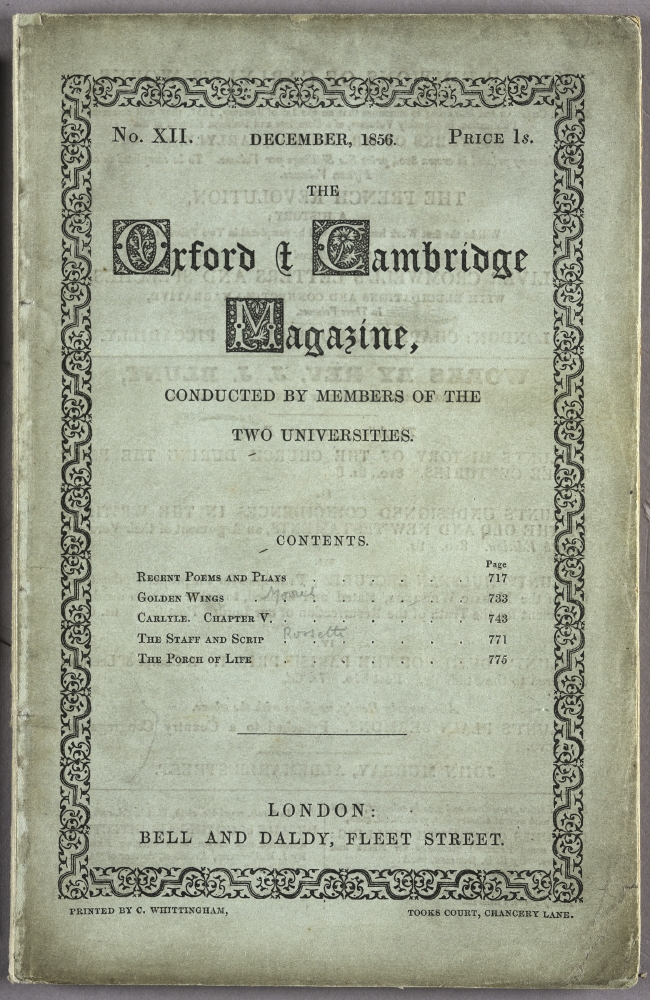
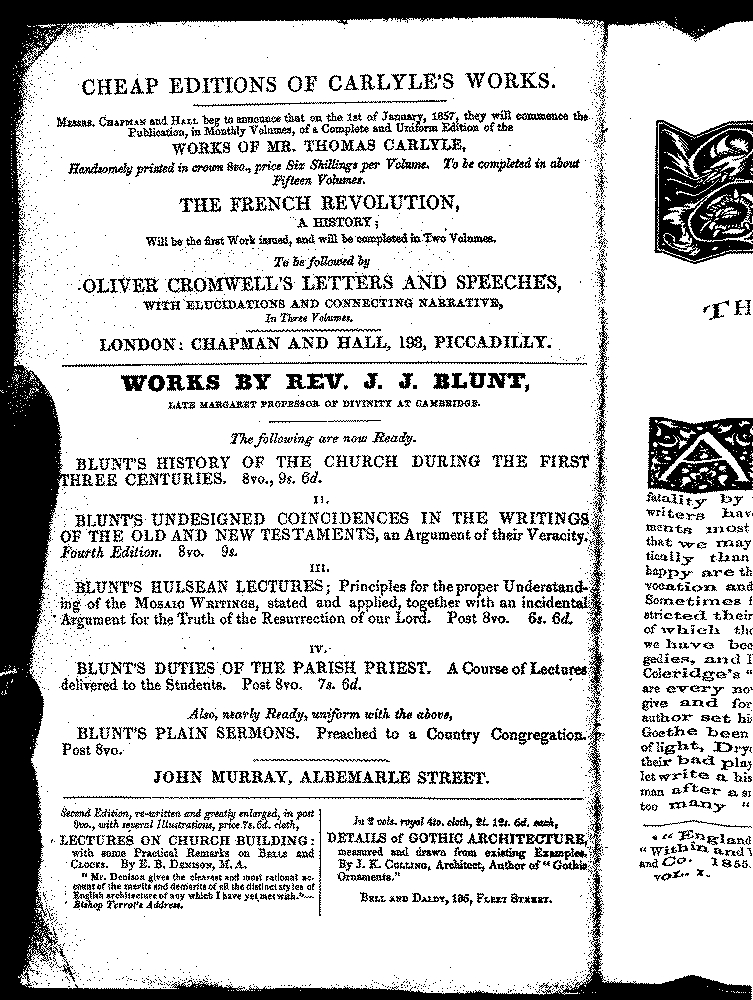
![Image of page [717]](http://www.rossettiarchive.org/img/ap4.o93.1.717.jpg)