Rossetti Archive Textual Transcription
The full Rossetti Archive record for this transcribed document is available.
![Image of page [001]](http://www.rossettiarchive.org/img/1-1886.1ed.v1.front1.jpg)
![Image of page [002]](http://www.rossettiarchive.org/img/1-1886.1ed.v1.front2.jpg)
![Image of page [004]](http://www.rossettiarchive.org/img/1-1886.1ed.v1.i.jpg)
OF
DANTE GABRIEL ROSSETTI
![Image of page [ii]](http://www.rossettiarchive.org/img/1-1886.1ed.v1.ii-iii.jpg)
OF
DANTE GABRIEL ROSSETTI
EDITED
WITH PREFACE AND NOTES
BY
WILLIAM M ROSSETTI
IN TWO VOLUMES
VOLUME I
POEMS
PROSE—TALES AND LITERARY PAPERS
ELLIS AND SCRUTTON
LONDON
1886
All rights reserved
![Image of page [iv]](http://www.rossettiarchive.org/img/1-1886.1ed.v1.iv-v.jpg)
Printed by Hazell, Watson, & Viney, Ld., London and Aylesbury.
DIED 9 APRIL 1882 AGED 53
FRANCES MARY LAVINIA ROSSETTI
DIED 8 APRIL 1886 AGED 85
TO
THE MOTHER'S SACRED MEMORY
THIS FIRST COLLECTED EDITION OF
THE SON'S WORKS
IS DEDICATED BY
THE SURVIVING SON AND BROTHER
W M R
![Image of page [vi]](http://www.rossettiarchive.org/img/1-1886.1ed.v1.vi-vii.jpg)
- Preface by William M. Rossetti . . . . . xv
-
-
POEMS.
-
-
I.—
Principal Poems:—
- Dante at Verona . . . . . . . . 1
- A Last Confession . . . . . . . . 18
- The Bride's Prelude . . . . . . . 35
- Sister Helen . . . . . . . . . 66
- The Staff and Scrip . . . . . . . . 75
- Jenny . . . . . . . . . . 83
- The Stream's Secret . . . . . . . 95
- Rose Mary . . . . . . . . . 103
- The White Ship . . . . . . . . 137
- The King's Tragedy . . . . . . . 148
-
-
The House of Life, A
Sonnet-Sequence—
-
- Introductory Sonnet . . . . . . . 176
-
-
Part
I.—Youth and
Change:—
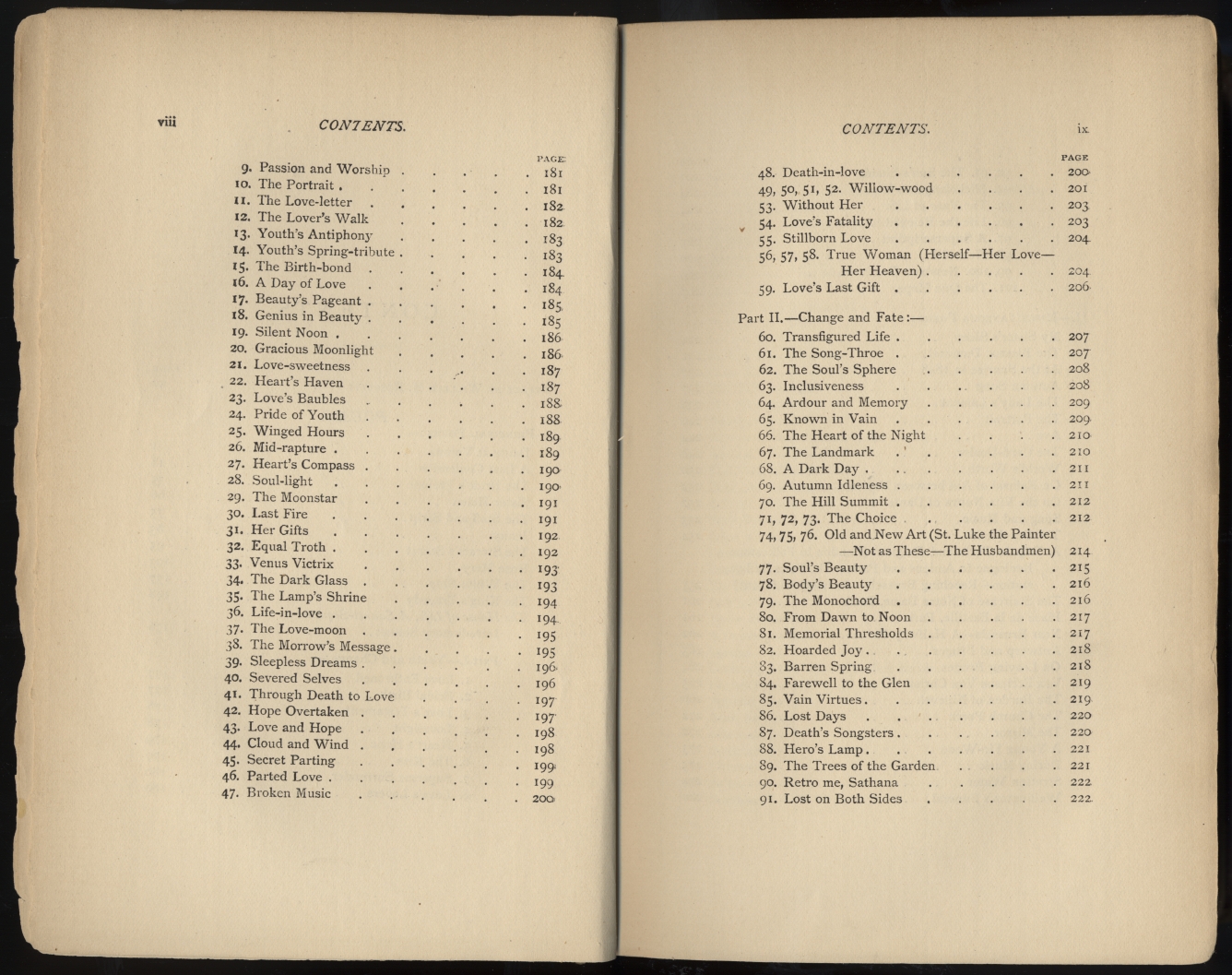
- 1. Love Enthroned . . . . . . 177
- 2. Bridal Birth . . . . . . . 177
- 3. Love's Testament . . . . . . 178
- 4. Lovesight . . . . . . . 178
- 5. Heart's Hope . . . . . . 179
- 6. The Kiss . . . . . . . 179
- 7. Supreme Surrender . . . . . 180
- 8. Love's Lovers . . . . . . 180
- 9. Passion and Worship . . . . . 181
- 10. The Portrait . . . . . . . 181
- 11. The Love-letter . . . . . . 182
- 12. The Lover's Walk . . . . . 182
- 13. Youth's Antiphony . . . . . 183
- 14. Youth's Spring-tribute . . . . . 183
- 15. The Birth-bond . . . . . . 184
- 16. A Day of Love . . . . . . 184
- 17. Beauty's Pageant . . . . . . 185
- 18. Genius in Beauty . . . . . . 185
- 19. Silent Noon . . . . . . . 186
- 20. Gracious Moonlight . . . . . 186
- 21. Love-sweetness . . . . . . 187
- 22. Heart's Haven . . . . . . 187
- 23. Love's Baubles . . . . . . 188
- 24. Pride of Youth . . . . . . 188
- 25. Winged Hours . . . . . . 189
- 26. Mid-rapture . . . . . . . 189
- 27. Heart's Compass . . . . . . 190
- 28. Soul-light . . . . . . . 190
- 29. The Moonstar . . . . . . 191
- 30. Last Fire . . . . . . . 191
- 31. Her Gifts . . . . . . . 192
- 32. Equal Troth . . . . . . . 192
- 33. Venus Victrix . . . . . . 193
- 34. The Dark Glass . . . . . . 193
- 35. The Lamp's Shrine . . . . . 194
- 36. Life-in-love . . . . . . . 194
- 37. The Love-moon . . . . . . 195
- 38. The Morrow's Message . . . . . 195
- 39. Sleepless Dreams . . . . . . 196
- 40. Severed Selves . . . . . . 196
- 41. Through Death to Love . . . . 197
- 42. Hope Overtaken . . . . . . 197
- 43. Love and Hope . . . . . . 198
- 44. Cloud and Wind . . . . . . 198
- 45. Secret Parting . . . . . . 199
- 46. Parted Love . . . . . . . 199
- 47. Broken Music . . . . . . 200
- 48. Death-in-love . . . . . . 200
- 49, 50, 51, 52. Willow-wood . . . . 201
- 53. Without Her . . . . . . 203
- 54. Love's Fatality . . . . . . 203
- 55. Stillborn Love . . . . . . 204
- 56, 57, 58.
True Woman
(Herself—Her
Love—
Her Heaven) . . . . . 204 - 59. Love's Last Gift . . . . . . 206
-
-
Part
II.—Change and
Fate:—
- 60. Transfigured Life . . . . . 207
- 61. The Song-Throe . . . . . . 207
- 62. The Soul's Sphere . . . . . 208
- 63. Inclusiveness . . . . . . 208
- 64. Ardour and Memory . . . . . 209
- 65. Known in Vain . . . . . . 209
- 66. The Heart of the Night . . . . 210
- 67. The Landmark . . . . . . 210
- 68. A Dark Day . . . . . . . 211
- 69. Autumn Idleness . . . . . . 211
- 70. The Hill Summit . . . . . . 212
- 71, 72, 73. The Choice . . . . . 212
- 74, 75, 76.
Old and New
Art (St. Luke the Painter
—Not as These—The Husbandmen) 214 - 77. Soul's Beauty . . . . . . 215
- 78. Body's Beauty . . . . . . 216
- 79. The Monochord . . . . . . 216
- 80. From Dawn to Noon . . . . . 217
- 81. Memorial Thresholds . . . . . 217
- 82. Hoarded Joy . . . . . . . 218
- 83. Barren Spring . . . . . . 218
- 84. Farewell to the Glen . . . . . 219
- 85. Vain Virtues . . . . . . . 219
- 86. Lost Days . . . . . . . 220
- 87. Death's Songsters . . . . . . 220
- 88. Hero's Lamp . . . . . . . 221
- 89. The Trees of the Garden . . . . 221
- 90. Retro me, Sathana . . . . . 222
- 91. Lost on Both Sides . . . . . 222
- 92, 93. The Sun's Shame . . . . . 223
- 94. Michelangelo's Kiss . . . . . 224
- 95. The Vase of Life . . . . . . 224
- 96. Life the Beloved . . . . . . 225
- 97. A Superscription . . . . . . 225
- 98. He and I . . . . . . . 226
- 99, 100. Newborn Death . . . . . 226
- 101. The One Hope . . . . . . 227
-
-
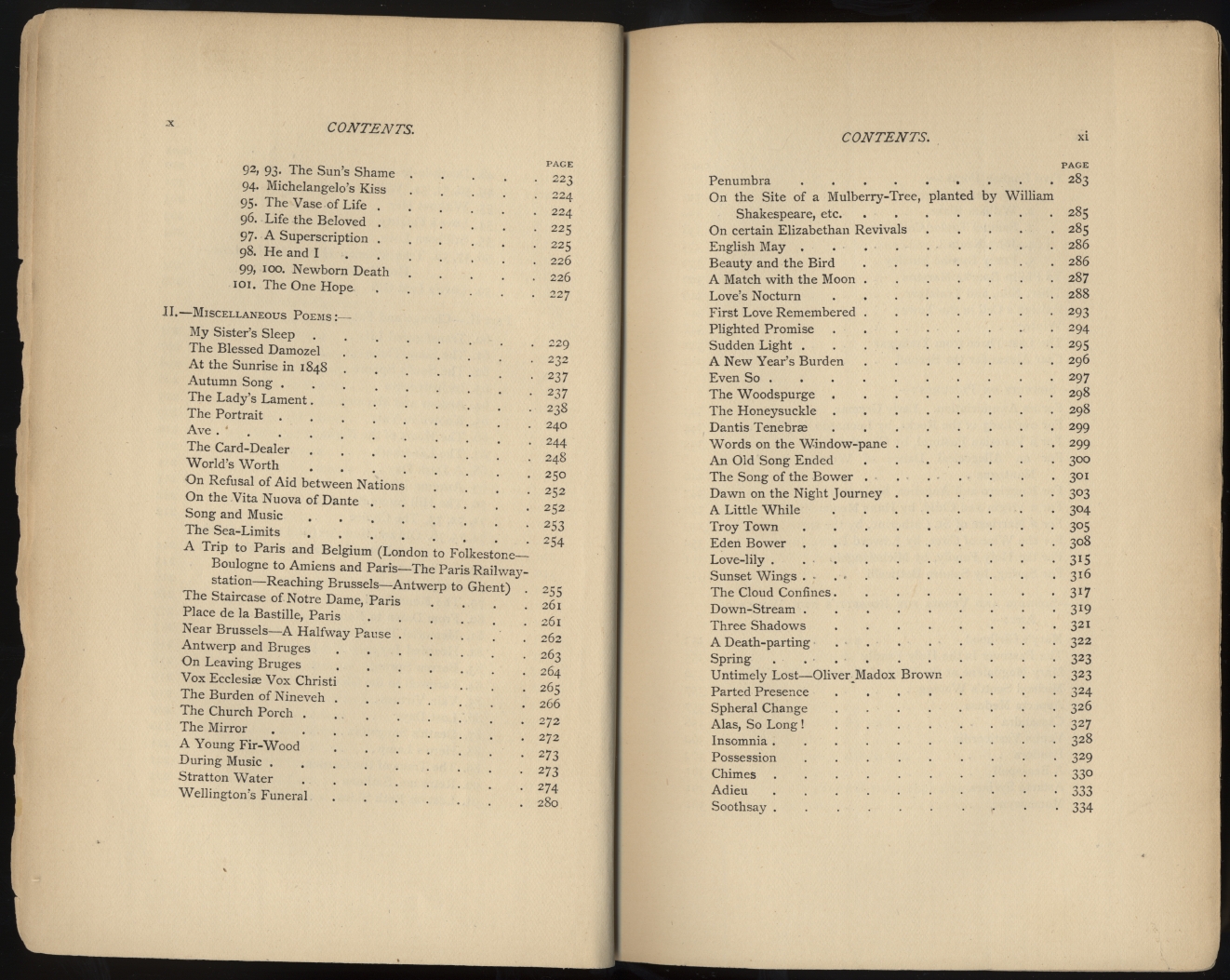
II.—Miscellaneous Poems:—
- My Sister's Sleep . . . . . . . . 229
- The Blessed Damozel . . . . . . . 232
- At the Sunrise in 1848 . . . . . . . 237
- Autumn Song . . . . . . . . . 237
- The Lady's Lament . . . . . . . . 238
- The Portrait . . . . . . . . . 240
- Ave . . . . . . . . . . . 244
- The Card-Dealer . . . . . . . . 248
- World's Worth . . . . . . . . 250
- On Refusal of Aid between Nations . . . . 252
- On the Vita Nuova of Dante . . . . . . 252
- Song and Music . . . . . . . . 253
- The Sea-Limits . . . . . . . . 254
-
A Trip to Paris and Belgium
(London to Folkestone—
Boulogne to Amiens and Paris—The Paris Railway-
station—Reaching Brussels—Antwerp to Ghent) . 255 - The Staircase of Notre Dame, Paris . . . . 261
- Place de la Bastille, Paris . . . . . . 261
- Near Brussels—A Halfway Pause . . . . . 262
- Antwerp and Bruges . . . . . . . 263
- On Leaving Bruges . . . . . . . 264
- Vox Ecclesiæ Vox Christi . . . . . . 265
- The Burden of Nineveh . . . . . . . 266
- The Church Porch . . . . . . . . 272
- The Mirror . . . . . . . . . 272
- A Young Fir-Wood . . . . . . . 273
- During Music . . . . . . . . . 273
- Stratton Water . . . . . . . . 274
- Wellington's Funeral . . . . . . . 280
- Penumbra . . . . . . . . . 283
-
On the Site of a Mulberry-Tree,
planted by William
Shakespeare, etc. . . . . . . . 285 - On certain Elizabethan Revivals . . . . . 285
- English May . . . . . . . . . 286
- Beauty and the Bird . . . . . . . 286
- A Match with the Moon . . . . . . . 287
- Love's Nocturn . . . . . . . . 288
- First Love Remembered . . . . . . . . . 293
- Plighted Promise . . . . . . . . 294
- Sudden Light . . . . . . . . . 295
- A New Year's Burden . . . . . . . 296
- Even So . . . . . . . . . . 297
- The Woodspurge . . . . . . . . 298
- The Honeysuckle . . . . . . . . 298
- Dantis Tenebræ . . . . . . . . 299
- Words on the Window-pane . . . . . . 299
- An Old Song Ended . . . . . . . 300
- The Song of the Bower . . . . . . . 301
- Dawn on the Night Journey . . . . . . 303
- A Little While . . . . . . . . 304
- Troy Town . . . . . . . . . 305
- Eden Bower . . . . . . . . . 308
- Love-lily . . . . . . . . . . 315
- Sunset Wings . . . . . . . . . 316
- The Cloud Confines . . . . . . . . 317
- Down-Stream . . . . . . . . . 319
- Three Shadows . . . . . . . . 321
- A Death-parting . . . . . . . . 322
- Spring . . . . . . . . . . 323
- Untimely Lost—Oliver Madox Brown . . . . 323
- Parted Presence . . . . . . . . 324
- Spheral Change . . . . . . . . 326
- Alas, So Long! . . . . . . . . 327
- Insomnia . . . . . . . . . . 328
- Possession . . . . . . . . . 329
- Chimes . . . . . . . . . . 330
- Adieu . . . . . . . . . . 333
- Soothsay . . . . . . . . . . 334
-
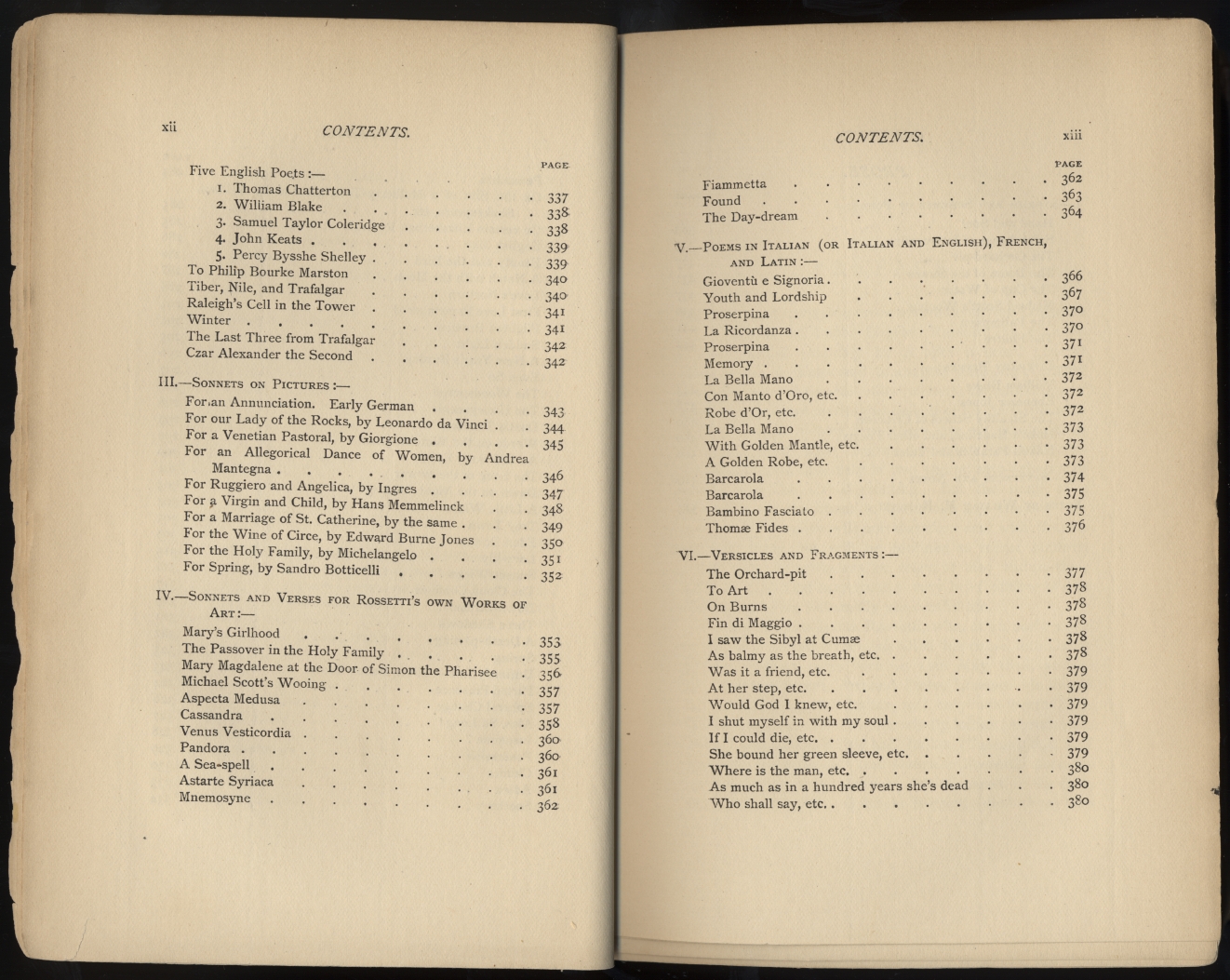
Five English
Poets:—
- 1. Thomas Chatterton . . . . . . 337
- 2. William Blake . . . . . . . 338
- 3. Samuel Taylor Coleridge . . . . . 338
- 4. John Keats . . . . . . . . 339
- 5. Percy Bysshe Shelley . . . . . . 339
- To Philip Bourke Marston . . . . . . 340
- Tiber, Nile, and Trafalgar . . . . . . 340
- Raleigh's Cell in the Tower . . . . . . 341
- Winter . . . . . . . . . . 341
- The Last Three from Trafalgar . . . . . 342
- Czar Alexander the Second . . . . . . 342
-
III.—Sonnets on
Pictures:—
- For an Annunciation. Early German . . . . 343
- For our Lady of the Rocks, by Leonardo da Vinci . . 344
- For a Venetian Pastoral, by Giorgione . . . . 345
-
For an Allegorical Dance of Women,
by Andrea
Mantegna . . . . . . . . . 346 - For Ruggiero and Angelica, by Ingres . . . . 347
- For a Virgin and Child, by Hans Memmelinck . . 348
- For a Marriage of St. Catherine, by the same . . . 349
- For the Wine of Circe, by Edward Burne Jones . . 350
- For the Holy Family, by Michelangelo . . . . 351
- For Spring, by Sandro Botticelli . . . . . 352
-
IV.—Sonnets and Verses for Rossetti's own
Works of
- Mary's Girlhood . . . . . . . . 353
- The Passover in the Holy Family . . . . . 355
- Mary Magdalene at the Door of Simon the Pharisee . 356
- Michael Scott's Wooing . . . . . . . 357
- Aspecta Medusa . . . . . . . . 357
- Cassandra . . . . . . . . . 358
- Venus Vesticordia . . . . . . . . 360
- Pandora . . . . . . . . . . 360
- A Sea-spell . . . . . . . . . 361
- Astarte Syriaca . . . . . . . . 361
- Mnemosyne . . . . . . . . . 362
- Fiametta . . . . . . . . . 362
- Found . . . . . . . . . . 363
- The Day-dream . . . . . . . . 364
Art:—-
V.—Poems in Italian (or Italian and English),
French,
- Gioventù e Signoria . . . . . . . . 366
- Youth and Lordship . . . . . . . 367
- Proserpina . . . . . . . . . 370
- La Ricordanza . . . . . . . . . 370
- Proserpina . . . . . . . . . 371
- Memory . . . . . . . . . . 371
- La Bella Mano . . . . . . . . 372
- Con Manto d'Oro, etc. . . . . . . . 372
- Robe d'Or, etc. . . . . . . . . 372
- La Bella Mano . . . . . . . . 373
- With Golden Mantle, etc. . . . . . . 373
- A Golden Robe, etc. . . . . . . . 373
- Barcarola . . . . . . . . . 374
- Barcarola . . . . . . . . . 375
- Bambino Fasciato . . . . . . . . 375
- Thomæ Fides . . . . . . . . . 376
and Latin:—-
VI.—Versicles and Fragments:—
- The Orchard-pit . . . . . . . . 377
- To Art . . . . . . . . . . 378
- On Burns . . . . . . . . . 378
- Fin di Maggio . . . . . . . . . 378
- I saw the Sibyl at Cumæ . . . . . . 378
- As balmy as the breath, etc. . . . . . . 378
- Was it a friend, etc. . . . . . . . 379
- At her step, etc. . . . . . . . . 379
- Would God I knew, etc. . . . . . . 379
- I shut myself in with my soul . . . . . . 379
- If I could die, etc. . . . . . . . . 379
- She bound her green sleeve, etc. . . . . . 379
- Where is the man, etc. . . . . . . . 380
- As much as in a hundred years she's dead . . . 380
- Who shall say, etc. . . . . . . 380
-
-
-
PROSE.
-
-
I.—Stories and Schemes of
Poems:—
- Hand and Soul . . . . . . . . 383
- Saint Agnes of Intercession . . . . . . 399
- The Orchard-pit . . . . . . . . 427
- The Doom of the Sirens . . . . . . . 431
- The Cup of Water . . . . . . . . 437
- Michael Scott's Wooing . . . . . . . 439
- The Palimpsest . . . . . . . . 441
- The Philtre . . . . . . . . . 442
-
-
II.—Literary Papers:—
- William Blake . . . . . . . . . 443
- Ebenezer Jones . . . . . . . . 478
- The Stealthy School of Criticism . . . . . 480
- Hake's Madeline, and other Poems . . . . . 489
- Hake's Parables and Tales . . . . . . 500
- III.—Sentences and Notes. . . . . . 510
-
- Notes by William M. Rossetti . . . . . 513

Works of Dante Gabriel Rossetti, as of most
authors, would probably be to offer a broad general
view of his writings, and to analyse with some critical
precision his relation to other writers, contemporary or
otherwise, and the merits and defects of his performances.
In this case, as in how few others, one would also have
to consider in what degree his mind worked con-
sentaneously or diversely in two several arts—the art of
poetry and the art of painting. But the hand of a
brother is not the fittest to undertake any work of this
scope. My preface will not therefore deal with themes
such as these, but will be confined to minor matters,
which may nevertheless be relevant also within their
limits. And first may come a very brief outline of the
few events of an outwardly uneventful life.
of his professional career, modified his name into Dante
Gabriel Rossetti, was born on 12th May 1828, at No.
38 Charlotte Street, Portland Place, London. In blood
he was three-fourths Italian, and only one-fourth Eng-
lish; being on the father's side wholly Italian (Abruzzese),
and on the mother's side half Italian (Tuscan) and half
English. His father was Gabriele Rossetti, born in
1783 at Vasto, in the Abruzzi, Adriatic coast, in the then
kingdom of Naples. Gabriele Rossetti (died 1854) was a man of letters, a custodian of ancient bronzes in the
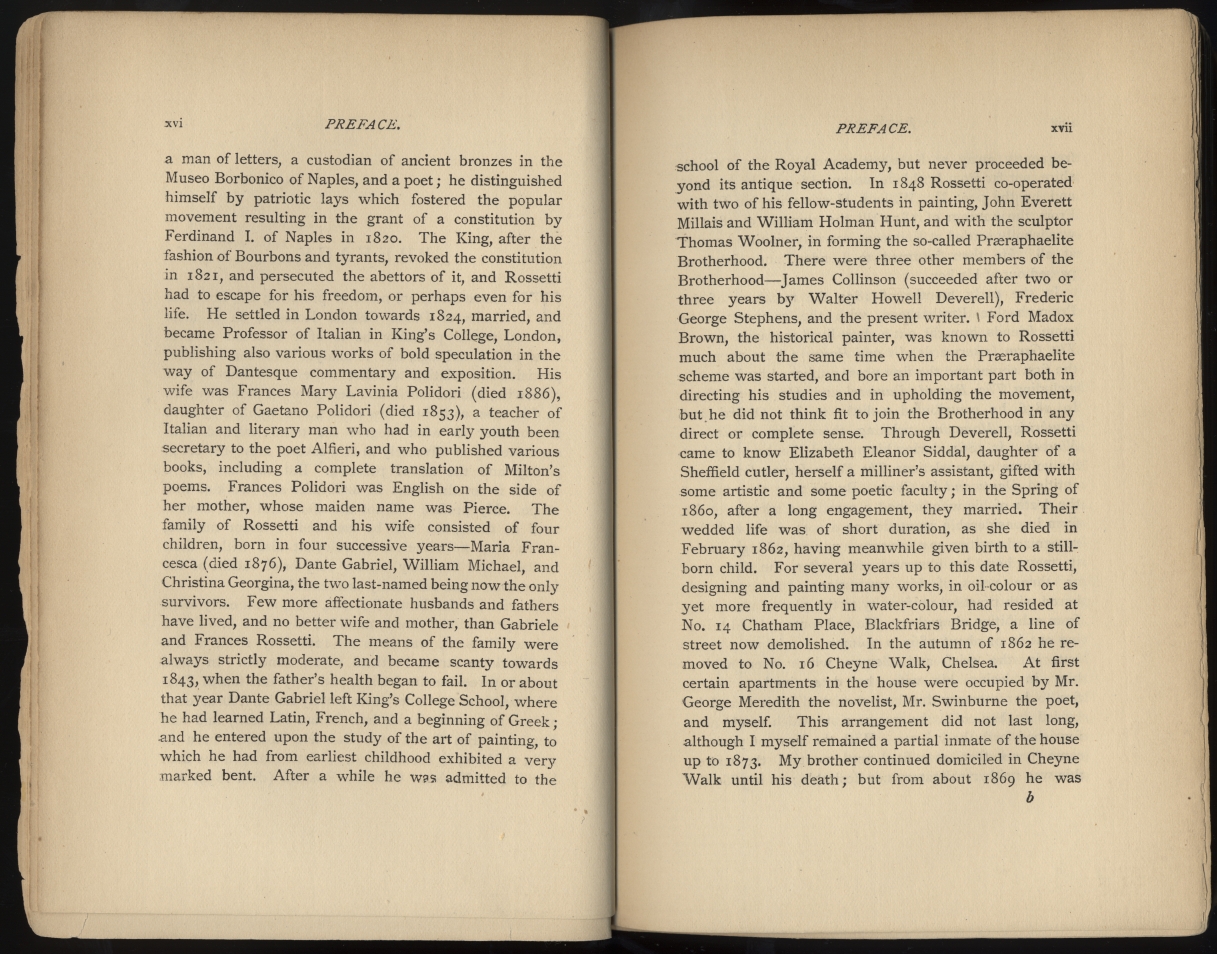
Museo Borbonico of Naples, and a poet; he distinguished
himself by patriotic lays which fostered the popular
movement resulting in the grant of a constitution by
Ferdinand I. of Naples in 1820. The King, after the
fashion of Bourbons and tyrants, revoked the constitution
in 1821, and persecuted the abettors of it, and Rossetti
had to escape for his freedom, or perhaps even for his
life. He settled in London towards 1824, married, and
became Professor of Italian in King's College, London,
publishing also various works of bold speculation in the
way of Dantesque commentary and exposition. His
wife was Frances Mary Lavinia Polidori (died 1886),
daughter of Gaetano Polidori (died 1853), a teacher of
Italian and literary man who had in early youth been
secretary to the poet Alfieri, and who published various
books, including a complete translation of Milton's
poems. Frances Polidori was English on the side of
her mother, whose maiden name was Pierce. The
family of Rossetti and his wife consisted of four
children, born in four successive years—Maria Fran-
cesca (died 1876), Dante Gabriel, William Michael, and
Christina Georgina, the two last-named being now the only
survivors. Few more affectionate husbands and fathers
have lived, and no better wife and mother, than Gabriele
and Frances Rossetti. The means of the family were
always strictly moderate, and became scanty towards
1843, when the father's health began to fail. In or about
that year Dante Gabriel left King's College School, where
he had learned Latin, French, and a beginning of Greek;
and he entered upon the study of the art of painting, to
which he had from earliest childhood exhibited a very
marked bent. After a while he was admitted to the school of the Royal Academy, but never proceeded be-
yond its antique section. In 1848 Rossetti co-operated
with two of his fellow-students in painting, John Everett
Millais and William Holman Hunt, and with the sculptor
Thomas Woolner, in forming the so-called Præraphaelite
Brotherhood. There were three other members of the
Brotherhood—James Collinson (succeeded after two or
three years by Walter Howell Deverell), Frederic
George Stephens, and the present writer. Ford Madox
Brown, the historical painter, was known to Rossetti
much about the same time when the Præraphaelite
scheme was started, and bore an important part both in
directing his studies and in upholding the movement,
but he did not think fit to join the Brotherhood in any
direct or complete sense. Through Deverell, Rossetti
came to know Elizabeth Eleanor Siddal, daughter of a
Sheffield cutler, herself a milliner's assistant, gifted with
some artistic and some poetic faculty; in the Spring of
1860, after a long engagement, they married. Their
wedded life was of short duration, as she died in
February 1862, having meanwhile given birth to a still-
born child. For several years up to this date Rossetti,
designing and painting many works, in oil-colour or as
yet more frequently in water-colour, had resided at
No. 14 Chatham Place, Blackfriars Bridge, a line of
street now demolished. In the autumn of 1862 he re-
moved to No. 16 Cheyne Walk, Chelsea. At first
certain apartments in the house were occupied by Mr.
George Meredith the novelist, Mr. Swinburne the poet,
and myself. This arrangement did not last long,
although I myself remained a partial inmate of the house
up to 1873. My brother continued domiciled in Cheyne
Walk until his death; but from about 1869 he was
frequently away at Kelmscot manorhouse, in Oxford-
shire, not far from Lechlade, occupied jointly by himself,
and by the poet Mr. William Morris with his family.
From the autumn of 1872 till the summer of 1874 he
was wholly settled at Kelmscot, scarcely visiting London
at all. He then returned to London, and Kelmscot
passed out of his ken.
Præraphaelite Brotherhood, with the co-operation of
some friends, brought out a short-lived magazine named
The Germ (afterwards Art and Poetry); here appeared
the first verses and the first prose published by Rossetti,
including The Blessed Damozel and Hand and Soul .
In 1856 he contributed a little to The Oxford and
Cambridge Magazine , printing there The Burden of
Nineveh . In 1861, during his married life, he published
his volume of translations The Early Italian Poets , now
entitled Dante and his Circle . By the time therefore of
the death of his wife he had a certain restricted yet far
from inconsiderable reputation as a poet, along with his
recognized position as a painter—a non-exhibiting painter,
it may here be observed, for, after the first two
or three years of his professional course, he ad-
hered with practical uniformity to the plan of abstaining
from exhibition altogether. He had contemplated bring-
ing out in or about 1862 a volume of original poems;
but, in the grief and dismay which overwhelmed
him in losing his wife, he determined to sacri-
fice to her memory this long-cherished project, and he
buried in her coffin the manuscripts which would have
furnished forth the volume. With the lapse of years he
came to see that, as a final settlement of the matter,
this was neither obligatory nor desirable; so in 1869 the
manuscripts were disinterred, and in 1870 his volume
named Poems was issued. For some considerable
while it was hailed with general and lofty praise,
chequered by only moderate stricture or demur; but
late in 1871 Mr. Robert Buchanan published under a
pseudonym, in the Contemporary Review , a very hostile
article named The Fleshly School of Poetry , attacking
the poems on literary and more especially on moral
grounds. The article, in an enlarged form, was after-
wards reissued as a pamphlet. The assault produced
on Rossetti an effect altogether disproportionate to its
intrinsic importance; indeed, it developed in his cha-
racter an excess of sensitiveness and of distempered
brooding which his nearest relatives and friends had
never before surmised,—for hitherto he had on the whole
had an ample sufficiency of high spirits, combined with
a certain underlying gloominess or abrupt moodiness of
nature and outlook. Unfortunately there was in him
already only too much of morbid material on which this
venom of detraction was to work. For some years the
state of his eyesight had given very grave cause for appre-
hension, he himself fancying from time to time that the
evil might end in absolute blindness, a fate with which
our father had been formidably threatened in his closing
years. From this or other causes insomnia had ensued,
coped with by far too free a use of chloral, which may
have begun towards the end of 1869. In the summer of
1872 he had a dangerous crisis of illness; and from that
time forward, but more especially from the middle of
1874, he became secluded in his habits of life, and often
depressed, fanciful, and gloomy. Not indeed that there
were no intervals of serenity, even of brightness; for in
fact he was often genial and pleasant, and a most agreeable
companion, with as much bonhomie as acuteness for wiling
an evening away. He continued also to prosecute his
pictorial work with ardour and diligence, and at times he
added to his product as a poet. The second of his original
volumes, Ballads and Sonnets , was published in the
autumn of 1881. About the same time he sought change
of air and scene in the Vale of St. John, near Keswick,
Cumberland; but he returned to town more shattered in
health and in mental tone than he had ever been before.
In December a shock of a quasi-paralytic character struck
him down. He rallied sufficiently to remove to Birching-
ton-on-Sea, near Margate. The hand of death was then
upon him, and was to be relaxed no more. The last
stage of his maladies was uræmia. Tended by his
mother and his sister Christina, with the constant com-
panionship at Birchington of Mr. Hall Caine, and in the
presence likewise of Mr. Theodore Watts, Mr. Frederick
Shields, and myself, he died on Easter Sunday, April 9th
1882. His sister-in-law, the daughter of Madox Brown,
arrived immediately after his latest breath had been
drawn. He lies buried in the churchyard of Birchington.
one another's feelings and thoughts more intimately, in
childhood, boyhood, and well on into mature manhood,
than Dante Gabriel and myself. I have no idea of
limning his character here at any length, but will de-
fine a few of its leading traits. He was always and
essentially of a dominant turn, in intellect and in
temperament a leader. He was impetuous and vehe-
ment, and necessarily therefore impatient; easily
angered, easily appeased, although the embittered
feelings of his later years obscured this amiable quality
to some extent; constant and helpful as a friend where
he perceived constancy to be reciprocated; free-handed
and heedless of expenditure, whether for himself or for
others; in family affection warm and equable, and (except
in relation to our mother, for whom he had a fondling
love) not demonstrative. Never on stilts in matters of
the intellect or of aspiration, but steeped in the sense
of beauty, and loving, if not always practising, the good;
keenly alive also (though many people seem to discredit
this now) to the laughable as well as the grave or solemn
side of things; superstitious in grain, and anti-scientific
to the marrow. Throughout his youth and early man-
hood I considered him to be markedly free from vanity,
though certainly well equipped in pride; the distinction
between these two tendencies was less definite in his
closing years. Extremely natural and therefore totally
unaffected in tone and manner, with the naturalism
characteristic of Italian blood; good-natured and hearty,
without being complaisant or accommodating; reserved
at times, yet not haughty; desultory enough in youth,
diligent and persistent in maturity; self-centred always,
and brushing aside whatever traversed his purpose or
his bent. He was very generally and very greatly liked
by persons of extremely diverse character; indeed, I
think it can be no exaggeration to say that no one ever
disliked him. Of course I do not here confound the
question of liking a man's personality with that of
approving his conduct out-and-out.
impression. I have said that it was natural; it was
likewise eminently easy, and even of the free-and-easy
kind. There was a certain British bluffness, streaking
the finely poised Italian suppleness and facility. As he
was thoroughly unconventional, caring not at all to
fall in with the humours or prepossessions of any
particular class of society, or to conciliate or approxi-
mate the socially distinguished, there was little in him
of any veneer or varnish of elegance; none the less he
was courteous and well-bred, meeting all sorts of persons
upon equal terms— i.e., upon his own terms; and I am
satisfied that those who are most exacting in such
matters found in Rossetti nothing to derogate from the
standard of their requirements. In habit of body he was
indolent and lounging, disinclined to any prescribed
or trying exertion of any sort, and very difficult to stir
out of his ordinary groove, yet not wanting in active
promptitude whenever it suited his liking. He often
seemed totally unoccupied, especially of an evening;
no doubt the brain was busy enough.
Italian than English, though I have more than once
heard it said that there was nothing observable to
bespeak foreign blood. He was of rather low middle
stature, say five feet seven and a half, like our father;
and, as the years advanced, he resembled our father
not a little in a characteristic way, yet with highly
obvious divergences. Meagre in youth, he was at
times decidedly fat in mature age. The complexion,
clear and warm, was also dark, but not dusky or sombre.
The hair was dark and somewhat silky; the brow grandly
spacious and solid; the full-sized eyes blueish-grey;
the nose shapely, decided, and rather projecting, with an
aquiline tendency and large nostrils, and perhaps no
detail in the face was more noticeable at a first glance
than the very strong indentation at the spring of the
nose below the forehead; the mouth moderately well-
shaped, but with a rather thick and unmoulded under-
lip; the chin unremarkable; the line of the jaw, after
youth was passed, full, rounded, and sweeping; the ears
well-formed and rather small than large. His hips were
wide, his hands and feet small; the hands very much
those of the artist or author type, white, delicate,
plump, and soft as a woman's. His gait was resolute
and rapid, his general aspect compact and deter-
mined, the prevailing expression of the face that
of a fiery and dictatorial mind concentrated into re-
pose. Some people regarded Rossetti as eminently
handsome; few, I think, would have refused him the
epithet of well-looking. It rather surprises me to
find from Mr. Caine's book of Recollections that that
gentleman, when he first saw Rossetti in 1880, con-
sidered him to look full ten years older than he really
was,—namely, to look as if sixty-two years old. To my
own eye nothing of the sort was apparent. He wore
moustaches from early youth, shaving his cheeks; from
1870 or thereabouts he grew whiskers and beard, mode-
rately full and auburn-tinted, as well as moustaches. His
voice was deep and harmonious; in the reading of poetry,
remarkably rich, with rolling swell and musical cadence.
the interruption of his ordinary habits of life, and the
flurry or discomfort, involved in locomotion. In boy-
hood he knew Boulogne: he was in Paris three or four
times, and twice visited some principal cities of Belgium.
This was the whole extent of his foreign travelling.
He crossed the Scottish border more than once, and
knew various parts of England pretty well—Hastings,
Bath, Oxford, Matlock, Stratford-on-Avon, Newcastle-
on-Tyne, Bognor, Herne Bay; Kelmscot, Keswick, and
Birchington-on-Sea, have been already mentioned. From

1878 or thereabouts he became, until he went to the
neighbourhood of Keswick, an absolute home-keeping
recluse, never even straying outside the large garden of
his own house, except to visit from time to time our
mother in the central part of London.
friends, and could always have commanded any amount
of intercourse with any number of ardent or kindly
well-wishers, had he but felt elasticity and cheerfulness
of mind enough for the purpose. I should do injustice
to my own feelings if I were not to mention here some
of his leading friends. First and foremost I name Mr.
Madox Brown, his chief intimate throughout life, on
the unexhausted resources of whose affection and con-
verse he drew incessantly for long years; they were at
last separated by the removal of Mr. Brown to Man-
chester, for the purpose of painting the Town Hall
frescoes. The Præraphaelites—Millais, Hunt, Woolner,
Stephens, Collinson, Deverell—were on terms of un-
bounded familiarity with him in youth; owing to death
or other causes, he lost sight eventually of all of them
except Mr. Stephens. Mr. William Bell Scott was, like
Mr. Brown, a close friend from a very early period until
the last; Scott being both poet and painter, there was
a strict bond of affinity between him and Rossetti.
Mr. Ruskin was extremely intimate with my brother
from 1854 till about 1865, and was of material help to
his professional career. As he rose towards celebrity,
Rossetti knew Burne Jones, and through him Morris
and Swinburne, all staunch and fervently sympathetic
friends. Mr. Shields was a rather later acquaintance,
who soon became an intimate, equally respected and
cherished. Then Mr. Hueffer the musical critic (now
a close family connection, editor of the Tauchnitz edition
of Rossetti's works), and Dr. Hake the poet. Through
the latter my brother came to know Mr. Theodore
Watts, whose intellectual companionship and incessant
assiduity of friendship did more than anything else
towards assuaging the discomforts and depression of his
closing years. In the latest period the most intimate
among new acquaintances were Mr. William Sharp and
Mr. Hall Caine, both of them known to Rossettian readers
as his biographers. Nor should I omit to speak of the
extremely friendly relation in which my brother stood to
some of the principal purchasers of his pictures—Mr.
Leathart, Mr. Rae, Mr. Leyland, Mr. Graham, Mr. Valpy,
Mr. Turner, and his early associate Mr. Boyce. Other
names crowd upon me—James Hannay, John Tupper,
Patmore, Thomas and John Seddon, Mrs. Bodichon,
Browning, John Marshall, Tebbs, Mrs. Gilchrist, Miss
Boyd, Sandys, Whistler, Joseph Knight, Fairfax Murray,
Mr. and Mrs. Stillman, Treffry Dunn, Lord and Lady
Mount-Temple, Oliver Madox Brown, the Marstons,
father and son—but I forbear.
sequence, etc., of my brother's writings, it may be worth
while to speak of the poets who were particularly
influential in nurturing his mind and educing its own
poetic endowment. The first poet with whom he
became partially familiar was Shakespeare. Then fol-
lowed the usual boyish fancies for Walter Scott and
Byron. The Bible was deeply impressive to him,
perhaps above all Job, Ecclesiastes, and the Apocalypse.
Byron gave place to Shelley when my brother was about
sixteen years of age; and Mrs. Browning and the old
English or Scottish ballads rapidly ensued. It may have
been towards this date, say 1845, that he first seriously
applied himself to Dante, and drank deep of that in-
exhaustible well-head of poesy and thought; for the
Florentine, though familiar to him as a name, and in
some sense as a pervading penetrative influence, from
earliest childhood, was not really assimilated until boy-
hood was practically past. Bailey's Festus was enor-
mously relished about the same time—read again and
yet again; also Faust, Victor Hugo, De Musset (and
along with them a swarm of French novelists), and
Keats, whom my brother for the most part, though not
without some compunctious visitings now and then,
truly preferred to Shelley. The only classical poet
whom he took to in any degree worth speaking of was
Homer, the Odyssey considerably more than the Iliad.
Tennyson reigned along with Keats, and Edgar Poe and
Coleridge along with Tennyson. In the long run he
perhaps enjoyed and revered Coleridge beyond any other
modern poet whatsoever; but Coleridge was not so
distinctly or separately in the ascendant, at any par-
ticular period of youth, as several of the others. Blake
likewise had his peculiar meed of homage, and Charles
Wells, the influence of whose prose style, in the Stories
after Nature , I trace to some extent in Rossetti's Hand
and Soul . Lastly came Browning, and for a time, like
the serpent-rod of Moses, swallowed up all the rest.
This was still at an early stage of life; for I think the
year 1847 cannot certainly have been passed before my
brother was deep in Browning. The readings or frag-
mentary recitations of Bells and Pomegranates, Para-
celsus , and above all Sordello, are something to remember
from a now distant past. My brother lighted upon
Pauline (published anonymously) in the British Museum,
copied it out, recognized that it must be Browning's, and
wrote to the great poet at a venture to say so, receiving
a cordial response, followed by a genial and friendly inter-
course for several years. One prose-work of great
influence upon my brother's mind, and upon his product
as a painter, must not be left unspecified—Malory's
Mort d'Arthur, which engrossed him towards 1856.
The only poet whom I feel it needful to add to the
above is Chatterton. In the last two or three years of
his life my brother entertained an abnormal—I think
an exaggerated—admiration of Chatterton. It appears
to me that (to use a very hackneyed phrase) he “evolved
this from his inner consciousness” at that late period;
certainly in youth and early manhood he had no such
feeling. He then read the poems of Chatterton with
cursory glance and unexcited spirit, recognizing them
as very singular performances for their date in English
literature, and for the author's boyish years, but beyond
that laying no marked stress upon them.
names unmentioned in this list: I have stated the facts
as I remember and know them. Chaucer, Spenser,
the Elizabethan dramatists (other than Shakespeare),
Milton, Dryden, Pope, Wordsworth, are unnamed. It
should not be supposed that he read them not at all, or
cared not for any of them; but, if we except Chaucer in
a rather loose way and (at a late period of life) Marlowe
in some of his non-dramatic poems, they were compara-
tively neglected. Thomas Hood he valued highly; also
very highly Burns in mature years, but he was not
a constant reader of the Scottish lyrist. Of Italian poets
he earnestly loved none save Dante: Cavalcanti in his
degree, and also Poliziano and Michelangelo — not
Petrarca, Boccaccio, Ariosto, Tasso, or Leopardi, though
in boyhood he delighted well enough in Ariosto. Of
French poets, none beyond Hugo and De Musset;
except Villon, and partially Dumas, whose novels ranked
among his favourite reading. In German poetry he
read nothing currently in the original, although (as our
pages bear witness) he had in earliest youth so far
mastered the language as to make some translations.
Calderon, in Fitzgerald's version, he admired deeply;
but this was only at a late date. He had no liking for
the specialities of Scandinavian, nor indeed of Teutonic,
thought and work, and little or no curiosity about
Oriental—such as Indian, Persian, or Arabic—poetry.
Any writing about devils, spectres, or the supernatural
generally, whether in poetry or in prose, had always
a fascination for him; at one time, say 1844, his supreme
delight was the blood-curdling romance of Maturin,
Melmoth the Wanderer.
writings. Of his merely childish or boyish performances
I need have said nothing, were it not that they have
been mentioned in other books regarding Rossetti. First
then there was The Slave , a “drama” which he
composed and wrote out in or about the sixth year of his
age. It is of course simple nonsense. “Slave” and
“traitor” were two words which he found passim in
Shakespeare; so he gave to his principal or only
characters the names of Slave and Traitor. If what
they do is meaningless, what they say (when they deviate
from prose) is probably unmetrical; but it is so long
since I read The Slave that I speak about this with
uncertainty. Towards his thirteenth year he began
a romantic prose-tale named Roderick and Rosalba . I
hardly think that he composed anything else prior to
the ballad narrative Sir Hugh the Heron , founded on
a tale by Allan Cunningham. Our grandfather printed it
in 1843, which is probably the year of its composition.
It is correctly enough versified, but has no merit, and
little that could even be called promise. Soon afterwards a
prose-tale named Sorrentino , in which the devil played
a conspicuous part, was begun, and carried to some
length; it was of course boyish, but it must, I think, have
shown some considerable degree of cleverness. In 1844
or 1845 there was a translation of Bürger's Lenore ,
spirited and I suppose fairly efficient; and in November
1845 was begun a translation of the Nibelungenlied ,
almost deserving (if my memory serves me) to be con-
sidered good. Several hundred lines of it must certainly
have been written. My brother was by this time a
practised and competent versifier, at any rate, and his
mere prentice-work may count as finished.
succeeded, along with the version of Der Arme Heinrich ,
and the beginning of his translations from the early
Italians. These must, I think, have been in full career
in the first half of 1847, if not in 1846. They show
a keen sensitiveness to whatsoever is poetic in the
originals, and a sinuous strength and ease in providing
English equivalents, with the command of a rich and
romantic vocabulary. In his nineteenth year, or before
12th May 1847, he wrote The Blessed Damozel .* As
that is universally recognized as one of his typical
* My brother said so, in a letter published by Mr. Caine. He
must
presumably have been correct; otherwise I should have
thought
that his twentieth year, or even his twenty-first, would
be
nearer the mark.
![Image of page xx[x]](http://www.rossettiarchive.org/img/1-1886.1ed.v1.xxx-xxxi.jpg)
his faculty whether inventive or executive, I may here
close this record of preliminaries; the poems, with such
slight elucidations as my notes supply, being left to
speak for themselves. I will only add that for some
while, more especially in the later part of 1848 and in
1849, my brother practised his pen to no small extent in
writing sonnets to bouts-rimés. He and I would sit
together in our bare little room at the top of No. 50
Charlotte Street, I giving him the rhymes for a sonnet,
and he me the rhymes for another; and we would write
off our emulous exercises with considerable speed, he
constantly the more rapid of the two. From five to eight
minutes may have been the average time for one of his
sonnets; not unfrequently more, and sometimes hardly
so much. In fact, the pen scribbled away at its fastest.
Many of his bouts-rimés sonnets still exist in my posses-
sion, a little touched up after the first draft. Two or
three seemed to me nearly good enough to appear in the
present collection, but on the whole I decided against
them all. Some have a faux air of intensity of meaning,
as well as of expression; but their real core of signifi-
cance is necessarily small, the only wonder being how
he could spin so deftly with so weak a thread. I may
be allowed to mention that most of my own sonnets (and
not sonnets alone) published in The Germ were bouts-
rimes experiments such as above described. In poetic
tone they are of course inferior to my brother's work of
like fashioning; in point of sequence or self-congruity of
meaning, the comparison might be less to my disadvantage.
three volumes, chiefly of poetry. I shall transcribe the
title-pages verbatim.
Dante Alighieri (1100—1200—1300) in the Original
Metres. Together with Dante's Vita Nuova. Translated
by D. G. Rossetti. Part I. Poets chiefly before Dante.
Part II. Dante and his Circle. London: Smith, Elder
and Co., 65, Cornhill. 1861. The rights of translation
and reproduction, as regards all editorial parts of this
work, are reserved.
ceding him (1100—1200—1300). A Collection of Lyrics,
edited, and translated in the original metres, by Dante
Gabriel Rossetti. Revised and rearranged edition.
Part I. Dante's Vita Nuova, &c. Poets of Dante's
Circle. Part II. Poets chiefly before Dante. London:
Ellis and White, 29 New Bond Street. 1874.
F. S. Ellis, 33 King Street, Covent Garden. 1870.
London: Ellis and White, 29 New Bond Street. 1881.
London: Ellis and White, 29, New Bond Street, W. 1881.
same book as 1 a, but altered in arrangement, chiefly
by inverting the order in which the poems of Dante
and of the Dantesque epoch, and those of an earlier
period, are printed. In the present collection, I reprint
1 b, taking no further count of 1 a. The volume 2 b is to
a great extent the same as 2 a, yet by no means identical
with it. 2 a contained a section named Sonnets and
Songs, towards a work to be called “The House of Life.”
In 1881, when 2 b and 3 were published simultaneously,
The House of Life was completed, was made to consist
solely of sonnets, and was transferred to 3; while the

gap thus left in 2 b was filled up by other poems. With
this essential modification of The House of Life it was
clearly my duty not to interfere.
but the question had to be considered whether I should
reprint 2 b and 3 exactly as they stood in 1881, adding
after them a section of poems not hitherto printed in
any one of my brother's volumes; or whether I should
recast, in point of arrangement, the entire contents of
2 b and 3, inserting here and there, in their most appro-
priate sequence, the poems hitherto unprinted. I have
chosen the latter alternative, as being in my own opinion
the only arrangement which is thoroughly befitting for
an edition of Collected Works. I am aware that some
readers would have preferred to see the old order— i.e.,
the order of 1881—retained, so that the two volumes of
that year could be perused as they then stood. Indeed,
one of my brother's friends, most worthy, whether as
friend or as critic, to be consulted on such a subject,
decidedly advocated that plan. On the other hand, I
found my own view confirmed by my sister Christina,
who, both as a member of the family and as a poetess,
deserved an attentive hearing. The reader who inspects
my table of contents will be readily able to follow the
method of arrangement which is here adopted. I have
divided the materials into Principal Poems, Miscellaneous
Poems, Translations, and some minor headings; and
have in each section arranged the poems—and the
same has been done with the prose-writings—in some
approximate order of date. This order of date is cer-
tainly not very far from correct; but I could not make it
absolute, having frequently no distinct information to go
by. The few translations which were printed in 2 b (as
shall give in a tabular form some particulars which will
enable the reader to follow out for himself, if he takes
an interest in such minutiæ, the original arrangement of
2 a, 2 b, and 3.
yet, which I am unable to include among his Collected
Works. One of these is a grotesque ballad about a
Dutchman, begun at a very early date, and finished in
his last illness. The other is a brace of sonnets, in-
teresting in subject, and as being the very last thing
that he wrote. These works were presented as a gift
of love and gratitude to a friend, with whom it remains
to publish them at his own discretion. I have also
advisedly omitted three poems; two of them sonnets,
the third a ballad of no great length. One of the
sonnets is that entitled Nuptial Sleep . It appeared in
the volume of Poems 1870 (2 a), but was objected
to by Mr. Buchanan, and I suppose by some other
censors, as being indelicate; and my brother excluded
it from The House of Life in his third volume. I con-
sider that there is nothing in the sonnet which need
imperatively banish it from his Collected Works; but
his own decision commands mine, and besides it could
not now be reintroduced into The House of Life ,
which he moulded into a complete whole without it,
and would be misplaced if isolated by itself—a point
as to which his opinion is very plainly set forth in
his prose-paper The Stealthy School of Criticism . The
second sonnet, named On the French Liberation of Italy,
was put into print by my brother while he was pre-
paring his volume of 1870, but he resolved to leave
it unpublished. Its title shows plainly enough that it relates to a matter in which sexual morals have no
part; but the subject is treated under the form of a
vigorous and perhaps repulsive metaphor, and here
again I follow his own lead. The ballad above referred
to, Dennis Shand , is a skilful and really very harmless
production; it was printed but not published, like the
sonnet last-mentioned, and no writer other than one
who took a grave view of questions of moral propriety
would have preferred to suppress it. My brother's
opinion is worded thus in a letter to Mr. Caine, which
that gentleman has published: “The ballad . . . deals
trivially with a base amour (it was written very early),
and is therefore really reprehensible to some extent.”
I will not be less jealously scrupulous for him than he
was for himself.
might add, a very fastidious painter. He did not indeed
“cudgel his brains” for the idea of a poem or the
structure or diction of a stanza. He wrote out of a
large fund or reserve of thought and consideration,
which would culminate in a clear impulse or (as we
say) an inspiration. In the execution he was always
heedful and reflective from the first, and he spared no
after-pains in clarifying and perfecting. He abhorred
anything straggling, slipshod, profuse, or uncondensed.
He often recurred to his old poems, and was reluctant to
leave them merely as they were. A natural concomitant
of this state of mind was a great repugnance to the
notion of publishing, or of having published after his
death, whatever he regarded as juvenile, petty, or
inadequate. As editor of his Collected Works, I have
had to regulate myself by these feelings of his, whether
my own entirely correspond with them or not. The amount of unpublished work which he left behind him
was by no means large; out of the moderate bulk I
have been careful to select only such examples as I
suppose that he would himself have approved for the
purpose, or would, at any rate, not gravely have objected
to. A list of the new items is given at page xli, and a
few details regarding them will be found among my
notes. Some projects or arguments of poems which he
never executed are also printed among his prose-writings.
These particular projects had, I think, been practically
abandoned by him in all the later years of his life; but
there was one subject which he had seriously at heart,
and for which he had collected some materials, and he
would perhaps have put it into shape had he lived a
year or two longer—a ballad on the subject of Joan Darc,
to match The White Ship and The King's Tragedy .
he considered himself more essentially a poet than a
painter. To vary the form of expression, he thought that
he had mastered the means of embodying poetical concep-
tions in the verbal and rhythmical vehicle more thoroughly
than in form and design, perhaps more thoroughly than
in colour.
to publish at an early date a substantial selection from
the family-letters written by my brother, to be pre-
ceded by a Memoir drawn up by Mr. Theodore Watts,
who will be able to express more freely and more im-
partially than myself some of the things most apposite
to be said about Dante Gabriel Rossetti.
London, June 1886.
-
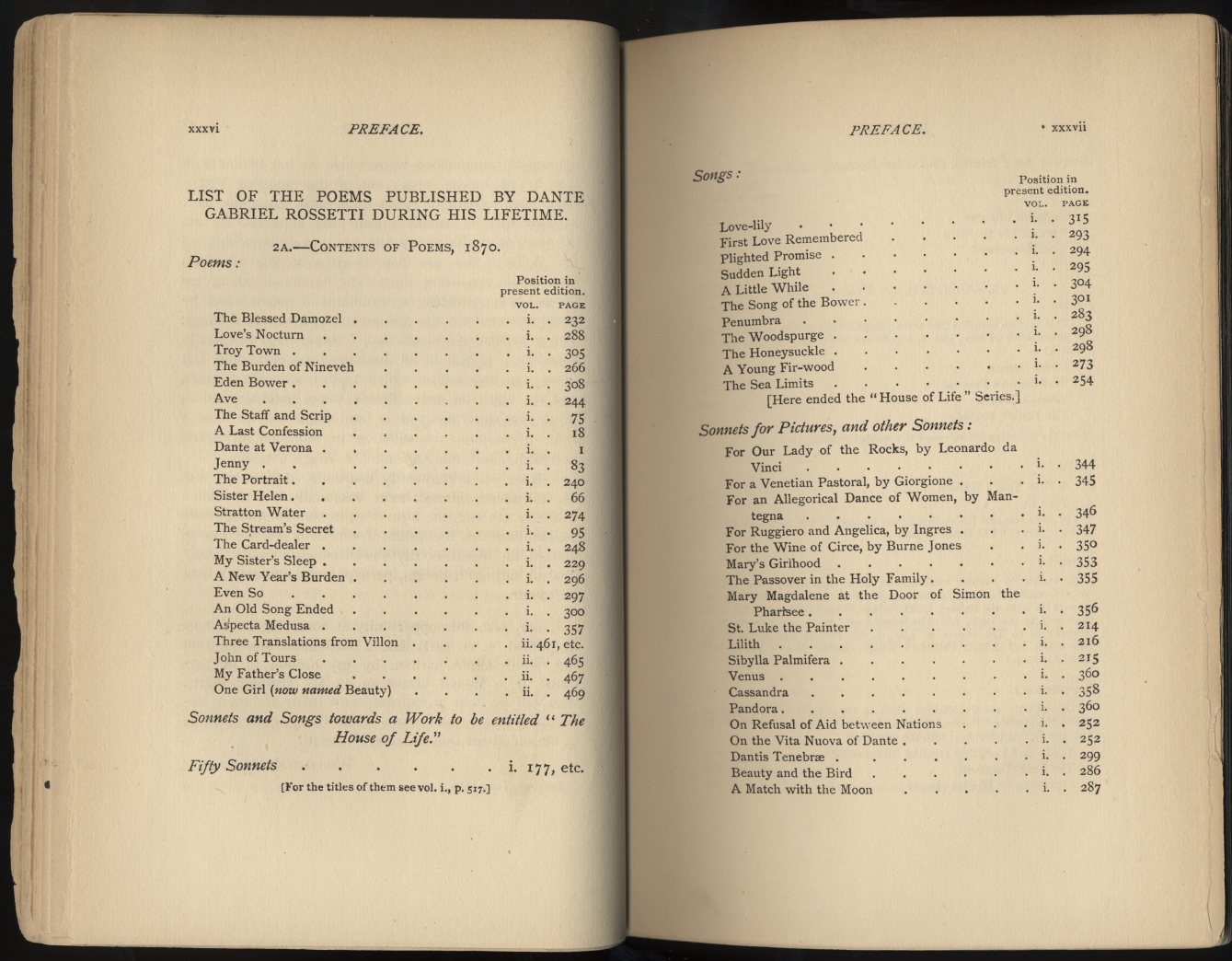
LIST OF THE POEMS PUBLISHED BY DANTE
-
- 2a.—Contents of
Poems, 1870.
-
-
Poems:
- The Blessed Damozel . . . . . . i. . 232
- Love's Nocturn . . . . . . . i. . 288
- Troy Town . . . . . . . . i. . 305
- The Burden of Nineveh . . . . . i. . 266
- Eden Bower . . . . . . . . i. . 308
- Ave . . . . . . . . . i. . 244
- The Staff and Scrip . . . . . . i. . 75
- A Last Confession . . . . . . i. . 18
- Dante at Verona . . . . . . . i. . 1
- Jenny . . . . . . . . i. . 83
- The Portrait . . . . . . . . i. . 240
- Sister Helen . . . . . . . . i. . 66
- Stratton Water . . . . . . . i. . 274
- The Stream's Secret . . . . . . i. . 95
- The Card-dealer . . . . . . . i. . 248
- My Sister's Sleep . . . . . . . i. . 229
- A New Year's Burden . . . . . . i. . 296
- Even So . . . . . . . . i. . 297
- An Old Song Ended . . . . . . i. . 300
- Aspecta Medusa . . . . . . . i. . 357
- Three Translations from Villon . . . . ii.461,etc.
- John of Tours . . . . . . . ii. . 465
- My Father's Close . . . . . . ii. . 467
- One Girl ( now named Beauty) . . . . ii. . 469
-
Sonnets and Songs towards a Work to be entitled
“The
House of Life.” - Fifty Sonnets . . . . . . i. 177, etc.
- [For the titles of them see vol. i., p. 517.]
-
-
Songs:
- Love-lily . . . . . . . . i. . 315
- First Love Remembered . . . . . i. . 293
- Plighted Promise . . . . . . . i. . 294
- Sudden Light . . . . . . . i. . 295
- A Little While . . . . . . . i. . 304
- The Song of the Bower . . . . . . i. . 301
- Penumbra . . . . . . . . i. . 283
- The Woodspurge . . . . . . . i. . 298
- The Honeysuckle . . . . . . . i. . 298
- A Young Fir-wood . . . . . . i. . 273
- The Sea Limits . . . . . . . i. . 254
- [Here ended the “House of Life” Series.]
-
-
Sonnets for Pictures, and other
Sonnets:
- For Our Lady of the Rocks, by Leonardo da
- Vinci . . . . . . . . i. . 344
- For a Venetian Pastoral, by Giorgione . . . i. . 345
- For an Allegorical Dance of Women, by Man-
- tegna . . . . . . . . i. . 346
- For Ruggiero and Angelica, by Ingres . . . i. . 347
- For the Wine of Circe, by Burne Jones . . i. . 350
- Mary's Girlhood . . . . . . . i. . 353
- The Passover in the Holy Family . . . . i. . 355
- Mary Magdalene at the Door of Simon the
- Pharisee . . . . . . . . i. . 356
- St. Luke the Painter . . . . . . i. . 214
- Lilith . . . . . . . . . i. . 216
- Sibylla Palmifera . . . . . . . i. . 215
- Venus . . . . . . . . . i. . 360
- Cassandra . . . . . . . . i. . 358
- Pandora . . . . . . . . . i. . 360
- On Refusal of Aid between Nations . . . i. . 252
- On the Vita Nuova of Dante . . . . . i. . 252
- Dantis Tenebræ . . . . . . . i. . 299
- Beauty and the Bird . . . . . . i. . 286
- A Match with the Moon . . . . . i. . 287
-
-
Sonnets for Pictures, and other
Sonnets,
continued:
- Autumn Idleness . . . . . . . i. . 211
- Farewell to the Glen . . . . . . i. . 219
- The Monochord . . . . . . . i. . 216
-
-
- 2b.—Contents of
Poems, 1881.
-
-
Poems:
-
[This section contains the same compositions as the section Poems
in the volume of 1870, but in a different sequence, and also the fol-
lowing] - Down Stream . . . . . . . i. . 319
- Wellington's Funeral . . . . . . i. . 281
- World's Worth . . . . . . . i. . 250
- The Bride's Prelude . . . . . . i. . 35
-
[But the following are removed to a section headed]
-
-
-
Lyrics:
- A New Year's Burden . . . . . . i. . 296
- Even So . . . . . . . . . i. . 297
-
[In other respects the section Lyrics consists of the Songs which used
to form part of “The House of Life.”]
-
-
Sonnets:
-
[Contains the various compositions which appeared in the volume
of 1870 under the heading Sonnets for Pictures, and other Sonnets,
except St. Luke the Painter, Lilith, Sibylla Palmifera, Autumn Idleness,
Farewell to the Glen, and The Monochord; these six sonnets were
transferred to The House of Life in the Ballads and Sonnets (3),
the Lilith and Sibylla Palmifera being renamed Body's Beauty and
Soul's Beauty.]
-
-
-
Translations:
-
[Contains the six translations which in the volume of 1870 appeared
under the heading “Poems,” the title One Girl being now superseded by
the title Beauty (Sappho); also the following] - Youth and Lordship (Italian Street-song) . . i. . 366
- The Leaf (Leopardi) . . . . . . ii. . 409
- Francesca da Rimini (Dante) . . . . ii. . 405
-
-
-
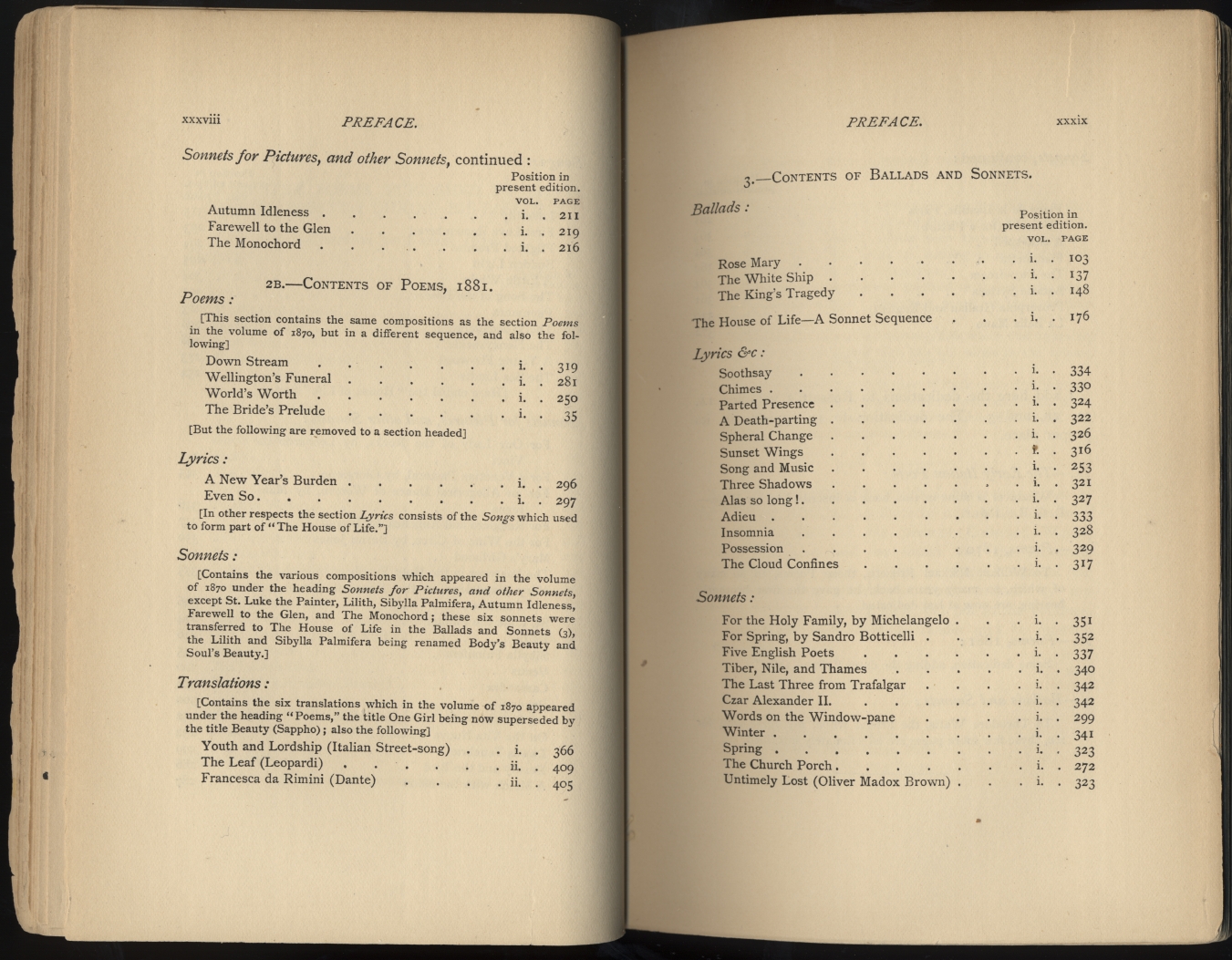
- 3.—Contents of
Ballads and Sonnets.
-
-
Ballads:
- Rose Mary . . . . . . . . i. . 103
- The White Ship . . . . . . . i. . 137
- The King's Tragedy . . . . . . i. . 148
- The House of Life— A Sonnet Sequence. . . i. . 176
-
-
Lyrics &c:
- Soothsay . . . . . . . . i. . 334
- Chimes . . . . . . . . . i. . 330
- Parted Presence . . . . . . . i. . 324
- A Death-parting . . . . . . . i. . 322
- Spheral Change . . . . . . . i. . 326
- Sunset Wings . . . . . . . i. . 316
- Song and Music . . . . . . . i. . 253
- Three Shadows . . . . . . . i. . 321
- Alas so long! . . . . . . . . i. . 327
- Adieu . . . . . . . . . i. . 333
- Insomnia . . . . . . . . i. . 328
- Possession . . . . . . . . i. . 329
- The Cloud Confines . . . . . . i. . 317
-
-
Sonnets:
- For the Holy Family, by Michelangelo . . . i. . 351
- For Spring, by Sandro Botticelli . . . . i. . 352
- Five English Poets . . . . . . i. . 337
- Tiber, Nile, and Thames . . . . . i. . 340
- The Last Three from Trafalgar . . . . i. . 342
- Czar Alexander II. . . . . . . i. . 342
- Words on the Window-pane . . . . i. . 299
- Winter . . . . . . . . . i. . 341
- Spring . . . . . . . . . i. . 323
- The Church Porch . . . . . . . i. . 272
- Untimely Lost (Oliver Madox Brown) . . . i. . 323
-
-
Sonnets, continued:
- Place de la Bastille, Paris . . . . . i. . 261
- “Found” (for a Picture) . . . . . i. . 363
- A Sea-spell . . . . . . . . i. . 361
- Fiammetta . . . . . . . . i. . 362
- The Day-dream . . . . . . . i. . 364
- Astarte Syriaca . . . . . . . i. . 361
- Proserpina (Italian and English) . . . . i. . 370
- La Bella Mano ” . . . . i. . 372
Note: Broken type: In the seventh line, the dot of the "i" for the page number is missing. -
GABRIEL ROSSETTI DURING HIS LIFETIME.
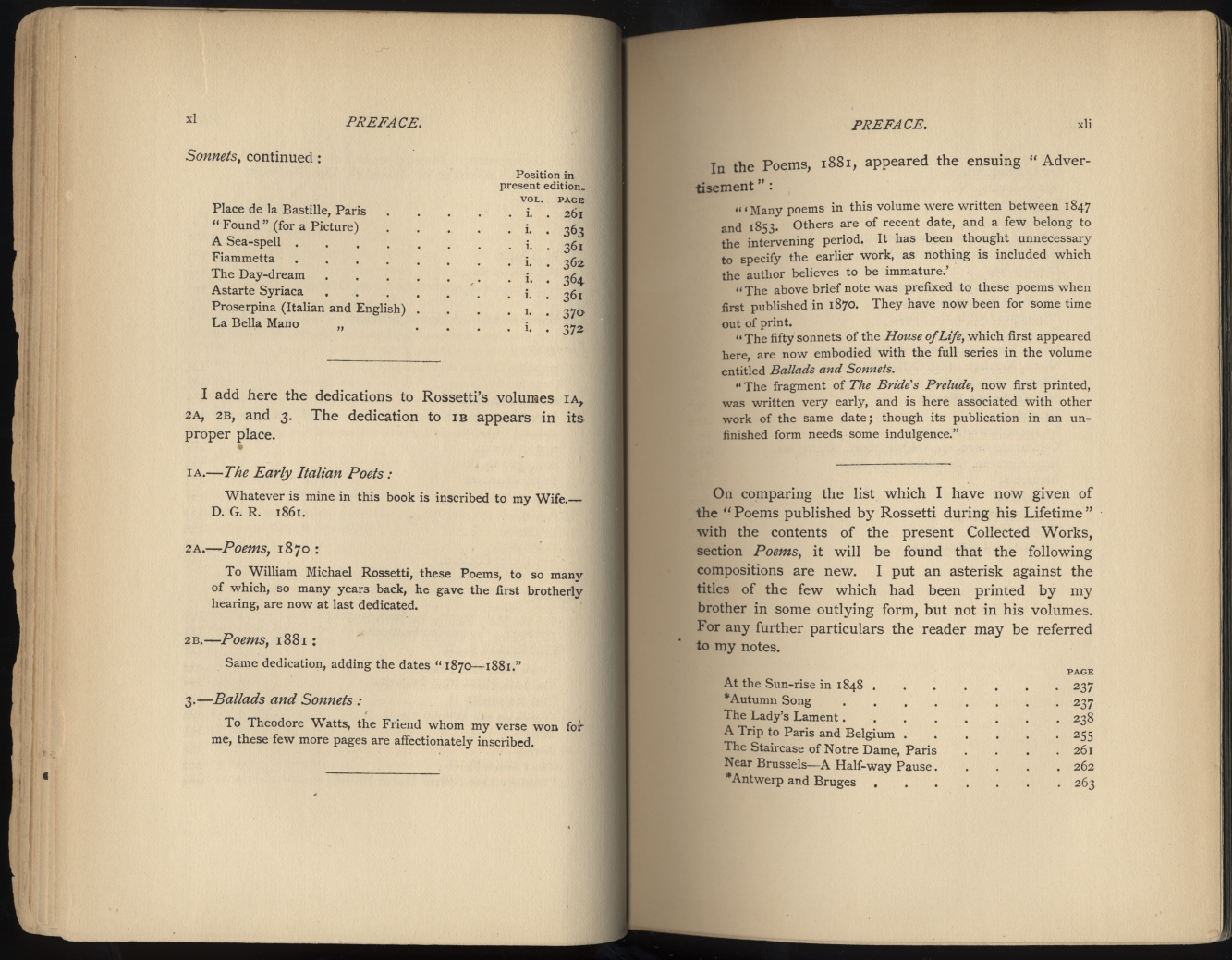
2a, 2b, and 3. The dedication to 1b appears in its
proper place.
- 1a.—
The Early Italian
Poets:
Whatever is mine in this book is inscribed to my Wife.—
D.G.R. 1861. - 2a.—
Poems,
1870:
To William Michael Rossetti, these Poems, to so many
of which, so many years back, he gave the first brotherly
hearing, are now at last dedicated. - 2b.—
Poems,
1881:
Same dedication, adding the dates “1870—1881.” - 3.—
Ballads and Sonnets:
To Theodore Watts, the Friend whom my verse won for
me, these few more pages are affectionately inscribed.
tisement”:
“‘Many poems in this volume were written
between 1847
and 1853. Others are of recent date, and a few
belong to
the intervening period. It has been thought
unnecessary
to specify the earlier work, as nothing is included
which
the author believes to be immature.’
“The above brief note was prefixed to these poems
when
first published in 1870. They have now been for some
time
out of print.
“The fifty sonnets of the
House of Life, which first appeared
here, are now embodied with the
full series in the volume
entitled
Ballads and Sonnets.
“The fragment of
The Bride's Prelude, now first printed,
was written very early, and is here
associated with other
work of the same date; though its
publication in an un-
finished form needs some
indulgence.”
the “Poems published by Rossetti during his Lifetime”
with the contents of the present Collected Works,
section Poems, it will be found that the following
compositions are new. I put an asterisk against the
titles of the few which had been printed by my
brother in some outlying form, but not in his volumes.
For any further particulars the reader may be referred
to my notes.
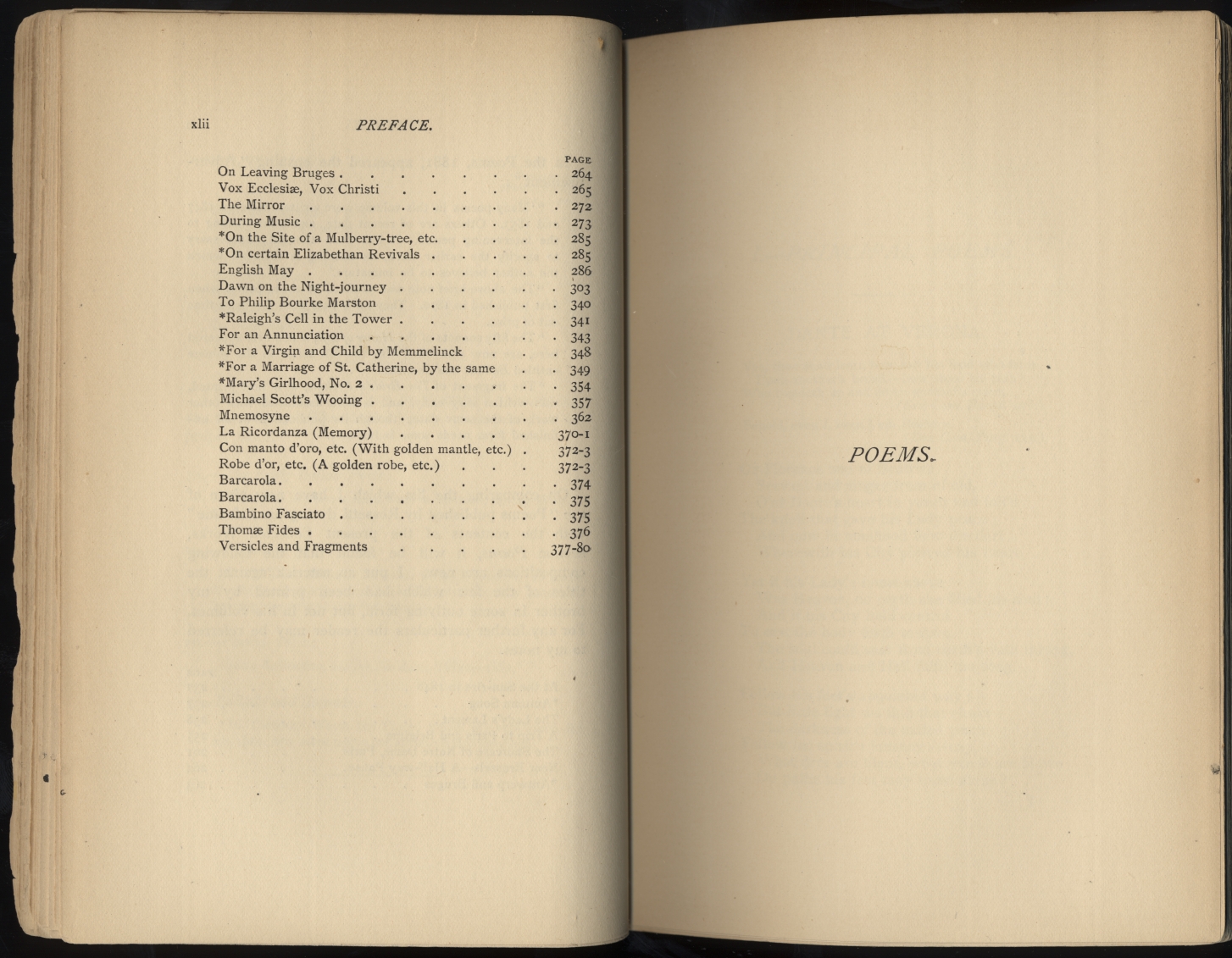
- At the Sun-rise in 1848 . . . . . . . 237
- *Autumn Song . . . . . . . . 237
- The Lady's Lament . . . . . . . . 238
- A Trip to Paris and Belgium . . . . . . 255
- The Staircase of Notre Dame, Paris . . . . 261
- Near Brussels—A Half-way Pause . . . . . 262
- *Antwerp and Bruges . . . . . . . 263
- On Leaving Bruges . . . . . . . . 264
- Vox Ecclesiæ, Vox Christi . . . . . . 265
- The Mirror . . . . . . . . . 272
- During Music . . . . . . . . . 273
- *On the Site of a Mulberry-tree, etc. . . . . 285
- *On certain Elizabethan Revivals . . . . . 285
- English May . . . . . . . . . 286
- Dawn on the Night-journey . . . . . . 303
- To Philip Bourke Marston . . . . . . 340
- *Raleigh's Cell in the Tower . . . . . . 341
- For an Annunciation . . . . . . . 343
- *For a Virgin and Child by Memmelinck . . . 348
- *For a Marriage of St. Catherine, by the same . . 349
- *Mary's Girlhood, No. 2 . . . . . . . 354
- Michael Scott's Wooing . . . . . . . 357
- Mnemosyne . . . . . . . . . 362
- La Ricordanza (Memory) . . . . . 370-1
- Con manto d'oro, etc. (With golden mantle, etc.) . 372-3
- Robe d'or, etc. (A golden robe, etc.) . . . 372-3
- Barcarola . . . . . . . . . . 374
- Barcarola . . . . . . . . . . 375
- Bambino Fasciato . . . . . . . . 375
- Thomæ Fides . . . . . . . . . 376
- Versicles and Fragments . . . . . 377-80

![Image of page [xliv]](http://www.rossettiarchive.org/img/1-1886.1ed.v1.xliv-1.jpg)
- Yea, thou shalt learn how salt his food who fares
- Upon another's bread,—how steep his path
- Who treadeth up and down another's stairs.
- Behold, even I, even I am Beatrice.
- Of Florence and of Beatrice
- Servant and singer from of old,
- O'er Dante's heart in youth had toll'd
- The knell that gave his Lady peace;
- And now in manhood flew the dart
- Wherewith his City pierced his heart.
- Yet if his Lady's home above
- Was Heaven, on earth she filled his soul;
- And if his City held control
- 10 To cast the body forth to rove,
- The soul could soar from earth's vain throng,
- And Heaven and Hell fulfil the song.
- Follow his feet's appointed way;—
- But little light we find that clears
- The darkness of the exiled years.
- Follow his spirit's journey:—nay,
- What fires are blent, what winds are blown
- On paths his feet may tread alone?
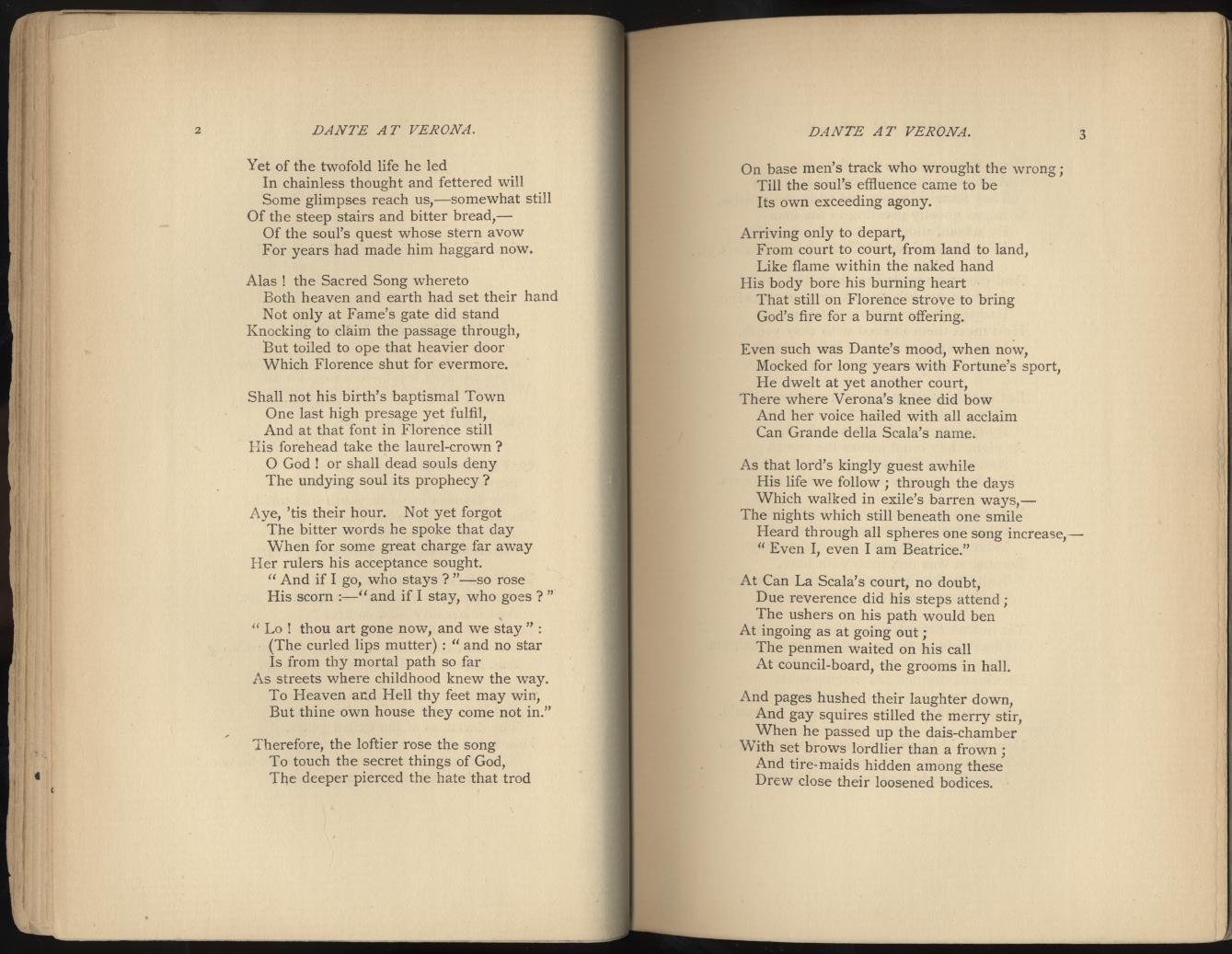
- Yet of the twofold life he led
- 20 In chainless thought and fettered will
- Some glimpses reach us,—somewhat still
- Of the steep stairs and bitter bread,—
- Of the soul's quest whose stern avow
- For years had made him haggard now.
- Alas! the Sacred Song whereto
- Both heaven and earth had set their hand
- Not only at Fame's gate did stand
- Knocking to claim the passage through,
- But toiled to ope that heavier door
- 30 Which Florence shut for evermore.
- Shall not his birth's baptismal Town
- One last high presage yet fulfil,
- And at that font in Florence still
- His forehead take the laurel-crown?
- O God! or shall dead souls deny
- The undying soul its prophecy?
- Aye, 'tis their hour. Not yet forgot
- The bitter words he spoke that day
- When for some great charge far away
- 40 Her rulers his acceptance sought.
- “And if I go, who stays?”—so rose
- His scorn:—“and if I stay, who goes?”
- “Lo! thou art gone now, and we stay”:
- (The curled lips mutter): “and no star
- Is from thy mortal path so far
- As streets where childhood knew the way.
- To Heaven and Hell thy feet may win,
- But thine own house they come not in.”
- Therefore, the loftier rose the song
- 50 To touch the secret things of God,
- The deeper pierced the hate that trod
- On base men's track who wrought the wrong;
- Till the soul's effluence came to be
- Its own exceeding agony.
- Arriving only to depart,
- From court to court, from land to land,
- Like flame within the naked hand
- His body bore his burning heart
- That still on Florence strove to bring
- 60 God's fire for a burnt offering.
- Even such was Dante's mood, when now,
- Mocked for long years with Fortune's sport,
- He dwelt at yet another court,
- There where Verona's knee did bow
- And her voice hailed with all acclaim
- Can Grande della Scala's name.
- As that lord's kingly guest awhile
- His life we follow; through the days
- Which walked in exile's barren ways,—
- 70 The nights which still beneath one smile
- Heard through all spheres one song increase,—
- “Even I, even I am Beatrice.”
- At Can La Scala's court, no doubt,
- Due reverence did his steps attend;
- The ushers on his path would ben
- At ingoing as at going out;
- The penmen waited on his call
- At council-board, the grooms in hall.
- And pages hushed their laughter down,
- 80 And gay squires stilled the merry stir,
- When he passed up the dais-chamber
- With set brows lordlier than a frown;
- And tire-maids hidden among these
- Drew close their loosened bodices.
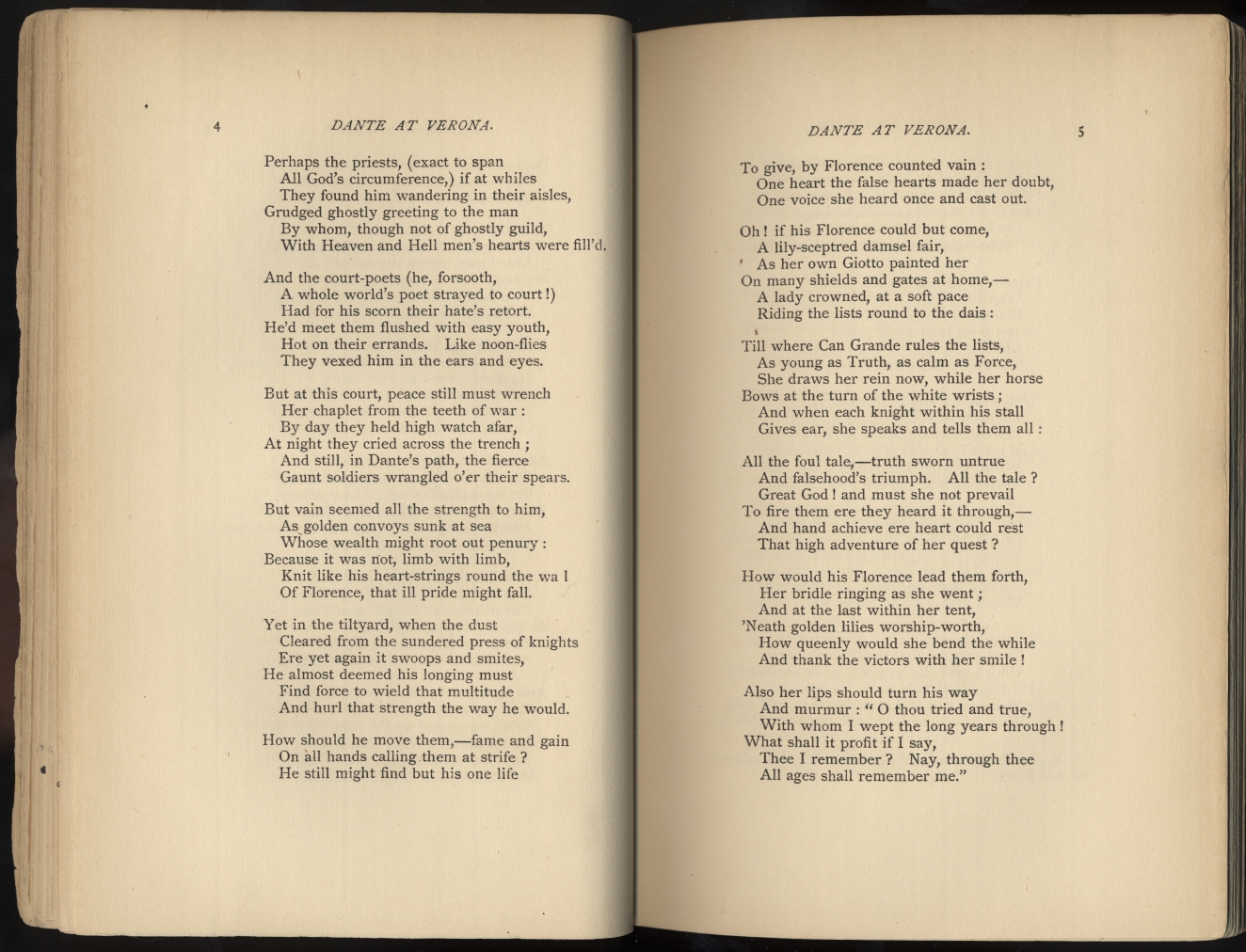
- Perhaps the priests, (exact to span
- All God's circumference,) if at whiles
- They found him wandering in their aisles,
- Grudged ghostly greeting to the man
- By whom, though not of ghostly guild,
- 90 With Heaven and Hell men's hearts were fill'd.
- And the court-poets (he, forsooth,
- A whole world's poet strayed to court!)
- Had for his scorn their hate's retort.
- He'd meet them flushed with easy youth,
- Hot on their errands. Like noon-flies
- They vexed him in the ears and eyes.
- But at this court, peace still must wrench
- Her chaplet from the teeth of war:
- By day they held high watch afar,
- 100 At night they cried across the trench;
- And still, in Dante's path, the fierce
- Gaunt soldiers wrangled o'er their spears.
- But vain seemed all the strength to him,
- As golden convoys sunk at sea
- Whose wealth might root out penury:
- Because it was not, limb with limb,
- Knit like his heart-strings round the wa l
- Of Florence, that ill pride might fall.
- Yet in the tiltyard, when the dust
- 110 Cleared from the sundered press of knights
- Ere yet again it swoops and smites,
- He almost deemed his longing must
- Find force to yield that multitude
- And hurl that strength the way he would.
- How should he move them,—fame and gain
- On all hands calling them at strife?
- He still might find but his one life
- To give, by Florence counted vain:
- One heart the false hearts made her doubt,
- 120 One voice she heard once and cast out.
- Oh! if his Florence could but come,
- A lily-sceptred damsel fair,
- As her own Giotto painted her
- On many shields and gates at home,—
- A lady crowned, at a soft pace
- Riding the lists round to the dais:
- Till where Can Grande rules the lists,
- As young as Truth, as calm as Force,
- She draws her rein now, while her horse
- 130 Bows at the turn of the white wrists;
- And when each knight within his stall
- Gives ear, she speaks and tells them all:
- All the foul tale,—truth sworn untrue
- And falsehood's triumph. All the tale?
- Great God! and must she not prevail
- To fire them ere they heard it through,—
- And hand achieve ere heart could rest
- That high adventure of her quest?
- How would his Florence lead them forth,
- 140 Her bridle ringing as she went;
- And at the last within her tent,
- 'Neath golden lilies worship-worth,
- How queenly would she bend the while
- And thank the victors with her smile!
- Also her lips should turn his way
- And murmur: “O thou tried and true,
- With whom I wept the long years through!
- What shall it profit if I say,
- Thee I remember? Nay, through thee
- 150 All ages shall remember me.”
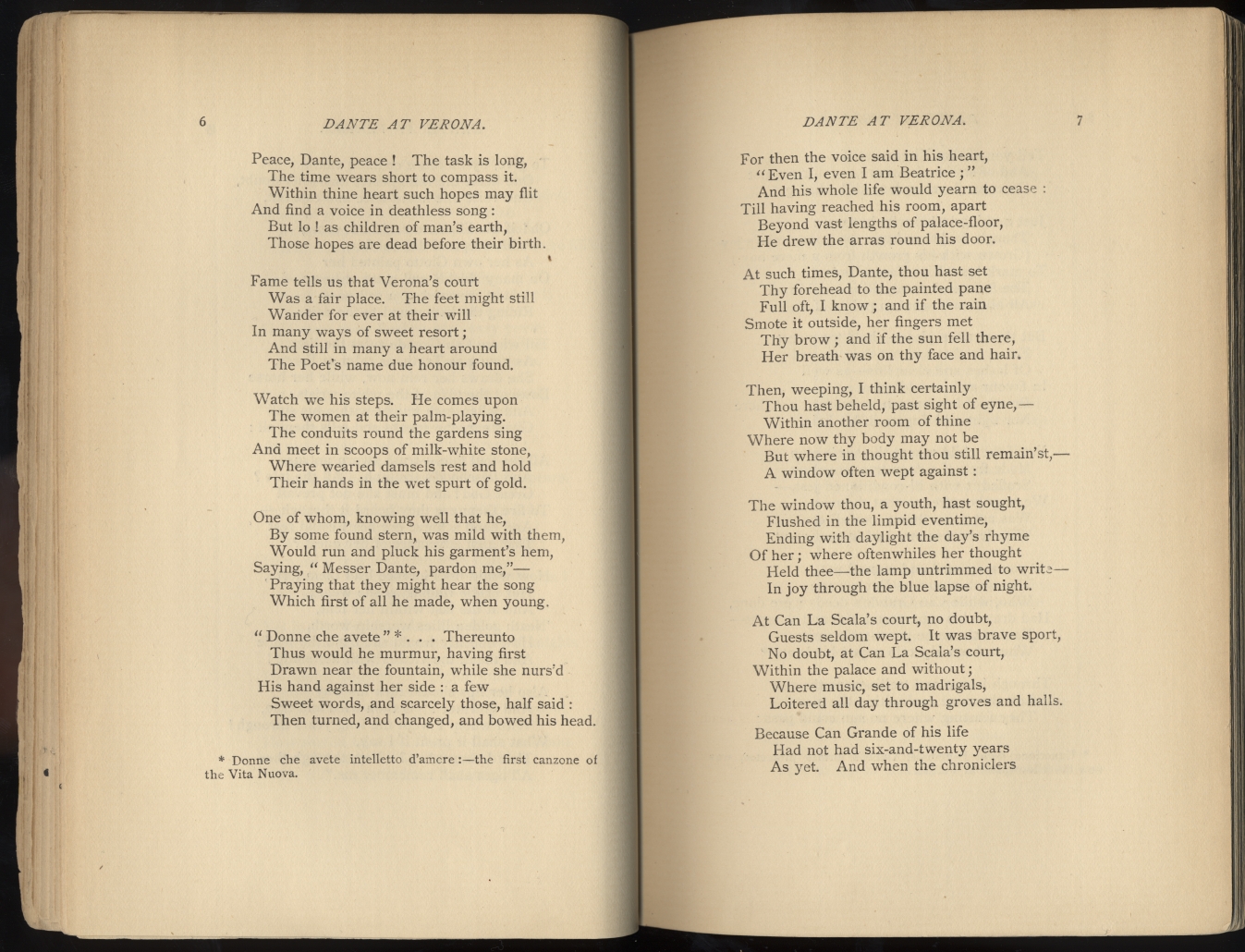
- Peace, Dante, peace! The task is long,
- The time wears short to compass it.
- Within thine heart such hopes may flit
- And find a voice in deathless song:
- But lo! as children of man's earth,
- Those hopes are dead before their birth.
- Fame tells us that Verona's court
- Was a fair place. The feet might still
- Wander for ever at their will
- 160 In many ways of sweet resort;
- And still in many a heart around
- The Poet's name due honour found.
- Watch we his steps. He comes upon
- The women at their palm-playing.
- The conduits round the gardens sing
- And meet in scoops of milk-white stone,
- Where wearied damsels rest and hold
- Their hands in the wet spurt of gold.
- One of whom, knowing well that he,
- 170 By some found stern, was mild with them,
- Would run and pluck his garment's hem,
- Saying, “Messer Dante, pardon me,”—
- Praying that they might hear the song
- Which first of all he made, when young.
- “Donne che avete”* . . . Thereunto
- Thus would he murmur, having first
- Drawn near the fountain, while she nurs'd
- His hand against her side: a few
- Sweet words, and scarcely those, half said:
- 180 Then turned, and changed, and bowed his head.
* Donne che avete intelletto
d'amore:—the first canzone of
the Vita Nuova.
- For then the voice said in his heart,
- “Even I, even I am Beatrice;”
- And his whole life would yearn to cease:
- Till having reached his room, apart
- Beyond vast lengths of palace-floor,
- He drew the arras round his door.
- At such times, Dante, thou hast set
- Thy forehead to the painted pane
- Full oft, I know; and if the rain
- 190 Smote it outside, her fingers met
- Thy brow; and if the sun fell there,
- Her breath was on thy face and hair.
- Then, weeping, I think certainly
- Thou hast beheld, past sight of eyne,—
- Within another room of thine
- Where now thy body may not be
- But where in thought thou still remain'st,—
- A window often wept against:
- The window thou, a youth, hast sought,
- 200 Flushed in the limpid eventime,
- Ending with daylight the day's rhyme
- Of her; where oftenwhiles her thought
- Held thee—the lamp untrimmed to write—
- In joy through the blue lapse of night.
- At Can La Scala's court, no doubt,
- Guests seldom wept. It was brave sport,
- No doubt, at Can La Scala's court,
- Within the palace and without;
- Where music, set to madrigals,
- 210 Loitered all day through groves and halls.
- Because Can Grande of his life
- Had not had six-and-twenty years
- As yet. And when the chroniclers
- Tell you of that Vicenza strife
- And of strifes elsewhere,—you must not
- Conceive for church-sooth he had got
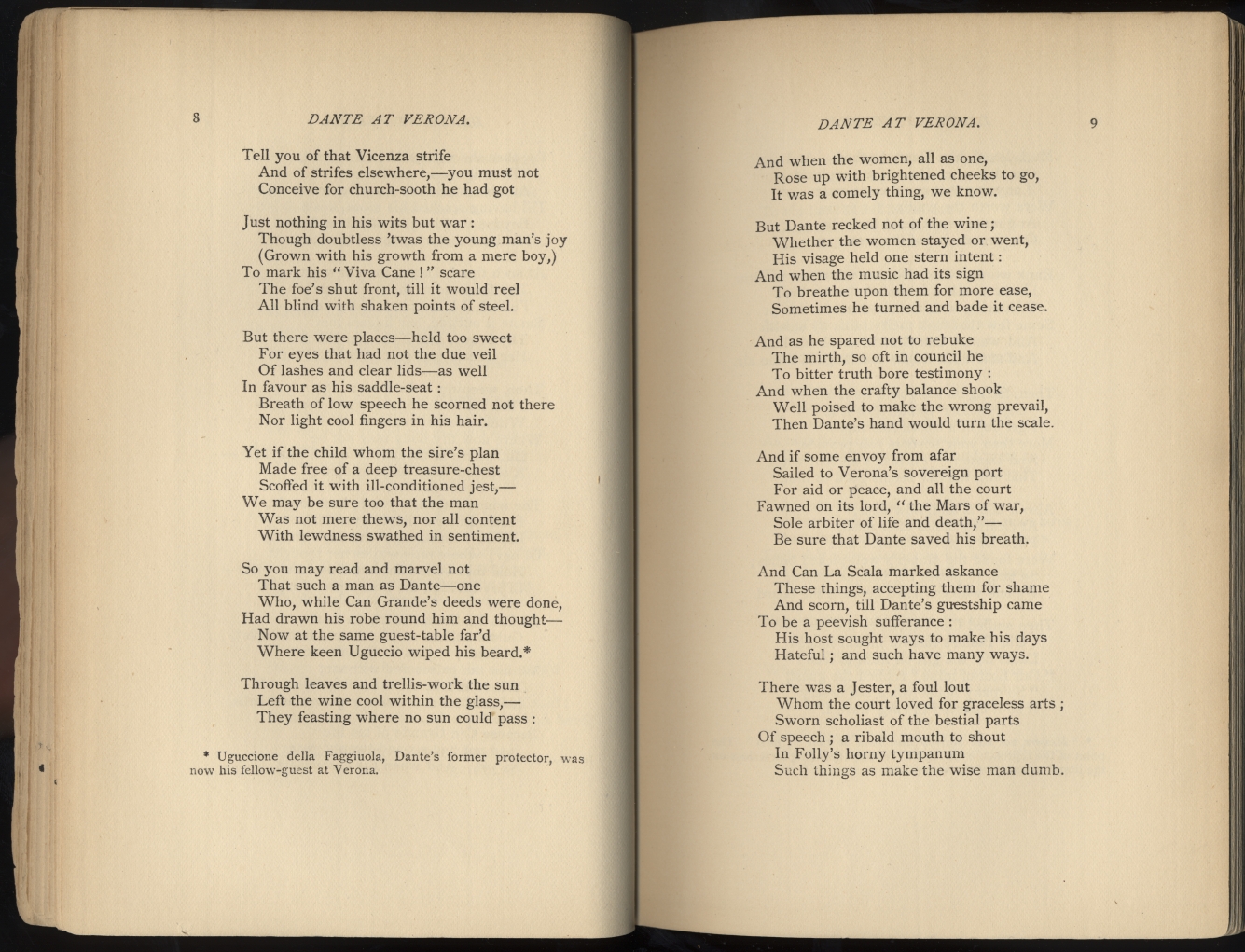
- Just nothing in his wits but war:
- Though doubtless 'twas the young man's joy
- (Grown with his growth from a mere boy,)
- 220To mark his “Viva Cane!” scare
- The foe's shut front, till it would reel
- All blind with shaken points of steel.
- But there were places—held too sweet
- For eyes that had not the due veil
- Of lashes and clear lids—as well
- In favour as his saddle-seat:
- Breath of low speech he scorned not there
- Nor light cool fingers in his hair.
- Yet if the child whom the sire's plan
- 230 Made free of a deep treasure-chest
- Scoffed it with ill-conditioned jest,—
- We may be sure too that the man
- Was not mere thews, nor all content
- With lewdness swathed in sentiment.
- So you may read and marvel not
- That such a man as Dante—one
- Who, while Can Grande's deeds were done,
- Had drawn his robe round him and thought—
- Now at the same guest-table far'd
- 240 Where keen Uguccio wiped his beard.*
- Through leaves and trellis-work the sun
- Left the wine cool within the glass,—
- They feasting where no sun could pass:
- And when the women, all as one,
- Rose up with brightened cheeks to go,
- It was a comely thing, we know.
* Uguccione della Faggiuola, Dante's former protector, was
now his fellow-guest at Verona.
- But Dante recked not of the wine;
- Whether the women stayed or went,
- His visage held one stern intent:
- 250 And when the music had its sign
- To breathe upon them for more ease,
- Sometimes he turned and bade it cease.
- And as he spared not to rebuke
- The mirth, so oft in council he
- To bitter truth bore testimony:
- And when the crafty balance shook
- Well poised to make the wrong prevail,
- Then Dante's hand would turn the scale.
- And if some envoy from afar
- 260 Sailed to Verona's sovereign port
- For aid or peace, and all the court
- Fawned on its lord, “the Mars of war,
- Sole arbiter of life and death,”—
- Be sure that Dante saved his breath.
- And Can La Scala marked askance
- These things, accepting them for shame
- And scorn, till Dante's guestship came
- To be a peevish sufferance:
- His host sought ways to make his days
- 270 Hateful; and such have many ways.
- There was a Jester, a foul lout
- Whom the court loved for graceless arts;
- Sworn scholiast of the bestial parts
- Of speech; a ribald mouth to shout
- In Folly's horny tympanum
- Such things as make the wise man dumb.
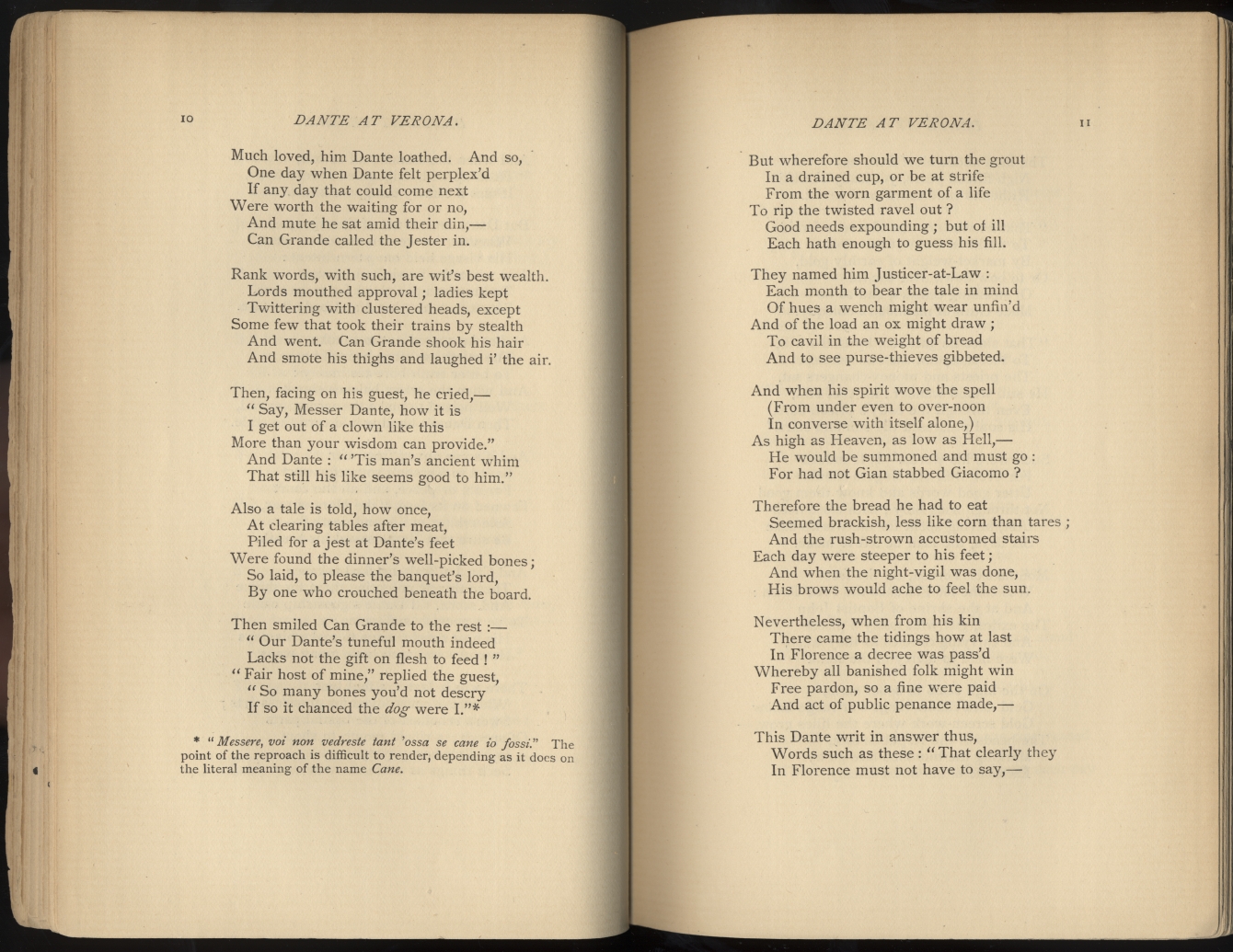
- Much loved, him Dante loathed. And so,
- One day when Dante felt perplex'd
- If any day that could come next
- 280 Were worth the waiting for or no,
- And mute he sat amid their din,—
- Can Grande called the Jester in.
- Rank words, with such, are wit's best wealth.
- Lords mouthed approval; ladies kept
- Twittering with clustered heads, except
- Some few that took their trains by stealth
- And went. Can Grande shook his hair
- And smote his thighs and laughed i' the air.
- Then, facing on his guest, he cried,—
- 290 “Say, Messer Dante, how it is
- I get out of a clown like this
- More than your wisdom can provide.”
- And Dante: “'Tis man's ancient whim
- That still his like seems good to him.”
- Also a tale is told, how once,
- At clearing tables after meat,
- Piled for a jest at Dante's feet
- Were found the dinner's well-picked bones;
- So laid, to please the banquet's lord,
- 300 By one who crouched beneath the board.
- Then smiled Can Grande to the rest:—
- “Our Dante's tuneful mouth indeed
- Lacks not the gift on flesh to feed!”
- “Fair host of mine,” replied the guest,
- “So many bones you'd not descry
- If so it chanced the dog were I.”*
* “
Messere, voi non vedreste tant 'ossa se cane io
fossi
.” The
point of the reproach is difficult
to render, depending as it does on
the literal meaning of the
name
Cane.
- But wherefore should we turn the grout
- In a drained cup, or be at strife
- From the worn garment of a life
- 310 To rip the twisted ravel out?
- Good needs expounding; but of ill
- Each hath enough to guess his fill.
- They named him Justicer-at-Law:
- Each month to bear the tale in mind
- Of hues a wench might wear unfin'd
- And of the load an ox might draw;
- To cavil in the weight of bread
- And to see purse-thieves gibbeted.
- And when his spirit wove the spell
- 320 (From under even to over-noon
- In converse with itself alone,)
- As high as Heaven, as low as Hell,—
- He would be summoned and must go:
- For had not Gian stabbed Giacomo?
- Therefore the bread he had to eat
- Seemed brackish, less like corn than tares;
- And the rush-strown accustomed stairs
- Each day were steeper to his feet;
- And when the night-vigil was done,
- 330 His brows would ache to feel the sun.
- Nevertheless, when from his kin
- There came the tidings how at last
- In Florence a decree was pass'd
- Whereby all banished folk might win
- Free pardon, so a fine were paid
- And act of public penance made,—
- This Dante writ in answer thus,
- Words such as these: “That clearly they
- In Florence must not have to say,—
- 340The man abode aloof from us
- Nigh fifteen years, yet lastly skulk'd
- Hither to candleshrift and mulct.
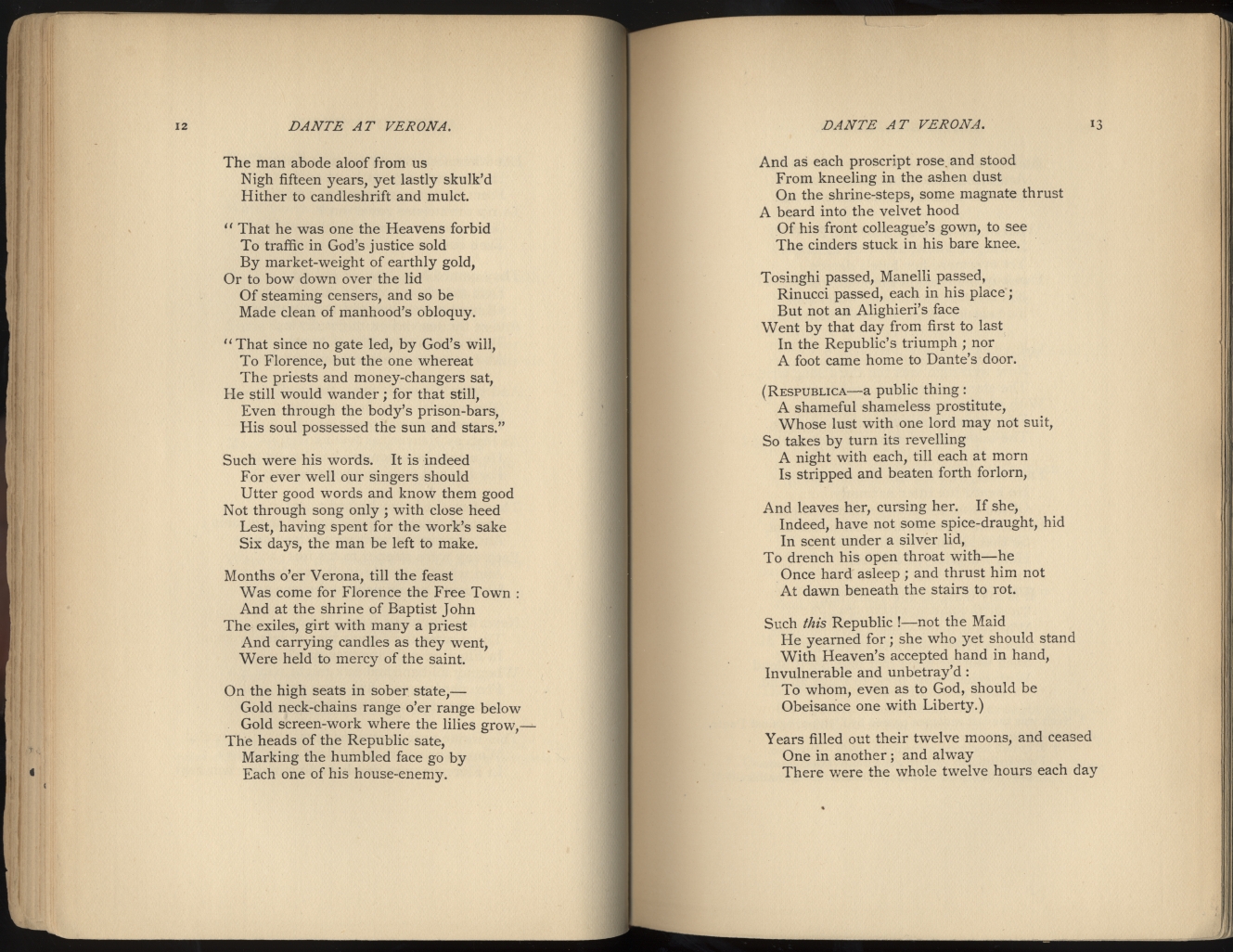
- “That he was one the Heavens forbid
- To traffic in God's justice sold
- By market-weight of earthly gold,
- Or to bow down over the lid
- Of steaming censers, and so be
- Made clean of manhood's obloquy.
- “That since no gate led, by God's will,
- 350 To Florence, but the one whereat
- The priests and money-changers sat,
- He still would wander; for that still,
- Even through the body's prison-bars,
- His soul possessed the sun and stars.”
- Such were his words. It is indeed
- For ever well our singers should
- Utter good words and know them good
- Not through song only; with close heed
- Lest, having spent for the work's sake
- 360 Six days, the man be left to make.
- Months o'er Verona, till the feast
- Was come for Florence the Free Town:
- And at the shrine of Baptist John
- The exiles, girt with many a priest
- And carrying candles as they went,
- Were held to mercy of the saint.
- On the high seats in sober state,—
- Gold neck-chains range o'er range below
- Gold screen-work where the lilies grow,—
- 370 The Heads of the Republic sate,
- Marking the humbled face go by
- Each one of his house-enemy.
- And as each proscript rose and stood
- From kneeling in the ashen dust
- On the shrine-steps, some magnate thrust
- A beard into the velvet hood
- Of his front colleague's gown, to see
- The cinders stuck in his bare knee.
- Tosinghi passed, Manelli passed,
- 380 Rinucci passed, each in his place;
- But not an Alighieri's face
- Went by that day from first to last
- In the Republic's triumph; nor
- A foot came home to Dante's door.
- (Respublica—a public thing:
- A shameful shameless prostitute,
- Whose lust with one lord may not suit,
- So takes by turn its revelling
- A night with each, till each at morn
- 390 Is stripped and beaten forth forlorn,
- And leaves her, cursing her. If she,
- Indeed, have not some spice-draught, hid
- In scent under a silver lid,
- To drench his open throat with—he
- Once hard asleep; and thrust him not
- At dawn beneath the stairs to rot.
- Such this Republic!—not the Maid
- He yearned for; she who yet should stand
- With Heaven's accepted hand in hand,
- 400 Invulnerable and unbetray'd:
- To whom, even as to God, should be
- Obeisance one with Liberty.)
- Years filled out their twelve moons, and ceased
- One in another; and alway
- There were the whole twelve hours each day
- And each night as the years increased;
- And rising moon and setting sun
- Beheld that Dante's work was done.
- What of his work for Florence? Well
- 410 It was, he knew, and well must be.
- Yet evermore her hate's decree
- Dwelt in his thought intolerable:—
- His body to be burned,*—his soul
- To beat its wings at hope's vain goal.
- What of his work for Beatrice?
- Now well-nigh was the third song writ,—
- The stars a third time sealing it
- With sudden music of pure peace:
- For echoing thrice the threefold song,
- 420 The unnumbered stars the tone prolong.†
- Each hour, as then the Vision pass'd,
- He heard the utter harmony
- Of the nine trembling spheres, till she
- Bowed her eyes towards him in the last,
- So that all ended with her eyes,
- Hell, Purgatory, Paradise.
- “It is my trust, as the years fall,
- To write more worthily of her
- Who now, being made God's minister,
- 430 Looks on His visage and knows all.”
- Such was the hope that love dar'd blend
- With grief's slow fires, to make an end
* Such was the last sentence passed by Florence against Dante,
as a recalcitrant exile.
† E quindi uscimmo a riveder le
stelle.— Inferno.
Puro e disposto a salire alle
stelle.— Purgatorio.
L'amor che muove il sole e l'altre
stelle.— Paradiso.
- Of the “New Life,” his youth's dear book:
- Adding thereunto: “In such trust
- I labour, and believe I must
- Accomplish this which my soul took
- In charge, if God, my Lord and hers,
- Leave my life with me a few years.”
- The trust which he had borne in youth
- 440 Was all at length accomplished. He
- At length had written worthily—
- Yea even of her; no rhymes uncouth
- 'Twixt tongue and tongue; but by God's aid
- The first words Italy had said.
- Ah! haply now the heavenly guide
- Was not the last form seen by him:
- But there that Beatrice stood slim
- And bowed in passing at his side,
- For whom in youth his heart made moan
- 450 Then when the city sat alone.*
- Clearly herself: the same whom he
- Met, not past girlhood, in the street,
- Low-bosomed and with hidden feet;
- And then as woman perfectly,
- In years that followed, many an once,—
- And now at last among the suns
- In that high vision. But indeed
- It may be memory might recall
- Last to him then the first of all,—
- 460 The child his boyhood bore in heed
- Nine years. At length the voice brought peace,—
- “Even I, even I am Beatrice.”
*
Quomodo sedet sola civitas!—The words quoted by Dante
in the Vita Nuova when he speaks of the death of Beatrice.
- All this, being there, we had not seen.
- Seen only was the shadow wrought
- On the strong features bound in thought;
- The vagueness gaining gait and mien;
- The white streaks gathering clear to view
- In the burnt beard the women knew.
- For a tale tells that on his track,
- 470 As through Verona's streets he went,
- This saying certain women sent:—
- “Lo, he that strolls to Hell and back
- At will! Behold him, how Hell's reek
- Has crisped his beard and singed his cheek.”
- “Whereat” (Boccaccio's words) “he smil'd
- For pride in fame.” It might be so:
- Nevertheless we cannot know
- If haply he were not beguil'd
- To bitterer mirth, who scarce could tell
- 480 If he indeed were back from Hell.
- So the day came, after a space,
- When Dante felt assured that there
- The sunshine must lie sicklier
- Even than in any other place,
- Save only Florence. When that day
- Had come, he rose and went his way.
- He went and turned out. From his shoes
- It may be that he shook the dust,
- As every righteous dealer must
- 490 Once and again ere life can close:
- And unaccomplished destiny
- Struck cold his forehead, it may be.
- No book keeps record how the Prince
- Sunned himself out of Dante's reach,
- Nor how the Jester stank in speech:
- While courtiers, used to cringe and wince,
- Poets and harlots, all the throng,
- Let loose their scandal and their song.
- No book keeps record if the seat
- 500 Which Dante held at his host's board
- Were sat in next by clerk or lord,—
- If leman lolled with dainty feet
- At ease, or hostage brooded there,
- Or priest lacked silence for his prayer.
- Eat and wash hands, Can Grande;—scarce
- We know their deeds now: hands which fed
- Our Dante with that bitter bread;
- And thou the watch-dog of those stairs
- Which, of all paths his feet knew well,
- 510 Were steeper found than Heaven or Hell.
- Our Lombard country-girls along the coast
- Wear daggers in their garters: for they know
- That they might hate another girl to death
- Or meet a German lover. Such a knife
- I bought her, with a hilt of horn and pearl.
- Father, you cannot know of all my thoughts
- That day in going to meet her,—that last day
- For the last time, she said;—of all the love
- And all the hopeless hope that she might change
- 10 And go back with me. Ah! and everywhere,
- At places we both knew along the road,
- Some fresh shape of herself as once she was
- Grew present at my side; until it seemed—
- So close they gathered round me—they would all
- Be with me when I reached the spot at last,
- To plead my cause with her against herself
- So changed. O Father, if you knew all this
- You cannot know, then you would know too, Father,
- And only then, if God can pardon me.
- 20 What can be told I'll tell, if you will hear.
- I passed a village-fair upon my road,
- And thought, being empty-handed, I would take
- Some little present: such might prove, I said,
- Either a pledge between us, or (God help me!)
- A parting gift. And there it was I bought
- The knife I spoke of, such as women wear.
- That day, some three hours afterwards, I found
- For certain, it must be a parting gift.
- And, standing silent now at last, I looked
- 30 Into her scornful face; and heard the sea
- Still trying hard to din into my ears
- Some speech it knew which still might change her heart,
- If only it could make me understand.
- One moment thus. Another, and her face
- Seemed further off than the last line of sea,
- So that I thought, if now she were to speak
- I could not hear her. Then again I knew
- All, as we stood together on the sand
- At Iglio, in the first thin shade o' the hills.
- 40 “Take it,” I said, and held it out to her,
- While the hilt glanced within my trembling hold;
- “Take it and keep it for my sake,” I said.
- Her neck unbent not, neither did her eyes
- Move, nor her foot left beating of the sand;
- Only she put it by from her and laughed.
- Father, you hear my speech and not her laugh;
- But God heard that. Will God remember all?
- It was another laugh than the sweet sound
- Which rose from her sweet childish heart, that day
- 50 Eleven years before, when first I found her
- Alone upon the hill-side; and her curls
- Shook down in the warm grass as she looked up
- Out of her curls in my eyes bent to hers.
- She might have served a painter to pourtray
- That heavenly child which in the latter days
- Shall walk between the lion and the lamb.
- I had been for nights in hiding, worn and sick
- And hardly fed; and so her words at first
- Seemed fiftul like the talking of the trees
- 60 And voices in the air that knew my name.
- And I remember that I sat me down
- Upon the slope with her, and thought the world
- Must be all over or had never been,
- We seemed there so alone. And soon she told me
- Her parents both were gone away from her.
- I thought perhaps she meant that they had died;
- But when I asked her this, she looked again
- Into my face and said that yestereve
- They kissed her long, and wept and made her weep,
- 70 And gave her all the bread they had with them,
- And then had gone together up the hill
- Where we were sitting now, and had walked on
- Into the great red light; “and so,” she said,
- “I have come up here too; and when this evening
- They step out of the light as they stepped in,
- I shall be here to kiss them.” And she laughed.
- Then I bethought me suddenly of the famine;
- And how the church-steps throughout all the town,
- When last I had been there a month ago,
- 80 Swarmed with starved folk; and how the bread was
- weighed
- By Austrians armed; and women that I knew
- For wives and mothers walked the public street,
- Saying aloud that if their husbands feared
- To snatch the children's food, themselves would stay
- Till they had earned it there. So then this child
- Was piteous to me; for all told me then
- Her parents must have left her to God's chance,
- To man's or to the Church's charity,
- Because of the great famine, rather than
- 90 To watch her growing thin between their knees.
- With that, God took my mother's voice and spoke,
- And sights and sounds came back and things long since,
- And all my childhood found me on the hills;
- And so I took her with me.
- I was young.
- Scarce man then, Father: but the cause which gave
- The wounds I die of now had brought me then
- Some wounds already; and I lived alone,
- As any hiding hunted man must live.
- It was no easy thing to keep a child
- 100 In safety; for herself it was not safe,
- And doubled my own danger: but I knew
- That God would help me.
- Yet a little while
- Pardon me, Father, if I pause. I think
- I have been speaking to you of some matters
- There was no need to speak of, have I not?
- You do not know how clearly those things stood
- Within my mind, which I have spoken of,
- Nor how they strove for utterance. Life all past
- Is like the sky when the sun sets in it,
- 110 Clearest where furthest off.
- I told you how
- She scorned my parting gift and laughed. And yet
- A woman's laugh's another thing sometimes:
- I think they laugh in Heaven. I know last night
- I dreamed I saw into the garden of God,
- Where women walked whose painted images
- I have seen with candles round them in the church.
- They bent this way and that, one to another,
- Playing: and over the long golden hair
- Of each there floated like a ring of fire
- 120 Which when she stooped stooped with her, and when she
- rose
- Rose with her. Then a breeze flew in among them,
- As if a window had been opened in heaven
- For God to give His blessing from, before
- This world of ours should set; (for in my dream
- I thought our world was setting, and the sun
- Flared, a spent taper;) and beneath that gust
- The rings of light quivered like forest-leaves.
- Then all the blessed maidens who were there
- Stood up together, as it were a voice
- 130 That called them; and they threw their tresses back,
- And smote their palms, and all laughed up at once,
- For the strong heavenly joy they had in them
- To hear God bless the world. Wherewith I woke:
- And looking round, I saw as usual
- That she was standing there with her long locks
- Pressed to her side; and her laugh ended theirs.
- For always when I see her now, she laughs.
- And yet her childish laughter haunts me too,
- The life of this dead terror; as in days
- 140 When she, a child, dwelt with me. I must tell
- Something of those days yet before the end.
- I brought her from the city—one such day
- When she was still a merry loving child,—
- The earliest gift I mind my giving her;
- A little image of a flying Love
- Made of our coloured glass-ware, in his hands
- A dart of gilded metal and a torch.
- And him she kissed and me, and fain would know
- Why were his poor eyes blindfold, why the wings
- 150 And why the arrow. What I knew I told
- Of Venus and of Cupid,—strange old tales.
- And when she heard that he could rule the loves
- Of men and women, still she shook her head
- And wondered; and, “Nay, nay,” she murmured still,
- “So strong, and he a younger child than I!”
- And then she'd have me fix him on the wall
- Fronting her little bed; and then again
- She needs must fix him there herself, because
- I gave him to her and she loved him so,
- 160 And he should make her love me better yet,
- If women loved the more, the more they grew.
- But the fit place upon the wall was high
- For her, and so I held her in my arms:
- And each time that the heavy pruning-hook
- I gave her for a hammer slipped away
- As it would often, still she laughed and laughed
- And kissed and kissed me. But amid her mirth,
- Just as she hung the image on the nail,
- It slipped and all its fragments strewed the ground:
- 170 And as it fell she screamed, for in her hand
- The dart had entered deeply and drawn blood.
- And so her laughter turned to tears: and “Oh!”
- I said, the while I bandaged the small hand,—
- “That I should be the first to make you bleed,
- Who love and love and love you!”—kissing still
- The fingers till I got her safe to bed.
- And still she sobbed,—“not for the pain at all,”
- She said, “but for the Love, the poor good Love
- You gave me.” So she cried herself to sleep.
- 180 Another later thing comes back to me.
- 'Twas in those hardest foulest days of all,
- When still from his shut palace, sitting clean
- Above the splash of blood, old Metternich
- (May his soul die, and never-dying worms
- Feast on its pain for ever!) used to thin
- His year's doomed hundreds daintily, each month
- Thirties and fifties. This time, as I think,
- Was when his thrift forbad the poor to take
- That evil brackish salt which the dry rocks
- 190 Keep all through winter when the sea draws in.
- The first I heard of it was a chance shot
- In the street here and there, and on the stones
- A stumbling clatter as of horse hemmed round.
- Then, when she saw me hurry out of doors,
- My gun slung at my shoulder and my knife
- Stuck in my girdle, she smoothed down my hair
- And laughed to see me look so brave, and leaped
- Up to my neck and kissed me. She was still
- A child; and yet that kiss was on my lips
- 200 So hot all day where the smoke shut us in.
- For now, being always with her, the first love
- I had—the father's, brother's love—was changed,
- I think, in somewise; like a holy thought
- Which is a prayer before one knows of it.
- The first time I perceived this, I remember,
- Was once when after hunting I came home
- Weary, and she brought food and fruit for me,
- And sat down at my feet upon the floor
- Leaning against my side. But when I felt
- 210 Her sweet head reach from that low seat of hers
- So high as to be laid upon my heart,
- I turned and looked upon my darling there
- And marked for the first time how tall she was;
- And my heart beat with so much violence
- Under her cheek, I thought she could not choose
- But wonder at it soon and ask me why;
- And so I bade her rise and eat with me.
- And when, remembering all and counting back
- The time, I made out fourteen years for her
- 220 And told her so, she gazed at me with eyes
- As of the sky and sea on a grey day,
- And drew her long hands through her hair, and
- asked me
- If she was not a woman; and then laughed:
- And as she stooped in laughing, I could see
- Beneath the growing throat the breasts half-globed
- Like folded lilies deepset in the stream.
- Yes, let me think of her as then; for so
- Her image, Father, is not like the sights
- Which come when you are gone. She had a mouth
- 230 Made to bring death to life,—the underlip
- Sucked in, as if it strove to kiss itself.
- Her face was pearly pale, as when one stoops
- Over wan water; and the dark crisped hair
- And the hair's shadow made it paler still:—
- Deep-serried locks, the dimness of the cloud
- Where the moon's gaze is set in eddying gloom.
- Her body bore her neck as the tree's stem
- Bears the top branch; and as the branch sustains
- The flower of the year's pride, her high neck bore
- 240 That face made wonderful with night and day.
- Her voice was swift, yet ever the last words
- Fell lingeringly; and rounded finger-tips
- She had, that clung a little where they touched
- And then were gone o' the instant. Her great eyes,
- That sometimes turned half dizzily beneath
- The passionate lids, as faint, when she would speak,
- Had also in them hidden springs of mirth,
- Which under the dark lashes evermore
- Shook to her laugh, as when a bird flies low
- 250 Between the water and the willow-leaves,
- And the shade quivers till he wins the light.
- I was a moody comrade to her then,
- For all the love I bore her. Italy,
- The weeping desolate mother, long has claimed
- Her sons' strong arms to lean on, and their hands
- To lop the poisonous thicket from her path,
- Cleaving her way to light. And from her need
- Had grown the fashion of my whole poor life
- Which I was proud to yield her, as my father
- 260 Had yielded his. And this had come to be
- A game to play, a love to clasp, a hate
- To wreak, all things together that a man
- Needs for his blood to ripen; till at times
- All else seemed shadows, and I wondered still
- To see such life pass muster and be deemed
- Time's bodily substance. In those hours, no doubt,
- To the young girl my eyes were like my soul,—
- Dark wells of death-in-life that yearned for day.
- And though she ruled me always, I remember
- 270 That once when I was thus and she still kept
- Leaping about the place and laughing, I
- Did almost chide her; whereupon she knelt
- And putting her two hands into my breast
- Sang me a song. Are these tears in my eyes?
- 'Tis long since I have wept for anything.
- I thought that song forgotten out of mind;
- And now, just as I spoke of it, it came
- All back. It is but a rude thing, ill rhymed,
- Such as a blind man chaunts and his dog hears
- 280 Holding the platter, when the children run
- To merrier sport and leave him. Thus it goes:—

- La bella donna*
- Piangendo disse:
- “Come son fisse
- Le stelle in cielo!
- Quel fiato anelo
- Dello stanco sole,
- Quanto m' assonna!
- *She wept, sweet lady,
- And said in weeping:
- “What spell is keeping
- The stars so steady?
- Why does the power
- Of the sun's noon-hour
- To sleep so move me?
- And the moon in heaven,
- Stained where she passes
- 10 As a worn-out glass is,—
- Wearily driven,
- Why walks she above me?
- “Stars, moon, and sun too,
- I'm tired of either
- And all together!
- Whom speak they unto
- That I should listen?
- For very surely,
- Though my arms and shoulders
- 20 Dazzle beholders,
- And my eyes glisten,
- All's nothing purely!
- What are words said for
- At all about them,
- If he they are made for
- Can do without them?”
- She laughed, sweet lady,
- And said in laughing:
- “His hand clings half in
- 30 My own already!
- Oh! do you love me?
- Oh! speak of passion
- In no new fashion,
- No loud inveighings,
- But the old sayings
- You once said of me.
- “You said: ‘As summer,
- Through boughs grown brittle,
- Comes back a little
- 40 Ere frosts benumb her,—
- So bring'st thou to me
- All leaves and flowers,
- Though autumn's gloomy
- To-day in the bowers.’
- “Oh! does he love me,
- When my voice teaches
- The very speeches
- He then spoke of me?
- Alas! what flavour
- 50 Still with me lingers?”
- (But she laughed as my kisses
- Glowed in her fingers
- With love's old blisses.)
- “Oh! what one favour
- Remains to woo him,
- Whose whole poor savour
- Belongs not to him?”
- E la luna, macchiata
- 290Come uno specchio
- Logoro e vecchio,—
- Faccia affannata,
- Che cosa vuole?
- “Chè stelle, luna, e sole,
- Ciascun m' annoja
- E m' annojano insieme;
- Non me ne preme
- Nè ci prendo gioja.
- E veramente,
- 300 Che le spalle sien franche
- E le braccia bianche
- E il seno caldo e tondo,
- Non mi fa niente.
- Che cosa al mondo
- Posso più far di questi
- Se non piacciono a te, come dicesti?”
- La donna rise
- E riprese ridendo:—
- “Questa mano che prendo
- 310 È dunque mia?
- Tu m' ami dunque?
- Dimmelo ancora,
- Non in modo qualunque,
- Ma le parole
- Belle e precise
- Che dicesti pria.
- ‘ Siccome suole
- La state talora
- (Dicesti) un qualche istante
- 320 Tornare innanzi inverno,
- Così tu fai ch' io scerno
- Le foglie tutte quante,
- Ben ch' io certo tenessi
- Per passato l' autunno .’
- “Eccolo il mio alunno!
- Io debbo insegnargli
- Quei cari detti istessi
- Ch' ei mi disse una volta!
- Oimè! Che cosa dargli,”
- 330(Ma ridea piano piano
- Dei baci in sulla mano,)
- “Ch' ei non m'abbia da lungo tempo tolta?”
- That I should sing upon this bed!—with you
- To listen, and such words still left to say!
- Yet was it I that sang? The voice seemed hers,
- As on the very day she sang to me;
- When, having done, she took out of my hand
- Something that I had played with all the while
- And laid it down beyond my reach; and so
- 340 Turning my face round till it fronted hers,—
- “Weeping or laughing, which was best?” she said.
- But these are foolish tales. How should I show
- The heart that glowed then with love's heat, each day
- More and more brightly?—when for long years now
- The very flame that flew about the heart,
- And gave it fiery wings, has come to be
- The lapping blaze of hell's environment
- Whose tongues all bid the molten heart despair.
- Yet one more thing comes back on me to-night
- 350 Which I may tell you: for it bore my soul
- Dread firstlings of the brood that rend it now.
- It chanced that in our last year's wanderings
- We dwelt at Monza, far away from home,
- If home we had: and in the Duomo there
- I sometimes entered with her when she prayed.
- An image of Our Lady stands there, wrought
- In marble by some great Italian hand
- In the great days when she and Italy
- Sat on one throne together: and to her
- 360 And to none else my loved one told her heart.
- She was a woman then; and as she knelt,—
- Her sweet brow in the sweet brow's shadow there,—
- They seemed two kindred forms whereby our land
- (Whose work still serves the world for miracle)
- Made manifest herself in womanhood.
- Father, the day I speak of was the first
- For weeks that I had borne her company
- Into the Duomo; and those weeks had been
- Much troubled, for then first the glimpses came
- 370 Of some impenetrable restlessness
- Growing in her to make her changed and cold.
- And as we entered there that day, I bent
- My eyes on the fair Image, and I said
- Within my heart, “Oh turn her heart to me!”
- And so I left her to her prayers, and went
- To gaze upon the pride of Monza's shrine,
- Where in the sacristy the light still falls
- Upon the Iron Crown of Italy,
- On whose crowned heads the day has closed, nor yet
- 380 The daybreak gilds another head to crown.
- But coming back, I wondered when I saw
- That the sweet Lady of her prayers now stood
- Alone without her; until further off,
- Before some new Madonna gaily decked,
- Tinselled and gewgawed, a slight German toy,
- I saw her kneel, still praying. At my step
- She rose, and side by side we left the church.
- I was much moved, and sharply questioned her
- Of her transferred devotion; but she seemed
- 390 Stubborn and heedless; till she lightly laughed
- And said: “The old Madonna? Aye indeed,
- She had my old thoughts,—this one has my new.”
- Then silent to the soul I held my way:
- And from the fountains of the public place
- Unto the pigeon-haunted pinnacles,
- Bright wings and water winnowed the bright air;
- And stately with her laugh's subsiding smile
- She went, with clear-swayed waist and towering neck
- And hands held light before her; and the face
- 400 Which long had made a day in my life's night
- Was night in day to me; as all men's eyes
- Turned on her beauty, and she seemed to tread
- Beyond my heart to the world made for her.

- Ah, there! my wounds will snatch my sense again:
- The pain comes billowing on like a full cloud
- Of thunder, and the flash that breaks from it
- Leaves my brain burning. That's the wound he gave,
- The Austrian whose white coat I still made match
- With his white face, only the two grew red
- 410 As suits his trade. The devil makes them wear
- White for a livery, that the blood may show
- Braver that brings them to him. So he looks
- Sheer o'er the field and knows his own at once.
- Give me a draught of water in that cup;
- My voice feels thick; perhaps you do not hear;
- But you must hear. If you mistake my words
- And so absolve me, I am sure the blessing
- Will burn my soul. If you mistake my words
- And so absolve me, Father, the great sin
- 420 Is yours, not mine: mark this: your soul shall burn
- With mine for it. I have seen pictures where
- Souls burned with Latin shriekings in their mouths:
- Shall my end be as theirs? Nay, but I know
- 'Tis you shall shriek in Latin. Some bell rings,
- Rings through my brain: it strikes the hour in hell.
- You see I cannot, Father; I have tried,
- But cannot, as you see. These twenty times
- Beginning, I have come to the same point
- And stopped. Beyond, there are but broken words
- 430 Which will not let you understand my tale.
- It is that then we have her with us here,
- As when she wrung her hair out in my dream
- To-night, till all the darkness reeked of it.
- Her hair is always wet, for she has kept
- Its tresses wrapped about her side for years;
- And when she wrung them round over the floor,
- I heard he blood between her fingers hiss;
- So that I sat up in my bed and screamed
- Once and again; and once to once, she laughed.
- 440 Look that you turn not now,—she's at your back:
- Gather your robe up, Father, and keep close,
- Or she'll sit down on it and send you mad.
- At Iglio in the first thin shade o' the hills
- The sand is black and red. The black was black
- When what was spilt that day sank into it,
- And the red scarcely darkened. There I stood
- This night with her, and saw the sand the same.
- What would you have me tell you? Father, father,
- How shall I make you know? You have not known
- 450 The dreadful soul of woman, who one day
- Forgets the old and takes the new to heart,
- Forgets what man remembers, and therewith
- Forgets the man. Nor can I clearly tell
- How the change happened between her and me.
- Her eyes looked on me from an emptied heart
- When most my heart was full of her; and still
- In every corner of myself I sought
- To find what service failed her; and no less
- Than in the good time past, there all was hers.
- 460 What do you love? Your Heaven? Conceive it spread
- For one first year of all eternity
- All round you with all joys and gifts of God;
- And then when most your soul is blent with it
- And all yields song together,—then it stands
- O' the sudden like a pool that once gave back
- Your image, but now drowns it and is clear
- Again,—or like a sun bewitched, that burns
- Your shadow from you, and still shines in sight.
- How could you bear it? Would you not cry out,
- 470 Among those eyes grown blind to you, those ears
- That hear no more your voice you hear the same,—
- “God! what is left but hell for company,
- But hell, hell, hell?”—until the name so breathed
- Whirled with hot wind and sucked you down in fire?
- Even so I stood the day her empty heart
- Left her place empty in our home, while yet
- I knew not why she went nor where she went
- Nor how to reach her: so I stood the day
- When to my prayers at last one sight of her
- 480 Was granted, and I looked on heaven made pale
- With scorn, and heard heaven mock me in that laugh.
- O sweet, long sweet! Was that some ghost of you,
- Even as your ghost that haunts me now,—twin shapes
- Of fear and hatred? May I find you yet
- Mine when death wakes? Ah! be it even in flame,
- We may have sweetness yet, if you but say
- As once in childish sorrow: “Not my pain,
- My pain was nothing: oh your poor poor love,
- Your broken love!”
- My Father, have I not
- 490 Yet told you the last things of that last day
- On which I went to meet her by the sea?
- O God, O God! but I must tell you all.
- Midway upon my journey, when I stopped
- To buy the dagger at the village fair,
- I saw two cursed rats about the place
- I knew for spies—blood-sellers both. That day
- Was not yet over; for three hours to come
- I prized my life: and so I looked around
- For safety. A poor painted mountebank
- 500 Was playing tricks and shouting in a crowd.
- I knew he must have heard my name, so I
- Pushed past and whispered to him who I was,
- And of my danger. Straight he hustled me
- Into his booth, as it were in the trick,
- And brought me out next minute with my face
- All smeared in patches and a zany's gown;
- And there I handed him his cups and balls
- And swung the sand-bags round to clear the ring
- For half an hour. The spies came once and looked;
- 510 And while they stopped, and made all sights and
- sounds
- Sharp to my startled senses, I remember
- A woman laughed above me. I looked up
- And saw where a brown-shouldered harlot leaned
- Half through a tavern window thick with vine.
- Some man had come behind her in the room
- And caught her by her arms, and she had turned
- With that coarse empty laugh on him, as now
- He munched her neck with kisses, while the vine
- Crawled in her back.
- And three hours afterwards,
- 520 When she that I had run all risks to meet
- Laughed as I told you, my life burned to death
- Within me, for I thought it like the laugh
- Heard at the fair. She had not left me long;
- But all she might have changed to, or might change to,
- (I know nought since—she never speaks a word—)
- Seemed in that laugh. Have I not told you yet,
- Not told you all this time what happened, Father,
- When I had offered her the little knife,
- And bade her keep it for my sake that loved her,
- 530 And she had laughed? Have I not told you yet?
- “Take it,” I said to her the second time,
- “Take it and keep it.” And then came a fire
- That burnt my hand; and then the fire was blood,
- And sea and sky were blood and fire, and all
- The day was one red blindness; till it seemed,
- Within the whirling brain's eclipse, that she
- Or I or all things bled or burned to death.
- And then I found her laid against my feet
- And knew that I had stabbed her, and saw still
- 540 Her look in falling. For she took the knife
- Deep in her heart, even as I bade her then,
- And fell; and her stiff bodice scooped the sand
- Into her bosom.
- And she keeps it, see,
- Do you not see she keeps it?—there, beneath
- Wet fingers and wet tresses, in her heart.
- For look you, when she stirs her hand, it shows
- The little hilt of horn and pearl,—even such
- A dagger as our women of the coast
- Twist in their garters.
- Father, I have done:
- 550 And from her side now she unwinds the thick
- Dark hair; all round her side it is wet through,
- But, like the sand at Iglio, does not change.
- Now you may see the dagger clearly. Father,
- I have told all: tell me at once what hope
- Can reach me still. For now she draws it out
- Slowly, and only smiles as yet: look, Father,
- She scarcely smiles: but I shall hear her laugh
- Soon, when she shows the crimson steel to God.
- “Sister,” said busy Amelotte
- To listless Aloÿse;
- “Along your wedding-road the wheat
- Bends as to hear your horse's feet,
- And the noonday stands still for heat.”
- Amelotte laughed into the air
- With eyes that sought the sun:
- But where the walls in long brocade
- Were screened, as one who is afraid
- 10 Sat Aloÿse within the shade.
- And even in shade was gleam enough
- To shut out full repose
- From the bride's 'tiring-chamber, which
- Was like the inner altar-niche
- Whose dimness worship has made rich.
- Within the window's heaped recess
- The light was counterchanged
- In blent reflexes manifold
- From perfume-caskets of wrought gold
- 20 And gems the bride's hair could not hold
- All thrust together: and with these
- A slim-curved lute, which now,
- At Amelotte's sudden passing there,
- Was swept in somewise unaware,
- And shook to music the close air.
- Against the haloed lattice-panes
- The bridesmaid sunned her breast;
- Then to the glass turned tall and free,
- And braced and shifted daintily
- 30 Her loin-belt through her cote-hardie.
- The belt was silver, and the clasp
- Of lozenged arm-bearings;
- A world of mirrored tints minute
- The rippling sunshine wrought into 't,
- That flushed her hand and warmed her foot.
- At least an hour had Aloÿse,—
- Her jewels in her hair,—
- Her white gown, as became a bride,
- Quartered in silver at each side,—
- 40 Sat thus aloof, as if to hide.
- Over her bosom, that lay still,
- The vest was rich in grain,
- With close pearls wholly overset:
- Around her throat the fastenings met
- Of chevesayle and mantelet.
- Her arms were laid along her lap
- With the hands open: life
- Itself did seem at fault in her:
- Beneath the drooping brows, the stir
- 50 Of thought made noonday heavier.
- Long sat she silent; and then raised
- Her head, with such a gasp
- As while she summoned breath to speak
- Fanned high that furnace in the cheek
- But sucked the heart-pulse cold and weak.
- (Oh gather round her now, all ye
- Past seasons of her fear,—
- Sick springs, and summers deadly cold!
- To flight your hovering wings unfold,
- 60 For now your secret shall be told.
- Ye many sunlights, barbed with darts
- Of dread detecting flame,—
- Gaunt moonlights that like sentinels
- Went past with iron clank of bells,—
- Draw round and render up your spells!)
- “Sister,” said Aloÿse, “I had
- A thing to tell thee of
- Long since, and could not. But do thou
- Kneel first in prayer awhile, and bow
- 70 Thine heart, and I will tell thee now.”
- Amelotte wondered with her eyes;
- But her heart said in her:
- “Dear Aloÿse would have me pray
- Because the awe she feels to-day
- Must need more prayers than she can say.”
- So Amelotte put by the folds
- That covered up her feet,
- And knelt,—beyond the arras'd gloom
- And the hot window's dull perfume,—
- 80 Where day was stillest in the room.
- “Queen Mary, hear,” she said, “and say
- To Jesus the Lord Christ,
- This bride's new joy, which He confers,
- New joy to many ministers,
- And many griefs are bound in hers.”
- The bride turned in her chair, and hid
- Her face against the back,
- And took her pearl-girt elbows in
- Her hands, and could not yet begin,
- 90 But shuddering, uttered, “Urscelyn!”
- Most weak she was; for as she pressed
- Her hand against her throat,
- Along the arras she let trail
- Her face, as if all heart did fail,
- And sat with shut eyes, dumb and pale.
- Amelotte still was on her knees
- As she had kneeled to pray.
- Deeming her sister swooned, she thought,
- At first, some succour to have brought;
- 100 But Aloÿse rocked, as one distraught.
- She would have pushed the lattice wide
- To gain what breeze might be;
- But marking that no leaf once beat
- The outside casement, it seemed meet
- Not to bring in more scent and heat.
- So she said only: “Aloÿse,
- Sister, when happened it
- At any time that the bride came
- To ill, or spoke in fear of shame
- 110 When speaking first the bridegroom's name?
- A bird had out its song and ceased
- Ere the bride spoke. At length
- She said: “The name is as the thing:—
- Sin hath no second christening,
- And shame is all that shame can bring.
- “In divers places many an while
- I would have told thee this;
- But faintness took me, or a fit
- Like fever. God would not permit
- 120 That I should change thine eyes with it.
- “Yet once I spoke, hadst thou but heard:—
- That time we wandered out
- All the sun's hours, but missed our way
- When evening darkened, and so lay
- The whole night covered up in hay.
- “At last my face was hidden: so,
- Having God's hint, I paused
- Not long; but drew myself more near
- Where thou wast laid, and shook off fear,
- 130 And whispered quick into thine ear
- “Something of the whole tale. At first
- I lay and bit my hair
- For the sore silence thou didst keep:
- Till, as thy breath came long and deep,
- I knew that thou hadst been asleep.
- “The moon was covered, but the stars
- Lasted till morning broke.
- Awake, thou told'st me that thy dream
- Had been of me,—that all did seem
- 140 At jar,—but that it was a dream.
- “I knew God's hand and might not speak.
- After that night I kept
- Silence and let the record swell:
- Till now there is much more to tell
- Which must be told out ill or well.”
- She paused then, weary, with dry lips
- Apart. From the outside
- By fits there boomed a dull report
- From where i' the hanging tennis-court
- 150 The bridegroom's retinue made sport.
- The room lay still in dusty glare,
- Having no sound through it
- Except the chirp of a caged bird
- That came and ceased: and if she stirred,
- Amelotte's raiment could be heard.
- Quoth Amelotte: “The night this chanced
- Was a late summer night
- Last year! What secret, for Christ's love,
- Keep'st thou since then? Mary above!
- 160 What thing is this thou speakest of?
- “Mary and Christ! Lest when 'tis told
- I should be prone to wrath,—
- This prayer beforehand! How she errs
- Soe'er, take count of grief like hers,
- Whereof the days are turned to years!”
- She bowed her neck, and having said,
- Kept on her knees to hear;
- And then, because strained thought demands
- Quiet before it understands,
- 170 Darkened her eyesight with her hands.
- So when at last her sister spoke,
- She did not see the pain
- O' the mouth nor the ashamèd eyes,
- But marked the breath that came in sighs
- And the half-pausing for replies.
- This was the bride's sad prelude-strain:—
- “I' the convent where a girl
- I dwelt till near my womanhood,
- I had but preachings of the rood
- 180 And Aves told in solitude
- “To spend my heart on: and my hand
- Had but the weary skill
- To eke out upon silken cloth
- Christ's visage, or the long bright growth
- Of Mary's hair, or Satan wroth.
- “So when at last I went, and thou,
- A child not known before,
- Didst come to take the place I left,—
- My limbs, after such lifelong theft
- 190 Of life, could be but little deft
- “In all that ministers delight
- To noble women: I
- Had learned no word of youth's discourse,
- Nor gazed on games of warriors,
- Nor trained a hound, nor ruled a horse.
- “Besides, the daily life i' the sun
- Made me at first hold back.
- To thee this came at once; to me
- It crept with pauses timidly;
- 200 I am not blithe and strong like thee.
- “Yet my feet liked the dances well,
- The songs went to my voice,
- The music made me shake and weep;
- And often, all night long, my sleep
- Gave dreams I had been fain to keep.
- “But though I loved not holy things,
- To hear them scorned brought pain,—
- They were my childhood; and these dames
- Were merely perjured in saints' names
- 210 And fixed upon saints' days for games.
- “And sometimes when my father rode
- To hunt with his loud friends,
- I dared not bring him to be quaff'd,
- As my wont was, his stirrup-draught,
- Because they jested so and laugh'd.
- “At last one day my brothers said,
- ‘The girl must not grow thus,—
- Bring her a jennet,—she shall ride.’
- They helped my mounting, and I tried
- 220 To laugh with them and keep their side.
- “But brakes were rough and bents were steep
- Upon our path that day:
- My palfrey threw me; and I went
- Upon men's shoulders home, sore spent,
- While the chase followed up the scent.
- “Our shrift-father (and he alone
- Of all the household there
- Had skill in leechcraft,) was away
- When I reached home. I tossed, and lay
- 230 Sullen with anguish the whole day.
- “For the day passed ere some one brought
- To mind that in the hunt
- Rode a young lord she named, long bred
- Among the priests, whose art (she said)
- Might chance to stand me in much stead.
- “I bade them seek and summon him:
- But long ere this, the chase
- Had scattered, and he was not found.
- I lay in the same weary stound,
- 240 Therefore, until the night came round.
- “It was dead night and near on twelve
- When the horse-tramp at length
- Beat up the echoes of the court:
- By then, my feverish breath was short
- With pain the sense could scarce support.
- “My fond nurse sitting near my feet
- Rose softly,—her lamp's flame
- Held in her hand, lest it should make
- My heated lids, in passing, ache;
- 250 And she passed softly, for my sake.
- “Returning soon, she brought the youth
- They spoke of. Meek he seemed,
- But good knights held him of stout heart.
- He was akin to us in part,
- And bore our shield, but barred athwart.
- “I now remembered to have seen
- His face, and heard him praised
- For letter-lore and medicine,
- Seeing his youth was nurtured in
- 260 Priests' knowledge, as mine own had been.”
- The bride's voice did not weaken here,
- Yet by her sudden pause
- She seemed to look for questioning;
- Or else (small need though) 'twas to bring
- Well to her mind the bygone thing.
- Her thought, long stagnant, stirred by speech,
- Gave her a sick recoil;
- As, dip thy fingers through the green
- That masks a pool,—where they have been
- 270 The naked depth is black between.
- Amelotte kept her knees; her face
- Was shut within her hands,
- As it had been throughout the tale;
- Her forehead's whiteness might avail
- Nothing to say if she were pale.
- Although the lattice had dropped loose,
- There was no wind; the heat
- Being so at rest that Amelotte
- Heard far beneath the plunge and float
- 280 Of a hound swimming in the moat.
- Some minutes since, two rooks had toiled
- Home to the nests that crowned
- Ancestral ash-trees. Through the glare
- Beating again, they seemed to tear
- With that thick caw the woof o' the air.
- But else, 'twas at the dead of noon
- Absolute silence; all,
- From the raised bridge and guarded sconce
- To green-clad places of pleasaunce
- 290 Where the long lake was white with swans.
- Amelotte spoke not any word
- Nor moved she once; but felt
- Between her hands in narrow space
- Her own hot breath upon her face,
- And kept in silence the same place.
- Aloÿse did not hear at all
- The sounds without. She heard
- The inward voice (past help obey'd)
- Which might not slacken nor be stay'd,
- 300 But urged her till the whole were said.
- Therefore she spoke again: “That night
- But little could be done:
- My foot, held in my nurse's hands,
- He swathed up heedfully in bands,
- And for my rest gave close commands.
- “I slept till noon, but an ill sleep
- Of dreams: through all that day
- My side was stiff and caught the breath;
- Next day, such pain as sickeneth
- 310 Took me, and I was nigh to death.
- “Life strove, Death claimed me for his own
- Through days and nights: but now
- 'Twas the good father tended me,
- Having returned. Still, I did see
- The youth I spoke of constantly.
- “For he would with my brothers come
- To stay beside my couch,
- And fix my eyes against his own,
- Noting my pulse; or else alone,
- 320 To sit at gaze while I made moan.
- “(Some nights I knew he kept the watch,
- Because my women laid
- The rushes thick for his steel shoes.)
- Through many days this pain did use
- The life God would not let me lose.
- “At length, with my good nurse to aid,
- I could walk forth again:
- And still, as one who broods or grieves,
- At noons I'd meet him and at eves,
- 330 With idle feet that drove the leaves.
- “The day when I first walked alone
- Was thinned in grass and leaf,
- And yet a goodly day o' the year:
- The last bird's cry upon mine ear
- Left my brain weak, it was so clear.
- “The tears were sharp within mine eyes
- I sat down, being glad,
- And wept; but stayed the sudden flow
- Anon, for footsteps that fell slow;
- 340 'Twas that youth passed me, bowing low.
- “He passed me without speech; but when,
- At least an hour gone by,
- Rethreading the same covert, he
- Saw I was still beneath the tree,
- He spoke and sat him down with me.
- “Little we said; nor one heart heard
- Even what was said within;
- And, faltering some farewell, I soon
- Rose up; but then i' the autumn noon
- 350 My feeble brain whirled like a swoon.
- “He made me sit. ‘Cousin, I grieve
- Your sickness stays by you.’
- ‘I would,’ said I, ‘that you did err
- So grieving. I am wearier
- Than death, of the sickening dying year.’
- “He answered: ‘If your weariness
- Accepts a remedy,
- I hold one and can give it you.’
- I gazed: ‘What ministers thereto,
- 360 Be sure,’ I said, ‘that I will do.’
- “He went on quickly:—'Twas a cure
- He had not ever named
- Unto our kin lest they should stint
- Their favour, for some foolish hint
- Of wizardry or magic in't:
- “But that if he were let to come
- Within my bower that night,
- (My women still attending me,
- He said, while he remain'd there,) he
- 370 Could teach me the cure privily.
- “I bade him come that night. He came;
- But little in his speech
- Was cure or sickness spoken of,
- Only a passionate fierce love
- That clamoured upon God above.
- “My women wondered, leaning close
- Aloof. At mine own heart
- I think great wonder was not stirr'd.
- I dared not listen, yet I heard
- 380 His tangled speech, word within word.
- “He craved my pardon first,—all else
- Wild tumult. In the end
- He remained silent at my feet
- Fumbling the rushes. Strange quick heat
- Made all the blood of my life meet.
- “And lo! I loved him. I but said,
- If he would leave me then,
- His hope some future might forecast.
- His hot lips stung my hand: at last
- 390 My damsels led him forth in haste.”
- The bride took breath to pause; and turned
- Her gaze where Amelotte
- Knelt,—the gold hair upon her back
- Quite still in all its threads,—the track
- Of her still shadow sharp and black.
- That listening without sight had grown
- To stealthy dread; and now
- That the one sound she had to mark
- Left her alone too, she was stark
- 400 Afraid, as children in the dark.
- Her fingers felt her temples beat;
- Then came that brain-sickness
- Which thinks to scream, and murmureth;
- And pent between her hands, the breath
- Was damp against her face like death.
- Her arms both fell at once; but when
- She gasped upon the light,
- Her sense returned. She would have pray'd
- To change whatever words still stay'd
- 410 Behind, but felt there was no aid.
- So she rose up, and having gone
- Within the window's arch
- Once more, she sat there, all intent
- On torturing doubts, and once more bent
- To hear, in mute bewilderment
- But Aloÿse still paused. Thereon
- Amelotte gathered voice
- In somewise from the torpid fear
- Coiled round her spirit. Low but clear
- 420 She said: “Speak, sister; for I hear.”
- But Aloÿse threw up her neck
- And called the name of God:—
- “Judge, God, 'twixt her and me to-day!
- She knows how hard this is to say,
- Yet will not have one word away.”
- Her sister was quite silent. Then
- Afresh:—“Not she, dear Lord!
- Thou be my judge, on Thee I call!”
- She ceased,—her forehead smote the wall:
- 430 “Is there a God,” she said “at all?”
- Amelotte shuddered at the soul,
- But did not speak. The pause
- Was long this time. At length the bride
- Pressed her hand hard against her side,
- And trembling between shame and pride
- Said by fierce effort: “From that night
- Often at nights we met:
- That night, his passion could but rave:
- The next, what grace his lips did crave
- 440 I knew not, but I know I gave.”
- Where Amelotte was sitting, all
- The light and warmth of day
- Were so upon her without shade
- That the thing seemed by sunshine made
- Most foul and wanton to be said.
- She would have questioned more, and known
- The whole truth at its worst,
- But held her silent, in mere shame
- Of day. 'Twas only these words came:—
- 450 “Sister, thou hast not said his name.”
- “Sister,” quoth Aloÿse, “thou know'st
- His name. I said that he
- Was in a manner of our kin.
- Waiting the title he might win,
- They called him the Lord Urscelyn.”
- The bridegroom's name, to Amelotte
- Daily familiar,—heard
- Thus in this dreadful history,—
- Was dreadful to her; as might be
- 460 Thine own voice speaking unto thee.
- The day's mid-hour was almost full;
- Upon the dial-plate
- The angel's sword stood near at One.
- An hour's remaining yet; the sun
- Will not decrease till all be done.
- Through the bride's lattice there crept in
- At whiles (from where the train
- Of minstrels, till the marriage-call,
- Loitered at windows of the wall,)
- 470 Stray lute-notes, sweet and musical.
- They clung in the green growths and moss
- Against the outside stone;
- Low like dirge-wail or requiem
- They murmured, lost 'twixt leaf and stem:
- There was no wind to carry them.
- Amelotte gathered herself back
- Into the wide recess
- That the sun flooded: it o'erspread
- Like flame the hair upon her head
- 480 And fringed her face with burning red.
- All things seemed shaken and at change:
- A silent place o' the hills
- She knew, into her spirit came:
- Within herself she said its name
- And wondered was it still the same.
- The bride (whom silence goaded) now
- Said strongly,—her despair
- By stubborn will kept underneath:—
- “Sister, 'twere well thou didst not breathe
- 490 That curse of thine. Give me my wreath.”
- “Sister,” said Amelotte, “abide
- In peace. Be God thy judge,
- As thou hast said—not I. For me,
- I merely will thank God that he
- Whom thou hast lovèd loveth thee.”
- Then Aloÿse lay back, and laughed
- With wan lips bitterly,
- Saying, “Nay, thank thou God for this,—
- That never any soul like his
- 500 Shall have its portion where love is.”
- Weary of wonder, Amelotte
- Sat silent: she would ask
- No more, though all was unexplained:
- She was too weak; the ache still pained
- Her eyes,—her forehead's pulse remained.
- The silence lengthened. Aloÿse
- Was fain to turn her face
- Apart, to where the arras told
- Two Testaments, the New and Old,
- 510 In shapes and meanings manifold.
- One solace that was gained, she hid.
- Her sister, from whose curse
- Her heart recoiled, had blessed instead:
- Yet would not her pride have it said
- How much the blessing comforted.
- Only, on looking round again
- After some while, the face
- Which from the arras turned away
- Was more at peace and less at bay
- 520 With shame than it had been that day.
- She spoke right on, as if no pause
- Had come between her speech:
- “That year from warmth grew bleak and pass'd,”
- She said; “the days from first to last
- How slow,—woe's me! the nights how fast!
- “From first to last it was not known:
- My nurse, and of my train
- Some four or five, alone could tell
- What terror kept inscrutable:
- 530 There was good need to guard it well.
- “Not the guilt only made the shame,
- But he was without land
- And born amiss. He had but come
- To train his youth here at our home,
- And, being man, depart therefrom.
- “Of the whole time each single day
- Brought fear and great unrest:
- It seemed that all would not avail
- Some once,—that my close watch would fail,
- 540 And some sign, somehow, tell the tale.
- “The noble maidens that I knew,
- My fellows, oftentimes
- Midway in talk or sport, would look
- A wonder which my fears mistook,
- To see how I turned faint and shook.
- “They had a game of cards, where each
- By painted arms might find
- What knight she should be given to.
- Ever with trembling hand I threw
- 550 Lest I should learn the thing I knew.
- “And once it came. And Aure d'Honvaulx
- Held up the bended shield
- And laughed: ‘Gramercy for our share!—
- If to our bridal we but fare
- To smutch the blazon that we bear!’
- “But proud Denise de Villenbois
- Kissed me, and gave her wench
- The card, and said: ‘If in these bowers
- You women play at paramours,
- 560 You must not mix your game with ours.’
- “And one upcast it from her hand:
- ‘Lo! see how high he'll soar!’
- But then their laugh was bitterest;
- For the wind veered at fate's behest
- And blew it back into my breast.
- “Oh! if I met him in the day
- Or heard his voice,—at meals
- Or at the Mass or through the hall,—
- A look turned towards me would appal
- 570 My heart by seeming to know all.
- “Yet I grew curious of my shame,
- And sometimes in the church,
- On hearing such a sin rebuked,
- Have held my girdle-glass unhooked
- To see how such a woman looked.
- “But if at night he did not come,
- I lay all deadly cold
- To think they might have smitten sore
- And slain him, and as the night wore,
- 580 His corpse be lying at my door.
- “And entering or going forth,
- Our proud shield o'er the gate
- Seemed to arraign my shrinking eyes.
- With tremors and unspoken lies
- The year went past me in this wise.
- “About the spring of the next year
- An ailing fell on me;
- (I had been stronger till the spring;)
- 'Twas mine old sickness gathering,
- 590 I thought; but 'twas another thing.
- “I had such yearnings as brought tears,
- And a wan dizziness:
- Motion, like feeling, grew intense;
- Sight was a haunting evidence
- And sound a pang that snatched the sense.
- “It now was hard on that great ill
- Which lost our wealth from us
- And all our lands. Accursed be
- The peevish fools of liberty
- 600 Who will not let themselves be free!
- “The Prince was fled into the west:
- A price was on his blood,
- But he was safe. To us his friends
- He left that ruin which attends
- The strife against God's secret ends.
- “The league dropped all asunder,—lord,
- Gentle and serf. Our house
- Was marked to fall. And a day came
- When half the wealth that propped our name
- 610 Went from us in a wind of flame.
- “Six hours I lay upon the wall
- And saw it burn. But when
- It clogged the day in a black bed
- Of louring vapour, I was led
- Down to the postern, and we fled.
- “But ere we fled, there was a voice
- Which I heard speak, and say
- That many of our friends, to shun
- Our fate, had left us and were gone,
- 620 And that Lord Urscelyn was one.
- “That name, as was its wont, made sight
- And hearing whirl. I gave
- No heed but only to the name:
- I held my senses, dreading them,
- And was at strife to look the same.

- “We rode and rode. As the speed grew,
- The growth of some vague curse
- Swarmed in my brain. It seemed to me
- Numbed by the swiftness, but would be—
- 630 That still—clear knowledge certainly.
- “Night lapsed. At dawn the sea was there
- And the sea-wind: afar
- The ravening surge was hoarse and loud
- And underneath the dim dawn-cloud
- Each stalking wave shook like a shroud.
- “From my drawn litter I looked out
- Unto the swarthy sea,
- And knew. That voice, which late had cross'd
- Mine ears, seemed with the foam uptoss'd:
- 640 I knew that Urscelyn was lost.
- “Then I spake all: I turned on one
- And on the other, and spake:
- My curse laughed in me to behold
- Their eyes: I sat up, stricken cold,
- Mad of my voice till all was told.
- “Oh! of my brothers, Hugues was mute,
- And Gilles was wild and loud,
- And Raoul strained abroad his face,
- As if his gnashing wrath could trace
- 650 Even there the prey that it must chase.
- “And round me murmured all our train,
- Hoarse as the hoarse-tongued sea;
- Till Hugues from silence louring woke,
- And cried: ‘What ails the foolish folk?
- Know ye not frenzy's lightning-stroke?’
- “But my stern father came to them
- And quelled them with his look,
- Silent and deadly pale. Anon
- I knew that we were hastening on,
- 660 My litter closed and the light gone.
- “And I remember all that day
- The barren bitter wind
- Without, and the sea's moaning there
- That I first moaned with unaware,
- And when I knew, shook down my hair.
- “Few followed us or faced our flight:
- Once only I could hear,
- Far in the front, loud scornful words,
- And cries I knew of hostile lords,
- 670 And crash of spears and grind of swords.
- “It was soon ended. On that day
- Before the light had changed
- We reached our refuge; miles of rock
- Bulwarked for war; whose strength might mock
- Sky, sea, or man, to storm or shock.
- “Listless and feebly conscious, I
- Lay far within the night
- Awake. The many pains incurred
- That day,—the whole, said, seen or heard,—
- 680 Stayed by in me as things deferred.
- “Not long. At dawn I slept. In dreams
- All was passed through afresh
- From end to end. As the morn heaved
- Towards noon, I, waking sore aggrieved,
- That I might die, cursed God, and lived.

- “Many days went, and I saw none
- Except my women. They
- Calmed their wan faces, loving me;
- And when they wept, lest I should see,
- 690 Would chaunt a desolate melody.
- “Panic unthreatened shook my blood
- Each sunset, all the slow
- Subsiding of the turbid light.
- I would rise, sister, as I might,
- And bathe my forehead through the night
- “To elude madness. The stark walls
- Made chill the mirk: and when
- We oped our curtains, to resume
- Sun-sickness after long sick gloom,
- 700 The withering sea-wind walked the room.
- “Through the gaunt windows the great gales
- Bore in the tattered clumps
- Of waif-weed and the tamarisk-boughs;
- And sea-mews, 'mid the storm's carouse,
- Were flung, wild-clamouring, in the house.
- “My hounds I had not; and my hawk,
- Which they had saved for me,
- Wanting the sun and rain to beat
- His wings, soon lay with gathered feet;
- 710 And my flowers faded, lacking heat.
- “Such still were griefs: for grief was still
- A separate sense, untouched
- Of that despair which had become
- My life. Great anguish could benumb
- My soul,—my heart was quarrelsome.
- “Time crept. Upon a day at length
- My kinsfolk sat with me:
- That which they asked was bare and plain:
- I answered: the whole bitter strain
- 720 Was again said, and heard again.
- “Fierce Raoul snatched his sword, and turned
- The point against my breast.
- I bared it, smiling: ‘To the heart
- Strike home,’ I said; ‘another dart
- Wreaks hourly there a deadlier smart.’
- “'Twas then my sire struck down the sword,
- And said with shaken lips:
- ‘She from whom all of you receive
- Your life, so smiled; and I forgive.’
- 730 Thus, for my mother's sake, I live.
- “But I, a mother even as she,
- Turned shuddering to the wall:
- For I said: ‘Great God! and what would I do,
- When to the sword, with the thing I knew,
- I offered not one life but two!’
- “Then I fell back from them, and lay
- Outwearied. My tired sense
- Soon filmed and settled, and like stone
- I slept; till something made me moan,
- 740 And I woke up at night alone.
- “I woke at midnight, cold and dazed;
- Because I found myself
- Seated upright, with bosom bare,
- Upon my bed, combing my hair,
- Ready to go, I knew not where.

- “It dawned light day,—the last of those
- Long months of longing days.
- That noon, the change was wrought on me
- In somewise,—nought to hear or see,—
- 750 Only a trance and agony.”
- The bride's voice failed her, from no will
- To pause. The bridesmaid leaned,
- And where the window-panes were white,
- Looked for the day: she knew not quite
- If there were either day or night.
- It seemed to Aloÿse that the whole
- Day's weight lay back on her
- Like lead. The hours that did remain
- Beat their dry wings upon her brain
- 760 Once in mid-flight, and passed again.
- There hung a cage of burnt perfumes
- In the recess: but these,
- For some hours, weak against the sun,
- Had simmered in white ash. From One
- The second quarter was begun.
- They had not heard the stroke. The air,
- Though altered with no wind,
- Breathed now by pauses, so to say:
- Each breath was time that went away,—
- 770 Each pause a minute of the day.
- I' the almonry, the almoner,
- Hard by, had just dispensed
- Church-dole and march-dole. High and wide
- Now rose the shout of thanks, which cried
- On God that He should bless the bride.
- Its echo thrilled within their feet,
- And in the furthest rooms
- Was heard, where maidens flushed and gay
- Wove with stooped necks the wreaths alway
- 780 Fair for the virgin's marriage-day.
- The mother leaned along, in thought
- After her child; till tears,
- Bitter, not like a wedded girl's,
- Fell down her breast along her curls,
- And ran in the close work of pearls.
- The speech ached at her heart. She said:
- “Sweet Mary, do thou plead
- This hour with thy most blessed Son
- To let these shameful words atone,
- 790 That I may die when I have done.”
- The thought ached at her soul. Yet now:—
- “Itself—that life” (she said,)
- “Out of my weary life—when sense
- Unclosed, was gone. What evil men's
- Most evil hands had borne it thence
- “I knew, and cursed them. Still in sleep
- I have my child; and pray
- To know if it indeed appear
- As in my dream's perpetual sphere,
- 800 That I—death reached—may seek it there.
- “Sleeping, I wept; though until dark
- A fever dried mine eyes
- Kept open; save when a tear might
- Be forced from the mere ache of sight.
- And I nursed hatred day and night.
- “Aye, and I sought revenge by spells;
- And vainly many a time
- Have laid my face into the lap
- Of a wise woman, and heard clap
- 810 Her thunder, the fiend's juggling trap.
- “At length I feared to curse them, lest
- From evil lips the curse
- Should be a blessing; and would sit
- Rocking myself and stifling it
- With babbled jargon of no wit.
- “But this was not at first: the days
- And weeks made frenzied months
- Before this came. My curses, pil'd
- Then with each hour unreconcil'd,
- 820 Still wait for those who took my child.”
- She stopped, grown fainter. “Amelotte,
- Surely,” she said, “this sun
- Sheds judgment-fire from the fierce south:
- It does not let me breathe: the drouth
- Is like sand spread within my mouth.”
- The bridesmaid rose. I' the outer glare
- Gleamed her pale cheeks, and eyes
- Sore troubled; and aweary weigh'd
- Her brows just lifted out of shade;
- 830 And the light jarred within her head.
- 'Mid flowers fair-heaped there stood a bowl
- With water. She therein
- Through eddying bubbles slid a cup,
- And offered it, being risen up,
- Close to her sister's mouth, to sup.
- The freshness dwelt upon her sense,
- Yet did not the bride drink;
- But she dipped in her hand anon
- And cooled her temples; and all wan
- 840 With lids that held their ache, went on.
- “Through those dark watches of my woe,
- Time, an ill plant, had waxed
- Apace. That year was finished. Dumb
- And blind, life's wheel with earth's had come
- Whirled round: and we might seek our home.
- “Our wealth was rendered back, with wealth
- Snatched from our foes. The house
- Had more than its old strength and fame:
- But still 'neath the fair outward claim
- 850 I rankled,—a fierce core of shame.
- “It chilled me from their eyes and lips
- Upon a night of those
- First days of triumph, as I gazed
- Listless and sick, or scarcely raised
- My face to mark the sports they praised.
- “The endless changes of the dance
- Bewildered me: the tones
- Of lute and cithern struggled tow'rds
- Some sense; and still in the last chords
- 860 The music seemed to sing wild words.
- “My shame possessed me in the light
- And pageant, till I swooned.
- But from that hour I put my shame
- From me, and cast it over them
- By God's command and in God's name
- “For my child's bitter sake. O thou
- Once felt against my heart
- With longing of the eyes,—a pain
- Since to my heart for ever,—then
- 870 Beheld not, and not felt again!”
- She scarcely paused, continuing:—
- “That year drooped weak in March;
- And April, finding the streams dry,
- Choked, with no rain, in dust: the sky
- Shall not be fainter this July.
- “Men sickened; beasts lay without strength;
- The year died in the land.
- But I, already desolate,
- Said merely, sitting down to wait,—
- 880 ‘The seasons change and Time wears late.’
- “For I had my hard secret told,
- In secret, to a priest;
- With him I communed; and he said
- The world's soul, for its sins, was sped,
- And the sun's courses numberèd.
- “The year slid like a corpse afloat:
- None trafficked,—who had bread
- Did eat. That year our legions, come
- Thinned from the place of war, at home
- 890 Found busier death, more burdensome.
- “Tidings and rumours came with them,
- The first for months. The chiefs
- Sat daily at our board, and in
- Their speech were names of friend and kin:
- One day they spoke of Urscelyn.
- “The words were light, among the rest:
- Quick glance my brothers sent
- To sift the speech; and I, struck through,
- Sat sick and giddy in full view:
- 900 Yet did none gaze, so many knew.
- “Because in the beginning, much
- Had caught abroad, through them
- That heard my clamour on the coast:
- But two were hanged; and then the most
- Held silence wisdom, as thou know'st.
- “That year the convent yielded thee
- Back to our home; and thou
- Then knew'st not how I shuddered cold
- To kiss thee, seeming to enfold
- 910 To my changed heart myself of old.
- “Then there was showing thee the house,
- So many rooms and doors;
- Thinking the while how thou would'st start
- If once I flung the doors apart
- Of one dull chamber in my heart.
- “And yet I longed to open it;
- And often in that year
- Of plague and want, when side by side
- We've knelt to pray with them that died,
- 920 My prayer was, ‘Show her what I hide!’”
- “Why did you melt your waxen man,
- Sister Helen?
- To-day is the third since you began.”
- “The time was long, yet the time ran,
- Little brother.”
- ( O Mother, Mary Mother,
- Three days to-day, between Hell and Heaven!)
- “But if you have done your work aright,
- Sister Helen,
- 10You'll let me play, for you said I might.”
- “Be very still in your play to-night,
- Little brother.”
- ( O Mother, Mary Mother,
- Third night, to-night, between Hell and Heaven! )
- “You said it must melt ere vesper-bell,
- Sister Helen;
- If now it be molten, all is well.”
- “Even so,—nay, peace! you cannot tell,
- Little brother.”
- 20 ( O Mother, Mary Mother,
- O what is this, between Hell and Heaven?)
- “Oh the waxen knave was plump to-day,
- Sister Helen;
- How like dead folk he has dropped away!”
- “Nay now, of the dead what can you say,
- Little brother?”
- ( O Mother, Mary Mother,
- What of the dead, between Hell and Heaven?)
- “See, see, the sunken pile of wood,
- 30 Sister Helen,
- Shines through the thinned wax red as blood!”
- “Nay now, when looked you yet on blood,
- Little brother?”
- ( O Mother, Mary Mother,
- How pale she is, between Hell and Heaven!)
- “Now close your eyes, for they're sick and sore,
- Sister Helen,
- And I'll play without the gallery door.”
- “Aye, let me rest,—I'll lie on the floor,
- 40 Little brother.”
- ( O Mother, Mary Mother,
- What rest to-night, between Hell and Heaven?)
- “Here high up in the balcony,
- Sister Helen,
- The moon flies face to face with me.”
- “Aye, look and say whatever you see,
- Little brother.”
- ( O Mother, Mary Mother,
- What sight to-night, between Hell and Heaven?)
- 50“Outside it's merry in the wind's wake,
- Sister Helen;
- In the shaken trees the chill stars shake.”
- “Hush, heard you a horse-tread as you spake,
- Little brother?”
- ( O Mother, Mary Mother,
- What sound to-night, between Hell and Heaven?)
- “I hear a horse-tread, and I see,
- Sister Helen,
- Three horsemen that ride terribly.”
- 60“Little brother, whence come the three,
- Little brother?”
- ( O Mother, Mary Mother,
- Whence should they come, between Hell and Heaven? )
- “They come by the hill-verge from Boyne Bar,
- Sister Helen,
- And one draws nigh, but two are afar.”
- “Look, look, do you know them who they are,
- Little brother?”
- ( O Mother, Mary Mother,
- 70 Who should they be, between Hell and Heaven?)
- “Oh, it's Keith of Eastholm rides so fast,
- Sister Helen,
- For I know the white mane on the blast.”
- “The hour has come, has come at last,
- Little brother!”
- ( O Mother, Mary Mother,
- Her hour at last, between Hell and Heaven!)
- “He has made a sign and called Halloo!
- Sister Helen,
- 80And he says that he would speak with you.”
- “Oh tell him I fear the frozen dew,
- Little brother.”
- ( O Mother, Mary Mother,
- Why laughs she thus, between Hell and Heaven?)
- “The wind is loud, but I hear him cry,
- Sister Helen,
- That Keith of Ewern's like to die.”
- “And he and thou, and thou and I,
- Little brother.”
- 90 ( O Mother, Mary Mother,
- And they and we, between Hell and Heaven!)
- “Three days ago, on his marriage-morn,
- Sister Helen,
- He sickened, and lies since then forlorn.”
- “For bridegroom's side is the bride a thorn,
- Little brother?”
- ( O Mother, Mary Mother,
- Cold bridal cheer, between Hell and Heaven!)
- “Three days and nights he has lain abed,
- 100 Sister Helen,
- And he prays in torment to be dead.”
- “The thing may chance, if he have prayed,
- Little brother!”
- ( O Mother, Mary Mother,
- If he have prayed, between Hell and Heaven!)
- “But he has not ceased to cry to-day,
- Sister Helen,
- That you should take your curse away.”
- “ My prayer was heard,—he need but pray,
- 110 Little brother!”
- ( O Mother, Mary Mother,
- Shall God not hear, between Hell and Heaven?)
- “But he says, till you take back your ban,
- Sister Helen,
- His soul would pass, yet never can.”
- “Nay then, shall I slay a living man,
- Little brother?”
- ( O Mother, Mary Mother,
- A living soul, between Hell and Heaven!)
- 120“But he calls for ever on your name,
- Sister Helen,
- And says that he melts before a flame.”
- “My heart for his pleasure fared the same,
- Little brother.”
- ( O Mother, Mary Mother,
- Fire at the heart, between Hell and Heaven!)
- “Here's Keith of Westholm riding fast,
- Sister Helen,
- For I know the white plume on the blast.”
- 130“The hour, the sweet hour I forecast,
- Little brother!”
- ( O Mother, Mary Mother,
- Is the hour sweet, between Hell and Heaven?)
- “He stops to speak, and he stills his horse,
- Sister Helen;
- But his words are drowned in the wind's course.”
- “Nay hear, nay hear, you must hear perforce,
- Little brother!”
- ( O Mother, Mary Mother,
- 140 What word now heard, between Hell and Heaven?)
- “Oh he says that Keith of Ewern's cry,
- Sister Helen,
- Is ever to see you ere he die.”
- “In all that his soul sees, there am I,
- Little brother!”
- ( O Mother, Mary Mother,
- The soul's one sight, between Hell and Heaven! )
- “He sends a ring and a broken coin,
- Sister Helen,
- 150And bids you mind the banks of Boyne.”
- “What else he broke will he ever join,
- Little brother?”
- ( O Mother, Mary Mother,
- No, never joined, between Hell and Heaven!)
- “He yields you these and craves full fain,
- Sister Helen,
- You pardon him in his mortal pain.”
- “What else he took will he give again,
- Little brother?”
- 160 ( O Mother, Mary Mother,
- Not twice to give, between Hell and Heaven!)
- “He calls your name in an agony,
- Sister Helen,
- That even dead Love must weep to see.”
- “Hate, born of Love, is blind as he,
- Little brother!”
- ( O Mother, Mary Mother,
- Love turned to hate, between Hell and Heaven!)
- “Oh it's Keith of Keith now that rides fast,
- 170 Sister Helen,
- For I know the white hair on the blast.”
- “The short short hour will soon be past,
- Little brother!”
- ( O Mother, Mary Mother,
- Will soon be past, between Hell and Heaven!)
- “He looks at me and he tries to speak,
- Sister Helen,
- But oh! his voice is sad and weak!”
- “What here should the mighty Baron seek,
- 180 Little brother?”
- ( O Mother, Mary Mother,
- Is this the end, between Hell and Heaven?)
- “Oh his son still cries, if you forgive,
- Sister Helen,
- The body dies but the soul shall live.”
- “Fire shall forgive me as I forgive,
- Little brother!”
- ( O Mother, Mary Mother,
- As she forgives, between Hell and Heaven!)
- 190“Oh he prays you, as his heart would rive,
- Sister Helen,
- To save his dear son's soul alive.”
- “Fire cannot slay it, it shall thrive,
- Little brother!”
- ( O Mother, Mary Mother,
- Alas, alas, between Hell and Heaven!)
- “He cries to you, kneeling in the road,
- Sister Helen,
- To go with him for the love of God!”
- 200“The way is long to his son's abode,
- Little brother.”
- ( O Mother, Mary Mother,
- The way is long, between Hell and Heaven!)
- “A lady's here, by a dark steed brought,
- Sister Helen,
- So darkly clad, I saw her not.”
- “See her now or never see aught,
- Little brother!”
- ( O Mother, Mary Mother,
- 210 What more to see, between Hell and Heaven?)
- “Her hood falls back, and the moon shines fair,
- Sister Helen,
- On the Lady of Ewern's golden hair.”
- “Blest hour of my power and her despair,
- Little brother!”
- ( O Mother, Mary Mother,
- Hour blest and bann'd, between Hell and Heaven! )
- “Pale, pale her cheeks, that in pride did glow,
- Sister Helen,
- 220'Neath the bridal-wreath three days ago.”
- “One morn for pride and three days for woe,
- Little brother!”
- ( O Mother, Mary Mother,
- Three days, three nights, between Hell and Heaven! )
- “Her clasped hands stretch from her bending head,
- Sister Helen;
- With the loud wind's wail her sobs are wed.”
- “What wedding-strains hath her bridal-bed,
- Little brother?”
- 230 ( O Mother, Mary Mother,
- What strain but death's, between Hell and Heaven! )
- “She may not speak, she sinks in a swoon,
- Sister Helen,—
- She lifts her lips and gasps on the moon.”
- “Oh! might I but hear her soul's blithe tune,
- Little brother!”
- ( O Mother, Mary Mother,
- Her woe's dumb cry, between Hell and Heaven!)
- “They've caught her to Westholm's saddle-bow,
- 240 Sister Helen,
- And her moonlit hair gleams white in its flow.”
- “Let it turn whiter than winter snow,
- Little brother!”
- ( O Mother, Mary Mother,
- Woe-withered gold, between Hell and Heaven!)
- “O Sister Helen, you heard the bell,
- Sister Helen!
- More loud than the vesper-chime it fell.”
- “No vesper-chime, but a dying knell,
- 250 Little brother!”
- ( O Mother, Mary Mother,
- His dying knell, between Hell and Heaven!)
- “Alas! but I fear the heavy sound,
- Sister Helen;
- Is it in the sky or in the ground?”
- “Say, have they turned their horses round,
- Little brother?”
- ( O Mother, Mary Mother,
- What would she more, between Hell and Heaven?)
- 260 “They have raised the old man from his knee,
- Sister Helen,
- And they ride in silence hastily.”
- “More fast the naked soul doth flee,
- Little brother!”
- ( O Mother, Mary Mother,
- The naked soul, between Hell and Heaven!)
- “Flank to flank are the three steeds gone,
- Sister Helen,
- But the lady's dark steed goes alone.”
- 270 “And lonely her bridegroom's soul hath flown,
- Little brother.”
- ( O Mother, Mary Mother,
- The lonely ghost, between Hell and Heaven!)
- “Oh the wind is sad in the iron chill,
- Sister Helen,
- And weary sad they look by the hill.”
- “But he and I are sadder still,
- Little brother!”
- ( O Mother, Mary Mother,
- 280 Most sad of all, between Hell and Heaven!)
- “See, see, the wax has dropped from its place,
- Sister Helen,
- And the flames are winning up apace!”
- “Yet here they burn but for a space,
- Little brother!”
- ( O Mother, Mary Mother,
- Here for a space, between Hell and Heaven!)
- “Ah! what white thing at the door has cross'd,
- Sister Helen,
- 290 Ah! what is this that sighs in the frost?”
- “A soul that's lost as mine is lost,
- Little brother!”
- ( O Mother, Mary Mother,
- Lost, lost, all lost, between Hell and Heaven! )
- “Who rules these lands?” the Pilgrim said.
- “Stranger, Queen Blanchelys.”
- “And who has thus harried them?” he said.
- “It was Duke Luke did this:
- God's ban be his!”
- The Pilgrim said: “Where is your house?
- I'll rest there, with your will.”
- “You've but to climb these blackened boughs
- And you'll see it over the hill,
- 10 For it burns still.”
- “Which road, to seek your Queen?” said he.
- “Nay, nay, but with some wound
- You'll fly back hither, it may be,
- And by your blood i' the ground
- My place be found.”
- “Friend, stay in peace. God keep your head,
- And mine, where I will go;
- For He is here and there,” he said.
- He passed the hill-side, slow,
- 20 And stood below.
- The Queen sat idle by her loom:
- She heard the arras stir,
- And looked up sadly: through the room
- The sweetness sickened her
- Of musk and myrrh.
- Her women, standing two and two,
- In silence combed the fleece.
- The Pilgrim said, “Peace be with you,
- Lady;” and bent his knees.
- 30 She answered, “Peace.”
- Her eyes were like the wave within;
- Like water-reeds the poise
- Of her soft body, dainty thin;
- And like the water's noise
- Her plaintive voice.
- For him, the stream had never well'd
- In desert tracks malign
- So sweet; nor had he ever felt
- So faint in the sunshine
- 40 Of Palestine.
- Right so, he knew that he saw weep
- Each night through every dream
- The Queen's own face, confused in sleep
- With visages supreme
- Not known to him.
- “Lady,” he said, “your lands lie burnt
- And waste: to meet your foe
- All fear: this I have seen and learnt.
- Say that it shall be so,
- 50 And I will go.”
- She gazed at him. “Your cause is just,
- For I have heard the same,”
- He said: “God's strength shall be my trust.
- Fall it to good or grame,
- 'Tis in His name.”
- “Sir, you are thanked. My cause is dead.
- Why should you toil to break
- A grave, and fall therein?” she said.
- He did not pause but spake:
- 60 “For my vow's sake.”
- “Can such vows be, Sir—to God's ear,
- Not to God's will?” “My vow
- Remains: God heard me there as here,”
- He said with reverent brow,
- “Both then and now.”
- They gazed together, he and she,
- The minute while he spoke;
- And when he ceased, she suddenly
- Looked round upon her folk
- 70 As though she woke.
- “Fight, Sir,” she said; “my prayers in pain
- Shall be your fellowship.”
- He whispered one among her train,—
- “To-morrow bid her keep
- This staff and scrip.”
- She sent him a sharp sword, whose belt
- About his body there
- As sweet as her own arms he felt.
- He kissed its blade, all bare,
- 80 Instead of her.
- She sent him a green banner wrought
- With one white lily stem,
- To bind his lance with when he fought.
- He writ upon the same
- And kissed her name.

- She sent him a white shield, whereon
- She bade that he should trace
- His will. He blent fair hues that shone,
- And in a golden space
- 90 He kissed her face.
- Born of the day that died, that eve
- Now dying sank to rest;
- As he, in likewise taking leave,
- Once with a heaving breast
- Looked to the west.
- And there the sunset skies unseal'd,
- Like lands he never knew,
- Beyond to-morrow's battle-field
- Lay open out of view
- 100 To ride into.
- Next day till dark the women pray'd:
- Nor any might know there
- How the fight went: the Queen has bade
- That there do come to her
- No messenger.
- The Queen is pale, her maidens ail;
- And to the organ-tones
- They sing but faintly, who sang well
- The matin-orisons,
- 110 The lauds and nones.
- Lo, Father, is thine ear inclin'd,
- And hath thine angel pass'd?
- For these thy watchers now are blind
- With vigil, and at last
- Dizzy with fast.
- Weak now to them the voice o' the priest
- As any trance affords;
- And when each anthem failed and ceas'd,
- It seemed that the last chords
- 120 Still sang the words.
- “Oh what is the light that shines so red?
- 'Tis long since the sun set;”
- Quoth the youngest to the eldest maid:
- “'Twas dim but now, and yet
- The light is great.”
- Quoth the other: “'Tis our sight is dazed
- That we see flame i' the air.”
- But the Queen held her brows and gazed,
- And said, “It is the glare
- 130 Of torches there.”
- “Oh what are the sounds that rise and spread?
- All day it was so still;”
- Quoth the youngest to the eldest maid:
- “Unto the furthest hill
- The air they fill.”
- Quoth the other: “'Tis our sense is blurr'd
- With all the chants gone by.”
- But the Queen held her breath and heard,
- And said, “It is the cry
- 140 Of Victory.”
- The first of all the rout was sound,
- The next were dust and flame,
- And then the horses shook the ground:
- And in the thick of them
- A still band came.
- “Oh what do ye bring out of the fight,
- Thus hid beneath these boughs?”
- “Thy conquering guest returns to-night,
- And yet shall not carouse,
- 150 Queen, in thy house.”
- “Uncover ye his face,” she said.
- “O changed in little space!”
- She cried, “O pale that was so red!
- O God, O God of grace!
- Cover his face.”
- His sword was broken in his hand
- Where he had kissed the blade.
- “O soft steel that could not withstand!
- O my hard heart unstayed,
- 160 That prayed and prayed!”
- His bloodied banner crossed his mouth
- Where he had kissed her name.
- “O east, and west, and north, and south,
- Fair flew my web, for shame,
- To guide Death's aim!”
- The tints were shredded from his shield
- Where he had kissed her face.
- “Oh, of all gifts that I could yield,
- Death only keeps its place,
- 170 My gift and grace!”
- Then stepped a damsel to her side,
- And spoke, and needs must weep:
- “For his sake, lady, if he died,
- He prayed of thee to keep
- This staff and scrip.”
- That night they hung above her bed,
- Till morning wet with tears.
- Year after year above her head
- Her bed his token wears,
- 180 Five years, ten years.
- That night the passion of her grief
- Shook them as there they hung.
- Each year the wind that shed the leaf
- Shook them and in its tongue
- A message flung.
- And once she woke with a clear mind
- That letters writ to calm
- Her soul lay in the scrip; to find
- Only a torpid balm
- 190 And dust of palm.
- They shook far off with palace sport
- When joust and dance were rife;
- And the hunt shook them from the court;
- For hers, in peace or strife,
- Was a Queen's life.
- A Queen's death now: as now they shake
- To gusts in chapel dim,—
- Hung where she sleeps, not seen to wake,
- (Carved lovely white and slim),
- 200 With them by him.
- Stand up to-day, still armed, with her,
- Good knight, before His brow
- Who then as now was here and there,
- Who had in mind thy vow
- Then even as now.
- The lists are set in Heaven to-day,
- The bright pavilions shine;
- Fair hangs thy shield, and none gainsay;
- The trumpets sound in sign
- 210 That she is thine.
- Not tithed with days' and years' decease
- He pays thy wage He owed,
- But with imperishable peace
- Here in His own abode
- Thy jealous God.
Vengeance of Jenny's case! Fie on her! Never
name
her, child!—(Mrs. Quickly.)
- Lazy laughing languid Jenny,
- Fond of a kiss and fond of a guinea,
- Whose head upon my knee to-night
- Rests for a while, as if grown light
- With all our dances and the sound
- To which the wild tunes spun you round:
- Fair Jenny mine, the thoughtless queen
- Of kisses which the blush between
- Could hardly make much daintier;
- 10 Whose eyes are as blue skies, whose hair
- Is countless gold incomparable:
- Fresh flower, scarce touched with signs that tell
- Of Love's exuberant hotbed:—Nay,
- Poor flower left torn since yesterday
- Until to-morrow leave you bare;
- Poor handful of bright spring-water
- Flung in the whirlpool's shrieking face;
- Poor shameful Jenny, full of grace
- Thus with your head upon my knee;—
- 20 Whose person or whose purse may be
- The lodestar of your reverie?
- This room of yours, my Jenny, looks
- A change from mine so full of books,
- Whose serried ranks hold fast, forsooth,
- So many captive hours of youth,—
- The hours they thieve from day and night
- To make one's cherished work come right,
- And leave it wrong for all their theft,
- Even as to-night my work was left:
- 30 Until I vowed that since my brain
- And eyes of dancing seemed so fain,
- My feet should have some dancing too:—
- And thus it was I met with you.
- Well, I suppose 'twas hard to part,
- For here I am. And now, sweetheart,
- You seem too tired to get to bed.
- It was a careless life I led
- When rooms like this were scarce so strange
- Not long ago. What breeds the change,—
- 40 The many aims or the few years?
- Because to-night it all appears
- Something I do not know again.
- The cloud's not danced out of my brain,—
- The cloud that made it turn and swim
- While hour by hour the books grew dim.
- Why, Jenny, as I watch you there,—
- For all your wealth of loosened hair,
- Your silk ungirdled and unlac'd
- And warm sweets open to the waist,
- 50 All golden in the lamplight's gleam,—
- You know not what a book you seem,
- Half-read by lightning in a dream!
- How should you know, my Jenny? Nay,
- And I should be ashamed to say:—
- Poor beauty, so well worth a kiss!
- But while my thought runs on like this
- With wasteful whims more than enough,
- I wonder what you're thinking of.
- If of myself you think at all,
- 60 What is the thought?—conjectural
- On sorry matters best unsolved?—
- Or inly is each grace revolved
- To fit me with a lure?—or (sad
- To think!) perhaps you're merely glad
- That I'm not drunk or ruffianly
- And let you rest upon my knee.
- For sometimes, were the truth confess'd,
- You're thankful for a little rest,—
- Glad from the crush to rest within,
- 70 From the heart-sickness and the din
- Where envy's voice at virtue's pitch
- Mocks you because your gown is rich;
- And from the pale girl's dumb rebuke,
- Whose ill-clad grace and toil-worn look
- Proclaim the strength that keeps her weak,
- And other nights than yours bespeak;
- And from the wise unchildish elf,
- To schoolmate lesser than himself
- Pointing you out, what thing you are:—
- 80 Yes, from the daily jeer and jar,
- From shame and shame's outbraving too,
- Is rest not sometimes sweet to you?—
- But most from the hatefulness of man,
- Who spares not to end what he began,
- Whose acts are ill and his speech ill,
- Who, having used you at his will,
- Thrusts you aside, as when I dine
- I serve the dishes and the wine.
- Well, handsome Jenny mine, sit up:
- 90 I've filled our glasses, let us sup,
- And do not let me think of you,
- Lest shame of yours suffice for two.
- What, still so tired? Well, well then, keep
- Your head there, so you do not sleep;
- But that the weariness may pass
- And leave you merry, take this glass.
- Ah! lazy lily hand, more bless'd
- If ne'er in rings it had been dress'd
- Nor ever by a glove conceal'd!

- 100 Behold the lilies of the field,
- They toil not neither do they spin;
- (So doth the ancient text begin,—
- Not of such rest as one of these
- Can share.) Another rest and ease
- Along each summer-sated path
- From its new lord the garden hath,
- Than that whose spring in blessings ran
- Which praised the bounteous husbandman,
- Ere yet, in days of hankering breath,
- 110 The lilies sickened unto death.
- What, Jenny, are your lilies dead?
- Aye, and the snow-white leaves are spread
- Like winter on the garden-bed.
- But you had roses left in May,—
- They were not gone too. Jenny, nay,
- But must your roses die, and those
- Their purfled buds that should unclose?
- Even so; the leaves are curled apart,
- Still red as from the broken heart,
- 120 And here's the naked stem of thorns.
- Nay, nay, mere words. Here nothing warns
- As yet of winter. Sickness here
- Or want alone could waken fear,—
- Nothing but passion wrings a tear.
- Except when there may rise unsought
- Haply at times a passing thought
- Of the old days which seem to be
- Much older than any history
- That is written in any book;
- 130 When she would lie in fields and look
- Along the ground through the blown grass
- And wonder where the city was,
- Far out of sight, whose broil and bale
- They told her then for a child's tale.
- Jenny, you know the city now.
- A child can tell the tale there, how
- Some things which are not yet enroll'd
- In market-lists are bought and sold
- Even till the early Sunday light,
- 140 When Saturday night is market-night
- Everywhere, be it dry or wet,
- And market-night in the Haymarket.
- Our learned London children know,
- Poor Jenny, all your pride and woe;
- Have seen your lifted silken skirt
- Advertise dainties through the dirt;
- Have seen your coach-wheels splash rebuke
- On virtue; and have learned your look
- When, wealth and health slipped past, you stare
- 150 Along the streets alone, and there,
- Round the long park, across the bridge,
- The cold lamps at the pavement's edge
- Wind on together and apart,
- A fiery serpent for your heart.
- Let the thoughts pass, an empty cloud!
- Suppose I were to think aloud,—
- What if to her all this were said?
- Why, as a volume seldom read
- Being opened halfway shuts again,
- 160 So might the pages of her brain
- Be parted at such words, and thence
- Close back upon the dusty sense.
- For is there hue or shape defin'd
- In Jenny's desecrated mind,
- Where all contagious currents meet,
- A Lethe of the middle street?
- Nay, it reflects not any face,
- Nor sound is in its sluggish pace,
- But as they coil those eddies clot,
- 170 And night and day remember not.
- Why, Jenny, you're asleep at last!—
- Asleep, poor Jenny, hard and fast,—
- So young and soft and tired; so fair,
- With chin thus nestled in your hair,
- Mouth quiet, eyelids almost blue
- As if some sky of dreams shone through!
- Just as another woman sleeps!
- Enough to throw one's thoughts in heaps
- Of doubt and horror,—what to say
- 180 Or think,—this awful secret sway,
- The potter's power over the clay!
- Of the same lump (it has been said)
- For honour and dishonour made,
- Two sister vessels. Here is one.
- My cousin Nell is fond of fun,
- And fond of dress, and change, and praise,
- So mere a woman in her ways:
- And if her sweet eyes rich in youth
- Are like her lips that tell the truth,
- 190 My cousin Nell is fond of love.
- And she's the girl I'm proudest of.
- Who does not prize her, guard her well?
- The love of change, in cousin Nell,
- Shall find the best and hold it dear:
- The unconquered mirth turn quieter
- Not through her own, through others' woe:
- The conscious pride of beauty glow
- Beside another's pride in her,
- One little part of all they share.
- 200 For Love himself shall ripen these
- In a kind soil to just increase
- Through years of fertilizing peace.
- Of the same lump (as it is said)
- For honour and dishonour made,
- Two sister vessels. Here is one.
- It makes a goblin of the sun.
- So pure,—so fall'n! How dare to think
- Of the first common kindred link?
- Yet, Jenny, till the world shall burn
- 210 It seems that all things take their turn;
- And who shall say but this fair tree
- May need, in changes that may be,
- Your children's children's charity?
- Scorned then, no doubt, as you are scorn'd!
- Shall no man hold his pride forewarn'd
- Till in the end, the Day of Days,
- At Judgment, one of his own race,
- As frail and lost as you, shall rise,—
- His daughter, with his mother's eyes?
- 220 How Jenny's clock ticks on the shelf!
- Might not the dial scorn itself
- That has such hours to register?
- Yet as to me, even so to her
- Are golden sun and silver moon,
- In daily largesse of earth's boon,
- Counted for life-coins to one tune.
- And if, as blindfold fates are toss'd,
- Through some one man this life be lost,
- Shall soul not somehow pay for soul?
- 230 Fair shines the gilded aureole
- In which our highest painters place
- Some living woman's simple face.
- And the stilled features thus descried
- As Jenny's long throat droops aside,—
- The shadows where the cheeks are thin,
- And pure wide curve from ear to chin,—
- With Raffael's, Leonardo's hand
- To show them to men's souls, might stand,
- Whole ages long, the whole world through,
- 240 For preachings of what God can do.
- What has man done here? How atone,
- Great God, for this which man has done?
- And for the body and soul which by
- Man's pitiless doom must now comply
- With lifelong hell, what lullaby
- Of sweet forgetful second birth
- Remains? All dark. No sign on earth
- What measure of God's rest endows
- The many mansions of his house.

- 250 If but a woman's heart might see
- Such erring heart unerringly
- For once! But that can never be.
- Like a rose shut in a book
- In which pure women may not look,
- For its base pages claim control
- To crush the flower within the soul;
- Where through each dead rose-leaf that clings,
- Pale as transparent Psyche-wings,
- To the vile text, are traced such things
- 260 As might make lady's cheek indeed
- More than a living rose to read;
- So nought save foolish foulness may
- Watch with hard eyes the sure decay;
- And so the life-blood of this rose,
- Puddled with shameful knowledge, flows
- Through leaves no chaste hand may unclose:
- Yet still it keeps such faded show
- Of when 'twas gathered long ago,
- That the crushed petals' lovely grain,
- 270 The sweetness of the sanguine stain,
- Seen of a woman's eyes, must make
- Her pitiful heart, so prone to ache,
- Love roses better for its sake:—
- Only that this can never be:—
- Even so unto her sex is she.
- Yet, Jenny, looking long at you,
- The woman almost fades from view.
- A cipher of man's changeless sum
- Of lust, past, present, and to come,
- 280 Is left. A riddle that one shrinks
- To challenge from the scornful sphinx.
- Like a toad within a stone
- Seated while Time crumbles on;
- Which sits there since the earth was curs'd
- For Man's transgression at the first;
- Which, living through all centuries,
- Not once has seen the sun arise;
- Whose life, to its cold circle charmed,
- The earth's whole summers have not warmed;
- 290 Which always—whitherso the stone
- Be flung—sits there, deaf, blind, alone;—
- Aye, and shall not be driven out
- Till that which shuts him round about
- Break at the very Master's stroke,
- And the dust thereof vanish as smoke,
- And the seed of Man vanish as dust:—
- Even so within this world is Lust.
- Come, come, what use in thoughts like this?
- Poor little Jenny, good to kiss,—
- 300 You'd not believe by what strange roads
- Thought travels, when your beauty goads
- A man to-night to think of toads!
- Jenny, wake up . . . . Why, there's the dawn!
- And there's an early waggon drawn
- To market, and some sheep that jog
- Bleating before a barking dog;
- And the old streets come peering through
- Another night that London knew;
- And all as ghostlike as the lamps.
- 310 So on the wings of day decamps
- My last night's frolic. Glooms begin
- To shiver off as lights creep in
- Past the gauze curtains half drawn-to,
- And the lamp's doubled shade grows blue,—
- Your lamp, my Jenny, kept alight,
- Like a wise virgin's, all one night!
- And in the alcove coolly spread
- Glimmers with dawn your empty bed;
- And yonder your fair face I see
- 320 Reflected lying on my knee,
- Where teems with first foreshadowings
- Your pier-glass scrawled with diamond rings:
- And on your bosom all night worn
- Yesterday's rose now droops forlorn,
- But dies not yet this summer morn.
- And now without, as if some word
- Had called upon them that they heard,
- The London sparrows far and nigh
- Clamour together suddenly;
- 330 And Jenny's cage-bird grown awake
- Here in their song his part must take,
- Because here too the day doth break.
- And somehow in myself the dawn
- Among stirred clouds and veils withdrawn
- Strikes greyly on her. Let her sleep.
- But will it wake her if I heap
- These cushions thus beneath her head
- Where my knee was? No,—there's your bed,
- My Jenny, while you dream. And there
- 340 I lay among your golden hair
- Perhaps the subject of your dreams,
- These golden coins.
- For still one deems
- That Jenny's flattering sleep confers
- New magic on the magic purse,—
- Grim web, how clogged with shrivelled flies!
- Between the threads fine fumes arise
- And shape their pictures in the brain.
- There roll no streets in glare and rain,
- Nor flagrant man-swine whets his tusk;
- 350 But delicately sighs in musk
- The homage of the dim boudoir;
- Or like a palpitating star
- Thrilled into song, the opera-night
- Breathes faint in the quick pulse of light;
- Or at the carriage-window shine
- Rich wares for choice; or, free to dine,
- Whirls through its hour of health (divine
- For her) the concourse of the Park.
- And though in the discounted dark
- 360 Her functions there and here are one,
- Beneath the lamps and in the sun
- There reigns at least the acknowledged belle
- Apparelled beyond parallel.
- Ah Jenny, yes, we know your dreams.
- For even the Paphian Venus seems
- A goddess o'er the realms of love,
- When silver-shrined in shadowy grove:
- Aye, or let offerings nicely plac'd
- But hide Priapus to the waist,
- 370 And whoso looks on him shall see
- An eligible deity.
- Why, Jenny, waking here alone
- May help you to remember one,
- Though all the memory's long outworn
- Of many a double-pillowed morn.
- I think I see you when you wake,
- And rub your eyes for me, and shake
- My gold, in rising, from your hair,
- A Danaë for a moment there.

- 380 Jenny, my love rang true! for still
- Love at first sight is vague, until
- That tinkling makes him audible.
- And must I mock you to the last,
- Ashamed of my own shame,—aghast
- Because some thoughts not born amiss
- Rose at a poor fair face like this?
- Well, of such thoughts so much I know:
- In my life, as in hers, they show,
- By a far gleam which I may near,
- 390 A dark path I can strive to clear.
- Only one kiss. Good-bye, my dear.
- What thing unto mine ear
- Wouldst thou convey,—what secret thing,
- O wandering water ever whispering?
- Surely thy speech shall be of her.
- Thou water, O thou whispering wanderer,
- What message dost thou bring?
- Say, hath not Love leaned low
- This hour beside thy far well-head,
- And there through jealous hollowed fingers said
- 10 The thing that most I long to know,—
- Murmuring with curls all dabbled in thy flow
- And washed lips rosy red?
- He told it to thee there
- Where thy voice hath a louder tone;
- But where it welters to this little moan
- His will decrees that I should hear.
- Now speak: for with the silence is no fear,
- And I am all alone.
- Shall Time not still endow
- 20 One hour with life, and I and she
- Slake in one kiss the thirst of memory?
- Say, stream; lest Love should disavow
- Thy service, and the bird upon the bough
- Sing first to tell it me.
- What whisperest thou? Nay, why
- Name the dead hours? I mind them well:
- Their ghosts in many darkened doorways dwell
- With desolate eyes to know them by.
- The hour that must be born ere it can die,—
- 30 Of that I'd have thee tell.
- But hear, before thou speak!
- Withhold, I pray, the vain behest
- That while the maze hath still its bower for quest
- My burning heart should cease to seek.
- Be sure that Love ordained for souls more meek
- His roadside dells of rest.
- Stream, when this silver thread
- In flood-time is a torrent brown
- May any bulwark bind thy foaming crown?
- 40 Shall not the waters surge and spread
- And to the crannied boulders of their bed
- Still shoot the dead drift down?
- Let no rebuke find place
- In speech of thine: or it shall prove
- That thou dost ill expound the words of Love,
- Even as thine eddy's rippling race
- Would blur the perfect image of his face.
- I will have none thereof.
- O learn and understand
- 50 That 'gainst the wrongs himself did wreak
- Love sought her aid; until her shadowy cheek
- And eyes beseeching gave command;
- And compassed in her close compassionate hand
- My heart must burn and speak.
- For then at last we spoke
- What eyes so oft had told to eyes
- Through that long-lingering silence whose half-sighs
- Alone the buried secret broke,
- Which with snatched hands and lips' reverberate stroke
- 60 Then from the heart did rise.
- But she is far away
- Now; nor the hours of night grown hoar
- Bring yet to me, long gazing from the door,
- The wind-stirred robe of roseate grey
- And rose-crown of the hour that leads the day
- When we shall meet once more.
- Dark as thy blinded wave
- When brimming midnight floods the glen,—
- Bright as the laughter of thy runnels when
- 70 The dawn yields all the light they crave;
- Even so these hours to wound and that to save
- Are sisters in Love's ken.
- Oh sweet her bending grace
- Then when I kneel beside her feet;
- And sweet her eyes' o'erhanging heaven; and sweet
- The gathering folds of her embrace;
- And her fall'n hair at last shed round my face
- When breaths and tears shall meet.
- Beneath her sheltering hair,
- 80 In the warm silence near her breast,
- Our kisses and our sobs shall sink to rest;
- As in some still trance made aware
- That day and night have wrought to fulness there
- And Love has built our nest.
- And as in the dim grove,
- When the rains cease that hushed them long,
- 'Mid glistening boughs the song-birds wake to song,—
- So from our hearts deep-shrined in love,
- While the leaves throb beneath, around, above,
- 90 The quivering notes shall throng.
- Till tenderest words found vain
- Draw back to wonder mute and deep,
- And closed lips in closed arms a silence keep,
- Subdued by memory's circling strain,—
- The wind-rapt sound that the wind brings again
- While all the willows weep.
- Then by her summoning art
- Shall memory conjure back the sere
- Autumnal Springs, from many a dying year
- 100 Born dead; and, bitter to the heart,
- The very ways where now we walk apart
- Who then shall cling so near.
- And with each thought new-grown,
- Some sweet caress or some sweet name
- Low-breathed shall let me know her thought the same;
- Making me rich with every tone
- And touch of the dear heaven so long unknown
- That filled my dreams with flame.
- Pity and love shall burn
- 110 In her pressed cheek and cherishing hands;
- And from the living spirit of love that stands
- Between her lips to soothe and yearn,
- Each separate breath shall clasp me round in turn
- And loose my spirit's bands.
- Oh passing sweet and dear,
- Then when the worshiped form and face
- Are felt at length in darkling close embrace;
- Round which so oft the sun shone clear,
- With mocking light and pitiless atmosphere,
- 120 In many an hour and place.
- Ah me! with what proud growth
- Shall that hour's thirsting race be run;
- While, for each several sweetness still begun
- Afresh, endures love's endless drouth:
- Sweet hands, sweet hair, sweet cheeks, sweet eyes,
- [sweet mouth,
- Each singly wooed and won.
- Yet most with the sweet soul
- Shall love's espousals then be knit;
- For very passion of peace shall breathe from it
- 130 O'er tremulous wings that touch the goal,
- As on the unmeasured height of Love's control
- The lustral fires are lit.
- Therefore, when breast and cheek
- Now part, from long embraces free,—
- Each on the other gazing shall but see
- A self that has no heed to speak:
- All things unsought, yet nothing more to seek,—
- One love in unity.
- O water wandering past,—
- 140 Albeit to thee I speak this thing,
- O water, thou that wanderest whispering,
- Thou keep'st thy counsel to the last.
- What spell upon thy bosom should Love cast,
- His message thence to wring?
- Nay, must thou hear the tale
- Of the past days,—the heavy debt
- Of life that obdurate time withholds,—ere yet
- To win thine ear these prayers prevail,
- And by thy voice Love's self with high All-hail
- 150 Yield up the love-secret?
- How should all this be told?—
- All the sad sum of wayworn days;—
- Heart's anguish in the impenetrable maze;
- And on the waste uncoloured wold
- The visible burthen of the sun grown cold
- And the moon's labouring gaze?
- Alas! shall hope be nurs'd
- On life's all-succouring breast in vain,
- And made so perfect only to be slain?
- 160 Or shall not rather the sweet thirst
- Even yet rejoice the heart with warmth dispers'd
- And strength grown fair again?
- Stands it not by the door—
- Love's Hour—till she and I shall meet;
- With bodiless form and unapparent feet
- That cast no shadow yet before,
- Though round its head the dawn begins to pour
- The breath that makes day sweet?
- Its eyes invisible
- 170 Watch till the dial's thin-thrown shade
- Be born,—yea, till the journeying line be laid
- Upon the point that wakes the spell,
- And there in lovelier light than tongue can tell
- Its presence stand array'd.
- Its soul remembers yet
- Those sunless hours that passed it by;
- And still it hears the night's disconsolate cry,
- And feels the branches wringing wet
- Cast on its brow, that may not once forget,
- 180 Dumb tears from the blind sky.
- But oh! when now her foot
- Draws near, for whose sake night and day
- Were long in weary longing sighed away,—
- The Hour of Love, 'mid airs grown mute,
- Shall sing beside the door, and Love's own lute
- Thrill to the passionate lay.
- Thou know'st, for Love has told
- Within thine ear, O stream, how soon
- That song shall lift its sweet appointed tune.
- 190 O tell me, for my lips are cold,
- And in my veins the blood is waxing old
- Even while I beg the boon.
- So, in that hour of sighs
- Assuaged, shall we beside this stone
- Yield thanks for grace; while in thy mirror shown
- The twofold image softly lies,
- Until we kiss, and each in other's eyes
- Is imaged all alone.
- Still silent? Can no art
- 200 Of Love's then move thy pity? Nay,
- To thee let nothing come that owns his sway:
- Let happy lovers have no part
- With thee; nor even so sad and poor a heart
- As thou hast spurned to-day.
- To-day? Lo! night is here.
- The glen grows heavy with some veil
- Risen from the earth or fall'n to make earth pale;
- And all stands hushed to eye and ear,
- Until the night-wind shake the shade like fear
- 210 And every covert quail.
- Ah! by a colder wave
- On deathlier airs the hour must come
- Which to thy heart, my love, shall call me home.
- Between the lips of the low cave
- Against that night the lapping waters lave,
- And the dark lips are dumb.
- But there Love's self doth stand,
- And with Life's weary wings far-flown,
- And with Death's eyes that make the water moan,
- 220 Gathers the water in his hand:
- And they that drink know nought of sky or land
- But only love alone.
- O soul-sequestered face
- Far off,—O were that night but now!
- So even beside that stream even I and thou
- Through thirsting lips should draw Love's grace,
- And in the zone of that supreme embrace
- Bind aching breast and brow.
- O water whispering
- 230 Still through the dark into mine ears,—
- As with mine eyes, is it not now with hers?—
- Mine eyes that add to thy cold spring,
- Wan water, wandering water weltering,
- This hidden tide of tears.
Of her two fights with the Beryl-stone:
Lost the first, but the second won.
- “Mary mine that art Mary's Rose,
- Come in to me from the garden-close.
- The sun sinks fast with the rising dew,
- And we marked not how the faint moon grew;
- But the hidden stars are calling you.
- “Tall Rose Mary, come to my side,
- And read the stars if you'd be a bride.
- In hours whose need was not your own,
- While you were a young maid yet ungrown
- 10You've read the stars in the Beryl-stone.
- “Daughter, once more I bid you read;
- But now let it be for your own need:
- Because to-morrow, at break of day,
- To Holy Cross he rides on his way,
- Your knight Sir James of Heronhaye.
- “Ere he wed you, flower of mine,
- For a heavy shrift he seeks the shrine.
- Now hark to my words and do not fear;
- Ill news next I have for your ear;
- 20But be you strong, and our help is here.

- “On his road, as the rumour's rife,
- An ambush waits to take his life.
- He needs will go, and will go alone;
- Where the peril lurks may not be known;
- But in this glass all things are shown.”
- Pale Rose Mary sank to the floor:—
- “The night will come if the day is o'er!”
- “Nay, heaven takes counsel, star with star,
- And help shall reach your heart from afar:
- 30A bride you'll be, as a maid you are.”
- The lady unbound her jewelled zone
- And drew from her robe the Beryl-stone.
- Shaped it was to a shadowy sphere,—
- World of our world, the sun's compeer,
- That bears and buries the toiling year.
- With shuddering light 'twas stirred and strewn
- Like the cloud-nest of the wading moon:
- Freaked it was as the bubble's ball,
- Rainbow-hued through a misty pall
- 40Like the middle light of the waterfall.
- Shadows dwelt in its teeming girth
- Of the known and unknown things of earth;
- The cloud above and the wave around,—
- The central fire at the sphere's heart bound,
- Like doomsday prisoned underground.
- A thousand years it lay in the sea
- With a treasure wrecked from Thessaly;
- Deep it lay 'mid the coiled sea-wrack,
- But the ocean-spirits found the track:
- 50A soul was lost to win it back.
- The lady upheld the wondrous thing:—
- “Ill fare” (she said) “with a fiend's-fairing:
- But Moslem blood poured forth like wine
- Can hallow Hell, 'neath the Sacred Sign;
- And my lord brought this from Palestine.
- “Spirits who fear the Blessed Rood
- Drove forth the accursed multitude
- That heathen worship housed herein,—
- Never again such home to win,
- 60Save only by a Christian's sin.
- “All last night at an altar fair
- I burnt strange fires and strove with prayer;
- Till the flame paled to the red sunrise,
- All rites I then did solemnize;
- And the spell lacks nothing but your eyes.”
- Low spake maiden Rose Mary:—
- “O mother mine, if I should not see!”
- “Nay, daughter, cover your face no more,
- But bend love's heart to the hidden lore,
- 70And you shall see now as heretofore.”
- Paler yet were the pale cheeks grown
- As the grey eyes sought the Beryl-stone:
- Then over her mother's lap leaned she,
- And stretched her thrilled throat passionately,
- And sighed from her soul, and said, “I see.”
- Even as she spoke, they two were 'ware
- Of music-notes that fell through the air;
- A chiming shower of strange device,
- Drop echoing drop, once twice and thrice,
- 80As rain may fall in Paradise.
- An instant come, in an instant gone,
- No time there was to think thereon.
- The mother held the sphere on her knee:—
- “Lean this way and speak low to me,
- And take no note but of what you see.”
- “I see a man with a besom grey
- That sweeps the flying dust away.”
- “Ay, that comes first in the mystic sphere;
- But now that the way is swept and clear,
- 90Heed well what next you look on there.”
- “Stretched aloft and adown I see
- Two roads that part in waste-country:
- The glen lies deep and the ridge stands tall;
- What's great below is above seen small,
- And the hill-side is the valley-wall.”
- “Stream-bank, daughter, or moor and moss,
- Both roads will take to Holy Cross.
- The hills are a weary waste to wage;
- But what of the valley-road's presage?
- 100That way must tend his pilgrimage.”
- “As 'twere the turning leaves of a book,
- The road runs past me as I look;
- Or it is even as though mine eye
- Should watch calm waters filled with sky
- While lights and clouds and wings went by.”
- “In every covert seek a spear;
- They'll scarce lie close till he draws near.”
- “The stream has spread to a river now;
- The stiff blue sedge is deep in the slough,
- 110But the banks are bare of shrub or bough.”
- “Is there any roof that near at hand
- Might shelter yield to a hidden band?”
- “On the further bank I see but one,
- And a herdsman now in the sinking sun
- Unyokes his team at the threshold-stone.”
- “Keep heedful watch by the water's edge,—
- Some boat might lurk 'neath the shadowed sedge.’
- “One slid but now 'twixt the winding shores,
- But a peasant woman bent to the oars
- 120And only a young child steered its course.
- “Mother, something flashed to my sight!—
- Nay, it is but the lapwing's flight.—
- What glints there like a lance that flees?—
- Nay, the flags are stirred in the breeze,
- And the water's bright through the dart-rushes.
- “Ah! vainly I search from side to side:—
- Woe's me! and where do the foemen hide?
- Woe's me! and perchance I pass them by,
- And under the new dawn's blood-red sky
- 130Even where I gaze the dead shall lie.”
- Said the mother: “For dear love's sake,
- Speak more low, lest the spell should break.”
- Said the daughter: “By love's control,
- My eyes, my words, are strained to the goal;
- But oh! the voice that cries in my soul!”
- “Hush, sweet, hush! be calm and behold.”
- “I see two floodgates broken and old:
- The grasses wave o'er the ruined weir,
- But the bridge still leads to the breakwater;
- 140And—mother, mother, O mother dear!”
- The damsel clung to her mother's knee,
- And dared not let the shriek go free;
- Low she crouched by the lady's chair,
- And shrank blindfold in her fallen hair,
- And whispering said, “The spears are there!”
- The lady stooped aghast from her place,
- And cleared the locks from her daughter's face.
- “More's to see, and she swoons, alas!
- Look, look again, ere the moment pass!
- 150One shadow comes but once to the glass.
- “See you there what you saw but now?”
- “I see eight men 'neath the willow bough.
- All over the weir a wild growth's spread:
- Ah me! it will hide a living head
- As well as the water hides the dead.
- “They lie by the broken water-gate
- As men who have a while to wait.
- The chief's high lance has a blazoned scroll,—
- He seems some lord of tithe and toll
- 160With seven squires to his bannerole.
- “The little pennon quakes in the air,
- I cannot trace the blazon there:—
- Ah! now I can see the field of blue,
- The spurs and the merlins two and two;—
- It is the Warden of Holycleugh!”
- “God be thanked for the thing we know!
- You have named your good knight's mortal foe.
- Last Shrovetide in the tourney-game
- He sought his life by treasonous shame;
- 170And this way now doth he seek the same.
- “So, fair lord, such a thing you are!
- But we too watch till the morning star.
- Well, June is kind and the moon is clear:
- Saint Judas send you a merry cheer
- For the night you lie at Warisweir!
- “Now, sweet daughter, but one more sight,
- And you may lie soft and sleep to-night.
- We know in the vale what perils be:
- Now look once more in the glass, and see
- 180If over the hills the road lies free.”
- Rose Mary pressed to her mother's cheek,
- And almost smiled but did not speak;
- Then turned again to the saving spell,
- With eyes to search and with lips to tell
- The heart of things invisible.
- “Again the shape with the besom grey
- Comes back to sweep the clouds away.
- Again I stand where the roads divide;
- But now all's near on the steep hillside,
- 190And a thread far down is the rivertide.”
- “Ay, child, your road is o'er moor and moss,
- Past Holycleugh to Holy Cross.
- Our hunters lurk in the valley's wake,
- As they knew which way the chase would take:
- Yet search the hills for your true love's sake.”
- “Swift and swifter the waste runs by,
- And nought I see but the heath and the sky;
- No brake is there that could hide a spear,
- And the gaps to a horseman's sight lie clear;
- 200Still past it goes, and there's nought to fear.”
- “Fear no trap that you cannot see,—
- They'd not lurk yet too warily.
- Below by the weir they lie in sight,
- And take no heed how they pass the night
- Till close they crouch with the morning light.”
- “The road shifts ever and brings in view
- Now first the heights of Holycleugh:
- Dark they stand o'er the vale below,
- And hide that heaven which yet shall show
- 210The thing their master's heart doth know.
- “Where the road looks to the castle steep,
- There are seven hill-clefts wide and deep:
- Six mine eyes can search as they list,
- But the seventh hollow is brimmed with mist:
- If aught were there, it might not be wist.”
- “Small hope, my girl, for a helm to hide
- In mists that cling to a wild moorside:
- Soon they melt with the wind and sun,
- And scarce would wait such deeds to be done:
- 220God send their snares be the worst to shun.”
- “Still the road winds ever anew
- As it hastens on towards Holycleugh;
- And ever the great walls loom more near,
- Till the castle-shadow, steep and sheer,
- Drifts like a cloud, and the sky is clear.”
- “Enough, my daughter,” the mother said,
- And took to her breast the bending head;
- “Rest, poor head, with my heart below,
- While love still lulls you as long ago:
- 230For all is learnt that we need to know.
- “Long the miles and many the hours
- From the castle-height to the abbey-towers;
- But here the journey has no more dread;
- Too thick with life is the whole road spread
- For murder's trembling foot to tread.”
- She gazed on the Beryl-stone full fain
- Ere she wrapped it close in her robe again:
- The flickering shades were dusk and dun
- And the lights throbbed faint in unison,
- 240Like a high heart when a race is run.
- As the globe slid to its silken gloom,
- Once more a music rained through the room;
- Low it splashed like a sweet star-spray,
- And sobbed like tears at the heart of May,
- And died as laughter dies away.
- The lady held her breath for a space,
- And then she looked in her daughter's face:
- But wan Rose Mary had never heard;
- Deep asleep like a sheltered bird
- 250She lay with the long spell minister'd.
- “Ah! and yet I must leave you, dear,
- For what you have seen your knight must hear.
- Within four days, by the help of God,
- He comes back safe to his heart's abode:
- Be sure he shall shun the valley-road.”
- Rose Mary sank with a broken moan,
- And lay in the chair and slept alone,
- Weary, lifeless, heavy as lead:
- Long it was ere she raised her head
- 260And rose up all discomforted.

- She searched her brain for a vanished thing,
- And clasped her brows, remembering;
- Then knelt and lifted her eyes in awe,
- And sighed with a long sigh sweet to draw:—
- “Thank God, thank God, thank God I saw!”
- The lady had left her as she lay,
- To seek the Knight of Heronhaye.
- But first she clomb by a secret stair,
- And knelt at a carven altar fair,
- 270And laid the precious Beryl there.
- Its girth was graved with a mystic rune
- In a tongue long dead 'neath sun and moon:
- A priest of the Holy Sepulchre
- Read that writing and did not err;
- And her lord had told its sense to her.
- She breathed the words in an undertone:—
- “ None sees here but the pure alone .”
- “And oh!” she said, “what rose may be
- In Mary's bower more pure to see
- 280Than my own sweet maiden Rose Mary?”
- We whose home is the Beryl,
- Fire-spirits of dread desire,
- Who entered in
- By a secret sin,
- 'Gainst whom all powers that strive with ours are sterile,—
- We cry, Woe to thee, mother!
- What hast thou taught her, the girl thy daughter,
- That she and none other
- Should this dark morrow to her deadly sorrow imperil?
- 10 What were her eyes
- But the fiend's own spies,
- O mother,
- And shall We not fee her, our proper prophet and seër?
- Go to her, mother,
- Even thou, yea thou and none other,
- Thou, from the Beryl:
- Her fee must thou take her,
- Her fee that We send, and make her,
- Even in this hour, her sin's unsheltered avower.
- 20 Whose steed did neigh,
- Riderless, bridleless,
- At her gate before it was day?
- Lo! where doth hover
- The soul of her lover?
- She sealed his doom, she, she was the sworn approver,—
- Whose eyes were so wondrous wise,
- Yet blind, ah! blind to his peril!
- For stole not We in
- Through a love-linked sin,
- 30 'Gainst whom all powers at war with ours are sterile,—
- Fire-spirits of dread desire,
- We whose home is the Beryl?
- “Pale Rose Mary, what shall be done
- With a rose that Mary weeps upon?”
- “Mother, let it fall from the tree,
- And never walk where the strewn leaves be
- Till winds have passed and the path is free.”
- “Sad Rose Mary, what shall be done
- With a cankered flower beneath the sun?”
- “Mother, let it wait for the night;
- Be sure its shame shall be out of sight
- 10Ere the moon pale or the east grow light.”
- “Lost Rose Mary, what shall be done
- With a heart that is but a broken one?”
- “Mother, let it lie where it must;
- The blood was drained with the bitter thrust,
- And dust is all that sinks in the dust.”
- “Poor Rose Mary, what shall I do,—
- I, your mother, that lovèd you?”
- “O my mother, and is love gone?
- Then seek you another love anon:
- 20Who cares what shame shall lean upon?”
- Low drooped trembling Rose Mary,
- Then up as though in a dream stood she.
- “Come, my heart, it is time to go;
- This is the hour that has whispered low
- When thy pulse quailed in the nights we know.
- “Yet O my heart, thy shame has a mate
- Who will not leave thee desolate.
- Shame for shame, yea and sin for sin:
- Yet peace at length may our poor souls win
- 30If love for love be found therein.
- “O thou who seek'st our shrift to-day,”
- She cried, “O James of Heronhaye—
- Thy sin and mine was for love alone;
- And oh! in the sight of God 'tis known
- How the heart has since made heavy moan.
- “Three days yet!” she said to her heart;
- “But then he comes, and we will not part.
- God, God be thanked that I still could see!
- Oh! he shall come back assuredly,
- 40But where, alas! must he seek for me?
- “O my heart, what road shall we roam
- Till my wedding-music fetch me home?
- For love's shut from us and bides afar,
- And scorn leans over the bitter bar
- And knows us now for the thing we are.”
- Tall she stood with a cheek flushed high
- And a gaze to burn the heart-strings by.
- 'Twas the lightning-flash o'er sky and plain
- Ere labouring thunders heave the chain
- 50From the floodgates of the drowning rain.
- The mother looked on the daughter still
- As on a hurt thing that's yet to kill.
- Then wildly at length the pent tears came;
- The love swelled high with the swollen shame,
- And their hearts' tempest burst on them.
- Closely locked, they clung without speech,
- And the mirrored souls shook each to each,
- As the cloud-moon and the water-moon
- Shake face to face when the dim stars swoon
- 60In stormy bowers of the night's mid-noon.
- They swayed together, shuddering sore,
- Till the mother's heart could bear no more.
- 'Twas death to feel her own breast shake
- Even to the very throb and ache
- Of the burdened heart she still must break.
- All her sobs ceased suddenly,
- And she sat straight up but scarce could see.
- “O daughter, where should my speech begin?
- Your heart held fast its secret sin:
- 70How think you, child, that I read therein?”
- “Ah me! but I thought not how it came
- When your words showed that you knew my shame:
- And now that you call me still your own,
- I half forget you have ever known.
- Did you read my heart in the Beryl-stone?”
- The lady answered her mournfully:—
- “The Beryl-stone has no voice for me:
- But when you charged its power to show
- The truth which none but the pure may know,
- 80Did naught speak once of a coming woe?”
- Her hand was close to her daughter's heart,
- And it felt the life-blood's sudden start:
- A quick deep breath did the damsel draw,
- Like the struck fawn in the oakenshaw:
- “O mother,” she cried, “but still I saw!”
- “O child, my child, why held you apart
- From my great love your hidden heart?
- Said I not that all sin must chase
- From the spell's sphere the spirits of grace,
- 90And yield their rule to the evil race?
- “Ah! would to God I had clearly told
- How strong those powers, accurst of old:
- Their heart is the ruined house of lies;
- O girl, they can seal the sinful eyes,
- Or show the truth by contraries!”
- The daughter sat as cold as a stone,
- And spoke no word but gazed alone,
- Nor moved, though her mother strove a space
- To clasp her round in a close embrace,
- 100Because she dared not see her face.
- “Oh!” at last did the mother cry,
- “Be sure, as he loved you, so will I!
- Ah! still and dumb is the bride, I trow;
- But cold and stark as the winter snow
- Is the bridegroom's heart, laid dead below!
- “Daughter, daughter, remember you
- That cloud in the hills by Holycleugh?
- 'Twas a Hell-screen hiding truth away:
- There, not i' the vale, the ambush lay,
- 110And thence was the dead borne home to-day.”
- Deep the flood and heavy the shock
- When sea meets sea in the riven rock:
- But calm is the pulse that shakes the sea
- To the prisoned tide of doom set free
- In the breaking heart of Rose Mary.
- Once she sprang as the heifer springs
- With the wolf's teeth at its red heart-strings.
- First 'twas fire in her breast and brain,
- And then scarce hers but the whole world's pain,
- 120As she gave one shriek and sank again.
- In the hair dark-waved the face lay white
- As the moon lies in the lap of night;
- And as night through which no moon may dart
- Lies on a pool in the woods apart,
- So lay the swoon on the weary heart.
- The lady felt for the bosom's stir,
- And wildly kissed and called on her;
- Then turned away with a quick footfall,
- And slid the secret door in the wall,
- 130And clomb the strait stair's interval.
- There above in the altar-cell
- A little fountain rose and fell:
- She set a flask to the water's flow,
- And, backward hurrying, sprinkled now
- The still cold breast and the pallid brow.
- Scarce cheek that warmed or breath on the air,
- Yet something told that life was there.
- “Ah! not with the heart the body dies!”
- The lady moaned in a bitter wise;
- 140Then wrung her hands and hid her eyes.
- “Alas! and how may I meet again
- In the same poor eyes the selfsame pain?
- What help can I seek, such grief to guide?
- Ah! one alone might avail,” she cried,—
- “The priest who prays at the dead man's side.”
- The lady arose, and sped down all
- The winding stairs to the castle-hall.
- Long-known valley and wood and stream,
- As the loopholes passed, naught else did seem
- 150Than the torn threads of a broken dream.
- The hall was full of the castle-folk;
- The women wept, but the men scarce spoke.
- As the lady crossed the rush-strewn floor,
- The throng fell backward, murmuring sore,
- And pressed outside round the open door.
- A stranger shadow hung on the hall
- Than the dark pomp of a funeral.
- 'Mid common sights that were there alway,
- As 'twere a chance of the passing day,
- 160On the ingle-bench the dead man lay.
- A priest who passed by Holycleugh
- The tidings brought when the day was new.
- He guided them who had fetched the dead;
- And since that hour, unwearièd,
- He knelt in prayer at the low bier's head.
- Word had gone to his own domain
- That in evil wise the knight was slain:
- Soon the spears must gather apace
- And the hunt be hard on the hunters' trace;
- 170But all things yet lay still for a space.
- As the lady's hurried step drew near,
- The kneeling priest looked up to her.
- “Father, death is a grievous thing;
- But oh! the woe has a sharper sting
- That craves by me your ministering.
- “Alas for the child that should have wed
- This noble knight here lying dead!
- Dead in hope, with all blessed boon
- Of love thus rent from her heart ere noon,
- 180I left her laid in a heavy swoon.
- “O haste to the open bower-chamber
- That's topmost as you mount the stair:
- Seek her, father, ere yet she wake;
- Your words, not mine, be the first to slake
- This poor heart's fire, for Christ's sweet sake!
- “God speed!” she said as the priest passed through,
- “And I ere long will be with you.”
- Then low on the hearth her knees sank prone;
- She signed all folk from the threshold-stone,
- 190And gazed in the dead man's face alone.
- The fight for life found record yet
- In the clenched lips and the teeth hard-set;
- The wrath from the bent brow was not gone,
- And stark in the eyes the hate still shone
- Of that they last had looked upon.
- The blazoned coat was rent on his breast
- Where the golden field was goodliest;
- But the shivered sword, close-gripped, could tell
- That the blood shed round him where he fell
- 200Was not all his in the distant dell.
- The lady recked of the corpse no whit,
- But saw the soul and spoke to it:
- A light there was in her steadfast eyes,—
- The fire of mortal tears and sighs
- That pity and love immortalize.
- “By thy death have I learnt to-day
- Thy deed, O James of Heronhaye!
- Great wrong thou hast done to me and mine;
- And haply God hath wrought for a sign
- 210By our blind deed this doom of thine.
- “Thy shrift, alas! thou wast not to win;
- But may death shrive thy soul herein!
- Full well do I know thy love should be
- Even yet—had life but stayed with thee—
- Our honour's strong security.”
- She stooped, and said with a sob's low stir,—
- “Peace be thine,—but what peace for her?”
- But ere to the brow her lips were press'd,
- She marked, half-hid in the riven vest,
- 220A packet close to the dead man's breast.
- 'Neath surcoat pierced and broken mail
- It lay on the blood-stained bosom pale.
- The clot clung round it, dull and dense,
- And a faintness seized her mortal sense
- As she reached her hand and drew it thence.
- 'Twas steeped in the heart's flood welling high
- From the heart it there had rested by:
- 'Twas glued to a broidered fragment gay,—
- A shred by spear-thrust rent away
- 230From the heron-wings of Heronhaye.
- She gazed on the thing with piteous eyne:—
- “Alas, poor child, some pledge of thine!
- Ah me! in this troth the hearts were twain,
- And one hath ebbed to this crimson stain,
- And when shall the other throb again?”
- She opened the packet heedfully;
- The blood was stiff, and it scarce might be.
- She found but a folded paper there,
- And round it, twined with tenderest care,
- 240A long bright tress of golden hair.
- Even as she looked, she saw again
- That dark-haired face in its swoon of pain:
- It seemed a snake with a golden sheath
- Crept near, as a slow flame flickereth,
- And stung her daughter's heart to death.
- She loosed the tress, but her hand did shake
- As though indeed she had touched a snake;
- And next she undid the paper's fold,
- But that too trembled in her hold,
- 250And the sense scarce grasped the tale it told.
- “My heart's sweet lord,” ('twas thus she read,)
- “At length our love is garlanded.
- At Holy Cross, within eight days' space,
- I seek my shrift; and the time and place
- Shall fit thee too for thy soul's good grace.
- “From Holycleugh on the seventh day
- My brother rides, and bides away:
- And long or e'er he is back, mine own,
- Afar where the face of fear's unknown
- 260We shall be safe with our love alone.
- “Ere yet at the shrine my knees I bow,
- I shear one tress for our holy vow.
- As round these words these threads I wind,
- So, eight days hence, shall our loves be twined,
- Says my lord's poor lady, Jocelind.”
- She read it twice, with a brain in thrall,
- And then its echo told her all.
- O'er brows low-fall'n her hands she drew:—
- “O God!” she said, as her hands fell too,—
- 270“The Warden's sister of Holycleugh!”
- She rose upright with a long low moan,
- And stared in the dead man's face new-known.
- Had it lived indeed? She scarce could tell:
- 'Twas a cloud where fiends had come to dwell,—
- A mask that hung on the gate of Hell.
- She lifted the lock of gleaming hair
- And smote the lips and left it there.
- “Here's gold that Hell shall take for thy toll!
- Full well hath thy treason found its goal,
- 280O thou dead body and damnèd soul!”
- She turned, sore dazed, for a voice was near,
- And she knew that some one called to her.
- On many a column fair and tall
- A high court ran round the castle-hall;
- And thence it was that the priest did call.
- “I sought your child where you bade me go,
- And in rooms around and rooms below;
- But where, alas! may the maiden be?
- Fear nought,—we shall find her speedily,—
- 290But come, come hither, and seek with me.”
- She reached the stair like a lifelorn thing,
- But hastened upward murmuring:—
- “Yea, Death's is a face that's fell to see;
- But bitterer pang Life hoards for thee,
- Thou broken heart of Rose Mary!”
- We whose throne is the Beryl,
- Dire-gifted spirits of fire,
- Who for a twin
- Leash Sorrow to Sin,
- Who on no flower refrain to lour with peril,—
- We cry,—O desolate daughter!
- Thou and thy mother share newer shame with each other
- Than last night's slaughter.
- Awake and tremble, for our curses assemble!
- 10 What more, that thou know'st not yet,—
- That life nor death shall forget?
- No help from Heaven,—thy woes heart-riven are sterile!
- O once a maiden,
- With yet worse sorrow can any morrow be laden?
- It waits for thee,
- It looms, it must be,
- O lost among women,—
- It comes and thou canst not flee.
- Amen to the omen,
- 20 Says the voice of the Beryl.
- Thou sleep'st? Awake,—
- What dar'st thou yet for his sake,
- Who each for other did God's own Future imperil?
- Dost dare to live
- 'Mid the pangs each hour must give?
- Nay, rather die,—
- With him thy lover 'neath Hell's cloud-cover to fly,—
- Hopeless, yet not apart,
- Cling heart to heart,
- 30 And beat through the nether storm-eddying winds together?
- Shall this be so?
- There thou shalt meet him, but mayst thou greet him?
- ah no!
- He loves, but thee he hoped nevermore to see,—
- He sighed as he died,
- But with never a thought for thee.
- Alone!
- Alone, for ever alone,—
- Whose eyes were such wondrous spies for the fate foreshown!
- Lo! have not We leashed the twin
- 40 Of endless Sorrow to Sin,—
- Who on no flower refrain to lour with peril,—
- Dire-gifted spirits of fire,
- We whose throne is the Beryl?
- A swoon that breaks is the whelming wave
- When help comes late but still can save.
- With all blind throes is the instant rife,—
- Hurtling clangour and clouds at strife,—
- The breath of death, but the kiss of life.
- The night lay deep on Rose Mary's heart,
- For her swoon was death's kind counterpart:
- The dawn broke dim on Rose Mary's soul,—
- No hill-crown's heavenly aureole,
- 10But a wild gleam on a shaken shoal.
- Her senses gasped in the sudden air,
- And she looked around, but none was there.
- She felt the slackening frost distil
- Through her blood the last ooze dull and chill:
- Her lids were dry and her lips were still.
- Her tears had flooded her heart again;
- As after a long day's bitter rain,
- At dusk when the wet flower-cups shrink,
- The drops run in from the beaded brink,
- 20And all the close-shut petals drink.
- Again her sighs on her heart were rolled;
- As the wind that long has swept the wold,—
- Whose moan was made with the moaning sea,—
- Beats out its breath in the last torn tree,
- And sinks at length in lethargy.
- She knew she had waded bosom-deep
- Along death's bank in the sedge of sleep:
- All else was lost to her clouded mind;
- Nor, looking back, could she see defin'd
- 30O'er the dim dumb waste what lay behind.
- Slowly fades the sun from the wall
- Till day lies dead on the sun-dial:
- And now in Rose Mary's lifted eye
- 'Twas shadow alone that made reply
- To the set face of the soul's dark sky.
- Yet still through her soul there wandered past
- Dread phantoms borne on a wailing blast,—
- Death and sorrow and sin and shame;
- And, murmured still, to her lips there came
- 40Her mother's and her lover's name.
- How to ask, and what thing to know?
- She might not stay and she dared not go.
- From fires unseen these smoke-clouds curled;
- But where did the hidden curse lie furled?
- And how to seek through the weary world?
- With toiling breath she rose from the floor
- And dragged her steps to an open door:
- 'Twas the secret panel standing wide,
- As the lady's hand had let it bide
- 50In hastening back to her daughter's side.
- She passed, but reeled with a dizzy brain
- And smote the door which closed again.
- She stood within by the darkling stair,
- But her feet might mount more freely there,—
- 'Twas the open light most blinded her.

- Within her mind no wonder grew
- At the secret path she never knew:
- All ways alike were strange to her now,—
- One field bare-ridged from the spirit's plough,
- 60One thicket black with the cypress-bough.
- Once she thought that she heard her name;
- And she paused, but knew not whence it came.
- Down the shadowed stair a faint ray fell
- That guided the weary footsteps well
- Till it led her up to the altar-cell.
- No change there was on Rose Mary's face
- As she leaned in the portal's narrow space:
- Still she stood by the pillar's stem,
- Hand and bosom and garment's hem,
- 70As the soul stands by at the requiem.
- The altar-cell was a dome low-lit,
- And a veil hung in the midst of it:
- At the pole-points of its circling girth
- Four symbols stood of the world's first birth,—
- Air and water and fire and earth.
- To the north, a fountain glittered free;
- To the south, there glowed a red fruit-tree;
- To the east, a lamp flamed high and fair;
- To the west, a crystal casket rare
- 80Held fast a cloud of the fields of air.
- The painted walls were a mystic show
- Of time's ebb-tide and overflow;
- His hoards long-locked and conquering key,
- His service-fires that in heaven be,
- And earth-wheels whirled perpetually.
- Rose Mary gazed from the open door
- As on idle things she cared not for,—
- The fleeting shapes of an empty tale;
- Then stepped with a heedless visage pale,
- 90And lifted aside the altar-veil.
- The altar stood from its curved recess
- In a coiling serpent's life-likeness:
- Even such a serpent evermore
- Lies deep asleep at the world's dark core
- Till the last Voice shake the sea and shore.
- From the altar-cloth a book rose spread
- And tapers burned at the altar-head;
- And there in the altar-midst alone,
- 'Twixt wings of a sculptured beast unknown,
- 100Rose Mary saw the Béryl-stone.
- Firm it sat 'twixt the hollowed wings,
- As an orb sits in the hand of kings:
- And lo! for that Foe whose curse far-flown
- Had bound her life with a burning zone,
- Rose Mary knew the Beryl-stone.
- Dread is the meteor's blazing sphere
- When the poles throb to its blind career;
- But not with a light more grim and ghast
- Thereby is the future doom forecast,
- 110Than now this sight brought back the past.
- The hours and minutes seemed to whirr
- In a clanging swarm that deafened her;
- They stung her heart to a writhing flame,
- And marshalled past in its glare they came,—
- Death and sorrow and sin and shame.
- Round the Beryl's sphere she saw them pass
- And mock her eyes from the fated glass:
- One by one in a fiery train
- The dead hours seemed to wax and wane,
- 120And burned till all was known again.
- From the drained heart's fount there rose no cry,
- There sprang no tears, for the source was dry.
- Held in the hand of some heavy law,
- Her eyes she might not once withdraw,
- Nor shrink away from the thing she saw.
- Even as she gazed, through all her blood
- The flame was quenched in a coming flood:
- Out of the depth of the hollow gloom
- On her soul's bare sands she felt it boom,—
- 130The measured tide of a sea of doom.
- Three steps she took through the altar-gate,
- And her neck reared and her arms grew straight:
- The sinews clenched like a serpent's throe,
- And the face was white in the dark hair's flow,
- As her hate beheld what lay below.
- Dumb she stood in her malisons,—
- A silver statue tressed with bronze:
- As the fabled head by Perseus mown,
- It seemed in sooth that her gaze alone
- 140Had turned the carven shapes to stone.
- O'er the altar-sides on either hand
- There hung a dinted helm and brand:
- By strength thereof, 'neath the Sacred Sign,
- That bitter gift o'er the salt sea-brine
- Her father brought from Palestine.
- Rose Mary moved with a stern accord
- And reached her hand to her father's sword;
- Nor did she stir her gaze one whit
- From the thing whereon her brows were knit;
- 150But gazing still, she spoke to it.
- “O ye, three times accurst,” she said,
- “By whom this stone is tenanted!
- Lo! here ye came by a strong sin's might;
- Yet a sinner's hand that's weak to smite
- Shall send you hence ere the day be night.
- “This hour a clear voice bade me know
- My hand shall work your overthrow:
- Another thing in mine ear it spake,—
- With the broken spell my life shall break.
- 160I thank Thee, God, for the dear death's sake!
- “And he Thy heavenly minister
- Who swayed erewhile this spell-bound sphere,—
- My parting soul let him haste to greet,
- And none but he be guide for my feet
- To where Thy rest is made complete.”
- Then deep she breathed, with a tender moan:—
- “My love, my lord, my only one!
- Even as I held the cursed clue,
- When thou, through me, these foul ones slew,—
- 170By mine own deed shall they slay me too!
- “Even while they speed to Hell, my love,
- Two hearts shall meet in Heaven above.
- Our shrift thou sought'st, but might'st not bring:
- And oh! for me 'tis a blessed thing
- To work hereby our ransoming.

- “One were our hearts in joy and pain,
- And our souls e'en now grow one again.
- And O my love, if our souls are three,
- O thine and mine shall the third soul be,—
- 180One threefold love eternally.”
- Her eyes were soft as she spoke apart,
- And the lips smiled to the broken heart:
- But the glance was dark and the forehead scored
- With the bitter frown of hate restored,
- As her two hands swung the heavy sword.
- Three steps back from her Foe she trod:—
- “Love, for thy sake! In Thy Name, O God!”
- In the fair white hands small strength was shown;
- Yet the blade flashed high and the edge fell prone,
- 190And she cleft the heart of the Beryl-stone.
- What living flesh in the thunder-cloud
- Hath sat and felt heaven cry aloud?
- Or known how the levin's pulse may beat?
- Or wrapped the hour when the whirlwinds meet
- About its breast for a winding-sheet?
- Who hath crouched at the world's deep heart
- While the earthquake rends its loins apart?
- Or walked far under the seething main
- While overhead the heavens ordain
- 200The tempest-towers of the hurricane?
- Who hath seen or what ear hath heard
- The secret things unregister'd
- Of the place where all is past and done,
- And tears and laughter sound as one
- In Hell's unhallowed unison?
- Nay, is it writ how the fiends despair
- In earth and water and fire and air?
- Even so no mortal tongue may tell
- How to the clang of the sword that fell
- 210The echoes shook the altar-cell.
- When all was still on the air again
- The Beryl-stone lay cleft in twain;
- The veil was rent from the riven dome;
- And every wind that's winged to roam
- Might have the ruined place for home.
- The fountain no more glittered free;
- The fruit hung dead on the leafless tree;
- The flame of the lamp had ceased to flare;
- And the crystal casket shattered there
- 220Was emptied now of its cloud of air.
- And lo! on the ground Rose Mary lay,
- With a cold brow like the snows ere May,
- With a cold breast like the earth till Spring,
- With such a smile as the June days bring
- When the year grows warm for harvesting.
- The death she had won might leave no trace
- On the soft sweet form and gentle face:
- In a gracious sleep she seemed to lie;
- And over her head her hand on high
- 230Held fast the sword she triumphed by.
- 'Twas then a clear voice said in the room:—
- “Behold the end of the heavy doom.
- O come,—for thy bitter love's sake blest;
- By a sweet path now thou journeyest,
- And I will lead thee to thy rest.
- “Me thy sin by Heaven's sore ban
- Did chase erewhile from the talisman:
- But to my heart, as a conquered home,
- In glory of strength thy footsteps come
- 240Who hast thus cast forth my foes therefrom.
- “Already thy heart remembereth
- No more his name thou sought'st in death:
- For under all deeps, all heights above,—
- So wide the gulf in the midst thereof,—
- Are Hell of Treason and Heaven of Love.
- “Thee, true soul, shall thy truth prefer
- To blessed Mary's rose-bower:
- Warmed and lit is thy place afar
- With guerdon-fires of the sweet Love-star
- 250Where hearts of steadfast lovers are:—
- “Though naught for the poor corpse lying here
- Remain to-day but the cold white bier,
- But burial-chaunt and bended knee,
- But sighs and tears that heaviest be,
- But rent rose-flower and rosemary.”
- We, cast forth from the Beryl,
- Gyre-circling spirits of fire,
- Whose pangs begin
- With God's grace to sin,
- For whose spent powers the immortal hours are sterile,—
- Woe! must We behold this mother
- Find grace in her dead child's face, and doubt of none other
- But that perfect pardon, alas! hath assured her guerdon?
- Woe! must We behold this daughter,
- 10 Made clean from the soil of sin wherewith We had fraught
- her,
- Shake off a man's blood like water?
- Write up her story
- On the Gate of Heaven's glory,
- Whom there We behold so fair in shining apparel,
- And beneath her the ruin
- Of our own undoing!
- Alas, the Beryl!
- We had for a foeman
- But one weak woman;
- 20 In one day's strife,
- Her hope fell dead from her life;
- And yet no iron,
- Her soul to environ,
- Could this manslayer, this false soothsayer imperil!
- Lo, where she bows
- In the Holy House!
- Who now shall dissever her soul from its joy for ever
- While every ditty
- Of love and plentiful pity
- 30 Fills the White City,
- And the floor of Heaven to her feet for ever is given?
- Hark, a voice cries “Flee!”
- Woe! woe! what shelter have We,
- Whose pangs begin
- With God's grace to sin,
- For whose spent powers the immortal hours are sterile,
- Gyre-circling spirits of fire,
- We, cast forth from the Beryl?
- By none but me can the tale be told,
- The butcher of Rouen, poor Berold.
- ( Lands are swayed by a King on a throne. )
- 'Twas a royal train put forth to sea,
- Yet the tale can be told by none but me.
- ( The sea hath no King but God alone. )
- King Henry held it as life's whole gain
- That after his death his son should reign.
- 'Twas so in my youth I heard men say,
- 10And my old age calls it back to-day.
- King Henry of England's realm was he,
- And Henry Duke of Normandy.
- The times had changed when on either coast
- “Clerkly Harry” was all his boast.
- Of ruthless strokes full many an one
- He had struck to crown himself and his son;
- And his elder brother's eyes were gone.
- And when to the chase his court would crowd,
- The poor flung ploughshares on his road,
- 20And shrieked: “Our cry is from King to God!”
- But all the chiefs of the English land
- Had knelt and kissed the Prince's hand.
- And next with his son he sailed to France
- To claim the Norman allegiance:
- And every baron in Normandy
- Had taken the oath of fealty.
- 'Twas sworn and sealed, and the day had come
- When the King and the Prince might journey home:
- For Christmas cheer is to home hearts dear,
- 30And Christmas now was drawing near.
- Stout Fitz-Stephen came to the King,—
- A pilot famous in seafaring;
- And he held to the King, in all men's sight,
- A mark of gold for his tribute's right.
- “Liege Lord! my father guided the ship
- From whose boat your father's foot did slip
- When he caught the English soil in his grip,
- “And cried: ‘By this clasp I claim command
- O'er every rood of English land!’
- 40“He was borne to the realm you rule o'er now
- In that ship with the archer carved at her prow:
- “And thither I'll bear, an it be my due,
- Your father's son and his grandson too.
- “The famed White Ship is mine in the bay,
- From Harfleur's harbour she sails to-day,
- “With masts fair-pennoned as Norman spears
- And with fifty well-tried mariners.”
- Quoth the King: “My ships are chosen each one,
- But I'll not say nay to Stephen's son.
- 50“My son and daughter and fellowship
- Shall cross the water in the White Ship.”
- The King set sail with the eve's south wind,
- And soon he left that coast behind.
- The Prince and all his, a princely show,
- Remained in the good White Ship to go.
- With noble knights and with ladies fair,
- With courtiers and sailors gathered there,
- Three hundred living souls we were:
- And I Berold was the meanest hind
- 60In all that train to the Prince assign'd.
- The Prince was a lawless shameless youth;
- From his father's loins he sprang without ruth:
- Eighteen years till then he had seen,
- And the devil's dues in him were eighteen.
- And now he cried: “Bring wine from below;
- Let the sailors revel ere yet they row:
- “Our speed shall o'ertake my father's flight
- Though we sail from the harbour at midnight.”
- The rowers made good cheer without check;
- 70The lords and ladies obeyed his beck;
- The night was light, and they danced on the deck.

- But at midnight's stroke they cleared the bay,
- And the White Ship furrowed the water-way.
- The sails were set, and the oars kept tune
- To the double flight of the ship and the moon:
- Swifter and swifter the White Ship sped
- Till she flew as the spirit flies from the dead:
- As white as a lily glimmered she
- Like a ship's fair ghost upon the sea.
- 80And the Prince cried, “Friends, 'tis the hour to
- sing!
- Is a songbird's course so swift on the wing?”
- And under the winter stars' still throng,
- From brown throats, white throats, merry and
- strong,
- The knights and the ladies raised a song.
- A song,—nay, a shriek that rent the sky,
- That leaped o'er the deep!—the grievous cry
- Of three hundred living that now must die.
- An instant shriek that sprang to the shock
- As the ship's keel felt the sunken rock.
- 90'Tis said that afar—a shrill strange sigh—
- The King's ships heard it and knew not why.
- Pale Fitz-Stephen stood by the helm
- 'Mid all those folk that the waves must whelm.
- A great King's heir for the waves to whelm,
- And the helpless pilot pale at the helm!
- The ship was eager and sucked athirst,
- By the stealthy stab of the sharp reef pierc'd:
- And like the moil round a sinking cup
- The waters against her crowded up.
- 100A moment the pilot's senses spin,—
- The next he snatched the Prince 'mid the din,
- Cut the boat loose, and the youth leaped in.
- A few friends leaped with him, standing near.
- “Row! the sea's smooth and the night is clear!”
- “What! none to be saved but these and I?”
- “Row, row as you'd live! All here must die!”
- Out of the churn of the choking ship,
- Which the gulf grapples and the waves strip,
- They struck with the strained oars' flash and dip.
- 110'Twas then o'er the splitting bulwarks' brim
- The Prince's sister screamed to him.
- He gazed aloft, still rowing apace,
- And through the whirled surf he knew her face.
- To the toppling decks clave one and all
- As a fly cleaves to a chamber-wall.
- I Berold was clinging anear;
- I prayed for myself and quaked with fear,
- But I saw his eyes as he looked at her.
- He knew her face and he heard her cry,
- 120And he said, “Put back! she must not die!”
- And back with the current's force they reel
- Like a leaf that's drawn to a water-wheel.
- 'Neath the ship's travail they scarce might float,
- But he rose and stood in the rocking boat.
- Low the poor ship leaned on the tide:
- O'er the naked keel as she best might slide,
- The sister toiled to the brother's side.
- He reached an oar to her from below,
- And stiffened his arms to clutch her so.
- 130But now from the ship some spied the boat,
- And “Saved!” was the cry from many a throat.
- And down to the boat they leaped and fell:
- It turned as a bucket turns in a well,
- And nothing was there but the surge and swell.
- The Prince that was and the King to come,
- There in an instant gone to his doom,
- Despite of all England's bended knee
- And maugre the Norman fealty!
- He was a Prince of lust and pride;
- 140He showed no grace till the hour he died.
- When he should be King, he oft would vow,
- He'd yoke the peasant to his own plough.
- O'er him the ships score their furrows now.
- God only knows where his soul did wake,
- But I saw him die for his sister's sake.
- By none but me can the tale be told,
- The butcher of Rouen, poor Berold.
- ( Lands are swayed by a King on a throne. )
- 'Twas a royal train put forth to sea,
- 150Yet the tale can be told by none but me.
- ( The sea hath no King but God alone. )
- And now the end came o'er the waters' womb
- Like the last great Day that's yet to come.
- With prayers in vain and curses in vain,
- The White Ship sundered on the mid-main:
- And what were men and what was a ship
- Were toys and splinters in the sea's grip.
- I Berold was down in the sea;
- And passing strange though the thing may be,
- 160Of dreams then known I remember me.
- Blithe is the shout on Harfleur's strand
- When morning lights the sails to land:
- And blithe is Honfleur's echoing gloam
- When mothers call the children home:
- And high do the bells of Rouen beat
- When the Body of Christ goes down the street.
- These things and the like were heard and shown
- In a moment's trance 'neath the sea alone;
- And when I rose, 'twas the sea did seem,
- 170And not these things, to be all a dream.
- The ship was gone and the crowd was gone,
- And the deep shuddered and the moon shone,
- And in a strait grasp my arms did span
- The mainyard rent from the mast where it ran;
- And on it with me was another man.
- Where lands were none 'neath the dim sea-sky,
- We told our names, that man and I.

- “O I am Godefroy de l'Aigle hight,
- And son I am to a belted knight.”
- 180“And I am Berold the butcher's son
- Who slays the beasts in Rouen town.”
- Then cried we upon God's name, as we
- Did drift on the bitter winter sea.
- But lo! a third man rose o'er the wave,
- And we said, “Thank God! us three may He
- save!”
- He clutched to the yard with panting stare,
- And we looked and knew Fitz-Stephen there.
- He clung, and “What of the Prince?” quoth he.
- “Lost, lost!” we cried. He cried, “Woe on me!”
- 190And loosed his hold and sank through the sea.
- And soul with soul again in that space
- We two were together face to face:
- And each knew each, as the moments sped,
- Less for one living than for one dead:
- And every still star overhead
- Seemed an eye that knew we were but dead.
- And the hours passed; till the noble's son
- Sighed, “God be thy help! my strength's foredone!
- “O farewell, friend, for I can no more!”
- 200“Christ take thee!” I moaned; and his life was o'er.
- Three hundred souls were all lost but one,
- And I drifted over the sea alone.
- At last the morning rose on the sea
- Like an angel's wing that beat tow'rds me.
- Sore numbed I was in my sheepskin coat;
- Half dead I hung, and might nothing note,
- Till I woke sun-warmed in a fisher-boat.
- The sun was high o'er the eastern brim
- As I praised God and gave thanks to Him.
- 210That day I told my tale to a priest,
- Who charged me, till the shrift were releas'd,
- That I should keep it in mine own breast.
- And with the priest I thence did fare
- To King Henry's court at Winchester.
- We spoke with the King's high chamberlain,
- And he wept and mourned again and again,
- As if his own son had been slain:
- And round us ever there crowded fast
- Great men with faces all aghast:
- 220And who so bold that might tell the thing
- Which now they knew to their lord the King?
- Much woe I learnt in their communing.
- The King had watched with a heart sore stirred
- For two whole days, and this was the third:
- And still to all his court would he say,
- “What keeps my son so long away?”
- And they said: “The ports lie far and wide
- That skirt the swell of the English tide;

- “And England's cliffs are not more white
- 230Than her women are, and scarce so light
- Her skies as their eyes are blue and bright;
- “And in some port that he reached from France
- The Prince has lingered for his pleasaùnce.”
- But once the King asked: “What distant cry
- Was that we heard 'twixt the sea and sky?”
- And one said: “With suchlike shouts, pardie!
- Do the fishers fling their nets at sea.”
- And one: “Who knows not the shrieking quest
- When the sea-mew misses its young from the nest?”
- 240'Twas thus till now they had soothed his dread,
- Albeit they knew not what they said:
- But who should speak to-day of the thing
- That all knew there except the King?
- Then pondering much they found a way,
- And met round the King's high seat that day:
- And the King sat with a heart sore stirred,
- And seldom he spoke and seldom heard.
- 'Twas then through the hall the King was 'ware
- Of a little boy with golden hair,
- 250As bright as the golden poppy is
- That the beach breeds for the surf to kiss:
- Yet pale his cheek as the thorn in Spring,
- And his garb black like the raven's wing.
- Nothing heard but his foot through the hall,
- For now the lords were silent all.
- And the King wondered, and said, “Alack!
- Who sends me a fair boy dressed in black?
- “Why, sweet heart, do you pace through the hall
- As though my court were a funeral?”
- 260Then lowly knelt the child at the dais,
- And looked up weeping in the King's face.
- “O wherefore black, O King, ye may say,
- For white is the hue of death to-day.
- “Your son and all his fellowship
- Lie low in the sea with the White Ship.”
- King Henry fell as a man struck dead;
- And speechless still he stared from his bed
- When to him next day my rede I read.
- There's many an hour must needs beguile
- 270A King's high heart that he should smile,—
- Full many a lordly hour, full fain
- Of his realm's rule and pride of his reign:—
- But this King never smiled again.
- By none but me can the tale be told,
- The butcher of Rouen, poor Berold.
- ( Lands are swayed by a King on a throne. )
- 'Twas a royal train put forth to sea,
- Yet the tale can be told by none but me.
- ( The sea hath no King but God alone. )

NOTE.
Tradition says that Catherine Douglas, in honour of her heroic
act when she barred the door with her arm against the murderers
of James the First of Scots, received popularly the name of
“Bar-
lass.” This name remains to her
descendants, the Barlas family,
in Scotland, who bear for their
crest a broken arm. She married
Alexander Lovell of Bolunnie.
A few stanzas from King James's lovely poem, known as
The
King's Quair
, are quoted in the course of this ballad. The writer
must express regret for the necessity which has compelled him
to
shorten the ten-syllabled lines to eight syllables, in order
that
they might harmonize with the ballad metre.
- I Catherine am a Douglas born,
- A name to all Scots dear;
- And Kate Barlass they've called me now
- Through many a waning year.
- This old arm's withered now. 'Twas once
- Most deft 'mong maidens all
- To rein the steed, to wing the shaft,
- To smite the palm-play ball.
- In hall adown the close-linked dance
- 10It has shone most white and fair;
- It has been the rest for a true lord's head,
- And many a sweet babe's nursing-bed,
- And the bar to a King's chambère.
- Aye, lasses, draw round Kate Barlass,
- And hark with bated breath
- How good King James, King Robert's son,
- Was foully done to death.
- Through all the days of his gallant youth
- The princely James was pent,
- 20By his friends at first and then by his foes,
- In long imprisonment.
- For the elder Prince, the kingdom's heir,
- By treason's murderous brood
- Was slain; and the father quaked for the child
- With the royal mortal blood.
- I' the Bass Rock fort, by his father's care,
- Was his childhood's life assured;
- And Henry the subtle Bolingbroke,
- Proud England's King, 'neath the southron yoke
- 30His youth for long years immured.
- Yet in all things meet for a kingly man
- Himself did he approve;
- And the nightingale through his prison-wall
- Taught him both lore and love.
- For once, when the bird's song drew him close
- To the opened window-pane,
- In her bower beneath a lady stood,
- A light of life to his sorrowful mood,
- Like a lily amid the rain.
- 40And for her sake, to the sweet bird's note,
- He framed a sweeter Song,
- More sweet than ever a poet's heart
- Gave yet to the English tongue.

- She was a lady of royal blood;
- And when, past sorrow and teen,
- He stood where still through his crownless years
- His Scotish realm had been,
- At Scone were the happy lovers crowned,
- A heart-wed King and Queen.
- 50But the bird may fall from the bough of youth,
- And song be turned to moan,
- And Love's storm-cloud be the shadow of Hate,
- When the tempest-waves of a troubled State
- Are beating against a throne.
- Yet well they loved; and the god of Love,
- Whom well the King had sung,
- Might find on the earth no truer hearts
- His lowliest swains among.
- From the days when first she rode abroad
- 60With Scotish maids in her train,
- I Catherine Douglas won the trust
- Of my mistress sweet Queen Jane.
- And oft she sighed, “To be born a King!”
- And oft along the way
- When she saw the homely lovers pass
- She has said, “Alack the day!”
- Years waned,—the loving and toiling years:
- Till England's wrong renewed
- Drove James, by outrage cast on his crown,
- 70To the open field of feud.
- 'Twas when the King and his host were met
- At the leaguer of Roxbro' hold,
- The Queen o' the sudden sought his camp
- With a tale of dread to be told.
- And she showed him a secret letter writ
- That spoke of treasonous strife,
- And how a band of his noblest lords
- Were sworn to take his life.
- “And it may be here or it may be there,
- 80In the camp or the court,” she said:
- “But for my sake come to your people's arms
- And guard your royal head.”
- Quoth he, “'Tis the fifteenth day of the siege,
- And the castle's nigh to yield.”
- “O face your foes on your throne,” she cried,
- “And show the power you wield;
- And under your Scotish people's love
- You shall sit as under your shield.”
- At the fair Queen's side I stood that day
- 90When he bade them raise the siege,
- And back to his Court he sped to know
- How the lords would meet their Liege.
- But when he summoned his Parliament,
- The louring brows hung round,
- Like clouds that circle the mountain-head
- Ere the first low thunders sound.
- For he had tamed the nobles' lust
- And curbed their power and pride,
- And reached out an arm to right the poor
- 100Through Scotland far and wide;
- And many a lordly wrong-doer
- By the headsman's axe had died.
- 'Twas then upspoke Sir Robert Græme,
- The bold o'ermastering man:—
- “O King, in the name of your Three Estates
- I set you under their ban!
- “For, as your lords made oath to you
- Of service and fealty,
- Even in like wise you pledged your oath
- 110Their faithful sire to be:—
- “Yet all we here that are nobly sprung
- Have mourned dear kith and kin
- Since first for the Scotish Barons' curse
- Did your bloody rule begin.”
- With that he laid his hands on his King:—
- “Is this not so, my lords?”
- But of all who had sworn to league with him
- Not one spake back to his words.
- Quoth the King:—“Thou speak'st but for one
- Estate,
- 120Nor doth it avow thy gage.
- Let my liege lords hale this traitor hence!”
- The Græme fired dark with rage:—
- “Who works for lesser men than himself,
- He earns but a witless wage!”
- But soon from the dungeon where he lay
- He won by privy plots,
- And forth he fled with a price on his head
- To the country of the Wild Scots.
- And word there came from Sir Robert Græme
- 130To the King at Edinbro':—
- “No Liege of mine thou art; but I see
- From this day forth alone in thee
- God's creature, my mortal foe.
- “Through thee are my wife and children lost,
- My heritage and lands;
- And when my God shall show me a way,
- Thyself my mortal foe will I slay
- With these my proper hands.”
- Against the coming of Christmastide
- 140That year the King bade call
- I' the Black Friars' Charterhouse of Perth
- A solemn festival.
- And we of his household rode with him
- In a close-ranked company;
- But not till the sun had sunk from his throne
- Did we reach the Scotish Sea.
- That eve was clenched for a boding storm,
- 'Neath a toilsome moon half seen;
- The cloud stooped low and the surf rose high;
- 150And where there was a line of the sky,
- Wild wings loomed dark between.
- And on a rock of the black beach-side,
- By the veiled moon dimly lit,
- There was something seemed to heave with life
- As the King drew nigh to it.
- And was it only the tossing furze
- Or brake of the waste sea-wold?
- Or was it an eagle bent to the blast?
- When near we came, we knew it at last
- 160For a woman tattered and old.
- But it seemed as though by a fire within
- Her writhen limbs were wrung;
- And as soon as the King was close to her,
- She stood up gaunt and strong.
- 'Twas then the moon sailed clear of the rack
- On high in her hollow dome;
- And still as aloft with hoary crest
- Each clamorous wave rang home,
- Like fire in snow the moonlight blazed
- 170Amid the champing foam.
- And the woman held his eyes with her eyes:—
- “O King, thou art come at last;
- But thy wraith has haunted the Scotish Sea
- To my sight for four years past.
- “Four years it is since first I met,
- 'Twixt the Duchray and the Dhu,
- A shape whose feet clung close in a shroud,
- And that shape for thine I knew.
- “A year again, and on Inchkeith Isle
- 180I saw thee pass in the breeze,
- With the cerecloth risen above thy feet
- And wound about thy knees.
- “And yet a year, in the Links of Forth,
- As a wanderer without rest,
- Thou cam'st with both thine arms i' the shroud
- That clung high up thy breast.
- “And in this hour I find thee here,
- And well mine eyes may note
- That the winding-sheet hath passed thy breast
- 190And risen around thy throat.
- “And when I meet thee again, O King,
- That of death hast such sore drouth,—
- Except thou turn again on this shore,—
- The winding-sheet shall have moved once more
- And covered thine eyes and mouth.
- “O King, whom poor men bless for their King,
- Of thy fate be not so fain;
- But these my words for God's message take,
- And turn thy steed, O King, for her sake
- 200Who rides beside thy rein!”
- While the woman spoke, the King's horse reared
- As if it would breast the sea,
- And the Queen turned pale as she heard on the gale
- The voice die dolorously.
- When the woman ceased, the steed was still,
- But the King gazed on her yet,
- And in silence save for the wail of the sea
- His eyes and her eyes met.
- At last he said:—“God's ways are His own;
- 210Man is but shadow and dust.
- Last night I prayed by His altar-stone;
- To-night I wend to the Feast of His Son;
- And in Him I set my trust.
- “I have held my people in sacred charge,
- And have not feared the sting
- Of proud men's hate,—to His will resign'd
- Who has but one same death for a hind
- And one same death for a King.
- “And if God in His wisdom have brought close
- 220The day when I must die,
- That day by water or fire or air
- My feet shall fall in the destined snare
- Wherever my road may lie.
- “What man can say but the Fiend hath set
- Thy sorcery on my path,
- My heart with the fear of death to fill,
- And turn me against God's very will
- To sink in His burning wrath?”
- The woman stood as the train rode past,
- 230And moved nor limb nor eye;
- And when we were shipped, we saw her there
- Still standing against the sky.

- As the ship made way, the moon once more
- Sank slow in her rising pall;
- And I thought of the shrouded wraith of the King,
- And I said, “The Heavens know all.”
- And now, ye lasses, must ye hear
- How my name is Kate Barlass:—
- But a little thing, when all the tale
- 240Is told of the weary mass
- Of crime and woe which in Scotland's realm
- God's will let come to pass.
- 'Twas in the Charterhouse of Perth
- That the King and all his Court
- Were met, the Christmas Feast being done,
- For solace and disport.
- 'Twas a wind-wild eve in February,
- And against the casement-pane
- The branches smote like summoning hands
- 250And muttered the driving rain.
- And when the wind swooped over the lift
- And made the whole heaven frown,
- It seemed a grip was laid on the walls
- To tug the housetop down.
- And the Queen was there, more stately fair
- Than a lily in garden set;
- And the King was loth to stir from her side;
- For as on the day when she was his bride,
- Even so he loved her yet.
- 260And the Earl of Athole, the King's false friend,
- Sat with him at the board;
- And Robert Stuart the chamberlain
- Who had sold his sovereign Lord.
- Yet the traitor Christopher Chaumber there
- Would fain have told him all,
- And vainly four times that night he strove
- To reach the King through the hall.
- But the wine is bright at the goblet's brim
- Though the poison lurk beneath;
- 270And the apples still are red on the tree
- Within whose shade may the adder be
- That shall turn thy life to death.
- There was a knight of the King's fast friends
- Whom he called the King of Love;
- And to such bright cheer and courtesy
- That name might best behove.
- And the King and Queen both loved him well
- For his gentle knightliness;
- And with him the King, as that eve wore on,
- 280Was playing at the chess.
- And the King said, (for he thought to jest
- And soothe the Queen thereby;)—
- “In a book 'tis writ that this same year
- A King shall in Scotland die.
- “And I have pondered the matter o'er,
- And this have I found, Sir Hugh,—
- There are but two Kings on Scotish ground,
- And those Kings are I and you.
- “And I have a wife and a newborn heir,
- 290And you are yourself alone;
- So stand you stark at my side with me
- To guard our double throne.
- “For here sit I and my wife and child,
- As well your heart shall approve,
- In full surrender and soothfastness,
- Beneath your Kingdom of Love.”
- And the Knight laughed, and the Queen too smiled;
- But I knew her heavy thought,
- And I strove to find in the good King's jest
- 300What cheer might thence be wrought.
- And I said, “My Liege, for the Queen's dear love
- Now sing the song that of old
- You made, when a captive Prince you lay,
- And the nightingale sang sweet on the spray,
- In Windsor's castle-hold.”
- Then he smiled the smile I knew so well
- When he thought to please the Queen;
- The smile which under all bitter frowns
- Of fate that rose between
- 310For ever dwelt at the poet's heart
- Like the bird of love unseen.
- And he kissed her hand and took his harp,
- And the music sweetly rang;
- And when the song burst forth, it seemed
- 'Twas the nightingale that sang.
- “Worship, ye lovers, on this May:
- Of bliss your kalends are begun:
- Sing with us, Away, Winter, away!
- Come, Summer, the sweet season and sun!
- 320 Awake for shame,—your heaven is won,—
- And amorously your heads lift all:
- Thank Love, that you to his grace doth call!”
- But when he bent to the Queen, and sang
- The speech whose praise was hers,
- It seemed his voice was the voice of the Spring
- And the voice of the bygone years.
- “The fairest and the freshest flower
- That ever I saw before that hour,
- The which o' the sudden made to start
- 330 The blood of my body to my heart.
- Ah sweet, are ye a worldly creature
- Or heavenly thing in form of nature?”
- And the song was long, and richly stored
- With wonder and beauteous things;
- And the harp was tuned to every change
- Of minstrel ministerings;
- But when he spoke of the Queen at the last,
- Its strings were his own heart-strings.
- “Unworthy but only of her grace,
- 340 Upon Love's rock that's easy and sure,
- In guerdon of all my lovè's space
- She took me her humble creäture.
- Thus fell my blissful aventure
- In youth of love that from day to day
- Flowereth aye new, and further I say.
- “To reckon all the circumstance
- As it happed when lessen gan my sore,
- Of my rancour and woful chance,
- It were too long,—I have done therefor.
- 350 And of this flower I say no more,
- But unto my help her heart hath tended
- And even from death her man defended.”
- “Aye, even from death,” to myself I said;
- For I thought of the day when she
- Had borne him the news, at Roxbro' siege,
- Of the fell confederacy.
- But Death even then took aim as he sang
- With an arrow deadly bright;
- And the grinning skull lurked grimly aloof,
- 360And the wings were spread far over the roof
- More dark than the winter night.
- Yet truly along the amorous song
- Of Love's high pomp and state,
- There were words of Fortune's trackless doom
- And the dreadful face of Fate.
- And oft have I heard again in dreams
- The voice of dire appeal
- In which the King then sang of the pit
- That is under Fortune's wheel.
- 370 “And under the wheel beheld I there
- An ugly Pit as deep as hell,
- That to behold I quaked for fear:
- And this I heard, that who therein fell
- Came no more up, tidings to tell:
- Whereat, astound of the fearful sight,
- I wist not what to do for fright.”
- And oft has my thought called up again
- These words of the changeful song:—
- “Wist thou thy pain and thy travàil
- 380 To come, well might'st thou weep and wail!”
- And our wail, O God! is long.
- But the song's end was all of his love;
- And well his heart was grac'd
- With her smiling lips and her tear-bright eyes
- As his arm went round her waist.
- And on the swell of her long fair throat
- Close clung the necklet-chain
- As he bent her pearl-tir'd head aside,
- And in the warmth of his love and pride
- 390He kissed her lips full fain.
- And her true face was a rosy red,
- The very red of the rose
- That, couched on the happy garden-bed,
- In the summer sunlight glows.
- And all the wondrous things of love
- That sang so sweet through the song
- Were in the look that met in their eyes,
- And the look was deep and long.
- 'Twas then a knock came at the outer gate,
- 400And the usher sought the King.
- “The woman you met by the Scotish Sea,
- My Liege, would tell you a thing;
- And she says that her present need for speech
- Will bear no gainsaying.”
- And the King said: “The hour is late;
- To-morrow will serve, I ween.”
- Then he charged the usher strictly, and said:
- “No word of this to the Queen.”
- But the usher came again to the King.
- 410“Shall I call her back?” quoth he:
- “For as she went on her way, she cried,
- ‘Woe! Woe! then the thing must be!‘”
- And the King paused, but he did not speak.
- Then he called for the Voidee-cup:
- And as we heard the twelfth hour strike,
- There by true lips and false lips alike
- Was the draught of trust drained up.
- So with reverence meet to King and Queen,
- To bed went all from the board;
- 420And the last to leave of the courtly train
- Was Robert Stuart the chamberlain
- Who had sold his sovereign lord.
- And all the locks of the chamber-door
- Had the traitor riven and brast;
- And that Fate might win sure way from afar,
- He had drawn out every bolt and bar
- That made the entrance fast.
- And now at midnight he stole his way
- To the moat of the outer wall,
- 430And laid strong hurdles closely across
- Where the traitors' tread should fall.
- But we that were the Queen's bower-maids
- Alone were left behind;
- And with heed we drew the curtains close
- Against the winter wind.
- And now that all was still through the hall,
- More clearly we heard the rain
- That clamoured ever against the glass
- And the boughs that beat on the pane.
- 440But the fire was bright in the ingle-nook,
- And through empty space around
- The shadows cast on the arras'd wall
- 'Mid the pictured kings stood sudden and tall
- Like spectres sprung from the ground.
- And the bed was dight in a deep alcove;
- And as he stood by the fire
- The King was still in talk with the Queen
- While he doffed his goodly attire.
- And the song had brought the image back
- 450Of many a bygone year;
- And many a loving word they said
- With hand in hand and head laid to head;
- And none of us went anear.
- But Love was weeping outside the house,
- A child in the piteous rain;
- And as he watched the arrow of Death,
- He wailed for his own shafts close in the sheath
- That never should fly again.
- And now beneath the window arose
- 460A wild voice suddenly:
- And the King reared straight, but the Queen fell back
- As for bitter dule to dree;
- And all of us knew the woman's voice
- Who spoke by the Scotish Sea.
- “O King,” she cried, “in an evil hour
- They drove me from thy gate;
- And yet my voice must rise to thine ears;
- But alas! it comes too late!
- “Last night at mid-watch, by Aberdour,
- 470When the moon was dead in the skies,
- O King, in a death-light of thine own
- I saw thy shape arise.
- “And in full season, as erst I said,
- The doom had gained its growth;
- And the shroud had risen above thy neck
- And covered thine eyes and mouth.

- “And no moon woke, but the pale dawn broke,
- And still thy soul stood there;
- And I thought its silence cried to my soul
- 480As the first rays crowned its hair.
- “Since then have I journeyed fast and fain
- In very despite of Fate,
- Lest Hope might still be found in God's will:
- But they drove me from thy gate.
- “For every man on God's ground, O King,
- His death grows up from his birth
- In a shadow-plant perpetually;
- And thine towers high, a black yew-tree,
- O'er the Charterhouse of Perth!”
- 490That room was built far out from the house;
- And none but we in the room
- Might hear the voice that rose beneath,
- Nor the tread of the coming doom.
- For now there came a torchlight-glare,
- And a clang of arms there came;
- And not a soul in that space but thought
- Of the foe Sir Robert Græme.
- Yea, from the country of the Wild Scots,
- O'er mountain, valley, and glen,
- 500He had brought with him in murderous league
- Three hundred armèd men.
- The King knew all in an instant's flash;
- And like a King did he stand;
- But there was no armour in all the room,
- Nor weapon lay to his hand.
- And all we women flew to the door
- And thought to have made it fast;
- But the bolts were gone and the bars were gone
- And the locks were riven and brast.
- 510And he caught the pale pale Queen in his arms
- As the iron footsteps fell,—
- Then loosed her, standing alone, and said,
- “Our bliss was our farewell!”
- And 'twixt his lips he murmured a prayer,
- And he crossed his brow and breast;
- And proudly in royal hardihood
- Even so with folded arms he stood,—
- The prize of the bloody quest.
- Then on me leaped the Queen like a deer:—
- 520“O Catherine, help!” she cried.
- And low at his feet we clasped his knees
- Together side by side.
- “Oh! even a King, for his people's sake,
- From treasonous death must hide!”
- “For her sake most!” I cried, and I marked
- The pang that my words could wring.
- And the iron tongs from the chimney-nook
- I snatched and held to the King:—
- “Wrench up the plank! and the vault beneath
- 530Shall yield safe harbouring.”
- With brows low-bent, from my eager hand
- The heavy heft did he take;
- And the plank at his feet he wrenched and tore;
- And as he frowned through the open floor,
- Again I said, “For her sake!”
- Then he cried to the Queen, “God's will be done!”
- For her hands were clasped in prayer.
- And down he sprang to the inner crypt;
- And straight we closed the plank he had ripp'd
- 540And toiled to smooth it fair.
- (Alas! in that vault a gap once was
- Wherethro' the King might have fled:
- But three days since close-walled had it been
- By his will; for the ball would roll therein
- When without at the palm he play'd.)
- Then the Queen cried, “Catherine, keep the door,
- And I to this will suffice!”
- At her word I rose all dazed to my feet,
- And my heart was fire and ice.
- 550And louder ever the voices grew,
- And the tramp of men in mail;
- Until to my brain it seemed to be
- As though I tossed on a ship at sea
- In the teeth of a crashing gale.
- Then back I flew to the rest; and hard
- We strove with sinews knit
- To force the table against the door;
- But we might not compass it.
- Then my wild gaze sped far down the hall
- 560To the place of the hearthstone-sill;
- And the Queen bent ever above the floor,
- For the plank was rising still.
- And now the rush was heard on the stair,
- And “God, what help?” was our cry.
- And was I frenzied or was I bold?
- I looked at each empty stanchion-hold,
- And no bar but my arm had I!
- Like iron felt my arm, as through
- The staple I made it pass:—
- 570Alack! it was flesh and bone—no more!
- 'Twas Catherine Douglas sprang to the door,
- But I fell back Kate Barlass.
- With that they all thronged into the hall,
- Half dim to my failing ken;
- And the space that was but a void before
- Was a crowd of wrathful men.
- Behind the door I had fall'n and lay,
- Yet my sense was wildly aware,
- And for all the pain of my shattered arm
- 580I never fainted there.
- Even as I fell, my eyes were cast
- Where the King leaped down to the pit;
- And lo! the plank was smooth in its place,
- And the Queen stood far from it.
- And under the litters and through the bed
- And within the presses all
- The traitors sought for the King, and pierced
- The arras around the wall.
- And through the chamber they ramped and stormed
- 590Like lions loose in the lair,
- And scarce could trust to their very eyes,—
- For behold! no King was there.
- Then one of them seized the Queen, and cried,—
- “Now tell us, where is thy lord?”
- And he held the sharp point over her heart:
- She drooped not her eyes nor did she start,
- But she answered never a word.
- Then the sword half pierced the true true breast:
- But it was the Græme's own son
- 600Cried, “This is a woman,—we seek a man!”
- And away from her girdle zone
- He struck the point of the murderous steel;
- And that foul deed was not done.
- And forth flowed all the throng like a sea,
- And 'twas empty space once more;
- And my eyes sought out the wounded Queen
- As I lay behind the door.
- And I said: “Dear Lady, leave me here,
- For I cannot help you now;
- 610But fly while you may, and none shall reck
- Of my place here lying low.”
- And she said, “My Catherine, God help thee!”
- Then she looked to the distant floor,
- And clasping her hands, “O God help him,”
- She sobbed, “for we can no more!”
- But God He knows what help may mean,
- If it mean to live or to die;
- And what sore sorrow and mighty moan
- On earth it may cost ere yet a throne
- 620Be filled in His house on high.
- And now the ladies fled with the Queen;
- And thorough the open door
- The night-wind wailed round the empty room
- And the rushes shook on the floor.
- And the bed drooped low in the dark recess
- Whence the arras was rent away;
- And the firelight still shone over the space
- Where our hidden secret lay.
- And the rain had ceased, and the moonbeams lit
- 630The window high in the wall,—
- Bright beams that on the plank that I knew
- Through the painted pane did fall,
- And gleamed with the splendour of Scotland's crown
- And shield armorial.
- But then a great wind swept up the skies
- And the climbing moon fell back;
- And the royal blazon fled from the floor,
- And nought remained on its track;
- And high in the darkened window-pane
- 640The shield and the crown were black.
- And what I say next I partly saw
- And partly I heard in sooth,
- And partly since from the murderers' lips
- The torture wrung the truth.
- For now again came the armèd tread,
- And fast through the hall it fell;
- But the throng was less; and ere I saw,
- By the voice without I could tell
- That Robert Stuart had come with them
- 650Who knew that chamber well.
- And over the space the Græme strode dark
- With his mantle round him flung;
- And in his eye was a flaming light
- But not a word on his tongue.
- And Stuart held a torch to the floor,
- And he found the thing he sought;
- And they slashed the plank away with their swords;
- And O God! I fainted not!
- And the traitor held his torch in the gap,
- 660All smoking and smouldering;
- And through the vapour and fire, beneath
- In the dark crypt's narrow ring,
- With a shout that pealed to the room's high roof
- They saw their naked King.
- Half naked he stood, but stood as one
- Who yet could do and dare:
- With the crown, the King was stript away,—
- The Knight was 'reft of his battle-array,—
- But still the Man was there.
- 670From the rout then stepped a villain forth,—
- Sir John Hall was his name;
- With a knife unsheathed he leapt to the vault
- Beneath the torchlight-flame.
- Of his person and stature was the King
- A man right manly strong,
- And mightily by the shoulder-blades
- His foe to his feet he flung.
- Then the traitor's brother, Sir Thomas Hall,
- Sprang down to work his worst;
- 680And the King caught the second man by the neck
- And flung him above the first.
- And he smote and trampled them under him;
- And a long month thence they bare
- All black their throats with the grip of his hands
- When the hangman's hand came there.
- And sore he strove to have had their knives,
- But the sharp blades gashed his hands.
- Oh James! so armed, thou hadst battled there
- Till help had come of thy bands;
- 690And oh! once more thou hadst held our throne
- And ruled thy Scotish lands!
- But while the King o'er his foes still raged
- With a heart that nought could tame,
- Another man sprang down to the crypt;
- And with his sword in his hand hard-gripp'd,
- There stood Sir Robert Græme.
- (Now shame on the recreant traitor's heart
- Who durst not face his King
- Till the body unarmed was wearied out
- 700With two-fold combating!
- Ah! well might the people sing and say,
- As oft ye have heard aright:—
- “ O Robert Græme, O Robert Græme,
- Who slew our King, God give thee shame! ”
- For he slew him not as a knight.)
- And the naked King turned round at bay,
- But his strength had passed the goal,
- And he could but gasp:—“Mine hour is come;
- But oh! to succour thine own soul's doom,
- 710Let a priest now shrive my soul!”
- And the traitor looked on the King's spent strength,
- And said:—“Have I kept my word?—
- Yea, King, the mortal pledge that I gave?
- No black friar's shrift thy soul shall have,
- But the shrift of this red sword!”
- With that he smote his King through the breast;
- And all they three in that pen
- Fell on him and stabbed and stabbed him there
- Like merciless murderous men.
- 720Yet seemed it now that Sir Robert Græme,
- Ere the King's last breath was o'er,
- Turned sick at heart with the deadly sight
- And would have done no more.
- But a cry came from the troop above:—
- “If him thou do not slay,
- The price of his life that thou dost spare
- Thy forfeit life shall pay!”
- O God! what more did I hear or see,
- Or how should I tell the rest?
- 730But there at length our King lay slain
- With sixteen wounds in his breast.
- O God! and now did a bell boom forth,
- And the murderers turned and fled;—
- Too late, too late, O God, did it sound!—
- And I heard the true men mustering round,
- And the cries and the coming tread.
- But ere they came, to the black death-gap
- Somewise did I creep and steal;
- And lo! or ever I swooned away,
- 740Through the dusk I saw where the white face lay
- In the Pit of Fortune's Wheel.
- And now, ye Scotish maids who have heard
- Dread things of the days grown old,—
- Even at the last, of true Queen Jane
- May somewhat yet be told,
- And how she dealt for her dear lord's sake
- Dire vengeance manifold.
- 'Twas in the Charterhouse of Perth,
- In the fair-lit Death-chapelle,
- 750That the slain King's corpse on bier was laid
- With chaunt and requiem-knell.
- And all with royal wealth of balm
- Was the body purified;
- And none could trace on the brow and lips
- The death that he had died.
- In his robes of state he lay asleep
- With orb and sceptre in hand;
- And by the crown he wore on his throne
- Was his kingly forehead spann'd.
- 760And, girls, 'twas a sweet sad thing to see
- How the curling golden hair,
- As in the day of the poet's youth,
- From the King's crown clustered there.
- And if all had come to pass in the brain
- That throbbed beneath those curls,
- Then Scots had said in the days to come
- That this their soil was a different home
- And a different Scotland, girls!
- And the Queen sat by him night and day,
- 770And oft she knelt in prayer,
- All wan and pale in the widow's veil
- That shrouded her shining hair.
- And I had got good help of my hurt:
- And only to me some sign
- She made; and save the priests that were there,
- No face would she see but mine.
- And the month of March wore on apace;
- And now fresh couriers fared
- Still from the country of the Wild Scots
- 780With news of the traitors snared.
- And still as I told her day by day,
- Her pallor changed to sight,
- And the frost grew to a furnace-flame
- That burnt her visage white.
- And evermore as I brought her word,
- She bent to her dead King James,
- And in the cold ear with fire-drawn breath
- She spoke the traitors' names.
- But when the name of Sir Robert Græme
- 790Was the one she had to give,
- I ran to hold her up from the floor;
- For the froth was on her lips, and sore
- I feared that she could not live.
- And the month of March wore nigh to its end,
- And still was the death-pall spread;
- For she would not bury her slaughtered lord
- Till his slayers all were dead.
- And now of their dooms dread tidings came,
- And of torments fierce and dire;
- 800And nought she spake,—she had ceased to speak,—
- But her eyes were a soul on fire.
- But when I told her the bitter end
- Of the stern and just award,
- She leaned o'er the bier, and thrice three times
- She kissed the lips of her lord.
- And then she said,—“My King, they are dead!”
- And she knelt on the chapel-floor,
- And whispered low with a strange proud smile,—
- “James, James, they suffered more!”
- 810Last she stood up to her queenly height,
- But she shook like an autumn leaf,
- As though the fire wherein she burned
- Then left her body, and all were turned
- To winter of life-long grief.
- And “O James!” she said,—“My James!” she
- said,—
- “Alas for the woful thing,
- That a poet true and a friend of man,
- In desperate days of bale and ban,
- Should needs be born a King!”
(The present full series of
The House of Life consists of sonnets
only. It will be evident that many
among those now first added
are still the work of earlier
years.—1881.)
- A Sonnet is a moment's monument,—
- Memorial from the Soul's eternity
- To one dead deathless hour. Look that it be,
- Whether for lustral rite or dire portent,
- Of its own arduous fulness reverent:
- Carve it in ivory or in ebony,
- As Day or Night may rule; and let Time see
- Its flowering crest impearled and orient.
- A Sonnet is a coin: its face reveals
- 10 The soul,—its converse, to what Power 'tis due: —
- Whether for tribute to the august appeals
- Of Life, or dower in Love's high retinue,
- It serve; or, 'mid the dark wharf's cavernous breath,
- In Charon's palm it pay the toll to Death.
- I marked all kindred Powers the heart finds fair:—
- Truth, with awed lips; and Hope, with eyes upcast;
- And Fame, whose loud wings fan the ashen Past
- To signal-fires, Oblivion's flight to scare;
- And Youth, with still some single golden hair
- Unto his shoulder clinging, since the last
- Embrace wherein two sweet arms held him fast;
- And Life, still wreathing flowers for Death to wear.
- Love's throne was not with these; but far above
- 10 All passionate wind of welcome and farewell
- He sat in breathless bowers they dream not of;
- Though Truth foreknow Love's heart, and Hope foretell,
- And Fame be for Love's sake desirable,
- And Youth be dear, and Life be sweet to Love.
- As when desire, long darkling, dawns, and first
- The mother looks upon the newborn child,
- Even so my Lady stood at gaze and smiled
- When her soul knew at length the Love it nurs'd.
- Born with her life, creature of poignant thirst
- And exquisite hunger, at her heart Love lay
- Quickening in darkness, till a voice that day
- Cried on him, and the bonds of birth were burst.
- Now, shadowed by his wings, our faces yearn
- 10 Together, as his full–grown feet now range
- The grove, and his warm hands our couch prepare:
- Till to his song our bodiless souls in turn
- Be born his children, when Death's nuptial change
- Leaves us for light the halo of his hair.
- O thou who at Love's hour ecstatically
- Unto my heart dost evermore present,
- Clothed with his fire, thy heart his testament;
- Whom I have neared and felt thy breath to be
- The inmost incense of his sanctuary;
- Who without speech hast owned him, and, intent
- Upon his will, thy life with mine hast blent,
- And murmured, “I am thine, thou'rt one with me!”
- O what from thee the grace, to me the prize,
- 10 And what to Love the glory,—when the whole
- Of the deep stair thou tread'st to the dim shoal
- And weary water of the place of sighs,
- And there dost work deliverance, as thine eyes
- Draw up my prisoned spirit to thy soul!
- When do I see thee most, beloved one?
- When in the light the spirits of mine eyes
- Before thy face, their altar, solemnize
- The worship of that Love through thee made known?
- Or when in the dusk hours, (we two alone,)
- Close-kissed and eloquent of still replies
- Thy twilight-hidden glimmering visage lies,
- And my soul only sees thy soul its own?
- O love, my love! if I no more should see
- 10Thyself, nor on the earth the shadow of thee,
- Nor image of thine eyes in any spring,—
- How then should sound upon Life's darkening slope
- The ground-whirl of the perished leaves of Hope,
- The wind of Death's imperishable wing?
- By what word's power, the key of paths untrod,
- Shall I the difficult deeps of Love explore,
- Till parted waves of Song yield up the shore
- Even as that sea which Israel crossed dryshod?
- For lo! in some poor rhythmic period,
- Lady, I fain would tell how evermore
- Thy soul I know not from thy body, nor
- Thee from myself, neither our love from God.
- Yea, in God's name, and Love's, and thine, would I
- 10 Draw from one loving heart such evidence
- As to all hearts all things shall signify;
- Tender as dawn's first hill-fire, and intense
- As instantaneous penetrating sense,
- In Spring's birth-hour, of other Springs gone by.
- What smouldering senses in death's sick delay
- Or seizure of malign vicissitude
- Can rob this body of honour, or denude
- This soul of wedding-raiment worn to-day?
- For lo! even now my lady's lips did play
- With these my lips such consonant interlude
- As laurelled Orpheus longed for when he wooed
- The half-drawn hungering face with that last lay.
- I was a child beneath her touch,—a man
- 10 When breast to breast we clung, even I and she,—
- A spirit when her spirit looked through me,—
- A god when all our life-breath met to fan
- Our life-blood, till love's emulous ardours ran,
- Fire within fire, desire in deity.
- To all the spirits of Love that wander by
- Along his love-sown harvest-field of sleep
- My lady lies apparent; and the deep
- Calls to the deep; and no man sees but I.
- The bliss so long afar, at length so nigh,
- Rests there attained. Methinks proud Love must weep
- When Fate's control doth from his harvest reap
- The sacred hour for which the years did sigh.
- First touched, the hand now warm around my neck
- 10 Taught memory long to mock desire: and lo!
- Across my breast the abandoned hair doth flow,
- Where one shorn tress long stirred the longing ache:
- And next the heart that trembled for its sake
- Lies the queen-heart in sovereign overthrow.
- Some ladies love the jewels in Love's zone,
- And gold-tipped darts he hath for painless play
- In idle scornful hours he flings away;
- And some that listen to his lute's soft tone
- Do love to vaunt the silver praise their own;
- Some prize his blindfold sight; and there be they
- Who kissed his wings which brought him yesterday
- And thank his wings to-day that he is flown.
- My lady only loves the heart of Love:
- 10 Therefore Love's heart, my lady, hath for thee
- His bower of unimagined flower and tree:
- There kneels he now, and all-anhungered of
- Thine eyes grey-lit in shadowing hair above,
- Seals with thy mouth his immortality.
- One flame-winged brought a white-winged harp-player
- Even where my lady and I lay all alone;
- Saying: “Behold, this minstrel is unknown;
- Bid him depart, for I am minstrel here:
- Only my strains are to Love's dear ones dear.”
- Then said I: “Through thine hautboy's rapturous tone
- Unto my lady still this harp makes moan,
- And still she deems the cadence deep and clear.”
- Then said my lady: “Thou art Passion of Love,
- 10 And this Love's Worship: both he plights to me.
- Thy mastering music walks the sunlit sea:
- But where wan water trembles in the grove
- And the wan moon is all the light thereof,
- This harp still makes my name its voluntary.”
- O Lord of all compassionate control,
- O Love! let this my lady's picture glow
- Under my hand to praise her name, and show
- Even of her inner self the perfect whole:
- That he who seeks her beauty's furthest goal,
- Beyond the light that the sweet glances throw
- And refluent wave of the sweet smile, may know
- The very sky and sea-line of her soul.
- Lo! it is done. Above the enthroning throat
- 10 The mouth's mould testifies of voice and kiss,
- The shadowed eyes remember and foresee.
- Her face is made her shrine. Let all men note
- That in all years (O Love, thy gift is this!)
- They that would look on her must come to me.
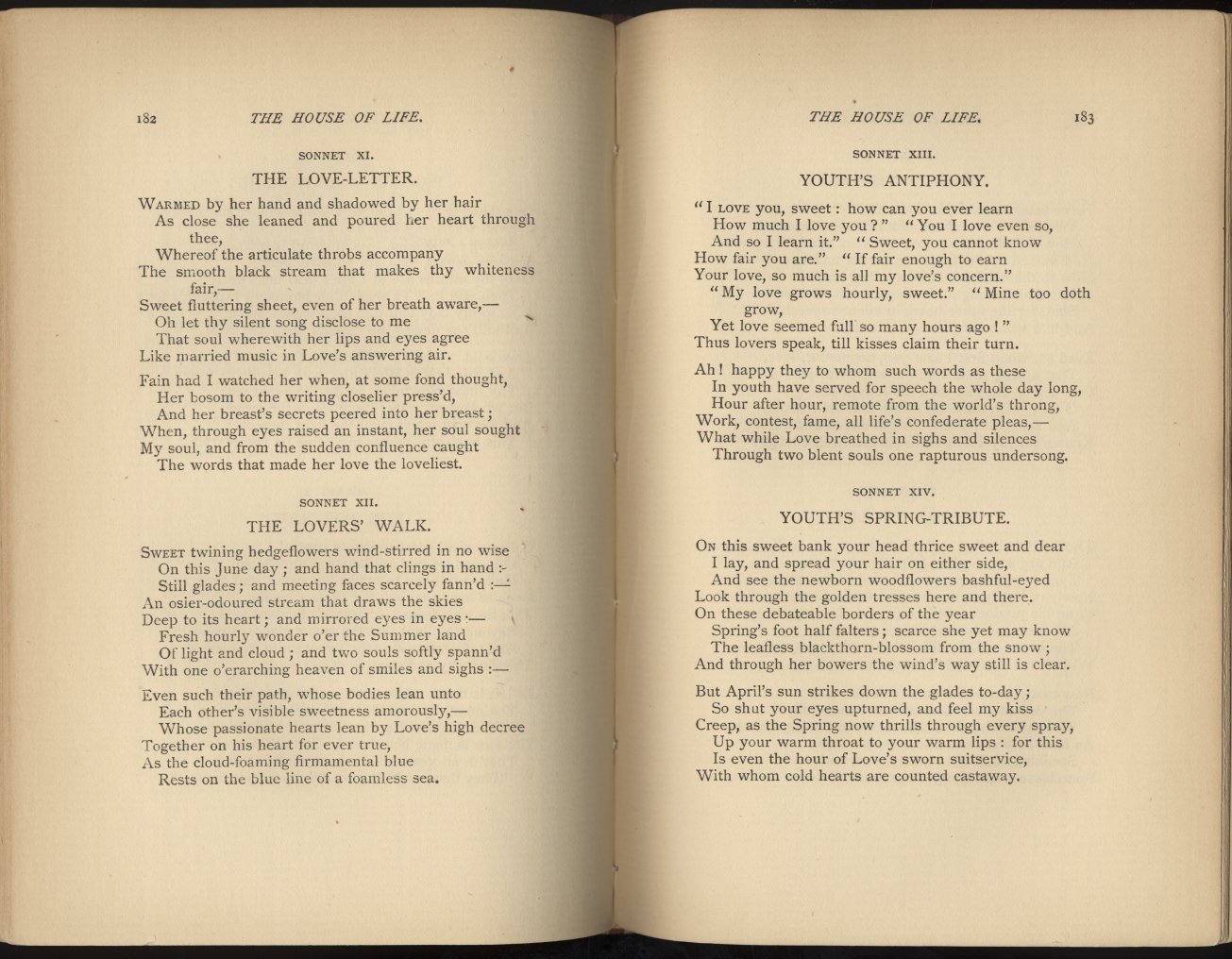
- Warmed by her hand and shadowed by her hair
- As close she leaned and poured her heart through
- thee,
- Whereof the articulate throbs accompany
- The smooth black stream that makes thy whiteness
- fair,—
- Sweet fluttering sheet, even of her breath aware,—
- Oh let thy silent song disclose to me
- That soul wherewith her lips and eyes agree
- Like married music in Love's answering air.
- Fain had I watched her when, at some fond thought,
- 10 Her bosom to the writing closelier press'd,
- And her breast's secrets peered into her breast;
- When, through eyes raised an instant, her soul sought
- My soul, and from the sudden confluence caught
- The words that made her love the loveliest.
- Sweet twining hedgeflowers wind-stirred in no wise
- On this June day; and hand that clings in hand:—
- Still glades; and meeting faces scarcely fann'd:—
- An osier-odoured stream that draws the skies
- Deep to its heart; and mirrored eyes in eyes:—
- Fresh hourly wonder o'er the Summer land
- Of light and cloud; and two souls softly spann'd
- With one o'erarching heaven of smiles and sighs:—
- Even such their path, whose bodies lean unto
- 10 Each other's visible sweetness amorously,—
- Whose passionate hearts lean by Love's high decree
- Together on his heart for ever true,
- As the cloud-foaming firmamental blue
- Rests on the blue line of a foamless sea.
- “I love you, sweet: how can you ever learn
- How much I love you?” “You I love even so,
- And so I learn it.” “Sweet, you cannot know
- How fair you are.” “If fair enough to earn
- Your love, so much is all my love's concern.”
- “My love grows hourly, sweet.” “Mine too doth
- grow,
- Yet love seemed full so many hours ago!”
- Thus lovers speak, till kisses claim their turn.
- Ah! happy they to whom such words as these
- 10 In youth have served for speech the whole day long,
- Hour after hour, remote from the world's throng,
- Work, contest, fame, all life's confederate pleas,—
- What while Love breathed in sighs and silences
- Through two blent souls one rapturous undersong.
- On this sweet bank your head thrice sweet and dear
- I lay, and spread your hair on either side,
- And see the newborn woodflowers bashful-eyed
- Look through the golden tresses here and there.
- On these debateable borders of the year
- Spring's foot half falters; scarce she yet may know
- The leafless blackthorn-blossom from the snow;
- And through her bowers the wind's way still is clear.
- But April's sun strikes down the glades to-day;
- 10 So shut your eyes upturned, and feel my kiss
- Creep, as the Spring now thrills through every spray,
- Up your warm throat to your warm lips: for this
- Is even the hour of Love's sworn suitservice,
- With whom cold hearts are counted castaway.

- Have you not noted, in some family
- Where two were born of a first marriage-bed,
- How still they own their gracious bond, though fed
- And nursed on the forgotten breast and knee?—
- How to their father's children they shall be
- In act and thought of one goodwill; but each
- Shall for the other have, in silence speech,
- And in a word complete community?
- Even so, when first I saw you, seemed it, love,
- 10 That among souls allied to mine was yet
- One nearer kindred than life hinted of.
- O born with me somewhere that men forget,
- And though in years of sight and sound unmet,
- Known for my soul's birth-partner well enough!
- Those envied places which do know her well,
- And are so scornful of this lonely place,
- Even now for once are emptied of her grace:
- Nowhere but here she is: and while Love's spell
- From his predominant presence doth compel
- All alien hours, an outworn populace,
- The hours of Love fill full the echoing space
- With sweet confederate music favourable.
- Now many memories make solicitous
- 10 The delicate love-lines of her mouth, till, lit
- With quivering fire, the words take wing from it;
- As here between our kisses we sit thus
- Speaking of things remembered, and so sit
- Speechless while things forgotten call to us.
- What dawn-pulse at the heart of heaven, or last
- Incarnate flower of culminating day,—
- What marshalled marvels on the skirts of May,
- Or song full-quired, sweet June's encomiast;
- What glory of change by Nature's hand amass'd
- Can vie with all those moods of varying grace
- Which o'er one loveliest woman's form and face
- Within this hour, within this room, have pass'd?
- Love's very vesture and elect disguise
- 10 Was each fine movement,—wonder new-begot
- Of lily or swan or swan-stemmed galiot;
- Joy to his sight who now the sadlier sighs,
- Parted again; and sorrow yet for eyes
- Unborn, that read these words and saw her not.
- Beauty like hers is genius. Not the call
- Of Homer's or of Dante's heart sublime,—
- Not Michael's hand furrowing the zones of time,—
- Is more with compassed mysteries musical;
- Nay, not in Spring's or Summer's sweet footfall
- More gathered gifts exuberant Life bequeathes
- Than doth this sovereign face, whose love-spell breathes
- Even from its shadowed contour on the wall.
- As many men are poets in their youth,
- 10 But for one sweet-strung soul the wires prolong
- Even through all change the indomitable song;
- So in likewise the envenomed years, whose tooth
- Rends shallower grace with ruin void of ruth,
- Upon this beauty's power shall wreak no wrong.

- Your hands lie open in the long fresh grass,—
- The finger-points look through like rosy blooms:
- Your eyes smile peace. The pasture gleams and glooms
- 'Neath billowing skies that scatter and amass.
- All round our nest, far as the eye can pass,
- Are golden kingcup-fields with silver edge
- Where the cow-parsley skirts the hawthorn-hedge.
- 'Tis visible silence, still as the hour-glass.
- Deep in the sun-searched growths the dragon-fly
- 10Hangs like a blue thread loosened from the sky:—
- So this wing'd hour is dropt to us from above.
- Oh! clasp we to our hearts, for deathless dower,
- This close-companioned inarticulate hour
- When twofold silence was the song of love.
- Even as the moon grows queenlier in mid-space
- When the sky darkens, and her cloud-rapt car
- Thrills with intenser radiance from afar,—
- So lambent, lady, beams thy sovereign grace
- When the drear soul desires thee. Of that face
- What shall be said,—which, like a governing star,
- Gathers and garners from all things that are
- Their silent penetrative loveliness?
- O'er water-daisies and wild waifs of Spring,
- 10 There where the iris rears its gold-crowned sheaf
- With flowering rush and sceptred arrow-leaf,
- So have I marked Queen Dian, in bright ring
- Of cloud above and wave below, take wing
- And chase night's gloom, as thou the spirit's grief.
- Sweet dimness of her loosened hair's downfall
- About thy face; her sweet hands round thy head
- In gracious fostering union garlanded;
- Her tremulous smiles; her glances' sweet recall
- Of love; her murmuring sighs memorial;
- Her mouth's culled sweetness by thy kisses shed
- On cheeks and neck and eyelids, and so led
- Back to her mouth which answers there for all:—
- What sweeter than these things, except the thing
- 10 In lacking which all these would lose their sweet:—
- The confident heart's still fervour: the swift beat
- And soft subsidence of the spirit's wing,
- Then when it feels, in cloud-girt wayfaring,
- The breath of kindred plumes against its feet?
- Sometimes she is a child within mine arms,
- Cowering beneath dark wings that love must chase,—
- With still tears showering and averted face,
- Inexplicably filled with faint alarms:
- And oft from mine own spirit's hurtling harms
- I crave the refuge of her deep embrace,—
- Against all ills the fortified strong place
- And sweet reserve of sovereign counter-charms.
- And Love, our light at night and shade at noon,
- 10 Lulls us to rest with songs, and turns away
- All shafts of shelterless tumultuous day.
- Like the moon's growth, his face gleams through his tune;
- And as soft waters warble to the moon,
- Our answering spirits chime one roundelay.
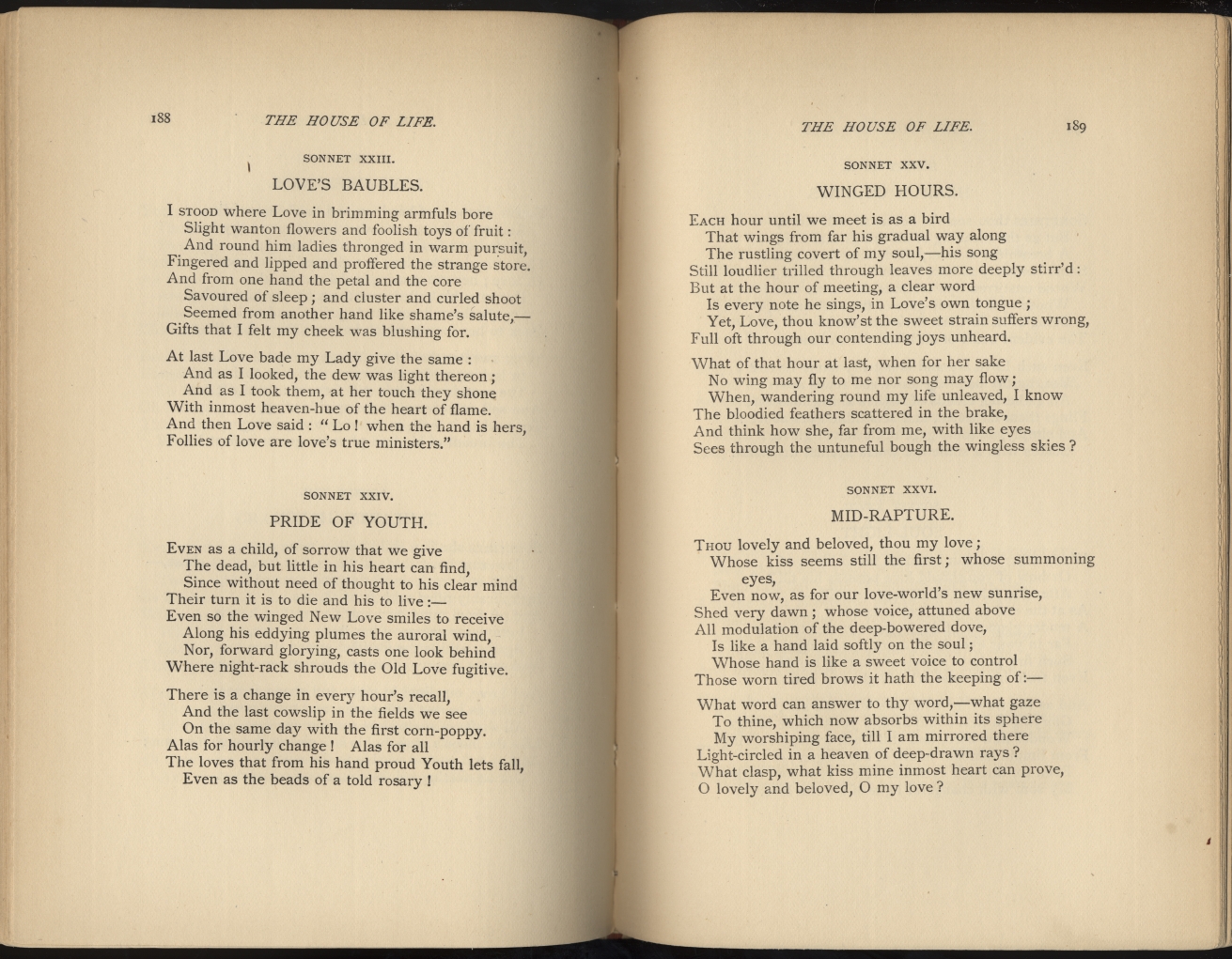
- I stood where Love in brimming armfuls bore
- Slight wanton flowers and foolish toys of fruit:
- And round him ladies thronged in warm pursuit,
- Fingered and lipped and proffered the strange store.
- And from one hand the petal and the core
- Savoured of sleep; and cluster and curled shoot
- Seemed from another hand like shame's salute,—
- Gifts that I felt my cheek was blushing for.
- At last Love bade my Lady give the same:
- 10 And as I looked, the dew was light thereon;
- And as I took them, at her touch they shone
- With inmost heaven-hue of the heart of flame.
- And then Love said: “Lo! when the hand is hers,
- Follies of love are love's true ministers.”
- Even as a child, of sorrow that we give
- The dead, but little in his heart can find,
- Since without need of thought to his clear mind
- Their turn it is to die and his to live:—
- Even so the winged New Love smiles to receive
- Along his eddying plumes the auroral wind,
- Nor, forward glorying, casts one look behind
- Where night-rack shrouds the Old Love fugitive.
- There is a change in every hour's recall,
- 10 And the last cowslip in the fields we see
- On the same day with the first corn-poppy.
- Alas for hourly change! Alas for all
- The loves that from his hand proud Youth lets fall,
- Even as the beads of a told rosary!
- Each hour until we meet is as a bird
- That wings from far his gradual way along
- The rustling covert of my soul,—his song
- Still loudlier trilled through leaves more deeply stirr'd:
- But at the hour of meeting, a clear word
- Is every note he sings, in Love's own tongue;
- Yet, Love, thou know'st the sweet strain suffers wrong,
- Full oft through our contending joys unheard.
- What of that hour at last, when for her sake
- 10 No wing may fly to me nor song may flow;
- When, wandering round my life unleaved, I know
- The bloodied feathers scattered in the brake,
- And think how she, far from me, with like eyes
- Sees through the untuneful bough the wingless skies?
- Thou lovely and beloved, thou my love;
- Whose kiss seems still the first; whose summoning
- eyes,
- Even now, as for our love-world's new sunrise,
- Shed very dawn; whose voice, attuned above
- All modulation of the deep-bowered dove,
- Is like a hand laid softly on the soul;
- Whose hand is like a sweet voice to control
- Those worn tired brows it hath the keeping of:—
- What word can answer to thy word,—what gaze
- 10 To thine, which now absorbs within its sphere
- My worshipping face, till I am mirrored there
- Light-circled in a heaven of deep-drawn rays?
- What clasp, what kiss mine inmost heart can prove,
- O lovely and beloved, O my love?
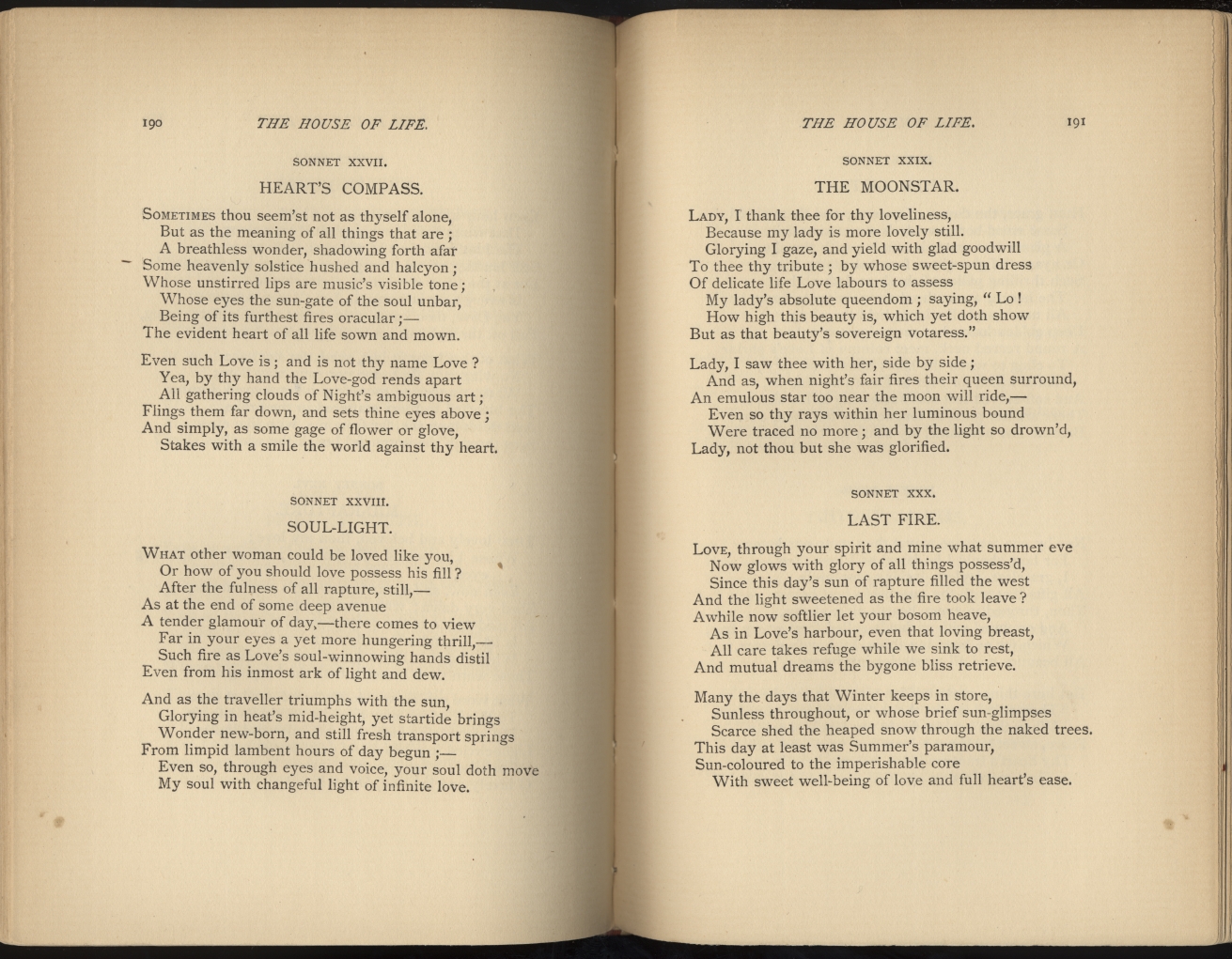
- Sometimes thou seem'st not as thyself alone,
- But as the meaning of all things that are;
- A breathless wonder, shadowing forth afar
- Some heavenly solstice hushed and halcyon;
- Whose unstirred lips are music's visible tone;
- Whose eyes the sun-gate of the soul unbar,
- Being of its furthest fires oracular;—
- The evident heart of all life sown and mown.
- Even such Love is; and is not thy name Love?
- 10 Yea, by thy hand the Love-god rends apart
- All gathering clouds of Night's ambiguous art;
- Flings them far down, and sets thine eyes above;
- And simply, as some gage of flower or glove,
- Stakes with a smile the world against thy heart.
- What other woman could be loved like you,
- Or how of you should love possess his fill?
- After the fulness of all rapture, still,—
- As at the end of some deep avenue
- A tender glamour of day,—there comes to view
- Far in your eyes a yet more hungering thrill,—
- Such fire as Love's soul-winnowing hands distil
- Even from his inmost ark of light and dew.
- And as the traveller triumphs with the sun,
- 10 Glorying in heat's mid-height, yet startide brings
- Wonder new-born, and still fresh transport springs
- From limpid lambent hours of day begun;—
- Even so, through eyes and voice, your soul doth move
- My soul with changeful light of infinite love.
- Lady, I thank thee for thy loveliness,
- Because my lady is more lovely still.
- Glorying I gaze, and yield with glad goodwill
- To thee thy tribute; by whose sweet-spun dress
- Of delicate life Love labours to assess
- My lady's absolute queendom; saying, “Lo!
- How high this beauty is, which yet doth show
- But as that beauty's sovereign votaress.”
- Lady, I saw thee with her, side by side;
- 10 And as, when night's fair fires their queen surround,
- An emulous star too near the moon will ride,—
- Even so thy rays within her luminous bound
- Were traced no more; and by the light so drown'd,
- Lady, not thou but she was glorified.
- Love, through your spirit and mine what summer eve
- Now glows with glory of all things possess'd,
- Since this day's sun of rapture filled the west
- And the light sweetened as the fire took leave?
- Awhile now softlier let your bosom heave,
- As in Love's harbour, even that loving breast,
- All care takes refuge while we sink to rest,
- And mutual dreams the bygone bliss retrieve.
- Many the days that Winter keeps in store,
- 10 Sunless throughout, or whose brief sun-glimpses
- Scarce shed the heaped snow through the naked trees.
- This day at least was Summer's paramour,
- Sun-coloured to the imperishable core
- With sweet well-being of love and full heart's ease.
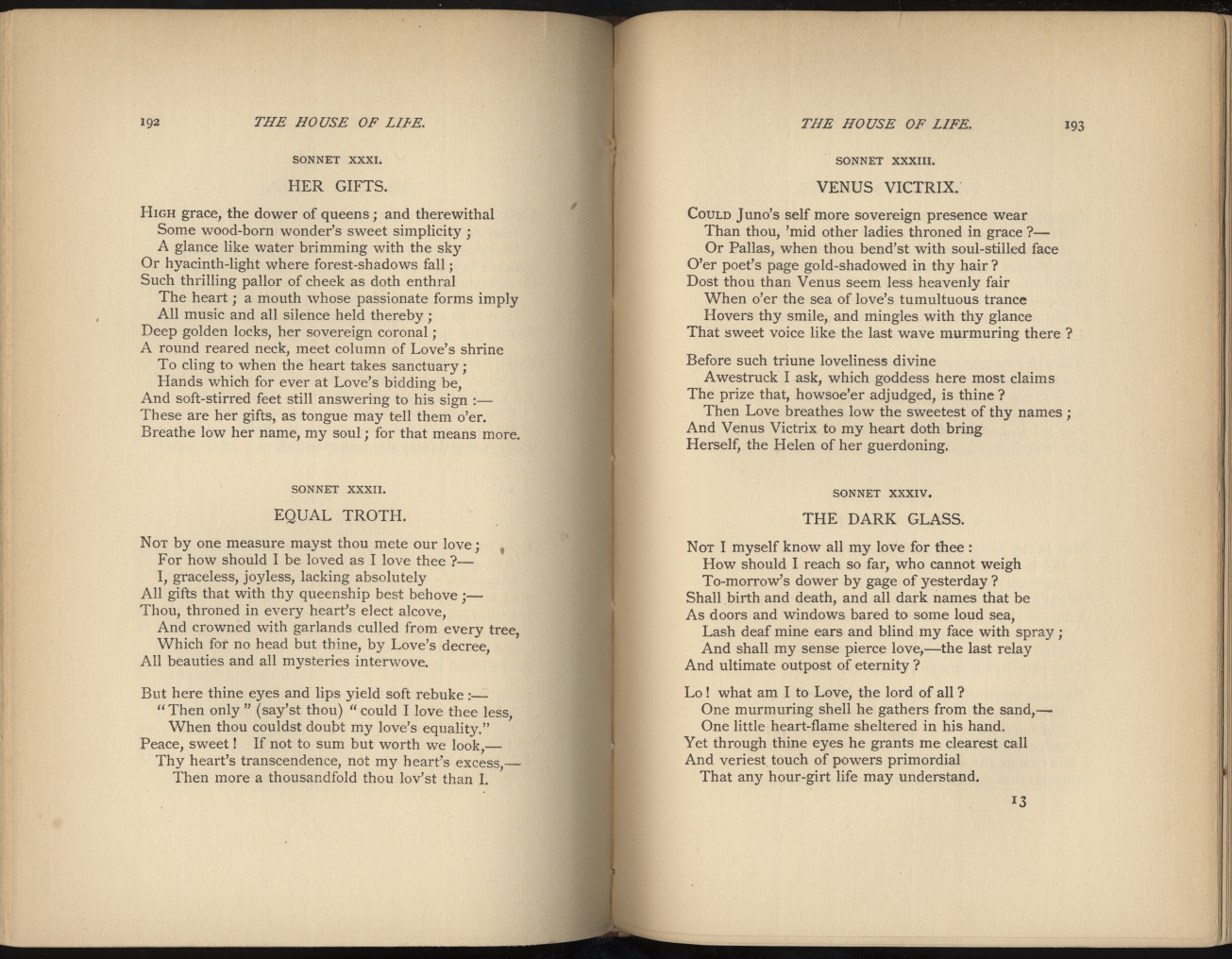
- High grace, the dower of queens; and therewithal
- Some wood-born wonder's sweet simplicity;
- A glance like water brimming with the sky
- Or hyacinth-light where forest-shadows fall;
- Such thrilling pallor of cheek as doth enthral
- The heart; a mouth whose passionate forms imply
- All music and all silence held thereby;
- Deep golden locks, her sovereign coronal;
- A round reared neck, meet column of Love's shrine
- 10 To cling to when the heart takes sanctuary;
- Hands which for ever at Love's bidding be,
- And soft-stirred feet still answering to his sign:—
- These are her gifts, as tongue may tell them o'er.
- Breathe low her name, my soul; for that means more.
- Not by one measure mayst thou mete our love;
- For how should I be loved as I love thee?—
- I, graceless, joyless, lacking absolutely
- All gifts that with thy queenship best behove;—
- Thou, throned in every heart's elect alcove,
- And crowned with garlands culled from every tree,
- Which for no head but thine, by Love's decree,
- All beauties and all mysteries interwove.
- But here thine eyes and lips yield soft rebuke:—
- 10“Then only” (say'st thou) “could I love thee less,
- When thou couldst doubt my love's equality.”
- Peace, sweet! If not to sum but worth we look,—
- Thy heart's transcendence, not my heart's excess,—
- Then more a thousandfold thou lov'st than I.
- Could Juno's self more sovereign presence wear
- Than thou, 'mid other ladies throned in grace?—
- Or Pallas, when thou bend'st with soul-stilled face
- O'er poet's page gold-shadowed in thy hair?
- Dost thou than Venus seem less heavenly fair
- When o'er the sea of love's tumultuous trance
- Hovers thy smile, and mingles with thy glance
- That sweet voice like the last wave murmuring there?
- Before such triune loveliness divine
- 10 Awestruck I ask, which goddess here most claims
- The prize that, howsoe'er adjudged, is thine?
- Then Love breathes low the sweetest of thy names;
- And Venus Victrix to my heart doth bring
- Herself, the Helen of her guerdoning.
- Not I myself know all my love for thee:
- How should I reach so far, who cannot weigh
- To-morrow's dower by gage of yesterday?
- Shall birth and death, and all dark names that be
- As doors and windows bared to some loud sea,
- Lash deaf mine ears and blind my face with spray;
- And shall my sense pierce love,—the last relay
- And ultimate outpost of eternity?
- Lo! what am I to Love, the lord of all?
- 10 One murmuring shell he gathers from the sand,—
- One little heart-flame sheltered in his hand.
- Yet through thine eyes he grants me clearest call
- And veriest touch of powers primordial
- That any hour-girt life may understand.

- Sometimes I fain would find in thee some fault,
- That I might love thee still in spite of it:
- Yet how should our Lord Love curtail one whit
- Thy perfect praise whom most he would exalt?
- Alas! he can but make my heart's low vault
- Even in men's sight unworthier, being lit
- By thee, who thereby show'st more exquisite
- Like fiery chrysoprase in deep basalt.
- Yet will I nowise shrink; but at Love's shrine
- 10 Myself within the beams his brow doth dart
- Will set the flashing jewel of thy heart
- In that dull chamber where it deigns to shine:
- For lo! in honour of thine excellencies
- My heart takes pride to show how poor it is.
- Not in thy body is thy life at all,
- But in this lady's lips and hands and eyes;
- Through these she yields thee life that vivifies
- What else were sorrow's servant and death's thrall.
- Look on thyself without her, and recall
- The waste remembrance and forlorn surmise
- That lived but in a dead-drawn breath of sighs
- O'er vanished hours and hours eventual.
- Even so much life hath the poor tress of hair
- 10 Which, stored apart, is all love hath to show
- For heart-beats and for fire-heats long ago;
- Even so much life endures unknown, even where,
- 'Mid change the changeless night environeth,
- Lies all that golden hair undimmed in death.
- “When that dead face, bowered in the furthest years,
- Which once was all the life years held for thee,
- Can now scarce bid the tides of memory
- Cast on thy soul a little spray of tears,—
- How canst thou gaze into these eyes of hers
- Whom now thy heart delights in, and not see
- Within each orb Love's philtred euphrasy
- Make them of buried troth remembrancers?”
- “Nay, pitiful Love, nay, loving Pity! Well
- 10 Thou knowest that in these twain I have confess'd
- Two very voices of thy summoning bell.
- Nay, Master, shall not Death make manifest
- In these the culminant changes which approve
- The love-moon that must light my soul to Love?”
- “Thou Ghost,” I said, “and is thy name To-day?—
- Yesterday's son, with such an abject brow!—
- And can To-morrow be more pale than thou?”
- While yet I spoke, the silence answered: “Yea,
- Henceforth our issue is all grieved and grey,
- And each beforehand makes such poor avow
- As of old leaves beneath the budding bough
- Or night-drift that the sundawn shreds away.”
- Then cried I: “Mother of many malisons,
- 10 O Earth, receive me to thy dusty bed!”
- But therewithal the tremulous silence said:
- “Lo! Love yet bids thy lady greet thee once:—
- Yea, twice,—whereby thy life is still the sun's;
- And thrice,—whereby the shadow of death is dead.”
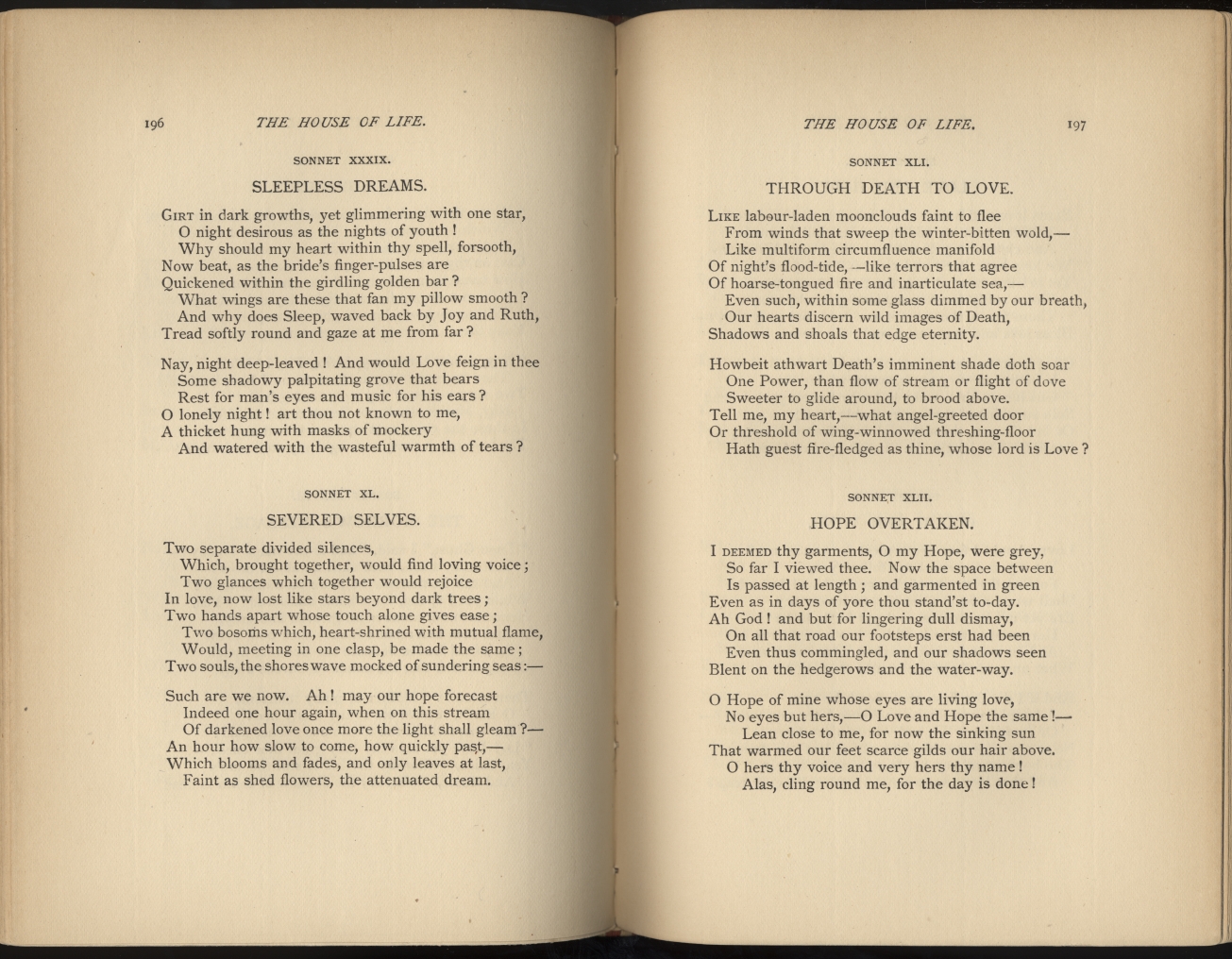
- Girt in dark growths, yet glimmering with one star,
- O night desirous as the nights of youth!
- Why should my heart within thy spell, forsooth,
- Now beat, as the bride's finger-pulses are
- Quickened within the girdling golden bar?
- What wings are these that fan my pillow smooth?
- And why does Sleep, waved back by Joy and Ruth,
- Tread softly round and gaze at me from far?
- Nay, night deep-leaved! And would Love feign in thee
- 10 Some shadowy palpitating grove that bears
- Rest for man's eyes and music for his ears?
- O lonely night! art thou not known to me,
- A thicket hung with masks of mockery
- And watered with the wasteful warmth of tears?
- Two separate divided silences,
- Which, brought together, would find loving voice;
- Two glances which together would rejoice
- In love, now lost like stars beyond dark trees;
- Two hands apart whose touch alone gives ease;
- Two bosoms which, heart-shrined with mutual flame,
- Would, meeting in one clasp, be made the same;
- Two souls, the shores wave mocked of sundering seas:—
- Such are we now. Ah! may our hope forecast
- 10 Indeed one hour again, when on this stream
- Of darkened love once more the light shall gleam?—
- An hour how slow to come, how quickly past,—
- Which blooms and fades, and only leaves at last,
- Faint as shed flowers, the attenuated dream.
- Like labour-laden moonclouds faint to flee
- From winds that sweep the winter-bitten wold,—
- Like multiform circumfluence manifold
- Of night's flood-tide,—like terrors that agree
- Of hoarse-tongued fire and inarticulate sea,—
- Even such, within some glass dimmed by our breath,
- Our hearts discern wild images of Death,
- Shadows and shoals that edge eternity.
- Howbeit athwart Death's imminent shade doth soar
- 10 One Power, than flow of stream or flight of dove
- Sweeter to glide around, to brood above.
- Tell me, my heart,—what angel-greeted door
- Or threshold of wing-winnowed threshing-floor
- Hath guest fire-fledged as thine, whose lord is Love?
- I deemed thy garments, O my Hope, were grey,
- So far I viewed thee. Now the space between
- Is passed at length; and garmented in green
- Even as in days of yore thou stand'st to-day.
- Ah God! and but for lingering dull dismay,
- On all that road our footsteps erst had been
- Even thus commingled, and our shadows seen
- Blent on the hedgerows and the water-way.
- O Hope of mine whose eyes are living love,
- 10 No eyes but hers,—O Love and Hope the same!—
- Lean close to me, for now the sinking sun
- That warmed our feet scarce gilds our hair above.
- O hers thy voice and very hers thy name!
- Alas, cling round me, for the day is done!
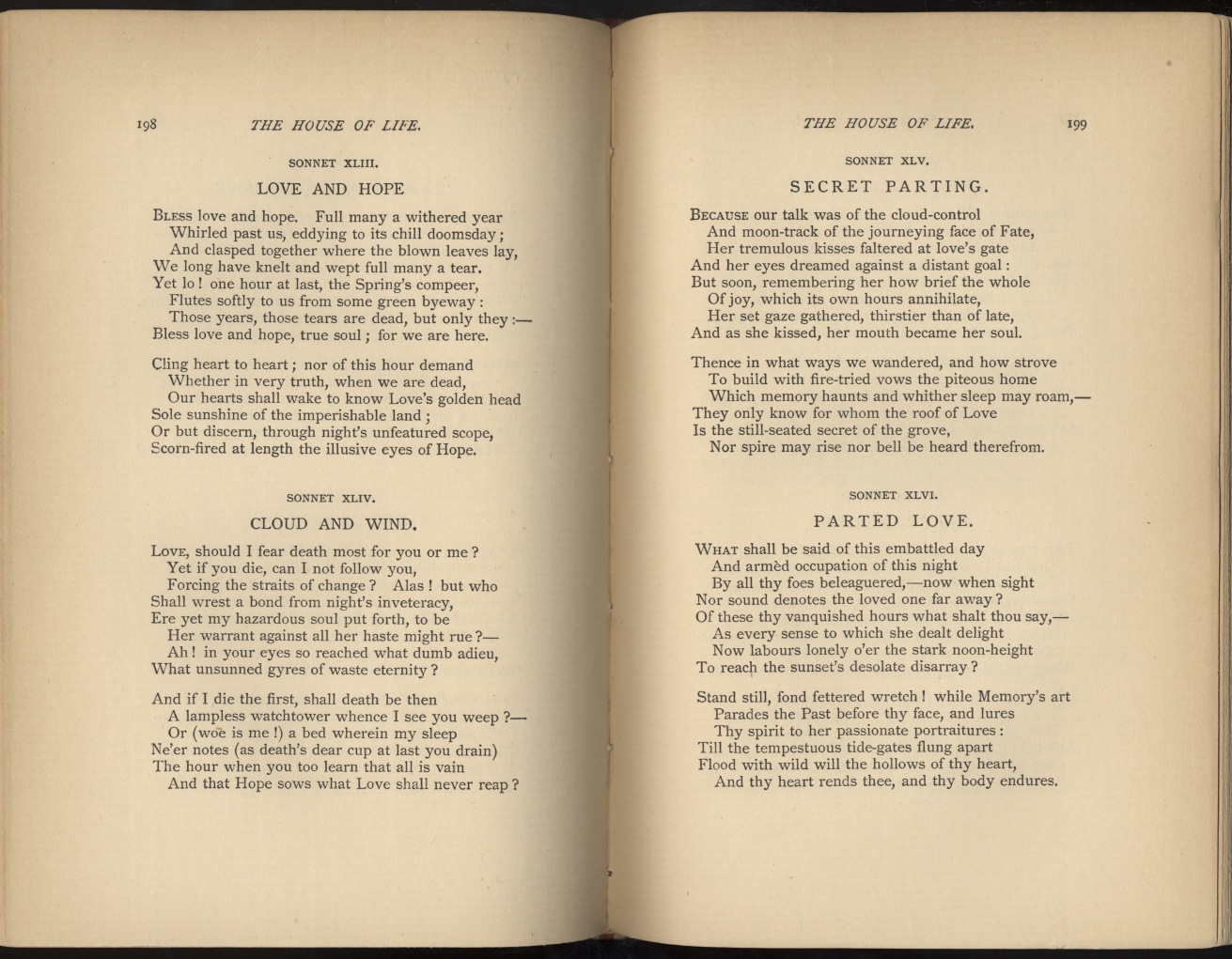
- Bless love and hope. Full many a withered year
- Whirled past us, eddying to its chill doomsday;
- And clasped together where the blown leaves lay,
- We long have knelt and wept full many a tear.
- Yet lo! one hour at last, the Spring's compeer,
- Flutes softly to us from some green byeway:
- Those years, those tears are dead, but only they:—
- Bless love and hope, true soul; for we are here.
- Cling heart to heart; nor of this hour demand
- 10 Whether in very truth, when we are dead,
- Our hearts shall wake to know Love's golden head
- Sole sunshine of the imperishable land;
- Or but discern, through night's unfeatured scope,
- Scorn-fired at length the illusive eyes of Hope.
- Love, should I fear death most for you or me?
- Yet if you die, can I not follow you,
- Forcing the straits of change? Alas! but who
- Shall wrest a bond from night's inveteracy,
- Ere yet my hazardous soul put forth, to be
- Her warrant against all her haste might rue?—
- Ah! in your eyes so reached what dumb adieu,
- What unsunned gyres of waste eternity?
- And if I die the first, shall death be then
- 10 A lampless watchtower whence I see you weep?—
- Or (woe is me!) a bed wherein my sleep
- Ne'er notes (as death's dear cup at last you drain)
- The hour when you too learn that all is vain
- And that Hope sows what Love shall never reap?
- Because our talk was of the cloud-control
- And moon-track of the journeying face of Fate,
- Her tremulous kisses faltered at love's gate
- And her eyes dreamed against a distant goal:
- But soon, remembering her how brief the whole
- Of joy, which its own hours annihilate,
- Her set gaze gathered, thirstier than of late,
- And as she kissed, her mouth became her soul.
- Thence in what ways we wandered, and how strove
- 10 To build with fire-tried vows the piteous home
- Which memory haunts and whither sleep may roam,—
- They only know for whom the roof of Love
- Is the still-seated secret of the grove,
- Nor spire may rise nor bell be heard therefrom.
- What shall be said of this embattled day
- And armèd occupation of this night
- By all thy foes beleaguered,—now when sight
- Nor sound denotes the loved one far away?
- Of these thy vanquished hours what shalt thou say,—
- As every sense to which she dealt delight
- Now labours lonely o'er the stark noon-height
- To reach the sunset's desolate disarray?
- Stand still, fond fettered wretch! while Memory's art
- 10 Parades the Past before thy face, and lures
- Thy spirit to her passionate portraitures:
- Till the tempestuous tide-gates flung apart
- Flood with wild will the hollows of thy heart,
- And thy heart rends thee, and thy body endures.

- The mother will not turn, who thinks she hears
- Her nursling's speech first grow articulate;
- But breathless with averted eyes elate
- She sits, with open lips and open ears,
- That it may call her twice. 'Mid doubts and fears
- Thus oft my soul has hearkened; till the song,
- A central moan for days, at length found tongue,
- And the sweet music welled and the sweet tears.
- But now, whatever while the soul is fain
- 10 To list that wonted murmur, as it were
- The speech-bound sea-shell's low importunate strain,—
- No breath of song, thy voice alone is there,
- O bitterly beloved! and all her gain
- Is but the pang of unpermitted prayer.
- There came an image in Life's retinue
- That had Love's wings and bore his gonfalon:
- Fair was the web, and nobly wrought thereon,
- O soul-sequestered face, thy form and hue!
- Bewildering sounds, such as Spring wakens to,
- Shook in its folds; and through my heart its power
- Sped trackless as the immemorable hour
- When birth's dark portal groaned and all was new.
- But a veiled woman followed, and she caught
- 10 The banner round its staff, to furl and cling,—
- Then plucked a feather from the bearer's wing,
- And held it to his lips that stirred it not,
- And said to me, “Behold, there is no breath:
- I and this Love are one, and I am Death.”
- I sat with Love upon a woodside well,
- Leaning across the water, I and he;
- Nor ever did he speak nor looked at me,
- But touched his lute wherein was audible
- The certain secret thing he had to tell:
- Only our mirrored eyes met silently
- In the low wave; and that sound came to be
- The passionate voice I knew; and my tears fell.
- And at their fall, his eyes beneath grew hers;
- 10And with his foot and with his wing-feathers
- He swept the spring that watered my heart's drouth.
- Then the dark ripples spread to waving hair,
- And as I stooped, her own lips rising there
- Bubbled with brimming kisses at my mouth.
- And now Love sang: but his was such a song,
- So meshed with half-remembrance hard to free,
- As souls disused in death's sterility
- May sing when the new birthday tarries long.
- And I was made aware of a dumb throng
- That stood aloof, one form by every tree,
- All mournful forms, for each was I or she,
- The shades of those our days that had no tongue.
- They looked on us, and knew us and were known;
- 10 While fast together, alive from the abyss,
- Clung the soul-wrung implacable close kiss;
- And pity of self through all made broken moan
- Which said, “For once, for once, for once alone!”
- And still Love sang, and what he sang was this:—

- “O ye, all ye that walk in Willowwood,
- That walk with hollow faces burning white;
- What fathom-depth of soul-struck widowhood,
- What long, what longer hours, one lifelong night,
- Ere ye again, who so in vain have wooed
- Your last hope lost, who so in vain invite
- Your lips to that their unforgotten food,
- Ere ye, ere ye again shall see the light!
- Alas! the bitter banks in Willowwood,
- 10 With tear-spurge wan, with blood-wort burning red:
- Alas! if ever such a pillow could
- Steep deep the soul in sleep till she were dead,—
- Better all life forget her than this thing,
- That Willowwood should hold her wandering!”
- So sang he: and as meeting rose and rose
- Together cling through the wind's wellaway
- Nor change at once, yet near the end of day
- The leaves drop loosened where the heart-stain glows,—
- So when the song died did the kiss unclose;
- And her face fell back drowned, and was as grey
- As its grey eyes; and if it ever may
- Meet mine again I know not if Love knows.
- Only I know that I leaned low and drank
- 10A long draught from the water where she sank,
- Her breath and all her tears and all her soul:
- And as I leaned, I know I felt Love's face
- Pressed on my neck with moan of pity and grace,
- Till both our heads were in his aureole.
- What of her glass without her? The blank grey
- There where the pool is blind of the moon's face.
- Her dress without her? The tossed empty space
- Of cloud-rack whence the moon has passed away.
- Her paths without her? Day's appointed sway
- Usurped by desolate night. Her pillowed place
- Without her? Tears, ah me! for love's good grace,
- And cold forgetfulness of night or day.
- What of the heart without her? Nay, poor heart,
- 10 Of thee what word remains ere speech be still?
- A wayfarer by barren ways and chill,
- Steep ways and weary, without her thou art,
- Where the long cloud, the long wood's counterpart,
- Sheds doubled darkness up the labouring hill.
- Sweet Love,—but oh! most dread Desire of Love
- Life-thwarted. Linked in gyves I saw them stand,
- Love shackled with Vain-longing, hand to hand:
- And one was eyed as the blue vault above:
- But hope tempestuous like a fire-cloud hove
- I' the other's gaze, even as in his whose wand
- Vainly all night with spell-wrought power has spann'd
- The unyielding caves of some deep treasure-trove.
- Also his lips, two writhen flakes of flame,
- 10 Made moan: “Alas O Love, thus leashed with me!
- Wing-footed thou, wing-shouldered, once born free:
- And I, thy cowering self, in chains grown tame,—
- Bound to thy body and soul, named with thy name,—
- Life's iron heart, even Love's Fatality.”
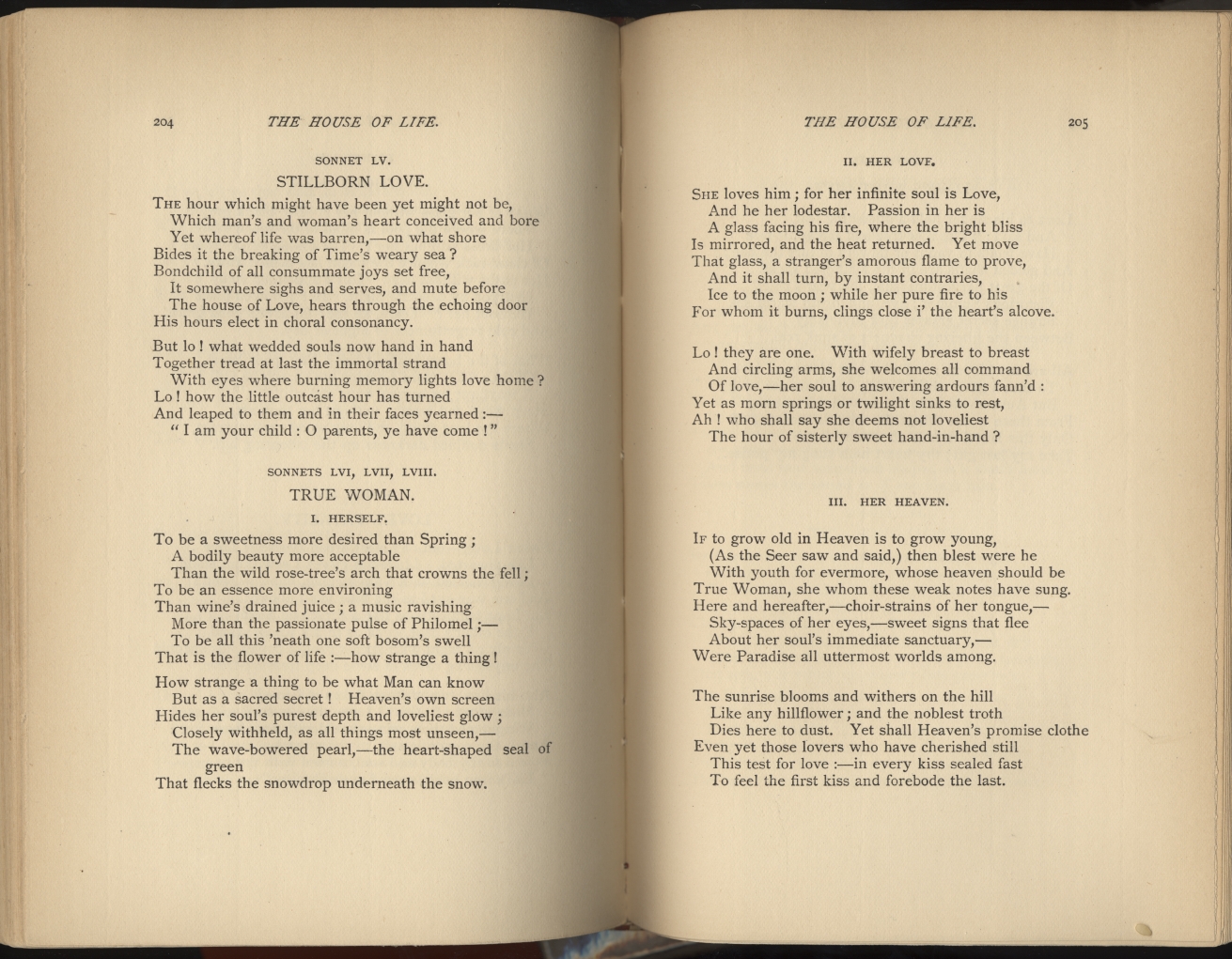
- The hour which might have been yet might not be,
- Which man's and woman's heart conceived and bore
- Yet whereof life was barren,—on what shore
- Bides it the breaking of Time's weary sea?
- Bondchild of all consummate joys set free,
- It somewhere sighs and serves, and mute before
- The house of Love, hears through the echoing door
- His hours elect in choral consonancy.
- But lo! what wedded souls now hand in hand
- 10Together tread at last the immortal strand
- With eyes where burning memory lights love home?
- Lo! how the little outcast hour has turned
- And leaped to them and in their faces yearned:—
- “I am your child: O parents, ye have come!”
- To be a sweetness more desired than Spring;
- A bodily beauty more acceptable
- Than the wild rose-tree's arch that crowns the fell;
- To be an essence more environing
- Than wine's drained juice; a music ravishing
- More than the passionate pulse of Philomel;—
- To be all this 'neath one soft bosom's swell
- That is the flower of life:—how strange a thing!
- How strange a thing to be what Man can know
- 10 But as a sacred secret! Heaven's own screen
- Hides her soul's purest depth and loveliest glow;
- Closely withheld, as all things most unseen,—
- The wave-bowered pearl,—the heart-shaped seal of
- green
- That flecks the snowdrop underneath the snow.
- She loves him; for her infinite soul is Love,
- And he her lodestar. Passion in her is
- A glass facing his fire, where the bright bliss
- Is mirrored, and the heat returned. Yet move
- That glass, a stranger's amorous flame to prove,
- And it shall turn, by instant contraries,
- Ice to the moon; while her pure fire to his
- For whom it burns, clings close i' the heart's alcove.
- Lo! they are one. With wifely breast to breast
- 10 And circling arms, she welcomes all command
- Of love,—her soul to answering ardours fann'd:
- Yet as morn springs or twilight sinks to rest,
- Ah! who shall say she deems not loveliest
- The hour of sisterly sweet hand-in-hand?
- If to grow old in Heaven is to grow young,
- (As the Seer saw and said,) then blest were he
- With youth for evermore, whose heaven should be
- True Woman, she whom these weak notes have sung.
- Here and hereafter,—choir-strains of her tongue,—
- Sky-spaces of her eyes,—sweet signs that flee
- About her soul's immediate sanctuary,—
- Were Paradise all uttermost worlds among.
- The sunrise blooms and withers on the hill
- 10 Like any hillflower; and the noblest troth
- Dies here to dust. Yet shall Heaven's promise clothe
- Even yet those lovers who have cherished still
- This test for love:—in every kiss sealed fast
- To feel the first kiss and forbode the last.
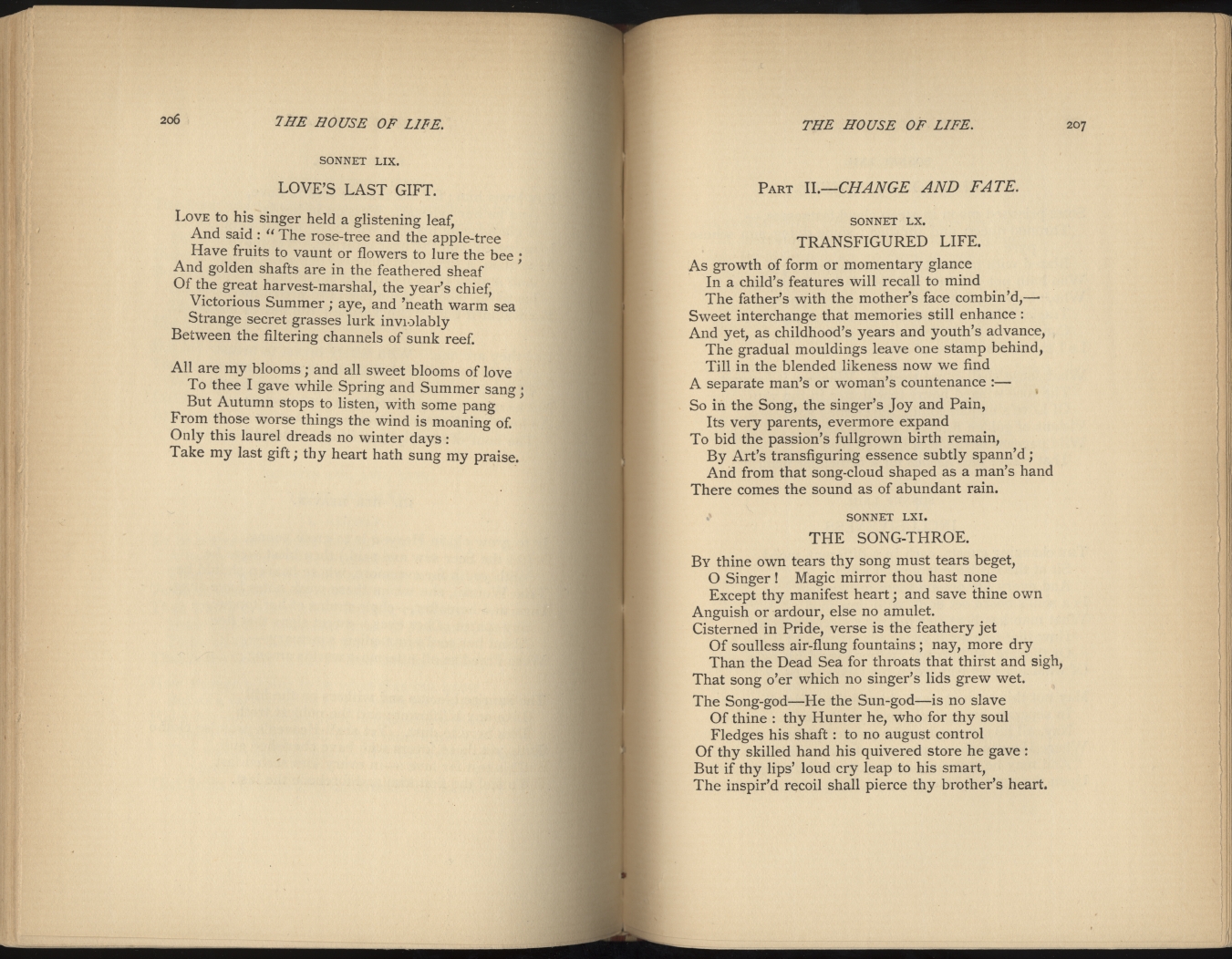
- Love to his singer held a glistening leaf,
- And said: “The rose-tree and the apple-tree
- Have fruits to vaunt or flowers to lure the bee;
- And golden shafts are in the feathered sheaf
- Of the great harvest-marshal, the year's chief,
- Victorious Summer; aye, and 'neath warm sea
- Strange secret grasses lurk inviolably
- Between the filtering channels of sunk reef.
- All are my blooms; and all sweet blooms of love
- 10 To thee I gave while Spring and Summer sang;
- But Autumn stops to listen, with some pang
- From those worse things the wind is moaning of.
- Only this laurel dreads no winter days:
- Take my last gift; thy heart hath sung my praise.
- As growth of form or momentary glance
- In a child's features will recall to mind
- The father's with the mother's face combin'd,—
- Sweet interchange that memories still enhance:
- And yet, as childhood's years and youth's advance,
- The gradual mouldings leave one stamp behind,
- Till in the blended likeness now we find
- A separate man's or woman's countenance:—
- So in the Song, the singer's Joy and Pain,
- 10 Its very parents, evermore expand
- To bid the passion's fullgrown birth remain,
- By Art's transfiguring essence subtly spann'd;
- And from that song-cloud shaped as a man's hand
- There comes the sound as of abundant rain.
- By thine own tears thy song must tears beget,
- O Singer! Magic mirror thou hast none
- Except thy manifest heart; and save thine own
- Anguish or ardour, else no amulet.
- Cisterned in Pride, verse is the feathery jet
- Of soulless air-flung fountains; nay, more dry
- Than the Dead Sea for throats that thirst and sigh,
- That song o'er which no singer's lids grew wet.
- The Song-god—He the Sun-god—is no slave
- 10 Of thine: thy Hunter he, who for thy soul
- Fledges his shaft: to no august control
- Of thy skilled hand his quivered store he gave:
- But if thy lips' loud cry leap to his smart,
- The inspir'd recoil shall pierce thy brother's heart.

- Some prisoned moon in steep cloud-fastnesses,—
- Throned queen and thralled; some dying sun whose
- pyre
- Blazed with momentous memorable fire;—
- Who hath not yearned and fed his heart with these?
- Who, sleepless, hath not anguished to appease
- Tragical shadow's realm of sound and sight
- Conjectured in the lamentable night? . . . . .
- Lo! the soul's sphere of infinite images!
- What sense shall count them? Whether it forecast
- 10 The rose-winged hours that flutter in the van
- Of Love's unquestioning unrevealèd span,—
- Visions of golden futures: or that last
- Wild pageant of the accumulated past
- That clangs and flashes for a drowning man.
- The changing guests, each in a different mood,
- Sit at the roadside table and arise:
- And every life among them in likewise
- Is a soul's board set daily with new food.
- What man has bent o'er his son's sleep, to brood
- How that face shall watch his when cold it lies?—
- Or thought, as his own mother kissed his eyes,
- Of what her kiss was when his father wooed?
- May not this ancient room thou sit'st in dwell
- 10 In separate living souls for joy or pain?
- Nay, all its corners may be painted plain
- Where Heaven shows pictures of some life spent well;
- And may be stamped, a memory all in vain,
- Upon the sight of lidless eyes in Hell.
- The cuckoo-throb, the heartbeat of the Spring;
- The rosebud's blush that leaves it as it grows
- Into the full-eyed fair unblushing rose;
- The summer clouds that visit every wing
- With fires of sunrise and of sunsetting;
- The furtive flickering streams to light re-born
- 'Mid airs new-fledged and valorous lusts of morn,
- While all the daughters of the daybreak sing:—
- These ardour loves, and memory: and when flown
- 10 All joys, and through dark forest-boughs in flight
- The wind swoops onward brandishing the light,
- Even yet the rose-tree's verdure left alone
- Will flush all ruddy though the rose be gone;
- With ditties and with dirges infinite.
- As two whose love, first foolish, widening scope,
- Knows suddenly, to music high and soft,
- The Holy of holies; who because they scoff'd
- Are now amazed with shame, nor dare to cope
- With the whole truth aloud, lest heaven should ope;
- Yet, at their meetings, laugh not as they laugh'd
- In speech; nor speak, at length; but sitting oft
- Together, within hopeless sight of hope
- For hours are silent:—So it happeneth
- 10 When Work and Will awake too late, to gaze
- After their life sailed by, and hold their breath.
- Ah! who shall dare to search through what sad maze
- Thenceforth their incommunicable ways
- Follow the desultory feet of Death?
- From child to youth; from youth to arduous man;
- From lethargy to fever of the heart;
- From faithful life to dream-dowered days apart;
- From trust to doubt; from doubt to brink of ban;—
- Thus much of change in one swift cycle ran
- Till now. Alas, the soul!—how soon must she
- Accept her primal immortality,—
- The flesh resume its dust whence it began?
- O Lord of work and peace! O Lord of life!
- 10 O Lord, the awful Lord of will! though late,
- Even yet renew this soul with duteous breath:
- That when the peace is garnered in from strife,
- The work retrieved, the will regenerate,
- This soul may see thy face, O Lord of death!
- Was that the landmark? What,—the foolish well
- Whose wave, low down, I did not stoop to drink,
- But sat and flung the pebbles from its brink
- In sport to send its imaged skies pell-mell,
- (And mine own image, had I noted well!)—
- Was that my point of turning?—I had thought
- The stations of my course should rise unsought,
- As altar-stone or ensigned citadel.
- But lo! the path is missed, I must go back,
- 10 And thirst to drink when next I reach the spring
- Which once I stained, which since may have grown
- black.
- Yet though no light be left nor bird now sing
- As here I turn, I'll thank God, hastening,
- That the same goal is still on the same track.
- The gloom that breathes upon me with these airs
- Is like the drops which strike the traveller's brow
- Who knows not, darkling, if they bring him now
- Fresh storm, or be old rain the covert bears.
- Ah! bodes this hour some harvest of new tares,
- Or hath but memory of the day whose plough
- Sowed hunger once,—the night at length when thou,
- O prayer found vain, didst fall from out my prayers?
- How prickly were the growths which yet how smooth,
- 10 Along the hedgerows of this journey shed,
- Lie by Time's grace till night and sleep may soothe!
- Even as the thistledown from pathsides dead
- Gleaned by a girl in autumns of her youth,
- Which one new year makes soft her marriage-bed.
- This sunlight shames November where he grieves
- In dead red leaves, and will not let him shun
- The day, though bough with bough be over-run.
- But with a blessing every glade receives
- High salutation; while from hillock-eaves
- The deer gaze calling, dappled white and dun,
- As if, being foresters of old, the sun
- Had marked them with the shade of forest-leaves.
- Here dawn to-day unveiled her magic glass;
- 10 Here noon now gives the thirst and takes the dew;
- Till eve bring rest when other good things pass.
- And here the lost hours the lost hours renew
- While I still lead my shadow o'er the grass,
- Nor know, for longing, that which I should do.
- This feast-day of the sun, his altar there
- In the broad west has blazed for vesper-song;
- And I have loitered in the vale too long
- And gaze now a belated worshiper.
- Yet may I not forget that I was 'ware,
- So journeying, of his face at intervals
- Transfigured where the fringed horizon falls,—
- A fiery bush with coruscating hair.
- And now that I have climbed and won this height,
- 10 I must tread downward through the sloping shade
- And travel the bewildered tracks till night.
- Yet for this hour I still may here be stayed
- And see the gold air and the silver fade
- And the last bird fly into the last light.
- Eat thou and drink; to-morrow thou shalt die.
- Surely the earth, that's wise being very old,
- Needs not our help. Then loose me, love, and hold
- Thy sultry hair up from my face; that I
- May pour for thee this golden wine, brim-high,
- Till round the glass thy fingers glow like gold.
- We'll drown all hours: thy song, while hours are toll'd,
- Shall leap, as fountains veil the changing sky.
- Now kiss, and think that there are really those,
- 10 My own high-bosomed beauty, who increase
- Vain gold, vain lore, and yet might choose our way!
- Through many years they toil; then on a day
- They die not,—for their life was death,—but cease;
- And round their narrow lips the mould falls close.
- Watch thou and fear; to-morrow thou shalt die.
- Or art thou sure thou shalt have time for death?
- Is not the day which God's word promiseth
- To come man knows not when? In yonder sky,
- Now while we speak, the sun speeds forth: can I
- Or thou assure him of his goal? God's breath
- Even at this moment haply quickeneth
- The air to a flame; till spirits, always nigh
- Though screened and hid, shall walk the daylight here.
- 10 And dost thou prate of all that man shall do?
- Canst thou, who hast but plagues, presume to be
- Glad in his gladness that comes after thee?
- Will his strength slay thy worm in Hell? Go to:
- Cover thy countenance, and watch, and fear.
- Think thou and act; to-morrow thou shalt die.
- Outstretched in the sun's warmth upon the shore,
- Thou say'st: “Man's measured path is all gone o'er:
- Up all his years, steeply, with strain and sigh,
- Man clomb until he touched the truth; and I,
- Even I, am he whom it was destined for.”
- How should this be? Art thou then so much more
- Than they who sowed, that thou shouldst reap thereby?
- Nay, come up hither. From this wave-washed mound
- 10 Unto the furthest flood-brim look with me;
- Then reach on with thy thought till it be drown'd.
- Miles and miles distant though the last line be,
- And though thy soul sail leagues and leagues beyond,—
- Still, leagues beyond those leagues, there is more sea.

- Give honour unto Luke Evangelist;
- For he it was (the aged legends say)
- Who first taught Art to fold her hands and pray.
- Scarcely at once she dared to rend the mist
- Of devious symbols: but soon having wist
- How sky-breadth and field-silence and this day
- Are symbols also in some deeper way,
- She looked through these to God and was God's priest.
- And if, past noon, her toil began to irk,
- 10And she sought talismans, and turned in vain
- To soulless self-reflections of man's skill,—
- Yet now, in this the twilight, she might still
- Kneel in the latter grass to pray again,
- Ere the night cometh and she may not work.
- “I am not as these are,” the poet saith
- In youth's pride, and the painter, among men
- At bay, where never pencil comes nor pen,
- And shut about with his own frozen breath.
- To others, for whom only rhyme wins faith
- As poets,—only paint as painters,—then
- He turns in the cold silence; and again
- Shrinking, “I am not as these are,” he saith.
- And say that this is so, what follows it?
- 10 For were thine eyes set backwards in thine head,
- Such words were well; but they see on, and far.
- Unto the lights of the great Past, new-lit
- Fair for the Future's track, look thou instead,—
- Say thou instead, “I am not as these are.”
- Though God, as one that is an householder,
- Called these to labour in His vineyard first,
- Before the husk of darkness was well burst
- Bidding them grope their way out and bestir,
- (Who, questioned of their wages, answered, “Sir,
- Unto each man a penny”:) though the worst
- Burthen of heat was theirs and the dry thirst:
- Though God hath since found none such as these were
- To do their work like them:—Because of this
- 10 Stand not ye idle in the market-place.
- Which of ye knoweth he is not that last
- Who may be first by faith and will?—yea, his
- The hand which after the appointed days
- And hours shall give a Future to their Past?
- Under the arch of Life, where love and death,
- Terror and mystery, guard her shrine, I saw
- Beauty enthroned; and though her gaze struck awe,
- I drew it in as simply as my breath.
- Hers are the eyes which, over and beneath,
- The sky and sea bend on thee,—which can draw,
- By sea or sky or woman, to one law,
- The allotted bondman of her palm and wreath.
- This is that Lady Beauty, in whose praise
- 10 Thy voice and hand shake still,—long known to thee
- By flying hair and fluttering hem,—the beat
- Following her daily of thy heart and feet,
- How passionately and irretrievably,
- In what fond flight, how many ways and days!

- Of Adam's first wife, Lilith, it is told
- (The witch he loved before the gift of Eve,)
- That, ere the snake's, her sweet tongue could deceive,
- And her enchanted hair was the first gold.
- And still she sits, young while the earth is old,
- And, subtly of herself contemplative,
- Draws men to watch the bright web she can weave,
- Till heart and body and life are in its hold.
- The rose and poppy are her flowers; for where
- 10 Is he not found, O Lilith, whom shed scent
- And soft-shed kisses and soft sleep shall snare?
- Lo! as that youth's eyes burned at thine, so went
- Thy spell through him, and left his straight neck bent
- And round his heart one strangling golden hair.
- Is it this sky's vast vault or ocean's sound
- That is Life's self and draws my life from me,
- And by instinct ineffable decree
- Holds my breath quailing on the bitter bound?
- Nay, is it Life or Death, thus thunder-crown'd,
- That 'mid the tide of all emergency
- Now notes my separate wave, and to what sea
- Its difficult eddies labour in the ground?
- Oh! what is this that knows the road I came,
- 10The flame turned cloud, the cloud returned to flame,
- The lifted shifted steeps and all the way?—
- That draws round me at last this wind-warm space,
- And in regenerate rapture turns my face
- Upon the devious coverts of dismay?
- As the child knows not if his mother's face
- Be fair; nor of his elders yet can deem
- What each most is; but as of hill or stream
- At dawn, all glimmering life surrounds his place:
- Who yet, tow'rd noon of his half-weary race,
- Pausing awhile beneath the high sun-beam
- And gazing steadily back,—as through a dream,
- In things long past new features now can trace:—
- Even so the thought that is at length fullgrown
- 10 Turns back to note the sun-smit paths, all grey
- And marvellous once, where first it walked alone;
- And haply doubts, amid the unblenching day,
- Which most or least impelled its onward way,—
- Those unknown things or these things overknown.
- What place so strange,—though unrevealèd snow
- With unimaginable fires arise
- At the earth's end,—what passion of surprise
- Like frost-bound fire-girt scenes of long ago?
- Lo! this is none but I this hour; and lo!
- This is the very place which to mine eyes
- Those mortal hours in vain immortalize,
- 'Mid hurrying crowds, with what alone I know.
- City, of thine a single simple door,
- 10 By some new Power reduplicate, must be
- Even yet my life-porch in eternity,
- Even with one presence filled, as once of yore:
- Or mocking winds whirl round a chaff-strown floor
- Thee and thy years and these my words and me.
- I said: “Nay, pluck not,—let the first fruit be:
- Even as thou sayest, it is sweet and red,
- But let it ripen still. The tree's bent head
- Sees in the stream its own fecundity
- And bides the day of fulness. Shall not we
- At the sun's hour that day possess the shade,
- And claim our fruit before its ripeness fade,
- And eat it from the branch and praise the tree?”
- I say: “Alas! our fruit hath wooed the sun
- 10 Too long,—'tis fallen and floats adown the stream.
- Lo, the last clusters! Pluck them every one,
- And let us sup with summer; ere the gleam
- Of autumn set the year's pent sorrow free,
- And the woods wail like echoes from the sea.”
- Once more the changed year's turning wheel returns:
- And as a girl sails balanced in the wind,
- And now before and now again behind
- Stoops as it swoops, with cheek that laughs and burns,—
- So Spring comes merry towards me here, but earns
- No answering smile from me, whose life is twin'd
- With the dead boughs that winter still must bind,
- And whom to-day the Spring no more concerns.
- Behold, this crocus is a withering flame;
- 10 This snowdrop, snow; this apple-blossom's part
- To breed the fruit that breeds the serpent's art.
- Nay, for these Spring-flowers, turn thy face from them,
- Nor stay till on the year's last lily-stem
- The white cup shrivels round the golden heart.
- Sweet stream-fed glen, why say “farewell” to thee
- Who far'st so well and find'st for ever smooth
- The brow of Time where man may read no ruth?
- Nay, do thou rather say “farewell” to me,
- Who now fare forth in bitterer fantasy
- Than erst was mine where other shade might soothe
- By other streams, what while in fragrant youth
- The bliss of being sad made melancholy.
- And yet, farewell! For better shalt thou fare
- 10 When children bathe sweet faces in thy flow
- And happy lovers blend sweet shadows there
- In hours to come, than when an hour ago
- Thine echoes had but one man's sighs to bear
- And thy trees whispered what he feared to know.
- What is the sorriest thing that enters Hell?
- None of the sins,—but this and that fair deed
- Which a soul's sin at length could supersede.
- These yet are virgins, whom death's timely knell
- Might once have sainted; whom the fiends compel
- Together now, in snake-bound shuddering sheaves
- Of anguish, while the pit's pollution leaves
- Their refuse maidenhood abominable.
- Night sucks them down, the tribute of the pit,
- 10 Whose names, half entered in the book of Life,
- Were God's desire at noon. And as their hair
- And eyes sink last, the Torturer deigns no whit
- To gaze, but, yearning, waits his destined wife,
- The Sin still blithe on earth that sent them there.
- The lost days of my life until to-day,
- What were they, could I see them on the street
- Lie as they fell? Would they be ears of wheat
- Sown once for food but trodden into clay?
- Or golden coins squandered and still to pay?
- Or drops of blood dabbling the guilty feet?
- Or such spilt water as in dreams must cheat
- The undying throats of Hell, athirst alway?
- I do not see them here; but after death
- 10 God knows I know the faces I shall see,
- Each one a murdered self, with low last breath.
- “I am thyself,—what hast thou done to me?”
- “And I—and I—thyself,” (lo! each one saith,)
- “And thou thyself to all eternity!”
- When first that horse, within whose populous womb
- The birth was death, o'ershadowed Troy with fate,
- Her elders, dubious of its Grecian freight,
- Brought Helen there to sing the songs of home;
- She whispered, “Friends, I am alone; come, come!”
- Then, crouched within, Ulysses waxed afraid,
- And on his comrades' quivering mouths he laid
- His hands, and held them till the voice was dumb.
- The same was he who, lashed to his own mast,
- 10 There where the sea-flowers screen the charnel-caves,
- Beside the sirens' singing island pass'd,
- Till sweetness failed along the inveterate waves. . . .
- Say, soul,—are songs of Death no heaven to thee,
- Nor shames her lip the cheek of Victory?
- That lamp thou fill'st in Eros' name to-night,
- O Hero, shall the Sestian augurs take
- To-morrow, and for drowned Leander's sake
- To Anteros its fireless lip shall plight.
- Aye, waft the unspoken vow: yet dawn's first light
- On ebbing storm and life twice ebb'd must break;
- While 'neath no sunrise, by the Avernian Lake,
- Lo where Love walks, Death's pallid neophyte.
- That lamp within Anteros' shadowy shrine
- 10 Shall stand unlit (for so the gods decree)
- Till some one man the happy issue see
- Of a life's love, and bid its flame to shine:
- Which still may rest unfir'd; for, theirs or thine,
- O brother, what brought love to them or thee?
1 After the deaths of Leander and of
Hero, the signal-lamp was
dedicated to Anteros, with
the edict that no man should light it
unless his love
had proved fortunate.
- Ye who have passed Death's haggard hills; and ye
- Whom trees that knew your sires shall cease to know
- And still stand silent:—is it all a show,—
- A wisp that laughs upon the wall?—decree
- Of some inexorable supremacy
- Which ever, as man strains his blind surmise
- From depth to ominous depth, looks past his eyes,
- Sphinx-faced with unabashèd augury?
- Nay, rather question the Earth's self. Invoke
- 10 The storm-felled forest-trees moss-grown to-day
- Whose roots are hillocks where the children play;
- Or ask the silver sapling 'neath what yoke
- [wage
- Those stars, his spray-crown's clustering gems, shall
- Their journey still when his boughs shrink with age.
- Get thee behind me. Even as, heavy-curled,
- Stooping against the wind, a charioteer
- Is snatched from out his chariot by the hair,
- So shall Time be; and as the void car, hurled
- Abroad by reinless steeds, even so the world:
- Yea, even as chariot-dust upon the air,
- It shall be sought and not found anywhere.
- Get thee behind me, Satan. Oft unfurled,
- Thy perilous wings can beat and break like lath
- 10 Much mightiness of men to win thee praise.
- Leave these weak feet to tread in narrow ways.
- Thou still, upon the broad vine-sheltered path,
- Mayst wait the turning of the phials of wrath
- For certain years, for certain months and days.
- As when two men have loved a woman well,
- Each hating each, through Love's and Death's deceit;
- Since not for either this stark marriage-sheet
- And the long pauses of this wedding-bell;
- Yet o'er her grave the night and day dispel
- At last their feud forlorn, with cold and heat;
- Nor other than dear friends to death may fleet
- The two lives left that most of her can tell:—
- So separate hopes, which in a soul had wooed
- 10 The one same Peace, strove with each other long,
- And Peace before their faces perished since:
- So through that soul, in restless brotherhood,
- They roam together now, and wind among
- Its bye-streets, knocking at the dusty inns.
- Beholding youth and hope in mockery caught
- From life; and mocking pulses that remain
- When the soul's death of bodily death is fain;
- Honour unknown, and honour known unsought;
- And penury's sedulous self-torturing thought
- On gold, whose master therewith buys his bane;
- And longed-for woman longing all in vain
- For lonely man with love's desire distraught;
- And wealth, and strength, and power, and pleasantness,
- 10 Given unto bodies of whose souls men say,
- None poor and weak, slavish and foul, as they:—
- Beholding these things, I behold no less
- The blushing morn and blushing eve confess
- The shame that loads the intolerable day.
- As some true chief of men, bowed down with stress
- Of life's disastrous eld, on blossoming youth
- May gaze, and murmur with self-pity and ruth,—
- “Might I thy fruitless treasure but possess,
- Such blessing of mine all coming years should bless;”—
- Then sends one sigh forth to the unknown goal,
- And bitterly feels breathe against his soul
- The hour swift-winged of nearer nothingness:—
- Even so the World's grey Soul to the green World
- 10 Perchance one hour must cry: “Woe's me, for whom
- Inveteracy of ill portends the doom,—
- Whose heart's old fire in shadow of shame is furl'd:
- While thou even as of yore art journeying,
- All soulless now, yet merry with the Spring!”
- Great Michelangelo, with age grown bleak
- And uttermost labours, having once o'ersaid
- All grievous memories on his long life shed,
- This worst regret to one true heart could speak:—
- That when, with sorrowing love and reverence meek,
- He stooped o'er sweet Colonna's dying bed,
- His Muse and dominant Lady, spirit-wed,—
- Her hand he kissed, but not her brow or cheek.
- O Buonarruoti,—good at Art's fire-wheels
- 10 To urge her chariot!—even thus the Soul,
- Touching at length some sorely-chastened goal,
- Earns oftenest but a little: her appeals
- Were deep and mute,—lowly her claim. Let be:
- What holds for her Death's garner? And for thee?
- Around the vase of Life at your slow pace
- He has not crept, but turned it with his hands,
- And all its sides already understands.
- There, girt, one breathes alert for some great race;
- Whose road runs far by sands and fruitful space;
- Who laughs, yet through the jolly throng has pass'd;
- Who weeps, nor stays for weeping; who at last,
- A youth, stands somewhere crowned, with silent face.
- And he has filled this vase with wine for blood,
- 10 With blood for tears, with spice for burning vow,
- With watered flowers for buried love most fit;
- And would have cast it shattered to the flood,
- Yet in Fate's name has kept it whole; which now
- Stands empty till his ashes fall in it.
- As thy friend's face, with shadow of soul o'erspread,
- Somewhile unto thy sight perchance hath been
- Ghastly and strange, yet never so is seen
- In thought, but to all fortunate favour wed;
- As thy love's death-bound features never dead
- To memory's glass return, but contravene
- Frail fugitive days, and alway keep, I ween,
- Than all new life a livelier lovelihead:—
- So Life herself, thy spirit's friend and love,
- 10 Even still as Spring's authentic harbinger
- Glows with fresh hours for hope to glorify;
- Though pale she lay when in the winter grove
- Her funeral flowers were snow-flakes shed on her
- And the red wings of frost-fire rent the sky.
- Look in my face; my name is Might-have-been;
- I am also called No-more, Too-late, Farewell;
- Unto thine ear I hold the dead-sea shell
- Cast up thy Life's foam-fretted feet between;
- Unto thine eyes the glass where that is seen
- Which had Life's form and Love's, but by my spell
- Is now a shaken shadow intolerable,
- Of ultimate things unuttered the frail screen.
- Mark me, how still I am! But should there dart
- 10 One moment through thy soul the soft surprise
- Of that winged Peace which lulls the breath of
- sighs,—
- Then shalt thou see me smile, and turn apart
- Thy visage to mine ambush at thy heart
- Sleepless with cold commemorative eyes.
- Whence came his feet into my field, and why?
- How is it that he sees it all so drear?
- How do I see his seeing, and how hear
- The name his bitter silence knows it by?
- This was the little fold of separate sky
- Whose pasturing clouds in the soul's atmosphere
- Drew living light from one continual year:
- How should he find it lifeless? He, or I?
- Lo! this new Self now wanders round my field,
- 10 With plaints for every flower, and for each tree
- A moan, the sighing wind's auxiliary:
- And o'er sweet waters of my life, that yield
- Unto his lips no draught but tears unseal'd,
- Even in my place he weeps. Even I, not he.
- To-day Death seems to me an infant child
- Which her worn mother Life upon my knee
- Has set to grow my friend and play with me;
- If haply so my heart might be beguil'd
- To find no terrors in a face so mild,—
- If haply so my weary heart might be
- Unto the newborn milky eyes of thee,
- O Death, before resentment reconcil'd.
- How long, O Death? And shall thy feet depart
- 10 Still a young child's with mine, or wilt thou stand
- Fullgrown the helpful daughter of my heart,
- What time with thee indeed I reach the strand
- Of the pale wave which knows thee what thou art,
- And drink it in the hollow of thy hand?
- And thou, O Life, the lady of all bliss,
- With whom, when our first heart beat full and fast,
- I wandered till the haunts of men were pass'd,
- And in fair places found all bowers amiss
- Till only woods and waves might hear our kiss,
- While to the winds all thought of Death we cast:—
- Ah, Life! and must I have from thee at last
- No smile to greet me and no babe but this?
- Lo! Love, the child once ours; and Song, whose hair
- 10 Blew like a flame and blossomed like a wreath;
- And Art, whose eyes were worlds by God found fair:
- These o'er the book of Nature mixed their breath
- With neck-twined arms, as oft we watched them there;
- And did these die that thou mightst bear me Death?
- When vain desire at last and vain regret
- Go hand in hand to death, and all is vain,
- What shall assuage the unforgotten pain
- And teach the unforgetful to forget?
- Shall Peace be still a sunk stream long unmet,—
- Or may the soul at once in a green plain
- Stoop through the spray of some sweet life-fountain
- And cull the dew-drenched flowering amulet?
- Ah! when the wan soul in that golden air
- 10 Between the scriptured petals softly blown
- Peers breathless for the gift of grace unknown,—
- Ah! let none other alien spell soe'er
- But only the one Hope's one name be there,—
- Not less nor more, but even that word alone.
![Image of page [228]](http://www.rossettiarchive.org/img/1-1886.1stedn.vol1.228-229.jpg)
- She fell asleep on Christmas Eve:
- At length the long-ungranted shade
- Of weary eyelids overweigh'd
- The pain nought else might yet relieve.
- Our mother, who had leaned all day
- Over the bed from chime to chime,
- Then raised herself for the first time,
- And as she sat her down, did pray.
- Her little work-table was spread
- 10 With work to finish. For the glare
- Made by her candle, she had care
- To work some distance from the bed.
- Without, there was a cold moon up,
- Of winter radiance sheer and thin;
- The hollow halo it was in
- Was like an icy crystal cup.
- Through the small room, with subtle sound
- Of flame, by vents the fireshine drove
- And reddened. In its dim alcove
- 20 The mirror shed a clearness round.
- I had been sitting up some nights,
- And my tired mind felt weak and blank;
- Like a sharp strengthening wine it drank
- The stillness and the broken lights.

- Twelve struck. That sound, by dwindling years
- Heard in each hour, crept off; and then
- The ruffled silence spread again,
- Like water that a pebble stirs.
- Our mother rose from where she sat:
- 30 Her needles, as she laid them down,
- Met lightly, and her silken gown
- Settled: no other noise than that.
- “Glory unto the Newly Born!”
- So, as said angels, she did say;
- Because we were in Christmas Day,
- Though it would still be long till morn.
- Just then in the room over us
- There was a pushing back of chairs,
- As some who had sat unawares
- 40 So late, now heard the hour, and rose.
- With anxious softly-stepping haste
- Our mother went where Margaret lay,
- Fearing the sounds o'erhead—should they
- Have broken her long watched-for rest!
- She stopped an instant, calm, and turned;
- But suddenly turned back again;
- And all her features seemed in pain
- With woe, and her eyes gazed and yearned.
- For my part, I but hid my face,
- 50 And held my breath, and spoke no word:
- There was none spoken; but I heard
- The silence for a little space.
- Our mother bowed herself and wept:
- And both my arms fell, and I said,
- “God knows I knew that she was dead.”
- And there, all white, my sister slept.
- Then kneeling, upon Christmas morn
- A little after twelve o'clock,
- We said, ere the first quarter struck,
- 60 “Christ's blessing on the newly born!”

- The blessed damozel leaned out
- From the gold bar of Heaven;
- Her eyes were deeper than the depth
- Of waters stilled at even;
- She had three lilies in her hand,
- And the stars in her hair were seven.
- Her robe, ungirt from clasp to hem,
- No wrought flowers did adorn,
- But a white rose of Mary's gift,
- 10 For service meetly worn;
- Her hair that lay along her back
- Was yellow like ripe corn.
- Herseemed she scarce had been a day
- One of God's choristers;
- The wonder was not yet quite gone
- From that still look of hers;
- Albeit, to them she left, her day
- Had counted as ten years.
- (To one, it is ten years of years.
- 20 . . . Yet now, and in this place,
- Surely she leaned o'er me—her hair
- Fell all about my face. . . .
- Nothing: the autumn-fall of leaves.
- The whole year sets apace.)
- It was the rampart of God's house
- That she was standing on;
- By God built over the sheer depth
- The which is Space begun;
- So high, that looking downward thence
- 30 She scarce could see the sun.
- It lies in Heaven, across the flood
- Of ether, as a bridge.
- Beneath, the tides of day and night
- With flame and darkness ridge
- The void, as low as where this earth
- Spins like a fretful midge.
- Around her, lovers, newly met
- 'Mid deathless love's acclaims,
- Spoke evermore among themselves
- 40 Their heart-remembered names;
- And the souls mounting up to God
- Went by her like thin flames.
- And still she bowed herself and stooped
- Out of the circling charm;
- Until her bosom must have made
- The bar she leaned on warm,
- And the lilies lay as if asleep
- Along her bended arm.
- From the fixed place of Heaven she saw
- 50 Time like a pulse shake fierce
- Through all the worlds. Her gaze still strove
- Within the gulf to pierce
- Its path; and now she spoke as when
- The stars sang in their spheres.

- The sun was gone now; the curled moon
- Was like a little feather
- Fluttering far down the gulf; and now
- She spoke through the still weather.
- Her voice was like the voice the stars
- 60 Had when they sang together.
- (Ah sweet! Even now, in that bird's song,
- Strove not her accents there,
- Fain to be hearkened? When those bells
- Possessed the mid-day air,
- Strove not her steps to reach my side
- Down all the echoing stair?)
- “I wish that he were come to me,
- For he will come,” she said.
- “Have I not prayed in Heaven?—on earth,
- 70 Lord, Lord, has he not pray'd?
- Are not two prayers a perfect strength?
- And shall I feel afraid?
- “When round his head the aureole clings,
- And he is clothed in white,
- I'll take his hand and go with him
- To the deep wells of light;
- As unto a stream we will step down,
- And bathe there in God's sight.
- “We two will stand beside that shrine,
- 80 Occult, withheld, untrod,
- Whose lamps are stirred continually
- With prayer sent up to God;
- And see our old prayers, granted, melt
- Each like a little cloud.
- “We two will lie i' the shadow of
- That living mystic tree
- Within whose secret growth the Dove
- Is sometimes felt to be,
- While every leaf that His plumes touch
- 90 Saith His Name audibly.
- “And I myself will teach to him,
- I myself, lying so,
- The songs I sing here; which his voice
- Shall pause in, hushed and slow,
- And find some knowledge at each pause,
- Or some new thing to know.”
- (Alas! we two, we two, thou say'st!
- Yea, one wast thou with me
- That once of old. But shall God lift
- 100 To endless unity
- The soul whose likeness with thy soul
- Was but its love for thee?)
- “We two,” she said, “will seek the groves
- Where the lady Mary is,
- With her five handmaidens, whose names
- Are five sweet symphonies,
- Cecily, Gertrude, Magdalen,
- Margaret and Rosalys.
- “Circlewise sit they, with bound locks
- 110 And foreheads garlanded;
- Into the fine cloth white like flame
- Weaving the golden thread,
- To fashion the birth-robes for them
- Who are just born, being dead.
- “He shall fear, haply, and be dumb:
- Then will I lay my cheek
- To his, and tell about our love,
- Not once abashed or weak:
- And the dear Mother will approve
- 120 My pride, and let me speak.
- “Herself shall bring us, hand in hand,
- To Him round whom all souls
- Kneel, the clear-ranged unnumbered heads
- Bowed with their aureoles:
- And angels meeting us shall sing
- To their citherns and citoles.
- “There will I ask of Christ the Lord
- Thus much for him and me:—
- Only to live as once on earth
- 130 With Love,—only to be,
- As then awhile, for ever now
- Together, I and he.”
- She gazed and listened and then said,
- Less sad of speech than mild,—
- “All this is when he comes.” She ceased.
- The light thrilled towards her, fill'd
- With angels in strong level flight.
- Her eyes prayed, and she smil'd.
- (I saw her smile.) But soon their path
- 140 Was vague in distant spheres:
- And then she cast her arms along
- The golden barriers,
- And laid her face between her hands,
- And wept. (I heard her tears.)
- God said, Let there be light; and there was light.
- Then heard we sounds as though the Earth did sing
- And the Earth's angel cried upon the wing:
- We saw priests fall together and turn white:
- And covered in the dust from the sun's sight,
- A king was spied, and yet another king.
- We said: “The round world keeps its balancing;
- On this globe, they and we are opposite,—
- If it is day with us, with them 'tis night.
- 10 Still, Man, in thy just pride, remember this:—
- Thou hadst not made that thy sons' sons shall ask
- What the word king may mean in their day's task,
- But for the light that led: and if light is,
- It is because God said, Let there be light.
- Know'st thou not at the fall of the leaf
- How the heart feels a languid grief
- Laid on it for a covering,
- And how sleep seems a goodly thing
- In Autumn at the fall of the leaf?
- And how the swift beat of the brain
- Falters because it is in vain,
- In Autumn at the fall of the leaf
- Knowest thou not? and how the chief
- 10Of joys seems—not to suffer pain?
- Know'st thou not at the fall of the leaf
- How the soul feels like a dried sheaf
- Bound up at length for harvesting,
- And how death seems a comely thing
- In Autumn at the fall of the leaf?
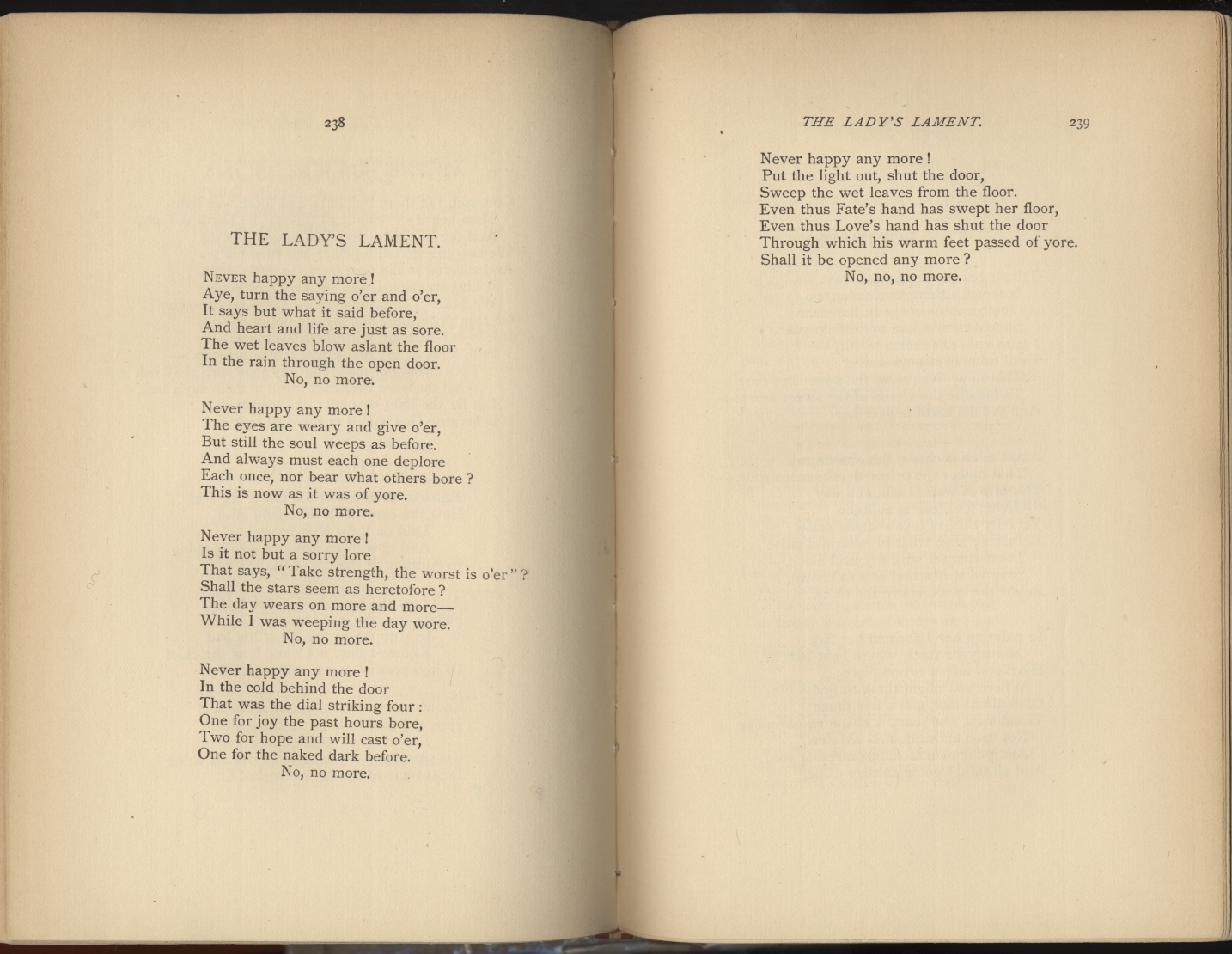
- Never happy any more!
- Aye, turn the saying o'er and o'er,
- It says but what it said before,
- And heart and life are just as sore.
- The wet leaves blow aslant the floor
- In the rain through the open door.
- No, no more.
- Never happy any more!
- The eyes are weary and give o'er,
- 10 But still the soul weeps as before.
- And always must each one deplore
- Each once, nor bear what others bore?
- This is now as it was of yore.
- No, no more.
- Never happy any more!
- Is it not but a sorry lore
- That says, “Take strength, the worst is o'er”?
- Shall the stars seem as heretofore?
- The day wears on more and more—
- 20 While I was weeping the day wore.
- No, no more.
- Never happy any more!
- In the cold behind the door
- That was the dial striking four:
- One for joy the past hours bore,
- Two for hope and will cast o'er,
- One for the naked dark before.
- No, no more.
- Never happy any more!
- Put the light out, shut the door,
- 30 Sweep the wet leaves from the floor.
- Even thus Fate's hand has swept her floor,
- Even thus Love's hand has shut the door
- Through which his warm feet passed of yore.
- Shall it be opened any more?
- No, no, no more.

- This is her picture as she was:
- It seems a thing to wonder on,
- As though mine image in the glass
- Should tarry when myself am gone.
- I gaze until she seems to stir,—
- Until mine eyes almost aver
- That now, even now, the sweet lips part
- To breathe the words of the sweet heart:—
- And yet the earth is over her.
- 10 Alas! even such the thin-drawn ray
- That makes the prison-depths more rude,—
- The drip of water night and day
- Giving a tongue to solitude.
- Yet only this, of love's whole prize,
- Remains; save what in mournful guise
- Takes counsel with my soul alone,—
- Save what is secret and unknown,
- Below the earth, above the skies.
- In painting her I shrined her face
- 20 'Mid mystic trees, where light falls in
- Hardly at all; a covert place
- Where you might think to find a din
- Of doubtful talk, and a live flame
- Wandering, and many a shape whose name
- Not itself knoweth, and old dew,
- And your own footsteps meeting you,
- And all things going as they came.
- A deep dim wood; and there she stands
- As in that wood that day: for so
- 30 Was the still movement of her hands
- And such the pure line's gracious flow.
- And passing fair the type must seem,
- Unknown the presence and the dream.
- 'Tis she: though of herself, alas!
- Less than her shadow on the grass
- Or than her image in the stream.
- That day we met there, I and she
- One with the other all alone;
- And we were blithe; yet memory
- 40 Saddens those hours, as when the moon
- Looks upon daylight. And with her
- I stooped to drink the spring-water,
- Athirst where other waters sprang:
- And where the echo is, she sang,—
- My soul another echo there.
- But when that hour my soul won strength
- For words whose silence wastes and kills,
- Dull raindrops smote us, and at length
- Thundered the heat within the hills.
- 50 That eve I spoke those words again
- Beside the pelted window-pane;
- And there she hearkened what I said,
- With under-glances that surveyed
- The empty pastures blind with rain.
- Next day the memories of these things,
- Like leaves through which a bird has flown,
- Still vibrated with Love's warm wings;
- Till I must make them all my own
- And paint this picture. So, 'twixt ease
- 60 Of talk and sweet long silences,
- She stood among the plants in bloom
- At windows of a summer room,
- To feign the shadow of the trees.
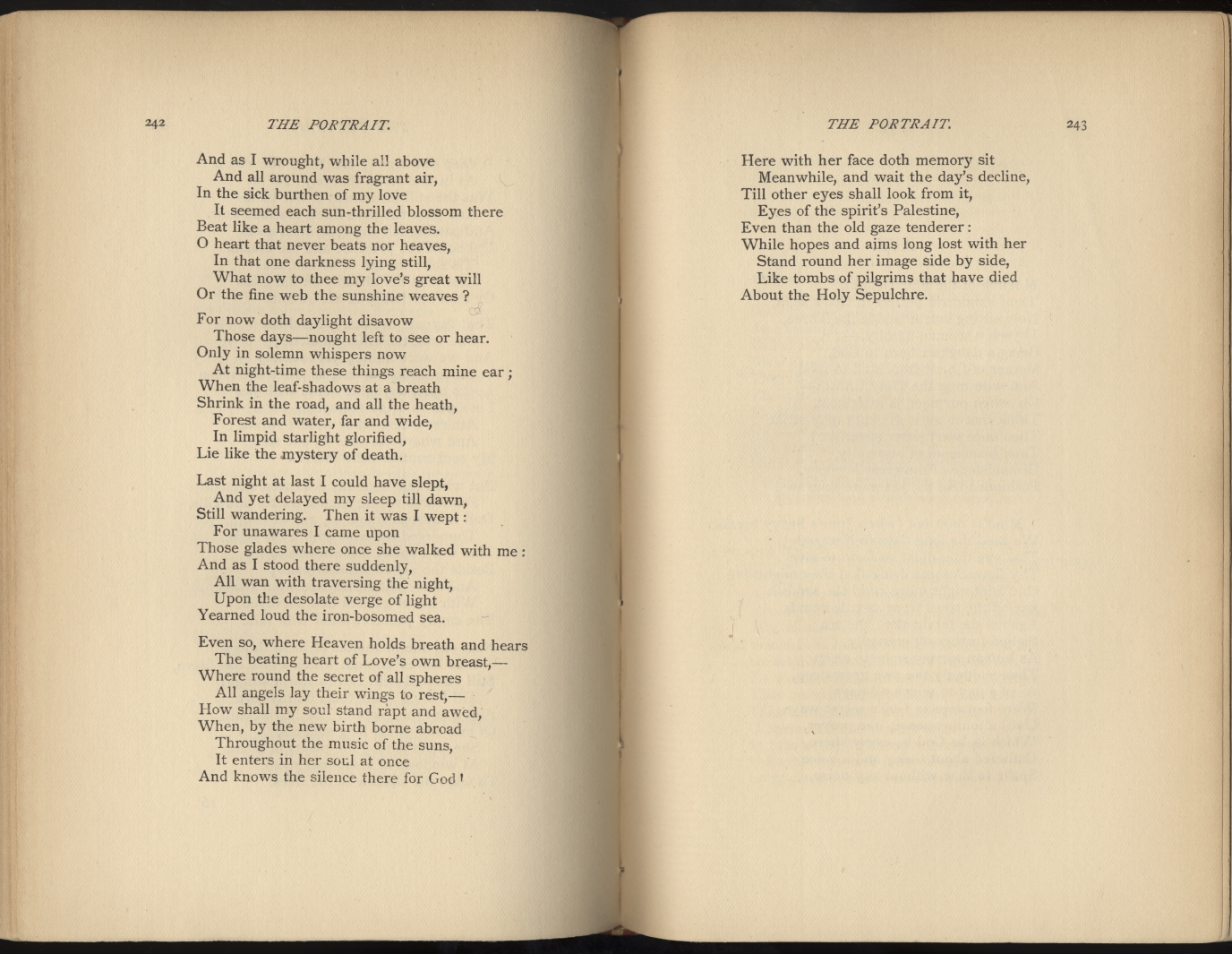
- And as I wrought, while all above
- And all around was fragrant air,
- In the sick burthen of my love
- It seemed each sun-thrilled blossom there
- Beat like a heart among the leaves.
- O heart that never beats nor heaves,
- 70 In that one darkness lying still,
- What now to thee my love's great will
- Or the fine web the sunshine weaves?
- For now doth daylight disavow
- Those days—nought left to see or hear.
- Only in solemn whispers now
- At night-time these things reach mine ear;
- When the leaf-shadows at a breath
- Shrink in the road, and all the heath,
- Forest and water, far and wide,
- 80 In limpid starlight glorified,
- Lie like the mystery of death.
- Last night at last I could have slept,
- And yet delayed my sleep till dawn,
- Still wandering. Then it was I wept:
- For unawares I came upon
- Those glades where once she walked with me:
- And as I stood there suddenly,
- All wan with traversing the night,
- Upon the desolate verge of light
- 90 Yearned loud the iron-bosomed sea.
- Even so, where Heaven holds breath and hears
- The beating heart of Love's own breast,—
- Where round the secret of all spheres
- All angels lay their wings to rest,—
- How shall my soul stand rapt and awed,
- When, by the new birth borne abroad
- Throughout the music of the suns,
- It enters in her soul at once
- And knows the silence there for God!
- 100 Here with her face doth memory sit
- Meanwhile, and wait the day's decline,
- Till other eyes shall look from it,
- Eyes of the spirit's Palestine,
- Even than the old gaze tenderer:
- While hopes and aims long lost with her
- Stand round her image side by side,
- Like tombs of pilgrims that have died
- About the Holy Sepulchre.
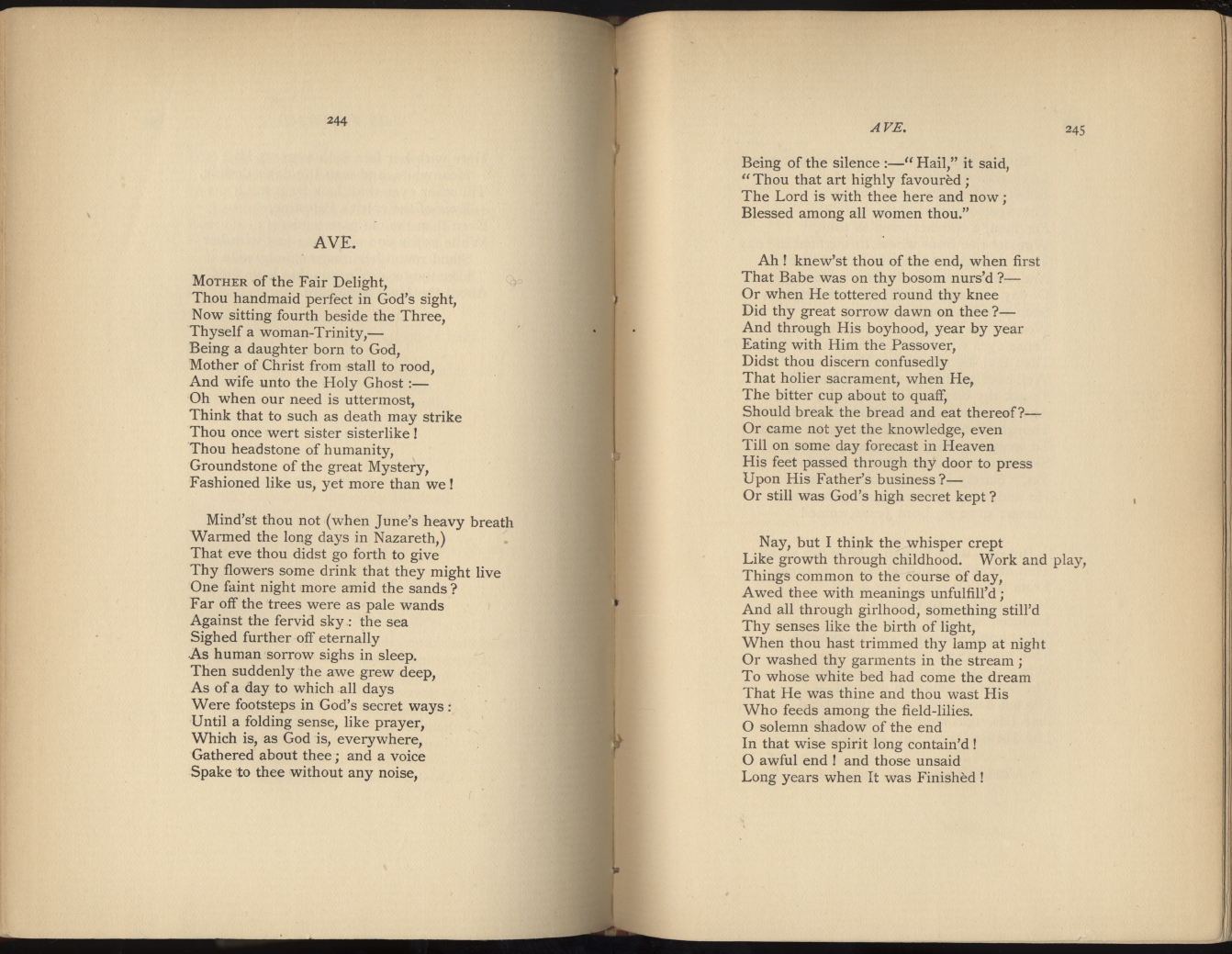
- Mother of the Fair Delight,
- Thou handmaid perfect in God's sight,
- Now sitting fourth beside the Three,
- Thyself a woman-Trinity,—
- Being a daughter born to God,
- Mother of Christ from stall to rood,
- And wife unto the Holy Ghost:—
- Oh when our need is uttermost,
- Think that to such as death may strike
- 10 Thou once wert sister sisterlike!
- Thou headstone of humanity,
- Groundstone of the great Mystery,
- Fashioned like us, yet more than we!
- Mind'st thou not (when June's heavy breath
- Warmed the long days in Nazareth,)
- That eve thou didst go forth to give
- Thy flowers some drink that they might live
- One faint night more amid the sands?
- Far off the trees were as pale wands
- 20 Against the fervid sky: the sea
- Sighed further off eternally
- As human sorrow sighs in sleep.
- Then suddenly the awe grew deep,
- As of a day to which all days
- Were footsteps in God's secret ways:
- Until a folding sense, like prayer,
- Which is, as God is, everywhere,
- Gathered about thee; and a voice
- Spake to thee without any noise,
- 30 Being of the silence:—“Hail,” it said,
- “Thou that art highly favourèd;
- The Lord is with thee here and now;
- Blessed among all women thou.”
- Ah! knew'st thou of the end, when first
- That Babe was on thy bosom nurs'd?—
- Or when He tottered round thy knee
- Did thy great sorrow dawn on thee?—
- And through His boyhood, year by year
- Eating with Him the Passover,
- 40 Didst thou discern confusedly
- That holier sacrament, when He,
- The bitter cup about to quaff,
- Should break the bread and eat thereof?—
- Or came not yet the knowledge, even
- Till on some day forecast in Heaven
- His feet passed through thy door to press
- Upon His Father's business?—
- Or still was God's high secret kept?
- Nay, but I think the whisper crept
- 50 Like growth through childhood. Work and play,
- Things common to the course of day,
- Awed thee with meanings unfulfill'd;
- And all through girlhood, something still'd
- Thy senses like the birth of light,
- When thou hast trimmed thy lamp at night
- Or washed thy garments in the stream;
- To whose white bed had come the dream
- That He was thine and thou wast His
- Who feeds among the field-lilies.
- 60 O solemn shadow of the end
- In that wise spirit long contain'd!
- O awful end! and those unsaid
- Long years when It was Finishèd!
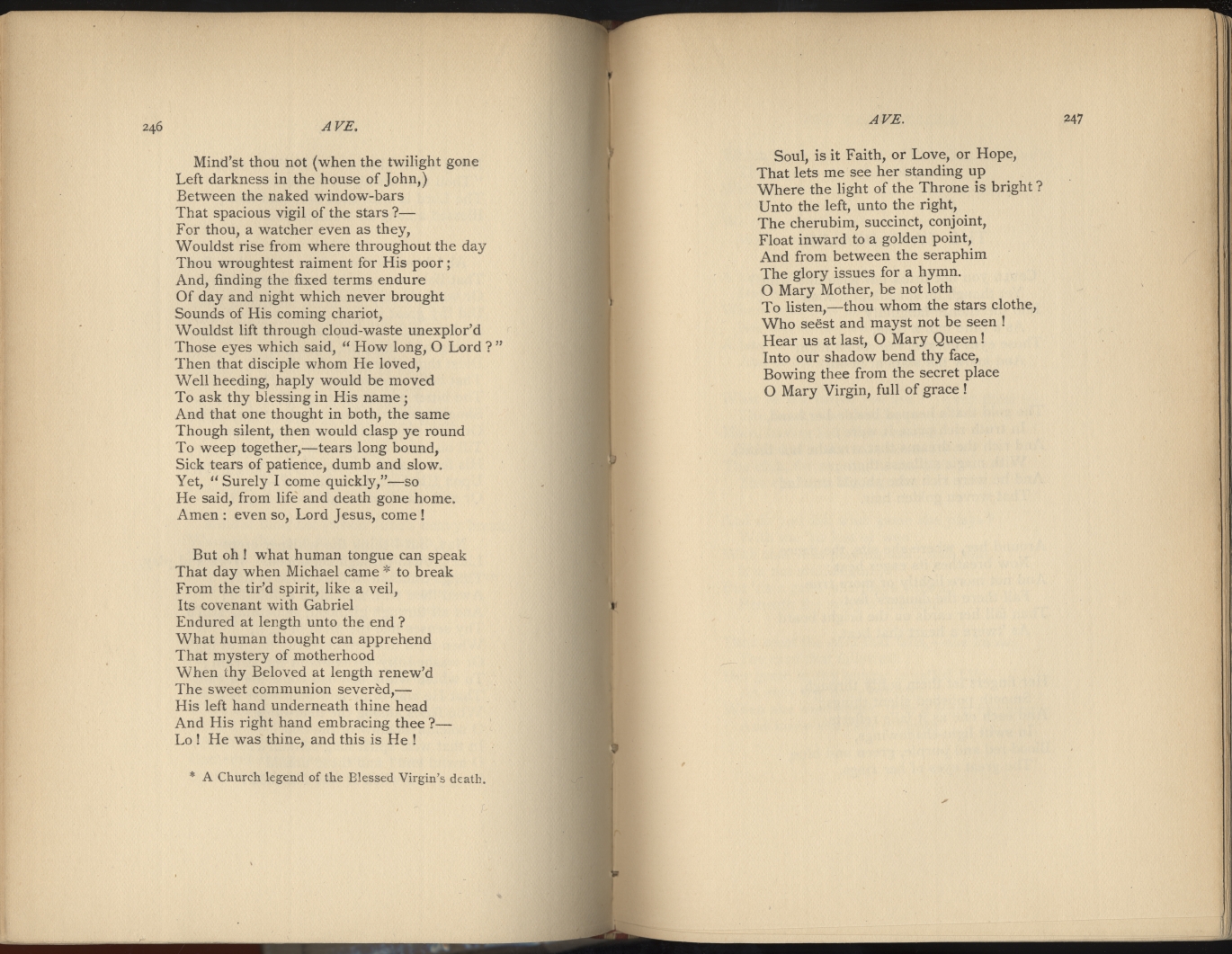
- Mind'st thou not (when the twilight gone
- Left darkness in the house of John,)
- Between the naked window-bars
- That spacious vigil of the stars?—
- For thou, a watcher even as they,
- Wouldst rise from where throughout the day
- 70 Thou wroughtest raiment for His poor;
- And, finding the fixed terms endure
- Of day and night which never brought
- Sounds of His coming chariot,
- Wouldst lift through cloud-waste unexplor'd
- Those eyes which said, “How long, O Lord?”
- Then that disciple whom He loved,
- Well heeding, haply would be moved
- To ask thy blessing in His name;
- And that one thought in both, the same
- 80 Though silent, then would clasp ye round
- To weep together,—tears long bound,
- Sick tears of patience, dumb and slow.
- Yet, “Surely I come quickly,”—so
- He said, from life and death gone home.
- Amen: even so, Lord Jesus, come!
- But oh! what human tongue can speak
- That day when Michael came* to break
- From the tir'd spirit, like a veil,
- Its covenant with Gabriel
- 90 Endured at length unto the end?
- What human thought can apprehend
- That mystery of motherhood
- When thy Beloved at length renew'd
- The sweet communion severèd,—
- His left hand underneath thine head
- And His right hand embracing thee?—
- Lo! He was thine, and this is He!
* A Church legend of the Blessed Virgin's death.
- Soul, is it Faith, or Love, or Hope,
- That lets me see her standing up
- 100 Where the light of the Throne is bright?
- Unto the left, unto the right,
- The cherubim, succinct, conjoint,
- Float inward to a golden point,
- And from between the seraphim
- The glory issues for a hymn.
- O Mary Mother, be not loth
- To listen,—thou whom the stars clothe,
- Who seëst and mayst not be seen!
- Hear us at last, O Mary Queen!
- 110 Into our shadow bend thy face,
- Bowing thee from the secret place,
- O Mary Virgin, full of grace!

- Could you not drink her gaze like wine?
- Yet though its splendour swoon
- Into the silence languidly
- As a tune into a tune,
- Those eyes unravel the coiled night
- And know the stars at noon.
- The gold that's heaped beside her hand,
- In truth rich prize it were;
- And rich the dreams that wreathe her brows
- 10 With magic stillness there;
- And he were rich who should unwind
- That woven golden hair.
- Around her, where she sits, the dance
- Now breathes its eager heat;
- And not more lightly or more true
- Fall there the dancers' feet
- Than fall her cards on the bright board
- As 'twere an heart that beat.
- Her fingers let them softly through,
- 20 Smooth polished silent things;
- And each one as it falls reflects
- In swift light-shadowings,
- Blood-red and purple, green and blue,
- The great eyes of her rings.
- Whom plays she with? With thee, who lov'st
- Those gems upon her hand;
- With me, who search her secret brows;
- With all men, bless'd or bann'd.
- We play together, she and we,
- 30 Within a vain strange land:
- A land without any order,—
- Day even as night, (one saith,)—
- Where who lieth down ariseth not
- Nor the sleeper awakeneth;
- A land of darkness as darkness itself
- And of the shadow of death.
- What be her cards, you ask? Even these:—
- The heart, that doth but crave
- More, having fed; the diamond,
- 40 Skilled to make base seem brave;
- The club, for smiting in the dark;
- The spade, to dig a grave.
- And do you ask what game she plays?
- With me 'tis lost or won;
- With thee it is playing still; with him
- It is not well begun;
- But 'tis a game she plays with all
- Beneath the sway o' the sun.
- Thou seest the card that falls,—she knows
- 50 The card that followeth:
- Her game in thy tongue is called Life,
- As ebbs thy daily breath:
- When she shall speak, thou'lt learn her tongue
- And know she calls it Death.
- 'Tis of the Father Hilary.
- He strove, but could not pray; so took
- The steep-coiled stair, where his feet shook
- A sad blind echo. Ever up
- He toiled. 'Twas a sick sway of air
- That autumn noon within the stair,
- As dizzy as a turning cup.
- His brain benumbed him, void and thin;
- He shut his eyes and felt it spin;
- 10 The obscure deafness hemmed him in.
- He said: “O world, what world for me?”
- He leaned unto the balcony
- Where the chime keeps the night and day;
- It hurt his brain, he could not pray.
- He had his face upon the stone:
- Deep 'twixt the narrow shafts, his eye
- Passed all the roofs to the stark sky,
- Swept with no wing, with wind alone.
- Close to his feet the sky did shake
- 20 With wind in pools that the rains make:
- The ripple set his eyes to ache.
- He said: “O world, what world for me?”
- He stood within the mystery
- Girding God's blessed Eucharist:
- The organ and the chaunt had ceas'd.
- The last words paused against his ear
- Said from the altar: drawn round him
- The gathering rest was dumb and dim.
- And now the sacring-bell rang clear
- 30 And ceased; and all was awe,—the breath
- Of God in man that warranteth
- The inmost utmost things of faith.
- He said: “O God, my world in Thee!”
- Not that the earth is changing, O my God!
- Nor that the seasons totter in their walk,—
- Not that the virulent ill of act and talk
- Seethes ever as a winepress ever trod,—
- Not therefore are we certain that the rod
- Weighs in thine hand to smite thy world; though now
- Beneath thine hand so many nations bow,
- So many kings:—not therefore, O my God!—
- But because Man is parcelled out in men
- 10 To-day; because, for any wrongful blow,
- No man not stricken asks, “I would be told
- Why thou dost thus;” but his heart whispers then,
- “He is he, I am I.” By this we know
- That our earth falls asunder, being old.
- As he that loves oft looks on the dear form
- And guesses how it grew to womanhood,
- And gladly would have watched the beauties bud
- And the mild fire of precious life wax warm:
- So I, long bound within the threefold charm
- Of Dante's love sublimed to heavenly mood,
- Had marvelled, touching his Beatitude,
- How grew such presence from man's shameful swarm.
- At length within this book I found pourtrayed
- 10 Newborn that Paradisal Love of his,
- And simple like a child; with whose clear aid
- I understood. To such a child as this,
- Christ, charging well His chosen ones, forbade
- Offence: “for lo! of such my kingdom is.”
- O leave your hand where it lies cool
- Upon the eyes whose lids are hot:
- Its rosy shade is bountiful
- Of silence, and assuages thought.
- O lay your lips against your hand
- And let me feel your breath through it,
- While through the sense your song shall fit
- The soul to understand.
- The music lives upon my brain
- 10 Between your hands within mine eyes;
- It stirs your lifted throat like pain,
- An aching pulse of melodies.
- Lean nearer, let the music pause:
- The soul may better understand
- Your music, shadowed in your hand,
- Now while the song withdraws.

- Consider the sea's listless chime:
- Time's self it is, made audible,—
- The murmur of the earth's own shell.
- Secret continuance sublime
- Is the sea's end: our sight may pass
- No furlong further. Since time was,
- This sound hath told the lapse of time.
- No quiet, which is death's,—it hath
- The mournfulness of ancient life,
- 10 Enduring always at dull strife.
- As the world's heart of rest and wrath,
- Its painful pulse is in the sands.
- Last utterly, the whole sky stands,
- Grey and not known, along its path.
- Listen alone beside the sea,
- Listen alone among the woods;
- Those voices of twin solitudes
- Shall have one sound alike to thee:
- Hark where the murmurs of thronged men
- 20 Surge and sink back and surge again,—
- Still the one voice of wave and tree.
- Gather a shell from the strown beach
- And listen at its lips: they sigh
- The same desire and mystery,
- The echo of the whole sea's speech.
- And all mankind is thus at heart
- Not anything but what thou art:
- And Earth, Sea, Man, are all in each.
- A constant keeping-past of shaken trees,
- And a bewildered glitter of loose road;
- Banks of bright growth, with single blades atop
- Against white sky: and wires—a constant chain—
- That seem to draw the clouds along with them
- (Things which one stoops against the light to see
- Through the low window; shaking by at rest,
- Or fierce like water as the swiftness grows);
- And, seen through fences or a bridge far off,
- 10Trees that in moving keep their intervals
- Still one 'twixt bar and bar; and then at times
- Long reaches of green level, where one cow,
- Feeding among her fellows that feed on,
- Lifts her slow neck, and gazes for the sound.
- Fields mown in ridges; and close garden-crops
- Of the earth's increase; and a constant sky
- Still with clear trees that let you see the wind;
- And snatches of the engine-smoke, by fits
- Tossed to the wind against the landscape, where
- 20Rooks stooping heave their wings upon the day.
- Brick walls we pass between, passed so at once
- That for the suddenness I cannot know
- Or what, or where begun, or where at end.
- Sometimes a station in grey quiet; whence,
- With a short gathered champing of pent sound,
- We are let out upon the air again.
- Pauses of water soon, at intervals,
- That has the sky in it;—the reflexes
- O' the trees move towards the bank as we go by,
- 30Leaving the water's surface plain. I now
- Lie back and close my eyes a space; for they
- Smart from the open forwardness of thought
- Fronting the wind
- I did not scribble more,
- Be certain, after this; but yawned, and read,
- And nearly dozed a little, I believe;
- Till, stretching up against the carriage-back,
- I was roused altogether, and looked out
- To where the pale sea brooded murmuring.
- Strong extreme speed, that the brain hurries with,
- Further than trees, and hedges, and green grass
- Whitened by distance,—further than small pools
- Held among fields and gardens, further than
- Haystacks, and wind-mill-sails, and roofs and herds,—
- The sea's last margin ceases at the sun.
- The sea has left us, but the sun remains.
- Sometimes the country spreads aloof in tracts
- Smooth from the harvest; sometimes sky and land
- 10Are shut from the square space the window leaves
- By a dense crowd of trees, stem behind stem
- Passing across each other as we pass:
- Sometimes tall poplar-wands stand white, their heads
- Outmeasuring the distant hills. Sometimes
- The ground has a deep greenness; sometimes brown
- In stubble; and sometimes no ground at all,
- For the close strength of crops that stand unreaped.
- The water-plots are sometimes all the sun's,—
- Sometimes quite green through shadows filling them,
- 20Or islanded with growths of reeds,—or else
- Masked in grey dust like the wide face o' the fields.
- And still the swiftness lasts; that to our speed
- The trees seem shaken like a press of spears.
- There is some count of us:—folks travelling capped,
- Priesthood, and lank hard-featured soldiery,
- Females (no women), blouses, Hunt, and I.
- We are delayed at Amiens. The steam
- Snorts, chafes, and bridles, like three hundred horse,
- And flings its dusky mane upon the air.
- 30Our company is thinned, and lamps alight.
- But still there are the folks in travelling-caps,
- No priesthood now, but always soldiery,
- And babies to make up for show in noise;
- Females (no women), blouses, Hunt, and I.
- Our windows at one side are shut for warmth;
- Upon the other side, a leaden sky,
- Hung in blank glare, makes all the country dim,
- Which too seems bald and meagre,—be it truth,
- Or of the waxing darkness. Here and there
- 40The shade takes light, where in thin patches stand
- The unstirred dregs of water.
- In France, (to baffle thieves and murderers)
- A journey takes two days of passport work
- At least. The plan's sometimes a tedious one,
- But bears its fruit. Because, the other day,
- In passing by the Morgue, we saw a man
- (The thing is common, and we never should
- Have known of it, only we passed that way)
- Who had been stabbed and tumbled in the Seine,
- Where he had stayed some days. The face was black,
- 10And, like a negro's, swollen; all the flesh
- Had furred, and broken into a green mould.
- Now, very likely, he who did the job
- Was standing among those who stood with us,
- To look upon the corpse. You fancy him—
- Smoking an early pipe, and watching, as
- An artist, the effect of his last work.
- This always if it had not struck him that
- 'Twere best to leave while yet the body took
- Its crust of rot beneath the Seine. It may:
- 20But, if it did not, he can now remain
- Without much fear. Only, if he should want
- To travel, and have not his passport yet,
- (Deep dogs these French police!) he may be caught.
- Therefore you see (lest, being murderers,
- We should not have the sense to go before
- The thing were known, or to stay afterwards)
- There is good reason why—having resolved
- To start for Belgium—we were kept three days
- To learn about the passports first, then do
- 30As we had learned. This notwithstanding, in
- The fulness of the time 'tis come to pass.
- There is a small change of country; but the sun
- Is out, and it seems shame this were not said.
- For upon all the grass the warmth has caught;
- And betwixt distant whitened poplar-stems
- Makes greener darkness; and in dells of trees
- Shows spaces of a verdure that was hid;
- And the sky has its blue floated with white,
- And crossed with falls of the sun's glory aslant
- To lay upon the waters of the world;
- 10And from the road men stand with shaded eyes
- To look; and flowers in gardens have grown strong;
- And our own shadows here within the coach
- Are brighter; and all colour has more bloom.
- So, after the sore torments of the route;—
- Toothache, and headache, and the ache of wind,
- And huddled sleep, and smarting wakefulness,
- And night, and day, and hunger sick at food,
- And twenty-fold relays, and packages
- To be unlocked, and passports to be found,
- 20And heavy well-kept landscape;—we were glad
- Because we entered Brussels in the sun.
- We are upon the Scheldt. We know we move
- Because there is a floating at our eyes
- Whatso they seek; and because all the things
- Which on our outset were distinct and large
- Are smaller and much weaker and quite grey,
- And at last gone from us. No motion else.
- We are upon the road. The thin swift moon
- Runs with the running clouds that are the sky,
- And with the running water runs—at whiles
- 10Weak 'neath the film and heavy growth of reeds.
- The country swims with motion. Time itself
- Is consciously beside us, and perceived.
- Our speed is such the sparks our engine leaves
- Are burning after the whole train has passed.
- The darkness is a tumult. We tear on,
- The roll behind us and the cry before,
- Constantly, in a lull of intense speed
- And thunder. Any other sound is known
- Merely by sight. The shrubs, the trees your eye
- 20Scans for their growth, are far along in haze.
- The sky has lost its clouds, and lies away
- Oppressively at calm: the moon has failed:
- Our speed has set the wind against us. Now
- Our engine's heat is fiercer, and flings up
- Great glares alongside. Wind and steam and speed
- And clamour and the night. We are in Ghent.
- As one who, groping in a narrow stair,
- Hath a strong sound of bells upon his ears,
- Which, being at a distance off, appears
- Quite close to him because of the pent air:
- So with this France. She stumbles file and square
- Darkling and without space for breath: each one
- Who hears the thunder says: “It shall anon
- Be in among her ranks to scatter her.”
- This may be; and it may be that the storm
- 10 Is spent in rain upon the unscathed seas,
- Or wasteth other countries ere it die:
- Till she,—having climbed always through the swarm
- Of darkness and of hurtling sound,—from these
- Shall step forth on the light in a still sky.
- How dear the sky has been above this place!
- Small treasures of this sky that we see here
- Seen weak through prison-bars from year to year;
- Eyed with a painful prayer upon God's grace
- To save, and tears that stayed along the face
- Lifted at sunset. Yea, how passing dear,
- Those nights when through the bars a wind left
- clear
- The heaven, and moonlight soothed the limpid space!
- So was it, till one night the secret kept
- 10 Safe in low vault and stealthy corridor
- Was blown abroad on gospel-tongues of flame.
- O ways of God, mysterious evermore!
- How many on this spot have cursed and wept
- That all might stand here now and own Thy
- Name.
- The turn of noontide has begun.
- In the weak breeze the sunshine yields.
- There is a bell upon the fields.
- On the long hedgerow's tangled run
- A low white cottage intervenes:
- Against the wall a blind man leans,
- And sways his face to have the sun.
- Our horses' hoofs stir in the road,
- Quiet and sharp. Light hath a song
- 10 Whose silence, being heard, seems long.
- The point of noon maketh abode,
- And will not be at once gone through.
- The sky's deep colour saddens you,
- And the heat weighs a dreamy load.
- I climbed the stair in Antwerp church,
- What time the circling thews of sound
- At sunset seem to heave it round.
- Far up, the carillon did search
- The wind, and the birds came to perch
- Far under, where the gables wound.
- In Antwerp harbour on the Scheldt
- I stood along, a certain space
- Of night. The mist was near my face;
- 10Deep on, the flow was heard and felt.
- The carillon kept pause, and dwelt
- In music through the silent place.
- John Memmeling and John van Eyck
- Hold state at Bruges. In sore shame
- I scanned the works that keep their name.
- The carillon, which then did strike
- Mine ears, was heard of theirs alike:
- It set me closer unto them.
- I climbed at Bruges all the flight
- 20 The belfry has of ancient stone.
- For leagues I saw the east wind blown;
- The earth was grey, the sky was white.
- I stood so near upon the height
- That my flesh felt the carillon.
- The city's steeple-towers remove away,
- Each singly; as each vain infatuate Faith
- Leaves God in heaven, and passes. A mere breath
- Each soon appears, so far. Yet that which lay
- The first is now scarce further or more grey
- Than the last is. Now all are wholly gone.
- The sunless sky has not once had the sun
- Since the first weak beginning of the day.
- The air falls back as the wind finishes,
- 10 And the clouds stagnate. On the water's face
- The current breathes along, but is not stirred.
- There is no branch that thrills with any bird.
- Winter is to possess the earth a space,
- And have its will upon the extreme seas.
I saw under the altar the souls of them that were slain for
the
word of God, and for the testimony which they held; and
they
cried with a loud voice, saying, How long, O Lord, holy
and
true, dost Thou not judge and avenge our blood on them
that
dwell on the earth?—Rev. vi.
9, 10.
- Not 'neath the altar only,—yet, in sooth,
- There more than elsewhere,—is the cry, “How long?”
- The right sown there hath still borne fruit in wrong—
- The wrong waxed fourfold. Thence, (in hate of truth)
- O'er weapons blessed for carnage, to fierce youth
- From evil age, the word hath hissed along:—
- “Ye are the Lord's: go forth, destroy, be strong:
- Christ's Church absolves ye from Christ's law of ruth.”
- Therefore the wine-cup at the altar is
- 10 As Christ's own blood indeed, and as the blood
- Of Christ's elect, at divers seasons spilt
- On the altar-stone, that to man's church, for this,
- Shall prove a stone of stumbling,—whence it stood
- To be rent up ere the true Church be built.
- In our Museum galleries
- To-day I lingered o'er the prize
- Dead Greece vouchsafes to living eyes,—
- Her Art for ever in fresh wise
- From hour to hour rejoicing me.
- Sighing I turned at last to win
- Once more the London dirt and din;
- And as I made the swing-door spin
- And issued, they were hoisting in
- 10 A wingèd beast from Nineveh.
- A human face the creature wore,
- And hoofs behind and hoofs before,
- And flanks with dark runes fretted o'er.
- 'Twas bull, 'twas mitred Minotaur,
- A dead disbowelled mystery:
- The mummy of a buried faith
- Stark from the charnel without scathe,
- Its wings stood for the light to bathe,—
- Such fossil cerements as might swathe
- 20 The very corpse of Nineveh.
- The print of its first rush-wrapping,
- Wound ere it dried, still ribbed the thing.
- What song did the brown maidens sing,
- From purple mouths alternating,
- When that was woven languidly?
- What vows, what rites, what prayers preferr'd,
- What songs has the strange image heard?
- In what blind vigil stood interr'd
- For ages, till an English word
- 30 Broke silence first at Nineveh?
- Oh when upon each sculptured court,
- Where even the wind might not resort,—
- O'er which Time passed, of like import
- With the wild Arab boys at sport,—
- A living face looked in to see:—
- O seemed it not—the spell once broke—
- As though the carven warriors woke,
- As though the shaft the string forsook,
- The cymbals clashed, the chariots shook,
- 40 And there was life in Nineveh?
- On London stones our sun anew
- The beast's recovered shadow threw.
- (No shade that plague of darkness knew,
- No light, no shade, while older grew
- By ages the old earth and sea.)
- Lo thou! could all thy priests have shown
- Such proof to make thy godhead known?
- From their dead Past thou liv'st alone;
- And still thy shadow is thine own,
- 50 Even as of yore in Nineveh.
- That day whereof we keep record,
- When near thy city-gates the Lord
- Sheltered His Jonah with a gourd,
- This sun, (I said) here present, pour'd
- Even thus this shadow that I see.
- This shadow has been shed the same
- From sun and moon,—from lamps which came
- For prayer,—from fifteen days of flame,
- The last, while smouldered to a name
- 60 Sardanapalus' Nineveh.
- Within thy shadow, haply, once
- Sennacherib has knelt, whose sons
- Smote him between the altar-stones:
- Or pale Semiramis her zones
- Of gold, her incense brought to thee,
- In love for grace, in war for aid: . . . .
- Ay, and who else? . . . . till 'neath thy shade
- Within his trenches newly made
- Last year the Christian knelt and pray'd—
- 70 Not to thy strength—in Nineveh.*
- Now, thou poor god, within this hall
- Where the blank windows blind the wall
- From pedestal to pedestal,
- The kind of light shall on thee fall
- Which London takes the day to be:
- While school-foundations in the act
- Of holiday, three files compact,
- Shall learn to view thee as a fact
- Connected with that zealous tract:
- 80 “Rome,—Babylon and Nineveh.”
- Deemed they of this, those worshipers,
- When, in some mythic chain of verse
- Which man shall not again rehearse,
- The faces of thy ministers
- Yearned pale with bitter ecstasy?
- Greece, Egypt, Rome,—did any god
- Before whose feet men knelt unshod
- Deem that in this unblest abode
- Another scarce more unknown god
- 90 Should house with him, from Nineveh?
- Ah! in what quarries lay the stone
- From which this pillared pile has grown,
- Unto man's need how long unknown,
- Since those thy temples, court and cone,
- Rose far in desert history?
- Ah! what is here that does not lie
- All strange to thine awakened eye?
- Ah! what is here can testify
- (Save that dumb presence of the sky)
- 100 Unto thy day and Nineveh?
* During the excavations, the Tiyari workmen held their
services
in the shadow of the great bulls.—(
Layard's “Nineveh,” ch. ix.)
- Why, of those mummies in the room
- Above, there might indeed have come
- One out of Egypt to thy home,
- An alien. Nay, but were not some
- Of these thine own “antiquity”?
- And now,—they and their gods and thou
- All relics here together,—now
- Whose profit? whether bull or cow,
- Isis or Ibis, who or how,
- 110 Whether of Thebes or Nineveh?
- The consecrated metals found,
- And ivory tablets, underground,
- Winged teraphim and creatures crown'd,
- When air and daylight filled the mound,
- Fell into dust immediately.
- And even as these, the images
- Of awe and worship,—even as these,—
- So, smitten with the sun's increase,
- Her glory mouldered and did cease
- 120 From immemorial Nineveh.
- The day her builders made their halt,
- Those cities of the lake of salt
- Stood firmly 'stablished without fault,
- Made proud with pillars of basalt,
- With sardonyx and porphyry.
- The day that Jonah bore abroad
- To Nineveh the voice of God,
- A brackish lake lay in his road,
- Where erst Pride fixed her sure abode,
- 130 As then in royal Nineveh.
- The day when he, Pride's lord and Man's,
- Showed all the kingdoms at a glance
- To Him before whose countenance
- The years recede, the years advance,
- And said, Fall down and worship me:—
- 'Mid all the pomp beneath that look,
- Then stirred there, haply, some rebuke,
- Where to the wind the Salt Pools shook,
- And in those tracts, of life forsook,
- 140 That knew thee not, O Nineveh!
- Delicate harlot! On thy throne
- Thou with a world beneath thee prone
- In state for ages sat'st alone;
- And needs were years and lustres flown
- Ere strength of man could vanquish thee:
- Whom even thy victor foes must bring,
- Still royal, among maids that sing
- As with doves' voices, taboring
- Upon their breasts, unto the King,—
- 150 A kingly conquest, Nineveh!
- . . . Here woke my thought. The wind's slow sway
- Had waxed; and like the human play
- Of scorn that smiling spreads away,
- The sunshine shivered off the day:
- The callous wind, it seemed to me,
- Swept up the shadow from the ground:
- And pale as whom the Fates astound,
- The god forlorn stood winged and crown'd:
- Within I knew the cry lay bound
- 160 Of the dumb soul of Nineveh.
- And as I turned, my sense half shut
- Still saw the crowds of kerb and rut
- Go past as marshalled to the strut
- Of ranks in gypsum quaintly cut.
- It seemed in one same pageantry
- They followed forms which had been erst;
- To pass, till on my sight should burst
- That future of the best or worst
- When some may question which was first,
- 170 Of London or of Nineveh.
- For as that Bull-god once did stand
- And watched the burial-clouds of sand,
- Till these at last without a hand
- Rose o'er his eyes, another land,
- And blinded him with destiny:—
- So may he stand again; till now,
- In ships of unknown sail and prow,
- Some tribe of the Australian plough
- Bear him afar,—a relic now
- 180 Of London, not of Nineveh!
- Or it may chance indeed that when
- Man's age is hoary among men,—
- His centuries threescore and ten,—
- His furthest childhood shall seem then
- More clear than later times may be:
- Who, finding in this desert place
- This form, shall hold us for some race
- That walked not in Christ's lowly ways,
- But bowed its pride and vowed its praise
- 190 Unto the God of Nineveh.
- The smile rose first,—anon drew nigh
- The thought: . . Those heavy wings spread high
- So sure of flight, which do not fly;
- That set gaze never on the sky;
- Those scriptured flanks it cannot see;
- Its crown, a brow-contracting load;
- Its planted feet which trust the sod: . . .
- (So grew the image as I trod:)
- O Nineveh, was this thy God,—
- 200 Thine also, mighty Nineveh?
- Sister, first shake we off the dust we have
- Upon our feet, lest it defile the stones
- Inscriptured, covering their sacred bones
- Who lie i' the aisles which keep the names they gave,
- Their trust abiding round them in the grave;
- Whom painters paint for visible orisons,
- And to whom sculptors pray in stone and bronze;
- Their voices echo still like a spent wave.
- Without here, the church-bells are but a tune,
- 10And on the carven church-door this hot noon
- Lays all its heavy sunshine here without:
- But having entered in, we shall find there
- Silence, and sudden dimness, and deep prayer,
- And faces of crowned angels all about.
- She knew it not:—most perfect pain
- To learn: this too she knew not. Strife
- For me, calm hers, as from the first.
- 'Twas but another bubble burst
- Upon the curdling draught of life,—
- My silent patience mine again.
- As who, of forms that crowd unknown
- Within a distant mirror's shade,
- Deems such an one himself, and makes
- 10 Some sign but when the image shakes
- No whit, he finds his thought betray'd,
- And must seek elsewhere for his own.
- These little firs to-day are things
- To clasp into a giant's cap,
- Or fans to suit his lady's lap.
- From many winters many springs
- Shall cherish them in strength and sap
- Till they be marked upon the map,
- A wood for the wind's wanderings.
- All seed is in the sower's hands:
- And what at first was trained to spread
- 10 Its shelter for some single head,—
- Yea, even such fellowship of wands,—
- May hide the sunset, and the shade
- Of its great multitude be laid
- Upon the earth and elder sands.
- O cool unto the sense of pain
- That last night's sleep could not destroy
- O warm unto the sense of joy,
- That dreams its life within the brain.
- What though I lean o'er thee to scan
- The written music cramped and stiff;—
- 'Tis dark to me, as hieroglyph
- On those weird bulks Egyptian.
- But as from those, dumb now and strange,
- 10 A glory wanders on the earth,
- Even so thy tones can call a birth
- From these, to shake my soul with change.
- O swift, as in melodious haste
- Float o'er the keys thy fingers small;
- O soft, as is the rise and fall
- Which stirs that shade within thy breast.
- “O have you seen the Stratton flood
- That's great with rain to-day?
- It runs beneath your wall, Lord Sands,
- Full of the new-mown hay.
- “I led your hounds to Hutton bank
- To bathe at early morn:
- They got their bath by Borrowbrake
- Above the standing corn.”
- Out from the castle-stair Lord Sands
- 10 Looked up the western lea;
- The rook was grieving on her nest,
- The flood was round her tree.
- Over the castle-wall Lord Sands
- Looked down the eastern hill:
- The stakes swam free among the boats,
- The flood was rising still.
- “What's yonder far below that lies
- So white against the slope?”
- “O it's a sail o' your bonny barks
- 20 The waters have washed up.”
- “But I have never a sail so white,
- And the water's not yet there.”
- “O it's the swans o' your bonny lake
- The rising flood doth scare.”
- “The swans they would not hold so still,
- So high they would not win.”
- “O it's Joyce my wife has spread her smock
- And fears to fetch it in.”
- “Nay, knave, it's neither sail nor swans,
- 30 Nor aught that you can say;
- For though your wife might leave her smock,
- Herself she'd bring away.”
- Lord Sands has passed the turret-stair,
- The court, and yard, and all;
- The kine were in the byre that day,
- The nags were in the stall.
- Lord Sands has won the weltering slope
- Whereon the white shape lay:
- The clouds were still above the hill,
- 40 And the shape was still as they.
- Oh pleasant is the gaze of life
- And sad is death's blind head;
- But awful are the living eyes
- In the face of one thought dead!
- “In God's name, Janet, is it me
- Thy ghost has come to seek?”
- “Nay, wait another hour, Lord Sands,—
- Be sure my ghost shall speak.”
- A moment stood he as a stone,
- 50 Then grovelled to his knee.
- “O Janet, O my love, my love,
- Rise up and come with me!”
- “O once before you bade me come,
- And it's here you have brought me!
- “O many's the sweet word, Lord Sands,
- You've spoken oft to me;
- But all that I have from you to-day
- Is the rain on my body.
- “And many's the good gift, Lord Sands,
- 60 You've promised oft to me;
- But the gift of yours I keep to-day
- Is the babe in my body.
- “O it's not in any earthly bed
- That first my babe I'll see;
- For I have brought my body here
- That the flood may cover me.”
- His face was close against her face,
- His hands of hers were fain:
- O her wet cheeks were hot with tears,
- 70 Her wet hands cold with rain.
- “They told me you were dead, Janet,—
- How could I guess the lie?”
- “They told me you were false, Lord Sands,—
- What could I do but die?”
- “Now keep you well, my brother Giles,—
- Through you I deemed her dead!
- As wan as your towers seem to-day,
- To-morrow they'll be red.
- “Look down, look down, my false mother,
- 80 That bade me not to grieve:
- You'll look up when our marriage fires
- Are lit to-morrow eve:
- “O more than one and more than two
- The sorrow of this shall see:
- But it's to-morrow, love, for them,—
- To-day's for thee and me.”
- He's drawn her face between his hands
- And her pale mouth to his:
- No bird that was so still that day
- 90 Chirps sweeter than his kiss.
- The flood was creeping round their feet.
- “O Janet, come away!
- The hall is warm for the marriage-rite,
- The bed for the birthday.”
- “Nay, but I hear your mother cry,
- ‘Go bring this bride to bed!
- And would she christen her babe unborn
- So wet she comes to wed?’
- “I'll be your wife to cross your door
- 100 And meet your mother's e'e.
- We plighted troth to wed i' the kirk,
- And it's there you'll wed with me.”
- He's ta'en her by the short girdle
- And by the dripping sleeve:
- “Go fetch Sir Jock my mother's priest,—
- You'll ask of him no leave.
- “O it's one half-hour to reach the kirk
- And one for the marriage-rite;
- And kirk and castle and castle-lands
- 110 Shall be our babe's to-night.”
- “The flood's in the kirkyard, Lord Sands,
- And round the belfry-stair.”
- “I bade you fetch the priest,” he said,
- “Myself shall bring him there.
- “It's for the lilt of wedding bells
- We'll have the hail to pour,
- And for the clink of bridle-reins
- The plashing of the oar.
- Beneath them on the nether hill
- 120 A boat was floating wide:
- Lord Sands swam out and caught the oars
- And rowed to the hill-side.
- He's wrapped her in a green mantle
- And set her softly in;
- Her hair was wet upon her face,
- Her face was grey and thin;
- And “Oh!” she said, “lie still, my babe,
- It's out you must not win!”
- But woe's my heart for Father John
- 130 As hard as he might pray,
- There seemed no help but Noah's ark
- Or Jonah's fish that day.
- The first strokes that the oars struck
- Were over the broad leas;
- The next strokes that the oars struck
- They pushed beneath the trees;
- The last stroke that the oars struck,
- The good boat's head was met,
- And there the gate of the kirkyard
- 140 Stood like a ferry-gate.
- He's set his hand upon the bar
- And lightly leaped within:
- He's lifted her to his left shoulder,
- Her knees beside his chin.
- The graves lay deep beneath the flood
- Under the rain alone;
- And when the foot-stone made him slip,
- He held by the head-stone.
- The empty boat thrawed i' the wind,
- 150 Against the postern tied.
- “Hold still, you've brought my love with me,
- You shall take back my bride.”
- But woe's my heart for Father John
- And the saints he clamoured to!
- There's never a saint but Christopher
- Might hale such buttocks through!
- And “Oh!” she said, “on men's shoulders
- I well had thought to wend,
- And well to travel with a priest,
- 160 But not to have cared or ken'd.
- “And oh!” she said, “it's well this way
- That I thought to have fared,—
- Not to have lighted at the kirk
- But stopped in the kirkyard.
- “For it's oh and oh I prayed to God,
- Whose rest I hoped to win,
- That when to-night at your board-head
- You'd bid the feast begin,
- This water past your window-sill
- 170 Might bear my body in.”
- Now make the white bed warm and soft
- And greet the merry morn.
- The night the mother should have died,
- The young son shall be born.
- “Victory!”
- So once more the cry must be.
- Duteous mourning we fulfil
- In God's name; but by God's will,
- Doubt not, the last word is still
- “Victory!”
- Funeral,
- In the music round this pall,
- Solemn grief yields earth to earth;
- 10 But what tones of solemn mirth
- In the pageant of new birth
- Rise and fall?
- For indeed,
- If our eyes were openèd,
- Who shall say what escort floats
- Here, which breath nor gleam denotes,—
- Fiery horses, chariots
- Fire-footed?
- Trumpeter,
- 20 Even thy call he may not hear;
- Long-known voice for ever past,
- Till with one more trumpet-blast
- God's assuring word at last
- Reach his ear.
- Multitude,
- Hold your breath in reverent mood:
- For while earth's whole kindred stand
- Mute even thus on either hand,
- This soul's labour shall be scann'd
- 30 And found good.
- Cherubim,
- Lift ye not even now your hymn?
- Lo! once lent for human lack,
- Michael's sword is rendered back.
- Thrills not now the starry track,
- Seraphim?
- Gabriel,
- Since the gift of thine “All hail!”
- Out of Heaven no time hath brought
- 40 Gift with fuller blessing fraught
- Than the peace which this man wrought
- Passing well.
- Be no word
- Raised of bloodshed Christ-abhorr'd.
- Say: “'Twas thus in His decrees
- Who Himself, the Prince of Peace,
- For His harvest's high increase
- Sent a sword.”
- Veterans,
- 50 He by whom the neck of France
- Then was given unto your heel,
- Timely sought, may lend as well
- To your sons his terrible
- Countenance.
- Waterloo!
- As the last grave must renew,
- Ere fresh death, the banshee-strain,—
- So methinks upon thy plain
- Falls some presage in the rain,
- 60 In the dew.
- And O thou,
- Watching with an exile's brow
- Unappeased, o'er death's dumb flood:—
- Lo! the saving strength of God
- In some new heart's English blood
- Slumbers now.
- Emperor,
- Is this all thy work was for?—
- Thus to see thy self-sought aim,
- 70 Yea thy titles, yea thy name,
- In another's shame, to shame
- Bandied o'er? *
- Wellington,
- Thy great work is but begun.
- With quick seed his end is rife
- Whose long tale of conquering strife
- Shows no triumph like his life
- Lost and won.
* Date of the Coup d' État: 2nd December 1851.
- I did not look upon her eyes,
- (Though scarcely seen, with no surprise,
- 'Mid many eyes a single look,)
- Because they should not gaze rebuke,
- At night, from stars in sky and brook.
- I did not take her by the hand,
- (Though little was to understand
- From touch of hand all friends might take,)
- Because it should not prove a flake
- 10 Burnt in my palm to boil and ache.
- I did not listen to her voice,
- (Though none had noted, where at choice
- All might rejoice in listening,)
- Because no such a thing should cling
- In the wood's moan at evening.
- I did not cross her shadow once,
- (Though from the hollow west the sun's
- Last shadow runs along so far,)
- Because in June it should not bar
- 20 My ways, at noon when fevers are.
- They told me she was sad that day,
- (Though wherefore tell what love's soothsay,
- Sooner than they, did register?)
- And my heart leapt and wept to her,
- And yet I did not speak nor stir.
- So shall the tongues of the sea's foam
- (Though many voices therewith come
- From drowned hope's home to cry to me,)
- Bewail one hour the more, when sea
- 30 And wind are one with memory.
- This tree, here fall'n, no common birth or death
- Shared with its kind. The world's enfranchised son,
- Who found the trees of Life and Knowledge one,
- Here set it, frailer than his laurel-wreath.
- Shall not the wretch whose hand it fell beneath
- Rank also singly—the supreme unhung?
- Lo! Sheppard, Turpin, pleading with black tongue
- This viler thief's unsuffocated breath!
- We'll search thy glossary, Shakspeare! whence almost,
- 10 And whence alone, some name shall be reveal'd
- For this deaf drudge, to whom no length of ears
- Sufficed to catch the music of the spheres;
- Whose soul is carrion now,—too mean to yield
- Some Starveling's ninth allotment of a ghost.
- O ruff-embastioned vast Elizabeth,
- Bush to these bushel-bellied casks of wine,
- Home-growth, 'tis true, but rank as turpentine—
- What would we with such skittle-plays at death?
- Say, must we watch these brawlers' brandished lathe,
- Or to their reeking wit our ears incline,
- Because all Castaly flowed crystalline
- In gentle Shakspeare's modulated breath?
- What! must our drama with the rat-pit vie,
- 10 Nor the scene close while one is left to kill?
- Shall this be poetry? And thou—thou man
- Of blood, thou cannibalic Caliban,
- What shall be said of thee? A poet?—Fie!
- “An honourable murderer, if you will.”
- Would God your health were as this month of May
- Should be, were this not England,—and your face
- Abroad, to give the gracious sunshine grace
- And laugh beneath the budding hawthorn-spray.
- But here the hedgerows pine from green to grey
- While yet May's lyre is tuning, and her song
- Is weak in shade that should in sun be strong;
- And your pulse springs not to so faint a lay.
- If in my life be breath of Italy,
- 10 Would God that I might yield it all to you!
- So, when such grafted warmth had burgeoned through
- The languor of your Maytime's hawthorn-tree,
- My spirit at rest should walk unseen and see
- The garland of your beauty bloom anew.
- She fluted with her mouth as when one sips,
- And gently waved her golden head, inclin'd
- Outside his cage close to the window-blind;
- Till her fond bird, with little turns and dips,
- Piped low to her of sweet companionships.
- And when he made an end, some seed took she
- And fed him from her tongue, which rosily
- Peeped as a piercing bud between her lips.
- And like the child in Chaucer, on whose tongue
- 10 The Blessed Mary laid, when he was dead,
- A grain,—who straightway praised her name in song:
- Even so, when she, a little lightly red,
- Now turned on me and laughed, I heard the throng
- Of inner voices praise her golden head.
- Weary already, weary miles to-night
- I walked for bed: and so, to get some ease,
- I dogged the flying moon with similes.
- And like a wisp she doubled on my sight
- In ponds; and caught in tree-tops like a kite;
- And in a globe of film all liquorish
- Swam full-faced like a silly silver fish;—
- Last like a bubble shot the welkin's height
- Where my road turned, and got behind me, and sent
- 10 My wizened shadow craning round at me,
- And jeered, “So, step the measure,—one two three!”—
- And if I faced on her, looked innocent.
- But just at parting, halfway down a dell,
- She kissed me for good-night. So you'll not tell.
- Master of the murmuring courts
- Where the shapes of sleep convene!—
- Lo! my spirit here exhorts
- All the powers of thy demesne
- For their aid to woo my queen.
- What reports
- Yield thy jealous courts unseen?
- Vaporous, unaccountable,
- Dreamworld lies forlorn of light,
- 10Hollow like a breathing shell.
- Ah! that from all dreams I might
- Choose one dream and guide its flight!
- I know well
- What her sleep should tell to-night.
- There the dreams are multitudes:
- Some that will not wait for sleep,
- Deep within the August woods;
- Some that hum while rest may steep
- Weary labour laid a-heap;
- 20 Interludes,
- Some, of grievous moods that weep.
- Poets' fancies all are there:
- There the elf-girls flood with wings
- Valleys full of plaintive air;
- There breathe perfumes; there in rings
- Whirl the foam-bewildered springs;
- Siren there
- Winds her dizzy hair and sings.
- Thence the one dream mutually
- 30 Dreamed in bridal unison,
- Less than waking ecstasy;
- Half-formed visions that make moan
- In the house of birth alone;
- And what we
- At death's wicket see, unknown.
- But for mine own sleep, it lies
- In one gracious form's control,
- Fair with honourable eyes,
- Lamps of a translucent soul:
- 40 O their glance is loftiest dole,
- Sweet and wise,
- Wherein Love descries his goal.
- Reft of her, my dreams are all
- Clammy trance that fears the sky:
- Changing footpaths shift and fall;
- From polluted coverts nigh,
- Miserable phantoms sigh;
- Quakes the pall,
- And the funeral goes by.
- 50Master, is it soothly said
- That, as echoes of man's speech
- Far in secret clefts are made,
- So do all men's bodies reach
- Shadows o'er thy sunken beach,—
- Shape or shade
- In those halls pourtrayed of each?
- Ah! might I, by thy good grace
- Groping in the windy stair,
- (Darkness and the breath of space
- 60 Like loud waters everywhere,)
- Meeting mine own image there
- Face to face,
- Send it from that place to her!
- Nay, not I; but oh! do thou,
- Master, from thy shadowkind
- Call my body's phantom now:
- Bid it bear its face declin'd
- Till its flight her slumbers find,
- And her brow
- 70Feel its presence bow like wind.
- Where in groves the gracile Spring
- Trembles, with mute orison
- Confidently strengthening,
- Water's voice and wind's as one
- Shed an echo in the sun.
- Soft as Spring,
- Master, bid it sing and moan.
- Song shall tell how glad and strong
- Is the night she soothes alway;
- 80Moan shall grieve with that parched tongue
- Of the brazen hours of day:
- Sounds as of the springtide they,
- Moan and song,
- While the chill months long for May.
- Not the prayers which with all leave
- The world's fluent woes prefer,—
- Not the praise the world doth give,
- Dulcet fulsome whisperer;—
- Let it yield my love to her,
- 90 And achieve
- Strength that shall not grieve or err.
- Wheresoe'er my dreams befall,
- Both at night-watch, (let it say,)
- And where round the sundial
- The reluctant hours of day,
- Heartless, hopeless of their way,
- Rest and call;—
- There her glance doth fall and stay.
- Suddenly her face is there:
- 100 So do mounting vapours wreathe
- Subtle-scented transports where
- The black firwood sets its teeth.
- Part the boughs and look beneath,—
- Lilies share
- Secret waters there, and breathe.
- Master, bid my shadow bend
- Whispering thus till birth of light,
- Lest new shapes that sleep may send
- Scatter all its work to flight;—
- 110 Master, master of the night,
- Bid it spend
- Speech, song, prayer, and end aright.
- Yet, ah me! if at her head
- There another phantom lean
- Murmuring o'er the fragrant bed,—
- Ah! and if my spirit's queen
- Smile those alien prayers between,—
- Ah! poor shade!
- Shall it strive, or fade unseen?
- 120How should love's own messenger
- Strive with love and be love's foe?
- Master, nay! If thus, in her,
- Sleep a wedded heart should show,—
- Silent let mine image go,
- Its old share
- Of thy spell-bound air to know.
- Like a vapour wan and mute,
- Like a flame, so let it pass;
- One low sigh across her lute,
- 130 One dull breath against her glass;
- And to my sad soul, alas!
- One salute
- Cold as when death's foot shall pass.
- Then, too, let all hopes of mine,
- All vain hopes by night and day,
- Slowly at thy summoning sign
- Rise up pallid and obey.
- Dreams, if this is thus, were they:—
- Be they thine,
- 140 And to dreamworld pine away.
- Yet from old time, life, not death,
- Master, in thy rule is rife:
- Lo! through thee, with mingling breath,
- Adam woke beside his wife.
- O Love bring me so, for strife,
- Force and faith,
- Bring me so not death but life!
- Yea, to Love himself is pour'd
- This frail song of hope and fear.
- 150 Thou art Love, of one accord
- With kind Sleep to bring her near,
- Still-eyed, deep-eyed, ah how dear!
- Master, Lord,
- In her name implor'd, O hear!
- Peace in her chamber, wheresoe'er
- It be, a holy place:
- The thought still brings my soul such grace
- As morning meadows wear.
- Whether it still be small and light,
- A maid's who dreams alone,
- As from her orchard-gate the moon
- Its ceiling showed at night:
- Or whether, in a shadow dense
- 10 As nuptial hymns invoke,
- Innocent maidenhood awoke
- To married innocence:
- There still the thanks unheard await
- The unconscious gift bequeathed:
- For there my soul this hour has breathed
- An air inviolate.
- In a soft-complexioned sky,
- Fleeting rose and kindling grey,
- Have you seen Aurora fly
- At the break of day?
- So my maiden, so my plighted may
- Blushing cheek and gleaming eye
- Lifts to look my way.
- Where the inmost leaf is stirred
- With the heart-beat of the grove,
- 10 Have you heard a hidden bird
- Cast her note above?
- So my lady, so my lovely love,
- Echoing Cupid's prompted word,
- Makes a tune thereof.
- Have you seen, at heaven's mid-height,
- In the moon-rack's ebb and tide,
- Venus leap forth burning white,
- Dian pale and hide?
- So my bright breast-jewel, so my bride,
- 20 One sweet night, when fear takes flight,
- Shall leap against my side.
- I have been here before,
- But when or how I cannot tell:
- I know the grass beyond the door,
- The sweet keen smell,
- The sighing sound, the lights around the shore.
- You have been mine before,—
- How long ago I may not know:
- But just when at that swallow's soar
- Your neck turned so,
- 10 Some veil did fall,—I knew it all of yore.
- Has this been thus before?
- And shall not thus time's eddying flight
- Still with our lives our love restore
- In death's despite,
- And day and night yield one delight once more?
- Along the grass sweet airs are blown
- Our way this day in Spring.
- Of all the songs that we have known
- Now which one shall we sing?
- Not that, my love, ah no!—
- Not this, my love? why, so!—
- Yet both were ours, but hours will come and go.
- The grove is all a pale frail mist,
- The new year sucks the sun.
- 10 Of all the kisses that we kissed
- Now which shall be the one?
- Not that, my love, ah no!—
- Not this, my love?—heigh-ho
- For all the sweets that all the winds can blow!
- The branches cross above our eyes,
- The skies are in a net:
- And what's the thing beneath the skies
- We two would most forget?
- Not birth, my love, no, no,—
- 20 Not death, my love, no, no,—
- The love once ours, but ours long hours ago.
- So it is, my dear.
- All such things touch secret strings
- For heavy hearts to hear.
- So it is, my dear.
- Very like indeed:
- Sea and sky, afar, on high,
- Sand and strewn seaweed,—
- Very like indeed.
- But the sea stands spread
- 10 As one wall with the flat skies,
- Where the lean black craft like flies
- Seem well-nigh stagnated,
- Soon to drop off dead.
- Seemed it so to us
- When I was thine and thou wast mine,
- And all these things were thus,
- But all our world in us?
- Could we be so now?
- Not if all beneath heaven's pall
- 20 Lay dead but I and thou,
- Could we be so now!
- The wind flapped loose, the wind was still,
- Shaken out dead from tree and hill:
- I had walked on at the wind's will,—
- I sat now, for the wind was still.
- Between my knees my forehead was,—
- My lips, drawn in, said not Alas!
- My hair was over in the grass,
- My naked ears heard the day pass.
- My eyes, wide open, had the run
- 10 Of some ten weeds to fix upon;
- Among those few, out of the sun,
- The woodspurge flowered, three cups in one.
- From perfect grief there need not be
- Wisdom or even memory:
- One thing then learnt remains to me,—
- The woodspurge has a cup of three.
- I plucked a honeysuckle where
- The hedge on high is quick with thorn,
- And climbing for the prize, was torn,
- And fouled my feet in quag-water;
- And by the thorns and by the wind
- The blossom that I took was thinn'd,
- And yet I found it sweet and fair.
- Thence to a richer growth I came,
- Where, nursed in mellow intercourse,
- 10 The honeysuckles sprang by scores,
- Not harried like my single stem,
- All virgin lamps of scent and dew.
- So from my hand that first I threw,
- Yet plucked not any more of them.
- And didst thou know indeed, when at the font
- Together with thy name thou gav'st me his,
- That also on thy son must Beatrice
- Decline her eyes according to her wont,
- Accepting me to be of those that haunt
- The vale of magical dark mysteries
- Where to the hills her poet's foot-track lies
- And wisdom's living fountain to his chaunt
- Trembles in music? This is that steep land
- 10 Where he that holds his journey stands at gaze
- Tow'rd sunset, when the clouds like a new height
- Seem piled to climb. These things I understand:
- For here, where day still soothes my lifted face,
- On thy bowed head, my father, fell the night.
- Did she in summer write it, or in spring,
- Or with this wail of autumn at her ears,
- Or in some winter left among old years
- Scratched it through tettered cark? A certain thing
- That round her heart the frost was hardening,
- Not to be thawed of tears, which on this pane
- Channelled the rime, perchance, in fevered rain,
- For false man's sake and love's most bitter sting.
- Howbeit, between this last word and the next
- 10Unwritten, subtly seasoned was the smart,
- And here at least the grace to weep: if she,
- Rather, midway in her disconsolate text,
- Rebelled not, loathing from the trodden heart
- That thing which she had found man's love to be.
* For a woman's fragmentary inscription.
- “ How should I your true love know
- From another one?”
- “ By his cockle-hat and staff
- And his sandal-shoon.”
- “And what signs have told you now
- That he hastens home?”
- “Lo! the spring is nearly gone,
- He is nearly come.”
- “For a token is there nought,
- 10 Say, that he should bring?”
- “He will bear a ring I gave
- And another ring.”
- “How may I, when he shall ask,
- Tell him who lies there?”
- “Nay, but leave my face unveiled
- And unbound my hair.”
- “Can you say to me some word
- I shall say to him?”
- “Say I'm looking in his eyes
- 20 Though my eyes are dim.”
- Say, is it day, is it dusk in thy bower,
- Thou whom I long for, who longest for me?
- Oh! be it light, be it night, 'tis Love's hour,
- Love's that is fettered as Love's that is free.
- Free Love has leaped to that innermost chamber,
- Oh! the last time, and the hundred before:
- Fettered Love, motionless, can but remember,
- Yet something that sighs from him passes the door.
- Nay, but my heart when it flies to thy bower,
- 10 What does it find there that knows it again?
- There it must droop like a shower-beaten flower,
- Red at the rent core and dark with the rain.
- Ah! yet what shelter is still shed above it,—
- What waters still image its leaves torn apart?
- Thy soul is the shade that clings round it to love it,
- And tears are its mirror deep down in thy heart.
- What were my prize, could I enter thy bower,
- This day, to-morrow, at eve or at morn?
- Large lovely arms and a neck like a tower,
- 20 Bosom then heaving that now lies forlorn.
- Kindled with love-breath, (the sun's kiss is colder!)
- Thy sweetness all near me, so distant to-day;
- My hand round thy neck and thy hand on my shoulder,
- My mouth to thy mouth as the world melts away.
- What is it keeps me afar from thy bower,—
- My spirit, my body, so fain to be there?
- Waters engulfing or fires that devour?—
- Earth heaped against me or death in the air?
- Nay, but in day-dreams, for terror, for pity,
- 30 The trees wave their heads with an omen to tell;
- Nay, but in night-dreams, throughout the dark city,
- The hours, clashed together, lose count in the bell.
- Shall I not one day remember thy bower,
- One day when all days are one day to me?—
- Thinking, “I stirred not, and yet had the power!”—
- Yearning, “Ah God, if again it might be!”
- Peace, peace! such a small lamp illumes, on this
- highway,
- So dimly so few steps in front of my feet,—
- Yet shows me that her way is parted from my way....
- 40 Out of sight, beyond light, at what goal may we
- meet?
- Till dawn the wind drove round me. It is past
- And still, and leaves the air to lisp of bird,
- And to the quiet that is almost heard
- Of the new-risen day, as yet bound fast
- In the first warmth of sunrise. When the last
- Of the sun's hours to-day shall be fulfilled,
- There shall another breath of time be stilled
- For me, which now is to my senses cast
- As much beyond me as eternity,
- 10 Unknown, kept secret. On the newborn air
- The moth quivers in silence. It is vast,
- Yea, even beyond the hills upon the sea,
- The day whose end shall give this hour as sheer
- As chaos to the irrevocable Past.
- A little while a little love
- The hour yet bears for thee and me
- Who have not drawn the veil to see
- If still our heaven be lit above.
- Thou merely, at the day's last sigh,
- Hast felt thy soul prolong the tone;
- And I have heard the night-wind cry
- And deemed its speech mine own.
- A little while a little love
- 10 The scattering autumn hoards for us
- Whose bower is not yet ruinous
- Nor quite unleaved our songless grove.
- Only across the shaken boughs
- We hear the flood-tides seek the sea,
- And deep in both our hearts they rouse
- One wail for thee and me.
- A little while a little love
- May yet be ours who have not said
- The word it makes our eyes afraid
- 20 To know that each is thinking of.
- Not yet the end: be our lips dumb
- In smiles a little season yet:
- I'll tell thee, when the end is come,
- How we may best forget.
- Heavenborn Helen, Sparta's queen,
- ( O Troy Town!)
- Had two breasts of heavenly sheen,
- The sun and moon of the heart's desire:
- All Love's lordship lay between.
- ( O Troy's down,
- Tall Troy's on fire!)
- Helen knelt at Venus' shrine,
- ( O Troy Town!)
- 10Saying, “A little gift is mine,
- A little gift for a heart's desire.
- Hear me speak and make me a sign!
- ( O Troy's down,
- Tall Troy's on fire!)
- “Look, I bring thee a carven cup;
- ( O Troy Town!)
- See it here as I hold it up,—
- Shaped it is to the heart's desire,
- Fit to fill when the gods would sup.
- 20 ( O Troy's down,
- Tall Troy's on fire!)
- “It was moulded like my breast;
- ( O Troy Town!)
- He that sees it may not rest,
- Rest at all for his heart's desire.
- O give ear to my heart's behest!
- ( O Troy's down,
- Tall Troy's on fire!)

- “See my breast, how like it is;
- 30 ( O Troy Town!)
- See it bare for the air to kiss!
- Is the cup to thy heart's desire?
- O for the breast, O make it his!
- ( O Troy's down,
- Tall Troy's on fire!)
- “Yea, for my bosom here I sue;
- ( O Troy Town!)
- Thou must give it where 'tis due,
- Give it there to the heart's desire.
- 40Whom do I give my bosom to?
- ( O Troy's down,
- Tall Troy's on fire!)
- “Each twin breast is an apple sweet.
- ( O Troy Town!)
- Once an apple stirred the beat
- Of thy heart with the heart's desire:—
- Say, who brought it then to thy feet?
- ( O Troy's down,
- Tall Troy's on fire!)
- 50“They that claimed it then were three:
- ( O Troy Town!)
- For thy sake two hearts did he
- Make forlorn of the heart's desire.
- Do for him as he did for thee!
- ( O Troy's down,
- Tall Troy's on fire!)
- “Mine are apples grown to the south,
- ( O Troy Town!)
- Grown to taste in the days of drouth,
- 60Taste and waste to the heart's desire:
- Mine are apples meet for his mouth.”
- ( O Troy's down,
- Tall Troy's on fire!)
- Venus looked on Helen's gift,
- ( O Troy Town!)
- Looked and smiled with subtle drift,
- Saw the work of her heart's desire:—
- “There thou kneel'st for Love to lift!”
- ( O Troy's down,
- 70 Tall Troy's on fire!)
- Venus looked in Helen's face,
- ( O Troy Town!)
- Knew far off an hour and place,
- And fire lit from the heart's desire;
- Laughed and said, “Thy gift hath grace!”
- ( O Troy's down,
- Tall Troy's on fire!)
- Cupid looked on Helen's breast,
- ( O Troy Town!)
- 80Saw the heart within its nest,
- Saw the flame of the heart's desire,—
- Marked his arrow's burning crest.
- ( O Troy's down,
- Tall Troy's on fire!)
- Cupid took another dart,
- ( O Troy Town!)
- Fledged it for another heart,
- Winged the shaft with the heart's desire,
- Drew the string and said, “Depart!”
- 90 ( O Troy's down,
- Tall Troy's on fire!)
- Paris turned upon his bed,
- ( O Troy Town!)
- Turned upon his bed and said,
- Dead at heart with the heart's desire,—
- “Oh to clasp her golden head!”
- ( O Troy's down,
- Tall Troy's on fire!)
- It was Lilith the wife of Adam:
- ( Sing Eden Bower!)
- Not a drop of her blood was human,
- But she was made like a soft sweet woman.
- Lilith stood on the skirts of Eden;
- ( Alas the hour!)
- She was the first that thence was driven;
- With her was hell and with Eve was heaven.
- In the ear of the Snake said Lilith:—
- 10 ( Sing Eden Bower!)
- “To thee I come when the rest is over;
- A snake was I when thou wast my lover.
- “I was the fairest snake in Eden:
- ( Alas the hour!)
- By the earth's will, new form and feature
- Made me a wife for the earth's new creature.
- “Take me thou as I come from Adam:
- ( Sing Eden Bower!)
- Once again shall my love subdue thee;
- 20The past is past and I am come to thee.
- “O but Adam was thrall to Lilith!
- ( Alas the hour!)
- All the threads of my hair are golden,
- And there in a net his heart was holden.
- “O and Lilith was queen of Adam!
- ( Sing Eden Bower!)
- All the day and the night together
- My breath could shake his soul like a feather.
- “What great joys had Adam and Lilith!—
- 30 ( Alas the hour!)
- Sweet close rings of the serpent's twining,
- As heart in heart lay sighing and pining.
- “What bright babes had Lilith and Adam!—
- ( Sing Eden Bower!)
- Shapes that coiled in the woods and waters,
- Glittering sons and radiant daughters.
- “O thou God, the Lord God of Eden!
- ( Alas the hour!)
- Say, was this fair body for no man,
- 40That of Adam's flesh thou mak'st him a woman?
- “O thou Snake, the King-snake of Eden!
- ( Sing Eden Bower!)
- God's strong will our necks are under,
- But thou and I may cleave it in sunder.
- “Help, sweet Snake, sweet lover of Lilith!
- ( Alas the hour!)
- And let God learn how I loved and hated
- Man in the image of God created.
- “Help me once against Eve and Adam!
- 50 ( Sing Eden Bower!)
- Help me once for this one endeavour,
- And then my love shall be thine for ever!
- “Strong is God, the fell foe of Lilith:
- ( Alas the hour!)
- Nought in heaven or earth may affright Him;
- But join thou with me and we will smite Him.
- “Strong is God, the great God of Eden:
- ( Sing Eden Bower!)
- Over all He made He hath power;
- 60But lend me thou thy shape for an hour!
- “Lend thy shape for the love of Lilith!
- ( Alas the hour!)
- Look, my mouth and my cheek are ruddy,
- And thou art cold, and fire is my body.
- “Lend thy shape for the hate of Adam!
- ( Sing Eden Bower!)
- That he may wail my joy that forsook him,
- And curse the day when the bride-sleep took him.
- “Lend thy shape for the shame of Eden!
- 70 ( Alas the hour!)
- Is not the foe-God weak as the foeman
- When love grows hate in the heart of a woman?
- “Wouldst thou know the heart's hope of Lilith?
- ( Sing Eden Bower!)
- Then bring thou close thine head till it glisten
- Along my breast, and lip me and listen.
- “Am I sweet, O sweet Snake of Eden?
- ( Alas the hour!)
- Then ope thine ear to my warm mouth's cooing
- 80And learn what deed remains for our doing.
- “Thou didst hear when God said to Adam:—
- ( Sing Eden Bower!)
- ‘Of all this wealth I have made thee warden;
- Thou'rt free to eat of the trees of the garden:
- “‘Only of one tree eat not in Eden;
- ( Alas the hour!)
- All save one I give to thy freewill,—
- The Tree of the Knowledge of Good and Evil.’
- “O my love, come nearer to Lilith!
- 90 ( Sing Eden Bower!)
- In thy sweet folds bind me and bend me,
- And let me feel the shape thou shalt lend me!
- “In thy shape I'll go back to Eden;
- ( Alas the hour!)
- In these coils that Tree will I grapple,
- And stretch this crowned head forth by the apple.
- Lo, Eve bends to the breath of Lilith!
- ( Sing Eden Bower!)
- O how then shall my heart desire
- 100All her blood as food to its fire!
- “Lo, Eve bends to the words of Lilith!—
- ( Alas the hour!)
- ‘Nay, this Tree's fruit,—why should ye hate it,
- Or Death be born the day that ye ate it?
- “‘Nay, but on that great day in Eden,
- ( Sing Eden Bower!)
- By the help that in this wise Tree is,
- God knows well ye shall be as He is.’
- “Then Eve shall eat and give unto Adam;
- 110 ( Alas the hour!)
- And then they both shall know they are naked,
- And their hearts ache as my heart hath achèd.
- “Ay, let them hide 'mid the trees of Eden,
- ( Sing Eden Bower!)
- As in the cool of the day in the garden
- God shall walk without pity or pardon.
- “Hear, thou Eve, the man's heart in Adam!
- ( Alas the hour!)
- Of his brave words hark to the bravest:—
- 120‘This the woman gave that thou gavest.’
- “Hear Eve speak, yea list to her, Lilith!
- ( Sing Eden Bower!)
- Feast thine heart with words that shall sate it—
- ‘This the serpent gave and I ate it.’
- “O proud Eve, cling close to thine Adam,
- ( Alas the hour!)
- Driven forth as the beasts of his naming
- By the sword that for ever is flaming.
- “Know, thy path is known unto Lilith!
- 130 ( Sing Eden Bower!)
- While the blithe birds sang at thy wedding,
- There her tears grew thorns for thy treading.
- “O my love, thou Love-snake of Eden!
- ( Alas the hour!)
- O to-day and the day to come after!
- Loose me, love,—give breath to my laughter.
- “O bright Snake, the Death-worm of Adam!
- ( Sing Eden Bower!)
- Wreathe thy neck with my hair's bright tether,
- 140And wear my gold and thy gold together!
- “On that day on the skirts of Eden,
- ( Alas the hour!)
- In thy shape shall I glide back to thee,
- And in my shape for an instant view thee.
- “But when thou'rt thou and Lilith is Lilith,
- ( Sing Eden Bower!)
- In what bliss past hearing or seeing
- Shall each one drink of the other's being!
- “With cries of ‘Eve!’ and ‘Eden!’ and ‘Adam!’
- 150 ( Alas the hour!)
- How shall we mingle our love's caresses,
- I in thy coils, and thou in my tresses!
- “With those names, ye echoes of Eden,
- ( Sing Eden Bower!)
- Fire shall cry from my heart that burneth,—
- ‘Dust he is and to dust returneth!’
- “Yet to-day, thou master of Lilith,—
- ( Alas the hour!)
- Wrap me round in the form I'll borrow
- 160And let me tell thee of sweet to-morrow.
- “In the planted garden eastward in Eden,
- ( Sing Eden Bower!)
- Where the river goes forth to water the garden,
- The springs shall dry and the soil shall harden.
- “Yea, where the bride-sleep fell upon Adam,
- ( Alas the hour!)
- None shall hear when the storm-wind whistles
- Through roses choked among thorns and thistles.
- “Yea, beside the east-gate of Eden,
- 170 ( Sing Eden Bower!)
- Where God joined them and none might sever,
- The sword turns this way and that for ever.
- “What of Adam cast out of Eden?
- ( Alas the hour!)
- Lo! with care like a shadow shaken,
- He tills the hard earth whence he was taken.
- “What of Eve too, cast out of Eden?
- ( Sing Eden Bower!)
- Nay, but she, the bride of God's giving,
- 180Must yet be mother of all men living.
- “Lo, God's grace, by the grace of Lilith!
- ( Alas the hour!)
- To Eve's womb, from our sweet to-morrow,
- God shall greatly multiply sorrow.
- “Fold me fast, O God-snake of Eden!
- ( Sing Eden Bower!)
- What more prize than love to impel thee?
- Grip and lip my limbs as I tell thee!
- “Lo! two babes for Eve and for Adam!
- 190 ( Alas the hour!)
- Lo! sweet Snake, the travail and treasure,—
- Two men-children born for their pleasure!
- “The first is Cain and the second Abel:
- ( Sing Eden Bower!)
- The soul of one shall be made thy brother,
- And thy tongue shall lap the blood of the other.”
- ( Alas the hour!)
- Between the hands, between the brows,
- Between the lips of Love-Lily,
- A spirit is born whose birth endows
- My blood with fire to burn through me;
- Who breathes upon my gazing eyes,
- Who laughs and murmurs in mine ear,
- At whose least touch my colour flies,
- And whom my life grows faint to hear.
- Within the voice, within the heart,
- 10 Within the mind of Love-Lily,
- A spirit is born who lifts apart
- His tremulous wings and looks at me;
- Who on my mouth his finger lays,
- And shows, while whispering lutes confer,
- That Eden of Love's watered ways
- Whose winds and spirits worship her.
- Brows, hands, and lips, heart, mind, and voice,
- Kisses and words of Love-Lily,—
- Oh! bid me with your joy rejoice
- 20 Till riotous longing rest in me!
- Ah! let not hope be still distraught,
- But find in her its gracious goal,
- Whose speech Truth knows not from her thought
- Nor Love her body from her soul.
- To-night this sunset spreads two golden wings
- Cleaving the western sky;
- Winged too with wind it is, and winnowings
- Of birds; as if the day's last hour in rings
- Of strenuous flight must die.
- Sun-steeped in fire, the homeward pinions sway
- Above the dovecote-tops;
- And clouds of starlings, ere they rest with day,
- Sink, clamorous like mill-waters, at wild play,
- 10 By turns in every copse:
- Each tree heart-deep the wrangling rout receives,—
- Save for the whirr within,
- You could not tell the starlings from the leaves;
- Then one great puff of wings, and the swarm heaves
- Away with all its din.
- Even thus Hope's hours, in ever-eddying flight,
- To many a refuge tend;
- With the first light she laughed, and the last light
- Glows round her still; who natheless in the night
- 20 At length must make an end.
- And now the mustering rooks innumerable
- Together sail and soar,
- While for the day's death, like a tolling knell,
- Unto the heart they seem to cry, Farewell,
- No more, farewell, no more!
- Is Hope not plumed, as 'twere a fiery dart?
- And oh! thou dying day,
- Even as thou goest must she too depart,
- And Sorrow fold such pinions on the heart
- 30 As will not fly away?
- The day is dark and the night
- To him that would search their heart;
- No lips of cloud that will part
- Nor morning song in the light:
- Only, gazing alone,
- To him wild shadows are shown,
- Deep under deep unknown
- And height above unknown height.
- Still we say as we go,—
- 10 “Strange to think by the way,
- Whatever there is to know,
- That shall we know one day.”
- The Past is over and fled;
- Named new, we name it the old;
- Thereof some tale hath been told,
- But no word comes from the dead;
- Whether at all they be,
- Or whether as bond or free,
- Or whether they too were we,
- 20Or by what spell they have sped.
- Still we say as we go,—
- “Strange to think by the way,
- Whatever there is to know,
- That shall we know one day.”
- What of the heart of hate
- That beats in thy breast, O Time?—
- Red strife from the furthest prime,
- And anguish of fierce debate
- War that shatters her slain,
- 30 And peace that grinds them as grain,
- And eyes fixed ever in vain
- On the pitiless eyes of Fate.
- Still we say as we go,—
- “Strange to think by the way,
- Whatever there is to know,
- That shall we know one day.”
- What of the heart of love
- That bleeds in thy breast, O Man?—
- Thy kisses snatched 'neath the ban
- 40Of fangs that mock them above;
- Thy bells prolonged unto knells,
- Thy hope that a breath dispels,
- Thy bitter forlorn farewells
- And the empty echoes thereof?
- Still we say as we go,—
- “Strange to think by the way,
- Whatever there is to know,
- That shall we know one day.”
- The sky leans dumb on the sea,
- 50 Aweary with all its wings;
- And oh! the song the sea sings
- Is dark everlastingly.
- Our past is clean forgot,
- Our present is and is not,
- Our future's a sealed seedplot,
- And what betwixt them are we?—
- We who say as we go,—
- “Strange to think by the way,
- Whatever there is to know,
- 60 That shall we know one day.”
- Between Holmscote and Hurstcote
- The river-reaches wind,
- The whispering trees accept the breeze,
- The ripple's cool and kind:
- With love low-whispered 'twixt the shores,
- With rippling laughters gay,
- With white arms bared to ply the oars,
- On last year's first of May.
- Between Holmscote and Hurstcote
- 10 The river's brimmed with rain,
- Through close-met banks and parted banks
- Now near, now far again:
- With parting tears caressed to smiles,
- With meeting promised soon,
- With every sweet vow that beguiles,
- On last year's first of June.
- Between Holmscote and Hurstcote
- The river's flecked with foam,
- 'Neath shuddering clouds that hang in shrouds
- 20 And lost winds wild for home:
- With infant wailings at the breast,
- With homeless steps astray,
- With wanderings shuddering tow'rds one rest
- On this year's first of May.
- Between Holmscote and Hurstcote
- The summer river flows
- With doubled flight of moons by night
- And lilies' deep repose:
- With lo! beneath the moon's white stare
- 30 A white face not the moon,
- With lilies meshed in tangled hair,
- On this year's first of June.

- Between Holmscote and Hurstcote
- A troth was given and riven,
- From heart's trust grew one life to two,
- Two lost lives cry to Heaven:
- With banks spread calm to meet the sky,
- With meadows newly mowed,
- The harvest-paths of glad July,
- 40 The sweet school-children's road.
- I looked and saw your eyes
- In the shadow of your hair,
- As a traveller sees a stream
- In the shadow of the wood;
- And I said, “My faint heart sighs,
- Ah me! to linger there,
- To drink deep and to dream
- In that sweet solitude.”
- I looked and saw your heart
- 10 In the shadow of your eyes,
- As a seeker sees the gold
- In the shadow of the stream;
- And I said, “Ah me! what art
- Should win the immortal prize,
- Whose want must make life cold
- And Heaven a hollow dream?”
- I looked and saw your love
- In the shadow of your heart,
- As a diver sees the pearl
- 20 In the shadow of the sea;
- And I murmured, not above
- My breath, but all apart,—
- “Ah! you can love, true girl,
- And is your love for me?”
- Leaves and rain and the days of the year,
- ( Water-willow and wellaway,)
- All these fall, and my soul gives ear,
- And she is hence who once was here.
- ( With a wind blown night and day .)
- Ah! but now, for a secret sign,
- ( The willow's wan and the water white ,)
- In the held breath of the day's decline
- Her very face seemed pressed to mine.
- 10 ( With a wind blown day and night .)
- O love, of my death my life is fain;
- ( The willows wave on the water-way ,)
- Your cheek and mine are cold in the rain,
- But warm they'll be when we meet again.
- ( With a wind blown night and day .)
- Mists are heaved and cover the sky;
- ( The willows wail in the waning light ,)
- O loose your lips, leave space for a sigh,—
- They seal my soul, I cannot die.
- 20 ( With a wind blown day and night .)
- Leaves and rain and the days of the year,
- ( Water-willow and wellaway,)
- All still fall, and I still give ear,
- And she is hence, and I am here.
- ( With a wind blown night and day .)
- Soft-littered is the new-year's lambing-fold,
- And in the hollowed haystack at its side
- The shepherd lies o'nights now, wakeful-eyed
- At the ewes' travailing call through the dark cold.
- The young rooks cheep 'mid the thick caw o' the old:
- And near unpeopled stream-sides, on the ground,
- By her Spring cry the moorhen's nest is found,
- Where the drained flood-lands flaunt their marigold.
- Chill are the gusts to which the pastures cower,
- 10 And chill the current where the young reeds stand
- As green and close as the young wheat on land:
- Yet here the cuckoo and the cuckoo-flower
- Plight to the heart Spring's perfect imminent hour
- Whose breath shall soothe you like your dear one's hand.
- Upon the landscape of his coming life
- A youth high-gifted gazed, and found it fair:
- The heights of work, the floods of praise, were there.
- What friendships, what desires, what love, what wife?—
- All things to come. The fanned springtide was rife
- With imminent solstice; and the ardent air
- Had summer sweets and autumn fires to bear;—
- Heart's ease full-pulsed with perfect strength for strife.
- A mist has risen: we see the youth no more:
- 10 Does he see on and strive on? And may we
- Late-tottering world-worn hence, find his to be
- The young strong hand which helps us up that shore?
- Or, echoing the No More with Nevermore,
- Must Night be ours and his? We hope: and he?

- Love, I speak to your heart,
- Your heart that is always here.
- Oh draw me deep to its sphere,
- Though you and I are apart;
- And yield, by the spirit's art,
- Each distant gift that is dear.
- O love, my love, you are here!
- Your eyes are afar to-day,
- Yet, love, look now in mine eyes.
- 10 Two hearts sent forth may despise
- All dead things by the way.
- All between is decay,
- Dead hours and this hour that dies.
- O love, look deep in mine eyes!
- Your hands to-day are not here,
- Yet lay them, love, in my hands.
- The hourglass sheds its sands
- All day for the dead hours' bier;
- But now, as two hearts draw near,
- 20 This hour like a flower expands.
- O love, your hands in my hands!
- Your voice is not on the air,
- Yet, love, I can hear your voice:
- It bids my heart to rejoice
- As knowing your heart is there,—
- A music sweet to declare
- The truth of your steadfast choice.
- O love, how sweet is your voice!
- To-day your lips are afar,
- 30 Yet draw my lips to them, love.
- Around, beneath, and above,
- Is frost to bind and to bar;
- But where I am and you are,
- Desire and the fire thereof.
- O kiss me, kiss me, my love!
- Your heart is never away,
- But ever with mine, for ever,
- For ever without endeavour,
- To-morrow, love, as to-day;
- 40Two blent hearts never astray,
- Two souls no power may sever,
- Together, O my love, for ever!
- In this new shade of Death, the show
- Passes me still of form and face;
- Some bent, some gazing as they go,
- Some swiftly, some at a dull pace,
- Not one that speaks in any case.
- If only one might speak!—the one
- Who never waits till I come near;
- But always seated all alone
- As listening to the sunken air,
- 10 Is gone before I come to her.
- O dearest! while we lived and died
- A living death in every day,
- Some hours we still were side by side,
- When where I was you too might stay
- And rest and need not go away.
- O nearest, furthest! Can there be
- At length some hard-earned heart-won home,
- Where,—exile changed for sanctuary,—
- Our lot may fill indeed its sum,
- 20 And you may wait and I may come?
- Ah! dear one, we were young so long,
- It seemed that youth would never go,
- For skies and trees were ever in song
- And water in singing flow
- In the days we never again shall know.
- Alas, so long!
- Ah! then was it all Spring weather?
- Nay, but we were young and together.
- Ah! dear one, I've been old so long,
- 10 It seems that age is loth to part,
- Though days and years have never a song,
- And oh! have they still the art
- That warmed the pulses of heart to heart?
- Alas, so long!
- Ah! then was it all Spring weather?
- Nay, but we were young and together.
- Ah! dear one, you've been dead so long,—
- How long until we meet again,
- Where hours may never lose their song
- 20 Nor flowers forget the rain
- In glad noonlight that never shall wane?
- Alas, so long!
- Ah! shall it be then Spring weather,
- And ah! shall we be young together?
- Thin are the night-skirts left behind
- By daybreak hours that onward creep,
- And thin, alas! the shred of sleep
- That wavers with the spirit's wind:
- But in half-dreams that shift and roll
- And still remember and forget,
- My soul this hour has drawn your soul
- A little nearer yet.
- Our lives, most dear, are never near,
- 10 Our thoughts are never far apart,
- Though all that draws us heart to heart
- Seems fainter now and now more clear.
- To-night Love claims his full control,
- And with desire and with regret
- My soul this hour has drawn your soul
- A little nearer yet.
- Is there a home where heavy earth
- Melts to bright air that breathes no pain,
- Where water leaves no thirst again
- 20And springing fire is Love's new birth?
- If faith long bound to one true goal
- May there at length its hope beget,
- My soul that hour shall draw your soul
- For ever nearer yet.
- There is a cloud above the sunset hill,
- That wends and makes no stay,
- For its goal lies beyond the fiery west;
- A lingering breath no calm can chase away,
- The onward labour of the wind's last will;
- A flying foam that overleaps the crest
- Of the top wave: and in possession still
- A further reach of longing; though at rest
- From all the yearning years,
- 10Together in the bosom of that day
- Ye cling, and with your kisses drink your tears.
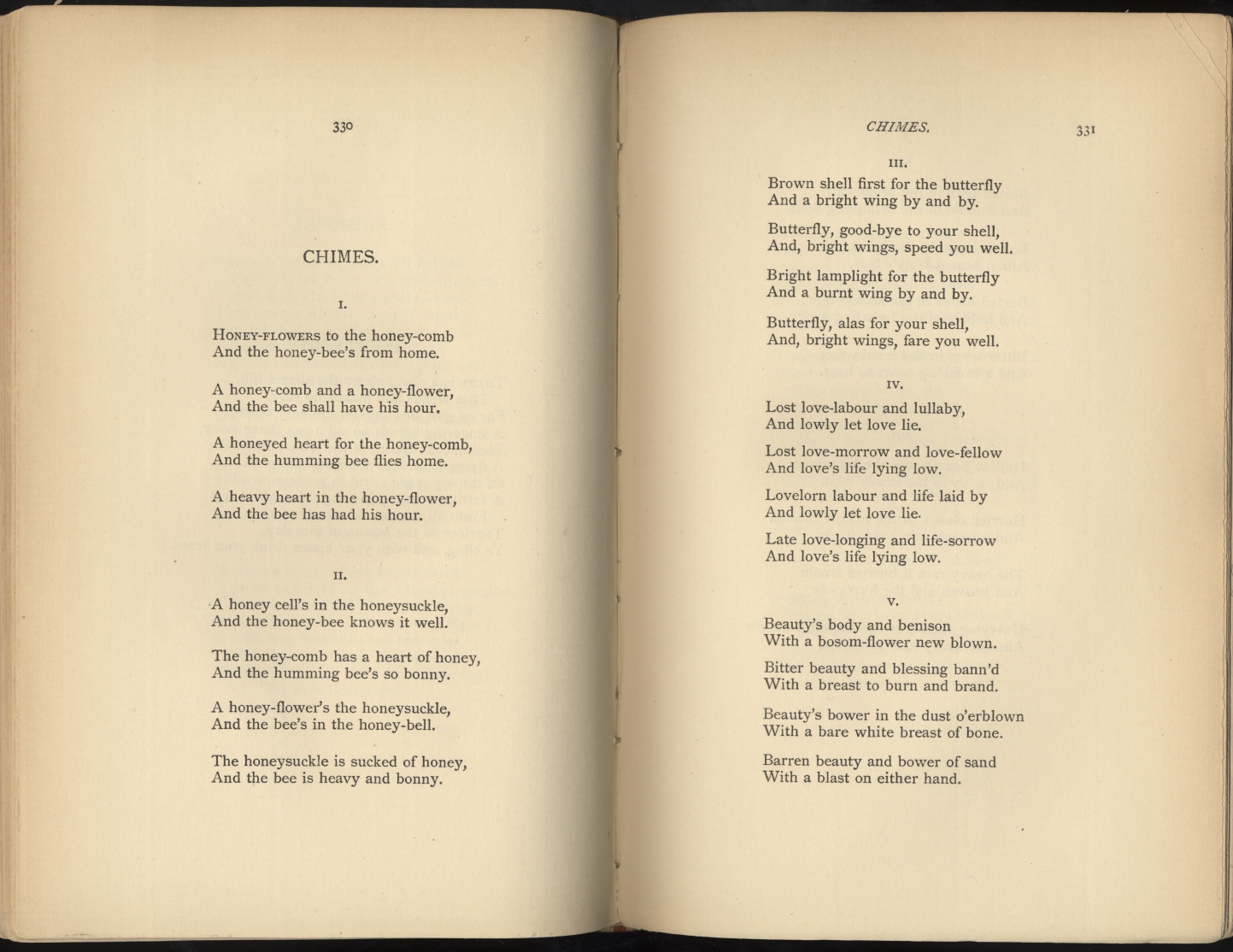
- Honey-flowers to the honey-comb
- And the honey-bee's from home.
- A honey-comb and a honey-flower,
- And the bee shall have his hour.
- A honeyed heart for the honey-comb,
- And the humming bee flies home.
- A heavy heart in the honey-flower,
- And the bee has had his hour.
- A honey cell's in the honeysuckle,
- 10And the honey-bee knows it well.
- The honey-comb has a heart of honey,
- And the humming bee's so bonny.
- A honey-flower's the honeysuckle,
- And the bee's in the honey-bell.
- The honeysuckle is sucked of honey,
- And the bee is heavy and bonny.
- Brown shell first for the butterfly
- And a bright wing by and by.
- Butterfly, good-bye to your shell,
- 20And, bright wings, speed you well.
- Bright lamplight for the butterfly
- And a burnt wing by and by.
- Butterfly, alas for your shell,
- And, bright wings, fare you well.
- Lost love-labour and lullaby,
- And lowly let love lie.
- Lost love-morrow and love-fellow
- And love's life lying low.
- Lovelorn labour and life laid by
- 30And lowly let love lie.
- Late love-longing and life-sorrow
- And love's life lying low.
- Beauty's body and benison
- With a bosom-flower new blown.
- Bitter beauty and blessing bann'd
- With a breast to burn and brand.
- Beauty's bower in the dust o'erblown
- With a bare white breast of bone.
- Barren beauty and bower of sand
- 40With a blast on either hand.
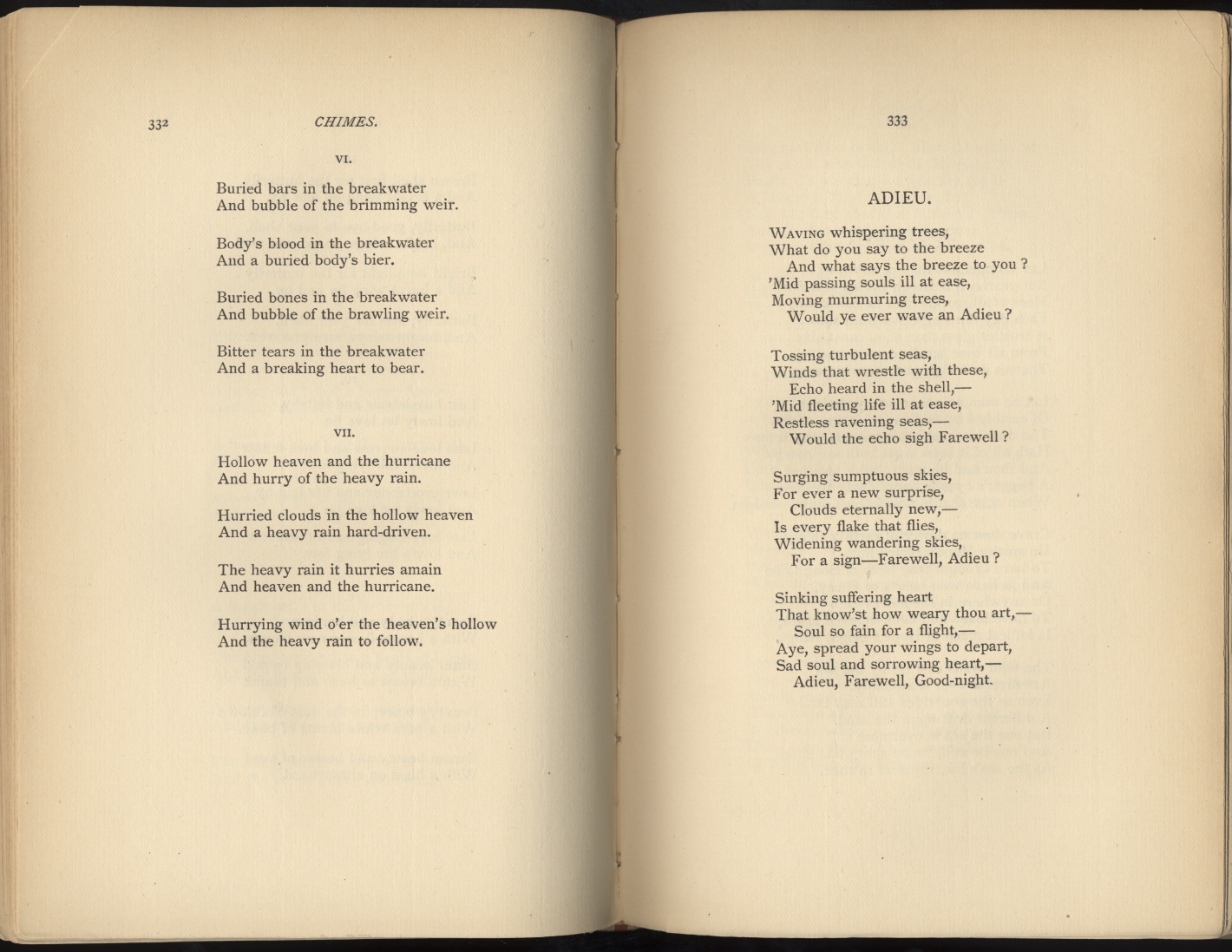
- Buried bars in the breakwater
- And bubble of the brimming weir.
- Body's blood in the breakwater
- And a buried body's bier.
- Buried bones in the breakwater
- And bubble of the brawling weir.
- Bitter tears in the breakwater
- And a breaking heart to bear.
- Hollow heaven and the hurricane
- 50And hurry of the heavy rain.
- Hurried clouds in the hollow heaven
- And a heavy rain hard-driven.
- The heavy rain it hurries amain
- And heaven and the hurricane.
- Hurrying wind o'er the heaven's hollow
- And the heavy rain to follow.
- Waving whispering trees,
- What do you say to the breeze
- And what says the breeze to you?
- 'Mid passing souls ill at ease,
- Moving murmuring trees,
- Would ye ever wave an Adieu?
- Tossing turbulent seas,
- Winds that wrestle with these,
- Echo heard in the shell,—
- 10'Mid fleeting life ill at ease,
- Restless ravening seas,—
- Would the echo sigh Farewell?
- Surging sumptuous skies,
- For ever a new surprise,
- Clouds eternally new,—
- Is every flake that flies,
- Widening wandering skies,
- For a sign—Farewell, Adieu?
- Sinking suffering heart
- 20That know'st how weary thou art,—
- Soul so fain for a flight,—
- Aye, spread your wings to depart,
- Sad soul and sorrowing heart,—
- Adieu, Farewell, Good-night.

- Let no man ask thee of anything
- Not yearborn between Spring and Spring.
- More of all worlds than he can know,
- Each day the single sun doth show.
- A trustier gloss than thou canst give
- From all wise scrolls demonstrative,
- The sea doth sigh and the wind sing.
- Let no man awe thee on any height
- Of earthly kingship's mouldering might.
- 10The dust his heel holds meet for thy brow
- Hath all of it been what both are now;
- And thou and he may plague together
- A beggar's eyes in some dusty weather
- When none that is now knows sound or sight.
- Crave thou no dower of earthly things
- Unworthy Hope's imaginings.
- To have brought true birth of Song to be
- And to have won hearts to Poesy,
- Or anywhere in the sun or rain
- 20To have loved and been beloved again,
- Is loftiest reach of Hope's bright wings.
- The wild waifs cast up by the sea
- Are diverse ever seasonably.
- Even so the soul-tides still may land
- A different drift upon the sand.
- But one the sea is evermore:
- And one be still, 'twixt shore and shore,
- As the sea's life, thy soul in thee.
- Say, hast thou pride? How then may fit
- 30Thy mood with flatterers' silk-spun wit?
- Haply the sweet voice lifts thy crest,
- A breeze of fame made manifest.
- Nay, but then chaf'st at flattery? Pause:
- Be sure thy wrath is not because
- It makes thee feel thou lovest it.
- Let thy soul strive that still the same
- Be early friendship's sacred flame.
- The affinities have strongest part
- In youth, and draw men heart to heart:
- 40As life wears on and finds no rest,
- The individual in each breast
- Is tyrannous to sunder them.
- In the life-drama's stern cue-call,
- A friend's a part well-prized by all:
- And if thou meet an enemy,
- What art thou that none such should be?
- Even so: but if the two parts run
- Into each other and grow one,
- Then comes the curtain's cue to fall.
- 50Whate'er by other's need is claimed
- More than by thine,—to him unblamed
- Resign it: and if he should hold
- What more than he thou lack'st, bread, gold,
- Or any good whereby we live,—
- To thee such substance let him give
- Freely: nor he nor thou be shamed.
- Strive that thy works prove equal: lest
- That work which thou hast done the best
- Should come to be to thee at length
- 60(Even as to envy seems the strength
- Of others) hateful and abhorr'd,—
- Thine own above thyself made lord,—
- Of self-rebuke the bitterest.
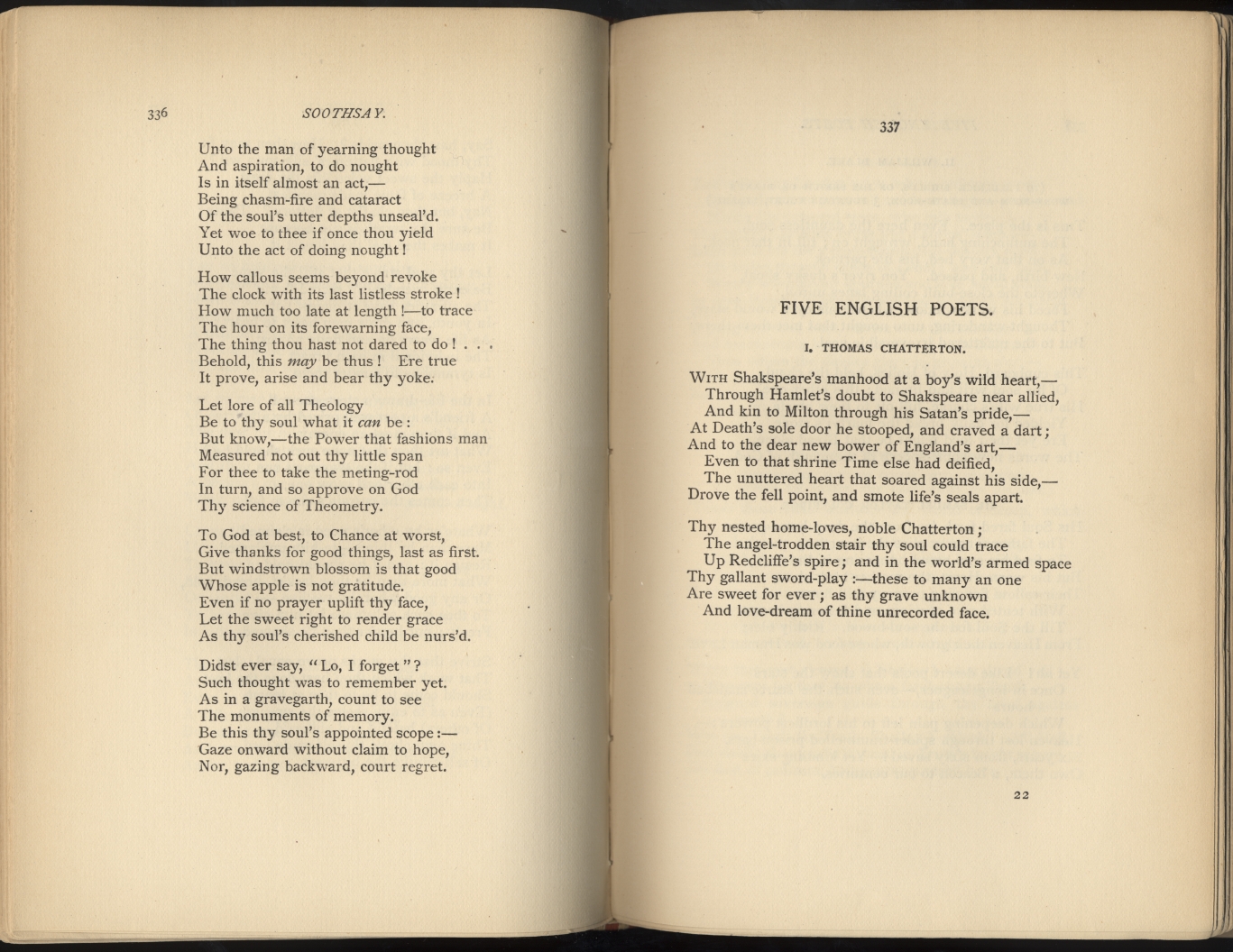
- Unto the man of yearning thought
- And aspiration, to do nought
- Is in itself almost an act,—
- Being chasm-fire and cataract
- Of the soul's utter depths unseal'd.
- Yet woe to thee if once thou yield
- 70Unto the act of doing nought!
- How callous seems beyond revoke
- The clock with its last listless stroke!
- How much too late at length!—to trace
- The hour on its forewarning face,
- The thing thou hast not dared to do!. . .
- Behold, this may be thus! Ere true
- It prove, arise and bear thy yoke.
- Let lore of all Theology
- Be to thy soul what it can be:
- 80But know,—the Power that fashions man
- Measured not out thy little span
- For thee to take the meting-rod
- In turn, and so approve on God
- Thy science of Theometry.
- To God at best, to Chance at worst,
- Give thanks for good things, last as first.
- But windstrown blossom is that good
- Whose apple is not gratitude.
- Even if no prayer uplift thy face,
- 90Let the sweet right to render grace
- As thy soul's cherished child be nurs'd.
- Didst ever say, “Lo, I forget”?
- Such thought was to remember yet.
- As in a gravegarth, count to see
- The monuments of memory.
- Be this thy soul's appointed scope:—
- Gaze onward without claim to hope,
- Nor, gazing backward, court regret.
- With Shakspeare's manhood at a boy's wild heart,—
- Through Hamlet's doubt to Shakspeare near allied,
- And kin to Milton through his Satan's pride,—
- At Death's sole door he stooped, and craved a dart;
- And to the dear new bower of England's art,—
- Even to that shrine Time else had deified,
- The unuttered heart that soared against his side,—
- Drove the fell point, and smote life's seals apart.
- Thy nested home-loves, noble Chatterton;
- 10 The angel-trodden stair thy soul could trace
- Up Redcliffe's spire; and in the world's armed space
- Thy gallant sword-play:—these to many an one
- Are sweet for ever; as thy grave unknown
- And love-dream of thine unrecorded face.
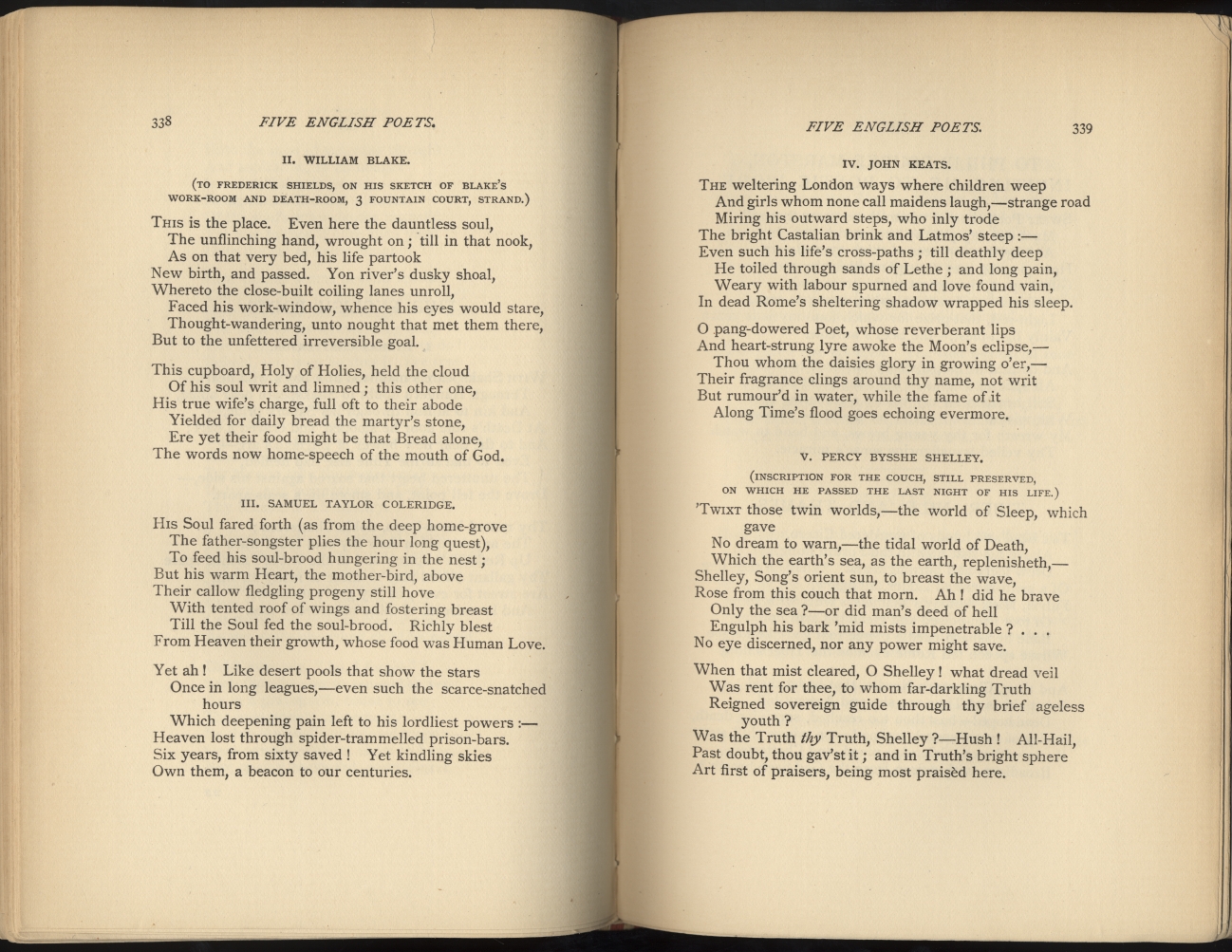
( TO FREDERICK SHIELDS, ON HIS SKETCH OF BLAKE'S
WORK-ROOM AND DEATH-ROOM, 3 FOUNTAIN COURT, STRAND. )
- This is the place. Even here the dauntless soul,
- The unflinching hand, wrought on; till in that nook,
- As on that very bed, his life partook
- New birth, and passed. Yon river's dusky shoal,
- Whereto the close-built coiling lanes unroll,
- Faced his work-window, whence his eyes would stare,
- Thought-wandering, unto nought that met them there,
- But to the unfettered irreversible goal.
- This cupboard, Holy of Holies, held the cloud
- 10 Of his soul writ and limned; this other one,
- His true wife's charge, full oft to their abode
- Yielded for daily bread the martyr's stone,
- Ere yet their food might be that Bread alone,
- The words now home-speech of the mouth of God.
- His Soul fared forth (as from the deep home-grove
- The father-songster plies the hour long quest),
- To feed his soul-brood hungering in the nest;
- But his warm Heart, the mother-bird, above
- Their callow fledgling progeny still hove
- With tented roof of wings and fostering breast
- Till the Soul fed the soul-brood. Richly blest
- From Heaven their growth, whose food was Human Love.
- Yet ah! Like desert pools that show the stars
- 10 Once in long leagues,—even such the scarce-snatched
- hours
- Which deepening pain left to his lordliest powers:—
- Heaven lost through spider-trammelled prison-bars.
- Six years, from sixty saved! Yet kindling skies
- Own them, a beacon to our centuries.
- The weltering London ways where children weep
- And girls whom none call maidens laugh,—strange road
- Miring his outward steps, who inly trode
- The bright Castalian brink and Latmos' steep:—
- Even such his life's cross-paths; till deathly deep
- He toiled through sands of Lethe; and long pain,
- Weary with labour spurned and love found vain,
- In dead Rome's sheltering shadow wrapped his sleep.
- O pang-dowered Poet, whose reverberant lips
- 10And heart-strung lyre awoke the Moon's eclipse,—
- Thou whom the daisies glory in growing o'er,—
- Their fragrance clings around thy name, not writ
- But rumour'd in water, while the fame of it
- Along Time's flood goes echoing evermore.
(INSCRIPTION FOR THE COUCH, STILL PRESERVED,
ON WHICH HE PASSED THE LAST NIGHT OF HIS LIFE.)
- 'Twixt those twin worlds,—the world of Sleep, which
- gave
- No dream to warn,—the tidal world of Death,
- Which the earth's sea, as the earth, replenisheth,—
- Shelley, Song's orient sun, to breast the wave,
- Rose from this couch that morn. Ah! did he brave
- Only the sea?—or did man's deed of hell
- Engulph his bark 'mid mists impenetrable? . . .
- No eye discerned, nor any power might save.
- When that mist cleared, O Shelley! what dread veil
- 10 Was rent for thee, to whom far-darkling Truth
- Reigned sovereign guide through thy brief ageless
- youth?
- Was the Truth thy Truth, Shelley?—Hush! All-Hail,
- Past doubt, thou gav'st it; and in Truth's bright sphere
- Art first of praisers, being most praisèd here.
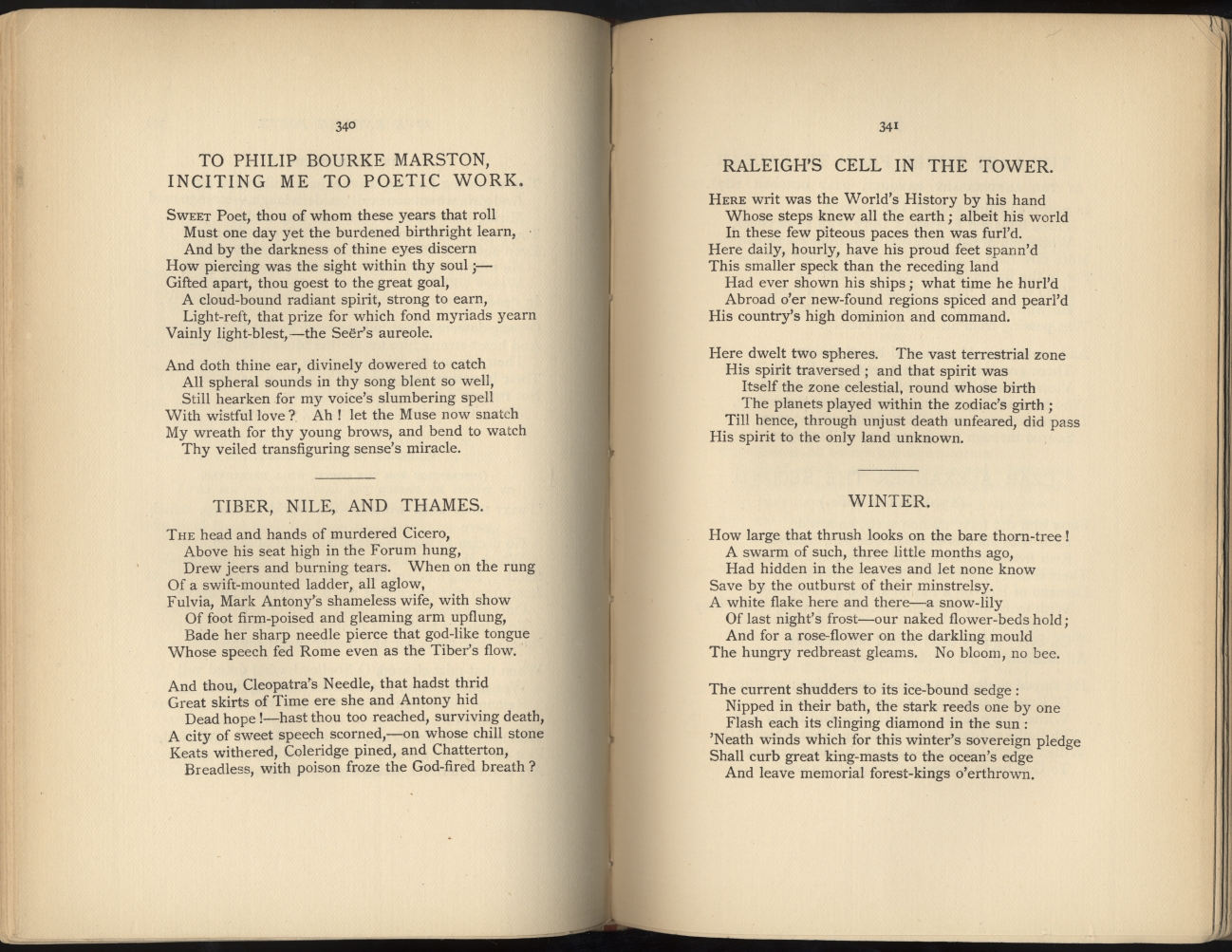
- Sweet Poet, thou of whom these years that roll
- Must one day yet the burdened birthright learn,
- And by the darkness of thine eyes discern
- How piercing was the sight within thy soul;—
- Gifted apart, thou goest to the great goal,
- A cloud-bound radiant spirit, strong to earn,
- Light-reft, that prize for which fond myriads yearn
- Vainly light-blest,—the Seër's aureole.
- And doth thine ear, divinely dowered to catch
- 10 All spheral sounds in thy song blent so well,
- Still hearken for my voice's slumbering spell
- With wistful love? Ah! let the Muse now snatch
- My wreath for thy young brows, and bend to watch
- Thy veiled transfiguring sense's miracle.
- The head and hands of murdered Cicero,
- Above his seat high in the Forum hung,
- Drew jeers and burning tears. When on the rung
- Of a swift-mounted ladder, all aglow,
- Fluvia, Mark Antony's shameless wife, with show
- Of foot firm-poised and gleaming arm upflung,
- Bade her sharp needle pierce that god-like tongue
- Whose speech fed Rome even as the Tiber's flow.
- And thou, Cleopatra's Needle, that hadst thrid
- 10Great skirts of Time ere she and Antony hid
- Dead hope!—hast thou too reached, surviving death,
- A city of sweet speech scorned,—on whose chill stone
- Keats withered, Coleridge pined, and Chatterton,
- Breadless, with poison froze the God-fired breath?
- Here writ was the World's History by his hand
- Whose steps knew all the earth; albeit his world
- In these few piteous paces then was furl'd.
- Here daily, hourly, have his proud feet spann'd
- This smaller speck than the receding land
- Had ever shown his ships; what time he hurl'd
- Abroad o'er new-found regions spiced and pearl'd
- His country's high dominion and command.
- Here dwelt two spheres. The vast terrestrial zone
- 10His spirit traversed; and that spirit was
- Itself the zone celestial, round whose birth
- The planets played within the zodiac's girth;
- Till hence, through unjust death unfeared, did pass
- His spirit to the only land unknown.
- How large that thrush looks on the bare thorn-tree!
- A swarm of such, three little months ago,
- Had hidden in the leaves and let none know
- Save by the outburst of their minstrelsy.
- A white flake here and there—a snow-lily
- Of last night's frost—our naked flower-beds hold;
- And for a rose-flower on the darkling mould
- The hungry redbreast gleams. No bloom, no bee.
- The current shudders to its ice-bound sedge:
- 10 Nipped in their bath, the stark reeds one by one
- Flash each its clinging diamond in the sun:
- 'Neath winds which for this Winter's sovereign pledge
- Shall curb great king-masts to the ocean's edge
- And leave memorial forest-king's o'erthrown.
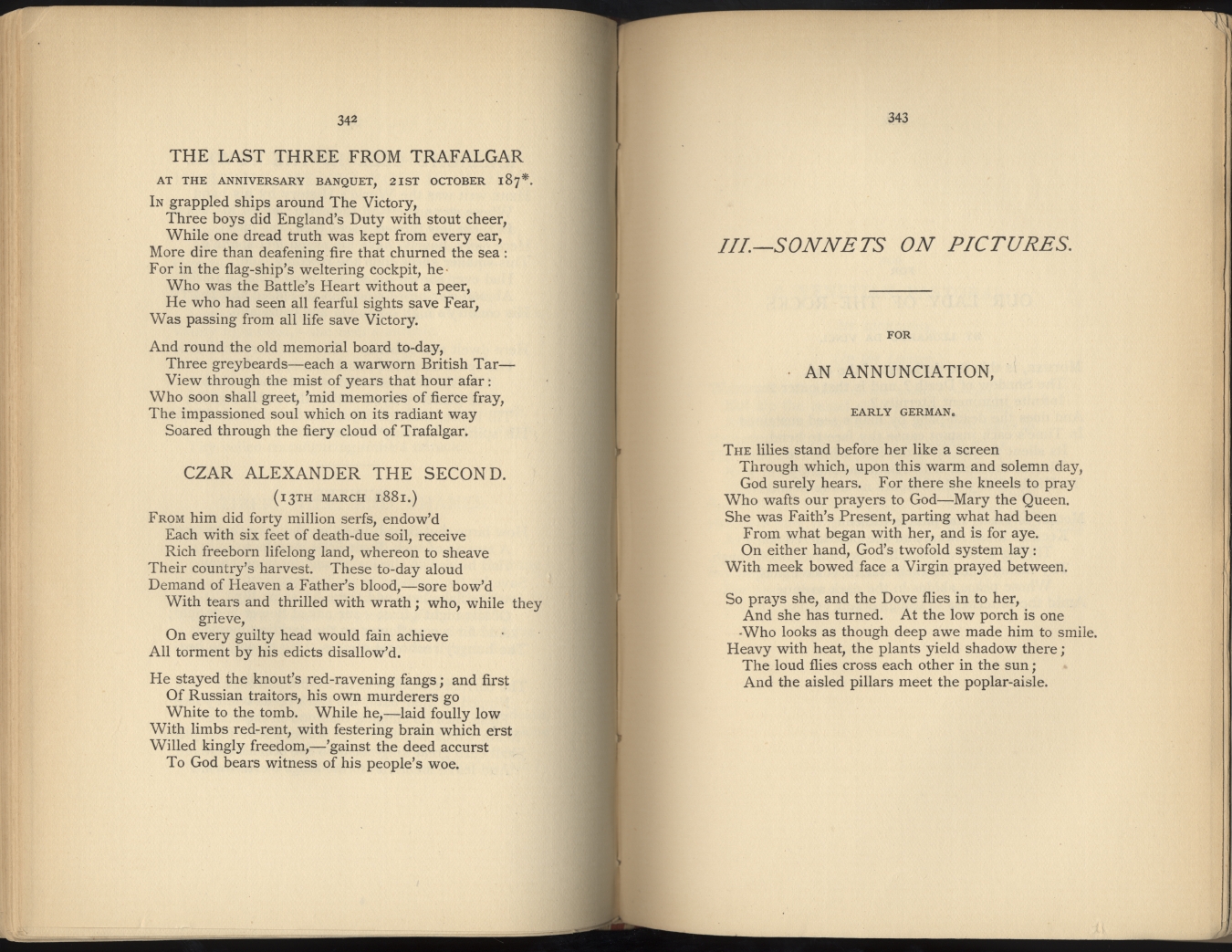
- In grappled ships around The Victory,
- Three boys did England's Duty with stout cheer,
- While one dread truth was kept from every ear,
- More dire than deafening fire that churned the sea:
- For in the flag-ship's weltering cockpit, he
- Who was the Battle's Heart without a peer,
- He who had seen all fearful sights save Fear,
- Was passing from all life save Victory.
- And round the old memorial board to-day,
- 10 Three greybeards—each a warworn British Tar—
- View through the mist of years that hour afar:
- Who soon shall greet, 'mid memories of fierce fray,
- The impassioned soul which on its radiant way
- Soared through the fiery cloud of Trafalgar.
- From him did forty million serfs, endow'd
- Each with six feet of death-due soil, receive
- Rich freeborn lifelong land, whereon to sheave
- Their country's harvest. These to-day aloud
- Demand of Heaven a Father's blood,—sore bow'd
- With tears and thrilled with wrath; who, while they
- grieve,
- On every guilty head would fain achieve
- All torment by his edicts disallow'd.
- He stayed the knout's red-ravening fangs; and first
- 10 Of Russian traitors, his own murderers go
- White to the tomb. While he,—laid foully low
- With limbs red-rent, with festering brain which erst
- Willed kingly freedom,—'gainst the deed accurst
- To God bears witness of his people's woe.
- The lilies stand before her like a screen
- Through which, upon this warm and solemn day,
- God surely hears. For there she kneels to pray
- Who wafts our prayers to God—Mary the Queen.
- She was Faith's Present, parting what had been
- From what began with her, and is for aye.
- On either hand, God's twofold system lay:
- With meek bowed face a Virgin prayed between.
- So prays she, and the Dove flies in to her,
- 10 And she has turned. At the low porch is one
- Who looks as though deep awe made him to smile.
- Heavy with heat, the plants yield shadow there;
- The loud flies cross each other in the sun;
- And the aisled pillars meet the poplar-aisle.
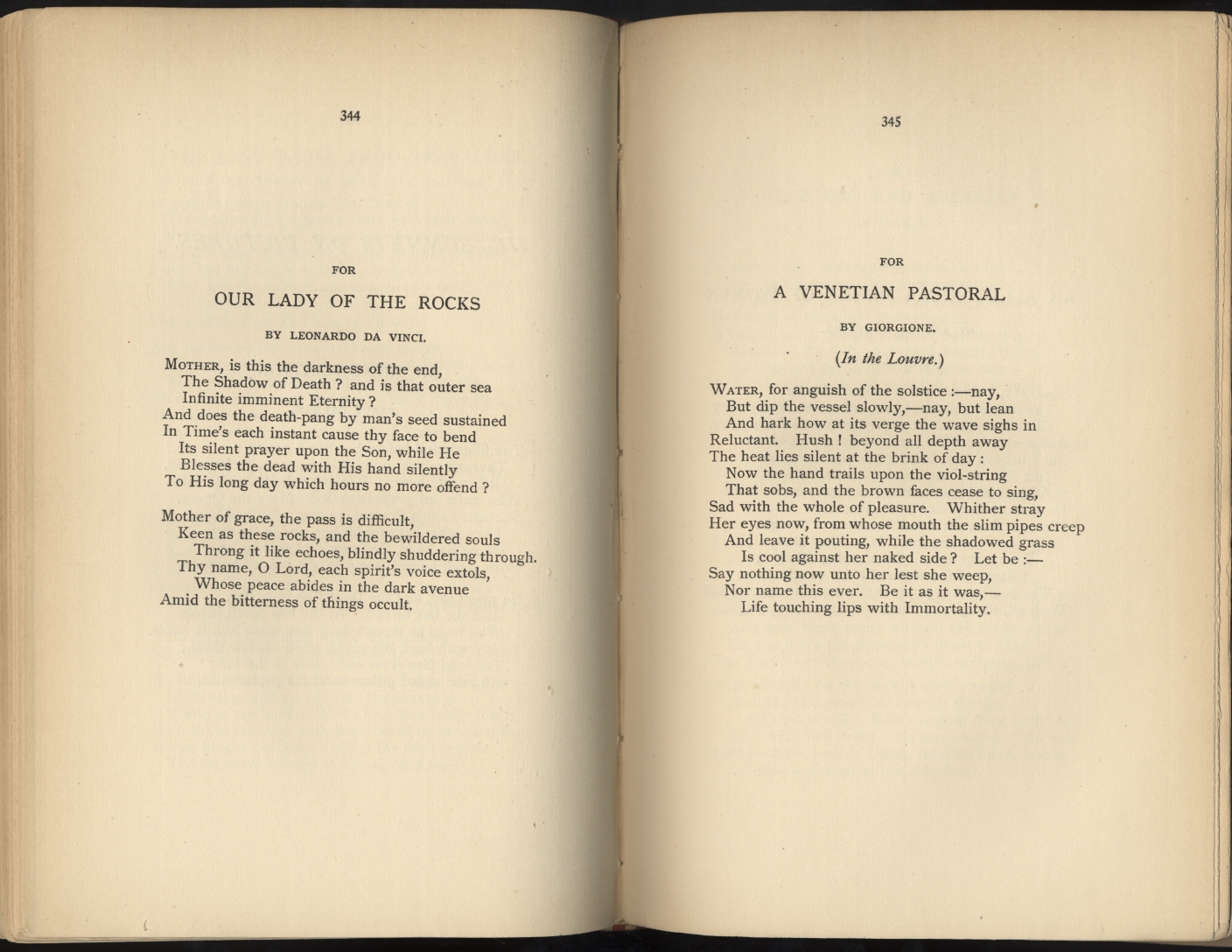
- Mother, is this the darkness of the end,
- The Shadow of Death? and is that outer sea
- Infinite imminent Eternity?
- And does the death-pang by man's seed sustained
- In Time's each instant cause thy face to bend
- Its silent prayer upon the Son, while He
- Blesses the dead with His hand silently
- To His long day which hours no more offend?
- Mother of grace, the pass is difficult,
- 10 Keen as these rocks, and the bewildered souls
- Throng it like echoes, blindly shuddering through.
- Thy name, O Lord, each spirit's voice extols,
- Whose peace abides in the dark avenue
- Amid the bitterness of things occult.
- Water, for anguish of the solstice:—nay,
- But dip the vessel slowly,—nay, but lean
- And hark how at its verge the wave sighs in
- Reluctant. Hush! beyond all depth away
- The heat lies silent at the brink of day:
- Now the hand trails upon the viol-string
- That sobs, and the brown faces cease to sing,
- Sad with the whole of pleasure. Whither stray
- Her eyes now, from whose mouth the slim pipes creep
- 10 And leave it pouting, while the shadowed grass
- Is cool against her naked side? Let be:—
- Say nothing now unto her lest she weep,
- Nor name this ever. Be it as it was,—
- Life touching lips with Immortality.
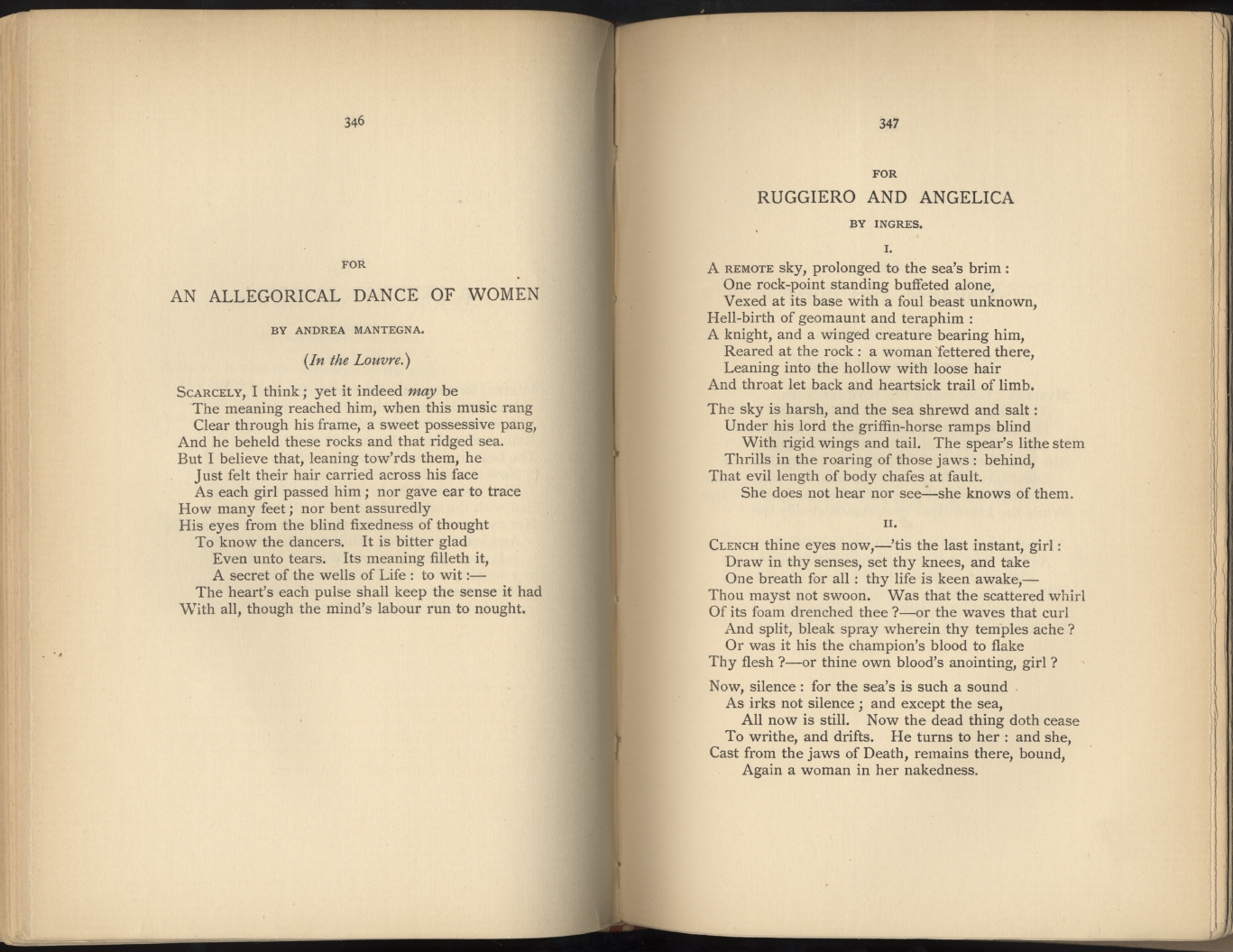
- Scarcely, I think; yet it indeed may be
- The meaning reached him, when this music rang
- Clear through his frame, a sweet possessive pang,
- And he beheld these rocks and that ridged sea.
- But I believe that, leaning tow'rds them, he
- Just felt their hair carried across his face
- As each girl passed him; nor gave ear to trace
- How many feet; nor bent assuredly
- His eyes from the blind fixedness of thought
- 10 To know the dancers. It is bitter glad
- Even unto tears. Its meaning filleth it,
- A secret of the wells of Life: to wit:—
- The heart's each pulse shall keep the sense it had
- With all, though the mind's labour run to nought.
- A remote sky, prolonged to the sea's brim:
- One rock-point standing buffeted alone,
- Vexed at its base with a foul beast unknown,
- Hell-birth of geomaunt and teraphim:
- A knight, and a winged creature bearing him,
- Reared at the rock: a woman fettered there,
- Leaning into the hollow with loose hair
- And throat let back and heartsick trail of limb.
- The sky is harsh, and the sea shrewd and salt:
- 10 Under his lord the griffin-horse ramps blind
- With rigid wings and tail. The spear's lithe stem
- Thrills in the roaring of those jaws: behind,
- That evil length of body chafes at fault.
- She does not hear nor see—she knows of them.
- Clench thine eyes now,—'tis the last instant, girl:
- Draw in thy senses, set thy knees, and take
- One breath for all: thy life is keen awake,—
- Thou mayst not swoon. Was that the scattered whirl
- Of its foam drenched thee?—or the waves that curl
- And split, bleak spray wherein thy temples ache?
- Or was it his the champion's blood to flake
- Thy flesh?—or thine own blood's anointing, girl?
- Now, silence: for the sea's is such a sound
- 10 As irks not silence; and except the sea,
- All now is still. Now the dead thing doth cease
- To writhe, and drifts. He turns to her: and she,
- Cast from the jaws of Death, remains there, bound,
- Again a woman in her nakedness.
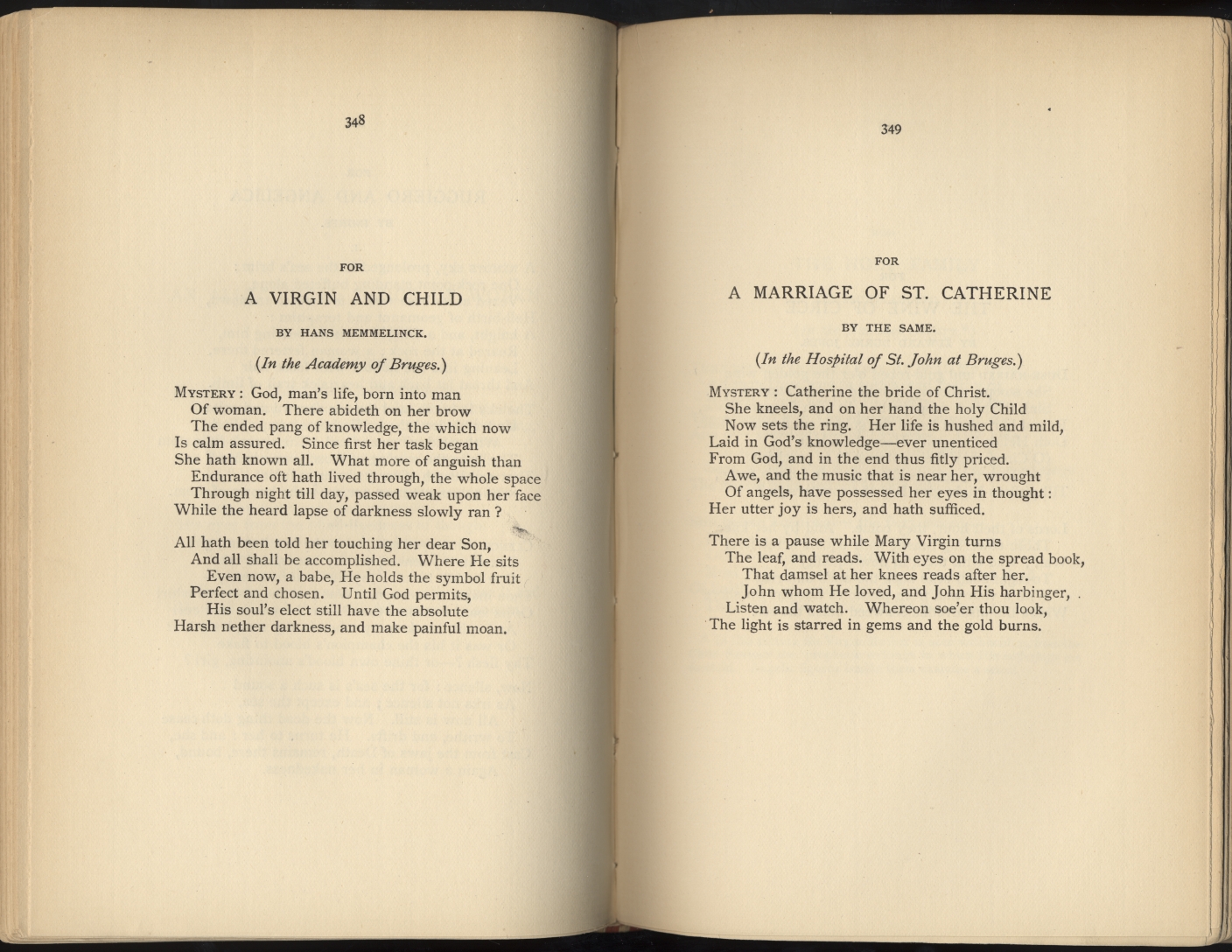
- Mystery: God, man's life, born into man
- Of woman. There abideth on her brow
- The ended pang of knowledge, the which now
- Is calm assured. Since first her task began
- She hath known all. What more of anguish than
- Endurance oft hath lived through, the whole space
- Through night till day, passed weak upon her face
- While the heard lapse of darkness slowly ran?
- All hath been told her touching her dear Son,
- 10 And all shall be accomplished. Where He sits
- Even now, a babe, He holds the symbol fruit
- Perfect and chosen. Until God permits,
- His soul's elect still have the absolute
- Harsh nether darkness, and make painful moan.
- Mystery: Catherine the bride of Christ.
- She kneels, and on her hand the holy Child
- Now sets the ring. Her life is hushed and mild,
- Laid in God's knowledge—ever unenticed
- From God, and in the end thus fitly priced.
- Awe, and the music that is near her, wrought
- Of angels, have possessed her eyes in thought:
- Her utter joy is hers, and hath sufficed.
- There is a pause while Mary Virgin turns
- 10 The leaf, and reads. With eyes on the spread book,
- That damsel at her knees reads after her.
- John whom He loved, and John His harbinger,
- Listen and watch. Whereon soe'er thou look,
- The light is starred in gems and the gold burns.
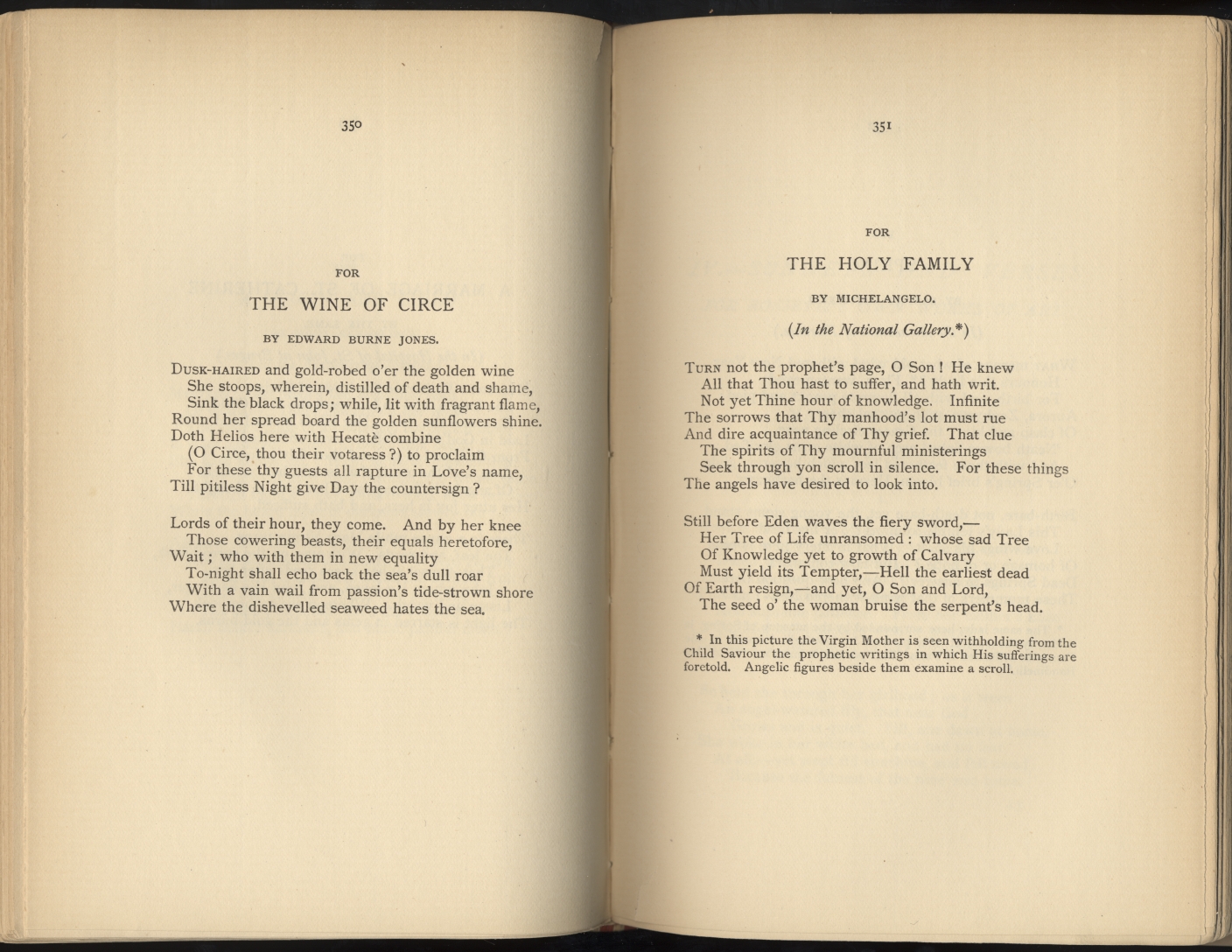
- Dusk-haired and gold-robed o'er the golden wine
- She stoops, wherein, distilled of death and shame,
- Sink the black drops; while, lit with fragrant flame,
- Round her spread board the golden sunflowers shine.
- Doth Helios here with Hecatè combine
- (O Circe, thou their votaress?) to proclaim
- For these thy guests all rapture in Love's name,
- Till pitiless Night give Day the countersign?
- Lords of their hour, they come. And by her knee
- 10 Those cowering beasts, their equals heretofore,
- Wait; who with them in new equality
- To-night shall echo back the sea's dull roar
- With a vain wail from passion's tide-strown shore
- Where the dishevelled seaweed hates the sea.
- Turn not the prophet's page, O Son! He knew
- All that Thou hast to suffer, and hath writ.
- Not yet Thine hour of knowledge. Infinite
- The sorrows that Thy manhood's lot must rue
- And dire acquaintance of Thy grief. That clue
- The spirits of Thy mournful ministerings
- Seek through yon scroll in silence. For these things
- The angels have desired to look into.
- Still before Eden waves the fiery sword,—
- 10 Her Tree of Life unransomed: whose sad Tree
- Of Knowledge yet to growth of Calvary
- Must yield its Tempter,—Hell the earliest dead
- Of Earth resign,—and yet, O Son and Lord,
- The seed o' the woman bruise the serpent's head.
* In this picture the Virgin Mother is seen withholding from the
Child Saviour the prophetic writings in which His sufferings
are
foretold. Angelic figures beside them examine a
scroll.
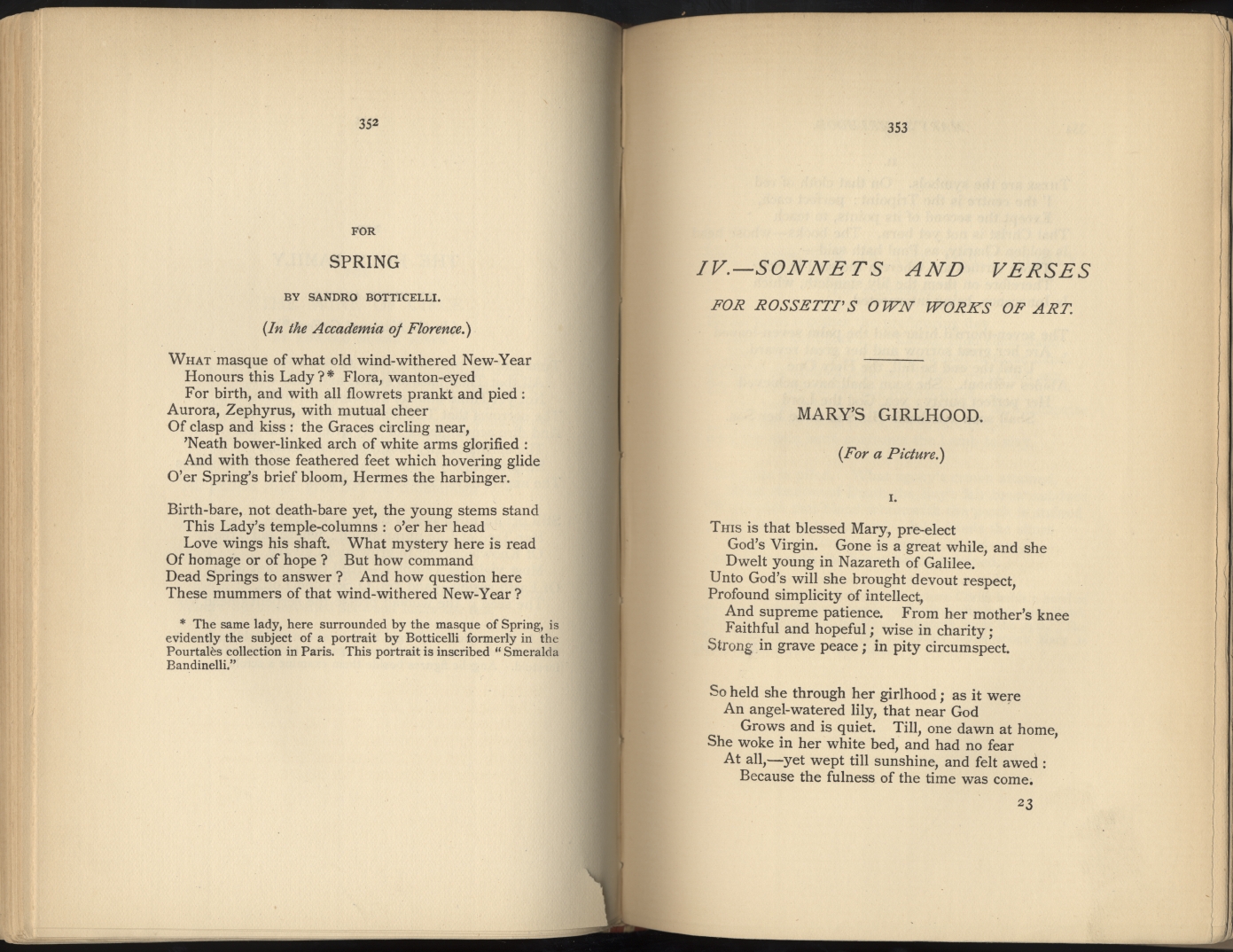
- What masque of what old wind-withered New-Year
- Honours this Lady?* Flora, wanton-eyed
- For birth, and with all flowrets prankt and pied:
- Aurora, Zephyrus, with mutual cheer
- Of clasp and kiss: the Graces circling near,
- 'Neath bower-linked arch of white arms glorified:
- And with those feathered feet which hovering glide
- O'er Spring's brief bloom, Hermes the harbinger.
- Birth-bare, not death-bare yet, the young stems stand
- 10 This Lady's temple-columns: o'er her head
- Love wings his shaft. What mystery here is read
- Of homage or of hope? But how command
- Dead Springs to answer? And how question here
- These mummers of that wind-withered New-Year?
* The same lady, here surrounded by the masque of Spring, is
evidently the subject of a portrait by Botticelli formerly in the
Pourtalès collection in Paris. This portrait is
inscribed “Smeralda
Bandinelli.”
- This is that blessed Mary, pre-elect
- God's Virgin. Gone is a great while, and she
- Dwelt young in Nazareth of Galilee.
- Unto God's will she brought devout respect,
- Profound simplicity of intellect,
- And supreme patience. From her mother's knee
- Faithful and hopeful; wise in charity;
- Strong in grave peace; in pity circumspect.
- So held she through her girlhood; as it were
- 10 An angel-watered lily, that near God
- Grows and is quiet. Till, one dawn at home,
- She woke in her white bed, and had no fear
- At all,—yet wept till sunshine, and felt awed:
- Because the fulness of the time was come.
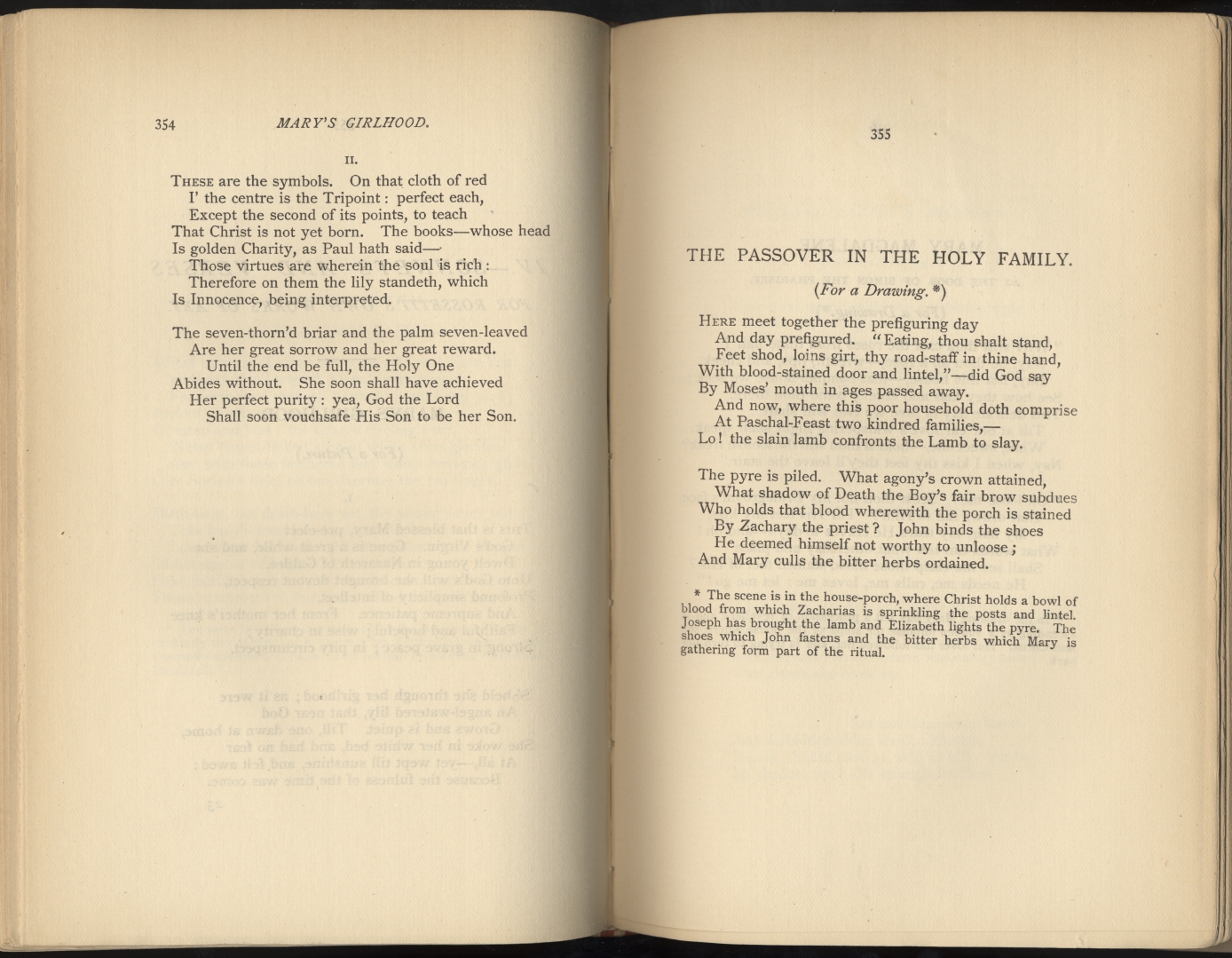
- These are the symbols. On that cloth of red
- I' the centre is the Tripoint: perfect each,
- Except the second of its points, to teach
- That Christ is not yet born. The books—whose head
- Is golden Charity, as Paul hath said—
- Those virtues are wherein the soul is rich:
- Therefore on them the lily standeth, which
- Is Innocence, being interpreted.
- The seven-thorn'd briar and the palm seven-leaved
- 10 Are her great sorrow and her great reward.
- Until the end be full, the Holy One
- Abides without. She soon shall have achieved
- Her perfect purity: yea, God the Lord
- Shall soon vouchsafe His Son to be her Son.
- Here meet together the prefiguring day
- And day prefigured. “Eating, thou shalt stand,
- Feet shod, loins girt, thy road-staff in thine hand,
- With blood-stained door and lintel,”—did God say
- By Moses' mouth in ages passed away.
- And now, where this poor household doth comprise
- At Paschal-Feast two kindred families,—
- Lo! the slain lamb confronts the Lamb to slay.
- The pyre is piled. What agony's crown attained,
- 10 What shadow of Death the Boy's fair brow subdues
- Who holds that blood wherewith the porch is stained
- By Zachary the priest? John binds the shoes
- He deemed himself not worthy to unloose;
- And Mary culls the bitter herbs ordained.
* The scene is in the house-porch, where Christ holds a bowl of
blood from which Zacharias is sprinkling the posts and lintel.
Joseph has brought the lamb and Elizabeth lights the pyre. The
shoes which John fastens and the bitter herbs which Mary is
gathering form part of the ritual.

- “Why wilt thou cast the roses from thine hair?
- Nay, be thou all a rose,—wreath, lips, and cheek.
- Nay, not this house,—that banquet-house we seek;
- See how they kiss and enter; come thou there.
- This delicate day of love we two will share
- Till at our ear love's whispering night shall speak.
- What, sweet one,—hold'st thou still the foolish freak?
- Nay, when I kiss thy feet they'll leave the stair.”
- “Oh loose me! Seest thou not my Bridegroom's face
- 10 That draws me to Him? For His feet my kiss,
- My hair, my tears He craves to-day:—and oh!
- What words can tell what other day and place
- Shall see me clasp those blood-stained feet of His?
- He needs me, calls me, loves me: let me go!”
* In the drawing Mary has left a procession of revellers, and is
ascending by a sudden impulse the steps of the house where she
sees Christ. Her lover has followed her, and is trying to turn her
back.
- Rose-sheathed beside the rosebud tongue
- Lurks the young adder's tooth;
- Milk-mild from new-born hemlock-bluth
- The earliest drops are wrung:
- And sweet the flower of his first youth
- When Michael Scott was young.
- Andromeda, by Perseus saved and wed,
- Hankered each day to see the Gorgon's head:
- Till o'er a fount he held it, bade her lean,
- And mirrored in the wave was safely seen
- That death she lived by.
- Let not thine eyes know
- Any forbidden thing itself, although
- It once should save as well as kill: but be
- Its shadow upon life enough for thee.
- Rend, rend thine hair, Cassandra: he will go.
- Yea, rend thy garments, wring thine hands, and cry
- From Troy still towered to the unreddened sky.
- See, all but she that bore thee mock thy woe:—
- He most whom that fair woman arms, with show
- Of wrath on her bent brows; for in this place
- This hour thou bad'st all men in Helen's face
- The ravished ravishing prize of Death to know.
- What eyes, what ears hath sweet Andromache,
- 10 Save for her Hector's form and step; as tear
- On tear make salt the warm last kiss he gave?
- He goes. Cassandra's words beat heavily
- Like crows above his crest, and at his ear
- Ring hollow in the shield that shall not save.
* The subject shows Cassandra prophesying among her kindred,
as
Hector leaves them for his last battle. They are on the
platform
of a fortress, from which the Trojan troops are
marching out.
Helen is arming Paris; Priam soothes Hecuba; and
Andromache
holds the child to her bosom.
- “O Hector, gone, gone, gone! O Hector, thee
- Two chariots wait, in Troy long bless'd and curs'd;
- And Grecian spear and Phrygian sand athirst
- Crave from thy veins the blood of victory.
- Lo! long upon our hearth the brand had we,
- Lit for the roof-tree's ruin: and to-day
- The ground-stone quits the wall,—the wind hath
- way,—
- And higher and higher the wings of fire are free.
- O Paris, Paris! O thou burning brand,
- 10 Thou beacon of the sea whence Venus rose,
- Lighting thy race to shipwreck! Even that hand
- Wherewith she took thine apple let her close
- Within thy curls at last, and while Troy glows
- Lift thee her trophy to the sea and land.”
- She hath the apple in her hand for thee,
- Yet almost in her heart would hold it back;
- She muses, with her eyes upon the track
- Of that which in thy spirit they can see.
- Haply, “Behold, he is at peace,” saith she;
- “Alas! the apple for his lips,—the dart
- That follows its brief sweetness to his heart,—
- The wandering of his feet perpetually!”
- A little space her glance is still and coy;
- 10 But if she give the fruit that works her spell,
- Those eyes shall flame as for her Phrygian boy.
- Then shall her bird's strained throat the woe foretell,
- And her far seas moan as a single shell,
- And through her dark grove strike the light of Troy.
- What of the end, Pandora? Was it thine,
- The deed that set these fiery pinions free?
- Ah! wherefore did the Olympian consistory
- In its own likeness make thee half divine?
- Was it that Juno's brow might stand a sign
- For ever? and the mien of Pallas be
- A deadly thing? and that all men might see
- In Venus' eyes the gaze of Proserpine?
- What of the end? These beat their wings at will,
- 10 The ill-born things, the good things turned to ill,—
- Powers of the impassioned hours prohibited.
- Aye, clench the casket now! Whither they go
- Thou mayst not dare to think: nor canst thou know
- If Hope still pent there be alive or dead.
- Her lute hangs shadowed in the apple-tree,
- While flashing fingers weave the sweet-strung spell
- Between its chords; and as the wild notes swell,
- The sea-bird for those branches leaves the sea.
- But to what sound her listening ear stoops she?
- What netherworld gulf-whispers doth she hear,
- In answering echoes from what planisphere,
- Along the wind, along the estuary?
- She sinks into her spell: and when full soon
- 10 Her lips move and she soars into her song,
- What creatures of the midmost main shall throng
- In furrowed surf-clouds to the summoning rune:
- Till he, the fated mariner, hears her cry,
- And up her rock, bare-breasted, comes to die?
- Mystery: lo! betwixt the sun and moon
- Astarte of the Syrians: Venus Queen
- Ere Aphrodite was. In silver sheen
- Her twofold girdle clasps the infinite boon
- Of bliss whereof the heaven and earth commune:
- And from her neck's inclining flower-stem lean
- Love-freighted lips and absolute eyes that wean
- The pulse of hearts to the spheres' dominant tune.
- Torch-bearing, her sweet ministers compel
- 10 All thrones of light beyond the sky and sea
- The witnesses of Beauty's face to be:
- That face, of Love's all-penetrative spell
- Amulet, talisman, and oracle,—
- Betwixt the sun and moon a mystery.
- Thou fill'st from the winged chalice of the soul
- Thy lamp, O Memory, fire-winged to its goal.
- Behold Fiammetta, shown in Vision here.
- Gloom-girt 'mid Spring-flushed apple-growth she stands;
- And as she sways the branches with her hands,
- Along her arm the sundered bloom falls sheer,
- In separate petals shed, each like a tear;
- While from the quivering bough the bird expands
- His wings. And lo! thy spirit understands
- Life shaken and shower'd and flown, and Death drawn
- near.
- All stirs with change. Her garments beat the air:
- 10 The angel circling round her aureole
- Shimmers in flight against the tree's grey bole:
- While she, with reassuring eyes most fair,
- A presage and a promise stands; as 'twere
- On Death's dark storm the rainbow of the Soul.
- “There is a budding morrow in midnight:”—
- So sang our Keats, our English nightingale.
- And here, as lamps across the bridge turn pale
- In London's smokeless resurrection-light,
- Dark breaks to dawn. But o'er the deadly blight
- Of Love deflowered and sorrow of none avail
- Which makes this man gasp and this woman quail,
- Can day from darkness ever again take flight?
- Ah! gave not these two hearts their mutual pledge,
- 10Under one mantle sheltered 'neath the hedge
- In gloaming courtship? And, O God! to-day
- He only knows he holds her;—but what part
- Can life now take? She cries in her locked heart,—
- “Leave me—I do not know you—go away!”

- The thronged boughs of the shadowy sycamore
- Still bear young leaflets half the summer through;
- From when the robin 'gainst the unhidden blue
- Perched dark, till now, deep in the leafy core,
- The embowered throstle's urgent wood-notes soar
- Through summer silence. Still the leaves come new;
- Yet never rosy-sheathed as those which drew
- Their spiral tongues from spring-buds heretofore.
- Within the branching shade of Reverie
- 10Dreams even may spring till autumn; yet none be
- Like woman's budding day-dream spirit-fann'd.
- Lo! tow'rd deep skies, not deeper than her look,
- She dreams; till now on her forgotten book
- Drops the forgotten blossom from her hand.
- È giovine il signore,
- Ed ama molte cose,—
- I canti, le rose,
- La forza e l'amore.
- Quel che più vuole
- Ancor non osa:
- Ahi più che il sole,
- Più ch' ogni rosa,
- La cara cosa,
- 10Donna a gioire.
- È giovine il signore,
- Ed ama quelle cose
- Che ardor dispose
- In cuore all' amore.
- Bella fanciulla,
- Guardalo in viso;
- Non mancar nulla,
- Motto o sorriso;
- Ma viso a viso
- 20Guarda a gradire.
- È giovine il signore,
- Ed ama tutte cose,
- Vezzose, giojose,
- Tenenti all' amore.
- My young lord's the lover
- Of earth and sky above,
- Of youth's sway and youth's play,
- Of songs and flowers and love.
- Yet for love's desire
- Green youth lacks the daring;
- Though one dream of fire,
- All his hours ensnaring,
- Burns the boy past bearing—
- 10 The dream that girls inspire.
- My young lord's the lover
- Of every burning thought
- That Love's will, that Love's skill
- Within his breast has wrought.
- Lovely girl, look on him
- Soft as music's measure;
- Yield him, when you've won him,
- Joys and toys at pleasure;
- But to win your treasure,
- 20 Softly look upon him.
- My young lord's the lover
- Of every tender grace
- That woman, to woo man,
- Can wear in form or face.

- Prendilo in braccio
- Adesso o mai;
- Per più mi taccio,
- Chè tu lo sai;
- Bacialo e l'avrai,
- 30Ma non lo dire.
- È giovine il signore,
- Ed ama ben le cose
- Che Amor nascose,
- Che mostragli Amore.
- Deh trionfando
- Non farne pruova;
- Ahimè! che quando
- Gioja più giova,
- Allor si trova
- 40Presso al finire.
- È giovine il signore,
- Ed ama tante cose,
- Le rose, le spose,
- Quante gli dona Amore.
- Take him to your bosom
- Now, girl, or never;
- Let not your new blossom
- Of sweet kisses sever;
- Only guard for ever
- 30 Your boast within your bosom.
- My young lord's the lover
- Of every secret thing,
- Love-hidden, love-bidden
- This day to banqueting.
- Lovely girl, with vaunting
- Never tempt to-morrow:
- From all shapes enchanting
- Any joy can borrow,
- Still the spectre Sorrow
- 40 Rises up for haunting.
- And now my lord's the lover
- Of ah! so many a sweet,—
- Of roses, of spouses,
- As many as love may greet.
- Lungi è la luce che in sù questo muro
- Rifrange appena, un breve istante scorta
- Del rio palazzo alla soprana porta.
- Lungi quei fiori d'Enna, O lido oscuro,
- Dal frutto tuo fatal che omai m'è duro.
- Lungi quel cielo dal tartareo manto
- Che quì mi cuopre: e lungi ahi lungi ahi quanto
- Le notti che saran dai dì che furo.
- Lungi da me mi sento; e ognor sognando
- 10 Cerco e ricerco, e resto ascoltatrice;
- E qualche cuore a qualche anima dice,
- (Di cui mi giunge il suon da quando in quando,
- Continuamente insieme sospirando,)—
- “Oimè per te, Proserpina infelice!”
- Maggior dolore è ben la Ricordanza,
- O nell' amaro inferno amena stanza?
- Afar away the light that brings cold cheer
- Unto this wall,—one instant and no more
- Admitted at my distant palace-door.
- Afar the flowers of Enna from this drear
- Dire fruit, which, tasted once, must thrall me here.
- Afar those skies from this Tartarean grey
- That chills me: and afar, how far away,
- The nights that shall be from the days that were.
- Afar from mine own self I seem, and wing
- 10 Strange ways in thought, and listen for a sign:
- And still some heart unto some soul doth pine,
- (Whose sounds mine inner sense is fain to bring,
- Continually together murmuring,)—
- “Woe's me for thee, unhappy Proserpine!”
- Is Memory most of miseries miserable,
- Or the one flower of ease in bitterest hell?
- O bella Mano, che ti lavi e piaci
- In quel medesmo tuo puro elemento
- Donde la Dea dell' amoroso avvento
- Nacque, (e dall' onda s'infuocar le faci
- Di mille inispegnibili fornaci):—
- Come a Venere a te l'oro e l'argento
- Offron gli Amori; e ognun riguarda attento
- La bocca che sorride e te che taci.
- In dolce modo dove onor t'invii
- 10 Vattene adorna, e porta insiem fra tante
- Di Venere e di vergine sembiante;
- Umilemente in luoghi onesti e pii
- Bianca e soave ognora; infin che sii,
- O Mano, mansueta in man d'amante.
- Con manto d'oro, collana, ed anelli,
- Le piace aver con quelli
- Non altro che una rosa ai suoi capelli.
- Robe d'or, mais rien ne veut
- Qu'une rose à ses cheveux.
- O lovely hand, that thy sweet self dost lave
- In that thy pure and proper element,
- Whence erst the Lady of Love's high advènt
- Was born, and endless fires sprang from the wave:—
- Even as her Loves to her their offerings gave,
- For thee the jewelled gifts they bear; while each
- Looks to those lips, of music-measured speech
- The fount, and of more bliss than man may crave.
- In royal wise ring-girt and bracelet-spann'd,
- 10 A flower of Venus' own virginity,
- Go shine among thy sisterly sweet band;
- In maiden-minded converse delicately
- Evermore white and soft; until thou be,
- O hand! heart-handsel'd in a lover's hand.
- With golden mantle, rings, and necklace fair,
- It likes her best to wear
- Only a rose within her golden hair.
- A golden robe, yet will she wear
- Only a rose in her golden hair.
- Per carità,
- Mostrami amore:
- Mi punge il cuore,
- Ma non si sa
- Dove è amore.
- Che mi fa
- La bella età,
- Sè non si sa
- Come amerà?
- 10Ahi me solingo!
- Il cuor mi stringo!
- Non più ramingo,
- Per carità!
- Per carità,
- Mostrami il cielo:
- Tutto è un velo,
- E non si sa
- Dove è il cielo.
- Se si sta
- 20Così colà,
- Non si sa
- Se non si va.
- Ahi me lontano!
- Tutto è in vano!
- Prendimi in mano,
- Per carità!
- Oltre tomba
- Qualche cosa?
- E che ne dici?
- Saremo felici?
- Terra mai posa,
- E mar rimbomba.
- A Pippo Pipistrello
- Farfalla la fanciulla:
- “O vedi quanto è bello
- Ridendo in questa culla!
- E noi l'abbiamo fatto,
- Noi due insiem d 'un tratto,
- E senza noi fia nulla.”
- “Digitum tuum, Thoma,
- Infer, et vide manûs!
- Manum tuam, Thoma,
- Affer, et mitte in latus.”
- “Dominus et Deus,
- Deus,” dixit,
- “Et Dominus meus.”
- “Quia me vidisti,
- Thoma, credidisti.
- 10Beati qui non viderunt,
- Thoma, et crediderunt.”
- “Dominus et Deus,
- Deus,” dixit,
- “Et Dominus meus.”
- Piled deep below the screening apple-branch
- They lie with bitter apples in their hands:
- And some are only ancient bones that blanch,
- And some had ships that last year's wind did launch,
- And some were yesterday the lords of lands.
- In the soft dell, among the apple-trees,
- High up above the hidden pit she stands,
- And there for ever sings, who gave to these,
- That lie below, her magic hour of ease,
- 10 And those her apples holden in their hands.
- This in my dreams is shown me; and her hair
- Crosses my lips and draws my burning breath;
- Her song spreads golden wings upon the air,
- Life's eyes are gleaming from her forehead fair,
- And from her breasts the ravishing eyes of Death.
- Men say to me that sleep hath many dreams,
- Yet I knew never but this dream alone:
- There, from a dried-up channel, once the stream's,
- The glen slopes up; even such in sleep it seems
- 20 As to my waking sight the place well known.
- My love I call her, and she loves me well:
- But I love her as in the maelstrom's cup
- The whirled stone loves the leaf inseparable
- That clings to it round all the circling swell,
- And that the same last eddy swallows up.
- I loved thee ere I loved a woman, Love.
- In whomsoe'er, since Poesy began,
- A Poet most of all men we may scan,
- Burns of all poets is the most a Man.
- Oh! May sits crowned with hawthorn-flower,
- And is Love's month, they say;
- And Love's the fruit that is ripened best
- By ladies' eyes in May.
And the Sibyl, you know. I saw her with my own
eyes at Cumæ,
hanging in a jar; and,
when the boys asked her, “What would you,
Sibyl?” she answered, “I would
die.” —Petronius.
- “I saw the Sibyl at Cumæ”
- (One said) “with mine own eye.
- She hung in a cage, and read her rune
- To all the passers-by.
- Said the boys, ‘What wouldst thou, Sibyl?’
- She answered, ‘I would die.’”
- As balmy as the breath of her you love
- When deep between her breasts it comes to you.
- “Was it a friend or foe that spread these lies?”
- “Nay, who but infants question in such wise?
- 'Twas one of my most intimate enemies.”
- At her step the water-hen
- Springs from her nook, and skimming the clear stream,
- Ripples its waters in a sinuous curve,
- And dives again in safety.
- Would God I knew there were a God to thank
- When thanks rise in me!
- I shut myself in with my soul,
- And the shapes come eddying forth.
- If I could die like the British Queen
- Who faced the Roman war,
- Or hang in a cage for my country's sake
- Like Black Bess of Dunbar!
- She bound her green sleeve on my helm,
- Sweet pledge of love's sweet meed:
- Warm was her bared arm round my neck
- As well she bade me speed;
- And her kiss clings still between my lips,
- Heart's beat and strength at need.
- Where is the man whose soul has never waked
- To sudden pity of the poor torn past?
- As much as in a hundred years, she's dead:
- Yet is to-day the day on which she died.
- Who shall say what is said in me,
- With all that I might have been dead in me?
![Image of page [382]](http://www.rossettiarchive.org/img/1-1886.1stedn.vol1.382-383.jpg)
- Rivolsimi in quel lato
- Là onde venìa la voce,
- E parvemi una luce
- Che lucea quanto stella:
- La mia menta era quella.
Florence, there were already painters in Lucca, and
Pisa, and Arezzo, who feared God and loved the art.
The workmen from Greece, whose trade it was to sell
their own works in Italy and teach Italians to imitate
them, had already found in rivals of the soil a skill that
could forestall their lessons and cheapen their labours,
more years than is supposed before the art came at all
into Florence. The pre-eminence to which Cimabue was
raised at once by his contemporaries, and which he still
retains to a wide extent even in the modern mind, is
to be accounted for, partly by the circumstances under
which he arose, and partly by that extraordinary purpose
of fortune born with the lives of some few, and through
which it is not a little thing for any who went before, if
they are even remembered as the shadows of the coming
of such an one, and the voices which prepared his way
in the wilderness. It is thus, almost exclusively, that
the painters of whom I speak are now known. They
have left little, and but little heed is taken of that which
men hold to have been surpassed; it is gone like time
gone,—a track of dust and dead leaves that merely led
to the fountain.
become manifest. A case in point is that of the triptych
and two cruciform pictures at Dresden, by Chiaro di
Messer Bello dell' Erma, to which the eloquent pamphlet
of Dr. Aemmster has at length succeeded in attracting
the students. There is another still more solemn and
beautiful work, now proved to be by the same hand, in
the Pitti gallery at Florence. It is the one to which my
narrative will relate.
honourable family in Arezzo; where, conceiving art
almost for himself, and loving it deeply, he endeavoured
from early boyhood towards the imitation of any objects
offered in nature. The extreme longing after a visible
embodiment of his thoughts strengthened as his years
increased, more even than his sinews or the blood of his
life; until he would feel faint in sunsets and at the sight
of stately persons. When he had lived nineteen years,
he heard of the famous Giunta Pisano; and, feeling
much of admiration, with perhaps a little of that envy
which youth always feels until it has learned to measure
success by time and opportunity, he determined that he
would seek out Giunta, and, if possible, become his
pupil.
apparel, being unwilling that any other thing than the
desire he had for knowledge should be his plea with the
great painter; and then, leaving his baggage at a house
of entertainment, he took his way along the street,
asking whom he met for the lodging of Giunta. It soon
chanced that one of that city, conceiving him to be
a stranger and poor, took him into his house and
refreshed him; afterwards directing him on his way.
merely that he was a student, and that nothing in the
world was so much at his heart as to become that which he had heard told of him with whom he was speaking.
He was received with courtesy and consideration, and
soon stood among the works of the famous artist. But
the forms he saw there were lifeless and incomplete;
and a sudden exultation possessed him as he said within
himself, “I am the master of this man.” The blood
came at first into his face, but the next moment he was
quite pale and fell to trembling. He was able, however,
to conceal his emotion; speaking very little to Giunta,
but when he took his leave, thanking him respectfully.
work out thoroughly some one of his thoughts, and let
the world know him. But the lesson which he had now
learned, of how small a greatness might win fame, and
how little there was to strive against, served to make
him torpid, and rendered his exertions less continual.
Also Pisa was a larger and more luxurious city than
Arezzo; and when, in his walks, he saw the great
gardens laid out for pleasure, and the beautiful women
who passed to and fro, and heard the music that was in
the groves of the city at evening, he was taken with
wonder that he had never claimed his share of the
inheritance of those years in which his youth was cast.
And women loved Chiaro; for, in despite of the burthen
of study, he was well-favoured and very manly in his
walking; and, seeing his face in front, there was a glory
upon it, as upon the face of one who feels a light round
his hair.
But, one night, being in a certain company of ladies,
a gentleman that was there with him began to speak of
the paintings of a youth named Bonaventura, which he
had seen in Lucca; adding that Giunta Pisano might
now look for a rival. When Chiaro heard this, the
lamps shook before him and the music beat in his ears.
He rose up, alleging a sudden sickness, and went out of
that house with his teeth set. And, being again within
his room, he wrote up over the door the name of
out.
Arezzo, but remaining in Pisa, that no day more might
be lost; only living entirely to himself. Sometimes,
after nightfall, he would walk abroad in the most solitary
places he could find; hardly feeling the ground under
him, because of the thoughts of the day which held him
in fever.
looked upon gardens fast by the Church of San Petronio.
It was here, and at this time, that he painted the
Dresden pictures; as also, in all likelihood, the one—
inferior in merit, but certainly his—which is now at
Munich. For the most part he was calm and regular in
his manner of study; though often he would remain at
work through the whole of a day, not resting once so
long as the light lasted; flushed, and with the hair from
his face. Or, at times, when he could not paint, he
would sit for hours in thought of all the greatness the
world had known from of old; until he was weak with
yearning, like one who gazes upon a path of stars.
years, at the end of which his name was spoken through-
out all Tuscany. As his fame waxed, he began to be
employed, besides easel-pictures, upon wall-paintings;
but I believe that no traces remain to us of any of these
latter. He is said to have painted in the Duomo; and
D'Agincourt mentions having seen some portions of a
picture by him which originally had its place above
the high altar in the Church of the Certosa; but which,
at the time he saw it, being very dilapidated, had been
hewn out of the wall, and was preserved in the stores
of the convent. Before the period of Dr. Aemmster's
researches, however, it had been entirely destroyed.
that he had girded up his loins; and he had not paused
until fame was reached; yet now, in taking breath, he found that the weight was still at his heart. The years
of his labour had fallen from him, and his life was still
in its first painful desire.
years, and even before with the studies of his early
youth, there had always been a feeling of worship and
service. It was the peace-offering that he made to God
and to his own soul for the eager selfishness of his aim.
There was earth, indeed, upon the hem of his raiment;
but this was of the heaven, heavenly. He had seasons
when he could endure to think of no other feature of his
hope than this. Sometimes it had even seemed to him
to behold that day when his mistress—his mystical lady
(now hardly in her ninth year, but whose smile at
meeting had already lighted on his soul,)—even she, his
own gracious Italian Art—should pass, through the sun
that never sets, into the shadow of the tree of life, and
be seen of God and found good: and then it had seemed
to him that he, with many who, since his coming, had
joined the band of whom he was one (for, in his dream,
the body he had worn on earth had been dead an
hundred years), were permitted to gather round the
blessed maiden, and to worship with her through all
ages and ages of ages, saying, Holy, holy, holy. This
thing he had seen with the eyes of his spirit; and in
this thing had trusted, believing that it would surely
come to pass.
himself,) even as, in the pursuit of fame, the unrest
abiding after attainment had proved to him that he had
misinterpreted the craving of his own spirit—so also,
now that he would willingly have fallen back on devo-
tion, he became aware that much of that reverence
which he had mistaken for faith had been no more than
the worship of beauty. Therefore, after certain days
passed in perplexity, Chiaro said within himself, “My
life and my will are yet before me: I will take another
aim to my life.”
put his hand to no other works but only to such as had
for their end the presentment of some moral greatness
that should influence the beholder: and to this end,
he multiplied abstractions, and forgot the beauty and
passion of the world. So the people ceased to throng
about his pictures as heretofore; and, when they were
carried through town and town to their destination, they
were no longer delayed by the crowds eager to gaze and
admire; and no prayers or offerings were brought to
them on their path, as to his Madonnas, and his Saints,
and his Holy Children, wrought for the sake of the life
he saw in the faces that he loved. Only the critical
audience remained to him; and these, in default of more
worthy matter, would have turned their scrutiny on a
puppet or a mantle. Meanwhile, he had no more of
fever upon him; but was calm and pale each day in all
that he did and in his goings in and out. The works he
produced at this time have perished—in all likelihood,
not unjustly. It is said (and we may easily believe it),
that, though more laboured than his former pictures,
they were cold and unemphatic; bearing marked out
upon them the measure of that boundary to which they
were made to conform.
he held in his breath, never resting (for he was afraid),
and would not know it.
a great feast in Pisa, for holy matters: and each man left
his occupation; and all the guilds and companies of the
city were got together for games and rejoicings. And
there were scarcely any that stayed in the houses,
except ladies who lay or sat along their balconies
between open windows which let the breeze beat through
the rooms and over the spread tables from end to end.
And the golden cloths that their arms lay upon drew
all eyes upward to see their beauty; and the day was
long; and every hour of the day was bright with the sun.
the hot pavement of the Piazza Nunziata, and saw the
hurry of people that passed him, got up and went along
with them; and Chiaro waited for him in vain.
Chiaro's room from the Church close at hand; and he
could hear the sounds that the crowd made in the
streets; hushed only at long intervals while the pro-
cessions for the feast-day chanted in going under his
windows. Also, more than once, there was a high
clamour from the meeting of factious persons: for the
ladies of both leagues were looking down; and he who
encountered his enemy could not choose but draw upon
him. Chiaro waited a long time idle; and then knew
that his model was gone elsewhere. When at his work,
he was blind and deaf to all else; but he feared sloth:
for then his stealthy thoughts would begin to beat round
and round him, seeking a point for attack. He now
rose, therefore, and went to the window. It was
within a short space of noon; and underneath him a
throng of people was coming out through the porch
of San Petronio.
the church for that mass. The first to leave had been
the Gherghiotti; who, stopping on the threshold, had
fallen back in ranks along each side of the archway: so
that now, in passing outward, the Marotoli had to walk
between two files of men whom they hated, and whose
fathers had hated theirs. All the chiefs were there and
their whole adherents; and each knew the name of
each. Every man of the Marotoli, as he came forth and
saw his foes, laid back his hood and gazed about him, to
show the badge upon the close cap that held his hair.
And of the Gherghiotti there were some who tightened
their girdles; and some shrilled and threw up their
wrists scornfully, as who flies a falcon; for that was the
crest of their house.
which Chiaro had painted that year for the Church. The
Gherghiotti stood with their backs to these frescoes; and
among them Golzo Ninuccio, the youngest noble of the
faction, called by the people Golaghiotta, for his debased
life. This youth had remained for some while talking
listlessly to his fellows, though with his sleepy sunken
eyes fixed on them who passed: but now, seeing that
no man jostled another, he drew the long silver shoe
off his foot and struck the dust out of it on the cloak of
him who was going by, asking him how far the tides
rose at Viderza. And he said so because it was three
months since, at that place, the Gherghiotti had beaten
the Marotoli to the sands, and held them there while the
sea came in; whereby many had been drowned. And,
when he had spoken, at once the whole archway was
dazzling with the light of confused swords; and they
who had left turned back; and they who were still
behind made haste to come forth; and there was so
much blood cast up the walls on a sudden, that it ran in
long streams down Chiaro's paintings.
felt dry between his lids, and he could not look. He sat
down, and heard the noise of contention driven out of
the church-porch and a great way through the streets;
and soon there was a deep murmur that heaved and
waxed from the other side of the city, where those of
both parties were gathering to join in the tumult.
again he had wished to set his foot on a place that
looked green and fertile; and once again it seemed to
him that the thin rank mask was about to spread away,
and that this time the chill of the water must leave
leprosy in his flesh. The light still swam in his head,
and bewildered him at first; but when he knew his
thoughts, they were these:—
—the hope that I nourished in this my generation of men,—shall pass from me, and leave my feet and my
hands groping. Yet because of this are my feet become
slow and my hands thin. I am as one who, through the
whole night, holding his way diligently, hath smitten the
steel unto the flint, to lead some whom he knew
darkling; who hath kept his eyes always on the sparks
that himself made, lest they should fail; and who,
towards dawn, turning to bid them that he had guided
God speed, sees the wet grass untrodden except of his
own feet. I am as the last hour of the day, whose
chimes are a perfect number; whom the next followeth
not, nor light ensueth from him; but in the same dark-
ness is the old order begun afresh. Men say,‘This is
not God nor man; he is not as we are, neither above
us: let him sit beneath us, for we are many.’ Where I
write Peace, in that spot is the drawing of swords, and
there men's footprints are red. When I would sow,
another harvest is ripe. Nay, it is much worse with me
than thus much. Am I not as a cloth drawn before the
light, that the looker may not be blinded? but which
sheweth thereby the grain of its own coarseness, so
that the light seems defiled, and men say, ‘We will not
walk by it.’ Wherefore through me they shall be
doubly accursed, seeing that through me they reject the
light. May one be a devil and not know it?”
slowly on his veins, till he could sit no longer and would
have risen; but suddenly he found awe within him, and
held his head bowed, without stirring. The warmth of
the air was not shaken; but there seemed a pulse in the
light, and a living freshness, like rain. The silence
was a painful music, that made the blood ache in his
temples; and he lifted his face and his deep eyes.
and feet with a green and grey raiment, fashioned to
that time. It seemed that the first thoughts he had ever
known were given him as at first from her eyes, and he
knew her hair to be the golden veil through which he beheld his dreams. Though her hands were joined, her

face was not lifted, but set forward; and though the
gaze was austere, yet her mouth was supreme in gentle-
ness. And as he looked, Chiaro's spirit appeared
abashed of its own intimate presence, and his lips
shook with the thrill of tears; it seemed such a bitter
while till the spirit might be indeed alone.
to be as much with him as his breath. He was like one
who, scaling a great steepness, hears his own voice
echoed in some place much higher than he can see,
and the name of which is not known to him. As the
woman stood, her speech was with Chiaro: not, as it
were, from her mouth or in his ears; but distinctly
between them.
thee. See me, and know me as I am. Thou sayest
that fame has failed thee, and faith failed thee; but
because at least thou hast not laid thy life unto riches,
therefore, though thus late, I am suffered to come into
thy knowledge. Fame sufficed not, for that thou didst
seek fame: seek thine own conscience (not thy mind's
conscience, but thine heart's), and all shall approve and
suffice. For Fame, in noble soils, is a fruit of the
Spring: but not therefore should it be said: ‘Lo! my
garden that I planted is barren: the crocus is here, but
the lily is dead in the dry ground, and shall not lift the
earth that covers it: therefore I will fling my garden
together, and give it unto the builders.’ Take heed
rather that thou trouble not the wise secret earth; for in
the mould that thou throwest up shall the first tender
growth lie to waste; which else had been made strong
in its season. Yea, and even if the year fall past in all
its months, and the soil be indeed, to thee, peevish and
incapable, and though thou indeed gather all thy harvest,
and it suffice for others, and thou remain vexed with
emptiness; and others drink of thy streams, and the
drouth rasp thy throat;—let it be enough that these have found the feast good, and thanked the giver:
remembering that, when the winter is striven through,
there is another year, whose wind is meek, and whose
sun fulfilleth all.”
was not to her that spoke, for the speech seemed within
him and his own. The air brooded in sunshine, and
though the turmoil was great outside, the air within was
at peace. But when he looked in her eyes, he wept.
And she came to him, and cast her hair over him, and
took her hands about his forehead, and spoke again:—
failed thee. This cannot be. Either thou hadst it not,
or thou hast it. But who bade thee strike the point
betwixt love and faith? Wouldst thou sift the warm
breeze from the sun that quickens it? Who bade thee
turn upon God and say: ‘Behold, my offering is of
earth, and not worthy: Thy fire comes not upon it:
therefore, though I slay not my brother whom Thou
acceptest, I will depart before Thou smite me.’ Why
shouldst thou rise up and tell God He is not content?
Had He, of His warrant, certified so to thee? Be not
nice to seek out division; but possess thy love in
sufficiency: assuredly this is faith, for the heart must
believe first. What He hath set in thine heart to do,
that do thou; and even though thou do it without thought
of Him, it shall be well done; it is this sacrifice that He
asketh of thee, and His flame is upon it for a sign.
Think not of Him; but of His love and thy love. For
God is no morbid exactor: He hath no hand to bow
beneath, nor a foot, that thou shouldst kiss it.”
covered his face; and the salt tears that he shed ran
through her hair upon his lips; and he tasted the bitter-
ness of shame.
to him, saying:

put them away, and it needs not that I lay my bidding
upon thee. How is it that thou, a man, wouldst say
coldly to the mind what God hath said to the heart
warmly? Thy will was honest and wholesome; but
look well lest this also be folly,—to say, ‘I, in doing
this, do strengthen God among men.’ When at any
time hath He cried unto thee, saying, ‘My son, lend Me
thy shoulder, for I fall’ ? Deemest thou that the men
who enter God's temple in malice, to the provoking of
blood, and neither for His love nor for His wrath will
abate their purpose,—shall afterwards stand, with thee
in the porch midway between Him and themselves, to
give ear unto thy thin voice, which merely the fall of
their visors can drown, and to see thy hands, stretched
feebly, tremble among their swords? Give thou to God
no more than He asketh of thee; but to man also, that
which is man's. In all that thou doest, work from thine
own heart, simply; for his heart is as thine, when thine
is wise and humble; and he shall have understanding of
thee. One drop of rain is as another, and the sun's
prism in all: and shalt thou not be as he, whose lives
are the breath of One? Only by making thyself his
equal can he learn to hold communion with thee, and at
last own thee above him. Not till thou lean over the
water shalt thou see thine image therein: stand erect,
and it shall slope from thy feet and be lost. Know that
there is but this means whereby thou mayst serve God
with man:—Set thine hand and thy soul to serve man
with God.”
Chiaro's spirit, she left his side quietly, and stood up as
he had first seen her: with her fingers laid together,
and her eyes steadfast, and with the breadth of her long
dress covering her feet on the floor. And, speaking
again, she said:—
thee, and paint me thus, as I am, to know me: weak, as I am, and in the weeds of this time; only with eyes
which seek out labour, and with a faith, not learned, yet
jealous of prayer. Do this; so shall thy soul stand
before thee always, and perplex thee no more.”
his face grew solemn with knowledge: and before the
shadows had turned, his work was done. Having
finished, he lay back where he sat, and was asleep imme-
diately: for the growth of that strong sunset was heavy
about him, and he felt weak and haggard; like one just
come out of a dusk, hollow country, bewildered with
echoes, where he had lost himself, and who has not slept
for many days and nights. And when she saw him lie
back, the beautiful woman came to him, and sat at his
head, gazing, and quieted his sleep with her voice.
through all Pisa, though Chiaro had not heard it: and
the last service of that feast was a mass sung at mid-
night from the windows of all the churches for the many
dead who lay about the city, and who had to be buried
before morning, because of the extreme heats.
were there at the same time with myself—those, at
least, to whom Art is something,—will certainly recollect
how many rooms of the Pitti Gallery were closed
through that season, in order that some of the pictures
they contained might be examined and repaired without
the necessity of removal. The hall, the staircases,
and the vast central suite of apartments, were the only
accessible portions; and in these such paintings as they
could admit from the sealed penetralia were profanely
huddled together, without respect of dates, schools, or
persons.
seeing many of the best pictures. I do not mean only
the most talked of: for these, as they were restored, generally found their way somehow into the open rooms,

owing to the clamours raised by the students; and I
remember how old Ercoli's, the curator's, spectacles used
to be mirrored in the reclaimed surface, as he leaned
mysteriously over these works with some of the visitors,
to scrutinize and elucidate.
forget. It was among those, I believe, brought from the
other rooms, and had been hung, obviously out of all
chronology, immediately beneath that head by Raphael
so long known as the Berrettino, and now said to be the
portrait of Cecco Ciulli.
merely the figure of a woman, clad to the hands and feet
with a green and grey raiment, chaste and early in its
fashion, but exceedingly simple. She is standing: her
hands are held together lightly, and her eyes set ear-
nestly open.
with great delicacy, have the appearance of being
painted at once, in a single sitting: the drapery is
unfinished. As soon as I saw the figure, it drew an
awe upon me, like water in shadow. I shall not attempt
to describe it more than I have already done; for the
most absorbing wonder of it was its literality. You
knew that figure, when painted, had been seen; yet it
was not a thing to be seen of men. This language will
appear ridiculous to such as have never looked on the
work; and it may be even to some among those who
have. On examining it closely, I perceived in one
corner of the canvas the words Manus Animam pinxit,
and the date 1239.
pictures were all displaced. I then stepped up to the
Cavaliere Ercoli, who was in the room at the moment,
and asked him regarding the subject and authorship of
the painting. He treated the matter, I thought, some-
what slightingly, and said that he could show me the reference in the Catalogue, which he had compiled. This,
when found, was not of much value, as it merely said,
“Schizzo d'autore incerto,” adding the inscription.* I
could willingly have prolonged my inquiry, in the hope
that it might somehow lead to some result; but I had
disturbed the curator from certain yards of Guido, and
he was not communicative. I went back, therefore, and
stood before the picture till it grew dusk.
circle of students was round the spot, all copying the
Berrettino. I contrived, however, to find a place whence
I could see my picture, and where I seemed to be in
nobody's way. For some minutes I remained undis-
turbed; and then I heard, in an English voice: “Might
I beg of you, sir, to stand a little more to this side, as
you interrupt my view.”
struck on the picture from the windows, and I could not
see it. However, the request was reasonably made, and
from a countryman; so I complied, and turning away,
stood by his easel. I knew it was not worth while; yet
I referred in some way to the work underneath the one
he was copying. He did not laugh, but he smiled as we
do in England. “ Very odd, is it not?” said he.
seeing an Englishman select an Englishman to speak
with, conceived, I suppose, that he could understand no
language but his own. They had evidently been noticing
the interest which the little picture appeared to excite
in me.
* I should here say, that in the latest catalogues (owing, as in
cases before mentioned, to the zeal and enthusiasm of Dr. Aemm-
ster), this, and several other pictures, have been more competently
entered. The work in question is now placed in the
Sala Sessa-
gona
, a room I did not see—under the number 161. It
is described
as “Figura
mistica di Chiaro dell' Erma,” and there is
a brief
notice of the author appended.
who stood next to him. He spoke with a Genoese
accent, and I lost the sense in the villanous dialect.
“Che so?” replied the other, lifting his eyebrows
towards the figure; “roba mistica: 'st' Inglesi son
matti sul misticismo: somiglia alle nebbie di là. Li
fa pensare alla patria,
- ‘e intenerisce il core
- Lo dì ch' han detto ai dolci amici adio.’”
evidently a novice in the language, and did not take
in what was said. I remained silent, being amused.
turning to a student, whose birthplace was unmistakable,
even had he been addressed in any other language:
“que dis-tu de ce genre-là ?”
his easel, and looking at me and at the figure, quite
politely, though with an evident reservation: “Je dis,
mon cher, que c'est une spécialité dont je me fiche pas
mal. Je tiens que quand on ne comprend pas une
chose, c'est qu' elle ne signifie rien.”
was right.
“In all my life,” said my uncle in his
customary voice, made up
of goodness and trusting simplicity,
and a spice of piety withal,
which, an't pleased your worship,
made it sound the sweeter,—
“In all my
life,” quoth my uncle Toby, “I have never
heard a
stranger story than one which was told me by a
sergeant in
Maclure's regiment, and which, with your
permission, Doctor, I
will relate.”
“No stranger, brother Toby,” said my
father testily, “than a
certain tale to be found in
Slawkenbergius (being the eighth of
his third Decad), and
called by him the History of an Icelandish
Nose.”
“Nor than the golden legend of Saint Anschankus of
Lithuania,”
added Dr. Slop, “who, being
troubled digestively while delivering
his discourse ‘de sanctis sanctorum,’ was tempted by the Devil
in
imagine vasis in contumeliam
,—which is to say,—in the form of a
vessel unto dishonour.”
Now Excentrio, as one mocking, sayeth, etc.,
etc.—Tristram
Shandy.
that of my father standing before the fire when he came
home in the London winter evenings, and singing to us
in his sweet, generous tones: sometimes ancient English
ditties,—such songs as one might translate from the
birds, and the brooks might set to music; sometimes
those with which foreign travel had familiarized his
youth,—among them the great tunes which have rung
the world's changes since '89. I used to sit on the
hearth-rug, listening to him, and look between his knees
into the fire till it burned my face, while the sights
swarming up in it seemed changed and changed with the
music: till the music and the fire and my heart burned
together, and I would take paper and pencil, and try in
some childish way to fix the shapes that rose within me.
For my hope, even then, was to be a painter.
accord, was an old-fashioned work on Art, which my
mother had,—Hamilton's “English Conoscente.” It was
a kind of continental tour,—sufficiently Della-Cruscan,
from what I can recall of it,—and contained notices of
pictures which the author had seen abroad, with engrav-
ings after some of them. These were in the English
fashion of that day, executed in stipple and printed with
red ink; tasteless enough, no doubt, but I yearned to-
wards them and would toil over them for days. One
especially possessed for me a strong and indefinable
charm: it was a Saint Agnes in glory, by Bucciolo d'Orlì
Angiolieri. This plate I could copy from the first with
much more success than I could any of the others;
indeed, it was mainly my love of the figure, and a desire
to obtain some knowledge regarding it, which impelled
me, by one magnanimous effort upon the “Conoscente,”
to master in a few days more of the difficult art of reading
than my mother's laborious inculcations had accomplished
till then. However, what I managed to spell and puzzle
out related chiefly to the executive qualities of the
picture, which could be little understood by a mere child;
of the artist himself, or the meaning of his work, the
author of the book appeared to know scarcely any-
thing.
grew into a vital passion; till at last my father took me
from school and permitted me my own bent of study.
There is no need that I should dwell much upon the
next few years of my life. The beginnings of Art,
entered on at all seriously, present an alternation of
extremes:—on the one hand, the most bewildering
phases of mental endeavour, on the other, a toil rigidly
exact and dealing often with trifles. What was then
the precise shape of the cloud within my tabernacle, I
could scarcely say now; or whether through so thick a
veil I could be sure of its presence there at all. And
as to which statue at the Museum I drew most or learned least from,—or which Professor at the Academy “set”
the model in the worst taste,—these are things which no
one need care to know. I may say, briefly, that I was
wayward enough in the pursuit, if not in the purpose;
that I cared even too little for what could be taught me
by others; and that my original designs greatly out-
numbered my school-drawings.
involves any practical elements) has benumbed that
subtle transition which brings youth out of boyhood,
there comes a point, after some time, when the mind
loses its suppleness and is riveted merely by the con-
tinuance of the mechanical effort. It is then that the
constrained senses gradually assume their utmost ten-
sion, and any urgent impression from without will
suffice to scatter the charm. The student looks up: the
film of their own fixedness drops at once from before
his eyes, and for the first time he sees his life in the
face.
path of Art and another, I worked hard. One afternoon
I was returning, after an unprofitable morning, from a
class which I attended. The day was one of those
oppressive lulls in autumn, when application, unless
under sustained excitement, is all but impossible,—
when the perceptions seem curdled and the brain full
of sand. On ascending the stairs to my room, I heard
voices there, and when I entered, found my sister
Catharine, with another young lady, busily turning over
my sketches and papers, as if in search of something.
Catharine laughed, and introduced her companion as
Miss Mary Arden. There might have been a little
malice in the laugh, for I remembered to have heard the
lady's name before, and to have then made in fun some
teasing inquiries about her, as one will of one's sisters'
friends. I bowed for the introduction, and stood re-
buked. She had her back to the window, and I could
not well see her features at the moment; but I made sure
way that she held her hands. Catharine told me they
had been looking together for a book of hers which
I had had by me for some time, and which she had
promised to Miss Arden. I joined in the search, the
book was found, and soon after they left my room. I
had come in utterly spiritless; but now I fell to and
worked well for several hours. In the evening, Miss
Arden remained with our family circle till rather late:
till she left I did not return to my room, nor, when
there, was my work resumed that night. I had thought
her more beautiful than at first.
to grow on my sight by gazing, as the stars do in water.
It was some time before I ceased to think of her beauty
alone; and even then it was still of her that I thought.
For about a year my studies somewhat lost their hold
upon me, and when that year was upon its close, she
and I were promised in marriage.
of more ease than my own, but the earnestness of her
attachment to me had deterred her parents from placing
any obstacles in the way of our union. All the more,
therefore, did I now long to obtain at once such a posi-
tion as should secure me from reproaching myself with
any sacrifice made by her for my sake: and I now set to
work with all the energy of which I was capable, upon
a picture of some labour, involving various aspects of
study. The subject was a modern one, and indeed it
has often seemed to me that all work, to be truly
worthy, should be wrought out of the age itself, as well
as out of the soul of its producer, which must needs be
a soul of the age. At this picture I laboured constantly
and unweariedly, my days and my nights; and Mary sat
to me for the principal female figure. The exhibition to
which I sent it opened a few weeks before the comple-
tion of my twenty-first year.
ignorant of a matter perhaps still more important,—
its situation on the walls. On that now depended its
success; on its success the fulfilment of my most
cherished hopes might almost be said to depend. That
is not the least curious feature of life as evolved in
society,—which, where the average strength and the
average mind are equal, as in this world, becomes to
each life another name for destiny,—when a man, having
endured labour, gives its fruit into the hands of other
men, that they may do their work between him and
mankind: confiding it to them, unknown, without seek-
ing knowledge of them; to them, who have probably
done in like wise before him, without appeal to the
sympathy of kindred experience: submitting to them his
naked soul, himself, blind and unseen: and with no
thought of retaliation, when, it may be, by their judg-
ment, more than one year, from his dubious threescore
and ten, drops alongside, unprofitable, leaving its baffled
labour for its successors to recommence. There is
perhaps no proof more complete how sluggish and little
arrogant, in aggregate life, is the sense of individuality.
in my mind as I entered the lobby of the exhibition,
though the principle, with me as with others, was sub-
servient to its application; my thoughts, in fact, starting
from and tending towards myself and my own picture.
The kind of uncertainty in which I then was is rather
a nervous affair; and when, as I shouldered my way
through the press, I heard my name spoken close behind
me, I believe that I could have wished the speaker
further off without being particular as to distance. I
could not well, however, do otherwise than look round,
and on doing so, recognized in him who had addressed
me a gentleman to whom I had been introduced over-
night at the house of a friend, and to whose remarks on
the Corn question and the National Debt I had listened
with a wish for deliverance somewhat akin to that which I now felt; the more so, perhaps, that my distaste was
coupled with surprise; his name having been for some
time familiar to me as that of a writer of poetry.
shook hands; and I said, to conceal my chagrin, some
platitudes as to Poetry being present to support her
sister Art in the hour of trial.
thing here?”
the night before, had informed me this gentleman was a
critic as well as a poet. And indeed, for the hippopota-
mus-fronted man, with his splay limbs and wading gait,
it seemed the more congenial vocation of the two. In
a moment, the instinctive antagonism wedged itself
between the artist and the reviewer, and I avoided his
question.
together. My companion's scrutiny was limited almost
entirely to the “line,” but my own glance wandered
furtively among the suburbs and outskirts of the ceiling,
as a misgiving possessed me that I might have a per-
sonal interest in those unenviable “high places” of art.
Works, which at another time would have absorbed my
whole attention, could now obtain from me but a restless
and hurried examination: still I dared not institute an open
search for my own, lest thereby I should reveal to my
companion its presence in some dismal condemned corner
which might otherwise escape his notice. Had I procured
my catalogue, I might at least have known in which room
to look, but I had omitted to do so, thinking thereby to
know my fate the sooner, and never anticipating so
vexatious an obstacle to my search. Meanwhile I must
answer his questions, listen to his criticism, observe and
discuss. After nearly an hour of this work, we were
not through the first room. My thoughts were already
bewildered, and my face burning with excitement.
oppressive. A glance round the walls could reveal but
little of the consecrated “line,” before all parts of which
the backs were clustered more or less thickly; except,
perhaps, where at intervals hung the work of some
venerable member, whose glory was departed from him.
The seats in the middle of the room were, for the most
part, empty as yet: here and there only an unenthusi-
astic lady had been left by her party, and sat in stately
unruffled toilet, her eye ranging apathetically over the
upper portion of the walls, where the gilt frames were
packed together in desolate parade. Over these my gaze
also passed uneasily, but without encountering the object
of its solicitude.
conspicuously hung, which interested him prodigiously,
and on which he seemed determined to have my opinion.
It was one of those tender and tearful works, those
“labours of love,” since familiar to all print-shop flâneurs,
—in which the wax doll is made to occupy a position in
Art which it can never have contemplated in the days
of its humble origin. The silks heaved and swayed in
front of this picture the whole day long.
glimpse of it now and then, through the whispering
bonnets, whose “curtains” brushed our faces continu-
ally. I hardly knew what to say, but my companion
was lavish of his admiration, and began to give symp-
toms of the gushing of the poet-soul. It appeared that
he had already seen the picture in the studio, and being
but little satisfied with my monosyllables, was at great
pains to convince me. While he chattered, I trembled
with rage and impatience.
us rest a little.” He led the way to a seat. I was his
slave, bound hand and foot: I followed him.
took from his pocket some papers, one of which he handed to me. Who does not know the dainty action of
a poet fingering MS.? The knowledge forms a portion
of those wondrous instincts implanted in us for self-
preservation. I was past resistance, however, and took
the paper submissively.
picture you have just seen. I mean to print them in
our next number, as being the only species of criticism
adequate to such a work.”
I found I had not attended to a word of it, and was
ashamed to give it him back. The repetition was not,
however, much more successful, as regarded comprehen-
sion,—a fact which I have since believed (having seen
it again) may have been dependent upon other causes
besides my distracted thoughts. The poem, now in-
cluded among the works of its author, runs as follows:—
- “O thou who art not as I am,
- Yet knowest all that I must be,—
- O thou who livest certainly
- Full of deep meekness like a lamb
- Close laid for warmth under its dam,
- On pastures bare towards the sea:—
- “Look on me, for my soul is bleak,
- Nor owns its labour in the years,
- Because of the deep pain of tears:
- 10 It hath not found and will not seek,
- Lest that indeed remain to speak
- Which, passing, it believes it hears.
- “Like ranks in calm unipotence
- Swayed past, compact and regular,
- Time's purposes and portents are:
- Yet the soul sleeps, while in the sense
- The graven brows of Consequence
- Lie sunk, as in blind wells the star.
- “O gaze along the wind-strewn path
- 20 That curves distinct upon the road
- To the dim purple-hushed abode.
- Lo! autumntide and aftermath!
- Remember that the year has wrath
- If the ungarnered wheat corrode.
- “It is not that the fears are sore
- Or that the evil pride repels:
- But there where the heart's knowledge dwells
- The heart is gnawed within the core,
- Nor loves the perfume from that shore
- 30 Faint with bloom-pulvered asphodels.”
whose only result was non-comprehension, I thought I
had done my duty towards this performance, which I
accordingly folded up and returned to its author. He
asked, in so many words, my opinion of it.
out for himself a new path in style, he should first be
quite convinced that it possesses sufficient advantages to
counterbalance the contempt which the swarm of his
imitators will bring upon poetry.”
the compliment to himself, and inhale it like a scent,
while a slow broad smile covered his face. It was much
as if, at some meeting, on a speech being made compli-
mentary to the chairman, one of the waiters should
elbow that personage aside, plant his knuckles on the
table, and proceed to return thanks.
so in due form, but my thoughts, which had been unable
to resist some enjoyment of his conceit, now suddenly
reverted to their one dominant theme; and rising at
once, in an indignant spleen at being thus harassed and
beset, I declared that I must leave him, and hurry
through the rest of the gallery by myself, for that I had
an impending appointment. He rose also. As we
were shaking hands, a part of the “line” opposite to
where we stood was left bare by a lapse in the crowd.
“There seems to be an odd-looking picture,” said my
companion. I looked in the same direction: the press was closing again; I caught only a glimpse of the
canvas, but that sufficed: it was my own picture, on
the line! For a moment my head swam with me.
did not at first hear well what he said of the picture;
but when I did, I found he was abusing it. He called
it quaint, crude, even grotesque; and certainly the
uncompromising adherence to nature as then present
before me, which I had attempted throughout, gave it,
in the exhibition, a more curious and unique appearance
than I could have anticipated. Of course only a very
few minutes elapsed before my companion turned to the
catalogue for the artist's name.
his eye down the pages, “or it wouldn't be on the line.
605, 606, —— or else the fellow has interest some-
where. 630, what the deuce am I thinking of?——
613, 613, 613 —— Here it is ——Why,” he exclaimed,
short of breath with astonishment, “the picture is
yours!”
“I suppose they're likely to know.”
it. And so the picture is yours!”
every one thinks as well of it as you do.”
offended: one always finds fault first: I am sure to
congratulate you.”
so that people were beginning to nudge each other, and
whisper that I was the painter. I therefore repeated
hurriedly that I really must go, or I should miss my
appointment.
am trying to think what the style of your picture is like.
It is like the works of a very early man that I saw in
Italy. Angioloni, Angellini, Angiolieri, that was the name, Bucciuolo Angiolieri. He always turned the toes
in. The head of your woman there” (and he pointed to
the figure painted from Mary) “is exactly like a
St. Agnes of his at Bologna.”
The name mentioned was a part of my first recollections;
and the picture he spoke of.... Yes, indeed, there,
in the face of my betrothed bride, I beheld the once
familiar features of the St. Agnes, forgotten since child-
hood! I gazed fixedly on the work of my own hands;
and thought turned in my brain like a wheel.
see that he was wondering at my evident abstraction. I
did not explain, but abruptly bidding him good-bye,
hastened out of the exhibition.
and the street seemed to pass me like a shadow. My
life had been, as it were, drawn by, and the child and
the man brought together. How had I not at once
recognized, in her I loved, the dream of my childhood?
Yet, doubtless, the sympathy of relation, though uncon-
scious, must have had its influence. The fact of the
likeness was a mere casualty, however singular; but
that which had cast the shadow of a man's love in the
path of the child, and left the seed at his heart to work
its growth blindly in darkness, was surely much more
than chance.
my mother concerning my old friend the “English
Conoscente”; but learned, to my disappointment, that
she had long since missed the book, and had never
recovered it. I felt vexed in the extreme.
hailed at home may readily be imagined. There was
one, however, to whom it may have been more welcome
even than to my own household: to her, as to myself, it
was hope seen nearer. I could scarcely have assigned
a reason why I refrained from mentioning to her, or to any one, the strange point of resemblance which I had
been led to perceive; but from some unaccountable
reluctance I kept it to myself at the time. The matter
was detailed in the journal of the worthy poet-critic who
had made the discovery; such scraps of research being
much too scarce not to be worked to their utmost; it
may be too that my precipitate retreat had left him in
the belief of my being a convicted plagiarist. I do not
think, however, that either Mary's family or my own
saw the paper; and indeed it was much too æsthetic to
permit itself many readers.
notice, favourable with unfavourable, which constitutes
success, and was not long in finding a purchaser. My
way seemed clearing before me. Still, I could not
prevent my mind from dwelling on the curious incident
connected with the painting, and which, by constant
brooding upon it, had begun to assume, in my idea,
almost the character of a mystery. The coincidence was
the more singular that my work, being in subject,
costume, and accessories, English, and of the present
period, could scarcely have been expected to suggest so
striking an affinity in style to the productions of one of
the earliest Italian painters.
missioned me at the same time for another. I had
always entertained a great wish to visit Italy, but now
a still stronger impulse than before drew me thither.
All substantial record having been lost, I could hardly
persuade myself that the idol of my childhood, and the
worship I had rendered it, was not all an unreal dream:
and every day the longing possessed me more strongly
to look with my own eyes upon the veritable St. Agnes.
Not holding myself free to marry as yet, I therefore
determined (having it now within my power) that I
would seek Italy at once, and remain there while I
painted my next picture. Nor could even the thought
of leaving Mary deter me from this resolution.
placed her hand in mine, and renewed his promise; but
our own hearts were a covenant between us.
rapidly to its issue. Some lives of men are as the sea
is, continually vexed and trampled with winds. Others
are, as it were, left on the beach. There the wave is
long in reaching its tide-mark, where it abides but a
moment; afterwards, for the rest of that day, the water
is shifted back more or less slowly; the sand it has
filled hardens; and hourly the wind drives lower till
nightfall.
much as they concern the thread of my story, would be
superfluous. The first place where I established myself,
on arriving in the Papal State, was Bologna, since it was
there, as I well remembered, that the St. Agnes of
Bucciuolo Angiolieri was said to be. I soon became
convinced, however, after ransacking the galleries and
private collections, that I had been misinformed. The
great Clementine is for the most part a dismal wilderness
of Bolognese Art, “where nothing is that hath life,”
being rendered only the more ghastly by the “life-in-
death” of Guido and the Caracci; and the private
collectors seem to emulate the Clementine.
only for a month, and proceeded thence into Tuscany.
Here, in the painter's native province, after all, I
thought the picture was most likely to be found; as is
generally the case with artists who have produced com-
paratively few works, and whose fame is not of the
highest order of all. Having visited Siena and Arezzo,
I took up my abode in Florence. Here, however, seeing
the necessity of getting to work at once, I commenced
my next picture, devoting to it a certain number of hours
each day; the rest of my time being chiefly spent among
the galleries, where I continued my search. The St.
Agnes still eluded me; but in the Pitti and elsewhere, I met with several works of Bucciuolo; in all of which
I thought, in fact, that I could myself recognize, despite
the wide difference both of subject and occasional treat-
ment, a certain mental approximation, not easily defined,
to the style of my own productions. The peculiarities
of feeling and manner which had attracted my boyish
admiration had evidently sunk deep, and maintained,
though hitherto unperceived, their influence over me.
my picture was progressing, though slowly enough;
moreover, the other idea which engrossed me was losing
its energy, by the recurrence of defeat, so that I now
determined on leaving the thing mainly to chance, and
went here and there, during the hours when I was not
at work, seeing what was to see. One day, however,
being in a bookseller's shop, I came upon some numbers
of a new Dictionary of Works of Art, then in course of
publication, where it was stated that a painting of St.
Agnes, by Bucciuolo Angiolieri, was in the possession
of the Academy of Perugia. This then, doubtless, was
the work I wished to see; and when in the Roman
States, I must already have passed upon my search
through the town which contained it. In how many
books had I rummaged for the information which chance
had at length thrown in my way! I was almost inclined
to be provoked with so inglorious a success. All my
interest in the pursuit, however, revived at once, and I
immediately commenced taking measures for retracing
my steps to Perugia. Before doing so I despatched a
long letter to Mary, with whom I kept up a correspon-
dence, telling her where to direct her next missive, but
without informing her as to the motive of my abrupt
removal, although in my letter I dwelt at some length,
among other topics, on those works of Bucciuolo which
I had met with at Florence.
gallery before the next morning was out of the question.
I passed a most restless night. The same one thought had been more or less with me during the whole of my
journey, and would not leave me now until my wish was
satisfied. The next day proved to be one on which the
pictures were not visible; so that on hastening to the
Academy in the morning, I was again disappointed.
Upon the second day, had they refused me admittance,
I believe I should have resorted to desperate measures.
The doors however were at last wide open. Having
put the swarm of guides to rout, I set my feet on the
threshold; and such is the power of one absorbing idea,
long suffered to dwell on the mind, that as I entered
I felt my heart choke me as if with some vague
apprehension.
gone through is so unromantic and easy of belief, that I
fear the startling circumstances which remain to be told
will jar upon him all the more by contrast as a clumsy
fabrication. My course, however, must be to speak on,
relating to the best of my memory things in which the
memory is not likely to have failed; and reserving at
least my own inward knowledge that all the events of
this narrative (however unequal the measure of credit
they may obtain) have been equally, with myself,
matters of personal experience.
of the high places of privilege; and the first room, the
Council Chamber, full of rickety arm chairs, is hung
with the presentation pictures of the members, a collec-
tion of indigenous grandeurs of the school of David. I
purchased a catalogue of an old woman who was knitting
in one corner, and proceeded to turn the leaves with
nervous anxiety. Having found that the Florentine
pictures were in the last room, I commenced hurrying
across the rest of the gallery as fast as the polish of the
waxed boards would permit. There was no visitor
besides myself in the rooms, which were full of Roman,
Bolognese, and Perugian handiwork: one or two students
only, who had set up their easels before some master- piece of the “advanced” style, stared round in wonder
at my irreverent haste. As I walked, I continued my
search in the catalogue; so that, by the time I reached
the Florentine room, I had found the number, and
walked, with a beating heart, straight up to the picture.
a beautiful woman, seated, in the costume of the painter's
time, richly adorned with jewels; she holds a palm
branch, and a lamb nestles to her feet. The glory round
her head is a device pricked without colour on the gold
background, which is full of the faces of angels. The
countenance was the one known to me, by a feeble
reflex, in childhood; it was also the exact portrait of
Mary, feature by feature. I had been absent from her
for more than five months, and it was like seeing her
again.
and to stun me like a pulse in my head. For some
time I stood lost in astonishment, admiration, perplex-
ity, helpless of conjecture, and an almost painful sense of
love.
account of the picture; and now, after a long while, I
removed my eyes, dizzy with gazing and with thought,
from the face, and read in Italian as follows:
Bucciuolo Angiolieri.
native of Cignana in the Florentine territory, was born
in 1405 and died in 1460. He was the friend, and has
been described as the pupil, of Benozzo Gozzoli; which
latter statement is not likely to be correct, since their
ages were nearly the same, as are also the dates of their
earliest known pictures.
a perfectly nude figure in a devotional subject (the St.
Sebastian now at Florence); an opinion which Professor
Ehrenhaupt has called in question, by fixing the date of the five anonymous frescoes in the Church of Sant'
Andrea d'Oltr 'arno, which contain several nude figures,
at a period antecedent to that in which he flourished.
His works are to be met with at Florence, at Lucca, and
in one or two cities of Germany. The present picture,
though ostensibly representing St. Agnes, is the por-
trait of Blanzifiore dall 'Ambra, a lady to whom the
painter was deeply attached, and who died early. The
circumstances connected by tradition with the painting
of this picture are of a peculiarly melancholy nature.
family were exiled from Florence, and took refuge at
Lucca; where some of them were delivered by treachery
to their enemies and put to death. These accumulated
misfortunes (not the least among which was the separa-
tion from her lover, who, on account of his own ties and
connections, could not quit Florence), preyed fatally on
the mind and health of Blanzifiore; and before many
months had passed, she was declared to be beyond
medicinal aid. No sooner did she learn this, than her
first thought was of the misery which her death would
occasion her lover; and she insisted on his being sum-
moned immediately from Florence, that they might at
least see each other once again upon earth. When, on his
arrival, she witnessed his anguish at thus losing her for
ever, Blanzifiore declared that she would rise at once
from her bed, and that Bucciuolo should paint her por-
trait before she died; for so, she said, there should still
remain something to him whereby to have her in
memory. In this will she persisted against all remon-
strance occasioned by the fears of her friends; and for
two days, though in a dying state, she sat with wonder-
ful energy to her lover: clad in her most sumptuous
attire, and arrayed with all her jewels: her two sisters
remaining constantly at her side, to sustain her and
supply restoratives. On the third day, while Bucciuolo
was still at work, she died without moving.
purity. He kept it always near him during his lifetime;
and, in dying, bequeathed it to the Church of Santa
Agnese dei Lavoranti, where he was buried at her side.
During all the years of his life, after the death of Blan-
zifiore, he remained at Lucca: where some of his works
are still to be found.
never competently engraved; and was among those con-
veyed to Paris by Bonaparte, in the days of his omnipo-
tence.”
as I proceeded with this notice, was yet less strong than
an intense penetrating sympathy excited in me by the
unhappy narrative, which I could not easily have
accounted for, but which so overcame me that, as I
finished, the tears stung my eyes. I remained for some
time leaning upon the bar which separated me from the
picture, till at last my mind settled to more definite
thought. But thought here only served to confound. A
woman had then lived four hundred years since, of
whom that picture was the portrait; and my own eyes
bore me witness that it was also the surpassingly per-
fect resemblance of a woman now living and breathing,
—of my own affianced bride! While I stood, these
things grew and grew upon my mind, till my thoughts
seemed to hustle about me like pent-up air.
as my eyes wandered, in aimless distraction, over the
page, they were arrested by these words: “ No. 231.
Portrait of Bucciuolo Angiolieri painted by himself .” At
first my bewildered perceptions scarcely attached a
meaning to the words; yet, owing no doubt to the
direction of my thoughts, my eye dwelt upon them, and
continued to peruse them over and over, until at last
their purport flashed upon me. At the same instant
that it did so, I turned round and glanced rapidly over
the walls for the number: it was at the other end of the room. A trembling suspense, with something almost of
involuntary awe, was upon me as I ran towards the
spot; the picture was hung low; I stooped over the rail
to look closely at it, and was face to face with myself!
I can recall my feeling at that moment, only as one of
the most lively and exquisite fear.
then, but perhaps a little older. The hair and beard
were of my colour, trimmed in an antique fashion; and
the dress belonged to the early part of the fifteenth cen-
tury. In the background was a portion of the city of
Florence. One of the upper corners contained this
inscription:—
Ipsum ipse
ÆTAT. SUÆ XXIV.
portrait of Mary,—and that both had been painted by
myself four hundred years ago,—this now rose up dis-
tinctly before me as the one and only solution of so
startling a mystery, and as being, in fact, that result
round which, or some portion of which, my soul had
been blindly hovering, uncertain of itself. The tremen-
dous experience of that moment, the like of which has
never, perhaps, been known to any other man, must
remain undescribed; since the description, read calmly
at common leisure, could seem but fantastic raving. I
was as one who, coming after a wilderness to some city
dead since the first world, should find among the tombs
a human body in his own exact image, embalmed;
having the blackened coin still within its lips, and the
jars still at its side, in honour of gods whose very names
are abolished.
rooted to the spot, I could no longer endure to look on
* Alberto, Albertuccio, Bertuccio, Buccio, Bucciuolo.
rooms and into the street. I reached it with the sweat
springing on my forehead, and my face felt pale and
cold in the sun.
ideas, I had clearly resolved on one thing,—namely, that
I would leave Perugia that night on my return to Eng-
land. I had passports which would carry me as far as
the confines of Italy; and when there I counted on some-
how getting them signed at once by the requisite
authorities, so as to pursue my journey without delay.
I found a letter from Mary lying on the table. I was
too much agitated with conflicting thoughts to open it at
once; and therefore allowed it to remain till my pertur-
bation should in some measure have subsided. I drew
the blinds before my windows, and covered my face to
think; my forehead was still damp between my hands.
At least an hour must have elapsed in that tumult of the
spirit which leaves no impression behind, before I opened
the letter.
leaving Florence. After many questions and much news
of home, there was a paragraph which ran thus:—
Angiolieri interested me greatly. I am surprised never
to have heard you mention him before, as he appears to
find so much favour with you. But perhaps he was un-
known to you till now. How I wish I could stand by
your side before his pictures, to enjoy them with you
and hear you interpret their beauties! I assure you that
what you say about them is so vivid, and shows so much
insight into all the meanings of the painter, that, while
reading, I could scarcely divest myself of the impression
that you were describing some of your own works.”
hands. A solemn passage of scripture had been running
in my mind; and as I again lay back and hid my now burning and fevered face, I repeated it aloud:—“How
unsearchable are Thy judgments, and Thy ways past
finding out!”
Perugia that same night; but on making enquiry, I
found that it would be impossible to do so before the
morning, as there was no conveyance till then. Post-
horses, indeed, I might have had, but of this my re-
sources would not permit me to think. That was a
troubled and gloomy evening for me. I wrote, as well
as my disturbed state would allow me, a short letter to
my mother, and one to Mary, to apprise them of my
return; after which, I went early to bed, and, contrary
to my expectations, was soon asleep.
clear and whole in my memory as the events of the day:
and so strange were those events—so apart from the
rest of my life till then,—that I could sometimes almost
persuade myself that my dream of that night also was
not without a mystic reality.
my picture had been; but in the place of my picture,
which I could not see, there hung the St. Agnes of
Perugia. A crowd was before it; and I heard several
say that it was against the rules to hang that picture, for
that the painter (naming me) was dead. At this, a
woman who was there began to weep: I looked at her
and perceived it to be Mary. She had her arm in that
of a man who appeared to wear a masquerade dress;
his back was towards me, and he was busily writing on
some tablets; but on peering over his shoulder, I saw
that his pencil left no mark where it passed, which he
did not seem to perceive, however, going on as before.
I spoke to Mary, but she continued crying and did not
look up. I then touched her companion on the shoulder;
but finding that he paid no attention, I shook him and
told him to resign that lady's arm to me, as she was my
bride. He then turned round suddenly, and showed me my own face with the hair and beard quaintly cut, as in
the portrait of Bucciuolo. After looking mournfully at
me, he said, “Not mine, friend, but neither thine:” and
while he spoke, his face fell in like a dead face. Mean-
time, every one seemed pale and uneasy, and they began
to whisper in knots; and all at once I found opposite
me the critic I met at the gallery, who was saying some-
thing I could not understand, but so fast that he panted
and kept wiping his forehead. Then my dream changed.
I was going up stairs to my room at home, where I
thought Mary was waiting to sit for her portrait. The
staircase was quite dark; and as I went up, the voices
of several persons I knew passed by me, as if they were
descending; and sometimes my own among them. I
had reached the top, and was feeling for the handle of
the door, when it was opened suddenly by an angel;
and looking in, I saw, not Mary, but a woman whose
face was hidden with white light, and who had a lamb
beside her that was bleating aloud. She knelt in the
middle of the room, and I heard her say several times:
“O Lord, it is more than he can bear. Spare him, O
Lord, for her sake whom he consecrated to me.” After
this, music came out of heaven, and I thought to have
heard speech; but instead, there was silence that woke
me.
course of the night, for I remember waking up in perfect
darkness, overpowered with fear, and crying out in the
words which I had heard spoken by the woman; and
when I woke in the morning, it was from the same
dream, and the same words were on my lips.
time to think of the picture I was engaged upon, which
had therefore remained in its packing-case, as had also
the rest of my baggage. I was thus in readiness to start
without further preliminaries. My mind was so con-
fused and disturbed that I have but a faint recollection
of that morning; to the agitating events of the previous day, my dream had now added, in spite of myself, a
vague foreboding of calamity.
journey, which was, even at that recent date, a longer
one than it is now. The whole time, with me, was
occupied by one haunting and despotic idea: it accom-
panied me all day on the road; and if we paused at
night it either held me awake or drove all rest from my
sleep. It is owing to this, I suppose, that the wretched
mode of conveyance, the evil roads, the evil weather,
the evil inns, the harassings of petty authorities, and all
those annoyances which are set as close as milestones
all over the Continent, remain in my memory only with
a general sense of discomfort. Moreover, on the day
when I left Perugia I had felt the seeds of fever already
in my veins; and during the journey this oppression
kept constantly on the increase. I was obliged, however,
carefully to conceal it, since the panic of the cholera was
again in Europe, and any sign of illness would have
caused me to be left at once on the road.
truly and seriously ill; and, indeed during the last
part of the journey, physical suffering had for the first
time succeeded in partially distracting my thought from
the thing which possessed it. The first inquiries I made
of my family were regarding Mary. I learned that she
at least was still in good health, and anxiously looking
for my arrival; that she would have been there, indeed,
but that I had not been expected till a day later. This
was a weight taken from my heart. After scarcely more
than an hour passed among my family, I repaired to my
bed; both body and mind had at length a perfect craving
for rest. My mother, immediately on my arrival, had
noticed my flushed and haggard appearance; but when
questioned by her I attributed this to the fatigues of
travelling.
felt for it, I believe that I slept but little that night. I am not certain, however, for I can only remember that
as soon as I lay down my head began to whirl till I
seemed to be lifted out of my bed; but whether this
were in waking or a part of some distempered dream, I
cannot determine. This, however, is the last thing I can
recall. The next morning I was in a raging fever, which
lasted for five weeks.
as light and air towards the outlet of a long vault. At
length, one day, I sat up in bed for the first time. My
head felt light in the pillows; and the sunshine that
warmed the room made my blood creep refreshingly.
My father and mother were both with me.
in the form of one constant thought. But this was now
grown peremptory, absolute, uncompromising, and
seemed to cry within me for speech, till silence became
a torment. To-day, therefore, feeling for the first time,
since my gradual recovery, enough of strength for the
effort, I resolved that I would at last tell the whole to
my parents. Having first warned them of the extra-
ordinary nature of the disclosure I was about to make,
I accordingly began. Before I had gone far with my
story, however, my mother fell back in her seat, sobbing
violently; then rose, and running up to me, kissed me
many times, still sobbing and calling me her poor boy.
She then left the room. I looked towards my father,
and saw that he had turned away his face. In a few
moments he rose also without looking at me, and went
out as my mother had done.
doubt and conjecture, that I was content to attribute it to
the feelings excited by my narration and the pity for all
those troubles which the events I spoke of had brought
upon me. It may appear strange, but I believe it to
have been the fact, that the startling and portentous
reality which those events had for me, while it left me
fully prepared for wonder and perturbation on the part of my hearers, prevented the idea from even occurring
to me that, as far as belief went, there could be more
hesitation in another's than in my own.
questioning him as to the cause of my mother's excite-
ment, he made no explicit answer, but begged to hear
the remainder of what I had to disclose. I went on,
therefore, and told my tale to the end. When I had
finished, my father again appeared deeply affected; but
soon recovering himself, endeavoured, by reasoning, to
persuade me either that the circumstances I had described
had no foundation save in my own diseased fancy, or
else that at the time of their occurrence incipient illness
had caused me to magnify very ordinary events into
marvels and omens.
actuality, he then informed me that the matters I had
related were already known to himself and to my mother
through the disjointed ravings of my long delirium, in
which I had dwelt on the same theme incessantly; and
that their grief, which I had remarked, was occasioned
by hearing me discourse thus connectedly on the same
wild and unreal subject, after they had hoped me to be
on the road to recovery. To convince me that this
could merely be the effect of prolonged illness, he led
me to remark that I had never till then alluded to the
topic, either by word or in any of my letters, although,
by my account, the chain of coincidences had already
begun before I left England. Lastly, he implored me
most earnestly at once to resist and dispel this fantastic
brain-sickness, lest the same idea, allowed to retain
possession of my mind, might end,—as he dreaded to
think that it indeed might,—by endangering my reason.
mouth; there was no longer any answer that I could
make. I was very weak at the time, and I believe I
lay down in my bed and sobbed. I remember it was
on that day that it seemed to me of no use to see Mary again, or, indeed, to strive again after any aim I had
had, and that for the first time I wished to die; and
then it was that there came distinctly, such as it may
never have come to any other man, the unutterable
suspicion of the vanity of death.
never in any way alluded to the same terrible subject;
but I feared my father's eye as though I had been
indeed a madman. It is a wonder that I did not
really lose my senses. I lived in a continual panic lest
I should again speak of that matter unconsciously, and
used to repeat inwardly, for hours together, words
enjoining myself to silence. Several friends of the
family, who had made constant inquiries during my
illness, now wished to see me; but this I strictly
refused, being in fear that my incubus might get the
better of me, and that I might suddenly implore them to
say if they had any recollection of a former existence.
Even a voice or a whistle from the street would set me
wondering whether that man also had lived before, and
if so, why I alone should be cursed with this awful
knowledge. It was useless even to seek relief in books;
for the name of any historical character occurring at once
disturbed my fevered mind with conjectures as to what
name its possessor now bore, who he was, and in what
country his lot was cast.
room, and then at last I might go forth. Latterly, I had
scarcely spoken to any one, but I do not think that either
my father or my mother imagined I had forgotten. It
was on a Sunday that I left the house for the first time.
Some person must have been buried at the neighbouring
church very early that morning, for I recollect that the
first thing I heard upon waking was the funeral bell.
I had had, during the night, but a restless throbbing
kind of sleep; and I suppose it was my excited nerves
which made me wait with a feeling of ominous dread
through the long pauses of the tolling, unbroken as they were by any sound from the silent Sunday streets,
except the twitter of birds about the housetops. The
last knell had long ceased, and I had been lying for some
time in bitter reverie, when the bells began to ring for
church. I cannot express the sudden refreshing joy
which filled me at that moment. I rose from my bed,
and kneeling down, prayed while the sound lasted.
repeat to me once more how many times Mary had
called during my illness, and all that she had said and
done. They told me that she would probably be there
that morning; but my impatience would not permit me
to wait; I must go and seek her myself at once. Often
already, said my parents, she had wished and begged
to see me, but they had feared for my strength. This
was in my thoughts as I left the house; and when,
shutting the door behind me, I stood once again in the
living suunshine, it seemed as if her love burst around
me like music.
house. While I walked through the crowded streets,
the sense of reality grew upon me at every step, and for
the first time during some months I felt a man among
men. Any artist or thoughtful man whatsoever, whose
life has passed in a large city, can scarcely fail, in course
of time, to have some association connecting each spot
continually passed and repassed with the labours of his
own mind. In the woods and fields every place has its
proper spell and mystery, and needs no consecration
from thought; but wherever in the daily walk through
the thronged and jarring city, the soul has read some
knowledge from life, or laboured towards some birth
within its own silence, there abides the glory of that
hour, and the cloud rests there before an unseen taber-
nacle. And thus now, with myself, old trains of thought
and the conceptions of former years came back as I
passed from one swarming resort to another, and seemed,
by contrast, to wake my spirit from its wild and fantastic broodings to a consciousness of something like actual
existence; as the mere reflections of objects, sunk in the
vague pathless water, appear almost to strengthen it into
substance.
life I have dreamt one dream alone.
bed of a dried-up stream, and either slope is covered
with wild apple-trees. In the largest tree, within the
fork whence the limbs divide, a fair, golden-haired
woman stands and sings, with one white arm stretched
along a branch of the tree, and with the other holding
forth a bright red apple, as if to some one coming down
the slope. Below her feet the trees grow more and
more tangled, and stretch from both sides across the deep
pit below: and the pit is full of the bodies of men.
her apples bitten in their hands; and some are no
more than ancient bones now, and some seem dead but
yesterday. She stands over them in the glen, and sings
for ever, and offers her apple still.
glen, and have known it from childhood, and heard many
tales of those who have died there by the Siren's spell.
look at a place chosen for one's grave. I see nothing,
but I know that it means death for me. The apple-trees
are like others, and have childish memories connected
with them, though I was taught to shun the place.
is near; and no man sees that man again.
dell, and he fled and crouched under that tree, but the
dogs would not go near him. And when I approached,
he looked in my eyes as if to say, “Here you shall die, and will you here give death?” And his eyes seemed
the eyes of my soul, and I called off the dogs, who were
glad to follow me, and we left the deer to fly.
take the apple. I join with the young knights in their
games; and have led our vassals and fought well. But
all seems to me a dream, except what only I among
them all shall see. Yet who knows? Is there one
among them doomed like myself, and who is silent, like
me? We shall not meet in the dell, for each man goes
there alone: but in the pit we shall meet each other,
and perhaps know.
dream, and always of some familiar spot wherever he
lives in the world, and it is there that he finds her when
his time comes. But when he sinks in the pit, it is the
whole pomp of her dead gathered through the world that
awaits him there; for all attend her to grace her triumph.
Have they any souls out of those bodies? Or are the
bodies still the house of the soul, the Siren's prey till the
day of judgment?
One day we looked for his return from a border foray,
and his men came home without him, saying that he had
told them he went to seek his love who would come to
meet him by another road. But anon his love met
them, asking for him; and they sought him vainly all
that day. But in the night his love rose from a dream;
and she went to the edge of the Siren's dell, and there
lay his helmet and his sword. And her they sought in
the morning, and there she lay dead. None has ever
told this thing to my love, my sweet love who is affianced
to me.
as I took it she laughed, and said, “Do not eat, it is the
fruit of the Siren's dell.” And I laughed and ate: and
at the heart of the apple was a red stain like a woman's
mouth; and as I bit it I could feel a kiss upon my lips.
place, and she would needs have me sit with her under
the apple-tree in which the Siren is said to stand. Then
she stood in the hollow fork of the tree, and plucked an
apple, and stretched it to me and would have sung: but
at that moment she cried out, and leaped from the tree
into my arms, and said that the leaves were whispering
other words to her, and my name among them. She
threw the apple to the bottom of the dell, and fol-
lowed it with her eyes, to see how far it would fall, till
it was hidden by the tangled boughs. And as we still
looked, a little snake crept up through them.
church, where my ancestors and hers are buried; and
she looked round on the effigies, and said, “How long
will it be before we lie here carved together?” And I
thought I heard the wind in the apple trees that seemed
to whisper, “How long?”
to the dell, and said in my turn, “How long?” And
for a moment I seemed to see a hand and apple stretched
from the middle of the tree where my love had stood.
And then it was gone: and I plucked the apples and bit
them, and cast them in the pit, and said, “Come.”
her only as the stone whirling down the rapids loves
the dead leaf that travels with it and clings to it, and
that the same eddy will swallow up.
and now I know it is near. I not only saw, in sleep, the
lifelong pageant of the glen, but I took my part in it at
last, and learned for certain why that dream was mine.
that lead downward to the glen: and still she said, “It
is late;” but the wind was glenwards, and said, “Hither.”
And still she said, “Home grows far;” but the rooks
flew glenwards, and said, “Hither.” And still she said,
“Come back;” but the sun had set, and the moon laboured towards the glen, and said, “Hither.” And
my heart said in me, “Aye, thither at last.” Then we
stood on the margin of the slope, with the apple-trees
beneath us; and the moon bade the clouds fall from her,
and sat in her throne like the sun at noon-day: and
none of the apple-trees were bare now, though autumn
was far worn, but fruit and blossom covered them
together. And they were too thick to see through
clearly; but looking far down I saw a white hand holding
forth an apple, and heard the first notes of the Siren's
song. Then my love clung to me and wept; but I
began to struggle down the slope through the thick wall
of bough and fruit and blossom, scattering them as the
storm scatters the dead leaves; for that one apple only
would my heart have. And my love snatched at me as
I went; but the branches I thrust away sprang back on
my path, and tore her hands and face: and the last
I knew of her was the lifting of her hands to heaven as
she cried aloud above me, while I still forced my way
downwards. And now the Siren's song rose clearer as
I went. At first she sang, “Come to Love;” and of the
sweetness of Love she said many things. And next she
sang, “Come to Life;” and Life was sweet in her song.
But long before I reached her, she knew that all her will
was mine: and then her voice rose softer than ever,
and her words were, “Come to Death;” and Death's
name in her mouth was the very swoon of all sweetest
things that be. And then my path cleared; and she
stood over against me in the fork of the tree I knew so
well, blazing now like a lamp beneath the moon. And
one kiss I had of her mouth, as I took the apple from
her hand. But while I bit it, my brain whirled and my
foot stumbled; and I felt my crashing fall through the
tangled boughs beneath her feet, and saw the dead white
faces that welcomed me in the pit. And so I woke cold
in my bed: but it still seemed that I lay indeed at last
among those who shall be my mates for ever, and could
feel the apple still in my hand.
Hermitage near the Sirens' Rock. A Christianized
Prince, flying from persecution in the latter days of
the Roman Empire, is driven that way by stress of
weather (having with him his wife and infant child),
and succeeds in taking refuge in the Hermitage. The
Hermit relates to him the legend of the Sirens, and how
they are among the Pagan powers not yet subdued but
still acting as demons against the human race. The
spell upon them is that their power cannot be destroyed
until one of them shall yield to human love and become
enamoured of some one among her intended victims.
The Hermit has, therefore, established himself hard by
to pray for travellers in danger, and, if possible, to warn
them off in time, and he implores the Prince to pursue
his voyage by some other course. The Prince, however,
says that he shall not be able to do so, and trusts in
Heaven and in his love for his wife to guard him against
danger. He dwells on his being a Christian, and there-
fore beyond the power of Pagan demons, who had as yet
destroyed only those unprotected by true faith. The
storm having subsided (this scene occurs the morning
after he had taken refuge), the Prince and his family re-
embark, leaving the Hermit praying for their safety.
Scene 2.
The ship arrives at the Sirens' Rock, amid the songs
of the three Sirens, Thelxiope, Thelxione, and Ligeia.
The first offers wealth, the second greatness and triumph
over his enemies, the third (Ligeia) offers her love.
Here a chorus in which the three contend and the wife
strives against them. The Prince gradually, in spite of
his efforts, succumbs to Ligeia and climbs the rock, his
wife following him. Here the choral contention is con-
tinued, the Prince clinging to Ligeia, rapt by her spells
into the belief that it is the time of his first love and that
he is surrounded by the scenes of that time. At last he
dies in her arms, as she sings, under her poisonous breath,
calling her as he dies by his wife's name, and shrinking
from his wife without recognition. The Queen makes a
prayer begging God to make him know her. During
this he dies, and Ligeia then says,
- “He knows us now; woman, take back your dead!”
The Queen pronounces a despairing curse against Ligeia,
praying that she may yet love and be hated and so
destroy herself and her sisters. The Queen then flings
herself in madness from the rock into the sea.
Scene 3.
The Hermit puts out in a boat to where the Prince's
ship is still lying, and takes the infant to his hermitage.
He soliloquizes over him, saying how, if the faith prevails
in his father's kingdom, he will take him in due time to
occupy the throne, but how otherwise the youth shall
stay with himself to serve him as an acolyte, and so
escape the storms of human passion more baneful than
those of the sea.
Act II.—Scene 1.
At the court of the Byzantine Prince. The courtiers
are conversing about the approaching marriage of the
young Prince, now come to the throne. One of them
relates particulars respecting his being brought there as
a boy by the Hermit, who revealed the secret of his
father's and mother's death only to a trusted counsellor,
the father of the girl he is now about to marry. They
also refer to the troubles of the time when the former Prince had to fly from his kingdom on account of his
faith, and recall to each other the progress of events
since, and the establishment of Christianity in the
country, after which the young Prince was brought back
by the Hermit, and seated on his father's throne. Allu-
sions are made to various omens and portents appearing
to bear on the mysterious death of the Prince's father
and mother, and on the vengeance still to be taken
for it.
Scene 2.
A grove, formerly sacred to an Oracle. The Prince
and his betrothed meet here and speak of their love and
approaching nuptials, which are to take place the next
day. They are both, however, troubled by dreams they
have had and which they relate to each other at length.
These bear fantastically on the death of the Prince's
parents, but without clearly revealing anything, though
seeming to prognosticate misfortunes still unaccomplished,
and a fatal issue to their love. The Prince connects
these things with the events of his early boyhood, which
he dimly remembers in the hermitage by the Sirens'
Rock, before the Hermit brought him to his kingdom;
and he confesses to his betrothed the gloomy uncertainty
with which his mind is clouded. However, they try to
forget all forebodings and dwell on the happiness in store
for them. They sing to each other and together, but
their songs seem to find an ominous burden in the echoes
of the sacred grove, and they part at last, saddened in
spite of themselves. The Prince goes, leaving the lady,
who says that she will stay there till her maidens join
her. Being left alone, she suddenly hears a voice calling
her, and finds that it comes from the Oracle of the grove,
whose shrine is forgotten and almost overgrown. She
forces the tangled growth aside and enters the precincts.
Scene 3.
The Shrine of the Oracle. Here the Oracle speaks to
her; at first in dark sentences, but at length more

accomplishing which he must not hope for love or peace.
It speaks of the evil powers which caused his parents'
death, and are doomed themselves to annihilation by the
just vengeance transmitted to him. It then tells her
clearly how it is the heavenly will that the Prince shall
only wed if he survives the vengeance due for his parents'
death, but that he had been chosen now to fulfil the doom
of the Sirens, and must at once accomplish his mission.
Finally the Oracle announces that its function has been
so far renewed for the last time that it may be compelled
to denounce its fellow powers of Paganism; but that
now its voice is silent for ever. At the end of this
scene the Bride's maidens come to meet her, and find her
bewildered and in tears, but cannot learn the cause from
her.
Scene 4.
The Bridal Chamber on the morning after the nuptials.
The scene opens with a réveillee sung outside. The
Prince and Princess are together, and he is speaking
to her of his love and their future happiness, but after
a time, in the midst of their endearments, he begins to
perceive that she is disturbed and anxious, and presses
her to tell him the cause. She at last informs him with
tears of her conference with the Oracle on their last
meeting in the grove. This (as she tells him) she had
not the courage to reveal to him before their wedding,
as, if obeyed, it must tear him from her arms, perhaps
never to return; and she had then resolved to suppress
the terrible secret at any risk to herself; but on the
bridal night, while she lay in his arms, the Hermit, now
a saint in heaven, had appeared to her in a dream, with
a wrathful aspect. He had told her how by his means
the Prince had been preserved in infancy; had reproached
her with her silence as to the charge she had received;
and had told her that if she did not now make known to
her husband the will of Heaven, some fatal mischance would soon separate them for ever. All this she now
tells him with many tears and with bitter upbraidings of
the cruel fate which compelled her to avoid the certain
wrath threatened to him by sending him on a mission
of such terrible uncertainty. Before telling all this she
had consented to speak only on his promising to grant
the first favour she should afterwards ask for herself;
and she now tells him that this favour is the permission
to accompany him on his voyage. He endeavours in
vain to dissuade her from this, and at last consents to it.
Act III.—Scene 1.
The hermitage near the Sirens' Rock, as in Act I.
Arrival of the Prince, accompanied by his Bride, who is
prevailed on by him to remain in prayer at the hermitage
while he pursues his journey to the rock. Before they
part, a paper is found written, by which they learn that
the Hermit had died there a year and a day before, and
that he named the day of their present arrival as the
one on which his hermitage would again be tenanted,
and yet on which its appointed use would cease.
Scene 2.
The Sirens' Rock. The Sirens have been warned by
the evil powers to whom they are tributary that this
day is a signal one for them. They are uncertain
whether for good or ill, but are possessed by a spirit
of baneful exaltation, and in their songs alternate from
one to the other wild tales of their triumphs in past
times and the renowned victims who have succumbed to
them. As they reach the name of the Christian Prince
and his wife who died by their means, a vessel comes in
view, but almost before their songs have been directed
towards it, they are surprised to see it make straight for
the rock, and the occupant resolutely disembark and
commence the ascent. As he nears them, they exchange
scornful prophecies of his ruin between the pauses of
their song; but gradually Ligeia, who has at first begged
him of her sisters as her special prey, finds herself strangely overpowered by emotions she does not under-
stand, and by the time he reaches the summit of the
rock and stands before them, she is alternately beseech-
ing him for his love and her sisters for his life. A long
chorus here occurs: Ligeia yielding to the agony of her
passion, while the Prince repulses and reviles her, and
the other Sirens wail and curse, warning her of the im-
pending doom. The Prince tells Ligeia of his parentage
and mission, but she still madly craves for his love and
holds forth to him such promises of infernal sovereignty
as her gods afford, if he will yield to her passion. He
meanwhile, though proof against her lures and loathing
her in his heart, is physically absorbed into the death-
agony of the expiring spell; and when, at his last word
of reprobation, the curse seizes her and her sisters, and
they dash themselves headlong from the rock, he also
succumbs to the doom, calling with his last breath on his
Bride to come to him. Throughout the scene the prayers
of the Bride are fitfully wafted from the hermitage
between the pauses of the Sirens' songs and the deadly
chorus of love and hate.
Scene 3.
Within the hermitage, the Bride still praying. The
scene to commence with a few lines of prayer, after
which the Spirit of the Prince appears, calling the Bride
to come to him, in the same words with which the last
scene ended. She then discourses to him, saying many
things in gradually increasing ecstasy of love, he all the
time speaking to her at intervals, only the same words
as before. She ends by answering him in his own
words, calling him to come to her, and so dies.
and rock to be visible on the stage at the same time—
the conclusion might be that at the moment of the Prince's
death, when he calls to his bride, she breaks off her
prayers; answering him in the same words, and dies.
Scene 3 would thus be dispensed with.
young Knight, his friend; when, feeling thirsty, he stops
at a Forester's cottage, and the Forester's daughter brings
him a cup of water to drink. Both of them are equally
enamoured at once of her unequalled beauty. The
King, however, has been affianced from boyhood to a
Princess worthy of all love, and whom he has always
believed he loved until undeceived by his new absorbing
passion; but the Knight, resolved to sacrifice all other
considerations to his love, goes again to the Forester's
cottage and asks his daughter's hand. He finds that the
girl has fixed her thoughts on the King, whose rank she
does not know. On hearing it she tells her suitor
humbly that she must die if such be her fate, but cannot
love another. The Knight goes to the King to tell him
all and beg his help; and the two friends then come
to an explanation. Ultimately the King goes to the girl
and pleads his friend's cause, not disguising his own
passion, but saying that as he sacrifices himself to honour,
so should she, at his prayer, accept a noble man whom
he loves better than all men and whom she will love too.
This she does at last; and the King makes his friend an
Earl and gives him a grant of the forest and surround-
ing country as a marriage gift, with the annexed condition,
that the Earl's wife shall bring the King a cup of water
at the same spot on every anniversary of their first
meeting when he rides a-hunting with her husband. At
no other time will he see her, loving her too much. He
weds the Princess, and thus two years pass, the condition
being always fulfilled. But before the third anniversary the lady dies in childbirth, leaving a daughter. The
King's life wears on, and still he and his friend pursue
their practice of hunting on that day, for sixteen years.
When the anniversary comes round for the sixteenth
time since the lady's death, the Earl tells his daughter,
who has grown to her mother's perfect likeness (but
whom the King has never seen), to meet them on the
old spot with the cup of water, as her mother first did
when of the same age. The King, on seeing her, is
deeply moved; but on her being presented to him by
the Earl, he is about to take the cup from her hand, when
he is aware of a second figure in her exact likeness but
dressed in peasant's clothes, who steps to her side as he
bends from his horse to take the cup, looks in his face
with solemn words of love and welcome, and kisses him
on the mouth. He falls forward on his horse's neck, and
is lifted up dead.
are returning from a carouse, by moonlight, along a wild
sea-coast during a groundswell. As they come within
view of a small house on the rocky shore, his companion
taunts Michael Scott as to his known passion for the
maiden Janet who dwells there with her father, and as
to the failure of the snares he has laid for her. Scott is
goaded to great irritation, and as they near the point of
the sands overlooked by the cottage, he turns round on
his friend and declares that the maiden shall come out to
him then and there at his summons.The friend still
taunts and banters him, saying that wine has heated his
brain; but Scott stands quite still, muttering, and regard-
ing the cottage with a gesture of command. After he
has done so for some time, the door opens softly, and Janet
comes running down the rock. As she approaches, she
nearly rushes into Michael Scott's arms, but instead
swerves aside, runs swiftly by him, and plunges into the
surging waves. With a shriek Michael plunges after
her, and strikes out this side and that, and lashes his
way among the billows, between the rising and sinking
breakers; but all in vain, no sign appears of her. After
some time spent in this way he returns almost exhausted
to the sands, and passing without answer by his appalled
and questioning friend, he climbs the rock to the door
of the cottage, which is now closed. Janet's father
answers his loud knocking, and to him he says, “Slay
me, for your daughter has drowned herself this hour in
yonder sea, and by my means.” The father at first
suspects some stratagem, but finally deems him mad,
and says, “You rave,—my daughter is at rest in her bed.” “Go seek her there,” answers Michael Scott.

The father goes up to his daughter's chamber, and re-
turning very pale, signs to Michael to follow him.
Together they climb the stair, and find Janet half lying
and half kneeling, turned violently round, as if, in the
act of rising from her bed, she had again thrown herself
backward and clasped the feet of a crucifix at her bed-
head; so she lies dead. Michael Scott rushes from the
house, and returning maddened to the seashore, is with
difficulty restrained from suicide by his friend. At last
he stands like stone for a while, and then, as if repeating
an inner whisper, he describes the maiden's last struggle
with her heart. He says how she loved him but would
not sin; how, hearing in her sleep his appeal from the
shore she almost yielded, and the embodied image of
her longing came rushing out to him; but how in the
last instant she turned back for refuge to Christ, and her
soul was wrung from her by the struggle of her heart.
“And as I speak,” he says, “the fiend who whispers
this concerning her says also in my ear how surely I
am lost.”
theological one, respecting a palimpsest. The classical
one takes years to decipher his Pagan author, while the
Theologian considers the only value of the scroll to con-
sist in the Early Father on the surface, whom he is to
edit in due course. The Theologian is in bad health, and
expects to die before the Classic has finished. This drives
him to desperation, and impels him at last to murder his
rival; who in dying shows him in triumph the scroll,
from which the Early Father has been completely erased
by acids, leaving a fair MS. of the Pagan poet.
love her, makes use of a philtre to secure his love. In
this she succeeds; but it also acts gradually upon his
life. She attempts to avert this by destroying the whole
effect of the philtre, but finds this is not permitted her;
and he dies in her arms, deeply loving her and deeply
loved by her, while she is conscious of being the cause
of his death. As he yields his last breath in a kiss, she
knows that his spirit now hates her.
Blake felt his way in drawing,
notwithstanding his
love of a “bold
determinate outline,” and did not get
this at once. Copyists and plagiarists do that, but not
original artists, as it is common to suppose: they find
a difficulty in developing the first idea. Blake drew
a rough, dotted line with pencil, then with ink; then
colour, filling in cautiously, carefully. At the same time
he attached very great importance to
“first lines,” and
was wont to affirm—“First
thoughts are best in art,
second thoughts in other
matters.”
He held that nature should be learned by heart, and
remembered by the painter, as the poet remembers
language.“To learn the language of art,
Copy for ever
is my rule,” said he.
But he never painted his pictures
from
models.“Models are
difficult—enslave one—
efface
from one's mind a conception or reminiscence
which was
better.” This last axiom is open to much
more discussion than can be given it here. From
Fuseli, that often-reported declaration of his,
“Nature
puts me
out,” seems but another expression of the
same wilful arrogance and want of delicate shades,
whether of character or style, which we find in that
painter's works. Nevertheless a sentence should here
be
spared to say that England would do well to preserve
some
remnant of Fuseli's work before it is irremediably
obliterated. His oil pictures are, for the most part,
overloaded in mere slimy pigment. But his sketches in
water-wash and pencil or pen-and-ink should yet be
formed, ere too late, into a precious national collection,
including as they do many specimens than which not
the greatest Italian masters could show greater proofs of
mastery.
Blake's natural tendencies were, in many respects, far
different from Fuseli's; and it is deeply to be regretted
that an antagonism, which became more and more
personal as
well as artistic, to the petty practice of the
art of his
day,—joined no doubt to inevitable sympathy
with this very Fuseli, fighting in great measure the same
battle with himself for the high against the
low,—should
have led to Blake's adopting and
unreservedly following
the dogma above given as regards
the living model.
Poverty, and consequent difficulty of
models at com-
mand, must have had something to do with it
too. The
truth on this point is, that no imaginative
artist can fully
express his own tone of mind without
sometimes in his
life working untrammelled by present
reference to
nature; and, indeed, that the first
conception of every
serious work must be wrought into
something like
complete form, as a preparatory design,
without such
aid, before having recourse to it in the
carrying-out of
the work. But it is equally or still more
imperative
that immediate study of nature should pervade
the whole
completed work. Tenderness, the constant unison
of
wonder and familiarity so mysteriously allied in nature,
the sense of fulness and abundance such as we feel in
a field, not because we pry into it all, but because it is
all there: these are the inestimable prizes to be secured
only by such study in the painter's every picture. And
all
this Blake, as thoroughly as any painter, was gifted
to
have attained, as we may see especially in his works
of
that smallest size where memory and genius may
really
almost stand in lieu of immediate consultation of
nature.
But the larger his works are, the further he
when we read the above maxim, we know why. How-
ever, the principle was not one about which he had no
misgiving, for very fluctuating if not quite conflicting
opinions on this point might be quoted from his writings.
No special consideration has yet been entered on here
of Blake's claim as a colourist, but it is desirable that
this should be done now in winding up the subject, both
because his place in this respect among painters is very
peculiar, and also on account of the many misleading
things he wrote regarding colour, carried away at the
moment, after his fiery fashion, by the predominance he
wished to give to other qualities in some argument in
hand. Another reason why his characteristics in this
respect need to be dwelt upon is that certainly his most
original and prismatic system of colour,—in which
tints
laid on side by side, each in its utmost force, are
made
by masterly treatment to produce a startling and
novel
effect of truth,—must be viewed as being,
more deci-
dedly than the system of any other painter, the
fore-
runner of a style of execution now characterizing a
whole
new section of the English School, and making itself
admitted as actually involving some positive additions to
the resources of the art. Some of the out-door pictures
of this class, studied as they are with a closeness of
imitation perhaps unprecedented, have nevertheless no
slight essential affinity to Blake's way of representing
natural scenes, though the smallness of scale in these
latter, and the spiritual quality which always mingles
with their truth to nature, may render the parallel less
apparent than it otherwise would be. In Blake's
colour-
ing of landscape, a subtle and exquisite reality
forms
quite as strong an element as does ideal grandeur;
whether we find him dealing with the pastoral sweetness
of drinking cattle at a stream, their hides and fleeces
all
glorified by sunset with magic rainbow hues; or
reveal-
ing to us, in a flash of creative genius, some
parted sky
and beaten sea full of portentous expectation.
One
colourists is the lovingly wrought and realistic flesh-
painting which is constantly to be met with in the midst
of his most extraordinary effects. For pure realism, too,
though secured in a few touches as only greatness can,
let us turn to the dingy London street, all snow-clad and
smoke-spotted, through which the little black Chimney-
sweeper wends his way in the Songs of Experience.
Certainly an unaccountable perversity of colour may
now and then be apparent, as where, in the same series,
the tiger is painted in fantastic streaks of red, green,
blue, and yellow, while a tree stem at his side tanta-
lizingly supplies the tint which one might venture to
think his due, and is perfect tiger-colour! I am sure,
however, that such vagaries, curious enough no doubt,
are not common with Blake, as the above is the only
striking instance I can recall in his published work.
But, perhaps, a few occasional bewilderments may be
allowed to a system of colour which is often suddenly
called upon to help in embodying such conceptions as
painter never before dreamed of: some old skeleton
folded together in the dark bowels of earth or rock, dis-
coloured with metallic stain and vegetable mould; some
symbolic human birth of crowned flowers at dawn, amid
rosy light and the joyful opening of all things. Even
a presentment of the most abstract truths of natural
science is not only attempted by this new painter, but
actually effected by legitimate pictorial ways; and we
are somehow shown, in figurative yet not wholly unreal
shapes and hues, the mingling of organic substances,
the gradual development and perpetual transfusion of
life.
The reader who wishes to study Blake as a colourist
has a means of doing so, thorough in kind though limited
in extent, by going to the Print Room at the British
Museum (which is accessible to any one who takes the
proper course to gain admission), and there examining
certain of Blake's hand-coloured prints, bound in
valuable, since the various copies of Blake's own colour-
ing differ extremely in finish and richness. The Museum
copy of the Songs of Innocence and Experience is rather a
poor one, though it will serve to judge of the book; and
some others of his works are there represented by copies
which, I feel convinced, are not coloured by Blake's hand
at all, but got up more or less in his manner, and brought
into the market after his death. But two volumes here—
the Song of Los , and especially the smaller of the two
collections of odd plates from his different works, which
is labelled Designs by W. Blake, and numbered inside
the fly-leaf 5240—afford specimens of his colouring,
perhaps equal to any that could be seen.
The tinting in the
Song of
Los
is not, throughout, of
one order of value; but no
finer example of Blake's
power in rendering poetic effects
of landscape could be
found than that almost miraculous
expression of the
glow and freedom of air in closing
sunset, in a plate
where a youth and maiden, lightly
embraced, are racing
along a saddened low-lit hill,
against an open sky of
blazing and changing wonder. But in
the volume of
collected designs I have specified, almost
every plate (or
more properly water-colour drawing, as the
printed
groundwork in such specimens is completely
overlaid)
shows Blake's colour to advantage, and some in
its very
fullest force. See, for instance, in plate 8, the
deep,
unfathomable, green sea churning a broken foam as
white as milk against that sky which is all blue and gold
and blood-veined heart of fire; while from sea to sky
one locked and motionless face gazes, as it might seem,
for ever. Or, in plate 9, the fair tongues and threads
of
liquid flame deepening to the redness of blood, lapping
round the flesh-tints of a human figure which bathes
and
swims in the furnace. Or plate 12, which, like the
other two, really embodies some of the wild ideas in
Urizen, but might seem to be Aurora guiding the new-
born
day, as a child, through a soft-complexioned sky of
dreams can show us. Or, for pure delightfulness, intri-
cate colour, and a kind of Shakespearean sympathy with
all forms of life and growth, as in the Midsummer Night's
Dream , let the gazer, having this precious book once in
his hands, linger long over plates 10, 16, 22, and 23. If
they be for him, he will be joyful more and more the
longer he looks, and will gain back in that time some
things as he first knew them, not encumbered behind
the days of his life; things too delicate for memory or
years since forgotten; the momentary sense of spring in
winter-sunshine, the long sunsets long ago, and falling
fires on many distant hills.
The inequality in value, to which I have alluded,
between various copies of the same design as coloured
by
Blake, may be tested by comparing the book con-
taining the
plates alluded to above, with the copies of
Urizen and the
Book of
Thel
, also in the Print Room,
some of whose contents are
the same as in this collected
volume. The immense
difference dependent on greater
finish in the book I have
described, and indeed some-
times involving the
introduction of entirely new features
into the design,
will thus be at once apparent. In these
highly-wrought
specimens, the colour has a half floating
and half
granulated character which is most curious and
puzzling,
seeming dependent on the use of some peculiar
means,
either in vehicle, or by some kind of pressure or
stamping
which had the result of blending the trans-
parent and body
tints in a manner not easily described.
The actual
printing from the plate bearing the design
was, as I have
said and feel convinced, confined to the
first impression
in monochrome. But this perplexing
quality of execution
reaches its climax in some of
Blake's
“oil-colour printed” and hand-finished
designs,
such as several large ones now in the possession
of
Captain Butts, the grandson of Blake's friend and
patron.
One of these, the
Newton, consists in a great part of
rock covered with
fossil substance or lichen of some
intricate as a photograph from a piece of seaweed would
be. It cannot possibly be all handwork, and yet I can
conceive no mechanical process, short of photography,
which is really capable of explaining it. It is no less
than a complete mystery, well worthy of any amount of
inquiry, if a clue could only be found from which to
commence. In nearly all Blake's works of this solidly
painted kind, it is greatly to be lamented that the
harmony of tints is continually impaired by the blacken-
ing of the bad white pigment, and perhaps red lead also,
which has been used,—an injury which must probably
go still further in course of time.
Of the process by which the designs last alluded to
were produced, the following explanation has been fur-
nished by Mr. Tatham. It is interesting, and I have no
doubt correct as regards the groundwork, but certainly
it
quite falls short of accounting for the perplexing
intricacy of such portions as the rock-background of the
Newton. “Blake, when he wanted to make his
prints
in oil” (writes my
informant), “took a common thick
millboard, and drew, in some strong ink or colour, his
design upon it strong and thick. He then painted upon
that in such oil colours and in such a state of fusion
that
they would blur well. He painted roughly and
quickly,
so that no colour would have time to dry. He
then
took a print of that on paper, and this
impression he
coloured up in water-colours, repainting
his outline on
the millboard when he wanted to take
another print.
This plan he had recourse to, because
he could vary
slightly each impression; and each
having a sort of
accidental look, he could branch out
so as to make each
one different. The accidental look
they had was very
enticing.”
Objections might be raised to this account
as to the
apparent impracticability of painting in water
colours over
oil; but I do not believe it would be found
so, if the oil
colour were merely stamped as described,
and left to dry
thoroughly into the paper.
In concluding a biography which has for its subject
a
life so prone to new paths as was that of William
Blake,
it may be well to allude, however briefly, to those
succeeding British artists who have shown unmistakably
something of his influence in their works. Foremost
among
these comes a very great though as yet imper-
fectly
acknowledged name,—that of David Scott of Edin-
burgh, a man whom Blake himself would have delighted
to
honour, and to whose high appreciation of Blake the
motto
on the title-page of the present book bears witness.
Another proof of this is to be found in a MS. note in a
copy of
The Grave which belonged to Scott; which note
I shall here
transcribe. I may premise that the apparent
preference
given to
The Grave over Blake's other works
seems to me almost to argue
in the writer an imperfect
acquaintance with the
Job.
“These, of any series of designs which
art has pro-
duced” (writes the
Scottish painter), “are the most
purely
elevated in their relation and sentiment. It
would be
long to discriminate the position they hold in
this
respect, and at the same time the disregard in
which
they may be held by some who judge of them in
a
material relation; while the great beauty which they
possess will at once be apparent to others who can
appreciate their style in its immaterial connection. But
the sum of the whole in my mind is this: that these
designs reach the intellectual or infinite, in an
abstract
significance, more entirely unmixed with
inferior ele-
ments and local conventions than any
others; that they
are the result of high intelligence,
of thought, and of
a progress of art through many
styles and stages of
different times, produced through
a bright generalizing
and transcendental mind.
“The errors or defects of Blake's mere
science in
form, and his proneness to overdo some of
its best fea-
tures into weakness, are less perceptible
in these than
in others of his works. What was a
disappointment to
him was a benefit to the
work,—that it was etched by
consistent, (but which Blake has the originality of having
pointed out, in his series from Young, though he did not
properly effect it,) and to pass over those solecisms
which would have interrupted its impression, in a way
that, to the apprehender of these, need scarcely give
offence, and hides them from the discovery of others.
They are etched with most appropriate and consummate
ability.” David Scott, 1844.
In the list of subscribers appended to Blake's
Grave,
we find the name of “Mr. Robert
Scott, Edinburgh.”
This was the
engraver, father of David Scott, to whom,
therefore, this
book (published in 1808, one year after
his birth) must
have come as an early association and
influence. That such
was the case is often traceable in
his works, varied as
they are in their grand range of
subject, and even
treatment. And it is singular that the
clear perception of
Blake's weak side, evident in the
second paragraph of the
note, did not save its writer
from falling into defects
exactly similar in that peculiar
class of his works in
which he most resembles Blake.
It must be noticed,
however, that these are chiefly among
his earlier
productions (such as the
Monograms of
Man
, the picture of
Discord, etc.), or else among the
sketches left imperfect;
while the note dates only five
years before his untimely
death at the age of forty-
two. This is not a place where
any attempt can be
made at estimating the true position of
David Scott.
Such a task will need, and some day doubtless
find,
ample limit and opportunity. It is fortunate that
an
unusually full and excellent biographical record of
him
already exists in the
Memoir from the hand of a brother
no less allied to him
by mental and artistic powers than
by ties of blood; but
what is needed is that his works
should be collected and
competently placed before the
world. An opportunity in
this direction was afforded
by the International
Exhibition of 1862; but the two
noble works of his which
were there were so unpardon-
which was not worth the seeing) that the chance was
completely missed. David Scott will one day be ac-
knowledged as the painter most nearly fulfilling the
highest requirements for historic art, both as a thinker
and a colourist (in spite of the great claims in many
respects of Etty and Maclise), who had come among us
from the time of Hogarth to his own. In saying this it
is necessary to add distinctly (for the sake of objectors
who have raised, or may raise, their voices), that it is
not only or even chiefly on his intellectual eminence
that the statement is based, but also on the great qualities
of colour and powers of solid execution displayed in his
finest works, which are to be found among those deriving
their subjects from history.
Another painter, ranking far below David Scott, but
still not to be forgotten where British poetic art is the
theme, was Theodore von Holst, an Englishman, though
of
German extraction; in many of whose most charac-
teristic
works the influence of Blake, as well as of
Fuseli, has
probably been felt. But Holst was far from
possessing
anything like the depth of thought or high
aims which
distinguished Blake. At the same time, his
native sense of
beauty and colour in the more ideal
walks of art was
originally beyond that of any among
his contemporaries,
except Etty and Scott. He may be
best described, perhaps,
to the many who do not know
his works, as being, in some
sort, the Edgar Poe of
painting; but lacking, probably,
even the continuity of
closely studied work in the midst
of irregularities which
distinguished the weird American
poet, and has enabled
him to leave behind some things
which cannot be soon
forgotten. Holst, on the contrary, it
is to be feared, has
hardly transmitted such complete
record of his naturally
great gifts as can secure their
rescue from oblivion. It
would be very desirable that an
account of him and his
works should be written by some one
best able to do so
among those still living who must have
known him.
It is a tribute due to an artist who, however
imperfect
his self-expression during a short and fitful
career, forms
certainly one of the few connecting links
between the
early and sound period of English colour and
method in
painting, and that revival of which so many signs
have,
in late years, been apparent. At present, much of
what
he did is doubtless in danger of being lost
altogether.
Specimens from his hand existed in the late
Northwick
collection, now dispersed; and some years since I
saw
a most beautiful work by him—a female head
or half
figure—among the pictures at Stafford
House. But
Holst's sketches and designs on paper (a legion
past
numbering) were, for the most part, more expressive of
his full powers than his pictures, which were too often
merely sketches enlarged without reference to nature.
Of these, a very extensive collection was possessed by
the late Serjeant Ralph Thomas. What has become of
them? Amongst Holst's pictures, the best are nearly
always
those partaking of the fantastic or supernatural,
which,
however dubious a ground to take in art, was the
true bent
of his genius. A notable instance of his com-
parative
weakness in subjects of pure dignity may be
found in what
has been pronounced his best work, and
was probably about
the most “successful” at the
time of
its production; that is, the
Raising of Jairus's
Daughter
, which was once in the gallery at the Pantheon
in
Oxford Street. Probably the fullest account of Holst
is to
be found in the sufficiently brief notice of him
which
appeared in the
Art Journal (or
Art Union, as
then called).
Of any affinity in spirit to Blake which might be
found
existing in the works of some living artists, it is
not
necessary to speak here; yet allusion should be made to
one still alive and honoured in other ways, who early in
life produced a series of Biblical designs seldom equalled
for imaginative impression, and perhaps more decidedly
like Blake's works, though quite free from plagiarism,
than anything else that could be cited. I allude to
One
by Isaac Taylor, junior, calculated to ornament all quarto
and octavo editions of the Bible. London: Allan Bell
& Co., Warwick Square. 1834. Strange as it may
appear, I believe I am right in stating that these were
produced in youth by the late venerable author of the
Natural History of Enthusiasm, and many other works.
How he came to do them, or why he did no more, I have
no means of recording. They are very small and very
unattractively engraved, sometimes by the artist and
sometimes by others. In simplicity, dignity, and
original thought, probably in general neglect at the time,
and certainly in complete disregard ever since, they bear
a close affinity to the mass of Blake's works, and may
fairly be supposed to have been, in some measure,
inspired by the study of them. The Witch of Endor,
The Plague Stayed, The Death of Samson, and many
others, are, in spirit, even well worthy of his hand, and
from him, at least, would not have missed the admiration
they deserve.
Having spoken so far of Blake's influence as a painter,
I should be glad if I could point out that the simplicity
and purity of his style as a lyrical poet had also
exercised
some sway. But, indeed, he is so far removed from
ordinary apprehensions in most of his poems, or more or
less in all, and they have been so little spread abroad,
that it will be impossible to attribute to them any
decided
place among the impulses which have directed the
extra-
ordinary mass of poetry, displaying power of one or
another kind, which has been brought before us, from
his day to our own. Perhaps some infusion of his
modest
and genuine beauties might add a charm even to
the most
gifted works of our present rather redundant
time. One
grand poem which was, till lately, on the
same footing as
his own (or even a still more obscure
one) as regards
popular recognition, and which shares,
though on a more
perfect scale than he ever realized in
poetry, the exalted
and primeval, if not the subtly
Charles Wells's scriptural drama of Joseph and his Brethren,
published in 1824 under the assumed name of Howard.
This work affords, perhaps, the solitary instance, within
our period, of poetry of the very first class falling quite
unrecognized and remaining so for a long space of
years. In the first edition of this Life of Blake it was
prophesied that Wells's time would “assuredly still
come.” In 1876 Joseph and his Brethren was repub-
lished under the auspices of Mr. Swinburne, and with
an introduction from his pen. Charles Wells lived to
see this new phœnix form of the genius of his youth,
but died in 1878. The work is attainable now, and need
not here be dwelt on at any length. In what may
be called the Anglo-Hebraic order of aphoristic truth,
Shakspeare, Blake, and Wells, are nearly akin; nor
could any fourth poet be named so absolutely in the
same connection, though from the Shakspearean point of
view alone the “marvellous,” nay miraculous, Chatter-
ton must also be included. It may be noted that Wells's
admirable prose Stories after Nature (1822) have not yet
been republished.
A very singular example of the closest and most abso-
lute resemblance to Blake's poetry may be met with (if
only one
could meet with it) in a phantasmal
sort of little
book, published, or perhaps not published
but only
printed, some years since, and entitled
Improvisations
of the Spirit
. It bears no author's name, but was
written by Dr.
J. J. Garth Wilkinson, the highly-gifted
editor of
Swedenborg's writings, and author of a
Life
of him: to whom we owe a reprint of the poems in
Blake's
Songs of
Innocence and Experience
. These im-
provisations profess to be written under
precisely the
same kind of spiritual guidance, amounting
to abnegation
of personal effort in the writer, which
Blake supposed to
have presided over the production of his
Jerusalem, etc.
The little book has passed into the general
(and in all
other cases richly-deserved) limbo of the
modern “spiri-
unsubstantial its origin; and contains, amid much that is
disjointed or hopelessly obscure (but then why be the
polisher of poems for which a ghost, and not even your
own ghost, is alone responsible?) many passages and
indeed whole compositions of a remote and charming
beauty, or sometimes of a grotesque figurative relation
to things of another sphere, which are startlingly akin
to Blake's writings,—could pass, in fact, for no one's
but his. Professing as they do the same new kind of
authorship, they might afford plenty of material for
comparison and bewildered speculation, if such were in
any request.
Considering the interval of seventeen years which has
now elapsed since the first publication of this
Life
, it
may be well to refer briefly to such studies
connected
with Blake as have since appeared. This is not
the
place where any attempt could be made to appraise the
thanks due for such a work as Mr. Swinburne's
Critical
Essay
on Blake. The task chiefly undertaken in
it—
that of exploring and expounding the system
of thought
and personal mythology which pervades Blake's
Pro-
phetic Books
—has been
fulfilled, not by piecework or
analysis, but by creative
intuition. The fiat of Form
and Light has gone forth, and
as far as such a chaos
could respond it has responded. To
the volume itself,
and to that only, can any reader be
referred for its store
of intellectual wealth and reach of
eloquent dominion.
Next among Blake labours of love let me
here refer to
Mr. James Smetham's deeply sympathetic and
assimila-
tive study (in the form of a review article on
the present
Life
) published in the
London Quarterly Review for
January 1869. As this article is reprinted in
our
present Vol. II., no further tribute to its delicacy
and
force needs to be made here: it speaks for itself. But
some personal mention, however slight, should here
exist as due to its author, a painter and designer of our
own day who is, in many signal respects, very closely
artist could be said to be. James Smetham's work—
generally of small or moderate size—ranges from Gospel
subjects, of the subtlest imaginative and mental insight,
and sometimes of the grandest colouring, through Old
Testament compositions and through poetic and pastoral
themes of every kind, to a special imaginative form of
landscape. In all these he partakes greatly of Blake's
immediate spirit, being also often nearly allied by land-
scape intensity to Samuel Palmer,—in youth, the noble
disciple of Blake. Mr. Smetham's works are very
numerous, and, as other exclusive things have come to
be, will some day be known in a wide circle. Space is
altogether wanting to make more than this passing men-
tion here of them and of their producer, who shares, in
a remarkable manner, Blake's mental beauties and his
formative shortcomings, and possesses besides an indi-
vidual invention which often claims equality with the
great exceptional master himself.
Mr. W. B. Scott's two valuable contributions to Blake
records—his
Catalogue Raisonné of the
Exhibition of
Blake's Works
, as held at the Burlington Fine Arts
Club in 1876,
and his
Etchings from Blake's Works,
with
Descriptive Text
,—are both duly specified in the
General
Catalogues, existing in our Vol. II. We will
say briefly
here that no man living has a better right to
write of
Blake or to engrave his work than Mr. Scott,
whose work of
both kinds is now too well known to call
for recognition.
Last but not least, the richly condensed
and
representative essay prefixed by Mr. W. M. Rossetti
to his
edition (in the Aldine series) of Blake's
Poetical
Works
demands from all sides—as its writer has, from
all sides, discerned and declared Blake—the
highest
commendation we can here briefly offer.
The reader has now reached the threshold of the
Second Volume of this work, in which he will be for-
tunate
enough to be communicating directly with Blake's
own mind,
in a series of writings in prose and verse,
no poet ever courted a public with more apparent
need for some smoothing of the way, or mild fore-
warning, from within, from without, or indeed from
any region whence a helping heaven and four bountiful
winds might be pleased to waft it, than does Blake
in many of the “emanations” contained in this our
Second Volume. Yet, on the other hand, there is
the plain truth that such aid will be not at all
needed by those whom these writings will impress, and
almost certainly lost upon those whom they will not. On
the whole, I have thought it best to preface each class of
these Selections with a few short remarks, but neither to
encumber with many words their sure effect in the
right circles, nor to do battle with their destiny in the
wrong. Only it may be specified here, that whenever
any pieces occurring in Blake's written note-books
appeared of a nature on the privacy of which he might
have relied in writing them, these have been passed by,
in the task of selection. At the same time, all has been
included which seemed capable in any way of extending
our knowledge of Blake as a poet and writer, in the
manner he himself might have wished. Mere obscurity
or remoteness from usual ways of thought was, as we
know, no bar to publication with him; therefore, in all
cases where such qualities, even seeming to myself
excessive, are found in conjunction with the lyrical
power and beauty of expression so peculiar to Blake's
style as a poet (and this, let us not forget, startlingly in
advance of the time at which he wrote), I have thought
it better to include the compositions so qualified. On
the other hand, my MS. researches have often furnished
me with poems which I treasure most highly, and which
I cannot doubt will dwell in many memories as they do
in mine. But, as regards the varying claims of these
selections, it should be borne in mind that an attempt is
made in the present volume to produce, after a long
period of neglect, as complete a record as might be of Blake and his works; and that, while any who can here
find anything to love will be the poet-painter's welcome
guests, still such a feast is spread first of all for those
who can know at a glance that it is theirs and was meant
for them; who can meet their host's eye with sympathy
and recognition, even when he offers them the new strange
fruits grown for himself in far-off gardens where he has
dwelt alone, or pours for them the wines which he has
learned to love in lands where they never travelled.
From the Poetical Sketches.
[ Printed in 1783. Written 1768-77. æt. 11—20.]
There is no need for many further critical remarks on
these selections from the Poetical Sketches, which have
already been spoken of in Chap. VI. of the Life . Among
the lyrical pieces here chosen, it would be difficult to
award a distinct preference. These Songs are certainly
among the small class of modern times which recall
the best period of English song writing, whose rarest
treasures lie scattered among the plays of our Elizabethan
dramatists. They deserve no less than very high admi-
ration in a quite positive sense, which cannot be even
qualified by the slight, hasty, or juvenile imperfections
of execution to be met with in some of them, though by
no means in all. On the other hand, if we view them
comparatively; in relation to Blake's youth when he
wrote them, or the poetic epoch in which they were
produced; it would be hardly possible to overrate their
astonishing merit. The same return to the diction and
high feeling of a greater age is to be found in the un-
finished play of Edward the Third, from which some
fragments are included here. In the original edition,
however, these are marred by frequent imperfections in
the metre (partly real and partly dependent on careless
printing), which I have thought it best to remove, as I found it possible to do so without once, in the slightest
degree, affecting the originality of the text. The same
has been done in a few similar instances elsewhere.
The poem of Blind-man's Buff stands in curious contrast
with the rest, as an effort in another manner, and, though
less excellent, is not without interest. Besides what is
here given, there are attempts in the very modern-antique
style of ballad prevalent at the time, and in Ossianic
prose, but all naturally very inferior, and probably
earlier. It is singular that, for formed style and purely
literary qualities, Blake perhaps never afterwards
equalled the best things in this youthful volume, though
he often did so in melody and feeling, and more than
did so in depth of thought.
Songs of Innocence and Songs of Experience.
[ Engraved 1789.]
Here again but little need be added to what has
already been said in the Life respecting the Songs of
Innocence and Experience . The first series is incom-
parably the more beautiful of the two, being indeed
almost flawless in essential respects; while in the second
series, the five years intervening between the two had
proved sufficient for obscurity and the darker mental
phases of Blake's writings to set in and greatly mar its
poetic value. This contrast is more especially evident
in those pieces whose subjects tally in one and the other
series. For instance, there can be no comparison
between the first Chimney Sweeper, which touches with
such perfect simplicity the true pathetic chord of its
subject, and the second, tinged somewhat with the
commonplaces, if also with the truths, of social discon-
tent. However, very perfect and noble examples of
Blake's metaphysical poetry occur among the Songs
of Experience , such as Christian Forbearance, and The
Human Abstract . One piece, the second Cradle Song, I have myself introduced from the MS. Note-book often
referred to, since there can be no doubt that it was
written to match with the first, and it has quite sufficient
beauty to give it a right to its natural place. A few
alterations and additions in other poems have been made
from the same source.
Ideas of Good and Evil.
In the MS. Note-book, to which frequent
reference has
been made in the
Life
, a page stands inscribed with the
heading given
above. It seems uncertain how much of
the book's contents
such title may have been meant to
include; but it is now
adopted here as a not inappro-
priate summarizing
endorsement for the precious section
which here follows. In
doing so, Mr. Swinburne's
example (in his
Essay on
Blake
) has been followed, as
regards pieces drawn from the
Note-book.
The contents of the present section are derived
partly
from the Note-book in question, and partly from
another
small autograph collection of different matter,
somewhat
more fairly copied. The poems have been reclaimed,
as
regards the first-mentioned source, from as chaotic a
mass
as could well be imagined; amid which it has sometimes
been necessary either to omit, transpose, or combine,
so as to render available what was very seldom found
in a final state. And even in the pieces drawn from the
second source specified above, means of the same kind
have
occasionally been resorted to, where they seemed
to lessen
obscurity or avoid redundance. But with all
this, there is
nothing throughout that is not faithfully
Blake's own.
One piece in this series (
The Two Songs) may be
regarded as a different version of
The Human Abstract,
occurring in the
Songs of Experience. This new form is
certainly the finer one, I
think, by reason of its personified
character, which adds
greatly to the force of the impres-
sion produced. It is,
indeed, one of the finest things
ness, to the order of perfect short poems,—never a very
large band, even when the best poets are ransacked to
recruit it. Others among the longer poems of this
section, which are, each in its own way, truly admirable,
are Broken Love, Mary, and Auguries of Innocence.
It is but too probable that the piece called
Broken Love
has a recondite bearing on the bewilderments of
Blake's
special mythology. But besides a soul suffering in
such
limbo, this poem has a recognizable body
penetrated
with human passion. From this point of view,
never,
perhaps, have the agony and perversity of sundered
affection been more powerfully (however singularly)
expressed than here.
The speaker is one whose soul has been intensified by
pain to be his only world, among the scenes, figures,
and events of which he moves as in a new state of being.
The emotions have been quickened and isolated by con-
flicting torment, till each is a separate companion. There
is his “spectre,” the
jealous pride which scents in the
snow the footsteps of
the beloved rejected woman, but
is a wild beast to guard
his way from reaching her; his
“emanation” which silently
weeps within him, for has
not he also sinned? So they
wander together in “a
fathomless and
boundless deep,” the morn full of
tempests
and the night of tears. Let her weep, he says,
not for
his sins only, but for her own; nay, he will cast
his sins
upon her shoulders too; they shall be more and
more
till she come to him again. Also this woe of his can
array itself in stately imagery. He can count separately
how many of his soul's affections the knife she stabbed
it with has slain, how many yet mourn over the tombs
which he has built for these: he can tell too of some
that
still watch around his bed, bright sometimes with
ecstatic
passion of melancholy and crowning his mournful
head with
vine. All these living forgive her transgres-
sions: when
will she look upon them, that the dead may
live again? Has
she not pity to give for pardon? nay,
but oh! if she would return! Surely her place is ready
for her, and bread and wine of forgiveness of sins.
The
Crystal Cabinet and the
Mental Traveller belong
to a truly mystical order of poetry. The
former is a
lovely piece of lyrical writing, but certainly
has not the
clearness of crystal. Yet the meaning of such
among
Blake's compositions as this is may sometimes be
missed chiefly through seeking for a sense more re-
condite than was really meant. A rather intricate
interpretation was attempted here in the first edition
of
these Selections. Mr. W. M. Rossetti has probably
since
found the true one in his simple sentence:
“This
poem seems to me to represent,
under a very ideal form,
the phenomena of gestation
and birth” (see the Aldine
edition
of Blake's
Poems, page 174). The singular stanza
commencing
“Another England there I
saw,” etc.,
may thus be taken to
indicate quaintly that the un-
developed creature, half
sentient and half conscious, has
a world of its own akin
in some wise to the country of its
birth.
The
Mental Traveller seemed at first a hopeless riddle;
and the editor of
these Selections must confess to having
been on the point
of omitting it, in spite of its high poetic
beauty, as
incomprehensible. He is again indebted to
his brother for
the clear-sighted, and no doubt correct,
exposition which
is now printed with it, and brings its
full value to
light.
The poem of
Mary appears to be, on one side, an
allegory of the
poetic or spiritual mind moving unre-
cognized and reviled
among its fellows; and this view
of it is corroborated
when we find Blake applying to
himself two lines almost
identically taken from it, in the
last of the Letters to
Mr. Butts printed in the
Life
. But
the literal meaning may be accepted, too, as a
hardly
extreme expression of the rancour and envy so
constantly
attending pre-eminent beauty in women.
A most noble, though surpassingly quaint example of
Blake's loving sympathy with all forms of created life,
as well as of the kind of oracular power which he
possessed of giving vigorous expression to abstract or
social truths, will be found in the Auguries of Innocence.
It is a somewhat tangled skein of thought, but stored
throughout with the riches of simple wisdom.
Quaintness reaches its climax in
William Bond, which
may be regarded as a kind of glorified
street-ballad.
One point that requires to be noted is that
the term
“fairies” is
evidently used to indicate passionate emo-
tions, while
“angels” are spirits of
cold coercion. The
close of the ballad is very beautiful.
It is not long since
there seemed to dawn on the present
writer a mean-
ing in this ballad not discovered before.
Should we
not connect it with the lines
In a Myrtle Shade the
meaning of which is obvious to all knowers of
Blake
as bearing on marriage? And may not
“William
Bond”
thus be William Blake, the bondman of the
“lovely myrtle
tree”? It is known that the shadow
of
jealousy, far from unfounded, fell on poor Catherine
Blake's married life at one moment, and it has been
stated
that this jealousy culminated in a terrible and
difficult
crisis. We ourselves can well imagine that this
ballad is
but a literal relation, with such emotional
actors, of
some transfiguring trance and passion of
mutual tears from
which Blake arose no longer “bond”
to his myrtle-tree, but with that love, purged of all
drossier element, whose last death-bed accent was,
“Kate, you have ever been an angel to
me!”
The ballad of
William Bond has great spiritual
beauties, whatever its meaning;
and it is one of only
two examples, in this form,
occurring among Blake's
lyrics. The other is called
Long John Brown and Little
Mary
Bell
, and perhaps the reader may be sufficiently
surprised
without it.
The shorter poems, and even the fragments, afford
many instances of that exquisite metrical gift and right-
ness in point of form which constitute Blake's special
perhaps than the grander command of mental resources
which is also his. Such qualities of pure perfection in
writing verse as he perpetually without effort displayed
are to be met with among those elder poets whom he
loved, and such again are now looked upon as the
peculiar trophies of a school which has arisen since his
time; but he alone (let it be repeated and remembered)
possessed them then, and possessed them in clear com-
pleteness. Colour and metre, these are the true patents
of nobility in painting and poetry, taking precedence of
all intellectual claims; and it is by virtue of these, first
of all, that Blake holds, in both arts, a rank which cannot
be taken from him.
Of the
Epigrams on Art, which conclude this section,
a few are really
pointed, others amusingly irascible,—
all more
or less a sort of nonsense verses, and not even
pretending
to be much else. To enter into their reckless
spirit of
doggerel, it is almost necessary to see the original
note-book in which they occur, which continually testifies,
by sudden exclamatory entries, to the curious degree of
boyish impulse which was one of Blake's characteristics.
It is not improbable that such names as Rembrandt,
Rubens, Correggio, Reynolds, may have met the reader's
eye
before in a very different sort of context from that
which
surrounds them in the surprising poetry of this
their
brother artist; and certainly they are made to do
service
here as scarecrows to the crops of a rather jealous
husbandman. And for all that, I have my strong suspi-
cions
that the same amount of disparagement of them
uttered
to instead of
by our good
Blake, would have
elicited, on his side, a somewhat
different estimate.
These phials of his wrath, however,
have no poison but
merely some laughing gas in them; so now
that we are
setting the laboratory a little in order, let
these, too,
come down from their dusty upper shelf.
Prose Writings.
Of the prose writings which now follow, the only ones
already in print are the
Descriptive Catalogue and the
Sibylline Leaves. To the former of these, the
Public
Address
, which here succeeds it, forms a fitting and most
interesting pendant. It has been compiled from a very
confused mass of MS. notes; but its purpose is unmis-
takable as having been intended as an accompaniment
to the
engraving of Chaucer's Pilgrims. Both the
Catalogue and
Address abound in critical passages on
painting and poetry,
which must be ranked without
reserve among the very best
things ever said on either
subject. Such inestimable
qualities afford quite sufficient
ground whereon to claim
indulgence for eccentricities
which are here and there
laughably excessive, but which
never fail to have a
personal, even where they have no
critical, value. As
evidence of the writer's many moods,
these pieces of prose
are much best left unmutilated:
let us, therefore, risk
misconstruction in some quarters.
There are others where
even the whimsical onslaughts
on names no less great than
those which the writer
most highly honoured, and
assertions as to this or that
component quality of art
being everything or nothing
as it served the fiery plea in
hand, will be discerned as
the impatient extremes of a man
who had his own work
to do, which was of one kind, as he
thought, against
another; and who mainly did it too, in
spite of that
injustice without which no extremes might
ever have
been chargeable against him. And let us remember
that, after all, having greatness in him, his
practice of art
included
all
great aims, whether they were such as his
antagonistic
moods railed against or no.
The
Vision of the Last Judgment is almost as much a
manifesto of opinion as either
the
Catalogue or
Address.
But its work is in a wider field, and one which,
where
it stretches beyond our own clear view, may not
neces-
Certainly its grandeur and the sudden great things greatly
said in it, as in all Blake's prose, constitute it an addition
to our opportunities of communing with him, and one
which we may prize highly.
The constant decisive words in which Blake alludes,
throughout these writings, to the plagiarisms of his con-
temporaries, are painful to read, and will be wished
away;
but, still, it will be worth thinking whether their
being
said, or the need of their being said, is the greater
cause for complaint. Justice, looking through surface
accomplishments, greater nicety and even greater occa-
sional judiciousness of execution, in the men whom Blake
compares with himself, still perceives these words of
his
to be true. In each style of the art of a period, and
more
especially in the poetic style, there is often some
one
central initiatory man, to whom personally, if not to
the
care of the world, it is important that his creative
power
should be held to be his own, and that his ideas
and
slowly perfected materials should not be caught up
before
he has them ready for his own use. Yet, con-
sciously or
unconsciously, such an one's treasures and
possessions
are, time after time, while he still lives and
needs them,
sent forth to the world by others in forms
from which he
cannot perhaps again clearly claim what
is his own, but
which render the material useless to him
henceforward.
Hardly wonderful, after all, if for once
an impetuous man
of this kind is found raising the hue
and cry, careless
whether people heed him or no. It is
no small provocation,
be sure, when the gazers hoot you
as outstripped in your
race, and you know all the time
that the man ahead, whom
they shout for, is only a
flying thief.
The Inventions to the Book of Job.
These
Inventions to the Book of Job, which may be
regarded as the works of Blake's own
hand in which he
they do in style to the accepted category of engraved
designs—consist of twenty-one subjects on a considerably
smaller scale than those in The Grave, each highly
wrought in light and shade, and each surrounded by a
border of allusive design and inscription, executed in a
slighter style than the subject itself. Perhaps this may
fairly be pronounced, on the whole, the most remark-
able series of prints on a scriptural theme which has
appeared since the days of Albert Dürer and Rembrandt,
widely differing too from either.
Except
The Grave, these designs must be known to a
larger circle than
any other series by Blake; and yet
they are by no means so
familiar as to render unneces-
sary such imperfect
reproduction of their intricate beau-
ties as the scheme of
this work made possible, or even
the still more shadowy
presentment of verbal description.
The first among them shows us the patriarch Job
worshiping among his family under a mighty oak,
surrounded
by feeding flocks, range behind range, as far
as the
distant homestead, in a landscape glorified by
setting sun
and rising moon. “Thus did Job
continually,”
the leading motto tells
us. In the second plate we see
the same persons grouped,
still full of happiness and
thanksgiving. But this is that
day when the sons of
God came to present themselves before
the Lord, and
Satan came also among them; and above the
happy group
we see what they do not see, and know that
power is
given to Satan over all that Job has. Then in the
two
next subjects come the workings of that power; the
house falling on the slain feasters, and the messengers
hurrying one after another to the lonely parents, still
with fresh tidings of ruin. The fifth is a wonderful
design. Job and his wife still sit side by side, the closer
for their misery, and still, out of the little left to
them,
give alms to those poorer than themselves. The angels
of their love and resignation are ever with them on
either side; but above, again, the unseen Heaven lies
now with inexpressible pity, almost with compunction.
Around Him His angels shrink away in horror; for now
the fires which clothe them —the very fires of God—are
compressed in the hand of Satan into a phial for the
devoted head of Job himself. Job is to be tried to the
utmost; only his life is withheld from the tormentor.
How this is wrought, and how Job's friends come
to visit him in his desolation, are the subjects which
follow; and then, in the eighth design, Job at last
lifts up his voice, with arms uplifted too, among his
crouching, shuddering friends, and curses the day when
he was born. The next, again, is among the grandest
of the series. Eliphaz the Temanite is telling Job of the
thing which was secretly brought to him in the visions
of the night; and above we are shown the matter of
his words, the spirit which passed before his face; all
blended in a wondrous partition of light, cloud, and mist
of light. After this, Job kneels up and prays his re-
proachful friends to have pity on him, for the hand of
God has touched him. And next—most terrible of all
—we see embodied the accusations of torment which Job
brings against his Maker: a theme hard to dwell upon,
and which needs to be viewed in the awful spirit in
which Blake conceived it. But in the following subject
there comes at last some sign of soothing change. The
sky, till now full of sunset and surging cloud, in which
the stones of the ruined home looked as if they were
still burning, has here given birth to the large peaceful
stars, and under them the young Elihu begins to speak:
“Lo! all these things worketh God oftentimes with man,
to bring forth his soul from the pit.” The expression of
Job, as he sits with folded arms, beginning to be recon-
ciled, is full of delicate familiar nature; while the look
of the three unmerciful friends, in their turn reproved,
has something in it almost humorous. And then the
Lord answers Job out of the whirlwind, dreadful in its
resistless force, but full also of awakening life, and rich with lovely clinging spray. Under its influence, Job and
his wife kneel and listen, with faces to which the blessing
of thankfulness has almost returned. In the next sub-
ject it shines forth fully present again, for now God
Himself is speaking of His own omnipotence and right
of judgment—of that day of creation “when the morning
stars sang together, and all the sons of God shouted for
joy.” All that He says is brought before us, surround-
ing His own glorified Image; while below, the hearers
kneel rapt and ecstatic. This is a design which never
has been surpassed in the whole range of Christian art.
Very grand too is the next, where we see Behemoth,
chief of the ways of God, and Leviathan, king over the
children of pride. The sixteenth plate, to which we
now come, is a proof of the clear dramatic sense with
which Blake conceived the series as a whole. It is
introduced in order to show us the defeat of Satan in his
contest against Job's uprightness. Here, again, is the
throned Creator among His angels, and beneath Him the
Evil One falls with tremendous plummet-force; Hell
naked before His face, and Destruction without a cover-
ing. Job with his friends are present as awe-struck
witnesses. In the design which follows, He who has
chastened and consoled Job and his wife is seen to be-
stow His blessing on them; while the three friends,
against whom “His wrath is kindled,” cover their faces
with fear and trembling. And now comes the acceptance
of Job, who prays for his friends before an altar, from
which a heart-shaped body of flame shoots upward into
the sun itself; the background showing a distant evening
light through broad tree-stems—the most peaceful sight
in the world. Then Job's kindred return to him: “every
one also gave him a piece of money and every one an
earring of gold.” Next he is seen relating his trials and
mercies to the new daughters who were born to him—
no women so fair in the land. And, lastly, the series
culminates in a scene of music and rapturous joy, which,
contrasted with the calm thanksgiving of the opening design, gloriously embodies the words of its text, “So
the Lord blessed the latter end of Job more than the
beginning.”
In these three last designs, I would specially direct
attention to the exquisite beauty of the female figures.
Nothing proves more thoroughly how free was the
spiritualism of Blake's art from any ascetic tinge. These
women are given to us no less noble in body than in
soul;
large-eyed, and large-armed also; such as a man
may love
with all his life.
The angels (and especially those in plate 14,
“When
the morning stars sang
together,”) may be equally cited
as
proofs of the same great distinctive quality. These
are no
flimsy, filmy creatures, drowsing on feather-bed
wings, or
smothered in draperies. Here the utmost
amount of vital
power is the heavenly glory they dis-
play; faces, bodies,
and wings, all living and springing
fire. And that the
ascetic tendency, here happily absent,
is not the
inseparable penalty to be paid for a love of the
Gothic
forms of beauty, is evident enough, when we seen
those
forms everywhere rightly mingling with the artist's
conceptions, as the natural breath of sacred art. With
the
true daring of genius, he has even introduced a Gothic
cathedral in the background of the worshipping group in
plate 1, as the shape in which the very soul of worship
is
now for ever embodied for us. It is probably with
the fine
intention of symbolizing the unshaken piety of
Job under
heavy affliction that a similar building is still
seen
pointing its spires heavenward in the fourth plate,
where
the messengers of ruin follow close at one ano-
ther's
heels. We may, perhaps, even conjecture that
the shapeless
buildings, like rude pagan cairns, which
are scattered
over those scenes of the drama which refer
to the gradual
darkening of Job's soul, have been intro-
duced as forms
suggestive of error and the shutting out
of hope.
Everywhere throughout the series we meet
with evidences of
Gothic feeling. Such are the recessed
settle and screen of
trees in plate 2, much in the spirit
plate 12; the Leviathan and Behemoth in plate 15,
grouped so as to recall a mediæval medallion or wood-
carving; the trees, drawn always as they might be carved
in the woodwork of an old church. Further instances
of the same kind may be found in the curious sort of
painted chamber, showing the themes of his discourse,
in which Job addresses his daughters in plate 20; and
in the soaring trumpets of plate 21, which might well be
one of the rich conceptions of Luca della Robbia.
Nothing has yet been said of the borders of
illustrative
design and inscription which surround each
subject in
the
Job. These are slight in manner, but always thought-
ful
and appropriate, and often very beautiful. Where
Satan
obtains power over Job, we see a terrible serpent
twined
round tree-stems among winding fires, while
angels weep,
but may not quench them. Fungi spring
under baleful dews,
while Job prays that the night may
be solitary, and the
day perish wherein he was born.
Trees stand and bow like
ghosts, with bristling hair of
branches, round the spirit
which passes before the face
of Eliphaz. Fine examples
also are the prostrate rain-
beaten tree in plate 13; and,
in the next plate, the map
of the days of creation. In
plate 18 (the sacrifice and
acceptance of Job), Blake's
palette and brushes are ex-
pressively introduced in the
border, lying, as it were,
on an altar-step beside the
signature of his name. That
which possesses the greatest
charm is perhaps the border
to plate 2. Here, at the base,
are sheepfolds watched
by shepherds: up the sides is a
trellis, on whose lower
rings birds sit upon their nests,
while angels, on the
higher ones, worship round flame and
cloud, till it arches
at the summit into a sky full of the
written words of
God.
Such defects as exist in these designs are of the
kind
usual with Blake, but far less frequent than in his
more
wilful works; indeed, many among them are entirely
free from any damaging peculiarities. Intensely mus-
the throat, wrists, and ankles, but show no other sign
of being draped, are certainly to be sometimes found
here as elsewhere, but not many of them. The lifted
arms and pointing arms in plates 7 and 10 are pieces of
mannerism to be regretted, the latter even seeming a
reminiscence of Macbeth's Witches by Fuseli: and a
few other slight instances might, perhaps, be cited.
But, on the whole, these are designs no less well and
clearly considered, however highly imaginative, than the
others in the small highest class of original engraved
inventions, which comprises the works of Albert Dürer,
of Rembrandt, of Hogarth, of Turner, of Cruikshank in
his best time, and some few others. Like all these they
are incisive and richly toned to a degree which can only
be attained in engraving by the original inventor, and
have equally a style of execution all their own. In spirit
and character they are no less independent, having more
real affinity, perhaps, with Orcagna than with any other
of the greatest men. In their unison of natural study
with imagination, they remind one decidedly of him;
and also of Giotto, himself the author of a now almost
destroyed series of frescoes from Job, in the Campo Santo
at Pisa, which it would be interesting to compare, as far
as possible, with these inventions of Blake.
Jerusalem.
Of the pictorial part of the
Jerusalem much might be
said which would merely be applicable
to all Blake's
works alike. One point perhaps somewhat
distinctive
about it is an extreme largeness and
decorative character
in the style of the drawings, which
are mostly made up
of a few massive forms, thrown together
on a grand,
equal scale. The beauty of the drawings varies
much,
according to the colour in which they are printed.
One
copy, possessed by Lord Houghton, is so incomparably
no one could know the work properly without having
examined this copy. It is printed in a warm reddish
brown, the exact colour of a very fine photograph; and
the broken blending of the deeper tones with the more
tender shadows,—all sanded over with a sort of golden
mist peculiar to Blake's mode of execution,—makes still
more striking the resemblance to the then undiscovered
“handling” of Nature herself. The extreme breadth of
the forms throughout, when seen through the medium
of this colour, shows sometimes, united with its grandeur,
a suavity of line which is almost Venetian.
The subjects are vague and mystic as the poem itself.
Female figures lie among waves full of reflected stars:
a
strange human image, with a swan's head and wings,
floats
on water in a kneeling attitude, and drinks: lovers
embrace in an open water-lily: an eagle-headed creature
sits and contemplates the sun: serpent-women are coiled
with serpents: Assyrian-looking, human-visaged lions are
seen yoked to the plough or the chariot: rocks swallow
or
vomit forth human forms, or appear to amalgamate
with
them: angels cross each other over wheels of flame:
and
flames and hurrying figures wreathe and wind among
the
lines. Even such slight things as these rough inter-
secting circles, each containing some hint of an angel,
even these are made the unmistakable exponents of
genius.
Here and there some more familiar theme meets
us,—the creation of Eve, or the Crucifixion; and then
the thread is lost again. The whole spirit of the designs
might seem well symbolized in one of the finest among
them, where we see a triple-headed and triple-crowned
figure embedded in rocks, from whose breast is bursting
a string of youths, each in turn born from the other's
breast in one sinuous throe of mingled life, while the
life of suns and planets dies and is born and rushes
together around them.
There is an ominous sentence in one of the letters of
Blake to Mr. Butts, where, speaking of the
Jerusalem, he
inhabitants of earth ( some of the persons excepted ).” The
italics are mine, and alas! to what wisp-led flounderings
of research might they not lure a reckless adventurer.
The mixture of the unaccountable with the familiar in
nomenclature which occurs towards the close of a pre-
ceding extract from the Jerusalem is puzzling enough
in itself; but conjecture attains bewilderment when we
realize that one of the names, “Scofield” (spelt, perhaps
more properly Scholfield, but pronounced no doubt as
above), was that of the soldier who had brought a charge
of sedition against Blake at Felpham. Whether the
other English names given were in some way connected
with the trial would be worth any practicable inquiries.
When we consider the mystical connection in which
this name of Scofield is used, a way seems opened into
a more perplexed region of morbid analogy existing in
Blake's brain than perhaps any other key could unlock.
It is a minute point, yet a significant and amazing one.
Further research discovers further references to “Sco-
field,” for instance,
- “Go thou to Skofield:
- Ask him if he is Bath or if he is Canterbury:
- Tell him to be no more dubious: demand explicit words:
- Tell him I will dash him into shivers where and at what time
- I please. Tell him, Hand and Skofield, they are ministers of
- evil
- To those I hate: for I can hate also as well as they.”
Again (not without Jack the Giant Killer to help):—
- “Hark! hear the giants of Albion cry at night,—
- We smell the blood of the English, we delight in their blood on
- our altars;
- The living and the dead shall be ground in our crumbling mill,
- For bread of the sons of Albion, of the giants Hand and Skofield:
- Skofield and Cox are let loose upon the Saxons; they accumu-
- late
- A world in which man is, by his nature, the enemy of man.”
Again (and woe is the present editor!):—
- “These are the names of Albion's twelve sons and of his twelve
- daughters:—”

(Then follows a long enumeration,—to each name
certain counties attached):—
- “Skofield had Ely, Rutland, Cambridge, Huntingdon,
- Norfolk, Suffolk, Hertford, Essex, and his emanation is Guini-
- vere.”(!!!)
The first of the three above quotations seems meant
really as a warning to Scholfield to be exact in evidence
as to his place of birth or other belongings, and as to
the “explicit words” used
by Blake. Cox and Court-
hope are Sussex names: can these
be the “Kox” and
“Kotope” of the poem,
and names in some way con-
nected, like Scholfield's, with
the trial?
Is the wild, wild tale of Scofield exhausted here?
Alas no! At leaf 51 of the
Jerusalem occurs a certain
design. In some, perhaps in all,
copies of the
Jeru-
salem
, as a whole, the names inscribed above the figures
are not given, but at least three examples of water-
colour
drawings or highly-coloured reproductions of
the plate
exist, in which the names appear. Who
“Vala” and
“Hyle” may personify I
do not pretend
to conjecture, though dim surmises hurtle
in the
mind, which, like De Quincey in the catastrophe
of
the
Spanish Nun, I shall keep to myself. These two
seem, pretty
clearly, to be prostrate at the discomfiture
of Scofield,
who is finally retiring fettered into his
native element.
As a historical picture, then, Blake felt
it his duty to
monumentalize this design with due in-
scription. Two of
the three hand-coloured versions,
referred to above, are
registered as Nos. 50 and 51 of
the Catalogue in Vol. II.,
and the third version appears
as No. 108 in the Burlington
Catalogue.
I may note another point bearing on the personal
grudges shadowed in the
Jerusalem. In Blake's
Public
Address
he says:—“The manner in which
my character
has been blasted these thirty years, both
as an artist and
a man, may be seen, particularly in a
Sunday paper called
the
Examiner, published in Beaufort's Buildings (we all
very little about art and science, and that they are
always paid for what they put in upon these ungracious
subjects); and the manner in which I have rooted out
the nest of villains will be seen in a poem concerning
my three years' Herculean labours at Felpham, which I
shall soon publish. Secret calumny and open profes-
sions of friendship are common enough all the world
over, but have never been so good an occasion of poetic
imagery.” Thus we are evidently to look (or sigh in
vain) for some indication of Blake's wrath against the
Examiner in the vast Jerusalem. It is true that the
Examiner persecuted him, his publications and exhibi-
tion, and that Leigh Hunt was prone to tell “good
stories” of him; and in some MS. doggrel of Blake's
we meet with the line,
- The “Examiner whose very name is Hunt.”
But what form can the irate allegory be supposed to
take in the Jerusalem? Is it conceivable that that
mysterious entity or non-entity, “Hand,” whose name
occurs sometimes in the poem, and of whom an inscribed
spectrum is there given at full length, can be a hiero-
glyph for Leigh Hunt? Alas! what is possible or
impossible in such a connection?
sources a more complete account than I can give of this
remarkable poet, who affords nearly the most striking
instance of neglected genius in our modern school of
poetry. This is a more important fact about him than
his being a Chartist, which however he was, at any rate
for a time. I met him only once in my life, I believe
in 1848, at which time he was about thirty, and
would hardly talk on any subject but Chartism. His
poems (the Studies of Sensation and Event) had been
published some five years before my meeting him, and
are full of vivid disorderly power. I was little more
than a lad at the time I first chanced on them, but they
struck me greatly, though I was not blind to their
glaring defects and even to the ludicrous side of their
wilful “newness”; attempting, as they do, to deal
recklessly with those almost inaccessible combinations
in nature and feeling which only intense and oft-renewed
effort may perhaps at last approach. For all this, these
Studies should be, and one day will be, disinterred
from the heaps of verse deservedly buried.
to hear the great poet Robert Browning speak in warm
terms of the merit of his work; and I have understood
that Monckton Milnes (Lord Houghton) admired the
Studies, and interested himself on their author's
behalf. The only other recognition of this poet which
I have observed is the appearance of a short but
admirable lyric by him in the collection called Nightin- gale Valley, edited by William Allingham. I believe
that some of Jones's unpublished MSS. are still in the
possession of his friend Mr. W. J. Linton, the eminent
wood-engraver, now residing in New York, who could
no doubt furnish more facts about him than any one
else. It is fully time that attention should be called
to this poet's name, which is a noteworthy one.
earlier and still more striking instance of poetic genius
which has hitherto failed of due recognition. I allude
to Charles J. Wells, the author of the blank verse
scriptural drama of Joseph and his Brethren, published
under the pseudonym of “Howard” in 1824, and of
Stories after Nature (in prose, but of a highly poetic
cast), published anonymously in 1822. This poet was
a friend of Keats, who addressed to him one of the
sonnets to be found in his works—“On receiving a
present of roses.” Wells's writings—youthful as they
are—deserve to stand beside any poetry, even of that
time, for original genius, and, I may add, for native
structural power, though in this latter respect they bear
marks of haste and neglect. Their time will come yet.
donymous authorship of an article, violently assailing
myself and other writers of poetry, in the Contemporary
Review for October last, reveals a species of critical
masquerade which I have expressed in the heading
given to this letter. Since then, Mr. Sidney Colvin's
note, qualifying the report that he intends to “answer”
that article, has appeared in your pages; and my own
view as to the absolute forfeit, under such conditions, of
all claim to honourable reply, is precisely the same as
Mr. Colvin's. For here a critical organ, professedly
adopting the principle of open signature, would seem,
in reality, to assert (by silent practice, however, not by
enunciation,) that if the anonymous in criticism was—as
itself originally inculcated—but an early caterpillar stage,
the nominate too is found to be no better than a homely
transitional chrysalis, and that the ultimate butterfly
form for a critic who likes to sport in sunlight and yet
to elude the grasp, is after all the pseudonymous. But,
indeed, what I may call the “Siamese” aspect of the
entertainment provided by the Review will elicit but one
verdict. Yet I may, perhaps, as the individual chiefly
attacked, be excused for asking your assistance now in
giving a specific denial to specific charges which, if
unrefuted, may still continue, in spite of their author's
strategic fiasco, to serve his purpose against me to some
extent.
fleshliness as the distinct and supreme end of poetic
and pictorial art; aver that poetic expression is greater
than poetic thought; and, by inference, that the body
is greater than the soul, and sound superior to sense.”
the article, I shall confine my answer to myself; and
this must first take unavoidably the form of a challenge
to prove so broad a statement. It is true, some frag-
mentary pretence at proof is put in here and there
throughout the attack, and thus far an opportunity is
given of contesting the assertion.
abused at page 338 of the Review , and is there dwelt
upon as a “whole poem,” describing “merely animal
sensations.” It is no more a whole poem, in reality,
than is any single stanza of any poem throughout the
book. The poem, written chiefly in sonnets, and of
which this is one sonnet-stanza, is entitled The House
of Life ; and even in my first published instalment of
the whole work (as contained in the volume under
notice) ample evidence is included that no such passing
phase of description as the one headed Nuptial Sleep
could possibly be put forward by the author of The
House of Life as his own representative view of the
subject of love. In proof of this, I will direct attention
(among the love-sonnets of this poem) to Nos. 2, 8, 11,
17, 28, and more especially 13, which, indeed, I had
better print here.
LOVE-SWEETNESS.
- “Sweet dimness of her loosened hair's downfall
- About thy face; her sweet hands round thy head
- In gracious fostering union garlanded;
- Her tremulous smiles; her glances' sweet recall
- Of love; her murmuring sighs memorial;
- Her mouth's culled sweetness by thy kisses shed
- On cheeks and neck and eyelids, and so led
- Back to her mouth which answers there for all:—
- “What sweeter than these things, except the thing
- 10In lacking which all these would lose their sweet:—
- The confident heart's still fervour; the swift beat
- And soft subsidence of the spirit's wing
- Then when it feels, in cloud-girt wayfaring,
- The breath of kindred plumes against its feet?”
against the above sonnet; but one charge it would be
impossible to maintain against the writer of the series
in which it occurs, and that is, the wish on his part to
assert that the body is greater than the soul. For here
all the passionate and just delights of the body are
declared—somewhat figuratively, it is true, but unmis-
takably—to be as naught if not ennobled by the concur-
rence of the soul at all times. Moreover, nearly one
half of this series of sonnets has nothing to do with love,
but treats of quite other life-influences. I would defy
any one to couple with fair quotation of Sonnets 29, 30,
31, 39, 40, 41, 43, or others, the slander that their
author was not impressed, like all other thinking men,
with the responsibilities and higher mysteries of life;
while Sonnets 35, 36, and 37, entitled The Choice ,
sum up the general view taken in a manner only to be
evaded by conscious insincerity. Thus much for The
House of Life , of which the sonnet Nuptial Sleep is
one stanza, embodying, for its small constituent share,
a beauty of natural universal function, only to be repro-
bated in art if dwelt on (as I have shown that it is not
here) to the exclusion of those other highest things of
which it is the harmonious concomitant.
short quotations as being specially “my own property,”
that is, (for the context shows the meaning,) as being
grossly sensual; though all guiding reference to any
precise page or poem in my book is avoided here. The
first of these unspecified quotations is from the Last
Confession ; and is the description referring to the
harlot's laugh, the hideous character of which, together with its real or imagined resemblance to the laugh
heard soon afterwards from the lips of one long cherished
as an ideal, is the immediate cause which makes the
maddened hero of the poem a murderer. Assailants
may say what they please; but no poet or poetic reader
will blame me for making the incident recorded in these
seven lines as repulsive to the reader as it was to the
hearer and beholder. Without this, the chain of motive
and result would remain obviously incomplete. Observe
also that these are but seven lines in a poem of some
five hundred, not one other of which could be classed
with them.
following sonnet, which is the first of four sonnets in
The House of Life jointly entitled Willowwood :—
- “I sat with Love upon a woodside well,
- Leaning across the water, I and he;
- Nor ever did he speak nor looked at me,
- But touched his lute wherein was audible
- The certain secret thing he had to tell:
- Only our mirrored eyes met silently
- In the low wave; and that sound seemed to be
- The passionate voice I knew; and my tears fell.
- “And at their fall, his eyes beneath grew hers;
- 10 And with his foot and with his wing-feathers
- He swept the spring that watered my heart's drouth.
- Then the dark ripples spread to waving hair,
- And as I stooped, her own lips rising there
- Bubbled with brimming kisses at my mouth.”
The critic has quoted (as I said) only the last two
lines, and he has italicized the second as something
unbearable and ridiculous. Of course the inference
would be that this was really my own absurd bubble-
and-squeak notion of an actual kiss. The reader will
perceive at once, from the whole sonnet transcribed
above, how untrue such an inference would be. The
sonnet describes a dream or trance of divided love
momentarily re-united by the longing fancy; and in
the imagery of the dream, the face of the beloved rises through deep dark waters to kiss the lover. Thus the
phrase, “Bubbled with brimming kisses” etc., bears
purely on the special symbolism employed, and from
that point of view will be found, I believe, perfectly
simple and just
- “What more prize than love to impel thee?
- Grip and lip my limbs as I tell thee!”
Here again no reference is given, and naturally the
reader would suppose that a human embrace is described.
The embrace, on the contrary, is that of a fabled snake-
woman and a snake. It would be possible still, no
doubt, to object on other grounds to this conception; but
the ground inferred and relied on for full effect by the
critic is none the less an absolute misrepresentation.
These three extracts, it will be admitted, are virtually,
though not verbally, garbled with malicious intention;
and the same is the case, as I have shown, with the
sonnet called Nuptial Sleep when purposely treated as a
“whole poem.”
as conclusive examples consists of two lines from
Jenny . Neither some thirteen years ago, when I wrote
this poem, nor last year when I published it, did
I fail to foresee impending charges of recklessness and
aggressiveness, or to perceive that even some among
those who could really read the poem, and acquit me on
these grounds, might still hold that the thought in it had
better have dispensed with the situation which serves
it for framework. Nor did I omit to consider how far
a treatment from without might here be possible. But
the motive powers of art reverse the requirement of
science, and demand first of all an inner standing-point.
The heart of such a mystery as this must be plucked
from the very world in which it beats or bleeds; and
the beauty and pity, the self-questionings and all-ques-
tionings which it brings with it, can come with full force
only from the mouth of one alive to its whole appeal, such as the speaker put forward in the poem,—that is,
of a young and thoughtful man of the world. To such
a speaker, many half-cynical revulsions of feeling and
reverie, and a recurrent presence of the impressions of
beauty (however artificial) which first brought him with-
in such a circle of influence, would be inevitable features
of the dramatic relations portrayed. Here again I can
give the lie, in hearing of honest readers, to the base or
trivial ideas which my critic labours to connect with the
poem. There is another little charge, however, which
this minstrel in mufti brings against Jenny , namely,
one of plagiarism from that very poetic self of his which
the tutelary prose does but enshroud for the moment.
This question can, fortunately, be settled with ease by
others who have read my critic's poems; and thus I
need the less regret that, not happening myself to be in
that position, I must be content to rank with those who
cannot pretend to an opinion on the subject.
detail, to have to refute such an accusation as that of
“binding oneself by solemn league and covenant to
extol fleshliness as the distinct and supreme end of
poetic and pictorial art”; and one cannot but feel that
here every one will think it allowable merely to pass-by
with a smile the foolish fellow who has brought a charge
thus framed against any reasonable man. Indeed, what
I have said already is substantially enough to refute it,
even did I not feel sure that a fair balance of my poetry
must, of itself, do so in the eyes of every candid reader.
I say nothing of my pictures; but those who know
them will laugh at the idea. That I may, nevertheless,
take a wider view than some poets or critics, of how
much, in the material conditions absolutely given to
man to deal with as distinct from his spiritual aspira-
tions, is admissible within the limits of Art,—this, I say,
is possible enough; nor do I wish to shrink from such
responsibility. But to state that I do so to the ignoring
or overshadowing of spiritual beauty, is an absolute falsehood, impossible to be put forward except in the
indulgence of prejudice or rancour.
what seemed the most representative indictment against
me, and have, so far, answered it. Its remaining clauses
set forth how others and myself “aver that poetic ex-
pression is greater than poetic thought . . . and sound
superior to sense”—an accusation elsewhere, I observe,
expressed by saying that we “wish to create form for its
own sake.” If writers of verse are to be listened to in
such arraignment of each other, it might be quite com-
petent to me to prove, from the works of my friends in
question, that no such thing is the case with them; but
my present function is to confine myself to my own
defence. This, again, it is difficult to do quite seriously.
It is no part of my undertaking to dispute the verdict
of any “contemporary,” however contemptuous or con-
temptible, on my own measure of executive success;
but the accusation cited above is not against the poetic
value of certain work, but against its primary and (by
assumption) its admitted aim. And to this I must reply
that so far, assuredly, not even Shakespeare himself
could desire more arduous human tragedy for develop-
ment in Art than belongs to the themes I venture to
embody, however incalculably higher might be his power
of dealing with them. What more inspiring for poetic
effort than the terrible Love turned to Hate,—perhaps
the deadliest of all passion-woven complexities,—which
is the theme of Sister Helen , and, in a more fantastic
form, of Eden Bower —the surroundings of both poems
being the mere machinery of a central universal
meaning? What, again, more so than the savage
penalty exacted for a lost ideal, as expressed in the
Last Confession ;—than the outraged love for man
and burning compensations in art and memory of
Dante at Verona ;—than the baffling problems which
the face of Jenny conjures up;—or than the analysis
of passion and feeling attempted in The House of Life , and others among the more purely lyrical poems?
I speak here, as does my critic in the clause adduced, of
aim not of achievement; and so far, the mere summary
is instantly subversive of the preposterous imputation.
To assert that the poet whose matter is such as this
aims chiefly at “creating form for its own sake,” is, in
fact, almost an ingenuous kind of dishonesty; for surely
it delivers up the asserter at once, bound hand and foot,
to the tender mercies of contradictory proof. Yet this
may fairly be taken as an example of the spirit in which
a constant effort is here made against me to appeal to
those who either are ignorant of what I write, or else
belong to the large class too easily influenced by an
assumption of authority in addressing them. The false
name appended to the article must, as is evident, aid
this position vastly; for who, after all, would not be apt
to laugh at seeing one poet confessedly come forward
as aggressor against another in the field of criticism?
in noticing minutely how the system of misrepresenta-
tion is carried into points of artistic detail,—giving us,
for example, such statements as that the burthen em-
ployed in the ballad of Sister Helen “is repeated
with little or no alteration through thirty-four verses,”
whereas the fact is, that the alteration of it in every
verse is the very scheme of the poem. But these are
minor matters quite thrown into the shade by the critic's
more daring sallies. In addition to the class of attack I
have answered above, the article contains, of course, an
immense amount of personal paltriness; as, for instance,
attributions of my work to this, that, or the other absurd
derivative source; or again, pure nonsense (which can
have no real meaning even to the writer) about “one
art getting hold of another, and imposing on it its con-
ditions and limitations”; or, indeed, what not besides?
However, to such antics as this, no more attention is
possible than that which Virgil enjoined Dante to bestow
on the meaner phenomena of his pilgrimage.
afforded me to join issue with the Stealthy School of
Criticism. As for any literary justice to be done on
this particular Mr. Robert-Thomas, I will merely ask
the reader whether, once identified, he does not become
manifestly his own best “sworn tormentor”? For
who will then fail to discern all the palpitations which
preceded his final resolve in the great question whether
to be or not to be his acknowledged self when he became
an assailant? And yet this is he who, from behind his
mask, ventures to charge another with “bad blood,”
with “insincerity,” and the rest of it (and that where
poetic fancies are alone in question); while every word
on his own tongue is covert rancour, and every stroke
from his pen perversion of truth. Yet, after all, there
is nothing wonderful in the lengths to which a fretful
poet-critic will carry such grudges as he may bear, while
publisher and editor can both be found who are willing
to consider such means admissible, even to the clear
subversion of first professed tenets in the Review which
they conduct.
chaff and grain holds good,—the base enveloping the
precious continually; but an untruth was never yet the
husk of a truth. Thresh and riddle and winnow it as
you may,—let it fly in shreds to the four winds,—false-
hood only will be that which flies and that which stays.
And thus the sheath of deceit which this pseudonymous
undertaking presents at the outset insures in fact what
will be found to be its real character to the core.
learn to identify himself, there is one supremely real
which is the most imperative of all; namely, that of his
reader. And the practical watchfulness needed for such
assimilation is as much a gift and instinct as is the
creative grasp of alien character. It is a spiritual con-
tact, hardly conscious yet ever renewed, and which
must be a part of the very act of production. Among
the greatest English singers of the past, perhaps four
only have possessed this assimilative power in pure
perfection. These are Chaucer, Shakespeare, Byron,
and Burns; and to their names the world may probably
add in the future that of William Morris.
this circle, widest in range and narrowest in numbers, is
to be but half a poet. It is with the poetic glory as
with the planetary ones; this too has satellites called
into being by the law of its own creation. Not every
soul specially attuned to song is itself a singer; but
the productive and the receptive poetic mind are mem-
bers of one constellation; and it may be safely asserted
that to take rank in the exceptional order of those
born with perfect though passive song-perception is to
be even further removed from the “general reader”
on the one hand than from the producer of poetry on
the other.
the outer audience, must be the test of every poet's voca-
tion, and has to be considered first of all in criticizing his
work. The book under notice has perhaps as limited a reach of appeal as can well be imagined, and the writer's
faculty of rapport seems on the whole imperfect; yet
there are qualities in what he has written which no true
poetic reader can regard with indifference.
volume is decidedly its central division—the one
headed Parables. Had one poem of this section,
quaintly called Old Souls, come first in the book,
the favourable impression on opening it must have
been immediate and conclusive. The poem is a sym-
bolic expression of the humility of Christ in His personal
ministering to man's needs and renewal of fallen
humanity; and the subject is carried out with great
completeness as regards the contrast between Christ
Himself and His earthly representatives, His relation to
all classes of men, and the deliberate simplicity of His
beneficent labour in the soul. The form of expression
adopted in this poem is of the highest order of homely
pathos, to which no common word comes amiss, and yet
in which the sense of reverence and appropriateness is
everywhere perfect. The piece is so high in theme, and
so utterly good of its class, that we shall not attempt to
extract from it, as its unity of purpose and execution
throughout is the leading quality without which no idea
of its merit can be conveyed.
of the Valley and The Deadly Nightshade —though
somewhat less perfect successes than this, rival it in
essential value. They are contrasted pictures; the first,
of poverty surrounded by natural influences and the com-
pensations of universal endowment; the other, of poverty
surrounded in the life of cities by social rejection only,
and endlessly instigated to snatch some share of good by
the reiterated scoff, “This is not for thee.” In the first
poem a young forest-bred girl, in the second a boy reared
in the fetid life of courts and alleys, is the medium
through which the lesson is developed. Here, again, we
are at some loss to express the poems by extract; but with this proviso we may take from the Lily of the
Valley a few sweet stanzas of simple description:—
- “The wood is what it was of old,
- A timber-farm where wild flowers grow:
- There woodman's axe is never cold,
- And lays the oaks and beeches low:
- But though the hand of man deface,
- The lily ever grows in grace.
- “Of their sweet loving natures proud,
- The stock-doves sojourn in the tree:
- With breasts of feathered sky and cloud,
- 10And notes of soft though tuneless glee,
- Hid in the leaves they take a spring,
- And crush the stillness with their wing.
- “The wood to her was the old wood,
- The same as in her father's time;
- Nor with their sooths and sayings good
- The dead told of its youth or prime.
- The hollow trunks were hollow then,
- And honoured like the bones of men.”
ally at the point where the first acquaintance with death
among those she loved causes the child to wander forth
bewildered, and at last, weary and asleep in the wood, to
find the images of terror and decay hitherto overlooked
in nature assume prominence for the first time in her
dreams. This is very subtle and lovely; but it must be
added that even this poem, which is among the least
difficult in the book, needs some re-reading before it is
mastered, and leaves an impression—if not of artifici-
ality, to which the author's mind is evidently superior—
yet of a singular native tendency to embody all concep-
tions through a remote and reticent medium. This,
however, is much less apparent in the Deadly Night-
shade , which approaches Old Souls in clearness and
mastery, though not essentially finer than its companion
poem, the Lily. The description here of the poor
beggar-boy's drunken mother is in a vein of true realistic tragedy; and the dire directness of treatment is carried
on throughout:—
- “Then did he long for once to taste
- The reeking viands, as their smell
- From cellar-gratings ran to waste
- In gusts that sicken and repel.
- Like Beauty with a rose regaled,
- The grateful vapours he inhaled.
- “So oft a-hungered has he stood
- And yarn of fasting fancy spun,
- As wistfully he watched the food
- 10With one foot out away to run,
- Lest questioned be his only right
- To revel in the goodly sight.
- “Lest justice should detect within
- A blot no human eye could see,
- He dragged his rags about his skin
- To hide from view his pedigree:
- He deemed himself a thief by law,
- Who stole ere yet the light he saw.
- “His theft, the infancy of crime,
- 20Was but a sombre glance to steal,
- While outside shops he spent his time
- In vain imaginings to deal,
- With looks of awe to speculate
- On all things good, while others ate.
- “No better school his eyes to guide,
- He lingers by some savoury mass,
- And watches mouths that open wide
- And sees them eating through the glass:
- Oft his own lips he opes and shuts,—
- 30 With sympathy his fancy gluts.
- “Yet he begs not, but in a trance
- Admires the scene where numbers throng;
- And if on him descends a glance,
- He is abashed and slinks along;
- Nor cares he more, the spell once broke,
- Scenes of false plenty to invoke.”
the course of an elevated soul in which thwarted ambition is tempered by resignation, and which looks
into the future of eternity for free scope and for a re-
versed relation between itself and antagonistic natures.
This, however, is somewhat obscurely rendered, and
must be pronounced inferior to the other three. Of
these three, we may say that, if they are read first in the
book, the fit reader cannot but be deeply moved by their
genuine human and spiritual sympathy, and by their
many beauties of expression; and will be prepared to
look thenceforward past his author's difficulties to the
spirit which shines through them, with a feeling of
enthusiastic confidence.
the series of sixty-five short poems entitled in the
aggregate The World's Epitaph . Many of these
reveal the same tender thought for human suffering
which is the great charm of the Parables, and it is
sometimes expressed with equal force and beauty.
Such pre-eminently are those On the Outcast and
On the Saint; the last conveying a picture which has
something startlingly imaginative, of a member of the
communion of saints presenting before the supreme
Tribunal, as an appeal for pity, some poignant persona-
tion of the anguish endured on earth. However, here
again the order of the poems seems unfortunate, the
series opening with some of the weakest. Many of
the “epitaphs” have appended to them an “epode”
which appears to be, generally or always, the rejoinder
of the world to the poet's reflection; but perhaps these
do not often add much to the force of the thing said.
Such a scheme as this series presents is obviously not to
be fairly discussed in a brief notice like the present; but
we may note as interesting examples, in various degrees,
of its plan, the epitaphs On the Sanctuary, On Time,
On the Soul, On the Valley of the Shadow , On Life, On
the Seasons of Life , On the Widow, On Early Death, On
the Deserted , On Dissipated Youth , On the Statesman , On
Old Age , On Penitence, and On the Struggle for Immor- tality. As a specimen of this section of the book we
extract the following brief poem On the Soul:—
- “Free as the soul, the spire ascends;
- Heaven lets it in her presence sit;
- Yet ever back to earth it tends,—
- The tranquil waters echo it.
- So falls the future to the past;
- So the high soul to earth is cast.
- “But though the soul thus nobly fails,
- Not long it borders on despair;
- It still the fallen glory hails,
- 10Though lost its conquests in the air.
- While truth is yet above, its good
- Is measured in the spirit's flood.
- “Though not at first its holy light
- Is figured in that mirror's face,
- It scarce returns a form less bright
- Than fills above a higher place.
- The one was loved though little known,
- The other is the spirits' own.”
This little piece, in spite of some uncertainty in the
arrangement of its last stanza, has the dignity and
ordered compass of a mind naturally empowered to deal
with high things; and this is often equally evident
throughout the series. Still we have to regret that even
complete obscurity is a not uncommon blemish, while
imperfect expression seems too often to be attributable
to a neglect of means; and this despite the fact that a
sense of style is certainly one of the first impressions
derived from Dr. Hake's writings. But we fear that a
too great and probably organic abstraction of mind
interferes continually with the projection of his thoughts;
and we are frequently surprised to meet, amid the
excellence and fluent melody of his rhythm, with some
sudden deviation from the structure of the metre em-
ployed, which can be attributable only to carelessness
and want of watchful revision. It needs such practical
and patent proofs as this to convince one of neglect where
the instinct of structure exists so unmistakably; and it is then that we begin to perceive the cause of much that
is imperfect in the author's intellectual self-expression.
This is no doubt the absence of that self-examination and
self-confronting with the reader which are in an abso-
lutely unwearied degree necessary in art; and the
question only remains whether the poet's nature will or
will not for the future admit of his applying at all times
a rigorous remedy to this mental shortcoming.
to the poem which stands first on Dr. Hake's title-page—
Madeline. With this our remaining space is far from
permitting us to deal at such length as could alone give
any true idea of its involved and somewhat bewildering
elements. Its unexplained form is a puzzle at the out-
set. It is delivered in a kind of alternating recitative
between Valclusa, the name of the personified district
in which the action is laid, and a Chorus of Nymphs.
The argument may be summed up somewhat to this
effect. Hermes, a beneficent magician and poet, has
been enamoured of Daphne, who has since died and
become to him a ministering spirit and his coadjutress in
the hallowed exercise of his art. He has been made
aware of the seduction of a young girl, Madeline, by the
lord of the land, and has in vain laboured to prevent it,
but now calls Daphne to his aid in consoling the outcast.
This angelic spirit conveys her to the magician's home,
where a sort of heavenly encampment is formed, in the
midst of which Madeline lies in magic slumbers watched
by her protectress. Glad and sad visions succeed each
other in her sleep, varied but not broken by conference
with Daphne, who urges her to forgiveness of her
betrayer. But she has been chosen by a resistless
power as the avenger of her own wrong; and as this
ever-recurring phantom of vengeance gains gradual pos-
session of her whole being, the angelic comforter, who
has taken on herself some expiatory communion in
Madeline's agony, is so wrung by the human anguish
that she undergoes the last pain of humanity in a simu- lated death. Madeline then fulfils her destiny, and
makes her way, still in a trance of sleep, by stormy
mountain passes to the castle of him who had wrought
her ruin; passes through his guards, finds him among
his friends, and slays him. She then returns to the
magic encampment, and lying down by the now un-
conscious Daphne, is in her turn released by death.
The poem closes with the joint apotheosis of the consoler
and the consoled, together with a child, the unborn fruit
of Madeline's wrong.
of sublimity nor of real relation to human passion and
pity, is carried out with great structural labour, and
forms no doubt the portion of the volume on which
Dr. Hake has bestowed his most conscientious care.
But our rough argument can give no idea of the baffling
involutions of its treatment and diction, rendering it, we
fear, quite inaccessible to most readers. The scheme
of this strange poem is as literal and deliberate in a
certain sense as though the story were the simplest in
the world; and so far it might be supposed to fulfil
one of the truest laws of the supernatural in art—that
of homely externals developing by silent contrast the
inner soul of the subject. But here, in fact, the outer
world does not once affect us in tangible form. The
effect produced is operatic or even ballet-like as regards
mechanical environment and course of action. This is
still capable of defence on very peculiar ideal grounds;
but we fear the reader will find the sequence of the whole
work much more difficult to pursue than our summary
may promise.
and well combined; but the use of language, though
often extremely happy, is also too frequently vague to
excess; and the employment of one elaborate lyrical
metre throughout a long dramatic action, only varied by
occasional passages in the heroic couplet, conveys a
certain sense of oppression, in spite of the often felicitous workmanship. Moreover a rigid exactness in the rhymes
—without the variation of assonance so valuable or even
invaluable in poetry—is apt here to be preserved at the
expense of meaning and spontaneity. Nevertheless,
when all is said, there can be no doubt that the same
reader who at one moment lays down a poem like this
in hopeless bewilderment might at another, when his
mind is lighter and clearer, and he is at a happier junc-
ture of rapport with its author, take it up to much more
luminous and pleasurable results, and find it really im-
pressive. One point which should not be overlooked
in reading it is, that there is an evident intention on
Dr. Hake's part to make hysterical and even mesmeric
phenomena in some degree the groundwork of his concep-
tion. The fitness of these for poetry, particularly when
thus minutely dealt with, may indeed afford matter for
argument, but the intention must not be lost sight of.
Lastly, to deny to Madeline a decided element of
ideal beauty, however unusually presented, would be
to demonstrate entire unfitness for judgment on the
work.
Madeline in any representative way; but the following
two stanzas (the second of them extremely fine) may
serve to give an idea of the metre in which it is written,
and afford some glimpse of its uniquely fantastic elabora-
tion. The passage is from the very heart of the poem:
where Madeline is overshadowed in sleep by the vision
of her seducer's castle, rousing half-formed horror and
resolve; till all things, even to the drapery which clothes
her body, seem to take part in the direful overmaster-
ing hour.
- “The robe that round her flows
- Is stirred like drifted snows;
- Its restless waves her marble figure drape
- And all its charms express,
- In ever-changing shape,
- To zephyrs that caress
- Her limbs, and lay them bare,
- And all their grace and loveliness declare.
- Nor modesty itself could chide
- 10 The soft enchanters as they past her breathe
- And beauty wreathe
- In rippling forms that ever onward glide.

- “Breezes from yonder tower,
- Loosed by the avenging power,
- Her senses hurry and a dread impart.
- In terror she beholds
- Her fluttering raiment start
- In ribbed and bristled folds.
- Its texture close and fine
- 20 With broidery sweeps the bosom's heaving line,
- Then trickles down as from a wound,
- Curdling across the heart as past it steals,
- Where it congeals
- In horrid clots her quivering waist around.”
allusion to what appear to us grave verbal defects of
style in these poems; nor shall we cite such instances
at all, as things of this kind, detached from their context,
produce often an exaggeratedly objectionable impression.
Suffice it to say that, for a writer who displays an
undoubted command over true dignity of language,
Dr. Hake permits himself at times the most extra-
ordinarily conventional (or once conventional) use of
Della-Cruscan phrases, that could be found in any poet
since the wonderful days when Hayley wrote the
Triumphs of Temper. And this leads us to a few
final words on his position as a living writer.
his own time, as original a poet as one can well conceive
possible. He is uninfluenced by any styles or manner-
isms of the day to so absolute a degree as to tempt one
to believe that the latest English singer he may have
even heard of is Wordsworth; while in some respects his
ideas and points of view are newer than the newest in
vogue; and the external affinity frequently traceable to
elder poets only throws this essential independence into startling and at times almost whimsical relief. His
style, at its most characteristic pitch, is a combination of
extreme homeliness, as of Quarles or Bunyan, with a
formality and even occasional courtliness of diction
which recall Pope himself in his most artificial flights;
while one is frequently reminded of Gray by sustained
vigour of declamation. This is leaving out of the ques-
tion the direct reference to classical models which is
perhaps in reality the chief source of what this poet has
in common with the eighteenth century writers. The
resemblance sometimes apparent to Wordsworth may be
more on the surface than the influences named above;
while one might often suppose that the spiritual tender-
ness of Blake had found in our author a worthy disciple,
did not one think it most probable that Blake lay out of
his path of study. With all his pecularities, and all the
obstacles which really stand between him and the read-
ing public, he will not fail to be welcomed by certain
readers for his manly human heart, and genuine if not
fully subjugated powers of hand.
The first and highest is that where the work has been
all mentally “cartooned,” as it were, beforehand, by a
process intensely conscious, but patient and silent,—an
occult evolution of life: then follows the glory of wield-
ing words, and we see the hand of Dante, as that of
Michelangelo,—or almost as that quickening Hand
which Michelangelo has dared to embody,—sweep
from left to right, fiery and final. Of this order of
poetic action,—the omnipotent freewill of the artist's
mind,—our curbed and slackening world may seem to
have seen the last. It has been succeeded by another
kind of “finish,” devoted and ardent, but less building
on ensured foundations than self-questioning in the very
moment of action or even later: yet by such creative
labour also the evening and the morning may be blent
to a true day, though it be often but a fitful or an un-
glowing one. Not only with this second class, but even
with those highest among consummate workers, produc-
tiveness must be found, at the close of life, to have been
comparatively limited; though never failing, where a
true master is in question, of such mass as is necessary
to robust vitality.
in striving to perfect what they do as best they may,
resolve to have a tussle for their own with Oblivion, is
evident on comparison of his present little volume with
its predecessor of a year or two ago. A portion of its
contents is reproduced from that former book, but so
remoulded by a searching self-criticism as to give the
reader the best possible guarantee of its being worth his while to follow the author in his future course. We
believe, on the whole, that Dr. Hake will do well in
cultivating chiefly, as he does here, the less intricate of
his poetic tendencies. His former poem of Madeline,
—a tragic narrative couched in a metre, and invested
with an imagery, which recalled the Miltonic ode or the
Petrarchian canzone,—presented, amid much that was
unmanageable, some striking elements of success. But
there were other compositions in the same volume to
which some readers must have turned with astonish-
ment, after reading Madeline, and wondered that the
writer who had so much genuine command over the
heart as these displayed should be at pains to put his
thoughts elsewhere in a difficult and exclusive form.
Such a book does not get rapidly abroad, yet the piece
called Old Souls is probably already secure of a
distinct place in the literature of our day, and we believe
the same may be predicted of other poems in the little
collection just issued.
gives scope to all the poet's sympathies by summoning
the beloved beauties of visible nature round the ideal of
a mysterious exclusion and isolation. Speaking of the
aim alone, we may say that perhaps there is hardly in
Wordsworth himself any single poem of equal length
which from so central a stand-point interpenetrates the
seen with the unseen, bounded always in a familiar
circle of ideas. The blind boy—heir to the lands and
sea-coast which are dark to him alone—has their
beauties transmitted to him by description through his
loving sister's eyes and lips. Some of the opening
stanzas, wherein the poet spreads the scenery before us,
are very direct and spacious:—
- “Clouds, folded round the topmost peaks,
- Shut out the gorges from the sun
- Till midday, when the early streaks
- Of sunshine down the valley run;
- But where the opening cliffs expand,
- The early sea-light breaks on land.
- “Before the sun, like golden shields,
- The clouds a lustre shed around;
- Wild shadows gambolling o'er the fields;
- 10Tame shadows stretching o'er the ground.
- Towards noon the great rock-shadow moves,
- And takes slow leave of all it loves.”
assume an under-current of relative significance, when
the sister and brother are the speakers:—
- “She tells him how the mountains swell,
- How rocks and forests touch the skies;
- He tells her how the shadows dwell
- In purple dimness on his eyes,
- Whose tremulous orbs the while he lifts,
- As round his smile their spirit drifts.
- “More close around his heart to wind,
- She shuts her eyes in childish glee,
- ‘To share,’ she said, ‘his peace of mind;
- 10To sit beneath his shadow-tree.’
- So, half in play, the sister tries
- To find his soul within her eyes.
- “His hand in hers, she walks along
- And leads him to the river's brink;
- She stays to hear the water's song,
- Closing her eyes with him to think.
- His ear, more watchful than her own,
- Caught up the ocean's distant moan.
- “‘The river's flow is bright and clear,’
- 20The blind boy said, ‘and were it dark
- We should no less its music hear:
- Sings not at eventide the lark?
- Still when the ripples pause, they fade
- Upon my spirit like a shade.’
- “‘Yet, brother, when the river stops,
- And in the quiet bay is hushed,
- E'en though its gentle murmur drops,
- 'Tis bright as when by us it rushed;
- It is not like a shade the more
- 30 Except beneath the wooded shore.’”
infancy of expression which we find in William Blake. Such touches, sometimes quite masterly, as here, some-
times striving with what yet remains but half said, are
characteristic of this poet.
speaks again:—
- “‘The waves with mingling echoes fall;
- And memories of a long-lost light
- From far-off mornings seem to call,
- And what I hear comes into sight.
- The beauteous skies flash back again,
- But ah! the light will not remain!’”
and suggestive in the poem:—
- “Awhile he pauses; as he stops,
- Her little hand the sister moves,
- And pebbles on the water drops,
- As it runs up the sandy grooves;
- Or to her ear a shell applies,
- With parted lips and dreaming eyes.
- “‘That noise!’ said he, with lifted hand.
- ‘The sea-gull's scream and flapping wings.
- Before the wind it flies to land,
- 10And omens of a tempest brings.’
- She tells him how the sea-bird pale
- Whirls wildly on the coming gale.
- “‘And is the sea alone? Even now
- I hear faint mutterings.’ - ‘'Tis the waves.’
- ‘It seems a murmur sweeping low
- And hurrying through the distant caves.
- I hear again that smothered tone,
- As if the sea were not alone.’”
perhaps still more complete from the artistic point of
view, in the clear flow of its familiar observation and
homely pathos, is the poem entitled The Cripple. We
have given The Blind Boy the higher place on account
of its more ideal treatment; but a careful reading of The
Cripple will show it to be nothing less than a master-
piece in its simple way, and so blended together in its
parts that it is very difficult to extract from it so as to convey the emotional impression which the verses pro-
duce when read in sequence. The cripple is the helpless
son of a poor village widow, charwoman or washer-
woman as the chance presents itself.
- “As a wrecked vessel on the sand,
- The cripple to his mother clung:
- Close to the tub he took his stand
- While she the linen washed and wrung;
- And when she hung it out to dry
- The cripple still was standing by.
- “When she went out to char, he took
- His fife, to play some simple snatch
- Before the inn hard by the brook,
- 10While for the traveller keeping watch,
- Against the horse's head to stand,
- Or hold its bridle in his hand.
- “Sometimes the squire his penny dropped
- Upon the road for him to clutch,
- Which, as it rolled, the cripple stopped,
- Striking it nimbly with his crutch.
- The groom, with leathern belt and pad,
- E'en found a copper for the lad.
- “The farmer's wife her hand would dip
- 20Down her deep pocket with a sigh;
- Some halfpence in his hand would slip,
- When there was no observer nigh;
- Or give him apples for his lunch,
- That he loved leisurely to munch.
- “But for the farmer, what he made,
- At market table he would spend,
- And boys who used not plough or spade
- Had got the parish for their friend;
- He paid his poor-rates to the day,
- 30 So let the boy ask parish-pay.
- “Yet would the teamster feel his fob,
- The little cripple's heart to cheer,
- Himself of penny pieces rob,
- That he begrudged to spend in beer.
- His boy, too, might be sick or sore,
- So gave he of his thrifty store.”
passage is succeeded by a charming brookside description
of the cripple's favourite haunt. What follows we must
pursue to the close, though the extract be rather a long
one:—
- “There with soft notes his fife he filled—
- A mere tin plaything from the mart,
- With holes at equal distance drilled,
- To which his fingers grace impart,
- While it obeys his lips' control,
- And is a crutch unto his soul.
- “At church he longed his fife to try,
- Where oboe gave its doleful note,
- Where fiddle scraped harsh melody,
- 10Where bass the rustic vitals smote.
- Such music then was all in vogue,
- And psalms were sung in village brogue.
- “His cheerful ways gave many cause
- For wonder; nay, his very joy
- To others' mirth would give a pause:
- His soul so like his body's toy,
- So childish, yet with face of age,
- Beginning at life's latter stage.
- “Dead is his crutch on moping days—
- 20'Tis so they call his sickly fits,
- When by his side his crutch he lays,
- And in the chimney-corner sits,
- Hobbling in spirit near the yew
- That in the village churchyard grew.
- “Ah! it befell at harvest-time—
- Such are the ways of Providence,—
- That the poor widow in her prime
- Was fever-struck, and hurried hence;
- Then did he wish indeed to lie
- 30 Between her arms and with her die.
- “Who shall the cripple's woes beguile?
- Who earn the bread his mouth to feed?
- Who greet him with a mother's smile?
- Who tend him in his utter need?
- Who lead him to the sanded floor?
- Who put his crutch behind the door?

- “Who set him in his wadded chair,
- And after supper say his grace?
- Who to invite a loving air
- 40His fife upon the table place?
- Who, as he plays, her eyes shall lift
- In wonder at a cripple's gift?
- “Who ask him all the news that chanced—
- Of farmer's wife in coat and hat,
- Of squire who to the city pranced—
- To draw him out in lively chat?
- This flood of love, now but a surf
- Left on a nameless mound of turf.
- “Some it made sigh, and some made talk,
- 50To see the guardian of the poor
- Call for the boy to take a walk,
- And lead him to the workhouse door:
- With lifted hands and boding look
- They watched him cross the village brook.”
two already dwelt upon, as being a kind of light satirical
allegory, yet having an affinity to them by its rustic
surroundings, and producing much the same impression
as the old verse-inscribed Emblems of a whole school of
Dutch and English moralists. We hardly think it
possible to extract from this piece; nor, though full of
thoughtful perceptive whimsicality, does it quite possess
that consequent clear-headedness which must be the first
principle of all allegory, whether serious or humorous,
whereof twilight is the true atmosphere, but fog the utter
destruction. Nevertheless we may refer the reader to
the poem itself, as one characterized by flashes of genial
wisdom and by delicate and pleasurable execution. The
sound of its title recalls rather awkwardly Scott's Old
Mortality (a kind of trivial obstruction by no means
beneath artistic notice;) and for the symbolism of the
poem it seems to us that another representative name—
Old Veracity for instance—would have been actually
more to the purpose than the word Morality which
men have long conspired to beset with endless ambi-
guities.
and Child which stands first in the volume, and which
has a more distinctly dramatic aim than appears in its
other contents. We must admit that this poem is far
from satisfying us. Its subject is this. A young lady,
leaving the Opera, sees suddenly in the street a mother
and infant whose aspect—that of the child especially,
which seems confused in her mind with the face of her
affianced lover,—continues to haunt her memory most
painfully. Meeting them again by accident, she makes
enquiry and finds that the child is in fact her lover's
illegitimate offspring; whereupon she expresses by
words and by good deeds the gratitude due to the un-
conscious agents of her own rescue from the hands of
him who had ruined and abandoned another. This
invention is striking and certainly not impossible; but to
reconcile us to its exceptional features, it requires much
more individuality in the working out, and much more
space for the purpose, than are here bestowed upon it.
Its steady abruptness in disposing, one after another, of
incidents sufficiently surprising to give us pause, recalls
somewhat the pseudo-ballads of a past generation, and
its execution is certainly stiffer and more prosaic than is
the case with any other piece in the series. However,
it has, like all its author puts forth, the genuine charm
of human sympathy, and on a wider canvas its concep-
tion might probably have been developed to good
purpose.
elsewhere of several poems here reproduced from the
earlier volume,—notably of Old Souls and the subtly
exquisite Lily of the Valley . He will here only note
that—with the exception of Old Souls, which needed
and has received hardly any modification—every piece
which Dr. Hake has presented for the second time has
been made his own afresh by that double of himself, the
self-critic, who should be one always with the poet.
We do not venture to say that harmony of sound and clearness of structure have been everywhere equally
mastered throughout the present collection; but so much
has been done that to doubt further progress in fresh
work would be unjust to the author. Though disposed
to encourage him to the pursuit chiefly of the path in
poetry which this volume follows, we should not regret
to find his thoughts clothed sometimes in more varied
and even more adventurous lyrical forms.
fact tendencies of the reading public which poets desire
to enlist, it must we think be admitted that the simpler
and more domestic order of themes has not been
generally, of late years, the most widely popular. In-
deed these have probably had less than their due in the
balance of immediate acceptance. It would be easy to
point to examples,—for instance, to the work which
Mr. Allingham has done so well in this field,—above all,
to his very memorable book, Laurence Bloomfield in
Ireland ,—a solid and undeniable achievement, no less
a historical record than a searching poetic picture of
those manners which can alone be depicted with a
certainty of future value,—the manners of our own time.
Yet such a book as this seems yet to have its best day
to come. Should Dr. Hake's more restricted, but lovely
and sincere, contributions to the poetry of real life, not
find the immediate response they deserve, he may at
least remember that others also have failed to meet at
once with full justice and recognition. But we will hope
for good encouragement to his present and future work;
and can at least assure the lover of poetry (but indeed
we have proved it to him by quotation,) that in these
simple pages he shall find not seldom a humanity limpid
and pellucid,—the well-spring of a true heart, with
which his tears must mingle as with their own element.
which Mr. Arthur Hughes has contributed to his little
volume. No poet could have a more congenial yoke-
fellow than this gifted and imaginative artist. The lovely little picture which heads the Lily of the Valley must
satisfy even the most jealous admirer of the poem, and
that to the Blind Boy leaves nothing to desire, full
as it is of a gracious and kindred melancholy. The
illustration to Old Morality is another decided success,
except perhaps for the too plump and juvenile sexton;
and that to the Cripple has great sweetness, only the
poor widow here is hardly “in her prime” as described
in the text, and her son thus looks more like her grand-
son. We should be glad to find the poet and the artist
again in company.
the following:—
1. Pure light warm green.
2. Deep gold-colour.
3. Certain tints of grey.
4. Shadowy or steel blue.
5. Brown, with crimson tinge.
6. Scarlet.
to the relations in which they are placed.
the beauties, and in his own the defects.
for contemporary models does not deaden to the truly-
balanced claims of successive effort in art.
and saturates it with silence.
oneself, they would pardon and in some degree revere
one. Or, if one were a drinking boor oneself, and painted
refinements, they would condone the latter. But the
refined, painted by the refined, is unpardonable.
as beauty does in man and woman: the point of meeting
where the two are most identical is the supreme perfec-
tion.
present to his thought, but never before heard.
applying some of its qualities formed their prose. The
Annians created a style in prose, and wrenched its
characteristics to form their poetry.
he should have done by intuition all that was accom-
plished by gradual inheritance from him half a century
later.
so. This Coleridge and others have found. Why make
a place for what is neither adaptation nor reproduction?
Let it hew its way if it can.
tal as Coleridge sometimes becomes, his best work is
tuned but never twanged; and this is his great distinc-
tion from almost all other who venture as far.
not the weird and ominous only, but the value of monu-
mental moments.
nothing but fact could have given it birth, and will yet
show that consummate art is its true source.
work as the fatal capacity for abstracting, from his in-
evitable knowledge of the value of his achievements, an
ideal of his intrinsic power.
opposition to the teachings of the best minds in any
period: but when the best minds themselves are on a
false tack, who shall stem the tide?
changing season, so the tides of the soul throw up their
changing drift on the sand, but the sea beyond is one for
ever.
has ceased to love, but she has none for the memory of
what he has been to her.
fix it there, and the ways of thy real self will matter
nothing to thee, whose eyes can rest on the ideal already
perfected.
another.
afford to despise it; while he who has been guilty of it
can only despise himself for his act. Thus the advantage
is yours.
whom no amount of intellect can prevent from being
fools.
Yet the time may come when to my soul it may be diffi-
cult, in such old things, to tell which came first of all the
days which now seem so wide apart.
![Image of page [514]](http://www.rossettiarchive.org/img/1-1886.1stedn.vol1.514-515.jpg)
Page 35.
poem was written at a very early date, say 1847-9. This
portion may have extended up to about p. 52, “Not the
guilt only made the shame,” etc.; and the poem was then
named Bride-chamber Talk. The date of the remainder is
less definite to me; perhaps towards 1859-60 for the most
part; and in the earlier portion considerable changes in
diction etc. were introduced about the same time. My
brother had practically laid the poem aside for many years
before his death, and would probably never have completed
it, even in a longer term of life. I find a memorandum in
his handwriting of the contemplated conclusion of the poem:
written perhaps towards 1878. “Urscelyn has become cele-
brated as a soldier of fortune, selling his sword to the highest
bidder, and in this character reports reach Aloyse and her
family respecting him. Aloyse now becomes enamoured of
a young knight who loves her deeply; this leads, after fears
and hesitations, to her confessing to him the stain on her life;
he still remains devoted to her. Urscelyn now reappears;
his influence as a soldier renders a lasting bond with him
desirable to the brothers of Aloyse, much as they hate him;
and he, on his side, is bent on assuming an important position
in the family to which he as yet only half belongs. He there-
fore offers marriage to Aloyse, supported by the will of her
brothers, who moreover are well aware of the blot they have
to efface, which would thus disappear. At a tournament
Urscelyn succeeds in treacherously slaying the knight to
whom Aloyse has betrothed herself; and this death is followed
in due course by the bridal to which the poem relates. It
winds up with the description of the last preparations pre-
ceding the bridal procession. Amelotte would draw atten-
tion to the passing of the time. Aloyse then says: ‘There
is much now that you remember; how we heard that Urscelyn had become a soldier of fortune, and how he returned here,
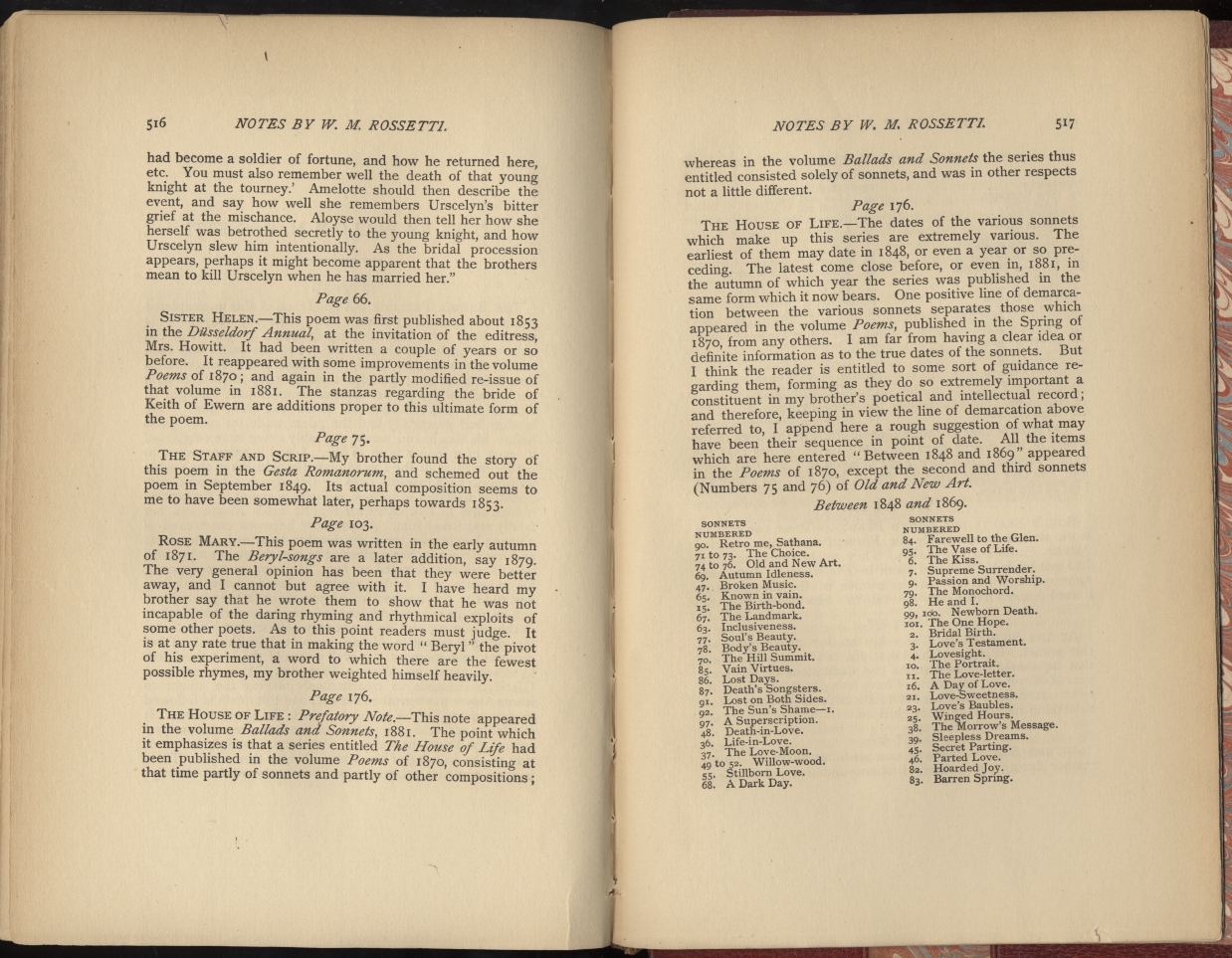
etc. You must also remember well the death of that young
knight at the tourney.’ Amelotte should then describe the
event, and say how well she remembers Urscelyn's bitter
grief at the mischance. Aloyse would then tell her how she
herself was betrothed secretly to the young knight, and how
Urscelyn slew him intentionally. As the bridal procession
appears, perhaps it might become apparent that the brothers
mean to kill Urscelyn when he has married her.”
in the Düsseldorf Annual, at the invitation of the editress,
Mrs. Howitt. It had been written a couple of years or so
before. It reappeared with some improvements in the volume
Poems of 1870; and again in the partly modified re-issue of
that volume in 1881. The stanzas regarding the bride of
Keith of Ewern are additions proper to this ultimate form of
the poem.
this in the Gesta Romanorum, and schemed out the
poem in September 1849. Its actual composition seems to
me to have been somewhat later, perhaps towards 1853.
of 1871. The Beryl-songs are a later addition, say 1879.
The very general opinion has been that they were better
away, and I cannot but agree with it. I have heard my
brother say that he wrote them to show that he was not
incapable of the daring rhyming and rhythmical exploits of
some other poets. As to this point readers must judge. It
is at any rate true that in making the word “Beryl” the pivot
of his experiment, a word to which there are the fewest
possible rhymes, my brother weighted himself heavily.
in the volume Ballads and Sonnets, 1881. The point which
it emphasizes is that a series entitled The House of Life had
been published in the volume Poems of 1870, consisting at
that time partly of sonnets and partly of other compositions; whereas in the volume Ballads and Sonnets the series thus
entitled consisted solely of sonnets, and was in other respects
not a little different.
which make up this series are extremely various. The
earliest of them may date in 1848, or even a year or so pre-
ceding. The latest come close before, or even in, 1881, in
the autumn of which year the series was published in the
same form which it now bears. One positive line of demarca-
tion between the various sonnets separates those which
appeared in the volume Poems, published in the Spring of
1870, from any others. I am far from having a clear idea or
definite information as to the true dates of the sonnets. But
I think the reader is entitled to some sort of guidance re-
garding them, forming as they do so extremely important a
constituent in my brother's poetical and intellectual record;
and therefore, keeping in view the line of demarcation above
referred to, I append here a rough suggestion of what may
have been their sequence in point of date. All the items
which are here entered “Between 1848 and 1869” appeared
in the Poems of 1870, except the second and third sonnets
(Numbers 75 and 76) of Old and New Art.
-
Between 1848
and
1869.
-
- SONNETS
- 90. Retro me, Sathana.
- 71 to 73. The Choice.
- 74 to 76. Old and New Art.
- 69. Autumn Idleness.
- 47. Broken Music.
- 65. Known in vain.
- 15. The Birth-bond.
- 67. The Landmark.
- 63. Inclusiveness.
- 77. Soul's Beauty.
- 78. Body's Beauty.
- 70. The Hill Summit.
- 85. Vain Virtues.
- 86. Lost Days.
- 87. Death's Songsters
- 91. Lost on Both Sides.
- 92. The Sun's Shame—I.
- 97. A Superscription.
- 48. Death-in-Love.
- 48. Death-in-Love.
- 36. Life-in-Love.
- 37. The Love-Moon.
- 49 to 52. Willow-wood.
- 55. Stillborn Love.
- 68. A Dark Day.
NUMBERED -
- SONNETS
- 84. Farewell to the Glen.
- 95. The Vase of Life.
- 6. The Kiss.
- 7. Supreme Surrender.
- 9. Passion and Worship.
- 79. The Monochord.
- 98. He and I.
- 99, 100. Newborn Death.
- 101. The One Hope.
- 2. Bridal Birth.
- 3. Love's Testament.
- 4. Lovesight.
- 10. The Portrait.
- 11. The Love-letter.
- 16. A Day of Love.
- 21. Love-Sweetness.
- 23. Love's Baubles.
- 25. Winged Hours.
- 38. The Morrow's Message.
- 39. Sleepless Dreams.
- 45. Secret Parting.
- 46. Parted Love.
- 82. Hoarded Joy.
- 83. Barren Spring.
NUMBERED
-
Between 1870
and
1881.
-
- SONNETS
- 29. The Moonstar.
- 30. Last Fire.
- 31. Her Gifts.
- 32. Equal Troth.
- 33. Venus Victrix.
- 34. The Dark Glass.
- 35. The Lamp's Shrine.
- 20. Gracious Moonlight.
- 1. Love Enthroned.
- 5. Heart's Hope.
- 8. Love's Lovers.
- 12. The Lovers' Walk.
- 13. Youth's Antiphony.
- 14. Youth's Spring-tribute.
- 17. Beauty's Pageant.
- 18. Genius in Beauty.
- 19. Silent Noon.
- 22. Heart's Haven.
- 26. Mid-Rapture.
- 27. Heart's Compass.
- 28. Soul-light.
- 42. Hope overtaken.
NUMBERED -
- SONNETS
- 43. Love and Hope.
- 44. Cloud and Wind.
- 53. Without Her.
- 54. Love's Fatality.
- 80. Love Dawn to Noon.
- 96. Life the Beloved.
- 40. Severed Selves.
- 41. Through Death to Love.
- 60. Transfigured Life.
- 66. The Heart of the Night.
- 81. Memorial Thresholds.
- 88. Hero's Lamp.
- 89. The Trees of the Garden.
- 93. The Sun's Shame—2.
- 61. The Song Throe.
- 62. The Soul's Sphere.
- 64. Ardour and Memory.
- 66 to 68. True Woman.
- 69. Love's Last Gift.
- 70. Introductory Sonnet.
- 24. Pride of Youth.
- 94. Michelango's Kiss.
NUMBERED
friend of his closing days, Mr. Hall Caine, shows that the
author regarded Still-born Love, Known in Vain, Lost Days,
and The One Hope (Nos. 55, 65, 86, and 101), as about the
best of the series.
a.2-1867.i92 were written respectively for Rossetti's pictures entitled
Sibylla Palmifera and Lilith. They might therefore, if he
had not himself embodied them in The House of Life, have
appeared appropriately in the section of the present book
named Sonnets and Verses for Rossetti's own Works of Art.
this sonnet. It is not of his best; yet, as it openly proclaims
that he shared the aspirations and exultations of the great
year of European revolution, I have thought the personal in-
terest attaching to the sonnet to be such as to entitle it to
something better than final oblivion.
reuther during my brother's lifetime, and was published in
that form—though not otherwise. I have therefore felt no
hesitation in including it among his collected works. As to
the next following lyric, The Lady's Lament, which had
hitherto been wholly unpublished, I did hesitate; but I
finally admitted it, as being a somewhat marked performance
of its class. The class is the same as with the Autumn
Song; each being the utterance of a dreamy or indeed
morbid mood of desolation to which the youth of our modern
generations is prone.
I have often seen the supposition advanced that this poem
was written after the death of his wife, in relation to some
portrait he had painted of her during her lifetime. The
supposition is very natural — yet not correct. The poem
was in fact an extremely early one, and purely imaginary,—
perhaps, in the first draft of it, as early as 1847; it was after-
wards considerably revised.
was written in 1849, or perhaps 1848. It refers to the apathy
with which other countries witnessed the national struggles
of Italy and Hungary against Austria.
my brother undertook this trip along with Mr. Holman Hunt.
He wrote the verses mostly while actually travelling by rail
etc., and sent them in his letters to me. Under the above
heading I have pieced together such portions of his verse-
missives as appear to me worthy of preservation in the present
form. Much the same observation applies to the two ensuing
sonnets, The Staircase of Notre Dame, Paris, and On
Leaving Bruges; and to the lyric, Near Brussels, A
Halfway Pause. The sonnet, Place de la Bastille, Paris,
belongs to the same series; it is only one of the set which
my brother published in one of his volumes ( Ballads and
Sonnets ). The lyric Antwerp and Bruges is an altered
version (as I find it in his own MS.) of The Carillon , which
was printed in The Germ.
published, was written in 1849. My brother wrote it to serve
as a pendent to a sonnet of my own composition which was
published in The Germ, 1850, under the vague title The Evil
under the Sun (“How long, O Lord,” etc.). That title was
vamped up to appease the publisher's nervousness; the
sonnet being in fact written by me as a sorrowful com-
memoration of the collapse—the temporary collapse, as we
now know it to have been—of various revolutionary move-
ments in Europe, especially that of Hungary. My own title
for the sonnet was On the General Oppression of the Better
by the Worse Cause, October 1849. The sonnet has of late
years been more than once republished under a more general-
ized title, Democracy Downtrodden . I mention these facts,
not to thrust my own performance into notice, but to bring
out the more clearly the precise point of view which marks
my brother's sonnet.
brother in the volume Ballads and Sonnets. It was written
as one of a brace of sonnets. He never published the second;
but this is to be found in an article, Dante Gabriel Rossetti,
by Mr. Gosse, printed in The Century Magazine in 1882. I
am rather reluctant to miss out that second sonnet; but, as
my brother saw fit to leave it unused when he gave publicity
to the first, I have decided to conform.
lished this snatch of verse, but he had a certain liking for it,
and I think it should now find a niche among his works.
by my brother, “Between Ightham and Sevenoaks, Novem-
ber 1850.”
books I find the following entry: “When printing in 1870, I
omitted the piece on Wellington's Funeral as referring to so
recent a date; but year by year such themes become more
dateless, and rank only with immortal things.”
had this sonnet printed long ago, but never published it ex-
cept in the Academy for 15 February 1871. In the last line
he substituted (in MS.) the word “Starveling's” for “tailor's”;
and I remember he once told me that his real reason for not
publishing the sonnet in either of his volumes was to avoid
hurting the feelings of some sensitive member or members
of the tailoring craft who might dislike the line in its original
wording. This point is referred to in a letter addressed by
my brother to Mr. Hall Caine, and published in that gentle-
man's Recollections of Dante Gabriel Rossetti.
hitherto appeared only in Mr. Caine's volume above-men-
tioned. My brother had offered it for the collection, Sonnets
of Three Centuries , compiled by Mr. Caine; but it dropped
out of that book, as being little in harmony with the other
contributions therein by Rossetti. The sonnet was written
many years prior to the date of either of Mr. Caine's
volumes.
lished. I regard it as addressed to Miss Siddal, whom my
brother married in 1860. Its date may probably have been
1854.
in Mr. William Sharp's book, Dante Gabriel Rossetti, a
Record and a Study. In line 4 he gives the word “sight.” In the MS. in my own possession I find “light” instead;
but I incline to think that Mr. Sharp's version is correct.
lished in Mr. Caine's Sonnets of Three Centuries.
sonnet, hitherto unpublished—perhaps the earliest of all the
Sonnets on Pictures.
Marriage of St. Catherine, by the Same .—These sonnets
were published in The Germ; I have thought it, on the whole,
better to admit them here. A few verbal alterations are
made on MS. authority.
relate was the first oil-painting, 1848-49, completed by my
brother. The concluding lines of sonnet I, “She woke in
her white bed” etc., have a more direct connection, however,
with his second picture, The Annunciation (or Ecce Ancilla
Domini ) , now in the National Gallery. Sonnet 2 was in-
scribed by my brother on the frame of his first picture. He
never published it otherwise; but it has been given in Mr.
Sharp's book, Dante Gabriel Rossetti, etc.
drawings of this subject of invention, diverse in composition.
He contemplated carrying out the subject in a large picture,
which was never executed; I am not certain whether a water-
colour of it was produced or not. He took some pains over
the wording of the illustrative verse, but never published it.
I think it deserves a place here, if merely as appertaining to
one of his own designs. See also the prose narrative under
the same title, p. 439.
of the picture entitled Mnemosyne, or the Lamp of Memory.
is certainly my brother's own composition—the Italian as well
as the English version. I have seen his MS. of it, replete
with alterations. In all the instances in which he wrote a
composition in the two languages, the Italian was, I think, the
first, and the English the second.
Bella Mano, might have been included in the section Sonnets
and Verses for Rossetti's own Works of Art. The fact of
their being written in Italian as well as English has guided
me, however, to a different arrangement.
equivalent—and also the preceding Italian triplet with the like
—may, I think, have been written to serve as motto for some
picture; I could not say which.
hitherto been published; nor yet the Bambino Fasciato nor
La Ricordanza.
MSS. that I have become aware of his having ventured thus
into the realm of Latin verse. I find the little composition
written out more than once, and with alterations of diction
which convince me that it must be his own composition. It
was intended to appear in a “lyrical tragedy,” The Doom of
the Sirens , of which he wrote out the scheme. See p. 431.
among various jottings in my brother's notebooks. The first
item, named The Orchard-Pit, is all that I can find written of
a poem which was long and seriously projected: the argument
of the poem appears printed now among the Prose works.
Of the other items I need perhaps say nothing, unless it be
this—that, slight as they are, they appear to me worthy

of preservation, on one ground or another. I do not think
that any of the Versicles and Fragments belong to my brother's
earlier period.
may rank as the most considerable prose-writing by Rossetti
apart from what appears in The Early Italian Poets—was
written in December 1849, almost entirely in one night,
or rather earliest morning (see Mr. Caine's Recollections
of Dante Gabriel Rossetti , p. 134). It is purely a work of
imagination; there never was a Chiaro dell' Erma, nor a Dr.
Aemmster, nor the rest of them. The story was published in
The Germ; and I have heard of more than one admirer of it
who made enquiry in Florence or Dresden after the pictures
of Chiaro—of course with no result save disappointment. The
statement on page 395, “In the spring of 1847 I was at
Florence,” is also fictitious, though it has sometimes been
cited as showing (contrary to the general and correct state-
ment) that Rossetti had once at least been in Italy.
I think, no unworthy pendent to Hand and Soul. It does
not seem to be intended to bear an equal weight of moral or
spiritual significance; but is not less imaginative, and its
style of writing, if simpler and less resolutely sustained,
seems to me fully as noticeable and individual. I incline to
think that it was begun before Hand and Soul—in 1849, or
even 1848; and was continued from time to time, probably
into the spring of 1850. My brother intended to publish it in
The Germ ; and would doubtless have done so, had that
magazine been less short-lived. He began an etching to
illustrate it; but threw this aside in disgust at his failure in
technique. Sir John Millais then undertook to execute the
etching. His production was included in the great Millais
Exhibition at the Grosvenor Gallery in 1886, and manifestly
represents the hero of the story painting the portrait of his
affianced bride during her mortal illness. This, therefore, is
clearly shown to be the intended finale of the tale; as indeed
one might readily divine from that portion of it which was
written. At a later date Rossetti himself painted the like
incident, in its mediæval phase, under the title of Bonifazio's
Mistress . The written portion may be surmised to constitute
less than half of the projected whole: my brother, according
to Mr. Caine, indicated, in talking to that gentleman, that it
would only be about a third. At some much later date, per-
haps towards 1870, my brother turned his thoughts again to
this tale, and transcribed the earlier pages of it; and he again
paid some attention to it in the last two or three months of
his life, but without writing anything additional, or even re-
vising the extant portion. The reader may observe that the
name in the title, St. Agnes of Intercession, does not re-appear
in the course of the story, where the picture itself comes to
be spoken of: it was only adopted towards the time when the
beginning of the tale was transcribed. My brother also
intended to substitute the name “Davanzati” for “Angio-
lieri”; but (in order to avoid tampering with an untranscribed
passage printed at the close of our p. 408) I have found it
requisite to retain “Angiolieri.” Something in the nature
of actual reminiscence may be traced in the opening details;
as that of our father singing old revolutionary and other
songs, and of the author leaving school early to study the
painter's art. The motto from Tristram Shandy would not,
I believe, be discoverable upon the most diligent turning-over
of the pages of that now too seldom read classic, which fasci-
nated my brother greatly at a date not much earlier than the
commencement of this tale: I regard it as his own.
following paragraph—discarded when my brother made his
transcript towards 1870. I preserve it here, as being, in its
dim way, a true sketch of our father. Where I write “Italy,”
my brother wrote “Poland,” or afterwards “ France.” “ My
father had settled in England only a few years before I was
born to him. He was one of that vast multitude of exiles
who, almost from lustrum to lustrum for a season of nearly a
century, have been scattered from Italy over all Europe—over
the world indeed. Few among these can have less of riches
than he had, wherein to seek happiness; but I believe that
there are still fewer who could be so happy as he was, with-
out riches, in exile and labour.”
cession —say 1851, and again towards 1855, to judge by the
character of the handwriting—that Rossetti began another
story of the fantastic or supernatural, entitled Deuced Odd, or
The Devil's in it. I have forgotten, or perhaps never knew,
what the narrative was to be: it relates to an actor in the
walk of legitimate drama. The fragment which remains of
this story, and I think no more was ever written, is so scanty,
and exhibits so little of the main purport, that I leave it un-
printed. Perhaps the idea may have been somewhat, yet
only remotely, like that of a tale published in Hood's
Magazine , in which the devil appears on the boards, acting
his own part in Der Freischütz or some such stage-piece; I
can well remember that both my brother and I, reading that
tale towards 1845, thought it extremely clever and effective.
The author remains to me unknown.
with a view to the composition of a poem: see p. 377. It
dates towards 1871.
schemed out this “lyrical tragedy” with a feeling that it
might really be made to constitute the words ( libretto) of a
musical opera. He regarded the project indeed with some
eagerness at one time: he had not, I fancy, any clearly de-
fined idea as to a musician to co-operate with him, but thought
vaguely of our friend Dr. Franz Hueffer. The date of the
composition may be nearly the same as that of The Orchard
Pit , but rather later.
the verses bearing the same title. The present project of a
poem, or perhaps rather of a prose-story, is entirely different
in its incidents from any of the designs which he made of
Michael Scott's Wooing—so far at least as my knowledge
of them extends. From the character of the handwriting I
judge this skeleton-narrative to be two or three years later
than The Orchard Pit, etc.
Life of Blake by Alexander Gilchrist, edition of 1880: the
large majority of them appeared also in the original edition,
1863. I need only say here that my brother knew, and had
a very sincere regard for, Mr. Gilchrist, who died in 1861, as
he was nearing the close of his excellent and now widely
appreciated labours on the Life. Rossetti supplied him with
some important materials, but not with any contributory
writing of his own. After Gilchrist's death, his widow also
worked to very good purpose upon the task; but she
thought it desirable to avail herself of my brother's assist-
ance in certain defined portions of the subject, especially the
arranging and editing of the poems. I here give the remarks
of my brother upon the poems; preceded by his “supple-
mentary chapter” to the Life, and followed by his comments
upon the Designs to the Book of Job, and upon certain points
connected with the designs to the Jerusalem. Part of this
last section ( Jerusalem) belongs only to the edition of 1880.
In the “supplementary chapter” a few of the opening phrases
must, I consider, be Mr. Gilchrist's own: I have not been at
the pains of detaching them. Nothing else of any substantial
bulk or importance was written by my brother for Gilchrist's
book. The present owner of the copyright handsomely
made me free to reproduce my brother's contribution in the
present form.
1870. This was an answer to a question asked by Mr. Gled-
stanes-Waugh.
reply to The Fleshly School of Poetry, was published in the
Athenæum for 16 December 1871. The Fleshly School of
Poetry was (as observed in my Preface) an article in the
Contemporary Review written by Mr. Robert Buchanan, and
published under the pseudonym “Thomas Maitland.” Subse-
quently to the printing of my brother's rejoinder, the Contem-
porary article was enlarged by its author, and re-issued in
pamphlet-form. Mr. Buchanan has since publicly admitted
that it was totally unjust to Rossetti: whether it was or was
not (even apart from its pseudonymity) a profligate act of
literary spite under the disguise of moral purism is a ques-
tion which I leave to the judgment of others. Having been
revoked, be the act condoned—so far at least as I am con-
cerned. My brother refers prominently to a sonnet in The
House of Life named Nuptial Sleep: this point also is
touched upon in my Preface. Later on in the article he
adverts to sonnets 29, 30, 31, 39, 40, 41, and 43. In the
present arrangement of The House of Life , these are sonnets
63, Inclusiveness, 65, Known in Vain, 67, The Landmark,
85, Vain Virtues, 86, Lost Days, 87, Death's Songsters, and
91, Lost on Both Sides.
comes from the Academy of 1 February 1871. The ensu-
ing critique, of the same author's Parables and Tales, is
from the Fortnightly Review, April 1873.
brother's note-books. The only date which I have given,
1866, may be about the earliest date of any of these jottings.
They go on till towards the close of his life.
![Image of page [530]](http://www.rossettiarchive.org/img/1-1886.1ed.v1.end1.jpg)
![Image of page [532]](http://www.rossettiarchive.org/img/1-1886.1ed.v1.end2.jpg)