Rossetti Archive Textual Transcription
The full Rossetti Archive record for this transcribed document is available.

FROM CIULLO D'ALCAMO TO
DANTE ALIGHIERI
(1100-1200-1300)
IN THE ORIGINAL METRES
TOGETHER WITH DANTE'S VITA NUOVA
TRANSLATED BY D. G. ROSSETTI
Part I. Poets chiefly before Dante
Part II. Dante and his Circle
LONDON:
SMITH, ELDER AND CO. 65, CORNHILL.
1861.
The rights of translation and reproduction, as regards all editorial parts
of this work, are reserved.
WHATEVER IS MINE IN THIS BOOK
IS INSCRIBED TO MY WIFE.
the first epoch of Italian Poetry; since the extent
of my translated selections is sufficient to afford a
complete view of it. Its great beauties may often
remain unapproached in the versions here attempted;
but, at the same time, its imperfections are not all
to be charged to the translator. Among these I may
refer to its limited range of subject and continual
obscurity, as well as to its monotony in the use of
rhymes or frequent substitution of assonances. But
to compensate for much that is incomplete and in-
experienced, these poems possess, in their degree,
beauties of a kind which can never again exist in art;
and offer, besides, a treasure of grace and variety in
the formation of their metres. Nothing but a strong
impression, first of their poetic value, and next of
the biographical interest of some of them (chiefly
of those in my second division), would have inclined
me to bestow the time and trouble which have re-
sulted in this collection.
against the value of metrical translation. But I think
it would be admitted that the tributary art might
find a not illegitimate use in the case of poems which
come down to us in such a form as do these early
Italian ones. Struggling originally with corrupt
dialect and imperfect expression, and hardly kept
alive through centuries of neglect, they have reached
that last and worst state in which the coup-de-grace
has almost been dealt them by clumsy transcription
and pedantic superstructure. At this stage the task
of talking much more about them in any language
is hardly to be entered upon; and a translation (in-
volving, as it does, the necessity of settling many
points without discussion,) remains perhaps the most
direct form of commentary.
a good poem shall not be turned into a bad one.
The only true motive for putting poetry into a fresh
language must be to endow a fresh nation, as far as
possible, with one more possession of beauty. Poetry
not being an exact science, literality of rendering is
altogether secondary to this chief aim. I say literality,
—not fidelity, which is by no means the same thing.
When literality can be combined with what is thus
the primary condition of success, the translator is
fortunate, and must strive his utmost to unite them;
when such object can only be attained by paraphrase,
that is his only path.
rived from an effort to follow this principle; and, in
some degree, from the fact that such painstaking in
arrangement and descriptive heading as is often
indispensable to old and especially to “occasional”
poetry, has here been bestowed on these poets for the
first time.
or that the above merit is their defect, or that they have
no merits but only defects, are discoveries so sure to be
made if necessary (or perhaps here and there in any
case), that I may safely leave them in other hands.
The collection has probably a wider scope than some
readers might look for, and includes now and then
(though I believe in rare instances) matter which
may not meet with universal approval; and whose
introduction, needed as it is by the literary aim of
my work, is I know inconsistent with the principles
of pretty bookmaking. My wish has been to give
a full and truthful view of early Italian poetry;
not to make it appear to consist only of certain
elements to the exclusion of others equally belonging
to it.
causes of imperfections for which I have no other
excuse,—it is the reader's best privilege to remain
ignorant; but I may perhaps be pardoned for briefly
referring to such among these as concern the exi-
gencies of translation. The task of the translator
(and with all humility be it spoken) is one of some
self-denial. Often would he avail himself of any
special grace of his own idiom and epoch, if only his
will belonged to him: often would some cadence
serve him but for his author's structure—some struc-
ture but for his author's cadence: often the beautiful
turn of a stanza must be weakened to adopt some
rhyme which will tally, and he sees the poet revelling
in abundance of language where himself is scantily
supplied. Now he would slight the matter for the
music, and now the music for the matter; but no,
he must deal to each alike. Sometimes too a flaw
in the work galls him, and he would fain remove it,
doing for the poet that which his age denied him;
but no,—it is not in the bond. His path is like that
of Aladdin through the enchanted vaults: many are
the precious fruits and flowers which he must pass
by unheeded in search for the lamp alone; happy
if at last, when brought to light, it does not prove
that his old lamp has been exchanged for a new one,—
glittering indeed to the eye, but scarcely of the same
virtue nor with the same genius at its summons.
is the only contribution I expect to make to our
English knowledge of old Italy), I feel, as it were,
divided from my youth. The first associations I
have are connected with my father's devoted studies,
which, from his own point of view, have done so
much towards the general investigation of Dante's
writings. Thus, in those early days, all around me
partook of the influence of the great Florentine; till,
from viewing it as a natural element, I also, growing
older, was drawn within the circle. I trust that
from this the reader may place more confidence in a
work not carelessly undertaken, though produced in
the spare-time of other pursuits more closely followed.
He should perhaps be told that it has occupied the
leisure moments of not a few years; thus affording,
often at long intervals, every opportunity for consi-
deration and revision; and that on the score of care,
at least, he has no need to mistrust it.
be made by launching afresh, on high-seas busy
with new traffic, the ships which have been long
outstripped and the ensigns which are grown strange.
The feeling of self-doubt inseparable from such an
attempt has been admirably expressed by a great
living poet, in words which may be applied exactly
to my humbler position, though relating in his case
to a work all his own.
- “Still, what if I approach the august sphere
- Named now with only one name,—disentwine
- That under current soft and argentine
- From its fierce mate in the majestic mass
- Leaven'd as the sea whose fire was mix'd with glass
- In John's transcendent vision,—launch once more
- That lustre? Dante, pacer of the shore
- Where glutted Hell disgorges filthiest gloom,
- Unbitten by its whirring sulphur-spume—
- Or whence the grieved and obscure waters slope
- Into a darkness quieted by hope—
- Plucker of amaranths grown beneath God's eye
- In gracious twilights where His chosen lie,—
- I would do this! If I should falter now!....”
a list of the works which have chiefly contributed to
the materials of the present volume.
- I. Poeti del primo secolo della Lingua Ita-
liana. 2 vol. (Firenze. 1816.) - II. Raccolta di Rime antiche Toscane. 4 vol.
(Palermo. 1817.) - III. Manuale della Letteratura del primo Secolo.
del Prof. V. Nannucci. 3 vol. (Firenze. 1843.) - IV. Poesie Italiane inedite di dugento autori:
raccolte da Francesco Trucchi. 4 vol. (Prato.
1846.)* - V. Opere Minori di Dante. Edizione di P. I.
Fraticelli. (Firenze. 1843, &c.) - VI. Rime di Guido Cavalcanti; raccolte da A.
Cicciaporci. (Firenze. 1813.) - VII. Vita e Poesie di Messer Cino da Pistoia.
Edizione di S. Ciampi. (Pisa. 1813.) - VIII. Documenti d'Amore; di Francesco da
Barberino. Annotati da F. Ubaldini. (Roma.
1640.) - IX. Del Reggimento e dei Costumi delle Donne;
di Francesco da Barberino. (Roma. 1815.) - X. Il Dittamondo di Fazio degli Uberti. (Milano.
1826.)
* This work contains, in its first and second volumes, by
far the best edited collection I know of early Italian poetry.
Unfortunately it is only a supplement to the previous ones,
giving poems till then unpublished. A reprint of the whole
mass by the same editor, with such
revision and further
additions as he could give it, would be very desirable.
-
PART I. POETS CHIEFLY BEFORE DANTE.
- TABLEof Poets in Part I. . . . . . . . xxiii
-
-
Guido Guinicelli.
- Sonnet. Concerning Lucy . . . . . . . . 23
- Canzone. Of the Gentle Heart . . . . . . 24
- Sonnet. He will praise his Lady . . . . . . 27
-
Canzone.
He perceives his Rashness in Love, but
has no choice . . . . . . . . . . . 28 - Sonnet. Of Moderation and Tolerance . . . . 30
- Sonnet. Of Human Presumption . . . . . . 31
-
-
Jacopo da Lentino.
- Sonnet. Of his Lady in Heaven . . . . . . 41
- Canzonetta. Of his Lady, and of her Portrait . 42
- Sonnet. No Jewel is worth his Lady . . . . . 45
-
Canzonetta.
He will neither boast nor lament to
his Lady . . . . . . . . . . . . . 46 -
Canzonetta.
Of his Lady, and of his making her
Likeness . . . . . . . . . . . . . 49 - Sonnet. Of his Lady's Face . . . . . . . 52
- Canzone. At the end of his Hope . . . . . . 53
-
-
Fazio degli Uberti.
-
Canzone.
His Portrait of his Lady Angiola of
Verona . . . . . . . . . . . . . 162 -
Extract from the “Dittamondo.”
Of England
and of its Marvels . . . . . . . . . . 166 -
Extract from the “Dittamondo.”
Of the Dukes
of Normandy, and thence of the Kings of England,
from William I. to Edward III. . . . . . 171
-
Canzone.
His Portrait of his Lady Angiola of
-
-
Anonymous Poems.
-
Sonnet.
A Lady laments for her lost Lover, by
similitude of a Falcon . . . . . . . . 181 - Ballata. One speaks of the Beginning of his Love 182
- Ballata. One speaks of his false Lady . . . . 183
- Ballata. One speaks of his feigned and real Love 184
- Ballata. Of True and False Singing . . . . 186
-
Sonnet.
A Lady laments for her lost Lover, by
-
PART II. DANTE AND HIS CIRCLE.
- Introduction to Part II. . . . . . . . . . 189
-
-
Dante Alighieri.
- The New Life. ( La Vita Nuova.) . . . . . 223
-
Sonnet (to Brunetto Latini).
Sent with the
Vita Nuova . . . . . . . . . . . . 310 -
Sonnet.
Of Beatrice de' Portinari, on All Saint's
Day . . . . . . . . . . . . . . 311 -
Sonnet.
To certain Ladies; when Beatrice was
lamenting her Father's Death . . . . . . 312 - Sonnet. To the same Ladies; with their Answer . 313
- Ballata. He will gaze upon Beatrice . . . . 314
-
Canzone.
He beseeches Death for the Life of Bea-
trice . . . . . . . . . . . . . . 315 - Sonnet. On the 9th of June, 1290 . . . . . 318
-
Sonnet (to Cino da Pistoia).
He rebukes Cino
for Fickleness . . . . . . . . . . . 319 - Sonnet (to Cino da Pistoia). Written in Exile. 321
- Sonnet. Of Beauty and Duty . . . . . . . 323
- Sestina. Of the Lady Pietra degli Scrovigni . . 324
- Sonnet. To the Lady Pietra degli Scrovigni . . 327
-
Sonnet (to Guido Cavalcanti).
He imagines a
pleasant voyage for Guido, Lapo Gianni, and
himself, with their three Ladies . . . . . . 340 -
Sonnet (to Giovanni Quirino).
He answers the
foregoing Sonnet (by Quirino); saying what he
feels at the approach of Death . . . . . . 436
-
-
Guido Cavalcanti.
-
Sonnet (to Dante Alighieri).
He interprets
Dante's Dream, related in the first Sonnet of the
Vita Nuova . . . . . . . . . . . 328 - Sonnet. To his Lady Joan, of Florence . . . . 329
-
Sonnet.
He compares all things with his Lady, and
finds them wanting . . . . . . . . . 330 - Sonnet. A Rapture concerning his Lady . . . 331
- Ballata. Of his Lady among other Ladies . . . 332
-
Sonnet (to Guido Orlandi).
Of a consecrated
Image resembling his Lady . . . . . . . 333 -
Sonnet.
Of the Eyes of a certain Mandetta, of Thou-
louse, which resemble those of his Lady Joan of
Florence . . . . . . . . . . . . . 336 -
Ballata.
He reveals, in a Dialogue, his increasing
love for Mandetta . . . . . . . . . . 337 -
Sonnet (to Dante Alighieri).
He answers the
foregoing Sonnet (by Dante), speaking with
shame of his changed Love . . . . . . . 341 -
Sonnet (to Dante Alighieri).
He reports, in a
feigned Vision, the successful issue of Lapo
Gianni's Love . . . . . . . . . . . 342 -
Sonnet (to Dante Alighieri).
He mistrusts the
love of Lapo Gianni . . . . . . . . . . 343 - Sonnet. On the Detection of a false Friend . . 344
- Sonnet. He speaks of a third Love of his . . . 345
- Ballata. Of a continual Death in Love . . . . 346
- Sonnet. To a Friend who does not pity his Love . 347
-
Ballata.
He perceives that his highest Love is gone
from him . . . . . . . . . . . . . 348 - Sonnet. Of his Pain from a new Love . . . . 350
-
Sonnet (to Bernardo da Bologna).
He answers
Bernardo, commending Pinella, and saying
that the Love he can offer her is already shared by
many noble Ladies . . . . . . . . . . 354 -
Sonnet (to Guido Orlandi).
In Praise of Guido
Orlandi's Lady . . . . . . . . . . . 356 -
Sonnet (to Dante Alighieri).
He rebukes Dante
for his way of Life after the Death of Beatrice. 358 - Ballata. Concerning a Shepherd-maid . . . . 359
- Sonnet. Of an ill-favoured Lady . . . . . . 361
-
Sonnet.
To a newly-enriched Man; reminding him
of the wants of the Poor . . . . . . . . 362 -
Sonnet (to Pope Boniface VIII).
After the
Pope's Interdict, when the Great Houses were
leaving Florence . . . . . . . . . . 363 - Ballata. In Exile at Sarzana . . . . . . . 364
- Canzone. A Song of Fortune . . . . . . . 366
- Canzone. A Song against Poverty . . . . . 370
-
Canzone.
He laments the Presumption and Incon-
tinence of his Youth . . . . . . . . . 373 - Canzone. A Dispute with Death . . . . . . 377
-
Sonnet (to Dante Alighieri).
He interprets
-
-
Cino da Pistoia.
-
Sonnet (to Dante Alighieri).
He answers Dante,
confessing his unsteadfast Heart . . . . . 320 -
Sonnet (to Dante Alighieri).
He answers the
foregoing Sonnet (by Dante), and prays him, in
the name of Beatrice, to continue his great Poem 322 -
Sonnet (to Dante Alighieri).
He interprets
Dante's Dream related in the first Sonnet of the
Vita Nuova . . . . . . . . . . . . 381 -
Canzone (to Dante Alighieri).
On the Death
of Beatrice Portinari . . . . . . . . . 382 -
Sonnet (to Dante Alighieri).
He conceives of
some Compensation in Death . . . . . . 385 -
Madrigal.
To his Lady Selvaggia Vergiolesi;
likening his Love to a search for Gold . . . 386 - Sonnet. To Love, in great Bitterness . . . . 387
- Sonnet. Death is not without but within him . . 388
- Sonnet. A Trance of Love . . . . . . . . 389
-
Sonnet.
Of the Grave of Selvaggia, on the Monte
della Sambuca . . . . . . . . . . . 390 - Canzone. His Lament for Selvaggia . . . . . 391
-
Sonnet (to Guido Cavalcanti).
He owes nothing
to Guido as a Poet . . . . . . . . . 393 -
Sonnet.
He impugns the verdicts of Dante's Com-
media . . . . . . . . . . . . .. 394 -
Sonnet.
He condemns Dante for not naming, in the
Commedia, his friend Onesto di Boncima, and his
Lady Selvaggia . . . . . . . . . . . 395
-
Sonnet (to Dante Alighieri).
He answers Dante,
-
-
Dante da Maiano.
-
Sonnet (to Dante Alighieri).
He interprets
Dante Alighieri's Dream, related in the first
Sonnet of the Vita Nuova . . . . . . . 396 - Sonnet. He craves interpreting of a Dream of his. 397
- Sonnet. To his Lady Nina, of Sicily . . . . 400
-
Sonnet.
He thanks his Lady for the Joy he has had
from her . . . . . . . . . . . . . 401
-
Sonnet (to Dante Alighieri).
He interprets
-
-
Cecco Angiolieri, da Siena.
-
Sonnet (to Dante Alighieri).
On the last Son-
net of the Vita Nuova . . . . . . . . . 402 - Sonnet. He will not be too deeply in Love . . . 403
- Sonnet. Of Love in Men and Devils . . . . . 404
- Sonnet. Of Love, in honour of his Mistress Becchina 405
- Sonnet. Of Becchina the Shoemaker's Daughter . 406
- Sonnet. To Messer Angiolieri, his Father . . . 407
- Sonnet. Of the 20th June, 1291 . . . . . . 408
- Sonnet. In absence from Becchina . . . . . 409
- Sonnet. Of Becchina in a Rage . . . . . . 410
-
Sonnet.
He rails against Dante, who had censured
his homage to Becchina . . . . . . . . 411 - Sonnet. Of his Four Tormentors . . . . . . 412
- Sonnet. Concerning his Father . . . . . . 413
- Sonnet. Of all he would do . . . . 414
- Sonnet. He is past all Help . . . . . . . 415
- Sonnet. Of why he is unhanged . . . . . . 416
- Sonnet. Of why he would be a Scullion . . . . 417
- Sonnet. He argues his case with Death . . . . 418
- Sonnet. Of Becchina, and of her Husband . . . 419
- Sonnet. On the Death of his Father . . . . . 420
- Sonnet. He would slay all who hate their Fathers 421
-
Sonnet (to Dante Alighieri).
He writes to
Dante, then in exile at Verona, defying him as
no better than himself . . . . . . . . . 422
-
Sonnet (to Dante Alighieri).
On the last Son-
-
-
Guido Orlandi.
-
Mandrigal (to Guido Cavalcanti).
In answer
to the foregoing Sonnet (by Cavalcanti) . . . 334 -
Prolonged Sonnet (to Guido Cavalcanti).
He
finds fault with the Conceits of the foregoing
Sonnet (by Cavalcanti) . . . . . . . . 351 -
Sonnet (to Guido Cavalcanti).
He answers the
foregoing Sonnet (by Cavalcanti), declaring
himself his Lady's Champion . . . . . . 357 -
Sonnet (to Dante da Maiano).
He interprets the
Dream related in the foregoing Sonnet (by
Dante da Maiano) . . . . . . . . . 398 - Sonnet. Against the “White” Ghibellines . . . 423
-
Mandrigal (to Guido Cavalcanti).
In answer
-
APPENDIX TO PART II.
-
-
I. Forese Donati.—Cecco d'Ascoli . . . . . . 437
-
Sonnet (Dante to Forese).
He taunts Forese
by the nickname of Bicci . . . . . . . . 439 -
Sonnet (Forese to Dante).
He taunts Dante
ironically for not avenging Geri Alighieri . . 440 -
Sonnet (Dante to Forese).
He taunts him con-
cerning his Wife . . . . . . . . . . 440 -
Sonnet (Forese to Dante).
He taunts him con-
cerning the unavenged Spirit of Geri Alighieri . 441
-
Sonnet (Dante to Forese).
He taunts Forese
-
-
II. Giovanni Boccaccio . . . . . . . . . . 446
-
Sonnet.
To one who had censured his public Ex-
position of Dante . . . . . . . . . . 447 - Sonnet. Inscription for a Portrait of Dante . . 447
-
Sonnet.
To Dante in Paradise, after Fiammetta's
death . . . . . . . . . . . . . . 448 - Sonnet. Of Fiammetta singing . . . . . . 449
- Sonnet. Of his last Sight of Fiammetta. . . . 449
- Sonnet. Of three Girls and of their Talk . . . 450
-
Sonnet.
To one who had censured his public Ex-
- I.
-
Ciullo is a popular form of the name Vin-
cenzo, and Alcamo an Arab fortress some miles
from Palermo. The Dialogue which is the only
known production of this poet holds here the place
generally accorded to it as the earliest Italian poem
(exclusive of one or two dubious inscriptions) which
has been preserved to our day. Arguments have
sometimes been brought to prove that it must be as-
signed to a later date than the poem by Folcachiero,
which follows it in this volume; thus ascribing the
first honours of Italian poetry to Tuscany, and not
to Sicily, as is commonly supposed. Trucchi, how-
ever, (in the preface to his valuable collection,)
states his belief that the two poems are about con-
temporaneous, fixing the date of that by Ciullo
between 1172 and 1178,—chiefly from the fact that
the fame of Saladin, to whom this poet alludes, was
most in men's mouths during that interval. At first
sight, any casual reader of the original would sup-
pose that this poem must be unquestionably the
earliest of all, as its language is far the most un-
formed and difficult; but much of this might, of course,
be dependent on the inferior dialect of Sicily, mixed
however in this instance (as far as I can judge)
with mere nondescript patois. II. Folcachiero de' Folcachieri, Knight of
-
The above date has been assigned with probabi-
lity to Folcachiero's Canzone, on account of its first
line where the whole world is said to be “living
without war;” an assertion which seems to refer
its production to the period of the celebrated peace
concluded at Venice between Frederick Barbarossa
and Pope Alexander III. III. Lodovico della Vernaccia, 1200.IV. Saint Francis of Assisi; born, 1182, died,
-
His baptismal name was Giovanni, and his father
was Bernardone Moriconi, whose mercantile pur-
suits he shared till the age of twenty-five; after
which his life underwent the extraordinary change
which resulted in his canonization, by Gregory IX.,
three years after his death, and in the formation of
the Religious Order called Franciscans. V. Frederick II., Emperor; born, 1194,
-
The life of Frederick II., and his excommunica-
tion and deposition from the Empire by Innocent
IV., to whom, however, he did not succumb, are
matters of history which need no repetition. In-
tellectually, he was in all ways a highly-gifted and
accomplished prince; and lovingly cultivated the
Italian language, in preference to the many others
with which he was familiar. The poem of his which
I give has great passionate beauty; yet I believe
that an allegorical interpretation may here probably
be admissible; and that the lady of the poem may
be the Empire, or perhaps the Church herself, held
in bondage by the Pope. VI. Enzo, King of Sardinia; born, 1225,
-
The unfortunate Enzo was a natural son of Fre-
derick II., and was born at Palermo. By his own
warlike enterprise, at an early age (it is said at
fifteen!) he subjugated the Island of Sardinia, and
was made King of it by his father. Afterwards he
joined Frederick in his war against the Church,
and displayed the highest promise as a leader; but
at the age of twenty-five was taken prisoner by the
Bolognese, whom no threats or promises from the
Emperor could induce to set him at liberty. He
died in prison at Bologna, after a confinement of
nearly twenty-three years. A hard fate indeed for
one who, while moving among men, excited their
hopes and homage, still on record, by his great mili-
tary genius and brilliant gifts of mind and person. VII. Guido Guinicelli, 1220.
-
This poet, certainly the greatest of his time, be-
Vulgari Eloquio; and many instances might be
longed to a noble and even princely Bolognese family.
Nothing seems known of his life, except that he was
married to a lady named Beatrice, and that in 1274,
having adhered to the imperial cause, he was sent
into exile, but whither cannot be learned. He died
two years afterwards. The highest praise has been
bestowed by Dante on Guinicelli, in the Commedia,
(Purg. C. xxvi.) in the Convito, and in the De
cited in which the works of the great Florentine
contain reminiscences of his Bolognese predecessor;
especially the third canzone of Dante's Convito may
be compared with Guido's most famous one “On the
Gentle Heart.” VIII. Guerzo di Montecanti, 1220.IX. Inghilfredi, Siciliano, 1220.X. Rinaldo d'Aquino, 1250.
-
I have placed this poet, belonging to a Neapoli-
tan family, under the date usually assigned to him;
but Trucchi states his belief that he flourished much
earlier, and was a contemporary of Folcachiero;
partly on account of two lines in one of his poems
which say,—- “Lo Imperadore con pace
- Tutto il mondo mantene.”
If so, the mistake would be easily accounted for, as
there seem to have been various members of the
family named Rinaldo, at different dates. XI. Jacopo da Lentino, 1250.
-
This Sicilian poet is generally called “the No-
tary of Lentino.” The low estimate expressed of him,
as well as of Bonaggiunta and Guittone, by Dante
(Purg. C. xxiv.), must be understood as referring in
great measure to their want of grammatical purity
and nobility of style, as we may judge when this
passage is taken in conjunction with the principles
of the De Vulgari Eloquio. However, Dante also
attributes his own superiority to the fact of his writing
only when love (or natural impulse) really prompted
him,—the highest certainly of all laws relating to
art:—- “Io mi son un che quando
- Amor mi spira, noto, e in quel modo
- Ch'ei detta dentro, vo significando.”
A translation does not suffer from such offences of
dialect as may exist in its original; and I think
my readers will agree that, chargeable as he is with
some conventionality of sentiment, the Notary of
Lentino is often not without his claims to beauty
and feeling. There is a peculiar charm in the son-
net which stands first among my specimens. XII. Mazzeo di Ricco, da Messina, 1250.XIII. Pannuccio dal Bagno, Pisano, 1250.XIV. Giacomino Pugliesi, Knight of Prato,
-
Of this poet there seems nothing to be learnt;
but he deserves special notice as possessing rather
more poetic individuality than usual, and also as
furnishing the only instance, among Dante's prede-
cessors, of a poem (and a very beautiful one) writ-
ten on a lady's death. XV. Fra Guittone d'Arezzo, 1250.
-
Guittone was not a monk, but derived the prefix
to his name from the fact of his belonging to the
religious and military order of Cavalieri Gau-
denti. He seems to have enjoyed a greater literary
reputation than almost any writer of his day; but
certainly his poems, of which many have been
preserved, cannot be said to possess merit of a pro-
minent kind; and Dante shows by various allusions
that he considered them much over-rated. The sonnet
I have given is somewhat remarkable, from Petrarch's
having transplanted its last line into his Trionfi
d'Amore (cap. III). Guittone is the author of a
series of Italian letters to various eminent persons,
which are the earliest known epistolary writings in
the language. XVI. Bartolomeo di Sant' Angelo, 1250.XVII. Saladino da Pavia, 1250.XVIII. Bonaggiunta Urbiciani, da Lucca,
-
Onesto was a doctor of laws, and an early friend
of Cino da Pistoia. He was living as late as 1301,
though his career as a poet may be fixed somewhat
further back. XXIV. Terino da Castel Fiorentino, 1250.XXV. Maestro Migliore, da Fiorenza,
-
This Sicilian poet has few equals among his con-
temporaries, and is ranked high by Dante in his
treatise De Vulgari Eloquio. He visited England
and wrote in Latin a Historia de regibus et rebus
Angliæ, as well as a Historia destructionis Trojæ. XXIX. Pier Moronelli, di Fiorenza, 1250.XXX. Ciuncio Fiorentino, 1250.XXXI. Ruggieri di Amici, Siciliano, 1250.XXXII. Carnino Ghiberti, da Fiorenza,
-
Prinzivalle commenced by writing Italian poetry,
but afterwards composed verses entirely in Provençal,
for the love of Beatrice, Countess of Provence. He
wrote also, in Provençal prose, a treatise “On the
dainty madness of Love,” and another “On the
War of Charles, King of Naples, against the tyrant
Manfredi.” He held various high offices, and died
at Naples in 1276. XXXIV. Rustico di Filippo; born about
-
The writings of this Tuscan poet (called also
Rustico Barbuto) show signs of more vigour and
versatility than was common in his day, and he pro-
bably began writing in Italian verse even before
many of those already mentioned. In his old age,
he, though a Ghibelline, received the dedication of
the Tesoretto from the Guelf Brunetto Latini, who
there pays him unqualified homage for surpassing
worth in peace and war. It is strange that more
should not be known regarding this doubtless re-
markable man. His compositions have sometimes
much humour, and on the whole convey the im-
pression of an active and energetic nature. More-
over, Trucchi pronounces some of them to be as pure
in language as the poems of Dante or Guido Caval-
canti, though written thirty or forty years earlier. XXXV. Pucciarello di Fiorenza, 1260.XXXVI. Albertuccio della Viola, 1260.XXXVII. Tommaso Buzzuola, da Faenza, 1280.XXXVIII. Noffo Bonaguida, 1280.XXXIX. Lippo Paschi de' Bardi, 1280.XL. Ser Pace, Notaio da Fiorenza, 1280.XLI. Niccolò degli Albizzi, 1300.
-
The noble Florentine family of Albizzi produced
writers of poetry in more than one generation. The
vivid and admirable sonnet which I have translated
is the only one I have met with by Niccolò. I must
confess my inability to trace the circumstances which
gave rise to it. XLII. Francesco da Barberino; born,
-
With the exception of Brunetto Latini, (whose
poems are neither very poetical nor well adapted for
extract,) Francesco da Barberino shows by far the
most sustained productiveness among the poets who
preceded Dante, or were contemporaries of his youth.
Though born only one year in advance of Dante,
Barberino seems to have undertaken, if not com-
pleted, his two long poetic treatises, some years be-
fore the commencement of the Commedia.This poet was born at Barberino di Valdelsa, of a
noble family, his father being Neri di Rinuccio da
Barberino. Up to the year of his father's death,
1296, he pursued the study of law chiefly in Bologna
and Padua; but afterwards removed to Florence for
the same purpose, and became one of the many
distinguished disciples of Brunetto Latini, who pro-
bably had more influence than any other one man in
forming the youth of his time to the great things
they accomplished. After this he travelled in France
and elsewhere; and on his return to Italy in 1313,
was the first who, by special favour of Pope Clement
V., received the grade of Doctor of Laws in Florence.
Both as lawyer and as citizen, he held great trusts
and discharged them honourably. He was twice
married, the name of his second wife being Barna
di Tano, and had several children. At the age of
eighty-four he died in the great Plague of Florence.
Of the two works which Barberino has left, one
bears the title of Documenti d'Amore, literally “Do-
cuments of Love,” but perhaps more properly ren-
dered as “Laws of Courtesy;” while the other is
called Del Reggimento e dei Costumi delle Donne,
“Of the Government and Conduct of Women.”
They may be described, in the main, as manuals of
good breeding, or social chivalry, the one for men
and the other for women. Mixed with vagueness,
tediousness, and not seldom with artless absurdity,
they contain much simple wisdom, much curious re-
cord of manners, and (as my specimens show) occa-Transcribed Note (page xxxii):Note: In line 11, the word "anecdotes" is misspelled.
sional poetic sweetness or power, though these last
are far from being their most prominent merits.
The first-named treatise, however, has much more
of such qualities than the second; and contains,
moreover, passages of homely humour which startle
by their truth as if written yesterday. At the same
time, the second book is quite as well worth reading,
for the sake of its authoritative minuteness in mat-
ters which ladies, now-a-days, would probably con-
sider their own undisputed region; and also for the
quaint gravity of certain surprising prose ancedotes
of real life, with which it is interspersed. Both
these works remained long unprinted, the first edi-
tion of the Documenti d'Amore being that edited
by Ubaldini in 1640, at which time he reports the
Reggimento, &c., to be only possessed by his
age “in name and in desire.” This treatise was
afterwards brought to light, but never printed till
1815. I should not forget to state that Barberino
attained some knowledge of drawing, and that
Ubaldini had seen his original MS. of the Docu-
menti, containing, as he says, skilful miniatures by
the author.Barberino never appears to have taken a very
active part in politics, but he inclined to the Imperial
and Ghibelline party. This contributes with other
things to render it rather singular that we find no
poetic correspondence or apparent communication of
any kind between him and his many great countrymen,
contemporaries of his long life, and with whom he
had more than one bond of sympathy. His career
stretched from Dante, Guido Cavalcanti, and Cino
da Pistoia, to Petrarca and Boccaccio; yet only in
one respectful but not enthusiastic notice of him by
the last-named writer ( Genealogia degli Dei), do we
ever meet with an allusion to him by any of the
greatest men of his time. Nor in his own writings,
as far as I remember, are they ever referred to.
His epitaph is said to have been written by Boccaccio,
but this is doubtful. On reviewing the present series,
I am sorry, on the whole, not to have included more
specimens of Barberino, whose writings, though not
very easy to tackle in the mass, would afford an
excellent field for selection and summary. XLIII. Fazio Degli Uberti, 1326-60.
-
The dates of this poet's birth and death are not
ascertainable, but I have set against his name two
dates which result from his writings as belonging to
his lifetime. He was a member of that great house
of the Uberti, which was driven from Florence on
the expulsion of the Ghibellines in 1267, and which
was ever afterwards specially excluded by name from
the various amnesties offered from time to time to
the exiled Florentines. His grandfather was Farinata
degli Uberti, whose stern nature, unyielding even
amid penal fires, has been recorded by Dante in the
tenth canto of the Inferno. Farinata's son Lapo,
himself a poet, was the father of Fazio ( i.e. Boni-
fazio), who was no doubt born in the lifetime of Dante,
and in some place of exile, but where is not known.
In his youth he was enamoured of a certain Vero-
nese lady named Angiola, and was afterwards
married, but whether to her or not is again among
the uncertainties. Certain it is that he had a son
named Leopardo, who, after his father's death at
Verona, settled in Venice, where his descendants
maintained an honourable rank for the space of two
succeeding centuries. Though Fazio appears to have
suffered sometimes from poverty, he enjoyed high
reputation as a poet, and is even said, on the autho-
rity of various early writers, to have publicly received
the laurel crown; but in what city of Italy this took
place, we do not learn.There is much beauty in several of Fazio's lyrical
poems, of which, however, no great number have
been preserved. The finest of all is the Canzone
which I have translated; whose excellence is such
as to have procured it the high honour of being at-
tributed to Dante, so that it is to be found in most
editions of the Canzoniere; and as far as poetic
beauty is concerned, it must be allowed to hold
even there an eminent place. Its style, however,
(as Monti was the first to point out) is more par-
ticularizing than accords with the practice of Dante;
while, though certainly more perfect than any other
poem by Fazio, its manner is quite his; bearing
especially a strong resemblance throughout in struc-
ture to one canzone, where he speaks of his love
with minute reference to the seasons of the year.
Moreover, Fraticelli tells us that it is not attributed
to Dante in any one of the many ancient MSS. he had
seen, but has been fathered on him solely on the autho-
rity of a printed collection of 1518. This contested
Canzone is well worth fighting for; and the victor
would deserve to receive his prize at the hands of a
peerless Queen of Beauty, for never was beauty
better described. I believe we may decide that
the triumph belongs by right to Fazio.An exile by inheritance, Fazio seems to have
acquired restless tastes; and in the latter years of
his life (which was prolonged to old age), he tra-
velled over a great part of Europe, and composed
his long poem entitled Il Dittamondo,—“The Song
of the World,” or, more exactly, “Words of the
World.” This work, though by no means con-
temptible in point of execution, certainly falls far
short of its conception, which is a grand one; the
topics of which it treats in great measure,—geogra-
phy and natural history,—rendering it in those days
the native home of all credulities and monstrosities.
In scheme it was intended as an earthly parallel to
Dante's Sacred Poem, doing for this world what
he did for the other. At Fazio's death it remained
unfinished, but I should think by very little; the
plan of the work seeming in the main accomplished.
The whole earth (or rather all that was then known
of it) is traversed,—its surface and its history,—end-
ing with the Holy Land, and thus bringing Man's
world as near as may be to God's; that is, to the
point at which Dante's office begins. No conception
could well be nobler, or worthier even now of being
dealt with by a great master. To the work of such a
man, Fazio's work might afford such first materials as
have usually been furnished beforehand to the
greatest poets by some unconscious steward. XLIV. Franco Sacchetti; born, 1335, died
-
This excellent writer is the only member of my
gathering who was born after the death of Dante,
which event (in 1321) preceded Franco's birth by
some fourteen years. I have introduced a few
specimens of his poetry, partly because their attrac-
tion was irresistible, but also because he is the earliest
Italian poet with whom playfulness is the chief
characteristic; for even with Boccaccio, in his poetry,
this is hardly the case. However, Franco Sacchetti
wrote poems also on political subjects; and had he
belonged more strictly to the period of which I treat,
there is no one who would better have deserved
abundant selection. Besides his poetry, he is the
author of a well-known series of three hundred
stories; and Trucchi gives a list of prose works by
him which are still in MS., and whose subjects are
genealogical, historical, natural-historical, and even
theological. He was a prolific writer, and one who
well merits complete and careful publication. The
pieces which I have translated, like many others of
his, are written for music.Franco Sacchetti was a Florentine noble by birth,
and was the son of Benci di Uguccione Sacchetti.
Between this family and the Alighieri there had
been a vendetta of long standing (spoken of here in
the Appendix to Part II .), but which was probably
set at rest before Franco's time, by the deaths of at
least one Alighieri and two Sacchetti. After some
years passed in study, Franco devoted himself to
commerce, like many nobles of the republic, and for
that purpose spent some time in Sclavonia, whose
uncongenial influences he has recorded in an amusing
poem. As his literary fame increased, he was
called to many important offices, was one of the
Priori in 1383, and for some time was deputed to
the government of Faenza, in the absence of its
lord, Astorre Manfredi. He was three times mar-
ried; to Felice degli Strozzi, to Ghita Gherardini,
and to Nannina di Santi Bruni. XLV. Anonymous Poems.
CIULLO D'ALCAMO, 1172-78.
Siena, 1177.
1226.
died, 1250.
died, 1272.
1250.
1250.XIX. Meo Abbracciavacca, da Pistoia,
1250.XX. Ubaldo di Marco, 1250.XXI. Simbuono Giudice, 1250.XXII. Masolino da Todi, 1250.XXIII. Onesto di Boncima, Bolognese,
1250.
1250.XXVI. Dello da Signa, 1250.XXVII. Folgore da San Geminiano, 1260. XXVIII. Guido delle Colonne, 1250.
1250.XXXIII. Prinzivalle Doria, 1250.
1200, died, 1270.
1264, died, 1348.
shortly after 1400.
- He.
- Thou sweetly-smelling fresh red rose
- That near thy summer art,
- Of whom each damsel and each dame
- Would fain be counterpart;
- Oh! from this fire to draw me forth
- Be it in thy good heart:
- For night or day there is no rest with me,
- Thinking of none, my lady, but of thee.
- She.
- If thou hast set thy thoughts on me,
- 10 Thou hast done a foolish thing.
- Yea, all the pine-wood of this world
- Together might'st thou bring,
- And make thee ships, and plough the sea
- Therewith for corn-sowing,
- Ere any way to win me could be found:
- For I am going to shear my locks all round.
- He.
- Lady, before thou shear thy locks
- I hope I may be dead:
- For I should lose such joy thereby
- 20 And gain such grief instead.
- Merely to pass and look at thee,
- Rose of the garden-bed,
- Has comforted me much, once and again.
- Oh! if thou wouldst but love, what were it then!
- She.
- Nay, though my heart were prone to love,
- I would not grant it leave.
- Hark! should my father or his kin
- But find thee here this eve,
- Thy loving body and lost breath
- 30 Our moat may well receive.
- Whatever path to come here thou dost know,
- By the same path I counsel thee to go.
- He.
- And if thy kinsfolk find me here,
- Shall I be drown'd then? Marry,
- I'll set, for price against my head,
- Two thousand agostari.
- I think thy father would not do't
- For all his lands in Bari.
- Long life to the Emperor! Be God's the praise!
- 40Thou hear'st, my beauty, what thy servant says.
- She.
- And am I then to have no peace
- Morning or evening?
- I have strong coffers of my own
- And much good gold therein;
- So that if thou couldst offer me
- The wealth of Saladin,
- And add to that the Soldan's money-hoard,
- Thy suit would not be anything toward.
- He.
- I have known many women, love,
- 50 Whose thoughts were high and proud,
- And yet have been made gentle by
- Man's speech not over loud.
- If we but press ye long enough,
- At length ye will be bow'd;
- For still a woman's weaker than a man.
- When the end comes, recall how this began.
- She.
- God grant that I may die before
- Any such end do come,—
- Before the sight of a chaste maid
- 60 Seem to be troublesome!
- I mark'd thee here all yestereve
- Lurking about my home,
- And now I say, Leave climbing, lest thou fall,
- For these thy words delight me not at all.
- He.
- How many are the cunning chains
- Thou hast wound round my heart!
- Only to think upon thy voice
- Sometimes I groan apart.
- For I did never love a maid
- 70 Of this world, as thou art,
- So much as I love thee, thou crimson rose.
- Thou wilt be mine at last: this my soul knows.
- She.
- If I could think it would be so,
- Small pride it were of mine
- That all my beauty should be meant
- But to make thee to shine.
- Sooner than stoop to that I'd shear
- These golden tresses fine,
- And make one of some holy sisterhood;
- 80Escaping so thy love, which is not good.
- He.
- If thou unto the cloister fly,
- Thou cruel lady and cold,
- Unto the cloister I will come
- And by the cloister hold;
- For such a conquest liketh me
- Much better than much gold;
- At matins and at vespers I shall be
- Still where thou art. Have I not conquer'd thee?
- She.
- Out and alack! wherefore am I
- 90 Tormented in suchwise?
- Lord Jesus Christ the Saviour,
- In whom my best hope lies,
- O give me strength that I may hush
- This vain man's blasphemies!
- Let him seek through the earth; 'tis long and broad:
- He will find fairer damsels, O my God!
- He.
- I have sought through Calabria,
- Lombardy, and Tuscany,
- Rome, Pisa, Lucca, Genoa,
- 100 All between sea and sea:
- Yea, even to Babylon I went
- And distant Barbary:
- But not a woman found I anywhere
- Equal to thee, who art indeed most fair.
- She.
- If thou have all this love for me,
- Thou canst no better do
- Than ask me of my father dear
- And my dear mother too:
- They willing, to the abbey-church
- 110 We will together go,
- And, before Advent, thou and I will wed;
- After the which, I'll do as thou hast said.
- He.
- These thy conditions, lady mine,
- Are altogether nought;
- Despite of them, I'll make a net
- Wherein thou shalt be caught.
- What, wilt thou put on wings to fly?
- Of wax I think they're wrought,—
- They'll let thee fall to earth, not rise with thee:
- 120So, if thou canst, then keep thyself from me.
- She.
- Think not to fright me with thy nets
- And suchlike childish gear;
- I am safe pent within the walls
- Of this strong castle here;
- A boy before he is a man
- Could give me as much fear.
- If suddenly thou get not hence again,
- It is my prayer thou may'st be found and slain.
- He.
- Wouldst thou in very truth that I
- 130 Were slain, and for thy sake?
- Then let them hew me to such mince
- As a man's limbs may make!
- But meanwhile I shall not stir hence
- Till of that fruit I take
- Which thou hast in thy garden, ripe enough:
- All day and night I thirst to think thereof.
- She.
- None have partaken of that fruit,
- Not Counts nor Cavaliers:
- Though many have reach'd up for it,
- 140 Barons and great Seigneurs,
- They all went hence in wrath because
- They could not make it theirs.
- Then how canst thou think to succeed alone
- Who hast not a thousand ounces of thine own?
- He.
- How many nosegays I have sent
- Unto thy house, sweet soul!
- At least till I am put to proof,
- This scorn of thine control.
- For if the wind, so fair for thee,
- 150 Turn ever and wax foul,
- Be sure that thou shalt say when all is done,
- “Now is my heart heavy for him that's gone.”
- She.
- If by my grief thou couldst be grieved,
- God send me a grief soon!
- I tell thee that though all my friends
- Pray'd me as for a boon,
- Saying, “Even for the love of us,
- Love thou this worthless loon,”—
- Thou shouldst not have the thing that thou dost hope.
- 160No, verily; not for the realm o' the Pope.
- He.
- Now could I wish that I in truth
- Were dead here in thy house:
- My soul would get its vengeance then;
- Once known, the thing would rouse
- A rabble, and they'd point and say,—
- “Lo! she that breaks her vows,
- And, in her dainty chamber, stabs!” Love, see:
- One strikes just thus: it is soon done, pardie!
- She.
- If now thou do not hasten hence,
- 170 (My curse companioning,)
- That my stout friends will find thee here
- Is a most certain thing:
- After the which, my gallant sir,
- Thy points of reasoning
- May chance, I think, to stand thee in small stead.
- Thou hast no friend, sweet friend, to bring thee aid.
- He.
- Thou sayest truly, saying that
- I have not any friend:
- A landless stranger, lady mine,
- 180 None but his sword defend.
- One year ago, my love began,
- And now, is this the end?
- Oh! the rich dress thou worest on that day
- Since when thou art walking at my side alway!
- She.
- So 'twas my dress enamour'd thee!
- What marvel? I did wear
- A cloth of samite silver-flower'd,
- And gems within my hair.
- But one more word; if on Christ's Book
- 190 To wed me thou didst swear,
- There's nothing now could win me to be thine:
- I had rather make my bed in the sea-brine.
- He.
- And if thou make thy bed therein,
- Most courteous lady and bland,
- I'll follow all among the waves,
- Paddling with foot and hand;
- Then, when the sea hath done with thee,
- I'll seek thee on the sand.
- For I will not be conquer'd in this strife:
- 200I'll wait, but win; or losing, lose my life.
- She.
- For Father, Son, and Holy Ghost,
- Three times I cross myself.
- Thou art no godless heretic,
- Nor Jew, whose God's his pelf:
- Even as I know it then, meseems,
- Thou needs must know thyself
- That woman, when the breath in her doth cease,
- Loseth all savour and all loveliness.
- He.
- Woe's me! Perforce it must be said
- 210 No craft could then avail:
- So that if thou be thus resolved,
- I know my suit must fail.
- Then have some pity, of thy grace!
- Thou may'st, love, very well;
- For though thou love not me, my love is such
- That 'tis enough for both—yea overmuch.
- She.
- Is it even so? Learn then that I
- Do love thee from my heart.
- To-morrow, early in the day,
- 220 Come here, but now depart.
- By thine obedience in this thing
- I shall know what thou art,
- And if thy love be real or nothing worth;
- Do but go now, and I am thine henceforth.
- He.
- Nay, for such promise, my own life,
- I will not stir a foot.
- I've said, if thou wouldst tear away
- My love even from its root,
- I have a dagger at my side
- 230 Which thou may'st take to do't:
- But as for going hence, it will not be.
- O hate me not! my heart is burning me.
- She.
- Think'st thou I know not that thy heart
- Is hot and burns to death?
- Of all that thou or I can say,
- But one word succoureth.
- Till thou upon the Holy Book
- Give me thy bounden faith,
- God is my witness that I will not yield:
- 240For with thy sword 'twere better to be kill'd.
- He.
- Then on Christ's Book, borne with me still
- To read from and to pray,
- (I took it, fairest, in a church,
- The priest being gone away,)
- I swear that my whole self shall be
- Thine always from this day.
- And now at once give joy for all my grief,
- Lest my soul fly, that's thinner than a leaf.
- She.
- Now that this oath is sworn, sweet lord,
- 250 There is no need to speak:
- My heart, that was so strong before,
- Now feels itself grow weak.
- If any of my words were harsh,
- Thy pardon: I am meek
- Now, and will give thee entrance presently.
- It is best so, sith so it was to be.
- All the whole world is living without war,
- And yet I cannot find out any peace.
- O God! that this should be!
- O God! what does the earth sustain me for?
- My life seems made for other lives' ill-ease:
- All men look strange to me;
- Nor are the wood-flowers now
- As once, when up above
- The happy birds in love
- 10Made such sweet verses, going from bough to bough.
- And if I come where other gentlemen
- Bear arms, or say of love some joyful thing,—
- Then is my grief most sore,
- And all my soul turns round upon me then:
- Folk also gaze upon me, whispering,
- Because I am not what I was before.
- I know not what I am.
- I know how wearisome
- My life is now become,
- 20And that the days I pass seem all the same.
- I think that I shall die; yea, death begins;
- Though 'tis no set down sickness that I have,
- Nor are my pains set down.
- But to wear raiment seems a burden since
- This came, nor ever any food I crave;
- Not any cure is known
- To me, nor unto whom
- I might commend my case:
- This evil therefore stays
- 30Still where it is, and hope can find no room.
- I know that it must certainly be Love:
- No other Lord, being thus set over me,
- Had judged me to this curse;
- With such high hand he rules, sitting above,
- That of myself he takes two parts in fee,
- Only the third being hers.
- Yet if through service I
- Be justified with God,
- He shall remove this load,
- 40Because my heart with inmost love doth sigh.
- Gentle my lady, after I am gone,
- There will not come another, it may be,
- To show thee love like mine:
- For nothing can I do, neither have done,
- Except what proves that I belong to thee
- And am a thing of thine.
- Be it not said that I
- Despair'd and perish'd, then;
- But pour thy grace, like rain,
- 50On him who is burn'd up, yea, visibly.

- Think a brief while on the most marvellous
- arts
- Of our high-purposed labour, citizens;
- And having thought, draw clear conclusion thence;
- And say, do not ours seem but childish parts?
- Also on these intestine sores and smarts
- Ponder advisedly; and the deep sense
- Thereof shall bow your heads in penitence,
- And like a thorn shall grow into your hearts.
- If, of our foreign foes, some prince or lord
- 10 Is now, perchance, some whit less troublesome,
- Shall the sword therefore drop into the sheath?
- Nay, grasp it as the friend that warranteth:
- For unto this vile rout, our foes at home,
- Nothing is high or awful save the sword.
- Set Love in order, thou that lovest Me.
- Never was virtue out of order found;
- And though I fill thy heart desirously,
- By thine own virtue I must keep My ground:
- When to My love thou dost bring charity,
- Even she must come with order girt and gown'd.
- Look how the trees are bound
- To order, bearing fruit;
- And by one thing compute,
- 10In all things earthly, order's grace or gain.
- All earthly things I had the making of
- Were number'd and were measured then by Me;
- And each was order'd to its end by Love,
- Each kept, through order, clean for ministry.
- Charity most of all, when known enough,
- Is of her very nature orderly.
- Lo, now! what heat in thee,
- Soul, can have bred this rout?
- Thou putt'st all order out.
- 20Even this love's heat must be its curb and rein.
* This speech occurs in a long poem on Divine Love, half
ecstatic, half scholastic, and hardly appreciable now. The
passage stands well by itself, and is the only one spoken by
our Lord.
- For grief I am about to sing,
- Even as another would for joy;
- Mine eyes which the hot tears destroy
- Are scarce enough for sorrowing:
- To speak of such a grievous thing
- Also my tongue I must employ,
- Saying: Woe's me, who am full of woes!
- Not while I live shall my sighs cease
- For her in whom my heart found peace:
- 10I am become like unto those
- That cannot sleep for weariness,
- Now I have lost my crimson rose.
- And yet I will not call her lost;
- She is not gone out of the earth;
- She is but girded with a girth
- Of hate, that clips her in like frost.
- Thus says she every hour almost:—
- “When I was born, 'twas an ill birth!
- O that I never had been born,
- 20 If I am still to fall asleep
- Weeping, and when I wake to weep;
- If he whom I most loathe and scorn
- Is still to have me his, and keep
- Smiling about me night and morn!
- “O that I never had been born
- A woman! a poor, helpless fool,
- Who can but stoop beneath the rule
- Of him she needs must loathe and scorn!
- If ever I feel less forlorn,
- 30 I stand all day in fear and dule,
- Lest he discern it, and with rough
- Speech mock at me, or with his smile
- So hard you scarce could call it guile:
- No man is there to say, ‘Enough.’
- O, but if God waits a long while,
- Death cannot always stand aloof!
- “Thou, God the Lord, dost know all this:
- Give me a little comfort then.
- Him who is worst among bad men
- 40 Smite thou for me. Those limbs of his
- Once hidden where the sharp worm is,
- Perhaps I might see hope again.
- Yet for a certain period
- Would I seem like as one that saith
- Strange things for grief, and murmureth
- With smitten palms and hair abroad:
- Still whispering under my held breath,
- ‘Shall I not praise Thy name, O God?’
Note: The final four lines of the preceding stanza ("Strange things for grief ... Thy name, O God?'") were incorrectly set too far to the left by the printer. They do not line up properly with the rest of the stanza.
- “Thou, God the Lord, dost know all this:
- 50 It is a very weary thing
- Thus to be always trembling:
- And till the breath of his life cease,
- The hate in him will but increase,
- And with his hate my suffering.
- Each morn I hear his voice bid them
- That watch me, to be faithful spies
- Lest I go forth and see the skies;
- Each night, to each, he saith the same;—
- And in my soul and in mine eyes
- 60There is a burning heat like flame.”
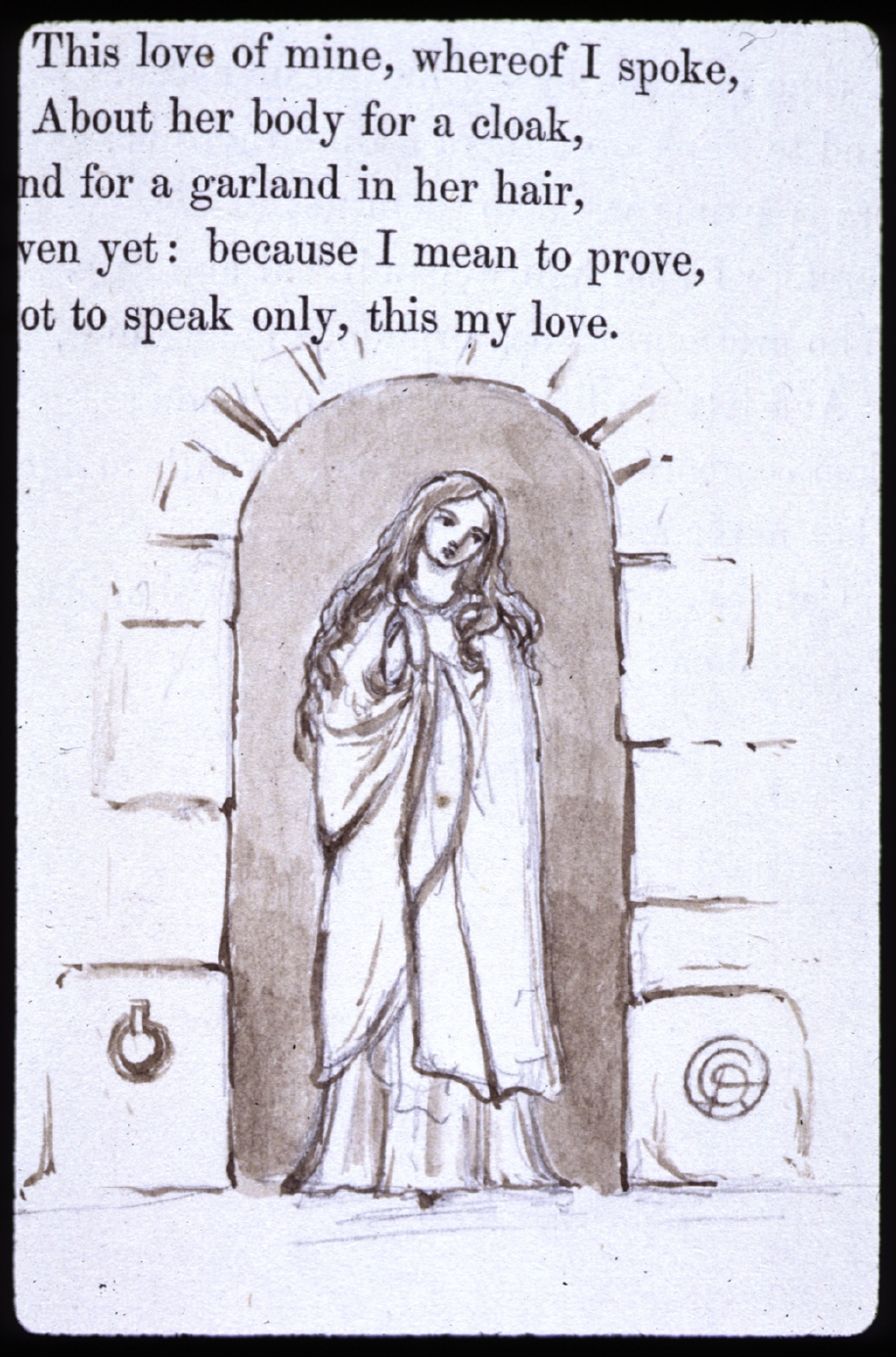
- Thus grieves she now; but she shall wear
- This love of mine, whereof I spoke,
- About her body for a cloak,
- And for a garland in her hair,
- Even yet: because I mean to prove,
- Not to speak only, this my love.
- There is a time to mount; to humble thee
- A time; a time to talk, and hold thy peace;
- A time to labour, and a time to cease;
- A time to take thy measures patiently;
- A time to watch what Time's next step may be;
- A time to make light count of menaces,
- And to think over them a time there is;
- There is a time when to seem not to see.
- Wherefore I hold him well-advised and sage
- 10 Who evermore keeps prudence facing him,
- And lets his life slide with occasion;
- And so comports himself, through youth to age,
- That never any man at any time
- Can say, Not thus, but thus thou shouldst have
- done.
- When Lucy draws her mantle round her face,
- So sweeter than all else she is to see,
- That hence unto the hills there lives not he
- Whose whole soul would not love her for her grace.
- Then seems she like a daughter of some race
- That holds high rule in France or Germany:
- And a snake's head stricken off suddenly
- Throbs never as then throbs my heart to embrace
- Her body in these arms, even were she loth;—
- 10 To kiss her lips, to kiss her cheeks, to kiss
- The lids of her two eyes which are two flames.
- Yet what my heart so longs for, my heart
- blames:
- For surely sorrow might be bred from this
- Where some man's patient love abides its growth.
- Within the gentle heart Love shelters him,
- As birds within the green shade of the
- grove.
- Before the gentle heart, in Nature's scheme,
- Love was not, nor the gentle heart ere Love.
- For with the sun, at once,
- So sprang the light immediately; nor was
- Its birth before the sun's.
- And Love hath his effect in gentleness
- Of very self; even as
-
10 Within the middle fire the heat's excess.
Note: The next-to-last line ("And Love hath...") and last line ("Within the middle...") of the preceding stanza were set incorrectly by the printer so that they do not line up properly with the rest of the stanza. Compare the indentation for corresponding lines in the rest of the poem.
- The fire of Love comes to the gentle heart
- Like as its virtue to a precious stone;
- To which no star its influence can impart
- Till it is made a pure thing by the sun:
- For when the sun hath smit
- From out its essence that which there was vile,
- The star endoweth it.
- And so the heart created by God's breath
- Pure, true, and clean from guile,
- 20A woman, like a star, enamoureth.
- In gentle heart Love for like reason is
- For which the lamp's high flame is fann'd and
- bow'd:
- Clear, piercing bright, it shines for its own bliss;
- Nor would it burn there else, it is so proud.
- For evil natures meet
- With Love as it were water met with fire,
- As cold abhorring heat.
- Through gentle heart Love doth a track divine,—
- Like knowing like; the same
- 30As diamond runs through iron in the mine.
- The sun strikes full upon the mud all day;
- It remains vile, nor the sun's worth is less.
- “By race I am gentle,” the proud man doth say:
- He is the mud, the sun is gentleness.
- Let no man predicate
- That aught the name of gentleness should have,
- Even in a king's estate,
- Except the heart there be a gentle man's.
- The star-beam lights the wave,—
- 40Heaven holds the star and the star's radiance.
- God, in the understanding of high Heaven,
- Burns more than in our sight the living sun:
- There to behold His Face unveil'd is given;
- And Heaven, whose will is homage paid to One,
- Fulfils the things which live
- In God, from the beginning excellent.
- So should my lady give
- That truth which in her eyes is glorified,
- On which her heart is bent,
- 50To me whose service waiteth at her side.
- My lady, God shall ask, “What dared'st thou?”
- (When my soul stands with all her acts review'd;)
- “Thou passed'st Heaven, into My sight, as now,
- To make Me of vain love similitude.
- To Me doth praise belong,
- And to the Queen of all the realm of grace
- Who endeth fraud and wrong.”
- Then may I plead: “As though from Thee he came,
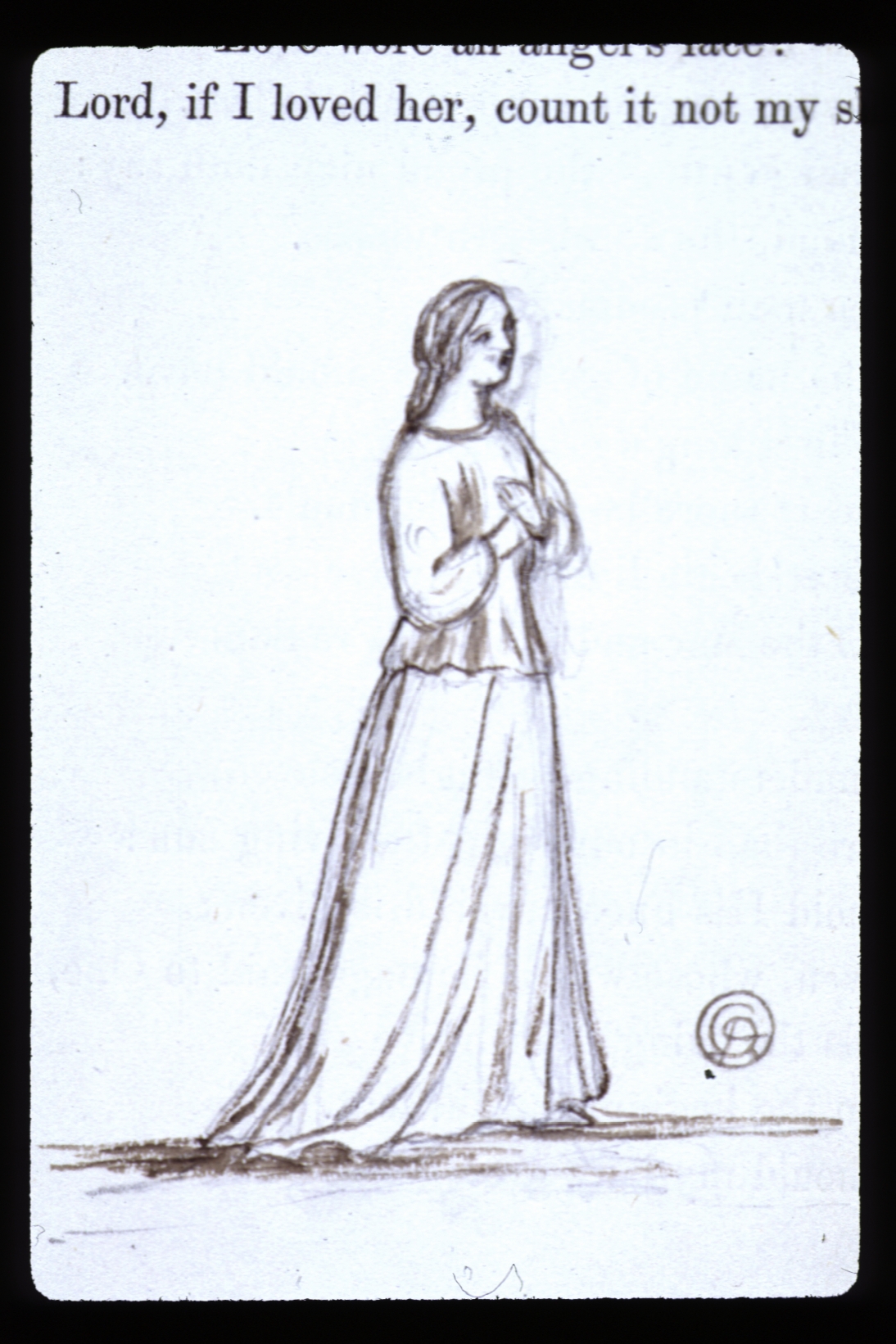
- Love wore an angel's face:
- 60Lord, if I loved her, count it not my shame.”
- Yea, let me praise my lady whom I love,
- Likening her unto the lily and rose:
- Brighter than morning star her visage glows;
- She is beneath even as her Saint above:
- She is as the air in summer which God wove
- Of purple and of vermillion glorious;
- As gold and jewels richer than man knows.
- Love's self, being love for her, must holier prove.
- Ever as she walks she hath a sober grace,
- 10 Making bold men abash'd and good men glad;
- If she delight thee not, thy heart must err.
- No man dare look on her his thoughts being base:
- Nay, let me say even more than I have said;—
- No man could think base thoughts who look'd
- on her.
- I hold him, verily, of mean emprise,
- Whose rashness tempts a strength too great to
- bear;
- As I have done, alas! who turn'd mine eyes
- Upon those perilous eyes of the most fair.
- Unto her eyes I bow'd;
- No need her other beauties in that hour
- Should aid them, cold and proud:
- As when the vassals of a mighty lord,
- What time he needs his power,
- 10Are all girt round him to make strong his sword.
- With such exceeding force the stroke was dealt,
- That by mine eyes its path might not be stay'd;
- But deep into the heart it pierced, which felt
- The pang of the sharp wound, and wax'd afraid;
- Then rested in strange wise,
- As when some creature utterly outworn
- Sinks into bed and lies.
- And she the while doth in no manner care,
- But goes her way in scorn,
- 20Beholding herself alway proud and fair.
- And she may be as proud as she shall please,
- For she is still the fairest woman found:
- A sun she seems among the rest; and these
- Have all their beauties in her splendour drown'd.
- In her is every grace,—
- Simplicity of wisdom, noble speech,
- Accomplish'd loveliness;
- All earthly beauty is her diadem.
- This truth my song would teach,—
- 30My lady is of ladies chosen gem.
- Love to my lady's service yieldeth me,—
- Will I, or will I not, the thing is so,—
- Nor other reason can I say or see,
- Except that where it lists the wind doth blow.
- He rules and gives no sign;
- Nor once from her did show of love upbuoy
- This passion which is mine.
- It is because her virtue's strength and stir
- So fill her full of joy
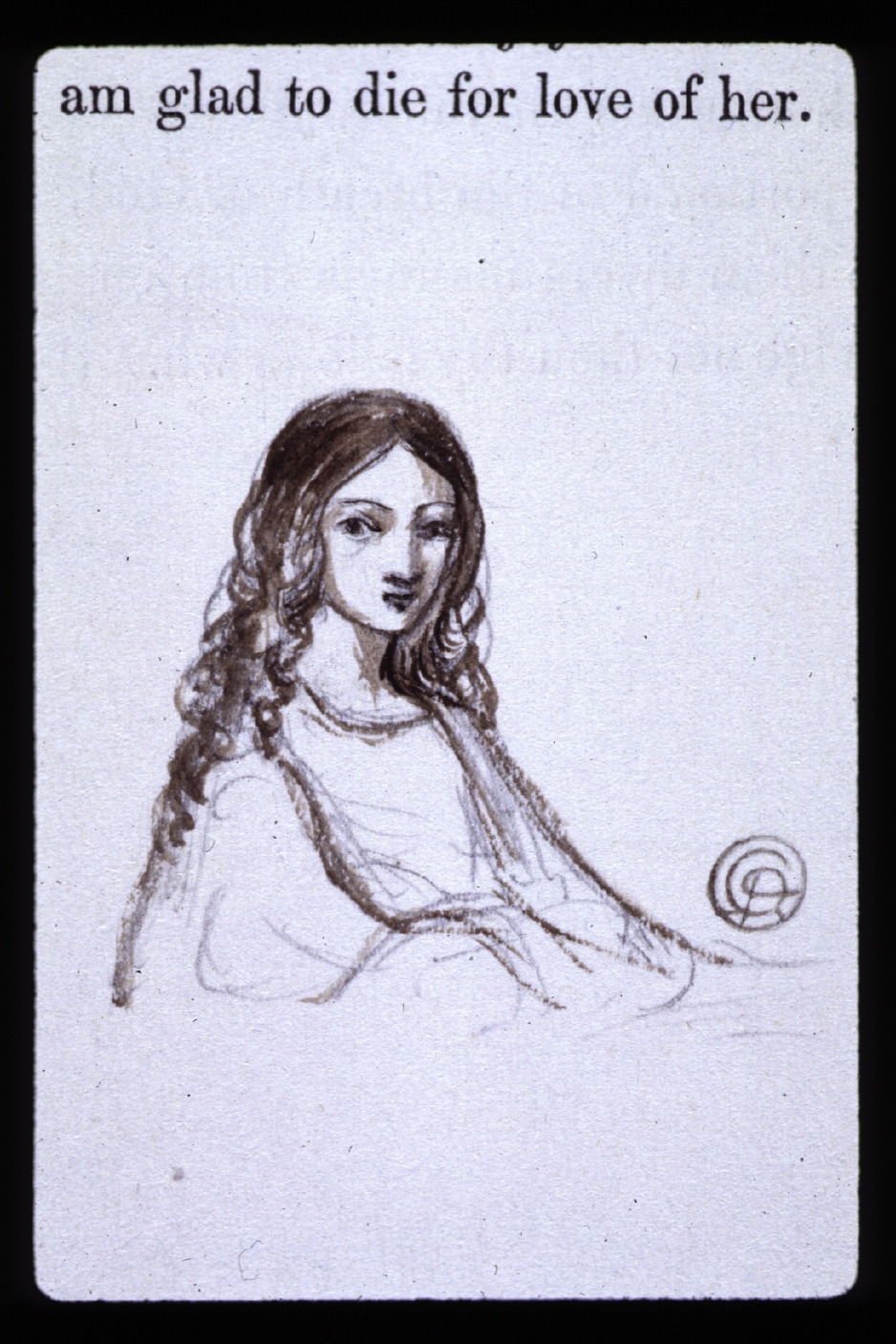
- 40That I am glad to die for love of her.
- He that has grown to wisdom hurries not,
- But thinks and weighs what Reason bids
- him do;
- And after thinking he retains his thought
- Until as he conceived the fact ensue.
- Let no man to o'erweening pride be wrought,
- But count his state as Fortune's gift and due.
- He is a fool who deems that none has sought
- The truth, save he alone, or knows it true.
- Many strange birds are on the air abroad,
- 10 Nor all are of one flight or of one force,
- But each after his kind dissimilar:
- To each was portion'd of the breath of God,
- Who gave them divers instincts from one source.
- Then judge not thou thy fellows what they are.
- Among my thoughts I count it wonderful,
- How foolishness in man should be so rife
- That masterly he takes the world to wife
- As though no end were set unto his rule:
- In labour alway that his ease be full,
- As though there never were another life;
- Till Death throws all his order into strife,
- And round his head his purposes doth pull.
- And evermore one sees the other die,
- 10 And sees how all conditions turn to change,
- Yet in no wise may the blind wretch be heal'd.
- I therefore say, that sin can even estrange
- Man's very sight, and his heart satisfy
- To live as lives a sheep upon the field.
- If any man would know the very cause
- Which makes me to forget my speech in rhyme,
- All the sweet songs I sang in other time,—
- I'll tell it in a sonnet's simple clause.
- I hourly have beheld how good withdraws
- To nothing, and how evil mounts the while:
- Until my heart is gnaw'd as with a file,
- Nor aught of this world's worth is what it was.
- At last there is no other remedy
- 10 But to behold the universal end;
- And so upon this hope my thoughts are urged:
- To whom, since truth is sunk and dead at sea,
- There has no other part or prayer remain'd,
- Except of seeing the world's self submerged.
- Hard is it for a man to please all men:
- I therefore speak in doubt,
- And as one may that looketh to be chid.
- But who can hold his peace in these days?—when
- Guilt cunningly slips out,
- And innocence atones for what he did;
- When worth is crush'd, even if it be not hid;
- When on crush'd worth, guile sets his foot to rise;
- And when the things wise men have counted wise
- 10 Make fools to smile and stare and lift the lid.
- Let none who have not wisdom govern you:
- For he that was a fool
- At first shall scarce grow wise under the sun.
- And as it is, my whole heart bleeds anew
- To think how hard a school
- Young hope grows old at, as these seasons run.
- Behold, sirs, we have reach'd this thing for
- one:—
- The lord before his servant bends the knee,
- And service puts on lordship suddenly.
- 20 Ye speak o' the end? Ye have not yet begun.
- I would not have ye without counsel ta'en
- Follow my words; nor meant,
- If one should talk and act not, to praise him.
- But who, being much opposed, speaks not again,
- Confesseth himself shent
- And put to silence,—by some loud-mouth'd
- mime,
- Perchance, for whom I speak not in this
- rhyme.
- Strive what ye can; and if ye cannot all,
- Yet should not your hearts fall:
- 30 The fruit commends the flower in God's good
- time.
- (For without fruit, the flower delights not God:)
- Wherefore let him whom Hope
- Puts off, remember time is not gone by.
- Let him say calmly: “Thus far on this road
- A foolish trust buoy'd up
- My soul, and made it like the butterfly
- Burn'd in the flame it seeks: even so was I:
- But now I'll aid myself; for still this trust,
- I find, falleth to dust:
- 40 The fish gapes for the bait-hook, and doth die.”
- And yet myself, who bid ye do this thing,—
- Am I not also spurn'd
- By the proud feet of Hope continually;
- Till that which gave me such good comforting
- Is altogether turn'd
- Unto a fire whose heat consumeth me?
- I am so girt with grief that my thoughts be
- Tired of themselves, and from my soul I loathe
- Silence and converse both;
- 50 And my own face is what I hate to see.
- Because no act is meet now nor unmeet.
- He that does evil, men applaud his name,
- And the well-doer must put up with shame:
- Yea, and the worst man sits in the best seat.
- A thing is in my mind,—
- To have my joy again,
- Which I had almost put away from me.
- It were in foolish kind
- For ever to refrain
- From song, and renounce gladness utterly.
- Seeing that I am given into the rule
- Of Love, whom only pleasure makes alive
- Whom pleasure nourishes and brings to
- growth:
- 10 The wherefore sullen sloth
- Will he not suffer in those serving him
- But pleasant they must seem,
- That good folk love them and their service thrive;
- Nor even their pain must make them sorrowful.
- So bear he him that thence
- The praise of men be gain'd,—
- He that would put his hope in noble Love;
- For by great excellence
- Alone can be attain'd
- 20That amorous joy which wisdom may approve.
- The way of Love is this, righteous and just;
- Then whoso would be held of good account,
- To seek the way of Love must him befit,—
- Pleasure, to wit.
- Through pleasure, man attains his worthiness:
- For he must please
- All men, so bearing him that Love may mount
- In their esteem, Love's self being in his trust.
- Trustful in servitude
- 30 I have been and will be,
- And loyal unto Love my whole life through.
- A hundred-fold of good
- Hath he not guerdon'd me
- For what I have endured of grief and woe?
- Since he hath given me unto one of whom
- Thus much he said,—thou mightest seek for
- aye
- Another of such worth, so beauteous.
- Joy therefore may keep house
- In this my heart, that it hath loved so well.
- 40 Me seems I scarce could dwell
- Ever in weary life or in dismay
- If to true service still my heart gave room.
- Serving at her pleasaunce
- Whose service pleasureth,
- I am enrich'd with all the wealth of Love.
- Song hath no utterance
- For my life's joyful breath
- Since in this lady's grace my homage throve.
- Yea, for I think it would be difficult
- 50 One should conceive my former abject case:—
- Therefore have knowledge of me from this
- rhyme.
- My penance-time
- Is all accomplish'd now, and all forgot,
- So that no jot
- Do I remember of mine evil days.
- It is my lady's will that I exult.
- Exulting let me take
- My joyful comfort, then,
- Seeing myself in so much blessedness.
- 60 Mine ease even as mine ache
- Accepting, let me gain
- No pride tow'rds Love; but with all humbleness,
- Even still, my pleasurable service pay.
- For a good servant ne'er was left to pine:
- Great shall his guerdon be who greatly bears.
- But, because he that fears
- To speak too much, by his own silence shent,
- Hath sometimes made lament,—
- I am thus boastful, lady; being thine
- 70For homage and obedience night and day.
- Now, when it flowereth,
- And when the banks and fields
- Are greener every day,
- And sweet is each bird's breath,
- In the tree where he builds
- Singing after his way,—
- Spring comes to us with hasty step and brief,
- Everywhere in leaf,
- And everywhere makes people laugh and play.
- 10 Love is brought unto me
- In the scent of the flower
- And in the birds' blithe noise.
- When day begins to be,
- I hear in every bower
- New verses finding voice:
- From every branch around me and above,
- A minstrels' court of love,
- The birds contend in song about love's joys.
- What time I hear the lark
- 20 And nightingale keep Spring,
- My heart will pant and yearn
- For love. (Ye all may mark
- The unkindly comforting
- Of fire that will not burn.)
- And, being in the shadow of the fresh wood,
- How excellently good
- A thing love is, I cannot choose but learn.
- Let me ask grace; for I,
- Being loved, loved not again.
- 30 Now springtime makes me love,
- And bids me satisfy
- The lover whose fierce pain
- I thought too lightly of:
- For that the pain is fierce I do feel now.
- And yet this pride is slow
- To free my heart, which pity would fain move.
- Wherefore I pray thee, Love,
- That thy breath turn me o'er,
- Even as the wind a leaf;
- 40 And I will set thee above
- This heart of mine, that's sore
- Perplex'd, to be its chief.
- Let also the dear youth, whose passion must
- Henceforward have good trust,
- Be happy without words; for words bring grief.
- I have it in my heart to serve God so
- That into Paradise I shall repair,—
- The holy place through the which everywhere
- I have heard say that joy and solace flow.
- Without my lady I were loth to go,—
- She who has the bright face and the bright hair;
- Because if she were absent, I being there,
- My pleasure would be less than nought, I know.
- Look you, I say not this to such intent
- 10 As that I there would deal in any sin:
- I only would behold her gracious mien,
- And beautiful soft eyes, and lovely face,
- That so it should be my complete content
- To see my lady joyful in her place.
- Marvellously elate,
- Love makes my spirit warm
- With noble sympathies;
- As one whose mind is set
- Upon some glorious form,
- To paint it as it is;—
- I verily who bear
- Thy face at heart, most fair,
- Am like to him in this.
- 10Not outwardly declared,
- Within me dwells enclosed
- Thine image as thou art.
- Ah! strangely hath it fared!
- I know not if thou know'st
- The love within my heart.
- Exceedingly afraid,
- My hope I have not said,
- But gazed on thee apart.
- Because desire was strong,
- 20 I made a portraiture
- In thine own likeness, love;
- When absence has grown long,
- I gaze, till I am sure
- That I behold thee move;
- As one who purposeth
- To save himself by faith,
- Yet sees not, nor can prove.
- Then comes the burning pain;
- As with the man that hath
- 30 A fire within his breast,—
- When most he struggles, then
- Most boils the flame in wrath,
- And will not let him rest.
- So still I burn'd and shook,
- To pass, and not to look
- In thy face, loveliest.
- For where thou art I pass,
- And do not lift mine eyes,
- Lady, to look on thee:
- 40But, as I go, alas!
- With bitterness of sighs
- I mourn exceedingly.
- Alas! the constant woe!
- Myself I do not know,
- So sore it troubles me.
- And I have sung thy praise,
- Lady, and many times
- Have told thy beauties o'er.
- Hast heard in anyways,
- 50 Perchance, that these my rhymes
- Are song-craft and no more?
- Nay, rather deem, when thou
- Shalt see me pass and bow,
- These words I sicken for.
- Delicate song of mine,
- Go sing thou a new strain;
- Seek, with the first sunshine,
- Our lady, mine and thine,—
- The rose of Love's domain,
- 60Than red gold comelier.
- “Lady, in Love's name hark
- To Jacopo the clerk,
- Born in Lentino here.”
- Sapphire, nor diamond, nor emerald,
- Nor other precious stones past reckoning,
- Topaz, nor pearl, nor ruby like a king,
- Nor that most virtuous jewel, jasper call'd,
- Nor amethyst, nor onyx, nor basalt,
- Each counted for a very marvellous thing,
- Is half so excellently gladdening
- As is my lady's head uncoronall'd.
- All beauty by her beauty is made dim;
- 10 Like to the stars she is for loftiness;
- And with her voice she taketh away grief.
- She is fairer than a bud, or than a leaf.
- Christ have her well in keeping, of His grace,
- And make her holy and beloved, like Him!
- Love will not have me cry
- For grace, as others do;
- Nor as they vaunt, that I
- Should vaunt my love to you.
- For service, such as all
- Can pay, is counted small;
- Nor is it much to praise
- The thing which all must know;—
- Such pittance to bestow
- 10On you my love delays.
- Love lets me not turn shape
- As chance or use may strike;
- As one may see an ape
- Counterfeit all alike.
- Then, lady, unto you
- Be it not mine to sue
- For grace or pitying.
- Many the lovers be
- That of such suit are free,—
- 20It is a common thing.
- A gem, the more 'tis rare,
- The more its cost will mount:
- And, be it not so fair,
- It is of more account.
- So, coming from the East,
- The sapphire is increased
- In worth, though scarce so bright;
- I therefore seek thy face
- Not to solicit grace
- 30Being cheapen'd and made slight.
- So is the colosmine
- Now cheapen'd, which in fame
- Was once so brave and fine,
- But now is a mean gem.
- So be such prayers for grace
- Not heard in any place;
- Would they indeed hold fast
- Their worth, be they not said,
- Nor by true lovers made
- 40Before nine years be past.
- Lady, sans sigh or groan,
- My longing thou canst see;
- Much better am I known
- Than to myself, to thee.
- And is there nothing else
- That in thy heart avails
- For love but groan and sigh?
- And wilt thou have it thus,
- This love betwixen us?—
- 50Much rather let me die.
- My lady mine,* I send
- These sighs in joy to thee;
- Though, loving till the end,
- There were no hope for me
- That I should speak my love;
- And I have loved indeed,
- Though, having fearful heed,
- It was not spoken of.
* Madonna mia.
- Thou art so high and great
- 10 That whom I love I fear;
- Which thing to circumstate
- I have no messenger:
- Wherefore to Love I pray,
- On whom each lover cries,
- That these my tears and sighs
- Find unto thee a way.
- Well have I wish'd, when I
- At heart with sighs have ached,
- That there were in each sigh
- 20 Spirit and intellect,
- The which, where thou dost sit,
- Should kneel and sue for aid,
- Since I am thus afraid
- And have no strength for it.
- Thou, lady, killest me,
- Yet keepest me in pain,
- For thou must surely see
- How, fearing, I am fain.
- Ah! why not send me still
- 30 Some solace, small and slight,
- So that I should not quite
- Despair of thy good will?
- Thy grace, all else above,
- Even now while I implore,
- Enamoureth my love
- To love thee still the more.
- Yet scarce should I know well
- A greater love to gain,
- Even if a greater pain,
- 40Lady, were possible.
- Joy did that day relax
- My grief's continual stress,
- When I essay'd in wax
- Thy beauty's life-likeness.
- Ah! much more beautiful
- Than golden-hair'd Yseult,—
- Who mak'st all men exult,
- Who bring'st all women dule.
- And certes without blame
- 50 Thy love might fall to me,
- Though it should chance my name
- Were never heard of thee.
- Yea, for thy love, in fine,
- Lentino gave me birth,
- Who am not nothing worth
- If worthy to be thine.
- Her face has made my life most proud and
- glad;
- Her face has made my life quite wearisome;
- It comforts me when other troubles come,
- And amid other joys it strikes me sad.
- Truly I think her face can drive me mad;
- For now I am too loud, and anon dumb.
- There is no second face in Christendom
- Has a like power, nor shall have, nor has had.
- What man in living face has seen such eyes,
- 10 Or such a lovely bending of the head,
- Or mouth that opens to so sweet a smile?
- In speech, my heart before her faints and dies,
- And into Heaven seems to be spirited;
- So that I count me blest a certain while.
- Remembering this—how Love
- Mocks me, and bids me hoard
- Mine ill reward that keeps me nigh to death,—
- How it doth still behove
- I suffer the keen sword,
- Whence undeplored I may not draw my breath;
- In memory of this thing
- Sighing and sorrowing,
- I am languid at the heart
- 10 For her to whom I bow,
- Craving her pity now,
- And who still turns apart.
- I am dying, and through her—
- This flower, from paradise
- Sent in some wise, that I might have no rest.
- Truly she did not err
- To come before his eyes
- Who fails and dies, by her sweet smile possess'd;
- For, through her countenance
- 20 (Fair brows and lofty glance!)
- I live in constant dule.
- Of lovers' hearts the chief
- For sorrow and much grief,
- My heart is sorrowful.
- For Love has made me weep
- With sighs that do him wrong,
- Since, when most strong my joy, he gave this woe.
- I am broken, as a ship
- Perishing of the song
- 30Sweet, sweet and long, the song the sirens know.
- The mariner forgets,
- Voyaging in those straits,
- And dies assuredly.
- Yea, from her pride perverse,
- Who hath my heart as her's,
- Even such my death must be.
- I deem'd her not so fell
- And hard but she would greet,
- From her high seat, at length, the love I bring;
- 40 For I have loved her well;—
- Nor that her face so sweet
- In so much heat would keep me languishing;
- Seeing that she I serve
- All honour doth deserve
- For worth unparallell'd.
- Yet what availeth moan
- But for more grief alone?
- O God! that it avail'd!
- Thou, my new song, shalt pray
- 50 To her, who for no end
- Each day doth tend her virtues that they grow,—
- Since she to love saith nay;—
- (More charms she hath attain'd
- Than sea hath sand, and wisdom even so);—
- Pray thou to her that she
- For my love pity me,
- Since with my love I burn,—
- That of the fruit of love,
- While help may come thereof,
- 60 She give to me in turn.
- The lofty worth and lovely excellence,
- Dear lady, that thou hast,
- Hold me consuming in the fire of love;
- That I am much afear'd and wilder'd thence,
- As who, being meanly placed,
- Would win unto some height he dreameth of.
- Yet, if it be decreed,
- After the multiplying of vain thought,
- By Fortune's favour he at last is brought
- 10To his far hope, the mighty bliss indeed.
- Thus, in considering thy loveliness,
- Love maketh me afear'd,—
- So high art thou, joyful, and full of good;—
- And all the more, thy scorn being never less.
- Yet is this comfort heard,—
- That underneath the water fire doth brood,
- Which thing would seem unfit
- By law of nature. So may thy scorn prove
- Changed at the last, through pity, into love,
- 20If favourable Fortune should permit.
- Lady, though I do love past utterance,
- Let it not seem amiss,
- Neither rebuke thou the enamour'd eyes.
- Look thou thyself on thine own countenance,
- From that charm unto this,
- All thy perfection of sufficiencies.
- So shalt thou rest assured
- That thine exceeding beauty lures me on
- Perforce, as by the passive magnet-stone
- 30The needle, of its nature's self, is lured.
- Certes, it was of Love's dispiteousness
- That I must set my life
- On thee, proud lady, who accept'st it not.
- And how should I attain unto thy grace,
- That falter, thus at strife
- To speak to thee the thing which is my thought?
- Thou, lovely as thou art,
- I pray for God, when thou dost pass me by,
- Look upon me: so shalt thou certify,
- 40By my cheek's ailing, that which ails my heart.
- So thoroughly my love doth tend toward
- Thy love its lofty scope,
- That I may never think to ease my pain;
- Because the ice, when it is frozen hard,
- May have no further hope
- That it should ever become snow again.
- But, since Love bids me bend
- Unto thy signiory,
- Have pity thou on me,
- 50That so upon thyself all grace descend.
- I laboured these six years
- For thee, thou bitter sweet;
- Yea, more than it is meet
- That speech should now rehearse
- Or song should rhyme to thee;
- But love gains never aught
- From thee, by depth or length;
- Unto thine eyes such strength
- And calmness thou hast taught,
- 10 That I say wearily:—
- “The child is most like me,
- Who thinks in the clear stream
- To catch the round flat moon
- And draw it all a-dripping unto him,—
- Who fancies he can take into his hand
- The flame o' the lamp, but soon
- Screams and is nigh to swoon
- At the sharp heat his flesh may not withstand.”
- Though it be late to learn
- 20 How sore I was possest,
- Yet do I count me blest,
- Because I still can spurn
- This thrall which is so mean.
- For when a man, once sick,
- Has got his health anew,
- The fever which boil'd through
- His veins, and made him weak,
- Is as it had not been.
- For all that I had seen,
- 30Thy spirit, like thy face,
- More excellently shone
- Than precious crystals in an untrod place.
- Go to: thy worth is but as glass, the cheat,
- Which, to gaze thereupon,
- Seems crystal, even as one,
- But only is a cunning counterfeit.
- Foil'd hope has made me mad,
- As one who, playing high,
- Thought to grow rich thereby,
- 40And loses what he had.
- Yet I can now perceive
- How true the saying is
- That says: “If one turn back
- Out of an evil track
- Through loss which has been his,
- He gains, and need not grieve.”
- To me now, by your leave,
- It chances as to him
- Who of his purse is free
- 50To one whose memory for such debts is dim.
- Long time he speaks no word thereof, being loth:
- But having ask'd, when he
- Is answer'd slightingly,
- Then shall he lose his patience, and be wroth.
- If any his own foolishness might see
- As he can see his fellow's foolishness,
- His evil speakings could not but prove less,
- For his own fault would vex him inwardly.
- But, by old custom, each man deems that he
- Has to himself all this world's worthiness;
- And thou, perchance, in blind contentedness,
- Scorn'st him, yet know'st not what I think of thee.
- Wherefore I wish it were so orderèd
- 10 That each of us might know the good that's his,
- And also the ill,—his honour and his shame.
- For oft a man has on his proper head
- Such weight of sins, that, did he know but this,
- He could not for his life give others blame.
- My lady, thy delightful high command,
- Thy wisdom's great intent,
- The worth which ever rules thee in thy sway,
- (Whose righteousness of strength has ta'en in hand
- Such full accomplishment
- As height makes worthy of more height alway,)
- Have granted to thy servant some poor due
- Of thy perfection; who
- From them has gain'd a proper will so fix'd,
- 10 With other thought unmix'd,
- That nothing save thy service now impels
- His life, and his heart longs for nothing else.
- Beneath thy pleasure, lady mine, I am:
- The circuit of my will,
- The force of all my life, to serve thee so:
- Never but only this I think or name,
- Nor ever can I fill
- My heart with other joy that man may know.
- And hence a sovereign blessedness I draw,
- 20 Who soon most clearly saw
- That not alone my perfect pleasure is
- In this my life-service;
- But Love has made my soul with thine to touch
- Till my heart feels unworthy of so much.
- For all that I could strive, it were not worth
- That I should be uplift
- Into thy love, as certainly I know:
- Since one to thy deserving should stretch forth
- His love for a free gift,
- 30 And be full fain to serve and sit below.
- And forasmuch as this is verity,
- It came to pass with thee
- That seeing how my love was not loud-tongued
- Yet for thy service long'd,—
- As only thy pure wisdom brought to pass,—
- Thou knew'st my heart for only what it was.
- Also because thou thus at once didst learn
- This heart of mine and thine,
- With all its love for thee, which was and is;
- 40Thy lofty sense that could so well discern
- Wrought even in me some sign
- Of thee, and of itself some emphasis,
- Which evermore might hold my purpose fast.
- For lo! thy law is pass'd
- That this my love should manifestly be
- To serve and honour thee:
- And so I do: and my delight is full,
- Accepted for the servant of thy rule.
- Without almost, I am all rapturous,
- 50 Since thus my will was set
- To serve, thou flower of joy, thine excellence:
- Nor ever seems it anything could rouse
- A pain or a regret,
- But on thee dwells mine every thought and sense;
- Considering that from thee all virtues spread
- As from a fountain-head,—
- That in thy gift is wisdom's best avail
- And honour without fail;
- With whom each sovereign good dwells separate
- 60Fulfilling the perfection of thy state.
- Lady, since I conceived
- Thy pleasurable aspect in my heart,
- My life has been apart
- In shining brightness and the place of truth;
- Which till that time, good sooth,
- Groped among shadows in a darken'd place
- Where many hours and days
- It hardly ever had remember'd good.
- But now my servitude
- 70Is thine, and I am full of joy and rest.
- A man from a wild beast
- Thou madest me, since for thy love I lived.
- The sweetly-favour'd face
- She has, and her good cheer,
- Have fill'd me full of grace
- When I have walk'd with her.
- They did upon that day:
- And everything that pass'd
- Comes back from first to last
- Now that I am away.
- There went from her meek mouth
- 10 A poor low sigh which made
- My heart sink down for drouth.
- She stoop'd, and sobb'd, and said,—
- “Sir, I entreat of you
- Make little tarrying:
- It is not a good thing
- To leave one's love and go.”
- But when I turn'd about
- Saying, “God keep you well!”—
- As she look'd up I thought
- 20 Her lips that were quite pale
- Strove much to speak, but she
- Had not half strength enough:
- My own dear graceful love
- Would not let go of me.
- I am not so far, sweet maid,
- That now the old love's unfelt:
- I believe Tristram had
- No such love for Yseult:
- And when I see your eyes
- 30 And feel your breath again,
- I shall forget this pain
- And my whole heart will rise.
- To see the green returning
- To stream-side, garden, and meadow,—
- To hear the birds give warning,
- (The laughter of sun and shadow
- Awaking them full of revel,)
- It puts me in strength to carol
- A music measured and level,
- This grief in joy to apparel;
- For the deaths of lovers are evil.
- 10Love is a foolish riot,
- And to be loved is a burden;
- Who loves and is loved in quiet
- Has all the world for his guerdon.
- Ladies on him take pity
- Who for their sake hath trouble:
- Yet, if any heart be a city
- From Love embarrèd double,
- Thereof is a joyful ditty.
- That heart shall be always joyful;—
- 20 But I in the heart, my lady,
- Have jealous doubts unlawful,
- And stubborn pride stands ready.
- Yet love is not with a measure,
- But still is willing to suffer
- Service at his good pleasure:
- The whole Love hath to offer
- Tends to his perfect treasure.
- Thine be this prelude-music
- That was of thy commanding:
- 30Thy gaze was not delusive,—
- Of my heart thou hadst understanding.
- Lady, by thine attemp'rance
- Thou held'st my life from pining:
- This tress thou gav'st, in semblance
- Like gold of the third refining,
- Which I do keep for remembrance.
- Death, why hast thou made life so hard to
- bear,
- Taking my lady hence? Hast thou no whit
- Of shame? The youngest flower and the most fair
- Thou hast pluck'd away, and the world wanteth it.
- O leaden Death, hast thou no pitying?
- Our warm love's very spring
- Thou stopp'st, and endest what was holy and meet;
- And of my gladdening
- Mak'st a most woful thing,
- 10And in my heart dost bid the bird not sing
- That sang so sweet.
- Once the great joy and solace that I had
- Was more than is with other gentlemen:—
- Now is my love gone hence, who made me glad.
- With her that hope I lived in she hath ta'en,
- And left me nothing but these sighs and tears,—
- Nothing of the old years
- That come not back again,
- Wherein I was so happy, being her's.
- 20Now to mine eyes her face no more appears,
- Nor doth her voice make music in mine ears,
- As it did then.
- O God, why hast thou made my grief so deep?
- Why set me in the dark to grope and pine?
- Why parted me from her companionship,
- And crush'd the hope which was a gift of thine?
- To think, dear, that I never any more
- Can see thee as before!
- Who is it shuts thee in?
- 30Who hides that smile for which my heart is sore,
- And drowns those words that I am longing for,
- Lady of mine?
- Where is my lady, and the lovely face
- She had, and the sweet motion when she walk'd?
- Her chaste, mild favour—her so delicate grace—
- Her eyes, her mouth, and the dear way she
- talk'd?—
- Her courteous bending—her most noble air—
- The soft fall of her hair? . . . .
- My lady—she who to my soul so rare
- 40 A gladness brought!
- Now I do never see her anywhere,
- And may not, looking in her eyes, gain there
- The blessing which I sought.
- So if I had the realm of Hungary,
- With Greece, and all the Almayn even to France,
- Or Saint Sophia's treasure-hoard, you see
- All could not give me back her countenance.
- For since the day when my dear lady died
- From us, (with God being born and glorified,)
- 50 No more pleasaunce
- Her image bringeth, seated at my side,
- But only tears. Ay me! the strength and pride
- Which it brought once.
- Had I my will, beloved, I would say
- To God, unto whose bidding all things bow,
- That we were still together night and day:
- Yet be it done as His behests allow.
- I do remember that while she remain'd
- With me, she often call'd me her sweet friend;
- 60 But does not now,
- Because God drew her towards Him, in the end.
- Lady, that peace which none but He can send
- Be thine. Even so.
- Lady of Heaven, the mother glorified
- Of glory, which is Jesus,—He whose death
- Us from the gates of Hell delivereth
- And our first parents' error sets aside:—
- Behold this earthly Love, how his darts glide—
- How sharpen'd—to what fate—throughout this
- earth!
- Pitiful Mother, partner of our birth,
- Win these from following where his flight doth guide.
- And O, inspire in me that holy love
- 10 Which leads the soul back to its origin,
- Till of all other love the link do fail.
- This water only can this fire reprove,—
- Only such cure suffice for such like sin;
- As nail from out a plank is struck by nail.
- I am so passing rich in poverty
- That I could furnish forth Paris and Rome,
- Pisa and Padua and Byzantium,
- Venice and Lucca, Florence and Forlì;
- For I possess, in actual specie,
- Of nihil and of nothing a great sum;
- And unto this my hoard whole shiploads come,
- What between nought and zero, annually.
- In gold and precious jewels I have got
- 10 A hundred ciphers' worth, all roundly writ;
- And therewithal am free to feast my friend.
- Because I need not be afraid to spend,
- Nor doubt the safety of my wealth a whit:—
- No thief will ever steal thereof, God wot.
- She.
- Fair sir, this love of ours,
- In joy begun so well,
- I see at length to fail upon thy part:
- Wherefore my heart sinks very heavily.
- Fair sir, this love of ours
- Began with amorous longing, well I ween:
- Yea, of one mind, yea, of one heart and will
- This love of ours hath been.
- Now these are sad and still;
- 10For on thy part at length it fails, I see.
- And now thou art gone from me,
- Quite lost to me thou art:
- Wherefore my heart in this pain languisheth,
- Which sinks it unto death thus heavily.
- He.
- Lady, for will of mine
- Our love had never changed in anywise,
- Had not the choice been thine
- With so much scorn my homage to despise.
- I swore not to yield sign
- 20Of holding 'gainst all hope my heart-service.
- Nay, let thus much suffice:—
- From thee whom I have served,
- All undeserved contempt is my reward,—
- Rich prize prepared to guerdon fealty!
- She.
- Fair sir, it oft is found
- That ladies, who would try their lovers so,
- Have for a season frown'd,
- Not from their heart but in mere outward show.
- Then chide not on such ground,
- 30Since ladies oft have tried their lovers so.
- Alas, but I will go,
- If now it be thy will.
- Yet turn thee still, alas! for I do fear
- Thou lov'st elsewhere, and therefore fly'st from me.
Note: Lines 31 and 32 appear to have been set incorrectly by the printer. They are indented a little deeper than the corresponding lines in the previous stanza, which otherwise has an identical form.
- He.
- Lady, there needs no doubt
- Of my good faith, nor any nice suspense
- Lest love be elsewhere sought.
- For thine did yield me no such recompense,—
- Rest thou assured in thought,—
- 40That now, within my life's circumference,
- I should not quite dispense
- My heart from woman's laws,
- Which for no cause give pain and sore annoy,
- And for one joy a world of misery.
- Never was joy or good that did not soothe
- And beget glorying,
- Neither a glorying without perfect love.
- Wherefore, if one would compass of a truth
- The flight of his soul's wing,
- To bear a loving heart must him behove.
- Since from the flower man still expects the fruit,
- And, out of love, that he desireth;
- Seeing that by good faith
- 10 Alone hath love its comfort and its joy;
- For, suffering falsehood, love were at the root
- Dead of all worth, which living must aspire;
- Nor could it breed desire
- If its reward were less than its annoy.
- Even such the joy, the triumph, and pleasaunce,
- Whose issue honour is,
- And grace, and the most delicate teaching sent
- To amorous knowledge, its inheritance;
- Because Love's properties
- 20 Alter not by a true accomplishment;
- But it were scarcely well if one should gain,
- Without much pain, so great a blessedness;
- He errs, when all things bless,
- Whose heart had else been humbled to implore.
- He gets not joy who gives no joy again;
- Nor can win love whose love hath little scope;
- Nor fully can know hope
- Who leaves not of the thing most languish'd for.
- Wherefore his choice must err immeasurably
- 30 Who seeks the image when
- He might behold the thing substantial.
- I at the noon have seen dark night to be,
- Against earth's natural plan,
- And what was good to worst abasement fall.
- Then be thus much sufficient, lady mine;
- If of thy mildness pity may be born,
- Count thou my grief outworn,
- And turn into sweet joy this better ill;
- Lest I might change, if left too long to pine:
- 40As one who, journeying, in mid path should stay,
- And not pursue his way,
- But should go back against his proper will.
- Natheless I hope, yea trust, to make an end
- Of the beginning made,
- Even by this sign—that yet I triumph not.
- And if in truth, against my will constrain'd,
- To turn my steps essay'd,
- No courage have I neither strength, God wot.
- Such is Love's rule, who thus subdueth me
- 50 By thy sweet face, lovely and delicate;
- Through which I live elate,
- But in such longing that I die for love.
- Ah! and these words as nothing seem to be:
- For love to such a constant fear has chid
- My heart, that I keep hid
- Much more than I have dared to tell thee of.
- Lady, my wedded thought,
- When to thy shape 'tis wrought,
- Can think of nothing else
- But only of thy grace,
- And of those gentle ways
- Wherein thy life excels.
- For ever, sweet one, dwells
- Thine image on my sight,
- (Even as it were the gem
- 10 Whose name is as thy name)*
- And fills the sense with light.
* The lady was probably called Diamante, Margherita, or
some similar name.
- Continual ponderings
- That brood upon these things
- Yield constant agony:
- Yea, the same thoughts have crept
- About me as I slept.
- My spirit looks at me,
- And asks, “Is sleep for thee?
- Nay, mourner, do not sleep,
- 20 But fix thine eyes, for lo!
- Love's fulness thou shalt know
- By steadfast gaze and deep.”
The indentation of line 15 has errantly slid to the right.
- Then, burning, I awake,
- Sore tempted to partake
- Of dreams that seek thy sight:
- Until, being greatly stirr'd,
- I turn to where I heard
- That whisper in the night;
- And there a breath of light
- 30Shines like a silver star.
- The same is mine own soul,
- Which lures me to the goal
- Of dreams that gaze afar.
- But now my sleep is lost;
- And through this uttermost
- Sharp longing for thine eyes,
- At length it may be said
- That I indeed am mad
- With love's extremities.
- 40Yet when in such sweet wise
- Thou passest and dost smile,
- My heart so fondly burns,
- That unto sweetness turns
- Its bitter pang the while.
- Even so Love rends apart
- My spirit and my heart,
- Lady, in loving thee;
- Till when I see thee now,
- Life beats within my brow
- 50And would be gone from me.
- So hear I ceaselessly
- Love's whisper, well fulfill'd,—
- Even I am he, even so,
- Whose flame thy heart doth know:
- And while I strive I yield.
- Such wisdom as a little child displays
- Were not amiss in certain lords of fame:
- For, where he fell, thenceforth he shuns the place,
- And, having suffer'd blows, he feareth them.
- Who knows not this may forfeit all he sways
- At length, and find his friends go as they came.
- O therefore on the past time turn thy face,
- And, if thy will do err, forget the same.
- Because repentance brings not back the past:
- 10 Better thy will should bend than thy life break:
- Who knows not this, by him shall it appear.
- And, because even from fools the wise may make
- Wisdom, the first should count himself the last,
- Since a dog scourged can bid the lion fear.
- Whoso abandons peace for war-seeking,
- 'Tis of all reason he should bear the
- smart.
- Whoso hath evil speech, his medicine
- Is silence, lest it seem a hateful art.
- To vex the wasps' nest is not a wise thing;
- Yet who rebukes his neighbour in good part,
- A hundred years shall show his right therein.
- Too prone to fear, one wrongs another's heart.
- If ye but knew what may be known to me,
- 10 Ye would fall sorry sick, nor be thus bold
- To cry among your fellows your ill thought.
- Wherefore I would that every one of ye
- Who thinketh ill, his ill thought should withold:
- If that ye would not hear it, speak it not.
- Your joyful understanding, lady mine,
- Those honours of fair life
- Which all in you agree to pleasantness,
- Long since to service did my heart assign;
- That never it has strife,
- Nor once remembers other means of grace;
- But this desire alone gives light to it.
- Behold, my pleasure, by your favour, drew
- Me, lady, unto you,
- 10 All beauty's and all joy's reflection here:
- From whom good women also have thought fit
- To take their life's example every day;
- Whom also to obey
- My wish and will have wrought, with love and fear.
- With love and fear to yield obedience, I
- Might never half deserve:
- Yet you must know, merely to look on me,
- How my heart holds its love and lives thereby;
- Though, well intent to serve,
- 20 It can accept Love's arrow silently.
- 'Twere late to wait, ere I would render plain
- My heart, (thus much I tell you, as I should,)
- Which, to be understood,
- Craves therefore the fine quickness of your glance.
- So shall you know my love of such high strain
- As never yet was shown by its own will;
- Whose proffer is so still,
- That love in heart hates love in countenance.
- In countenance oft the heart is evident
- 30 Full clad in mirth's attire
- Wherein at times it overweens to waste:
- Which yet of selfish joy or foul intent
- Doth hide the deep desire,
- And is, of heavy surety, double-faced;
- Upon things double therefore look ye twice.
- O ye that love! not what is fair alone
- Desire to make your own,
- But a wise woman, fair in purity;
- Nor think that any, without sacrifice
- 40 Of his own nature, suffers service still;
- But out of high free-will;
- In honour propp'd, thou bow'd in dignity.
- In dignity as best I may, must I
- The guerdon very grand,
- The whole of it, secured in purpose, sing?
- Lady, whom all my heart doth magnify,
- You took me in your hand,
- Ah! not ungraced with other guerdoning:
- For you of your sweet reason gave me rest
- 50 From yearning, from desire, from potent pain;
- Till, now, if Death should gain
- Me to his kingdom, it would pleasure me,
- Having obey'd the whole of your behest.
- Since you have drawn, and I am yours by lot,
- I pray you doubt me not
- Lest my faith swerve, for this could never be.
- Could never be; because the natural heart
- Will absolutely build
- Her dwelling-place within the gates of truth:
- 60And, if it be no grief to bear her part,
- Why, then by change were fill'd
- The measure of her shame beyond all ruth.
- And therefore no delay shall once disturb
- My bounden service, nor bring grief to it;
- Nor unto you deceit.
- True virtue her provision first affords,
- Ere she yield grace, lest afterward some curb
- Or check should come, and evil enter in:
- For alway shame and sin
- 70 Stand cover'd, ready, full of faithful words.
- By the long sojourning
- That I have made with grief,
- I am quite changed, you see;—
- If I weep, 'tis for glee;
- I smile at a sad thing;
- Despair is my relief.
- Good hap makes me afraid;
- Ruin seems rest and shade;
- In May the year is old;
- 10With friends I am ill at ease;
- Among foes I find peace;
- At noonday I feel cold.
- The thing that strengthens others, frightens me.
- If I am grieved, I sing;
- I chafe at comforting;
- Ill fortune makes me smile exultingly.
- And yet, though all my days are thus,—despite
- A shaken mind, and eyes
- Which see by contraries,—
- 20I know that without wings is an ill flight.
- My body resting in a haunt of mine,
- I ranged among alternate memories;
- What while an unseen noble lady's eyes
- Were fix'd upon me, yet she gave no sign;
- To stay and go she sweetly did incline,
- Always afraid lest there were any spies;
- Then reach'd to me,—and smelt it in sweet wise,
- And reach'd to me—some sprig of bloom or bine.
- Conscious of perfume, on my side I leant,
- 10 And rose upon my feet, and gazed around
- To see the plant whose flower could so beguile.
- Finding it not, I sought it by the scent;
- And by the scent, in truth, the plant I found,
- And rested in its shadow a great while.
- Often the day had a most joyful morn
- That bringeth grief at last
- Unto the human heart which deem'd all well:
- Of a sweet seed the fruit was often born
- That hath a bitter taste:
- Of mine own knowledge, oft it thus befell.
- I say it for myself, who, foolishly
- Expectant of all joy,
- Triumphing undertook
- 10 To love a lady proud and beautiful,
- For one poor glance vouchsafed in mirth to me:
- Wherefrom sprang all annoy:
- For, since the day Love shook
- My heart, she ever hath been cold and cruel.
- Well thought I to possess my joy complete
- When that sweet look of her's
- I felt upon me, amorous and kind:
- Now is my hope even underneath my feet.
- And still the arrow stirs
- 20 Within my heart—(oh hurt no skill can bind!)—
- Which through mine eyes found entrance cunningly;
- In manner as through glass
- Light pierces from the sun,
- And breaks it not, but wins its way beyond,—
- As into an unalter'd mirror, free
- And still, some shape may pass.
- Yet has my heart begun
- To break, methinks, for I on death grow fond.
- But, even though death were long'd for, the sharp
- wound
- 30 I have might yet be heal'd,
- And I not altogether sink to death.
- In mine own foolishness the curse I found,
- Who foolish faith did yield
- Unto mine eyes, in hope that sickeneth.
- Yet might love still exult and not be sad—
- (For some such utterance
- Is at my secret heart)—
- If from herself the cure it could obtain,—
- Who hath indeed the power Achilles had,
- 40 To wit, that of his lance,
- The wound could by no art
- Be closed till it were touch'd therewith again.
- So must I needs appeal for pity now
- From her on her own fault,
- And in my prayer put meek humility:
- For certes her much worth will not allow
- That anything be call'd
- Treacherousness in such an one as she,
- In whom is judgment and true excellence.
- 50 Wherefore I cry for grace;
- Not doubting that all good,
- Joy, wisdom, pity, must from her be shed;
- For scarcely should it deal in death's offence,
- The so-beloved face
- So watch'd for; rather should
- All death and ill be thereby subjected.
- And since, in hope of mercy, I have bent
- Unto her ordinance
- Humbly my heart, my body, and my life,
- 60Giving her perfect power acknowledgment,—
- I think some kinder glance
- She'll deign, and, in mere pity, pause from strife.
- She surely shall enact the good lord's part:
- When one whom force compels
- Doth yield, he is pacified,
- Forgiving him therein where he did err.
- Ah! well I know she hath the noble heart
- Which in the lion quells
- Obduracy of pride;
- 70 Whose nobleness is for a crown on her.
- A man should hold in very dear esteem
- The first possession that his labours gain'd;
- For, though great riches be at length attain'd,
- From that first mite they were increased to him.
- Who followeth after his own wilful whim
- Shall see himself outwitted in the end;
- Wherefore I still would have him apprehend
- His fall, who toils not being once supreme.
- Thou seldom shalt find folly, of the worst,
- 10 Holding companionship with poverty,
- Because it is distracted of much care.
- Howbeit, if one that hath been poor at first
- Is brought at last to wealth and dignity,
- Still the worst folly thou shalt find it there.
- Upon that cruel season when our Lord
- Shall come to judge the world eternally;
- When to no man shall anything afford
- Peace in the heart, how pure soe'er it be;
- When heaven shall break asunder at His word,
- With a great trembling of the earth and sea;
- When even the just shall fear the dreadful sword,—
- The wicked crying, “Where shall I cover me?”—
- When no one angel in His presence stands
- 10 That shall not be affrighted of that wrath,
- Except the Virgin Lady, she our guide;—
- How shall I then escape, whom sin commands?
- Out and alas on me! There is no path
- If in her prayers I be not justified.
- Whether all grace have fail'd I scarce
- may scan,
- Be it of mere mischance, or art's ill sway,
- That this-wise, Monday, Tuesday, every day,
- Afflicts me, through her means, with bale and ban.
- Now are my days but as a painful span;
- Nor once “Take heed of dying” did she say.
- I thank thee for my life thus cast away,
- Thou who hast wearied out a living man.
- Yet, oh! my Lord, if I were bless'd no more
- 10 Than thus much,—clothed with thy humility,
- To find her for a single hour alone,—
- Such perfectness of joy would triumph o'er
- This grief wherein I waste, that I should be
- As a new image of Love to look upon.
- If, as thou say'st, thy love tormented thee,
- That thou thereby wast in the fear of death,
- Messer Onesto, couldst thou bear to be
- Far from Love's self, and breathing other breath?
- Nay, thou wouldst pass beyond the greater sea
- (I do not speak of the Alps, an easy path),
- For thy life's gladdening; if so to see
- That light which for my life no comfort hath
- But rather makes my grief the bitterer:
- 10 For I have neither ford nor bridge—no course
- To reach my lady, or send word to her.
- And there is not a greater pain, I think,
- Than to see waters at the limpid source,
- And to be much athirst, and not to drink.
- Love, taking leave, my heart then leaveth me,
- And is enamour'd even while it would shun;
- For I have look'd so long upon the sun
- That the sun's glory is now in all I see.
- To its first will unwilling may not be
- This heart (though by its will its death be won),
- Having remembrance of the joy forerun:
- Yea, all life else seems dying constantly.
- Ay and alas! in love is no relief,
- 10 For any man who loveth in full heart,
- That is not rather grief than gratefulness.
- Whoso desires it, the beginning is grief;
- Also the end is grief, most grievous smart;
- And grief is in the middle, and is call'd grace.
- Prohibiting all hope
- Of the fulfilment of the joy of love,
- My lady chose me for her lover still.
- So am I lifted up
- To trust her heart which piteous pulses move,
- Her face which is her joy made visible.
- Nor have I any fear
- Lest love and service should be met with scorn,
- Nor doubt that thus I shall rejoice the more.
- 10 For ruth is born of prayer;
- Also, of ruth delicious love is born;
- And service wrought makes glad the servitor.
- Behold, I, serving more than others, love
- One lovely more than all;
- And, singing and exulting, look for joy
- There where my homage is for ever paid.
- And, for I know she does not disapprove
- If on her grace I call,
- My soul's good trust I will not yet destroy,
- 20Though Love's fulfilment stand prohibited.
- Because ye made your backs your shields, it
- came
- To pass, ye Guelfs, that these your enemies
- From hares grew lions: and because your eyes
- Turn'd homeward, and your spurs e'en did the same,
- Full many an one who still might win the game
- In fever'd tracts of exile pines and dies.
- Ye blew your bubbles as the falcon flies,
- And the wind broke them up and scatter'd them.
- This counsel, therefore. Shape your high resolves
- 10 In good king Robert's humour,* and afresh
- Accept your shames, forgive, and go your way.
- And so her peace is made with Pisa! Yea,
- What cares she for the miserable flesh
- That in the wilderness has fed the wolves?
* See what is said in allusion to his government of
Florence by Dante, (
Parad. C.viii.)
- Were ye but constant, Guelfs, in war or
- peace,
- As in divisions ye are constant still!
- There is no wisdom in your stubborn will,
- Wherein all good things wane, all harms increase.
- But each upon his fellow looks, and sees
- And looks again, and likes his favour ill;
- And traitors rule ye; and on his own sill
- Each stirs the fire of household enmities.
- What, Guelfs! and is Monte Catini* quite
- 10 Forgot,—where still the mothers and sad wives
- Keep widowhood, and curse the Ghibellins?
- O fathers, brothers, yea, all dearest kins!
- Those men of ye that cherish kindred lives,
- Even once again must set their teeth and fight.
* The battle of Monte Catini was fought and won by the
Ghibelline leader Uguccione della Faggiola against the
Florentines; August 29, 1315.
- The flower of Virtue is the heart's content;
- And fame is Virtue's fruit that she doth bear;
- And Virtue's vase is fair without and fair
- Within; and Virtue's mirror brooks no taint;
- And Virtue by her names is sage and saint;
- And Virtue hath a steadfast front and clear;
- And Love is Virtue's constant minister;
- And Virtue's gift of gifts is pure descent.
- And Virtue dwells with knowledge, and therein
- 10 Her cherish'd home of rest is real love;
- And Virtue's strength is in a suffering will;
- And Virtue's work is life exempt from sin,
- With arms that aid; and in the sum hereof,
- All Virtue is to render good for ill.
- Unto the blithe and lordly Fellowship,
- (I know not where, but wheresoe'er, I know,
- Lordly and blithe,) be greeting; and thereto,
- Dogs, hawks, and a full purse wherein to dip;
- Quails struck i' the flight; nags mettled to the whip;
Transcribed Footnote (page 102):
* This fellowship or club ( Brigata), so highly approved
and encouraged by our Folgore, is the same to which, and to
some of its members by name, scornful allusion is made by
Dante ( Inferno, C. xxix. l. 130), where he speaks of the
hair-brained character of the Sienese. Mr. Cayley, in his
valuable notes on Dante, says of it: “A dozen extravagant
youths of Siena had put together by equal contributions
216,000 florins to spend in pleasuring; they were reduced in
about a twelvemonth to the extremes of poverty. It was
their practice to give mutual entertainments twice a month;
at each of which, three tables having been sumptuously
covered, they would feast at one, wash their hands on
another, and throw the last out of window.”There exists a second curious series of sonnets for the
months, addressed also to this club, by Cene della Chitarra
d'Arezzo. Here, however, all sorts of disasters and discom-Note: There are two partial fingerprints at the bottom of the page, one of them in the last two lines of text, which are apparent artifacts of the printing process.Transcribed Footnote (page 103):forts, in the same pursuits of which Folgore treats, are
imagined for the prodigals; each sonnet, too, being composed
with the same terminations in its rhymes as the correspond-
ing one among his. They would seem to have been written
after the ruin of the club, as a satirical prophecy of the year
to succeed the golden one. But this second series, though
sometimes laughable, not having the poetical merit of the
first, I have not included it.My translations of Folgore's sonnets were made from the
versions given in the forlorn Florentine collection of 1816,
where editorial incompetence walks naked and not ashamed,
indulging indeed in gambols as of Punch, and words which
no voice but his could utter. Not till my book was in the
printer's hands, did I meet with Nannucci's Manuale del Primo
Secolo (1843), and am sorry that it is too late to avail myself
of lights cast here and there by him on dark passages through
which I had groped as I could. Nor is it only in these son-
nets that his suggestions might have done me service, though
fortunately the instances are never of much importance. - Hart-hounds, hare-hounds, and blood-hounds
- even so;
- And o'er that realm, a crown for Niccolò,
- Whose praise in Siena springs from lip to lip.
- Tingoccio, Atuin di Togno, and Ancaiàn,
- 10 Bartolo and Mugaro and Faënot,
- Who well might pass for children of King Ban,
- Courteous and valiant more than Lancelot,—
- To each, God speed! How worthy every man
- To hold high tournament in Camelot.
- For January I give you vests of skins,
- And mighty fires in hall, and torches lit;
- Chambers and happy beds with all things fit;
- Smooth silken sheets, rough furry counterpanes;
- And sweetmeats baked; and one that deftly spins
- Warm arras; and Douay cloth, and store of it;
- And on this merry manner still to twit
- The wind, when most his mastery the wind wins.
- Or issuing forth at seasons in the day,
- 10 Ye'll fling soft handfuls of the fair white snow
- Among the damsels standing round, in play:
- And when you all are tired and all aglow,
- Indoors again the court shall hold its sway,
- And the free Fellowship continue so.
- In February I give you gallant sport
- Of harts and hinds and great wild boars; and all
- Your company good foresters and tall,
- With buskins strong, with jerkins close and short;
- And in your leashes, hounds of brave report;
- And from your purses, plenteous money-fall,
- In very spleen of misers' starveling gall,
- Who at your generous customs snarl and snort.
- At dusk wend homeward, ye and all your folk
- 10 All laden from the wilds, to your carouse,
- With merriment and songs accompanied:
- And so draw wine and let the kitchen smoke;
- And so be till the first watch glorious;
- Then sound sleep to you till the day be wide.
- In March I give you plenteous fisheries
- Of lamprey and of salmon, eel and trout,
- Dental and dolphin, sturgeon, all the rout
- Of fish in all the streams that fill the seas.
- With fishermen and fishingboats at ease,
- Sail-barques and arrow-barques and galeons stout,
- To bear you, while the season lasts, far out,
- And back, through spring, to any port you please.
- But with fair mansions see that it be fill'd,
- 10 With everything exactly to your mind,
- And every sort of comfortable folk.
- No convent suffer there, nor priestly guild:
- Leave the mad monks to preach after their kind
- Their scanty truth, their lies beyond a joke.
- I give you meadow-lands in April, fair
- With over-growth of beautiful green grass;
- There among fountains the glad hours shall pass,
- And pleasant ladies bring you solace there.
- With steeds of Spain and ambling palfreys rare;
- Provençal songs and dances that surpass;
- And quaint French mummings; and through
- hollow brass
- A sound of German music on the air.
- And gardens ye shall have, that every one
- 10 May lie at ease about the fragrant place;
- And each with fitting reverence shall bow down
- Unto that youth to whom I gave a crown
- Of precious jewels like to those that grace
- The Babylonian Kaiser, Prester John.
- I give you horses for your games in May,
- And all of them well train'd unto the course,—
- Each docile, swift, erect, a goodly horse;
- With armour on their chests, and bells at play
- Between their brows, and pennons fair and gay;
- Fine nets, and housings meet for warriors,
- Emblazon'd with the shields ye claim for yours,
- Gules, argent, or, all dizzy at noonday.
- And spears shall split, and fruit go flying up
- 10In merry counterchange for wreaths that drop
- From balconies and casements far above;
- And tender damsels with young men and youths
- Shall kiss together on the cheeks and mouths;
- And every day be glad with joyful love.
- In June I give you a close-wooded fell,
- With crowns of thicket coil'd about its head,
- With thirty villas twelve times turreted,
- All girdling round a little citadel;
- And in the midst a springhead and fair well
- With thousand conduits branch'd and shining
- speed,
- Wounding the garden and the tender mead,
- Yet to the freshen'd grass acceptable.
- And lemons, citrons, dates, and oranges,
- 10 And all the fruits whose savour is most rare,
- Shall shine within the shadow of your trees;
- And every one shall be a lover there;
- Until your life, so fill'd with courtesies,
- Throughout the world be counted debonair.
- For Jùly, in Siena, by the willow-tree,
- I give you barrels of white Tuscan wine
- In ice far down your cellars stored supine;
- And morn and eve to eat in company
- Of those vast jellies dear to you and me;
- Of partridges and youngling pheasants sweet,
- Boil'd capons, sovereign kids: and let their treat
- Be veal and garlic, with whom these agree.
- Let time slip by, till by-and-by, all day;
- 10 And never swelter through the heat at all,
- But move at ease at home, sound, cool, and gay;
- And wear sweet-colour'd robes that lightly fall;
- And keep your tables set in fresh array,
- Not coaxing spleen to be your seneschal.
- For August, be your dwelling thirty towers
- Within an Alpine valley mountainous,
- Where never the sea-wind may vex your house,
- But clear life separate, like a star, be yours.
- There horses shall wait saddled at all hours,
- That ye may mount at morning or at eve:
- On each hand either ridge ye shall perceive,
- A mile apart, which soon a good beast scours.
- So alway, drawing homewards, ye shall tread
- 10 Your valley parted by a rivulet
- Which day and night shall flow sedate and
- smooth.
- There all through noon ye may possess the shade,
- And there your open purses shall entreat
- The best of Tuscan cheer to feed your youth.
- And in September, O what keen delight!
- Falcons and astors, merlins, sparrowhawks;
- Decoy-birds that shall lure your game in flocks;
- And hounds with bells; and gauntlets stout and
- tight;
- Wide pouches; crossbows shooting out of sight;
- Arblasts and javelins; balls and ball-cases;
- All birds the best to fly at; moulting these,
- Those rear'd by hand; with finches mean and slight;
- And for their chase, all birds the best to fly;
- 10 And each to each of you be lavish still
- In gifts; and robbery find no gainsaying;
- And if you meet with travellers going by,
- Their purses from your purse's flow shall fill;
- And avarice be the only outcast thing.
- Next, for October, to some shelter'd coign
- Flouting the winds, I'll hope to find you slunk;
- Though in bird-shooting (lest all sport be sunk),
- Your foot still press the turf, the horse your groin.
- At night with sweethearts in the dance you'll join,
- And drink the blessed must, and get quite drunk.
- There's no such life for any human trunk;
- And that's a truth that rings like golden coin!
- Then, out of bed again when morning's come,
- 10 Let your hands drench your face refreshingly,
- And take your physic roast, with flask and knife.
- Sounder and snugger you shall feel at home
- Than lake-fish, river-fish, or fish at sea,
- Inheriting the cream of Christian life.
- Let baths and wine-butts be November's due,
- With thirty mule-loads of broad gold-pieces;
- And canopy with silk the streets that freeze;
- And keep your drink-horns steadily in view.
- Let every trader have his gain of you:
- Clareta shall your lamps and torches send,—
- Caëta, citron-candies without end;
- And each shall drink, and help his neighbour to.
- And let the cold be great, and the fire grand:
- 10 And still for fowls, and pastries sweetly wrought,
- For hares and kids, for roast and boil'd, be sure
- You always have your appetites at hand;
- And then let night howl and heaven fall, so nought
- Be miss'd that makes a man's bed-furniture.
- Last, for December, houses on the plain,
- Ground-floors to live in, logs heap'd moun-
- tain-high,
- And carpets stretch'd, and newest games to try,
- And torches lit, and gifts from man to man:
- (Your host, a drunkard and a Catalan;)
- And whole dead pigs, and cunning cooks to ply
- Each throat with tit-bits that shall satisfy;
- And wine-butts of Saint Galganus' brave span.
- And be your coats well-lined and tightly bound,
- 10 And wrap yourselves in cloaks of strength and
- weight,
- With gallant hoods to put your faces through.
- And make your game of abject vagabond
- Abandon'd miserable reprobate
- Misers; don't let them have a chance with you.
- And now take thought, my sonnet, who is he
- That most is full of every gentleness;
- And say to him (for thou shalt quickly guess
- His name) that all his 'hests are law to me.
- For if I held fair Paris town in fee,
- And were not call'd his friend, 'twere surely less.
- Ah! had he but the emperor's wealth, my place
- Were fitted in his love more steadily
- Than is Saint Francis at Assisi. Alway
- 10 Commend me unto him and his,—not least
- To Caian, held so dear in the blithe band.
- “Folgore da San Geminiano” (say,)
- “Has sent me, charging me to travel fast,
- Because his heart went with you in your hand.”
- There is among my thoughts the joyous plan
- To fashion a bright-jewell'd carcanet,
- Which I upon such worthy brows would set,
- To say, it suits them fairly as it can.
- And now I have newly found a gentleman,
- Of courtesies and birth commensurate,
- Who better would become the imperial state
- Than fits the gem within the signet's span.
- Carlo di Messer Guerra Cavicciuoli,*
- 10 Of him I speak,—brave, wise, of just award
- And generous service, let who list command;
- And lithelier limb'd than ounce or lëopard.
- He holds not money-bags, as children, holy;
- For Lombard Esté hath no freer hand.
* That is, according to early Tuscan nomenclature; Carlo,
the son of Messer Guerra Cavicciuoli.
- Now with the moon the day-star Lucifer
- Departs, and night is gone at last, and day
- Brings, making all men's spirits strong and gay,
- A gentle wind to gladden the new air.
- Lo! this is Monday, the week's harbinger;
- Let music breathe her softest matin-lay,
- And let the loving damsels sing to-day,
- And the sun wound with heat at noontide here.
- And thou, young lord, arise and do not sleep,
- 10 For now the amorous day inviteth thee
- The harvest of thy lady's youth to reap.
- Let coursers round the door, and palfreys, be,
- With squires and pages clad delightfully;
- And Love's commandments have thou heed to keep.
- To a new world on Tuesday shifts my song,
- Where beat of drum is heard, and trumpet-
- blast;
- Where footmen arm'd and horsemen arm'd go past,
- And bells say ding to bells that answer dong;
- Where he the first and after him the throng,
- Arm'd all of them with coats and hoods of steel,
- Shall see their foes and make their foes to feel,
- And so in wrack and rout drive them along.
- Then hither, thither, dragging on the field
- 10 His master, empty-seated goes the horse,
- 'Mid entrails strown abroad of soldiers kill'd;
- Till blow to camp those trumpeters of yours
- Who noise awhile your triumph and are still'd,
- And to your tents you come back conquerors.
- And every Wednesday, as the swift days move,
- Pheasant and peacock-shooting out of doors
- You'll have, and multitude of hares to course,
- And after you come home, good cheer enough;
- And sweetest ladies at the board above,
- Children of kings and counts and senators;
- And comely-favour'd youthful bachelors
- To serve them, bearing garlands, for true love.
- And still let cups of gold and silver ware,
- 10Runlets of vernage-wine and wine of Greece,
- Comfits and cakes be found at bidding there;
- And let your gifts of birds and game increase;
- And let all those who in your banquet share
- Sit with bright faces perfectly at ease.
- For Thursday be the tournament prepared,
- And gentlemen in lordly jousts compete:
- First man with man, together let them meet,—
- By fifties and by hundreds afterward.
- Let arms with housings each be fitly pair'd,
- And fitly hold your battle to its heat
- From the third hour to vespers, after meat;
- Till the best-winded be at last declared.
- Then back unto your beauties, as ye came:
- 10 Where upon sovereign beds, with wise control
- Of leeches, shall your hurts be swathed in bands.
- The ladies shall assist with their own hands,
- And each be so well paid in seeing them
- That on the morrow he be sound and whole.
- Let Friday be your highest hunting-tide,
- —No hound nor brach nor mastiff absent
- thence,—
- Through a low wood, by many miles of dens,
- All covert, where the cunning beasts abide:
- Which now driven forth, at first you scatter wide,—
- Then close on them, and rip out blood and breath:
- Till all your huntsmens' horns wind at the death,
- And you count up how many beasts have died.
- Then, men and dogs together brought, you'll say:
- 10 Go fairly greet from us this friend and that,
- Bid each make haste to blithest wassailings.
- Might not one vow that the whole pack had
- wings?
- What! hither, Beauty, Dian, Dragon, what!
- I think we held a royal hunt to-day.
- I've jolliest merriment for Saturday:—
- The very choicest of all hawks to fly
- That crane or heron could be stricken by,
- As up and down you course the steep highway.
- So shall the wild geese, in your deadly play,
- Lose at each stroke a wing, a tail, a thigh;
- And man with man and horse with horse shall vie,
- Till you all shout for glory and holiday.
- Then, going home, you'll closely charge the cook:
- 10 “All this is for to-morrow's roast and stew:
- Skin, lop, and truss: hang pots on every hook:
- And we must have fine wine and white bread too,
- Because this time we mean to feast: so look
- We do not think your kitchens lost on you.”
- And on the morrow, at first peep o' the day
- Which follows, and which men as Sunday
- spell,—
- Whom most him liketh, dame or damozel,
- Your chief shall choose out of the sweet array.
- So in a palace painted and made gay
- Shall he converse with her whom he loves best;
- And what he wishes, his desire express'd
- Shall bring to presence there, without gainsay.
- And youths shall dance, and men do feats of arms,
- 10 And Florence be sought out on every side
- From orchards and from vineyards and from farms:
- That they who fill her streets from far and wide
- In your fine temper may discern such charms
- As shall from day to day be magnified.
- O Love, who all this while hast urged me on,
- Shaking the reins, with never any rest,—
- Slacken for pity somewhat of thy haste;
- I am oppress'd with languor and foredone,—
- Having outrun the power of sufferance,—
- Having much more endured than who, through
- faith
- That his heart holds, makes no account of death.
- Love is assuredly a fair mischance,
- And well may it be call'd a happy ill:
- 10 Yet thou, my lady, on this constant sting,
- So sharp a thing, have thou some pity still,—
- Howbeit a sweet thing too, unless it kill.
- O comely-favour'd, whose soft eyes prevail,
- More fair than is another on this ground,—
- Lift now my mournful heart out of its stound,
- Which thus is bound for thee in great travail:
- For a high gale a little rain may end.
- Also, my lady, be not anger'd thou
- That Love should thee enforce, to whom all bow.
- 20There is but little shame to apprehend
- If to a higher strength the conquest be;
- And all the more to Love who conquers all.
- Why then appal my heart with doubts of thee?
- Courage and patience triumph certainly.
- I do not say that with such loveliness
- Such pride may not beseem; it suits thee well;
- For in a lovely lady pride may dwell,
- Lest homage fail and high esteem grow less:
- Yet pride's excess is not a thing to praise.
- 30 Therefore, my lady, let thy harshness gain
- Some touch of pity which may still restrain
- Thy hand, ere Death cut short these hours and days.
- The sun is very high and full of light,
- And the more bright the higher he doth ride:
- So let thy pride, my lady, and thy height,
- Stand me in stead and turn to my delight.
- Still inmostly I love thee, labouring still
- That others may not know my secret smart.
- Oh! what a pain it is for the grieved heart
- 40To hold apart and not to show its ill!
- Yet by no will the face can hide the soul;
- And ever with the eyes the heart has need
- To be in all things willingly agreed.
- It were a mighty strength that should control
- The heart's fierce beat, and never speak a word:
- It were a mighty strength, I say again,
- To hide such pain, and to be sovran lord
- Of any heart that had such love to hoard.
- For Love can make the wisest turn astray;
- 50 Love, at its most, of measure still has least;
- He is the maddest man who loves the best;
- It is Love's jest, to make men's hearts alway
- So hot that they by coldness cannot cool.
- The eyes unto the heart bear messages
- Of the beginnings of all pain and ease:
- And thou, my lady, in thy hand dost rule
- Mine eyes and heart which thou hast made thine
- own.
- Love rocks my life with tempests on the deep,
- Even as a ship round which the winds are blown:
- 60Thou art my pennon that will not go down.
- O lady amorous,
- Merciless lady,
- Full blithely play'd ye
- These your beguilings.
- So with an urchin
- A man makes merry,—
- In mirth grows clamorous,
- Laughs and rejoices,—
- But when his choice is
- 10To fall aweary,
- Cheats him with silence.
- This is Love's portion:—
- In much wayfaring
- With many burdens
- He loads his servants;
- But at the sharing,
- The underservice
- And overservice
- Are alike barren.
- 20As my disaster
- Your jest I cherish,
- And well may perish.
- Even so a falcon
- Is sometimes taken
- And scantly cautell'd;
- Till when his master
- At length to loose him,
- To train and use him,
- Is after all gone,—
- 30The creature's throttled
- And will not waken.
- Wherefore, my lady,
- If you will own me,
- O look upon me!
- If I'm not thought on,
- At least perceive me!
- O do not leave me
- So much forgotten!
- If, lady, truly
- 40You wish my profit,
- What follows of it
- Though still you say so?—
- For all your well-wishes
- I still am waiting.
- I grow unruly,
- And deem at last I'm
- Only your pastime.
- A child will play so,
- Who greatly relishes
- 50Sporting and petting
- With a little wild bird:
- Unaware he kills it,—
- Then turns it, feels it,
- Calls it with a mild word,
- Is angry after,—
- Then again in laughter
- Loud is the child heard.
- O my delightful
- My own my lady,
- 60Upon the Mayday
- Which brought me to you
- Was all my haste then
- But a fool's venture?
- To have my sight full
- Of you propitious
- Truly my wish was,
- And to pursue you
- And let love chasten
- My heart to the centre.
- 70But warming, lady,
- May end in burning.
- Of all this yearning
- What comes, I beg you?
- In all your glances
- What is't a man sees?—
- Fever and ague.
- Lady, with all the pains that I can take,
- I'll sing my love renew'd, if I may, well,
- And only in your praise.
- The stag in his old age seeks out a snake
- And eats it, and then drinks, (I have heard tell)
- Fearing the hidden ways
- Of the snake's poison, and renews his youth.
- Even such a draught, in truth,
- Was your sweet welcome, which cast out of me,
- 10 With whole cure instantly,
- Whatever pain I felt, for my own good,
- When first we met that I might be renew'd.
- A thing that has its proper essence changed
- By virtue of some powerful influence,
- As water has by fire,
- Returns to be itself, no more estranged,
- So soon as that has ceased which gave offence:
- Yea, now will more aspire
- Than ever, as the thing it first was made.
- 20 Thine advent long delay'd
- Even thus had almost worn me out of love,
- Biding so far above:
- But now that thou hast brought love back for me,
- It mounts too much,—O lady, up to thee.
- I have heard tell, and can esteem it true,
- How that an eagle looking on the sun,
- Rejoicing for his part
- And bringing oft his young to look there too,—
- If one gaze longer than another one,
- 30 On him will set his heart.
- So I am made aware that Love doth lead
- All lovers, by their need,
- To gaze upon the brightness of their loves;
- And whosoever moves
- His eyes the least from gazing upon her,
- The same shall be Love's inward minister.
- I play this sweet prelùde
- For the best heart, and queen
- Of gentle womanhood,
- From here unto Messene;
- Of flowers the fairest one;
- The star that's next the sun;
- The brightest star of all.
- What time I look at her,
- My thoughts do crowd and stir
- 10 And are made musical.
- Sweetest my lady, then
- Wilt thou not just permit,
- As once I did, again
- That I should speak of it?
- My heart is burning me
- Within, though outwardly
- I seem so brave and gay.
- Ah! dost thou not sometimes
- Remember the sweet rhymes
- 20 Our lips made on that day?—
- When I her heart did move
- By kisses and by vows,
- Whom I then call'd my love,
- Fair-hair'd, with silver brows:
- She sang there as we sat;
- Nor then withheld she aught
- Which it were right to give;
- But said, “Indeed I will
- Be thine through good and ill
- 30 As long as I may live.”
- And while I live, dear love,
- In gladness and in need
- Myself I will approve
- To be thine own indeed.
- If any man dare blame
- Our loves,—bring him to shame,
- O God! and of this year
- Let him not see the May.
- Is't not a vile thing, say,
- 40 To freeze at Midsummer?
- I am afar, but near thee is my heart;
- Only soliciting
- That this long absence seem not ill to thee:
- For, if thou knew'st what pain and evil smart
- The lack of thy sweet countenance can bring,
- Thou wouldst remember me compassionately.
- Even as my case, the stag's is wont to be,
- Which, thinking to escape
- His death, escaping whence the pack gives cry,
- 10 Is wounded and doth die.
- So, in my spirit imagining thy shape,
- I would fly Death, and Death o'ermasters me.
- I am o'erpower'd of Death when, telling o'er
- Thy beauties in my thought,
- I seem to have that which I have not: then
- I am as he who in each meteor,
- Dazzled and wilder'd sees the thing he sought.
- In suchwise Love deals with me among men:—
- Thee whom I have not, yet who dost sustain
- 20My life, he bringeth in his arms to me
- Full oft,—yet I approach not unto thee.
- Ah! if we be not join'd i' the very flesh,
- It cannot last but I indeed shall die
- By burden of this love that weigheth so.
- As an o'erladen bough, while yet 'tis fresh,
- Breaks, and itself and fruit are lost thereby,—
- So shall I, love, be lost, alas for woe!
- And, if this slay indeed that thus doth rive
- My heart, how then shall I be comforted?
- 30 Thou, as a lioness
- Her cub, in sore distress
- Might'st toil to bring me out of death alive:
- But couldst thou raise me up, if I were dead?
- Oh! but an' if thou wouldst, I were more glad
- Of death than life,—thus kept
- From thee and the true life thy face can bring.
- So in nowise could death be harsh or bad;
- But it should seem to me that I had slept,
- And was awaken'd with thy summoning.
- 40 Yet, sith the hope thereof is a vain thing,
- I, in fast fealty,
- Can like the Assassin* be,
- Who, to be subject to his lord in all,
- Goes and accepts his death and has no heed:
- Even as he doth so could I do indeed.
- Nevertheless, this one memorial—
Transcribed Footnote (page 136):
* Alluding to the Syrian tribe of Assassins, whose chief
was the Old Man of the Mountain. - The last, I send thee, for Love orders it.
- He, this last once, wills that thus much be writ
- In prayer that it may fall 'twixt thee and me
- 50 After the manner of
- Two birds that feast their love
- Even unto anguish, till, if neither quit
- The other, one must perish utterly.
- Even as the day when it is yet at dawning
- Seems mild and kind, being fair to look upon,
- While the birds carol underneath their awning
- Of leaves, as if they never would have done;
- Which on a sudden changes, just at noon,
- And the broad light is broken into rain
- That stops and comes again;
- Even as the traveller, who had held his way
- Hopeful and glad because of the bright weather,
- 10 Forgetteth then his gladness altogether;
- Even so am I, through Love, alas the day!
- It plainly is through Love that I am so.
- At first, he let me still grow happier
- Each day, and made her kindness seem to grow;
- But now he has quite changed her heart in her.
- And I, whose hopes throbb'd and were all astir
- For times when I should call her mine aloud
- And in her pride be proud
- Who is more fair than gems are, ye may say,
- 20 Having that fairness which holds hearts in rule;—
- I have learnt now to count him but a fool
- Who before evening says, A goodly day.
- It had been better not to have begun,
- Since, having known my error, 'tis too late.
- This thing from which I suffer, thou hast done,
- Lady: canst thou restore me my first state?
- The wound thou gavest canst thou medicate?
- Not thou, forsooth: thou hast not any art
- To keep death from my heart.
- 30O lady! where is now my life's full meed
- Of peace,—mine once, and which thou took'st
- away?
- Surely it cannot now be far from day:
- Night is already very long indeed.
- The sea is much more beautiful at rest
- Than when the tempest tramples over it.
- Wherefore, to see the smile which has so bless'd
- This heart of mine, deem'st thou these eyes unfit?
- There is no maid so lovely, it is writ,
- That by such stern unwomanly regard
- 40 Her face may not be marr'd.
- I therefore pray of thee, my own soul's wife,
- That thou remember me who am forgot.
- How shall I stand without thee? Art thou not
- The pillar of the building of my life?
- When God had finish'd Master Messerin,
- He really thought it something to have
- done:
- Bird, man, and beast had got a chance in one,
- And each felt flatter'd, it was hoped, therein.
- For he is like a goose i' the windpipe thin,
- And like a cameleopard high i' the loins;
- To which, for manhood, you'll be told, he joins
- Some kinds of flesh-hues and a callow chin.
- As to his singing, he affects the crow;
- 10 As to his learning, beasts in general;
- And sets all square by dressing like a man.
- God made him, having nothing else to do;
- And proved there is not anything at all
- He cannot make, if that's a thing He can.
* I have not been able to trace the Fazio to whom this
sonnet refers.
- Master Bertuccio, you are call'd to account
- That you guard Fazio's life from poison
- ill:
- And every man in Florence tells me still
- He has no horse that he can safely mount.
- A mighty war-horse worth a thousand pound
- Stands in Cremona stabled at his will;
- Which for his honour'd person should fulfil
- Its use. Nay, sir, I pray you be not found
- So poor a steward. For all fame of yours
- 10 Is cared for best, believe me, when I say:—
- Our Florence gives Bertuccio charge of one
- Who rides her own proud spirit like a horse;
- Whom Cocciolo himself must needs obey;
- And whom she loves best, being her strongest son.
* The character here drawn certainly suggests Count
Ugolino de'Gherardeschi, though it would seem that Rustico
died nearly twenty years before the tragedy of the Tower of
Famine.
- If any one had anything to say
- To the Lord Ugolino, because he's
- Not staunch, and never minds his promises,
- 'Twere hardly courteous, for it is his way.
- Courteous it were to say such sayings nay:
- As thus: He's true, sir, only takes his ease
- And don't care merely if it plague or please,
- And has good thoughts, no doubt, if they would stay.
- Now I know he's so loyal every whit
- 10 And altogether worth such a good word
- As worst would best and best would worst befit.
- He'd love his party with a dear accord
- If only he could once quite care for it,
- But can't run post for any Law or Lord.
- Pass and let pass,—this counsel I would give,—
- And wrap thy cloak what way the wind may
- blow.
- Who cannot raise himself were wise to know
- How best, by dint of stooping, he may thrive.
- Take for ensample this: when the winds drive
- Against it, how the sapling tree bends low,
- And, once being prone, abideth even so
- Till the hard harsh wind cease to rend and rive.
- Wherefore, when thou behold'st thyself abased,
- 10 Be blind, deaf, dumb; yet therewith none the less
- Note thou in peace what thou shalt hear and
- see,
- Till from such state by Fortune thou be raised.
- Then hack, lop, buffet, thrust, and so redress
- Thine ill that it may not return on thee.
- Among the dancers I beheld her dance,
- Her who alone is my heart's sustenance.
- So, as she danced, I took this wound of her;
- Alas! the flower of flowers, she did not fail.
- Woe's me! I will be Jew and blasphemer
- If the good god of Love do not prevail
- To bring me to thy grace, oh! thou most fair.
- My lady and my lord! alas for wail!
- How many days and how much sufferance?
- 10Oh! would to God that I had never seen
- Her face, nor had beheld her dancing so!
- Then had I miss'd this wound which is so keen—
- Yea, mortal—for I think not to win through
- Unless her love be my sweet medicine;
- Whereof I am in doubt, alas for woe!
- Fearing therein but such a little chance.
- She was apparell'd in a Syrian cloth,
- My lady:—oh! but she did grace the same,
- Gladdening all folk, that they were nowise loth
- 20 At sight of her to put their ills from them.
- But upon me her power hath had such growth
- That nought of joy thenceforth, but a live flame,
- Stirs at my heart,—which is her countenance.
- Sweet-smelling rose, sweet, sweet to smell and see,
- Great solace had she in her eyes for all;
- But heavy woe is mine; for upon me
- Her eyes, as they were wont, did never fall.
- Which thing if it were done advisedly,
- I would choose death, that could no more appal,
- 30Not caring for my life's continuance.
- Even as the moon amid the stars doth shed
- Her lovelier splendour of exceeding light,—
- Even so my lady seems the queen and head
- Among all other ladies in my sight.
- Her human visage, like an angel's made,
- Is glorious even to beauty's perfect height;
- And with her simple bearing soft and staid
- All secret modesties of soul unite.
- I therefore feel a dread in loving her;
- 10 Because of thinking on her excellence,
- The wisdom and the beauty which she has.
- I pray her for the sake of God,—whereas
- I am her servant, yet in sore suspense
- Have held my peace,—to have me in her care.
- A spirit of Love, with Love's intelligence,
- Maketh his sojourn alway in my breast,
- Maintaining me in perfect joy and rest;
- Nor could I live an hour, were he gone thence:
- Through whom my love hath such full permanence
- That thereby other loves seem dispossess'd.
- I have no pain, nor am with sighs oppress'd,
- So calm is the benignant influence.
- Because this spirit of Love, who speaks to me
- 10 Of my dear lady's tenderness and worth,
- Says: “More than thus to love her seek thou
- not,
- Even as she loves thee in her wedded thought;
- But honour her in thy heart delicately:
- For this is the most blessed joy on earth.”
- Wert thou as prone to yield unto my prayer
- The thing, sweet virgin, which I ask of
- thee,
- As to repeat, with all humility,
- “Pray you go hence, and of your speech forbear;”—
- Then unto joy might I my heart prepare,
- Having my fellows in subserviency;
- But, for that thou contemn'st and mockest me,
- Whether of life or death I take no care;
- Because my heart may not assuage its drouth
- 10 Nor ever may again rejoice at all
- Till the sweet face bend to be felt of man,—
- Till tenderly the beautiful soft mouth
- I kiss by thy good leave; thenceforth to call
- Blessing and triumph Love's extremest ban.
- A fresh content of fresh enamouring
- Yields me afresh, at length, the sense of
- song,
- Who had well-nigh forgotten Love so long:
- But now my homage he will have me bring.
- So that my life is now a joyful thing,
- Having new-found desire, elate and strong,
- In her to whom all grace and worth belong,
- On whom I now attend for ministering.
- The countenance remembering, with the limbs,
- 10 She was all imaged on my heart at once
- Suddenly by a single look at her:
- Whom when I now behold, a heat there seems
- Within, as of a subtle fire that runs
- Unto my heart, and remains burning there.
- If you could see, fair brother, how dead beat
- The fellows look who come through Rome to-
- day,—
- Black yellow smoke-dried visages,—you'd say
- They thought their haste at going all too fleet.
- Their empty victual-waggons up the street
- Over the bridge dreadfully sound and sway;
- Their eyes, as hang'd men's, turning the wrong
- way;
- And nothing on their backs, or heads, or feet.
- One sees the ribs and all the skeletons
- 10 Of their gaunt horses; and a sorry sight
- Are the torn saddles, cramm'd with straw and stones.
- They are ashamed, and march throughout the
- night;
- Stumbling, for hunger, on their marrowbones;
- Like barrels rolling, jolting, in this plight.
- Their arms all gone, not even their swords are saved;
- And each as silent as a man being shaved.
* Extracted from his long treatise, in unrhymed verse and
in prose, “Of the Government and Conduct of Women;”
(
Del Reggimento e dei Costumi delle Donne.)
- Do not conceive that I shall here recount
- All my own beauty: yet I promise you
- That you, by what I tell, shall understand
- All that befits and that is well to know.
- My bosom, which is very softly made,
- Of a white even colour without stain,
- Bears two fair apples, fragrant, sweetly-savour'd,
- Gather'd together from the Tree of Life
- The which is in the midst of Paradise.
- 10And these no person ever yet has touch'd;
- For out of nurse's and of mother's hands
- I was, when God in secret gave them me.
- These ere I yield I must know well to whom;
- And for that I would not be robb'd of them,
- I speak not all the virtue that they have;
- Yet thus far speaking:—blessed were the man
- Who once should touch them, were it but a little;—
- See them I say not, for that might not be.
- My girdle, clipping pleasure round about,
- 20 Over my clear dress even unto my knees
- Hangs down with sweet precision tenderly;
- And under it Virginity abides.
- Faithful and simple and of plain belief
- She is, with her fair garland bright like gold;
- And very fearful if she overhears
- Speech of herself; the wherefore ye perceive
- That I speak soft lest she be made ashamed.
- Lo! this is she who hath for company
- The Son of God and Mother of the Son;
- 30 Lo! this is she who sits with many in heaven;
- Lo! this is she with whom are few on earth.
* This and the three following pieces are extracted from
his “Documents of Love” (
Documenti d' Amore).
- THERE is a vice which oft
- I've heard men praise; and divers forms it
- has;
- And it is this. Whereas
- Some, by their wisdom, lordship, or repute,
- When tumults are afoot,
- Might stifle them, or at the least allay,—
- These certain ones will say,
- “The wise man bids thee fly the noise of men.”
- One says, “Wouldst thou maintain
- 10 Worship,—avoid where thou may'st not avail;
- And do not breed worse ail
- By adding one more voice to strife begun.”
- Another, with this one,
- Avers, “I could but bear a small expense,
- Or yield a slight defence.”
- A third says this, “I could but offer words.”
- Or one, whose tongue records
- Unwillingly his own base heart, will say,
- “I'll not be led astray
- 20To bear a hand in others' life or death.”
- They have it in their teeth!
- For unto this each man is pledged and bound;
- And this thing shall be found
- Enter'd against him at the Judgment Day.
- NOW these four things, if thou
- Consider, are so bad that none are worse.
- First,—among counsellors
- To thrust thyself, when not call'd absolutely.
- And in the other three
- Many offend by their own evil wit.
- When men in council sit,
- One talks because he loves not to be still;
- And one to have his will;
- 10 And one for nothing else but only show.
- These rules were well to know,
- First for the first, for the others afterward.
- Where many are repair'd
- And met together, never go with them
- Unless thou'rt call'd by name.
- This for the first: now for the other three.
- What truly thou dost see
- Turn in thy mind, and faithfully report;
- And in the plainest sort
- 20Thy wisdom may, proffer thy counselling.
- There is another thing
- Belongs hereto, the which is on this wise.
- If one should ask advice
- Of thine for his own need whate'er it be,—
- This is my word to thee:—
- Deny it if it be not clearly of use;
- Or turn to some excuse
- That may seem fair, and thou shalt have done well.
- There is a vice prevails
- Concerning which I'll set you on your guard;
- And other four, which hard
- It were (as may be thought) that I should blame.
- Some think that still of them—
- Whate'er is said—some ill speech lies beneath;
- And this to them is death:
- Whereby we plainly may perceive their sins.
- And now let others wince.
- 10 One sort there is, who, thinking that they please,
- (Because no wit's in these,)
- Where'er you go, will stick to you all day,
- And answer, (when you say,
- “Don't let me tire you out!”) “Oh never mind—
- Say nothing of the kind,—
- It's quite a pleasure to be where you are!”
- A second,—when, as far
- As he could follow you, the whole day long
- He's sung you his dull song,
- 20And you for courtesy have borne with it,—
- Will think you've had a treat.
- A third will take his special snug delight,—
- Some day you've come in sight
- Of some great thought and got it well in view,—
- Just then to drop on you.
- A fourth, for any insult you've received
- Will say he is so grieved,
- And daily bring the subject up again.
- So now I would be fain
- 30 To show you your best course at all such times;
- And counsel you in rhymes
- That you yourself offend not in likewise.
- In these four cases lies
- This help:—to think upon your own affair,
- Just showing here and there
- By just a word that you are listening;
- And still to the last thing
- That's said to you attend in your reply,
- And let the rest go by,—
- 40It's quite a chance if he remembers them.
- Yet do not, all the same,
- Deny your ear to any speech of weight.
- But if importunate
- The speaker is, and will not be denied,
- Just turn the speech aside
- When you can find some plausible pretence;
- For if you have the sense,
- By a quick question or a sudden doubt
- You may so put him out
- 50 That he shall not remember where he was;
- And by such means you'll pass
- Upon your way and be well rid of him.
- And now it doth beseem
- I give you the advice I promised you.
- Before you have to do
- With men whom you must meet continually,
- Take notice what they be;
- And so you shall find readily enough
- If you can win their love,
- 60And give yourself for answer Yes or No.
- And finding Yes, do so
- That still the love between you may increase.
- Yet if they be of these
- Whom sometimes it is hard to understand,
- Let some slight cause be plann'd,
- And seem to go,—so you shall learn their will;
- And if but one sit still
- As 'twere in thought,—then go, unless he call.
- Lastly, if insult gall
- 70 Your friend, this is the course that you should
- take.
- At first 'tis well you make
- As much lament thereof as you think fit,—
- Then speak no more of it,
- Unless himself should bring it up again;
- And then no more refrain
- From full discourse, but say his grief is yours.
- Say, wouldst thou guard thy son,
- That sorrow he may shun?
- Begin at the beginning
- And let him keep from sinning.
- Wouldst guard thy house? One door
- Make to it, and no more.
- Wouldst guard thine orchard-wall?
- Be free of fruit to all.
- I look at the crisp golden-threaded hair
- Whereof, to thrall my heart, Love twists a net;
- Using at times a string of pearls for bait,
- And sometimes with a single rose therein.
- I look into her eyes which unaware
- Through mine own eyes to my heart penetrate;
- Their splendour, that is excellently great,
- To the sun's radiance seeming near akin,
- Yet from herself a sweeter light to win.
- 10So that I, gazing on that lovely one,
- Discourse in this wise with my secret thought:—
- “Woe's me! why am I not,
- Even as my wish, alone with her alone?—
- That hair of hers, so heavily uplaid,
- To shed down braid by braid,
- nd make myself two mirrors of her eyes
- Within whose light all other glory dies.”
- I look at the amorous beautiful mouth,
- The spacious forehead which her locks enclose,
- 20 The small white teeth, the straight and shapely
- nose,
- And the clear brows of a sweet pencilling.
- And then the thought within me gains full growth,
- Saying, “Be careful that thy glance now goes
- Between her lips, red as an open rose,
- Quite full of every dear and precious thing;
- And listen to her gracious answering,
- Born of the gentle mind that in her dwells,
- Which from all things can glean the nobler half.
- Look thou when she doth laugh
- 30How much her laugh is sweeter than aught else.”
- Thus evermore my spirit makes avow
- Touching her mouth; till now
- I would give anything that I possess,
- Only to hear her mouth say frankly, “Yes.”
- I look at her white easy neck, so well
- From shoulders and from bosom lifted out;
- And at her round cleft chin, which beyond doubt
- No fancy in the world could have design'd.
- And then, with longing grown more voluble,
- 40 “Were it not pleasant now,” pursues my thought,
- “To have that neck within thy two arms caught
- And kiss it till the mark were left behind?”
- Then, urgently: “The eyelids of thy mind
- Open thou: if such loveliness be given
- To sight here,—what of that which she doth hide?
- Only the wondrous ride
- Of sun and planets through the visible heaven
- Tells us that therebeyond is Paradise.
- Thus, if thou fix thine eyes,
- 50Of a truth certainly thou must infer
- That every earthly joy abides in her.”
- I look at the large arms, so lithe and round,—
- At the hands, which are white and rosy too,—
- At the long fingers, clasp'd and woven through,
- Bright with the ring which one of them doth
- wear.
- Then my thought whispers: “Were thy body wound
- Within those arms, as loving women's do,
- In all thy veins were born a life made new
- Which thou couldst find no language to declare.
- 60 Behold if any picture can compare
- With her just limbs, each fit in shape and size,
- Or match her angel's colour like a pearl.
- She is a gentle girl
- To see; yet when it needs, her scorn can rise.
- Meek, bashful, and in all things temperate,
- Her virtue holds its state;
- In whose least act there is that gift express'd
- Which of all reverence makes her worthiest.”
- Soft as a peacock steps she, or as a stork
- 70 Straight on herself, taller and statelier:
- 'Tis a good sight how every limb doth stir
- For ever in a womanly sweet way. y
- “Open thy soul to see God's perfect work,”
- (My thought begins afresh,) “and look at her
- When with some lady-friend exceeding fair
- She bends and mingles arms and locks in play.
- Even as all lesser lights vanish away,
- When the sun moves, before his dazzling face,
- So is this lady brighter than all these.
- 80 How should she fail to please,—
- Love's self being no more than her loveliness?
- In all her ways some beauty springs to view;
- All that she loves to do
- Tends alway to her honour's single scope;
- And only from good deeds she draws her hope.”
- Song, thou canst surely say, without pretence,
- That since the first fair woman ever made,
- Not one can have display'd
- More power upon all hearts than this one doth;
- 90 Because in her are both
- Loveliness and the soul's true excellence:—
- And yet (woe's me!) is pity absent thence?
- Now to Great Britain we must make our way,
- Unto which kingdom Brutus gave its name
- What time he won it from the giants' rule.
- 'Tis thought at first its name was Albion,
- And Anglia, from a damsel, afterwards.
Transcribed Footnote (page 166):
* I am quite sorry (after the foregoing love-song, the
original of which is not perhaps surpassed by any poem of its
class in existence) to endanger the English reader's respect
for Fazio by these extracts from the Dittamondo, or “Song
of the World,” in which he will find his own country endowed
with some astounding properties. However, there are a few
fine characteristic sentences, and the rest is no more absurd
than other travellers' tales of that day; while the table of our
Norman line of kings is not without some historical interest.
It must be remembered that the love-song was the work of
Fazio's youth, and the Dittamondo that of his old age, when
we may suppose his powers to have been no longer at their
best. Besides what I have given relating to Great Britain,
there is a table of the Saxon dynasty, and some surprising
facts about Scotland and Ireland; as well as a curious passage
written in French, and purporting to be an account, given by
a royal courier, of Edward the Third's invasion of France.Transcribed Footnote (page 167):
I felt half disposed to include these, but was afraid of over-
loading with such matter a selection made chiefly for the sake
of poetic beauty. I should mention that the Dittamondo, like
Dante's great poem, is written in terza rima; but as perfect
literality was of primary importance in the above extracts, I
have departed for once from my rule of fidelity to the original
metre. - The island is so great and rich and fair,
- It conquers others that in Europe be,
- Even as the sun surpasses other stars.
- Many and great sheep-pastures bountifully
- 10Nature has set there, and herein more bless'd,
- That they can hold themselves secure from wolves.
- Black amber* also doth the land enrich,
- (Whose properties my guide Solinus here
- Told me, and how its colour comes to it;)
- And pearls are found in great abundance too.
- The people are as white and comely-faced
- As they of Ethiop land are black and foul.
- Many hot springs and limpid fountain-heads
- We found about this land, and spacious plains,
- 20And divers beasts that dwell within thick woods.
- Plentiful orchards too, and fertile fields
- It has, and castle-forts, and cities fair
- With palaces and girth of lofty walls.
- And proud wide rivers without any fords
- We saw, and flesh, and fish, and crops enough.
- Justice is strong throughout those provinces.
* The word is
Gagata, which I find described in Alberti's
Dictionary, as “A black, solid, hard, and shining bitumen,
formed within the earth, and called also black amber.” Is
this coal?
- Now this I saw not; but so strange a thing
- It was to hear, and by all men confirm'd,
- That it is fit to note it as I heard;—
- 30To wit, there is a certain islet here
- Among the rest, where folk are born with tails,
- Short, as are found in stags and such-like beasts.*
* Mediæval Britons would seem really to have been
credited with this slight peculiarity. At the siege of
Damietta, Cœur-de-Lion's bastard brother is said to have
pointed out the prudence of deferring the assault, and to
have received for rejoinder from
the French crusaders, “See
now these faint-hearted English with the tails!” To which
the Englishman replied, “You will need stout hearts to keep
near our tails when the assault is made.”
- For this I vouch,—that when a child is freed
- From swaddling bands, the mother without stay
- Passes elsewhere, and 'scapes the care of it.
- I put no faith herein; but it is said
- Among them, how such marvellous trees are there
- That they grow birds, and this is their sole fruit.†
† This is the Barnacle-tree, often described in old books of
travels and natural history, and which Sir Thomas Browne
classes gravely among his “Vulgar Errors.”
- Forty times eighty is the circuit ta'en,
- 40With ten times fifteen, if I do not err,
- By our miles reckoning its circumference.
- Here every metal may be dug; and here
- I found the people to be given to God,
- Steadfast, and strong, and restive to constraint.
- Nor is this strange, when one considereth;
- For courage, beauty, and large-heartedness,
- Were there, as it is said, in ancient days.
- North Wales, and Orkney, and the banks of Thames,
- Land's End, and Stonehenge,* and Northumberland,
- 50I chose with my companion to behold.
- We went to London, and I saw the Tower
- Where Guenevere her honour did defend,
- With the Thames river which runs close to it.
- I saw the castle which by force was ta'en
- With the three shields by gallant Lancelot,
- The second year that he did deeds of arms.
- I beheld Camelot despoil'd and waste;
- And was where one and the other had her birth,
- The maids of Corbonek and Astolat.
- 60Also I saw the castle where Geraint
- Lay with his Enid; likewise Merlin's stone,
- Which for another's love I joy'd to see.
- I found the tract where is the pine-tree well
- And where of old the knight of the black shield
- With weeping and with laughter kept the pass,
- What time the pitiless and bitter dwarf
- Before Sir Gawaine's eyes discourteously
- With many heavy stripes led him away.
- I saw the valley which Sir Tristram won
- 70When having slain the giant hand to hand
- He set the stranger knights from prison free.
- And last I view'd the field, at Salisbury,
- Of that great martyrdom which left the world
- Empty of honour, valour, and delight.
* The words are “Listenois” and “Strangorre,” for which
I have substituted Land's End and Stonehenge, being unable
to identify them. What follows relates to the Romances
of
the Round Table. The only allusion here which I cannot
trace to the
Mort d'Arthur is one where “Rech” and “Nida”
are spoken of: it seems however that, by a perversion hardly
too corrupt for Fazio, these might be the Geraint and Enid
whose story occurs in the
Mabinogion, and has been used by
Tennyson in his
Idylls of the King. Why Fazio should have
“joyed to see” Merlin's stone “for another's love” seems
inscrutable; unless indeed the words “per amor altrui” are
a mere idiom, and Merlin himself
is the person meant.
- So, compassing that Island round and round,
- I saw and hearken'd many things and more
- Which might be fair to tell but which I hide.
Extract from the “Dittamondo”
(Lib. iv. Cap. 25.)
Of the Dukes of Normandy, and thence of the Kings
of England, from William the First to Edward
the Third.
- THOU well hast heard that Rollo had two sons,
- One William Longsword, and the other
- Richard,
- Whom thou now know'st to the marrow, as I do.*
- Daring and watchful, as a leopard is,
- Was William, fair in body and in face,
- Ready at all times, never slow to act.
- He fought great battles, but at last was slain
- By the earl of Flanders; so that in his place
- Richard his son was o'er the people set.
- 10And next in order, lit with blessed flame
- Of the Holy Spirit, his son follow'd him
- Who justly lived 'twixt more and less midway,—
- His father's likeness, as in shape in name.
Transcribed Footnote (page 171):
* The speaker here is the poet's guide Solinus (a histori-
cal and geographical writer of the third century,) who bears
the same relation to him which Virgil bears to Dante in the
Commedia. - So unto him succeeded as his heir
- Robert the Frank, high-counsell'd and august:
- And thereon following, I proceed to tell
- How William, who was Robert's son, did make
- The realm of England his co-heritage.
- The same was brave and courteous certainly,
- 20Generous and gracious, humble before God,
- Master in war and versed in counsel too.
- He with great following came from Normandy
- And fought with Harold, and so left him slain,
- And took the realm and held it at his will.
- Thus did this kingdom change its signiory;
- And know that all the kings it since has had
- Only from this man take their origin.
- Therefore, that thou may'st quite forget its past,
- I say this happen'd when, since our Lord's Love,
- 30Some thousand years and sixty were gone by.
- While the fourth Henry ruled as emperor,
- This king of England fought in many wars
- And wax'd through all in honour and account.
- And William Rufus next succeeded him;
- Tall, strong, and comely-limb'd, but therewith proud
- And grasping, and a killer of his kind.
- In body he was like his father much,
- But was in nature more his contrary
- Than fire and water when they come together;
- 40Yet so far good that he won fame in arms,
- And by himself risk'd many an enterprise
- All which he brought with honour to an end.
- Also if he were bad, he gat great ill;
- For, chasing once the deer within a wood,
- And having wander'd from his company,
- Him by mischance a servant of his own
- Hit with an arrow, that he fell and died.
- And after him Henry the First was king,
- His brother, but therewith the father's like,
- 50Being well with God and just in peace and war.
- Next Stephen, on his death, the kingdom seized,
- But with sore strife; of whom thus much be said,
- That he was frank and good is told of him.
- And after him another Henry reign'd,
- Who, when the war in France was waged and done,
- Pass'd beyond seas with the first Frederick.
- Then Richard came, who, after heavy toil
- At sea, was captive made in Germany,
- Leaving the Sepulchre to join his host.
- 60Who being dead, full heavy was the wrath
- Of John his brother; and so well he took
- Revenge, that still a moan is made of it.
- This John in kingly largesse and in war
- Delighted, when the kingdom fell to him;
- Hunting and riding ever in hot haste.
- Handsome in body and most poor in heart,
- Henry his son and heir succeeded him,
- Of whom to speak I count it wretchedness.
- Yet there's some good to say of him, I grant;
- 70Because of him was the good Edward born,
- Whose valour still is famous in the world.
- The same was he who, being without dread
- Of the Old Man's Assassins, captured them,
- And who repaid the jester if he lied.*
- The same was he who over seas wrought scathe
- So many times to Malekdar, and bent
- Unto the Christian rule whole provinces.
- He was a giant of his body, and great
- And proud to view, and of such strength of soul
- 80As never saddens with adversity.
* This may either refer to some special incident or merely mean generally that he would not suffer lying even in a jester.
- His reign was long; and when his death befell,
- The second Edward mounted to the throne,
- Who was of one kind with his grandfather.
- I say from what report still says of him,
- That he was evil, of base intellect,
- And would not be advised by any man.
- Conceive, good heart! that how to thatch a roof
- With straw,—conceive!—he held himself expert,
- And therein constantly would take delight!
- 90By fraud he seized the Earl of Lancaster,
- And what he did with him I say not here,
- But that he left him neither town nor tower.
- And thiswise, step by step, thou may'st perceive
- That I to the third Edward have advanced,
- Who now lives strong and full of enterprise,
- And who already has grown manifest
- For the best Christian known of in the world.
- Thus I have told, as thou wouldst have me tell,
- The race of William even unto the end.
- “Ye graceful peasant-girls and mountain-
- maids,
- Whence come ye homeward through these evening
- shades?”
- “We come from where the forest skirts the hill;
- A very little cottage is our home,
- Where with our father and our mother still
- We live, and love our life, nor wish to roam.
- Back every evening from the field we come
- And bring with us our sheep from pasturing there.”
- “Where, tell me, is the hamlet of your birth,
- 10 Whose fruitage is the sweetest by so much?
- Ye seem to me as creatures worship-worth,
- The shining of your countenance is such.
- No gold about your clothes, coarse to the touch,
- Nor silver; yet with such an angel's air!
- “I think your beauties might make great complaint
- Of being thus shown over mount and dell;
- Because no city is so excellent
- But that your stay therein were honorable.
- In very truth, now, does it like ye well
- 20To live so poorly on the hill-side here?”
- “Better it liketh one of us, pardiè,
- Behind her flock to seek the pasture-stance,
- Far better than it liketh one of ye
- To ride unto your curtain'd rooms and dance.
- We seek no riches neither golden chance
- Save wealth of flowers to weave into our hair.”
- Ballad, if I were now as once I was,
- I'd make myself a shepherd on some hill,
- And, without telling any one, would pass
- 30 Where these girls went, and follow at their will;
- And “Mary” and “Martin” we would murmur
- still,
- And I would be for ever where they were.
- “Be stirring, girls! we ought to have a run:
- Look, did you ever see so fine a day?
- Fling spindles right away,
- And rocks and reels and wools:
- Now don't be fools,—
- To-day your spinning's done.
- Up with you, up with you!” So, one by one,
- They caught hands, catch who can,
- Then singing, singing, to the river they ran,
- 10 They ran, they ran
- To the river, the river;
- And the merry-go-round
- Carries them at a bound
- To the mill o'er the river.
- “Miller, miller, miller,
- Weigh me this lady
- And this other. Now, steady!”
- “You weigh a hundred, you,
- And this one weighs two.”
- 20 “Why, dear, you do get stout!”
- “You think so, dear, no doubt:
- Are you in a decline?”
- “Keep your temper, and I'll keep mine.”
- “Come, girls,” (“O thank you, miller!”)
- “We'll go home when you will.”
- So, as we cross'd the hill,
- A clown came in great grief
- Crying, “Stop thief! stop thief!
- O what a wretch I am!”
- 30“Well, fellow, here's a clatter!
- Well, what's the matter?”
- “O Lord, O Lord, the wolf has got my lamb!”
- Now at that word of woe,
- The beauties came and clung about me so
- That if wolf had but shown himself, may be
- I too had caught a lamb that fled to me.
- As I walk'd thinking through a little grove,
- Some girls that gather'd flowers kept passing
- me,
- Saying, “Look here! look there!” delightedly.
- “Oh here it is!” “What's that?” “A lily, love.”
- “And there are violets!”
- “Further for roses! Oh the lovely pets—
- The darling beauties! Oh the nasty thorn!
- Look here, my hand's all torn!”
- “What's that that jumps?” “Oh don't! it's a
- grasshopper!”
- 10“Come run, come run,
- Here's bluebells!” “Oh what fun!”
- “Not that way! Stop her!”
- “Yes, this way!” “Pluck them, then!”
- “Oh, I've found mushrooms! Oh look here!” “Oh,
- I'm
- Quite sure that further on we'll get wild thyme.”
- “Oh we shall stay too long, it's going to rain!
- There's lightning, oh there's thunder!”
- “Oh shan't we hear the vesper-bell, I wonder?”
- “Why, it's not nones, you silly little thing;
- 20And don't you hear the nightingales that sing
- Fly away O die away?”
- “I feel so funny! Hush!”
- “Why, where? what is it then?” “Ah! in that
- bush!”
- So every girl here knocks it, shakes and shocks it,
- Till with the stir they make
- Out skurries a great snake.
- “O Lord! O me! Alack! Ah me! alack!”
- They scream, and then all run and scream again,
- And then in heavy drops down comes the rain.
- 30Each running at the other in a fright,
- Each trying to get before the other, and crying
- And flying, stumbling, tumbling, wrong or right;
- One sets her knee
- There where her foot should be;
- One has her hands and dress
- All smother'd up with mud in a fine mess;
- And one gets trampled on by two or three.
- What's gather'd is let fall
- About the wood and not pick'd up at all.
- 40The wreaths of flowers are scatter'd on the ground;
- And still as screaming hustling without rest
- They run this way and that and round and round,
- She thinks herself in luck who runs the best.
- I stood quite still to have a perfect view,
- And never noticed till I got wet through.
- Alas for me, who loved a falcon well!
- So well I loved him, I was nearly dead:
- Ever at my low call he bent his head,
- And ate of mine, not much, but all that fell.
- Now he has fled, how high I cannot tell,
- Much higher now than ever he has fled,
- And is in a fair garden housed and fed;
- Another lady, alas! shall love him well.
- O my own falcon whom I taught and rear'd!
- 10 Sweet bells of shining gold I gave to thee
- That in the chase thou shouldst not be afeard.
- Now thou hast risen like the risen sea,
- Broken thy jesses loose, and disappear'd,
- As soon as thou wast skill'd in falconry.
- This fairest one of all the stars, whose flame,
- For ever lit, my inner spirit fills,
- Came to me first one day between the hills.
- I wonder'd very much; but God the Lord
- Said, “From Our Virtue, lo! this light is pour'd.”
- So in a dream it seem'd that I was led
- By a great Master to a garden spread
- With lilies underfoot and overhead.
- When the last greyness dwells throughout
- the air
- And the first star appears,
- Appear'd to me a lady very fair.
- I seem'd to know her well by her sweet air;
- And, gazing, I was hers.
- To honour her, I follow'd her: and then. . . .
- Ah! what thou givest, God give thee again,
- Whenever thou remain'st as I remain.
- For no love borne by me,
- Neither because I care
- To find that thou art fair,—
- To give another pain I gaze on thee.
- And now, lest such as thought that thou couldst
- move
- My heart, should read this verse,
- I will say here, another has my love.
- An angel of the spheres
- She seems, and I am hers;
- 10 Who has more gentleness
- And owns a fairer face
- Than any woman else,—at least, to me.
- Sweeter than any, more in all at ease,
- Lighter and lovelier.
- Not to disparage thee; for whoso sees
- May like thee more than her.
- This vest will one prefer
- And one another vest.
- To me she seems the best,
- 20And I am hers, and let what will be, be.
- For no love borne by me,
- Neither because I care
- To find that thou art fair,—
- To give another pain, I gaze on thee.
- A little wild bird sometimes at my ear
- Sings his own little verses very clear:
- Others sing louder that I do not hear.
- For singing loudly is not singing well;
- But ever by the song that's soft and low
- The master-singer's voice is plain to tell.
- Few have it, and yet all are masters now,
- And each of them can trill out what he calls
- His ballads, canzonets, and madrigals.
- 10The world with masters is so cover'd o'er,
- There is no room for pupils any more.
- I. DANTE ALIGHIERI.
- II. GUIDO CAVALCANTI.
- III. CINO DA PISTOIA.
- IV. DANTE DA MAIANO.
- V. CECCO ANGIOLIERI.
- VI. GUIDO ORLANDI.
- VII. BERNARDO DA BOLOGNA.
- VIII. GIANNI ALFANI.
- IX. DINO COMPAGNI.
- X. LAPO GIANNI.
- XI. DINO FRESCOBALDI.
- XII. GIOTTO DI BONDONE.
- XIII. SIMONE DALL' ANTELLA.
- XIV. GIOVANNI QUIRINO.
all the poems I could find which seemed to have
value as being personal to the circle of Dante's friends,
and as illustrating their intercourse with each other.
Those who know the Italian collections from which I
have drawn these pieces (many of them most obscure)
will perceive how much which is in fact elucidation
is here attempted to be embodied in themselves, as
to their rendering, arrangement, and heading: since
the Italian editors have never yet paid any of them,
except of course those by Dante, any such attention;
but have printed and reprinted them in a jumbled
and disheartening form, by which they can serve little
purpose except as testi di lingua—dead stock by
whose help the makers of dictionaries may smother
the language with decayed words. Appealing now
I believe for the first time, though in a new idiom,
from their once living writers to such living readers
as they may find, they require some preliminary
notice.
youth till about his twenty-seventh year) is already
well known to many in the original, or by means of
essays and of English versions partial or entire; though I believe there is not one of the latter which
has been published in any full sense of the word. It
is, therefore, and on all accounts, unnecessary to say
much more of it here than it says for itself. Wedded
to its exquisite and intimate beauties are personal
peculiarities which excite wonder and conjecture, best
replied to in the words which Beatrice herself is made
to utter in the Commedia: “Questi fù tal nella sua
vita nuova.”* Thus then young Dante was. All
that seemed possible to be done here for the work
was to translate it in as free and clear a form as was
consistent with fidelity to its meaning; to ease it, as
far as possible, from notes and encumbrances; and to
accompany it for the first time with those poems from
Dante's own lyrical series which have reference to its
events, as well as with such native commentary (so
to speak) as might be afforded by the writings of those
with whom its author was at that time in familiar
intercourse. Not chiefly to Dante, then, of whom
so much is known to all or may readily be found
written, but to the various other members of his
circle, these few pages should be devoted.
a knowledge of the Vita Nuova is to the full
comprehension of the part borne by Beatrice in the
Commedia. Moreover, it is only from the perusal of
its earliest and then undivulged self-communings
that we can divine the whole bitterness of wrong
to such a soul as Dante's, its poignant sense of
abandonment, or its deep and jealous refuge in
memory. Above all, it is here that we find the first
manifestations of that wisdom of obedience, that
natural breath of duty, which afterwards, in the
* Purgatorio, C. xxx.
testimony. Throughout the Vita Nuova there is a
strain like the first falling murmur which reaches
the ear in some remote meadow, and prepares us to
look upon the sea.
great poet, in later life, was ashamed of this work
of his youth. Such a statement hardly seems
reconcilable with the allusions to it made or implied
in the Commedia; but it is true that the Vita Nuova
is a book which only youth could have produced,
and which must chiefly remain sacred to the young;
to each of whom the figure of Beatrice, less lifelike
than lovelike, will seem the friend of his own heart.
Nor is this, perhaps, its least praise. To tax its
author with effeminacy on account of the extreme
sensitiveness evinced by this narrative of his love,
would be manifestly unjust, when we find that, though
love alone is the theme of the Vita Nuova, war
already ranked among its author's experiences at the
period to which it relates. In the year 1289, the
one preceding the death of Beatrice, Dante served
with the foremost cavalry in the great battle of
Campaldino, on the eleventh of June, when the
Florentines defeated the people of Arezzo. In the
autumn of the next year, 1290, when for him, by the
death of Beatrice, the city as he says “sat solitary,”
such refuge as he might find from his grief was
sought in action and danger: for we learn from the
Commedia ( Hell, C. xxi.) that he served in the war
then waged by Florence upon Pisa, and was present
at the surrender of Caprona. He says, using the
reminiscence to give life to a description, in his
great way:—
- “I've seen the troops out of Caprona go
- On terms, affrighted thus, when on the spot
- They found themselves with foemen compass'd so.”
autobiography. The adjective Nuovo, nuova, or
Novello, novella, literally New, is often used by Dante
and other early writers in the sense of young. This
has induced some editors of the Vita Nuova to explain
the title as meaning Early Life. I should be glad
on some accounts to adopt this supposition, as every-
thing is a gain which increases clearness to the modern
reader; but on consideration I think the more mystical
interpretation of the words, as New Life, (in reference
to that revulsion of his being which Dante so minutely
describes as having occurred simultaneously with
his first sight of Beatrice,) appears the primary one,
and therefore the most necessary to be given in a
translation. The probability may be that both were
meant, but this I cannot convey.*
* I must hazard here (to relieve the first page of my
translation from a long note) a suggestion as to the meaning
of the most puzzling passage in the whole
Vita Nuova,—that
sentence just at the outset which says, “La gloriosa donna della
mia mente, la quale fù chiamata da molti Beatrice, i quali non
sapeano che si chiamare.” On this passage all the commentators
seem helpless,
turning it about and sometimes adopting altera-
tions not to be found in any ancient manuscript of the work.
The words mean literally, “The glorious lady of my mind who
was called Beatrice by many who knew not how she was
called.” This
presents the obvious difficulty that the lady's
name really
was Beatrice, and that Dante throughout uses
that name himself. In the text of my version I have adopted,
as a rendering, the one of the various compromises which
seemed to give the most beauty to
the meaning. But it occurs
to me that a less irrational escape out of the difficulty than
any I have seen suggested may possibly be found by linking
this passage with the close of the
sonnet at page 275 of the
Vita Nuova, beginning, “I felt a spirit of Love begin to stir,”
in the last line of which sonnet Love is made to assert that the
name of Beatrice is
Love. Dante appears to have dwelt
on this fancy with some pleasure, from what
is said in an
earlier
sonnet (page 233) about “Love in his proper form” (by
which Beatrice seems to be meant) bending over a dead lady.
And it is in connection with the sonnet where the name of
Beatrice is said
to be Love, that Dante, as if to show us that
the Love he speaks of is only his own emotion, enters into an
argument as to Love being merely an accident in substance,—
in other words, “Amore e il cor gentil son una cosa.” This
conjecture may be pronounced extravagant; but the Vita
Nuova, when examined, proves so full of intricate and fantastic
analogies, even in the mere arrangement of its parts, (much
more than appears on any but the closest scrutiny,) that it
seems admissible to suggest even a whimsical solution of a
difficulty which remains
unconquered.
order, the first in power, and the one whom Dante
has styled his “first friend,” is Guido Cavalcanti,
born about 1250, and thus Dante's senior by some
fifteen years. It is therefore probable that there is
some inaccuracy about the statement, often repeated,
that he was Dante's fellow-pupil under Brunetto
Latini; though it seems certain that they both
studied, probably Guido before Dante, with the same
teacher. The Cavalcanti family was among the most
ancient in Florence; and its importance may be
judged by the fact that in 1280, on the occasion of
one of the various missions sent from Rome with the
view of pacifying the Florentine factions, the name
of “Guido the son of Messer Cavalcante de' Caval-
canti” appears as one of the sureties offered by the
city, for the quarter of San Piero Scheraggio. His
father must have been notoriously a sceptic in matters
of religion, since we find him placed by Dante in the
sixth circle of Hell, in one of the fiery tombs of the unbelievers. That Guido shared this heresy was the
popular belief, as is plain from an anecdote in
Boccaccio which I shall give; and some corroboration
of such reports, at any rate as applied to Guido's
youth, seems capable of being gathered from an
extremely obscure poem which I have translated on
that account (at page 373) as clearly as I found
possible. It must be admitted, however, that there
is to the full as much devotional as sceptical tendency
implied here and there in his writings; while the
presence of either is very rare. We may also set
against such a charge the fact that Dino Compagni
refers, as will be seen, to his having undertaken a
religious pilgrimage. But indeed he seems to have
been in all things of that fitful and vehement nature
which would impress others always strongly, but often
in opposite ways. Self-reliant pride gave its colour to
all his moods; making his exploits as a soldier
frequently abortive through the headstrong ardour of
partisanship, and causing the perversity of a logician
to prevail in much of his amorous poetry. The
writings of his contemporaries, as well as his own,
tend to show him rash in war, fickle in love, and
presumptuous in belief; but also, by the same con-
current testimony, he was distinguished by great
personal beauty, high accomplishments of all kinds,
and daring nobility of soul. Not unworthy, for all
the weakness of his strength, to have been the object
of Dante's early emulation, the first friend of his
youth, and his precursor and fellow-labourer in the
creation of Italian Poetry.
much more than seventeen years of age, a last attempt
was made in Florence to reconcile the Guelfs and
Ghibellines. With this view several alliances were
formed between the leading families of the two fac-
tions; and among others, the Guelf Cavalcante de'
Cavalcanti wedded his son Guido to a daughter of
the Ghibelline Farinata degli Uberti. The peace
was of short duration; the utter expulsion of the
Ghibellines (through French intervention solicited
by the Guelfs) following almost immediately. In
the subdivision, which afterwards took place, of the
victorious Guelfs into so-called “Blacks” and
“Whites,” Guido embraced the White party, which
tended strongly to Ghibellinism, and whose chief was
Vieri de' Cerchi, while Corso Donati headed the
opposite faction. Whether his wife was still living
at the time when the events of the Vita Nuova oc-
curred, is probably not ascertainable; but about that
time Dante tells us that Guido was enamoured of a
lady named Giovanna or Joan, and whose Christian
name is absolutely all that we know of her. How-
ever, on the occasion of his pilgrimage to Thoulouse,
recorded by Dino Compagni, he seems to have con-
ceived a fresh passion for a lady of that city named
Mandetta, who first attracted him by a striking re-
semblance to his Florentine mistress. Thoulouse
had become a place of pilgrimage from its laying
claim to the possession of the body, or part of the
body, of Saint James the Apostle; though the same
supposed distinction had already made the shrine of
Compostella in Gallicia one of the most famous
throughout all Christendom. That this devout jour-
ney of Guido's had other results besides a new love,
will be seen by the passage from Compagni's Chro-
nicle. He says:—
disdainful, solitary, and devoted to study,—was a foe to
Messer Corso (Donati) and had many times cast about to
do him hurt. Messer Corso feared him exceedingly, as
knowing him to be of a great spirit, and sought to assassi-
nate him on a pilgrimage which Guido made to the shrine
of St. James; but he might not compass it. Wherefore,
having returned to Florence and being made aware of this,
Guido incited many youths against Messer Corso, and these
promised to stand by him. Who being one day on horseback
with certain of the house of the Cerchi, and having a javelin
in his hand, spurred his horse against Messer Corso, think-
ing to be followed by the Cerchi that so their companies
might engage each other; and he running in on his horse
cast the javelin, which missed its aim. And with Messer
Corso were Simon his son, a strong and daring youth, and
Cecchino de' Bardi, who with many others pursued Guido
with drawn swords; but not overtaking him they threw
stones after him, and also others were thrown at him from
the windows, whereby he was wounded in the hand. And
by this matter hate was increased. And Messer Corso
spoke great scorn of Messer Vieri, calling him the Ass of
the Gate; because, albeit a very handsome man, he was
but of blunt wit and no great speaker. And therefore
Messer Corso would say often, ‘To-day the Ass of the
Gate has brayed,’ and so greatly disparage him; and
Guido he called Cavicchia.* And thus it was spread abroad
of the jongleurs; and especially one named Scampolino
reported worse things than were said, that so the Cerchi
might be provoked to engage the Donati.”
* A nickname chiefly chosen, no doubt, for its resemblance
to
Cavalcanti. The word
cavicchia, cavicchio, or
caviglia means
a wooden peg or pin. A passage in Boccaccio says, “He had
tied his ass to a strong wooden pin,” (
caviglia.) Thus Guido,
from his mental superiority, might be said to be the Pin to
which the Ass, Messer Vieri, was tethered at the Gate, (that
is, the Gate of San Pietro, near which he lived.) However,
it seems quite as likely that the nickname was founded on a
popular
phrase by which one who fails in any undertaking is
said “to run his rear on a peg,” (
dare del culo in un cavicchio.)
The haughty Corso Donati himself went by the name of
Malefammi or “Do-me-harm.” For an account of his death
in 1307, which proved in keeping with his turbulent life, see
Dino Compagni's
Chronicle, or the
Pecorone of (Gior. xxiv Nov. 2.)
awards to Guido at the commencement of the fore-
going extract, receives additional value when viewed
in connection with the sonnet addressed to him by
the same writer (see page 355), where we find that
he could tell him of his faults.
common things in Florence, which kept on its course
from bad to worse till Pope Boniface VIII resolved
on sending a legate to propose certain amendments
in its scheme of government by Priori or represen-
tatives of the various arts and companies. These
proposals, however, were so ill received, that the
legate, who arrived in Florence in the month of
June, 1300, departed shortly afterwards greatly in-
censed, leaving the city under a papal interdict. In
the ill-considered tumults which ensued we again
hear of Guido Cavalcanti.
Florence) that in the month of December (1300) Messer
Corso Donati with his followers, and also those of the house
of the Cerchi and their followers, going armed to the funeral
of a lady of the Frescobaldi family, this party defying that
by their looks would have assailed one another; whereby
all those who were at the funeral having risen up tumul-
tuously and fled each to his house, the whole city got
under arms, both factions assembling in great numbers, at
their respective houses. Messer Gentile de' Cerchi, Guido
Cavalcanti, Baldinuccio and Corso Adimari, Baschiero
della Tosa and Naldo Gherardini, with their comrades and
adherents on horse and on foot, hastened to St. Peter's
Gate to the house of the Donati. Not finding them
there they went on to San Pier Maggiore, where Messer
Corso was with his friends and followers; by whom they
were encountered and put to flight, with many wounds and
with much shame to the party of the Cerchi and to their
adherents.”
Dante, in the arduous position which he then filled
as chief of the nine Priori on whom the government
of Florence devolved, had resigned for far other
cares the sweet intercourse of thought and poetry
which he once held with that first friend of his who
had now become so factious a citizen. Yet it is
impossible to say how much of the old feeling may
still have survived in Dante's mind when, at the close
of the year 1300 or beginning of 1301, it became
his duty, as a faithful magistrate of the republic, to
add his voice to those of his colleagues in pronounc-
ing a sentence of banishment on the heads of both
the Black and White factions, Guido Cavalcanti
being included among the latter. The Florentines
had been at last provoked almost to demand this
course from their governors, by the discovery of a
conspiracy, at the head of which was Corso Donati,
(while among its leading members was Simone de'
Bardi, once the husband of Beatrice Portinari), for
the purpose of inducing the Pope to subject the re-
public to a French peace-maker ( Paciere) and so
shamefully free it from its intestine broils. It ap-
pears therefore that the immediate cause of the exile
to which both sides were subjected lay entirely with
the “Black” party, the leaders of which were
banished to the Castello della Pieve in the wild dis-
trict of Massa Trabœria, while those of the “White”
faction were sent to Sarzana, probably (for more
than one place bears the name) in the Genovesato.
“But this party” (writes Villani) “remained a less
time in exile, being recalled on account of the un-
healthiness of the place, which made that Guido
Cavalcanti returned with a sickness, whereof he
died. And of him was a great loss; seeing that he was a man, as in philosophy, so in many things
deeply versed; but therewithal too fastidious and
prone to take offence.” His death apparently took
place in 1301.
in death, Dante also had seen their native city for
the last time. Before Guido's return he had under-
taken that embassy to Rome which bore him the
bitter fruit of unjust and perpetual exile: and it will
be remembered that a chief accusation against him
was that of favour shown to the White party on the
banishment of the factions.
in the Vita Nuova, Dante has unmistakeably re-
ferred to him in at least two passages of the Com-
media. One of these references is to be found in
those famous lines of the Purgatory (C. xi.) where
he awards him the palm of poetry over Guido
Guinicelli (though also of the latter he speaks else-
where with high praise,) and implies at the same
time, it would seem, a consciousness of his own su-
premacy over both.
- “Lo, Cimabue thought alone to tread
- The lists of painting; now doth Giotto gain
- The praise, and darkness on his glory shed.
- Thus hath one Guido from another ta'en
- The praise of speech, and haply one hath pass'd
- Through birth, who from their nest will chase the
- twain.”—
passage of the Hell (C. x.) where Dante meets
among the lost souls Cavalcante de' Cavalcanti:—
- “All roundabout he look'd, as though he had
- Desire to see if one was with me else.
- But after his surmise was all extinct,
- He weeping said: ‘If through this dungeon blind
- Thou goest by loftiness of intellect,—
- Where is my son, and wherefore not with thee?’
- And I to him: ‘Of myself come I not:
- He who there waiteth leads me thoro' here,
- Whom haply in disdain your Guido had.’*
- Raised upright of a sudden, cried he: ‘How
- Did'st say He had? Is he not living still?
- Doth not the sweet light strike upon his eyes?’
- When he perceived a certain hesitance
- Which I was making ere I should reply,
- He fell supine, and forth appear'd no more.”
* Virgil, Dante's guide through Hell. Any prejudice
which Guido entertained against Virgil depended, no doubt,
only on his strong desire to see the Latin language give place,
in poetry and literature, to a perfected Italian idiom.
Dante, however, conveys his answer afterwards to the
spirit of Guido's father, through another of the con-
demned also related to Guido, Farinata degli Uberti,
with whom he has been speaking meanwhile:—
- “Then I, as in compunction for my fault,
- Said: ‘Now then shall ye tell that fallen one
- His son is still united with the quick.
- And, if I erst was dumb to the response,
- I did it, make him know, because I thought
- Yet on the error you have solved for me.’”
† These passages are extracted from a literal blank verse
translation of the
Inferno made by my brother, which is as yet
in MS., but which I trust may before long see the light; as I
believe such a work not to be superfluous even now, notwith-
standing the many existing versions of the
Commedia. It is
long since Mr. Cary led the way with a good but rather free
rendering, more perhaps in the spirit of that day than of this,
and accompanied by notes and other editorial matter which
are among the clearest and most complete that Dante's work
has ever
received. Mr. Cayley's version, of much more recent
date, seems to me to have now occupied (and that without
much likelihood of its being superseded) the post which is
the first in all such cases,—that of a fine English poem render-
ing a great foreign one in its
own metre, with all essential
fidelity, for the use of English readers who read for the sake
of poetry. Dr. Carlyle's prose translation takes other ground,
that of word-for-word literality, for which it presupposes prose
to be indispensable. I will venture to assert that my brother's
work
yields nothing to his, however, in minute precision of
this kind; and if so, it can hardly be doubtful that its being
in blank verse is a great gain, even as adding the last refine-
ment to exactness by showing the division of the lines; but
of course also on the higher
poetic ground. I do not forget
that a version already exists, by Mr. Pollock, professing a like
aim with my brother's; and must again express a hope that
publicity will shortly afford to all an opportunity of judging
the claims of the new attempt. I may here also
acknowledge
my obligations to my brother for valuable suggestions and
assistance in the course of my present work.
The date which Dante fixes for his vision is Good
Friday of the year 1300. A year later, his answer
must have been different. The love and friendship
of his Vita Nuova had then both left him. For ten
years Beatrice Portinari had been dead, or (as Dante
says in the Convito) “lived in heaven with the
angels and on earth with his soul.” And now, dis-
tant and probably estranged from him, Guido Caval-
canti was gone too.
the Decameron of Boccaccio, are two anecdotes re-
lating to Guido. Sacchetti tells us how, one day
that he was intent on a game at chess, Guido (who
is described as “one who perhaps had not his equal
in Florence”) was disturbed by a child playing
about, and threatened punishment if the noise con-
tinued. The child, however, managed slily to nail
Guido's coat to the chair on which he sat, and so
had the laugh against him when he rose soon after-
wards to fulfil his threat. This may serve as an
amusing instance of Guido's hasty temper, but
is rather a disappointment after its magniloquent
heading, which sets forth how “Guido Cavalcanti,
being a man of great valour and a philosopher, is
defeated by the cunning of a child.”
relates a repartee of Guido's, which has all the pro-
found platitude of mediæval wit. As the anecdote,
however, is interesting on other grounds, I translate
it here.
city certain goodly and praiseworthy customs no one of
which is now left, thanks to avarice which has so increased
with riches that it has driven them all away. Among the
which was one whereby the gentlemen of the outskirts
were wont to assemble together in divers places through-
out Florence, and to limit their fellowships to a certain
number, having heed to compose them of such as could
fitly discharge the expense. Of whom to-day one, and to-
morrow another, and so all in turn, laid tables each on
his own day for all the fellowship. And in such wise
often they did honour to strangers of worship and also to
citizens. They all dressed alike at least once in the year,
and the most notable among them rode together through
the city; also at seasons they held passages of arms, and
specially on the principal feast-days, or whenever any
news of victory or other glad tidings had reached the city.
And among these fellowships was one headed by Messer
Betto Brunelleschi, into the which Messer Betto and his
companions had often intrigued to draw Guido di Messer
Cavalcante de' Cavalcanti; and this not without cause,
seeing that not only he was one of the best logicians that
the world held, and a surpassing natural philosopher, (for the
which things the fellowship cared little,) but also he ex-
ceeded in beauty and courtesy, and was of great gifts as a
speaker; and everything that it pleased him to do, and
that best became a gentleman, he did better than any
other; and was exceeding rich and knew well to solicit
with honourable words whomsoever he deemed worthy.
But Messer Betto had never been able to succeed in enlist-
ing him; and he and his companions believed that this
was through Guido's much pondering which divided him
from other men. Also because he held somewhat of the
opinion of the Epicureans, it was said among the vulgar
sort, that his speculations were only to cast about whether
he might find that there was no God. Now on a certain
day Guido having left Or San Michele, and held along the
Corso degli Adimari as far as San Giovanni (which often-
times was his walk); and coming to the great marble
tombs which now are in the Church of Santa Reparata,
but were then with many others in San Giovanni; he
being between the porphyry columns which are there
among those tombs, and the gate of San Giovanni which
was locked;—it so chanced that Messer Betto and his
fellowship came riding up by the Piazza di Santa Repa-
rata, and seeing Guido among the sepulchres, said, ‘Let
us go and engage him.’ Whereupon, spurring their
horses in the fashion of a pleasant assault, they were on
him almost before he was aware, and began to say to him,
‘Thou, Guido, wilt none of our fellowship; but lo now!
when thou shalt have found that there is no God, what
wilt thou have done?’ To whom Guido, seeing himself
hemmed in among then, readily replied, ‘Gentlemen, ye
are at home here, and may say what ye please to me.’
Wherewith, setting his hand on one of those high tombs,
being very light of his person, he took a leap and was
over on the other side; and so having freed himself
from them, went his way. And they all remained bewil-
dered, looking on one another; and began to say that he
was but a shallow-witted fellow, and that the answer he
had made was as though one should say nothing; seeing
that where they were, they had not more to do than other
citizens, and Guido not less than they. To whom Messer
Betto turned and said thus: ‘Ye yourselves are shallow-
witted if ye have not understood him. He has civilly and
in few words said to us the most uncivil thing in the
world; for if ye look well to it, these tombs are the homes
of the dead, seeing that in them the dead are set to dwell;
and here he says that we are at home; giving us to know
that we and all other simple unlettered men, in comparison
of him and the learned, are even as dead men; wherefore,
being here, we are at home.’ Thereupon each of them
understood what Guido had meant, and was ashamed;
nor ever again did they set themselves to engage him.
Also from that day forth they held Messer Betto to be a
subtle and understanding knight.”
Cavalcanti's wealth, and there seems no doubt that
at that time the family was very rich and powerful.
On this account I am disposed to question whether
the Canzone at page 370 (where the author speaks of
his poverty) can really be Guido's work, though I
have included it as being interesting if rightly attri-
buted to him; and it is possible that, when exiled,
he may have suffered for the time in purse as well as
person. About three years after his death, on the
10th June, 1304, the Black party plotted together
and set fire to the quarter of Florence chiefly held
by their adversaries. In this conflagration the
houses and possessions of the Cavalcanti were almost
entirely destroyed; the flames in that neighbourhood
(as Dino Compagni records) gaining rapidly in con-
sequence of the great number of waxen images in
the Virgin's shrine at Or San Michele; one of which,
no doubt, was the very image resembling his lady to
which Guido refers in a sonnet (see page 333.)
After this, their enemies succeeded in finally expel-
ling from Florence the Cavalcanti family,* greatly
impoverished by this monstrous fire in which nearly
two thousand houses were consumed.
besides his poems, a treatise on Philosophy and another
on Oratory, but his poems only have survived to our
day. As a poet, he has more individual life of his
own than belongs to any of his predecessors; by far
* With them were expelled the still more powerful Ghe-
rardini, also great sufferers by the conflagration; who, on
being driven from their own country, became the founders of
the ancient Geraldine family in Ireland. The Cavalcanti re-
appear now and then in later European
history; and espe-
cially we hear of a second Guido Cavalcanti, who also culti-
vated poetry, and travelled to collect books for the Ambrosian
Library; and who, in 1563, visited England as Ambassador
to the court of Elizabeth from Charles IX. of France.
the best of his pieces being those which relate to him-
self, his loves and hates. The best known, however,
and perhaps the one for whose sake the rest have
been preserved, is the metaphysical canzone on the
Nature of Love, beginning, “Donna mi priega,”
and intended, it is said, as an answer to a sonnet by
Guido Orlandi, written as though coming from a lady,
and beginning, “Onde si muove e donde nasce
Amore?” On this canzone of Guido's there are
known to exist no fewer than eight commentaries,
some of them very elaborate and written by prominent
learned men of the middle ages and renaissance;
the earliest being that by Egidio Colonna, a beatified
churchman who died in 1316; while most of the too
numerous Academic writers on Italian literature
speak of this performance with great admiration as
Guido's crowning work. A love-song which acts as
such a fly-catcher for priests and pedants looks very
suspicious; and accordingly, on examination, it proves
to be a poem beside the purpose of poetry, filled with
metaphysical jargon, and perhaps the very worst of
Guido's productions. Its having been written by a
man whose life and works include so much that is
impulsive and real, is easily accounted for by scholastic
pride in those early days of learning. I have not
translated it, as being of little true interest; but was
pleased lately, nevertheless, to meet with a remarkably
complete translation of it by the Rev. Charles T. Brooks
of Cambridge, United States.* The stiffness and
cold conceits which prevail in this poem may be found
* This translation occurs in the Appendix to an Essay on
the Vita Nuova of Dante, including extracts, by my friend
Mr. Charles E. Norton, of Cambridge, U.S.,—a work of high
delicacy and appreciation which originally appeared by por-
tions in the
Atlantic Monthly, but has since been augmented
by the author and privately printed in a volume which is a
beautiful specimen of American typography.
disfiguring much of what Guido Cavalcanti has left,
while much besides is blunt, obscure, and abrupt:
nevertheless, if it need hardly be said how far he falls
short of Dante in variety and personal directness, it
may be admitted that he worked worthily at his side,
and perhaps before him, in adding those qualities to
Italian poetry. That Guido's poems dwelt in the
mind of Dante is evident by his having appropriated
lines from them, (as well as from those of Guinicelli,)
with little alteration, more than once, in the Com-
media. I should not forget to state in conclusion
that a portrait of Guido (of which there is an engrav-
ing, I should think badly rendered) exists in the
gallery of Florence.
treatise De Vulgari Eloquio, again speaks of him-
self as the friend of a poet,—this time of Cino da
Pistoia. In an early passage of that work he says
that “those who have most sweetly and subtly written
poems in modern Italian are Cino da Pistoia and a
friend of his.” This friend we afterwards find to be
Dante himself; as among the various poetical examples
quoted are several by Cino followed in three instances
by lines from Dante's own lyrics, the author of the
latter being again described merely as “Amicus ejus.”
In immediate proximity to these, or coupled in two
instances with examples from Dante alone, are various
quotations taken from Guido Cavalcanti; but in none
of these cases is anything said to connect Dante
with him who was once “the first of his friends.”*
* It is also noticeable that in this treatise Dante speaks of
Guido Guinicelli on one occasion as
Guido Maximus, thus
seeming to contradict the preference of Cavalcanti which is
usually supposed to be implied in the passage I have quoted
from the Purgatory. It has been sometimes surmised (per-
haps for this reason) that the two Guidos there spoken of may
be Guittone d'Arezzo and Guido Guinicelli, the latter being
said to surpass the former, of whom Dante elsewhere in the
Purgatory has expressed a low opinion. But I should think
it doubtful whether the name Guittone, which (if not a nick-
name, as some say) is substantially the same as Guido, could
be so absolutely identified with it: at that rate Cino da
Pistoia even might be classed as one
Guido, his full name,
Guittoncino, being the diminutive of Guittone. I believe it
more probable that Guinicelli and Cavalcanti were then really
meant, and that Dante afterwards either altered his opinion,
or may (conjecturably) have chosen to imply a change of
preference
in order to gratify Cino da Pistoia whom he so
markedly distinguishes as his friend throughout the treatise,
and between whom and Cavalcanti some jealousy appears to
have existed, as we may gather from
one of Cino's sonnets
(at page 393); nor is Guido mentioned anywhere with praise
by Cino, as other poets are.
As commonly between old and new, the change of
Guido's friendship for Cino's seems doubtful gain.
Cino's poetry, like his career, is for the most part
smoother than that of Guido, and in some instances
it rises into truth and warmth of expression; but it
conveys no idea of such powers, for life or for work,
as seem to have distinguished the “Cavicchia” of
Messer Corso Donati. However, his one talent
(reversing the parable) appears generally to be made
the most of, while Guido's two or three remain un-
certain through the manner of their use.
of Beatrice, as well as his answer to the first sonnet
of the Vita Nuova, indicate that the two poets must
have become acquainted in youth, though there is no
earlier mention of Cino in Dante's writings than
those which occur in his treatise on the Vulgar
Tongue. To their younger days also we may pro-
bably ascribe the two sonnets [ sonnet 1, sonnet 2] translated at pages
319-20 of this volume. It might perhaps be infer-
red with some plausibility that their acquaintance
was revived after an interruption by the sonnet and
answer at pages 321-22, and that they afterwards
corresponded as friends till the period of Dante's
death when Cino wrote his elegy. Of the two son-
nets in which Cino expresses disapprobation of what
he thinks the partial judgments of Dante's Commedia,
the first seems written before the great poet's death,
but I should think that the second dated after that
event, as the Paradise, to which it refers, cannot have
become fully known in its author's lifetime. An-
other sonnet sent to Dante elicited a Latin epistle in
reply, where we find Cino addressed as “frater caris-
sime.” Among Cino's lyrical poems are a few more
written in correspondence with Dante, which I have
not translated as being of little personal interest.
name) was born in Pistoia, of a distinguished
family, in the year 1270. He devoted himself early
to the study of law, and in 1307 was Assessor of
Civil Causes in his native city. In this year, and
in Pistoia, the endless contest of the “Black” and
“White” factions first sprang into activity; the
“Blacks” and Guelfs of Florence and Lucca driving
out the “Whites” and Ghibellines, who had ruled
in the city since 1300. With their accession to
power came many iniquitous laws in favour of their
own party; so that Cino, as a lawyer of Ghibelline
opinions, soon found it necessary or advisable to
leave Pistoia, for it seems uncertain whether his
removal was voluntary or by proscription. He di-
rected his course towards Lombardy, on whose con-
fines the chief of the “White” party in Pistoia,
Filippo Vergiolesi, still held the fortress of Pitecchio.
Hither Vergiolesi had retreated with his family and
adherents when resistance in the city became no
longer possible; and it may be supposed that Cino
came to join him not on account of political sympathy
alone; as Selvaggia Vergiolesi, his daughter, is the
lady celebrated throughout the poet's compositions.
Three years later, the Vergiolesi and their followers,
finding Pitecchio untenable, fortified themselves on
the Monte della Sambuca, a lofty peak of the Apen-
nines; which again they were finally obliged to
abandon, yielding it to the Guelfs of Pistoia at the
price of eleven thousand lire. Meanwhile the bleak
air of the Sambuca had proved fatal to the lady
Selvaggia, who remained buried there, or, as Cino
expresses it in one of his poems,
- “Cast out upon the steep path of the mountains,
- Where Death had shut her in between hard stones.”
as he has told us, when, after a prolonged absence
spent partly in France, he returned through Tuscany
on his way to Rome. He had not been with Sel-
vaggia's family at the time of her death; and it is
probable that, on his return to the Sambuca, the
fortress was already surrendered, and her grave
almost the only record left there of the Vergiolesi.
having received a high office under Louis of Savoy,
who preceded the Emperor Henry VII. when he
went thither to be crowned in 1310. In another
three years the last blow was dealt to the hopes of
the exiled and persecuted Ghibellines, by the death
of the Emperor, attributed sometimes to poison.
This death Cino has lamented in a Canzone. It pro-
bably determined him to abandon a cause which
seemed dead, and return, when possible, to his na-
tive city. This he succeeded in doing before 1319,
as in that year we find him deputed together with
six other citizens, by the Government of Pistoia, to
take possession of a stronghold recently yielded to
them. He had now been for some time married to
Margherita degli Ughi, of a very noble Pistoiese
family, who bore him a son named Mino, and four
daughters, Diamante, Beatrice, Giovanna, and Lom-
barduccia. Indeed, this marriage must have taken
place before the death of Selvaggia in 1310, as in
1325-26, his son Mino was one of those by whose
aid from within, the Ghibelline Castruccio Antelmi-
nelli obtained possession of Pistoia, which he held
in spite of revolts till his death some two or three
years afterwards, when it again reverted to the
Guelfs.
devoted to the attainment of legal and literary fame.
In these pursuits he reaped the highest honours,
and taught at the universities of Siena, Perugia, and
Florence; having for his disciples men who after-
wards became celebrated, among whom rumour has
placed Petrarch, though on examination this seems
very doubtful. A sonnet by Petrarch exists, how-
ever, commencing “Piangete donne e con voi pianga
Amore,” written as a lament on Cino's death and
bestowing the highest praise on him. He and his
Selvaggia are also coupled with Dante and Beatrice
in the same poet's Trionfi d'Amore, (cap. 4.)
sided there but little till about the time of his death,
which occurred in 1336-7. His monument, where
he is represented as a professor among his disciples,
still exists in the Cathedral of Pistoia, and is a
mediæval work of great interest. Messer Cino de'
Sinibuldi was a prosperous man, of whom we have
ample records, from the details of his examinations
as a student, to the inventory of his effects after
death, and the curious items of his funeral expenses.
Of his claims as a poet it may be said that he filled
creditably the interval which elapsed between the
death of Dante and the full blaze of Petrarch's suc-
cess. Most of his poems in honour of Selvaggia are
full of an elaborate and mechanical tone of complaint
which hardly reads like the expression of a real love;
nevertheless there are some, and especially the son-
net on her tomb (at page 390), which display feeling
and power. The finest, as well as the most interest-
ing, of all his pieces, is the very beautiful canzone in
which he attempts to console Dante for the death of
Beatrice. Though I have found much fewer among
Cino's poems than among Guido's which seemed to
call for translation, the collection of the former is a
larger one. Cino produced legal writings also, of
which the chief one that has survived is a Com-
mentary on the Statutes of Pistoia, said to have
great merit, and whose production in the short space
of two years was accounted an extraordinary achieve-
ment.
division, it remains to notice the others of whom less
is known.
ghieri, the short of Durante, and Maiano in the
neighbourhood of Fiesole) had attained some repu-
tation as a poet before the career of his great name-
sake began; his lady Nina going by the then un-
equivocal title of “La Nina di Dante.” This also
appears to have been the case from the contemptuous
answer sent by him to Dante Alighieri's dream-
sonnet in the Vita Nuova (see page 396). All the
writers on early Italian poetry seem to agree in
specially censuring this poet's rhymes as coarse and
trivial in manner; nevertheless, they are sometimes
distinguished by a careless force not to be despised,
and even by snatches of real beauty. Of Dante da
Maiano's life no record whatever has come down to
us.
in modern phrase might be called their “scamp;”
and among our Danteans, this place is indisputably
filled by Cecco Angiolieri, of Siena. Nearly all
his sonnets (and no other pieces by him have been
preserved) relate either to an unnatural hatred of his
father, or to an infatuated love for the daughter of a
shoemaker, a certain married Becchina. It would
appear that Cecco was probably enamoured of her
before her marriage as well as afterwards, and we
may surmise that his rancour against his father may
have been partly dependent, in the first instance, on
the disagreements arising from such a connection.
However, from an amusing and lifelike story in the
Decameron (Gior. ix. Nov. 4.) we learn that on one
occasion Cecco's father paid him six months' allow-
ance in advance, in order that he might proceed to
the Marca d'Ancona and join the suite of a Papal
Legate who was his patron; which looks, after all, as
if the father had some care of his graceless son.
The story goes on to relate how Cecco (whom Boc-
caccio describes as a handsome and well-bred man)
was induced to take with him as his servant a fellow-
gamester with whom he had formed an intimacy
purely on account of the hatred which each of the two
bore his own father, though in other respects they
had little in common. The result was that this fellow,
during the journey, while Cecco was asleep at Buon-
convento, took all his money and lost it at the gaming-
table, and afterwards managed by an adroit trick to
get possession of his horse and clothes, leaving him
nothing but his shirt. Cecco then, ashamed to return
to Siena, made his way, in a borrowed suit and
mounted on his servant's sorry hack, to Corsignano
where he had relations; and there he stayed till his
father once more (surely much to his credit) made
him a remittance of money. Boccaccio seems to say
in conclusion that Cecco ultimately had his revenge
on the thief.
nets are very repulsive from their display of powers
perverted often to base uses; while it is impossible
not to feel some pity for the indications they contain
of self-sought poverty, unhappiness, and natural bent
to ruin. Altogether they have too much curious
individuality to allow of their being omitted here.
Their humour is sometimes strong, if not well chosen;
their passion always forcible from its evident reality:
nor indeed is the sonnet which stands fourth among
my translations devoid of a certain delicacy. This
quality is also to be discerned in other pieces which I
have not included as having less personal interest; but
it must be confessed that for the most part the sen-
timents expressed in Cecco's poetry are either impious
or licentious. Most of the sonnets of his which are
in print are here given;* the selections concluding
with an extraordinary one in which he proposes a
sort of murderous crusade against all those who hate
their fathers. This I have placed last (exclusive of
the sonnet to Dante in exile) in order to give the
writer the benefit of the possibility that it was written
last, and really expressed a still rather blood-thirsty
contrition; belonging at best, I fear, to the content of
self-indulgence when he came to enjoy his father's
inheritance. But most likely it is to be received as
the expression of impudence alone, unless perhaps of
hypocrisy.
course with Dante early as well as later in life;
but even from the little that remains, we may gather
that Dante soon put an end to any intimacy which
may have existed between them. That Cecco already
poetized at the time to which the Vita Nuova relates
is evident from a date given in one of his sonnets,—
the 20th June, 1291, and from his sonnet raising
objections to the one at the close of Dante's auto-
biography. When the latter was written he was
probably on good terms with the young Alighieri;
but within no great while afterwards they had dis-
covered that they could not agree, as is shown by a
sonnet in which Cecco can find no words bad enough
for Dante, who has remonstrated with him about
* It may be mentioned (as proving how much of the poetry
of this period still remains in MS.) that Ubaldini, in his
Glossary to Barberino, published in 1640, cites as grammati-
cal examples no fewer than twenty-two short fragments from
Cecco Angiolieri, one of
which alone is to be found among the
sonnets which I have seen, and which I believe are the only
ones in print. Ubaldini quotes them from the Strozzi MSS.
Becchina.* Much later, as we may judge, he again
addresses Dante in an insulting tone, apparently
while the latter was living in exile at the court of
Can Grande della Scala. No other reason can well
be assigned for saying that he had “turned Lom-
bard;” while some of the insolent allusions seem
also to point to the time when Dante learnt by ex-
perience “how bitter is another's bread and how
steep the stairs of his house.”
as having become a Roman, is more puzzling.
Boccaccio certainly speaks of his luckless journey to
join a papal legate, but does not tell us whether fresh
clothes and the wisdom of experience served him in
the end to become so far identified with the Church
of Rome. However, from the sonnet on his father's
death he appears (though the allusion is desperately
obscure) to have been then living at an abbey; and
also, from the one mentioned above, we may infer
that he himself, as well as Dante, was forced to sit
at the tables of others: coincidences which almost
seem to afford a glimpse of the phenomenal fact that
the bosom of the church was indeed for a time the
refuge of this shorn lamb. If so, we may further
conjecture that the wonderful crusade-sonnet was
an amende honorable then imposed on him, accom-
panied probably with more fleshly penance.
valcanti's sonnet at page 362, should happen really
to have been addressed to Cecco, (a possibility there
* Of this sonnet I have seen two printed versions, in both
of which the text is so corrupt as to make them very contra-
dictory in important points; but I believe that by comparing
the two I have given its meaning correctly. (See
page
411
.)
suggested in a foot-note,) he must have become a
rich man before the period of Dante's exile, as the
death of Guido immediately preceded that event. At
the same time, there is of course nothing likelier than
that he may have found himself poor again before
long, and may then (who knows?) have fled to Rome
for good, whether with sacred or profane views.
giolieri's death, I will venture to surmise that he
outlived the writing and revision of Dante's Inferno,
if only by the token that he is not found lodged in
one of its meaner circles. It is easy to feel sure that
no sympathy can ever have existed for long between
Dante and a man like Cecco; however arrogantly
the latter, in his verses, might attempt to establish a
likeness and even an equality. We may accept the
testimony of so reverent a biographer as Boccaccio,
that the Dante of later years was far other than the
silent and awe-struck lover of the Vita Nuova; but
he was still (as he proudly called himself) “the
singer of Rectitude,” and his that “disdainful soul”
which made blessed the mother who had borne him.*
the Scamp of Dante's Circle, I must risk the charge
of a confirmed taste for slang by describing Guido
Orlandi as its Bore. No other word could present
him so fully. Very few pieces of his exist besides
the five I have given. In one of these,† he rails
against his political adversaries; in three,‡falls foul
of his brother poets; and in the remaining one,§
- * “Alma sdegnosa,
- Benedetta colei che in te s'incinse!”
† Page 423.
§ Page 357.
seems somewhat appeased (I think) by a judicious
morsel of flattery. I have already referred to a
sonnet of his which is said to have led to the com-
position of Guido Cavalcanti's Canzone on the Nature
of Love. He has another sonnet beginning, “Per
troppa sottiglianza il fil si rompe,”* in which he is
certainly enjoying a fling at somebody, and I sus-
pect at Cavalcanti in rejoinder to the very poem
which he himself had instigated. If so, this stamps
him a master-critic of the deepest initiation. Of
his life nothing is recorded; but no wish perhaps
need be felt to know much of him, as one would pro-
bably have dropped his acquaintance. We may be
obliged to him, however, for his character of Guido
Cavalcanti (at page 351) which is boldly and vividly
drawn.
specimen apiece. By Bernardo da Bologna
( page 353) no other is known to exist, nor can any-
thing be learnt of his career. Gianni Alfani was
a noble and distinguished Florentine, a much graver
man, it would seem, than one could judge from this
sonnet of his ( page 352), which belongs rather to the
school of Sir Pandarus of Troy.
represented here by a sonnet addressed to Guido
Cavalcanti,† which is all the more interesting, as
the same writer's historical work furnishes so much
of the little known about Guido. Dino, though one
* This sonnet, as printed, has a gap in the middle; let us
hope (in so immaculate a censor) from unfitness for publication.
† Crescimbeni (
Ist. d. Volg. Poes.) gives this sonnet from
a MS., where it is headed, “To Guido Guinicelli;” but he
surmises, and I have no doubt correctly, that Cavalcanti is
really the person addressed in it.
of the noblest citizens of Florence, was devoted to
the popular cause, and held successively various high
offices in the state. The date of his birth is not
fixed, but he must have been at least thirty in 1289,
as he was one of the Priori in that year, a post which
could not be held by a younger man. He died at
Florence in 1323. Dino has rather lately assumed
for the modern reader a much more important
position than he occupied before among the early
Italian poets. I allude to the valuable discovery, in
the Magliabecchian Library at Florence, of a poem
by him in nona rima containing 309 stanzas. It is
entitled “L' Intelligenza,” and is of an allegorical
nature with romantic episodes.*
on account of the sonnet by Dante (page 340) in
which he seems undoubtedly to be the Lapo re-
ferred to. It has been supposed by some that Lapo
degli Uberti (father of Fazio, and brother-in-law of
Guido Cavalcanti) is meant; but this is hardly
possible. Dante and Guido seem to have been in
familiar intercourse with the Lapo of the sonnet at
the time when it and others were written; whereas
no Uberti can have been in Florence after the year
1267, when the Ghibellines were expelled; the
Uberti family (as I have mentioned elsewhere) being
the one of all others which was most jealously kept
afar and excluded from every amnesty. The only
information which I can find respecting Lapo Gianni
is the statement that he was a notary by profession.
I have also seen it somewhere asserted (though where
* See
Documents inédits pour servir à l'histoire littéraire de
l'Italie, &c.
par
A.F. Ozanam, (
Paris,1850,) where the poem
is printed entire.
I cannot recollect, and am sure no authority was
given) that he was a cousin of Dante. We may
equally infer him to have been the Lapo mentioned
by Dante in his treatise on the Vulgar Tongue, as
being one of the few who up to that time had written
verses in pure Italian.
here will not be disputed when it is remembered that
by his pious care the seven first cantos of Dante's
Hell were restored to him in exile, after the Casa
Alighieri in Florence had been given up to pillage;
by which restoration Dante was enabled to resume
his work. This sounds strange when we reflect that
a world without Dante would almost be a poorer
planet. But for Dino Frescobaldi, too, what labour
might not have been spared to how many generations
of the bonders and bottlers of Dante, the dealers in
foreign wind and words!* Meanwhile, beyond this
great fact of Dino's life, which perhaps hardly occu-
pied a day of it, there is no news to be gleaned of
him.
great man comes naturally to know another. But
he is said actually to have lived in great intimacy
with Dante, who was about twelve years older than
himself; Giotto having been born in or near the year
1276, at Vespignano, fourteen miles from Florence.
He died in 1336, fifteen years after Dante. On the
authority of Benvenuto da Imola, (an early commen-
tator on the Commedia,) of Vasari, and others, it is said
* Of course the allusion is only to the floods of empty
eloquence and philological acumen which have been lavished
upon Dante: no historical labours connected with him can
ever be deemed useless.
that Dante visited Giotto while he was painting at
Padua; that the great poet furnished the great
painter with the conceptions of a series of subjects
from the Apocalypse, which he painted at Naples;
and that Giotto, finally, passed some time with Dante
in the exile's last refuge at Ravenna. There is a
tradition that Dante also studied drawing with
Giotto's master Cimabue; and that he practised it
in some degree is evident from the passage in the
Vita Nuova, where he speaks of his drawing an
angel. The reader will not need to be reminded of
Giotto's portrait of the youthful Dante, painted in
the Bargello at Florence, then the chapel of the
Podestà. This is the author of the Vita Nuova.
That other portrait shown us in the posthumous
mask,—a face dead in exile after the death of hope,—
should front the first page of the Sacred Poem to
which Heaven and earth had set their hands; but
which might never bring him back to Florence,
though it had made him haggard for many years.*
poverty,—the only poem we have of his,—is a pro-
test against a perversion of gospel teaching which
had gained ground in his day to the extent of be-
coming a popular frenzy. People went literally mad
upon it; and to the reaction against this madness
may also be assigned (at any rate partly) Caval-
canti's poem on Poverty, which, as we have seen,
is otherwise not easily explained, if authentic.
Giotto's canzone is all the more curious when we re-
- * “Se mai continga che il poema sacro
- Al quale ha posto mano e cielo e terra,
- Sì che m'ha fatto per più anni macro,
- Vinca la crudeltà che fuor mi serra,” &c.
member his noble fresco at Assisi, of Saint Francis
wedded to Poverty.* It would really almost seem as
if the poem had been written as a sort of safety-valve
for the painter's true feelings, during the composition
of the picture. At any rate, it affords another proof
of the strong common sense and turn for humour
which all accounts attribute to Giotto.
the series of poems connected with Dante, Simone
dall' Antella's fine sonnet relating to the last
enterprises of Henry of Luxembourg, and to his
then approaching end,—that death-blow to the
Ghibelline hopes which Dante so deeply shared.
This one sonnet is all we know of its author, besides
his name.
forlorn of any personal history. Fraticelli (in his
well-known and valuable edition of Dante's Minor
Works ) says that there lived about 1250 a bishop
of that name, belonging to a Venetian family. But
the tone of the sonnet which I give (and which is the
only one attributed to this author) seems foreign at
least to the confessions of bishops. It might seem
credibly thus ascribed, however, from the fact that
Dante's sonnet probably dates from Ravenna, and
that his correspondent writes from some distance;
while the poet might well have formed a friendship
with a Venetian bishop at the court of Verona.
Dante's answer†to it enables me to wind up this
* See Dante's reverential treatment of this subject, (
Parad.
C. xi.)
† In the case of the above two sonnets, and of all others
interchanged between two poets, I have thought it best to
place them together among the poems of one or the other
correspondent, wherever they seemed to have most biographi-
cal value; and the same with several epistolary sonnets which
have no answer.
series with the name of its great chief; and, indeed,
with what would almost seem to have been his last
utterance in poetry, at that supreme juncture when he
- “Slaked in his heart the fervour of desire,”
- “Of Love which sways the sun and all the stars.”*
to my second division is longer than I could have
wished. Among the severely-edited books which
had to be consulted in forming this collection, I have
often suffered keenly from the buttonholders of
learned Italy who will not let one go on one's way; and
have contracted a horror of those editions where the
text, hampered with numerals for reference, struggles
through a few lines at the top of the page, only to
stick fast at the bottom in a slough of verbal analysis.
It would seem unpardonable to make a book which
should be even as these; and I have thus found my-
self led on to what I fear forms, by its length, an
awkward intermezzo to the volume, in the hope of
saying at once the most of what was to say; that so
the reader may not find himself perpetually worried
with footnotes during the consideration of something
which may require a little peace. The glare of too
many tapers is apt to render a picture confused and
inharmonious, even when their smoke does not ob-
scure or deface it.
* The last line of the Paradise (CAYLEY'S Translation).
the which is little that can be read, there is a
rubric, saying, Incipit Vita Nova.* Under such
rubric I find written many things; and among
them the words which I purpose to copy into this
little book; if not all of them, at the least their
substance.
of light returned to the selfsame point almost, as
concerns its own revolution, when first the glorious
Lady of my mind was made manifest to mine eyes;
even she who was called Beatrice by many who
knew not wherefore.† She had already been in
* “Here beginneth the new life.”
† In reference to the meaning of the name, “She who
confers blessing.” We learn from Boccaccio that this first
meeting took place at a May Feast, given in the year 1274
by Folco Portinari, father of Beatrice, who ranked among the
principal
citizens of Florence: to which feast Dante accom-
panied his father, Alighiero Alighieri.
this life for so long as that, within her time, the
starry heaven had moved towards the Eastern
quarter one of the twelve parts of a degree: so that
she appeared to me at the beginning of her ninth
year almost, and I saw her almost at the end of my
ninth year. Her dress, on that day, was of a most
noble colour, a subdued and goodly crimson, girdled
and adorned in such sort as best suited with her
very tender age. At that moment, I say most
truly that the spirit of life, which hath its dwelling
in the secretest chamber of the heart, began to
tremble so violently that the least pulses of my
body shook therewith; and in trembling it said these
words: Ecce deus fortior me, qui veniens domina-
bitur mihi.* At that moment the animate spirit,
which dwelleth in the lofty chamber whither all the
senses carry their perceptions, was filled with won-
der, and speaking more especially unto the spirits of
the eyes, said these words: Apparuit jam beatitudo
vestra.† At that moment the natural spirit, which
dwelleth there where our nourishment is adminis-
tered, began to weep, and in weeping said these
words: Heu miser! quia frequenter impeditus ero
deinceps.‡
* “Here is a deity stronger than I; who, coming, shall
rule over me.”
† “Your beatitude hath now been made manifest unto
you.”
‡ “Alas! how often shall I be disturbed from this time
forth!”
governed my soul; which was immediately espoused
to him, and with so safe and undisputed a lordship,
(by virtue of strong imagination) that I had nothing
left for it but to do all his bidding continually.
He oftentimes commanded me to seek if I might see
this youngest of the Angels: wherefore I in my
boyhood often went in search of her, and found her
so noble and praiseworthy that certainly of her
might have been said those words of the poet
Homer, “She seemed not to be the daughter of a
mortal man, but of God.”* And albeit her image,
that was with me always, was an exultation of Love
to subdue me, it was yet of so perfect a quality that
it never allowed me to be overruled by Love with-
out the faithful counsel of reason, whensoever such
counsel was useful to be heard. But seeing that
were I to dwell overmuch on the passions and doings
of such early youth, my words might be counted
something fabulous, I will therefore put them aside;
and passing many things that may be conceived by
the pattern of these, I will come to such as are
writ in my memory with a better distinctness.
exactly were completed since the above-written ap-
pearance of this most gracious being, on the last of
those days it happened that the same wonderful
lady appeared to me dressed all in pure white,
- * Οὐδὲ ἐῴκει
- Ἀνδρός γε θνητοϋ παϊς ἔμμεναι, ἀλλὰ θεοϊο.
* “I am thy master.”
between two gentle ladies elder than she. And
passing through a street, she turned her eyes
thither where I stood sorely abashed: and by her
unspeakable courtesy, which is now guerdoned in the
Great Cycle, she saluted me with so virtuous a bear-
ing that I seemed then and there to behold the very
limits of blessedness. The hour of her most sweet
salutation was certainly the ninth of that day; and
because it was the first time that any words from
her reached mine ears, I came into such sweetness
that I parted thence as one intoxicated. And be-
taking me to the loneliness of mine own room, I fell
to thinking of this most courteous lady, thinking of
whom I was overtaken by a pleasant slumber,
wherein a marvellous vision was presented to me:
for there appeared to be in my room a mist of the
colour of fire, within the which I discerned the
figure of a lord of terrible aspect to such as should
gaze upon him, but who seemed therewithal to re-
joice inwardly that it was a marvel to see. Speak-
ing he said many things, among the which I could
understand but few; and of these, this: Ego domi-
nus tuus.* In his arms it seemed to me that a
person was sleeping, covered only with a blood-
coloured cloth; upon whom looking very attentively,
I knew that it was the lady of the salutation who
had deigned the day before to salute me. And he
who held her held also in his hand a thing that was
burning in flames; and he said to me, Vide cor tuum.* But when he had remained with me a little
while, I thought that he set himself to awaken her
that slept; after the which he made her to eat that
thing which flamed in his hand; and she ate as one
fearing. Then, having waited again a space, all his
joy was turned into most bitter weeping; and as he
wept he gathered the lady into his arms, and it
seemed to me that he went with her up towards
heaven: whereby such a great anguish came upon
me that my light slumber could not endure through
it, but was suddenly broken. And immediately
having considered, I knew that the hour wherein
this vision had been made manifest to me was the
fourth hour (which is to say, the first of the nine last
hours) of the night.
relate the same to many poets who were famous in
that day: and for that I had myself in some sort the
art of discoursing with rhyme, I resolved on making
a sonnet, in the which, having saluted all such as
are subject unto Love, and entreated them to expound
my vision, I should write unto them those things
which I had seen in my sleep. And the sonnet I
made was this:—
- To every heart which the sweet pain doth move,
- And unto which these words may now be brought
- For true interpretation and kind thought,
- Be greeting in our Lord's name, which is Love.
- Of those long hours wherein the stars, above,
- Wake and keep watch, the third was almost
- nought
- When Love was shown me with such terrors
- fraught
- As may not carelessly be spoken of.
- He seem'd like one who is full of joy, and had
- 10 My heart within his hand, and on his arm
- My lady, with a mantle round her, slept;
- Whom (having waken'd her) anon he made
- To eat that heart; she ate, as fearing harm.
- Then he went out; and as he went, he wept.
* “Behold thy heart.”
first part I give greeting, and ask an answer; in the
second, I signify what thing has to be answered to.
The second part commences here: “Of those long
hours.”
ing many different opinions; of the which, one was
sent by him whom I now call the first among my
friends; and it began thus, “Unto my thinking thou
beheld'st all worth.”* And indeed, it was when he
learned that I was he who had sent those rhymes to
him, that our friendship commenced. But the true
meaning of that vision was not then perceived by any
one, though it be now evident to the least skilful.
* The friend of whom Dante here speaks was Guido Ca-
valcanti. For his answer, and those of Cino da Pistoia and
Dante da Maiano, see their poems further on.
body began to be vexed and impeded, for I was given
up wholly to thinking of this most gracious creature:
whereby in short space I became so weak and so re-
duced that it was irksome to many of my friends to
look upon me; while others, being moved by spite,
went about to discover what it was my wish should
be concealed. Wherefore I,(perceiving the drift of
their unkindly questions,) by Love's will, who di-
rected me according to the counsels of reason, told
them how it was Love himself who had thus dealt
with me: and I said so, because the thing was so
plainly to be discerned in my countenance that there
was no longer any means of concealing it. But
when they went on to ask, “And by whose help hath
Love done this?” I looked in their faces smiling,
and spake no word in return.
creature was sitting where words were to be heard of
the Queen of Glory;* and I was in a place whence
mine eyes could behold their beatitude: and betwixt
her and me, in a direct line, there sat another lady
of a pleasant favour; who looked round at me many
times, marvelling at my continued gaze which seemed
to have her for its object. And many perceived that
she thus looked: so that departing thence, I heard
it whispered after me, “Look you to what a pass
such a lady hath brought him;” and in saying this
they named her who had been midway between the
* i.e. in a church.
most gentle Beatrice, and mine eyes. Therefore I
was reassured, and knew that for that day my secret
had not become manifest. Then immediately it came
into my mind that I might make use of this lady as
a screen to the truth: and so well did I play my part
that the most of those who had hitherto watched and
wondered at me, now imagined they had found me
out. By her means I kept my secret concealed till
some years were gone over; and for my better se-
curity, I even made divers rhymes in her honour;
whereof I shall here write only as much as concern-
eth the most gentle Beatrice, which is but a very
little. Moreover, about the same time while this lady
was a screen for so much love on my part, I took the
resolution to set down the name of this most gracious
creature accompanied with many other women's
names, and especially with hers whom I spake of.
And to this end I put together the names of sixty the
most beautiful ladies in that city where God had
placed mine own lady; and these names I intro-
duced in an epistle in the form of a sirvent, which it
is not my intention to transcribe here. Neither
should I have said anything of this matter, did I not
wish to take note of a certain strange thing, to wit:
that having written the list, I found my lady's name
would not stand otherwise than ninth in order among
the names of these ladies.
thus long time concealed my desire, that it behoved
her to leave the city I speak of, and to journey afar: wherefore I, being sorely perplexed at the loss of so
excellent a defence, had more trouble than even I
could before have supposed. And thinking that if I
spoke not somewhat mournfully of her departure, my
former counterfeiting would be the more quickly
perceived, I determined that I would make a grievous
sonnet* thereof; the which I will write here, because
it hath certain words in it whereof my lady was the
immediate cause, as will be plain to him that under-
stands. And the sonnet was this:—
- All ye that pass along Love's trodden way,
- Pause ye awhile and say
- If there be any grief like unto mine:
- I pray you that you hearken a short space
- Patiently, if my case
- Be not a piteous marvel and a sign.
- Love (never, certes, for my worthless part,
- But of his own great heart,)
- Vouchsafed to me a life so calm and sweet
- 10That oft I heard folk question as I went
- What such great gladness meant:—
- They spoke of it behind me in the street.
* It will be observed that this poem is not what we now
call a sonnet. Its structure, however, is analogous to that of
the sonnet, being two sextetts followed by two quattrains,
instead of two quattrains followed by two triplets. Dante
applies the term sonnet to both these
forms of composition,
and to no other.
- But now that fearless bearing is all gone
- Which with Love's hoarded wealth was given me;
- Till I am grown to be
- So poor that I have dread to think thereon.
- And thus it is that I, being like as one
- Who is ashamed and hides his poverty,
- Without seem full of glee,
- 20And let my heart within travail and moan.
first, I mean to call the Faithful of Love in those
words of Jeremias the Prophet, “O vos omnes qui
transitis per viam, attendite et videte si est dolor
sicut dolor meus,” and to pray them to stay and
hear me. In the second I tell where Love had placed
me, with a meaning other than that which the last
part of the poem shows, and I say what I have lost.
The second part begins here: “Love, (never, certes).”
it pleased the Master of the Angels to call into His
glory a damsel, young and of a gentle presence,
who had been very lovely in the city I speak of: and
I saw her body lying without its soul among many
ladies, who held a pitiful weeping. Whereupon,
remembering that I had seen her in the company
of excellent Beatrice, I could not hinder myself from
a few tears; and weeping, I conceived to say some-
what of her death, in guerdon of having seen her
somewhile with my lady; which thing I spake of in the latter end of the verses that I writ in this matter,
as he will discern who understands. And I wrote
two sonnets, which are these:—
- Weep, Lovers, sith Love's very self doth weep,
- And sith the cause for weeping is so great;
- When now so many dames, of such estate
- In worth, show with their eyes a grief so deep:
- For Death the churl has laid his leaden sleep
- Upon a damsel who was fair of late,
- Defacing all our earth should celebrate,—
- Yea all save virtue, which the soul doth keep.
- Now hearken how much Love did honour her.
- 10 I myself saw him in his proper form
- Bending above the motionless sweet dead,
- And often gazing into Heaven; for there
- The soul now sits which when her life was warm
- Dwelt with the joyful beauty that is fled.
the first, I call and beseech the Faithful of Love to
weep; and I say that their Lord weeps, and that
they, hearing the reason why he weeps, shall be more
minded to listen to me. In the second, I relate this
reason. In the third, I speak of honour done by
Love to this Lady. The second part begins here:
“When now so many dames;” the third here:
“Now hearken.”
- Death, alway cruel, Pity's foe in chief,
- Mother who brought forth grief,
- Merciless judgment and without appeal!
- Since thou alone hast made my heart to feel
- This sadness and unweal,
- My tongue upbraideth thee without relief.
- And now (for I must rid thy name of ruth)
- Behoves me speak the truth
- Touching thy cruelty and wickedness:
- 10 Not that they be not known; but ne'ertheless
- I would give hate more stress
- With them that feed on love in very sooth.
- Out of this world thou hast driven courtesy,
- And virtue, dearly prized in womanhood;
- And out of youth's gay mood
- The lovely lightness is quite gone through thee.
- Whom now I mourn, no man shall learn from me
- Save by the measures of these praises given.
- Whoso deserves not Heaven
- 20May never hope to have her company.*
* The commentators assert that the last two lines here do
not allude to the dead lady, but to Beatrice. This would
make the poem very clumsy in construction; yet there must
be some covert allusion to Beatrice, as Dante himself inti-
mates. The only form in which I can trace
it consists in the
implied assertion that such person as
had enjoyed the dead
lady's society was worthy of heaven, and that person was
Beatrice. Or indeed the allusion to Beatrice might be in the
first poem, where he says that Love “
in forma vera” (that is,
Beatrice,) mourned over the corpse; as he afterwards says of
Beatrice, “
Quella ha nome Amor.” Most probably
both al-
lusions are intended.
I address Death by certain proper names of hers. In
the second, speaking to her, I tell the reason why I
am moved to denounce her. In the third, I rail
against her. In the fourth, I turn to speak to
a person undefined, although defined in my own
conception. The second part commences here, “Since
thou alone;” the third here, “And now (for I
must);” the fourth here, “Whoso deserves not.”
occasion to leave the city I speak of, and to go
thitherwards where she abode who had formerly been
my protection; albeit the end of my journey reached
not altogether so far. And notwithstanding that I
was visibly in the company of many, the journey was
so irksome that I had scarcely sighing enough to
ease my heart's heaviness; seeing that as I went, I
left my beatitude behind me. Wherefore it came
to pass that he who ruled me by virtue of my most
gentle lady was made visible to my mind, in the light
habit of a traveller, coarsely fashioned. He appeared
to me troubled, and looked always on the ground;
saving only that sometimes his eyes were turned to-
wards a river which was clear and rapid, and which
flowed along the path I was taking. And then I thought that Love called me and said to me these
words: “I come from that lady who was so long
thy surety; for the matter of whose return, I know
that it may not be. Wherefore I have taken that
heart which I made thee leave with her, and do bear
it unto another lady, who, as she was, shall be thy
surety;” (and when he named her, I knew her well.)
“And of these words I have spoken, if thou shouldst
speak any again, let it be in such sort as that none
shall perceive thereby that thy love was feigned for
her, which thou must now feign for another.” And
when he had spoken thus, all my imagining was
gone suddenly, for it seemed to me that Love be-
came a part of myself: so that, changed as it were
in mine aspect, I rode on full of thought the whole
of that day, and with heavy sighing. And the day
being over, I wrote this sonnet:—
- A day agone, as I rode sullenly
- Upon a certain path that liked me not,
- I met Love midway while the air was hot,
- Clothed lightly as a wayfarer might be.
- And for the cheer he show'd, he seem'd to me
- As one who hath lost lordship he had got;
- Advancing tow'rds me full of sorrowful thought,
- Bowing his forehead so that none should see.
- Then as I went, he call'd me by my name,
- 10 Saying: “I journey since the morn was dim
- Thence where I made thy heart to be: which
- now
- I needs must bear unto another dame.”
- Wherewith so much pass'd into me of him
- That he was gone, and I discern'd not how.
tell how I met Love, and of his aspect. In the
second, I tell what he said to me, although not in
full, through the fear I had of discovering my secret.
In the third, I say how he disappeared. The second
part commences here, “Then as I went;” the third
here, “Wherewith so much.”
whom my master had named to me while I jour-
neyed sighing. And because I would be brief, I will
now narrate that in a short while I made her my
surety, in such sort that the matter was spoken of
by many in terms scarcely courteous; through the
which I had oftenwhiles many troublesome hours.
And by this it happened (to wit: by this false
and evil rumour which seemed to misfame me of
vice) that she who was the destroyer of all evil and
the queen of all good, coming where I was, denied
me her most sweet salutation, in the which alone
was my blessedness.
this present matter, that it may be rightly under-
stood of what surpassing virtue her salutation was to
me. To the which end I say that when she ap-
peared in any place, it seemed to me, by the hope of
her excellent salutation, that there was no man mine
enemy any longer; and such warmth of charity
came upon me that most certainly in that moment
I would have pardoned whosoever had done me an
injury; and if one should then have questioned me
concerning any matter, I could only have said unto
him “Love,” with a countenance clothed in humble-
ness. And what time she made ready to salute me,
the spirit of Love, destroying all other perceptions,
thrust forth the feeble spirits of my eyes, saying,
“Do homage unto your mistress,” and putting itself
in their place to obey: so that he who would, might
then have beheld Love, beholding the lids of mine
eyes shake. And when this most gentle lady gave
her salutation, Love, so far from being a medium
beclouding mine intolerable beatitude, then bred in
me such an overpowering sweetness that my body,
being all subjected thereto, remained many times
helpless and passive. Whereby it is made manifest
that in her salutation alone was there any beatitude
for me, which then very often went beyond my en-
durance.
relate that when, for the first time, this beatitude
was denied me, I became possessed with such grief
that parting myself from others, I went into a lonely
place to bathe the ground with most bitter tears:
and when, by this heat of weeping, I was somewhat
relieved, I betook myself to my chamber, where I
could lament unheard. And there, having prayed
to the Lady of all Mercies, and having said also, “O Love, aid thou thy servant;” I went suddenly
asleep like a beaten sobbing child. And in my
sleep, towards the middle of it, I seemed to see in
the room, seated at my side, a youth in very white
raiment, who kept his eyes fixed on me in deep
thought. And when he had gazed some time, I
thought that he sighed and called to me in these
words: “ Fili mi, tempus est ut prætermittantur
simulata nostra.”* And thereupon I seemed to know
him; for the voice was the same wherewith he had
spoken at other times in my sleep. Then looking
at him, I perceived that he was weeping piteously,
and that he seemed to be waiting for me to speak.
Wherefore, taking heart, I began thus: “Why
weepest thou, Master of all honour?” And he made
answer to me: “ Ego tanquam centrum circuli, cui
simili modo se habent circumferentiæ partes: tu
autem non sic.”* And thinking upon his words, they
seemed to me obscure; so that again compelling my-
* “My son, it is time for us to lay aside our counterfeiting.”
† “I am as the centre of a circle, to the which all parts of
the circumference bear an equal relation: but with thee it is
not thus.” This phrase seems to have remained as obscure
to commentators as Dante found it at the moment. No one,
as
far as I know, has even fairly tried to find a meaning for
it. To me the following appears a not unlikely one. Love
is weeping on Dante's account, and not on his own. He says,
“I am the centre of a circle (
Amor che muove il sole e le altre
stelle): therefore all loveable objects, whether in heaven or
earth, or any part of the circle's circumference, are equally
near to me. Not so thou, who wilt one day lose Beatrice
when she goes to heaven.” The phrase would thus contain
an intimation of the death of Beatrice, accounting for Dante
being next told not to inquire the meaning of the speech,—
“Demand no more than may be useful to thee.”
self unto speech, I asked of him: “What thing is
this, Master, that thou hast spoken thus darkly?”
To the which he made answer in the vulgar tongue:
“Demand no more than may be useful to thee.”
Whereupon I began to discourse with him concern-
ing her salutation which she had denied me; and
when I had questioned him of the cause, he said
these words: “Our Beatrice hath heard from cer-
tain persons, that the lady whom I named to thee
while thou journeyedst full of sighs, is sorely dis-
quieted by thy solicitations: and therefore this most
gracious creature, who is the enemy of all disquiet,
being fearful of such disquiet, refused to salute thee.
For the which reason (albeit, in very sooth, thy
secret must needs have become known to her by
familiar observation) it is my will that thou compose
certain things in rhyme, in the which thou shalt set
forth how strong a mastership I have obtained over
thee, through her; and how thou wast hers even
from thy childhood. Also do thou call upon him
that knoweth these things to bear witness to them,
bidding him to speak with her thereof; the which I,
who am he, will do willingly. And thus she shall
be made to know thy desire; knowing which, she
shall know likewise that they were deceived who
spake of thee to her. And so write these things,
that they shall seem rather to be spoken by a third
scarce fitting. After the which, send them, not with-
out me, where she may chance to hear them; but
have them fitted with a pleasant music, into the
which I will pass whensoever it needeth.” With
this speech he was away, and my sleep was broken up.
beheld this vision during the ninth hour of the day;
and I resolved that I would make a ditty, before I
left my chamber, according to the words my master
had spoken. And this is the ditty that I made:—
- Song, 'tis my will that thou do seek out Love,
- And go with him where my dear lady is;
- That so my cause, the which thy harmonies
- Do plead, his better speech may clearly prove.
- Thou goest, my Song, in such a courteous kind,
- That even companionless
- Thou may'st rely on thyself anywhere.
- And yet, an' thou wouldst get thee a safe mind,
- First unto Love address
- 10Thy steps; whose aid, mayhap, 'twere ill to
- spare:
- Seeing that she to whom thou mak'st thy prayer
- Is, as I think, ill-minded unto me,
- And that if Love do not companion thee,
- Thou'lt have perchance small cheer to tell me of.
- With a sweet accent, when thou com'st to her,
- Begin thou in these words,
- First having craved a gracious audience:
- “He who hath sent me as his messenger,
- Lady, thus much records,
- 20 An' thou but suffer him, in his defence.
- Love, who comes with me, by thine influence
- Can make this man do as it liketh him:
- Wherefore, if this fault is or doth but seem
- Do thou conceive: for his heart cannot move.”
- Say to her also: “Lady, his poor heart
- Is so confirm'd in faith
- That all its thoughts are but of serving thee:
- 'Twas early thine, and could not swerve apart.”
- Then, if she wavereth,
- 30 Bid her ask Love, who knows if these things be.
- And in the end, beg of her modestly
- To pardon so much boldness: saying too:—
- “If thou declare his death to be thy due,
- The thing shall come to pass, as doth behove.”
Note: The indentation of line 31 is likely a typographical error. In the other stanzas the seventh line is always aligned with the sixth, and in 1911 this line conforms to that same pattern.
- Then pray thou of the Master of all ruth,
- Before thou leave her there,
- That he befriend my cause and plead it well.
- “In guerdon of my sweet rhymes and my truth”
- (Entreat him) “Stay with her;
- 40 Let not the hope of thy poor servant fail;
- And if with her thy pleading should prevail,
- Let her look on him and give peace to him.”
- Gentle my Song, if good to thee it seem,
- Do this: so worship shall be thine and love.
first, I tell it whither to go, and I encourage it, that it
may go the more confidently, and I tell it whose com-
pany to join if it would go with confidence and
without any danger. In the second, I say that which
it behoves the ditty to set forth. In the third, I give
it leave to start when it pleases, recommending its
course to the arms of Fortune. The second part be-
gins here, “With a sweet accent;” the third here,
“Gentle my Song.” Some might contradict me, and
say that they understand not whom I address in the
second person, seeing that the ditty is merely the
very words I am speaking. And therefore I say
that this doubt I intend to solve and clear up in this
little book itself, at a more difficult passage, and
then let him understand who now doubts, or would
now contradict as aforesaid.
written those words which Love had dictated to me,
I began to be harassed with many and divers
thoughts, by each of which I was sorely tempted;
and in especial, there were four among them that
left me no rest. The first was this: “Certainly the
lordship of Love is good; seeing that it diverts the
mind from all mean things.” The second was this:
“Certainly the lordship of Love is evil; seeing that
the more homage his servants pay to him, the more
grievous and painful are the torments wherewith he
torments them.” The third was this: “The name of
Love is so sweet in the hearing that it would not seem possible for its effects to be other than sweet; seeing
that the name must needs be like unto the thing
named: as it is written: Nomina sunt consequentia
rerum.”* And the fourth was this: “The lady whom
Love hath chosen out to govern thee is not as other
ladies, whose hearts are easily moved.”
assailed that I was like unto him who doubteth which
path to take, and wishing to go, goeth not. And
if I bethought myself to seek out some point at the
which all these paths might be found to meet, I dis-
cerned but one way, and that irked me; to wit, to
call upon Pity, and to commend myself unto her.
And it was then that, feeling a desire to write some-
what thereof in rhyme, I wrote this sonnet:—
- All my thoughts always speak to me of Love,
- Yet have between themselves such difference
- That while one bids me bow with mind and sense,
- A second saith, “Go to: look thou above;”
- The third one, hoping, yields me joy enough;
- And with the last come tears, I scarce know
- whence:
- All of them craving pity in sore suspense,
- Trembling with fears that the heart knoweth of.
- And thus, being all unsure which path to take,
- 10 Wishing to speak I know not what to say,
- And lose myself in amorous wanderings:
- Until, (my peace with all of them to make,)
- Unto mine enemy I needs must pray,
- My lady Pity, for the help she brings.
* “Names are the consequents of things.”
the first, I say and propound that all my thoughts
are concerning Love. In the second, I say that they
are diverse, and I relate their diversity. In the
third, I say wherein they all seem to agree. In the
fourth, I say that, wishing to speak of Love, I know
not from which of these thoughts to take my argu-
ment; and that if I would take it from all, I shall
have to call upon mine enemy, my Lady Pity.
“Lady” I say as in a scornful mode of speech.
The second begins here, “Yet have between them-
selves;” the third, “All of them craving;” the
fourth, “And thus.”
on a day that my most gracious lady was with a
gathering of ladies in a certain place; to the which
I was conducted by a friend of mine; he thinking to
do me a great pleasure by showing me the beauty of
so many women. Then I, hardly knowing where-
unto he conducted me, but trusting in him (who yet
was leading his friend to the last verge of life), made
question: “To what end are we come among these
ladies?” and he answered: “To the end that they
may be worthily served.” And they were assembled
around a gentlewoman who was given in marriage
on that day; the custom of the city being that these should bear her company when she sat down for the
first time at table in the house of her husband.
Therefore I, as was my friend's pleasure, resolved to
stay with him and do honour to those ladies.
a faintness and a throbbing at my left side, which
soon took possession of my whole body. Whereupon
I remember that I covertly leaned my back unto a
painting that ran round the walls of that house;
and being fearful lest my trembling should be dis-
cerned of them, I lifted mine eyes to look on those
ladies, and then first perceived among them the ex-
cellent Beatrice. And when I perceived her, all my
senses were overpowered by the great lordship that
Love obtained, finding himself so near unto that most
gracious being, until nothing but the spirits of sight
remained to me; and even these remained driven
out of their own instruments because Love entered
in that honoured place of theirs, that so he might
the better behold her. And although I was other
than at first, I grieved for the spirits so expelled
which kept up a sore lament, saying: “If he had
not in this wise thrust us forth, we also should behold
the marvel of this lady.” By this, many of her
friends, having discerned my confusion, began to
wonder; and together with herself, kept whispering
of me and mocking me. Whereupon my friend, who
knew not what to conceive, took me by the hands,
and drawing me forth from among them, required to
know what ailed me. Then, having first held me at quiet for a space until my perceptions were come
back to me, I made answer to my friend: “Of a
surety I have now set my feet on that point of life,
beyond the which he must not pass who would re-
turn.”*
where I had wept before; and again weeping and
ashamed, said: “If this lady but knew of my con-
dition, I do not think that she would thus mock at
me; nay, I am sure that she must needs feel some
pity.” And in my weeping I bethought me to write
certain words in the which, speaking to her, I should
signify the occasion of my disfigurement, telling her
also how I knew that she had no knowledge thereof:
which, if it were known, I was certain must move
others to pity. And then, because I hoped that
peradventure it might come into her hearing, I wrote
this sonnet.
- Even as the others mock, thou mockest me;
- Not dreaming, noble lady, whence it is
- That I am taken with strange semblances,
- Seeing thy face which is so fair to see:
- For else, compassion would not suffer thee
- To grieve my heart with such harsh scoffs as
- these.
- Lo! Love, when thou art present, sits at ease,
- And bears his mastership so mightily,
- That all my troubled senses he thrusts out,
- 10 Sorely tormenting some, and slaying some,
- Till none but he is left and has free range
- To gaze on thee. This makes my face to
- change
- Into another's; while I stand all dumb,
- And hear my senses clamour in their rout.
* It is difficult not to connect Dante's agony at this wed-
ding-feast with our knowledge that in her twenty-first year
Beatrice was wedded to Simone de' Bardi. That she herself
was the bride on this occasion might seem out of the question
from the fact of its not being
in any way so stated: but on
the other hand, Dante's silence throughout the
Vita Nuova
as regards her marriage (which must have brought deep sor-
row even to his ideal love) is so startling, that we might al-
most be led to conceive in this passage the only intimation of
it which he thought fit to give.
vision is only made to open the meaning of the thing
divided: and this, as it is sufficiently manifest
through the reasons given, has no need of division.
True it is that, amid the words whereby is shown
the occasion of this sonnet, dubious words are to be
found; namely, when I say that Love kills all my
spirits, but that the visual remain in life, only out-
side of their own instruments. And this difficulty
it is impossible for any to solve who is not in equal
guise liege unto Love; and, to those who are so, that
is manifest which would clear up the dubious words.
And therefore it were not well for me to expound
this difficulty, inasmuch as my speaking would be
either fruitless or else superfluous.
possessed with a strong conception which left me but
very seldom, and then to return quickly. And it
was this: “Seeing that thou comest into such scorn
by the companionship of this lady, wherefore seekest
thou to behold her? If she should ask thee this
thing, what answer couldst thou make unto her?
yea, even though thou wert master of all thy faculties,
and in no way hindered from answering.” Unto the
which, another very humble thought said in reply:
“If I were master of all my faculties, and in no way
hindered from answering, I would tell her that no
sooner do I image to myself her marvellous beauty
than I am possessed with the desire to behold her, the
which is of so great strength that it kills and destroys
in my memory all those things which might oppose
it; and it is therefore that the great anguish I have
endured thereby is yet not enough to restrain me
from seeking to behold her.” And then, because of
these thoughts, I resolved to write somewhat, wherein,
having pleaded mine excuse, I should tell her of what
I felt in her presence. Whereupon I wrote this
sonnet:—
- The thoughts are broken in my memory,
- Thou lovely Joy, whene'er I see thy face;
- When thou art near me, Love fills up the space,
- Often repeating, “If death irk thee, fly.”
- My face shows my heart's colour, verily,
- Which, fainting, seeks for any leaning-place;
- Till, in the drunken terror of disgrace,
- The very stones seem to be shrieking, “Die!”
- It were a grievous sin, if one should not
- 10 Strive then to comfort my bewilder'd mind
- (Though merely with a simple pitying)
- For the great anguish which thy scorn has wrought
- In the dead sight o' the eyes grown nearly blind,
- Which look for death as for a blessed thing.
first, I tell the cause why I abstain not from coming
to this lady. In the second, I tell what befalls me
through coming to her; and this part begins here,
“When thou art near.” And also this second part
divides into five distinct statements. For, in the first,
I say what Love, counselled by Reason, tells me when
I am near the lady. In the second, I set forth the
state of my heart by the example of the face. In
the third, I say how all ground of trust fails me.
In the fourth, I say that he sins who shows not pity
of me, which would give me some comfort. In the
last, I say why people should take pity; namely,
for the piteous look which comes into mine eyes;
which piteous look is destroyed, that is, appeareth
not unto others, through the jeering of this lady, who
draws to the like action those who peradventure
would see this piteousness. The second part begins
here, “My face shows;” the third, “Till, in the
drunken terror;” the fourth, “It were a grievous
sin;” the fifth, “For the great anguish.”
down in verse four other things touching my con-
dition, the which things it seemed to me that I had
not yet made manifest. The first among these was
the grief that possessed me very often, remember-
ing the strangeness which Love wrought in me;
the second was, how Love many times assailed me so
suddenly and with such strength that I had no other
life remaining except a thought which spake of my
lady: the third was, how when Love did battle with
me in this wise, I would rise up all colourless, if so
I might see my lady, conceiving that the sight of her
would defend me against the assault of Love, and
altogether forgetting that which her presence brought
unto me; and the fourth was, how when I saw her,
the sight not only defended me not, but took away
the little life that remained to me. And I said these
four things in a sonnet, which is this:—
- At whiles (yea oftentimes) I muse over
- The quality of anguish that is mine
- Through Love: then pity makes my voice to pine
- Saying, “Is any else thus, anywhere?”
- Love smiteth me, whose strength is ill to bear;
- So that of all my life is left no sign
- Except one thought; and that, because 'tis thine,
- Leaves not the body but abideth there.
- And then if I, whom other aid forsook,
- 10 Would aid myself, and innocent of art
- Would fain have sight of thee as a last hope,
- No sooner do I lift mine eyes to look
- Than the blood seems as shaken from my heart,
- And all my pulses beat at once and stop.
being therein narrated; and as these are set forth
above, I only proceed to distinguish the parts by
their beginnings. Wherefore I say that the second
part begins, “Love smiteth me;” the third, “And
then if I;” the fourth, “No sooner do I lift.”
I spake unto my lady, telling her almost the whole
of my condition, it seemed to me that I should be
silent, having said enough concerning myself. But
albeit I spake not to her again, yet it behoved me
afterward to write of another matter, more noble than
the foregoing. And for that the occasion of what I
then wrote may be found pleasant in the hearing, I
will relate it as briefly as I may.
secret of my heart was now understood of many.
Which thing being thus, there came a day when
certain ladies to whom it was well known (they
having been with me at divers times in my trouble)
were met together for the pleasure of gentle company.
And as I was going that way by chance, (but I think
rather by the will of fortune,) I heard one of them
call unto me, and she that called was a lady of very
sweet speech. And when I had come close up with
them, and perceived that they had not among them mine excellent lady, I was reassured; and saluted
them, asking of their pleasure. The ladies were
many; divers of whom were laughing one to another,
while divers gazed at me as though I should speak
anon. But when I still spake not, one of them, who
before had been talking with another, addressed me
by my name, saying, “To what end lovest thou
this lady, seeing that thou canst not support her
presence? Now tell us this thing, that we may know
it: for certainly the end of such a love must be worthy
of knowledge.” And when she had spoken these
words, not she only, but all they that were with her,
began to observe me, waiting for my reply. Where-
upon, I said thus unto them:—“Ladies, the end
and aim of my Love was but the salutation of that
lady of whom I conceive that ye are speaking;
wherein alone I found that beatitude which is the
goal of desire. And now that it hath pleased her to
deny me this, Love, my Master, of his great goodness,
hath placed all my beatitude there where my hope
will not fail me.” Then those ladies began to talk
closely together; and as I have seen snow fall among
the rain, so was their talk mingled with sighs. But
after a little, that lady who had been the first to
address me, addressed me again in these words: “We
pray thee that thou wilt tell us wherein abideth this
thy beatitude.” And answering, I said but thus
much: “In those words that do praise my lady.”
To the which she rejoined, “If thy speech were
true, those words that thou didst write concerning thy condition would have been written with another
intent.”
answer, went out from among them; and as I walked,
I said within myself: “Seeing that there is so much
beatitude in those words which do praise my lady,
wherefore hath my speech of her been different?”
And then I resolved that thenceforward I would
choose for the theme of my writings only the praise
of this most gracious being. But when I had thought
exceedingly, it seemed to me that I had taken to
myself a theme which was much too lofty, so that I
dared not begin; and I remained during several
days in the desire of speaking, and the fear of be-
ginning. After which it happened, as I passed one
day along a path which lay beside a stream of very
clear water, that there came upon me a great desire
to say somewhat in rhyme; but when I began think-
ing how I should say it, methought that to speak of
her were unseemly, unless I spoke to other ladies in
the second person; which is to say, not to any other
ladies; but only to such as are so called because they
are gentle, let alone for mere womanhood. Where-
upon I declare that my tongue spake as though by
its own impulse, and said, “Ladies that have in-
telligence in love.” These words I laid up in my
mind with great gladness, conceiving to take them
as my commencement. Wherefore, having returned
to the city I spake of, and considered thereof during
certain days, I began a poem with this beginning, constructed in the mode which will be seen below in
its division. The poem begins here:—
- Ladies that have intelligence in love,
- Of mine own lady I would speak with you;
- Not that I hope to count her praises through,
- But telling what I may, to ease my mind.
- And I declare that when I speak thereof
- Love sheds such perfect sweetness over me
- That if my courage fail'd not, certainly
- To him my listeners must be all resign'd.
- Wherefore I will not speak in such large kind
- 10That mine own speech should foil me, which were
- base;
- But only will discourse of her high grace
- In these poor words, the best that I can find,
- With you alone, dear dames and damozels:
- 'Twere ill to speak thereof with any else.
- An Angel, of his blessed knowledge, saith
- To God: “Lord, in the world that Thou hast made,
- A miracle in action is display'd
- By reason of a soul whose splendors fare
- Even hither: and since Heaven requireth
- 20 Nought saving her, for her it prayeth Thee,
- Thy Saints crying aloud continually.”
- Yet Pity still defends our earthly share
- In that sweet soul; God answering thus the
- prayer:
- “My well-belovèd, suffer that in peace
- Your hope remain, while so My pleasure is,
- There where one dwells who dreads the loss of her;
- And who in Hell unto the doom'd shall say,
- “I have look'd on that for which God's chosen pray.”
- My lady is desired in the high Heaven:
- 30 Wherefore, it now behoveth me to tell,
- Saying: Let any maid that would be well
- Esteem'd keep with her: for as she goes by,
- Into foul hearts a deathly chill is driven
- By Love, that makes ill thought to perish there;
- While any who endures to gaze on her
- Must either be made noble, or else die.
- When one deserving to be raised so high
- Is found, 'tis then her power attains its proof,
- Making his heart strong for his soul's behoof
- 40 With the full strength of meek humility.
- Also this virtue owns she, by God's will:
- Who speaks with her can never come to ill.
- Love saith concerning her: “How chanceth it
- That flesh, which is of dust, should be thus pure?”
- Then, gazing always, he makes oath: “Forsure,
- This is a creature of God till now unknown.”
- She hath that paleness of the pearl that's fit
- In a fair woman, so much and not more;
- She is as high as Nature's skill can soar;
- 50 Beauty is tried by her comparison.
- Whatever her sweet eyes are turn'd upon,
Sig. S
- Spirits of love do issue thence in flame,
- Which through their eyes who then may look on
- them
- Pierce to the heart's deep chamber every one.
- And in her smile Love's image you may see;
- Whence none can gaze upon her steadfastly.
- Dear Song, I know thou wilt hold gentle speech
- With many ladies, when I send thee forth:
- Wherefore, (being mindful that thou hadst thy
- birth
- 60 From Love, and art a modest, simple child,)
- Whomso thou meetest, say thou this to each:
- “Give me good speed! To her I wend along
- In whose much strength my weakness is made
- strong.”
- And if, i' the end, thou wouldst not be beguiled
- Of all thy labour, seek not the defiled
- And common sort; but rather choose to be
- Where man and woman dwell in courtesy.
- So to the road thou shalt be reconciled,
- And find the lady, and with the lady, Love.
- 70Commend thou me to each, as doth behove.
will divide more subtly than the others preceding;
and therefore I will make three parts of it. The
first part is a proem to the words following. The
second is the matter treated of. The third is, as it were, a handmaid to the preceding words. The se-
cond begins here, “An angel;” the third here, “Dear
Song, I know.” The first part is divided into four.
In the first, I say to whom I mean to speak of my
lady, and wherefore I will so speak. In the second, I
say what she appears to myself to be when I reflect
upon her excellence, and what I would utter if I lost
not courage. In the third, I say what it is I pur-
pose to speak, so as not to be impeded by faint-
heartedness. In the fourth, repeating to whom I
purpose speaking, I tell the reason why I speak to
them. The second begins here, “And I declare;”
the third here, “Wherefore I will not speak;” the
fourth here, “With you alone.” Then, when I say
“An Angel,” I begin treating of this lady: and
this part is divided into two. In the first, I tell
what is understood of her in heaven. In the second,
I tell what is understood of her on earth: here, “My
lady is desired.” This second part is divided into
two; for, in the first, I speak of her as regards the
nobleness of her soul, relating some of her virtues
proceeding from her soul; in the second, I speak of
her as regards the nobleness of her body, narrating
some of her beauties: here, “Love saith concerning
her.” This second part is divided into two; for,
in the first, I speak of certain beauties which belong
to the whole person; in the second, I speak of certain
beauties which belong to a distinct part of the per-
son: here, “Whatever her sweet eyes.” This second
part is divided into two; for, in the one, I speak of the eyes, which are the beginning of love; in the
second, I speak of the mouth, which is the end of
love. And, that every vicious thought may be dis-
carded herefrom, let the reader remember that it is
above written that the greeting of this lady, which
was an act of her mouth, was the goal of my desires,
while I could receive it. Then, when I say, “Dear
Song, I know,” I add a stanza as it were hand-
maid to the others, wherein I say what I desire from
this my poem. And because this last part is easy
to understand, I trouble not myself with more divi-
sions. I say, indeed, that the further to open the
meaning of this poem, more minute divisions ought
to be used; but nevertheless he who is not of wit
enough to understand it by these which have been
already made is welcome to leave it alone; for certes
I fear I have communicated its sense to too many by
these present divisions, if it so happened that many
should hear it.
one of my friends, hearing the same, was pleased to
question me, that I should tell him what thing love
is; it may be, conceiving from the words thus heard
a hope of me beyond my desert. Wherefore I,
thinking that after such discourse it were well to say
somewhat of the nature of Love, and also in accord-
ance with my friend's desire, proposed to myself to
write certain words in the which I should treat of
this argument. And the sonnet that I then made
is this:—
- Love and the gentle heart are one same thing,
- Even as the wise man* in his ditty saith.
- Each, of itself, would be such life in death
- As rational soul bereft of reasoning.
- 'Tis Nature makes them when she loves: a king
- Love is, whose palace where he sojourneth
- Is call'd the Heart; there draws he quiet breath
- At first, with brief or longer slumbering.
- Then beauty seen in virtuous womankind
- 10 Will make the eyes desire, and through the heart
- Send the desiring of the eyes again;
- Where often it abides so long enshrined
- That Love at length out of his sleep will start.
- And women feel the same for worthy men.
first, I speak of him according to his power. In the
second, I speak of him according as his power trans-
lates itself into act. The second part begins here,
“Then beauty seen.” The first is divided into two.
In the first, I say in what subject this power exists.
In the second, I say how this subject and this power
are produced together, and how the one regards the
other, as form does matter. The second begins here,
“'Tis Nature.” Afterwards when I say, “Then
beauty seen in virtuous womankind,” I say how this
power translates itself into act; and, first, how it so
translates itself in a man, then how it so translates
itself in a woman: here, “And women feel.”
* Guido Guinicelli, in the canzone which begins, “Within
the gentle heart Love shelters him.” (see
antè, p. 24.)
peared to me that I should also say something in
praise of my lady, wherein it might be set forth how
love manifested itself when produced by her; and
how not only she could awaken it where it slept, but
where it was not she could marvellously create it.
To the which end I wrote another sonnet; and it is
this:—
- My lady carries love within her eyes;
- All that she looks on is made pleasanter;
- Upon her path men turn to gaze at her;
- He whom she greeteth feels his heart to rise,
- And droops his troubled visage, full of sighs,
- And of his evil heart is then aware:
- Hate loves, and pride becomes a worshipper.
- O women, help to praise her in somewise.
- Humbleness, and the hope that hopeth well,
- 10 By speech of hers into the mind are brought,
- And who beholds is blessed oftenwhiles.
- The look she hath when she a little smiles
- Cannot be said, nor holden in the thought;
- 'Tis such a new and gracious miracle.
how this lady brings this power into action by those
most noble features, her eyes: and, in the third, I say
this same as to that most noble feature, her mouth.
And between these two sections is a little section, which
asks, as it were, help for the previous section and the subsequent; and it begins here, “O women, help.”
The third begins here, “Humbleness.” The first is
divided into three; for, in the first, I say how she
with power makes noble that which she looks upon;
and this is as much as to say that she brings Love,
in power, thither where he is not. In the second, I
say how she brings Love, in act, into the hearts of
all those whom she sees. In the third, I tell what
she afterwards, with virtue, operates upon their
hearts. The second begins, “Upon her path;” the
third, “He whom she greeteth.” Then, when I say,
“O women, help,” I intimate to whom it is my in-
tention to speak, calling on women to help me to
honour her. Then, when I say, “Humbleness,” I
say that same which is said in the first part, regard-
ing two acts of her mouth, one whereof is her most
sweet speech, and the other her marvellous smile.
Only, I say not of this last how it operates upon the
hearts of others, because memory cannot retain this
smile, nor its operation.
most High God, who also from Himself put not
away death,) the father of wonderful Beatrice, going
out of this life, passed certainly into glory. There-
by it happened, as of very sooth it might not be
otherwise, that this lady was made full of the bitter-
ness of grief: seeing that such a parting is very
grievous unto those friends who are left, and that no
other friendship is like to that between a good parent
and a good child; and furthermore considering that this lady was good in the supreme degree, and her
father (as by many it hath been truly averred) of
exceeding goodness. And because it is the usage
of that city that men meet with men in such a grief,
and women with women, certain ladies of her com-
panionship gathered themselves unto Beatrice, where
she kept alone in her weeping: and as they passed
in and out, I could hear them speak concerning her,
how she wept. At length two of them went by me,
who said: “Certainly she grieveth in such sort that
one might die for pity, beholding her.” Then,
feeling the tears upon my face, I put up my hands
to hide them: and had it not been that I hoped to
hear more concerning her, (seeing that where I sat,
her friends passed continually in and out,) I should
assuredly have gone thence to be alone, when I felt
the tears come. But as I still sat in that place,
certain ladies again passed near me, who were say-
ing among themselves: “Which of us shall be joy-
ful any more, who have listened to this lady in her
piteous sorrow?” And there were others who said
as they went by me: “He that sitteth here could
not weep more if he had beheld her as we have be-
held her;” and again: “He is so altered that he
seemeth not as himself.” And still as the ladies
passed to and fro, I could hear them speak after this
fashion of her and of me.
ceiving that there was herein matter for poesy, I
resolved that I would write certain rhymes in the which should be contained all that those ladies had
said. And because I would willingly have spoken
to them if it had not been for discreetness, I made
in my rhymes as though I had spoken and they had
answered me. And thereof I wrote two sonnets; in
the first of which I addressed them as I would fain
have done; and in the second related their answer,
using the speech that I had heard from them, as
though it had been spoken unto myself. And the
sonnets are these:—
- You that thus wear a modest countenance
- With lids weigh'd down by the heart's heaviness,
- Whence come you, that among you every face
- Appears the same, for its pale troubled glance?
- Have you beheld my lady's face, perchance,
- Bow'd with the grief that Love makes full of grace?
- Say now, “This thing is thus;” as my heart says,
- Marking your grave and sorrowful advance.
- And if indeed you come from where she sighs
- 10 And mourns, may it please you (for his heart's
- relief)
- To tell how it fares with her unto him
- Who knows that you have wept, seeing your eyes,
- And is so grieved with looking on your grief
- That his heart trembles and his sight grows
- dim.
from her, telling them that I think they do, because
they return the nobler. In the second, I pray them
to tell me of her: and the second begins here, “And
if indeed.”
- Canst thou indeed be he that still would sing
- Of our dear lady unto none but us?
- For though thy voice confirms that it is thus,
- Thy visage might another witness bring.
- And wherefore is thy grief so sore a thing
- That grieving thou mak'st others dolorous?
- Hast thou too seen her weep, that thou from us
- Canst not conceal thine inward sorrowing?
- Nay, leave our woe to us: let us alone:
- 10 'Twere sin if one should strive to soothe our woe,
- For in her weeping we have heard her speak:
- Also her look's so full of her heart's moan
- That they who should behold her, looking so,
- Must fall aswoon, feeling all life grow weak.
person I reply had four forms of answer. And,
because these are sufficiently shown above, I stay not
to explain the purport of the parts, and therefore I
only discriminate them. The second begins here,
“And wherefore is thy grief;” the third here,
“Nay, leave our woe;” the fourth, “Also her
look.”
with a painful infirmity, whereby I suffered bitter
anguish for many days, which at last brought me
unto such weakness that I could no longer move.
And I remember that on the ninth day, being over-
come with intolerable pain, a thought came into my
mind concerning my lady: but when it had a little
nourished this thought, my mind returned to its
brooding over mine enfeebled body. And then per-
ceiving how frail a thing life is, even though health
keep with it, the matter seemed to me so pitiful that
I could not choose but weep; and weeping I said
within myself: “Certainly it must some time come
to pass that the very gentle Beatrice will die.” Then,
feeling bewildered, I closed mine eyes; and my
brain began to be in travail as the brain of one frantic,
and to have such imaginations as here follow.
tain faces of women with their hair loosened, which
called out to me, “Thou shalt surely die;” after
the which, other terrible and unknown appearances
said unto me, “Thou art dead.” At length, as my
phantasy held on in its wanderings, I came to be I
knew not where, and to behold a throng of dishevelled
ladies wonderfully sad, who kept going hither and
thither weeping. Then the sun went out, so that
the stars showed themselves, and they were of such
a colour that I knew they must be weeping: and it
seemed to me that the birds fell dead out of the sky,
and that there were great earthquakes. With that, while I wondered in my trance, and was filled with
a grievous fear, I conceived that a certain friend
came unto me and said: “Hast thou not heard?
She that was thine excellent lady hath been taken
out of life.” Then I began to weep very piteously;
and not only in mine imagination, but with mine
eyes, which were wet with tears. And I seemed to
look towards Heaven, and to behold a multitude of
angels who were returning upwards, having before
them an exceedingly white cloud: and these angels
were singing together gloriously, and the words of
their song were these; “ Osanna in excelsis:” and
there was no more that I heard. Then my heart
that was so full of love said unto me: “It is true
that our lady lieth dead:” and it seemed to me that
I went to look upon the body wherein that blessed
and most noble spirit had had its abiding-place.
And so strong was this idle imagining, that it made
me to behold my lady in death; whose head certain
ladies seemed to be covering with a white veil; and
who was so humble of her aspect that it was as
though she had said, “I have attained to look on
the beginning of peace.” And therewithal I came
unto such humility by the sight of her, that I cried
out upon Death, saying: “Now come unto me, and
be not bitter against me any longer: surely, there
where thou hast been, thou hast learned gentleness.
Wherefore come now unto me who do greatly desire
thee: seest thou not that I wear thy colour already?”
And when I had seen all those offices performed that are fitting to be done unto the dead, it seemed to me
that I went back unto mine own chamber, and looked
up towards heaven. And so strong was my phantasy,
that I wept again in very truth, and said with my
true voice: “O excellent soul! how blessed is he
that now looketh upon thee!”
of sobbing and another prayer unto Death, a young
and gentle lady, who had been standing beside me
where I lay, conceiving that I wept and cried out
because of the pain of mine infirmity, was taken with
trembling and began to shed tears. Whereby other
ladies, who were about the room, becoming aware of
my discomfort by reason of the moan that she made,
(who indeed was of my very near kindred,) led her
away from where I was, and then set themselves to
awaken me, thinking that I dreamed, and saying:
“Sleep no longer, and be not disquieted.”
brought suddenly to an end, at the moment that I
was about to say, “O Beatrice! peace be with thee.”
And already I had said, “O Beatrice!” when being
aroused, I opened mine eyes, and knew that it had
been a deception. But albeit I had indeed uttered
her name, yet my voice was so broken with sobs,
that it was not understood by these ladies; so that
in spite of the sore shame that I felt, I turned to-
wards them by Love's counselling. And when they
beheld me, they began to say, “He seemeth as one
dead,” and to whisper among themselves, “Let us strive if we may not comfort him.” Whereupon they
spake to me many soothing words, and ques-
tioned me moreover touching the cause of my fear.
Then I, being somewhat reassured, and having per-
ceived that it was a mere phantasy, said unto them,
“This thing it was that made me afeard;” and
told them of all that I had seen, from the beginning
even unto the end, but without once speaking the
name of my lady. Also, after I had recovered from
my sickness, I bethought me to write these things in
rhyme; deeming it a lovely thing to be known.
Whereof I wrote this poem:—
- A very pitiful lady, very young,
- Exceeding rich in human sympathies,
- Stood by, what time I clamour'd upon Death;
- And at the wild words wandering on my tongue
- And at the piteous look within mine eyes
- She was affrighted, that sobs choked her breath.
- So by her weeping where I lay beneath,
- Some other gentle ladies came to know
- My state, and made her go:
- 10 Afterward, bending themselves over me,
- One said, “Awaken thee!”
- And one, “What thing thy sleep disquieteth?”
- With that, my soul woke up from its eclipse,
- The while my lady's name rose to my lips:
- But utter'd in a voice so sob-broken,
- So feeble with the agony of tears,
- That I alone might hear it in my heart;
- And though that look was on my visage then
- Which he who is ashamed so plainly wears,
- 20 Love made that I through shame held not apart,
- But gazed upon them. And my hue was such
- That they look'd at each other and thought of death;
- Saying under their breath
- Most tenderly, “Oh, let us comfort him:”
- Then unto me: “What dream
- Was thine, that it hath shaken thee so much?”
- And when I was a little comforted,
- “This, ladies, was the dream I dreamt,” I said.
- “I was a-thinking how life fails with us
- 30 Suddenly after a little while;
- When Love sobb'd in my heart, which is his
- home.
- Whereby my spirit wax'd so dolorous
- That in myself I said, with sick recoil:
- ‘Yea, to my lady too this Death must come.’
- And therewithal such a bewilderment
- Possess'd me, that I shut mine eyes for peace;
- And in my brain did cease
- Order of thought, and every healthful thing.
- Afterwards, wandering
- 40 Amid a swarm of doubts that came and went,
- Some certain women's faces hurried by,
- And shriek'd to me, ‘Thou too shalt die, shalt die!’
- “Then saw I many broken hinted sights
- In the uncertain state I stepp'd into.
- Meseem'd to be I know not in what place,
- Where ladies through the street, like mournful
- lights,
- Ran with loose hair, and eyes that frighten'd you
- By their own terror, and a pale amaze:
- The while, little by little, as I thought,
- 50The sun ceased, and the stars began to gather,
- And each wept at the other;
- And birds dropp'd in mid-flight out of the sky;
- And earth shook suddenly;
- And I was 'ware of one, hoarse and tired out,
- Who ask'd of me: ‘Hast thou not heard it said? . . .
- Thy lady, she that was so fair, is dead.’
- “Then lifting up mine eyes, as the tears came,
- I saw the Angels, like a rain of manna,
- In a long flight flying back Heavenward;
- 60Having a little cloud in front of them,
- After the which they went and said, ‘Hosanna!’
- And if they had said more, you should have
- heard.
- Then Love spoke thus: ‘Now all shall be
- made clear:
- Come and behold our lady where she lies.’
- These idle phantasies
- Then carried me to see my lady dead:
- And standing at her head
- Her ladies put a white veil over her;
- And with her was such very humbleness
- 70That she appeared to say, ‘I am at peace.’
- And I became so humble in my grief,
- Seeing in her such deep humility,
- That I said: ‘Death, I hold thee passing good
- Henceforth, and a most gentle sweet relief,
- Since my dear love has chosen to dwell with thee:
- Pity, not hate, is thine, well understood.
- Lo! I do so desire to see thy face
- That I am like as one who nears the tomb;
- My soul entreats thee, Come.’
- 80 Then I departed, having made my moan;
- And when I was alone
- I said, and cast my eyes to the High Place:
- ‘Blessed is he, fair soul, who meets thy glance!’
- . . . . . . Just then you woke me, of your complai-
- saùnce.”
Note: The indentation of line 77 is a typographical error. In the other stanzas the seventh line is aligned with the sixth, and in 1911 this line conforms to that same pattern.
to a person undefined, I tell how I was aroused from
a vain phantasy by certain ladies, and how I pro-
mised them to tell what it was. In the second, I say
how I told them. The second part begins here, “I
was a-thinking.” The first part divides into two.
In the first, I tell that which certain ladies, and
which one singly, did and said because of my phan-
tasy, before I had returned into my right senses.
In the second, I tell what these ladies said to me after
I had left off this wandering: and it begins here,
“But uttered in a voice.” Then, when I say, “I
was a-thinking,” I say how I told them this my
imagination; and concerning this I have two parts.
the second, saying at what time they called me, I
covertly thank them: and this part begins here,
“Just then you woke me.”
as I sat thoughtful, that I was taken with such a
strong trembling at the heart, that it could not have
been otherwise in the presence of my lady. Whereupon
I perceived that there was an appearance of Love
beside me, and I seemed to see him coming from my
lady; and he said, not aloud but within my heart:
“Now take heed that thou bless the day when I
entered into thee; for it is fitting that thou shouldst
do so.” And with that my heart was so full of glad-
ness, that I could hardly believe it to be of very truth
mine own heart and not another.
spoke to me with the tongue of Love, I saw coming
towards me a certain lady who was very famous for
her beauty, and of whom that friend whom I have
already called the first among my friends had long
been enamoured. This lady's right name was Joan;
but because of her comeliness (or at least it was so
imagined) she was called of many Primavera
(Spring), and went by that name among them.
Then looking again, I perceived that the most noble
Beatrice followed after her. And when both these
ladies had passed by me, it seemed to me that Love
spake again in my heart, saying: “She that came
first was called Spring, only because of that which was to happen on this day. And it was I myself
who caused that name to be given her; seeing that
as the Spring cometh first in the year, so should she
come first on this day,* when Beatrice was to show
herself after the vision of her servant. And even if
thou go about to consider her right name, it is also
as one should say, “She shall come first;” inasmuch
as her name, Joan, is taken from that John who
went before the True Light, saying: “ Ego vox
clamantis in deserto: ‘Parate viam Domini.’”† And
also it seemed to me that he added other words, to
wit: “He who should inquire delicately touching
this matter, could not but call Beatrice by mine own
name, which is to say, Love; beholding her so like
unto me.”
it with rhymes and send it unto my chief friend; but
setting aside certain words‡ which seemed proper to
be set aside, because I believed that his heart still
regarded the beauty of her that was called Spring.
And I wrote this sonnet:—
* There is a play in the original upon the words
Primavera
(Spring) and
prima verrà (she shall come first), to which I
have given as near an equivalent as I could.
† “I am the voice of one crying in the wilderness: ‘Pre-
pare ye the way of the Lord.’”
‡ That is (as I understand it), suppressing, from delicacy
towards his friend, the words in which Love describes Joan
as merely the forerunner of Beatrice. And perhaps in the
latter part of this sentence a reproach is gently conveyed to
the fickle Guido
Cavalcanti, who may already have transferred
his homage (though Dante had not then learned it) from Joan
to Mandetta. (See his Poems.)
- I felt a spirit of love begin to stir
- Within my heart, long time unfelt till then;
- And saw Love coming towards me, fair and fain,
- (That I scarce knew him for his joyful cheer,)
- Saying, “Be now indeed my worshipper!”
- And in his speech he laugh'd and laugh'd again.
- Then, while it was his pleasure to remain,
- I chanced to look the way he had drawn near,
- And saw the Ladies Joan and Beatrice
- 10 Approach me, this the other following,
- One and a second marvel instantly.
- And even as now my memory speaketh this,
- Love spake it then: “The first is christen'd
- Spring;
- The second Love, she is so like to me.”
tells how I felt awakened within my heart the ac-
customed tremor, and how it seemed that Love ap-
peared to me joyful from afar. The second says
how it appeared to me that Love spake within my
heart, and what was his aspect. The third tells
how, after he had in such wise been with me a space,
I saw and heard certain things. The second part
begins here, “Saying, ‘Be now;’” the third here,
“Then, while it was his pleasure.” The third part
divides into two. In the first, I say what I saw.
In the second, I say what I heard: and it begins
here, “Love spake it then.”
Love as though it were a thing outward and visible:
not only a spiritual essence, but as a bodily substance
also. The which thing, in absolute truth, is a fallacy;
Love not being of itself a substance, but an accident
of substance. Yet that I speak of Love as though
it were a thing tangible and even human, appears by
three things which I say thereof. And firstly, I say
that I perceived Love coming towards me; whereby,
seeing that to come bespeaks locomotion, and seeing
also how philosophy teacheth us that none but a cor-
poreal substance hath locomotion, it seemeth that I
speak of Love as of a corporeal substance. And
secondly, I say that Love smiled; and thirdly, that
Love spake; faculties (and especially the risible
faculty) which appear proper unto man: whereby it
further seemeth that I speak of Love as of a man.
Now that this matter may be explained, (as is fitting,)
it must first be remembered that anciently they who
wrote poems of Love wrote not in the vulgar tongue,
but rather certain poets in the Latin tongue. I
mean, among us, although perchance the same may
have been among others, and although likewise, as
among the Greeks, they were not writers of spoken
language, but men of letters, treated of these things.*
* On reading Dante's treatise
De Vulgari Eloquio, it will
be found that the distinction which he intends here is not
between one language, or dialect, and another; but between
“vulgar speech” (that is, the language handed down from
mother to son without any conscious use of grammar or
syn-
tax,) and language as regulated by grammarians and the
laws of literary composition, and which Dante calls simply
“Grammar.” A great deal might be said on the bearings of
the present passage, but it is no part of my plan to enter on
such questions.
poetry began to be made in the vulgar tongue; the
writing of rhymes in spoken language corresponding
to the writing in metre of Latin verse, by a certain
analogy. And I say that it is but a little while,
because if we examine the language of oco and the
language of sì* we shall not find in those tongues
any written thing of an earlier date than the last
hundred and fifty years. Also the reason why certain
of a very mean sort obtained at the first some fame
as poets is, that before them no man had written
verses in the language of sì: and of these, the first
was moved to the writing of such verses by the wish
to make himself understood of a certain lady, unto
whom Latin poetry was difficult. This thing is
against such as rhyme concerning other matters than
love; that mode of speech having been first used
for the expression of love alone.† Wherefore, see-
* i.e. the languages of Provence and Tuscany.
† It strikes me that this curious passage furnishes a reason,
hitherto (I believe) overlooked, why Dante put such of his
lyrical poems as relate to philosophy into the form of love-
poems. He liked writing in Italian rhyme rather than Latin
metre; he thought
Italian rhyme ought to be confined to
love-poems; therefore whatever he wrote (at this age) had
to take the form of a love-poem. Thus any poem by Dante
not concerning love is later than his twenty-seventh year
(1291-2), when he wrote the prose of the Vita Nuova; the
poetry having been written earlier, at the time of the events
referred to.
not allowed unto the writers of prose, and seeing also
that they who write in rhyme are simply poets in the
vulgar tongue, it becomes fitting and reasonable that
a larger licence should be given to these than to
other modern writers; and that any metaphor or
rhetorical similitude which is permitted unto poets,
should also be counted not unseemly in the rhymers
of the vulgar tongue. Thus, if we perceive that
the former have caused inanimate things to speak
as though they had sense and reason, and to dis-
course one with another; yea, and not only actual
things, but such also as have no real existence, (see-
ing that they have made things which are not, to
speak; and oftentimes written of those which are
merely accidents as though they were substances and
things human;) it should therefore be permitted to
the latter to do the like; which is to say, not incon-
siderately, but with such sufficient motive as may
afterwards be set forth in prose.
through Virgil, where he saith that Juno (to wit, a
goddess hostile to the Trojans) spake unto Æolus,
master of the Winds; as it is written in the first book
of the Æneid, Æole, namque tibi, etc.; and that this
master of the Winds made reply: Tuus, o regina,
quid optes—Explorare labor, mihi jussa capessere
fas est. And through the same poet, the inanimate
thing speaketh unto the animate, in the third book
of the Æneid, where it is written: Dardanidæ duri, etc. With Lucan, the animate thing speaketh to
the inanimate; as thus: Multum, Roma, tamen
debes civilibus armis. In Horace man is made to
speak to his own intelligence as unto another person;
(and not only hath Horace done this but herein he
followeth the excellent Homer,) as thus in his Poetics:
Dic mihi, Musa, virum, etc. Through Ovid, Love
speaketh as a human creature, in the beginning of
his discourse De Remediis Amoris: as thus: Bella
mihi video, bella parantur, ait. By which ensamples
this thing shall be made manifest unto such as may
be offended at any part of this my book. And lest some
of the common sort should be moved to jeering hereat,
I will here add, that neither did these ancient poets
speak thus without consideration, nor should they who
are makers of rhyme in our day write after the same
fashion, having no reason in what they write; for it
were a shameful thing if one should rhyme under the
semblance of metaphor or rhetorical similitude, and
afterwards, being questioned thereof, should be un-
able to rid his words of such semblance, unto their
right understanding. Of whom, (to wit, of such as
rhyme thus foolishly,) myself and the first among
my friends do know many.
excellent lady, of whom I spake in what hath gone
before, came at last into such favour with all men,
that when she passed anywhere folk ran to behold
her; which thing was a deep joy to me: and when
she drew near unto any, so much truth and simple- ness entered into his heart, that he dared neither to
lift his eyes nor to return her salutation: and unto
this, many who have felt it can bear witness. She
went along crowned and clothed with humility, show-
ing no whit of pride in all that she heard and saw:
and when she had gone by, it was said of many,
“This is not a woman, but one of the beautiful angels
of Heaven,” and there were some that said: “This
is surely a miracle; blessed be the Lord, who hath
power to work thus marvellously.” I say, of very
sooth, that she showed herself so gentle and so full
of all perfection, that she bred in those who looked
upon her a soothing quiet beyond any speech; neither
could any look upon her without sighing immediately.
These things, and things yet more wonderful, were
brought to pass through her miraculous virtue.
Wherefore I, considering thereof and wishing to
resume the endless tale of her praises, resolved to
write somewhat wherein I might dwell on her sur-
passing influence; to the end that not only they who
had beheld her, but others also, might know as much
concerning her as words could give to the under-
standing. And it was then that I wrote this sonnet:—
- My lady looks so gentle and so pure
- When yielding salutation by the way,
- That the tongue trembles and has nought to say,
- And the eyes, which fain would see, may not endure.
- And still, amid the praise she hears secure,
- She walks with humbleness for her array;
- Seeming a creature sent from Heaven to stay
- On earth, and show a miracle made sure.
- She is so pleasant in the eyes of men
- 10That through the sight the inmost heart doth gain
- A sweetness which needs proof to know it by:
- And from between her lips there seems to move
- A soothing spirit that is full of love,
- Saying for ever to the soul, “O sigh!”
is afore narrated, that it needs no division: and there-
fore, leaving it, I say also that this excellent lady
came into such favour with all men, that not only
she herself was honoured and commended; but
through her companionship, honour and commenda-
tion came unto others. Wherefore I, perceiving
this and wishing that it should also be made manifest
to those that beheld it not, wrote the sonnet here
following; wherein is signified the power which her
virtue had upon other ladies:—
- For certain he hath seen all perfectness
- Who among other ladies hath seen mine:
- They that go with her humbly should combine
- To thank their God for such peculiar grace.
- So perfect is the beauty of her face
- That it begets in no wise any sign
- Of envy, but draws round her a clear line
- Of love, and blessed faith, and gentleness.
- Merely the sight of her makes all things bow:
- 10 Not she herself alone is holier
- Than all; but hers, through her, are raised
- above.
- From all her acts such lovely graces flow
- That truly one may never think of her
- Without a passion of exceeding love.
in what company this lady appeared most wondrous.
In the second, I say how gracious was her society.
In the third, I tell of the things which she, with
power, worked upon others. The second begins here,
“They that go with her;” the third here, “So per-
fect.” This last part divides into three. In the
first, I tell what she operated upon women, that is,
by their own faculties. In the second, I tell what
she operated in them through others. In the third,
I say how she not only operated in women, but in
all people; and not only while herself present, but,
by memory of her, operated wondrously. The
second begins here, “Merely the sight;” the third
here, “From all her acts.”
which I had said of my lady: to wit, in these two
sonnets aforegone: and becoming aware that I had
not spoken of her immediate effect on me at that
especial time, it seemed to me that I had spoken
defectively. Whereupon I resolved to write some-
what of the manner wherein I was then subject to
her influence, and of what her influence then was. And conceiving that I should not be able to say these
things in the small compass of a sonnet, I began
therefore a poem with this beginning:—
- Love hath so long possess'd me for his own
- And made his lordship so familiar
- That he, who at first irk'd me, is now grown
- Unto my heart as its best secrets are.
- And thus, when he in such sore wise doth mar
- My life that all its strength seems gone from it,
- Mine inmost being then feels throughly quit
- Of anguish, and all evil keeps afar.
- Love also gathers to such power in me
- 10 That my sighs speak, each one a grievous thing,
- Always soliciting
- My lady's salutation piteously.
- Whenever she beholds me, it is so,
- Who is more sweet than any words can show.
Quomodo sedet sola civitas plena populo! facta
est quasi vidua domina gentium.*
posed thereof only the above-written stanza,) when
the Lord God of justice called my most gracious
lady unto Himself, that she might be glorious under
* “How doth the city sit solitary, that was full of people!
how is she become as a widow, she that was great among the
nations!”—
Lamentations of Jeremiah,c. i. v. 1.
had always a deep reverence in the words of holy
Beatrice. And because haply it might be found
good that I should say somewhat concerning her de-
parture, I will herein declare what are the reasons
which make that I shall not do so.
matter belongeth not of right to the present argu-
ment, if one consider the opening of this little book.
The second is, that even though the present argu-
ment required it, my pen doth not suffice to write in
a fit manner of this thing. And the third is, that
were it both possible and of absolute necessity, it
would still be unseemly for me to speak thereof,
seeing that thereby it must behove me to speak also
mine own praises: a thing that in whosoever doeth
it is worthy of blame. For the which reasons, I will
leave this matter to be treated of by some other than
myself.
hath often had mention in what hath gone before,
(and not, as it might appear, without reason,) seems
also to have borne a part in the manner of her death:
it is therefore right that I should say somewhat
thereof. And for this cause, having first said what
was the part it bore herein, I will afterwards point
out a reason which made that this number was so
closely allied unto my lady.
in Italy, her most noble spirit departed from among us in the first hour of the ninth day of the month;
and according to the division of time in Syria, in the
ninth month of the year: seeing that Tismim, which
with us is October, is there the first month. Also
she was taken from among us in that year of our
reckoning (to wit, of the years of our Lord) in which
the perfect number was nine times multiplied within
that century wherein she was born into the world:
which is to say, the thirteenth century of Christians.*
closely allied unto her, it may peradventure be this.
According to Ptolemy, (and also to the Christian
verity,) the revolving heavens are nine; and accord-
ing to the common opinion among astrologers, these
nine heavens together have influence over the earth.
Wherefore it would appear that this number was
thus allied unto her for the purpose of signifying
that, at her birth, all these nine heavens were at
perfect unity with each other as to their influence.
This is one reason that may be brought: but more
narrowly considering, and according to the infallible
truth, this number was her own self: that is to say
by similitude. As thus. The number three is the
root of the number nine; seeing that without the
* Beatrice Portinari will thus be found to have died during
the first hour of the 9th of June, 1290. And from what Dante
says at the commencement of this work, (viz. that she was
younger than himself by eight or nine months,) it may also
be gathered that her age, at the
time of her death, was twenty-
four years and three months. The “perfect number” men-
tioned in the present passage is the number ten.
merely by itself, it produceth nine, as we manifestly
perceive that three times three are nine. Thus, three
being of itself the efficient of nine, and the Great
Efficient of Miracles being of Himself Three Persons
(to wit: the Father, the Son, and the Holy Spirit),
which, being Three, are also One:—this lady was
accompanied by the number nine to the end that men
might clearly perceive her to be a nine, that is, a
miracle, whose only root is the Holy Trinity. It
may be that a more subtile person would find for this
thing a reason of greater subtilty: but such is the
reason that I find, and that liketh me best.
from among us, the whole city came to be as it were
widowed and despoiled of all dignity. Then I, left
mourning in this desolate city, wrote unto the prin-
cipal persons thereof, in an epistle, concerning its
condition; taking for my commencement those words
of Jeremias: Quomodo sedet sola civitas! etc. And
I make mention of this, that none may marvel
wherefore I set down these words before, in begin-
ning to treat of her death. Also if any should blame
me, in that I do not transcribe that epistle whereof
I have spoken, I will make it mine excuse that I
began this little book with the intent that it should
be written altogether in the vulgar tongue; where-
fore, seeing that the epistle I speak of is in Latin,
it belongeth not to mine undertaking: more especially
as I know that my chief friend, for whom I write this book, wished also that the whole of it should be
in the vulgar tongue.
they were so weary with weeping that I could no
longer through them give ease to my sorrow, I be-
thought me that a few mournful words might stand
me instead of tears. And therefore I proposed to
make a poem, that weeping I might speak therein
of her for whom so much sorrow had destroyed my
spirit; and I then began “The eyes that weep.”
widowed at its close, I will divide it before writing
it; and this method I will observe henceforward.
I say that this poor little poem has three parts. The
first is a prelude. In the second, I speak of her.
In the third I speak pitifully to the poem. The
second begins here, “Beatrice is gone up;” the
third here, “Weep, pitiful Song of mine.” The first
divides into three. In the first, I say what moves
me to speak. In the second, I say to whom I mean
to speak. In the third, I say of whom I mean to
speak. The second begins here, “And because often,
thinking;” the third here, “And I will say.”
Then, when I say, “Beatrice is gone up,” I speak
of her; and concerning this I have two parts. First,
I tell the cause why she was taken away from us:
afterwards, I say how one weeps her parting; and
this part commences here, “Wonderfully.” This
part divides into three. In the first, I say who it
is that weeps her not. In the second, I say who it is that doth weep her. In the third, I speak of my
condition. The second begins here, “But sighing
comes, and grief;” the third, “With sighs.” Then,
when I say, “Weep, pitiful Song of mine,” I speak
to this my song, telling it what ladies to go to, and
stay with.
- The eyes that weep for pity of the heart
- Have wept so long that their grief languisheth
- And they have no more tears to weep withal:
- And now, if I would ease me of a part
- Of what, little by little, leads to death,
- It must be done by speech, or not at all.
- And because often, thinking, I recall
- How it was pleasant, ere she went afar,
- To talk of her with you, kind damozels,
- 10 I talk with no one else,
- But only with such hearts as women's are.
- And I will say,—still sobbing as speech fails,—
- That she hath gone to Heaven suddenly,
- And hath left Love below, to mourn with me.
- Beatrice is gone up into high Heaven,
- The kingdom where the angels are at peace;
- And lives with them; and to her friends is dead.
- Not by the frost of winter was she driven
- Away, like others; nor by summer-heats;
- 20 But through a perfect gentleness, instead.
- For from the lamp of her meek lowlihead
- Such an exceeding glory went up hence
- That it woke wonder in the Eternal Sire,
- Until a sweet desire
- Enter'd Him for that lovely excellence,
- So that He bade her to Himself aspire:
- Counting this weary and most evil place
- Unworthy of a thing so full of grace.
- Wonderfully out of the beautiful form
- 30 Soar'd her clear spirit, waxing glad the while;
- And is in its first home, there where it is.
- Who speaks thereof, and feels not the tears warm
- Upon his face, must have become so vile
- As to be dead to all sweet sympathies.
- Out upon him! an abject wretch like this
- May not imagine anything of her,—
- He needs no bitter tears for his relief.
- But sighing comes, and grief,
- And the desire to find no comforter,
- 40 (Save only Death, who makes all sorrow brief,)
- To him who for a while turns in his thought
- How she hath been among us, and is not.
- With sighs my bosom always laboureth
- On thinking, as I do continually,
- Of her for whom my heart now breaks apace;
- And very often when I think of death,
- Such a great inward longing comes to me
- That it will change the colour of my face;
- And, if the idea settles in its place,
- 50All my limbs shake as with an ague-fit;
- Till, starting up in wild bewilderment,
- I do become so shent
- That I go forth, lest folk misdoubt of it.
- Afterward, calling with a sore lament
- On Beatrice, I ask, “Canst thou be dead?”
- And calling on her, I am comforted.
- Grief with its tears, and anguish with its sighs,
- Come to me now whene'er I am alone;
- So that I think the sight of me gives pain.
- 60And what my life hath been, that living dies,
- Since for my lady the New Birth's begun,
- I have not any language to explain.
- And so, dear ladies, though my heart were fain,
- I scarce could tell indeed how I am thus.
- All joy is with my bitter life at war;
- Yea, I am fallen so far
- That all men seem to say, “Go out from us,”
- Eyeing my cold white lips, how dead they are.
- But she, though I be bow'd unto the dust,
- 70Watches me; and will guerdon me, I trust.
- Weep, piteous Song of mine, upon thy way,
- To the dames going, and the damozels,
- For whom, and for none else,
- Thy sisters have made music many a day.
- Thou, that art very sad and not as they,
- Go dwell thou with them as a mourner dwells.
degrees of friendship, and who, moreover, had been
united by the nearest kindred to that most gracious
creature. And when we had a little spoken together,
he began to solicit me that I would write somewhat
in memory of a lady who had died; and he disguised
his speech, so as to seem to be speaking of another
who was but lately dead: wherefore I, perceiving
that his speech was of none other than that blessed
one herself, told him that it should be done as he
required. Then afterwards, having thought thereof,
I imagined to give vent in a sonnet to some part of
my hidden lamentations: but in such sort that it
might seem to be spoken by this friend of mine, to
whom I was to give it. And the sonnet saith thus:
“Stay now with me,” &c.
Faithful of Love to hear me. In the second, I re-
late my miserable condition. The second begins
here, “Mark how they force.”
- Stay now with me, and listen to my sighs,
- Ye piteous hearts, as pity bids ye do.
- Mark how they force their way out and press
- through:
- If they be once pent up, the whole life dies.
- Seeing that now indeed my weary eyes
- Oftener refuse than I can tell to you,
- (Even though my endless grief is ever new,)
- To weep, and let the smother'd anguish rise.
- Also in sighing ye shall hear me call
- 10 On her whose blessed presence doth enrich
- The only home that well befitteth her:
- And ye shall hear a bitter scorn of all
- Sent from the inmost of my spirit in speech
- That mourns its joy and its joy's minister.
me who he was to whom I was to give it, that it
might appear to be his speech, it seemed to me that
this was but a poor and barren gift for one of her so
near kindred. Wherefore, before giving him this
sonnet, I wrote two stanzas of a poem: the first be-
ing written in very sooth as though it were spoken
by him, but the other being mine own speech, albeit,
unto one who should not look closely, they would
both seem to be said by the same person. Never-
theless, looking closely, one must perceive that it is
not so, inasmuch as one does not call this most gra-
cious creature his lady, and the other does, as is
manifestly apparent. And I gave the poem and the
sonnet unto my friend, saying that I had made them
only for him.
parts. In the first, that is, in the first stanza, this
my dear friend, her kinsman, laments. In the se-
cond, I lament; that is, in the other stanza, which
begins, “For ever.” And thus it appears that in
this poem two persons lament, of whom one laments
as a brother, the other as a servant.
- Whatever while the thought comes over me
- That I may not again
- Behold that lady whom I mourn for now,
- About my heart my mind brings constantly
- So much of extreme pain
- That I say, Soul of mine, why stayest thou?
- Truly the anguish, soul, that we must bow
- Beneath, until we win out of this life,
- Gives me full oft a fear that trembleth:
- 10 So that I call on Death
- Even as on Sleep one calleth after strife,
- Saying, Come unto me. Life showeth grim
- And bare; and if one dies, I envy him.
- For ever, among all my sighs which burn,
- There is a piteous speech
- That clamours upon death continually:
- Yea, unto him doth my whole spirit turn
- Since first his hand did reach
- My lady's life with most foul cruelty.
- 20 But from the height of woman's fairness, she,
- Going up from us with the joy we had,
- Grew perfectly and spiritually fair;
- That so she spreads even there
- A light of Love which makes the Angels glad,
- And even unto their subtle minds can bring
- A certain awe of profound marvelling.
had been made of the citizens of eternal life, remem- bering me of her as I sat alone, I betook myself to
draw the resemblance of an angel upon certain
tablets. And while I did thus, chancing to turn my
head, I perceived that some were standing beside
me to whom I should have given courteous welcome,
and that they were observing what I did: also I
learned afterwards that they had been there a while
before I perceived them. Perceiving whom, I arose
for salutation, and said: “Another was with me.”*
again to mine occupation, to wit, to the drawing figures
of angels: in doing which, I conceived to write of
this matter in rhyme, as for her anniversary, and to
address my rhymes unto those who had just left me.
It was then that I wrote the sonnet which saith,
“That lady:” and as this sonnet hath two com-
mencements, it behoveth me to divide it with both of
them here.
three parts. In the first, I say that this lady was
then in my memory. In the second, I tell what Love
therefore did with me. In the third, I speak of the
effects of Love. The second begins here, “Love
knowing;” the third here, “Forth went they.”
This part divides into two. In the one, I say that
all my sighs issued speaking. In the other, I say
how some spoke certain words different from the
* Thus according to some texts. The majority, however,
add the words, “And therefore was I in thought;” but the
shorter speech is perhaps the more forcible and pathetic.
this same manner is it divided with the other begin-
ning, save that, in the first part, I tell when this lady
had thus come into my mind, and this I say not in
the other.
- That lady of all gentle memories
- Had lighted on my soul;—whose new abode
- Lies now, as it was well ordain'd of God,
- Among the poor in heart, where Mary is.
- Love, knowing that dear image to be his,
- Woke up within the sick heart sorrow-bow'd,
- Unto the sighs which are its weary load,
- Saying, “Go forth.” And they went forth, I wis;
- Forth went they from my breast that throbb'd and
- ached;
- 10 With such a pang as oftentimes will bathe
- Mine eyes with tears when I am left alone.
- And still those sighs which drew the heaviest
- breath
- Came whispering thus: “O noble intellect!
- It is a year to-day that thou art gone.”
- That lady of all gentle memories
- Had lighted on my soul;—for whose sake flow'd
- The tears of Love; in whom the power abode
- Which led you to observe while I did this.
- Love, knowing that dear image to be his, &c.
because of the time that was now past, I was so filled
with dolorous imaginings that it became outwardly
manifest in mine altered countenance. Whereupon,
feeling this and being in dread lest any should have
seen me, I lifted mine eyes to look; and then per-
ceived a young and very beautiful lady, who was
gazing upon me from a window with a gaze full of
pity, so that the very sum of pity appeared gathered
together in her. And seeing that unhappy persons,
when they beget compassion in others, are then most
moved unto weeping, as though they also felt pity
for themselves, it came to pass that mine eyes began
to be inclined unto tears. Wherefore, becoming
fearful lest I should make manifest mine abject con-
dition, I rose up, and went where I could not be seen
of that lady; saying afterwards within myself:
“Certainly with her also must abide most noble
Love.” And with that, I resolved upon writing a
sonnet, wherein, speaking unto her, I should say all
that I have just said. And as this sonnet is very
evident, I will not divide it.
- Mine eyes beheld the blessed pity spring
- Into thy countenance immediately
- A while agone, when thou beheld'st in me
- The sickness only hidden grief can bring;
- And then I knew thou wast considering
- How abject and forlorn my life must be;
- And I became afraid that thou shouldst see
- My weeping, and account it a base thing.
- Therefore I went out from thee; feeling how
- 10 The tears were straightway loosen'd at my heart
- Beneath thine eyes' compassionate control.
- And afterwards I said within my soul:
- “Lo! with this lady dwells the counterpart
- Of the same Love who holds me weeping now.”
of this lady, she became pale and of a piteous coun-
tenance, as though it had been with love; whereby
she remembered me many times of my own most
noble lady, who was wont to be of a like paleness.
And I know that often, when I could not weep nor
in any way give ease unto mine anguish, I went to
look upon this lady, who seemed to bring the tears
into my eyes by the mere sight of her. Of the which
thing I bethought me to speak unto her in rhyme,
and then made this sonnet: which begins, “Love's
pallor,” and which is plain without being divided, by
its exposition aforesaid.
- Love's pallor and the semblance of deep ruth
- Were never yet shown forth so perfectly
- In any lady's face, chancing to see
- Grief's miserable countenance uncouth,
- As in thine, lady, they have sprung to soothe,
- When in mine anguish thou hast look'd on me;
- Until sometimes it seems as if, through thee,
- My heart might almost wander from its truth.
- Yet so it is, I cannot hold mine eyes
- 10 From gazing very often upon thine
- In the sore hope to shed those tears they
- keep;
- And at such time, thou mak'st the pent tears rise
- Even to the brim, till the eyes waste and pine;
- Yet cannot they, while thou art present,
- weep.
eyes began to be gladdened overmuch with her com-
pany; through which thing many times I had much
unrest, and rebuked myself as a base person: also,
many times I cursed the unsteadfastness of mine eyes,
and said to them inwardly: “Was not your grievous
condition of weeping wont one while to make others
weep? And will ye now forget this thing because
a lady looketh upon you? who so looketh merely in
compassion of the grief ye then showed for your own
blessed lady. But whatso ye can, that do ye, accursed
eyes! many a time will I make you remember it!
for never, till death dry you up, should ye make an
end of your weeping.” And when I had spoken thus
unto mine eyes, I was taken again with extreme and
grievous sighing. And to the end that this inward
strife which I had undergone might not be hidden
from all saving the miserable wretch who endured it,
I proposed to write a sonnet, and to comprehend in
it this horrible condition. And I wrote this which
begins, “The very bitter weeping.”
to my eyes, as my heart spoke within myself. In
the second, I remove a difficulty, showing who it is
that speaks thus: and this part begins here, “So
far.” It well might receive other divisions also;
but this would be useless, since it is manifest by the
preceding exposition.
- “The very bitter weeping that ye made
- So long a time together, eyes of mine,
- Was wont to make the tears of pity shine
- In other eyes full oft, as I have said.
- But now this thing were scarce rememberèd
- If I, on my part, foully would combine
- With you, and not recall each ancient sign
- Of grief, and her for whom your tears were shed.
- It is your fickleness that doth betray
- 10 My mind to fears, and makes me tremble thus
- What while a lady greets me with her eyes.
- Except by death, we must not any way
- Forget our lady who is gone from us.”
- So far doth my heart utter, and then sighs.
a condition that I often thought of her as of one too
dear unto me; and I began to consider her thus:
“This lady is young, beautiful, gentle, and wise:
perchance it was Love himself who set her in my
path, that so my life might find peace.” And there
were times when I thought yet more fondly, until my heart consented unto its reasoning. But when it had
so consented, my thought would often turn round
upon me, as moved by reason, and cause me to say
within myself: “What hope is this which would
console me after so base a fashion, and which hath
taken the place of all other imagining?” Also there
was another voice within me, that said: “And wilt
thou, having suffered so much tribulation through
Love, not escape while yet thou mayest from so much
bitterness? Thou must surely know that this thought
carries with it the desire of Love, and drew its life
from the gentle eyes of that lady who vouchsafed thee
so much pity.” Wherefore I, having striven sorely
and very often with myself, bethought me to say some-
what thereof in rhyme. And seeing that in the bat-
tle of doubts, the victory most often remained with
such as inclined towards the lady of whom I speak,
it seemed to me that I should address this sonnet
unto her: in the first line whereof, I call that thought
which spake of her a gentle thought, only because it
spoke of one who was gentle; being of itself most
vile.*
* Boccaccio tells us that Dante was married to Gemma
Donati about a year after the death of Beatrice. Can Gemma
then be “the lady of the window,” his love for whom Dante so
contemns? Such a passing conjecture (when considered to-
gether with the
interpretation of this passage in Dante's later
work, the
Convito) would of course imply an admission of what
I believe to lie at the heart of all true Dantesque commentary;
that is, the existence always of the actual events even where
the allegorical superstructure has been raised by Dante him-
self.
as my thoughts were divided one from the other.
The one part I call Heart, that is, appetite; the
other, Soul, that is, reason; and I tell what one
saith to the other. And that it is fitting to call the
appetite Heart, and the reason Soul, is manifest
enough to them to whom I wish this to be open.
True it is that, in the preceding sonnet, I take the
part of the Heart against the Eyes; and that appears
contrary to what I say in the present; and there-
fore I say that, there also, by the Heart I mean
appetite, because yet greater was my desire to re-
member my most gentle lady than to see this other,
although indeed I had some appetite towards her,
but it appeared slight: wherefrom it appears that
the one statement is not contrary to the other. This
sonnet has three parts. In the first, I begin to say
to this lady how my desires turn all towards her.
In the second, I say how the Soul, that is, the reason,
speaks to the Heart, that is, to the appetite. In the
third, I say how the latter answers. The second
begins here, “And what is this?” the third here,
“And the heart answers.”
- A gentle thought there is will often start,
- Within my secret self, to speech of thee;
- Also of Love it speaks so tenderly
- That much in me consents and takes its part.
- “And what is this,” the soul saith to the heart,
- “That cometh thus to comfort thee and me,
- And thence where it would dwell, thus potently
- Can drive all other thoughts by its strange art?”
- And the heart answers: “Be no more at strife
- 10 'Twixt doubt and doubt: this is Love's messenger
- And speaketh but his words, from him received;
- And all the strength it owns and all the life
- It draweth from the gentle eyes of her
- Who, looking on our grief, hath often grieved.”
up in me on a certain day, about the ninth hour, a
strong visible phantasy, wherein I seemed to behold
the most gracious Beatrice, habited in that crimson
raiment which she had worn when I had first beheld
her; also she appeared to me of the same tender
age as then. Whereupon I fell into a deep thought
of her: and my memory ran back according to the
order of time, unto all those matters in the which she
had borne a part; and my heart began painfully to
repent of the desire by which it had so basely let
itself be possessed during so many days, contrary to
the constancy of reason.
me, all my thoughts turned again unto their excellent
Beatrice. And I say most truly that from that hour
I thought constantly of her with the whole humbled
and ashamed heart; the which became often manifest
in sighs, that had among them the name of that most
gracious creature, and how she departed from us.
Also it would come to pass very often, through the bitter anguish of some one thought, that I forgot both
it, and myself, and where I was. By this increase of
sighs, my weeping, which before had been somewhat
lessened, increased in like manner; so that mine eyes
seemed to long only for tears and to cherish them, and
came at last to be circled about with red as though they
had suffered martyrdom; neither were they able to
look again upon the beauty of any face that might
again bring them to shame and evil: from which
things it will appear that they were fitly guerdoned
for their unsteadfastness. Wherefore I, (wishing
that mine abandonment of all such evil desires and
vain temptations should be certified and made mani-
fest, beyond all doubts which might have been sug-
gested by the rhymes aforewritten,) proposed to write
a sonnet, wherein I should express this purport.
And I then wrote, “Woe's me!”
the trifling of mine eyes. This sonnet I do not divide,
since its purport is manifest enough.
- Woe's me! by dint of all these sighs that come
- Forth of my heart, its endless grief to prove,
- Mine eyes are conquer'd, so that even to move
- Their lids for greeting is grown troublesome.
- They wept so long that now they are grief's home
- And count their tears all laughter far above:
- They wept till they are circled now by Love
- With a red circle in sign of martyrdom.
- These musings, and the sighs they bring from me,
- 10 Are grown at last so constant and so sore
- That Love swoons in my spirit with faint breath;
- Hearing in those sad sounds continually
- The most sweet name that my dead lady bore,
- With many grievous words touching her death.
persons undertook a pilgrimage, to the end that they
might behold that blessed portraiture bequeathed unto
us by our Lord Jesus Christ as the image of his beauti-
ful countenance,* (upon which countenance my dear
lady now looketh continually.) And certain among
these pilgrims, who seemed very thoughtful, passed
by a path which is wellnigh in the midst of the city
where my most gracious lady was born, and abode,
and at last died.
“These pilgrims seem to be come from very far; and
I think they cannot have heard speak of this lady, or
know anything concerning her. Their thoughts are
* The Veronica (
Vera icon, or true image); that is, the
napkin with which a woman was said to have wiped our
Saviour's face on his way to the cross, and which miracu-
lously retained its likeness. Dante makes mention of it also
in the
Commedia (Parad. xxi. 103), where he says:—
- “Qual è colui che forse di Croazia
- Viene a veder la Veronica nostra,
- Che per l'antica fama non si sazia
- Ma dice nel pensier fin che si mostra:
- Signor mio Gesù Cristo, Iddio verace,
- Or fu sì fatta la sembianza vostra?” etc.
friends who are far distant, and whom we, in our
turn, know not.” And I went on to say: “I know
that if they were of a country near unto us, they would
in some wise seem disturbed, passing through this
city which is so full of grief.” And I said also:
“If I could speak with them a space, I am certain
that I should make them weep before they went
forth of this city; for those things that they would
hear from me must needs beget weeping in any.”
bethought me to write a sonnet, showing forth mine
inward speech; and that it might seem the more
pitiful, I made as though I had spoken it indeed unto
them. And I wrote this sonnet, which beginneth:
“Ye pilgrim-folk.” I made use of the word pilgrim
for its general signification; for “pilgrim” may be
understood in two senses, one general, and one special.
General, so far as any man may be called a pilgrim
who leaveth the place of his birth; whereas, more
narrowly speaking, he only is a pilgrim who goeth
towards or frowards the House of St. James. For
there are three separate denominations proper unto
those who undertake journeys to the glory of God.
They are called Palmers who go beyond the seas
eastward, whence often they bring palm-branches.
And Pilgrims, as I have said, are they who journey
unto the holy House of Gallicia; seeing that no
other apostle was buried so far from his birth-place
as was the blessed Saint James. And there is a third sort who are called Romers; in that they go
whither these whom I have called pilgrims went:
which is to say, unto Rome.
sufficiently declare it.
- Ye pilgrim-folk, advancing pensively
- As if in thought of distant things, I pray,
- Is your own land indeed so far away
- As by your aspect it would seem to be,—
- That nothing of our grief comes over ye
- Though passing through the mournful town mid-
- way;
- Like unto men that understand to-day
- Nothing at all of her great misery?
- Yet if ye will but stay, whom I accost,
- 10 And listen to my words a little space,
- At going ye shall mourn with a loud voice.
- It is her Beatrice that she hath lost;
- Of whom the least word spoken holds such grace
- That men weep hearing it, and have no choice.
unto me, praying that I would bestow upon them
certain of these my rhymes. And I, (taking into
account their worthiness and consideration,) resolved
that I would write also a new thing, and send it
them together with those others, to the end that their
wishes might be more honourably fulfilled. There-
fore I made a sonnet, which narrates my condition, and which I caused to be conveyed to them, accom-
panied with the one preceding, and with that other
which begins, “Stay now with me and listen to my
sighs.” And the new sonnet is, “Beyond the
sphere.”
tell whither my thought goeth, naming the place by
the name of one of its effects. In the second, I say
wherefore it goeth up, and who makes it go thus.
In the third, I tell what it saw, namely, a lady
honoured. And I then then call it a “Pilgrim
Spirit,” because it goes up spiritually, and like a
pilgrim who is out of his known country. In the
fourth, I say how the spirit sees her such (that is, in
such quality) that I cannot understand her; that is to
say, my thought rises into the quality of her in a degree
that my intellect cannot comprehend, seeing that our
intellect is, towards those blessed souls, like our eye
weak against the sun; and this the Philosopher says
in the Second of the Metaphysics. In the fifth, I
say that, although I cannot see there whither my
thought carries me—that is, to her admirable essence—
I at least understand this, namely, that it is a thought
of my lady, because I often hear her name therein.
And, at the end of this fifth part, I say, “Ladies
mine,” to show that they are ladies to whom I speak.
The second part begins, “A new perception;” the
third, “When it hath reached;” the fourth, “It
sees her such;” the fifth, “And yet I know.” It
might be divided yet more nicely, and made yet
I stay not to divide it further.
- Beyond the sphere which spreads to widest space
- Now soars the sigh that my heart sends above:
- A new perception born of grieving Love
- Guideth it upward the untrodden ways.
- When it hath reach'd unto the end, and stays,
- It sees a lady round whom splendours move
- In homage; till, by the great light thereof
- Abash'd, the pilgrim spirit stands at gaze.
- It sees her such, that when it tells me this
- 10 Which it hath seen, I understand it not,
- It hath a speech so subtile and so fine.
- And yet I know its voice within my thought
- Often remembereth me of Beatrice:
- So that I understand it, ladies mine.
behold a very wonderful vision;* wherein I saw
things which determined me that I would say nothing
further of this most blessed one, until such time as
I could discourse more worthily concerning her.
And to this end I labour all I can; as she well
* This we may believe to have been the Vision of Hell,
Purgatory, and Paradise, which furnished the triple argument
of the “Divina Commedia.” The Latin words ending the
Vita Nuova are almost identical with those at the close of the
letter in which Dante, on concluding the
Paradise, and ac-
complishing the hope here expressed, dedicates his great work
to Can Grande della Scala.
whom is the life of all things, that my life continue
with me a few years, it is my hope that I shall yet
write concerning her what hath not before been
written of any woman. After the which, may it
seem good unto Him who is the Master of Grace,
that my spirit should go hence to behold the glory
of its lady: to wit, of that blessed Beatrice who now
gazeth continually on His countenance qui est per
omnia sæcula benedictus.* Laus Deo.
* “Who is blessed throughout all ages.”
- Master Brunetto, this my little maid
- Is come to spend her Easter-tide with
- you;
- Not that she reckons feasting as her due,—
- Whose need is hardly to be fed, but read.
- Not in a hurry can her sense be weigh'd,
- Nor mid the jests of any noisy crew:
- Ah! and she wants a little coaxing too
- Before she'll get into another's head.
- But if you do not find her meaning clear,
- 10 You've many Brother Alberts* hard at hand,
- Whose wisdom will respond to any call.
- Consult with them and do not laugh at her;
- And if she still is hard to understand,
- Apply to Master Giano last of all.
* Probably in allusion to Albert of Cologne. Giano (Janus),
which follows, was in use as an Italian name, as for instance
Giano della Bella; but it seems possible that Dante is merely
playfully advising his preceptor to avail himself of the two-
fold insight of Janus the
double-faced.
* This and the five following pieces seem so certainly to
have been written at the same time as the poetry of the
Vita
Nuova, that it becomes difficult to guess why they were omitted
from that work. Other poems in Dante's
Canzoniere refer in
a more general manner to his love for Beatrice, but each among
those I have selected bears the impress of some special occa-
sion.
- Last All Saints' holy-day, even now gone by,
- I met a gathering of damozels:
- She that came first, as one doth who excels,
- Had Love with her, bearing her company:
- A flame burn'd forward through her steadfast eye,
- As when in living fire a spirit dwells:
- So, gazing with the boldness which prevails
- O'er doubt, I saw an angel visibly.
- As she pass'd on, she bow'd her mild approof
- 10 And salutation to all men of worth,
- Lifting the soul to solemn thoughts aloof.
- In Heaven itself that lady had her birth,
- I think, and is with us for our behoof:
- Blessed are they who meet her on the earth.
* See the Vita Nuova, at page 263.
- Whence come you, all of you so sorrowful?
- An' it may please you, speak for courtesy.
- I fear for my dear lady's sake, lest she
- Have made you to return thus fill'd with dule.
- O gentle ladies, be not hard to school
- In gentleness, but to some pause agree,
- And something of my lady say to me,
- For with a little my desire is full.
- Howbeit it be a heavy thing to hear:
- 10 For love now utterly has thrust me forth,
- With hand for ever lifted, striking fear.
- See if I be not worn unto the earth:
- Yea, and my spirit must fail from me here,
- If, when you speak, your words are of no worth.
- “Ye ladies, walking past me piteous-eyed,
- Who is the lady that lies prostrate here?
- Can this be even she my heart holds dear?
- Nay, if it be so, speak, and nothing hide.
- Her very aspect seems itself beside,
- And all her features of such alter'd cheer
- That to my thinking they do not appear
- Hers who makes others seem beatified.”
- “If thou forget to know our lady thus,
- 10 Whom grief o'ercomes, we wonder in no wise,
- For also the same thing befalleth us.
- Yet if thou watch the movement of her eyes,
- Of her thou shalt be straightway conscious.
- O weep no more! thou art all wan with sighs.”
- Because mine eyes can never have their fill
- Of looking at my lady's lovely face,
- I will so fix my gaze
- That I may become bless'd, beholding her.
- Even as an angel, up at his great height
- Standing amid the light,
- Becometh bless'd by only seeing God:—
- So, though I be a simple earthly wight,
- Yet none the less I might,
- 10 Beholding her who is my heart's dear load,
- Be bless'd, and in the spirit soar abroad.
- Such power abideth in that gracious one;
- Albeit felt of none
- Save of him who, desiring, honours her.
- Death, since I find not one with whom to
- grieve,
- Nor whom this grief of mine may move to tears,
- Whereso I be or whitherso I turn:
- Since it is thou who in my soul wilt leave
- No single joy, but chill'st it with just fears
- And makest it in fruitless hopes to burn:
- Since thou, Death, and thou only, canst discern
- Wealth to my life, or want, at thy free choice:—
- It is to thee that I lift up my voice,
- 10 Bowing my face that's like a face just dead.
- I come to thee, as to one pitying,
- In grief for that sweet rest which nought can bring
- Again, if thou but once be enterèd
- Into her life whom my heart cherishes
- Even as the only portal of its peace.—
- Death, how most sweet the peace is that thy grace
- Can grant to me, and that I pray thee for,
- Thou easily mayst know by a sure sign,
- If in mine eyes thou look a little space
- 20 And read in them the hidden dread they store,—
- If upon all thou look which proves me thine.
- Since the fear only maketh me to pine
- After this sort,—what will mine anguish be
- When her eyes close, of dreadful verity,
- In whose light is the light of mine own eyes?
- But now I know that thou wouldst have my life
- As hers, and joy'st thee in my fruitless strife.
- Yet I do think this which I feel implies
- That soon, when I would die to flee from pain,
- 30I shall find none by whom I may be slain.
- Death, if indeed thou smite this gentle one,
- Whose outward worth but tells the intellect
- How wondrous is the miracle within,—
- Thou biddest Virtue rise up and begone,
- Thou dost away with Mercy's best effect,
- Thou spoil'st the mansion of God's sojourning;
- Yea, unto naught her beauty thou dost bring
- Which is above all other beauties, even
- In so much as befitteth one whom Heaven
- 40 Sent upon earth in token of its own.
- Thou dost break through the perfect trust which hath
- Been alway her companion in Love's path:
- The light once darken'd which was hers alone,
- Love needs must say to them he ruleth o'er,
- “I have lost the noble banner that I bore.”
- Death, have some pity then for all the ill
- Which cannot choose but happen if she die,
- And which will be the sorest ever known.
- Slacken the string, if so it be they will,
- 50 That the sharp arrow leave it not,—thereby
- Sparing her life, which if it flies is flown.
- O Death, for God's sake, be some pity shown!
- Restrain within thyself, even at its height,
- The cruel wrath which moveth thee to smite
- Her in whom God hath set so much of grace.
- Show now some ruth if 'tis a thing thou hast!
- I seem to see Heaven's gate, that is shut fast,
- Open, and angels filling all the space
- About me,—come to fetch her soul whose laud
- 60Is sung by saints and angels before God.
- Song, thou must surely see how fine a thread
- This is that my last hope is holden by,
- And what I should be brought to without her.
- Therefore for thy plain speech and lowlihead
- Make thou no pause; but go immediately,
- (Knowing thyself for my heart's minister,)
- And with that very meek and piteous air
- Thou hast, stand up before the face of Death,
- To wrench away the bar that prisoneth
- 70 And win unto the place of the good fruit.
- And if indeed thou shake by thy soft voice
- Death's mortal purpose,—haste thee and rejoice
- Our lady with the issue of thy suit.
- So yet awhile our earthly nights and days
- Shall keep the blessed spirit that I praise.
- Upon a day, came Sorrow in to me,
- Saying, “I've come to stay with thee a
- while;”
- And I perceived that she had usher'd Bile
- And Pain into my house for company.
- Wherefore I said, “Go forth,—away with thee!”
- But like a Greek she answer'd, full of guile,
- And went on arguing in an easy style.
- Then, looking, I saw Love come silently,
- Habited in black raiment, smooth and new,
- 10 Having a black hat set upon his hair;
- And certainly the tears he shed were true.
- So that I ask'd, “What ails thee, trifler?”
- Answering he said; “A grief to be gone through;
- For our own lady's dying, brother dear.”
- I thought to be for ever separate,
- Fair Master Cino, from these rhymes of yours;
- Since further from the coast, another course,
- My vessel now must journey with her freight.*
- Yet still, because I hear men name your state
- As his whom every lure doth straight beguile,
- I pray you lend a very little while
- Unto my voice your ear grown obdurate.
- The man after this measure amorous,
- 10 Who still at his own will is bound and loosed,
- How slightly Love him wounds is lightly known.
- If on this wise your heart in homage bows,
- I pray you for God's sake it be disused,
- So that the deed and the sweet words be one.
* This might seem to suggest that the present sonnet was
written about the same time as the close of the
Vita Nuova,
and that an allusion may also here be intended to the first
conception of Dante's great work.
- Dante, since I from my own native place
- In heavy exile have turn'd wanderer,
- Far distant from the purest joy which e'er
- Had issued from the Fount of joy and grace,
- I have gone weeping through the world's dull space,
- And me proud Death, as one too mean, doth spare;
- Yet meeting Love, Death's neighbour, I declare
- That still his arrows hold my heart in chase.
- Nor from his pitiless aim can I get free,
- 10 Nor from the hope which comforts my weak will,
- Though no true aid exists which I could share.
- One pleasure ever binds and looses me;
- That so, by one same Beauty lured, I still
- Delight in many women here and there.
- Because I find not whom to speak withal
- Anent that lord whose I am as thou art,
- Behoves that in thine ear I tell some part
- Of this whereof I gladly would say all.
- And deem thou nothing else occasional
- Of my long silence while I kept apart,
- Except this place, so guilty at the heart
- That the right has not who will give it stall.
- Love comes not here to any woman's face,
- 10 Nor any man here for his sake will sigh,
- For unto such “thou fool” were straightway
- said.
- Ah! Master Cino, how the time turns base,
- And mocks at us, and on our rhymes says fie,
- Since truth has been thus thinly harvested.
Sonnet.
He answers the foregoing Sonnet, and prays Dante,
in the name of Beatrice, to continue his great
Poem.
- I know not, Dante, in what refuge dwells
- The truth, which with all men is out of mind;
- For long ago it left this place behind,
- Till in its stead at last God's thunder swells.
- Yet if our shifting life too clearly tells
- That here the truth has no reward assign'd,—
- 'Twas God, remember, taught it to mankind,
- And even among the fiends preach'd nothing else.
- Then, though the kingdoms of the earth be torn,
- 10 Where'er thou set thy feet, from Truth's control,
- Yet unto me thy friend this prayer accord:—
- Beloved, O my brother, sorrow-worn,
- Even in that lady's name who is thy goal,
- Sing on till thou redeem thy plighted word!*
* That is, the pledge given at the end of the
Vita Nuova.
This may perhaps have been written in the early days of
Dante's exile, before his resumption of the interrupted
Com-
media.
- Two ladies to the summit of my mind
- Have clomb, to hold an argument of love.
- The one has wisdom with her from above,
- For every noblest virtue well design'd:
- The other, beauty's tempting power refined
- And the high charm of perfect grace approve:
- And I, as my sweet Master's will doth move,
- At feet of both their favours am reclined.
- Beauty and Duty in my soul keep strife,
- 10 At question if the heart such course can take
- And 'twixt two ladies hold its love complete.
- The fount of gentle speech yields answer meet,
- That Beauty may be loved for gladness' sake,
- And Duty in the lofty ends of life.
- To the dim light and the large circle of shade
- I have clomb, and to the whitening of the hills
- There where we see no colour in the grass.
- Natheless my longing loses not its green,
- It has so taken root in the hard stone
- Which talks and hears as though it were a lady.
- Utterly frozen is this youthful lady
- Even as the snow that lies within the shade;
Transcribed Footnote (page 324):
* I have translated this piece both on account of its great
and peculiar beauty, and also because it affords an example
of a form of composition which I have met with in no Italian
writer before Dante's time, though it is not uncommon
among the Provençal poets (see Dante, de Vulg. Eloq.). I have
headed it with the name of a Paduan lady to whom it is
surmised by some to have been addressed during Dante's
exile; but this must be looked upon as a rather doubtful
conjecture. I have adopted the name chiefly to mark it at
once as not referring to Beatrice; and have ventured for the
same reason to give a like heading to the sonnet which follows
it. - For she is no more moved than is a stone
- 10By the sweet season which makes warm the hills
- And alters them afresh from white to green,
- Covering their sides again with flowers and grass.
- When on her hair she sets a crown of grass
- The thought has no more room for other lady;
- Because she weaves the yellow with the green
- So well that Love sits down there in the shade,—
- Love who has shut me in among low hills
- Faster than between walls of granite-stone.
- She is more bright than is a precious stone;
- 20The wound she gives may not be heal'd with grass:
- I therefore have fled far o'er plains and hills
- For refuge from so dangerous a lady;
- But from her sunshine nothing can give shade,—
- Not any hill, nor wall, nor summer-green.
- A while ago, I saw her dress'd in green,—
- So fair, she might have waken'd in a stone
- This love which I do feel even for her shade;
- And therefore, as one woos a graceful lady,
- I wooed her in a field that was all grass
- 30Girdled about with very lofty hills.
- Yet shall the streams turn back and climb the hills
- Before Love's flame in this damp wood and green
- Burn, as it burns within a youthful lady,
- For my sake, who would sleep away in stone
- My life, or feed like beasts upon the grass,
- Only to see her garments cast a shade.
- How dark soe'er the hills throw out their shade,
- Under her summer-green the beautiful lady
- Covers it, like a stone cover'd in grass.
- My curse be on the day when first I saw
- The brightness in those treacherous eyes of
- thine,—
- The hour when from my heart thou cam'st to draw
- My soul away, that both might fail and pine—
- My curse be on the skill that smooth'd each line
- Of my vain songs,—the music and just law
- Of art, by which it was my dear design
- That the whole world should yield thee love and awe.
- Yea, let me curse mine own obduracy,
- 10 Which firmly holds what doth itself confound—
- To wit, thy fair perverted face of scorn:
- For whose sake Love is oftentimes forsworn
- So that men mock at him; but most at me
- Who would hold fortune's wheel and turn it round.
TO DANTE ALIGHIERI.
Sonnet.
He interprets Dante's Dream, related in the first
Sonnet of the Vita Nuova.*
* See the Vita Nuova, at page 227.
- Unto my thinking, thou beheld'st all worth,
- All joy, as much of good as man may know,
- If thou wert in his power who here below
- Is honour's righteous lord throughout this earth.
- Where evil dies, even there he has his birth,
- Whose justice out of pity's self doth grow.
- Softly to sleeping persons he will go,
- And, with no pain to them, their hearts draw forth.
- Thy heart he took, as knowing well, alas!
- 10 That Death had claim'd thy lady for her prey:
- In fear whereof, he fed her with thy heart.
- But when he seem'd in sorrow to depart,
- Sweet was thy dream; for by that sign, I say,
- Surely the opposite shall come to pass.†
† This may refer to the belief that, towards morning, dreams
go by contraries.
- Flowers hast thou in thyself, and foliage,
- And what is good, and what is glad to see;
- The sun is not so bright as thy visàge;
- All is stark naught when one hath look'd on thee;
- There is not such a beautiful personage
- Anywhere on the green earth verily;
- If one fear love, thy bearing sweet and sage
- Comforteth him, and no more fear hath he.
- Thy lady friends and maidens ministering
- 10 Are all, for love of thee, much to my taste:
- And much I pray them that in everything
- They honour thee even as thou meritest,
- And have thee in their gentle harbouring:
- Because among them all thou art the best.
- Beauty in woman; the high will's decree;
- Fair knighthood arm'd for manly exercise;
- The pleasant song of birds; love's soft replies;
- The strength of rapid ships upon the sea;
- The serene air when light begins to be;
- The white snow, without wind that falls and lies;
- Fields of all flower; the place where waters rise;
- Silver and gold; azure in jewellery:—
- Weigh'd against these, the sweet and quiet worth
- 10 Which my dear lady cherishes at heart
- Might seem a little matter to be shown;
- Being truly, over these, as much apart
- As the whole heaven is greater than this earth.
- All good to kindred natures cleaveth soon.
- Who is she coming, whom all gaze upon,
- Who makes the air all tremulous with light,
- And at whose side is Love himself? that none
- Dare speak, but each man's sighs are infinite.
- Ah me! how she looks round from left to right,
- Let Love discourse: I may not speak thereon.
- Lady she seems of such high benison
- As makes all others graceless in men's sight.
- The honour which is hers cannot be said;
- 10 To whom are subject all things virtuous,
- While all things beauteous own her deity.
- Ne'er was the mind of man so nobly led
- Nor yet was such redemption granted us
- That we should ever know her perfectly.
- With other women I beheld my love;—
- Not that the rest were women to mine eyes,
- Who only as her shadows seem'd to move.
- I do not praise her more than with the truth,
- Nor blame I these if it be rightly read.
- But while I speak, a thought I may not soothe
- Says to my senses: “Soon shall ye be dead,
- If for my sake your tears ye will not shed.”
- And then the eyes yield passage, at that thought,
- 10To the heart's weeping, which forgets her not.
- Guido, an image of my lady dwells
- At San Michele in Orto, consecrate
- And duly worshipp'd. Fair in holy state
- She listens to the tale each sinner tells:
- And among them that come to her, who ails
- The most, on him the most doth blessing wait.
- She bids the fiend men's bodies abdicate;
- Over the curse of blindness she prevails,
- And heals sick languors in the public squares.
- 10 A multitude adores her reverently:
- Before her face two burning tapers are;
- Her voice is utter'd upon paths afar.
- Yet through the Lesser Brethren's* jealousy
- She is named idol, not being one of theirs.
* The Franciscans, in profession of deeper poverty and hu-
mility than belonged to other Orders, called themselves
Fratres
minores.
- If thou hadst offer'd, friend, to blessed Mary
- A pious voluntary,
- As thus: “Fair rose, in holy garden set:”
- Thou then hadst found a true similitude:
- Because all truth and good
- Are hers, who was the mansion and the gate
- Wherein abode our High Salvation,
- Conceived in her, a Son,
- Even by the angel's greeting whom she met.
- 10Be thou assured that if one cry to her,
- Confessing, “I did err,”
- For death she gives him life; for she is great.
- Ah! how may'st thou be counsell'd to implead
- With God thine own misdeed,
- And not another's? Ponder what thou art;
- And humbly lay to heart
- That Publican who wept his proper need.
- The Lesser Brethren cherish the divine
- Scripture and church-doctrine;
- 20Being appointed keepers of the faith
- Whose preaching succoureth:
- For what they preach is our best medicine.
Sonnet.
Of the Eyes of a certain Mandetta, of Thoulouse, which
resemble those of his Lady Joan, of Florence.
- A certain youthful lady in Thoulouse,
- Gentle and fair, of cheerful modesty,
- Is in her eyes, with such exact degree,
- Of likeness unto mine own lady, whose
- I am, that through the heart she doth abuse
- The soul to sweet desire. It goes from me
- To her; yet, fearing, saith not who is she
- That of a truth its essence thus subdues.
- This lady looks on it with the sweet eyes
- 10 Whose glance did erst the wounds of Love anoint
- Through its true lady's eyes which are as they.
- Then to the heart returns it, full of sighs,
- Wounded to death by a sharp arrow's point
- Wherewith this lady speeds it on its way.
- Being in thought of love, I chanced to see
- Two youthful damozels.
- One sang: “Our life inhales
- All love continually.”
- Their aspect was so utterly serene,
- So courteous, of such quiet nobleness,
- That I said to them: “Yours, I well may ween,
- 'Tis of all virtue to unlock the place.
- Ah! damozels, do not account him base
- 10 Whom thus his wound subdues:
- Since I was at Thoulouse,
- My heart is dead in me.”
- They turn'd their eyes upon me in so much
- As to perceive how wounded was my heart;
- While, of the spirits born of tears, one such
- Had been begotten through the constant smart.
- Then seeing me, abash'd, to turn apart,
- One of them said, and laugh'd:
- “Love, look you, by his craft
- 20 Holds this man thoroughly.”
- But with grave sweetness, after a brief while,
- She who at first had laugh'd on me replied,
- Saying: “This lady, who by Love's great guile
- Her countenance in thy heart has glorified,
- Look'd thee so deep within the eyes, Love sigh'd
- And was awaken'd there.
- If it seem ill to bear,
- In him thy hope must be.”
- The second piteous maiden, of all ruth,
- 30 Fashion'd for sport in Love's own image, said:
- “This stroke, whereof thy heart bears trace in sooth,
- From eyes of too much püissance was shed,
- Whence in thy heart such brightness enterèd,
- Thou may'st not look thereon.
- Say, of those eyes that shone
- Canst thou remember thee?”
- Then said I, yielding answer therewithal
- Unto this virgin's difficult behest:
- “A lady of Thoulouse, whom Love doth call
- 40 Mandetta, sweetly kirtled and enlaced,
- I do remember to my sore unrest.
- Yea, by her eyes indeed
- My life has been decreed
- To death inevitably.”
- Go, Ballad, to the city, even Thoulouse,
- And softly entering the Dauràde,* look round
- And softly call, that so there may be found
- Some lady who for compleasaunce may choose
- To show thee her who can my life confuse.
- 50 And if she yield thee way,
- Lift thou thy voice and say:
- “For grace I come to thee.”
* The ancient church of the Daurade still exists at Thou-
louse. It was so called from the golden effect of the mosaics
adorning it.
CAVALCANTI.
Sonnet.
He imagines a pleasant Voyage for Guido, Lapo
Gianni, and himself, with their three Ladies.
- Guido, I wish that Lapo, thou, and I,
- Could be by spells convey'd, as it were now,
- Upon a barque, with all the winds that blow
- Across all seas at our good will to hie.
- So no mischance nor temper of the sky
- Should mar our course with spite or cruel slip;
- But we, observing old companionship,
- To be companions still should long thereby.
- And Lady Joan, and Lady Beatrice,
- 10 And her the thirtieth on my roll,* with us
- Should our good wizard set, o'er seas to move
- And not to talk of anything but love:
- And they three ever to be well at ease
- As we should be, I think, if this were thus.
* That is, his list of the sixty most beautiful ladies of
Florence, referred to in the
Vita Nuova; among whom Lapo
Gianni's lady, Lagia, would seem to have stood thirtieth.
TO DANTE ALIGHIERI.
Sonnet.
Guido answers the foregoing Sonnet, speaking with
shame of his changed Love.
- If I were still that man, worthy to love,
- Of whom I have but the remembrance now,
- Or if the lady bore another brow,
- To hear this thing might bring me joy thereof.
- But thou, who in Love's proper court dost move,
- Even there where hope is born of grace,—see how
- My very soul within me is brought low:
- For a swift archer, whom his feats approve,
- Now bends the bow, which Love to him did yield,
- 10 In such mere sport against me, it would seem
- As though he held his lordship for a jest.
- Then hear the marvel which is sorriest:—
- My sorely wounded soul forgiveth him,
- Yet knows that in his act her strength is kill'd.
TO DANTE ALIGHIERI.
Sonnet.
He reports, in a feigned Vision, the successful Issue
of Lapo Gianni's Love.
- Dante, a sigh that rose from the heart's core
- Assail'd me, while I slumber'd, suddenly;
- So that I woke o' the instant, fearing sore
- Lest it came thither in Love's company:
- Till, turning, I beheld the servitor
- Of lady Lagia: “Help me,” so said he,
- “O help me, Pity.” Though he said no more,
- So much of Pity's essence enter'd me,
- That I was ware of Love, those shafts he wields
- 10 A-whetting, and preferr'd the mourner's quest
- To him, who straightway answer'd on this wise:
- “Go tell my servant that the lady yields,
- And that I hold her now at his behest:
- If he believe not, let him note her eyes.”
- I pray thee, Dante, shouldst thou meet with Love
- In any place where Lapo then may be,
- That there thou fail not to mark heedfully
- If Love with lover's name that man approve;
- If to our Master's will his lady move
- Aright, and if himself show fealty:
- For ofttimes, by ill custom, ye may see
- This sort profess the semblance of true love.
- Thou know'st that in the court where Love holds sway,
- 10 A law subsists, that no man who is vile
- Can service yield to a lost woman there.
- If suffering aught avail the sufferer,
- Thou straightway shalt discern our lofty style,
- Which needs the badge of honour must display.
* I should think, from the mention of lady Lagia, that this
might refer again to Lapo Gianni, who seems (one knows not
why) to have fallen into disgrace with his friends. The Guido
mentioned is probably Guido Orlandi.
- Love and the lady Lagia, Guido and I,
- Unto a certain lord are bounden all,
- Who has released us—know ye from whose thrall?
- Yet I'll not speak, but let the matter die:
- Since now these three no more are held thereby,
- Who in such homage at his feet did fall
- That I myself was not more whimsical,
- In him conceiving godship from on high.
- Let Love be thank'd the first, who first discern'd
- 10 The truth; and that wise lady afterward,
- Who in fit time took back her heart again;
- And Guido next, from worship wholly turn'd;
- And I, as he. But if ye have not heard,
- I shall not tell how much I loved him then.
- O thou that often hast within thine eyes
- A Love who holds three shafts,—know thou
- from me
- That this my sonnet would commend to thee
- (Come from afar) a soul in heavy sighs,
- Which even by Love's sharp arrow wounded lies.
- Twice did the Syrian archer shoot, and he
- Now bends his bow the third time, cunningly,
- That, thou being here, he wound me in no wise.
- Because the soul would quicken at the core
- 10 Thereby, which now is near to utter death,
- From those two shafts, a triple wound that yield.
- The first gives pleasure, yet disquieteth;
- And with the second is the longing for
- The mighty gladness by the third fulfill'd.
- Though thou, indeed, hast quite forgotten ruth,
- Its steadfast truth my heart abandons not;
- But still its thought yields service in good part
- To that hard heart in thee.
- Alas! who hears believes not I am so.
- Yet who can know? of very surety, none.
- From Love is won a spirit, in some wise,
- Which dies perpetually:
- And, when at length in that strange ecstasy
- 10 The heavy sigh will start,
- There rains upon my heart
- A love so pure and fine,
- That I say: “Lady, I am wholly thine.”*
* I may take this opportunity of mentioning that, in every
case where an abrupt change of metre occurs in one of my
translations, it is so also in the original poem.
- If I entreat this lady that all grace
- Seem not unto her heart an enemy,
- Foolish and evil thou declarest me,
- And desperate in idle stubbornness.
- Whence is such cruel judgment thine, whose face,
- To him that looks thereon, professeth thee
- Faithful, and wise, and of all courtesy,
- And made after the way of gentleness.
- Alas! my soul within my heart doth find
- 10 Sighs, and its grief by weeping doth enhance,
- That, drown'd in bitter tears, those sighs depart:
- And then there seems a presence in the mind,
- As of a lady's thoughtful countenance
- Come to behold the death of the poor heart.
- Through this my strong and new misaventure,
- All now is lost to me
- Which most was sweet in Love's supremacy.
- So much of life is dead in its control,
- That she, my pleasant lady of all grace,
- Is gone out of the devastated soul:
- I see her not, nor do I know her place;
- Nor even enough of virtue with me stays
- To understand, ah me!
- 10The flower of her exceeding purity.
- Because there comes—to kill that gentle thought
- With saying that I shall not see her more—
- This constant pain wherewith I am distraught,
- Which is a burning torment very sore,
- Wherein I know not whom I should implore.
- Thrice thank'd the Master be
- Who turns the grinding wheel of misery!
- Full of great anguish in a place of fear
- The spirit of my heart lies sorrowing,
- 20Through Fortune's bitter craft. She lured it here,
- And gave it o'er to Death, and barb'd the sting;
- She wrought that hope which was a treacherous
- thing;
- In Time, which dies from me,
- She made me lose mine hour of ecstasy.
- For ye, perturb'd and fearful words of mine,
- Whither it like yourselves, even thither go;
- But always burthen'd with shame's troublous sign,
- And on my lady's name still calling low:
- For me, I must abide in such deep woe
- 30 That all who look shall see
- Death's shadow on my face assuredly.
- Why from the danger did not mine eyes start,—
- Why not become even blind,—ere through
- my sight
- Within my soul thou ever couldst alight
- To say: “Dost thou not hear me in thy heart?”
- New torment then, the old torment's counterpart,
- Fill'd me at once with such a sore affright,
- That, Lady, lady, (I said,) destroy not quite
- Mine eyes and me! O help us where thou art!
- Thou hast so left mine eyes, that Love is fain—
- 10 Even Love himself—with pity uncontroll'd
- To bend above them, weeping for their loss:
- Saying: If any man feel heavy pain,
- This man's more painful heart let him behold:
- Death has it in her hand, cut like a cross.*
* Death (
la Morte), being feminine in Italian, is naturally
personified as a female. I have endeavoured to bear this in
mind throughout my translations, but possibly some instances
might be found in which habit has prevailed, and I have made
Death
masculine.
CAVALCANTI.
Prolonged Sonnet.
He finds fault with the Conceits of the foregoing
Sonnet.
- Friend, well I know thou knowest well to bear
- Thy sword's-point, that it pierce the close-
- lock'd mail:
- And like a bird to flit from perch to pale:
- And out of difficult ways to find the air:
- Largely to take and generously to share:
- Thrice to secure advantage: to regale
- Greatly the great, and over lands prevail.
- In all thou art, one only fault is there:
- For still among the wise of wit thou say'st
- 10 That Love himself doth weep for thine estate;
- And yet, no eyes no tears: lo now, thy whim!
- Soft, rather say: This is not held in haste;
- But bitter are the hours and passionate,
- To him that loves, and love is not for him.
- For me, (by usage strengthen'd to forbear
- From carnal love,) I fall not in such snare.
* From a passage in Ubaldini's Glossary (1640) to the
“Documenti d'Amore” of Francesco Barberino (1300), I judge
that Guido answered the above sonnet, and that Alfani made
a rejoinder, from which a scrap there printed appears to be
taken. The whole piece existed, in Ubaldini's time, among
the Strozzi MSS.
- Guido, that Gianni who, a day agone,
- Sought thee, now greets thee (ay and thou
- may'st laugh!)
- On that same Pisan beauty's sweet behalf
- Who can deal love-wounds even as thou hast done.
- She ask'd me whether thy good will were prone
- For service unto Love who troubles her,
- If she to thee in suchwise should repair
- That, save by him and Gualtier, 'twere not known:—
- For thus her kindred of ill augury
- 10 Should lack the means wherefrom there might be
- plann'd
- Worse harm than lying speech that smites afar.
- I told her that thou hast continually
- A goodly sheaf of arrows to thy hand,
- Which well should stead her in such gentle war.
CAVALCANTI.
Sonnet.
He writes to Guido, telling him of the Love which a
certain Pinella showed on seeing him.
- Unto that lowly lovely maid, I wis,
- So poignant in the heart was thy salute,
- That she changed countenance, remaining mute.
- Wherefore I ask'd: “Pinella, how is this?
- Hast heard of Guido? know'st thou who he is?”
- She answer'd, “Yea;” then paused, irresolute;
- But I saw well how the love-wounds acute
- Were widen'd, and the star which Love calls his
- Fill'd her with gentle brightness perfectly.
- 10 “But, friend, an't please thee, I would have it told,”
- She said, “how I am known to him through thee?
- Yet since, scarce seen, I knew his name of old,—
- Even as the riddle is read, so must it be.
- Oh! send him love of mine a thousand-fold!”
TO BERNARDO DA BOLOGNA.
Sonnet.
Guido answers, commending Pinella, and saying
that the Love he can offer her is already shared
by many noble Ladies.
- The fountain-head that is so bright to see
- Gains as it runs in virtue and in sheen,
- Friend Bernard; and for her who spoke with thee,
- Even such the flow of her young life has been.
- So that when Love discourses secretly
- Of things the fairest he has ever seen,
- He says there is no fairer thing than she,
- A lowly maid as lovely as a queen.
- And for that I am troubled, thinking of
- 10 That sigh wherein I burn upon the waves
- Which drift her heart,—poor barque, so ill
- bested!—
- Unto Pinella a great river of love
- I send, that's full of sirens, and whose slaves
- Are beautiful and richly habited.
- No man may mount upon a golden stair,
- Guido my master, to Love's palace-sill:
- No key of gold will fit the lock that's there,
- Nor heart there enter without pure goodwill.
- Not if he miss one courteous duty, dare
- A lover hope he should his love fulfil;
- But to his lady must make meek repair,
- Reaping with husbandry her favours still.
- And thou but know'st of Love (I think) his name:
- 10 Youth holds thy reason in extremities:
- Only on thine own face thou turn'st thine eyes;
- Fairer than Absalom's account'st the same;
- And think'st, as rosy moths are drawn by flame,
- To draw the women from their balconies.*
* It is curious to find these poets perpetually rating one
another for the want of constancy in love. Guido is rebuked,
as above, by Dino Compagni; Cino da Pistoia by Dante
(
p. 319); and Dante by Guido (
p. 358), who
formerly, as we
have seen (
p. 343), had confided to him his doubts of Lapo
Gianni.
- A lady in whom love is manifest—
- That love which perfect honour doth adorn—
- Hath ta'en the living heart out of thy breast,
- Which in her keeping to new life is born:
- For there by such sweet power it is possest
- As even is felt of Indian unicorn:*
- And all its virtue now, with fierce unrest,
- Unto thy soul makes difficult return.
- For this thy lady is virtue's minister
- 10 In suchwise that no fault there is to show,
- Save that God made her mortal on this ground.
- And even herein His wisdom shall be found:
- For only thus our intellect could know
- That heavenly beauty which resembles her.
* In old representations, the unicorn is often seen with his
head in a lady's lap.
CAVALCANTI.
Sonnet.
He answers the foregoing Sonnet, declaring himself
his lady's Champion.
- To sound of trumpet rather than of horn,
- I in Love's name would hold a battle-play
- Of gentlemen in arms on Easter Day;
- And, sailing without oar or wind, be borne
- Unto my joyful beauty; all that morn
- To ride round her, in her cause seeking fray
- Of arms with all but thee, friend, who dost say
- The truth of her, and whom all truths adorn.
- And still I pray Our Lady's grace above
- 10 Most reverently, that she whom my thoughts bear
- In sweet remembrance own her Lord supreme.
- Holding her honour dear, as doth behove,—
- In God who therewithal sustaineth her
- Let her abide, and not depart from Him.
* This interesting sonnet must refer to the same period of
Dante's life regarding which he has made Beatrice address
him in words of noble reproach when he meets her in Eden,
(
Purg. C. xxx.)
- I come to thee by daytime constantly,
- But in thy thoughts too much of baseness find:
- Greatly it grieves me for thy gentle mind,
- And for thy many virtues gone from thee.
- It was thy wont to shun much company,
- Unto all sorry concourse ill inclined:
- And still thy speech of me, heartfelt and kind,
- Had made me treasure up thy poetry.
- But now I dare not, for thine abject life,
- 10 Make manifest that I approve thy rhymes;
- Nor come I in such sort that thou may'st know.
- Ah! prythee read this sonnet many times:
- So shall that evil one who bred this strife
- Be thrust from thy dishonour'd soul and go.
- Within a copse I met a shepherd-maid,
- More fair, I said, than any star to see.
- She came with waving tresses pale and bright,
- With rosy cheer, and loving eyes of flame,
- Guiding the lambs beneath her wand aright.
- Her naked feet still had the dews on them,
- As, singing like a lover, so she came;
- Joyful, and fashion'd for all ecstasy.
- I greeted her at once, and question made
- 10 What escort had she through the woods in spring?
- But with soft accents she replied and said
- That she was all alone there, wandering;
- Moreover: “Do you know, when the birds sing,
- My heart's desire is for a mate,” said she.
- While she was telling me this wish of hers,
- The birds were all in song throughout the wood.
- “Even now then,” said my thought, “the time recurs,
- With mine own longing to assuage her mood.”
- And so, in her sweet favour's name, I sued
- 20That she would kiss there and embrace with me.
- She took my hand to her with amorous will,
- And answer'd that she gave me all her heart,
- And drew me where the leaf is fresh and still,
- Where spring the wood-flowers in the shade apart.
- And on that day, by Joy's enchanted art,
- There Love in very presence seem'd to be.*
* The glossary to Barberino, already mentioned, refers to the
existence, among the Strozzi MSS., of a poem by Lapo di
Farinata degli Uberti, written in answer to the above ballata
of Cavalcanti. As this respondent was no other than Guido's
brother-in-law, one feels curious
to know what he said to the
peccadilloes of his sister's husband. But I fear the poem can-
not yet have been published, as I have sought for it in vain
at all my printed sources of information.
- Just look, Manetto, at that wry-mouth'd minx;
- Merely take notice what a wretch it is;
- How well contrived in her deformities,
- How beastly favour'd when she scowls and blinks.
- Why, with a hood on (if one only thinks)
- Or muffle of prim veils and scapularies,—
- And set together, on a day like this,
- Some pretty lady with the odious sphinx;—
- Why, then thy sins could hardly have such weight,
- 10 Nor thou be so subdued from Love's attack,
- Nor so possess'd in Melancholy's sway,
- But that perforce thy peril must be great
- Of laughing till the very heart-strings crack:
- Either thou'dst die, or thou must run away.
- As thou wert loth to see, before thy feet,
- The dear broad coin roll all thy hill-slope
- down,
- Till, 'twixt the cracks of the hard glebe, some clown
- Should find, rub oft, and scarcely render it;—
- Tell me, I charge thee, if by generous heat
- Or clutching frost the fruits of earth be grown,
- And by what wind the blight is o'er them strown,
- And with what gloom the tempest is replete.
- Moreover (an' it please thee,) when at morn
- 10 Thou hear'st the voice of the poor husbandman,
- And those loud herds, his other family,—
- I feel quite sure that if Bettina's born
- With a kind heart, she does the best she can
- To wheedle some of thy new wealth from thee.*
* The original is very obscure. Bettina being the same
name as Becchina, it suggests itself as possible that the person
addressed may be Cecco Angiolieri after he inherited his father's
property. (See his
Poems further on, and the notice of him
in
the
Introduction to Partii
.)
TO POPE BONIFACE VIII.
Sonnet.
After the Pope's Interdict, when the great Houses
were leaving Florence.
- Nero, thus much for tidings in thine ear.
- They of the Buondelmonti quake with dread,
- Nor by all Florence may be comforted,
- Noting in thee the lion's ravenous cheer;
- Who more than any dragon giv'st them fear,
- In ancient evil stubbornly array'd;
- Neither by bridge nor bulwark to be stay'd,
- But only by King Pharaoh's sepulchre.
- O in what monstrous sin dost thou engage,—
- 10 All these which are of loftiest blood to drive
- Away, that none dare pause but all take wing!
- Yet sooth it is, thou might'st redeem the pledge
- Even yet, and save thy naked soul alive,
- Wert thou but patient in the bargaining.
- Because I think not ever to return,
- Ballad, to Tuscany,—
- Go therefore thou for me
- Straight to my lady's face,
- Who, of her noble grace,
- Shall show thee courtesy.
- Thou seekest her in charge of many sighs,
- Full of much grief and of exceeding fear.
- But have good heed thou come not to the eyes
- 10 Of such as are sworn foes to gentle cheer:
- For, certes, if this thing should chance,—from her
- Thou then couldst only look
- For scorn, and such rebuke
- As needs must bring me pain;—
- Yea, after death again
- Tears and fresh agony.
- Surely thou knowest, Ballad, how that Death
- Assails me, till my life is almost sped:
- Thou knowest how my heart still travaileth
- 20 Through the sore pangs which in my soul are
- bred:—
- My body being now so nearly dead,
- It cannot suffer more.
- Then, going, I implore
- That this my soul thou take
- (Nay, do so for my sake,)
- When my heart sets it free.
- Ah! ballad, unto thy dear offices
- I do commend my soul, thus trembling;
- That thou may'st lead it, for pure piteousness,
- 30 Even to that lady's presence whom I sing.
- Ah! ballad, say thou to her, sorrowing,
- Whereso thou meet her then:—
- “This thy poor handmaiden
- Is come, nor will be gone,
- Being parted now from one
- Who served Love painfully.”
- Thou also, thou bewilder'd voice and weak
- That goest forth in tears from my grieved heart,
- Shalt, with my soul and with this ballad, speak
- 40 Of my dead mind, when thou dost hence depart,
- Unto that lady (piteous as thou art!)
- Who is so calm and bright
- It shall be deep delight
- To feel her presence there.
- And thou, Soul, worship her
- Still in her purity.
* This and the three following Canzoni are only to be found
in the later collections of Guido Cavalcanti's poems. I have
included them on account of their interest if really his, and
especially for the beauty of the last among them; but must
confess to some doubts of their
authenticity.
- Lo! I am she who makes the wheel to turn;
- Lo! I am she who gives and takes away;
- Blamed idly, day by day,
- In all mine acts by you, ye humankind.
- For whoso smites his visage and doth mourn,
- What time he renders back my gifts to me,
- Learns then that I decree
- No state which mine own arrows may not find.
- Who clomb must fall:—this bear ye well in mind,
- 10Nor say, because he fell, I did him wrong.
- Yet mine is a vain song:
- For truly ye may find out wisdom when
- King Arthur's resting-place is found of men.
- Ye make great marvel and astonishment
- What time ye see the sluggard lifted up
- And the just man to drop,
- And ye complain on God and on my sway.
- O humankind, ye sin in your complaint:
- For He, that Lord who made the world to live,
- 20 Lets me not take or give
- By mine own act, but as he wills I may.
- Yet is the mind of man so castaway,
- That it discerns not the supreme behest.
- Alas! ye wretchedest,
- And chide ye at God also? Shall not He
- Judge between good and evil righteously?
- Ah! had ye knowledge how God evermore,
- With agonies of soul and grievous heats,
- As on an anvil beats
- 30 On them that in this earth hold high estate,—
- Ye would choose little rather than much store,
- And solitude than spacious palaces;
- Such is the sore disease
- Of anguish that on all their days doth wait.
- Behold if they be not unfortunate,
- When oft the father dares not trust the son!
- O wealth, with thee is won
- A worm to gnaw for ever on his soul
- Whose abject life is laid in thy control!
- 40If also ye take note what piteous death
- They ofttimes make, whose hoards were manifold,
- Who cities had and gold
- And multitudes of men beneath their hand;
- Then he among you that most angereth
- Shall bless me saying, “Lo! I worship thee
- That I was not as he
- Whose death is thus accurst throughout the land.”
- But now your living souls are held in band
- Of avarice, shutting you from the true light
- 50 Which shows how sad and slight
- Are this world's treasured riches and array
- That still change hands a hundred times a-day.
- For me,—could envy enter in my sphere,
- Which of all human taint is clean and quit,—
- I well might harbour it
- When I behold the peasant at his toil.
- Guiding his team, untroubled, free from fear,
- He leaves his perfect furrow as he goes,
- And gives his field repose
- 60 From thorns and tares and weeds that vex the soil:
- Thereto he labours, and without turmoil
- Entrusts his work to God, content if so
- Such guerdon from it grow
- That in that year his family shall live:
- Nor care nor thought to other things will give.
- But now ye may no more have speech of me,
- For this mine office craves continual use:
- Ye therefore deeply muse
- Upon those things which ye have heard the while:
- 70Yea, and even yet remember heedfully
- How this my wheel a motion hath so fleet,
Sig. BB
- That in an eyelid's beat
- Him whom it raised it maketh low and vile.
- None was, nor is, nor shall be of such guile,
- Who could, or can, or shall, I say, at length
- Prevail against my strength.
- But still those men that are my questioners
- In bitter torment own their hearts perverse.
- Song, that wast made to carry high intent
- 80 Dissembled in the garb of humbleness,—
- With fair and open face
- To Master Thomas let thy course be bent.
- Say that a great thing scarcely may be pent
- In little room: yet always pray that he
- Commend us, thee and me,
- To them that are more apt in lofty speech:
- For truly one must learn ere he can teach.
- O Poverty, by thee the soul is wrapp'd
- With hate, with envy, dolefulness, and doubt.
- Even so be thou cast out,
- And even so he that speaks thee otherwise.
- I name thee now, because my mood is apt
- To curse thee, bride of every lost estate,
- Through whom are desolate
- On earth all honourable things and wise.
- Within thy power, each blessed condition dies:
- 10By thee, men's minds with sore mistrust are made
- Fantastic and afraid:—
- Thou, hated worse than Death, by just accord,
- And with the loathing of all hearts abhorr'd.
- Yea, rightly art thou hated worse than Death,
- For he at length is long'd for in the breast.
- But not with thee, wild beast,
- Was ever aught found beautiful or good.
- For life is all that man can lose by death,
- Not fame, and the fair summits of applause;
- 20 His glory shall not pause,
- But live in men's perpetual gratitude.
- While he who on thy naked sill has stood,
- Though of great heart and worthy everso,
- He shall be counted low.
- Then let the man thou troublest never hope
- To spread his wings in any lofty scope.
- Hereby my mind is laden with a fear,
- And I will take some thought to shelter me.
- For this I plainly see:—
- 30 Through thee, to fraud the honest man is led;
- To tyranny the just lord turneth here,
- And the magnanimous soul to avarice.
- Of every bitter vice
- Thou, to my thinking, art the fount and head.
- From thee no light in any wise is shed,
- Who bringest to the paths of dusky hell.
- I therefore see full well,
- That death, the dungeon, sickness, and old age,
- Weigh'd against thee, are blessed heritage.
- 40And what though many a goodly hypocrite,
- Lifting to thee his veritable prayer,
- Call God to witness there
- How this thy burden moved not Him to wrath.
- Why, who may call (of them that muse aright)
- Him poor, who of the whole can say, 'Tis Mine?
- Methinks I well divine
- That want, to such, should seem an easy path.
- God, who made all things, all things had and hath;
- Nor any tongue may say that He was poor,
- 50 What while He did endure
- For man's best succour among men to dwell:
- Since to have all, with Him, was possible.
- Song, thou shalt wend upon thy journey now:
- And, if thou meet with folk who rail at thee,
- Saying that poverty
- Is not even sharper than thy words allow,—
- Unto such brawlers briefly answer thou,
- To tell them they are hypocrites; and then
- Say mildly, once again,
- 60That I, who am nearly in a beggar's case,
- Might not presume to sing my proper praise.
- The devastating flame of that fierce plague,
- The foe of virtue, fed with others' peace
- More than itself foresees,
- Being still shut in to gnaw its own desire;
- Its strength not weaken'd, nor its hues more vague,
- For all the benison that virtue sheds,
- But which for ever spreads
- To be a living curse that shall not tire:
- Or yet again, that other idle fire
- 10Which flickers with all change as winds may please:
- One whichsoe'er of these
- At length has hidden the true path from me
- Which twice man may not see,
- And quench'd the intelligence of joy, till now
- All solace but abides in perfect woe.
- Alas! the more my painful spirit grieves,
- The more confused with miserable strife
- Is that delicious life
- Which sighing it recals perpetually:
- 20But its worst anguish, whence it still receives
- More pain than death, is sent, to yield the sting
- Of perfect suffering,
- By him who is my lord and governs me;
- Who holds all gracious truth in fealty,
- Being nursed in those four sisters' fond caress
- Through whom comes happiness.
- He now has left me; and I draw my breath
- Wound in the arms of Death,
- Desirous of her: she is cried upon
- 30In all the prayers my heart puts up alone.
- How fierce aforetime and how absolute
- That wheel of flame which turn'd within my head,
- May never quite be said,
- Because there are not words to speak the whole.
- It slew my hope whereof I lack the fruit,
- And stung the blood within my living flesh
- To be an intricate mesh
- Of pain beyond endurance or control;
- Withdrawing me from God, who gave my soul
- 40To know the sign where honour has its seat
- From honour's counterfeit.
- So in its longing my heart finds not hope,
- Nor knows what door to ope;
- Since, parting me from God, this foe took thought
- To shut those paths wherein He may be sought.
- My second enemy, thrice arm'd in guile,
- As wise and cunning to mine overthrow
- As her smooth face doth show,
- With yet more shameless strength holds mastery.
- 50My spirit, naked of its light and vile,
- Is lit by her with her own deadly gleam,
- Which makes all anguish seem
- As nothing to her scourges that I see.
- O thou the body of grace, abide with me
- As thou wert once in the once joyful time;
- And though thou hate my crime,
- Fill not my life with torture to the end;
- But in thy mercy, bend
- My steps, and for thine honour, back again;
- 60Till finding joy through thee, I bless my pain.
- Since that first frantic devil without faith
- Fell, in thy name, upon the stairs that mount
- Unto the limpid fount
- Of thine intelligence,—withhold not now
- Thy grace, nor spare my second foe from death.
- For lo! on this my soul has set her trust;
- And failing this, thou must
- Prove false to truth and honour, seest thou!
- Then, saving light and throne of strength, allow
- 70My prayer, and vanquish both my foes at last;
- That so I be not cast
- Into that woe wherein I fear to end.
- Yet if it is ordain'd
- That I must die ere this be perfected,—
- Ah! yield me comfort after I am dead.
- Ye unadornèd words obscure of sense,
- Go weeping, and these sighs along with ye,
- And bear mine agony
- (Not to be told by words, being too intense,)
- 80 To His intelligence
- Who moved by virtue shall fulfil my breath
- In human life or compensating death.
- “O sluggish, hard, ingrate, what doest thou?
- Poor sinner, folded round with heavy sin,
- Whose life to find out joy alone is bent.
- I call thee, and thou fall'st to deafness now;
- And, deeming that my path whereby to win
- Thy seat is lost, there sitt'st thee down content,
- And hold'st me to thy will subservient.
- But I into thy heart have crept disguised:
- Among thy senses and thy sins I went,
- 10By roads thou didst not guess, unrecognized.
- Tears will not now suffice to bid me go,
- Nor countenance abased, nor words of woe.”
- Now, when I heard the sudden dreadful voice
- Wake thus within to cruel utterance,
- Whereby the very heart of hearts did fail,
- My spirit might not any more rejoice,
- But fell from its courageous pride at once,
- And turn'd to fly, where flight may not avail.
- Then slowly 'gan some strength to re-inhale
- 20The trembling life which heard that whisper speak,
- And had conceived the sense with sore travail;
- Till in the mouth it murmur'd, very weak,
- Saying: “Youth, wealth, and beauty, these have I:
- O Death! remit thy claim,—I would not die.”
- Small sign of pity in that aspect dwells
- Which then had scatter'd all my life abroad
- Till there was comfort with no single sense:
- And yet almost in piteous syllables,
- When I had ceased to speak, this answer flow'd:
- 30 “Behold what path is spread before thee hence;
- Thy life has all but a day's permanence.
- And is it for the sake of youth there seems
- In loss of human years such sore offence?
- Nay, look unto the end of youthful dreams.
- What present glory does thy hope possess,
- That shall not yield ashes and bitterness?”
Note: The indentation of line 27 is a typographical error. In the other stanzas the third line is aligned with the sixth, and in 1911 this line conforms to that same pattern.
- But, when I look'd on Death made visible,
- From my heart's sojourn brought before mine eyes,
- And holding in her hand my grievous sin,
- 40I seem'd to see my countenance, that fell,
- Shake like a shadow: my heart utter'd cries,
- And my soul wept the curse that lay therein.
- Then Death: “Thus much thine urgent prayer
- shall win:—
- I grant thee the brief interval of youth
- At natural pity's strong soliciting.”
- And I (because I knew that moment's ruth
- But left my life to groan for a frail space)
- Fell in the dust upon my weeping face.
- So, when she saw me thus abash'd and dumb,
- 50 In loftier words she weigh'd her argument,
- That new and strange it was to hear her speak;
- Saying: “The path thy fears withhold thee from
- Is thy best path. To folly be not shent,
- Nor shrink from me because thy flesh is weak.
- Thou seest how man is sore confused, and eke
- How ruinous Chance makes havoc of his life,
- And grief is in the joys that he doth seek;
- Nor ever pauses the perpetual strife
- 'Twixt fear and rage; until beneath the sun
- 60His perfect anguish be fulfill'd and done.”
- “O Death! thou art so dark and difficult,
- That never human creature might attain
- By his own will to pierce thy secret sense;
- Because, foreshadowing thy dread result,
- He may not put his trust in heart or brain,
- Nor power avails him, nor intelligence.
- Behold how cruelly thou takest hence
- These forms so beautiful and dignified,
- And chain'st them in thy shadow chill and dense,
- 70And forcest them in narrow graves to hide;
- With pitiless hate subduing still to thee
- The strength of man and woman's delicacy.”
- “Not for thy fear the less I come at last,
- For this thy tremor, for thy painful sweat.
- Take therefore thought to leave (for lo! I call:)
- Kinsfolk and comrades, all thou didst hold fast,—
- Thy father and thy mother,—to forget
- All these thy brethren, sisters, children, all.
- Cast sight and hearing from thee; let hope fall;
- 80Leave every sense and thy whole intellect,
- These things wherein thy life made festival:
- For I have wrought thee to such strange effect
- That thou hast no more power to dwell with these
- As living man. Let pass thy soul in peace.”
- Yea, Lord. O thou, the Builder of the spheres,
- Who, making me, didst shape me, of thy grace,
- In thine own image and high counterpart;
- Do thou subdue my spirit, long perverse,
- To weep within thy will a certain space,
- 90 Ere yet thy thunder come to rive my heart.
- Set in my hand some sign of what thou art,
- Lord God, and suffer me to seek out Christ,—
- Weeping, to seek him in thy ways apart;
- Until my sorrow have at length sufficed
- In some accepted instant to atone
- For sins of thought, for stubborn evil done.
- Dishevell'd and in tears, go, song of mine,
- To break the hardness of the heart of man:
- Say how his life began
- 100From dust, and in that dust doth sink supine:
- Yet, say, the unerring spirit of grief shall guide
- His soul, being purified,
- To seek its Maker at the heavenly shrine.
TO DANTE ALIGHIERI.
Sonnet.
He interprets Dante's Dream, related in the first
Sonnet of the Vita Nuova.*
* See antè, page 227.
- Each lover's longing leads him naturally
- Unto his lady's heart his heart to show;
- And this it is that Love would have thee know
- By the strange vision which he sent to thee.
- With thy heart therefore, flaming outwardly,
- In humble guise he fed thy lady so,
- Who long had lain in slumber, from all woe
- Folded within a mantle silently.
- Also, in coming, Love might not repress
- 10 His joy, to yield thee thy desire achieved,
- Whence heart should unto heart true service
- bring.
- But understanding the great love-sickness
- Which in thy lady's bosom was conceived,
- He pitied her, and wept in vanishing.
- Albeit my prayers have not so long delay'd,
- But craved for thee, ere this, that Pity and
- Love
- Which only bring our heavy life some rest;
- Yet is not now the time so much o'erstay'd
- But that these words of mine which tow'rds thee
- move
- Must find thee still with spirit dispossess'd,
- And say to thee: “In Heaven she now is bless'd
- Even as the blessed name men call'd her by;
- While thou dost ever cry,
- 10 ‘Alas! the blessing of mine eyes is flown!’”
- Behold, these words set down
- Are needed still, for still thou sorrowest.
- Then hearken; I would yield advisedly
- Some comfort: Stay these sighs: give ear to me.
- We know for certain that in this blind world
- Each man's subsistence is of grief and pain,
- Still trail'd by fortune through all bitterness:
- At last the flesh within a shroud is furl'd,
- And into Heaven's rejoicing doth attain
- 20 The joyful soul made free of earthly stress.
- Then wherefore sighs thy heart in abjectness,
- Which for her triumph should exult aloud?
- For He the Lord our God
- Hath call'd her, hearkening what her Angel said,
- To have Heaven perfected.
- Each saint for a new thing beholds her face,
- And she the face of our Redemption sees,
- Discoursing with immortal substances.
- Why now do pangs of torment clutch thy heart
- 30 Which with thy love should make thee overjoy'd,
- As him whose intellect hath pass'd the skies?
- Behold, the spirits of thy life depart
- Daily to Heaven with her, they so are buoy'd
- With their desire, and Love so bids them rise.
- O God! and thou, a man whom God made wise,
- To nurse a charge of care, and love the same!
- I tell thee in His Name
- From sin of sighing grief to hold thy breath,
- Nor let thy heart to death,
- 40 Nor harbour death's resemblance in thine eyes.
- God hath her with Himself eternally,
- Yet she inhabits every hour with thee.
- Be comforted, Love cries, be comforted!
- Devotion pleads, Peace, for the love of God!
- O yield thyself to prayers so full of grace;
- And make thee naked now of this dull weed
- Which 'neath thy foot were better to be trod;
- For man through grief despairs and ends his days.
- How ever shouldst thou see the lovely face
- 50If any desperate death should once be thine?
- From justice so condign
- Withdraw thyself even now; that in the end
- Thy heart may not offend
- Against thy soul, which in the holy place,
- In Heaven, still hopes to see her and to be
- Within her arms. Let this hope comfort thee.
- Look thou into the pleasure wherein dwells
- Thy lovely lady who is in Heaven crown'd,
- Who is herself thy hope in Heaven, the while
- 60To make thy memory hallow'd she avails;
- Being a soul within the deep Heaven bound,
- A face on thy heart painted, to beguile
- Thy heart of grief which else should turn it vile.
- Even as she seem'd a wonder here below,
- On high she seemeth so,—
- Yea, better known, is there more wondrous yet.
- And even as she was met
- First by the angels with sweet song and smile,
- Thy spirit bears her back upon the wing,
- 70Which often in those ways is journeying.
- Of thee she entertains the blessed throngs,
- And says to them: “While yet my body thrave
- On earth, I gat much honour which he gave,
- Commending me in his commended songs.”
- Also she asks alway of God our Lord
- To give thee peace according to His word.
* Among Dante's Epistles, there is a Latin letter to Cino,
which I should judge was written in reply to this Sonnet.
- Dante, whenever this thing happeneth,—
- That Love's desire is quite bereft of Hope,
- (Seeking in vain at ladies' eyes some scope
- Of joy, through what the heart for ever saith,)—
- I ask thee, can amends be made by Death?
- Is such sad pass the last extremity?—
- Or may the Soul that never fear'd to die
- Then in another body draw new breath?
- Lo! thus it is through her who governs all
- 10 Below,—that I, who enter'd at her door,
- Now at her dreadful window must fare forth.
- Yea, and I think through her it doth befall
- That even ere yet the road is travell'd o'er
- My bones are weary and life is nothing worth.
- I am all bent to glean the golden ore
- Little by little from the river-bed;
- Hoping the day to see
- When Crœsus shall be conquer'd in my store.
- Therefore, still sifting where the sands are spread,
- I labour patiently:
- Till, thus intent on this thing and no more,—
- If to a vein of silver I were led,
- It scarce could gladden me.
- 10And, seeing that no joy's so warm i' the core
- As this whereby the heart is comforted
- And the desire set free,—
- Therefore thy bitter love is still my scope,
- Lady, from whom it is my life's sore theme
- More painfully to sift the grains of hope
- Than gold out of that stream.
- O Love, O thou that, for my fealty,
- Only in torment dost thy power employ,
- Give me, for God's sake, something of thy joy,
- That I may learn what good there is in thee.
- Yea, for, if thou art glad with grieving me,
- Surely my very life thou shalt destroy
- When thou renew'st my pain, because the joy
- Must then be wept for with the misery.
- He that had never sense of good, nor sight,
- 10 Esteems his ill estate but natural,
- Which so is lightlier borne: his case is mine.
- But, if thou wouldst uplift me for a sign,
- Bidding me drain the curse and know it all,
- I must a little taste its opposite.
- This fairest lady, who, as well I wot,
- Found entrance by her beauty to my soul,
- Pierced through mine eyes my heart, which erst
- was whole,
- Sorely, yet makes as though she knew it not;
- Nay, turns upon me now, to anger wrought,
- Dealing me harshness for my pain's best dole,
- And is so changed by her own wrath's control,
- That I go thence, in my distracted thought
- Content to die; and, mourning, cry abroad
- 10 On Death, as upon one afar from me;
- But Death makes answer from within my heart.
- Then, hearing her so hard at hand to be,
- I do commend my spirit unto God;
- Saying to her too, “Ease and peace thou art.”
- Vanquish'd and weary was my soul in me,
- And my heart gasp'd after its much lament,
- When sleep at length the painful languor sent.
- And, as I slept (and wept incessantly),—
- Through the keen fixedness of memory
- Which I had cherish'd ere my tears were spent,
- I pass'd to a new trance of wonderment;
- Wherein a visible spirit I could see,
- Which caught me up, and bore me to a place
- 10 Where my most gentle lady was alone;
- And still before us a fire seem'd to move,
- Out of the which methought there came a moan,
- Uttering, “Grace, a little season, grace!
- I am of one that hath the wings of Love.”
- I was upon the high and blessed mound,
- And kiss'd, long worshipping, the stones and
- grass,
- There on the hard stones prostrate, where, alas!
- That pure one laid her forehead in the ground.
- Then were the springs of gladness seal'd and bound,
- The day that unto Death's most bitter pass
- My sick heart's lady turn'd her feet, who was
- Already in her gracious life renown'd.
- So in that place I spake to Love, and cried:
- 10“O sweet my god, I am one whom Death may
- claim
- Hence to be his; for lo! my heart lies here.”
- Anon, because my Master lent no ear,
- Departing, still I call'd Selvaggia's name.
- So with my moan I left the mountain-side.
- Ay me, alas! the beautiful bright hair
- That shed reflected gold
- O'er the green growths on either side the way;
- Ay me! the lovely look, open and fair,
- Which my heart's core doth hold
- With all else of that best-remember'd day;
- Ay me! the face made gay
- With joy that Love confers;
- Ay me! that smile of hers
- 10 Where whiteness as of snow was visible
- Among the roses at all seasons red!
- Ay me! and was this well,
- O Death, to let me live when she is dead?
- Ay me! the calm, erect, dignified walk;
- Ay me! the sweet salute,—
- The thoughtful mind,—the wit discreetly worn;
- Ay me! the clearness of her noble talk,
- Which made the good take root
- In me, and for the evil woke my scorn;
- 20 Ay me! the longing born
- Of so much loveliness,—
- The hope, whose eager stress
- Made other hopes fall back to let it pass,
- Even till my load of love grew light thereby!
- These thou hast broken, as glass,
- O Death, who makest me, alive, to die!
- Ay me! Lady, the lady of all worth;—
- Saint, for whose single shrine
- All other shrines I left, even as Love will'd;—
- 30Ay me! what precious stone in the whole earth,
- For that pure fame of thine
- Worthy the marble statue's base to yield?
- Ay me! fair vase fullfill'd
- With more than this world's good,—
- By cruel chance and rude
- Cast out upon the steep path of the mountains
- Where Death has shut thee in between hard stones!
- Ay me! two languid fountains
- Of weeping are these eyes, which joy disowns.
- 40Ay me, sharp Death! till what I ask is done
- And my whole life is ended utterly,—
- Answer—must I weep on
- Even thus, and never cease to moan Ay me?
- What rhymes are thine which I have ta'en
- from thee,
- Thou Guido, that thou ever say'st I thieve?*
- 'Tis true, fine fancies gladly I receive,
- But when was aught found beautiful in thee?
- Nay, I have search'd my pages diligently,
- And tell the truth, and lie not, by your leave.
- From whose rich store my web of songs I weave
- Love knoweth well, well knowing them and me.
- No artist I,—all men may gather it;
- 10 Nor do I work in ignorance of pride,
- (Though the world reach alone the coarser sense;)
- But am a certain man of humble wit
- Who journeys with his sorrow at his side,
- For a heart's sake, alas! that is gone hence.
Note: The indentation of line 11 was changed from its proper place (see 1911), apparently to avoid overrunning the right margin.
* I have not examined Cino's poetry with special reference
to this accusation; but there is a Canzone of his in which he
speaks of having conceived an affection for another lady from
her resemblance to Selvaggia. Perhaps Guido considered this
as a sort of plagiarism
de facto on his own change of love
through Mandetta's likeness to Giovanna.
- This book of Dante's, very sooth to say,
- Is just a poet's lovely heresy,
- Which by a lure as sweet as sweet can be
- Draws other men's concerns beneath its sway;
- While, among stars' and comets' dazzling play,
- It beats the right down, lets the wrong go free,
- Shows some abased, and others in great glee,
- Much as with lovers is Love's ancient way.
- Therefore his vain decrees, wherein he lied,
- 10 Fixing folks' nearness to the Fiend their foe,
- Must be like empty nutshells flung aside.
- Yet through the rash false witness set to grow,
- French and Italian vengeance on such pride
- May fall, like Antony's on Cicero.
Sonnet.
He condemns Dante for not naming, in the Com-
media, his friend Onesto di Boncima, and his
Lady Selvaggia.
- Among the faults we in that book descry
- Which has crown'd Dante lord of rhyme
- and thought,
- Are two so grave that some attaint is brought
- Unto the greatness of his soul thereby.
- One is, that holding with Sordello high
- Discourse, and with the rest who sang and taught,
- He of Onesto di Boncima* nought
- Has said, who was to Arnauld Daniel† nigh.
- The other is, that when he says he came
- 10 To see, at summit of the sacred stair,
- His Beatrice among the heavenly signs,—
- He, looking in the bosom of Abraham,
- Saw not that highest of all women there
- Who join'd Mount Sion to the Apennines.‡
* Between this poet and Cino various friendly sonnets were
interchanged, which may be found in the Italian collections.
There is also one Sonnet by Onesto to Cino, with his answer,
both of which are far from being affectionate or respectful.
They are very obscure however,
and not specially interesting.
† The Provençal poet, mentioned in C. xxvi. of the Purgatory.
‡ That is, sanctified the Apennines by her burial on the
Monte della Sambuca.
TO DANTE ALIGHIERI.
Sonnet.
He interprets Dante Alighieri's Dream, related in the
first Sonnet of the Vita Nuova.*
* See antè, page 227.
- Of that wherein thou art a questioner
- Considering, I make answer briefly thus,
- Good friend, in wit but little prosperous:
- And from my words the truth thou shalt infer,—
- So hearken to thy dream's interpreter.
- If, sound of frame, thou soundly canst discuss
- In reason,—then, to expel this overplus
- Of vapours which hath made thy speech to err,
- See that thou lave and purge thy stomach soon.
- 10 But if thou art afflicted with disease,
- Know that I count it mere delirium.
- Thus of my thought I write thee back the sum:
- Nor my conclusions can be changed from these
- Till to the leech thy water I have shown.
- Thou that art wise, let wisdom minister
- Unto my dream, that it be understood.
- To wit: A lady, of her body fair,
- And whom my heart approves in womanhood,
- Bestow'd on me a wreath of flowers, fair-hued
- And green in leaf, with gentle loving air:
- After the which, meseem'd I was stark nude
- Save for a smock of hers that I did wear.
- Whereat, good friend, my courage gat such growth
- 10 That to mine arms I took her tenderly:
- With no rebuke the beauty laugh'd unloth,
- And as she laugh'd I kiss'd continually.
- I say no more, for that I pledged mine oath,
- And that my mother, who is dead, was by.
- On the last words of what you write to me
- I give you my opinion at the first.
- To see the dead must prove corruption nursed
- Within you, by your heart's own vanity.
- The soul should bend the flesh to its decree:
- Then rule it, friend, as fish by line amerced.
- As to the smock, your lady's gift, the worst
- Of words were not too bad for speech so free.
* There exist no fewer than six answers by different poets,
interpreting Dante da Maiano's dream. I have chosen Guido
Orlandi's, much the most matter-of-fact of the six, because it
is diverting to find the writer again in his antagonistic mood.
Among the five remaining
answers, in all of which the vision
is treated as a very mysterious matter, one is attributed to
Dante Alighieri, but seems so doubtful that I have not trans-
lated it. Indeed it would do the greater Dante, if he really
wrote it, little credit as a lucid interpreter of
dreams; though
it might have some interest, as giving him (when compared
with
the sonnet at page 396) a decided advantage over his
lesser namesake in point of courtesy.
- It is a thing unseemly to declare
- 10 The love of gracious dame or damozel,
- And therewith for excuse to say, I dream'd.
- Tell us no more of this, but think who seem'd
- To call you: mother came to whip you well.
- Love close, and of Love's joy you'll have your
- share.
- So greatly thy great pleasaunce pleasured me,
- Gentle my lady, from the first of all,
- That counting every other blessing small
- I gave myself up wholly to know thee:
- And since I was made thine, thy courtesy
- And worth, more than of earth, celestial,
- I learn'd, and from its freedom did enthrall
- My heart, the servant of thy grace to be.
- Wherefore I pray thee, joyful countenance,
- 10 Humbly, that it incense or irk thee not,
- If I, being thine, do wait upon thy glance.
- More to solicit, I am all afraid:
- Yet, lady, twofold is the gift, we wot,
- Given to the needy unsolicited.
- Wonderful countenance and royal neck,
- I have not found your beauty's parallel;
- Nor at her birth might any yet prevail
- The likeness of these features to partake.
- Wisdom is theirs, and mildness: for whose sake
- All grace seems stol'n, such perfect grace to swell;
- Fashion'd of God beyond delight to dwell
- Exalted. And herein my pride I take
- Who of this garden have possessïon,
- 10 So that all worth subsists for my behoof
- And bears itself according to my will.
- Lady, in thee such pleasaunce hath its fill
- That whoso is content to rest thereon
- Knows not of grief, and holds all pain aloof.
See antè, page 308.
- Dante Alighieri, Cecco, your good
- friend
- And servant, gives you greeting as his lord,
- And prays you for the sake of Love's accord,
- (Love being the Master before whom you bend,)
- That you will pardon him if he offend,
- Even as your gentle heart can well afford.
- All that he wants to say is just one word
- Which partly chides your sonnet at the end.
- For where the measure changes, first you say
- 10 You do not understand the gentle speech
- A spirit made touching your Beatrice:
- And next you tell your ladies how, straightway,
- You understand it. Wherefore (look you) each
- Of these your words the other's sense denies.
- I am enamour'd, and yet not so much
- But that I'd do without it easily;
- And my own mind thinks all the more of me
- That Love has not quite penn'd me in his hutch.
- Enough if for his sake I dance and touch
- The lute, and serve his servants cheerfully:
- An overdose is worse than none would be:
- Love is no lord of mine, I'm proud to vouch.
- So let no woman who is born conceive
- 10 That I'll be her liege slave, as I see some,
- Be she as fair and dainty as she will.
- Too much of love makes idiots, I believe:
- I like not any fashion that turns glum
- The heart, and makes the visage sick and ill.
- The man who feels not, more or less, some-
- what
- Of love in all the years his life goes round
- Should be denied a grave in holy ground
- Except with usurers who will bate no groat:
- Nor he himself should count himself a jot
- Less wretched than the meanest beggar found.
- Also the man who in Love's robe is gown'd
- May say that Fortune smiles upon his lot.
- Seeing how love has such nobility
- 10 That if it enter'd in the lord of Hell
- 'Twould rule him more than his fire's ancient
- sting;
- He should be glorified to eternity,
- And all his life be always glad and well
- As is a wanton woman in the spring.
- Whatever good is naturally done
- Is born of Love as fruit is born of flower:
- By Love all good is brought to its full power:
- Yea, Love does more than this; for he finds none
- So coarse but from his touch some grace is won
- And the poor wretch is alter'd in an hour.
- So let it be decreed that Death devour
- The beast who says that Love's a thing to shun.
- A man's just worth the good that he can hold,
- 10 And where no love is found, no good is there;
- On that there's nothing that I would not stake.
- So now, my Sonnet, go as you are told
- To lovers and their sweethearts everywhere,
- And say I made you for Becchina's sake.
- Why, if Becchina's heart were diamond,
- And all the other parts of her were steel,
- As cold to love as snows when they congeal
- In lands to which the sun may not get round;
- And if her father were a giant crown'd
- And not a donkey born to stitching shoes;
- Or I were but an ass myself;—to use
- Such harshness, scarce could to her praise redound.
- Yet if she'd only for a minute hear,
- 10 And I could speak if only pretty well,
- I'd let her know that I'm her happiness;
- That I'm her life should also be made clear,
- With other things that I've no need to tell;
- And then I feel quite sure she'd answer Yes.
- If I'd a sack of florins, and all new,
- (Pack'd tight together, freshly-coin'd and fine,)
- And Arcidosso and Montegiovi mine,*
- And quite a glut of eagle-pieces too,—
- It were but as three farthings to my view
- Without Becchina. Why then all these plots
- To whip me, daddy? Now for instance, what's
- The sin of all the Saracens to you?
- For I protest, (or may I be struck dead!)
- 10 My love's so firmly planted in its place,
- Whipping nor hanging now could change the
- grain.
- And if you want my reason on this head,
- It is that whoso looks her in the face,
- Though he were old, gets back his youth again.
* Perhaps the names of his father's estates.
- I'm full of everything I do not want
- And have not that wherein I should find ease;
- For alway till Becchina brings me peace
- The heavy heart I bear must toil and pant.
- That so all written paper would prove scant
- (Though in its space the Bible you might squeeze,)
- To say how like the flames of furnaces
- I burn, remembering what she used to grant.
- Because the stars are fewer in heaven's span
- 10 Than all those kisses wherewith I kept tune
- All in an instant (I who now have none!)
- Upon her mouth (I and no other man!)
- So sweetly on the twentieth day of June
- In the new year* twelve-hundred-ninety-one.
* The year, according to the calendar of those days, began
on the 25th March. The alteration to 1st January was made
in 1582 by the Pope, and immediately adopted by all Catholic
countries, but by England not till 1752.
- My heart's so heavy with a hundred things
- That I feel dead a hundred times a day:
- Yet death would be the least of sufferings,
- For life's all suffering save what's slept away:
- Though even in sleep there is no dream but brings
- From dream-land such dull torture as it may.
- And yet one moment would pluck out these stings,
- If for one moment she were mine to-day
- Who gives my heart the anguish that it has.
- 10 Each thought that seeks my heart for its abode
- Becomes a wan and sorrow-stricken guest:
- Sorrow has brought me to so sad a pass
- That men look sad to meet me on the road;
- Nor any road is mine that leads to rest.
- When I behold Becchina in a rage,
- Just like a little lad I trembling stand
- Whose master tells him to hold out his hand:
- Had I a lion's heart, the sight would wage
- Such war against it, that in that sad stage
- I'd wish my birth might never have been plann'd,
- And curse the day and hour that I was bann'd
- With such a plague for my life's heritage.
- Yet even if I should sell me to the Fiend,
- 10 I must so manage matters in some way
- That for her rage I may not care a fig;
- Or else from death I cannot long be screen'd.
- So I'll not blink the fact, but plainly say
- It's time I got my valour to grow big.
- Dante Alighieri in Becchina's praise
- Won't have me sing, and bears him like my
- lord.
- He's but a pinchbeck florin, on my word;
- Sugar he seems, but salt's in all his ways;
- He looks like wheaten bread, who's bread of maize;
- He's but a sty, though like a tower in height;
- A falcon, till you find that he's a kite;
- Call him a cock!—a hen's more like his case.
- Go now to Florence, Sonnet of my own,
- 10 And there with dames and maids hold pretty parles,
- And say that all he is doth only seem.
- And I meanwhile will make him better known
- Unto the Count of Provence, good King Charles;*
- And in this way we'll singe his skin for him.
* This may be either Charles II. King of Naples and Count
of Provence, or more probably his son Charles Martel, King of
Hungary. We know from Dante that a friendship subsisted
between himself and the latter prince, who visited Florence
in 1295, and died in the same year, in
his father's lifetime,
(
Paradise, C. viii.)
- I'm caught, like any thrush the nets surprise,
- By Daddy and Becchina, Mammy and Love.
- As to my father, let thus much suffice,—
- Each day he damns me, and each hour thereof:
- Becchina wants so much of all that's nice,
- Not Mahomet himself could yield enough:
- And Love still sets me doting in a trice
- On trulls who'd seem the Ghetto's proper stuff.
- My mother don't do much because she can't,
- 10 But I may count it just as good as done,
- Knowing the way and not the will's her want.
- To-day I tried a kiss with her—just one—
- To see if I could make her sulks avaunt:
- She said, “The devil rip you up, my son!”
- The dreadful and the desperate hate I bear
- My father (to my praise, not to my shame,)
- Will make him live more than Methusalem;
- Of this I've long ago been made aware.
- Now tell me, Nature, if my hate's not fair.
- A glass of some thin wine not worth a name
- One day I begg'd, (he has whole butts o' the
- same,)
- And he had almost kill'd me, I declare.
- “Good Lord, if I had ask'd for vernage-wine!”
- 10 Said I; for if he'd spit into my face
- I wish'd to see for reasons of my own.
- Now say that I mayn't hate this plague of mine!
- Why, if you knew what I know of his ways,
- You'd tell me that I ought to knock him down.*
* I have thought it necessary to soften one or two expres-
sions in this sonnet.
- If I were fire, I'd burn the world away;
- If I were wind, I'd turn my storms thereon;
- If I were water, I'd soon let it drown;
- If I were God, I'd sink it from the day;
- If I were Pope, I'd never feel quite gay
- Until there was no peace beneath the sun;
- If I were Emperor, what would I have done?—
- I'd lop men's heads all round in my own way.
- If I were Death, I'd look my father up;
- 10 If I were Life, I'd run away from him;
- And treat my mother to like calls and runs.
- If I were Cecco, (and that's all my hope,)
- I'd pick the nicest girls to suit my whim,
- And other folk should get the ugly ones.
- For a thing done, repentance is no good,
- Nor to say after, Thus would I have done:
- In life, what's left behind is vainly rued;
- So let a man get used his hurt to shun;
- For on his legs he hardly may be stood
- Again, if once his fall be well begun.
- But to show wisdom's what I never could;
- So where I itch I scratch now, and all's one.
- I'm down, and cannot rise in any way;
- 10 For not a creature of my nearest kin
- Would hold me out a hand that I could reach.
- I pray you do not mock at what I say;
- For so my love's good grace may I not win
- If ever sonnet held so true a speech.
- Whoever without money is in love
- Had better build a gallows and go hang;
- He dies not once, but oftener feels the pang
- Than he who was cast down from Heaven above.
- And certes, for my sins, it's plain enough,
- If Love's alive on earth, that he's myself,
- Who would not be so cursed with want of pelf
- If others paid my proper dues thereof.
- Then why am I not hang'd by my own hands?
- 10 I answer: for this empty narrow chink
- Of hope;—that I've a father old and rich,
- And that if once he dies I'll get his lands;
- And die he must, when the sea's dry, I think.
- Meanwhile God keeps him whole and me i' the
- ditch.
- I am so out of love through poverty
- That if I see my mistress in the street
- I hardly can be certain whom I meet,
- And of her name do scarce remember me.
- Also my courage it has made to be
- So cold, that if I suffer'd some foul cheat
- Even from the meanest wretch that one could beat,
- Save for the sin I think he should go free.
- Ay, and it plays me a still nastier trick;
- 10 For, meeting some who erewhile with me took
- Delight, I seem to them a roaring fire.
- So here's a truth whereat I need not stick:—
- That if one could turn scullion to a cook,
- It were a thing to which one might aspire.
- Gramercy, Death, as you've my love to win,
- Just be impartial in your next assault;
- And that you may not find yourself in fault,
- Whate'er you do, be quick now and begin.
- As oft may I be pounded flat and thin
- As in Grosseto there are grains of salt,
- If now to kill us both you be not call'd,—
- Both me and him who sticks so in his skin.
- Or better still, look here; for if I'm slain
- 10 Alone,—his wealth, it's true, I'll never have,
- Yet death is life to one who lives in pain:
- But if you only kill Saldagno's knave,
- I'm left in Siena (don't you see your gain?)
- Like a rich man who's made a galley-slave.*
* He means, perhaps, that he should be more than ever
tormented by his creditors.
- I would like better in the grace to be
- Of the dear mistress whom I bear in mind
- (As once I was) than I should like to find
- A stream that wash'd up gold continually:
- Because no language could report of me
- The joys that round my heart would then be twined,
- Who now, without her love, do seem resign'd
- To death that bends my life to its decree.
- And one thing makes the matter still more sad:
- 10 For all the while I know the fault's my own,
- That on her husband I take no revenge,
- Who's worse to her than is to me my dad.
- God send grief has not pull'd my courage down,
- That hearing this I laugh; for it seems strange.
- Let not the inhabitants of Hell despair,
- For one's got out who seem'd to be lock'd in;
- And Cecco's the poor devil that I mean,
- Who thought for ever and ever to be there.
- But the leaf's turn'd at last, and I declare
- That now my state of glory doth begin;
- For Messer Angiolieri's slipp'd his skin,
- Who plagued me, Summer and Winter, many a year.
- Make haste to Cecco, sonnet, with a will,
- 10 To him who no more at the Abbey dwells;
- Tell him that Brother Henry's half dried up.*
- He'll never more be down-at-mouth, but fill
- His beak at his own beck,† till his life swells
- To more than Enoch's or Elijah's scope.
* It would almost seem as if Cecco, in his poverty, had at
last taken refuge in a religious house under the name of Bro-
ther Henry (
Frate Arrigo), and as if he here meant that
Brother Henry was now decayed, so to speak, through the
resuscitation of Cecco.
(See
Introduction to Part II
.
page 215.)
† In the original words, “ Ma di tal cibo imbecchi lo suo
becco,” a play upon the name of Becchina seems intended,
which I have conveyed as well as I could.
- Who utters of his father aught but praise,
- 'Twere well to cut his tongue out of his
- mouth;
- Because the Deadly Sins are seven, yet doth
- No one provoke such ire as this must raise.
- Were I a priest, or monk in anyways,
- Unto the Pope my first respects were paid,
- Saying, “Holy Father, let a just crusade
- Scourge each man who his sire's good name gain-
- says.”
- And if by chance a handful of such rogues
- 10 At any time should come into our clutch,
- I'd have them cook'd and eaten then and there,
- If not by men, at least by wolves and dogs.
- The Lord forgive me! for I fear me much
- Some words of mine were rather foul than fair.
TO DANTE ALIGHIERI.
Sonnet.
He writes to Dante, then in exile at Verona, defying
him as no better than himself.
- Dante Alighieri, if I jest and lie,
- You in such lists might run a tilt with me;
- I get my dinner, you your supper, free;
- And if I bite the fat, you suck the fry;
- I shear the cloth and you the teazle ply;
- If I've a strut, who's prouder than you are?—
- If I'm foul-mouth'd, you're not particular;
- And you're turn'd Lombard, even if Roman I.
- So that, 'fore Heaven! if either of us flings
- 10 Much dirt at the other, he must be a fool:
- For lack of luck and wit we do these things.
- Yet if you want more lessons at my school,
- Just say so, and you'll find the next touch stings;
- For, Dante, I'm the goad and you're the bull.
* Several other pieces by this author, addressed to Guido
Cavalcanti and Dante da Maiano, will be found among their
poems.
- Now of the hue of ashes are the Whites;
- And they go following now after the kind
- Of creatures we call crabs, which, as some find,
- Will only seek their natural food o' nights.
- All day they hide; their flesh has such sore frights
- Lest death be come for them on every wind,
- Lest now the Lion's† wrath be so inclined
- That they may never set their sin to rights.
- Guelf were they once, and now are Ghibelline:
- 10 Nothing but rebels henceforth be they named,—
- State-foes, as are the Uberti, every one.
Transcribed Footnote (page [423]):
† i.e. Florence.
- Behold, against the Whites all men must sign
- Some judgment whence no pardon can be claim'd
- Excepting they were offer'd to Saint John.*
* That is, presented at the high altar on the feast-day of
St. John the Baptist; a ceremony attending the release of
criminals, a certain number of whom were annually pardoned
on that day in Florence. This was the disgraceful condition
annexed to that recall to Florence
which Dante received when
in exile at the court of Verona; which others accepted, but
which was refused by him in a memorable epistle still pre-
served.
- Love, I demand to have my lady in fee.
- Fine balm let Arno be;
- The walls of Florence all of silver rear'd,
- And crystal pavements in the public way.
- With castles make me fear'd,
- Till every Latin soul have own'd my sway.
- Be the world peaceful; safe throughout each path;
- No neighbour to breed wrath;
- The air, Summer and Winter, temperate.
- 10A thousand dames and damsels richly clad
- Upon my choice to wait,
- Singing by day and night to make me glad.
- Let me have fruitful gardens of great girth
- Fill'd with the strife of birds,
- With water-springs, and beasts that house i' the
- earth.
- Let me seem Solomon for lore of words,
- Samson for strength, for beauty Absalom.
- Knights as my serfs be given;
- And as I will, let music go and come;
- 20Till at the last thou bring me into Heaven.
- Ballad, since Love himself hath fashion'd thee
- Within my mind where he doth make abode,
- Hie thee to her who through mine eyes bestow'd
- Her blessing on my heart, which stays with me.
- Since thou wast born a handmaiden of Love,
- With every grace thou shouldst be perfected,
- And everywhere seem gentle, wise, and sweet.
- And for that thine aspèct gives sign thereof,
- I do not tell thee, “Thus much must be said:”—
- 10 Hoping, if thou inheritest my wit,
- And com'st on her when speech may ill befit,
- That thou wilt say no words of any kind:
- But when her ear is graciously inclined,
- Address her without dread submissively.
- Afterward, when thy courteous speech is done,
- (Ended with fair obeisance and salute
- To that chief forehead of serenest good)
- Wait thou the answer which, in heavenly tone,
- Shall haply stir between her lips, nigh mute
- 20 For gentleness and virtuous womanhood.
- And mark that, if my homage please her mood,
- No rose shall be incarnate in her cheek,
- But her soft eyes shall seem subdued and meek,
- And almost pale her face for delicacy.
- For, when at last thine amorous discourse
- Shall have possess'd her spirit with that fear
- Of thoughtful recollection which in love
- Comes first,—then say thou that my heart implores
- Only without an end to honour her,
- 30 Till by God's will my living soul remove:
- That I take counsel oftentimes with Love;
- For he first made my hope thus strong and rife,
- Through whom my heart, my mind, and all my life,
- Are given in bondage to her signiory.
- Then shalt thou find the blessed refuge girt
- I' the circle of her arms, where pity and grace
- Have sojourn, with all human excellence:
- Then shalt thou feel her gentleness exert
- Its rule (unless, alack! she deem thee base:)
- 40 Then shalt thou know her sweet intelligence:
- Then shalt thou see—O marvel most intense!—
- What thing the beauty of the angels is,
- And what are the miraculous harmonies
- Whereon Love rears the heights of sovereignty.
- Move, Ballad, so that none take note of thee,
- Until thou set thy footsteps in Love's road.
- Having arrived, speak with thy visage bow'd,
- And bring no false doubt back, or jealousy.
- This is the damsel by whom love is brought
- To enter at his eyes that looks on her;
- This is the righteous maid, the comforter,
- Whom evey virtue honours unbesought.
- Love, journeying with her, unto smiles is wrought,
- Showing the glory which surrounds her there;
- Who, when a lowly heart prefers its prayer,
- Can make that its transgression come to nought.
- And, when she giveth greeting, by Love's rule,
- 10 With sweet reserve she somewhat lifts her eyes,
- Bestowing that desire which speaks to us.
- Alone on what is noble looks she thus,
- Its opposite rejecting in like wise,
- This pitiful young maiden beautiful.
- That star the highest seen in heaven's expanse
- Not yet forsakes me with its lovely light:
- It gave me her who from her heaven's pure height
- Gives all the grace mine intellect demands.
- Thence a new arrow of strength is in my hands
- Which bears good will whereso it may alight;
- So barb'd, that no man's body or soul its flight
- Has wounded yet, nor shall wound any man's.
- Glad am I therefore that her grace should fall
- 10 Not otherwise than thus; whose rich increase
- Is such a power as evil cannot dim.
- My sins within an instant perish'd all
- When I inhaled the light of so much peace.
- And this Love knows; for I have told it him.
- Many there are, praisers of Poverty;
- The which as man's best state is register'd
- When by free choice preferr'd,
- With strict observance having nothing here.
- For this they find certain authority
- Wrought of an over-nice interpreting.
- Now as concerns such thing,
- A hard extreme it doth to me appear,
- Which to commend I fear,
- 10For seldom are extremes without some vice.
- Let every edifice,
- Of work or word, secure foundation find;
- Against the potent wind,
- And all things perilous, so well prepared,
- That it need no correction afterward.
- Of poverty which is against the will,
- It never can be doubted that therein
- Lies broad the way to sin.
- For oftentimes it makes the judge unjust;
- 20In dames and damsels doth their honour kill;
- And begets violence and villainies,
- And theft and wicked lies,
- And casts a good man from his fellows' trust.
- And for a little dust
- Of gold that lacks, wit seems a lacking too.
- If once the coat give view
- Of the bare back, farewell all dignity.
- Each therefore strives that he
- Should by no means admit her to his sight,
- 30Who, only thought on, makes his face turn white.
- Of poverty which seems by choice elect,
- I may pronounce from plain experience,—
- Not of mine own pretence,—
- That 'tis observed or unobserved at will.
- Nor its observance asks our full respect:
- For no discernment, nor integrity,
- Nor lore of life, nor plea
- Of virtue, can her cold regard instil.
- I call it shame and ill
- 40To name as virtue that which stifles good.
- I call it grossly rude,
- On a thing bestial to make consequent
- Virtue's inspired advènt
- To understanding hearts acceptable:
- For the most wise most love with her to dwell.
- Here may'st thou find some issue of demur:
- For lo! our Lord commendeth poverty.
- Nay, what His meaning be
- Search well: His words are wonderfully deep,
Sig. FF
- 50Oft doubly sensed, asking interpreter.
- The state for each most saving, is His will
- For each. Thine eyes unseal,
- And look within, the inmost truth to reap.
- Behold what concord keep
- His holy words with His most holy life.
- In Him the power was rife
- Which to all things apportions time and place.
- On earth He chose such case;
- And why? 'Twas His to point a higher life.
- 60But here, on earth, our senses show us still
- How they who preach this thing are least at peace,
- And evermore increase
- Much thought how from this thing they should escape.
- For if one such a lofty station fill,
- He shall assert his strength like a wild wolf,
- Or daily mask himself
- Afresh, until his will be brought to shape;
- Ay, and so wear the cape
- That direst wolf shall seem like sweetest lamb
- 70 Beneath the constant sham.
- Hence, by their art, this doctrine plagues the world:
- And hence, till they be hurl'd
- From where they sit in high hypocrisy,
- No corner of the world seems safe to me.
- Go, Song, to some sworn owls that we have known,
- And on their folly bring them to reflect:
- But if they be stiff-neck'd,
- Belabour them until their heads are down.
- Along the road all shapes must travel by,
- How swiftly, to my thinking, now doth fare
- The wanderer who built his watchtower there
- Where wind is torn with wind continually!
- Lo! from the world and its dull pain to fly,
- Unto such pinnacle did he repair,
- And of her presence was not made aware,
- Whose face, that looks like Peace, is Death's own lie.
- Alas, Ambition, thou his enemy,
- 10 Who lurest the poor wanderer on his way,
- But never bring'st him where his rest may be,—
- O leave him now, for he is gone astray
- Himself out of his very self through thee,
- Till now the broken stems his feet betray,
- And caught with boughs before and boughs behind,
- Deep in thy tangled wood he sinks entwined.
Sonnet.
He commends the work of Dante's life, then drawing
to its close; and deplores his own deficiencies.
- Glory to God and to God's Mother chaste,
- Dear friend, is all the labour of thy days:
- Thou art as he who evermore uplays
- That heavenly wealth which the worm cannot waste:
- So shalt thou render back with interest
- The precious talent given thee by God's grace:
- While I, for my part, follow in their ways
- Who by the cares of this world are possess'd.
- For as the shadow of the earth doth make
- 10 The moon's globe dark, when so she is debarr'd
- From the bright rays which lit her in the sky,—
- So now, since thou my sun didst me forsake,
- (Being distant from me,) I grow dull and hard,
- Even as a beast of Epicurus' sty.
QUIRINO.
Sonnet.
He answers the foregoing Sonnet; saying what he
feels at the approach of Death.
- The King by whose rich grace His servants be
- With plenty beyond measure set to dwell
- Ordains that I my bitter wrath dispel
- And lift mine eyes to the great consistory;
- Till, noting how in glorious quires agree
- The citizens of that fair citadel,
- To the Creator I His creature swell
- Their song, and all their love possesses me.
- So, when I contemplate the great reward
- 10 To which our God has call'd the Christian seed,
- I long for nothing else but only this.
- And then my soul is grieved in thy regard,
- Dear friend, who reck'st not of thy nearest need,
- Renouncing for slight joys the perfect bliss.
all the will-o'-the-wisps which have beset
me in making this book. I should be glad to let it
lose itself in its own quagmire, but am perhaps bound
to follow it as far as may be.
in 1640, and already several times referred to here,)
has a rather startling entry under the word Vendetta.
says:—
“sidered very shameful; and on this account Forese
“de' Donati sneers at Dante, who did not avenge
“his father Alighieri; saying to him ironically:—
- “Ben sò che fosti figliuol d' Alighieri;
- “Ed accorgomen pure alla vendetta
- “Che facesti di lui sì bella e netta;”
“the Spirit of one of his race.”
Dante's father, who died about 1270, in the poet's
childhood, came by his death in any violent way.
The spirit met in Hell (C. xxix), is Geri, son of Bello
Alighieri, and Dante's great-uncle; and he is there represented as passing his kinsman in contemptuous
silence on account of his own death by the hand of
one of the Sacchetti, which remained till then un-
avenged, and so continued till after Dante's death,
when Cione Alighieri fulfilled the vendetta by slay-
ing a Sacchetti at the door of his house. If Dante
is really the person addressed in the sonnet quoted
by Ubaldini, I think it probable (as I shall show
presently when I give the whole sonnet) that the
ironical allusion is to the death of Geri Alighieri.
But indeed the real writer, the real subject, and the
real object of this clumsy piece of satire seem about
equally puzzling.
I shall quote are attributed, was the brother of
Gemma Donati, Dante's wife, and of Corso and
Piccarda Donati. Dante introduces him in the
Purgatory (C. xxiii.) as expiating the sin of gluttony.
From what is there said, he seems to have been well
known in youth to Dante, who speaks also of having
wept his death; but at the same time he hints that
the life they led together was disorderly and a subject
for regret. This can hardly account for such violence
as is shown in these sonnets, said to have been written
from one to the other; but it is not impossible, of
course, that a rancour, perhaps temporary, may have
existed at some time between them, especially as
Forese probably adhered with the rest of his family
to the party hostile to Dante. At any rate, Ubaldini,
Crescimbeni, Quadrio, and other writers on Italian
Poetry, seem to have derived this impression from
the poems which they had seen in MS. attributed to
Forese. They all combine in stigmatizing Forese's
supposed productions as very bad poetry, and in fact this seems the only point concerning them which is
beyond a doubt. The four sonnets of which I now
proceed to give such translations as I have found
possible, were first published together in 1812 by
Fiacchi, who states that he had seen two separate
ancient MSS. in both of which they were attributed
to Dante and Forese. In rendering them, I have
no choice but to adopt in a positive form my con-
jectures as to their meaning; but that I view these
only as conjectures will appear afterwards.
- O Bicci, pretty son of who knows whom
- Unless thy mother Lady Tessa tell,—
- Thy gullet is already cramm'd too well,
- Yet others' food thou needs must now consume.
- Lo! he that wears a purse makes ample room
- When thou goest by in any public place,
- Saying, “This fellow with the branded face
- Is thief apparent from his mother's womb.”
- And I know one who's fain to keep his bed
- 10 Lest thou shouldst filch it, at whose birth he stood
- Like Joseph when the world its Christmas saw.
- Of Bicci and his brothers it is said
- That with the heat of misbegotten blood
- Among their wives they are nice brothers-in-
- law.
- Right well I know thou'rt Alighieri's son;
- Nay, that revenge alone might warrant it,
- Which thou didst take, so clever and complete,
- For thy great-uncle who awhile agone
- Paid scores in full. Why, if thou hadst hewn one
- In bits for it, 'twere early still for peace!
- But then thy head's so heap'd with things like these
- That they would weigh two sumpter-horses down.
- Thou hast taught us a fair fashion, sooth to say,—
- 10 That whoso lays a stick well to thy back,
- Thy comrade and thy brother he shall be.
- As for their names who've shown thee this good play,
- I'll tell them thee, so thou wilt tell me back
- All of thy fears, that I may stand by thee.
- To hear the unlucky wife of Bicci cough,
- (Bicci,—Forese as he's call'd, you know,—)
- You'd fancy she had winter'd, sure enough,
- Where icebergs rear themselves in constant snow:
- And Lord! if in mid-August it is so,
- How in the frozen months must she come off?
- To wear her socks abed avails not,—no,
- Nor quilting from Cortona, warm and tough.
- Her cough, her cold, and all her other ills,
- 10 Do not afflict her through the rheum of age,
- But through some want within her nest, poor
- spouse!
- This grief, with other griefs, her mother feels,
- Who says, “Without much trouble, I'll engage,
- She might have married in Count Guido's
- house!”
Forese Donati to Dante Alighieri.
He taunts him concerning the unavenged Spirit of
Geri Alighieri.
- The other night I had a dreadful cough
- Because I'd got no bed-clothes over me;
- And so, when the day broke, I hurried off
- To seek some gain whatever it might be.
- And such luck as I had I tell you of.
- For lo! no jewels hidden in a tree
- I find, nor buried gold, nor suchlike stuff,
- But Alighieri among the graves I see,
- Bound by some spell, I know not at whose 'hest,—
- 10 At Solomon's, or what sage's who shall say?
- Therefore I cross'd myself towards the east;
- And he cried out: “For Dante's love I pray
- Thou loose me!” But I knew not in the least
- How this were done, so turn'd and went my way.
scurrilous doggrel, and I would not have introduced
any of it, had I not wished to include everything which
could possibly belong to my subject.
attributed in each case, the insults heaped on Dante
have of course no weight, as coming from one who
shows every sign of being both foul-mouthed and a
fool. The two sonnets bearing Dante's name, if not
less offensive than the others, are rather more pointed;
but seem still very unworthy even of his least exalted
mood.
Dante ) settles to his own satisfaction that these four
sonnets are not by Dante and Forese; but I do not
think his arguments conclusive enough to set the
matter quite at rest. He first states positively that
Sonnet I. (as above) is by Burchiello, the Florentine
barber-poet of the fifteenth century. However it
is only to be found in one edition of Burchiello, and
that a late one, of 1757, where it is placed among
the pieces which are very doubtfully his. It becomes
all the more doubtful when we find it there followed
by Sonnet II. (as above) which would seem by all
evidence to be at any rate written by a different per-
son from the first, whoever the writers of both may
be. Of this sonnet Fraticelli seems to state that he
has seen it attributed in one MS. to a certain Bicci
Novello; and adds (but without giving any authority)
that it was addressed to some descendant of the great
poet, also bearing the name of Dante. Sonnet III.
is pronounced by Fraticelli to be of uncertain author-
ship, though if the first is by Burchiello, so must this
be. He also decides that the designation “Bicci, vocato Forese,” shows that Forese was the nickname
and Bicci the real name; but this is surely quite
futile, as the way in which the name is put is to the
full as likely to be meant in ridicule as in earnest.
Lastly, of Sonnet IV. Fraticelli says nothing.
I translate it, is made up from two versions, the one
printed by Fiacchi and the one given among Bur-
chiello's poems; while in one respect I have adopted
a reading of my own. I would make the first four
lines say—
- Ben so che fosti figliuol d'Alighieri;
- Ed accorgomen pure alla vendetta
- Che facesti di lui, sì bella e netta,
- Dell' avolin che diè cambio l'altrieri.
line—
- Dell'aguglin ched ei cambiò l'altrieri;
- Degli auguglin che diè cambio l'altrieri.
whole sense of the line seems quite unfathomable:
whereas at the same time “aguglino” would not be
an unlikely corrupt transcription, or even corrupt
version, of “avolino,” which again (according to the
often confused distinctions of Italian relationships,)
might well be a modification of “avolo,” (grandfather)
meaning great uncle. The reading would thus be,
“La vendetta che facesti di lui (i.e.) dell' avolino
che diè cambio l'altrieri;” translated literally, “The
vengeance which you took for him,—for your great
uncle who gave change the other day.” Geri Ali- ghieri might indeed have been said to “give change”
or “pay scores in full” by his death, as he himself
had been the aggressor in the first instance, having
slain one of the Sacchetti, and been afterwards slain
himself by another.
however questionable, of these sonnets being authen-
tically by Dante and Forese, depends solely on the
admission of this word “avolino.”
I. seems a tendency somewhat akin to the insatiable
gluttony which Forese is represented as expiating in
Dante's Purgatory. Mention is also there made of
Forese's wife, though certainly in a very different
strain from that of Sonnet III; but it is not im-
possible that the poet might have intended to make
amends to her as well as in some degree to her hus-
band's memory. I am really more than half ashamed
of so many “possibles” and “not impossibles;” but
perhaps, having been led into the subject, am a little
inclined that the reader should be worried with it
like myself.
attributed by various old manuscripts to Dante and
Forese Donati;—that various writers (beginning with
Ubaldini, who seems to have ransacked libraries more
than almost any one) have spoken of these and other
sonnets by Forese against Dante,—that the feud
between the Alighieri and Sacchetti, and the death
of Geri, were certainly matters of unabated bitterness
in Dante's lifetime, as we find the vendetta accom-
plished even after his death,—and lastly, that the
sonnets attributed to Forese seem to be plausibly re-
ferrible to this subject,—I have thought it pardonable towards myself and my readers to devote to these
ill-natured and not very refined productions this very
long and tiresome note.
another sonnet against Dante as being written by
Forese Donati, and it certainly resembles these in
style. I should add that their obscurity of mere
language is excessive, and that my translations there-
fore are necessarily guesswork here and there; though
as to this I may spare particulars except in what
affects the question at issue. In conclusion, I hope
I need hardly protest against the inference that my
translations and statements might be shown to abound
in dubious makeshifts and whimsical conjectures;
though it would be admitted, on going over the ground
I have traversed, that it presents a difficulty of some
kind at almost every step.
Dante, to whom I might be expected to refer. This
is the ill-fated Francesco Stabili, better known as
Cecco d'Ascoli, who was burnt by the Inquisition at
Florence in 1327, as a heretic, though the exact
nature of his offence is involved in some mystery.
He was a narrow, discontented and self-sufficient
writer; and his incongruous poem in sesta rima,
called L'Acerba, contains various references to the
poetry of Dante (whom he knew personally) as well
as to that of Guido Cavalcanti, made chiefly in a
supercilious spirit. These allusions have no poetical
or biographical value whatever, so I need say no
more of them or their author. And indeed perhaps
the “Bicci” sonnets are quite enough of themselves
in the way of absolute trash.
have reference to Dante, but, being written in the
generation which followed his, do not belong to the
body of my second division. I therefore place three
of them here, together with a few more specimens
from the same poet.
claim to our regard than the enthusiastic reverence
with which he loved to dwell on the Commedia and
on the memory of Dante, who died when he was
seven years old. This is amply proved by his Life
of the Poet and Commentary on the Poem, as well
as by other passages in his writings both in prose
and poetry. I cannot pretend to have achieved a
knowledge of his (both to writer and reader) more
arduous poetical undertakings, the Teseide, the Nim-
fale Fiesolano , &c: and indeed these belong to that
class of works regarding which most men can feel
equally certain that they never did read them and
that they never will. However, the use which
Chaucer has made of the Teseide and Filostrato
might alone induce us to regard them with interest.
Boccaccio's public reading and elucidation of Dante,
which took place at Florence, by a decree of the state,
in 1373. The second sonnet shows how the greatest
minds of the generation which immediately succeeded
Dante already paid unhesitating tribute to his po-
litical as well as poetical greatness. In the third sonnet, it is interesting to note the personal love and
confidence with which Boccaccio could address the
spirit of his mighty master, unknown to him in the
flesh.
- If Dante mourns, there wheresoe'er he be,
- That such high fancies of a soul so proud
- Should be laid open to the vulgar crowd,
- (As, touching my Discourse, I'm told by thee,)
- This were my grievous pain; and certainly
- My proper blame should not be disavow'd;
- Though hereof somewhat, I declare aloud,
- Were due to others, not alone to me.
- False hopes, true poverty, and therewithal
- 10 The blinded judgment of a host of friends,
- And their entreaties, made that I did thus.
- But of all this there is no gain at all
- Unto the thankless souls with whose base ends
- Nothing agrees that's great or generous.
- Dante Alighieri, a dark oracle
- Of wisdom and of art, I am; whose mind
- Has to my country such great gifts assign'd
- That men account my powers a miracle.
- My lofty fancy pass'd as low as Hell,
- As high as Heaven, secure and unconfined;
- And in my noble book doth every kind
- Of earthly lore and heavenly doctrine dwell.
- Renownèd Florence was my mother,—nay,
- 10 Stepmother unto me her piteous son,
- Through sin of cursed slander's tongue and
- tooth.
- Ravenna shelter'd me so cast away;
- My body is with her,—my soul with One
- For whom no envy can make dim the truth.
- Dante, if thou within the sphere of Love,
- As I believe, remain'st contemplating
- Beautiful Beatrice, whom thou didst sing
- Erewhile, and so wast drawn to her above;—
- Unless from false life true life thee remove
- So far that Love's forgotten, let me bring
- One prayer before thee: for an easy thing
- This were, to thee whom I do ask it of.
- I know that where all joy doth most abound
- 10 In the third Heaven, my own Fiammetta sees
- The grief which I have borne since she is dead.
- O pray her (if mine image be not drown'd
- In Lethe) that her prayers may never cease
- Until I reach her and am comforted.
to Maria d'Aquino, the lady whom, in his writings,
he calls Fiammetta.
the author of the Decameron; while its beauty of
colour (to our modern minds, privileged to review
the whole pageant of Italian Art,) might recall the
painted pastorals of Giorgione.
- Love steer'd my course, while yet the sun rode high,
- On Scylla's waters to a myrtle-grove:
- The heaven was still and the sea did not move;
- Yet now and then a little breeze went by
- Stirring the tops of trees against the sky:
- And then I heard a song as glad as love,
- So sweet that never yet the like thereof
- Was heard in any mortal company.
- “A nymph, a goddess, or an angel sings
- 10 Unto herself, within this chosen place,
- Of ancient loves;” so said I at that sound.
- And there my lady, 'mid the shadowings
- Of myrtle-trees, 'mid flowers and grassy space,
- Singing I saw, with others who sat round.
- Round her red garland and her golden hair
- I saw a fire about Fiammetta's head;
- Thence to a little cloud I watch'd it fade,
- Than silver or than gold more brightly fair;
- And like a pearl that a gold ring doth bear,
- Even so an angel sat therein, who sped
- Alone and glorious throughout heaven, array'd
- In sapphires and in gold that lit the air.
- Then I rejoiced as hoping happy things,
- 10Who rather should have then discern'd how God
- Had haste to make my lady all his own,
- Even as it came to pass. And with these stings
- Of sorrow, and with life's most weary load
- I dwell, who fain would be where she is gone.
- By a clear well, within a little field
- Full of green grass and flowers of every hue,
- Sat three young girls, relating (as I knew)
- Their loves. And each had twined a bough to shield
- Her lovely face; and the green leaves did yield
- The golden hair their shadow; while the two
- Sweet colours mingled, both blown lightly through
- With a soft wind for ever stirr'd and still'd.
- After a little while one of them said,
- 10(I heard her,) “Think! If, ere the next hour
- struck,
- Each of our lovers should come here to-day,
- Think you that we should fly or feel afraid?”
- To whom the others answer'd, “From such luck
- A girl would be a fool to run away.”
This paragraph is indented in the Virginia, Fitzwilliam, and Wren copies.
materials most available for my selections, among
those which exist in print. I have never visited Italy
and enjoyed the opportunity of making my own re-
searches in the libraries there for everything which
might belong to my subject. Some day I still hope
to do so, and then to enrich this series, especially as
regards its second division, with an appendix of
valuable matter which is as yet beyond my reach.
THE END.
-
A CERTAIN youthful lady in Thoulouse
Una giovine donna di Tolosa . . . . . . 336 -
A day agone as I rode sullenly
Cavalcando l'altrier per un cammino . . . . . 236 -
A fresh content of fresh enamouring
Novella gioia e nova innamoranza . . . . . . 149 -
A gentle thought there is will often start
Gentil pensiero che parla di vui . . . . . . . 301 -
A lady in whom love is manifest
La bella donna dove Amor si mostra . . . . . 356 -
Alas for me who loved a falcon well
Tapina me che amava uno sparviero . . . . . . 181 -
Albeit my prayers have not so long delayed
Avvegna ched io m'aggio più per tempo . . . . . 382 -
A little wild bird sometimes at my ear
Augelletto selvaggio per stagione . . . . . . . 186 -
All my thoughts always speak to me of Love
Tutti li miei pensier parlan d'Amore . . . . . 244 -
All the whole world is living without war
Tutto lo mondo vive senza guerra . . . . . . 13 -
All ye that pass along Love's trodden way
O voi che per la via d'amor passate . . . . . . 231 -
Along the road all shapes must travel by
Per quella via che l'altre forme vanno . . . . . 434 -
A man should hold in very dear esteem
Ogni uomo deve assai caro tenere . . . . . . 93 -
Among my thoughts I count it wonderful
Pure a pensar mi par gran meraviglia . . . . . 31 -
Among the dancers I beheld her dance
Alla danza la vidi danzare . . . . . . . . . 144 -
Among the faults we in that book descry
Infra gli altri difetti del libello . . . . . . . 395 -
And every Wednesday as the swift days move
Ogni Mercoledì corredo grande . . . . . . . 120 -
And in September O what keen delight
Di Settembre vi do diletti tanti . . . . . . . 112 -
And now take thought my Sonnet who is he
Sonetto mio, anda o' lo divisi . . . . . . . . 116 -
And on the morrow at first peep o' the day
Alla domane al parere del giorno . . . . . . . 124 -
As I walked thinking through a little grove
Passando con pensier per un boschetto . . . . . 179 -
As thou wert loth to see before thy feet
Se non ti caggia la tua Santalena . . . . . . 362 -
A thing is in my mind
Venuto m'è in talento . . . . . . . . . . 36 -
At whiles yea oftentimes I muse over
Spesse fiate venemi alla mente . . . . . . . . 251 -
A very pitiful lady very young
Donna pietosa e di novella etate . . . . . . . 269 -
Ay me alas the beautiful bright hair
Ohimè lasso quelle treccie bionde . . . . . . . 391 -
Ballad since Love himself hath fashioned thee
Ballata poi che ti compose Amore . . . . . . 427 -
Beauty in woman the high will's decree
Beltà di donna e di saccente core . . . . . . . 330 -
Because I find not whom to speak withal
Poich' io non trovo chi meco ragioni . . . . . . 321 -
Because I think not ever to return
Perch' io non spero di tornar giammai . . . . . 364 -
Because mine eyes can never have their fill
Poichè saziar non posso gli occhi miei . . . . . 314 -
Because ye made your backs your shields it came
Guelfi per fare scudo delle reni . . . . . . . 99 -
Being in thought of love I chanced to see
Era in pensier d' amor quand' io trovai . . . . . 337 -
Be stirring girls we ought to have a run
State su donne che debbiam noi fare . . . . . . 177 -
Beyond the sphere which spreads to widest space
Oltre la spera che più larga gira . . . . . . . 308 -
By a clear well within a little field
Intorno ad una fonte in un pratello . . . . . . 450 -
By the long sojourning
Per lunga dimoranza . . . . . . . . . . 88 -
Canst thou indeed be he that still would sing
Sei tu colui ch' hai trattato sovente . . . . . . 265 -
Dante Alighieri a dark oracle
Dante Alighieri son Minerva oscura . . . . . 447 -
Dante Alighieri Cecco your good friend
Dante Alighier Cecco tuo servo ed amico . . . . 402 -
Dante Alighieri if I jest and lie
Dante Alighier s' io son buon begolardo . . . . 422 -
Dante Alighieri in Becchina's praise
Lassar vuol lo trovare di Becchina . . . . . . 411 -
Dante a sigh that rose from the heart's core
Dante un sospiro messagger del core . . . . . . 342 -
Dante if thou within the sphere of Love
Dante se tu nell' amorosa spera . . . . . . . 448 -
Dante since I from my own native place
Poich' io fui Dante dal mio natal sito . . . . . 320 -
Dante whenever this thing happeneth
Dante quando per caso s' abbandona . . . . . . 385 -
Death alway cruel Pity's foe in chief
Morte villana di Pietà nemica . . . . . . . . 234 -
Death since I find not one with whom to grieve
Morte poich' io non trovo a cui mi doglia . . . . 315 -
Death why hast thou made life so hard to bear
Morte perchè m' hai fatto sì gran guerra . . . . 70 -
Do not conceive that I shall here recount
Non intendiate ch' io qui le vi dica . . . . . . 151 -
Each lover's longing leads him naturally
Naturalmente chere ogni amadore . . . . . . 381 -
Even as the day when it is yet at dawning
Come lo giorno quando e al mattino . . . . . . 138 -
Even as the moon amid the stars doth shed
Come le stelle sopra la Diana . . . . . . . . 146 -
Even as the others mock thou mockest me
Con l' altre donne mia vista gabbate . . . . . . 247 -
Fair sir this love of ours
Messer lo nostro amore . . . . . . . . . . 75 -
Flowers hast thou in thyself and foliage
Avete in voi li fiori e la verdura . . . . . . . 329 -
For a thing done repentance is no good
A cosa fatta già non val pentire . . . . . . . 415 -
For certain he hath seen all perfectness
Vede perfettamente ogni salute . . . . . . . 281 -
For grief I am about to sing
Di dolor mi conviene cantare . . . . . . . . 19 -
For January I give you vests of skins
Io dono vai nel mese di Gennaio . . . . . . . 104 -
For July in Siena by the willow-tree
Di Luglio in Siena sulla saliciata . . . . . . 110 -
For August be your dwelling thirty towers
D'Agosto sì vi do trenta castella . . . . . . . 111 -
For no love borne by me
Non per ben ch' io ti voglia . . . . . . . . 184 -
For Thursday be the tournament prepared
Ed ogni Giovedì torniamento . . . . . . . . 121 -
Friend well I know thou knowest well to bear
Amico saccio ben che sai limare . . . . . . . 351 -
Glory to God and to God's Mother chaste
Lode di Dio e della Madre pura . . . . . . 435 -
Gramercy Death as you've my love to win
Morte mercè sì ti priego e m' è in grato . . . . . 418 -
Guido an image of my lady dwells
Una figura della donna mia . . . . . . . . 333 -
Guido I wish that Lapo thou and I
Guido vorrei che tu e Lape ed io . . . . . . . 340 -
Guido that Gianni who a day agone
Guido quel Gianni che a te fù l'altrieri . . . . 352 -
Hard is it for a man to please all men
Greve puot' uom piacere a tutta gente . . . . . 33 -
He that has grown to wisdom hurries not
Uomo ch' è saggio non corre leggiero . . . . . 30 -
Her face has made my life most proud and glad
Lo viso mi fa andare allegramente . . . . . . 52 -
I am all bent to glean the golden ore
Io mi son dato tutto a tragger oro . . . . . . 386 -
I am enamoured and yet not so much
Io sono innamorato ma non tanto . . . . . . . 403 -
I am afar but near thee is my heart
Lontan vi son ma presso v' è lo core . . . . . . 135 -
I am so passing rich in poverty
Eo son si ricco della povertate . . . . . . . . 74 -
I am so out of love through poverty
La povertà m' ha sì disamorato . . . . . . . 417 -
I come to thee by daytime constantly
Io vegno il giorno a te infinite volte . . . . . . 358 -
I felt a spirit of Love begin to stir
Io mi sentii svegliar dentro dal core . . . . . . 275 -
If any his own foolishness might see
Chi conoscesse si la sua fallanza . . . . . . . 62 -
If any man would know the very cause
Se alcun volesse la cagion savere . . . . . . . 32 -
If any one had anything to say
Chi Messer Ugolin biasma o riprende . . . . . 142 -
If as thou say'st thy love tormented thee
Se vi stringesse quanto dite amore . . . . . . 96 -
If Dante mourns there wheresoe'er he be
Se Dante piange dove ch' el si sia . . . . . . 447 -
If I'd a sack of florins and all new
S' io avessi un sacco di fiorini . . . . . . 407 -
If I entreat this lady that all grace
S' io prego questa donna che pietate . . . . . . 347 -
If I were fire I'd burn the world away
S' io fossi foco arderei lo mondo . . . . . . . 414 -
If I were still that man worthy to love
S' io fossi quello che d'amor fù degno . . . . . 341 -
If thou hadst offered friend to blessed Mary
Se avessi detto amico di Maria . . . . . . . 334 -
If you could see fair brother how dead beat
Fratel se tu vedessi questa gente . . . . . . . 150 -
I give you horses for your games in May
Di Maggio sì vi do molti cavagli . . . . . . . 108 -
I give you meadow-lands in April fair
D'Aprile vi do la gentil campagna . . . . . . 107 -
I have it in my heart to serve God so
Io m'aggio posto in core a Dio servire . . . . . 41 -
I hold him verily of mean emprise
Tegno di folle impresa allo ver dire . . . . . . 28 -
I know not Dante in what refuge dwells
Dante io non odo in qual albergo suoni . . . . . 322 -
I laboured these six years
Sei anni ho travagliato . . . . . . . . . . 59 -
I look at the crisp golden-threaded hair
Io miro i crespi e gli biondi capegli . . . . . . 162 -
I'm caught like any thrush the nets surprise
Babbo Becchina Amore e mia madre . . . . . . 412 -
I'm full of everything I do not want
Io ho tutte le cose ch' io non voglio . . . . . . 408 -
In February I give you gallant sport
Di Febbraio vi dono bella caccia . . . . . . . 105 -
In March I give you plenteous fisheries
Di Marzo sì vi do una peschiera . . . . . . . 106 -
In June I give you a close-wooded fell
Di Giugno dovvi una montagnetta . . . . . . . 109 -
I play this sweet prelude
Dolce cominciamento . . . . . . . . . . 133 -
I pray thee Dante shouldst thou meet with Love
Se vedi Amore assai ti prego Dante . . . . . . 343 -
I thought to be for ever separate
Io mi credea del tutto esser partito . . . . . . 319 -
I've jolliest merriment for Saturday
E il Sabato diletto ed allegranza . . . . . . . 123 -
I was upon the high and blessed mound
Io fui in sull' alto e in sul beato monte . . . . . 390 -
I would like better in the grace to be
Io vorrei innanzi in grazia ritornare . . . . . . 419 -
Just look Manetto at that wry-mouthed minx
Guarda Manetto quella sgrignutuzza . . . . . 361 -
Ladies that have intelligence of Love
Donne che avete intelletto d'Amore . . . . . 255 -
Lady my wedded thought
La mia amorosa mente . . . . . . . . . . 80 -
Lady of Heaven the Mother glorified
Donna del cielo gloriosa madre . . . . . . . 73 -
Lady with all the pains that I can take
Donna io forzeraggio lo podere . . . . . . . 131 -
Last All-Saints' holy-day even now gone by
Di donne io vidi una gentile schiera . . . . . . 311 -
Last for December houses on the plain
E di Dicembre una città in piano . . . . . . 115 -
Let baths and wine-butts be November's due
E di Novembre petriuolo e il bagno . . . . . . 114 -
Let Friday be your highest hunting-tide
Ed ogni Venerdì gran caccia e forte . . . . . . 122 -
Let not the inhabitants of hell despair
Non si disperin quelli dello Inferno . . . . . . 420 -
Lo I am she who makes the wheel to turn
Io son la donna che volgo la rota . . . . . . . 366 -
Love and the gentle heart are one same thing
Amore e cor gentil son una cosa . . . . . . . 260 -
Love and the Lady Lagia Guido and I
Amore e Monna Lagia e Guido ed io . . . . . 344 -
Love hath so long possessed me for his own
Sì lungamente m' ha tenuto Amore . . . . . . 283 -
Love I demand to have my lady in fee
Amore io chero mia donna in domino . . . . . 425 -
Love's pallor and the semblance of deep ruth
Color d' amore e di pietà sembianti . . . . . . 297 -
Love steered my course while yet the Sun rode high
Guidommi Amor ardendo ancora il Sole . . . . 449 -
Love taking leave my heart then leaveth me
Amor s'eo parto il cor si parte e dole . . . . . 97 -
Love will not have me cry
Amor non vuol ch' io clami . . . . . . . . 46 -
Many there are praisers of poverty
Molti son quei che lodan povertade . . . . . . 431 -
Marvellously elate
Maravigliosamente . . . . . . . . . . . 42 -
Master Bertuccio you are call'd to account
Messer Bertuccio a dritto uom vi cagiona . . . . 141 -
Master Brunetto this my little maid
Messer Brunetto questa pulzelletta . . . . . . 310 -
Mine eyes beheld the blessed pity spring
Videro gli occhi miei quanta pietate . . . . . . 296 -
My body resting in a haunt of mine
Poso il corpo in un loco mio pigliando . . . . . 89 -
My curse be on the day when first I saw
Io maladico il dì ch' io vidi imprima . . . . . 327 -
My heart's so heavy with a hundred things
Io ho si tristo il cor di cose cento . . . . . . . 409 -
My lady carries love within her eyes
Negli occhi porta la mia donna amore . . . . . 261 -
My lady looks so gentle and so pure
Tanto gentile e tanto onesta pare . . . . . . . 280 -
My lady mine I send
Madonna mia a voi mando . . . . . . . . . 49 -
My lady thy delightful high command
Madonna vostro altero piacimento . . . . . . 63 -
Nero thus much for tidings in thine ear
Novella ti so dire odi Nerone . . . . . . . . 363 -
Never was joy or good that did not soothe
Gioia nè ben non è senza conforto . . . . . . 77 -
Next for October to some sheltered coign
Di Ottobre nel contà ch' ha buono stallo . . . . 113 -
No man may mount upon a golden stair
Non vi si monta per iscala d' oro . . . . . . 355 -
Now of the hue of ashes are the Whites
Color di cener fatti son li Bianchi . . . . . . 423 -
Now these four things if thou
Quattro cose chi vuole . . . . . . . . . . 155 -
Now to Great Britain we must make our way
Ora si passa nella Gran Bretagna . . . . . . 166 -
Now when it flowereth
Oramai quando flore . . . . . . . . . . 39 -
Now with the moon the day-star Lucifer
Quando la luna e la stella diana . . . . . . . 118 -
O Bicci pretty son of who knows whom
Bicci novel figliuol di non so cui . . . . . . . 439 -
Often the day had a most joyful morn
Spesso di gioia nasce ed incomenza . . . . . . . . . . 90 -
Of that wherein thou art a questioner
Di ciò che stato sei dimandatore . . . . . . . 396 -
O Lady amorous
Donna amorosa . . . . . . . . . . . . 128 -
O Love O thou that for my fealty
O tu Amore che m' hai fatto martire . . . . . 387 -
O Love who all this while hast urged me on
Amor che lungiamente m' hai menato . . . . . 125 -
On the last words of what you write to me
Al motto diredan prima ragione . . . . . . . 398 -
O Poverty by thee the soul is wrapped
O Povertà come tu sei un manto . . . . . . . 370 -
O sluggish hard ingrate what doest thou
O lento pigro ingrato ignar che fai . . . . . . 377 -
O thou that often hast within thine eyes
O tu che porti negli occhi sovente . . . . . . 345 -
Pass and let pass this counsel I would give
Per consiglio ti do dè passa passa . . . . . . . 143 -
Prohibiting all hope
Levandomi speranza . . . . . . . . . . 98 -
Remembering this how Love
Membrando cio che Amore . . . . . . . . 53 -
Right well I know thou'rt Alighieri's son
Ben so che fosti figliuol d'Alighieri . . . . . . 440 -
Round her red garland and her golden hair
Sovra li fior vermigli e i capei d' oro . . . . . 449 -
Sapphire nor diamond nor emerald
Diamante nè smeraldo nè zaffino . . . . . . 45 -
Say wouldst thou guard thy son
Vuoi guardar tuo figliuolo . . . . . . . . 16 -
Set Love in order thou that lovest me
Ordina quest' Amore o tu che m' ami . . . . . 17 -
So greatly thy great pleasaunce pleasured me
Si m'abbellìo la vostra gran piacenza . . . . . 400 -
Song 'tis my will that thou do seek out Love
Ballata io vo che tu ritruovi Amore . . . . . . 241 -
Stay now with me and listen to my sighs
Venite a intender li sospiri miei . . . . . . . 291 -
Such wisdom as a little child displays
Saver che sente un picciolo fantino . . . . . . 83 -
That lady of all gentle memories
Era venuta nella mente mia . . . . . . . . 295 -
That star the highest seen in heaven's expanse
Quest' altissima stella che si vede . . . . . . . 430 -
The devastating flame of that fierce plague
L' ardente fiamma della fiera peste . . . . . . 373 -
The dreadful and the desperate hate I bear
Il pessimo e il crudel odio ch' io porto . . . . . 413 -
The eyes that weep for pity of the heart
Gli occhi dolenti per pietà del core . . . . . . 288 -
The flower of virtue is the heart's content
Fior di virtù si è gentil coraggio . . . . . . . 101 -
The fountain-head that is so bright to see
Ciascuna fresca e dolce fontanella . . . . . . 354 -
The King by whose rich grace His servants be
Lo Re che merta i suoi servi a ristoro . . . . . 436 -
The lofty worth and lovely excellence
Lo gran valore e lo pregio amoroso . . . . . . 56 -
The man who feels not more or less somewhat
Chi non sente d'Amore o tanto o quanto . . . . 404 -
The other night I had a dreadful cough
L'altra notte mi venne una gran tosse . . . . . 441 -
The sweetly-favoured face
La dolce ciera piacente . . . . . . . . . . 66 -
The thoughts are broken in my memory
Ciò che m'incontra nella mente more . . . . . 249 -
The very bitter weeping that ye made
L'amaro lagrimar che voi faceste . . . . . . 299 -
There is a time to mount to humble thee
Tempo vien di salire e di scendere . . . . . . 22 -
There is a vice which oft
Un vizio è che laudato . . . . . . . . . . 153 -
There is a vice prevails
Par che un vizio pur regni . . . . . . . . 157 -
There is among my thoughts the joyous plan
Io ho pensato di fare un gioiello . . . . . . . 117 -
Think a brief while on the most marvellous arts
Sè 'l subietto preclaro O Cittadini . . . . . . 16 -
This book of Dante's very sooth to say
In verità questo libel di Dante . . . . . . . 394 -
This fairest lady who as well I wot
Questa leggiadra donna ched io sento . . . . . 388 -
This fairest one of all the stars whose flame
La bella stella che sua fiamma tiene . . . . . . 182 -
This is the damsel by whom Love is brought
Questa è la giovinetta ch' amor guida . . . . . 429 -
Thou sweetly-smelling fresh red rose
Rosa fresca aulentissima . . . . . . . . . . 1 -
Thou that art wise let wisdom minister
Provvedi saggio ad esta visione . . . . . . . 397 -
Thou well hast heard that Rollo had two sons
Come udit' hai due figliuoli ebbe Rollo . . . . . 171 -
Though thou indeed hast quite forgotten ruth
Se m'hai del tutto obliato mercede . . . . . . 346 -
Through this my strong and new misaventure
La forte e nova mia disavventura . . . . . . 348 -
To a new world on Tuesday shifts my song
E il Martedì li do un nuovo mondo . . . . . . 119 -
To every heart which the sweet pain doth move
A ciascun' alma presa e gentil core . . . . . . 227 -
To hear the unlucky wife of Bicci cough
Chi udisse tossir la mal fatata . . . . . . . 440 -
To see the green returning
Quando veggio rinverdire . . . . . . . . . 68 -
To sound of trumpet rather than of horn
A suon di tromba innanzi che di corno . . . . . 357 -
To the dim light and the large circle of shade
Al poco giorno ed al gran cerchio d' ombra . . . 324 -
Two ladies to the summit of my mind
Due donne in cima della mente mia . . . . . . 323 -
Unto my thinking thou beheld'st all worth
Vedesti al mio parere ogni valore . . . . . . 328 -
Unto that lowly lovely maid I wis
A quella amorosetta forosella . . . . . . . . 353 -
Unto the blithe and lordly fellowship
Alla brigata nobile e cortese . . . . . . . . 102 -
Upon a day came Sorrow in to me
Un dì si venne a me Melancolìa . . . . . . . 318 -
Upon that cruel season when our Lord
Quella crudel stagion che a giudicare . . . . . 94 -
Vanquished and weary was my soul in me
Vinta e lassa era già l'anima mia . . . . . . 389 -
Weep Lovers sith Love's very self doth weep
Piangete amanti poi che piange Amore . . . . . 233 -
Were ye but constant Guelfs in war or peace
Così faceste voi o guerra o pace . . . . . . . 100 -
Wert thou as prone to yield unto my prayer
Così fossi tu acconcia di donarmi . . . . . . . 148 -
Whatever good is naturally done
Qualunque ben si fa naturalmente . . . . . . 405 -
Whatever while the thought comes over me
Quantunque volte lasso mi rimembra . . . . . 293 -
What rhymes are thine which I have ta'en from thee
Quai son le cose vostre ch' io vi tolgo . . . . . 393 -
Whence come you all of you so sorrowful
Onde venite voi così pensose . . . . . . . . 312 -
When God had finished Master Messerin
Quando Iddio Messer Messerin fece . . . . . 140 -
When I behold Becchina in a rage
Quando veggio Becchina corrucciata . . . . . 410 -
When Lucy draws her mantle round her face
Chi vedesse a Lucia un var cappuzzo . . . . . 23 -
When the last greyness dwells throughout the air
Quando l'aria comincia a farsi bruna . . . . . 183 -
Whether all grace have failed I scarce may scan
Non so s' è mercè che mo vene a meno . . . . . 95 -
Whoever without money is in love
Chi è senza denari innamorato . . . . . . . 416 -
Who is she coming whom all gaze upon
Chi è questa che vien ch' ogn' uom la mira . . . 331 -
Whoso abandons peace for war-seeking
Chi va cherendo guerra e lassa pace . . . . . . 84 -
Who utters of his father aught but praise
Chi dice di suo padre altro che onore . . . . . 421 -
Why from the danger did not mine eyes start
Perchè non furo a me gli occhi dispenti . . . . 350 -
Why if Becchina's heart were diamond
Sè di Becchina il cor fosse diamante . . . . . . 406 -
Within a copse I met a shepherd maid
In un boschetto trovai pastorella . . . . . . . 359 -
Within the gentle heart Love shelters him
Al cor gentil ripara sempre Amore . . . . . . 24 -
With other women I beheld my love
Io vidi donne con la donna mia . . . . . . . 332 -
Woe's me by dint of all these sighs that come
Lasso per forza de' molti sospiri . . . . . . . 303 -
Wonderful countenance and royal neck
Viso mirabil gola morganata . . . . . . . . 401 -
Yea let me praise my lady whom I love
Io vo del ver la mia donna lodare . . . . . . 27 -
Ye graceful peasant-girls and mountain-maids
Vaghe le montanine e pastorelle . . . . . . . 175 -
Ye ladies walking past me piteous-eyed
Voi donne che pietoso atto mostrate . . . . . . 313 -
Ye pilgrim-folk advancing pensively
Deh peregrini che pensosi andate . . . . . . . 306 -
You that thus wear a modest countenance
Voi che portate la sembianza umile . . . . . . 264 -
Your joyful understanding lady mine
Madonna vostra altera canoscenza . . . . . . 85
TOOKS COURT, CHANCERY LANE.
Cavalcanti, as it is merely one of a spurious series in the
Uffizj [sic.], painted about 1550.
“Suddenly after such a little while.”
Shortly will be published,
DANTE AT VERONA,
AND OTHER POEMS.
BY D. G. ROSSETTI.